
1. Executive Summary
Over the past seven days, the operational tempo of the Russia-Ukraine conflict has been distinctly characterized by a highly coordinated, asymmetrical deep-strike campaign orchestrated by Ukrainian forces, aimed at systemically degrading Russian domestic energy infrastructure, long-range aerospace communications, and critical logistical nodes. Authorized as a discrete “40-day operation” by the Ukrainian presidency, this campaign has successfully precipitated a cascading macroeconomic and logistical crisis within the Russian Federation. Sapping rear-echelon industrial capacity, the systematic destruction of key refining nodes has forced widespread fuel rationing across more than fifty Russian regions, exacerbating domestic inflation and prompting Moscow to urgently, and somewhat paradoxically, request emergency gasoline imports from neighboring Kazakhstan. Concurrently, the strategic isolation of the Crimean Peninsula has accelerated, with persistent unmanned aerial vehicle (UAV) and unmanned surface vehicle (USV) strikes paralyzing rail logistics, naval infrastructure, and regional power grids, culminating in a localized state of emergency and the withdrawal of Russian forces from the highly contested and strategically vital Kinburn Spit in southern Ukraine.
Diplomatically, the geopolitical architecture surrounding the conflict is undergoing significant and formalized realignment, hardening into entrenched blocs. As the North Atlantic Treaty Organization (NATO) prepares for its July 2026 Ankara Summit, European allies are systematically absorbing a greater share of the conventional deterrence burden in response to scheduled United States force posture adjustments and strategic pivots toward the Indo-Pacific. The European Union has concurrently formalized its long-term institutional support mechanisms, initiating the disbursement of a €3.2 billion macro-financial assistance tranche. Conversely, Moscow’s diplomatic posture remains resolutely entrenched in maximalist demands, with senior Kremlin officials explicitly rejecting direct negotiations that do not codify comprehensive Ukrainian capitulation. This diplomatic rigidity is increasingly underwritten by the deepening military integration of what analysts term the “Axis of Aggressors,” with verified open-source intelligence indicating the active training of Russian combat personnel by the People’s Republic of China, and the expansion of North Korean logistical and munitions support, which now sustains a massive proportion of Russian artillery fires.
On the tactical level, the airspace over both nations has seen the mass deployment of next-generation, low-cost unmanned systems, marking a definitive evolution in modern aerial warfare. The Russian introduction of the “Parodiya” decoy drones and the “Gerbera” platform—the latter utilized both as a cheap decoy to exhaust Ukrainian air defenses and as a deep-penetration “mothership” capable of deploying First-Person View (FPV) munitions far behind the line of contact—highlights a continuous cycle of tactical adaptation. In response, Ukraine has rapidly scaled the procurement of domestic interceptor UAVs, shifting the economic asymmetry of air defense back into a sustainable equilibrium. While Russian ground forces maintain a persistent, grinding initiative along the Eastern front, utilizing massive artillery throughput sustained by domestic defense industrial base (DIB) expansion, the overarching strategic dynamic of the week suggests a war of deep-theater attrition, where the degradation of rear-echelon industrial and financial capacity is eclipsing incremental territorial shifts along the line of contact.
2. Detailed Operational and Diplomatic Developments
Direct Bilateral Interactions and Diplomatic Posture
Direct diplomatic engagement between the Russian Federation and Ukraine remains non-existent, with both capitals maintaining fundamentally incompatible prerequisites for a cessation of hostilities. Throughout the reporting period, senior Kremlin officials systematically reiterated their commitment to maximalist objectives, utilizing cognitive warfare narratives to project an image of inevitable victory. On June 23, 2026, Russian President Vladimir Putin stated a willingness to enter peace negotiations but explicitly conditioned them on the 2022 Istanbul Protocols, his own June 2024 ultimatum to the Russian Ministry of Foreign Affairs, and alleged unconfirmed understandings from the August 2025 Anchorage Summit with the United States.1 These conditions require the complete withdrawal of Ukrainian forces from the entirety of the Luhansk, Donetsk, Zaporizhia, and Kherson oblasts, the permanent abandonment of NATO accession aspirations, and severe, unilateral limitations on the size and capability of the Ukrainian Armed Forces.1
The invocation of the 2022 Istanbul Protocols is particularly notable, as those negotiations occurred under starkly different battlefield conditions when Russian forces were advancing on Kyiv City.1 Russian Foreign Minister Sergei Lavrov and Deputy Foreign Minister Sergei Ryabkov echoed these demands throughout the week, stating that Russia will not accept the freezing of the current frontline as a precondition for talks and explicitly rejecting the European Union as a legitimate negotiating partner, in a continued effort to fracture Western diplomatic unity.2 Addressing these narratives, United States Secretary of State Marco Rubio confirmed on June 25 that the US and Russia reached no formal agreement during the 2025 Alaska Summit, characterizing Russian claims as a cognitive warfare narrative designed to persuade Ukraine’s partners to capitulate to Moscow’s demands.3 High-ranking Russian officials, including Security Council Deputy Chairperson Dmitry Medvedev, have dismissed the legitimacy of the Ukrainian presidency, rejected direct dialogue, and insisted that all goals will be achieved exclusively on the battlefield.2
Despite the total freeze in strategic peace negotiations, tactical deconfliction mechanisms functioned successfully to execute a major prisoner exchange. On June 26, the Russian Ministry of Defense and Ukrainian President Volodymyr Zelensky confirmed a 160-for-160 prisoner of war (POW) swap.4 Facilitated through the humanitarian mediation of the United Arab Emirates, the exchange marked the 75th such swap since the full-scale invasion began in 2022.4 All 160 Ukrainian personnel returned in this iteration had been held in Russian captivity since 2022, highlighting the enduring nature of the detentions.4 Following the exchange, both nations initiated standard medical rehabilitation, psychological support protocols, and reintegration procedures for the returned combatants.5 Over 9,500 Ukrainian prisoners of war have been returned since the war started, including 1,596 individuals in 2026 alone.7
Frontline Combat Updates and Territorial Shifts
The terrestrial frontline remains highly fluid, characterized by localized Russian infiltration operations in the north and intense mechanized and infantry engagements in the east and south, which are currently being offset by notable Ukrainian operational successes in strategically vital littoral zones.
In one of the most significant territorial developments of the week, Ukrainian forces successfully raised the national flag over the Kinburn Spit in Mykolaiv Oblast, marking the first time Ukrainian forces have held the position since March 2022.9 The Ukrainian Southern Territorial Defense Forces Command reported that a sustained, intelligence-driven campaign of precision strikes against Russian military depots, electronic warfare installations, and logistical infrastructure forced Russian troops to abandon their defensive positions and evacuate the peninsula across the water.10 Ukrainian Navy spokesperson Dmytro Pletenchuk confirmed the retreat, noting that Russian forces suffered “very painful” and significant personnel and equipment losses prior to the withdrawal.13 The liberation of the spit holds immense strategic value; it restores Ukrainian fire control over the Dnipro-Buh river estuary, thereby securing vital maritime access to the Black Sea for the commercial seaports of Mykolaiv and Kherson.13 Furthermore, it neutralizes a key staging ground previously utilized by Russian artillery and drone operators to shell the southern Ukrainian coastline.13
Along the Northern Axis in Sumy Oblast, Russian forces escalated infiltration missions across the international border, attempting to create defensible buffer zones and fix Ukrainian defenders in place. Combat elements of the Russian 30th Motorized Regiment were identified operating within the settlements of Bachkivsk, Pysarivka, and Nova Sich, north of Sumy City.2 The Russian Ministry of Defense claimed successful strikes using FAB-500 glide bombs against Ukrainian drone control points in Velyka Pysarivka.14 While these actions did not result in deep territorial consolidation, they serve the operational purpose of stretching Ukrainian defensive lines and maintaining the credible threat of a secondary offensive front.
In the Eastern Axis, specifically within the Novopavlivka and Oleksandrivka directions, Russian forces secured marginal tactical gains east of Ivanivka at the confluence of the Solena and Vovcha rivers, currently occupying the settlement of Voskresenka.2 The Russian military command has heavily reinforced this sector, deploying elements of the 90th Tank Division and the 29th and 36th Combined Arms Armies to halt aggressive Ukrainian counterattacks near the N-15 Zaporizhia-Donetsk highway.2 Further north, the battle for Kostyantynivka—the strategic linchpin of the Kramatorsk agglomeration spanning Sloviansk, Kramatorsk, and Druzhkivka—has intensified dramatically. Russian forces have initiated a pincer movement from the south and northeast, attempting to isolate the city through small group infiltrations.15 Open-source intelligence aggregates reflect a highly contested, grinding war of attrition with negligible strategic breakthroughs.
| Intelligence Source | Reporting Period | Assessed Territorial Change | Implication |
| DeepState OSINT Group | May 26 – June 23, 2026 | Net gain of 12 square miles for Russian forces | Indicates extremely slow, localized tactical advances despite high operational tempo. |
| Institute for the Study of War (ISW) | May 26 – June 23, 2026 | Net loss of 20 square miles for Russian forces | Highlights the fluidity and rapid exchange of small tactical positions along the line of contact, refuting claims of a collapsing Ukrainian front. |
| DeepState OSINT Group | April 28 – May 26, 2026 | Net gain of 21 square miles for Russian forces | Demonstrates a deceleration in the rate of Russian territorial acquisition month-over-month. |
The 40-Day Deep-Strike Campaign and Maritime Security
On June 25, Ukrainian President Volodymyr Zelensky formally announced the authorization of a specialized 40-day intermediate- and long-range strike operation executed by the Ukrainian Security Service (SBU) and Unmanned Systems Forces (USF). The explicitly stated objective is to “influence the aggressor state in order to press for an end to the war” by systematically dismantling the economic, logistical, and military infrastructure that sustains the Russian invasion.14
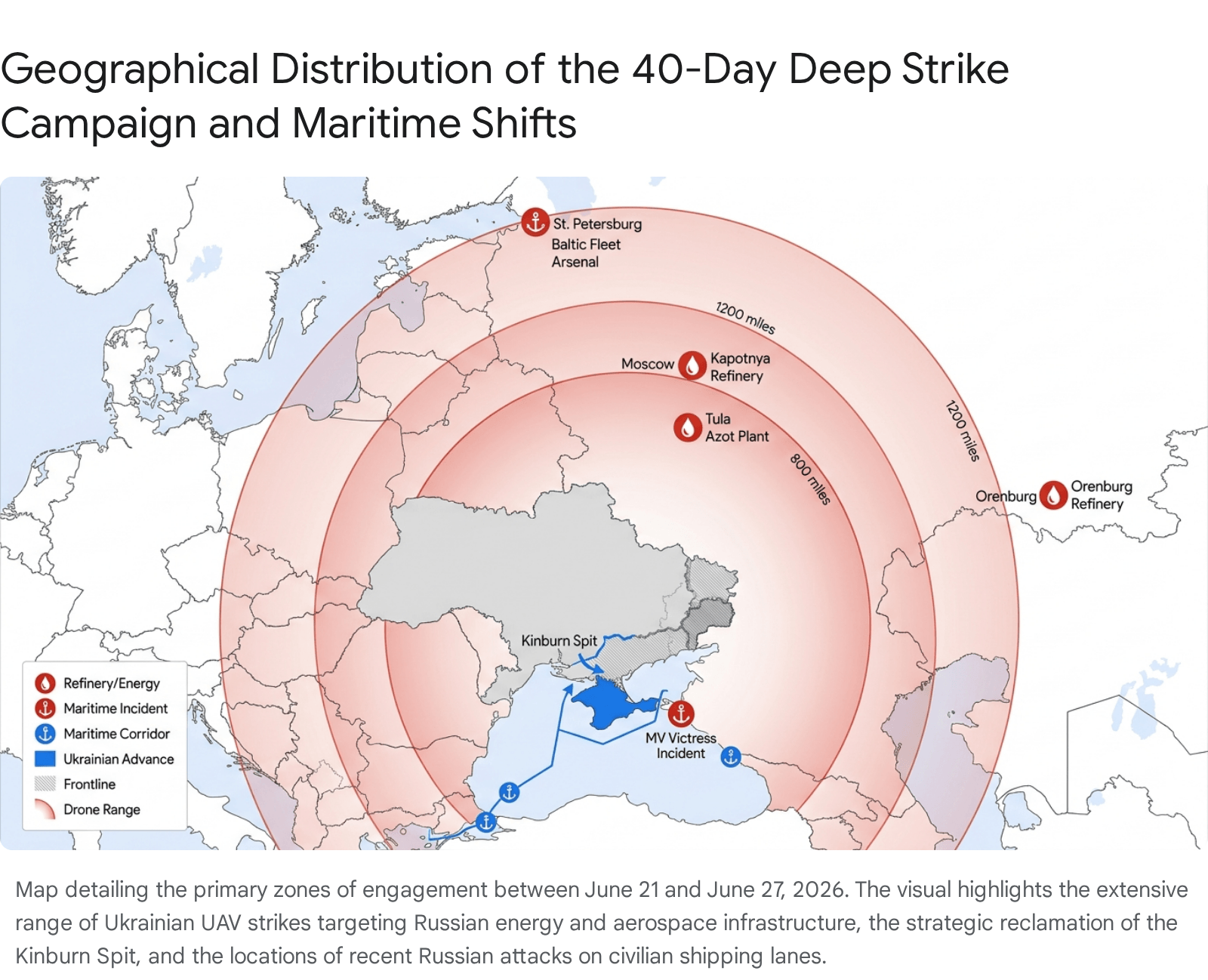
The campaign has successfully targeted critical industrial capacity deep within the Russian Federation. Battle Damage Assessments (BDA) confirmed that a previous Ukrainian strike on the Kapotnya Oil Refinery in Moscow City forced the facility to entirely halt operations until the end of 2026, requiring a minimum of six months for intensive engineering repairs.2 Overnight on June 23 to 24, Ukrainian forces conducted a long-range strike hitting the Orenburg Gas Processing Plant and Helium Plant—located over 1,200 kilometers from the frontline. These facilities account for 60 percent of Gazprom Pererabotka’s total gas processing capacity and produce materials with direct military applications.2 Additionally, the Azot chemical plant in Novomoskovsk, located in the Tula region, which serves as one of Russia’s largest producers of ammonia, nitrogen fertilizers, and explosive components, was struck by a large-scale drone swarm on June 25 to 26, resulting in significant structural fires and localized power outages.17
Ukrainian forces have also actively degraded Russian long-range command, control, and space capabilities. Strikes hit the Vladimir Space Communications Center in Vladimir Oblast and the Dubna Space Communications Center in Moscow Oblast, severely damaging the hardware-module complex of the 32-meter MARK-IV antenna and administrative buildings essential for satellite communications.2 Concurrently, strikes against the Baltic Fleet arsenal near St. Petersburg in Leningrad Oblast successfully destroyed an estimated 6,000 tons of stored ammunition.2
The occupied Crimean Peninsula remains a primary focal point of the 40-day operation. Sustained drone and missile strikes have effectively blacked out Sevastopol, crippled the regional power grid, and severely restricted the peninsula’s water supply, prompting widespread civilian exodus.14 The resulting gasoline shortages have led to a complete ban on civilian fuel sales, forcing occupation authorities to declare a state of emergency and reduce civilian railway traffic over the Kerch Bridge.9 Military targets in Crimea were systematically degraded: the SBU successfully struck the Volga and Vyatka Project 15310 cable ships at the Zatoka shipyard, the Petropavlovsk cargo ferry, an S-400 radar station near Kerch, multiple early-warning radar arrays (including ST-68U and Imbir systems) in Dzhankoi and Armyansk, as well as the NS-2 electrical substation in Mykolaivka.14 To defend against this onslaught, Russian forces have been compelled to relocate vital air defense systems from interior Russian regions to Moscow and the Kerch Bridge, thinning their overall national defensive umbrella.2
In an apparent retaliatory effort to reimpose a de facto maritime blockade and disrupt the Ukrainian maritime corridor, Russian forces resumed strikes on civilian shipping in the Black Sea. Overnight on June 22, Russian drones targeted three foreign-flagged civilian cargo ships, heavily damaging the Turkish-owned, Panamanian-flagged bulk carrier MV Victress and resulting in the death of an Egyptian crew member.20 This follows similar attacks on Barbados and Panama-flagged vessels earlier in the month, underscoring the severe hybrid risks to the emerging Middle Corridor trade routes and global food security.22 Since the resumption of civilian shipping from Odesa following the expiration of the 2022 Black Sea grain deal, Russia has routinely targeted large vessels carrying Ukrainian exports, transforming the region into a highly contested hybrid warfare laboratory.20 Over 7,800 ships have managed to pass through the corridor despite these intense strikes.21
The Role of Third-Party Countries and Actors
The geopolitical alignment surrounding the conflict continues to solidify into distinct and formalized blocs, with both Ukraine and Russia drawing heavily on external support to sustain their respective war efforts. The transatlantic alliance is currently undergoing a structural transition in its support mechanisms. During the E5 Leaders meeting on June 24, European powers committed to assuming a greater role in conventional deterrence across the continent.24 This strategic shift is catalyzed by a classified Pentagon briefing indicating a significant drawdown of American military assets in Europe—including the withdrawal of approximately 5,000 troops and the cancellation of an armored brigade rotation to Poland—as Washington reorients its focus toward the Indo-Pacific theater.25
In response to these shifting dynamics, NATO is heavily leveraging the Prioritized Ukraine Requirements List (PURL), through which European and Indo-Pacific allies have pledged over $6 billion to purchase US defense equipment directly for Ukraine, ensuring the sustainment of warfighting efforts despite domestic political fluctuations in Washington.50 Concurrently, the European Union reaffirmed its economic commitment at the Ukraine Recovery Conference in Gdańsk, announcing the disbursement of a €3.2 billion macro-financial assistance tranche—the first installment of a massive €90 billion Ukraine Support Loan designated for 2026-2027.51 The EU has also authorized the imminent disbursement of a €6 billion defense package specifically tailored for drone procurement.51 The EU also formally opened accession negotiations with Ukraine and extended comprehensive economic sanctions against the Russian Federation for an additional year.26
| Financial / Military Aid Mechanism | Contributing Body | Total Commitment | Strategic Purpose |
| Prioritized Ukraine Requirements List (PURL) | NATO Allies & Indo-Pacific Partners | $6.0 Billion+ | Coordinated purchase of critical US defense equipment, offsetting individual national stock depletion. |
| Ukraine Support Loan (MFA) | European Union | €90 Billion (2026-2027) | Sustained macroeconomic budget support and defense-related procurement over a multi-year horizon. |
| Ukraine Facility | European Union | €50 Billion (until 2027) | Support for national recovery, reconstruction, modernization, and EU accession reform efforts. |
| G7 Loan Framework | G7 Nations & EU | $50 Billion | Leveraging extraordinary revenues from immobilized Russian sovereign assets for budgetary and military needs. |
The territory of Belarus remains a critical friction point. Following an ultimatum issued by President Zelensky warning that Ukraine would kinetically strike Russian-installed signal repeaters along the border if they were not disabled by June 26, the repeaters ceased operations on June 22.2 These repeaters had previously enabled Russian forces to pilot guided munitions deep into western Ukraine. Despite this tactical de-escalation, the Kremlin is applying intense pressure on Belarusian President Alexander Lukashenko to integrate more fully into the war effort, demanding permission to launch drones directly from Belarusian soil and threatening to withdraw critical financial support.2 Meanwhile, Belarus has quietly increased its sales of domestically produced gasoline to Russia by more than fifty-fold year-over-year to offset Russian refinery losses.28
Intelligence confirms the deep integration of the “Axis of Aggressors,” comprising China, Iran, North Korea, and Russia.52 The European Union has obtained conclusive evidence that the People’s Republic of China actively trained hundreds of Russian military personnel on Chinese territory prior to their deployment in Ukraine, particularly for operations involving advanced drone technologies in Crimea and Zaporizhia.29 Furthermore, Chinese components now constitute 65% of the foreign electronics found in Russian Shahed-type strike UAVs.29 North Korea continues to provide massive logistical and munitions support, accounting for up to half of all artillery shells used by Russia in late 2025.31 Symbolizing this deepening alliance, Russia and North Korea inaugurated a new road bridge over the Tumen River on June 19, significantly expanding cross-border logistical capacity.32
3. Drone Warfare and Unmanned Systems
The conflict has definitively transitioned into an era where unmanned systems dictate both tactical engagements and strategic attrition. The period from June 21 to June 27 witnessed the massive deployment of specialized UAVs, marked by a deliberate shift toward low-cost decoy tactics and deep-penetration strikes designed to evade traditional air defense architecture.
Tactical & Strategic Deployments
Ukraine has fully operationalized long-range unmanned systems capable of striking well beyond traditional theater boundaries. Central to this capability is the deployment of platforms such as the domestically produced “Fire Point” drone, a miniature jet-powered system with an operational range of 800 to 1,200 miles.33 These platforms have been the vanguard of the 40-day strike campaign, successfully bypassing traditional air defense networks to target energy infrastructure in Siberia and the greater Moscow area.33 Unmanned Systems Forces now account for striking approximately 25% of all frontline targets, indicating a complete doctrinal integration of these assets into daily combat operations.34
The Russian Aerospace Forces (VKS) executed several massive overnight drone barrages, leveraging sheer volume and a diverse mix of platforms to saturate Ukrainian air defenses. A strike on the night of June 23 to 24 utilized 101 UAVs (of which 95 were intercepted), while a subsequent attack on June 26 to 27 launched 129 drones (of which 113 were intercepted).2 These swarms consist of a meticulously calculated mix of the traditional Shahed/Geran series, the newly introduced Gerbera and Italmas platforms, and specialized “Parodiya” decoy drones.35
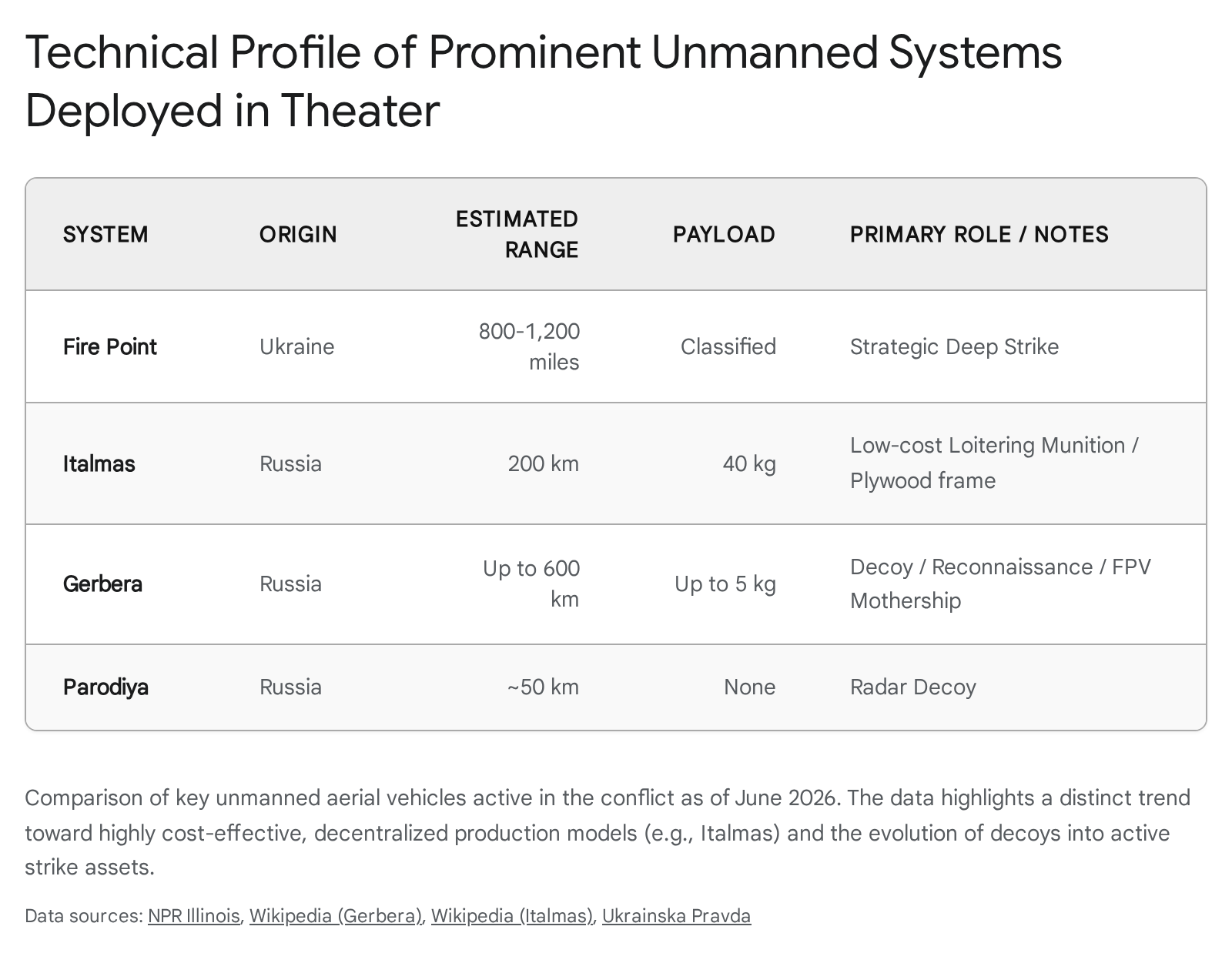
The proliferation of the Gerbera and Italmas platforms represents a significant shift toward hyper-economical warfare. Initially introduced in July 2024 as a cheap decoy designed to visually mimic the Shahed-136, the “Gerbera” drone has rapidly evolved.39 With a flight ceiling of 3,000 meters and a range of up to 600 kilometers, recent variants have been found carrying a 5-kilogram explosive payload, transitioning from a mere decoy to an active reconnaissance and strike asset.39 Similarly, the “Italmas” (or Geran-3) drone represents the extreme end of cost-efficiency. Constructed with a plywood fuselage, an off-the-shelf DLE-60 twin boxer piston engine, and utilizing a simple plastic bottle as a fuel tank, the Italmas boasts a 200-kilometer range and a devastating 40-kilogram warhead.40 Its rudimentary design allows for rapid assembly at decentralized aeromodelling clubs across Russia, compounding the air defense challenge by massively increasing volume.40 In tandem with these systems, Russia has escalated the production and use of the “Parodiya” decoy drone, a purpose-built radar decoy featuring a distinct ring wing design and a range of up to 50 kilometers, strictly designed to exhaust interceptor munitions without carrying any combat payload.53
Targeting Priorities
The Ukrainian targeting matrix is exclusively focused on the systematic degradation of Russia’s ability to wage war and project power. Primary targets include oil refineries, gas processing plants, chemical facilities producing explosive components, railway bridges (specifically those connecting Kherson and Crimea over the North Crimean Canal), early-warning radar installations, and space communication centers.2 The overarching objective is to starve the Russian frontline of fuel, disrupt command and control, isolate the Crimean Peninsula, and bring the tangible costs of the war directly to the Russian populace and political elite.16
Conversely, Russian targeting has increasingly focused on civilian infrastructure, localized logistics, and psychological terror. During the reporting period, Russian “Gerbera” drones specifically targeted up to five civilian gas stations in the Chernihiv and Sumy oblasts, attempting to instigate regional fuel shortages and disrupt the “last mile” logistics of the Ukrainian military.14 Former Ukrainian Minister of Infrastructure Andriy Pyvovarsky noted that Russian forces have struck over 150 gas stations in Ukraine in the past two months.14 Additionally, the sheer volume of the mixed drone swarms is a deliberate tactic intended to economically exhaust Ukrainian air defense interceptor stockpiles, forcing the expenditure of multimillion-dollar missiles on plywood decoys.18
Countermeasures & Tech Shifts
A highly concerning tactical evolution observed this week is the use of Russian “Gerbera” UAVs as aerial “motherships.” Ukrainian intelligence confirmed that Gerbera drones are now transporting and dropping FPV drones equipped with warheads deep inside Ukrainian territory—often more than 30 kilometers from the border.43 This novel tactic effectively bypasses the dense frontline electronic warfare (EW) jamming networks, allowing localized FPV strikes in areas previously considered secure from short-range tactical drones.43 Additionally, Russian forces have begun equipping Shahed drone variants with double warheads containing cluster munitions, enabling the remote mining of areas during the drone’s terminal flight phase.41
To counter the unsustainable economic cost of using sophisticated surface-to-air missiles (SAMs) against cheap decoys, Ukraine is rapidly scaling the production of specialized interceptor UAVs. These interceptor drones cost approximately $5,000 per unit, and systems like the “General Chereshnya AIR” have proven highly effective at engaging and destroying Gerbera and Italmas drones mid-air.39 This technological shift is crucial for realigning the cost-exchange ratio of the air war in Ukraine’s favor. Furthermore, the Ukrainian Ministry of Defense’s Defence Procurement Agency (DOT) has transitioned to highly competitive, tender-based procurement procedures for FPV and deep-strike drones, maximizing output while reducing costs.44
4. Resource Utilization, Constraints, and Sustainability Projection
The trajectory of the war is increasingly dictated by the industrial capacity of the belligerents and their ability to sustain staggering material consumption rates. Both nations are experiencing severe logistical bottlenecks, forcing radical adaptations in resource procurement, personnel management, and domestic economic policy.
Resource Utilization and Manpower Dynamics
The artillery duel remains the defining feature of frontline ground combat, heavily favoring the Russian Federation in sheer volume. Russia has successfully scaled its defense industrial base to sustain immense throughput, producing an estimated 7 million artillery, mortar, tank, and rocket rounds in 2025 (including 3.4 million howitzer shells and 2.3 million mortar rounds), representing a seventeenfold increase since the invasion began.31 This domestic production is heavily augmented by imports; North Korean munitions accounted for up to 50% of all shells fired by Russia in the latter half of 2025, costing Moscow approximately €10.6 billion.31 The unit economics heavily favor Russia, with a legacy 152mm shell costing less than 100,000 rubles (roughly €1,050)—a fraction of the cost of Western 155mm equivalents.31
| Munition Type | 2025 Estimated Russian Production | Notes on Origin and Economics |
| 152mm / 122mm Howitzer | 3.4 million rounds | Domestic DIB scaling. Unit cost < €1,050. |
| 120mm / 240mm Mortar | 2.3 million rounds | Represents significant close-range barrage capability. |
| Tank & IFV Rounds | 0.8 million rounds | Sustains localized mechanized infiltration operations. |
| MLRS Rockets | 0.5 million rounds | Represents sustained bombardment capabilities on fixed positions. |
| Imported Munitions (North Korea) | 5 – 7 million rounds (since 2023) | Constitutes ~50% of frontline usage in late 2025. Total cost €10.6 billion. |
In response to this overwhelming volume, the Ukrainian Defence Procurement Agency (DOT) completed its largest-ever procurement of 155mm long-range artillery rounds this week. By instituting a highly competitive bidding process among six suppliers, Ukraine secured a 16% reduction in costs, saving billions of hryvnias and ensuring a stable supply pipeline through the remainder of 2026.44
However, technology and ammunition are secondary to the human element. Recognizing the unsustainability of indefinite combat deployments and widespread draft evasion, the Ukrainian Ministry of Defense unveiled sweeping manpower reforms on June 12, aimed at stabilizing troop rotation dynamics.46 The new framework introduces high-paying, fixed-term contracts designed to establish “clear and understandable rules of the game” for recruits, replacing the demoralizing prospect of open-ended service.46 This shift is critical; as noted by Ukrainian officials, potential troops observe neighbors serving continuously since 2022 and view mobilization as a one-way ticket, fueling desertion and Absence Without Leave (AWOL) rates.46 A failure to adequately mobilize and rotate exhausted frontline units poses a greater existential threat to Ukrainian defensive lines than localized Russian mechanized assaults.
Logistical Constraints and the Russian Fuel Crisis
The most severe logistical constraint observed during the reporting period is the acute, cascading fuel crisis currently gripping the Russian Federation—a direct consequence of Ukraine’s methodical 40-day deep-strike campaign against energy infrastructure. Sustained strikes on critical nodes such as the Kapotnya and TANECO refineries have caused a precipitous drop in Russian fuel output. Data indicates that Russian gasoline production has fallen 15% since June 2025 and 9% since May 2026.3 As a result, catastrophic shortages have materialized across the country. Fuel restrictions and rationing are now in effect in more than 53 Russian regions.48 At filling stations owned by Gazprom Neft and Lukoil, strict limits have been imposed (e.g., a maximum of 40 liters of gasoline per customer), and the filling of portable containers has been explicitly banned in regions including Belgorod, Kursk, Tyumen, and Novosibirsk to prevent panic buying.48
The macroeconomic contagion resulting from this deficit is profound. The operational fuel deficit currently stands at approximately 25,000 tons per day (with operational refineries producing 85,000 tons against a summer demand of 110,000 tons).49 The inflationary ripple effects of this shortage are severe. Increased production and transportation costs have driven Russia’s total annual inflation rate up from 5.3% to 5.8% in June 2026.3 This inflationary pressure directly threatens the Russian Central Bank’s core mandate. Having progressively lowered the key interest rate from 21% to 14.25% to subsidize capital availability for the defense industrial base, Central Bank Governor Elvira Nabiullina acknowledged on June 19 that the spike in gasoline prices may force a reversal of this expansionary monetary policy, thereby constraining the very financial mechanisms funding the war effort.3
Efforts to alleviate the crisis via emergency imports highlight the deep fragility of the regional energy matrix. While Russia requested 50,000 tons of fuel from Kazakhstan (following a previous 100,000-ton request in 2024), this avenue presents a circular paradox: the Kazakh Kondensat refinery relies almost entirely on condensate feedstock processed through the damaged Russian TANECO facility, effectively neutralizing the import avenue through a crippled supply chain.48 Similarly, imports from Belarus (estimated at 3,000 to 5,000 tons per day) are vastly insufficient to close the 25,000-ton daily deficit.49 As a result, India has emerged as a key supplier for Russia; having become the largest buyer of seaborne Russian oil, Indian refineries exported a record 400,000 barrels per day of gasoline and diesel back out in the past year, partially cycling back to meet the Russian deficit.49
Sustainability Projection
Based on the current utilization rates and emerging constraints, the short-to-medium term sustainability of both forces presents a complex, interlocking asymmetry:
The Russian military will almost certainly maintain its superiority in raw artillery volume and mechanized assault frequency along the Eastern front through the remainder of 2026, insulated by deep Soviet-era reserves, maximized DIB output, and reliable North Korean and Chinese imports.29 However, the domestic fuel crisis represents a critical, compounding vulnerability. If Ukraine can sustain the operational tempo of its deep-strike campaign, the resulting fuel shortages will begin to systematically degrade frontline Russian logistics—delaying ammunition deliveries to artillery parks, restricting armored maneuverability, and exacerbating runaway inflation. The Kremlin will likely face an inflection point in late 2026 where it must choose between funding massive domestic economic subsidies to prevent civil unrest or continuing to inject cheap capital into the defense sector.3
Conversely, Ukrainian forces are well-positioned to sustain and escalate their asymmetric strike capabilities. The localized production of deep-strike platforms like Fire Point and interceptors like General Chereshnya is highly resilient, decentralized, and economically viable.33 The massive 155mm procurement via the Defence Procurement Agency will stabilize defensive counter-battery fires.44 However, Ukraine’s ability to hold static frontline positions against grinding Russian assaults is entirely contingent upon the successful implementation of the recent fixed-term contract manpower reforms.46 If these social reforms fail to generate sufficient combat-ready reserves by late summer 2026, Ukrainian forces may be compelled to trade further localized territory for time, relying heavily on the strategic degradation of the Russian rear to force an eventual culmination of the Russian offensive.
5. Chronological Timeline of Key Events
- June 21, 2026: The Ukrainian General Staff reports intensified strikes on railway bridges across the North Crimea Canal near Rozdolne and Chonhar, severely disrupting Russian logistics into the occupied peninsula.
- June 22, 2026: Following an ultimatum from Kyiv, Russian-installed signal repeaters along the Belarusian-Ukrainian border cease operations.
- June 22, 2026: Russian forces strike the Dubna Space Communications Center in Moscow Oblast, damaging vital satellite communication infrastructure.
- June 22, 2026 (Overnight): Russian drones attack three foreign-flagged civilian cargo ships in the Black Sea, heavily damaging the MV Victress and killing an Egyptian crew member.
- June 23, 2026: Russian President Vladimir Putin reiterates demands for Ukrainian capitulation (withdrawal from four regions and abandonment of NATO aspirations) as a strict prerequisite for peace talks.
- June 23-24, 2026 (Overnight): Ukraine executes long-range strikes against the Orenburg Gas Processing Plant and Helium Plant. Concurrently, Russia launches 101 strike and decoy drones against Ukraine; 95 are successfully intercepted.
- June 24, 2026: The E5 European leaders release a joint statement committing to assume a greater conventional deterrence role in Europe ahead of the July NATO Ankara Summit.24 Reuters confirms the Kapotnya Oil Refinery in Moscow is halted until the end of 2026 due to previous Ukrainian strikes.
- June 25, 2026: Ukrainian President Volodymyr Zelensky officially announces the authorization of a 40-day intermediate- and long-range strike campaign against Russian strategic economic and military assets.
- June 25, 2026: The European Union initiates the disbursement of a €3.2 billion macro-financial assistance loan to Ukraine at the Gdańsk Recovery Conference.
- June 25-26, 2026 (Overnight): Ukrainian drones successfully strike the Azot chemical plant in Novomoskovsk (Tula region), causing structural fires and power outages. Ukrainian forces officially raise the national flag over the Kinburn Spit following a Russian withdrawal.
- June 26, 2026: Russia and Ukraine conduct a 160-for-160 prisoner of war exchange mediated by the United Arab Emirates.
- June 26-27, 2026 (Overnight): Russia launches a massive swarm of 129 drones (including Shahed, Gerbera, Italmas, and Parodiya variants) at Ukraine. Ukrainian air defenses intercept or neutralize 113.
Please share the link on Facebook, Forums, with colleagues, etc. Your support is much appreciated and if you have any feedback, please email us in**@*********ps.com. If you’d like to request a report or order a reprint, please click here for the corresponding page to open in new tab.
Sources Used
- Russian Offensive Campaign Assessment, June 23, 2026, accessed June 27, 2026, https://understandingwar.org/research/russia-ukraine/russian-offensive-campaign-assessment-june-23-2026/
- Russian Offensive Campaign Assessment, June 24, 2026 | ISW, accessed June 27, 2026, https://understandingwar.org/research/russia-ukraine/russian-offensive-campaign-assessment-june-24-2026/
- Russian Offensive Campaign Assessment, June 25, 2026, accessed June 27, 2026, https://understandingwar.org/research/russia-ukraine/russian-offensive-campaign-assessment-june-25-2026/
- Russia and Ukraine exchange 160 prisoners of war each – Meduza, accessed June 27, 2026, https://meduza.io/amp/en/news/2026/06/26/russia-and-ukraine-exchange-160-prisoners-of-war-each
- Russia and Ukraine exchange prisoners of war in 160-for-160 swap – Armenpress, accessed June 27, 2026, https://armenpress.am/en/article/1254121/amp
- Our people are home: 186 Ukrainians released from russian captivity | MoD News, accessed June 27, 2026, https://mod.gov.ua/en/news/our-people-are-home-186-ukrainians-released-from-russian-captivity
- Russia, Ukraine exchange 160 prisoners of war each in latest swap – Anadolu Ajansı, accessed June 27, 2026, https://www.aa.com.tr/en/russia-ukraine-war/russia-ukraine-exchange-160-prisoners-of-war-each-in-latest-swap/3978881
- SSU releases exclusive footage of prisoner exchange – Ukrinform, accessed June 27, 2026, https://www.ukrinform.net/rubric-society/4138056-ssu-releases-exclusive-footage-of-prisoner-exchange.html
- Timeline of the Russo-Ukrainian war (1 June 2026 – present) – Wikipedia, accessed June 27, 2026, https://en.wikipedia.org/wiki/Timeline_of_the_Russo-Ukrainian_war_(1_June_2026_%E2%80%93_present)
- Ukraine Raises Flag on Kinburn Spit, a Key Black Sea Strategic Point After Russian Withdrawal – Kyiv Post, accessed June 27, 2026, https://www.kyivpost.com/post/78968
- Defenders raise Ukrainian flag on Kinburn Spit as Russians retreat – video, accessed June 27, 2026, https://www.pravda.com.ua/eng/news/2026/06/25/8041052/
- Ukraine war latest: Ukrainian troops raise flag on Russian-held Kinburn Spit, military says, accessed June 27, 2026, https://kyivindependent.com/ukraine-war-latest-ukrainian-troops-raise-flag-on-kinburn-spit-in-mykolaiv-oblast-held-by-russian-forces-since-2022-military-says/
- Navy Spokesperson details Kinburn Spit situation after flag video emerges, accessed June 27, 2026, https://english.nv.ua/russian-war/navy-spokesperson-explains-partial-russian-retreat-from-kinburn-spit-50619509.html
- Russian Offensive Campaign Assessment, June 26, 2026 | ISW, accessed June 27, 2026, https://understandingwar.org/research/russia-ukraine/russian-offensive-campaign-assessment-june-26-2026/
- The Russia-Ukraine War Report Card, June 24, 2026, accessed June 27, 2026, https://www.russiamatters.org/news/russia-ukraine-war-report-card/russia-ukraine-war-report-card-june-24-2026
- Ukraine war briefing: Zelenskyy declares 40-day Russia blitz to ‘influence the aggressor state’, accessed June 27, 2026, https://www.theguardian.com/world/2026/jun/26/ukraine-war-briefing-zelenskyy-40-day-russia-blitz
- Drones Strike Azot Chemical Plant in Novomoskovsk, accessed June 27, 2026, https://militarnyi.com/en/news/drones-strike-azot-chemical-plant-in-novomoskovsk/
- Ukraine launches huge drone attack on Russia and occupied Crimea as it seeks to force Putin “to end the war” – CBS News, accessed June 27, 2026, https://www.cbsnews.com/news/ukraine-russia-war-drone-attack-crimea-kerch-zelenskyy-force-putin-end-war/
- Russia downs 660 Ukrainian drones in one night, says Moscow; chemical plant hit in one of war’s biggest aerial assaults, accessed June 27, 2026, https://indianexpress.com/article/world/russia-reports-the-biggest-ukrainian-drone-attacks-on-its-soil-10758548/
- Russia attacks foreign cargo ships in Black Sea, killing Egyptian sailor, accessed June 27, 2026, https://kyivindependent.com/russia-attacks-foreign-cargo-ships-in-black-sea-killing-egyptian-sailor/
- Over 7800 Ships Pass Through Ukraine’s Black Sea Grain Corridor Despite Intense Russian Strikes – UNITED24 Media, accessed June 27, 2026, https://united24media.com/war-in-ukraine/over-7800-ships-pass-through-ukraines-black-sea-grain-corridor-despite-intense-russian-strikes-20114
- The Black Sea in 2026: From Contested Waters to Strategic Opportunity – A Policy Framework for NATO and the EU | Atlas Institute for International Affairs, accessed June 27, 2026, https://atlasinstitute.org/the-black-sea-in-2026-from-contested-waters-to-strategic-opportunity-a-policy-framework-for-nato-and-the-eu/
- Will Russia Be Able to Block the Black Sea Again? :: Intent, accessed June 27, 2026, https://intent.press/en/blog/2026/will-russia-be-able-to-block-the-black-sea-again/
- E5 Leaders’ Statement: 24 June 2026, accessed June 27, 2026, https://www.gov.uk/government/news/e5-leaders-statement-24-june-2026
- Hollowing Out the Shield: US Strategic Defence Equipment Reductions and the Implications for European Security – GLOBSEC, accessed June 27, 2026, https://www.globsec.org/what-we-do/commentaries/hollowing-out-shield-us-strategic-defence-equipment-reductions-and
- EU Assistance to Ukraine (in U.S. Dollars) – EEAS – European Union, accessed June 27, 2026, https://www.eeas.europa.eu/delegations/united-states-america/eu-assistance-ukraine-us-dollars_en?s=253
- Russia’s war of aggression against Ukraine: Council extends economic sanctions for another year, accessed June 27, 2026, https://www.consilium.europa.eu/en/press/press-releases/2026/06/25/russia-s-war-of-aggression-against-ukraine-council-extends-economic-sanctions-for-another-year/
- Belarus is quietly preparing to play a larger role in Russia’s Ukraine war, accessed June 27, 2026, https://www.atlanticcouncil.org/blogs/ukrainealert/belarus-is-quietly-preparing-to-play-a-larger-role-in-russias-ukraine-war/
- EU Officials Confirm Training of Russian Military Personnel in China, accessed June 27, 2026, https://militarnyi.com/en/news/eu-confirm-training-russian-military-china/
- EU finds evidence of China training Russian soldiers who later fought against Ukraine, accessed June 27, 2026, https://www.eurointegration.com.ua/eng/news/2026/06/12/7239576/
- Russia ramps up shell production in preparation for next war – Estonian intelligence, accessed June 27, 2026, https://www.pravda.com.ua/eng/news/2026/02/11/8020424/
- Korean Peninsula Update, June 16, 2026 | ISW, accessed June 27, 2026, https://understandingwar.org/research/china-taiwan/korean-peninsula-update-june-16-2026/
- Inside a secretive Ukrainian team launching deep drone strikes at Russia – NPR Illinois, accessed June 27, 2026, https://www.nprillinois.org/2026-06-27/inside-a-secretive-ukrainian-team-launching-deep-drone-strikes-at-russia
- Fedorov Urges Allies to Scale Up Air Defense, Drone and Artillery Support – Kyiv Post, accessed June 27, 2026, https://www.kyivpost.com/post/78900
- Ukraine’s air defenses down 113 out of 129 Russian drones in overnight attack, accessed June 27, 2026, https://www.ukrinform.net/rubric-ato/4138177-ukraines-air-defenses-down-113-out-of-129-russian-drones-in-overnight-attack.html
- Modified Russian Jet Drones Target Sumy Residential Areas, Leaving 11 Injured, accessed June 27, 2026, https://www.kyivpost.com/post/79113
- Russia launches 196 drones and missiles at Ukraine, with 177 neutralized – Air Force, accessed June 27, 2026, https://hromadske.ua/en/war/266561-okupanty-zapustyly-po-ukrayini-196-povitrianykh-tsiley-skilky-zbyly-ta-iaki-naslidky
- Overnight drone attack from seven directions: Ukraine’s air defenses repel most Russian targets, accessed June 27, 2026, https://newsukraine.rbc.ua/news/overnight-drone-attack-from-seven-directions-1782545629.html
- Gerbera (drone) – Wikipedia, accessed June 27, 2026, https://en.wikipedia.org/wiki/Gerbera_(drone)
- Italmas – Wikipedia, accessed June 27, 2026, https://en.wikipedia.org/wiki/Italmas
- Russian Offensive Campaign Assessment, June 21, 2026 | ISW, accessed June 27, 2026, https://understandingwar.org/research/russia-ukraine/russian-offensive-campaign-assessment-june-21-2026/
- ‘Morale bombing’ Moscow is not justified, accessed June 27, 2026, https://www.theguardian.com/world/2026/jun/25/morale-bombing-moscow-is-not-justified
- Russian Gerbera UAVs drop FPV drones carrying warheads dozens of kilometres from border | Ukrainska Pravda, accessed June 27, 2026, https://www.pravda.com.ua/eng/news/2026/05/07/8033569/
- Ukraine completes largest artillery ammunition procurement to expand long-range fire capability – Defence Industry Europe, accessed June 27, 2026, https://defence-industry.eu/ukraine-completes-largest-artillery-ammunition-procurement-to-expand-long-range-fire-capability/
- largest procurement of long-range artillery rounds completed | MoD News, accessed June 27, 2026, https://mod.gov.ua/en/news/expanding-artillery-range-largest-procurement-of-long-range-artillery-rounds-completed
- Analysis: Ukraine unveils reforms to address manpower shortage …, accessed June 27, 2026, https://www.longwarjournal.org/archives/2026/06/analysis-ukraine-unveils-reforms-to-address-manpower-shortage.php
- Mobilizing Ukraine for a long war – New Eastern Europe, accessed June 27, 2026, https://neweasterneurope.eu/2026/06/08/mobilizing-ukraine-for-a-long-war/
- Russia seeks to buy gasoline from Kazakhstan amid fuel crisis – RBC-Ukraine, accessed June 27, 2026, https://newsukraine.rbc.ua/news/russia-seeks-50-000-tonnes-of-gasoline-from-1782328190.html
- Fuel Crisis Forces Russia to Seek Gasoline Imports from India – Caspian News, accessed June 27, 2026, https://caspiannews.com/news-detail/fuel-crisis-forces-russia-to-seek-gasoline-imports-from-india-2026-6-24-40/
- NATO’s support for Ukraine | NATO Topic, accessed June 27, 2026, https://www.nato.int/en/what-we-do/partnerships-and-cooperation/natos-support-for-ukraine
- Ukraine Recovery Conference: EU Commission starts disbursment of Ukraine Support Loan, accessed June 27, 2026, https://ieu-monitoring.com/editorial/ukraine-recovery-conference-eu-commission-starts-disbursment-of-ukraine-support-loan/1244086?utm_source=ieu-portal
- Axis of Aggressors, accessed June 27, 2026, https://www.fdd.org/analysis/2026/06/26/axis-of-aggressors/
- Russia uses Parodiya decoy drones again during attack on Kyiv Oblast – photos, accessed June 27, 2026, https://www.pravda.com.ua/eng/news/2026/05/03/8032918/
- Russia’s Fuel Crisis and Kazakhstan’s Gasoline Imports Explained 2026 – Discovery Alert, accessed June 27, 2026, https://discoveryalert.com.au/russia-fuel-crisis-kazakhstan-gasoline-imports-2026/