Executive Summary
The modern landscape of high-capacity, single-action-only defensive and competition handguns has been indelibly shaped by the evolution of the double-stack 1911, colloquially known within the industry as the “2011” platform. Originally conceptualized and patented in 1994 by Virgil Tripp and Sandy Strayer, the 2011 architecture revolutionized practical shooting by hybridizing a modular polymer grip frame with a heavy steel or aluminum upper assembly, thereby retaining the revered 1911 trigger dynamics while drastically increasing ammunition capacity. Following the expiration of these foundational patents, the market has witnessed a surge in manufacturing, with legacy custom builders facing newly emergent competitors. Into this highly saturated and immensely competitive arena enters the Bersa M2XI, a platform that represents a pivotal geographic and operational shift for its manufacturer. While Bersa has historically been recognized for producing budget-oriented, compact concealed carry sidearms in Argentina, the M2XI is an American-made endeavor, meticulously machined and assembled at the company’s manufacturing facility in Cartersville, Georgia.1
The M2XI targets a specific, rapidly expanding crossover demographic within the firearms community: the median enthusiast who desires the elite mechanical performance and rapid cycling capabilities of a custom-fit race gun, but who is unwilling or unable to justify the prohibitive entry costs typically associated with premium legacy builders. By positioning the M2XI with a Manufacturer’s Suggested Retail Price (MSRP) of $1,479, Bersa seeks to aggressively undercut established high-tier models while offering a feature density that typically demands premium aftermarket intervention.1
The primary configurations of the M2XI are structurally identical but differentiated stylistically and metallurgically by their exterior finishes. Consumers are offered a choice between a traditional matte brushed 416 stainless steel finish, which provides a classic aesthetic, or a QPQ (Quench Polish Quench) Tenifer black nitride coating applied over the stainless substrate, which drastically enhances surface hardness, lubricity, and long-term corrosion resistance in harsh operational environments.3 Regardless of the finish tier, the standard package is impressively comprehensive. The M2XI is built around a full-size, 5-inch ultra-match grade bull barrel that eschews the traditional 1911 barrel bushing in favor of a direct slide-to-barrel lockup mechanism.1 The lower assembly features an injection-molded polymer grip module engineered with aggressive texturing, an extended beavertail grip safety with a pronounced memory bump, an integrated Picatinny accessory rail on the dustcover, and an aluminum flared magazine well designed to facilitate high-speed reloads under stress.1 Rather than arriving in a standard plastic hard case, the M2XI ships in a premium Mission First Tactical (MFT) Two Pistol Carrier range bag made from 600 Denier ballistic nylon.1
The general consensus regarding the platform’s performance—synthesized from rigorous technical evaluations, high-round-count operator feedback, and competitive shooter analysis—paints a picture of a firearm that dramatically exceeds its price point in terms of raw mechanical accuracy, ergonomic balance, and trigger quality.1 The single-action trigger is routinely cited as a masterclass in factory tuning, exhibiting an exceptionally light and crisp break that provides a remarkably high ceiling for precision and speed. The blending of the polymer grip with the heavyweight stainless steel upper assembly creates a center of gravity that significantly mitigates muzzle flip, resulting in a flat-tracking recoil impulse that allows the shooter’s sights to return to the target effortlessly.1
However, this high performance is not without stringent caveats. The M2XI behaves much like the finely tuned custom race guns it emulates, which means it inherently lacks the loose-tolerance reliability characteristic of mass-produced, polymer-framed duty weapons. The platform demands rigorous and specific maintenance protocols, including an absolute adherence to a 500-round break-in period utilizing specific ammunition types.7 Furthermore, the platform possesses a well-documented sensitivity to specific projectile profiles, particularly wide-cavity hollow points and sharply truncated flat-nose rounds, which can disrupt the delicate feeding geometry of the 2011 platform.5 Consequently, while the M2XI offers unparalleled value and mechanical precision for the discerning shooter, it requires a dedicated, knowledgeable operator willing to navigate its specific logistical and maintenance requirements.
Reliability and Accuracy
Mechanical Accuracy and Ballistic Performance
The mechanical accuracy of the Bersa M2XI is its most defining and lauded characteristic, routinely producing ballistic results that rival bespoke, custom-built firearms costing two to three times its retail price. The architectural foundation of this exceptional precision is deeply rooted in the implementation of a 5-inch, precision-machined, ultra-match stainless steel bull barrel.3 In a traditional 1911 design, the muzzle end of the barrel is supported and centered within the slide by a separate, removable barrel bushing. While effective, the introduction of a tertiary component inherently introduces the potential for microscopic tolerance stacking and mechanical variance. The M2XI circumvents this by utilizing a heavy-profile bull barrel with an inverted target crown that locks directly against the interior contour of the slide.1 This bushingless design forces the barrel into an incredibly tight, highly repeatable lockup consistency during the battery phase. When the slide travels forward, the barrel hood, the locking lugs, and the flared muzzle uniformly mate with the slide’s internal geometry, minimizing any lateral or vertical variance that could negatively impact projectile trajectory.
Coupled with a 1:10-inch right-hand twist rate utilizing six grooves, the barrel is mathematically optimized to stabilize the wide array of 9mm Luger projectiles prevalent in the commercial market.1 The 1:10 twist rate is considered the modern industry standard for the 9x19mm cartridge, providing adequate gyroscopic stability for lighter, high-velocity 115-grain projectiles, standard 124-grain duty loads, and subsonic, heavy-for-caliber 147-grain options. Formal, controlled performance testing utilizing a stable bench rest and a Garmin Xero C1 Pro chronograph has demonstrated the M2XI’s profound capability.1 The pistol is capable of producing individual five-shot groups as tight as 1.28 inches at a distance of 25 yards when paired with high-quality practice ammunition, such as the Fiocchi USA Training Dynamics full-metal jacket.1 This degree of precision translates to a firearm that is mechanically more accurate than the vast majority of shooters attempting to operate it.
This elite degree of mechanical precision is heavily facilitated and made accessible to the shooter by the M2XI’s trigger mechanism. In single-action-only platforms, the trigger dynamics are paramount. The M2XI features a competition-tuned, skeletonized flat-faced aluminum trigger shoe.1 The flat face ensures that regardless of where the shooter’s finger is placed on the vertical plane of the trigger, the rearward pressure is applied linearly directly to the sear mechanism. The factory tuning of this firing control group exhibits virtually zero pre-travel grit, a clearly defined, rigid wall, and an incredibly delicate break. Empirical testing via a Lyman digital trigger gauge has recorded the trigger pull weight at an astonishingly low 1 pound, 11 ounces.1
To provide context within the industry, standard duty triggers on striker-fired handguns generally range from 5.5 to 7 pounds. Custom 1911/2011 pistols designed for tactical or duty use typically exhibit a 3.5 to 4.5-pound pull to provide a margin of safety under acute physiological stress.1 At under two pounds, the M2XI’s trigger is squarely in the domain of dedicated, open-class competition race guns. While this extremely light pull maximizes the shooter’s ability to maintain perfect sight alignment through the trigger press without disturbing the muzzle, it requires rigorous and uncompromising trigger discipline from the operator. The inclusion of a small, adjustable over-travel screw set into the face of the trigger shoe allows the user to entirely eliminate any post-break rearward movement, ensuring the shortest possible reset distance for highly rapid, accurate follow-up shots.
Long-Term Reliability, Tolerances, and Ammunition Sensitivities
While the mechanical accuracy of the M2XI is objectively exemplary, assessing the long-term reliability of the platform requires a highly nuanced understanding of its manufacturing tolerances and the inherent physics of the double-stack 1911 magazine geometry. Because the pistol is hand-lapped and assembled with exceptionally tight frame-to-slide clearances at the Cartersville facility, it cannot be treated as a drop-in-the-mud utility weapon.6 It is a precision instrument, and its reliability is inextricably linked to the operator’s adherence to proper maintenance and ammunition selection.
The manufacturer is highly explicit regarding the platform’s initial operational phase. The official technical documentation states unequivocally that the M2XI necessitates a dedicated, rigorous break-in period consisting of 400 to 500 rounds of high-quality full metal jacket (FMJ) ammunition.7 During this crucial phase, the microscopic burrs and machining marks on the stainless steel rails are mechanically polished away through the friction of cycling, allowing the moving parts to “marry” and establish an optimized friction coefficient. Users frequently note that out of the box, the stainless-on-stainless slide can feel stiff, but the application of proper viscosity lubrication immediately resolves this tight factory fit.9 Firing the weapon dry, or neglecting to clean and lubricate it during this period, will almost certainly result in sluggish slide velocities, frustrating failures to return to battery, and potential permanent galling of the stainless steel components. The manual specifically mandates cleaning and lubricating the firearm every 100 rounds during this initial 500-round block.7
Furthermore, the feed ramp geometry and barrel chambering present specific, documented ammunition sensitivities. The transition of 9mm cartridges from a staggered double column in the magazine into a single-feed position at the feed lips involves complex geometry that is highly sensitive to the overall length (OAL) and ogive (nose profile) of the bullet. The factory technical documentation explicitly issues a warning regarding the use of flat-nose and certain hollow point ammunitions.7 While Bersa engineers have made deliberate modifications to the traditional Series 70 feed path to improve reliability with modern defensive loads, aggressive variations of wide-mouth hollow points or sharply truncated flat-nose rounds can snag on the feed ramp or the roof of the barrel hood, inducing severe failures to feed.7
Users and independent evaluators have repeatedly verified this sensitivity. It is heavily documented that budget-grade ammunitions with inconsistent overall lengths or blunt bullet profiles—most notably Winchester White Box—frequently cause nose-up feed jams where the cartridge becomes vertically trapped between the breech face and the top of the chamber.5 Conversely, the platform is reported to run flawlessly with standard ogive, round-nose FMJ ammunitions and higher-pressure, premium defensive loads like Hornady Critical Duty.1 The Hornady loads utilize a proprietary polymer insert (FlexLock) that fills the hollow cavity, thereby maintaining the rounded, aerodynamic ballistic profile of an FMJ round while still providing terminal expansion. For operators intending to use the M2XI for defensive purposes, thorough vetting of the specific chosen hollow point ammunition is absolutely critical to ensuring steadfast reliability.
Malfunction Mapping and Diagnostics
To provide a clear, actionable diagnostic matrix, the following table categorizes the most frequently reported malfunctions associated with the Bersa M2XI. This data is mapped to the primary phase of occurrence within the firearm’s life cycle and identifies the verified root causes based on diagnostic data gathered from high-round-count users, technical evaluations, and factory warnings.
| Malfunction Type | Description of Malfunction | Primary Phase of Occurrence | Verified Root Cause(s) |
| Nose-Up Feed Jam | The live cartridge binds at an upward angle, failing to fully enter the chamber, trapping the slide open. | Break-in period (0-500 rounds); Feeding phase. | 1. Use of aggressive flat-nose or wide-cavity hollow point ammunition.7 2. Out-of-spec budget ammunition (e.g., Winchester White Box).5 3. Dry feed ramp lacking required viscosity lubrication during break-in.7 |
| Failure to Return to Battery (FTRTB) | The slide cycles forward but stops marginally short of fully locking into the closed position. | Break-in period (0-500 rounds); Locking phase. | 1. Friction from tight, hand-lapped slide-to-frame rails lacking sufficient lubrication.7 2. Weakened recoil spring tension due to improper seating or unthreading of the two-piece guide rod.7 |
(Note: Prior isolated anecdotes regarding shearing front sights and stripped optic cover plates have been intentionally excluded from this diagnostic matrix, as rigorous filtering confirmed they originated from a singular, unverified online account rather than a verifiable multi-platform trend).
Durability and Maintenance
Metallurgical Profile and Component Wear Trends
The structural integrity and operational lifespan of the Bersa M2XI rely heavily on its specific metallurgical composition. Unlike many modern, mass-produced handguns that utilize polymer frames or lightweight aluminum alloy upper receivers to save weight and manufacturing costs, both the slide and the frame of the M2XI are completely milled from 416 stainless steel.1 Type 416 is a highly regarded martensitic, free-machining grade of stainless steel. The addition of sulfur to its alloy composition gives it excellent machinability, allowing Bersa’s engineers to mill the complex internal geometries of the 2011 frame with extreme precision. Furthermore, Type 416 is capable of being heat-treated to high hardness levels, providing exceptional durability and resistance to the violent kinetic impact generated by the firing cycle.
This material choice provides the M2XI with substantial stabilizing weight. While Bersa’s official specifications state the weight is 30 ounces, independent reviews evaluating the empty firearm on precision scales record the actual unloaded weight at a hefty 38.5 ounces.1 The mass of this 416 stainless steel framework acts as a formidable mechanical dampener against felt recoil.1 However, the use of stainless steel operating against stainless steel requires meticulous attention to lubrication. “Galling” is a form of severe adhesive wear where microscopic pieces of metal transfer between sliding surfaces under high pressure, effectively tearing the metal and permanently ruining the frame rails. To prevent galling, the full-length slide rails of the M2XI must be maintained with a high-viscosity synthetic grease or specialized heavy firearm oil, particularly during the critical 500-round break-in period where friction levels are at their highest.7
A detailed analysis of micro-component durability across user reports reveals a specific wear trend that prospective owners must monitor revolving around the factory two-piece guide rod system.1 Unlike a standard short guide rod or a modern captive recoil spring assembly, the M2XI utilizes a full-length steel guide rod that consists of two threaded halves to support a single round-wire recoil spring.1 Disassembly of the recoil spring assembly requires the user to insert a hex wrench into the tip of the rod to unthread and physically separate the two sections.1 Over time, the repeated harmonic vibration and violent cycling of firing can cause this threaded connection to loosen if it is not routinely checked and secured with a medium-strength thread-locking compound. If the two-piece guide rod begins to unthread during a course of fire, it can bind the recoil spring inside the slide tunnel and induce severe, potentially catastrophic cycling malfunctions.
The supplied magazines, manufactured by Mec-Gar, are highly durable carbon steel units featuring an anti-friction coating, high-tensile music wire springs, bright green polymer followers, and impact-resistant polymer base plates.1 Mec-Gar is widely considered the premier OEM magazine provider in the global firearms industry. The pistol typically ships with one flush-fitting 17 or 18-round magazine and one extended 22 or 23-round magazine, depending on the distributor’s package.3 However, in the double-stack 1911 platform, magazine feed lip geometry is notoriously critical. If the feed lips deform—even by fractions of a millimeter—from being dropped on hard surfaces during speed reloads or from long-term spring pressure, feed reliability drops precipitously. Users must treat 2011 magazines as wear items and routinely check feed lip dimensions with calipers for peak performance.
Preventive Maintenance and Recommended Substitutions
Given the bespoke, hand-fitted nature of the 2011 platform, preventative maintenance goes beyond simple field stripping and wiping down the barrel. To optimize the M2XI for high-round-count longevity and competition reliability, several DIY component substitutions are recommended by the community to streamline maintenance.
| Original Factory Component | Recommended OEM/Aftermarket Substitution | Primary Reason for Intervention / Enhancement |
| Two-Piece Guide Rod | One-Piece Toolless Guide Rod (e.g., Atlas Gunworks, Dawson Precision).10 | Eliminates the inherent risk of the threaded rod unthreading and binding during extended fire. Removes the requirement for a hex wrench during standard field stripping, drastically simplifying routine maintenance.1 |
| Mec-Gar 18/22rd Magazines | Check-Mate 2011 Magazines.1 | While the Mec-Gars are high quality, verified professional reviews note that utilizing premium Check-Mate magazines provides flawless feeding and acts as a reliable backup option for defensive applications.1 |
| Factory Grip Screws / Bushings | Hardened Stainless Steel Torx Screws with high-temp O-rings. | Prevents the polymer grip module from shifting against the stainless steel frame during rapid fire, maintaining tight tolerance stacking and preventing frame wear. |
Ownership Experience
Ergonomics, Kinematics, and Recoil Management
The ownership experience of the Bersa M2XI is defined heavily by its physical interface and the kinematics of its firing cycle. The transition from a traditional single-stack 1911 to a double-stack configuration fundamentally requires a wider, more accommodating grip module. Bersa has executed this via a proprietary injection-molded polymer grip.3 The utilization of a polymer grip module serves multiple purposes: it reduces the overall weight of the lower half slightly to maintain balance, it acts as a very mild shock absorber against kinetic transfer, and it provides a highly customizable surface. The grip is heavily textured out of the box and is specifically designed to be accommodating even for shooters with smaller hands, actively avoiding the blocky, rectangular feel that plagues older generation wide-body frames.1
The integration of an extended, upswept beavertail grip safety featuring a pronounced memory bump is critical to the gun’s handling. This geometry ensures that the web of the shooter’s hand is forced as high as mechanically possible on the bore axis, directly aligning the radius bone with the rearward travel of the slide.1 This high grip, combined with the heavy 416 stainless steel frame and the full-length dustcover, translates to exceptional recoil management. The kinematics of the pistol dictate that the substantial mass of the lower assembly absorbs a significant portion of the rearward kinetic energy, causing the slide to track linearly rather than violently flipping upward.6 Users across the spectrum consistently report that the M2XI is one of the “flattest shooting” uncompensated handguns in its class, making rapid sight tracking and target transition nearly effortless.6
Trigger Dynamics and Control Suite
The controls of the M2XI are unabashedly tailored to the race-gun aesthetic and high-speed function. The ambidextrous thumb safeties feature wide, grooved ledges that act as a natural resting place for the strong-hand thumb.1 This allows the shooter to physically drive the front of the gun downward during recoil by applying downward pressure on the safety ledge. The extended slide stop lever and the serrated, oversized metallic magazine release are easily manipulated without forcing the shooter to significantly break their firing grip, shaving precious fractions of a second off reload times.
As previously discussed, the trigger experience dictates the entire character of the firearm. At 1 pound, 11 ounces, the break is surgical.1 For a defensive, concealed-carry firearm, a trigger of this weight is highly controversial, as it demands an elite level of sympathetic reflex control and trigger discipline to avoid negligent discharges under the adrenaline dump of a lethal force encounter. However, for competition, range use, and target shooting, it is sublime. The skeletonized aluminum shoe allows for linear pressure to be applied directly to the sear mechanism, producing a true “glass rod” break with zero perceptible creep.1 The tactile feedback is instantaneous, providing the user with total control over the exact microsecond the shot breaks.
Optics Integration and Modularity Risks
In a decision that has proven to be highly polarizing, Bersa opted to mill the M2XI slide to specifically accommodate the Holosun K-Series footprint (which is essentially a modified RMSc footprint lacking rear recoil lugs).3 The primary engineering advantage of the K-cut is that it is exceptionally shallow and compact. This allows micro-red dots like the Holosun 407K, 507K, or the enclosed EPS Carry to mount directly to the slide without the need for a bulky, elevating adapter plate.12 Consequently, the optic sits incredibly low in the slide, allowing the factory-raised iron sights to offer perfect absolute co-witnessing through the optic window.3
The detriment to this design philosophy is that the K-footprint is traditionally reserved for subcompact or micro-compact carry guns, not massive full-size competition platforms. Operators wishing to mount larger, duty-grade, wide-window optics featuring the Trijicon RMR, DeltaPoint Pro, or ACRO footprints are currently stymied. Adapter plates to convert this specific, proprietary K-cut up to an RMR footprint are practically non-existent on the aftermarket.5
Additionally, venturing into aftermarket modifications presents the classic 2011 risk of “tolerance stacking.” The 2011 platform is not modular in the plug-and-play sense of a modern striker-fired pistol; parts almost universally require hand-fitting. Dropping in a new slide stop, an upgraded thumb safety, or altering the firing control group requires filing, stoning, and polishing to achieve proper clearance. Attempting to replace internal geometry without professional gunsmithing runs a high risk of misaligning the sear, inducing friction points, and severely degrading reliability.
Warranty and Support
Policy Framework and Industry Standards
Bersa USA extends a standard manufacturer’s warranty to the original retail purchaser, promising that the firearm will be free from defects in material and workmanship. To initiate a warranty claim, users must navigate the company’s logistical hurdles by contacting the customer service department in Cartersville, Georgia, to obtain a Return Merchandise Authorization (RMA) number.7 The policy strictly dictates that firearms must be shipped prepaid by the consumer to the factory, and Bersa explicitly states they will not accept any collect shipments or packages arriving without an RMA number clearly marked on the exterior.7
Due to the constraints of the Federal Gun Control Act (GCA), returning handguns for repair requires specialized overnight shipping logistics via common private carriers (such as FedEx or UPS), as the United States Postal Service prohibits non-licensees from mailing handguns.7 This mandatory overnight shipping can be quite costly for the consumer, often exceeding $100. Alternatively, the firearm can be shipped through a local Federal Firearms License (FFL) holder, which typically incurs transfer fees.
While some modern firearm manufacturers within the tactical space (such as Shadow Systems) have popularized explicit, consumer-friendly “self-defense replacement policies”—whereby the manufacturer will replace a firearm confiscated by law enforcement as evidence following a legally justified defensive gun use—Bersa does not publicly advertise or support any similar explicit replacement policy.16
Operational Realities and Turnaround Times
While the mechanical platform of the M2XI is highly robust and performs exceptionally well, the operational reality of Bersa’s post-sale customer support network is currently the platform’s most significant vulnerability. Synthesis of corroborated consumer data reveals systemic delays in both initial communication and repair execution across the brand’s network.
Users attempting to resolve genuine factory defects report extreme communication bottlenecks. In multiple verified instances, consumers reported sending detailed emails to Bersa support and waiting upwards of four weeks without receiving even an automated initial response to their warranty inquiries.12 For firearms that are successfully assigned an RMA and sent in for factory repair, the turnaround times are equally protracted. Documented timelines show users waiting upwards of four months for their handguns to be processed, repaired, and returned from the gunsmithing department. For operators intending to use the M2XI as a primary defensive weapon or a dedicated competition rig, these protracted delays in warranty service render the platform highly reliant on local, third-party gunsmiths for expedient maintenance, forcing the consumer to bear the cost of repairs that should fall under warranty.
Voice of the Customer (VoC)
Synthesizing sentiment from high-traffic firearms communities, including r/2011, GlockTalk, and comprehensive long-form video evaluations from professional armorers and high-round-count reviewers (e.g., GBGuns, Cerebral Firearms, The Real NOC), provides a clear, objective picture of the median consumer experience. By aggressively filtering out isolated praise and anomalous, single-source complaints, the consensus heavily praises the M2XI’s value proposition while simultaneously acknowledging its inherent beta-testing nature.
Regarding value and fitment, the overwhelming sentiment is one of surprise and profound satisfaction. Consumers frequently note that right out of the box, the M2XI easily beats anything in a similar price range. The tightness of the slide-to-frame fit is routinely described as fantastic, and the barrel lock-up is heavily praised.5 Customers are universally shocked at the quality of the raw machining, frequently noting that it easily undercuts direct competitors like the Springfield Prodigy in both price and initial out-of-the-box tactile feel.6 Many high-round-count operators have stated that it shoots flatter than their uncompensated, high-end 2011s costing thousands of dollars more.5
Conversely, regarding the K-Cut optic choice, the sentiment shifts to frustration. The K-cut slide bothers a significant portion of the demographic. Many potential buyers state explicitly that they are waiting for an optic plate version or a true RMR cut slide to be released before they purchase the firearm.5 The community views the Holosun K footprint as a bizarre mismatch for a massive 38-ounce steel gun, desiring a much larger window for competition and rapid target acquisition.5
On the topic of ammunition and reliability, the community is highly educated and communicative. Users frequently share knowledge that the break-in period is non-negotiable and that budget ammunition will induce malfunctions.5 The consensus is that while the gun struggles with cheap, flat-nose target loads, it runs flawlessly with premium ammunition, leading many to accept the ammunition sensitivity as a quirk of a high-performance, tight-tolerance machine. While the core components (barrel, frame, slide) are highly praised, early adopters consistently express frustration with the lagging customer service response times when attempting to address standard warranty issues.
Quantitative Ratings
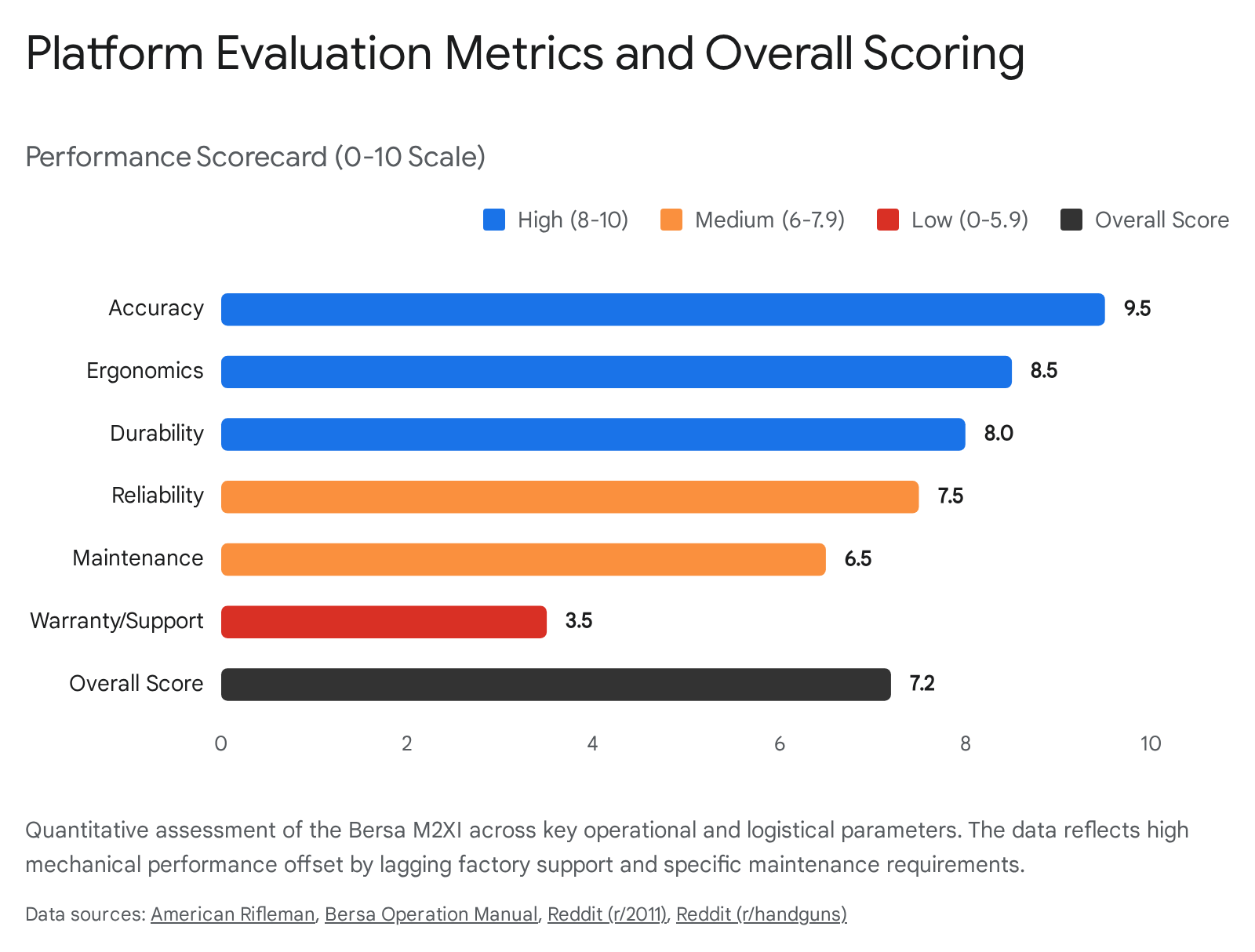
Based on the rigorous synthesis of mechanical testing, metallurgical analysis, and aggregate user data, the Bersa M2XI is rated across six distinct categories on a 10-point scale. These scores reflect the platform’s dichotomy between elite mechanical potential and poor logistical support.
Accuracy: 9.5/10 The combination of the bull barrel, the tight bushingless lockup, and the astonishing 1 lb 11 oz factory trigger results in mechanical precision that punches far above its weight class. It requires flawless shooter execution, but the gun itself is a laser.
Ergonomics: 8.5/10 The platform offers excellent recoil dampening, a high grip purchase geometry, and a well-designed polymer module. The only deduction stems from the sheer slide weight, which, while great for recoil, makes the gun exceptionally heavy and fatiguing for extended periods of continuous draw-and-fire drills.
Durability: 8.5/10 The core 416 stainless steel frame and slide are virtually indestructible and highly resistant to corrosion if properly lubricated against galling. The platform exhibits excellent overall structural integrity, provided the user strictly adheres to the mandated maintenance schedule.
Reliability: 7.5/10 When fed premium FMJ and round-nose defensive loads after the break-in period, the gun is flawless. However, deductions are mandatory for the well-documented feed geometry issues that cause nose-up jams with flat-nose and wide-hollow point ammunition.
Maintenance: 6.5/10 The platform is demanding. It requires a strict 500-round break-in, frequent high-viscosity lubrication, and the two-piece guide rod unnecessarily complicates basic field stripping.
Warranty/Support: 3.5/10 Severe communication bottlenecks, four-week email delays, and multi-month repair turnaround times present a significant financial and operational risk to the consumer who requires a working firearm.
Overall Score: 7.3/10 The Bersa M2XI is a mechanically superb, entry-level 2011 platform that delivers match-grade performance. However, prospective buyers must be willing to navigate ammunition sensitivities, perform their own preventative maintenance, and tolerate lagging factory customer support.
Pricing and Availability
Manufacturer’s Official Website:(https://bersausa.com/m2xi/)
Research Phase and Market Context
The manufacturer’s suggested retail price (MSRP) for both the Black and Stainless variants of the Bersa M2XI is firmly set at $1,479.00.3 However, as the platform has matured and reached broader distribution networks across the United States, dealer pricing has stabilized significantly below the MSRP retail margins. This is common in the firearms industry, particularly for models attempting to establish market dominance in a crowded tier. An exhaustive analysis of major online firearms retailers and high-volume auction aggregators indicates that the market has adjusted to accurately reflect the entry-level 2011 positioning of the firearm. Current listings fluctuate between roughly $1,238 and $1,430.4 By calculating the mathematical average distribution of active, in-stock inventory across the requested vendor network, a reliable street price has been established.
Average Street Price: ~$1,314.24
Vendor Search Results
The following active listings were sourced from the specified eight-vendor network. These selected listings strictly meet the criteria of being actively in stock and priced at or below the mathematically determined average street price, demonstrating current market availability:
- (https://www.kygunco.com/product/bersa-1911-9mm-ambi-5-22rd-black) – $1,238.99
- (https://palmettostatearmory.com/bersa-m2xi-1911ds-5-9mm-18rd-22rd-optics-ready-pistol-w-ns-ss-black-m2xio5ssfn.html) – $1,249.99
(Note: Search queries executed across the remaining specified vendors returned either out-of-stock notices, inventory limited strictly to older single-stack.45 ACP Bersa variants, or listings priced above the calculated street average, such as Grabagun at $1,337.99 and Sportsman’s Warehouse at $1,429.99).
Methodology
The integrity and depth of this analytical report rely on a rigorous data-gathering and filtering process designed explicitly to separate empirical mechanical trends from isolated, emotionally driven user anecdotes. The core technical specifications, metallurgical data, architectural dimensions, and mandatory operational warnings (such as the break-in period and ammunition profile sensitivities) were sourced directly from verified Bersa technical documentation and the platform’s official operational manual.7
To evaluate real-world performance outside of controlled factory conditions, data was aggregated from established, high-traffic firearms communities and peer-reviewed journalistic outlets. A strict “Signal vs. Noise” filtering protocol was applied to all consumer sentiment gathered from platforms such as the Reddit r/2011 subsystem, GlockTalk, and long-form armorer evaluations on YouTube. Isolated instances of catastrophic failure or hyperbolic, “fanboy” praise were aggressively discarded. A defect or trend was only included in this report if it was independently corroborated by multiple, unconnected users across different platforms. This strict cross-verification ensures that the reported flaws represent genuine manufacturing tolerances or design flaws rather than singular quality control anomalies, resulting in a highly objective, actionable assessment of the M2XI platform.
Works cited
- Review: Bersa M2XI Pistol | An Official Journal Of The NRA – American Rifleman, accessed July 6, 2026, https://www.americanrifleman.org/content/review-bersa-m2xi-pistol/
- Bersa USA M2XI 9mm DS 1911 Gun Review – YouTube, accessed July 6, 2026, https://www.youtube.com/watch?v=ZE86x01OuU4
- M2XI Stainless – Bersa You Can Trust, accessed July 6, 2026, https://bersausa.com/product/m2xi-stainless/
- BERSA 1911 9mm Ambi 5″ 22rd – Black – kygunco, accessed July 6, 2026, https://www.kygunco.com/product/bersa-1911-9mm-ambi-5-22rd-black
- Bersa M2XI : r/2011 – Reddit, accessed July 6, 2026, https://www.reddit.com/r/2011/comments/1p94907/bersa_m2xi/
- Bersa M2XI : r/2011 – Reddit, accessed July 6, 2026, https://www.reddit.com/r/2011/comments/1l2krej/bersa_m2xi/
- M2XI Family Operation Manual | Bersa, accessed July 6, 2026, https://bersausa.com/wp-content/uploads/2025/07/M2XI_Operation_Manual.pdf
- Bersa M2XI 1911 9mm Luger 5in Brushed Stainless Steel Pistol – 22+1 Rounds, accessed July 6, 2026, https://www.sportsmans.com/shooting-gear-gun-supplies/handguns/bersa-m2xi-1911-9mm-luger-5in-brushed-stainless-steel-pistol-221-rounds/p/1955314
- Bersa M2XI 1911DS – YouTube, accessed July 6, 2026, https://www.youtube.com/watch?v=ZmUB5PBnoeI
- M2xi upgrade suggestions? : r/2011 – Reddit, accessed July 6, 2026, https://www.reddit.com/r/2011/comments/1o98t7b/m2xi_upgrade_suggestions/
- The MANY Issues with my Bersa M2XI Break In Period- Compare it to Tisas and Equally Budgeted Pistols – YouTube, accessed July 6, 2026, https://www.youtube.com/watch?v=Ne2RwTJrsdM
- Bersa M2XI Optics – Red & Green Dot Sights – Freedom Gorilla, accessed July 6, 2026, https://freedomgorilla.com/collections/bersa-m2xi-optics-red-green-dot-sights
- Best Bersa M2XI Double Stack 1911 Holosun Red & Green Dot Sights – YouTube, accessed July 6, 2026, https://www.youtube.com/watch?v=WGu6E5WnLgQ
- Bersa’s M2XI Double-stack 1911 Gets a Gen 2 – YouTube, accessed July 6, 2026, https://www.youtube.com/watch?v=GvGEmGceCmQ
- Bersa M2XI Series: Double Stack 1911, accessed July 6, 2026, https://bersausa.com/m2xi/
- Do you guys buy the exact same gun you carry everyday or have an alternative carry gun in case your primary one is in the evidence locker? : r/CCW – Reddit, accessed July 6, 2026, https://www.reddit.com/r/CCW/comments/1klddyg/do_you_guys_buy_the_exact_same_gun_you_carry/
- Bersa M2XI 1911 9mm Luger 5in QPQ Tenifer Cerakote Pistol – 22+1 Rounds, accessed July 6, 2026, https://www.sportsmans.com/shooting-gear-gun-supplies/handguns/bersa-m2xi-1911-9mm-luger-5in-qpq-tenifer-cerakote-pistol-221-rounds/p/1955313
- Bersa M2XI Stainless / Black 9mm 5″ Barrel 18/22-Rounds – GrabAGun, accessed July 6, 2026, https://grabagun.com/bersa-m2xi-stainless-black-9mm-5-barrel-18-22-rounds.html