
Executive Summary
The United States civilian small arms market in the first half of 2026 has been defined by significant structural, regulatory, and technological shifts. Following a period of post-pandemic market normalization—frequently described by industry retailers as a broader macroeconomic slump driven by inflation and tightened discretionary income—the landscape was notably altered by legislative and regulatory changes. A primary market catalyst has been the effective elimination of the $200 National Firearms Act (NFA) tax stamp for suppressors, short-barreled rifles (SBRs), and short-barreled shotguns (SBSs). This statutory adjustment has transformed historically niche, highly regulated accessories into baseline consumer expectations, driving substantial production realignments and supply chain expansions across the manufacturing sector.
Concurrently, the judicial branch has redefined the regulatory environment. Landmark United States Supreme Court decisions in June 2026 expanded the interpretation of the Second Amendment, strictly curtailing state-level attempts to create default prohibitions on concealed carry on private property open to the public. Furthermore, the Court struck down decades-old federal statutes regarding the disarmament of controlled substance consumers. Simultaneously, the Bureau of Alcohol, Tobacco, Firearms and Explosives (ATF) initiated a “Repeal” initiative, rolling back several highly contested regulations regarding stabilizing braces, bump stocks, and the statutory definition of independent firearms dealers.
Technologically, the industry is experiencing a renewed interest in legacy platforms. The tactical modernization of the lever-action rifle has created a new category of fifty-state-legal, suppressor-ready utility rifles. Alongside this, the democratization of the double-stack 1911 (the “2011” platform) is reshaping the everyday concealed carry market. In the realm of ballistics, the prominence of the 6mm ARC cartridge is bridging the historical divide between the 5.56 NATO and.308 Winchester, driving innovation in both gas-operated and precision bolt-action platforms. Furthermore, the integration of military-grade technologies into the civilian market, ranging from Vertical-Cavity Surface-Emitting Laser (VCSEL) night vision to counter-unmanned aerial systems (UAS) munitions, demonstrates a maturing consumer base demanding professional-grade capabilities.
This analytical report delineates the top ten insights and lessons learned in the US civilian small arms market for the year-to-date 2026. Through a synthesis of macro-market data, localized legislative reactions, technological developments, and shifting regulatory frameworks, this document provides a comprehensive roadmap of the current ecosystem for industry professionals, supply chain logisticians, and informed consumers.
1. The NFA Regulatory Paradigm Shift and the Zero-Dollar Suppressor Boom
A consequential market catalyst of 2026 thus far has been the functional elimination of the $200 NFA tax stamp, an artificial barrier to entry that had constrained the suppressor and short-barreled rifle market since the passage of the National Firearms Act of 1934. Following legislation signed in the summer of 2025—frequently referred to within the industry as the “One Big Beautiful Bill”—the requisite federal tax stamp was statutorily deemed as paid, effectively reducing the cost of transfer for these regulated items to $0.1 Without this financial penalty, the suppressor, SBR, and SBS markets experienced an immediate and rapid expansion as pent-up consumer demand was unleashed.1
The immediate aftermath of this legislative catalyst was a logistical shock to the federal processing infrastructure. On January 1, 2026, the ATF processed an estimated 150,000 eForm submissions in a single day—a figure representing approximately sixty times the historical daily average.2 To comprehend the scale of this economic shift, between January and May 2026, over 845,000 suppressor applications were submitted, with 768,000 approved, pushing the industry toward a projected annualized rate of over one million NFA items processed.1 June 2026 NFA figures alone reached 166,677 background checks, representing a 177.1 percent increase compared to the 60,147 checks recorded in June 2025.31
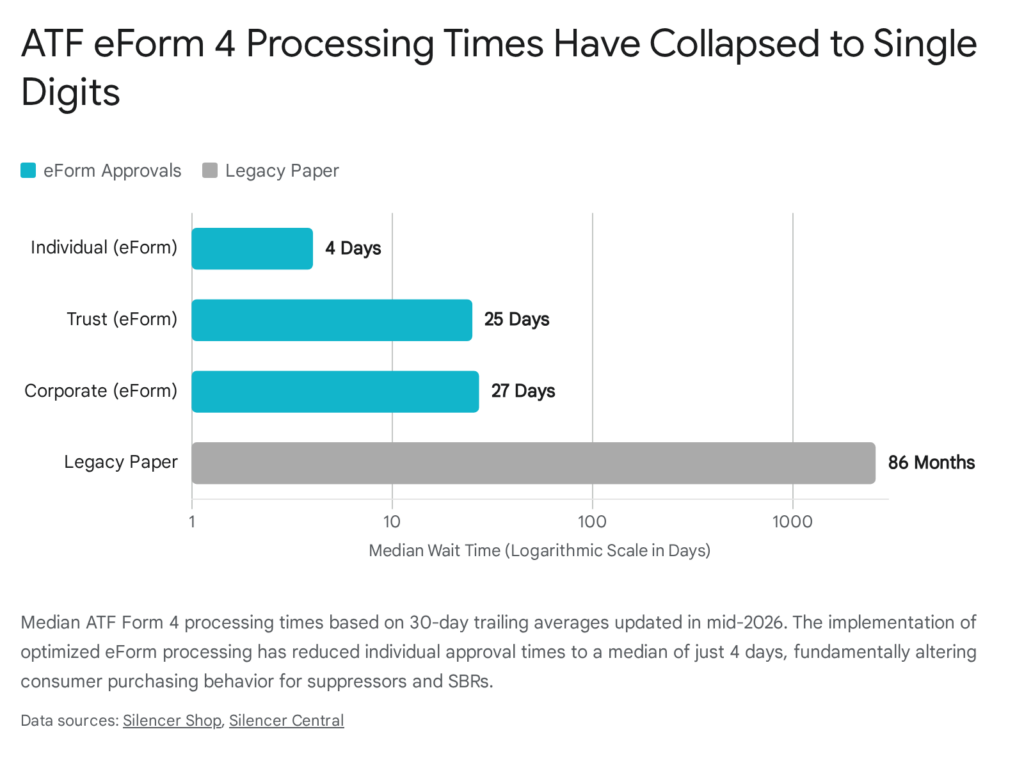
This demand has been heavily facilitated by highly optimized ATF processing infrastructure. The ATF’s NFA Division is currently clearing eForm 4 individual applications in a matter of days. As of mid-2026, individual eForm 4 wait times exhibit a median of just 4 days, while Trust submissions—which require more complex background checks for multiple responsible persons—are clearing with a median of 25 days.4 This modern efficiency stands in stark contrast to the legacy paper form pipeline, which currently languishes at a median wait time of 86 months.4
The geographic distribution of this boom is heavily concentrated in states with robust existing firearms cultures and favorable local laws. Analysis of the raw data from the federal tracking systems reveals the primary drivers of this NFA explosion.
| State | June 2026 NFA Checks (Form 1 and 4) | Market Rank |
| Texas | 23,133 | 1 |
| Virginia | 18,235 | 2 |
| Florida | 11,782 | 3 |
| North Carolina | 6,785 | 4 |
| Georgia | 6,711 | 5 |
| Table 1: Top 5 States for NFA Background Checks, June 2026.33 |
Despite the functional success of the $0 tax stamp, the legislative push to completely deregulate these items remains highly active. In January 2025, Representative Ben Cline (R-VA-06) and Senator Mike Crapo (R-ID) reintroduced the Hearing Protection Act (H.R. 404 / S. 364) in the 119th Congress.567 While the $0 tax stamp removed the financial burden, the items remain under the bureaucratic purview of the NFA. The Hearing Protection Act seeks to entirely remove suppressors from NFA regulation, replacing the federal eForm transfer process with a simple, instantaneous point-of-sale background check, identically mirroring the purchase of standard firearms.5 The continued momentum behind this legislation indicates that the market views the current $0 tax stamp as an intermediate victory, with structural deregulation remaining the ultimate objective.
2. Suppressor Mainstreaming, Pricing Dynamics, and Integral Architectures
The secondary effect of the NFA tax elimination has been a significant restructuring of suppressor market economics and weapon system engineering. Historically, the $200 tax stamp acted as both a price floor and a psychological barrier; consumers purchasing a $400 entry-level suppressor were forced to pay a 50 percent tax premium to the federal government. This dynamic artificially drove the market toward high-end, premium-priced titanium or exotic alloy units, as consumers felt compelled to justify the fixed bureaucratic cost and lengthy wait times by purchasing top-tier products. With the tax eliminated, this dynamic has inverted, sparking an aggressive “race to the bottom” regarding retail pricing.2
This democratized, high-volume market has attracted a wave of formidable new entrants previously absent from the NFA space. During the 2026 SHOT Show, established conventional firearms and accessory brands—including Palmetto State Armory (PSA), Canik, Diamondback, Hi-Point, Bergara, and Lyman Products—launched their inaugural suppressor lines, instantly saturating the entry-level and mid-tier markets.2 Furthermore, niche markets are seeing expansion, with companies like Banish expanding their shotgun suppressor lineups by adding 20-gauge and.410 versions alongside their flagship 12-gauge models.2 This influx of competition is commoditizing standard direct-thread and quick-detach suppressors, forcing legacy silencer manufacturers to innovate or face severe margin compression.
Technologically, the industry response to commoditization has been the development of integral suppression systems and “Over-Barrel” architectures. Because standard threaded barrels and “suppressor-ready” configurations are now considered baseline factory specifications rather than premium upgrades, forward-leaning engineering is focusing on harmonic integration, weight distribution, and overall length reduction.2 The traditional consumer complaint regarding suppressors is the addition of six to nine inches of length to the muzzle, which severely disrupts the balance, swing weight, and maneuverability of a hunting or defensive rifle.
To solve this spatial dilemma, manufacturers are pushing reflex-style, back-over-barrel designs. A premier example introduced in 2026 is the Savage AC30 B.O.B. (Back-Over-Barrel) suppressor.8910 By recessing the internal mounting threads four inches deep into the suppressor tube, the unit slides backward over the existing barrel profile.8 This maintains the critical internal expansion volume required for effective sound mitigation—achieving a highly respectable 133-decibel rating on a 20-inch.308 Winchester rifle—while drastically reducing the overall forward footprint of the weapon system.9 To ensure durability and weight optimization, the AC30 B.O.B. utilizes a sophisticated tri-material construction: a titanium (6AL-4V alloy) thread insert prevents abrasive thread galling against the steel rifle barrel, which is housed within a 7075-T6 aluminum mount and a removable monocore baffle stack.8 The entire assembly is finished with Type III hard-coat anodizing and a Diamond-Like Carbon (DLC) topcoat.8
Similarly, Foxtrot Mike (FM) Products introduced the Ranch Rifle ISU-556 G2, a platform that abandons thread-on accessories entirely. This rifle features a fully integrated suppressor built directly into a monolithic billet upper receiver, prioritizing durability and a seamless ergonomic profile for backpackers and outdoorsmen.211 The primary structural insight for 2026 is that the suppressor is rapidly shedding its identity as an aftermarket accessory; it is increasingly engineered as an organic, inseparable component of the firearm’s primary operating system, altering barrel manufacturing methodologies.
3. The Counter-UAS Small Arms Convergence
An emerging trend in 2026 that highlights the crossover of military defense technology into the broader small arms market is the development of dedicated counter-unmanned aerial systems (C-UAS) munitions capable of being fired from standard civilian and law enforcement platforms. As the proliferation of commercial and weaponized drones continues to pose complex security threats both domestically and abroad, the small arms industry has responded with specialized kinetic solutions.
The most notable introduction in this sector is the “Drone Round,” a specialized counter-drone munition currently available in both 5.56 NATO and 7.62 NATO calibers.12 Unlike traditional buckshot utilized in smoothbore shotguns, which suffers from severe range limitations and requires manual manipulation, the Drone Round is engineered to function within standard gas-operated, magazine-fed rifles.12 The munition is completely suppressor-ready and cycle-reliable during automatic fire, requiring no mechanical modifications or specialized training for the end-user.12
The ballistics of this munition represent a significant engineering achievement. The 5.56 NATO variant generates a muzzle velocity of 2,200 feet per second (fps), or approximately 670 meters per second.12 This velocity is effectively double that of a standard 12-gauge shotgun shell, providing the kinetic energy and flatter trajectory required to engage high-speed, fixed-wing drones, as well as highly maneuverable fiber-optic or radio-controlled quadcopters at extended ranges.12 This development signifies a pivot in small arms capability; modern rifles are no longer exclusively anti-personnel or hunting tools, but are actively being adapted into highly mobile, point-defense anti-aircraft systems tailored for the modern asymmetric threat environment.
4. Legislative Catalysts, Market Slumps, and Localized Panic Buying
When stripping away the NFA-specific suppressor boom, the baseline US civilian small arms market in late 2025 and early 2026 faced undeniable macroeconomic headwinds. Retailers across the country—such as Ready Gunner in Utah—reported a tangible softening in standard firearms sales in late 2025 and early 2026, attributing the lull to a combination of economic stagflation, tightened consumer discretionary income, and political fatigue. Store managers frequently described this phenomenon at the retail counter as the “Trump Slump,” “stagflation,” or “Bidenomics”.1313 However, relying purely on top-line national NICS data obscures acute, highly localized spikes in consumer demand driven entirely by state-level legislative threats.1413 In states facing impending restrictions on semi-automatic firearms and standard capacity magazines, the market experienced classic “panic buying” surges that overwhelmed local supply chains.
The most acute and statistically significant example of this phenomenon occurred in Virginia. Following a shift in legislative control, Governor Abigail Spanberger signed SB 749 into law. This gun control package makes it a Class 1 misdemeanor to manufacture, sell, purchase, or transfer “assault firearms”. The statute broadly defined these firearms to include semi-automatic centerfire rifles or pistols equipped with magazines capable of holding more than 15 rounds 15. The ban was scheduled for implementation on July 1, 2026, creating a hard legislative deadline that catalyzed a localized buying frenzy.15
Anticipating the prohibition, Virginia consumers entered the market at high rates. In the first six months of 2026, the state processed 468,778 background checks for firearm sales, a 91 percent increase (representing 224,178 additional checks) over the same period in 2025.14 The culmination of this surge occurred in June 2026—the final 30 days before the ban’s enactment—where Virginia recorded 123,699 background checks, marking a 241 percent year-over-year increase for the month.1416 Rhode Island experienced an identical, albeit proportionally smaller, market distortion. Facing a similar impending ban slated for July, Rhode Island recorded a 201 percent year-over-year increase in June 2026, finalizing 7,815 background checks.16
These localized surges were significant enough to skew national data sets. The NSSF-adjusted National Instant Criminal Background Check System (NICS) figure for the entire US in June 2026 was 1,123,006, reflecting an 11.7 percent increase compared to June 2025.16 A substantial portion of this national growth was propped up by the legislative deadlines in just two states.
| Market Metric | Top 5 States Ranked by Volume |
| Adjusted NICS Checks (Overall) | Texas, Florida, Virginia, California, Pennsylvania |
| FBI NICS Handgun Checks | Texas, Florida, Virginia, Pennsylvania, California |
| FBI NICS Long Gun Checks | Texas, Virginia, Pennsylvania, California, Florida |
| Table 2: Top 5 States for NICS Background Checks, May/June 2026 Data Consolidation.3 Note the abnormal elevation of Virginia across all categories due to impending state legislation. |
Furthermore, longitudinal data reveals that historically smaller markets are exhibiting disproportionate year-over-year growth, indicating a broadening geographic base of civilian ownership outside of traditional high-volume states.
| State | 2024 Total Estimated Sales | YOY Change in Sales (2023-2024) |
| Iowa | 89,144 | +7.7% |
| South Carolina | 277,081 | +6.9% |
| New Hampshire | 145,700 | +6.7% |
| Arkansas | 213,165 | +6.4% |
| Table 3: Fastest Growing State Markets by Percentage, demonstrating sustained regional expansion independent of major legislative panics.17 |
The fundamental insight for market analysts is that national macro-trendlines are increasingly unreliable indicators of true retail health and inventory velocity. Localized political environments, specifically the introduction of restrictive state-level legislation, remain primary drivers of acute inventory depletion and demand spikes.
5. Administrative Rollbacks and the Federal Deregulation Push
In a reversal of the regulatory expansion witnessed between 2021 and 2024, the ATF in 2026 launched a comprehensive “Repeal” initiative under the banner of a “New Era of Reform”.18 This shift represents a reactive alignment by the administrative state to a series of federal court defeats and a shifting executive branch posture pushing for the liberalization of federal gun rules.1918
The most prominent reversal is the formal rescission of the 2023 rule governing firearms equipped with stabilizing braces (1140-AA98 – NPRM).1820 Multiple federal courts had previously determined that the ATF’s attempt to classify braced pistols as short-barreled rifles under the NFA violated the Administrative Procedure Act (APA), leading to nationwide injunctions, stays, and vacaturs.1818 By formally removing the factoring criteria and regulatory language codified in 27 CFR 478.11 and 479.11, the ATF conceded the legal unenforceability of the rule, restoring the regulatory definitions to their underlying statutory constraints.18
A parallel rollback occurred regarding the classification of bump stocks. Following the U.S. Supreme Court’s binding legal interpretation in Garland v. Cargill (2024)—which ruled that semiautomatic rifles equipped with bump stocks fundamentally do not meet the mechanical statutory definition of a “machine gun” under the NFA—the ATF finalized a rule (1140-AA60) stripping the incorporating language from its three regulatory definitions.18
Furthermore, the ATF is unwinding expansions to the definition of a firearms dealer. The proposed rule (1140-AB01) rescinds the Biden-era provisions that expanded the definition of who is “engaged in the business” of dealing in firearms.18 These stringent regulations placed casual hobbyists at risk of felony prosecution for selling personal collections and were heavily criticized following highly publicized, fatal ATF enforcement raids.19 The agency formally acknowledged that these definitional expansions failed to produce any of the anticipated outcomes regarding administrative licensing actions, civil forfeitures, or increased FFL applications.1821 Consequently, the ATF is reverting exclusively to the statutory definition explicitly codified by Congress in the Bipartisan Safer Communities Act (BSCA).1818
This deregulation extends into administrative minutiae as well. The ATF proposed the rescission of 27 CFR § 478.103 (1140-AA87 – NPRM), removing the requirement for FFLs to physically post signage (ATF I 5300.1) and provide written notification (ATF I 5300.2) to handgun purchasers regarding the 1998 Youth Handgun Safety Act, citing it as an unnecessary administrative burden for a law that has been universally accessible for over 30 years.18
Beyond the ATF, the broader Trump Administration’s Justice Department is challenging restrictive state-level gun measures in federal court. Active DOJ lawsuits currently target Colorado’s ban on standard-capacity magazines (holding over 15 rounds), California’s prohibition on popular Glock handguns, and the “assault weapon” bans enacted by both the state of Virginia and the city of Denver.19 Additional executive proposals seek to permit remote background checks, allow FFLs to ship firearms directly to in-state buyers, and clarify “straw purchase” rules to ease the legal liabilities surrounding the gifting and interstate transportation of firearms.19 The definitive lesson for 2026 is that the federal administrative pendulum has swung toward deregulation, dismantling compliance hurdles erected over the previous four years.
6. Supreme Court Jurisprudence: Wolford v. Lopez and U.S. v. Hemani Redefine Permissible Restrictions
The judicial branch exerted immense influence over the civilian small arms market in the summer of 2026, delivering two landmark Supreme Court decisions in June that expanded the scope of Second Amendment protections. These rulings explicitly clarified the boundaries of the “historical tradition” test established in the 2022 New York State Rifle & Pistol Association v. Bruen decision, setting stringent new limits on the government’s ability to disarm citizens.2222
The first major ruling, Wolford v. Lopez, addressed attempts by state legislatures to circumvent the Bruen mandate, which universally recognized a citizen’s right to carry a concealed handgun for public self-defense.22 Following Bruen, the state of Hawaii enacted a novel legal framework that effectively flipped standard property rights defaults: rather than requiring property owners to actively post signage to prohibit firearms, the Hawaii statute assumed concealed carry was banned on all private property open to the public unless the owner explicitly posted signage authorizing it.22
In a 6-3 decision authored by Justice Samuel Alito, the Court struck down the Hawaii statute. The majority reasoned that the law effectively rendered concealed carry a “practical impossibility,” barring citizens from routinely visited commercial spaces such as gas stations, grocery stores, restaurants, pharmacies, hair salons, and laundromats.2222 The core legal insight from Wolford is the Court’s intolerance for legislative subterfuge; states may not utilize property law technicalities to eradicate or effectively nullify a core constitutional right 22. This ruling ensures that the civilian market for micro-compact concealed carry handguns and holsters will remain highly viable nationwide, regardless of localized political opposition.
The second, and perhaps more culturally transformative, decision was the unanimous 9-0 ruling in U.S. v. Hemani. This case systematically dismantled long-standing federal statutes—originating with the 1968 Gun Control Act and expanded by the 1993 Brady Law and 1994 Violence Against Women Act—that prohibited consumers of controlled substances from possessing firearms.22 The case centered on Ali Hemani, a Texas resident indicted for possessing a firearm while admitting to consuming marijuana approximately every other day, who drew legal and amicus support from a broad coalition ranging from the ACLU to the NRA.
The federal government attempted to justify the disarmament under the Bruen historical tradition standard by equating modern cannabis users to “habitual drunkards” regulated during the nation’s founding era.22 The Supreme Court universally rejected this historical analog. The Justices noted that colonial-era laws targeting drunkards only applied to individuals who were “practically incapacitated” and entirely incapable of managing their own affairs, not to functional members of society who engaged in social or heavy drinking.22 To emphasize the failure of this historical comparison, the Court highlighted that founding fathers such as George Washington, John Adams, and James Madison were serious consumers of alcohol but were never subjected to disarmament or considered incapacitated.22
The Hemani decision reflects a profound judicial acknowledgment of shifting societal norms regarding cannabis. In concurring opinions, both conservative and liberal justices noted the federal government’s recent initiative to reclassify marijuana from Schedule 1 to Schedule 3, placing it alongside substances like Tylenol with codeine.22 The Court further cited statistical realities suggesting that regular marijuana users in the US—totaling an estimated 20 million consumers—may now outnumber regular alcohol consumers.22 By ruling that moderate, recreational drug use does not meet the high threshold of historical incapacity required to sever Second Amendment rights, the Court instantly enfranchised a new demographic segment, legally opening a vast market to the firearms industry without the threat of federal felony prosecution 22.
7. The Tactical Lever-Action Renaissance and Subsonic Synergy
A highly pronounced product engineering trend in 2026 is the tactical modernization of the lever-action rifle. Far from relying on cowboy nostalgia, manufacturers have recognized that the lever-action mechanism occupies a unique regulatory safe harbor: it is universally fifty-state legal, immune to semi-automatic “assault weapon” bans, and inherently reliable in adverse conditions. By integrating modern tactical features, the industry has birthed a new category that bridges traditional manual actions with modern sporting rifle utility.
The 2026 SHOT Show served as the premier exhibition for this renaissance.23 Marlin, operating under the financial and manufacturing umbrella of Ruger, continued to dominate the premium segment with the expansion of its highly successful “Dark Series” into.44 Magnum and.30-30 Winchester, while retaining its flagship.45-70 Government model.23 Marlin’s modernization strategy focuses on retaining the classic tube-magazine aesthetic while integrating M-LOK handguards, Picatinny rails, and threaded barrels. A critical engineering update for 2026 was the inclusion of factory-installed radial muzzle brakes (utilizing an 11/16″-24 thread pitch) specifically designed to tame the severe recoil of the.45-70 cartridge.23 This caliber has seen massive adoption by hunters utilizing subsonic ammunition in conjunction with the booming suppressor market, creating a near-silent, high-kinetic-energy hunting platform.23
Smith & Wesson aggressively entered this highly contested space to challenge Marlin’s historical dominance with the introduction of the Model 1854 series. The lineup includes standard models chambered in.38-55 Winchester, as well as the modern Model 1854 Stealth Hunter.2324 This rifle exemplifies the tactical lever-gun ethos, featuring synthetic furniture, a proprietary smooth-cycling action, and a standardized threaded barrel, indicating that S&W recognizes suppressor compatibility as a mandatory, rather than optional, feature for the modern hunter.
Simultaneously, companies are pushing the mechanical boundaries of the platform by completely abandoning the traditional tubular magazine in favor of modern box magazines. The Bond Arms LVRB (Lever Action Repeating Bond) and the Henry Supreme (LASR) represent redesigns that utilize standard AR-15 magazines and modern intermediate chamberings (such as 5.56mm/.223 Rem).23 The Henry LASR, for instance, pairs a celestial-anodized aluminum receiver with a free-floated barrel, bringing the sub-MOA precision and rapid reloading capability of a modern tactical rifle to the lever platform.23
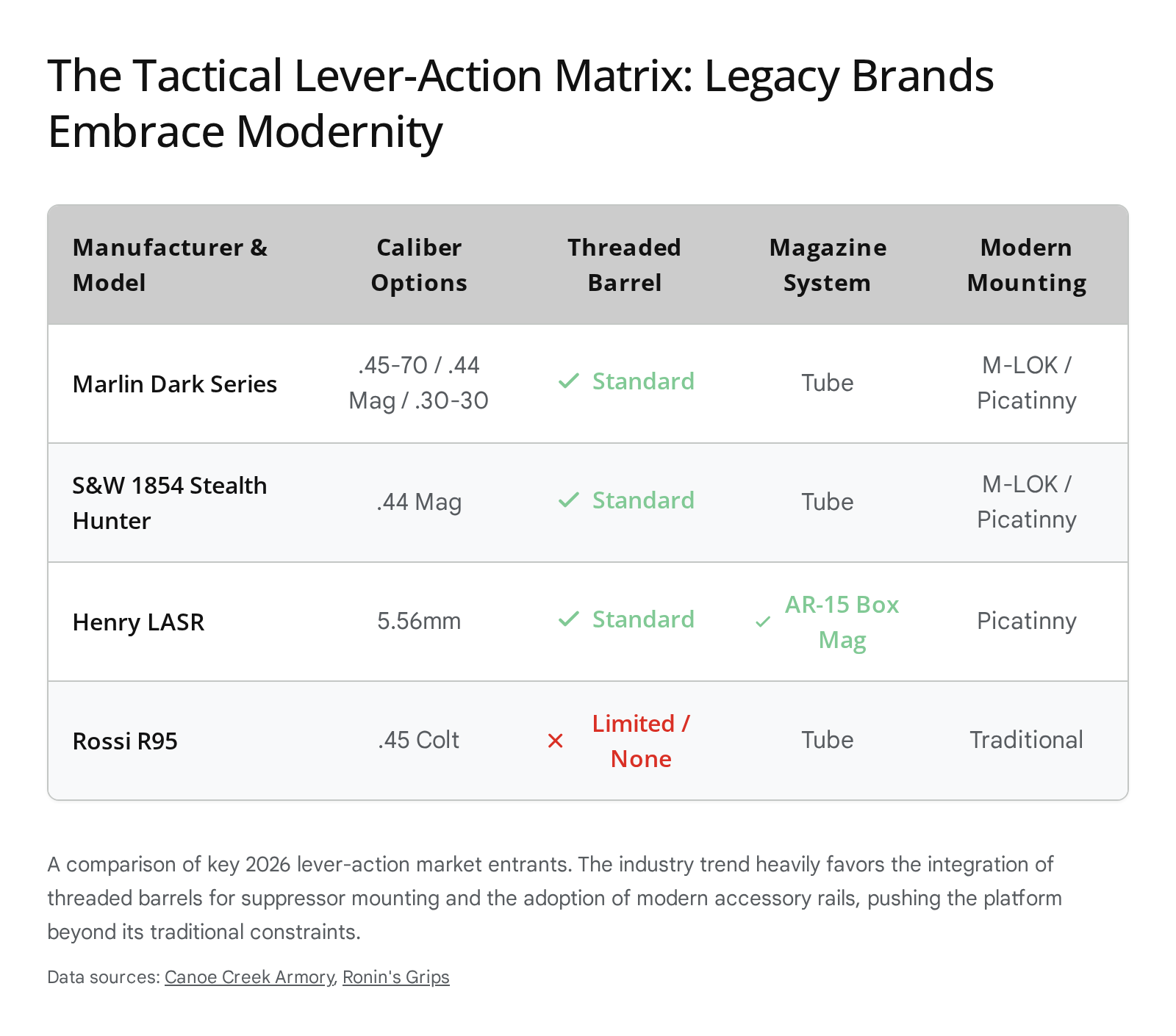
At the entry-level tier, the Rossi R95 continues to capture market share by offering a rugged, affordable alternative in straight-wall cartridges like the.45 Colt, though it generally lacks the factory threaded barrels seen on premium competitors.24 The insight generated by this platform evolution is twofold: First, consumers are demanding modern ergonomics, optics readiness, and suppressor compatibility across all manual action types. Second, in an era of unpredictable state-level semi-automatic bans, the tactical lever-action serves as a highly capable, politically insulated primary defensive and sporting arm.
8. Democratization of the 2011 Platform and Premium Carry Evolution
Despite the macroeconomic softening in the long-gun sector, the market for concealable handguns demonstrated remarkable resilience in early 2026, heavily outpacing rifle sales. Retailers noted that handguns consistently outsold rifles by a two-to-one ratio in the entry-to-mid-level pricing tiers.13 Within this resilient segment, the double-stack 1911—universally referred to in the civilian market as the “2011” platform—underwent a significant evolution. Historically the exclusive domain of high-end competition shooters and elite law enforcement units, with prices rarely falling below the $2,000 threshold, the 2011 platform was aggressively democratized and optimized for daily concealed carry in 2026.
Palmetto State Armory (PSA) acted as the primary disruptor in this space with the introduction of the Sabre 11 and Sabre 11P (ported) models.25 Leveraging their vertically integrated manufacturing capabilities, PSA engineered a 2011-style handgun aimed at a significantly lower price bracket.25 A key engineering decision allowing this cost reduction is the implementation of an external extractor. Traditional 1911 purists demand internal extractors, which require highly skilled, time-consuming hand-tuning by gunsmiths to ensure reliability.25 By opting for an external extractor, PSA optimized the design for rapid, automated mass production while simultaneously increasing reliability for high-volume shooters.25 Furthermore, PSA partnered with Agency Arms to integrate a premium optic mounting system directly from the factory, ensuring the weapon is immediately relevant to the modern red-dot-driven market.25
On the premium end of the carry spectrum, SIG Sauer introduced the P211 (specifically the GT4 and GT5 variants).25 While many legacy 2011s are oversized duty weapons that are difficult to hide, the P211 is engineered specifically for daily concealed carry without sacrificing the platform’s legendary trigger dynamics.25 To achieve this, SIG abandoned the traditional 1911 barrel link mechanism in favor of a proprietary cam-lock system. Market analysts reported that this cam-lock geometry results in a significantly smoother cycling impulse and enhanced durability under the high pressures of modern defensive ammunition.25
Beyond the 2011, legacy manufacturers focused on iterative, highly integrated updates to stimulate the saturated striker-fired market. Glock’s introduction of the Generation 6 architecture (spanning the G17, G19, and G45) perfectly illustrates this defensive engineering strategy.25 While the Gen 6 features standard ergonomic updates like redesigned stippling and refined recoil springs, its primary market narrative is an engineering pivot toward regulatory defense.25 The Gen 6 utilizes an “anti-switch” internal architecture explicitly designed to prevent the illicit installation of aftermarket auto-sears, protecting Glock’s legal standing while providing institutional buyers a compelling reason to upgrade aging fleets.25
The aftermarket also played a critical role in 2026 by resolving the engineering compromises of early micro-compacts. Shield Arms, famous for inventing the flush-fit 15-round magazine for the Glock 43X, released their Gen 3 S15 and the new S10 magazines, successfully resolving early-generation reliability criticisms and restoring consumer faith in modifying slimline carry guns for duty-level capacity.25 Other notable handgun introductions catering to specialized carry needs include the Archon Type B Gen 2, which integrates a flat-shooting two-chamber compensator into a compact profile, and Charter Arms’ new Professional series 8-shot double/single action revolver, which packs immense firepower into a 20-ounce, 3.5-inch barreled frame ideal for trail defense.2627
9. Caliber Dominance: The 6mm ARC Ascendancy in Precision and Gas Platforms
In the realm of cartridge ballistics, 2026 has solidified the prominence of the 6mm Advanced Rifle Cartridge (6mm ARC). Originally developed at the behest of specialized military units (SOCOM) seeking to maximize the long-range ballistic potential of the standard AR-15 platform without transitioning to the much heavier AR-10 platform 28, the 6mm ARC has successfully bridged the ballistic gap between the 5.56 NATO and the.308 Winchester.
The cartridge’s ascendance in the civilian market is driven by its exceptional performance in both long-range precision bolt-action rifles and standard gas-operated semi-automatics. In gas guns, the chamber pressure is strictly capped at approximately 54,000 PSI to ensure the longevity and safety of the AR-15 bolt face, yet it still delivers supersonic trajectories and reliable target impacts well past 1,000 yards.29 This unique ballistic profile has made it the undisputed king of the “Gas Gun” divisions in competitive shooting disciplines like the Precision Rifle Series (PRS), where competitors engage variably sized targets from 400 to over 1,000 yards off improvised barricades and unstable props.30
Recognizing this market saturation, major ammunition manufacturers aggressively expanded their 6mm ARC offerings in 2026 to support both competitors and hunters. Federal Premium introduced heavily optimized loads for distinct use cases.31 This includes the 108-grain Gold Medal Berger BT Target load, boasting an impressive G1 ballistic coefficient of.522 (and a G7 of.268) with a muzzle velocity of 2,650 fps.32 This load is designed specifically to minimize wind drift and flatten trajectories at extended ranges for PRS competitors.32 For high-volume training, Federal released a 110-grain Total Metal Jacket (TMJ) load pushing 2,550 fps, and for hunters, a new Fusion Tipped design incorporating a polymer tip to maximize energy transfer and expansion upon impact.3233
Simultaneously, Black Hills Ammunition introduced a proprietary 6mm ARC load utilizing a 107-grain MKX bullet.34 By redesigning the legendary MatchKing jacket and utilizing a softer lead core, Black Hills created a projectile that delivers match-grade accuracy while ensuring reliable expansion down to 1,800 fps, creating a devastating medium-game hunting cartridge.34 The overriding lesson learned from the 6mm ARC’s success is that modern shooters prioritize high ballistic coefficients, aerodynamic efficiency, and minimal wind deflection over raw kinetic energy or traditional caliber loyalties, shifting barrel manufacturing and ammunition supply chain priorities for the foreseeable future.
10. Electro-Optics Disruption and Custom Modularity as a Baseline
The final major insight of YTD 2026 involves the democratization of highly advanced electro-optics and the shift of physical modularity from an aftermarket luxury to a rigid factory baseline expectation.
In the electro-optics space, the Holosun Iris Laser/Illuminator significantly impacted the civilian night vision market.25 Historically, civilian access to high-quality infrared illumination was gated by the extreme “premium tax” associated with VCSEL (Vertical-Cavity Surface-Emitting Laser) technology, which offers vastly superior beam clarity and distance over standard edge-emitting lasers. By integrating VCSEL technology into an accessible, mass-market price point, and featuring a highly functional dual-switch ergonomic layout, Holosun has significantly lowered the entry barrier for high-quality civilian night vision setups, driving a secondary boom in helmet-mounted optics sales.25
Concurrently, physical modularity has become a mandatory engineering requirement. Modern gun owners demand the ability to configure, upgrade, and adapt their weapons using common-pattern parts at home, without the need to consult a gunsmith.2 This trend is highly visible even in the traditional bolt-action hunting market. The Savage Impulse Core Hunter Pro exemplifies this shift, abandoning traditional fixed stocks for an architecture built around interchangeable grip modules (small, medium, and large) and an AccuFit V2 stock system that allows for completely tool-free adjustments to comb height and length-of-pull.2 Furthermore, the inclusion of M-LOK attachment points throughout the forend signals the death of the traditional sling swivel stud as the sole accessory mounting option on hunting rifles.2
This modularity demand extends to specialized ergonomics. Browning continued its bolt-action dominance by releasing a comprehensive series of six X-Bolt 2 Left-Hand rifles (including the Hunter Composite, Speed, Speed SPR, Speed LR, Hunter, and Medallion variants, priced between $1,420 and $1,650).35 By offering factory-built left-handed actions across its entire product matrix, Browning acknowledged that consumers will no longer accept ergonomic compromises.35 Even budget-conscious tiers are adopting modular philosophies. Ruger’s revival of the Glenfield brand with the Model A—a rebadged, lower-cost Ruger American—targets buyers who want a low barrier to entry but demand the architectural capacity to incrementally upgrade stocks, triggers, and optic systems over time.2 A modular firearm is no longer a static tool; it is an adaptable host platform that the end-user can continually reconfigure to accommodate new thermal optics, heavier suppressors, or changing physical requirements.
Conclusion
The first half of 2026 will be recorded as a transformative epoch in the history of the US civilian small arms market. The traditional delineations between standard sporting arms and heavily regulated NFA items have blurred, driven entirely by the legislative elimination of the $200 tax stamp and the rapid acceleration of ATF eForm processing. Suppressors are no longer niche accessories; they are foundational components dictating the future engineering of barrels, receivers, and entire weapon architectures.
Simultaneously, the legal operating environment has shifted. As the Supreme Court continues to enforce the Bruen historical tradition standard—invalidating localized concealed carry subterfuges and unconstitutional drug-related disarmaments—the ATF is actively retreating from its most aggressive recent rulemakings regarding braces and dealer definitions. Yet, this federal deregulation is counterbalanced by state-level prohibitions, resulting in a fractured domestic market where national sales data is distorted by localized panic buying and artificial legislative deadlines.
For manufacturers, the path forward requires operational agility. The consumer expectation matrix now demands uncompromised modularity, sophisticated optic integration, and seamless suppressor readiness across all platforms, from polymer micro-compacts to classic lever-action rifles. As the market navigates the macroeconomic headwinds of the latter half of 2026, the brands that succeed will be those that view these legislative and technological shifts not as transient trends, but as the permanent, irreversible new baseline of American firearms ownership.
Appendix: Analytical Methodology
To synthesize this mid-year report on the 2026 US civilian small arms market, a multi-tiered analytical methodology was employed, relying exclusively on open-source intelligence (OSINT) and authoritative industry data streams to ensure a factual, neutral assessment.
1. Data Collection and Aggregation The primary data corpus was constructed by aggregating reporting from authoritative industry associations (e.g., the National Shooting Sports Foundation), federal regulatory bodies (the ATF processing dashboards, FBI NICS databases), legal archives detailing Supreme Court decisions, and leading trade publications reporting from premier industry events such as the 2026 SHOT Show.
2. Taxonomy and Categorization of Market Events To systematically manage the high volume of market noise and isolate true signals, the aggregated data was parsed into three distinct taxonomic categories:
- Legislative & Regulatory: Tracking statutory changes (e.g., NFA tax adjustments, the Hearing Protection Act pipeline), ATF administrative rulemaking/repeals, and pivotal federal judicial rulings impacting market demographics.
- Technological & Engineering: Monitoring shifts in mechanical design (e.g., integral suppression, external extractors on 2011s, modular chassis systems), electro-optics adoption, and cartridge ballistics.
- Market Economics & Consumer Behavior: Analyzing FBI NICS background check data, NSSF-adjusted retail figures, and qualitative retail reporting to gauge baseline economic health versus localized demand spikes.
3. Prioritization Filtering To identify the top 10 core developments, a prioritization filter was applied to the categorized data. Events were evaluated against three operational criteria:
- Magnitude of Demographic Impact: Did the event alter the behavior or legal standing of a demographic? (e.g., The Hemani decision affecting cannabis users, or the Wolford decision protecting concealed carry permit holders).
- Supply Chain Disruption: Did the event force manufacturers to alter production lines or logistics? (e.g., The surge in suppressor demand forcing the integration of threaded barrels and back-over-barrel designs).
- Permanent Paradigm Shift: Does the event represent an irreversible change in consumer expectations? (e.g., The transition of physical modularity from an aftermarket luxury to a factory-standard requirement).
4. Synthesis and Secondary Analysis Finally, the selected data points were subjected to second and third-order effect analysis. Rather than merely reporting isolated data points (such as the raw 241% surge in Virginia’s background checks), the analysis structurally connected these localized surges to the broader national market data, explaining precisely how state-level political environments are currently skewing macro-level economic indicators. This qualitative synthesis ensures the final report delivers actionable, structural intelligence regarding cause, effect, and future trajectory.
Please share the link on Facebook, Forums, with colleagues, etc. Your support is much appreciated and if you have any feedback, please email us in**@*********ps.com. If you’d like to request a report or order a reprint, please click here for the corresponding page to open in new tab.
Sources Used
- If You Haven’t Heard, Suppressor Sales are Booming – NSSF, accessed July 12, 2026, https://www.nssf.org/articles/if-you-havent-heard-suppressor-sales-are-booming/
- 2026 Firearms Trends: Suppressors, Optics, Modularity – Gun Talk, accessed July 12, 2026, https://www.guntalk.com/post/three-trends-that-defined-the-2026-firearms-market
- NSSF-Adjusted NICS Background Checks for June 2026 – The Outdoor Wire, accessed July 12, 2026, https://www.theoutdoorwire.com/releases/2026/07/nssf-adjusted-nics-background-checks-for-june-2026
- ATF eForm Wait Times – Silencer Shop, accessed July 12, 2026, https://www.silencershop.com/atf-wait-times
- The Hearing Protection Act introduced in the 119th Congress – NRA-ILA, accessed July 12, 2026, https://www.nraila.org/articles/20250205/the-hearing-protection-act-introduced-in-the-119th-congress
- H.R. 404 (IH) – Hearing Protection Act – BILLS-119hr404ih | Content Details | GovInfo, accessed July 12, 2026, https://www.govinfo.gov/app/details/BILLS-119hr404ih
- Votes: US HB404 | 2025-2026 | 119th Congress – LegiScan, accessed July 12, 2026, https://legiscan.com/US/votes/HB404/2025
- Savage’s New AC30 B.O.B. Lightweight Hunting Suppressor Review – Firearms News, accessed July 12, 2026, https://www.firearmsnews.com/editorial/savages-ac30-hunting-suppressor/539101
- Savage AccuCan AC30 B.O.B.: Full Review – Guns and Ammo, accessed July 12, 2026, https://www.gunsandammo.com/editorial/accucan-ac30-bob/543041
- Over-barrel Suppressors: The New AccuCan AC30 B.O.B. – Savage Arms, accessed July 12, 2026, https://savagearms.com/blog/post/over-barrel-suppressors-the-new-accucan-ac30-bob
- Ranch Rifle Lower – Foxtrot Mike Products, accessed July 12, 2026, https://fm-products.com/ranch-rifle-lower/
- SHOT Show 2026: more new products from the “extra day” – All4Shooters.com, accessed July 12, 2026, https://www.all4shooters.com/en/shooting/culture/shot-show-all-the-innovations-presented-at-the-las-vegas-show/
- Shooting Industry Magazine 2026 Sales Trends Already Emerging …, accessed July 12, 2026, https://shootingindustry.com/dealer-advantage/2026-sales-trends-already-emerging/
- Virginia MSR Ban Fizzles While Sales Boom – NSSF, accessed July 12, 2026, https://www.nssf.org/articles/virginia-msr-ban-fizzles-while-sales-boom/
- The Supreme Court Is Coming For Assault Weapons Bans Next, accessed July 12, 2026, https://ballsandstrikes.org/scotus/supreme-court-assault-weapons-ban-case-preview/
- NICS: Over 1.1 Million Guns Sold in June, NFA Saw 177 Percent Jump, accessed July 12, 2026, https://www.guns.com/news/2026/07/06/nics-over-11-million-guns-sold-in-june-nfa-saw-177-percent-jump
- Gun Sales in the U.S.: 2026 Statistics | SafeHome.org, accessed July 12, 2026, https://www.safehome.org/data/firearms-guns-statistics/
- Repeal | ATF, accessed July 12, 2026, https://www.atf.gov/rules-and-regulations/atf-launches-new-era-reform/repeal
- Trump’s ATF continues push to relax gun control – Reason Magazine, accessed July 12, 2026, https://reason.com/2026/07/08/trump-administration-continues-push-for-liberalized-gun-rules/
- ATF Announces Historic Firearms Regulatory Reform Package Emphasizing Modernization and Burden Reduction – Wiley Rein, accessed July 12, 2026, https://www.wiley.law/alert-ATF-Announces-Historic-Firearms-Regulatory-Reform-Package-Emphasizing-Modernization-and-Burden-Reduction
- Revising Regulations Defining “Engaged in the Business” as a Dealer in Firearms, accessed July 12, 2026, https://www.federalregister.gov/documents/2026/05/06/2026-08919/revising-regulations-defining-engaged-in-the-business-as-a-dealer-in-firearms
- In Landmark Decision, the Supreme Court Expands Gun Rights for …, accessed July 12, 2026, https://www.cannabisequipmentnews.com/news/article/22970307/in-landmark-decision-the-supreme-court-expands-gun-rights-for-casual-drug-users
- Shot Show 2026 Preview – Rifles – Ronin’s Grips, accessed July 12, 2026, https://blog.roninsgrips.com/shot-show-2026-preview-rifles/
- Lever Rifle Brand Comparisons for 2026: Henry, Marlin, Smith & Wesson, and Rossi, accessed July 12, 2026, https://canoecreekarmory.com/blog/lever-rifle-brand-comparisons-2026-henry-marlin-smith-wesson-rossi/
- SHOT Show 2026: Top 20 Products Based on Attendee Buzz on …, accessed July 12, 2026, https://blog.roninsgrips.com/shot-show-2026-top-20-products-based-on-attendee-buzz-on-january-22-2026/
- New Guns For 2026: A Full Guide | An Official Journal Of The NRA – American Rifleman, accessed July 12, 2026, https://www.americanrifleman.org/content/new-guns-for-2026-a-full-guide/
- New Handguns Coming in 2026 | NSSF SHOT Show 2027, accessed July 12, 2026, https://shotshow.org/new-handguns-coming-in-2026/
- Why THIS Caliber Is Dominating the U.S. Gun Market in 2025! – YouTube, accessed July 12, 2026, https://www.youtube.com/watch?v=ZGzXCiYBi6c
- 6mm ARC: Ballistics & Review – Recoil Magazine, accessed July 12, 2026, https://www.recoilweb.com/6mm-arc-ballistics-review-179189.html
- 6mm ARC: The Best Long-Range AR Round Ever? – The Armory Life, accessed July 12, 2026, https://www.thearmorylife.com/6mm-arc-the-best-long-range-ar-round-ever/
- New Products | Federal Premium, accessed July 12, 2026, https://www.federalpremium.com/this-is-federal/new-products.html
- Shop products in 6mm ARC today – Federal Ammunition, accessed July 12, 2026, https://www.federalpremium.com/rifle/shop-by-caliber/6mm-arc/
- Federal Ammunition Expands Options in 6mm ARC | An Official Journal Of The NRA, accessed July 12, 2026, https://www.americanhunter.org/content/federal-ammunition-expands-options-in-6mm-arc/
- New Ammo Coming in 2026 | NSSF SHOT Show 2027, accessed July 12, 2026, https://shotshow.org/new-ammo-coming-in-2026/
- SHOT Show Standouts: The Best New Products of 2026 – Petersen’s Hunting, accessed July 12, 2026, https://www.petersenshunting.com/editorial/shot-show-best-new-products/544182