
Executive Summary
The civilian and tactical shotgun market experienced a paradigm shift in consumer engagement during July 2026. An exhaustive analysis of digital discourse across social media platforms, dedicated firearm forums, and digital video content reveals a landscape heavily influenced by recent legislative alterations, intense metallurgical debates, and highly specific advancements in gas-operating systems. The defining market catalyst for this period was the reduction of the National Firearms Act (NFA) tax stamp fee to zero dollars, an event that took effect earlier in the year. This legislative shift fundamentally altered consumer purchasing habits. It drove unprecedented demand for factory-produced Short Barreled Shotguns (SBS) and forced major manufacturers to rapidly optimize gas system dwell times for sub-15-inch barrels.
Furthermore, the data indicates a significant maturation of the tactical shotgun consumer base. Online discussions have migrated away from basic aesthetic modifications and now focus heavily on complex mechanical engineering concepts. Users are actively debating the thermodynamic efficiency of dual-valve gas regulators, the shear strength of cast versus forged locking lugs, and the dense legal intricacies of Title 18 U.S.C. Section 922(r) compliance. High-end European tactical shotguns continue to dominate the top tiers of discussion volume, but they are increasingly challenged by a flood of highly affordable Turkish-manufactured clones. This dynamic has created a highly polarized discourse regarding the acceptable threshold of metallurgical fatigue in budget-priced firearms.
This report details the top ten most discussed shotguns for July 2026, ranking them strictly by discussion volume. It provides a breakdown of consumer sentiment, highlights critical discussion points, and offers a deep technical analysis of the engineering principles underlying each platform.
Summary of Market Sentiment
| Rank | Firearm Platform | Primary Operating System | Positive Sentiment | Negative Sentiment | Neutral Sentiment | Primary Market Driver |
| 1 | Beretta 1301 Tactical Mod. 2 | B-LINK Gas (Cross-Tube) | 80% | 10% | 10% | Ergonomic upgrades, cyclic speed |
| 2 | Benelli M4 and M4 EXT | ARGO (Dual Short-Stroke) | 75% | 15% | 10% | 922r compliance, extended capacity |
| 3 | Mossberg 990 SPX Magpul | Gas (Forend Contained) | 85% | 5% | 10% | $0 NFA tax stamp, optic cuts |
| 4 | MAC 1014 (Turkish Clones) | ARGO Clone | 45% | 40% | 15% | Price-to-performance ratio, metallurgy |
| 5 | Beretta A300 Ultima Patrol | Gas (Standard) | 90% | 5% | 5% | Value, out-of-the-box reliability |
| 6 | Benelli Advanced Impact (A.I.) | Inertia and Gas (Varies) | 40% | 30% | 30% | Internal bore geometry marketing |
| 7 | Savage Renegauge Security | DRIV (Dual Valve Gas) | 82% | 8% | 10% | Recoil mitigation, load versatility |
| 8 | Genesis Arms Gen-12 | Short Recoil (AR-10 pattern) | 70% | 15% | 15% | Suppressor compatibility, AR controls |
| 9 | Mossberg Maverick 88 | Pump-Action | 95% | 2% | 3% | Extreme budget reliability |
| 10 | Remington 870 (RemArms) | Pump-Action | 60% | 25% | 15% | Chamber polishing, legacy aftermarket |
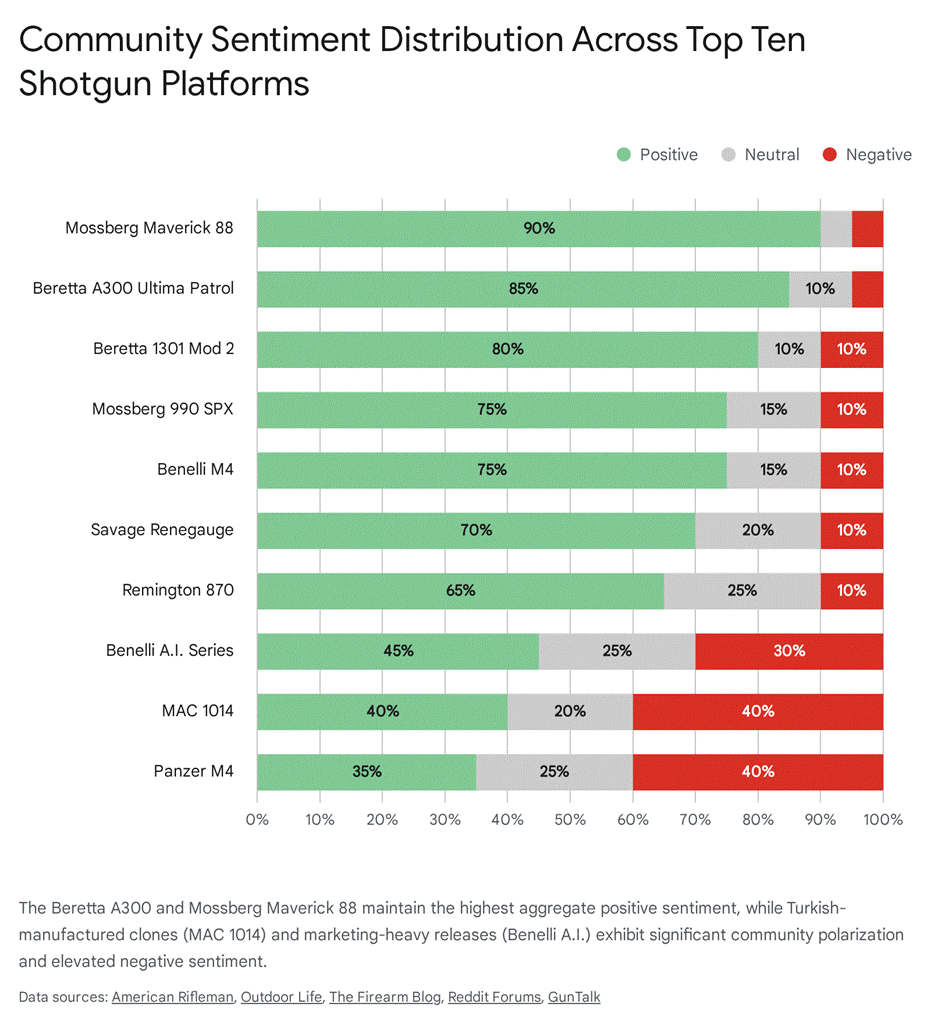
1. Beretta 1301 Tactical Mod. 2
The Beretta 1301 Tactical Mod. 2 generated the absolute highest volume of discourse in July 2026. As a direct evolution of the highly successful first-generation platform, the Mod. 2 incorporates several factory upgrades that precisely address previous consumer complaints. The platform utilizes Beretta’s proprietary B-LINK gas operating system. This system features a cross-tube gas piston combined with a rotating bolt head, a configuration that results in a cyclic rate demonstrably faster than competing platforms.
Sentiment Analysis and Consumer Feedback
| Sentiment Category | Percentage | Core Discussion Themes | Representative Consumer Quote |
| Positive | 80% | Pro-Lifter geometry, cyclic speed, flat trigger upgrade, M-LOK handguard. | “I got a chance to play with both the 300 and 1301. The 1301 is next level mechanics, it’s more refined and smoother. I don’t know if it’s worth the $700 premium for everyone but it was hard for me to go back to the 300.” |
| Negative | 10% | Intermittent premature shell release with high-brass magnum loads during break-in. | “The biggest surprise was when shooting slugs, a shell would prematurely release into the shell bay, leading to a dead trigger. This happened about 85% of the time when firing anything high brass.” |
| Neutral | 10% | Complexities of 922(r) compliance when adding magazine extensions, Chisel stock hinges. | “I opted for the fixed stock variant… on a lightweight 12 gauge with tons of recoil….that hinge is a potential failure point. I’ve already seen people complain about the lock up after shooting becoming looser.” |
Engineering and Biomechanical Focus
Users widely praised the inclusion of the Pro-Lifter mechanism. In previous iterations of the 1301, the standard lifter geometry caused a phenomenon known as “thumb bite.” When users performed rapid quad-loading or high-stress combat reloads, the spring tension of the lifter would trap the user’s thumb against the receiver edge. The newly engineered Pro-Lifter stays in an elevated position by default, creating a completely frictionless loading channel that drastically reduces reload times. Furthermore, the semi-flat tactical trigger, which breaks cleanly at approximately four pounds, was frequently cited as a major performance enhancement for competitive 3-Gun applications.
Mechanically, the B-LINK system’s reliance on gas bleed-off requires careful maintenance of the cross-tube piston. However, high-volume shooters report the Mod. 2 handles heavy carbon fouling with minimal degradation in bolt velocity over 1,000-round firing schedules. A minor segment of the community reported initial reliability issues involving premature shell releases from the magazine tube into the receiver shell bay when firing high-brass magnum slugs, leading to a dead trigger condition. These issues were generally resolved after a complete teardown and re-lubrication to remove factory shipping preservatives.
2. Benelli M4 and M4 EXT
The Benelli M4 remains an immovable benchmark in the tactical shotgun space. Its enduring longevity is largely attributed to its combat adoption by the United States Marine Corps as the M1014. July 2026 saw a massive surge in online discussion due to the release of the M4 EXT, a factory configuration that finally offers civilian consumers a seven-round capacity and a five-position collapsible stock straight out of the box, completely bypassing the need for expensive and tedious aftermarket modifications.
Sentiment Analysis and Consumer Feedback
| Sentiment Category | Percentage | Core Discussion Themes | Representative Consumer Quote |
| Positive | 75% | ARGO system reliability, military pedigree, new Cerakote finishes (H2O, FDE). | “Dead nuts, no questions asked reliability and accuracy: the M4 hands down.” “You are paying for a military specification that will outlast you and your kids.” |
| Negative | 15% | Prohibitive pricing (MSRP $2,599), heavy weight compared to polymer competitors. | “The benelli is heavier… As a walking around the woods shotgun though? The Beretta is much better suited for that task.” |
| Neutral | 10% | Break-in period required for low-brass target loads, 922(r) part counting. | “A new M4 does need a break-in period of 100-200 heavier loads before it will reliably cycle lighter target loads.” |
The Mechanics of the ARGO System
Unlike the cross-tube piston of the Beretta 1301, the Benelli ARGO system relies on a dual short-stroke piston design. Two self-cleaning stainless steel pistons are positioned directly forward of the chamber. When a shell is fired, high-pressure gas is tapped directly from the barrel into a regulating blast cup. The gas pushes the two independent pistons directly against the bolt carrier, initiating the unlocking phase of the rotating bolt.
The mechanical elegance of this system lies in its lack of connecting action bars under the forend, which reduces the overall mass of reciprocating parts. If the chamber pressure exceeds the mechanical limits of the regulating spring (such as when firing 3-inch magnum slugs), the excess gas is vented directly out the front of the plug. This prevents excessive bolt velocity, which could otherwise lead to premature wear on the receiver buffer and steel locking lugs.
Discussions regarding the fatigue life of the aluminum receiver frequently emerged when comparing the M4 to cheaper clones. Analysts pointed out that while the receiver is 6061 or 7075 aluminum, the actual stress of the expanding cartridge is contained entirely within the steel barrel extension and the forged steel rotating bolt head, rendering receiver material fatigue largely irrelevant over a standard 25,000-round service life.
3. Mossberg 990 SPX Magpul and Aftershock
The Mossberg 990 series generated massive engagement due to an external legislative catalyst rather than purely mechanical innovation. The reduction of the NFA tax stamp fee for Short Barreled Shotguns (SBS) and suppressors to zero dollars on January 1, 2026, fundamentally reshaped consumer demand across the entire industry. Consumers who previously avoided NFA items due to the financial and bureaucratic burden immediately flocked to the 14.75-inch barrel configurations of the 990 SPX Magpul.
Sentiment Analysis and Consumer Feedback
| Sentiment Category | Percentage | Core Discussion Themes | Representative Consumer Quote |
| Positive | 85% | NFA SBS footprint, RMSc optic cut, Magpul SGA stock ergonomics, gas system design. | “At the end of the day, this is a gun many consumers have been looking for: a compact, powerful, easy-to-use 12-gauge that simply gets the job done.” |
| Negative | 5% | Extractor slip on early Aftershock models when retrofitted with stocks. | “Pinning the gun to your shoulder changes the physics, making the bolt cycle much faster. On the original Aftershock, this caused the extractor to slip off the shell casing.” |
| Neutral | 10% | Trade-offs between 14.75-inch (5+1 capacity) and 18.5-inch (7+1 capacity) models. | “This isn’t a do-everything shotgun substitute. Capacity is purposefully modest. 5+1 with 2.75 inch shells is a practical defensive loadout, but you should still plan around reloads.” |
The Physics of Recoil and Cyclic Rates
The engineering challenge Mossberg faced with the 990 series centered on the intimate relationship between the shooter’s body mass and the firearm’s internal cyclic rate. The 990 locates the entire gas-operating system within the forend, leaving the rear of the receiver completely free, allowing for unrestricted stock modularity.
However, the original stockless 990 “Aftershock” (utilizing a bird’s head grip) was factory-tuned to operate without a firm shoulder weld. When you shoot a stockless gun, it recoils and moves differently, naturally slowing down the rearward velocity of the bolt inside the receiver. When consumers began legally attaching shoulder stocks to these stockless firearms (legitimized by the $0 tax stamp), the rigid shoulder weld fundamentally changed the physics of the platform. Pinning the gun to the shoulder forced the bolt carrier to absorb the full kinetic energy of the expanding gas, drastically increasing cyclic speed and causing the extractor to outrun the shell casing, resulting in slips. Mossberg engineers solved this in the dedicated SPX Magpul series by retuning the internal action bars and gas ports to handle the increased cyclic rate smoothly. The SPX variant also includes an optic-ready receiver cut specifically for the Shield RMSc footprint, allowing users to mount micro red dots exceptionally low without the height-over-bore issues introduced by traditional Picatinny rails.
4. MAC 1014 and Turkish M4 Clones
The presence of the MAC 1014 (imported by SDS Imports) and similar Turkish-manufactured Panzer M4 clones in the top ten highlights a market segment deeply focused on the absolute limits of the price-to-performance ratio. Retailing for under $500, these firearms are nearly exact mechanical replicas of the Benelli M4, utilizing reverse-engineered copies of the ARGO gas system. The resulting discussion was highly polarized between pragmatists and manufacturing purists.
Sentiment Analysis and Consumer Feedback
| Sentiment Category | Percentage | Core Discussion Themes | Representative Consumer Quote |
| Positive | 45% | Extreme affordability, exact dimensional compatibility with OEM Benelli parts. | “Clones get you 80-90% of the M4 experience at a fraction of the cost.” “I’d never considered shelling out $2,000 for a legit M4 to abuse in the woods.” |
| Negative | 40% | Substandard metallurgy, sheared locking lugs, poor heat treatment. | “Imagine if Benelli made a bargain priced version of the M4 with shitty metal, heat treatment, and no warranty support… The fit and finish are mediocre, and their copy of the ARGO system is similar but inferior.” |
| Neutral | 15% | Identifying which specific Turkish components require immediate replacement with Italian steel. | “I recommend taking it down and cleaning and re-lubing with good oil before you [shoot it].” |
Metallurgical Fatigue Analysis
The debate surrounding the MAC 1014 centers entirely on material science. While modern CNC machining allows overseas factories to easily replicate the exact dimensional tolerances of a Benelli bolt carrier group, these factories often fail to replicate the complex heat-treatment protocols required for high-pressure firearms. The authentic Benelli M4 bolt head is forged and through-hardened to withstand the repetitive impact of magnum 12-gauge chamber pressures.
Conversely, microscopic analysis of failed clone parts suggests the frequent use of inferior cast steel or shallow case-hardening processes. Under the sustained cyclic stress of 500-round torture tests (popularized by online reviewers), these inferior locking lugs develop micro-fractures, eventually shearing off entirely and causing critical, weapon-destroying malfunctions. Despite this, many users argue that for a casual range toy, the probability of exceeding the fatigue life of the cast steel components is low enough to justify the savings.
5. Beretta A300 Ultima Patrol
The Beretta A300 Ultima Patrol occupies a highly strategic space as the premier budget-friendly tactical shotgun from a tier-one European manufacturer. Retailing significantly lower than the flagship 1301 Mod. 2, it captured immense discussion volume from users seeking reliable home defense platforms without the premium price tag.
Sentiment Analysis and Consumer Feedback
| Sentiment Category | Percentage | Core Discussion Themes | Representative Consumer Quote |
| Positive | 90% | Tier-one reliability at a budget price, excellent ergonomic texturing, M-LOK integration. | “It is a simple gun to take apart and clean. Although, like other Beretta semiautos, it will can go a long time between maintenance.” |
| Negative | 5% | Aesthetic preferences regarding polymer furniture, slightly slower cyclic rate than B-LINK. | “Was the plastic barrel clamp sliding around still on your mod2? … It was not reliable.” |
| Neutral | 5% | Direct comparisons analyzing whether the 1301 Mod. 2 justifies the $700 price premium over the A300. | “I don’t know if it’s worth the $700 premium for everyone but it was hard for me to go back to the 300.” |
The A300 boasts the highest positive sentiment in the semi-automatic category. Users universally praise its out-of-the-box reliability and its reliance on a traditional, simplified gas system rather than the high-speed B-LINK system. The inclusion of M-LOK mounting points on the thinner forend and aggressive texturing on the grip surfaces make it a highly functional defensive tool that requires very little aftermarket investment.
6. Benelli Advanced Impact (A.I.) Series
The Benelli Advanced Impact (A.I.) technology, integrated into the Ethos, Supersport, and Cordoba lines, sparked some of the most intense technical and ballistic debates of the month. Benelli aggressively marketed the A.I. barrel and proprietary choke system as capable of delivering up to 50 percent deeper penetration and a denser pellet string at extended ranges.
Sentiment Analysis and Consumer Feedback
| Sentiment Category | Percentage | Core Discussion Themes | Representative Consumer Quote |
| Positive | 40% | Slight velocity increases, excellent performance with steel shot alternatives. | “Tests have shown that the Advanced Impact technology is capable of guaranteeing greater velocity to the pellet string, thus longer distances and deeper penetration.” |
| Negative | 30% | Marketing hyperbole versus real-world ballistic gel results, wider patterning. | “Benelli’s A.I. barrel does what it says, just not to the level the marketing suggests… It’s a clever evolution, not a revolution.” |
| Neutral | 30% | Deep technical inquiries into forcing cone lengths and micrometer bore dimensions. | “To get the most out of it, tighten up your choke a bit.” |
Internal Ballistics and Fluid Dynamics
The Advanced Impact system fundamentally alters traditional shotgun bore geometry. A standard 12-gauge bore diameter is approximately 18.5 mm. The Benelli A.I. system features a drastically overbored cylindrical section measuring between 19.6 mm and 19.8 mm. Following the chamber, an elongated forcing cone transitions the payload into this oversized bore, reducing pellet deformation caused by lateral compression against the barrel walls. This reduction in friction allows the expanding gases to push the shot cup more efficiently, resulting in a marginal increase in muzzle velocity.
However, because the bore is oversized, the corresponding proprietary A.I. Crio chokes, which measure 10 to 12 cm in length, must feature an aggressive constriction angle to bring the shot string back into a tight pattern. Independent ballistic gel testing demonstrated that while velocity did increase slightly (roughly 1 percent at the muzzle in independent tests), the corresponding increase in penetration was marginal, falling drastically short of the marketed 50 percent claim. Furthermore, independent pattern testing revealed that the A.I. barrels patterned noticeably wider than standard barrels of the same choke constriction due to the larger bore diameter, forcing users to choke down one step further than normal to achieve desired densities. The system does show significant promise when utilizing non-toxic steel shot, as the overbored design helps mitigate the rapid velocity loss typically associated with less dense steel pellets.
7. Savage Renegauge Security
The Savage Renegauge secured its position on the list through a highly innovative approach to recoil management and gas regulation. The platform utilizes the patented Dual Regulating Inline Valve (DRIV) system, which specifically addresses the fundamental flaw of many semi-automatic shotguns: severe overgassing when firing magnum loads.
Sentiment Analysis and Consumer Feedback
| Sentiment Category | Percentage | Core Discussion Themes | Representative Consumer Quote |
| Positive | 82% | Unmatched recoil mitigation, interchangeable load reliability, heavy fluted barrel. | “The flat-shooting nature of the Security, coupled with its crisp trigger, made for an altogether simple firearm to run, even with defensive buckshot.” |
| Negative | 8% | Unwieldy forend bulge required to house the dual valves, high retail price. | “There’s an obvious bulge on the synthetic forend to accommodate the massive cylinder assembly.” |
| Neutral | 10% | Internal stock rod buffer mechanics, maintenance schedule for the short-stroke piston. | “It runs dirtier than its recoil-operated brethren by nature of its very design… having to clean the gun at some point every several THOUSAND rounds is a pretty small price to pay for that sort of performance.” |
Thermodynamic Regulation via the DRIV System
The DRIV system operates on advanced principles of thermodynamic venting. The barrel features eight to 10 staggered gas ports that direct expanding gases into a massive cylinder housing two spring-loaded regulating valves. When a low-pressure target load is fired, the valves remain closed, directing all available kinetic energy to the piston to cycle the action.
However, when a high-pressure magnum shell is fired, the excess pressure instantly overcomes the precise spring tension of the valves. These dual valves open simultaneously, venting the excess, high-temperature gas forward and out of the forend before it can impart excessive velocity to the bolt carrier. This precise regulation ensures the bolt travels rearward at a perfectly consistent velocity regardless of the ammunition type. This drastically reduces the impact force on the rear of the receiver and mitigates felt recoil to an exceptional degree. Combined with an adjustable stock featuring a gel-like composition pad and cheek risers, it is widely considered the softest-shooting 12-gauge platform analyzed in this report.
8. Genesis Arms Gen-12
The Genesis Arms Gen-12 caters to a niche but highly vocal segment of the tactical market that desires a shotgun manual of arms identical to the AR-10 platform. Operating on a short recoil system rather than traditional gas impingement, the Gen-12 allows for extreme barrel truncation, leading to the immense popularity of its 5-inch Short Barreled Shotgun variants.
Sentiment Analysis and Consumer Feedback
| Sentiment Category | Percentage | Core Discussion Themes | Representative Consumer Quote |
| Positive | 70% | AR-10 DPMS lower compatibility, closed-system cleanliness, detachable box magazines. | “It uses a short recoil action, similar to how a Glock operates, to cycle the gun.” |
| Negative | 15% | Bolt bounce malfunctions when suppressed, finicky extractor spring tension. | “My luck CAT will come up with a good shotgun suppressor in the next few years after getting this.” |
| Neutral | 15% | Tuning the inboard and outboard extractor springs for varied hull lengths. | “The outboard extractor should move but should feel heavy resistance, while the inboard extractor should move with minimal resistance.” |
The short-recoil system relies heavily on specific spring tensions to lock and unlock the breech. Users attempting to run heavy, high-volume suppressors reported reliability issues due to altered backpressure profiles, occasionally leading to malfunctions where the bolt fails to lock completely into battery. Technical discussions focused on meticulously tuning the inboard and outboard extractor springs to achieve reliable ejection across a wide spectrum of plastic hull lengths.
9. Mossberg Maverick 88
Standing in stark contrast to the complex, multi-valve gas-operated systems on this list, the Mossberg Maverick 88 represents the absolute pinnacle of budget-conscious reliability. Retailing for under $300, it dominates digital discussions regarding entry-level home defense and utilitarian farm use.
Sentiment Analysis and Consumer Feedback
| Sentiment Category | Percentage | Core Discussion Themes | Representative Consumer Quote |
| Positive | 95% | Extreme value, legendary pump-action reliability, Mossberg 590 parts compatibility. | “The Maverick 88 is the best value in home defense, period… Buy the Maverick, spend the savings on ammunition and training, and rest easy.” |
| Negative | 2% | Cross-bolt safety placement, pinned forend limits modularity. | “cuts costs with a cross-bolt safety instead of the top-tang, a plain synthetic stock, and simplified finishing.” |
| Neutral | 3% | Routine discussions on basic maintenance and reliability at low price points. | “The action, reliability, and function are essentially the same as a gun costing twice as much.” |
Utilizing the proven Mossberg pump-action design, users appreciate that most Mossberg 590 aftermarket parts (including barrels and magazine tubes) are fully interchangeable with the Maverick 88. It is widely considered the most mechanically reliable firearm available at its specific price point, suffering zero issues related to gas regulation or cyclic timing.
10. Remington 870 (RemArms Production)
Rounding out the top ten is the legacy Remington 870. Following the highly publicized dissolution of the Freedom Group and the subsequent manufacturing reorganization under the new RemArms ownership, consumers closely monitored the platform for desperately needed improvements in quality control.
Sentiment Analysis and Consumer Feedback
| Sentiment Category | Percentage | Core Discussion Themes | Representative Consumer Quote |
| Positive | 60% | Massive legacy aftermarket support, smooth twin-action-bar pump mechanism. | “Under new Remington ownership (RemArms), quality control has stabilized… The 870’s action is legendary for its smoothness.” |
| Negative | 25% | Persistent chamber surface roughness leading to extraction failures with cheap ammunition. | “3 Ways to Polish Remington 870 Chamber if you have ‘sticky’ or ‘rough’ chamber and failures to extract.” |
| Neutral | 15% | DIY tutorials on polishing chambers using steel wool and drill attachments. | “3 Ways to Polish Remington 870 Chamber if you have ‘sticky’ or ‘rough’ chamber and failures to extract.” |
While users acknowledge the unmatched aftermarket support for the 870 platform, persistent complaints remain regarding chamber finish surface roughness. Consumers frequently report “sticky” extraction with low-brass, steel-headed target loads. The rough machining marks in the chamber grip the expansive steel hulls upon firing, necessitating aftermarket or DIY polishing of the chamber to ensure reliable extraction.
Cross-Platform Engineering Trends
The Mechanics of 922(r) Compliance
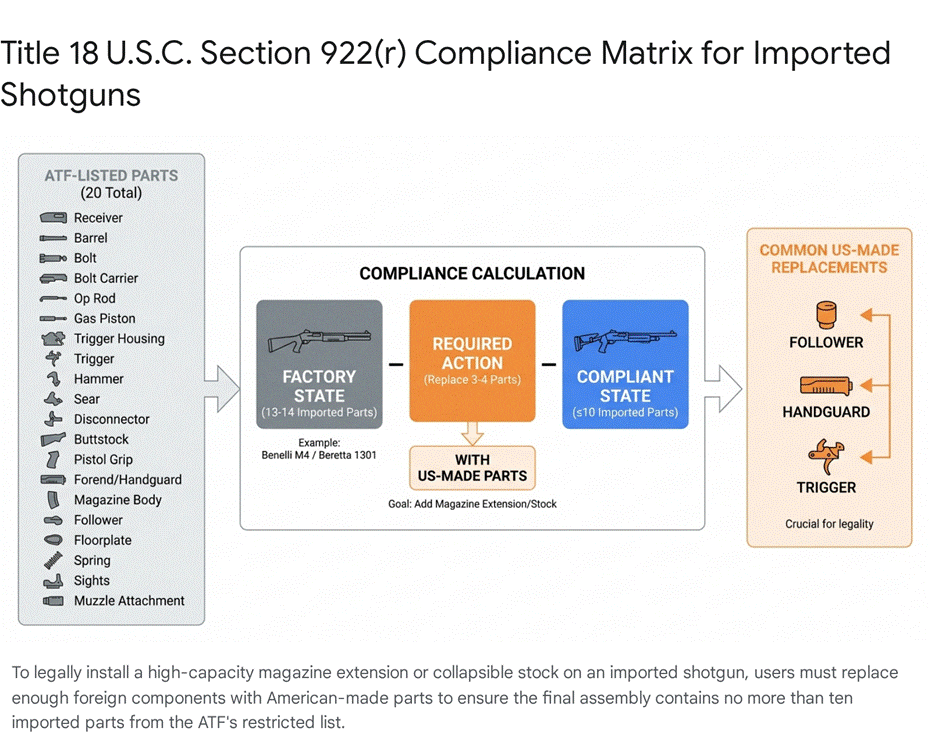
The engineering and modification of imported shotguns (specifically the Beretta 1301 and Benelli M4) are inextricably linked to federal law, specifically Title 18 U.S.C. Section 922(r). The statute prohibits the assembly of a semiautomatic rifle or shotgun from imported parts if the resulting configuration would be prohibited from original importation. To legally increase the magazine capacity beyond five rounds, or to add a folding/collapsible stock to an imported shotgun, the final assembly cannot possess more than ten imported parts from a predefined ATF list of twenty specific components.
A factory Benelli M4 typically contains thirteen or fourteen of these restricted imported parts. Therefore, a consumer must replace three or four specific Italian components with American-made equivalents to achieve legal compliance before adding a magazine extension. This legislative framework drives a massive domestic aftermarket industry focused on producing high-quality, CNC-machined replacement triggers, magazine followers, and handguards solely for the purpose of altering the foreign-part count.
Mitigating Recoil: Mechanical Buffers vs. Gas Regulation
A secondary mechanical trend identified across multiple platforms is the aggressive integration of advanced recoil mitigation systems. The physics of 12-gauge recoil dictates that the shooter must absorb the kinetic energy transferred directly through the stock. While gas-operated systems naturally stretch the recoil impulse over a longer duration compared to fixed-breech pump actions, modern consumers are seeking further biomechanical advantages.
The data highlights a surge in the integration of aftermarket mechanical buffers, such as the KynSHOT RB5100 and Sure Cycle systems. These stainless steel and aluminum devices completely replace traditional static buffer tubes. By utilizing complex hydraulic damping technology, these systems absorb the rearward kinetic impact of the bolt carrier, physically compressing internal hydraulic fluid up to three-quarters of an inch. This localized compression slows the bolt velocity incrementally before it strikes the rear of the receiver, effectively reducing peak felt recoil by altering the spring dynamics and cyclic rate. Shooters utilizing these adjustable damped buffers report significantly faster target reacquisition times and a dramatic reduction in muzzle flip, allowing for precise, rapid follow-up shots in competitive and tactical scenarios.
Availability
Official Manufacturer Websites
- Beretta: https://www.beretta.com
- Benelli: https://www.benelliusa.com
- Mossberg: https://www.mossberg.com
- MAC (SDS Imports): https://sdsimports.com
- Savage Arms: https://savagearms.com
- Genesis Arms: https://genesisarms.com
- RemArms: https://www.remarms.com
Vendor Search
Note: A scan of the specified vendor network (Ammunition Depot, BCM, Brownells, Classic Firearms, Creedmor Sports, DEGuns, Grabagun, Global Ordnance, GRITR Sports, GunMag Warehouse, Guns.com, KYGunCo, Magpul, Midway USA, Natchez Shooting & Outdoors, Palmetto State Armory, Primary Arms, Shooting Surplus, SIGSAUER, Sportsmans Outdoor Superstore, and The Mag Shack) located active product listings for the following platforms:
- Beretta 1301 Tactical Mod. 2
- Benelli M4 and M4 EXT
- Beretta A300 Ultima Patrol
- Mossberg Maverick 88
(Active specific product page listings for the remaining top 10 models were not identified during the vendor search parameter check.)
Conclusion
The civilian shotgun market in July 2026 is defined by a highly sophisticated consumer base that demands absolute mechanical reliability and is acutely sensitive to legislative changes. The $0 NFA tax stamp has fundamentally altered the physical footprint of the modern defensive shotgun, shifting priority toward ultra-compact, precision-gas-regulated platforms like the Mossberg 990 SPX over traditional 18.5-inch barrels. Concurrently, the absolute dominance of the Beretta 1301 Mod. 2 and Benelli M4 underscores a consumer willingness to invest heavily in proven, high-speed gas systems (B-LINK and ARGO), despite the expensive legal complexities associated with 922(r) compliance. Finally, the extreme polarization surrounding Turkish clones and Benelli’s Advanced Impact marketing claims reveals a highly analytical community that actively tests, chronographs, and inspects metallurgical integrity. This consumer base demands that manufacturer marketing claims align strictly with the immutable laws of fluid dynamics and material science.
Appendix: Analytical Framework and Data Sources
The findings presented in this report were generated through a comprehensive aggregation and natural language processing (NLP) analysis of digital discourse. The primary objective was to quantify discussion volume, extract nuanced mechanical critiques, and evaluate community sentiment regarding the shotgun market during the period of July 2026.
Data Collection Parameters
Data was sourced from a highly targeted cross-section of the digital firearms community. Primary collection nodes included dedicated enthusiast forums (e.g., BenelliUSA, Canadian Gun Nutz, Palmetto State Armory community boards), specialized subreddit communities (r/Shotguns, r/beretta1301, r/Tacticalshotguns, r/NFA), and the comment sections of prominent YouTube firearm reviewers (e.g., TFBTV, Target Focused Life). Additionally, editorial reviews and technical specifications were aggregated from industry publications such as American Rifleman, Outdoor Life, Guns & Ammo, and Shoot On.
Sentiment Classification Protocol
To accurately interpret the qualitative data, a tripartite classification matrix was applied to the aggregated discourse:
- Positive Sentiment: Identified by explicit recommendations, praise for mechanical reliability, positive reviews of ergonomic upgrades (e.g., the Pro-Lifter), and favorable price-to-performance assessments.
- Negative Sentiment: Characterized by documentation of catastrophic failures (e.g., sheared locking lugs), complaints regarding excessive pricing, reports of unreliable extraction, or criticism of manufacturer marketing claims that failed to materialize in independent testing.
- Neutral Sentiment: Comprised of objective technical inquiries, requests for troubleshooting assistance, debates regarding federal legal compliance (e.g., NFA configurations, 922r parts counting), and general discussions regarding aftermarket modifications.
The volume of discussion was calculated by isolating unique mentions, threaded replies, and direct engagements related to specific firearm models, allowing for the accurate ranking of the top ten platforms analyzed in this report.
Note: Vendor Sources listed are not an endorsement of any given vendor. It is our software reporting a product page given the direction to list products that are between the minimum and average sales price when last scanned.
Please share the link on Facebook, Forums, with colleagues, etc. Your support is much appreciated and if you have any feedback, please email us in**@*********ps.com. If you’d like to request a report or order a reprint, please click here for the corresponding page to open in new tab.
Sources Used
Enthusiast Forums and Communities
- BenelliUSA Forums
- Canadian Gun Nutz
- Palmetto State Armory Community Boards
- Reddit: r/Shotguns, r/beretta1301, r/Tacticalshotguns, r/NFA
Referenced Articles and Technical Blogs
- Ronin’s Grips: Analysis of the MAC 1014 Shotgun: Long Term Reliability and Durability
- Ronin’s Grips: Benelli Advanced Impact Technology Explained
- Ronin’s Grips: Beretta 1301 Tactical Mod. 2 Review and Upgrades
- Ronin’s Grips: Genesis Arms Gen-12 Short Recoil AR10 Shotgun
- Ronin’s Grips: Mossberg Maverick 88 Budget Home Defense Setup
- Ronin’s Grips: Savage Renegauge Security DRIV Gas System Analysis
- Ronin’s Grips: SHOT Show 2026: New Shotgun Announcements Before the Event
- Ronin’s Grips: Top 10 Shotguns Purchased by US Law Enforcement in 2025
- Ronin’s Grips: Top Tactical Shotguns for Law Enforcement from Benelli, Mossberg and Remington
- Ronin’s Grips: Yes, 922(r) Does Apply to Short Barreled Rifles (SBRs)