
Executive Summary and Strategic Outlook
Overall Fragility Score: 3.4 / 10.0
(Scale: 1.0 = Maximally Resilient, 10.0 = Total State Collapse)
Lifecycle Stage Assessment: Late Stability / Early Decline
This stability assessment of Canada reveals a clear contrast: while the country appears exceptionally stable on the surface, its core institutions are steadily weakening. Looking at global rankings, Canada remains highly resilient, supported by vast natural resources, a stable democracy, and favorable geography. The 2024 Fragile States Index (FSI) gives Canada an overall score of 18.60 out of 120, placing it securely among the world’s most stable nations1. However, a deeper analysis across multiple sectors shows growing vulnerabilities that suggest the country is transitioning from a period of mature stability into early decline.
The assigned fragility score of 3.4 captures the widening gap between Canada’s public stability and the ongoing slowing of its core institutions. This decline does not point to violent conflict or physical collapse. Instead, it shows up as misplaced investment, slow bureaucracy, shrinking independence, and a declining ability to protect democratic processes from foreign influence. Across several key areas, the state is finding it increasingly difficult to launch and sustain long-term national initiatives.
Core Drivers of Fragility:
First, misdirected investment and stagnant productivity have slowed economic innovation. Diverting capital into non-productive areas (mainly an overpriced housing market) led the Organisation for Economic Co-operation and Development (OECD) to project that Canada will experience the lowest real per capita Gross Domestic Product (GDP) growth among advanced economies from 2020 to 20304.
Second, slow purchasing systems and shrinking military capability have weakened national defense. The bureaucracy overseeing the Canadian Armed Forces (CAF) cannot equip or recruit personnel fast enough to replace departures, leaving the country increasingly reliant on allies to protect its own airspace and coastal waters6.
Third, vulnerabilities to foreign interference have threatened the fairness of democratic governance. Open political systems, combined with lightly regulated candidate nominations, have allowed foreign intelligence agencies to build influence networks within parliament9.
Fourth, concentrated supply chains and fragile key infrastructure create vulnerable points across the economy. Relying on a small number of critical shipping routes, combined with cyber intrusions by foreign governments, leaves essential services open to sudden disruptions11.
1. Military and Security Architecture
Public Safety Control and Power Projection
The Canadian government holds clear, unchallenged control over public safety within its borders. There are no rival armed groups or domestic insurgencies threatening internal security. Civilian leadership of the military is respected, and civil-military relations remain stable despite recent workplace culture challenges.
However, true security requires more than internal policing; it demands the ability to defend national territory and project force when necessary. In this regard, Canada’s capabilities are weakening. The vast size of the Canadian landmass, particularly in the Arctic, stretches monitoring and response efforts thin. For example, closing the planned Nanisivik naval refueling site in the High Arctic, which was meant to be a key hub for Northern sovereignty, highlights an inability to build and maintain military facilities in strategic areas, creating a gap that rival nations can exploit14.
Despite overall equipment and staffing shortages, Canada maintains highly skilled specialized units, notably within the Canadian Special Operations Forces Command (CANSOFCOM)17. Joint Task Force 2 (JTF2) remains a top-tier asset, expanding over thirty years from counter-terrorism into a versatile international response team17. Deployments to Haiti in 2024 and ongoing work integrating ground operations with cyber defense demonstrate strong capability within these specialized teams18. Canadian forces also work smoothly alongside international partners, as shown during joint exercises in the Indo-Pacific, such as Balikatan 202619.
Military Staffing Shortages and Hiring Delays
The strength of Canada’s defense organization is being undermined by a growing staffing crisis. The military currently lacks roughly 15,000 personnel out of an authorized total of 71,500 Regular Force and 30,000 Reserve members20. This shortage limits the military’s capacity to respond to domestic disasters, maintain overseas commitments, or fulfill core defence duties.
Although updated pay and policy changes brought in a thirty-year high in job applications (nearly 192,000 between April 2022 and March 2025), hiring processes remain clogged6. An investigation by the Auditor General showed that only 1 in 13 applicants successfully completes the recruitment process6. Outdated IT systems and major processing backlogs slow progress. Average hiring times range from 245 to 271 days, while the backlog for security clearances exceeds 8,300 cases22. Around 40% of applications fail initial checks, and over half of applicants withdraw because the process takes too long6.
Long-term stability is further threatened by high exit rates among new recruits. Early-career departures have reached 9.4% for privates, aviators, and junior sailors, more than double the overall military average of 4.3%24. This loss of talent is driven by training delays. Training facilities operate below capacity due to a lack of instructors and working equipment. Recruits often wait over 200 days for specialized trade courses, leading to months of downtime that push new members to leave25.
As a result, specialized positions remain understaffed. By mid-2024, pilot positions were filled at only 89.1%, while signal technicians, engineers, and ammunition specialists faced severe shortages20.
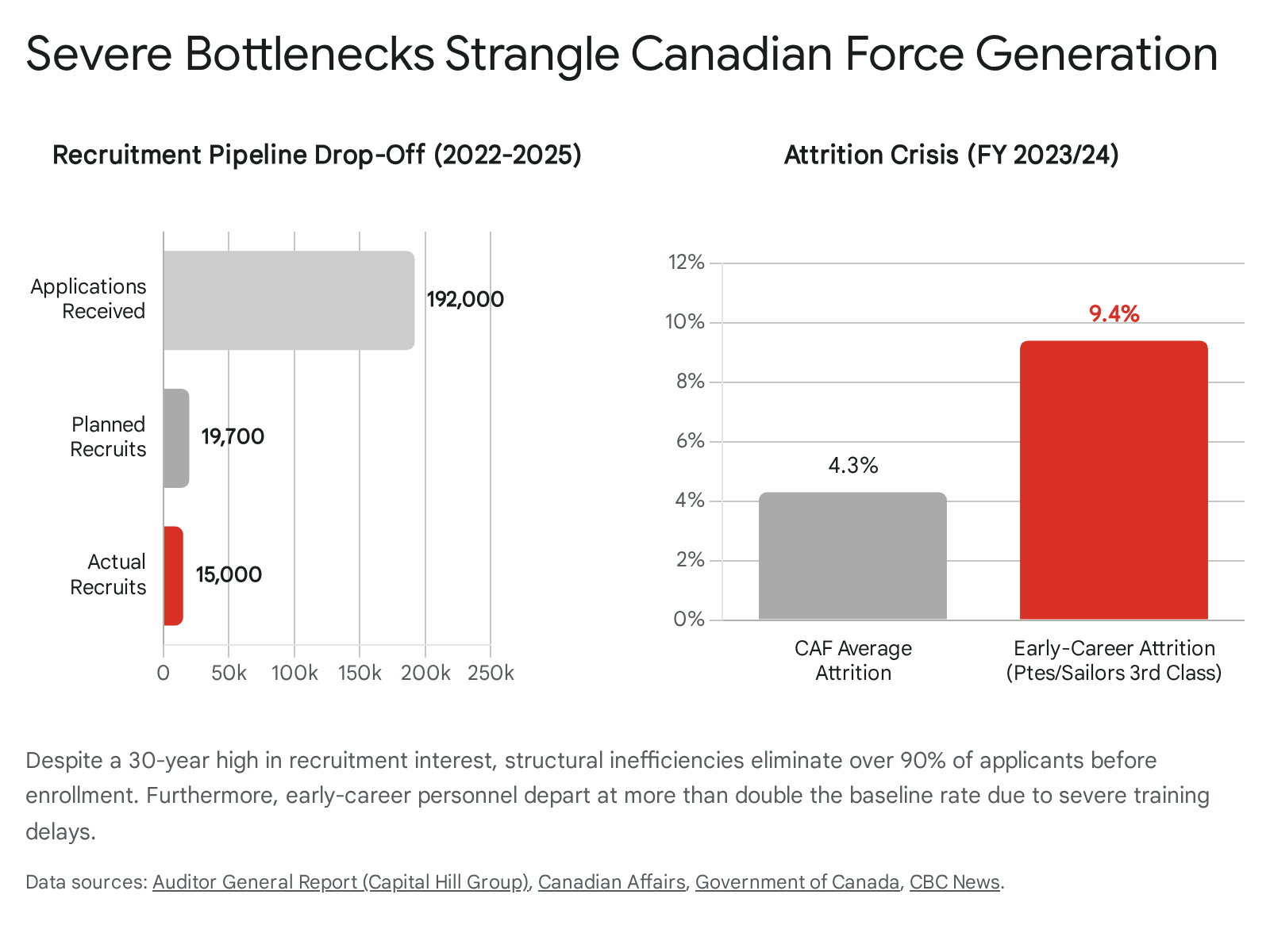
These combined staffing problems have led to a noticeable drop in military readiness, with defense metrics showing the military is missing its own readiness targets.
| Force Element Category | Target Readiness Level | Actual Serviceability (FY 22/23) | Readiness Deficit |
| Overall Force Elements | 90.0% | 61.0% | -29.0% |
| Maritime Fleets | 90.0% | 51.2% | -38.8% |
| Land Fleets | 90.0% | 56.0% | -34.0% |
| Aerospace Fleets | 90.0% | 43.9% | -46.1% |
| Data derived from Department of National Defence actuals, illustrating systemic capability deficits across all primary domains20. |
Defense Industry Delays and Equipment Purchasing Problems
The inability to update equipment turns temporary capability gaps into lasting problems. Canada’s defense purchasing system suffers from heavy bureaucracy, leading to large cost overruns and multi-year delays.
A clear example is the River-class destroyer program. Intended to replace aging frigates and retired destroyers, the program was originally budgeted at $26.2 billion for 15 ships7. Updated estimates by the Parliamentary Budget Officer (PBO) project purchase costs of $80 billion to $84 billion, with total lifetime costs exceeding $300 billion7. Because final delivery is not expected until the late 2040s, the Navy will have to operate older ships well past their intended service life, raising maintenance costs and operational risks7.
To address these industry limits, the government launched the Defence Industrial Strategy (DIS) in 2026. Backed by $81.8 billion in defense funding, the DIS sets a goal to award 70% of defense contracts to Canadian companies28. The strategy focuses on building domestic capabilities in aerospace, digital systems, and ammunition, including plans for local production of key explosive materials by 202928. While the plan projects 125,000 new jobs, analysis indicates major practical hurdles during implementation28.
The domestic manufacturing sector currently lacks the capacity to meet a 70% target without slowing delivery schedules further. While NATO recommends maintaining a 30-day supply of ammunition, Canada currently holds only enough artillery ammunition for a few days of intensive operations30. In addition, key sectors remain heavily concentrated. For instance, small arms supply relies largely on a single primary manufacturer (Colt Canada), creating supply chain risks31. Even successful updates, such as replacing the C14 rifle with the multi-caliber C21, are mainly driven by the need to simplify maintenance and parts purchasing32.
Furthermore, Canada’s goal to reach NATO’s defense spending target of 2% of GDP by 2032 faces skepticism. Analysis by the PBO shows government projections relied on unrealistic growth models that assumed a prolonged recession to make spending appear higher as a percentage of GDP33. Meeting the target by 2032 requires doubling the defense budget from $41 billion to $81.9 billion35. This increase will place significant pressure on federal finances, likely requiring tax increases or spending cuts elsewhere36.
Radar Coverage and Surveillance Gaps
Canada’s surveillance network leaves large geographic areas unmonitored, creating gaps in North American Aerospace Defense Command (NORAD) coverage. The aging North Warning System uses line-of-sight technology that cannot reliably track low-flying missiles, fast glide weapons, or submarines under Arctic ice. For example, foreign icebreakers and deep submersibles can operate near underwater cables without detection due to a lack of acoustic tracking equipment38. This gap was also highlighted when high-altitude surveillance balloons transited Canadian airspace undetected39.
To address these surveillance gaps, Canada agreed to a $2.5 billion deal with Australia to acquire Arctic Over-the-Horizon Radar (A-OTHR) technology38. By bouncing high-frequency signals off the atmosphere, the new radar can monitor areas up to 3,000 kilometers away, effectively seeing beyond the horizon38.
While this improves early-warning abilities, the deployment schedule creates operational risks. The system will not be partially operational until late 2029, with full completion extending into the 2030s41. Additionally, while over-the-horizon radar covers wide areas, it lacks the precision needed to guide missile defense targeting directly41. Until the system is ready, Canada remains heavily reliant on United States tracking assets to monitor its northern airspace.
2. Political and Governance Systems
Centralized Power and Provincial Divide
Canada’s government operates under a challenging divide: executive decision-making is concentrated at the federal level, while provincial governments hold significant local authority. Federal power is centered in the Prime Minister’s Office (PMO), creating an environment where policy decisions can become isolated from broader legislative input and public service advice.
This structure often limits the government’s ability to carry out uniform national plans, as Ottawa lacks the power to enforce policies across provincial lines. This friction shows clearly in internal trade barriers. Conflicting provincial rules, separate trade licensing, and local market protections restrict the flow of goods, services, and workers within the country43. Economic estimates suggest that removing internal trade rules could increase national GDP by 4% to 7%, unlocking significant economic activity43. The difficulty federal leaders face in resolving these regional disagreements highlights practical limits on national policymaking44.
| Fragile States Index (2024) – Key Sub-Indicators | Score (0-10, 10 = Most Fragile) | Systemic Implication |
| Factionalized Elites | 2.50 | Indicates moderate but growing political polarization and provincial-federal friction2. |
| Uneven Economic Development | 2.50 | Reflects regional resource disparities and the economic friction caused by interprovincial trade barriers. |
| State Legitimacy | 0.30 | Demonstrates high overall baseline trust in democratic institutions, though recent foreign interference scandals threaten this metric. |
| Security Apparatus | 2.40 | Highlights the growing strain on intelligence services and the degradation of military readiness. |
Foreign Influence and Political Weaknesses
A persistent challenge to Canada’s political system is foreign interference targeting democratic institutions. Official reviews, including the 2024 report by the National Security and Intelligence Committee of Parliamentarians (NSICOP) and public inquiry findings, confirmed that foreign actors (including entities linked to China, India, Iran, and Russia) have conducted interference activities in Canada9.
These vulnerabilities exist partly because political parties manage local nominations with minimal federal oversight. Party nominations rely on local rules that can be influenced with targeted effort. Intelligence reports described cases where foreign operatives sought to influence local nomination contests through coordinated voting and local campaign support9.
Reports also noted that interference efforts have reached elected officials. Classified assessments reviewed by oversight committees indicated that some parliamentarians interacted with foreign intelligence figures or shared internal political information, raising concerns about foreign influence in legislative work9.
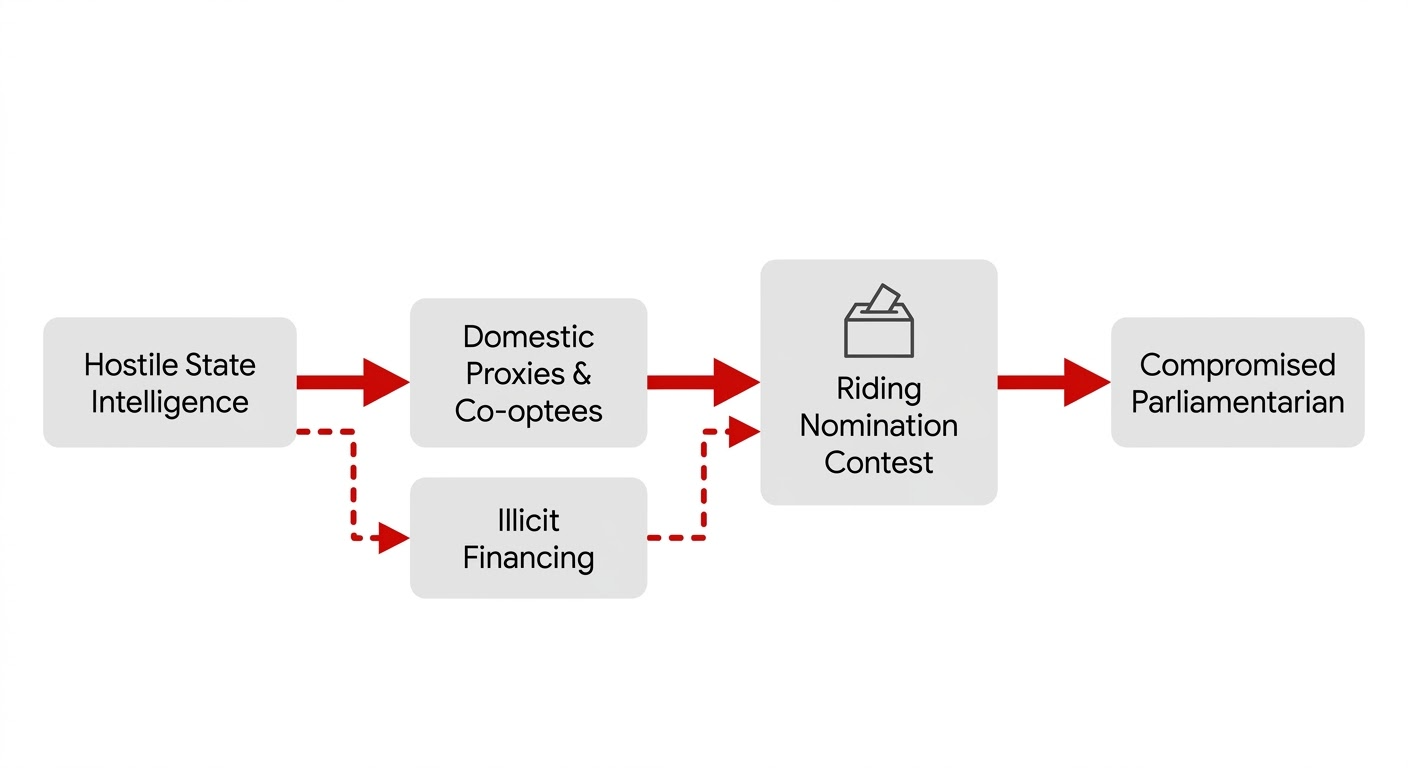
Addressing these threats has been complicated by communication gaps between security agencies and political leaders. Oversight reviews noted differing opinions between security officials and political advisors regarding what actions constitute foreign interference versus standard diplomatic outreach. These differences delayed national responses. Additionally, because protecting classified information limits public disclosure, authorities have hesitated to release specific details or lay charges, which has fed public skepticism regarding democratic integrity9. The Public Inquiry into Foreign Interference emphasized that online misinformation and targeted social media campaigns pose lasting risks to voter confidence51.
3. Economy and Infrastructure
Economic Productivity and Capital Investment
Canada’s economy shows a mismatch between general financial wealth and workplace productivity. The country continues to attract foreign investment, with Foreign Direct Investment (FDI) stock reaching $1.6 trillion by late 2025, driven by mining, manufacturing, and technology supply chains52. Canada also recorded a trade surplus of $8.8 billion in mid-2026, supported by strong energy exports54.
Despite these positive numbers, underlying domestic investment remains weak. The OECD projects Canada will average real per capita GDP growth of just 0.7% annually from 2020 to 2030, ranking lowest among advanced economies. This slow growth stems from where capital flows: instead of investing in business expansion, new technology, research, or equipment, a large share of Canadian investment remains concentrated in residential real estate55.
Heavy regulation and slow technology adoption have slowed private sector expansion56. Furthermore, Canadian investments abroad have slowed, reflecting cautious corporate spending and a preference for established domestic markets52.
Economic Vulnerability: Household Debt
The economy’s ability to handle financial shocks (such as interest rate changes or global inflation) is limited due to high consumer debt levels.
In early 2026, household debt reached 179.6% of disposable income, before settling near 175.1% later in the year58. This means Canadians owe roughly $1.75 for every dollar of disposable income they earn. Total consumer debt has passed $3.25 trillion, tied mostly to home mortgages61.
While overall household net worth appears high on paper ($19 trillion in 2026), much of this wealth is tied up in home values and is difficult to access quickly62. A study by the C.D. Howe Institute showed that while net worth has grown for older demographics, most of that gain is locked in real estate, which cannot easily be converted into cash during emergencies64. Consequently, debt payments accounted for 14.75% of disposable income in early 202659.
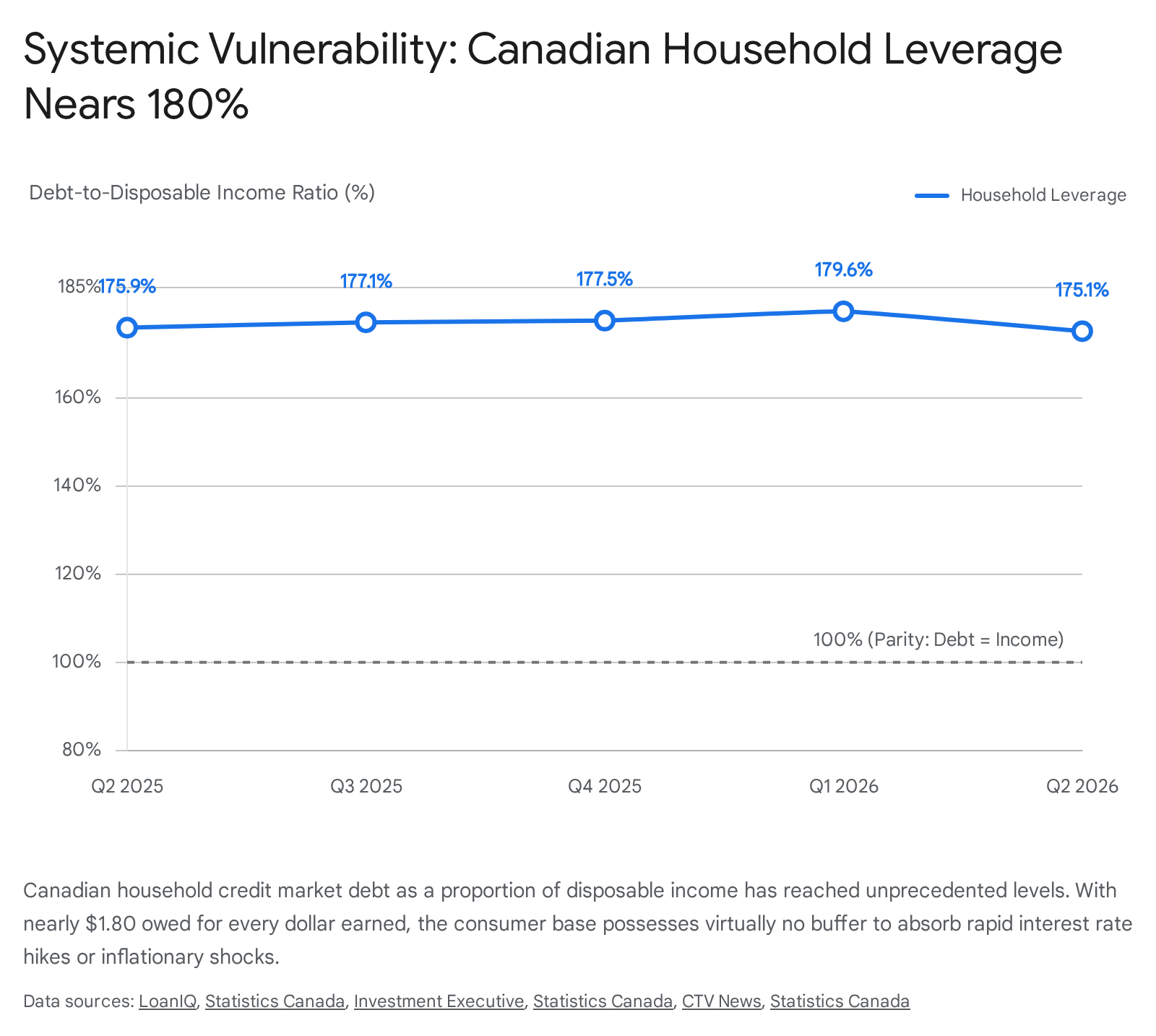
Because so much household wealth depends on property values, a drop in real estate prices or higher borrowing costs would directly impact household finances. Personal savings rates have dropped to 3.5% as daily living costs rise62. This leaves households with limited savings buffers, meaning an economic downturn could lead to increased loan defaults and reduced consumer spending across the broader economy.
Transport Networks and Cybersecurity Risks
Canada’s shipping routes and digital infrastructure rely heavily on a few primary corridors, creating potential congestion points.
This vulnerability was visible during labor disruptions at the Ports of Vancouver, Prince Rupert, and Montreal in late 2024. These three ports process roughly 40% of Canada’s sea freight12. The work stoppages halted an estimated $1 billion in daily trade, slowing shipments at key terminals12. Shipping delays forced expensive re-routing through U.S. ports and caused backlogs along freight rail lines. Even after work resumed, port cargo waiting times remained high into 202567. This demonstrated that inland rail connections can struggle to match port unloading speeds during peak periods13.
At the same time, critical utility and transit networks face growing cybersecurity risks. The Canadian Centre for Cyber Security (CCCS) reported that foreign state-sponsored groups regularly probe Canada’s power grid, pipelines, transport hubs, and water facilities11. Connecting older industrial control systems to modern internet networks has created new security vulnerabilities11.
Cyber security monitoring shows that sophisticated hackers focus on establishing hidden access points inside critical networks that could be activated during future international disputes11. Alongside state actors, commercial ransomware attacks frequently disrupt smaller public organizations, including municipalities, healthcare boards, and local utility providers11. These smaller entities deliver essential services but often lack the IT budgets needed to maintain advanced network defenses, leaving them open to cyber extortion.
4. People and Social Cohesion
Demographic Changes and Economic Pressures
Canada’s social cohesion is feeling the effects of demographic shifts and economic pressure. The country relies on immigration to support its aging workforce, contributing to a population growth rate of roughly 1.2% per year, the highest in the G772. While this immigration maintains overall workforce numbers, rapid growth has increased demand on regional housing supply, health services, and transit infrastructure.
Housing costs have made homeownership difficult for younger residents and recent newcomers. At the same time, youth unemployment (ages 15 to 24) rose to 14.3% in 2025, more than double the rate for older workers21. This gap in economic opportunity risks creating frustration among younger cohorts who feel homeownership and financial stability are becoming harder to achieve.
Public Trust and Social Division
Long viewed as a stable and peaceful nation, Canada has seen a slight drop in public safety rankings. The Global Peace Index noted a 5.8% decline in Canada’s score, placing it 14th worldwide73. This change was linked to modest increases in violent crime rate metrics, international trade tensions, and growing political debate online.
These political divisions are sometimes amplified by online propaganda campaigns. Foreign actors use automated social media accounts to deepen political arguments, criticize community leaders, and reduce public trust in democratic institutions51. When combined with rising living costs and unanswered questions about political interference, public confidence in democratic processes can weaken over time.
Synthesis and Advanced Analysis
Connected System Risks
Because national systems are closely linked, a disruption in one area can quickly cause secondary problems across others.
Chain Reaction Scenario: Transport to Debt Impact
- Initial Event (Cyber/Transport): A cyberattack disables the digital scheduling systems controlling rail movement at the Port of Vancouver.
- Stage 1 (Shipping): Port operations slow down dramatically. Shipping delays multiply, stranding over $1 billion in daily goods and causing supply shortages for manufacturing and agricultural sectors12.
- Stage 2 (Economy): Goods shortages push up retail prices. To manage rising inflation, the Bank of Canada keeps interest rates elevated.
- Stage 3 (Households): Households carrying high debt (averaging 175% of income) struggle with mortgage renewals at higher interest rates. Increased debt payments lead to reduced consumer spending and falling home prices.
- Stage 4 (Government): Lower consumer spending reduces government tax revenues. Facing budget deficits alongside commitments to increase defense spending toward $81.9 billion35, the government is forced to delay major infrastructure and defense orders.
Scenario Analysis: Unexpected Leadership Changes
If an unexpected political crisis were to suddenly disrupt federal leadership, the centralized nature of executive decision-making could lead to temporary policy delays across government departments.
- Administrative Delays: Because strategic choices depend heavily on top leaders, major purchasing decisions (such as finalizing ship building contracts or Arctic radar land purchases) would likely pause8.
- External Influence Efforts: Foreign intelligence operations might attempt to influence subsequent leadership races or candidate selections using digital campaigns and targeted local funding9.
- Provincial Disagreements: Provincial leaders might use a federal pause to push for greater local control over resources and regulations, making national policy agreement harder to reach.
Key Indicators to Monitor
Analysts should track the following measurable indicators over the next 12 to 18 months to gauge whether these underlying challenges are worsening:
| EWI Category | Specific Indicator | Threshold for Action |
| Force Generation | CAF Monthly Intake vs. Attrition | Net military personnel numbers fall for three consecutive quarters despite faster application processing, pointing to hiring and retention issues. |
| Economic Fragility | Debt Service Ratio | Debt payment obligations pass 15.5% of disposable income (up from 15.13% in 2023), signaling increased financial strain on households and banks63. |
| Infrastructure | Container Dwell Times | Container waiting times at the Port of Vancouver stay above 8 days outside of labor disputes, showing persistent inland transport bottlenecks. |
| Foreign Interference | Judicial or Legislative Stagnation | Recommended security updates or political transparency rules remain unadopted after 12 months, showing slow policy responses to foreign interference. |
Five-Year Trajectory Forecast (to 2031)
Five-Year Outlook: Over the next five years, Canada is likely to face continued institutional pressure, leading to greater reliance on international partners and slower progress on domestic goals. Some independent policy forecasts already mark Canada as under strain (giving it a score around 5.2 out of 10) due to gradual declines in economic and defense flexibility76.
Canada will struggle to hit NATO’s 2% GDP defense target by 2032. Reaching the required $81.9 billion in defense spending would require substantial budget reallocations or higher taxes34. As a result, the military may need to adjust its force goals and focus on key priorities6. Major equipment orders, including new ships, will likely experience ongoing timeline adjustments, maintaining reliance on North American defense partnerships7.
Economically, internal trade barriers and housing-focused investment will continue to weigh on per capita growth, keeping GDP expansion modest5. Socially, housing affordability will remain a key public concern. At the same time, cyber threats to infrastructure will require constant monitoring to protect energy, transport, and communication services.
Overall, Canada is expected to remain a stable and prosperous democracy, though one that must manage significant domestic constraints while relying closely on international alliances for security and growth.
Please share the link on Facebook, Forums, with colleagues, etc. Your support is much appreciated and if you have any feedback, please email us in**@*********ps.com. If you’d like to request a report or order a reprint, please click here for the corresponding page to open in new tab.
Sources Used
- Canada Fragile state index – Économie mondiale, https://fr.theglobaleconomy.com/Canada/fragile_state_index/
- Canada Fragile state index – data, chart – TheGlobalEconomy.com, https://www.theglobaleconomy.com/Canada/fragile_state_index/
- What do the Colors and Categories in the Index and on the Map, https://fragilestatesindex.org/frequently-asked-questions/what-do-the-colors-and-categories-in-the-index-and-on-the-map-signify/
- OECD Sees Canada’s Growth Slowing to 0.9% in 2026 as U.S., https://www.todocanada.ca/oecd-sees-canadas-growth-slowing-to-0-9-in-2026-before-picking-up-next-year-q3/
- OECD predicts Canada will be the worst performing advanced, https://www.bcbc.com/insight/oecd-predicts-canada-will-be-the-worst-performing-advanced-economy-over-the-next-decade-and-the-three-decades-after-that
- Canadian Forces bleeding applicants in recruitment process: report, https://www.canadianaffairs.news/2025/10/21/recruitment-process-sees-applicants-avoiding-caf/
- The Life Cycle Cost of the Canadian Surface Combatants, https://distribution-a617274656661637473.pbo-dpb.ca/747dfffc97de30adc19e38143f28b6e8334a0f7510c5c3a94c465a41c66cf504
- Estimated cost of warship fleet rises to $84B thanks to delays, inflation, https://www.ctvnews.ca/atlantic/article/estimated-cost-of-warship-fleet-rises-to-84b-thanks-to-delays-inflation-pbo/
- Some Canadian politicians are ‘wittingly’ participating in foreign, https://globalnews.ca/news/10541842/politicians-witting-participants-foreign-interference/
- Special Report on Foreign Interference in Canada’s Democratic, https://www.nsicop-cpsnr.ca/reports/rp-2024-06-03/special-report-foreign-interference.pdf
- Canada’s cyber threat assessment points at the operators least able, https://northwardab.ca/news/canada-critical-infrastructure-cyber-exposure/
- BC Ports Lockout & Montreal Strike Update 2026 – FreightAmigo, https://www.freightamigo.com/en/blog/logistics/what-we-know-about-the-bc-ports-lockout-and-port-of-montreal-strike/
- Inland bottlenecks choking B.C. trade, says DP World Canada exec, https://www.biv.com/news/transportation/inland-bottlenecks-choking-bc-trade-says-dp-world-canada-exec-11908177
- Canada to Discontinue Construction of Nanisivik Arctic Naval Facility, https://maritime-executive.com/article/canada-to-discontinue-construction-of-nanisivik-arctic-naval-facility
- Canadian military to shutter Nanisivik naval facility in the Arctic, https://www.reddit.com/r/CanadianForces/comments/1tjrgpb/canadian_military_to_shutter_nanisivik_naval/
- Ottawa reveals plans to shut down and offload Nanisivik naval port, https://www.cbc.ca/news/canada/north/ottawa-reveals-plans-to-shut-down-and-offload-nanisivik-naval-port-on-baffin-island-9.7207826
- Global Special Operations Forces: A Comparative Assessment of, https://blog.roninsgrips.com/global-special-operations-forces-a-comparative-assessment-of-capabilities/
- An Analytical History and Future Assessment of Canada’s Joint Task, https://blog.roninsgrips.com/facta-non-verba-an-analytical-history-and-future-assessment-of-canadas-joint-task-force-2/
- Balikatan 2026: A Multinational Security Milestone – Ronin’s Grips, https://blog.roninsgrips.com/balikatan-2026-strategic-shifts-multilateral-integration-and-operational-lessons-in-the-indo-pacific/
- Personnel – Canada.ca, https://www.canada.ca/en/department-national-defence/corporate/reports-publications/proactive-disclosure/mnd-mandate-priorities-10-october-2024/personnel.html
- CAF Achieves Record Recruitment in 30 Years – Canadian Forces, https://canadiandefencereview.com/caf-achieves-record-recruitment-in-30-years/
- Recruiting For Canada’s Military – Auditor General Report 2025, https://capitalhillgroup.ca/recruiting-for-canadas-military-auditor-general-report-2025/
- Canadian Military Hits Highest Recruitment In 30 Years, https://www.eurasiareview.com/22052026-canadian-military-hits-highest-recruitment-in-30-years/
- Evaluation of Canadian Armed Forces Retention – Canada.ca, https://www.canada.ca/en/department-national-defence/corporate/reports-publications/audit-evaluation/evaluation-caf-retention.html
- Leaked Canadian military report shows many new recruits … – CBC, https://www.cbc.ca/news/politics/military-retention-program-defunding-1.7536509
- River-class destroyer (2030s) – Wikipedia, https://en.wikipedia.org/wiki/River-class_destroyer_(2030s)
- River-class Destroyer Project – Canada.ca, https://www.canada.ca/en/department-national-defence/services/procurement/canadian-surface-combatant.html
- CANADA’S DEFENCE INDUSTRIAL STRATEGY, https://www.canada.ca/content/dam/dnd-mdn/documents/reports/industrial-strategy/defence-industrial-strategy-update-en.pdf
- Canada’s New Defence Industrial Strategy: What Business Needs to, https://cassels.com/insights/canadas-new-defence-industrial-strategy-what-business-needs-to-know/
- Scaling Canada’s Defence Industrial Strategy (DIS) – NAOC, https://natoassociation.ca/from-buyer-to-builder-scaling-canadas-defence-industrial-strategy-dis/
- PGW Defence Technologies Inc.: Comprehensive Strategic, https://blog.roninsgrips.com/pgw-defence-technologies-inc-comprehensive-strategic-assessment-and-operational-analysis/
- PGW Defence Technologies C14 Timberwolf Series – Ronin’s Grips, https://blog.roninsgrips.com/strategic-assessment-and-technical-analysis-pgw-defence-technologies-c14-timberwolf-series/
- Defence spending needs to double to meet NATO target by 2032: PBO, https://www.ipolitics.ca/2024/10/30/defence-spending-needs-to-double-to-meet-nato-target-by-2032-pbo/
- The Fiscal Implications of Meeting the NATO Military Spending Target, https://www.pbo-dpb.ca/en/publications/RP-2425-020-S–fiscal-implications-meeting-nato-military-spending-target–repercussions-financieres-atteinte-cible-depenses-militaires-fixee-otan
- Federal government would have to double military spending to meet, https://www.cbc.ca/news/politics/pbo-canada-nato-double-spending-1.7368031
- As PBO says NATO target plan is off, here’s why it matters to the, https://globalnews.ca/news/10847260/canada-nato-target-defence-spending-pbo-military-impact/
- Annual military spending must reach $81.9 billion by 2032-33 to, https://www.pbo-dpb.ca/en/news-releases–communiques-de-presse/annual-military-spending-must-reach-819-billion-by-2032-33-to-meet-natos-spending-target-new-pbo-report-finds-les-depenses-militaires-annuelles-doivent-atteindre-819-milliards-de-dollars-dici-a-2032-33-pour-respecter-lobjectif-de-depenses-de-lotan-selon-un-nouveau-rapport-du-dpb
- Australia and Canada sign Arctic radar deal to boost NORAD, https://en.highnorthnews.com/politics/australia-canada-sign-25-billion-arctic-radar-deal-as-ottawa-accelerates-norad-modernization/1114335
- The Problem with NORAD Modernization: Addressing Emerging, https://www.queensu.ca/cidp/publications/policy-briefs/problem-norad-modernization-addressing-emerging-threats-china
- Aecon Partnership Advances Arctic Over-the-Horizon Radar Program, https://www.vanguarddefence.ca/p/building-canada-s-northern-shield-aecon-partnership-advances-arctic-over-the-horizon-radar-program
- Canada Finalizes Landmark Australian Arctic Radar Deal, https://canadiandefencereview.com/canada-finalizes-landmark-australian-arctic-radar-deal/
- Canada advances Arctic defence on Over-the-Horizon Radar, https://www.canada.ca/en/defence-investment-agency/news/2026/06/canada-advances-arctic-defence-on-over-the-horizon-radar-capability-through-partnership-with-australia.html
- Internal Trade in Focus: Ten Ways to Improve the Canadian Free, https://cdhowe.org/publication/internal-trade-focus-ten-ways-improve-canadian-free-trade-agreement/
- Eyes on the Prize: A Game Plan to Speed Up Removal of Internal, https://cdhowe.org/publication/eyes-on-the-prize-a-game-plan-to-speed-up-removal-of-internal-trade-barriers-in-canada/
- Let’s Reclaim the Billions We’re Paying for Canada’s Internal Trade, https://cdhowe.org/publication/eichenbaum-alexopoulos-and-kronick-lets-reclaim-billions-were-paying-canadas/
- Tangled in Red Tape: How Canada Can Free Its Internal Trade Market, https://cdhowe.org/publication/tangled-in-red-tape-how-canada-can-free-its-internal-trade-market/
- List of countries by Fragile States Index – Wikipedia, https://en.wikipedia.org/wiki/List_of_countries_by_Fragile_States_Index
- Foreign Interference: Overview of Hostile Activities, https://www.publicsafety.gc.ca/cnt/trnsprnc/brfng-mtrls/prlmntry-bndrs/20250226-1/17-en.aspx
- A foreign interference report lobbed bombshells at Parliament. Now, https://www.cbc.ca/news/politics/foreign-interference-china-india-nsicop-1.7225862
- 2 new foreign interference cases in Canada disclosed by CSIS, https://www.youtube.com/watch?v=hciSOVgoaas
- Final Report Vol. 1 (Janua – Foreign Interference Commission, https://foreigninterferencecommission.ca/fileadmin/report_volume_1.pdf
- The Daily — Foreign direct investment, 2025, https://www150.statcan.gc.ca/n1/daily-quotidien/260429/dq260429b-eng.htm
- FDI Report 2025 – Invest in Canada, https://www.investcanada.ca/FDIReport2025
- Canada’s balance of international payments, second quarter 2026, https://www150.statcan.gc.ca/n1/daily-quotidien/260827/dq260827a-eng.htm
- Homes are a bigger share of Canada’s economy than in other G7, https://www.reddit.com/r/TorontoRealEstate/comments/16s3ljo/homes_are_a_bigger_share_of_canadas_economy_than/
- OECD raises red flag about Canada’s ‘stagnating productivity, https://www.forexfactory.com/news/793402-oecd-raises-red-flag-about-canadas-stagnating-productivity/comment/11266902
- Show Me the Money: Canada’s Financial Flows and … – TD Economics, https://economics.td.com/ca-financial-flows-2025
- Canada Households Credit Market Debt to Disposable Income, https://tradingeconomics.com/canada/households-debt-to-income
- Household debt outpaced income in first quarter, https://www.investmentexecutive.com/news/economy/household-debt-outpaced-income-in-first-quarter/
- Household debt-to-income ratio rose in Q4 for fifth straight quarter, https://www.ctvnews.ca/business/article/household-debt-to-income-ratio-rose-in-q4-for-fifth-straight-quarter-statcan/
- Canada Household Debt-to-Income Ratio Hits 177.2% in 2026, https://loaniq.ca/research/canadian-household-debt-to-income-ratio-trends-and-borrower–2026-04-27-ove7
- National balance sheet and financial flow accounts, first quarter 2026, https://www150.statcan.gc.ca/n1/daily-quotidien/260612/dq260612a-eng.htm
- Canadian National Balance Sheet (2026 Q2) – TD Economics, https://economics.td.com/ca-canadian-wealth
- Canada slips to 21st in global retirement index as inequality widens, https://www.wealthprofessional.ca/news/industry-news/canada-slips-to-21st-in-global-retirement-index-as-inequality-widens/393622
- Canadian Operations Impacted By Port Strikes – Killick Martin & Co, https://killickmartin.com/canadian-operations-impacted-by-port-strikes/
- Strikes Impact Operations Throughout Canada, https://atlantic-pacific.com/strikes-impact-operations-throughout-canada/
- Canada’s intermodal chokepoints need attention – GVCdtLab, https://gvcdtlab.com/en/dv-34/
- Port of Vancouver Congestion and the Ripple Effect on BC Inland, https://www.keylinktransport.ca/blog/port-vancouver-congestion-2025
- Canada flags urgent threat from nation-state and criminal groups to, https://industrialcyber.co/control-device-security/canada-flags-urgent-threat-from-nation-state-and-criminal-groups-to-critical-infrastructure/
- ASSESSING CYBER THREATS TO CANADIAN INFRASTRUCTURE, https://publications.gc.ca/collections/collection_2016/scrs-csis/PS73-2-2012-10-01-eng.pdf
- National Cyber Threat Assessment 2025-2026, https://www.cyber.gc.ca/en/guidance/national-cyber-threat-assessment-2025-2026
- Key facts about Canada’s competitiveness for foreign direct investment, https://international.canada.ca/en/global-affairs/corporate/reports/chief-economist/international-investment/2026-05-key-facts
- Canada Ranks 14th on the Global Peace Index 2025, https://www.canadaaction.ca/global-peace-index-ranking
- CSIS report warns Canada drawing closer ties with countries that, https://www.youtube.com/watch?v=Bd0mVCDiT-4
- Canadian Centre for Cyber Security Releases National Cyber, https://www.drivesandcontrols.ca/peers-profiles/canadian-centre-for-cyber/
- Disaster & Collapse Scenario Analytics and Reporting – Ronin’s Grips, https://blog.roninsgrips.com/disaster-collapse-scenario-analytics-and-reporting/