Executive Summary
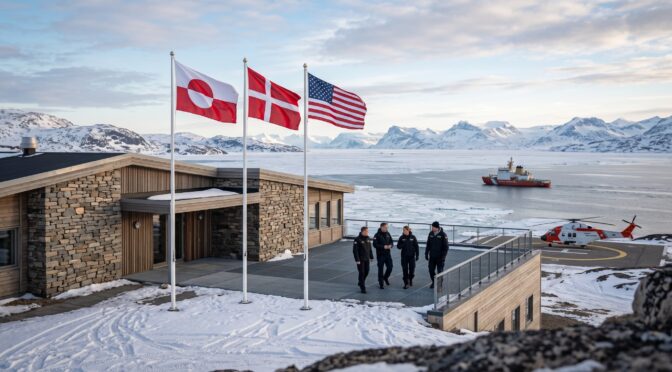
On September 22, 2026, during the United Nations General Assembly in New York, the United States, Denmark, and Greenland signed a major security pact1. This three-way deal ended months of public diplomatic tension, which was largely triggered by aggressive US talk about purchasing or taking over Greenland4. Despite strong initial opposition from Copenhagen and Nuuk against any threats to their territory, all three parties negotiated a legally binding agreement that significantly updates the military arrangement in the Arctic and North Atlantic1.
The 2026 agreement rests on three main pillars: expanded military access and operational freedom for US forces, strict rules to prevent rival nations from investing in critical resources, and a clear guarantee of Danish sovereignty alongside Greenland’s right to self-determination1. By allowing the US to expand its military footprint, including major upgrades to Pituffik Space Base and new forward locations at Narsarsuaq and Mestersvig, the deal strengthens North American defense and improves surveillance over the Greenland-Iceland-United Kingdom (GIUK) Gap6.
At the same time, the pact puts strong economic protections in place, specifically limiting foreign investment and control in Greenland’s key sectors to NATO members, EU countries, and approved partner nations6. This creates a safeguard against strategic moves by Russia and China, both of which have sought to access Arctic minerals and shipping routes10.
This report examines the factors behind the deal, the viewpoints of each nation involved, and the specifics of the new legal, military, and economic framework. It outlines how a diplomatic dispute was transformed into a shared military and economic alliance, highlighting the historical context and ongoing commitments that will shape the relationship between the US, Denmark, and Greenland in an era of international competition.
1. Introduction: Changing Dynamics in the Arctic
To understand the recent tensions and ultimate agreement over Greenland, it helps to view the island through the lens of modern international rivalry. The Arctic is no longer an isolated region. Melting ice and increased military activity have made it a focal point for global shipping, valuable minerals, and strategic defense7. Greenland’s location, positioned directly between North America and Europe, makes it crucial for situational awareness and defense across the North Atlantic7.
1.1 The Shifting Military Geography of the High North
The military balance in the Arctic has shifted steadily toward Russia over the past two decades. Russia currently maintains significantly more military bases in the region than NATO, outnumbering allied installations by roughly 30 percent13. In particular, the Kola Peninsula in northwestern Russia houses most of the Russian Navy’s Northern Fleet, including the majority of its nuclear submarine fleet, with eight of its eleven strategic submarines stationed in the Arctic2.
As melting ice opens up the Northern Sea Route, Russia has rebuilt many of its former Cold War bases. This effort aims to establish defensive zones that allow Russian forces to project power into the North Atlantic while limiting access for NATO ships and aircraft9.
Greenland sits directly above the GIUK Gap, a critical maritime passage that naval vessels must cross to enter the open waters of the Atlantic9. Monitoring this passage is vital for NATO security, as maintaining control helps safeguard ocean transit routes connecting North America to Europe9. Military strategists consider Greenland an essential forward position for tracking underwater activity and monitoring airborne threats before they approach the North American mainland16.
1.2 Early Warning and Missile Defense Systems
Beyond maritime tracking, Greenland provides an ideal position for early warning radar and missile defense operations. Pituffik Space Base (formerly Thule Air Base) in northwestern Greenland is the northernmost US military installation6. Managed by the 821st Space Base Group, its upgraded radar installations provide continuous ballistic missile detection and space surveillance data directly to NORAD and US Space Force networks1.
Because the shortest flight path for long-range missiles traveling between Eurasia and North America passes over the Arctic, tracking stations in Greenland are fundamental to strategic warning systems9. Without the continuous data provided by Pituffik, response time in defensive operations would be noticeably reduced.
1.3 The Economics of Critical Minerals
At the same time, Greenland’s strategic importance has grown due to its large, largely undeveloped deposits of critical minerals, such as rare earth elements, uranium, platinum, and copper10. As global demand increases for technology, green energy infrastructure, and defense manufacturing, establishing secure supply chains for these materials has become a major policy goal.
Currently, China produces a significant share of the world’s processed rare earth elements11. Prior to the 2026 agreement, Chinese state-affiliated entities had shown interest in Greenland’s mining ventures and infrastructure projects10. For the US, Denmark, and NATO allies, preventing rival states from dominating access to these resources is viewed as essential for both economic stability and national security12. Integrating these mineral deposits into allied supply chains complements the broader security goals of the new agreement.
2. Historical Background and Legal Foundation
The September 2026 deal builds on a long-standing defense relationship spanning more than eight decades. Reviewing this history helps clarify how the latest agreement took shape.
2.1 The 1941 Kaufmann Treaty and the World War II Pivot
Greenland first became central to American defense planning during World War II. Following the German occupation of Denmark in 1940, Henrik Kauffmann, the Danish envoy to the US, signed the 1941 Agreement Relating to the Defense of Greenland1. This agreement allowed the United States to establish airfields, weather stations, and naval facilities across Greenland. These installations helped protect Allied Atlantic shipping convoys and supported operations throughout the war6.
2.2 The 1951 Defense of Greenland Agreement
Following World War II and the founding of NATO, the US and Denmark formalized this arrangement for the Cold War era. In April 1951, they signed the Defense of Greenland Agreement22. Article II granted Washington operational flexibility within designated defense areas24.
These rights included constructing facilities, stationing personnel, and maintaining transit access for aircraft and vessels23. Importantly, the agreement explicitly affirmed respect for the sovereignty of the Kingdom of Denmark25. Article XIV tied the treaty to the duration of the NATO alliance, establishing that the US operated within Danish territory under a shared defense framework rather than through land ownership25. This structure served as the foundation for subsequent arrangements, including the 2026 pact.
2.3 The 2004 Igaliku Agreement
As Greenland gained greater self-governance from Denmark in the late 20th century, the defense framework was updated to give local leaders a direct voice. The 2004 Igaliku Agreement, signed by US Secretary of State Colin Powell, Danish Foreign Minister Per Stig Møller, and Greenlandic official Josef Motzfeldt, included Greenland’s Home Rule government as a direct partner2.
The 2004 update also refined operational boundaries. It designated Thule Air Base (Pituffik) as the primary US defense area in Greenland26. It introduced environmental standards for operations outside designated zones and required advance consultation with Danish and Greenlandic authorities before making significant changes to military activities26. While this ensured regular coordination, it also concentrated active US military infrastructure largely in the northwest, leaving other regions with minimal permanent presence25.
2.4 The 2009 Self-Government Act
Governance evolved further in 2009 with the passage of the Self-Government Act. This legislation recognized Greenlanders as a distinct political community with the right to self-determination13. The Act transferred authority over judicial matters, policing, and mineral resource management to Nuuk2.
However, core responsibilities including foreign affairs, national defense, and monetary policy remained under the jurisdiction of the Danish Realm1. This division of responsibility meant that future negotiations would need to balance US defense goals, Danish sovereign authority, and Greenland’s domestic self-governance.
3. The Diplomatic Crisis of 2024–2026: Perspectives from Each Nation
The catalyst for the 2026 deal was a period of public diplomatic debate initiated by US President Donald Trump, who revisited earlier proposals regarding the purchase or long-term control of Greenland4. These statements created tension with political leaders in Denmark and Greenland, leading to prolonged discussions on how to balance alliance obligations with regional self-governance.
3.1 The United States Viewpoint: Focus on Long-Term Security
From the perspective of US defense planners, existing agreements needed updating to address modern security challenges. Early in 2026, President Trump argued that long-term security arrangements required guarantees that key installations would remain available regardless of domestic political shifts in Copenhagen or Nuuk4.
Washington highlighted vulnerabilities across the Arctic region, noting that foreign entities had previously sought investments in Greenland’s infrastructure. These included past proposals involving airport expansions, former naval facilities, and stakes in mining operations such as the Kvanefjeld project10. Meanwhile, military capability in nearby Arctic areas continued to expand.
US officials sought to prevent scenarios where commercial investments by non-aligned nations might complicate security around radar sites or early warning systems in the GIUK Gap8. Consequently, the administration pressed for terms that would grant stable basing access and mechanisms to screen foreign investments in key sectors7. This strategy emphasized keeping non-NATO powers from acquiring critical strategic footholds in North America’s northern approaches28.
3.2 Denmark’s Viewpoint: Sovereignty and Alliance Stability
For Denmark, the blunt demands from America set off a huge crisis. The idea that Danish territory could be bought like real estate or taken over by an ally insulted international law, diplomacy, and national pride.
In early 2026, Danish Prime Minister Mette Frederiksen stressed that territory could not be transferred, reaffirming that Greenland’s sovereignty remained firmly with the Realm and its people, a position supported by several European allies4. The surrounding debates coincided with domestic political discussion in Denmark, leading to early parliamentary elections29. Additionally, European partners conducted cooperative exercises, such as “Operation Arctic Endurance,” sending small deployments to train alongside Danish forces and demonstrate alliance presence in the High North28.
At the same time, Danish leadership recognized the practical need for robust Arctic security. Maintaining surveillance across vast territories requires substantial resources, and Copenhagen relies on NATO and US cooperation to support regional defense15. Denmark’s policy aimed to address legitimate US security requirements while upholding sovereign authority and maintaining stability within the NATO alliance1.
3.3 Greenland’s Viewpoint: Self-Determination and Economic Growth
Greenlandic leadership balanced aspirations for long-term economic autonomy with immediate defense and commercial needs. Prime Ministers Muté Bourup Egede and later Jens-Frederik Nielsen rejected proposals that treated Greenland as real estate to be bought or sold1. Nielsen emphasized that Greenland valued its constitutional relationship with Denmark while remaining open to constructive defense partnerships.
Economically, Greenland has worked to build self-sustaining industries alongside the annual Danish block grant (bloktilskud), which provides important funding for public services31. To diversify its economy, Nuuk seeks foreign investment, modern infrastructure, and local participation in major procurement projects10.
Relations had previously been strained by a 2014 change in base maintenance contracts at Thule. For years, a Danish-Greenlandic enterprise held the contract, generating local employment and tax revenue. In 2014, the contract was awarded to a US-based firm32. This change reduced Greenland’s tax receipts by roughly $30 million USD annually, equivalent to about ten percent of government tax revenue at the time32. The issue led to legal challenges and calls in Greenland’s parliament for clearer economic terms in future defense arrangements25.
Entering the 2026 discussions, Greenland aimed for an agreement that ensured direct economic participation, respected environmental standards, and preserved its political path forward while maintaining strong collective security32.
4. The Agreement: Aligning Shared Goals
Negotiations reached a breakthrough in mid-2026 as officials in Washington, Copenhagen, and Nuuk identified common ground. The security objectives of the United States, including guaranteed military access and resource protection, could be met through a structured framework without altering legal ownership of land7.
By addressing US security needs alongside Danish sovereignty and Greenlandic self-governance, the parties negotiated a balanced compromise.
Here is how everyone’s goals lined up in the final 2026 deal:
| Sovereign Actor | Primary Security Objective | Primary Political/Economic Objective | Outcome in the 2026 Agreement |
| United States | Secure the GIUK gap, upgrade missile defense, and block Chinese/Russian bases. | Get permanent, guaranteed military access and control over critical sites without relying on temporary deals. | Won sweeping new base access and permanent vetoes over rival investments, meeting security needs without needing to annex land. |
| Kingdom of Denmark | Keep the NATO alliance strong and keep the US engaged in European defense. | Keep absolute legal sovereignty over Greenland and avoid the embarrassment of giving up territory. | Kept full sovereignty. Handed operational defense to the US while promising to boost its own Arctic military spending. |
| Greenland | Get physical protection from superpowers while keeping local control. | Maximize local money, mandate local contracts, and keep the door to independence open. | Won strict rules for local defense contracting (fixing the 2014 mess) and got clear legal backing for future independence within NATO. |
The resulting ten-page document updates the 1951 Defense Agreement, establishing updated guidelines for military access, economic screening, and future political developments6.
5. The 2026 Defense Agreement: Core Military and Strategic Provisions
The most immediate result of the 2026 agreement is the updated, legally protected framework for US military operations across Greenland.
5.1 Expansion and Modernization of Pituffik Space Base
The agreement provides a framework for ongoing modernization at Pituffik Space Base1. As a key site for Arctic defense, Pituffik’s role in early warning, missile defense, and satellite tracking is reconfirmed6. The agreement also establishes terms for potential integration with broader defensive initiatives, such as the proposed “Golden Dome” missile defense network1. Estimates suggest overall system development could cost up to $175 billion worldwide6, supported by streamlined management within defense planning agencies36. Specific plans and budgets for local infrastructure will be managed through a joint Permanent Committee1. Meanwhile, funding has already been directed toward Pituffik to upgrade runways, lighting, and power facilities to support increased transport capacity37.
5.2 The Establishment of New Forward Operating Bases
Expanding beyond the single-site focus of the 2004 Igaliku Agreement, the 2026 arrangement allows for additional operating facilities at Narsarsuaq and Mestersvig7.
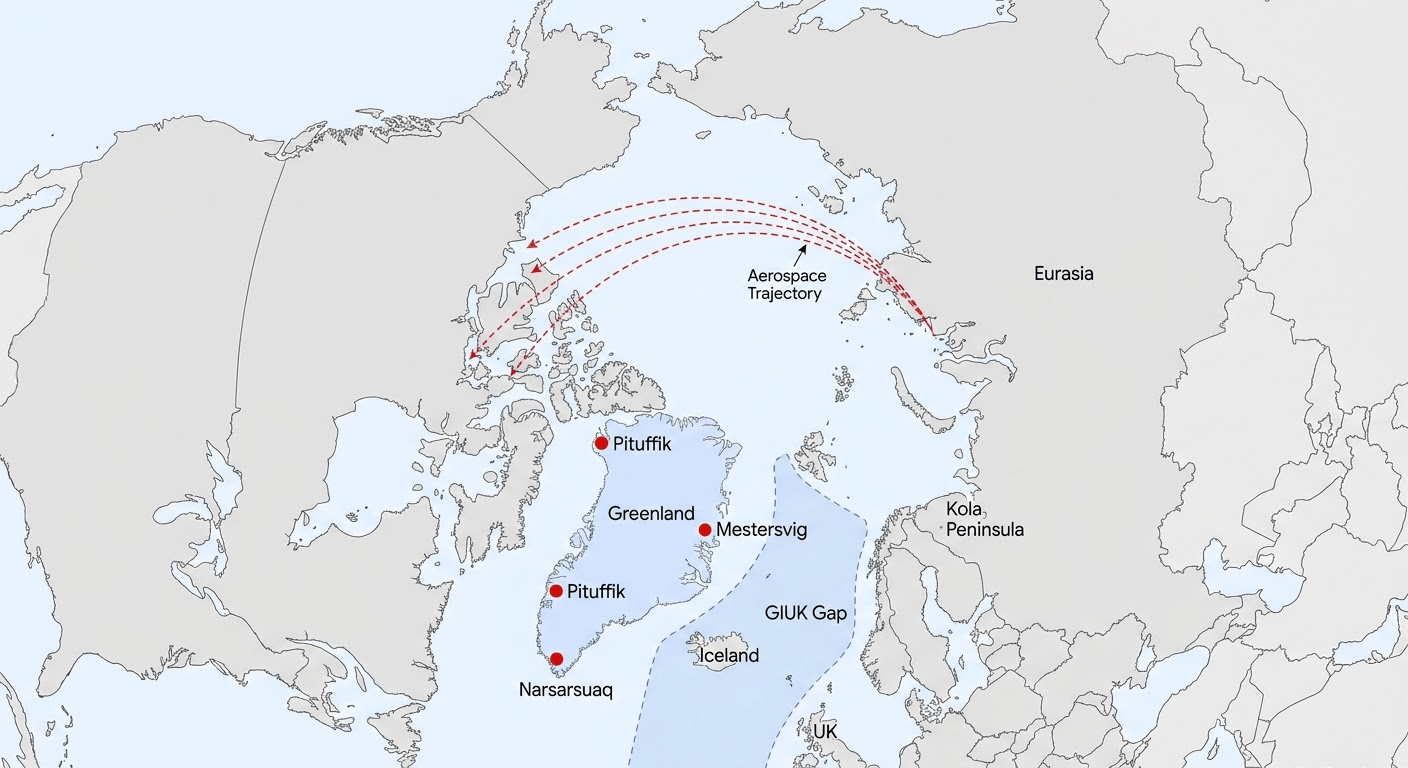
These locations serve distinct operational roles. Narsarsuaq in the south can support maritime patrol aircraft tracking naval traffic across the GIUK Gap and Labrador Sea7. Mestersvig on the eastern coast, long utilized by Denmark’s Sirius Dog Sled Patrol, offers a location for monitoring the Greenland Sea and northern maritime approaches1. Together with Pituffik, these sites create a broader surveillance network across the region1.
5.3 Operational Access and Remote Monitoring
In addition to base facilities, the agreement clarifies operational movement. Article VI permits US aircraft, naval vessels, and personnel to move between defense zones in Greenland25. Aircraft may transit Greenlandic airspace, and naval units retain standard passage rights in surrounding waters, subject to standard notification protocols1.
This restores a broader operational scope similar to the principles of the 1951 framework25. The agreement also provides a procedure for placing temporary monitoring equipment, such as ocean sensors or automated weather stations, outside primary defense areas, subject to review by Danish and Greenlandic authorities35.
6. Economic Security: Foreign Investment and Critical Resources
Alongside military provisions, the agreement introduces investment screening measures to address economic and security concerns. The pact outlines screening standards for foreign investment in sensitive infrastructure, including ports, telecommunications, airports, and mining projects6.
6.1 Managing Mineral Supply Chains
Greenland holds notable deposits of rare earth elements, which are key components in modern electronics, renewable energy hardware, and aerospace manufacturing21. The 2026 agreement restricts majority ownership or controlling interests in critical mineral projects to entities from NATO members, EU nations, and designated partner states1.
This rule establishes a legal framework to govern foreign participation in strategic resources. US leadership noted that future commercial partnerships in Greenland will require explicit approval through established screening channels7. Markets responded to the clarity, with companies like Greenland Mines Ltd., which develops the Sarfartoq rare earth deposit, gaining attention from international investors39. The Sarfartoq project holds significant estimated value and could contribute to the global supply of rare earth oxides processed outside of primary Asian refining hubs39.
6.2 Economic Development and Local Autonomy
Implementing investment screening requires careful coordination with local policy goals. Greenland, working with Denmark, enforces these guidelines through domestic commercial law1. While narrowing investment sources, it highlights the importance of allied capital in funding sustainable infrastructure and mining development8.
This aligns with Greenland’s broader effort to expand its domestic economy. Over the past two decades, local industries have grown, reducing the relative proportion of public expenditure covered by external subsidies.
| Economic Indicator | Historical Data (1994 / 2003) | Recent Data (2021 / 2023) | Trend Analysis |
| Danish Block Grant Total | 2.4 Billion DKK (1994) | 4.1 Billion DKK (2023) | The actual amount of money from Copenhagen has gone up over time to keep up with inflation and costs. |
| Grant as a Share of GDP | 30% (2003) | 18.7% (2023) | Even though the cash amount went up, massive growth in Greenland’s economy (thanks to fishing, tourism, and building) has heavily shrunk their reliance on the subsidy. |
| Greenland GDP Total | 10.3 Billion DKK (2003) | 22.9 Billion DKK (2023) | The economy has basically doubled in size, proving they can grow on their own. |
Data sourced from Statistics Greenland and the 2024 Økonomisk Råd Rapport.
As shown in the data, while total block grant funding has increased over time, its relative share of Greenland’s overall GDP fell to 18.7% in 202327. By encouraging investment from allied nations, the 2026 agreement supports Greenland’s goal of economic diversification through responsible resource extraction and commercial development.
Currently, Greenland’s tax receipts account for approximately 25% of GDP, reflecting a low-tax environment that supports local growth while highlighting the need for broader revenue sources30. To strengthen domestic revenue, Greenland is also investing in sectors such as sustainable tourism31. Upcoming airport developments in Nuuk and other centers are expected to enhance travel connectivity, supporting broader economic self-sufficiency31.
7. Sovereignty, Independence, and Strategic Commitments
A central feature of the agreement is how it addresses sovereign authority alongside Greenland’s constitutional path. US leadership noted that the agreement ensures long-term security access, while Danish Prime Minister Frederiksen welcomed the text for reconfirming Denmark’s constitutional framework7. Both perspectives reflect key elements of the final treaty.
7.1 Continuity and the Independence Provision
The treaty remains in effect indefinitely and requires mutual consent for major modifications, providing the stability required for long-term defense planning1. At the same time, it acknowledges Greenland’s political rights and self-determination process under existing law7.
Article XI addresses potential future political changes, specifying that if Greenland chooses independent statehood in the future, it will inherit the rights and obligations outlined in the 2026 defense agreement1.
Additionally, the clause outlines that an independent Greenland would maintain participation in NATO security structures1. By integrating defense continuity into future political scenarios, the agreement ensures stable security arrangements while respecting Greenland’s constitutional self-determination process8.
8. Implementation and Next Steps
With the agreement signed, attention turns to operational implementation and coordinating details across all participating nations.
8.1 United States Commitments and Procurement
The US Department of Defense will coordinate base planning, environmental reviews, construction timelines, and operational budgets for facilities at Narsarsuaq and Mestersvig through the joint Permanent Committee18. To streamline coordination, the agreement establishes a 90-day review period for resolving administrative or technical questions at the ministerial level35.
To support local economic integration, the treaty emphasizes local engagement. Military operations are required to respect Greenlandic land use and traditional activities whenever practical1. Furthermore, contract guidelines encourage hiring Danish and Greenlandic enterprises for base support and construction projects where viable1.
This framework is already in practice. In August 2024, Serco Inc. received a $323 million contract to upgrade power systems at Pituffik Space Base30. Serco partnered with Aarsleff, a established local construction company, ensuring significant local labor and business participation in the project18. Maintaining this collaborative approach will be important during future projects at Narsarsuaq and Mestersvig32.
8.2 Denmark’s Operational Support
Denmark has the tough job of balancing a massive American military buildup with its own sovereignty. Copenhagen has to quickly process US requests to drop unmanned gear outside the main bases using the new fast-track rules35.
The agreement also outlines plans for increased Danish defense investment in the Arctic3. Copenhagen has committed to expanding its regional defense budget to fund long-range surveillance drones, maritime patrol aircraft, and specialized northern patrol units13. Danish security services will also maintain close coordination with US counterparts on regional security and counter-intelligence efforts35.
8.3 Greenland’s Regulatory Role
Greenland’s role involves implementing and overseeing investment screening mechanisms in coordination with Denmark1. Local agencies will monitor corporate ownership structures in the resource sector to ensure alignment with security requirements7. Authorities will continuously review commercial proposals to verify compliance with established guidelines8.
Overall, Greenland remains committed to long-term alliance goals. While pursuing civilian economic expansion in fishing, tourism, and mining, Nuuk operates within the shared NATO framework1. Should Greenland’s citizens eventually vote for independence, the agreement ensures that defense arrangements remain stable and aligned with Western security networks1.
9. Conclusion
The 2026 US-Denmark-Greenland security agreement represents a practical resolution to complex diplomatic discussions. Following a period of intense public debate regarding territory and sovereignty, the final arrangement clearly separates military operational access from legal ownership.
For the United States, the treaty secures long-term strategic access in the High North, supports monitoring across the GIUK Gap, and establishes clear screening rules for critical mineral investments. For Denmark, the agreement preserves constitutional authority, avoids alliance disruptions, and reinforces transatlantic defense coordination in the Arctic.
For Greenland, the deal provides strategic stability, encourages local investment through military procurement and mining partnerships, and formally respects the island’s constitutional right to determine its future.
As Arctic activity continues to increase, this trilateral agreement establishes a stable, long-term framework for regional defense, resource security, and diplomatic cooperation across the North Atlantic.
Please share the link on Facebook, Forums, with colleagues, etc. Your support is much appreciated and if you have any feedback, please email us in**@*********ps.com. If you’d like to request a report or order a reprint, please click here for the corresponding page to open in new tab.
Sources Used
- Key Details Still Unresolved as US Expands Greenland Military, https://www.military.com/key-details-still-unresolved-us-expands-greenland-military-defense-sites
- 5 ways Greenland’s 2026 defense deal breaks with the past, https://www.turkiyetoday.com/world/5-ways-greenlands-2026-defense-deal-breaks-with-the-past-3228822
- Explainer-What is in the US-Greenland-Denmark security deal?, https://www.globalbankingandfinance.com/explainer-what-us-greenland-denmark-security-deal/
- A timeline of US President Donald Trump’s interest in Greenland, https://m.economictimes.com/news/international/world-news/a-timeline-of-us-president-donald-trumps-interest-in-greenland/articleshow/134404480.cms
- What’s inside the US-Greenland-Denmark security deal?, https://m.economictimes.com/news/defence/whats-inside-the-us-greenland-denmark-security-deal-donald-trump-military/articleshow/134423584.cms
- CNA Explains: What does the US-Greenland security deal actually change?, https://www.channelnewsasia.com/world/greenland-us-deal-military-base-denmark-cna-explains-6401501
- Greenland, Denmark and US Move Toward New Arctic Security, https://arcticportal.org/ap-library/news/4156-greenland-denmark-and-us-move-toward-new-arctic-security-agreement
- Denmark’s diplomatic victory in Greenland – Bruegel, https://www.bruegel.org/first-glance/denmarks-diplomatic-victory-greenland
- GREENLAND – Institute for Security & Development Policy, https://www.isdp.eu/wp-content/uploads/2026/03/Backgrounder-Greenland-final.pdf
- (PDF) Greenland’s Arctic Role: Trade, Resources & Geopolitics, https://www.researchgate.net/publication/394275142_Greenland’s_Arctic_Role_Trade_Resources_Geopolitics
- An Arctic security bargain – Opinion News | The Financial Express, https://www.financialexpress.com/opinion/an-arctic-security-bargain/4344218/
- Greenland, Trump, and the New Arctic Security Bargain, https://www.orfonline.org/research/greenland-trump-and-the-new-arctic-security-bargain
- JIIA Strategic Comments (2026-4) Enhancing Greenland’s Future, https://www.jiia.or.jp/eng/report/2026/02/strategic_comment_2026-4.html
- Russia’s Military Posture in the Arctic – Chatham House, https://www.chathamhouse.org/sites/default/files/2019-06-27-Russias-Military-Posture-Arctic.pdf
- Danish Security and Defence towards 2035, https://um.dk/media/trhdwwdl/regeringens_security-policy-report_uk_web_09-final-a.pdf
- arctic moment, https://csis-website-prod.s3.amazonaws.com/s3fs-public/publication/Conley_ArcticMoment_layout_WEB%20FINAL.pdf
- Exploring Gaps in Arctic Governance – RAND, https://www.rand.org/content/dam/rand/pubs/research_reports/RRA1000/RRA1007-1/RAND_RRA1007-1.pdf
- Serco to Modernize Backup Power Plant at Pituffik Space Base, https://www.executivebiz.com/articles/serco-to-modernize-backup-power-plant-at-pituffik-space-base-under-323m-contract-tom-watson-quoted
- Greenland critical minerals investment screening agreement, https://www.facebook.com/DiscoveryAlert/posts/a-trilateral-security-agreement-signed-at-the-un-on-22-september-2026-has-drawn-/1090127550219166/
- John Strand: Greenland, USA and Denmark – Ménage à Trois Now With a Happy Ending, https://broadbandbreakfast.com/john-strand-greenland-usa-and-denmark-menage-a-trois-now-with-a-happy-ending/
- Greenland Rare Earths US Denmark Security Deal Explained, https://rareearthexchanges.com/news/greenland-rare-earths-us-denmark-deal/
- Proposed United States acquisition of Greenland – Wikipedia, https://en.wikipedia.org/wiki/Proposed_United_States_acquisition_of_Greenland
- US Greenland Deal: Does America Now Control Greenland?, https://www.diplomacyandlaw.com/post/us-greenland-deal
- Trump threatened to redraw the map. Greenland deal shows the limits of his disruption, https://theprint.in/opinion/donald-trump-redraw-map-greenland-deal/3047629/
- What Stands Out in the US-Greenland-Denmark Agreement, https://www.fpri.org/article/2026/09/what-stands-out-in-the-us-greenland-denmark-agreement/
- Greenland Defense Agreement (1951): U.S. Military Rights Explained, https://www.diplomacyandlaw.com/post/greenland-defense-agreement-1951-u-s-military-rights-explained
- New agreement will allow the US to turn Narsarsuaq into a military, https://www.reddit.com/r/greenland/comments/1wnfeii/new_agreement_will_allow_the_us_to_turn/
- Greenland Archives – Ronin’s Grips, https://blog.roninsgrips.com/tag/greenland/
- Europe Archives – Ronin’s Grips, https://blog.roninsgrips.com/tag/europe/
- Serco Awarded $323 Million Power Plant Construction Contract at, https://www.serco.com/na/media-and-news/2024/serco-awarded-323-million-power-plant-construction-contract-at-pituffik-space-base
- Greenland’s Shift from Block Grant Reliance to Economic Strength, https://www.nordicinsights.dk/2025/02/25/resilient-progress-greenlands-shift-from-block-grant-reliance-to-economic-strength/
- Greenland and U.S. Agree On Improved Cooperation at Thule Air, https://en.highnorthnews.com/politics/greenland-and-us-agree-on-improved-cooperation-at-thule-air-base/116450
- U.S. modernizes Pituffik (Thule) Space Base for Arctic forward, https://thewatch-journal.com/2023/05/31/u-s-modernizes-pituffik-thule-space-base-for-arctic-forward-operations/
- Greenland has tilted the rules for a lucrative American contract in its, https://polarjournal.net/greenland-has-tilted-the-rules-for-a-lucrative-american-contract-in-its-favour/
- AGREEMENT BETWEEN THE GOVERNMENT OF THE UNITED, https://www.whitehouse.gov/briefings-statements/2026/09/agreement-between-the-government-of-the-united-states-of-america-and-the-government-of-the-kingdom-of-denmark-together-with-the-government-of-greenland-to-amend-and-supplement-the-agreement-of-27-apri/
- 2026 National Defense Strategy: Homeland Defense and Global, https://blog.roninsgrips.com/2026-national-defense-strategy-homeland-defense-and-global-implications/
- Pentagon wants major improvements to runways at Greenland base, https://taskandpurpose.com/news/pentagon-greenland-pituffik-runway-improvements/
- A chance to retreat – Civilsdaily, https://www.civilsdaily.com/news/a-chance-to-retreat/
- Greenland Security Pact Reshapes the Race for Rare Earth Supply, https://markets.businessinsider.com/news/stocks/greenland-security-pact-reshapes-the-race-for-rare-earth-supply-1036564937
- Greenland Security Pact Pulls the Rare Earth Supply Race North, https://www.newswire.ca/news-releases/greenland-security-pact-pulls-the-rare-earth-supply-race-north-897326879.html
- Serco books $323M job to modernize arctic space base, https://www.washingtontechnology.com/contracts/2024/08/serco-books-323m-job-modernize-arctic-space-base/399000/
- A New (Cold) Front in Polar Intelligence? Trends and Implications of, https://www.sciencepolicyjournal.org/uploads/5/4/3/4/5434385/urban_jspg_19-1.pdf