Tag Archives: Europe

SITREP Europe – Week Ending February 28, 2026

Executive Summary

The strategic environment in Europe and its immediate periphery has reached a state of severe, multi-domain volatility during the week ending February 28, 2026. The intersection of kinetic military escalation in the Middle East, intensifying Russian shaping operations in Eastern Europe, aggressive grey-zone provocations in the Baltic and Arctic theaters, and profound internal institutional fractures within the European Union has created a highly complex threat matrix. This convergence of crises requires an immediate recalibration of European security, economic, and diplomatic postures, as the fundamental pillars of regional stability are simultaneously tested.

The most critical and immediate external shock occurred on February 28, when the United States and Israel initiated “Operation Epic Fury,” launching preemptive, multi-domain military strikes against military and nuclear infrastructure across the Islamic Republic of Iran.1 This operation marks the definitive collapse of the renewed nuclear negotiations in Geneva and the culmination of escalating diplomatic tensions following the “12-Day War” of June 2025.1 The immediate retaliatory ballistic missile and drone strikes launched by Iran’s Islamic Revolutionary Guard Corps (IRGC) against U.S. military installations in the Persian Gulf have placed global energy markets on high alert.2 These tit-for-tat strikes present an acute and direct threat to critical energy supply lines, most notably through the Strait of Hormuz, which handles approximately one-fifth of the world’s liquefied natural gas (LNG) and a quarter of seaborne oil trade.5 For the European continent, this represents an immediate risk of energy-driven inflation and supply chain disruption, compounded by the widespread suspension of commercial aviation routes across the Middle East by major European flag carriers.6

Simultaneously, the European security architecture is facing direct, calculated testing by the Russian Federation. In the Baltic Sea, a Russian signals intelligence (SIGINT) vessel deliberately launched an unauthorized drone to harass the French nuclear-powered aircraft carrier Charles de Gaulle while it was anchored in Malmö, Sweden.8 This brazen grey-zone provocation is assessed as an effort to test NATO’s electronic warfare countermeasures and signal displeasure at Sweden’s integration into the Alliance’s defense frameworks.8 Further north in the Arctic theater, renewed and aggressive diplomatic maneuvers by the U.S. administration to annex Greenland have triggered a profound political crisis in Denmark, forcing the Prime Minister to call early elections amid unprecedented intelligence warnings of hybrid electoral interference emanating from both Moscow and Washington.11

On the Eastern Flank, the Russo-Ukrainian War is rapidly entering a highly critical and potentially decisive operational phase. Russian military forces have initiated a massive, theater-wide Battlefield Air Interdiction (BAI) and artillery preparation campaign specifically targeting Ukraine’s “Fortress Belt” in the Donetsk Oblast-a heavily fortified urban agglomeration comprising Slovyansk, Kramatorsk, Druzhkivka, and Kostyantynivka.14 This intense shaping operation, heavily leveraging unmanned aerial systems and glide bombs to interdict logistics, signals the imminent commencement of the long-anticipated Russian Spring-Summer 2026 ground offensive, aimed at breaking the last major urban defensive line in the Donbas region.17

Internally, the European Union is navigating a severe institutional and macroeconomic crisis that threatens the bloc’s political cohesion. European Commission President Ursula von der Leyen’s highly controversial decision to provisionally apply the EU-Mercosur Free Trade Agreement-deliberately bypassing the European Parliament and a pending legal review by the European Court of Justice-has deeply fractured the bloc along industrial and agricultural lines.19 This maneuver, while strongly supported by export-heavy economies like Germany, has been vehemently opposed by France and Italy, igniting violent, large-scale agricultural protests that have paralyzed transit routes in Brussels and Paris.19 While recent macroeconomic indicators show a tentatively stabilizing Eurozone inflation rate of 1.7 percent for January 2026, the dangerous convergence of geopolitical energy shocks in the Middle East and internal trade disputes threatens to completely derail the European Central Bank’s fragile disinflationary trajectory in the coming quarters.23

1. Geopolitical Flashpoints and External Threat Vectors

1.1. Operation Epic Fury: The U.S.-Israeli Strikes on Iran

On the morning of February 28, 2026, the geopolitical landscape of the Middle East was radically altered when the United States and Israel launched a massive, coordinated military offensive against the Islamic Republic of Iran. The military campaign, codenamed “Operation Epic Fury” by the United States Department of Defense and “Operation Roaring Lion” by the Israel Defense Forces, represents a severe escalation in regional hostilities.2 The strikes denote the absolute collapse of the renewed nuclear negotiations held in Geneva and the execution of a preemptive military strategy designed to neutralize Iran’s ballistic missile infrastructure and nuclear enrichment capabilities.1

The diplomatic runway for this conflict had been deteriorating for months. Following the “12-Day War” between Israel and Iran in June 2025, the International Atomic Energy Agency (IAEA) declared Iran in violation of its nuclear commitments.3 In response, the E3 nations-France, Germany, and the United Kingdom-initiated their own dialogue with Tehran in a desperate bid to salvage a diplomatic framework, but ultimately failed, leading the E3 to issue a statement in August 2025 declaring Iran in violation and setting in motion the ‘snapback’ provision of UN Resolution 2231, which restored the international arms embargo.3 Despite intense last-minute diplomatic efforts by U.S. envoys Steve Witkoff and Jared Kushner, and explicit warnings from the E3 Ministers and the High Representative of the European Union urging de-escalation, the military option was authorized.27

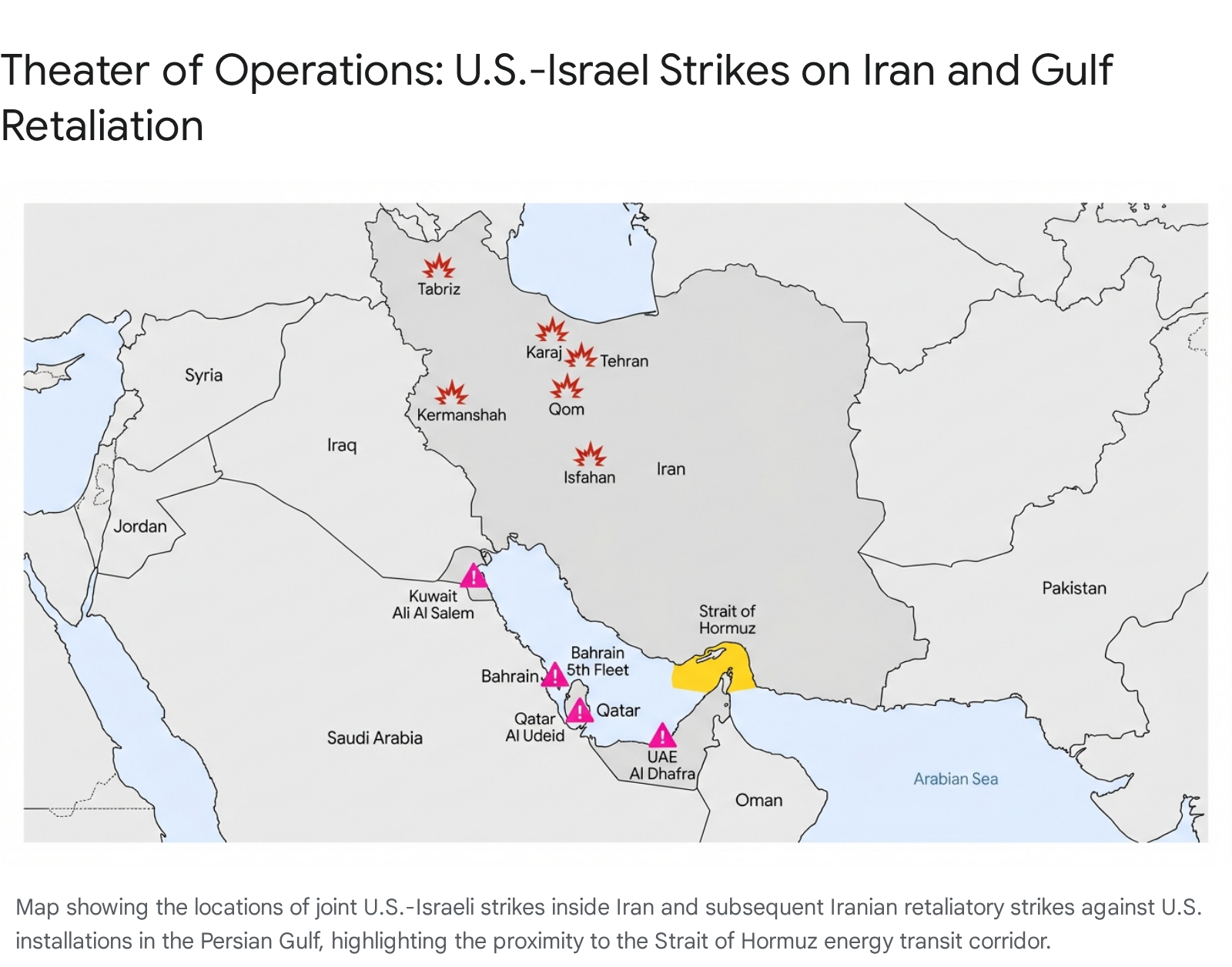
The multi-domain military operation utilized a highly complex array of assets. The opening salvos featured sea-launched Tomahawk cruise missiles and air-launched munitions fired from U.S. Air Force and Navy jets.2 The United States had recently surged its regional force posture, positioning over a dozen warships in the theater, including the destroyers USS Michael Murphy and USS Mitscher, alongside littoral combat ships USS Canberra and USS Santa Barbara near the critical Strait of Hormuz.2 The strikes targeted a broad spectrum of military infrastructure, command and control centers, and surface-to-surface missile sites across multiple Iranian cities, with verified explosions reported in the capital Tehran, as well as Karaj, Qom, Isfahan, Kermanshah, and Tabriz.2 U.S. President Donald Trump publicly declared that the strategic objective was to eliminate imminent threats to the American homeland and explicitly called for regime change, urging the Iranian populace to “take over your government” while ensuring that the regime’s nuclear and missile industries would be “obliterated”.1

The strategic implications for European security and economic stability are immediate, profound, and overwhelmingly negative. Unwilling to absorb the strikes passively, Iran’s Islamic Revolutionary Guard Corps (IRGC) rapidly initiated retaliatory ballistic missile and drone barrages.4 These retaliatory strikes were not limited to northern Israel; they deliberately targeted U.S. military installations hosted by Gulf Arab states.4 Targeted facilities reportedly include the U.S. Navy’s 5th Fleet headquarters at Naval Support Activity in Bahrain, Al Udeid Air Base in Qatar, Ali Al Salem Air Base in Kuwait, and Al Dhafra Air Base in the United Arab Emirates.2 The UAE government later confirmed that one person was killed in Abu Dhabi by falling debris from an intercepted Iranian missile.7
Yugo M85/M92 dust cover quick takedown pin installed

The sudden kinetic escalation has forced a rapid and chaotic recalibration of European foreign policy and logistics. European airspace management has been thrown into complete disarray. Major European commercial carriers, including Lufthansa, Air France, and KLM, immediately canceled routes to Tel Aviv, Beirut, Amman, and Dubai, while the Hungarian low-cost carrier Wizz Air suspended all flights to the region until at least March 7.7 This effectively severs primary commercial air corridors between Europe and the Middle East, creating massive logistical bottlenecks. Furthermore, the conflict threatens to draw in European military assets currently deployed in the region for maritime security operations, forcing national commands to urgently evaluate force protection protocols against the threat of asymmetric Iranian retaliation or proxy attacks on European shipping. The UK Government, via the Chair of the Commons Foreign Affairs Committee, Emily Thornberry, expressed deep concern over the legal basis of the preemptive action and warned of the severe risks of Britain being dragged into a wider regional war due to its permanent military presence in the area.34

1.2. The Malmö Incident: Russian Grey-Zone Aggression

Amid the overwhelming focus on the Middle Eastern crisis, the Russian Federation executed a highly provocative and calculated grey-zone operation against a key European naval asset, demonstrating Moscow’s continued willingness to test NATO’s defensive thresholds. During the week, the French nuclear-powered aircraft carrier Charles de Gaulle, operating as the flagship of its strike group, made a historic port call in Malmö, Sweden, as part of routine NATO integration and exercise activities.8 The port of Malmö is strategically located on the Öresund strait, directly opposite the Danish capital of Copenhagen, representing a vital maritime chokepoint connecting the Baltic Sea to the North Sea.35

On February 26, the Swedish Armed Forces detected an unauthorized unmanned aerial vehicle (UAV) approaching the French carrier. Swedish military intelligence and naval sources subsequently confirmed, via intercepted technical data, that the drone was launched directly from the Zhigulevsk, a Russian signals intelligence (SIGINT) vessel operating in the immediate vicinity within the Öresund strait.10 The Russian drone deliberately breached Swedish territorial airspace and approached within 13 kilometers (eight miles) of the Charles de Gaulle before the Swedish naval vessel HMS Rapp, integrated into the carrier’s security cordon, initiated active electronic countermeasures to disrupt, jam, and neutralize the threat.8

The diplomatic fallout was immediate. French Foreign Minister Jean-Noel Barrot, speaking from aboard the Charles de Gaulle, dismissed the event as a “ridiculous provocation,” while Swedish Defense Minister Pål Jonson condemned it as an irresponsible and serious violation of sovereign Swedish airspace.8 Swedish Prime Minister Ulf Kristersson explicitly noted that the timing of the drone flight was not a coincidence, recognizing it as a familiar pattern of Russian asymmetric behavior.8 Kremlin spokesperson Dmitry Peskov characteristically denied involvement, labeling the Swedish accusations as “absurd”.8

However, European intelligence analysts assess this incident as a highly deliberate probing operation rather than a mere nuisance. By launching a drone from a dedicated SIGINT vessel in close proximity to a nuclear-powered aircraft carrier, the Russian military command intentionally aimed to force the deployment and activation of French and Swedish electronic warfare (EW) and localized air defense systems. The primary objective of such an operation is the collection of highly valuable electronic intelligence (ELINT) and signature data on NATO’s latest countermeasures and response times. Furthermore, the incident serves as a potent strategic messaging tool, demonstrating Moscow’s willingness to harass high-value NATO assets within the territorial waters of the Alliance’s newest member state, thereby continuously applying pressure below the threshold of armed conflict.

1.3. The Nordic Theater: The Greenland Crisis and Electoral Interference

The geopolitical stability of the Nordic region has been further degraded by a severe and escalating diplomatic friction between the United States and Denmark regarding the status of Greenland. Following his inauguration in 2025, U.S. President Donald Trump resurrected his highly controversial 2019 campaign objective to effectively annex or purchase the autonomous Danish territory.38 This push is driven by a deep strategic imperative within the U.S. administration to secure Arctic dominance and gain exclusive access to Greenland’s vast, untapped reserves of rare earth minerals, which are critical for both defense technologies and the broader energy transition.39

In January 2026, the diplomatic pressure escalated into overt economic coercion. President Trump announced the application of an extra 10 percent tariff on Denmark, the United Kingdom, and six other European nations, explicitly linking the economic penalties to European resistance to his Greenland ambitions.12 This resulted in an immediate mobilization of European military personnel under the banner of a reconnaissance mission dubbed “Operation Arctic Endurance”.12 Despite briefly reversing his position at the Davos conference in late January by pledging not to use military force to annex the island, the intense U.S. focus has irrevocably altered the diplomatic landscape.38

This relentless pressure campaign has profoundly destabilized the Danish domestic political environment. Prime Minister Mette Frederiksen, seeking a strong public mandate to navigate what analysts are calling the worst U.S.-Europe diplomatic crisis in decades, was forced to call for early general elections, scheduled for March 24, 2026.11 While her rejection of U.S. demands temporarily boosted her Social Democrat party’s polling to 21 percent, the situation has rapidly evolved into a severe national security threat.13

In a highly unusual and alarming joint statement, Denmark’s Police Intelligence Service (PET) and the military intelligence service (FE) issued explicit public warnings that foreign powers are actively preparing to interfere in the upcoming parliamentary elections.11 While the Russian Federation is cited as the primary threat-motivated by a desire to punish Denmark for its staunch military and financial support for Ukraine-the intelligence agencies unprecedentedly named the United States as a potential source of influence operations.11 Intelligence assessments indicate that the intense U.S. focus on Greenland has generated a chaotic and highly polarized information environment, creating “new international fault lines” that both official and informal state actors are exploiting.13 These actors are anticipated to utilize tactics including the spread of disinformation, the deepening of social divisions, the discrediting of specific candidates, and the execution of limited cyberattacks against electoral infrastructure.11 This dynamic highlights a deeply concerning fracturing of trust within the transatlantic alliance, forcing European domestic intelligence agencies to treat a primary, foundational ally as a potential vector for political destabilization and hybrid warfare.

2. The Russo-Ukrainian War: Operational Assessment

2.1. Shaping the Battlefield: The Assault on the Fortress Belt

On the Eastern Flank of the European continent, the ongoing Russo-Ukrainian War has entered a highly critical and potentially decisive operational phase. Comprehensive intelligence assessments indicate that Russian military forces have commenced extensive, theater-wide artillery and drone preparation of the battlefield ahead of their anticipated Spring-Summer 2026 offensive campaign.14 The primary, overarching strategic objective of this upcoming campaign is the reduction, encirclement, and capture of Ukraine’s “Fortress Belt” in the Donetsk Oblast.

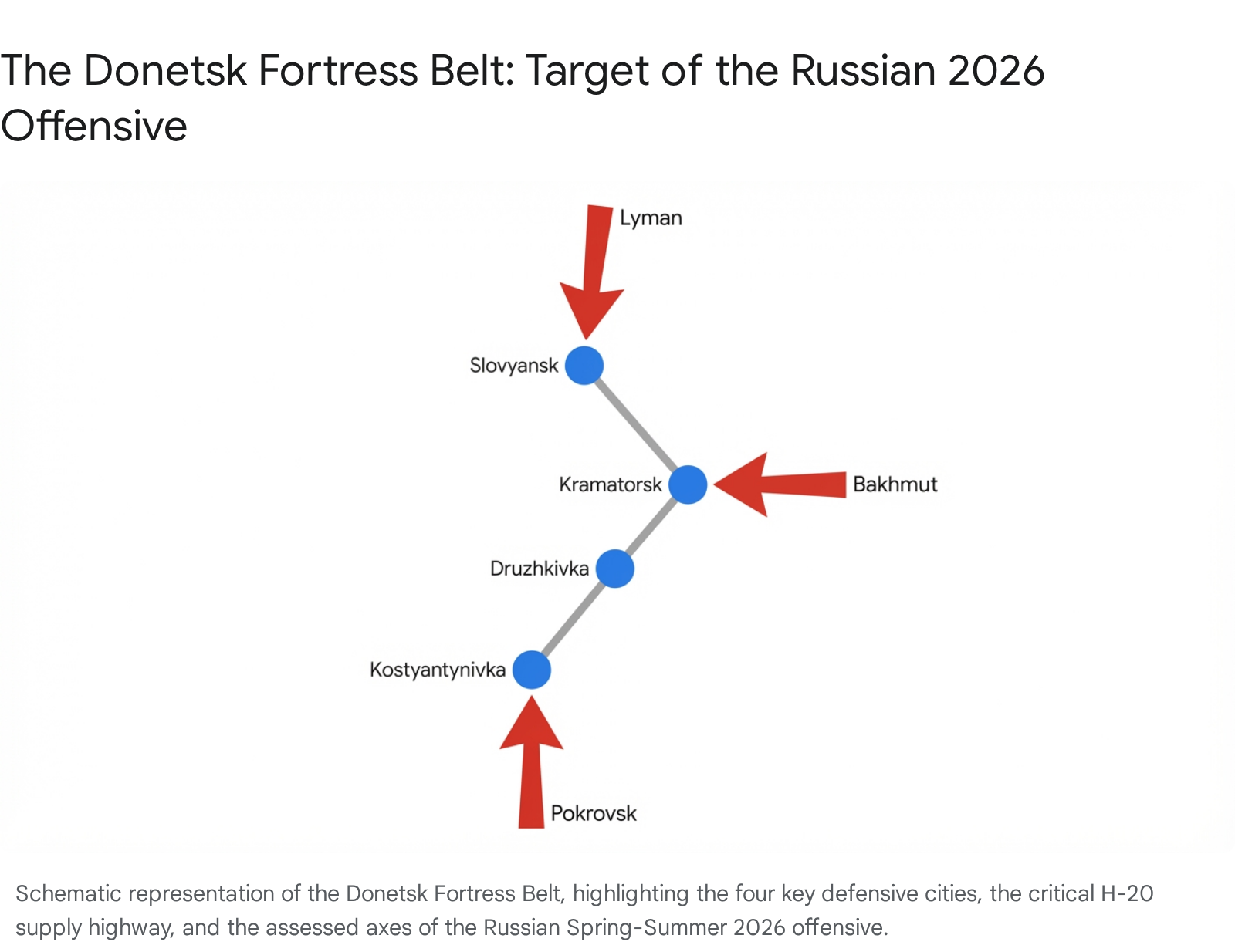
The Fortress Belt is a heavily fortified, interconnected urban conurbation consisting of four major cities-Slovyansk, Kramatorsk, Druzhkivka, and Kostyantynivka.14 These cities run along a north-to-south axis, physically connected by the critical H-20 (also designated N-20) ground line of communication (GLOC) highway.14 With a pre-war combined population exceeding 380,000 residents, this urban agglomeration represents the absolute backbone of the Ukrainian defense in the Donbas.18 The Ukrainian Armed Forces have spent the past 11 years-dating back to the initial 2014 Russian incursions led by Igor Girkin in Slovyansk-pouring immense time, capital, and engineering effort into reinforcing this specific belt, establishing significant defense-industrial and subterranean infrastructure in and around these cities.18

The operational conditions for this new phase were set by the slow, grinding, and highly costly Russian capture of the logistical hub of Pokrovsk in late December 2025.44 While the capture of Pokrovsk did not immediately “open up” the entire region as the Kremlin claimed, it provided a staging ground for a northward thrust.44 During the week ending February 28, Russian tube artillery began striking the settlement of Bilenke, located roughly 14 kilometers northeast of Kramatorsk.14 This marks a significant escalation, as it is the first time the northern tip of the Fortress Belt has come under sustained, direct conventional artillery fire in this phase of the war.14

Simultaneously, Russian forces are exerting severe, multi-directional pressure on the southern anchor of the belt. Ukrainian defenders are gradually being forced to retreat from their last holding positions within the city limits of Kostyantynivka, with the majority of the city now categorized as a contested grey zone or under direct Russian control.17 The broader Russian offensive architecture is unfolding along three distinct operational axes: pushing south from the Lyman direction, advancing west from the Bakhmut direction, and thrusting north from the recently captured Pokrovsk and Kostiantynivka sectors.17 This tri-directional pressure threatens to physically sever the M03 motorway, the vital logistical artery supplying the northern Fortress Belt cities directly from the Kharkiv Oblast.17
Yugo M85/M92 dust cover quick takedown pin installed

2.2. Tactical Evolution: The Battlefield Air Interdiction (BAI) Campaign

In order to degrade the formidable defenses of the Fortress Belt before committing to massive infantry ground assaults, the Russian military command has radically intensified a theater-wide Battlefield Air Interdiction (BAI) campaign. This campaign explicitly targets Ukraine’s operational rear-defined as the zone roughly 20 to 100 kilometers behind the line of contact-aiming to paralyze logistical movements and impact tactical battlefield operations.14 This campaign represents a significant and lethal evolution in Russian tactical doctrine, heavily leveraging a diverse array of unmanned aerial systems (UAS) to isolate tactical sectors.

Russian forces are currently utilizing a complex, layered mix of drone technologies. This includes modified tactical first-person view (FPV) drones equipped with fiber-optic cables (rendering them immune to traditional radio-frequency electronic warfare jamming), “sleeper” drones that are pre-positioned to lie in ambush on the ground until activated by the acoustic or thermal signatures of approaching targets, and long-range Geran-2 (Shahed-type) strike drones.16 These assets are systematically targeting the H-20 highway, ruthlessly hunting Ukrainian unmanned ground vehicles (UGVs), exposing drone operators, and striking civilian logistics corridors in what military analysts have starkly termed “human safari” tactics.14 For example, geolocated footage from February 26 confirmed Russian drone strikes against both military personnel in Oleksiievo-Druzhkivka and a civilian cyclist utilizing the H-20 highway northwest of Kostyantynivka.14

This pervasive drone interdiction is heavily augmented by the mass deployment of KAB glide bombs. These highly destructive munitions provide immense explosive power capable of penetrating fortified concrete positions in cities like Druzhkivka and Kostyantynivka, while allowing Russian tactical aviation to release their payloads from distances that keep them safely outside the engagement envelope of Ukrainian short-range air defenses.16 The strategic intent behind this months-long BAI campaign is to systematically starve the Fortress Belt of ammunition, food, and reinforcements, thereby creating localized tactical gaps and degrading drone defenses. Once these vulnerabilities are established, Russian forces-including recently deployed reinforcements in the Slovyansk direction consisting of ex-convicts motivated by financial incentives-will exploit them utilizing rapid infiltration tactics during the ground assault phase.15

2.3. European Military Aid and Air Defense Gaps

The severe vulnerability of the Ukrainian operational rear to Russian drone and glide bomb strikes starkly highlights the critical, ongoing shortage of Integrated Air and Missile Defense (IAMD) systems across Europe. NATO Secretary-General Mark Rutte had previously outlined a staggering requirement to increase overall NATO IAMD capability by 400 percent to adequately address the sheer volume and persistent nature of the Russian aerial threat.45 While European nations have significantly accelerated procurement efforts-ordering an estimated 18 billion USD worth of short- and very-short-range air defense systems since 2022, a massive increase compared to the 7.5 billion USD spent in the preceding four years-deployable inventories remain vastly insufficient to simultaneously protect NATO’s eastern flank and satisfy the voracious consumption rates of the Ukrainian military.45

Furthermore, Europe is currently engaged in a frantic race to supplant U.S. defense enablers, particularly in the domain of space-based Intelligence, Surveillance, and Reconnaissance (ISR). Following a controversial U.S. policy decision to halt the sharing of certain proprietary space intelligence with Ukraine in March 2025, European nations recognized the acute risk of over-reliance on American data.46 This prompted a flurry of sovereign investments, with Poland, Portugal, the Netherlands, Finland, Germany, and France all announcing expedited plans to acquire independent satellite-based radar and intelligence capabilities.46 However, significant structural bottlenecks remain unresolved. Getting hardware into orbit is insufficient; Europe currently faces a severe, systemic shortage of trained analysts with the requisite expertise to exploit raw signals intelligence and convert it into the precise targeting data required by modern precision-guided munitions.46

3. European Defense Posture, Spending, and Internal Security

3.1. The 2026 Military Balance: European Rearmament

The relentless sequence of geopolitical shocks over the past four years has triggered a permanent and historic alteration of the European defense-industrial base and fiscal landscape. According to the authoritative Military Balance 2026 report released this week by the International Institute for Strategic Studies (IISS), total global defense spending reached a staggering record of 2.63 trillion USD in 2025, representing a 2.5 percent real-term increase from the 2.48 trillion USD recorded in 2024.47 As a proportion of global GDP, average spending increased from 1.89 percent to 2.01 percent.47

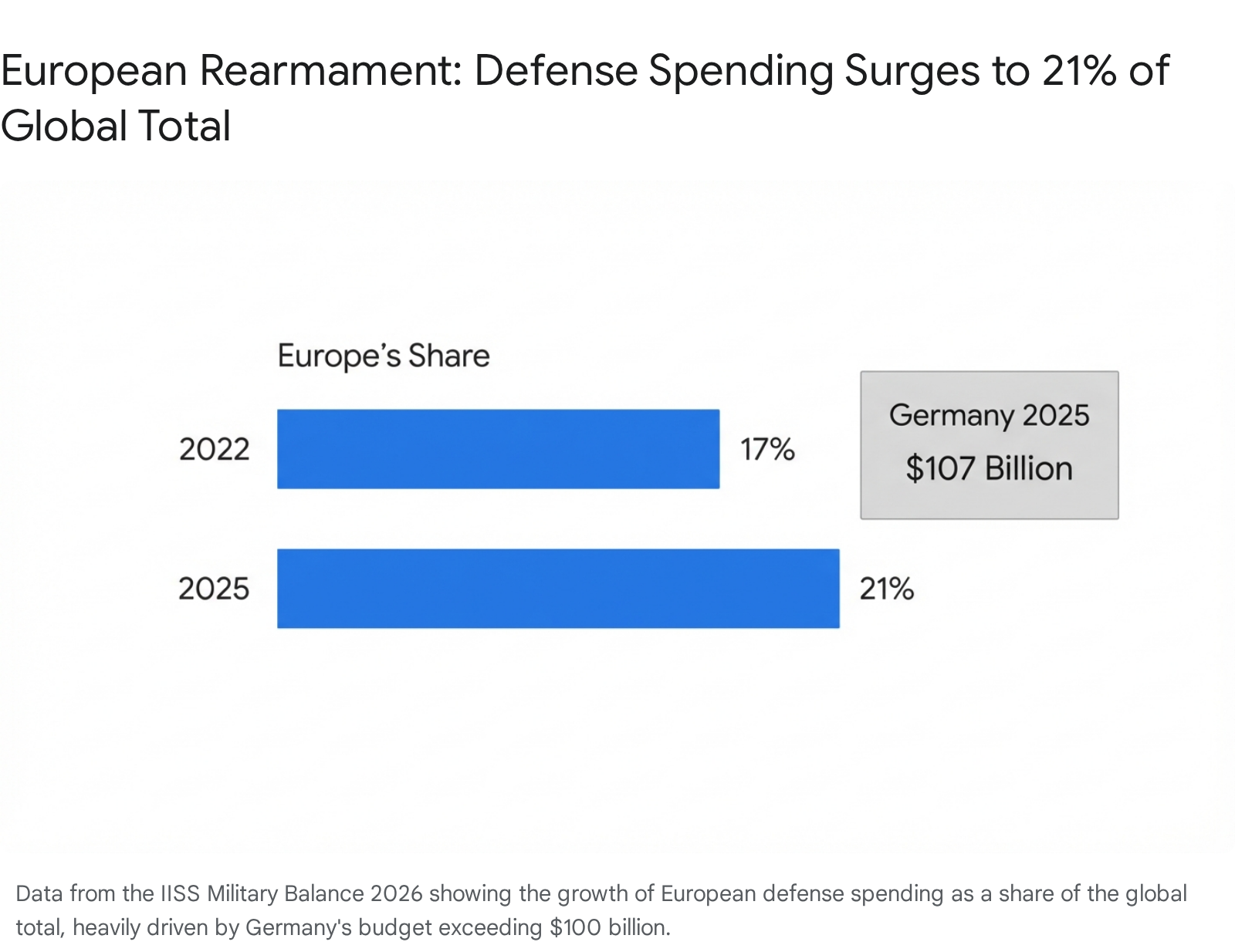
Europe has unequivocally emerged as the primary global driver of this fiscal uplift, defying expectations that spending would plateau after the initial shock of the 2022 Russian invasion of Ukraine. The European continent now accounts for over 21 percent of total global defense expenditure, a significant strategic shift from its 17 percent share in 2022.48 In 2025 alone, European defense spending grew by a remarkable 12.6 percent in real terms, reaching nearly 563 billion USD.49 NATO’s European member states are now spending an average of 2.16 percent of their GDP on defense, firmly establishing the 2 percent metric as a baseline rather than an aspirational ceiling.48

This continental rearmament is being disproportionately driven by the Federal Republic of Germany. Berlin’s national defense budget passed the historic and psychologically significant 100 billion USD threshold in 2025, reaching 107 billion USD (95 billion EUR), which constitutes an 18 percent real-term increase year-on-year.48 Germany alone has accounted for a full quarter of all European defense-spending growth over the past two years, cementing its position as the fourth-largest absolute defense spender globally.48 This massive capital influx is rapidly reshaping the broader European defense sector, characterized by a notable surge in venture capital investment directed toward agile defense start-ups focusing on autonomous systems, artificial intelligence, and dual-use capabilities.47

Defense Spending Metric (IISS 2026 Report)2024 Value2025 ValueReal-Term Growth / Shift
Global Total Spending$2.48 Trillion$2.63 Trillion+2.5%
Global Spending as % of GDP1.89%2.01%+0.12 percentage points
European Total Spending~$463 Billion~$563 Billion+12.6%
Europe’s Share of Global Spending17% (in 2022)21%+4 percentage points
German Total Spending$86 Billion$107 Billion+18%
Average European NATO SpendingN/A2.16% of GDPAbove 2.0% NATO benchmark
Yugo M85/M92 dust cover quick takedown pin installed

3.2. Force Integration and NATO Exercises

To effectively operationalize this unprecedented funding surge and deter further Russian aggression, NATO is currently executing a highly complex series of multi-domain military exercises across the European continent. These exercises are explicitly designed to stress-test the newly formed Allied Reaction Force and enhance seamless interoperability among member states’ militaries.

The scope and scale of these deployments are significant, as detailed in the current operational schedule:

Exercise NameOperational Dates (2026)Primary Host Nations / RegionsStrategic Objective
Steadfast Dart 26Jan 2 – Mar 18Germany (Lower Saxony) / Baltic SeaJoint deployment exercise testing the operational deployment and rapid reinforcement of Allied Reaction Force elements under peacetime conditions.51
Arctic Dolphin 26Feb 2 – Feb 24Norway (western fjords)Naval and amphibious operations focused on securing critical northern maritime approaches.52
Dynamic Manta 26Feb 23 – Mar 6Mediterranean SeaAdvanced submarine warfare and Anti-Submarine Warfare (ASW) war-fighting capabilities.51
Cold Response 26Mar 9 – Mar 19 (field phase)Norway, Finland, SwedenRoutine winter military exercise testing rapid deployment across the Atlantic and host nation reception capabilities.52
Dynamic Front 26Early FebRomania (Cincu)Artillery and fire support coordination along the eastern flank.52

Of particular note is Exercise Cold Response 26, operating in northern Norway as part of the broader Arctic Sentry vigilance activity.53 This exercise achieved a historic integration milestone in January and February 2026 by successfully establishing the first fully integrated combined joint logistics headquarters between the U.S. Marine Corps (specifically the 2nd Marine Logistics Group, commanded by Brig. Gen. Maura Hennigan) and the Norwegian Armed Forces.53 This Unified Combined Joint Logistics Support Group is vital for validating the capability to manage the rapid reception, staging, and onward movement of massive transatlantic reinforcements into the austere Arctic theater during a crisis scenario.53

Concurrently, during Steadfast Dart 26, NATO’s Allied Air Command executed highly targeted counter-UAS (Unmanned Aircraft System) training over the Baltics.54 Directed by the Combined Air Operations Centre in Uedem, this exercise integrated German and Italian Eurofighters, Spanish F-18s, and a Spanish A400M tanker with a Turkish Baykar Bayraktar TB3 drone.54 The objective was to refine integrated air and missile defense tactics against the exact profile of drone threats currently paralyzing the Ukrainian frontlines, ensuring Allied forces can effectively sanitize contested airspace.54

3.3. Internal Security and Counterterrorism Resiliency

While conventional military threats dominate the exterior flanks, the internal security apparatus of the European Union is undergoing rapid modernization to address an evolving, technologically sophisticated hybrid threat landscape. On February 26, the European Commission formally presented a comprehensive new counterterrorism agenda, acting as a flagship initiative under the broader ProtectEU European Internal Security Strategy.55

The driving force behind this new agenda is the rapid weaponization of emerging technologies by both state-sponsored actors and extremist organizations. The Commission explicitly identified the growing misuse of artificial intelligence, crypto-assets, commercially available drones, and 3D-printed weapons as primary vectors reshaping terrorist activity.55 Furthermore, the strategy addresses the alarming rise in the rapid online radicalization of minors orchestrated via social media algorithms.55

To counter these threats, the strategy focuses heavily on the “Anticipating Threats” pillar, proposing the creation of a centralized Single Intelligence Analysis Capacity (SIAC) at the EU level.55 This mechanism is designed to significantly augment Europol’s existing analytical support capacities, particularly by institutionalizing and expanding open-source intelligence (OSINT) capabilities and strengthening security research into emerging technologies via funding from Horizon Europe and the EU Internal Security Fund.55

Concurrently, the European regulatory landscape regarding critical infrastructure and cybersecurity is hardening. The Commission has proposed critical amendments to the NIS2 Directive (2022/2555).57 These amendments aim to simplify risk-management compliance for companies operating within the EU single market while simultaneously removing micro and small DNS service providers from the scope, and redesignating small mid-cap companies as “important” rather than “essential” entities.57 This regulatory adjustment is backed by proposed reinforced support and funding for the European Union Agency for Cybersecurity (ENISA), aimed at creating a more resilient, whole-of-society deterrence posture against state-sponsored cyber espionage and sabotage.57

4. Macroeconomics, Trade, and Energy Security

4.1. The EU-Mercosur Institutional Crisis

The geopolitical cohesion and internal political stability of the European Union suffered a severe, highly public blow this week over the deeply controversial EU-Mercosur Free Trade Agreement. The landmark deal, which has been under negotiation since 2000, aims to create a massive combined market of approximately 780 million people, covering nearly 25 percent of global GDP, by progressively eliminating tariffs between the EU and the South American Mercosur bloc (comprising Brazil, Argentina, Uruguay, Paraguay, and Bolivia).20 However, final ratification has been stalled for years due to profound environmental concerns and intense protectionist pressure from the European agricultural sector.

In a highly unorthodox, legally contentious, and politically divisive maneuver, European Commission President Ursula von der Leyen unilaterally decided to move forward with the “provisional application” of the agreement following its formal ratification by the legislatures of Argentina and Uruguay.19 Under this specialized procedural mechanism, the two trading blocs will formally exchange diplomatic communications known as “notes verbales” in early March. According to the established rules of the agreement, this would legally permit preferential trade and tariff reductions to commence on the first day of the second month following the exchange, potentially as early as May 2026.19

This executive decision has triggered an immediate and profound institutional crisis within Brussels. A majority of Members of the European Parliament (MEPs) had previously voted to refer the contested trade deal to the European Court of Justice (ECJ) to adjudicate on its fundamental legality, a move that effectively paused the standard democratic ratification process.19 By executing a provisional application, von der Leyen is taking a massive, calculated political gamble. Legal experts estimate that the ECJ could take up to two years to issue a final ruling.19 The Commission’s strategy relies on the assumption that over those 24 months, the agreement will deliver such significant, tangible macroeconomic growth and export benefits that it will become politically impossible for the European Parliament to retroactively vote to dismantle the deal once the ECJ ruling is finally delivered.19

The maneuver has fiercely and publicly divided the leaders of the EU’s largest member states. The German government, recognizing the immense potential benefits for its export-driven automotive and industrial manufacturing sectors, strongly backed the Commission’s decision. German Foreign Minister Johann Wadephul hailed the move as a “historic” achievement, declaring “This is the hour of Europe” and emphasizing the immediate need for increased prosperity and growth.19 Bernd Lange, the German Chair of the European Parliament’s Trade Committee, defended the bypass, arguing that the agreement provides vital “certainty, predictability and economic opportunities” in an era where international trade rules are routinely violated by competitors like the U.S. and China.19

Conversely, the governments of France and Italy, deeply protective of their politically powerful agricultural sectors, vehemently opposed the maneuver. French President Emmanuel Macron led the vocal opposition, publicly rebuking von der Leyen during a press conference. Macron characterized the move to provisionally apply the deal as a “bad surprise” and explicitly condemned it as “disrespectful” to the European Parliament and its democratic role in the approval process.19 French Agriculture Minister Annie Genevard echoed this sentiment, stating the decision was damaging to institutional cooperation.19 While some MEPs, such as Ireland’s Maria Walsh, cynically dismissed the original ECJ referral as a mere “delaying tactic” and a “political gesture dressed up as strategy” that failed to protect domestic farmers, the fundamental breach of trust between the Commission, the Parliament, and key member states remains severe.19

4.2. Agricultural Unrest and Supply Chain Disruptions

The political fallout from the Mercosur provisional application decision did not remain confined to diplomatic statements; it materialized immediately and violently on the streets of Europe’s major capitals. European farmers’ unions-who argue that the free trade deal will flood the European market with cheap South American beef, poultry, and grain produced under significantly lower environmental and labor standards-view themselves as unacceptable “collateral damage” sacrificed for the benefit of industrial export interests.19

Between February 22 and 28, massive, highly organized agricultural protests escalated across the continent. In Brussels, the administrative heart of the EU, thousands of farmers driving heavy tractors successfully blockaded critical arterial roads, set off pyrotechnics, and targeted EU institutional offices, resulting in severe clashes with riot police who were forced to deploy tear gas and water cannons to disperse the crowds.20

Concurrently, the powerful French agricultural union, the FNSEA, orchestrated a nationwide campaign of disruption. French farmers erected massive tractor roadblocks across major national highways and critical roundabouts, systematically dumped tons of manure at government prefectures, and targeted local EU administrative offices.22 While EU leaders, including Italian Prime Minister Giorgia Meloni, attempted to mitigate the political damage by securing a nominal delay in the final ceremonial signatures until January-requesting time to “reassure domestic farmers”-the reality of the provisional application mechanism ensures that the structural crisis regarding European agricultural sovereignty and market protectionism remains entirely unresolved.20

4.3. Macroeconomic Baseline: Disinflation Trends and Equity Markets

Before the massive geopolitical and military shocks of the weekend, the Eurozone economy was exhibiting signs of a paradoxical, yet welcome, stabilization. According to the latest flash estimates released by Eurostat, the Euro area annual headline inflation rate dropped to 1.7 percent in January 2026, down from 2.0 percent in December 2025.24 This represents the lowest inflation rate observed within the currency bloc since September 2024, placing it comfortably below the European Central Bank’s (ECB) stated 2.0 percent medium-term target.23

This disinflationary trend was heavily driven by a sharp 4.0 percent year-on-year contraction in energy prices, compounding a 1.9 percent decline observed in the previous month.24 Furthermore, core inflation-a critical metric that strips out the volatile energy, food, alcohol, and tobacco sectors to reveal underlying price pressures-also cooled significantly to 2.2 percent, marking its lowest point since October 2021.24

The inflation moderation was generally broad-based across the bloc’s largest national economies, though slight divergences remain, as detailed in the January 2026 data:

Eurozone Member State / ComponentJanuary 2026 Annual Inflation RateDecember 2025 Annual Inflation RateTrend Direction
Euro Area (Overall)1.7%2.0%Decreasing
Euro Area (Core Inflation)2.2%2.3% (est)Decreasing
Germany2.1%2.0%Slightly Increasing
France1.0% (1.1% harmonised)0.7%Increasing (base effect driven)
Spain2.4%3.0%Decreasing
Italy1.0%1.2%Decreasing
Component: Services3.2%3.4%Decreasing
Component: Energy-4.0%-1.9%Sharp Decrease

(Note: As of February 2026, Eurostat implemented methodological changes to the Harmonised Index of Consumer Prices (HICP), aligning with the UN COICOP 2018 classification, updating the index reference period to 2025=100, and fully integrating Bulgaria into the EA21 aggregate series).60

This period of easing price pressures occurred alongside a notable strengthening of the euro, which climbed above $1.20 at the end of the month, its highest valuation against the U.S. dollar in over four years.24 Gross Domestic Product (GDP) for the fourth quarter of 2025 also registered a modest but positive growth rate of 0.3 percent for both the euro area and the broader EU, avoiding a technical recession.63

Driven by these stabilizing figures and strong corporate earnings reports, European equity markets experienced a highly bullish week. The UK’s FTSE 100 index hit multiple record intra-day highs, closing the week at a record 10,910.55 points, drawing ever closer to the psychological 11,000 mark.64 In mainland Europe, despite slight end-of-week cooling, the German DAX and French CAC 40 remained robust, supported by strong corporate performances from entities like the London Stock Exchange Group (LSEG), Rightmove, and International Consolidated Airlines Group (IAG), the latter reporting a 26 percent surge in pretax profit to 4.51 billion EUR.64

However, significant underlying vulnerabilities persist beneath the surface. European consumer confidence remains entrenched in negative territory at -11.7 points for the EU and -12.2 points for the euro area.67 This reflects deep structural anxieties regarding purchasing power, as consumers’ perceived inflation remains substantially higher than the official data suggests, prompting elevated savings rates and constrained domestic consumption.23 While economists had broadly anticipated that the ECB would hold interest rates steady at their March 19 meeting due to these stabilizing figures, the sudden, violent explosion of conflict in the Middle East has introduced massive, immediate inflationary risk to the forecast.23

4.4. The Strait of Hormuz Shock: Energy Market Vulnerability

The massive joint U.S.-Israeli military strike on Iran on the morning of February 28 instantly shattered the Eurozone’s favorable energy price trajectory and injected a severe dose of geopolitical volatility into global markets. The immediate market reaction was swift: Brent crude oil surged approximately 3 percent on the final trading day of the month to close at 73.12 USD per barrel, marking its highest level since June 2025.26 West Texas Intermediate (WTI) crude mirrored this movement, gaining 2.7 percent to trade near 67.22 USD per barrel.69

For the European economy, the primary and most devastating threat vector is not the physical destruction of Iranian domestic oil infrastructure-which primarily services East Asian markets-but rather the potential asymmetric disruption of maritime traffic through the Strait of Hormuz.6 As a retaliatory measure, the Iranian regime possesses the well-documented capability to harass, mine, or effectively blockade this narrow, 33-kilometer-wide geographic chokepoint.5

The strategic importance of this waterway cannot be overstated. Approximately 19 to 20 million barrels of liquid fuel transit the Strait of Hormuz daily, alongside nearly one-fifth of the entire world’s liquefied natural gas (LNG) supply, which predominantly originates from Qatar.5 Given Europe’s heavy pivot toward seaborne LNG following the severing of Russian pipeline gas in 2022, the continent is exceptionally vulnerable to disruptions in Qatari exports.

Energy analysts assess that the risks associated with the Iranian conflict are highly ‘asymmetric’ for the oil market, presenting significantly more upside price risk than downside potential.6 Even a brief, localized disruption or a severe spike in maritime insurance premiums for tankers navigating the Strait could rapidly push Brent crude prices toward 80 USD per barrel.6 In a worst-case scenario involving a prolonged military closure or severe mining of the waterway, geopolitical risk analysts warn that crude oil prices could experience a violent spike toward 150 USD per barrel.69 Such an eventuality would instantly transmit a massive inflationary shock throughout the entire European economy, immediately erasing the ECB’s hard-won disinflationary progress, drastically inflating industrial production and transport costs, and severely dampening consumer sentiment and economic growth projections for the remainder of 2026.69

5. Strategic Outlook and Intelligence Forecast

The unprecedented convergence of kinetic military action, hybrid grey-zone operations, and severe internal political fractures during the final week of February 2026 has profoundly degraded the strategic outlook for the European continent across multiple interconnected domains.

In the immediate term (1-4 weeks), the highest probability threat to European stability is the economic and security spillover originating from the execution of “Operation Epic Fury.” European capitals and intelligence services must urgently prepare for asymmetric, secondary Iranian retaliation. While the primary Iranian response has targeted U.S. installations, the risk of proxy harassment of European-flagged commercial shipping in the Red Sea, the Gulf of Aden, and the Persian Gulf is exceptionally high. Furthermore, state-sponsored cyberattacks against European critical infrastructure, financial institutions, and energy grids cannot be ruled out as Tehran seeks to punish allies of the United States. Macroeconomically, the European Central Bank will likely be forced to rapidly pivot its forecasting models to account for a sustained, elevated geopolitical risk premium embedded in crude oil and LNG prices. If the Strait of Hormuz is even partially restricted, the resulting energy shock will threaten a severe resurgence of imported inflation, potentially forcing the ECB to reconsider its anticipated interest rate trajectory.

In the near term (1-3 months), the operational focus will remain intensely fixated on the Eastern Flank. The Russian military is methodically positioning itself to initiate high-intensity ground assaults against the Donetsk Fortress Belt. If the sustained, drone-heavy Battlefield Air Interdiction campaign successfully starves Ukrainian defenders and degrades logistics along the H-20 highway, Russian forces may achieve localized tactical breakthroughs. The fall of any of the four anchor cities-Slovyansk, Kramatorsk, Druzhkivka, or Kostyantynivka-would threaten the total collapse of the primary Ukrainian defensive line in the Donbas. This imminent operational crisis will generate intense, immediate political pressure on European NATO members to drastically expedite the delivery of highly scarce short-range air defense systems, electronic warfare countermeasures, and artillery munitions, further straining a continental defense-industrial base that is already operating at maximum capacity.

Internally, the European Union’s institutional cohesion is deeply and perhaps irrevocably compromised. The unilateral executive action taken by the Commission regarding the provisional application of the Mercosur agreement has deeply alienated key member states, particularly France and Italy, and aggressively bypassed the oversight function of the European Parliament. As highly organized agricultural protests continue to disrupt critical supply chains and paralyze urban centers across the continent, domestic political polarization will only increase, empowering populist factions ahead of critical national elections.

Concurrently, the severe diplomatic friction with the United States regarding the status of Greenland, coupled with verified, unprecedented intelligence warnings of hybrid electoral interference in Denmark orchestrated by both Moscow and Washington, underscores a stark new reality. Europe is now forced to navigate an incredibly hostile geopolitical environment characterized not only by overt Russian military aggression on its borders but also by increasingly transactional, unpredictable, and potentially destabilizing pressure from its primary transatlantic ally. In this volatile matrix, the pursuit of genuine European strategic autonomy-in defense procurement, energy security, and diplomatic leverage-is no longer merely a theoretical policy objective debated in Brussels, but an absolute, immediate operational necessity for the survival of the bloc’s security architecture.


Please share the link on Facebook, Forums, with colleagues, etc. Your support is much appreciated and if you have any feedback, please email us in**@*********ps.com. If you’d like to request a report or order a reprint, please click here for the corresponding page to open in new tab.


Sources Used

  1. US and Israel launch strikes on Iran: what we know so far, accessed February 28, 2026, https://www.theguardian.com/world/2026/feb/28/us-israel-launch-strikes-attack-iran-what-we-know-so-far-latest
  2. Live updates: U.S. and Israel launch attack on Iran as Trump calls for regime change, accessed February 28, 2026, https://www.washingtonpost.com/world/2026/02/28/israel-strikes-iran-live-updates/
  3. Iran Turned to Russia, China for Missiles After 12-Day War – Defense Security Monitor, accessed February 28, 2026, https://dsm.forecastinternational.com/2026/02/27/iran-turned-to-russia-china-for-missiles-after-12-day-war/
  4. Iran strikes Israel, UAE, Qatar, Bahrain, and Kuwait following US-Israel attack, accessed February 28, 2026, https://www.middleeasteye.net/news/us-israel-strike-iran-joint-attack
  5. How strikes on Iran put focus on the Strait of Hormuz, accessed February 28, 2026, https://www.straitstimes.com/world/middle-east/how-strikes-on-iran-put-focus-on-the-strait-of-hormuz?ref=latest-headlines
  6. Will the resumption of conflict in Iran push Brent crude oil prices to test $80 again?, accessed February 28, 2026, https://www.moomoo.com/news/post/66187583/will-the-resumption-of-conflict-in-iran-push-brent-crude
  7. UAE intercepts several Iranian missiles, state news agency says, accessed February 28, 2026, https://iranintl.com/en/202602283447
  8. France slams ‘ridiculous provocation’ as Sweden confirms Russian drone buzzed French aircraft carrier, accessed February 28, 2026, https://www.malaymail.com/news/world/2026/02/28/france-slams-ridiculous-provocation-as-sweden-confirms-russian-drone-buzzed-french-aircraft-carrier/210722
  9. Swedish Navy intercepts suspected Russian drone nearing French aircraft carrier, accessed February 28, 2026, https://www.defensenews.com/global/europe/2026/02/27/swedish-navy-intercepts-suspected-russian-drone-nearing-french-aircraft-carrier/
  10. Sweden says it intercepted Russian drone during visit by French aircraft carrier, accessed February 28, 2026, https://community.triblive.com/news/3991328
  11. Danish intelligence warns of threat of Russian and US interference in general elections in March, accessed February 28, 2026, https://unn.ua/en/news/danish-intelligence-warns-of-threat-of-russian-and-us-interference-in-general-elections-in-march
  12. President Trump and Greenland: Frequently asked questions – House of Commons Library, accessed February 28, 2026, https://commonslibrary.parliament.uk/research-briefings/cbp-10472/
  13. Russia may interfere in Danish election, exploiting chaos sewn by US, spies warn, accessed February 28, 2026, https://www.theguardian.com/world/2026/feb/28/denmark-election-interference-russia-chaos-us-greenland-intelligence-agencies
  14. Russian Offensive Campaign Assessment, February 27, 2026, accessed February 28, 2026, https://understandingwar.org/research/russia-ukraine/russian-offensive-campaign-assessment-february-27-2026/
  15. Russian Offensive Campaign Assessment, February 26, 2026 – Institute for the Study of War, accessed February 28, 2026, https://understandingwar.org/research/russia-ukraine/russian-offensive-campaign-assessment-february-26-2026/
  16. Russia’s Quest to Intensify The Theater-Wide Battlefield Air Interdiction Campaign Against Ukraine’s Logistics, accessed February 28, 2026, https://understandingwar.org/research/russia-ukraine/russias-quest-to-intensify-the-theater-wide-battlefield-air-interdiction-campaign-against-ukraines-logistics/
  17. The Russians are advancing towards Sloviansk and Kramatorsk. Day 1462 of the war, accessed February 28, 2026, https://www.osw.waw.pl/en/publikacje/analyses/2026-02-24/russians-are-advancing-towards-sloviansk-and-kramatorsk-day-1462-war
  18. The Donbas ‘fortress belt’: why does it matter? – Newspaper – DAWN.COM, accessed February 28, 2026, https://www.dawn.com/news/1934973
  19. Von der Leyen pushes through Mercosur deal, splitting European …, accessed February 28, 2026, https://www.theguardian.com/world/live/2026/feb/27/russia-europe-nuclear-plant-iaea-southern-ukraine-latest-news-updates
  20. EU Delays Mercosur Deal as Farmers’ Protests Shake Brussels – Materia Rinnovabile, accessed February 28, 2026, https://www.renewablematter.eu/en/eu-delays-mercosur-deal-as-farmers-protests-shake-brussels
  21. EU delays massive free-trade deal with South American bloc Mercosur amid farmer protests, accessed February 28, 2026, https://www.pbs.org/newshour/world/eu-delays-massive-free-trade-deal-with-south-american-bloc-mercosur-amid-farmer-protests
  22. Thousands of Farmers March Against EU-Mercosur trade deal | Paris Protest – YouTube, accessed February 28, 2026, https://www.youtube.com/watch?v=nC6HyRA2SG4
  23. Eurozone Inflation: What to Expect from February’s CPI Data, accessed February 28, 2026, https://global.morningstar.com/en-gb/economy/eurozone-inflation-what-expect-februarys-cpi-data
  24. Euro Area Inflation Rate – Trading Economics, accessed February 28, 2026, https://tradingeconomics.com/euro-area/inflation-cpi
  25. 2026 Israeli–United States strikes on Iran – Wikipedia, accessed February 28, 2026, https://en.wikipedia.org/wiki/2026_Israeli%E2%80%93United_States_strikes_on_Iran
  26. US, Israel launch major attack on Iran, accessed February 28, 2026, https://www.argusmedia.com/en/news-and-insights/latest-market-news/2794460-us-israel-launch-major-attack-on-iran
  27. Trump ‘not happy’ with Iran situation and says military force is still an option, accessed February 28, 2026, https://www.theguardian.com/world/2026/feb/27/us-urges-citizens-leave-israel-threat-strike-iran
  28. Marco Rubio orders US officials to stop commentary that could strain Iran talks, accessed February 28, 2026, https://www.theguardian.com/us-news/2026/feb/27/marco-rubio-iran-talks-mike-huckabee
  29. Statement by the Ministers of Foreign Affairs of France, Germany, and the United Kingdom, together with the High Representative of the European Union | EEAS, accessed February 28, 2026, https://www.eeas.europa.eu/eeas/statement-ministers-foreign-affairs-france-germany-and-united-kingdom-together-high-representative_en
  30. US and Israel attack Iran: What we know so far, accessed February 28, 2026, https://www.aljazeera.com/news/2026/2/28/us-and-israel-attack-iran-what-we-know-so-far
  31. US and Israel attack Iran as Trump says ‘major combat operations’ under way – live, accessed February 28, 2026, https://www.theguardian.com/world/live/2026/feb/28/israel-attacks-iran-as-blasts-heard-in-tehran-live-updates
  32. US-Israel Attacks Iran LIVE Updates: Iran Vows “Decisive Response” After Israel-US Strikes, accessed February 28, 2026, https://www.ndtv.com/world-news/iran-us-tensions-live-updates-explosion-rocks-iran-amid-heightened-nuclear-tensions-with-us-iran-israel-tensions-tehran-tel-aviv-tensions-11148388
  33. Live Updates: U.S. and Israel attack Iran, with Trump confirming “major combat operations”, accessed February 28, 2026, https://www.cbsnews.com/live-updates/israel-us-attack-iran-trump-says-major-combat-operations/
  34. UK should resist being dragged into war after Iran strikes – Labour MP, accessed February 28, 2026, https://global.morningstar.com/en-gb/news/alliance-news/1772272756075474400/uk-should-resist-being-dragged-into-war-after-iran-strikes-labour-mp
  35. Sweden says it intercepted Russian drone during visit by French aircraft carrier, accessed February 28, 2026, https://apnews.com/article/sweden-france-aircraft-carrier-drone-russia-c8905513cb9ade27176a88ef642411b7
  36. Sweden confirms drone that approached French aircraft carrier was Russian – Ukrinform, accessed February 28, 2026, https://www.ukrinform.net/rubric-polytics/4096419-sweden-confirms-drone-that-approached-french-aircraft-carrier-was-russian.html
  37. Sweden confirms Russian drone intercepted near French aircraft carrier, accessed February 28, 2026, https://www.aljazeera.com/news/2026/2/28/sweden-confirms-russian-drone-intercepted-near-french-aircraft-carrier
  38. Greenland crisis – Wikipedia, accessed February 28, 2026, https://en.wikipedia.org/wiki/Greenland_crisis
  39. Trump & Greenland: Is There Logic in the Chaos? | The Arctic Institute, accessed February 28, 2026, https://www.thearcticinstitute.org/trump-greenland-logic-chaos/
  40. Dispatch Politics Roundup: Reflections on the Union, accessed February 28, 2026, https://thedispatch.com/newsletter/dispatch-politics/state-of-the-union-rubio-trump-tariffs-patel/?utm_source=google-news&utm_medium=syndication
  41. What follows President Trump’s decision to step back from threatening to use force in Greenland? | Brookings, accessed February 28, 2026, https://www.brookings.edu/articles/what-follows-president-trump-decision-to-step-back-from-threatening-to-use-force-in-greenland/
  42. The Critical Importance of Ukraine’s Fortress Belt in Donetsk Oblast | ISW, accessed February 28, 2026, https://understandingwar.org/research/russia-ukraine/the-critical-importance-of-ukraines-fortress-belt-in-donetsk-oblast/
  43. Why Putin wants Donetsk | The Spectator Australia, accessed February 28, 2026, https://www.spectator.com.au/2025/08/why-putin-wants-donetsk/
  44. Russian Offensive Campaign Assessment, February 25, 2026 – Institute for the Study of War, accessed February 28, 2026, https://understandingwar.org/research/russia-ukraine/russian-offensive-campaign-assessment-february-25-2026/
  45. The Military Balance 2026: Fortifying NATO’s eastern flank, accessed February 28, 2026, https://www.iiss.org/publications/the-military-balance/2026/the-military-balance-2026/fortifying-natos-eastern-flank/
  46. The good, the bad and the ugly – Inside Europe’s race to supplant US defense enablers, accessed February 28, 2026, https://www.defensenews.com/global/europe/2026/02/27/the-good-the-bad-and-the-ugly-inside-europes-race-to-supplant-us-defense-enablers/
  47. The Military Balance 2026: Global defence spending, accessed February 28, 2026, https://www.iiss.org/publications/the-military-balance/2026/the-military-balance-2026/global-defence-spending/
  48. Europe ramps up defense spending to 21% of global total, led by Berlin: Report, accessed February 28, 2026, https://breakingdefense.com/2026/02/europe-ramps-up-defense-spending-to-21-of-global-total-led-by-berlin-report/
  49. Global defence spending continues to grow amid geopolitical uncertainty, accessed February 28, 2026, https://www.iiss.org/online-analysis/military-balance/2026/02/global-defence-spending-continues-to-grow-amid-geopolitical-uncertainty/
  50. EU Member States’ defence budgets | Epthinktank | European Parliament, accessed February 28, 2026, https://epthinktank.eu/2025/05/07/eu-member-states-defence-budgets/
  51. NATO Exercises and Activities, accessed February 28, 2026, https://shape.nato.int/nato-exercises
  52. NATO Exercises 2026: The Complete Guide to Allied Readiness, accessed February 28, 2026, https://www.grosswald.org/nato-exercises-2026/
  53. U.S. and Norway establish first fully integrated joint logistics command for NATO Exercise Cold Response 26, accessed February 28, 2026, https://defence-industry.eu/u-s-and-norway-establish-first-fully-integrated-joint-logistics-command-for-nato-exercise-cold-response-26/
  54. NATO conducts counter-drone training mission over Baltics to reinforce Eastern Flank air defence and deterrence, accessed February 28, 2026, https://defence-industry.eu/nato-conducts-counter-drone-training-mission-over-baltics-to-reinforce-eastern-flank-air-defence-and-deterrence/
  55. ProtectEU: Commission presents new counterterrorism agenda – Migration and Home Affairs, accessed February 28, 2026, https://home-affairs.ec.europa.eu/news/protecteu-commission-presents-new-counterterrorism-agenda-2026-02-26_en
  56. Commission proposes new measures to prevent and counter terrorism, accessed February 28, 2026, https://commission.europa.eu/news-and-media/news/commission-proposes-new-measures-prevent-and-counter-terrorism-2026-02-26_en
  57. Cyber security | UK Regulatory Outlook February 2026 – Osborne Clarke, accessed February 28, 2026, https://www.osborneclarke.com/insights/regulatory-outlook-february-2026-cyber-security
  58. Europe Knows It’s Under Attack. So Why Won’t It Respond?, accessed February 28, 2026, https://moderndiplomacy.eu/2026/02/28/europe-knows-its-under-attack-so-why-wont-it-respond/
  59. France farmers protest against low incomes and EU-Mercosur trade deal – JURIST – News, accessed February 28, 2026, https://www.jurist.org/news/2026/01/france-farmers-protest-against-low-incomes-and-eu-mercosur-trade-deal/
  60. Euro area annual inflation down to 1.7%, accessed February 28, 2026, https://ec.europa.eu/eurostat/web/products-euro-indicators/w/2-04022026-ap
  61. Eurozone Inflation Falls to 1.7% in January 2026 | Core Rate at 2021 Low – News and Statistics, accessed February 28, 2026, https://www.indexbox.io/blog/euro-area-inflation-drops-to-17-in-january-lowest-since-2024/
  62. Annual inflation down to 1.9% in the euro area – European Commission, accessed February 28, 2026, https://ec.europa.eu/eurostat/web/products-euro-indicators/w/2-19012026-ap
  63. EU economic press review, 2 February 2026: Monetary stabilisation and industrial challenges – L’Europe à Contre-Courant, accessed February 28, 2026, https://europeacontrecourant.eu/en/eu-economic-press-review-2-february-2026/
  64. LONDON MARKET MIDDAY: FTSE 100 draws closer to 11,000 mark, accessed February 28, 2026, https://global.morningstar.com/en-gb/news/alliance-news/1772194121423046800/london-market-midday-ftse-100-draws-closer-to-11000-mark
  65. Late market roundup: Stocks close up with new FTSE 100 record, accessed February 28, 2026, https://www.ajbell.co.uk/news/articles/late-market-roundup-stocks-close-new-ftse-100-record
  66. European stocks mixed as corporate earnings continue; inflation data in focus, accessed February 28, 2026, https://www.investing.com/news/stock-market-news/european-stocks-steady-as-corporate-earnings-continue-inflation-data-in-focus-4530540
  67. 19 February 2026 – Economy and Finance – European Union, accessed February 28, 2026, https://economy-finance.ec.europa.eu/document/download/e65fe2dc-b81c-4888-8723-77d5de9f9f90_en?filename=Flash_consumer_2026_02_en.pdf
  68. European Economic Outlook – February 2026 – KPMG agentic corporate services, accessed February 28, 2026, https://assets.kpmg.com/content/dam/kpmgsites/uk/pdf/2026/02/eu-outlook-feb-2026.pdf
  69. Israel strike risk heightens oil price concerns amid nuclear deadlock, accessed February 28, 2026, https://www.aa.com.tr/en/energy/energy-diplomacy/israel-strike-risk-heightens-oil-price-concerns-amid-nuclear-deadlock/55019
  70. When Commodities Meets War: What a US Strike on Iran Could Mean for Markets, accessed February 28, 2026, https://www.share-talk.com/when-commodities-meets-war-what-a-us-strike-on-iran-could-mean-for-markets-2/

SITREP Europe – Week Ending February 21, 2026

Executive Summary

The operating environment across the European theater for the week ending February 21, 2026, is characterized by a dangerous convergence of conventional high-intensity conflict, escalating sub-threshold hybrid warfare, and a profound restructuring of the transatlantic security architecture. As the Russia-Ukraine war approaches its four-year mark, the conflict shows no signs of culmination, remaining locked in a brutal war of attrition that is steadily reshaping the continent’s geopolitical and economic realities. Russian forces continue incremental, costly advances in the Donbas—specifically in the Pokrovsk direction—while maintaining a relentless strategic strike campaign against Ukrainian critical infrastructure. In response, Ukraine is executing highly sophisticated deep-strike operations into the Russian interior, targeting advanced missile production facilities.

Simultaneously, the European continent is experiencing an unprecedented surge in Russian hybrid warfare. Intelligence assessments confirm a four-fold increase in state-sponsored sabotage, arson, and cyberattacks targeting critical infrastructure, defense logistics, and political institutions across NATO member states. This shadow war is designed to degrade European public resolve, disrupt military supply chains to Ukraine, and test the thresholds of NATO’s Article 5 collective defense guarantees without triggering an overwhelming conventional military response. The sabotage of the national railway network in Bologna, Italy, coinciding with the Milano-Cortina 2026 Winter Olympics, exemplifies the operationalization of these hybrid tactics against high-visibility civilian and logistical targets.

In response to this deteriorating security environment and evolving signals from Washington regarding burden-sharing, European defense integration is accelerating at a historic pace. The Munich Security Conference and the subsequent European Group of Five (E5) meeting in Krakow highlighted a definitive mindset shift toward European strategic autonomy. The United Kingdom is actively pushing for the creation of a European Defence Mechanism (EDM) to integrate procurement and manufacturing outside of restrictive European Union frameworks, aiming to offset the fragmentation of the continent’s defense industrial base. However, this push for autonomy is revealing internal fractures, most notably public diplomatic friction between Germany and France over defense spending commitments and the pace of rearmament.

The political landscape underpinning these security dynamics is highly volatile. Germany’s new coalition government, formed after the dramatic February 2025 snap elections that saw a significant rise in the right-wing Alternative for Germany (AfD), is under immense pressure to deliver economic stabilization ahead of crucial regional elections. Economically, Europe is navigating a fragile stabilization. While natural gas prices at the Title Transfer Facility (TTF) have eased due to warmer weather forecasts and strong Liquefied Natural Gas (LNG) inflows, energy costs remain structurally elevated compared to pre-crisis levels. This persistent energy premium continues to hamper the European Union’s Clean Industrial Deal and broader economic competitiveness. Furthermore, geopolitical fissures within the bloc remain acute, starkly illustrated by Hungary’s ongoing veto of a 90-billion-euro macro-financial loan to Ukraine. This situation report synthesizes the week’s intelligence, diplomatic, and operational data to provide a comprehensive assessment of the European security landscape, identifying key trends, vulnerabilities, and strategic trajectories for the immediate future.

1. The Evolving European Security Architecture and Transatlantic Relations

The strategic architecture of European defense is undergoing a tectonic shift, driven by the dual pressures of an aggressive, mobilized Russian Federation to the east and a United States increasingly focused on the Indo-Pacific and domestic political considerations to the west. The week’s diplomatic engagements underscore a rapid, albeit friction-laden, transition toward greater European self-reliance in conventional deterrence and defense industrial capacity.

1.1 The Munich Security Conference and the Push for “Interdependence”

The Munich Security Conference (MSC), held from February 13 to 15, 2026, served as the primary forum for articulating the new European security paradigm. The overarching theme of the conference was the acknowledgment that the post-Cold War security architecture is irreparably broken. This realization, explicitly voiced by German Chancellor Friedrich Merz who stated the “old world order no longer exists,” is driving a fundamental reassessment of the transatlantic relationship.1

A highly significant development at the MSC was the diplomatic offensive launched by United Kingdom Prime Minister Keir Starmer. Seeking to fundamentally reset UK-EU relations ten years after the Brexit referendum, Starmer called for an “urgent need” to establish a closer defense relationship covering procurement and manufacturing.1 Warning against overdependence on the United States and describing Europe as a “sleeping giant” whose combined economies dwarf Russia’s by more than ten times, Starmer advocated for a shift from fragmented national planning to strategic “interdependence”.1 He argued that the US security umbrella had allowed European nations to develop bad habits of underinvestment, resulting in massive duplication and critical capability gaps.1

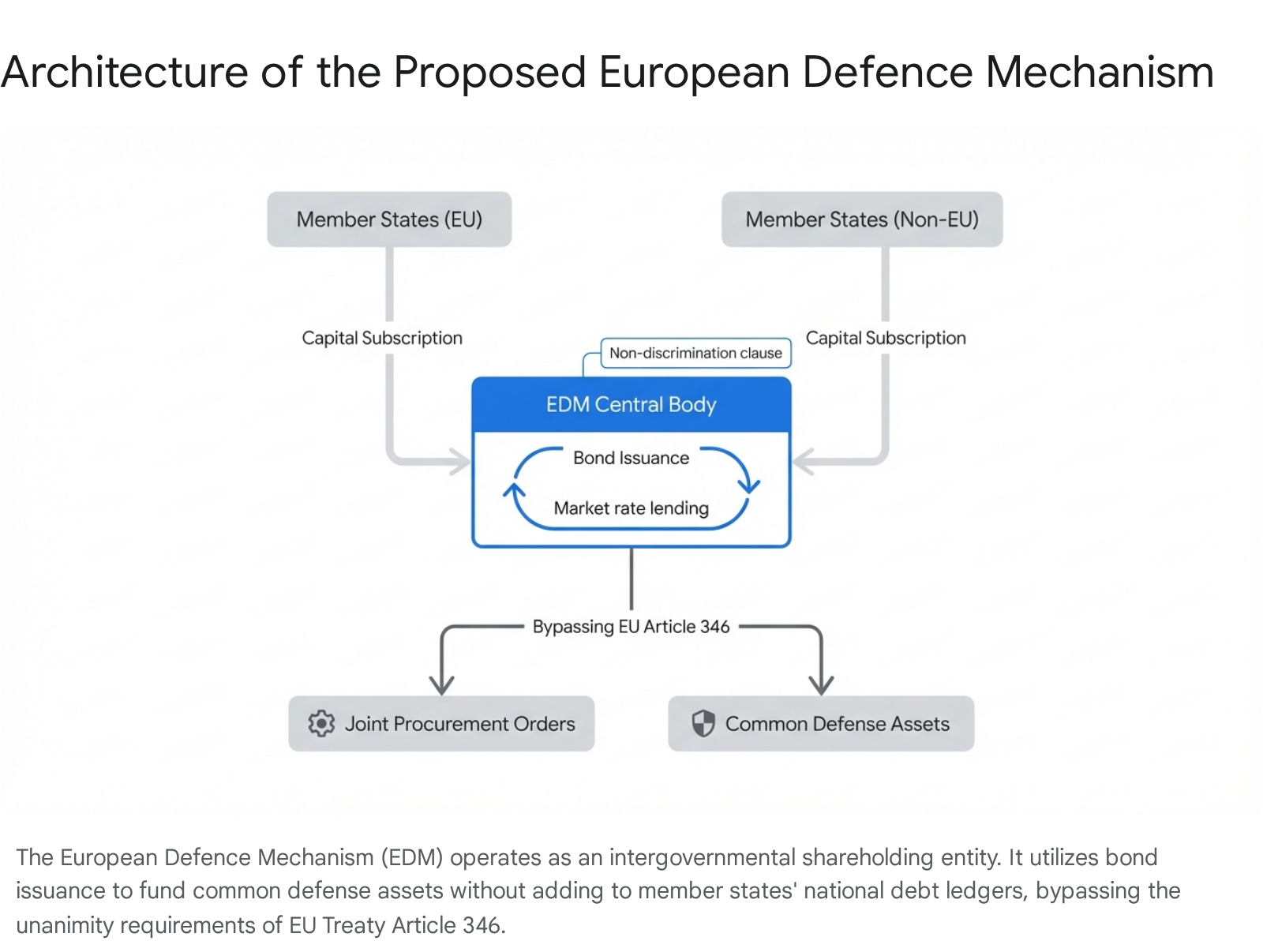
To operationalize this vision, the UK is heavily promoting the European Defence Mechanism (EDM), a concept originally championed by the Bruegel institute and former UK foreign secretary David Miliband.1 The EDM is envisioned as an intergovernmental institution open to all European democracies, deliberately designed to bypass the European Union’s Article 346, which exempts national security from the single market and currently mandates unanimity for any structural change.1

Yugo M85/M92 dust cover quick takedown pin set with ring

By operating as a shareholding entity that can issue bonds to finance joint procurement and common defense assets—such as European air defense systems or military intelligence satellites—the EDM aims to leverage economies of scale and lower the fiscal costs of rearmament.1 Crucially, debt issued by the EDM to fund large-scale common assets would remain on the mechanism’s books rather than directly inflating the national debt ledgers of individual member states, a highly attractive feature for heavily indebted European economies seeking to rapidly rearm.1 Concurrently, the UK and France are attempting to reopen stalled negotiations regarding the UK joining Security Action for Europe, an EU rearmament scheme, after talks collapsed in 2025 over the European Commission’s calculated cost of entry.1

In the domestic UK context, this push for external integration is mirrored by internal debates over defense procurement efficiency. The UK Ministry of Defence (MoD) is facing intense scrutiny regarding the potential scrapping of the Ajax armored vehicle program, which is eight years delayed and has already consumed £6 billion in taxpayer funds.2 Furthermore, public accounts committees have criticized the MoD for failing to publish its equipment plan in both 2023 and 2024, warning that such opacity damages public trust and signals weakness to adversaries.2 When questioned about independent domestic missile defense systems, the UK Minister of State for Defence confirmed the country will not pursue an independent “Iron Dome” equivalent, but will instead rely on a £1 billion investment integrated firmly within a broader NATO Integrated Air and Missile Defence endeavor.3

1.2 The E5 Consensus in Krakow

Following the MSC, the locus of European defense coordination shifted to Krakow, Poland, for the European Group of Five (E5) meeting on February 20, 2026.4 The E5—comprising defense ministers from France, Germany, Italy, Poland, and the United Kingdom, alongside NATO Deputy Secretary General Radmila Shekerinska and EU High Representative Kaja Kallas—represents the demographic, economic, and military core of the continent.4

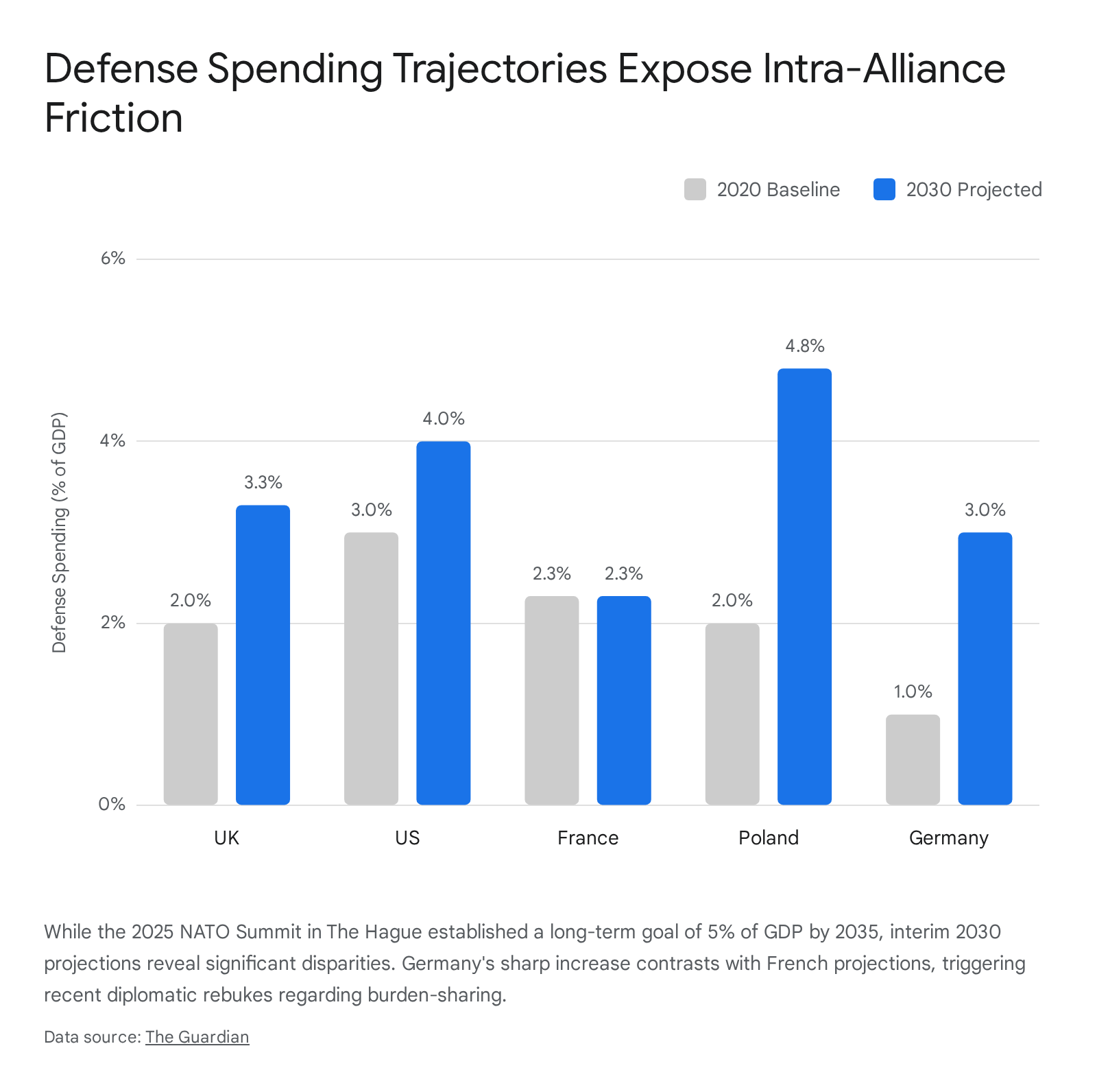
The Krakow summit solidified the mindset shift identified at the MSC. Shekerinska praised the E5 nations for demonstrating extraordinary commitment to increasing defense spending, noting that the pledge made at the 2025 NATO Summit in The Hague to invest 5% of GDP in defense by 2035 is becoming an operational reality.5 Germany’s trajectory is particularly notable in this regard; Berlin is on track to spend 152 billion euros on defense by 2029, effectively doubling its 2021 expenditure levels.7

The E5 discussions prioritized actionable deliverables, specifically focusing on expanding the European defense industrial base to ensure an uninterrupted flow of ammunition, artillery, and autonomous deep-strike drones to Ukraine.5 The presence of Ukrainian Defense Minister Mykhailo Fedorov at the E5 summit allowed for direct coordination on the Prioritised Ukraine Requirements List (PURL), particularly regarding urgently needed air defense systems drawn from Allied stockpiles.4 Shekerinska noted that the Ukrainian Ministry of Defence presented a very clear defense plan designed to help Kyiv remain strong while diplomatic negotiations continue, and to deter any future aggression.9

1.3 Intra-European Friction: The Franco-German Divide

Despite the outward projection of unity at the MSC and the E5 summit, significant intra-European fissures remain, most notably between Berlin and Paris regarding the pace and scale of financial commitment to rearmament. During the Munich Security Conference, German Chancellor Friedrich Merz and Foreign Minister Johann Wadephul publicly criticized France’s defense spending efforts as “insufficient”.10

Wadephul directly challenged French President Emmanuel Macron’s rhetoric on European sovereignty, stating, “He repeatedly and correctly refers to our pursuit of European sovereignty. Anyone who talks about it needs to act accordingly in their own country,”.10 Wadephul noted that while Germany is pushing through tough domestic discussions to reach the 5% of GDP by 2035 target, France’s trajectory is falling short of the required pace.10 This public rebuke highlights Germany’s growing assertiveness within the alliance and its frustration with perceived French reluctance to match rhetorical ambition with proportionate fiscal outlays.10 This friction threatens to complicate efforts to build a truly integrated European defense market, as trust between the continent’s two largest economies is a prerequisite for initiatives like the EDM to succeed.

Yugo M85/M92 dust cover quick takedown pin set with ring

1.4 US Pressure and the Upcoming Ankara Summit

Looming over European integration efforts is the profound uncertainty regarding United States strategy. Intelligence and diplomatic reports from mid-February indicate that Washington is actively pressing allies to limit the role of Ukraine and four Indo-Pacific partners (Australia, New Zealand, Japan, and South Korea) at the upcoming 36th NATO leaders’ summit in Ankara, scheduled for July 7-8, 2026.13

The United States has urged that these nations be excluded from official core meetings and relegated strictly to parallel events, citing a need to scale back the number of sessions and cut costs amidst resource constraints.13 Furthermore, NATO staff, reportedly under pressure from capitals, have proposed canceling the traditional public forum at the summit—an event that typically features leaders and defense experts engaging in high-profile panel discussions—replacing it with a closed-door NATO Defense Industry Forum.14

This maneuver is widely interpreted by European national security analysts as a US effort to sideline contentious expansion and partnership issues to focus strictly on core alliance deterrence and burden-sharing. However, former NATO spokeswoman Oana Lungescu warned that keeping partner countries on the periphery signals a retreat from global engagement, while keeping Ukraine at arm’s length sends a highly concerning strategic signal to Moscow, potentially validating the Kremlin’s assessment that Western resolve is fatiguing.14 This dynamic further accelerates the perceived necessity for the E5 and mechanisms like the EDM to secure a sovereign European defense capability independent of Washington’s political fluctuations.

2. The Russia-Ukraine Theater of Operations: Year Four

As the conflict nears its four-year anniversary on February 24, 2026, the operational tempo remains exceptionally high.15 The Council of Europe in Strasbourg is preparing to mark the anniversary with a special meeting of the Committee of Ministers to examine the consequences of the ongoing aggression, alongside a public ceremony featuring the raising of the Ukrainian flag and an exhibition titled “Living through the war”.15 On the ground, however, the war has settled into a brutal, multi-domain war of attrition, characterized by grueling, infantry-heavy tactical engagements in the east, sophisticated deep-strike drone warfare, and catastrophic losses on both sides.

2.1 Frontline Developments: The Pokrovsk Vulnerability and Zaporizhzhia Counterattacks

The center of gravity for Russian offensive operations remains the Donetsk Oblast, specifically the Pokrovsk-Myrnohrad agglomeration. Throughout the week of February 15-21, 2026, Russian forces maintained relentless pressure aiming to close a tactical pocket in this sector.17 Geolocated combat footage and intelligence reports indicate incremental Russian advances northwest of Pokrovsk, particularly near the settlements of Hryshyne and Zatyshok, as well as south of Novopavlivka near Filiya and Dachne.17

The Ukrainian 7th Rapid Reaction Corps of the Air Assault Forces reported severe infiltration attempts by small Russian assault groups striking from Kotlyne and Rodynske, attempting to envelop the northern and southern flanks of Pokrovsk.17 The Russian order of battle in this sector involves heavy utilization of the 35th Motorized Rifle Brigade (41st Combined Arms Army, Central Military District), providing sustained artillery barrages, while the Rubikon Center for Advanced Unmanned Technologies is deploying localized swarms of First-Person View (FPV) drones to degrade Ukrainian armored reserves near Dobropillya.17 To counter this, Ukrainian forces executed a frontline strike campaign, successfully eliminating a Russian drone control point near Zatyshok and a communications hub near Novopavlivka.17

Conversely, Ukrainian forces have demonstrated localized tactical successes in the southern theater. Between February 10 and 17, tactical counterattacks successfully liberated multiple small settlements along the Yanchur and Haichur rivers in the Zaporizhzhia Oblast, specifically in the Oleksandrivka and Hulyaipole directions.18 Open-source intelligence indicates that Ukrainian forces exploited a temporary degradation of the Starlink communications network used by Russian forward units to execute these rapid counter-thrusts.18

2.2 Territorial Control and Strategic Attrition Metrics

The war’s overarching stalemate is starkly reflected in territorial control data, though intelligence assessments vary slightly on the margins. As of February 2026, Russian forces control approximately 45,816 square miles of Ukrainian territory, equating to roughly 20% of the nation (an area comparable to the US state of Pennsylvania).18 This total includes the Crimean Peninsula and parts of the Donbas seized prior to the 2022 full-scale invasion.18

Over the past year (February 2025 to February 2026), Russia captured 2,102 square miles, representing less than 0.9% of Ukraine’s total 1991 territory.18 However, weekly fluctuations present conflicting narratives. The Institute for the Study of War (ISW) reported that for the week of February 10-17, 2026, Russian forces actually lost a net 19 square miles due to the aforementioned Zaporizhzhia counterattacks.18 Conversely, Ukraine’s DeepState OSINT group reported a net Russian gain of 6.6 square miles during the same period, citing the occupation of Bondarne and Rivne, while noting Ukrainian forces cleared enemy infiltration near Bilytske and Prymorske.18 Notably, Ukrainian forces maintain a cross-border operational foothold of approximately 4 square miles in the Russian regions of Kursk and Belgorod, serving as a political and tactical buffer.18

The human cost of this grinding territorial stalemate has reached staggering proportions, defining the conflict as the deadliest conventional war in Europe since 1945. Civilian fatalities in Ukraine have reached 15,954, with 2025 recorded as the deadliest year for non-combatants since the initial invasion, showing a 31% increase in casualties over 2024.16

EntityEstimated Total Military Casualties (Killed, Wounded, Missing)Estimated Military Fatalities
Russian Federation1,000,000 – 1,200,000~325,000
Ukraine500,000 – 600,00055,000 – 140,000

Data compiled from the Center for Strategic and International Studies (CSIS), Western intelligence officials, and the Estonian Foreign Intelligence Service as of February 2026.18 Ukrainian fatality estimates vary widely between independent assessments (140,000) and official state pronouncements by President Zelenskyy (55,000).18

Equipment losses further illustrate the catastrophic attrition. Verified visual evidence documents the loss of 24,099 pieces of Russian military hardware, including a devastating 13,887 armored combat vehicles.18 Ukraine has suffered the verified loss of 11,380 pieces of equipment, including 5,596 armored vehicles.18 A detailed breakdown of verified Russian main battle tank losses reveals the systematic destruction of Moscow’s mechanized reserves across multiple generations of hardware.

Russian Main Battle Tank ModelTotal Verified LossesDestroyedCaptured by Ukraine
T-62 (All Variants)27419645
T-64 (All Variants)102813
T-72 (All Variants)569+388+93+
Total Verified Tank Losses4,3343,239540

Data extracted from Oryx OSINT visual verification database. Numbers represent an absolute baseline; actual losses are assessed to be significantly higher due to unrecorded destruction.18

Yugo M85/M92 dust cover quick takedown pin set with ring

2.3 Deep Strikes and the Targeting of Critical Infrastructure

Beyond the contact line, the strategic air campaign continues unabated. On the night of February 16-17, 2026, Russian Aerospace Forces executed a massive, complex combined strike package utilizing Shahed-136 loitering munitions, cruise missiles, and ballistic trajectories aimed at Ukraine’s already heavily degraded energy infrastructure.19 Over the past twelve months, 70% of Ukraine’s energy facilities have been hit, causing severe winter power outages in major urban centers, including Kyiv.16

During the week of February 15-21, a heavy barrage struck the Black Sea port city of Odesa, destroying a power generating substation and a school building, while simultaneous strikes in the northeastern city of Sumy targeted residential districts, causing multiple civilian casualties, including children.22

Ukraine’s response has been to aggressively strike deeper into the Russian strategic rear, aiming to degrade Moscow’s war-making capacity at its source. On February 21, Ukrainian long-range systems successfully struck a defense manufacturing facility in Votkinsk, located nearly 1,900 kilometers northeast of the Ukrainian border.22 Intelligence reports suggest this factory is deeply integrated into Russia’s strategic missile production supply chain, potentially involved in manufacturing the nuclear-capable hypersonic Oreshnik missile system.22 This strike demonstrates a highly sophisticated Ukrainian C4ISR (Command, Control, Communications, Computers, Intelligence, Surveillance, and Reconnaissance) capability and a willingness to target the most sensitive nodes of the Russian military-industrial complex, despite the potential for escalatory rhetoric from Moscow.

2.4 Diplomatic Stagnation and the Hungarian Veto

Diplomatic efforts to resolve the conflict remain entirely deadlocked. US-brokered peace talks in Geneva collapsed mid-week without any breakthrough, as Moscow rigidly adhered to maximalist demands.22 These demands include the total withdrawal of Ukrainian forces from currently held eastern territories, the legitimization of sham elections to advance claims that the current Ukrainian government is illegitimate, and a permanent veto over Kyiv’s security alignments.22

Compounding Kyiv’s strategic predicament is internal sabotage within the European Union. On February 20, the Hungarian government, led by Prime Minister Viktor Orbán, officially announced it will block a planned 90-billion-euro ($106-billion) EU macro-financial loan to Ukraine.24 Budapest has conditioned its approval on the resumption of Russian oil flows through the Druzhba pipeline, which were interrupted in late January following a Ukrainian drone strike.24

Hungary, alongside Slovakia, maintains a temporary exemption from EU sanctions prohibiting Russian oil imports, arguing that Russian fossil fuels are indispensable to their economies.24 Foreign Minister Péter Szijjártó accused Kyiv of “blackmailing” Hungary by intentionally holding up supplies, a claim made without providing verifiable evidence, and in retaliation, Hungary suspended shipments of diesel to Ukraine.24 This geopolitical hostage-taking exposes the fragility of the EU’s consensus-based foreign policy apparatus and hands the Kremlin a potent vector for dividing the alliance from within. To partially offset these funding delays, France announced the Ukraine Fund II, a €71 million mechanism designed to mobilize French businesses to rebuild critical Ukrainian infrastructure, focusing on energy, agriculture, and mine clearance.25

3. The Shadow War: Hybrid Escalation and Cyber Operations

While conventional combat is confined to Eastern Europe, a sophisticated, multi-domain hybrid war is currently raging across the entire continent. The week ending February 21, 2026, saw multiple intelligence agencies sound the alarm on an unprecedented escalation of Russian sub-threshold aggression aimed at NATO and EU member states, designed to fracture political will and degrade European infrastructure.26

3.1 The Surge in Kinetic Sabotage and Proxy Recruitment

A joint threat assessment published this week by the Dutch General Intelligence and Security Service (AIVD) and the Military Intelligence and Security Service (MIVD), corroborated by data from the Center for Strategic and International Studies (CSIS), confirmed that Russian state-sponsored sabotage operations in Europe nearly tripled between 2023 and 2024, and have increased four-fold leading into 2026.26

The Dutch intelligence report bluntly warned that Russia is utilizing a “hybrid” campaign—comprising sabotage, arson, cyberattacks, disinformation, and espionage—to prepare for a prolonged confrontation with the West, test NATO’s red lines, and sow public fear, all while calculatingly avoiding actions that would definitively trigger an Article 5 collective defense response.27

The operational methodology of this sabotage campaign has evolved significantly. Russian military intelligence (the GRU) has largely pivoted away from using deep-cover officers for kinetic tasks, instead relying on the weaponization of local proxies. Intelligence intercepts indicate that the GRU is actively utilizing networks associated with the Wagner Group to recruit disaffected locals, petty criminals, and radicalized individuals via encrypted platforms like Telegram to carry out low-level arson and vandalism against defense logistics hubs and critical infrastructure.29 This strategy provides the Kremlin with plausible deniability while overwhelming European domestic security services.

Recent examples of this campaign include the deployment of “bloody and flammable parcels” in the logistics network, unauthorized drone overflights of military bases, and physical attacks on energy grids.30 The use of disposable local agents makes traditional deterrence mechanisms—such as prosecution and incarceration—ineffective at stopping the overarching state-directed campaign.29

3.2 The Cyber Domain: Targeting Command and Critical Infrastructure

The hybrid offensive is intimately synchronized with aggressive cyber operations, confirming the Munich Security Report’s finding that the line between cybersecurity and energy security has effectively ceased to exist.30 The European Commission formally acknowledged that on January 30, 2026, its central infrastructure managing mobile devices for thousands of EU civil servants suffered a sophisticated cyberattack.31 While CERT-EU (the central cybersecurity service for EU institutions) managed to contain the breach within nine hours, forensic evidence indicates that threat actors likely gained access to the names and contact information of key staff members.31 This data exfiltration poses a severe counterintelligence risk, potentially facilitating highly targeted spear-phishing or blackmail operations against EU policymakers.

Simultaneously, the threat to physical infrastructure via cyber intrusion is escalating. A late 2025 cyberattack attributed to the Russian threat actor “Sandworm” compromised 30 energy facilities in Poland, directly targeting the Operational Technology (OT) and SCADA systems responsible for energy distribution.20 Furthermore, a joint advisory issued by the US Cybersecurity and Infrastructure Security Agency (CISA) and the German domestic intelligence agency (BfV) revealed a coordinated attempt to insert “logic bombs” into the SCADA systems managing track switching at the vital Leipzig rail hub, a critical logistical node for NATO deployments.20

3.3 The Information Domain: Domestic Control and Information Warfare

To insulate its domestic population from the fallout of the war and control the narrative space, the Kremlin has drastically tightened its grip on the flow of information. On February 20, 2026, President Vladimir Putin signed into law a sweeping new measure granting the Federal Security Service (FSB) unilateral authority to command cellular and landline Internet Service Providers to shut down or throttle internet access across Russia.34 This law effectively finalizes the architecture of the “Sovereign Internet,” allowing the state to instantly blackout communications in the event of domestic unrest or cross-border incursions, further isolating the Russian populace from external factual reporting and amplifying the state’s cognitive warfare efforts aimed at convincing the West to abandon Ukraine.34

4. European Domestic Politics and Institutional Cohesion

The geopolitical maneuvering regarding defense spending and support for Ukraine is deeply intertwined with the volatile domestic political landscapes of key European powers. Germany, as the economic engine of the continent, is navigating a particularly fragile political transition that is directly impacting its foreign policy posture.

4.1 The German Political Landscape Post-2025 Election

Germany is currently operating under a new political reality following the dramatic snap federal elections held on February 23, 2025. These elections, triggered by the collapse of former Chancellor Olaf Scholz’s governing coalition, reshaped the Bundestag and significantly altered the balance of power.36

Under the leadership of Friedrich Merz, the conservative Christian Democratic Union/Christian Social Union (CDU/CSU) emerged victorious, securing 28.5% of the vote.36 However, the most consequential outcome was the massive surge of the right-wing Alternative for Germany (AfD), which captured 20.8% of the vote to become the second-largest parliamentary group.36 The incumbent Social Democrats (SPD) suffered a historic collapse, falling to 16.4%, while the liberal FDP was wiped out entirely, failing to meet the 5% threshold required to enter the newly downsized 630-seat parliament.36

Political Party2025 Popular Vote (%)Seats Won (Out of 630)Change in Seats from 2021
CDU/CSU28.5%208+11
AfD20.8%152+69
SPD16.4%120-86
Greens11.6%85-33
Die Linke8.8%64+25

Summary of the 2025 German Federal Election results, illustrating the fragmentation of the center-left and the rise of right-wing populism.36

Entering 2026, Merz’s coalition government is under immense pressure to deliver tangible results, particularly economic stabilization. Germany narrowly exited a recession in 2025 with a marginal GDP growth of 0.2%, and forecasts for 2026 project anemic growth between 0.5% and 1.0%.38 The coalition’s cohesion is being severely tested ahead of crucial state-level elections scheduled for September 2026 in regions like Saxony-Anhalt.38 Weak performance in these regional contests could fuel narratives exploited by the AfD, undermining federal stability.38 Consequently, there is only a narrow window between now and September for the government to pass contentious fiscal, social, and energy reforms.38 This domestic fragility explains Merz’s highly assertive stance on burden-sharing at the Munich Security Conference; his government must demonstrate to the German electorate that the massive domestic investments in rearmament are being matched by European partners, hence the public friction with France over defense spending.10

4.2 EU Institutional Focus and French Diplomacy

At the broader institutional level, the European Union is attempting to coalesce around a unified economic strategy. On February 12, 2026, EU leaders convened for an informal strategic retreat at Alden Biesen, Belgium, to discuss the bloc’s competitiveness.40 Guided by the ‘EU Strategic Agenda 2024-2029’, the focus is on strengthening the single market to build European sovereignty and reduce dependencies in a fracturing global order.40 The retreat featured insights from Mario Draghi and Enrico Letta, emphasizing that strengthening the economic base is an “urgent strategic imperative” to survive the ongoing years of “polycrisis”.40 Furthermore, European democracy support strategies are structurally recalibrating to prioritize protecting democratic norms within Europe, acknowledging the internal threat posed by populist movements.42

Simultaneously, French diplomacy is highly active on multiple fronts. At the Munich Security Conference, French Minister for Europe and Foreign Affairs Jean-Noël Barrot held a first-ever trilateral meeting with German Foreign Minister Johann Wadephul and Chinese Foreign Minister Wang Yi.43 Wang Yi utilized the forum to warn against unilateralism and protectionism, arguing that interdependence with China is not a risk and setting a clear agenda to maintain open EU-China trade relations despite US pressure.43 Barrot also chaired an informal G7 Foreign Ministers meeting on the sidelines of the MSC, outlining priorities for the 2026 French G7 Presidency, focusing on overhauling international partnerships and addressing macroeconomic imbalances, while releasing a joint statement with European allies condemning the continued targeting of civilian infrastructure in Sudan.44 Furthermore, Paris is working to revitalize the Australia–India–France trilateral as a more reliable platform for Indian Ocean security, given the chronic instability and shifting focus of the US-led Quad partnership.46

5. Human Security, Border Dynamics, and Environmental Stressors

The European periphery continues to be shaped by the complex interplay of migration flows, state-sponsored hybrid pressures, and increasingly severe environmental shocks.

Data released by the European Border and Coast Guard Agency (Frontex) indicates a dramatic short-term decline in irregular migration entering the bloc. Preliminary data for January 2026 showed a sharp 60% year-on-year drop in irregular border crossings, with approximately 5,500 detections recorded.47 This follows a broader trend; in 2025, detections of irregular border crossings fell by 26% to almost 178,000, representing the lowest level since 2021.49

However, intelligence analysts assess this January drop as a temporary, weather-induced anomaly rather than a structural resolution. Frontex explicitly linked the sharp decline to Cyclone Harry, a severe winter storm that battered the Mediterranean coast, Greece, Italy, Malta, and Portugal between January 19 and 21, making sea journeys exceptionally dangerous and temporarily disrupting smuggling departures.47

The Frontex Annual Risk Analysis for 2025-2026 warns that the underlying drivers of migration remain highly potent.50 Instability and external geopolitical influence in the Sahel continue to fuel southern smuggling routes, while the Eastern Borders face persistent, unpredictable pressure from hostile state actors utilizing migration as a hybrid weapon.49 As weather conditions improve, a resurgence in crossings is highly probable. European border management faces a pivotal stress test in June 2026, when the EU Pact on Migration and Asylum becomes fully applicable, alongside the full rollout of the Entry/Exit System (EES) and the planned launch of the European Travel Information and Authorisation System (ETIAS) later in the year.49

Yugo M85/M92 dust cover quick takedown pin set with ring

5.2 Environmental Shocks and Health Crises

The tactical impact of Cyclone Harry highlights a broader strategic vulnerability: the increasing frequency of extreme weather events destabilizing European infrastructure and society. The back-to-back low-pressure storms that battered the Iberian Peninsula resulted in severe flooding, killing at least 16 people in Portugal and causing localized devastation in Spain, such as the fatal flooding of the Fahala River in Málaga.48 Saturated soils across France prompted widespread flood alerts, creating a new reality where Europe alternates between being underwater in winter and withered by drought in summer.51

These environmental stressors compound existing vulnerabilities, creating vectors for disease. The World Health Organization (WHO) published Epidemiological Update #34 on February 21, 2026, detailing a multi-country outbreak of cholera.52 While the epicenter remains outside the continent, the degradation of water and sanitation infrastructure due to extreme weather events, combined with high volumes of displaced persons moving through informal transit camps, elevates the risk of localized outbreaks on Europe’s periphery, requiring continuous public health surveillance.52

6. The Milano-Cortina 2026 Winter Olympics: Security and Conclusion

The intersection of high-profile international events and the elevated threat environment placed immense strain on European domestic security forces during the conclusion of the Milano-Cortina 2026 Winter Olympics, which ran from February 6 to 22.53

6.1 Securing a Distributed Mega-Event

Operating across a geographically dispersed footprint—spanning the ice venues of Milan (including the San Siro Stadium) to the alpine events in Cortina, Livigno, and Fiemme—the Games created a vast, highly complex attack surface for both physical and cyber threats.53 The intelligence community assessed a high risk of opportunistic lone-actor terrorism, activist disruption, and state-backed sabotage.54

This threat materialized violently during the Games. Italian authorities were forced to investigate a series of coordinated sabotage attacks on the national railway network surrounding the vital transport hub of Bologna.58 The incidents involved synchronized arson at a track switch, severed high-voltage electrical cables, and the discovery of a rudimentary unexploded device.58 These attacks caused severe delays across the northern Italian transit corridor, demonstrating how relatively minor kinetic disruptions can cascade into significant logistical failures and mass strandings during capacity-strained mega-events.54

In the cyber domain, threat actors aggressively probed the Games’ digital infrastructure. Cybersecurity analysts identified the digitized “Smart Road” SS51 Alemagna—which relies on Vehicle-to-Infrastructure (V2I) IoT sensors—as a novel attack vector where false telemetry injection could cause severe gridlock or endanger VIP transit.59 Furthermore, authorities continuously monitored for AI-amplified hybrid threats, anticipating scenarios where threat actors might combine a minor technical outage with the release of high-fidelity deepfake audio or video to trigger mass panic in crowded fan zones.59 The necessity to protect thousands of third-party partners across a temporary digital supply chain highlighted the sprawling complexity of securing modern international events.60

6.2 Sporting Highlights and Diplomatic Undertones

Despite the security pressures, the sporting events proceeded successfully, concluding with the men’s ice hockey and women’s curling finals, and the freestyle skiing halfpipe events.61 Notable sporting narratives included a double gold medal victory for the married Chinese aerials team of Wang Xindi and Xu Mengtao.64

However, even the sporting arenas were not immune to diplomatic friction. Tensions flared during the Board of Peace meeting when International Olympic Committee (IOC) President Kirsty Coventry expressed surprise and concern over the unexpected presence of FIFA President Gianni Infantino alongside US President Donald Trump, indicating ongoing friction regarding the politicization of international sporting bodies.53 The Games officially concluded on February 22 with the “Beauty in Action” Closing Ceremony at the historic 1st-century AD Verona Arena, featuring performances by Roberto Bolle and Achille Lauro, transitioning the Olympic focus toward the upcoming 2026 Winter Paralympics and the 2030 French Alps Games.53

7. Economic Security, Energy Markets, and Industrial Policy

The geopolitical instability continues to exert a profound gravitational pull on Europe’s economic security, most notably in the energy sector, which remains the Achilles’ heel of the continent’s industrial competitiveness.

7.1 Natural Gas Market Volatility

European natural gas markets experienced significant volatility in the opening months of 2026. Following a sharp 45% price spike during January—driven by colder weather and below-average storage levels—prices retreated significantly in mid-February.67 As of February 20, 2026, the benchmark Title Transfer Facility (TTF) front-month contract fell to 31.57 EUR/MWh, representing a 19.48% drop over the preceding month and remaining 31.23% lower than the same period in 2025.68

This downward price pressure was facilitated by revised, warmer temperature forecasts across Northwest Europe, which depressed heating demand, coupled with robust Liquefied Natural Gas (LNG) sendouts averaging over 314 million cubic meters per day.70 Furthermore, a perceived reduction in Middle Eastern geopolitical risk premiums following ongoing US-Iran negotiations contributed to the bearish market sentiment.70

Despite the recent price dip, underlying vulnerabilities persist. European gas storage levels are concerningly low, sitting at just 33.02% capacity as of mid-February, significantly below the previous five-year seasonal average of 49.3%.70 Supply chains also remain sensitive to disruption, evidenced by an unplanned 11.8 million cubic meter per day reduction at Norway’s Ormen Lange facility due to compressor failure.70

European Trading HubSpot Price (Day-Ahead) EUR/MWhFutures Price (Month-Ahead) EUR/MWh
TTF (Netherlands)29.9429.81
THE (Germany)32.9031.89
CEGH (Austria)33.0032.31
PEG (France)28.2728.18

Snapshot of European natural gas hub pricing as of mid-February 2026, illustrating minor regional pricing disparities but overall market stabilization relative to January peaks.71

7.2 Electricity Demand and the Clean Industrial Deal

The long-term economic outlook is further complicated by structural challenges in the electricity market. The European Commission launched the Clean Industrial Deal in February 2025, aiming to aggressively accelerate decarbonization by increasing the share of electricity in the EU’s gross final energy consumption from 23% in 2024 to 32% by 2030.72

However, intelligence from macroeconomic analysts indicates that this target is severely at risk. Electricity consumption in the Euro area actually decreased by 6.3% between 2015 and 2023, and demand remains broadly stagnant.72 This stagnation is driven primarily by lower overall industrial demand—a symptom of the deindustrialization triggered by the 2021-2022 energy crisis—and a sluggish uptake in key consumer electrification technologies such as electric vehicles and heat pumps.72 While electricity demand from data centers and AI integration is rising globally, it is constrained in Europe by grid connection bottlenecks and stringent new regulations.72

While wholesale electricity prices have stabilized from their crisis peaks, they remain structurally elevated compared to pre-2021 levels. This continuously erodes the purchasing power of European households and devastates the global competitiveness of energy-intensive manufacturing firms.30 The compounding effect of high baseline electricity prices and rising carbon costs—with EU Emissions Trading System (ETS) permits forecast to climb above 100 EUR in 2026—creates a perilous environment for European heavy industry.73 Speculative capital and hedge-fund driven trading in the carbon market risk financializing a system meant to drive real-economy emissions reductions, further alienating affected industries and risking capital flight to jurisdictions with lower energy input costs.73 As Germany and France spar over defense spending, their shared inability to definitively solve the continent’s energy cost premium remains the greatest long-term threat to European strategic autonomy.


Please share the link on Facebook, Forums, with colleagues, etc. Your support is much appreciated and if you have any feedback, please email us in**@*********ps.com. If you’d like to request a report or order a reprint, please click here for the corresponding page to open in new tab.


Sources Used

  1. Starmer stresses ‘urgency’ of closer defence ties with Europe at …, accessed February 21, 2026, https://www.theguardian.com/politics/2026/feb/14/keir-starmer-munich-conference-closer-europe-defence-ties
  2. Spending even more on defence won’t buy us peace | Letters, accessed February 21, 2026, https://www.theguardian.com/politics/2026/feb/19/spending-even-more-on-defence-wont-buy-us-peace
  3. Question: 18 Feb 2026: Hansard Written Answers – TheyWorkForYou, accessed February 21, 2026, https://www.theyworkforyou.com/wrans/?id=2026-02-10.112424.h
  4. NATO Deputy Secretary General Welcomes Progress On Defence Investment And Support To Ukraine With The E5, accessed February 21, 2026, https://www.eurasiareview.com/21022026-nato-deputy-secretary-general-welcomes-progress-on-defence-investment-and-support-to-ukraine-with-the-e5/
  5. Statement | NATO Transcript, accessed February 21, 2026, https://www.nato.int/en/news-and-events/events/transcripts/2026/02/20/statement-by-the-nato-deputy-secretary-general-at-the-meeting-of-the-european-group-of-5-defence-ministers
  6. FULL REMARKS: NATO’s Leader Warns of Uncertain Future, Vows Stronger Defence and Support | AC1G – YouTube, accessed February 21, 2026, https://m.youtube.com/watch?v=RKfnauBfcjA&pp=0gcJCaIKAYcqIYzv
  7. NATO Secretary General pre-ministerial press conference at Defence Ministers Meeting, 11 FEB 2026 – YouTube, accessed February 21, 2026, https://www.youtube.com/watch?v=UdeAxw9OmMs
  8. Press conference, accessed February 21, 2026, https://www.nato.int/en/news-and-events/events/transcripts/2026/02/12/press-conference-by-the-nato-secretary-general-following-the-meeting-of-nato-ministers-of-defence
  9. NATO Has Heard a Clear Defense Plan from Ukraine — Alliance Deputy Secretary General, accessed February 21, 2026, https://armyinform.com.ua/en/2026/02/21/nato-has-heard-a-clear-defense-plan-from-ukraine-alliance-deputy-secretary-general/
  10. Germany calls on France to increase defence spending – The Guardian, accessed February 21, 2026, https://www.theguardian.com/world/2026/feb/16/germany-calls-on-france-to-increase-defence-spending-merz-macron
  11. Germany deems French defence spending efforts ‘insufficient’ – The Brussels Times, accessed February 21, 2026, https://www.brusselstimes.com/1975247/germany-deems-french-defence-spending-efforts-insufficient
  12. Germany says France lagging behind on defense spending – Semafor, accessed February 21, 2026, https://www.semafor.com/article/02/17/2026/germany-says-france-lagging-behind-on-defense-spending
  13. US Pushes to Sideline Ukraine at NATO Summit as Alliance Scales Back Meetings, accessed February 21, 2026, https://www.kyivpost.com/post/70457
  14. U.S. presses allies to limit Ukraine, partners’ role at NATO summit in Turkey, accessed February 21, 2026, https://english.nv.ua/nation/u-s-presses-allies-to-limit-invitations-at-nato-summit-politico-50585242.html
  15. Council of Europe to mark fourth anniversary of start of Russia’s war of aggression against Ukraine, accessed February 21, 2026, https://www.coe.int/en/web/portal/-/council-of-europe-to-mark-fourth-anniversary-of-start-of-russia-s-war-of-aggression-against-ukraine
  16. Country Conditions: Ukraine February 2026, accessed February 21, 2026, https://refugees.org/country-conditions-ukraine-february-2026/
  17. Russian Offensive Campaign Assessment, February 16, 2026 – Institute for the Study of War, accessed February 21, 2026, https://understandingwar.org/research/russia-ukraine/russian-offensive-campaign-assessment-february-16-2026/
  18. The Russia-Ukraine War Report Card, Feb. 18, 2026 | Russia Matters, accessed February 21, 2026, https://www.russiamatters.org/news/russia-ukraine-war-report-card/russia-ukraine-war-report-card-feb-18-2026
  19. Russian Offensive Campaign Assessment, February 17, 2026 – Institute for the Study of War, accessed February 21, 2026, https://understandingwar.org/research/russia-ukraine/russian-offensive-campaign-assessment-february-17-2026/
  20. The Erosion of the Multilateral Security Architecture in Central and Eastern Europe Amid Systematic Kinetic-Cyber Hybrid Aggression by the Russian Federation – https://debuglies.com, accessed February 21, 2026, https://debuglies.com/2026/02/08/the-erosion-of-the-multilateral-security-architecture-in-central-and-eastern-europe-amid-systematic-kinetic-cyber-hybrid-aggression-by-the-russian-federation/
  21. Ukraine war situation update | 31 January – 6 February 2026 – ACLED, accessed February 21, 2026, https://acleddata.com/update/ukraine-war-situation-update-31-january-6-february-2026
  22. Russian Strikes Hit More Ukrainian Power Facilities, Several People Wounded, accessed February 21, 2026, https://www.rferl.org/a/russia-ukraine-drone-strikes-factory-missile-odesa/33684082.html
  23. Russian Offensive Campaign Assessment, February 15, 2026 – Institute for the Study of War, accessed February 21, 2026, https://understandingwar.org/research/russia-ukraine/russian-offensive-campaign-assessment-february-15-2026/
  24. Hungary says it will block a key EU loan to Ukraine until Russian oil shipments resume, accessed February 21, 2026, https://www.newsday.com/news/nation/hungary-eu-ukraine-loan-russian-oil-v81108
  25. Replenishment of the Ukraine fund: €71 million raised as part of the call for projects open until 9 april 2026 (19.02.26), accessed February 21, 2026, https://www.diplomatie.gouv.fr/en/country-files/ukraine/news/article/replenishment-of-the-ukraine-fund-eur71-million-raised-as-part-of-the-call-for
  26. How Russia’s Hybrid Warfare Will Escalate in 2026 and What Europe Must Do? | GLOBSEC, accessed February 21, 2026, https://www.globsec.org/what-we-do/commentaries/how-russias-hybrid-warfare-will-escalate-2026-and-what-europe-must-do
  27. Russia stepping up hybrid attacks, preparing for long standoff with West, Dutch intelligence warns – Cyber Security News, accessed February 21, 2026, https://therecord.media/russia-cyberattacks-europe-warfare
  28. Russia’s Shadow War Against the West – CSIS, accessed February 21, 2026, https://www.csis.org/analysis/russias-shadow-war-against-west
  29. Europe’s Cyber Bullets Can’t Replace Political Will | Lawfare, accessed February 21, 2026, https://www.lawfaremedia.org/article/europe’s-cyber-bullets-can’t-replace-political-will
  30. The grid is the battlefield: what the Munich Security Report reveals about cyber warfare and the fight for Europe’s energy infrastructure, accessed February 21, 2026, https://nationalsecuritynews.com/2026/02/the-grid-is-the-battlefield-what-the-munich-security-report-reveals-about-cyber-warfare-and-the-fight-for-europes-energy-infrastructure/
  31. Commission responds to cyber-attack on its central mobile infrastructure, accessed February 21, 2026, https://ec.europa.eu/commission/presscorner/detail/en/ip_26_342
  32. European Commission breached – investigating mobile hack – Computing, accessed February 21, 2026, https://www.computing.co.uk/news/2026/security/european-commission-breached
  33. Russian Cyber Sabotage in Europe – RUSI, accessed February 21, 2026, https://my.rusi.org/events/russian-cyber-sabotage-in-europe.html
  34. Putin Signs New Measure Tightening FSB Control Over Russian Internet, accessed February 21, 2026, https://www.rferl.org/a/russia-internet-law-restriction-tech-censorship/33684027.html
  35. Russian Offensive Campaign Assessment, February 20, 2026, accessed February 21, 2026, https://understandingwar.org/research/russia-ukraine/russian-offensive-campaign-assessment-february-20-2026/
  36. 2025 German federal election – Wikipedia, accessed February 21, 2026, https://en.wikipedia.org/wiki/2025_German_federal_election
  37. Shaping Germany’s future: Key takeaways from the 2025 federal election, accessed February 21, 2026, https://riskandcompliance.freshfields.com/post/102k2gh/shaping-germanys-future-key-takeaways-from-the-2025-federal-election
  38. Germany: Political Outlook 2026 – Edelman Global Advisory, accessed February 21, 2026, https://www.edelmanglobaladvisory.com/insights/germany-political-outlook-2026
  39. Dispatch from Germany | February ’26 | Clean Energy Wire, accessed February 21, 2026, https://www.cleanenergywire.org/news/dispatch-germany-february-26
  40. EU’s competitiveness: A key priority for the European Council meeting on 12 February 2026, accessed February 21, 2026, https://www.tovima.com/opinions/eus-competitiveness-a-key-priority-for-the-european-council-meeting-on-12-february-2026/
  41. Forward look: 2 – 15 February 2026 – PubAffairs Bruxelles, accessed February 21, 2026, https://www.pubaffairsbruxelles.eu/eu-institution-news/forward-look-2-15-february-2026/
  42. European Democracy Support Annual Review 2025 | Carnegie Endowment for International Peace, accessed February 21, 2026, https://carnegieendowment.org/russia-eurasia/research/2026/02/european-democracy-support-annual-review-2025
  43. China, Germany, and France Hold Trilateral Foreign Ministers’ Meeting_Ministry of Foreign Affairs of the People’s Republic of China, accessed February 21, 2026, https://www.fmprc.gov.cn/eng/wjbzhd/202602/t20260215_11860534.html
  44. France and its partners call for an immediate end to fighting in Sudan, accessed February 21, 2026, https://uk.diplomatie.gouv.fr/en/france-and-its-partners-call-immediate-end-fighting-sudan
  45. G7 Foreign Ministers’ meeting on the sidelines of the Munich Security Conference (14 February 2026) – France Diplomatie, accessed February 21, 2026, https://www.diplomatie.gouv.fr/en/french-foreign-policy/g7-news/article/g7-foreign-ministers-meeting-on-the-sidelines-of-the-munich-security-conference
  46. Australia–India–France trilateral offers stability for Indian Ocean security, accessed February 21, 2026, https://www.aspistrategist.org.au/australia-india-france-trilateral-offers-stability-for-indian-ocean-security/
  47. Frontex | European Union Agency, accessed February 21, 2026, https://www.frontex.europa.eu/
  48. EU Irregular Border Crossings Drop 60% in January – ETIAS.com, accessed February 21, 2026, https://etias.com/articles/eu-irregular-border-crossings-drop-60-in-january
  49. Irregular border crossings down 26% in 2025, Europe must stay prepared – Frontex, accessed February 21, 2026, https://www.frontex.europa.eu/media-centre/news/news-release/frontex-irregular-border-crossings-down-26-in-2025-europe-must-stay-prepared-lyKpVb
  50. Frontex releases Annual Risk Analysis 2025-2026 – European Union, accessed February 21, 2026, https://www.frontex.europa.eu/media-centre/news/news-release/frontex-releases-annual-risk-analysis-2025-2026-xq0c2u
  51. Under water, in denial: is Europe drowning out the climate crisis?, accessed February 21, 2026, https://www.theguardian.com/news/ng-interactive/2026/feb/21/under-water-in-denial-is-europe-drowning-out-the-climate-crisis
  52. Multi-country outbreak of cholera, epidemiological update #34 -21 February 2026, accessed February 21, 2026, https://www.who.int/publications/m/item/multi-country-outbreak-of-cholera–epidemiological-update–34–21-february-2026
  53. 2026 Winter Olympics – Wikipedia, accessed February 21, 2026, https://en.wikipedia.org/wiki/2026_Winter_Olympics
  54. Special Event Threat Assessment: Olympic Winter Games Milano Cortina 2026 – Everbridge, accessed February 21, 2026, https://www.everbridge.com/resource/special-event-threat-report-olympic-winter-games-milano-cortina-2026/
  55. Olympic Opening Ceremony at San Siro: Everything You Need to Know, accessed February 21, 2026, https://www.olympics.com/en/milano-cortina-2026/news/olympic-opening-ceremony-at-san-siro-everything-you-need-to-know
  56. RANE Quick Take: Threat Landscape of the Winter Olympics – YouTube, accessed February 21, 2026, https://www.youtube.com/watch?v=X0jUvOrTSuc
  57. Italian Authorities to Implement Heightened Security for Winter Olympics Through February 2026 | Crisis24, accessed February 21, 2026, https://www.crisis24.com/articles/italian-authorities-to-implement-heightened-security-for-winter-olympics-through-february-2026
  58. Cyber and Physical Risks Targeting the 2026 Winter Olympics | Flashpoint, accessed February 21, 2026, https://flashpoint.io/blog/cyber-physical-risks-targeting-2026-winter-olympics/
  59. Understanding the Russian Cyberthreat to the 2026 Winter Olympics – Unit 42, accessed February 21, 2026, https://unit42.paloaltonetworks.com/russian-cyberthreat-2026-winter-olympics/
  60. The Milan-Cortina 2026 Olympic Games are a prime cyber target. Here’s why – and how defenders are responding – The World Economic Forum, accessed February 21, 2026, https://www.weforum.org/stories/2026/02/2026-milan-cortina-olympic-games-cyber-target-how-defenders-responding/
  61. Winter Olympics 2026: How to watch Day 16 live – full schedule, medal events and Closing Ceremony start time on Saturday (22 February), accessed February 21, 2026, https://www.olympics.com/en/milano-cortina-2026/news/winter-olympics-2026-how-to-watch-day-16-live-full-schedule-medal-events-and-closing-ceremony-start-time-on-saturday-22-february
  62. Olympic Schedule & Results – 21 February – Milano Cortina 2026, accessed February 21, 2026, https://www.olympics.com/en/milano-cortina-2026/schedule/21-feb
  63. 2026 Winter Olympics Men’s snowboarding slopestyle final rescheduled time, and other major events schedule, accessed February 21, 2026, https://m.economictimes.com/news/new-updates/2026-winter-olympics-mens-snowboarding-slopestyle-final-rescheduled-time-and-other-major-events-schedule/articleshow/128494122.cms
  64. Winter Olympics briefing: united by 2022 fiasco, Maier and Smith rise to the top, accessed February 21, 2026, https://www.theguardian.com/sport/2026/feb/20/winter-olympics-briefing-daniela-maier-fanny-smith-ski-cross
  65. Olympic Closing Ceremony – Milano Cortina 2026, accessed February 21, 2026, https://www.olympics.com/en/milano-cortina-2026/ceremonies/the-olympic-closing-ceremony
  66. Winter Olympics 2026 Closing Ceremony: What to expect, accessed February 21, 2026, https://www.olympics.com/en/milano-cortina-2026/news/winter-olympics-2026-closing-ceremony-what-to-expect
  67. European gas prices rise sharply at the start of 2026 as market tightness returns, accessed February 21, 2026, https://europeangashub.com/report-presentation/european-gas-prices-rise-sharply-at-the-start-of-2026-as-market-tightness-returns
  68. EU Natural Gas – Price – Chart – Historical Data – News – Trading Economics, accessed February 21, 2026, https://tradingeconomics.com/commodity/eu-natural-gas
  69. Natural gas price exceeds $400 in Europe – Apa.az, accessed February 21, 2026, https://en.apa.az/energy-and-industry/natural-gas-price-exceeds-400-in-europe-492421
  70. European Natural Gas – MNI, accessed February 21, 2026, https://media.marketnews.com/MNI_Gas_Weekly_18_02_2026_a6997ee455.pdf
  71. Gas prices. February 2026 (UPDATING), accessed February 21, 2026, https://agpu.org.ua/en/analytics/gas-prices/gas-prices-january-2026-updating
  72. Drivers of electricity prices across households and energy-intensive industries and their importance for the EU’s decarbonisation objectives, accessed February 21, 2026, https://www.ecb.europa.eu/press/economic-bulletin/focus/2026/html/ecb.ebbox202601_02~a552b71378.en.html
  73. Are rising carbon prices a sign of success – or a warning?, accessed February 21, 2026, https://www.weforum.org/stories/2026/02/are-rising-carbon-prices-a-sign-of-success-or-a-warning/

SITREP Europe – Week Ending February 14, 2026

Executive Summary

The European security architecture is currently navigating a period of profound structural erosion, characterized by the 62nd Munich Security Conference’s (MSC) theme of “Under Destruction”.1 This week, ending February 14, 2026, has seen the convergence of systemic geopolitical shifts, escalating hybrid warfare in the Baltic region, and intense domestic unrest that threatens the administrative stability of the European Union (EU). The primary driver of insecurity remains a revanchist Russian Federation, which has transitioned from conventional aggression in Ukraine to a sophisticated campaign of “unpeace,” utilizing global positioning system (GPS) jamming and undersea sabotage to degrade the resilience of NATO’s Northern and Eastern Flanks.2

Concurrently, the transatlantic relationship is undergoing a tectonic realignment. The second Trump administration has moved from rhetorical skepticism of NATO to a posture of “ambiguous detachment,” tying the US security umbrella to explicit economic alignment and placing the primary responsibility for conventional deterrence on European allies.2 This has prompted a frantic search for “strategic autonomy” among European leaders, exemplified by British Prime Minister Keir Starmer’s call to build “hard power” as the “currency of the age”.4 Military readiness is being tested through the launch of NATO’s “Arctic Sentry” mission and the conclusion of “Dynamic Front 26,” exercises designed to rehearse high-intensity, multi-domain conflict with peer adversaries.5

On the domestic front, the EU is besieged by a wave of agrarian and labor revolts. Thousands of farmers have blockaded Brussels and Paris, protesting the EU-Mercosur trade deal and environmental regulations that they claim threaten their livelihoods.7 In Belgium, the “Arizona” coalition government faces a crisis of governability as nationwide strikes against austerity measures cripple infrastructure.9 Economically, while energy markets show signs of oversupply in natural gas, the structural tightening of the carbon market and persistent high electricity prices continue to threaten the competitiveness of European industry.10 The intelligence community assesses that these internal divisions are being actively exploited by both state actors and far-right extremist networks to weaken European resolve and disrupt the implementation of long-term defense strategies.12

Geopolitical Assessment: The Munich Security Conference and the Breakdown of Order

The 62nd Munich Security Conference (MSC) has served as the epicenter of international diplomacy this week, providing a bleak diagnostic of the global order. The “Munich Security Report 2026,” titled “Under Destruction,” argues that the post-1945 international system is no longer merely under strain but is being actively dismantled by a new wave of “wrecking-ball politics”.1 This destruction is not a byproduct of external shocks but a deliberate policy choice by actors who favor transactional deals over principled cooperation.1

Transatlantic Realignment and the US Posture

The presence of US Secretary of State Marco Rubio at the MSC highlighted the stark divergence in transatlantic priorities. Rubio’s messaging centered on “The U.S. in the World,” emphasizing a global order where the US is freed from the constraints of traditional alliances to pursue its own prosperity.1 This “ambiguous detachment” has left European capitals in a state of psychological limbo between denial and acceptance.2 Washington has increasingly tied security guarantees to economic interests, signaling that the US defense umbrella is no longer a given but a conditional service.2

A particularly contentious point this week has been the US rhetoric regarding Greenland. The Trump administration’s renewed expressions of interest in “acquiring” the territory have outraged European leaders, leading Denmark’s intelligence services to assess that the US, while an ally, may also represent a potential security threat to European territorial integrity.2 This has deepened the sense of insecurity, as Europe realizes it is being viewed by its primary guarantor not just as a partner, but as a theatre for geoeconomic exploitation.2

The European Response: A Turn Toward Hard Power

In response to the US retreat, European leaders have shifted their rhetoric toward military self-reliance. German Chancellor Friedrich Merz opened the MSC by declaring that the “old world order no longer exists” and calling for a fundamental repair of US-Europe ties, even as he urged Europe to strengthen its independent military power.14 Merz’s position reflects the reality that Europe can no longer take its freedom for granted and must invest heavily in deterrence.14

British Prime Minister Keir Starmer’s speech on Saturday, February 14, was perhaps the most forceful articulation of this new reality. Starmer argued that the road ahead is “straight and clear” and that Europe must build “hard power” to defend its values and way of life.4 This sentiment was echoed by European Commission President Ursula von der Leyen, who emphasized that Europe must stand on its own feet.4 This rhetorical shift is being backed by a 5% defense spending pledge among several allies, though experts remain skeptical as to whether these efforts can compensate for the erosion of “Pax Americana” in the short term.2

MSC 2026 SpeakerKey MessageStrategic Implication
Friedrich Merz (DE)The old world order is dead; Europe must invest in its own defense.Shift from security consumer to security provider.
Marco Rubio (US)The US must be freed from alliance constraints to focus on domestic prosperity.Transition to a transactional transatlantic relationship.
Keir Starmer (UK)Hard power is the currency of the age; Europe must be ready to fight.Push for strategic autonomy and military readiness.
Volodymyr Zelenskyy (UA)Risk of US-Russia bilateral deals on Ukraine without Kyiv’s consent.Fear of a “peace” on Russian terms that compromises EU security.
Wang Yi (CN)China’s vision for a multipolar global order.Strategic competition for influence in the Global South.

The Ukraine Conflict: Attrition and Escalation

The war in Ukraine, now entering its fifth year, remains the most significant and direct threat to European security.2 This week has seen a “new height of brutality,” with Russia launching deadly strikes on Ukrainian cities ahead of the Munich summit.2 President Zelenskyy warned at the MSC that there is a severe risk of the US and Russia striking bilateral deals over Ukraine’s future without involving Kyiv.17 Intelligence analysts suggest that a ceasefire on Russian terms is currently one of the most acute risks to European stability, as it would reward aggression and leave the EU with a permanently unstable frontier.16

Russia’s strategy is increasingly one of “erosion,” betting on the gradual exhaustion of European political resolve and the depletion of Western military stockpiles.16 While a direct NATO-Russia war is still considered unlikely in 2026 due to remaining US deterrent power, Moscow is focusing on military actions in non-NATO neighboring states and intensifying its hybrid campaign across the continent.16

Military and Intelligence SITREP: Exercises, Posture, and Command

NATO has significantly increased its operational tempo this week, launching new missions and concluding major exercises that reflect a return to high-intensity collective defense planning.

Arctic Sentry and Northern Flank Security

On February 11, 2026, NATO Secretary General Mark Rutte announced the activation of “Arctic Sentry,” a new multi-domain activity led by Joint Force Command (JFC) Norfolk.5 This mission is designed to bolster security in the Arctic and High North, a region of increasing strategic competition where Russia has expanded its military footprint and China has sought to assert its interests.5

Arctic Sentry serves as an umbrella for existing exercises like Denmark’s “Arctic Endurance” and Norway’s “Cold Response,” bringing tens of thousands of personnel together under a single operational approach.5 This mission is explicitly intended to signal to Moscow that NATO possesses a unified and lethal response capability in the North Atlantic and Arctic.18 Rutte confirmed that the mission’s design was influenced by talks with the US administration, aimed at addressing American concerns about Arctic security while ensuring European allies take on a greater share of the burden.18

Dynamic Front 26: Rehearsing Multi-Domain Fires

In Romania, the US-led exercise “Dynamic Front 26” concluded this week, providing a critical demonstration of the “Eastern Flank Deterrence Line” (EFDL).19 This exercise, which involved Romanian, French, Italian, and German forces, focused on the integration of offensive and defensive fires in a distributed battlefield.19

The technological objectives of the exercise were ambitious. The US Army’s 56th Multi-Domain Command rehearsed the capability to engage 1,500 targets in a 24-hour period and shoot down between 600 and 1,200 ballistic missiles during the same timeframe.6 These drills incorporated several lessons from the Ukraine conflict, including the use of decoy drones to misdirect enemy fire and high-altitude drones to detect electronic warfare (EW) systems.6 The goal is to create a “relentless experience” for any adversary that chooses to aggress into NATO territory.6

NATO Exercise/ActivityDomain/FocusLead CommandLocation
Arctic SentryMulti-domain Arctic SecurityJFC NorfolkHigh North/Arctic
Dynamic Front 26Artillery and Multi-domain Fires56th MDCRomania
Steadfast Dart 26Allied Reaction Force (ARF) DeploymentJFC BrunssumGermany
Arctic Dolphin 26Naval/Anti-Submarine Warfare (ASW)NorwayWestern Fjords
Cold Response 26Nordic-Baltic High Intensity DefenseNorwayNorway, Finland, Sweden

Command Structure and Defense Production

A significant development in allied cooperation occurred on February 12, as NATO ministers agreed on a new distribution of senior officer posts in the Command Structure.5 This agreement ensures that European allies, including the newest members (Finland and Sweden), take on greater responsibility, which is viewed as a form of effective burden-sharing.5

In tandem with command changes, allies have launched new multinational capability initiatives. These include:

  1. Ballistic Missile Defense: Belgium, Denmark, France, the Netherlands, Norway, Türkiye, and the UK committed to developing sensors, interceptors, and tactical control systems to strengthen defense against missile threats.20
  2. Drone-based Deep Precision Strike: Denmark, Lithuania, the Netherlands, Poland, and Türkiye will collaborate on innovative drone capabilities, involving non-traditional defense companies to accelerate production.20
  3. Air Power Resilience: Fifteen allies committed to enhancing air power readiness and interoperability to ensure the alliance can maintain air superiority in a contested environment.20

Hybrid Warfare and Cyber Security: The “Unpeace” Domain

Europe is currently the primary target of a sustained hybrid campaign that aims to weaken political resolve and degrade critical infrastructure without crossing the threshold into conventional war.16

Baltic Sea GPS Jamming and Spoofing

This week, the “Baltic Sentry” mission and European intelligence agencies documented a significant escalation in Russian electronic warfare (EW) activity. On February 6, fourteen European states—including the UK, Germany, and the Nordic-Baltic nations—issued a formal warning about GPS interference originating from the Russian Federation.3 This interference is degrading the safety of international shipping in the Baltic and North Seas, affecting sat-nav positioning, AIS tracking, and emergency communications.3

The scale of the disruption is unprecedented. In 2025 alone, Sweden recorded 733 instances of satellite interference in its airspace, up from 495 in 2024.22 The disruption is attributed to Russian units in the Kaliningrad region, specifically the 841st Separate Electronic Warfare Center.23 The EU has responded by imposing sanctions on individuals and organizations involved in these operations, noting that spoofing tracking data “undermines maritime safety and severely hampers rescue operations”.21

Undersea Infrastructure and the “Shadow Fleet”

The Russian “shadow fleet”—a decentralized network of aging tankers used to circumvent sanctions—is being utilized as a delivery mechanism for hybrid attacks.24 The “Fitburg” case, involving a cargo ship that damaged an undersea cable in Estonia’s exclusive economic zone on New Year’s Eve, remains a focal point of investigation.24 The ship was found to be transporting sanctioned Russian steel and military goods between Russia and Iran.24 Intelligence reports suggest that Russia will continue to target undersea cables, which are essential for European data transmission and energy security.24

The European Commission Cyberattack

The week was also marked by the revelation of a targeted cyberattack on the European Commission’s IT infrastructure. Traces of the attack were identified on January 30, specifically targeting the systems managing mobile devices for Commission staff.25 While the Commission’s cybersecurity arm, CERT-EU, contained the incident within nine hours, it admitted that personal information, including names and phone numbers, may have been accessed.25 This breach has accelerated the rollout of the EU’s “Cybersecurity Act 2.0,” which focuses on securing the ICT supply chain and mitigating risks from “high-risk suppliers”.26

Hybrid Activity TypeIncident/LocationImpact/RiskAttribution (Suspected)
GPS JammingBaltic Sea Air/MaritimeNavigational safety; air disasters.Russia (Kaliningrad)
AIS SpoofingGulf of FinlandShipping collisions; rescue failure.Shadow Fleet/Russia
Undersea SabotageEstonia EEZData transmission loss.Shadow Fleet
Cyber IntrusionsEuropean Commission (Brussels)Data theft; institutional instability.Unspecified (Under Investigation)
Weaponized MigrationEastern/Southern BordersInstitutional strain; social friction.Russia/Belarus

Economic and Energy Assessment: Strategic Brainstorming in Alden Biesen

The economic situation in Europe is characterized by a “valuation pause” as investors await key US inflation data, while EU leaders attempt to craft a new industrial strategy for competitive industries.28

The Alden Biesen Retreat: Competitiveness and Autonomy

On February 12, EU leaders met for an informal “strategic brainstorming session” at Alden Biesen in Belgium.28 The retreat focused on the “Draghi Report” priorities: reducing bureaucracy, completing the single market, and strengthening innovation.28 A primary goal is to leverage the 33 trillion Euro in private savings across Europe to fund strategic needs, such as defense and the energy transition.28

President António Costa emphasized the need to harness the full potential of the single market in a “new geoeconomic context,” which includes promoting a “Savings and Investment Union” and strengthening digital sovereignty.28 However, internal divisions persist; for instance, France is promoting a “Buy European” policy for defense and space sectors, while smaller, export-driven states remain hesitant.28

Energy Markets and Carbon Pricing

Energy markets enter mid-February in a relatively comfortable supply environment, though long-term structural pressures remain. Natural gas prices (TTF) are expected to average 30 EUR/MWh in 2026, driven by an expansion in global LNG supply from the US and Qatar.10 This oversupply is expected to persist through the second and third quarters of the year.10

However, the European carbon market (EU ETS) is tightening. Prices are projected to average 84 EUR/tonne in 2026 due to reduced supply from the Market Stability Reserve and the phase-out of free allowances.10 This creates a “price floor” that keeps electricity costs high for industrial users, leading to warnings from the steel and chemical sectors that high energy prices are threatening Europe’s economic competitiveness.11

Market IndicatorValue (Feb 13, 2026)ChangeSentiment
Euro Stoxx 505,984.66-0.44%Cautious
Brent Crude Oil67.75 USD/bblWeekly DeclineBearish (Surplus)
Dutch TTF Gas32.89 EUR/MWh+2.23%Stable (Surplus)
EU ETS Carbon~84.00 EUR/tStructural RiseBullish (Supply Tight)
US S&P 500 (Futures)6,879.00-0.33%Hesitant

M&A and Infrastructure Investment

The 2026 outlook for mergers and acquisitions (M&A) is one of “constructive caution”.30 While deal values are strengthening, deal count remains fragile as boards focus on high-conviction transactions in strategic sectors like TMT, industrials, and energy.30 Financing remains the primary “gating item,” as access to standard bank credit facilities is expected to be tighter in 2026 than in previous cycles.30 There is a decisive tilt toward quality assets that support digital transformation and supply-chain resilience.30

Domestic Governance and Socio-Political Unrest

The administrative core of the EU is facing a “crisis of governability” as widespread protests and strikes disrupt daily operations and institutional continuity.

The Agrarian Revolt: Brussels Under Siege

The week ending February 14 has seen some of the most intense farmer protests in Brussels since 2024. Over 10,000 farmers from all 27 member states descended on the Belgian capital on February 12, coinciding with the EU Council summit.31 Protesters used tractors to block major thoroughfares, including Rue de la Loi, and clashed with police near the European Parliament.7

The primary catalyst is the EU-Mercosur trade agreement, which farmers fear will flood the market with cheap meat and grains produced under lower standards than those required in the EU.8 Protesters set fires in Luxembourg Square and threw eggs and firecrackers at EU buildings, leading to the deployment of water cannons and tear gas by Brussels police.7 These demonstrations have climbed to the top of the political agenda, as far-right parties seek to exploit the “rural revolt” ahead of upcoming regional elections.34

The Belgian Strike Crisis and the “Arizona” Reforms

In addition to the agrarian protests, Belgium is currently paralyzed by nationwide “interprofessional” strikes. The main union confederations (FGTB/ABVV, CSC/ACV, and CGSLB/ACLVB) confirmed strike actions for February 5, 10, and 12.9 These strikes are directed against the “Arizona” coalition’s socio-economic reforms, specifically:

  • Increasing the pension age to 67.9
  • An “index-jump” that suppresses wage growth relative to inflation.9
  • 10 billion Euro in planned austerity cuts.9

The strikes have crippled the national rail network and city-center bus services in Brussels, Ghent, and Antwerp.9 For global mobility managers and diplomatic staff, these rolling strikes have made logistics and travel within the capital nearly impossible, with significant delays in municipal services and bank registrations.9

Far-Right Exploitation of Discontent

Intelligence analysts have identified a disturbing pattern of far-right and conspiracy theorist networks infiltrating and amplifying these protests. In Germany, local farmers’ protests have been linked to networks promoting “blood and soil” nationalist ideologies.13 These actors use Telegram and WhatsApp groups to organize blockades and spread narratives that portray the EU government as a “fascist dictatorship” serving the interests of “globalist elites”.13 This subversion aims to erode public confidence in democratic institutions and undermine long-term support for policies like the green transition and aid to Ukraine.12

Protest/Strike EventLocationParticipantsDemand/Greivance
Great Farmer MarchBrussels (EU Quarter)10,000 FarmersStop EU-Mercosur deal; CAP reform.
Interprofessional StrikeNationwide Belgium3 Major UnionsWithdrawal of pension age hike.
Tractor BlockadesZeebrugge/Antwerp200+ TractorsHalt Mercosur competition.
Industrial ActionParis (Landmarks)French FarmersImprove pay; reduce red tape.
Doctors StrikeNationwide France85% of GPsProtest 2026 budget measures.

Counter-Terrorism and Internal Security Assessment

The internal security threat to Europe is increasingly multifaceted, moving away from traditional terrorist organizations toward lone actors and state-sponsored proxies.

The “Regicides” Trend: Threats to Elected Officials

A study by the National Centre for Terrorist Threat Assessment (NCT) indicates a persistent and evolving threat against European elected officials.36 This “new regicides era” is characterized by far-right violent extremism and foiled plots against high-ranking leaders, including the Belgian Prime Minister.36

Radicalization is occurring at an accelerated pace on social media and gaming platforms, often targeting young individuals.37 Furthermore, state actors are using organized crime syndicates to gain access to weapons and carry out deniable actions on European soil.37 The NCT assesses that the ideological motive is shifting from collective religious goals to individual, often idiosyncratic, narratives of violence.37

UN and International Policy Frameworks

At the international level, the UN Security Council held a briefing on February 4 regarding the threat posed by ISIL, noting that terrorist exploitation of children is outpacing state responses.38 The UN is currently reviewing its “Global Counter-Terrorism Strategy,” with a report on implementation progress due by February 2026.39 This review represents a critical opportunity for EU member states to align their national strategies with emerging trends in hybrid and digital terrorism.39

Strategic Conclusion

As of February 14, 2026, Europe faces a strategic landscape defined by “unpeace” and internal fragmentation. The successful launch of missions like Arctic Sentry and the commitment to new missile defense capabilities demonstrate that the military-technical level of NATO remains robust. However, this hard power is being undermined by a “crisis of governability” at the domestic level.

The intelligence community concludes that the current wave of agrarian and labor unrest is more than a simple economic dispute; it is a point of vulnerability that adversaries are actively probing. The intersection of hybrid warfare in the Baltic with socio-political polarization in Brussels creates a “perfect storm” that challenges the EU’s ability to project power externally while maintaining stability internally. The future outlook for 2026 suggests a prolonged contest of attrition, where deterrence will depend as much on societal preparedness and infrastructure redundancy as on traditional military instruments. Policy makers must prioritize the integration of economic security with traditional defense, while addressing the underlying social grievances that provide fertile ground for hybrid subversion.

END SITREP


Please share the link on Facebook, Forums, with colleagues, etc. Your support is much appreciated and if you have any feedback, please email us in**@*********ps.com. If you’d like to request a report or order a reprint, please click here for the corresponding page to open in new tab.


Sources Used

  1. Agenda and Livestreams: Munich Security Conference 2026 …, accessed February 14, 2026, https://securityconference.org/en/msc-2026/agenda/
  2. Europe: Detachment Issues – Munich Security Conference, accessed February 14, 2026, https://securityconference.org/en/publications/munich-security-report/2026/europe/
  3. 14 European States Warn of Russian GPS Interference Threatening Baltic Shipping, accessed February 14, 2026, https://www.polestarglobal.com/resources/14-states-russian-maritime-gps-interference/
  4. UK’s Starmer says we must build ‘hard power’ at European security conference – Global Banking & Finance Review®, accessed February 14, 2026, https://www.globalbankingandfinance.com/uks-starmer-we-build-hard-power-european-security-conference/
  5. NATO Secretary General outlines new activity – Arctic Sentry – ahead …, accessed February 14, 2026, https://www.nato.int/en/news-and-events/articles/news/2026/02/11/nato-secretary-general-outlines-new-activity-arctic-sentry-ahead-of-defence-ministers-meeting
  6. US-NATO exercise rehearses taking out 1500 targets a day to ‘overwhelm’ an enemy, accessed February 14, 2026, https://www.defenseone.com/threats/2026/02/us-nato-exercise-rehearses-taking-out-1500-targets-day-overwhelm-enemy/411396/
  7. ABSOLUTE CHAOS in Brussels as farmers DESTROY town square over trade deal, accessed February 14, 2026, https://www.youtube.com/watch?v=ivvBH7uLYlM
  8. Farmers stage tractor protests across Belgium and Paris over Mercosur deal, accessed February 14, 2026, https://www.belganewsagency.eu/farmers-stage-tractor-protests-across-belgium-and-paris-over-mercosur-deal
  9. Nation-wide interprofessional strikes confirmed for 5, 10 and 12 February — unions warn of transport and school shutdowns – VisaHQ, accessed February 14, 2026, https://www.visahq.com/news/2026-02-01/be/nation-wide-interprofessional-strikes-confirmed-for-5-10-and-12-february-unions-warn-of-transport-and-school-shutdowns/
  10. Energy Outlook 2026 – ING Think, accessed February 14, 2026, https://think.ing.com/uploads/reports/2026_Energy_Outlook.pdf
  11. Europe Daily News, 12 February 2026, accessed February 14, 2026, https://www.mayerbrown.com/en/insights/publications/2026/02/europe-daily-news/europe-daily-news-feb1226
  12. How Russia’s Hybrid Warfare Will Escalate in 2026 and What Europe Must Do? | GLOBSEC, accessed February 14, 2026, https://www.globsec.org/what-we-do/commentaries/how-russias-hybrid-warfare-will-escalate-2026-and-what-europe-must-do
  13. Chance or cultivation? Farmers’ protests in Germany and the far right – ISD, accessed February 14, 2026, https://www.isdglobal.org/digital_dispatches/chance-or-cultivation-farmers-protests-in-germany-and-the-far-right/
  14. Rubio and European leaders say global order has shifted as U.S.-Europe divide grows, accessed February 14, 2026, https://www.nbcpalmsprings.com/2026/02/13/rubio-and-european-leaders-say-global-order-has-shifted-as-useurope-divide-grows
  15. At Munich Conference, Merz Urges US, Europe To ‘Repair And Revive’ Transatlantic Trust, accessed February 14, 2026, https://www.rferl.org/a/munich-security-conference-rubio/33676743.html
  16. Global Risks to the EU in 2026: What are the main conflict threats for Europe?, accessed February 14, 2026, https://www.iss.europa.eu/publications/commentary/global-risks-eu-2026-what-are-main-conflict-threats-europe
  17. Ukraine war latest: Zelensky warns of ‘risk’ US, Russia could strike bilateral deals on Ukraine without Kyiv, accessed February 14, 2026, https://kyivindependent.com/ukraine-war-latest-2026-02-07-08/
  18. Putin ‘trying to break the Ukrainian people – they will not be broken,’ says Nato’s Rutte – Europe live, accessed February 14, 2026, https://www.theguardian.com/world/live/2026/feb/11/europe-live-latest-news-updates-eu-ukraine-russia
  19. 1-57th ADAR Combines With NATO Partners for Dynamic Front 26 in Romania – U.S. Army, accessed February 14, 2026, https://www.army.mil/article/290489/1_57th_adar_combines_with_nato_partners_for_dynamic_front_26_in_romania
  20. NATO Allies launch new multinational capability cooperation initiatives, expand existing projects, accessed February 14, 2026, https://www.nato.int/en/news-and-events/articles/news/2026/02/12/nato-allies-launch-new-multinational-capability-cooperation-initiatives-expand-existing-projects
  21. Europe Threatens to Block Shadow Fleet Tankers as GPS Jamming Escalates | the deep dive, accessed February 14, 2026, https://thedeepdive.ca/europe-threatens-to-block-shadow-fleet-tankers-as-gps-jamming-escalates/
  22. Baltic Sea Airspace Flooded With GPS Interference, Authorities Point to Russia – UNITED24, accessed February 14, 2026, https://united24media.com/latest-news/baltic-sea-airspace-flooded-with-gps-interference-authorities-point-to-russia-14982
  23. Europe Announces Sanctions Over GPS Jamming in the Baltics, accessed February 14, 2026, https://militarnyi.com/en/news/europe-announces-sanctions-over-gps-jamming-in-the-baltics/
  24. What Russia’s Baltic Cable Sabotage Tells Us About Its Shadow Fleet, accessed February 14, 2026, https://united24media.com/world/what-russias-baltic-cable-sabotage-tells-us-about-its-shadow-fleet-15819
  25. European Commission Investigating Cyberattack – SecurityWeek, accessed February 14, 2026, https://www.securityweek.com/european-commission-investigating-cyberattack/
  26. Commission responds to cyber-attack on its central mobile infrastructure, accessed February 14, 2026, https://ec.europa.eu/commission/presscorner/detail/en/ip_26_342
  27. Commission responds to cyber-attack on its central mobile infrastructure, accessed February 14, 2026, https://europeansting.com/2026/02/09/commission-responds-to-cyber-attack-on-its-central-mobile-infrastructure/
  28. Outlook for the 12 February 2026 retreat: Work on competitiveness …, accessed February 14, 2026, https://www.europarl.europa.eu/RegData/etudes/BRIE/2026/774677/EPRS_BRI(2026)774677_EN.pdf
  29. Euro Area Stock Market Index (EU50) – Quote – Chart – Historical Data – Trading Economics, accessed February 14, 2026, https://tradingeconomics.com/euro-area/stock-market
  30. Europe – Resilience and caution (again) | Herbert Smith Freehills Kramer | Global law firm, accessed February 14, 2026, https://www.hsfkramer.com/insights/reports/2026/global-ma-report-2026/regional-perspectives/europe
  31. Farmers protest this week: 10,000 expected in Brussels to denounce EU policy, accessed February 14, 2026, https://www.brusselstimes.com/1882789/farmers-protest-this-week-10000-expected-in-brussels-to-denounce-eu-policy
  32. Armers Out on the Streets, Overnight Protests Against the European Union | WION, accessed February 14, 2026, https://www.youtube.com/watch?v=KqXr5cHCkqI
  33. Tractors on the streets in Brussels against cuts in agricultural policy and Mercosur agreement – Eunews, accessed February 14, 2026, https://www.eunews.it/en/2025/12/18/tractors-on-the-streets-in-brussels-against-cuts-in-agricultural-policy-and-mercosur-agreement/
  34. ‘They’re drowning us in regulations’: how Europe’s furious farmers took on Brussels and won | Farming | The Guardian, accessed February 14, 2026, https://www.theguardian.com/environment/2024/feb/10/theyre-drowning-us-in-regulations-how-europes-furious-farmers-took-on-brussels-and-won
  35. Workers Struggles: Europe, Middle East & Africa – World Socialist Web Site, accessed February 14, 2026, https://www.wsws.org/en/articles/2026/01/08/rgze-j08.html
  36. A New ‘Regicides’ Era? Analyzing Trends in Terrorism Threats Against European Elected Officials, accessed February 14, 2026, https://ctc.westpoint.edu/a-new-regicides-era-analyzing-trends-in-terrorism-threats-against-european-elected-officials/
  37. Assessment of the terrorist threat in 2026 – Säkerhetspolisen, accessed February 14, 2026, https://sakerhetspolisen.se/ovriga-sidor/other-languages/english-engelska/press-room/news/news/2026-02-12-assessment-of-the-terrorist-threat-in-2026.html
  38. Security Council – Counter-Terrorism Committee (CTC) – the United Nations, accessed February 14, 2026, https://www.un.org/securitycouncil/ctc/
  39. United Nations Global Counter-Terrorism Strategy, accessed February 14, 2026, https://www.un.org/counterterrorism/en/un-global-counter-terrorism-strategy