1. Executive Summary
During the reporting period of August 8 through August 14, 2026, the Russo-Ukrainian conflict entered a highly volatile and technologically accelerated phase, marked by the culmination of a major Ukrainian ground counteroffensive, unprecedented shifts in naval power projection, and a rapid escalation in the deployment of jet-powered unmanned aerial systems (UAS). The strategic landscape is currently defined by both belligerents attempting to break the persistent positional deadlock of the frontline through the expansion of long-range deep-strike capabilities and the saturation of the tactical battlespace with advanced, electronic warfare (EW)-resistant drones1.
The most significant operational development of the week was the formal conclusion and subsequent damage assessment of the Ukrainian Oleksandrivka counteroffensive. Executed between January 29 and August 12, 2026, this multi-axis operation succeeded in liberating over 745 square kilometers of territory across the Dnipropetrovsk, Donetsk, and Zaporizhia oblasts. The operation successfully disrupted the planned Russian Spring-Summer 2026 offensive architecture and showed that it is operationally viable to integrate localized air superiority with electronic warfare suppression and tactical drone overmatch5. Concurrently, the Ukrainian Unmanned Systems Forces (USF) fundamentally altered the maritime security paradigm in the Black Sea theater. A massive, multi-domain strike on the Russian naval base at Novorossiysk on August 11–12 effectively crippled two-thirds of the Black Sea Fleet’s remaining premier surface combatants, severely degrading the Russian Federation’s capacity to launch sea-based Kalibr cruise missiles6.
Diplomatically, the Kremlin has hardened its geopolitical posture, outright rejecting third-party mediation efforts—including a Turkish-brokered moratorium on Black Sea merchant shipping strikes. Moscow is actively consolidating its domestic political structures ahead of the September 2026 State Duma elections, sterilizing the domestic opposition space and accelerating forced assimilation protocols in occupied Ukrainian territories4. This political intransigence is mirrored by a massive industrial reprioritization. The Russian defense-industrial base (DIB) is currently retooling to maximize the output of advanced ballistic missiles and high-speed, jet-powered loitering munitions (such as the Geran-4 and Geran-5). These systems are designed specifically to exploit Ukraine’s acute shortage of Western-supplied Patriot interceptor missiles and bypass traditional air defense tracking systems1.
As the autumn and winter of 2026 approach, the operational tempo and procurement data indicate that the Russian military command is preparing for a systemic, protracted campaign against the Ukrainian energy grid. This campaign is explicitly intended to force a political capitulation by the winter of 2026-2027 by freezing urban populations1. In response, the Ukrainian Armed Forces are rapidly scaling their deep-strike architecture, utilizing locally manufactured jet-powered missile-drones to target critical Russian logistics hubs, oil refineries, and electronic warfare nodes deep within the Russian Federation to preemptively degrade these impending seasonal assaults4.
2. Detailed Operational and Diplomatic Developments
Bilateral Interactions & Diplomatic Posture
The diplomatic arena this week was characterized by aggressive Russian entrenchment and a systematic, publicized rejection of any negotiations that fall short of Ukraine’s complete capitulation and demographic absorption. On August 14, Russian Foreign Minister Sergei Lavrov and Security Council Deputy Chairperson Dmitry Medvedev both issued statements categorically dismissing the prospect of any ceasefire agreement that would freeze the current frontline4. Lavrov reiterated that Moscow demands a “long-term, reliable, and sustainable” settlement strictly on its own maximalist terms, underscoring that diplomacy is currently viewed by the Kremlin not as a potential off-ramp, but as an unacceptable deceleration of Russia’s overarching attrition strategy9.
This hardline rhetoric was operationalized when the Russian Ministry of Foreign Affairs (MFA), via Spokesperson Maria Zakharova, officially rejected a bilateral moratorium on Black Sea merchant shipping strikes9. The proposal, advanced by the Turkish Ministry of Foreign Affairs on August 8 and supported through third-party backchannels by the Ukrainian government, was dismissed by Zakharova as a “half measure” designed merely to grant Kyiv a temporary operational respite and economic lifeline9. Zakharova explicitly noted that Moscow will not entertain mechanisms akin to the collapsed 2022-2023 Black Sea Grain Initiative, signaling a continued, calculated commitment to weaponizing global food supply logistics to maintain pressure on Ukraine’s export economy9.
Domestically, the Kremlin is preemptively sterilizing the political environment ahead of the September 18-20, 2026, State Duma elections. On August 10, the Russian Supreme Court disqualified the opposition Yabloko party from the elections, citing alleged copyright violations and the promotion of “extremist slogans”—a transparent judicial maneuver to eliminate anti-war platforms from the ballot and ensure the ruling United Russia Party faces zero institutional resistance8.
In occupied Ukraine, Russian occupation administrations have accelerated forced assimilation and demographic alteration protocols. The Russian Ministry of Education has institutionalized the use of a new textbook series, “History of Our Region: Donbas and Novorossiya,” for the 2026-2027 academic year. Independent reviews confirm these texts systematically villainize Ukrainian history and identity while legally justifying the occupation and annexation of the territories. Furthermore, occupation authorities are utilizing the Zemsky Teacher program to import ideologically compliant Russian educators into Kherson and Zaporizhia oblasts. Concurrently, occupation officials are establishing federal-level electoral frameworks—including highly coercive at-home voting mechanisms accompanied by security personnel—to ensure manufactured high turnout metrics (with stated targets of at least 65%) in the upcoming Duma elections.
On the broader geopolitical stage, Russian President Vladimir Putin utilized highly publicized visits to Sakhalin Oblast on August 12 and the disputed Kuril Islands on August 13 to project power into the Indo-Pacific theater. Meeting with Pacific Fleet Commander-in-Chief Admiral Viktor Liina, Putin explicitly condemned Japan’s recently published 2026 Defense White Paper, which accurately categorized the Russian Federation as a primary regional threat5. While maintaining that Russia theoretically harbors no territorial ambitions against Japan proper, Putin implicitly threatened Tokyo over its historical claims to the Kuril Islands (which Japan refers to as the Northern Territories). Putin stated that any further Japanese alignment with NATO security architecture or the continuation of sanctions over the Ukraine conflict would face severe regional pushback, signaling an intent to militarize the Russian Far East in response to perceived Western containment1.
Frontline Combat Updates
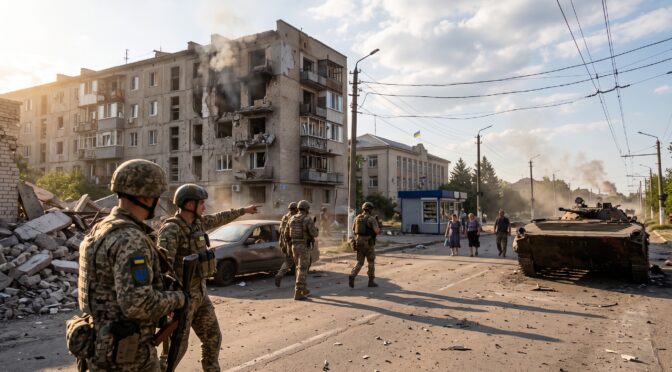
The most consequential ground maneuver development of the week was the official confirmation and assessment of the results of Ukraine’s Oleksandrivka counteroffensive. On August 12, Ukrainian President Volodymyr Zelensky convened with Commander-in-Chief Major General Mykhailo Drapatyi, Deputy Chief of the General Staff Major General Ihor Skybyuk, and Airborne Assault Forces Commander Major General Oleh Apostol to review the operational data of the campaign, which ran continuously from January 29 to August 12, 20261. The operation was a definitive operational success, disrupting the Russian Spring-Summer 2026 offensive architecture and ultimately pushing Russian frontline elements entirely out of Dnipropetrovsk Oblast1.
The Ukrainian Airborne Assault Forces Command reported the liberation of over 745 square kilometers of territory and the systematic clearing of 300 square kilometers of Russian infiltration zones. Conservative assessments by independent geospatial analysts confirm the liberation of at least 626.69 square kilometers in the Oleksandrivka and mutually reinforcing northern Hulyaipole directions1. The success of this counteroffensive was predicated on Ukraine’s maturation of localized operational planning, a highly coherent Suppression and Destruction of Enemy Air Defenses (SEAD/DEAD) campaign, overwhelming tactical drone superiority, and a critical, sudden disruption of Russian battlefield Starlink communications in early February 20261. The cascading effects of this advance forced the Russian military command into a resource dilemma, requiring them to divert manpower from other offensive axes during a period of rapidly declining volunteer recruitment rates1.
Table 1: Territorial Changes and Liberated Settlements (Oleksandrivka Axis, Jan 29 – Aug 12, 2026)
| Oblast | Operational Status / Territorial Shift | Key Settlements Liberated |
| Dnipropetrovsk | Completely cleared of Russian regular forces. | Sichneve, Maliivka, Stepove, Berezove, Ternove, Zaporizhzhia, Novomykolaivka, Kalynivske, Pryvillya, Tsehelne, Zlohoda, Novoheorhiivka1. |
| Donetsk | Active stabilization operations; significant buffer zone created. | Voskresenka, Oleksandrohrad, Myrne, Piddubne, Tovste, Zirka, Yalta, Hrushivske, Novokhatske, Zeleny Hai1. |
| Zaporizhia | Ground lines of communication (GLOCs) secured. | Novohryhorivka, Rybne, Krasnohirske, Pryvilne1. |
Conversely, the Russian military apparatus continues to struggle with positional warfare and attritional tactics across the eastern front. In the Kupyansk direction, Russian forces have escalated infiltration tactics, specifically targeting the Pishchane and Kupyansk-Vuzlovyi axes. Ukrainian military observers note that the operational objective here is to divide the Ukrainian bridgehead on the Oskil River into northern and southern halves, facilitating a gradual push to the riverbank9. In the Kostyantynivka sector—a critical node in Ukraine’s Donetsk “Fortress Belt”—urban combat continues to deteriorate into intense block-by-block attrition. Russian forces are widely utilizing guided glide bombs in a battlefield air interdiction (BAI) capacity to systematically reduce urban strongpoints to rubble before committing small infantry infiltration groups, such as the 1008th Motorized Rifle Regiment4. Despite Russian Ministry of Defense claims of full control over the city, geolocated footage confirms Ukrainian forces maintain resilient defensive positions in southwestern Kostyantynivka13.
Along the northern border in the Sumy and Kharkiv oblasts, the Russian Northern Grouping of Forces has engaged in a dedicated disinformation campaign, falsely claiming the seizure of 50 settlements since the beginning of 2026. Independent assessments confirm that Russian forces have only seized approximately 11 settlements in these border areas and remain largely confined to cross-border infiltration missions roughly 15 kilometers deep, failing to establish the Kremlin’s desired “buffer zone” to protect Belgorod14.
The 40-Day Deep-Strike Campaign & Maritime Security
The maritime domain witnessed a catastrophic failure of Russian force protection on the night of August 11–12. Ukrainian defense forces executed a highly complex, multi-vector strike against the Russian Black Sea Fleet (BSF) naval base at Novorossiysk6. Due to previous successful Ukrainian strike campaigns in occupied Crimea throughout 2024 and 2025, the BSF had relocated its most valuable strategic assets to Novorossiysk, operating under the assumption that the Krasnodar Krai port provided sufficient strategic depth beyond the reach of Ukrainian effectors6.
Ukraine decisively shattered this assumption using a coordinated, simultaneous swarm of newly developed Palianytsia drone missiles, Peklo and Bars drone missiles, extended-range Long Neptune anti-ship cruise missiles, and Sargan and Mamai unmanned surface vessels (USVs)6. The strike achieved direct hits on four major surface combatants. Most critically, satellite imagery provided by defense analysts confirms severe, structural damage to the forward Vertical Launch System (VLS) cell banks of two Project 11356R Admiral Grigorovich-class frigates—the Admiral Makarov and the Admiral Essen7. These vessels, which became the operational flagships of the fleet following the 2022 sinking of the cruiser Moskva, are now functionally stripped of their UKSK 3S14 vertical launch systems. This renders them incapable of launching surface-to-surface Kalibr cruise missiles and surface-to-air Shtil missiles without comprehensive dry-dock repairs, which Novorossiysk lacks the specialized facilities to provide safely16. A Project 21631 Buyan-M small missile ship and a Project 22160 Vasily Bykov patrol ship were also severely damaged in the barrage6.
Beyond the naval vessels, the Novorossiysk strike also systematically degraded shore-based logistics and air defense architecture. Ukrainian munitions struck the KS Kombinat Stroikomplekt (KSK) grain terminal, the Sheskharis oil terminal, the Grushovaya oil depot tunnel entrance, and a 30N6E radar belonging to an S-300 air defense battery7. This operation has essentially neutralized two-thirds of the BSF’s premier surface strike capability, forcing Russia to rely almost exclusively on strategic aviation and Kilo-class submarines for power projection in the Black Sea theater7.
In retaliation, and heavily aligned with its broader strategic objectives of societal attrition, the Russian military is actively preparing a devastating strike campaign against the Ukrainian energy grid. Intelligence assessments indicate that Russia is rapidly stockpiling newly produced ballistic missiles to launch massive, coordinated salvos against Kyiv City’s energy infrastructure, specifically timed to coincide with Ukraine’s Independence Day on August 249. By triggering these strikes in late summer rather than autumn, Moscow aims to critically disrupt infrastructure repair efforts ahead of the 2026-2027 winter, ruthlessly exploiting the current depletion of Ukraine’s Patriot interceptor stockpiles5. Russian forces have also demonstrated a renewed focus on interdicting civilian logistics, successfully striking the Mayaki bridge on the M-15 Odesa City-Reni highway on August 9. This bridge serves as a critical land corridor connecting Ukraine to Moldova and Romania, and its targeting represents a calculated effort to throttle Ukrainian agricultural and commercial exports19.
Role of Third-Party Countries
The geopolitical calculus of the conflict remains heavily dictated by external logistics, defense-industrial integration, and the pace of allied financial support. According to the Kiel Institute for the World Economy’s Ukraine Support Tracker, Europe significantly accelerated its financial commitments, allocating a record €7.2 billion in military aid to Ukraine in June 2026—the highest monthly total since the United States largely ceased direct financial funding20. This surge was underpinned by the implementation of the €90 billion European Union Ukraine Support Loan, which facilitated €4.3 billion in immediate military disbursements in May and June to cover budgetary and defense needs through 202720.
Despite these robust financial mechanisms, Europe’s indigenous Defense Industrial Base (DIB) remains critically inadequate for Ukraine’s immediate tactical requirements, sustaining a dangerously high dependency on American-manufactured weapon systems. Between January and June 2026, European donors procured over €3 billion in military aid directly from US defense conglomerates, accounting for 30% of Europe’s total military aid allocations22. Furthermore, existing US stockpiles provided 90% of the military aid routed through the NATO Prioritised Ukraine Requirements List (PURL) initiative22. The structural inability of Europe to rapidly substitute or independently manufacture the US Patriot missile system remains Ukraine’s most critical vulnerability in the face of escalating Russian ballistic missile production.
Bilateral European contributions remain vital to sustaining the Ukrainian war effort. Germany allocated €700 million in June alone, contributing to at least €11.5 billion in planned military assistance for 2026. This assistance actively anchors Ukraine’s middle- and deep-strike air defense architecture with the provision of additional IRIS-T launchers and hundreds of Patriot interceptor missiles, alongside the delivery of 10,000 Linza UAVs, advanced long-range artillery munitions, and thousands of G3 and G36 assault rifles for frontline infantry22. France has finalized a comprehensive aviation and air defense package, set to deliver 16 Rafale multirole fighter aircraft by the end of 2026, coupled with the advanced SAMP/T-NG surface-to-air missile systems, GM400 radars, and localized production licenses for AASM glide bombs and SCALP cruise missiles.
On the opposing axis, the Russian Federation continues to deeply integrate material and personnel support from the Democratic People’s Republic of Korea (DPRK) to sustain its attrition warfare model. Western intelligence indicates that Russia is currently preparing logistics to receive up to 50,000 North Korean combat and logistical troops5. Concurrently, elements of a North Korean missile unit have been directly embedded with Russia’s 112th Missile Brigade (1st Guards Tank Army). This unit has been forward-based from Ivanovo Oblast to a Rosgvardia training center in Voronezh Oblast to minimize flight times to Ukrainian targets, and has been equipped with an estimated 120 KN-23 ballistic missiles8. Ukraine continues to actively interdict this logistical pipeline; notably, on August 14, Ukrainian military intelligence (GUR) operatives destroyed a shipment of KN-23s on the Trans-Siberian railway via planted explosives9.
Table 2: Financial and Military Aid Mechanisms (Updated August 2026 Data)
| Supplying Entity | Nature of Support | Volume / Specific Assets | Strategic Impact |
| European Union | Financial/Military Loan | €90B Ukraine Support Loan (€4.3B released May/June). | Stabilizes Ukrainian state budget and procurement for 2026-2027. |
| Germany | Bilateral Military Aid | €11.5B (2026); Patriot interceptors, IRIS-T, 10k Linza UAVs, G3/G36 rifles24. | Anchors middle/deep-strike air defense architecture and infantry lethality. |
| United States | Defense Industrial Base | >€3B in European proxy procurements; 90% of NATO PURL supplies. | Irreplaceable source of Patriot systems, interceptors, and heavy munitions. |
| France | Aviation & Air Defense | 16 Rafale aircraft, SAMP/T-NG systems, AASM bomb production. | Modernizes Ukrainian combat aviation and bolsters anti-ballistic missile defense. |
| North Korea (DPRK) | Personnel / Munitions | 50,000 troops; 120 KN-23 Ballistic Missiles deployed to Voronezh5. | Augments Russian manpower shortages; directly stresses Ukrainian interceptor reserves. |
3. Drone Warfare and Unmanned Systems
The technological offense-defense cycle characterizing the Russo-Ukrainian war has precipitated a radical evolution in unmanned aerial systems (UAS). The operational environment has definitively transitioned from the deployment of slow, piston-engine loitering munitions to high-speed, jet-powered strike platforms and highly complex, EW-resistant tactical drones1. This tactical shift mirrors broader global trends in cost-imposition strategies and intelligentized warfare, where the proliferation of cheap, autonomous UAS fundamentally alters the economics of traditional air defense networks (as detailed in Military Drone Evolution: Top 10 Nations of 2026)30. The battlefield reality now dictates that without effective Counter-UAS (C-UAS) capabilities, traditional mechanized maneuver and static rear-area logistics are indefensible31.
Tactical & Strategic Deployments
The Russian defense establishment has heavily invested in scaling the production of its next-generation Geran series drones. At the Alabuga Special Economic Zone in Tatarstan, Russia is currently producing an estimated 3,000 Geran-4 and Geran-5 kamikaze drones per month2. This massive industrial output represents a deliberate doctrinal shift toward overwhelming Ukrainian air defenses with sheer speed rather than just numerical mass. By replacing the Chinese Telefly JT80 engines with 160–200 kgf thrust turbojets, Russian forces are significantly shortening the reaction window for Ukrainian mobile fire groups. These groups have historically relied on acoustic detection and the slow 200 km/h cruising speed of the Geran-2 to achieve high interception rates; the new systems render these legacy tactics obsolete2.
To counter this, Ukraine’s newly centralized Unmanned Systems Forces (USF)—the world’s first military branch dedicated exclusively to unmanned warfare—has accelerated the development of its own long-range, jet-powered “missile-drones.” The Palianytsia and the Peklo have rapidly entered mass production, utilizing up to 70% locally sourced components to bypass Western export restrictions and supply chain bottlenecks28. Capable of speeds up to 900 km/h and ranges of 650–700 kilometers, these systems bridge the operational gap between tactical loitering drones and multi-million-dollar cruise missiles. The deployment of these systems forces the Russian aerospace forces (VKS) to pull combat aviation and high-value radar arrays hundreds of kilometers away from the forward edge of the battle area (FEBA), degrading Russian close air support10. The development of such high-speed, jet-powered interceptors and attritable strike platforms is a defining characteristic of contemporary multidomain operations, further explored in The Future of Air and Ground Engagements34.
Technical Profile of Systems
The current battlespace is dominated by a new generation of systems designed specifically for high-speed penetration and multi-domain launch capabilities.
Table 3: Technical Profile of Prominent Unmanned Systems (August 2026)
| System Name | Origin | Propulsion / Speed | Operational Range | Payload / Role |
| Geran-4 | Russia | Turbojet (160 kgf) / 350-500 km/h | 850 km | 50 kg; Strategic long-range strike. Replaces Geran-39. |
| Geran-5 | Russia | Turbojet (200 kgf) / 600 km/h | 950-1,000 km | 90 kg; Cruise-missile drone, air-launch capable (Su-25). Potential R-73 integration2. |
| S8000 Banderol | Russia | SW800Pro Engine / Mach 0.57 (700 km/h) | 500 km | 150 kg; Air-launched cruise missile (launched via Kronshtadt Orion/Mi-28)36. |
| Palianytsia | Ukraine | Single-spool Turbojet / 900 km/h | 650 km | 100 kg; Strategic strike, intermediate-range interdiction (used in Novorossiysk)15. |
| Peklo | Ukraine | Jet-powered / 700 km/h | 700 km | Unspecified; High-speed airfield suppression and VKS displacement. |
| Dyagterev | Russia | Unspecified | Operational Rear | Carrier drone, highly EW-resistant; deployed in Kharkiv Oblast9. |
Targeting Priorities & Countermeasures
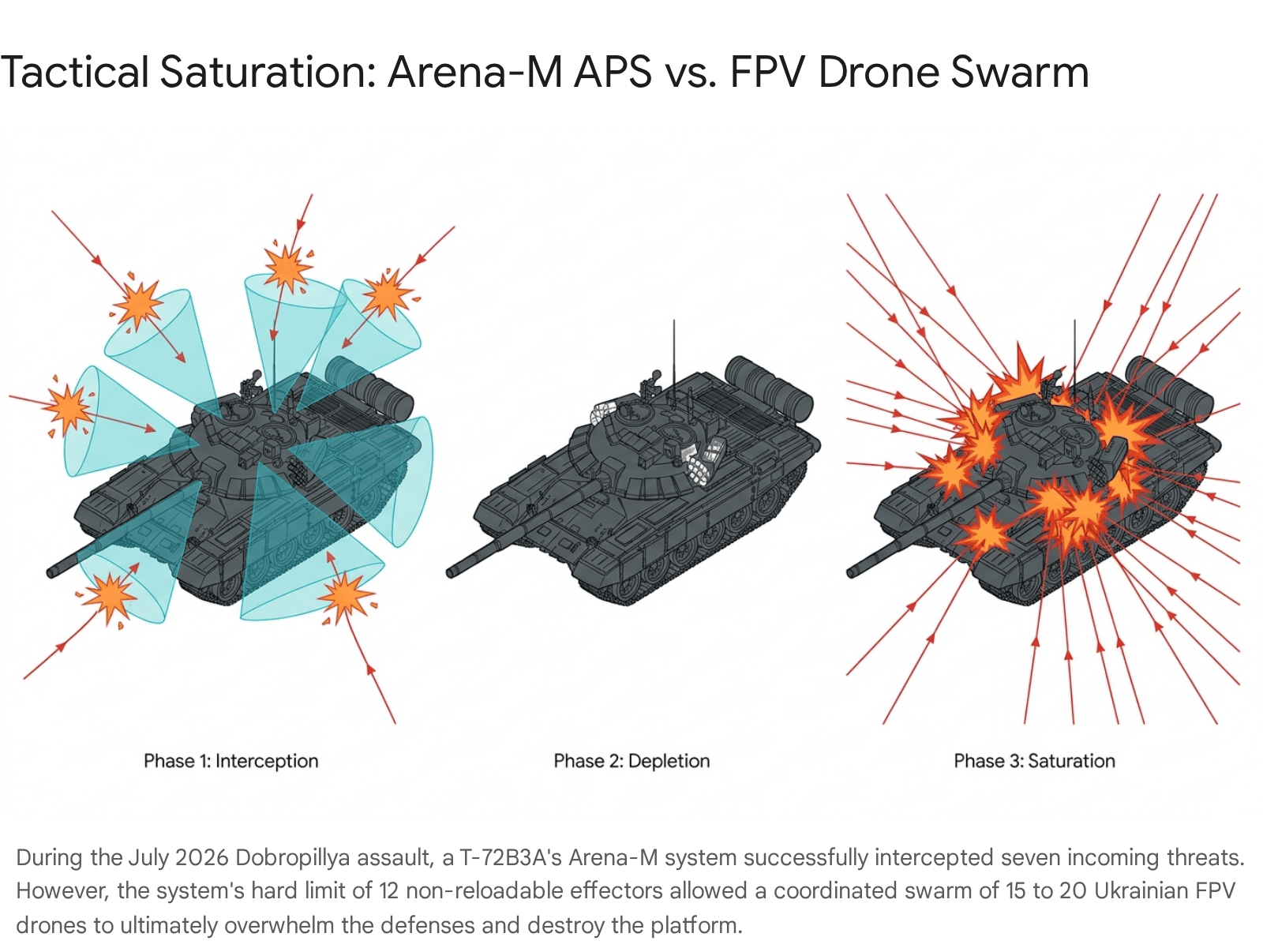
At the tactical level, the saturation of First-Person View (FPV) drones has effectively paralyzed traditional armored maneuver. In a desperate attempt to break this positional warfare, Russian forces have begun outfitting T-72B3A and T-90M tanks with the Arena-M Active Protection System (APS)19. Originally designed in the late Soviet era to intercept anti-tank guided missiles (ATGMs) via radar-cued hard-kill counter-munitions, the system was recently adapted for anti-drone warfare and tested during a late-July mechanized assault in the Dobropillya sector of Donetsk Oblast19.
While the Arena-M proved technically functional—intercepting seven Ukrainian FPV drones in a single engagement—it ultimately failed to ensure vehicle survivability38. The system has a capacity limit of 12 interceptor effectors, which cannot be reloaded from inside the hull under fire27. Ukrainian drone operators, communicating via distributed kill webs, simply saturated the airspace, requiring a coordinated swarm of 15 to 20 FPV drones to exhaust the Arena-M’s countermeasures and subsequently destroy the tank39. The engagement definitively demonstrated that while APS technology raises the ammunition cost of destroying Russian armor, it is structurally insufficient to protect mechanized columns from massed tactical drones in the current operational environment19.
Simultaneously, the depth of the battlefield “kill zone” has expanded exponentially. Historically confined to line-of-sight ranges near the trenches, the kill zone now stretches 15 to 25 kilometers behind the forward line of own troops (FLOT). This expansion is driven by the Russian integration of Frequency Hopping Spread Spectrum (FHSS) technology into tactical FPV drones4. By allowing drone command links to rapidly and autonomously oscillate across frequency bands, FHSS practically nullifies legacy Ukrainian RF jamming and electronic warfare (EW) systems9. Following their deployment of fiber-optic wire-guided drones in early 2024, the FHSS drones are Russia’s latest version of achieving EW immunity, significantly increasing the threat to Ukrainian artillery, logistics, and personnel in the near rear4. In response to severe localized drone deficits, the Russian command has begun redeploying elite drone operators from the Rubikon Center for Advanced Unmanned Technologies directly to the Lyman direction to provide aerial cover and logistical interdiction against stalling infantry assault groups9. The deployment of these fiber-optic and FHSS systems to completely bypass radio frequency jamming is a critical evolution in localized drone overmatch, a dynamic recently analyzed in SITREP: Military Unmanned Systems — August 1–9, 202643.
4. Resource Utilization, Constraints, and Sustainability
The war’s fundamentally attritional nature continues to place immense, compounding strain on the industrial capacity, domestic logistics, and manpower reserves of both nations, fundamentally dictating their strategic horizons.
Manpower Dynamics, Logistics, and Industrial Capacity
The Russian defense-industrial base has executed a rapid reprioritization away from complex, easily intercepted systems toward high-volume, high-velocity ballistic platforms. As of early August 2026, Russian defense contractors fulfilled their annual production quotas for Zirkon and Onyx anti-ship cruise missiles ahead of schedule. To achieve this, Moscow purposefully suspended production of Kinzhal air-launched ballistic missiles and Kh-32 cruise missiles1. The saved industrial capacity has been entirely reallocated to produce surface-to-surface ballistic missiles and specially modified RM-48U missiles fired from S-400 systems19.
This pivot enables Russia to conduct immediate, high-volume strikes straight from the production line rather than relying on depleting Soviet-era stockpiles. Ukrainian military intelligence indicates that Russian forces can now launch simultaneous salvos of 77 missiles and are actively working to scale their command and control architecture to support 200-missile salvos19. Concurrently, Russia is hoarding newly produced ship-launched Kalibr missiles and transferring them to naval fleets outside the Black Sea. This is a direct consequence of Ukraine’s near-100% interception rate of the system and the degradation of the BSF launch platforms at Novorossiysk19.
On the logistical front, Ukrainian deep strikes into the Russian Federation are inflicting severe macroeconomic and operational costs. Ukrainian drone strikes on August 11 targeted a massive Wildberries logistics warehouse in Voronezh Oblast, followed by strikes on the night of August 12-13 against Wildberries facilities and the Gazprom Neftekhim Salavat oil refining complex in the Bashkortostan Republic8. Financial analysts estimate the total damage to Wildberries sellers at 445 to 507 billion rubles, with total infrastructural damage across these logistics sites approaching 1 trillion rubles ($11.9 billion USD)44. While technically a civilian commercial entity, the destruction of such vast logistical hubs places secondary stress on the Russian rail and road transportation network, which is already heavily burdened by military prioritization. Furthermore, precision strikes on the Orsknefteorgsintez oil refinery in Orenburg Oblast have fully halted operations, with repairs expected to take up to six months, severely constraining regional aviation fuel supplies8.
Table 4: Industrial Production and Resource Metrics (August 2026)
| Resource / System | Production/Usage Metric | Strategic Implication |
| Ballistic Missiles | Exceeding monthly quota by 10-20%19. | Explicitly designed to overwhelm limited Ukrainian Patriot interceptor reserves. |
| Geran-4 / Geran-5 | ~3,000 units per month (Alabuga SEZ). | Replaces slower Geran-2s; drastically reduces Ukrainian mobile group intercept rates. |
| Russian Manpower | ~30,000 casualties per month1. | Forces reliance on North Korean troops; creates a chronic 500,000-man mobilization deficit5. |
| Black Sea Fleet (Kalibr) | Launch capacity heavily degraded; hoarding production1. | Shifts deep-strike burden entirely to Aerospace Forces (VKS) and ground-based Iskander/S-400 units. |
Strategic Sustainability Projection
President Vladimir Putin’s core theory of victory relies on the assumption that Russia can wage a war of infinite attrition, steadily degrading Ukraine’s physical infrastructure and outlasting the West’s political resolve to fund the defense19. Central to this timeline is the coming 2026-2027 winter. By aggressively targeting the Ukrainian defense-industrial base and civilian energy grid now, the Russian command intends to exhaust Ukraine’s localized Patriot missile supplies19. If successful, Russia anticipates that an undefended Ukrainian energy grid will completely collapse under winter temperatures, destroying the societal will to resist and rendering negotiations on maximalist Russian terms inevitable19.
However, Russia’s sustainability is acutely threatened by its own manpower constraints. Sustaining roughly 30,000 casualties per month, the Russian Ministry of Defense is struggling to replace battlefield losses through its shadow recruitment schemes, financial incentives, and penal battalions1. While the Kremlin is preparing the legislative groundwork for a potential formal mobilization of up to 500,000 personnel, Putin remains intensely hesitant to trigger a formal mobilization decree. He fears severe domestic destabilization and a collapse of the meticulously curated wartime normalcy within Russia1. The importation of North Korean forces and the massive expansion of unmanned systems serve as desperate stopgaps to delay this politically perilous decision.
5. Chronological Timeline of Key Events
- August 8, 2026:
- Turkish Foreign Minister Hakan Fidan proposes a bilateral moratorium on strikes against merchant ships in the Black Sea9.
- Ukrainian forces strike the Ilsky Oil Refinery in Krasnodar Krai, severely damaging the AVT-6 primary oil processing column19.
- Bulgarian PM reports a decoy drone explosion near the Romania/Bulgaria gas compressor stations, highlighting spillover risks5.
- August 9, 2026:
- Russian forces strike the Mayaki bridge on the M-15 highway in Odesa Oblast, attempting to sever Ukraine’s primary land grain export corridor to Romania and Moldova5.
- Ukrainian forces successfully conduct a SEAD campaign, destroying Russian S-400, Pantsir-S1, Tor air defense systems, and Kasta 2E2/Podlet-K1 radars in Krasnodar Krai and Rostov Oblast10.
- August 10, 2026:
- Russian Supreme Court disqualifies the opposition Yabloko party from the upcoming State Duma elections to consolidate the pro-war political platform8.
- Ukrainian military intelligence confirms Russia’s successful industrial reprioritization toward high-volume ballistic missile production19.
- August 11, 2026:
- Russia launches a North Korean-provided KN-23 ballistic missile at Zaporizhzhia City, signaling the active battlefield integration of DPRK munitions8.
- Ukrainian deep strikes target a massive Wildberries logistics warehouse in Voronezh Oblast8.
- August 12, 2026:
- Strategic Inflection: Ukraine executes a massive drone and missile strike on the Novorossiysk Naval Base, crippling the Black Sea Fleet’s Project 11356R frigates Admiral Makarov and Admiral Essen11.
- Ukrainian President Zelensky officially reviews the successful conclusion of the Oleksandrivka counteroffensive (745 sq km liberated since January)1.
- Vladimir Putin visits Sakhalin, meeting the Pacific Fleet commander to project power and deter Japan following the release of Tokyo’s Defense White Paper1.
- Ukrainian forces strike the Gazprom Neftekhim Salavat complex and Wildberries facilities in Bashkortostan on the night of August 12-1311.
- August 13, 2026:
- Putin visits the disputed Kuril Islands for the first time.
- The Kiel Institute for the World Economy releases the Ukraine Support Tracker, showing a record €7.2 billion in European military aid allocations for June 2026, offset by a critical dependency on US-manufactured weapons21.
- Orenburg Oblast Governor confirms the Orsknefteorgsintez oil refinery fully halted operations following Ukrainian strikes.
- August 14, 2026:
- Russian Foreign Minister Sergei Lavrov and MFA Spokesperson Maria Zakharova categorically reject the Black Sea merchant shipping moratorium and reiterate demands for complete Ukrainian capitulation9.
- Russian forces deploy highly specialized Rubikon Center drone operators to the Lyman direction to counteract Ukrainian tactical drone superiority9.
- Reports confirm the Russian rollout of the “History of Our Region” indoctrination textbooks across occupied Ukrainian territories.
- GUR operatives destroy a shipment of North Korean KN-23 ballistic missiles on the Trans-Siberian railway9.
Please share the link on Facebook, Forums, with colleagues, etc. Your support is much appreciated and if you have any feedback, please email us in**@*********ps.com. If you’d like to request a report or order a reprint, please click here for the corresponding page to open in new tab.
Sources Used
- Russian Offensive Campaign Assessment, August 10, 2026 | ISW, https://understandingwar.org/research/russia-ukraine/russian-offensive-campaign-assessment-august-10-2026/
- Russia Produces 3,000 Geran-4/5 Drones a Month, Ukraine Says, https://www.kyivpost.com/post/82224
- 3,000 drones a month: Russia scales up production of jet-powered Geran variants – why it matters, https://timesofindia.indiatimes.com/defence/international/3000-drones-a-month-russia-scales-up-production-of-jet-powered-geran-variants-why-it-matters/articleshow/133197398.cms
- Russian Offensive Campaign Assessment, August 14, 2026 | ISW, https://understandingwar.org/research/russia-ukraine/russian-offensive-campaign-assessment-august-14-2026/
- Russian Offensive Campaign Assessment, August 12, 2026 | ISW, https://understandingwar.org/research/russia-ukraine/russian-offensive-campaign-assessment-august-12-2026/
- Ukraine war latest: 4 Russian warships damaged in strike on Black Sea Fleet port in Novorossiysk – The Kyiv Independent, https://kyivindependent.com/ukraine-war-latest-4-russian-warships-damaged-in-strike-on-black-sea-fleet-port-in-novorossiysk/
- Ukraine Strike Damages 2 Russian Frigates at Novorossiysk – Naval News, https://www.navalnews.com/naval-news/2026/08/ukrainian-drone-strike-russian-frigates-novorossiysk/
- Russian Offensive Campaign Assessment, August 11, 2026 | ISW, https://understandingwar.org/research/russia-ukraine/russian-offensive-campaign-assessment-august-11-2026/
- Russian Offensive Campaign Assessment, August 8, 2026 | ISW, https://understandingwar.org/research/russia-ukraine/russian-offensive-campaign-assessment-august-8-2026/
- Blind Empire: Inside Ukraine’s Campaign to Degrade Russia’s Air Defense Architecture, https://www.ukrinform.net/rubric-ato/4110535-blind-empire-inside-ukraines-campaign-to-degrade-russias-air-defense-architecture.html
- Russian Offensive Campaign Assessment, August 13, 2026, https://understandingwar.org/research/russia-ukraine/russian-offensive-campaign-assessment-august-13-2026/
- Russian Offensive Campaign Assessment, July 29, 2026 | ISW, https://understandingwar.org/research/russia-ukraine/russian-offensive-campaign-assessment-july-29-2026/
- Russian Offensive Campaign Assessment, July 7, 2026 | ISW, https://understandingwar.org/research/russia-ukraine/russian-offensive-campaign-assessment-july-7-2026/
- Russian Offensive Campaign Assessment, July 17, 2026 | ISW, https://understandingwar.org/research/russia-ukraine/russian-offensive-campaign-assessment-july-17-2026/
- Four Russian Warships Damaged in Mass Ukrainian Strike on Novorossiysk Naval Base, https://united24media.com/war-in-ukraine/four-russian-warships-damaged-in-mass-ukrainian-strike-on-novorossiysk-naval-base-21630
- Satellite images suggest serious damage to Admiral Makarov and Admiral Essen – The New Voice of Ukraine, https://english.nv.ua/russian-war/ukrainian-strike-may-have-disabled-russian-frigates-in-novorossiysk-analysis-50632328.html
- Ukraine Confirms Hits on Four Russian Warships at Novorossiysk – The Maritime Executive, https://maritime-executive.com/article/ukraine-confirms-hits-on-four-russian-warships-at-novorossiysk
- Two Kalibr-carrying frigates, a missile ship, a patrol vessel: Ukraine hit four Russian warships in one night at Novorossiysk – Euromaidan Press, https://euromaidanpress.com/2026/08/12/two-kalibr-carrying-frigates-a-missile-ship-a-patrol-vessel-ukraine-hit-four-russian-warships-in-one-night-at-novorossiysk/
- Russian Offensive Campaign Assessment, August 9, 2026, https://understandingwar.org/research/russia-ukraine/russian-offensive-campaign-assessment-august-9-2026/
- Military aid to Ukraine reached a peak in June following the U.S. withdrawal, https://logos-pres.md/en/news/military-aid-to-ukraine-reached-a-peak-in-june-following-the-u-s-withdrawal/
- Ukraine Military Aid Surged in June Despite Long-Term Shortages, Says Institute, https://english.aawsat.com/world/5306425-ukraine-military-aid-surged-june-despite-long-term-shortages-says-institute
- Ukraine Support Tracker: Europe leads on aid – US weapons remain key – Kiel Institute, https://www.kielinstitut.de/publications/news/ukraine-support-tracker-europe-leads-on-aid-us-weapons-remain-key/
- Europe leads on Ukraine aid, US weapons remain key: Report, https://www.aa.com.tr/en/europe/europe-leads-on-ukraine-aid-us-weapons-remain-key-report/4027451
- Germany and Ukraine as leaders in European security: building a win-win partnership, https://mod.gov.ua/en/news/germany-and-ukraine-as-leaders-in-european-security-building-a-win-win-partnership
- Gewehr 3 and Gewehr 36: How German Rifles Performed on Front Lines, https://militarnyi.com/en/articles/gewehr-3-gewehr-36-german-rifles-front/
- Humanitarian, financial and military aid How Germany is supporting Ukraine – Bundesregierung.de, https://www.bundesregierung.de/breg-en/news/germany-aid-for-ukraine-2192480
- Russia’s new jet-powered Gerans, https://www.iiss.org/online-analysis/missile-dialogue-initiative/2026/01/russias-new-jet-powered-gerans/
- Drones in Modern Warfare (2024-2026) | Australian Army Research Centre (AARC) – DOI, https://doi.org/10.61451/2675166
- Drone Warfare in Ukraine: From Myths to Operational Reality – Part 1, https://researchcentre.army.gov.au/library/land-power-forum/drone-warfare-ukraine-myths-operational-reality-part-1
- Military Drone Evolution: Top 10 Nations of 2026 – Ronin’s Grips, https://blog.roninsgrips.com/military-drone-evolution-top-10-nations-of-2026/
- The Drone Paradox and Institutional Decay in Modern Conflict – https://debuglies.com, https://debuglies.com/2026/02/06/the-drone-paradox-and-institutional-decay-in-modern-conflict/
- Professionalizing the UAS/CUAS Ecosystem & Leaving the Smoke and Mirrors Behind, https://www.karveinternational.com/insights/professionalizing-the-uas-cuas-ecosystem
- Russia Produces Around 3,000 Geran-4/5 Kamikaze Drones per Month, https://militarnyi.com/en/news/russia-produces-around-3-000-geran-4-5-kamikaze-drones-per-month/
- The Future of Air and Ground Engagements: Small Arms and Unmanned Systems at Farnborough Airshow 2026 – Ronin’s Grips, https://blog.roninsgrips.com/the-future-of-air-and-ground-engagements-small-arms-and-unmanned-systems-at-farnborough-airshow-2026/
- Russia deploys Geran-5 strike drone in attack for first time | Ukrainska Pravda, https://www.pravda.com.ua/eng/news/2026/01/11/8015558/
- S8000 Banderol – Wikipedia, https://en.wikipedia.org/wiki/S8000_Banderol
- Inside the Specs of Ukraine’s Long-Range Drone-Missiles That Struck Novorossiysk, https://united24media.com/war-in-ukraine/inside-the-specs-of-ukraines-long-range-drone-missiles-that-struck-novorossiysk-21643
- Russian Arena-M protection system reportedly intercepted seven FPV drones in Ukraine, https://meta-defense.fr/en/2026/08/11/arena-m-intercepted-fpv-drones-ukraine/
- Russia’s tank shield shot down seven drones—Ukraine destroyed the tank anyway, https://euromaidanpress.com/2026/08/11/russias-tank-shield-shot-down-seven-drones-ukraine-destroyed-the-tank-anyway/
- Russian forces experiment with new tech to restore mechanized offensives – ISW, https://english.nv.ua/russian-war/russia-testing-new-battlefield-tech-to-break-positional-stalemate-isw-50631261.html
- Strategic Reconfiguration: European Burden-Shift and 5-Year Multi-Domain Warfare Matrix, https://debuglies.com/2026/08/14/strategic-reconfiguration-european-burden-shift-and-5-year-multi-domain-warfare-matrix/
- Russian Drone Innovations are Likely Achieving Effects of Battlefield Air Interdiction in Ukraine – Institute for the Study of War, https://understandingwar.org/research/russia-ukraine/russian-drone-innovations-are-likely-achieving-effects-of-battlefield-air-interdiction-in-ukraine/
- SITREP: Military Unmanned Systems — August 1–9, 2026 – Ronin’s Grips, https://blog.roninsgrips.com/sitrep-military-unmanned-systems-august-1-9-2026/
- Russian e-commerce giants seek hundreds of billions in state aid, https://english.nv.ua/business/russian-e-commerce-giants-seek-federal-aid-after-ukrainian-drone-strikes-50632823.html
- Russian Offensive Campaign Assessment, March 2, 2026 | ISW, https://understandingwar.org/research/russia-ukraine/russian-offensive-campaign-assessment-march-2-2026/