Executive Summary
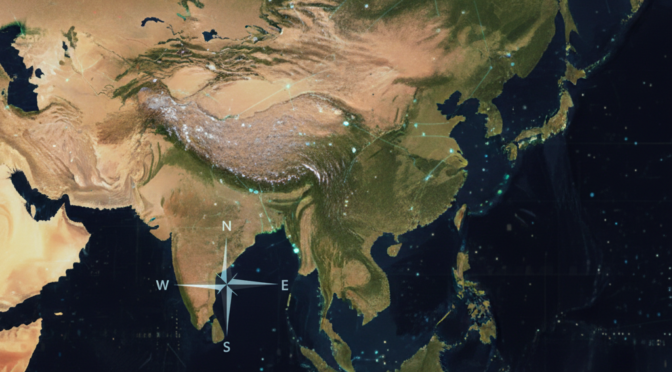
During the week ending February 21, 2026, the Asian strategic theater experienced profound structural shifts characterized by accelerated military modernization, the formalization of technological blocs, and systemic realignments in regional governance. Intelligence and diplomatic indicators point to an accelerating transition away from the post-1945 international order toward a highly polarized, multi-domain competitive environment. This shift is most clearly manifested in the dual-track strategy currently pursued by major global powers: engaging in tactical diplomatic rapprochement on the surface while concurrently executing aggressive strategic military, industrial, and economic decoupling beneath it.
In East Asia, a fragile United States-China rapprochement appears to be emerging, underscored by United States President Donald Trump’s unprecedented indication that United States arms sales to Taiwan may become a subject of bilateral negotiation with Chinese President Xi Jinping.1 However, this diplomatic signaling starkly contrasts with underlying military realities that threaten the long-term balance of power. The International Institute for Strategic Studies (IISS) released highly consequential data revealing that the People’s Republic of China (PRC) has definitively surpassed the United States in nuclear submarine production rates and total tonnage between 2021 and 2025, fundamentally altering the undersea balance of power in the Indo-Pacific region.3 Simultaneously, the Chinese Communist Party (CCP) convened its annual Taiwan Work Conference, explicitly targeting United States-Taiwan supply chains and mapping out a comprehensive, multi-domain coercion strategy ahead of Taiwan’s municipal elections.6
On the Korean Peninsula, the Democratic People’s Republic of Korea (DPRK) convened its milestone 9th Party Congress in Pyongyang. General Secretary Kim Jong Un projected a narrative of total economic triumph over international sanctions and introduced a newly deployed fleet of fifty 600mm multiple launch rocket systems (MLRS) purportedly utilizing artificial intelligence for strategic targeting against the South.8 Intelligence assessments also highlight the systematic grooming of his daughter, Kim Ju Ae, for formal succession, signaling Pyongyang’s intent to guarantee multi-generational regime continuity amidst a broader five-year military modernization cycle heavily subsidized by Russian technical assistance.12
In Southeast Asia and the maritime domain, friction in the gray zone has escalated into direct, kinetic law enforcement actions. Japan’s seizure of a PRC distant-water fishing vessel within its exclusive economic zone (EEZ) off Nagasaki marks a sharp departure from its previously restrained posture, reflecting the hardened national security mandate of Prime Minister Sanae Takaichi.13 Concurrently, the United States and the Philippines concluded their 12th Bilateral Strategic Dialogue (BSD), explicitly reaffirming the Mutual Defense Treaty’s applicability to coast guard vessels in the South China Sea and announcing the continued deployment of United States intermediate-range missile systems to the archipelago despite fierce diplomatic objections and military posturing from Beijing.15
South Asia witnessed a geopolitical earthquake with the landslide electoral victory of the Bangladesh Nationalist Party (BNP), decisively ending the Awami League era and presenting New Delhi with a highly unpredictable eastern flank defined by a resurgent Jamaat-e-Islami opposition.18 This comes as India grapples with escalating rhetoric on its western border, where Pakistani officials have alleged an India-Kabul proxy nexus—a narrative shaped heavily by the lingering strategic shadow of India’s unprecedented May 2025 “Operation Sindoor” cross-border missile strikes.20 Yet, India continues to assert its global leadership ambitions, hosting the monumental AI Impact Summit 2026, securing over 250 billion USD in infrastructure pledges, and formally joining the United States-led “Pax Silica” alliance to build critical technology supply chains insulated from Chinese coercion.22
1. Macro-Strategic Realignments and the Fragmentation of Global Governance
The overarching geopolitical narrative for the week was defined by competing institutional frameworks and the erosion of traditional multilateralism, a phenomenon described at the 62nd Munich Security Conference (MSC) as the irreversible dawn of “wrecking-ball politics”.24 The global order is visibly fracturing into competing spheres of influence, with traditional post-1945 institutions struggling to maintain relevance against bespoke, interest-driven coalitions.
1.1 The Munich Security Conference and Shifting Risk Perceptions
The 62nd Munich Security Conference, held from February 13 to 15, 2026, served as a stark diagnostic of the current international system’s decay.24 The accompanying Munich Security Report 2026 highlighted a severe crisis of confidence in democratic governance, noting that sweeping destruction of norms rather than careful policy correction has become the prevailing global trend.25 The Munich Security Index (MSI) 2026 provided empirical backing to this sentiment, revealing profound shifts in how major powers perceive global threats. According to the data collected across G7 and “BICS” (BRICS minus Russia) countries, respondents in nearly all surveyed nations—with the notable exceptions of Japan and China—now rate the United States as a significantly more serious global risk than in the previous year.25
This trend represents a continuation and acceleration of risk perceptions that spiked following the recent shifts in United States foreign policy and the resurgence of “America First” diplomatic frameworks.25 Furthermore, the risk associated with global trade wars reached its highest recorded ranking across both the G7 and BICS blocs, reflecting deep-seated anxiety over aggressive tariff regimes and supply chain weaponization.27 Conversely, the perceived seriousness of Russia as an immediate threat has declined across all surveyed countries since 2025. Among G7 nations, Russia dropped from the second most serious risk to the eighth out of 32 tracked parameters, indicating a normalization of the Eastern European conflict and a pivot in anxiety toward trans-Pacific dynamics and economic instability.27
The conference also functioned as a platform for starkly contrasting security visions and hostile rhetorical exchanges. PRC Foreign Minister Wang Yi delivered pointed, aggressive warnings against United States interference in Taiwan, explicitly stating that attempts to utilize the island to split China would cross Beijing’s ultimate red line and inevitably lead to direct military confrontation.28 Wang also directed highly irregular and aggressive rhetoric toward Japan, warning that Tokyo’s current security trajectory under right-wing leadership would inevitably lead the Japanese state toward “self-destruction”.29 He urged “peace-loving countries” to send a clear warning to Japan regarding its alleged revival of militarism, reflecting Beijing’s heightened threat perception regarding Tokyo’s rearmament and its willingness to utilize high-profile international forums to lay down non-negotiable strategic markers.29
1.2 The Emergence of Alternative Architectures: The Board of Peace
Against this backdrop of institutional decay and heightened rhetoric, alternative geopolitical architectures are rapidly materializing. The geopolitical landscape in 2026 shows a clear fracturing of traditional consensus, with new alliances like Pax Silica and the Board of Peace drawing distinct spheres of influence away from the traditional United Nations-led system. On February 19, 2026, the inaugural meeting of the “Board of Peace” was convened in Washington, D.C., hosted by United States President Donald Trump and Vice President JD Vance.30 Envisioned by the United States administration as a direct, functional rival to the United Nations, the body was initially established to oversee Gaza reconstruction following the implementation of United Nations Security Council Resolution 2803 but has rapidly expanded its mandate to address broader international conflicts.31
The United States committed an initial 10 billion USD to the Board, with President Trump explicitly stating that the new body would “almost be looking over the United Nations and making sure it runs properly,” signaling a profound lack of faith in the legacy institution’s financial and operational stability.31 An additional 7 billion USD was pledged by nine other nations for Gaza relief.31 The composition of the Board is highly indicative of the shifting global order. The absence of core G7 allies at the table, contrasted with the participation of 27 nations including Argentina, Armenia, Azerbaijan, Hungary, Pakistan, Saudi Arabia, and the United Arab Emirates, underscores a fracturing of traditional Western diplomatic consensus and the rise of transactional, issue-specific alliances.31
India’s calculated participation as an “observer” at the Board of Peace is a masterclass in New Delhi’s multi-aligned foreign policy doctrine.30 By attending the summit via its Chargé d’affaires at the Indian Embassy in Washington, Namgya Khampa, rather than joining as a full treaty member, India successfully avoided alienating the broader Global South and the traditional United Nations establishment while simultaneously acknowledging and engaging with Washington’s primary diplomatic initiative.31 Ministry of External Affairs spokesperson Randhir Jaiswal confirmed this delicate positioning, stating that India welcomes the Gaza Peace Plan initiative while carefully referencing its alignment with the existing UNSC Resolution 2803.31 This balancing act is essential for New Delhi as it navigates the friction between the United States and China while advancing its own great power aspirations on the global stage.
2. Cross-Strait Relations and the Evolving United States-China Security Paradigm
The United States-China bilateral relationship is currently navigating a highly volatile period characterized by paradoxical developments: a superficial diplomatic thaw driven by executive-level dialogue masking an intense, structural military, legislative, and economic arms race across the Taiwan Strait.
2.1 The “Fragile Rapprochement” and Negotiated Signaling
A significant structural shift in the strategic calculus of the Taiwan Strait occurred when United States President Donald Trump indicated he was actively discussing the issue of arms sales to Taiwan directly with PRC President Xi Jinping ahead of a planned high-stakes visit to China scheduled for early April 2026.1 Historically, the provision of United States defensive weaponry to Taipei has been managed as a routine, albeit sensitive, bureaucratic function mandated by the Taiwan Relations Act, designed to ensure Taiwan maintains a sufficient self-defense capability.1
By elevating arms sales to a topic of direct leader-to-leader negotiation, the United States administration is effectively transforming the defense of Taiwan from a statutory obligation into a mechanism for “negotiated signaling” within the context of a fragile bilateral rapprochement.1 This narrative shift poses profound risks to regional deterrence architectures. The current risk for the United States-Taiwan relationship is heavily rooted in this diplomatic storytelling; previously, Taiwan was perceived in Washington strictly as a plucky underdog standing against an authoritarian behemoth.2 Beijing interprets this new negotiating framework as validation of its preferred strategic logic: if Washington scales back its military support for Taiwan, broader United States-China relations can experience a renaissance, and peaceful unification can advance.2 Consequently, this incentivizes the PRC to aggressively test United States resolve, climbing the escalation ladder under the assumption that Washington, bogged down by domestic priorities and global crises, will prioritize mainland relations over insular defense.2
In direct response to this perceived executive ambiguity, the United States legislative branch has moved aggressively to legally insulate Taiwan’s security and international standing. The House of Representatives recently advanced two major pieces of legislation. On February 4, 2026, the Taiwan and American Space Assistance (TASA) Act was advanced, authorizing NASA and NOAA to collaborate with Taiwan on critical satellite and space exploration programs.7 This act is strategically vital, as Taiwan intends to utilize low-earth orbit (LEO) satellites equipped with synthetic aperture radar (SAR) to detect PRC vessels and provide communications redundancy in the event of an undersea cable severing.7 Subsequently, on February 9, the House passed the PROTECT Taiwan Act, which mandates the exclusion of the PRC from all international financial institutions should Beijing initiate an attack or significantly threaten Taiwan’s security, economic, or social systems.7
2.2 CCP Taiwan Work Conference Directives and Covert Operations
Beijing’s operational strategy for 2026 was explicitly codified during the annual CCP Taiwan Work Conference, held on February 9-10 in Beijing.7 Directed by Wang Huning, the CCP’s fourth-ranked official and top decision-maker on Taiwan policy, the conference formulated a comprehensive, multi-domain coercion strategy.6 The policy framework outlined four core objectives for the year:
First, the CCP aims to unite “patriotic” forces within Taiwan, specifically by increasing covert and overt engagement with leaders from the main opposition Kuomintang (KMT) party to advance unification-related goals and fracture domestic Taiwanese political consensus.6 Second, Beijing is prioritizing a campaign to prevent the United States from arming Taiwan while simultaneously executing an economic strategy designed to weaken United States-Taiwanese supply chains and forcibly promote the integration of PRC-Taiwanese industrial bases.6 Third, the party directed the strengthening of legal bases for unification, empowering state apparatuses to punish supporters of Taiwan independence.6 Finally, the conference mandated the establishment of a special task force utilizing United Front work and advanced cyberspace operations to damage the ruling Democratic Progressive Party (DPP) ahead of Taiwan’s highly anticipated municipal elections.6
The PRC has simultaneously escalated its espionage, surveillance, and physical harassment of Taiwanese leadership abroad. On February 9, 2026, the United States Department of Justice announced the sentencing of a convicted PRC operative, Yaoning “Mike” Sun, to four years in federal prison.7 Sun illegally acted as a PRC agent, executing a complex surveillance operation against then-President Tsai Ing-wen during her 2023 visit to California, providing real-time geographical and logistical updates to PRC intelligence officials.7 Furthermore, alarming reports surfaced detailing PRC diplomatic and military personnel executing physical harassment campaigns, including a PRC military attaché tailing then-Vice President-elect Hsiao Bi-khim in Czechia, and a separate covert plot by PRC diplomats to stage a “demonstrative” car crash to physically intimidate her.7 These actions demonstrate that Beijing views the entirety of the globe as a permissible operational theater for cross-strait coercion.
3. The Shifting Indo-Pacific Naval Balance and Industrial Capacity
While diplomatic maneuvering dominates the headlines, the hard-power reality in the Indo-Pacific is shifting decisively in favor of the PRC. The bedrock of United States deterrence in the region—its overwhelming superiority in the undersea domain—is currently facing an unprecedented industrial challenge from Chinese state-backed shipyards.
3.1 The IISS Military Balance 2026 Assessment
An authoritative and highly consequential report released by the International Institute for Strategic Studies (IISS) for its Military Balance 2026 assessment confirmed that China’s nuclear submarine production rate has officially surpassed that of the United States.3 The report, authored by senior military capability analysts, paints a stark picture of a maritime arms race where Beijing is leveraging its massive, centralized industrial base to out-build Western naval powers.4
Between 2021 and 2025, China’s state-owned shipyards—specifically the rapidly expanded Huludao yard of Bohai Shipbuilding Heavy Industry Company (BSHIC) in northern China—launched ten nuclear-powered submarines.4 These vessels possess an estimated combined displacement of 79,000 tonnes.4 In stark contrast, United States shipyards, plagued by supply chain bottlenecks, labor shortages, and maintenance backlogs, launched only seven nuclear submarines displacing 55,500 tonnes during the exact same chronological period.4
| Metric (2021-2025) | People’s Republic of China (PRC) | United States (US) | Delta (PRC vs US) |
| Nuclear Submarines Launched | 10 Vessels | 7 Vessels | +3 Vessels |
| Total Displacement Tonnage | 79,000 Tonnes | 55,500 Tonnes | +23,500 Tonnes |
| Primary Production Facility | Bohai Shipbuilding (Huludao) | General Dynamics / HII | N/A |
| Current Nuclear Fleet Size (Active) | ~12 Vessels | 65 Vessels | -53 Vessels |
| Current Conventional Fleet Size | ~46 Vessels | 0 Vessels | +46 Vessels |
This PRC output includes the critical launch of the seventh and eighth Type 094 (Jin-class) nuclear-armed ballistic-missile submarines (SSBNs), solidifying Beijing’s credible, sea-based nuclear triad.4 These SSBNs are increasingly being equipped with the longer-range JL-3 submarine-launched ballistic missile, allowing Chinese vessels to threaten the continental United States from heavily protected bastions within the South China Sea, mitigating their historical acoustic vulnerabilities.39 Furthermore, satellite imagery and open-source intelligence confirm the rollout of a new class of nuclear-powered guided-missile submarines (SSGN), designated the Type 093B (Shang III).4 These vessels are equipped with advanced vertical launch systems (VLS) highly likely capable of deploying the YJ-19 hypersonic anti-ship missile, presenting a massive, high-speed threat to United States carrier strike groups operating in the Philippine Sea.4 Beijing is also expected to begin producing the next-generation Type 096 SSBN later this decade, which analysts believe will close the acoustic quieting gap with Western designs.3
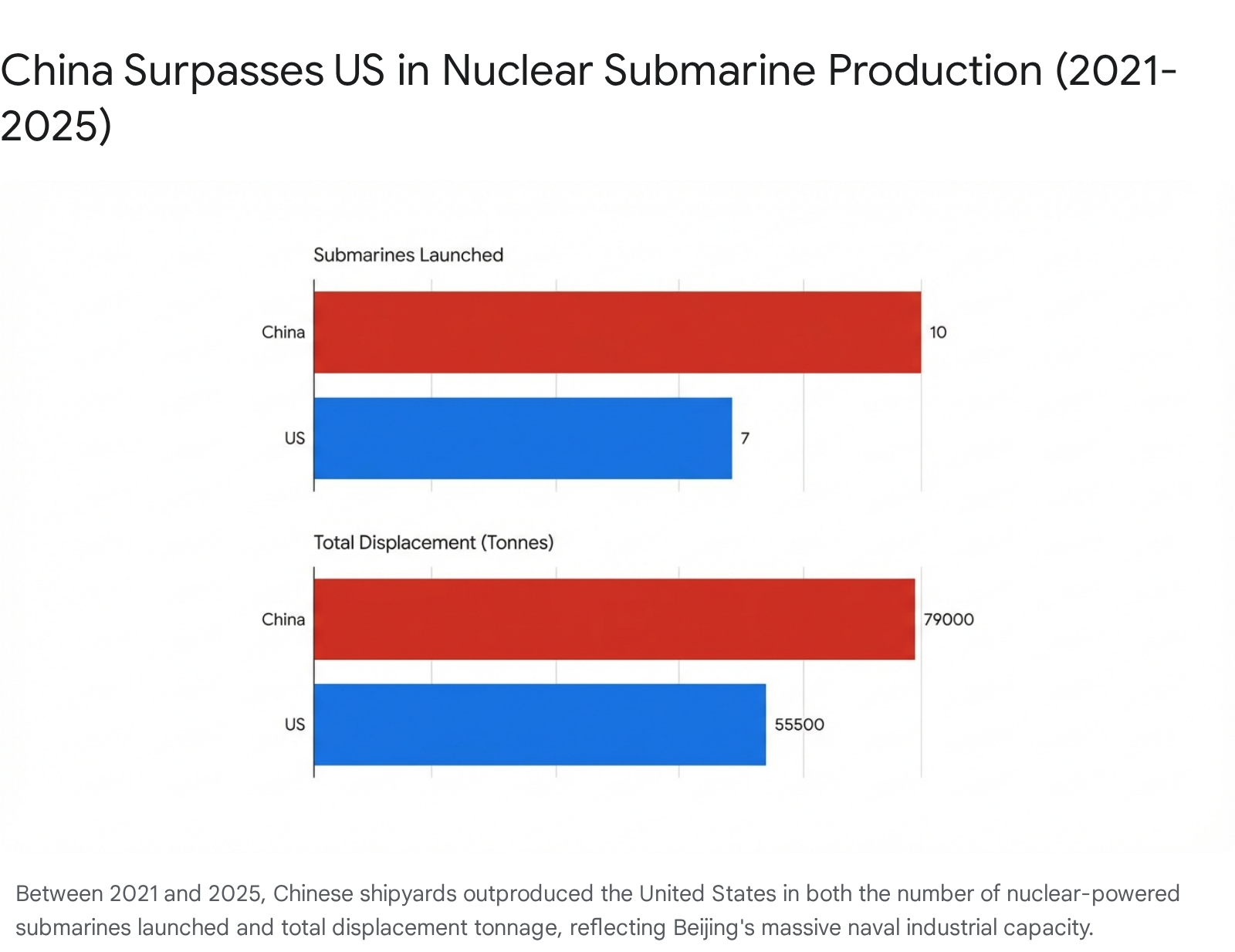
The implications of this industrial capacity gap are profound. While the United States retains a significant qualitative edge in undersea operations and possesses an overall larger operational nuclear fleet (65 submarines to China’s roughly 12 nuclear and 46 conventional vessels), the trajectory heavily favors Beijing.5 A recent United States Congressional Research Service report highlighted that the United States Navy is falling well behind its submarine-building goal of two Virginia-class attack boats per year, delivering only 1.1 to 1.2 vessels annually since 2022.38 Similarly, the next-generation Columbia-class ballistic-missile submarine program is at least a year behind schedule, with the lead vessel, the USS District of Columbia, not expected until 2028.38 When expanding the aperture to surface vessels, the disparity is even more alarming; China built between 115 and 125 military warships from 2020 to 2025, averaging nearly 20 units per year, eclipsing the combined production of the United States, Japan, and South Korea, which added only 46 to 51 ships in the same period.36
3.2 Proliferation of Unmanned and Autonomous Systems
Compounding the submarine deficit is the People’s Liberation Army Navy’s (PLAN) aggressive integration of unmanned systems into its fleet architecture. Security analysis from early February 2026 highlights massive advancements in PLA drone capabilities.7 The PLA’s newest amphibious assault vessel, the Type 076 landing helicopter dock (LHD) Sichuan, is currently undergoing outfitting.7 Intelligence indicates the Sichuan will function as a dedicated “drone carrier,” equipped with an electromagnetic catapult launch system capable of launching up to six GJ-21 naval stealth drones.7 The GJ-21, a naval variant of the GJ-11 “Sharp Sword,” possesses a range of at least 1,500 kilometers and a 2,000-kilogram payload.7 These platforms will radically enhance the PLAN’s ability to conduct long-distance deployments, providing critical situational awareness and strike capacity for carrier task groups operating far outside the range of mainland land-based sensors.7
Furthermore, the PLA is rapidly modernizing its aerial logistical vectors to support amphibious operations. On February 2, 2026, the PLA conducted the maiden flight of the YH-1000S transport drone.7 This hybrid-engine unmanned aerial vehicle boasts a 1,000-kilogram cargo capacity and a 1,600-kilometer range.7 Crucially, its ability to take off and land on improvised, unpaved runways (such as grass or dirt) allows it to execute massive over-the-beach (OTB) resupply missions during a theoretical invasion of Taiwan.7 This capability provides a resilient logistical network designed specifically to avoid United States and Taiwanese interdiction of slow-moving civilian roll-on/roll-off ferries in the Taiwan Strait.7
4. Maritime Security: Flashpoints in the East and South China Seas
The maritime domains of the Indo-Pacific remain the most volatile flashpoints for potential kinetic escalation, driven by the PRC’s expansive territorial claims, the weaponization of civilian fleets, and the increasingly hardened, militarized resistance from regional stakeholders.
4.1 Japan’s Paradigm Shift in Sovereignty Enforcement
In the East China Sea, the Japanese government executed a highly significant and unprecedented law enforcement action on February 12, seizing a PRC fishing vessel operating illegally within its exclusive economic zone (EEZ) off the coast of Nagasaki.14 According to the Japanese fisheries agency, the vessel attempted to flee after being ordered to halt; it was subsequently intercepted, its 47-year-old Chinese captain arrested, and its eleven crew members detained.14 The vessel was utilizing an industrial-scale “tiger net” fishing method, widely condemned for its environmental devastation.14
However, the ecological impact is secondary to the geopolitical significance. This incident represents the first time since 2022 that Tokyo has actively detained a Chinese vessel within its waters.14 For years, Chinese fishing fleets, often operating as quasi-militia vessels accompanied by heavily armed China Coast Guard (CCG) cutters, have employed gray-zone tactics to blur the line between civilian commerce and state-backed territorial probing.14 A recent investigation by the United States Select Committee on the CCP confirmed that the PRC’s distant-water fishing (DWF) fleet—estimated at between 2,000 and 16,000 vessels—is not a commercial enterprise but a deliberate instrument of Beijing’s “Maritime Great Power” strategy.40 This armada, which drives 44 percent of global fishing efforts and commands a 18.5 billion USD export market, is wielded with military precision, surging into disputed waters to assert leverage.40
Japan’s willingness to forcibly seize the vessel rather than merely escorting it out of the EEZ signals that Tokyo’s strategic patience with Beijing’s incremental coercion has totally evaporated.14 This harder line correlates directly with the domestic political landscape; on February 8, 2026, Prime Minister Sanae Takaichi secured an unparalleled landslide victory in the Lower House elections.7 Takaichi, who campaigned on an unapologetic platform of national security fortification, now possesses a decisive, unassailable mandate to strengthen the United States-Japan alliance, increase defense expenditures, and forcefully push back against PRC maritime probing.7 Beijing’s furious, apocalyptic rhetoric at the Munich Security Conference regarding Japan’s alleged descent into “militarism” is a direct, calculated reaction to this newfound Japanese assertiveness.29
4.2 Intra-Alliance Friction: The South Korea-Japan Territorial Dispute
Despite the clear need for unified deterrence against China and North Korea, regional cohesion continues to be hampered by deep-seated historical and territorial legacy disputes. During the week of February 20, relations between Tokyo and Seoul deteriorated sharply following a parliamentary speech by Japanese Foreign Minister Toshimitsu Motegi, wherein he reiterated Japan’s sovereign territorial claims over the disputed islets located halfway between the two nations—known as Dokdo in South Korea and Takeshima in Japan.41
The South Korean Ministry of Foreign Affairs responded with fury, lodging a formal diplomatic protest with the Japanese Embassy in Seoul and demanding an immediate withdrawal of the claims.41 South Korea, which currently maintains a small police detachment on the islets to effectively exercise physical control, vowed “resolute action” against what it termed Japanese “provocations,” asserting that the claims violate historical, geographical, and international law.41 These persistent, highly emotional frictions continuously threaten the political viability of the trilateral United States-Japan-South Korea security architecture, which Washington views as absolutely essential for containing authoritarian expansionism in Northeast Asia.
4.3 United States-Philippines Strategic Convergence and Missile Deployments
In the South China Sea, the alliance between Washington and Manila continues to deepen into a fully integrated, operational combat partnership. On February 16, 2026, senior officials concluded the 12th Philippines-United States Bilateral Strategic Dialogue (BSD) in Manila.15 The dialogue produced highly consequential joint statements designed to explicitly deter PRC aggression. Both sides unequivocally reaffirmed that the Mutual Defense Treaty (MDT) covers armed attacks on Philippine armed forces, aircraft, and public vessels—explicitly including those of the Philippine Coast Guard—anywhere in the Pacific, including the entirety of the contested South China Sea.15
Crucially, the United States announced concrete plans to deploy additional high-tech missile systems to the Philippines to actively deter naval aggression.17 This follows the highly controversial and successful 2024 placement of the Typhon mid-range missile system and anti-ship missile launchers in northern Luzon, which placed major Chinese naval bases and the Taiwan Strait within direct striking distance.17 The PRC has vehemently demanded the immediate withdrawal of these systems, arguing they severely destabilize the region and threaten China’s rise.17 However, Philippine officials, led by President Ferdinand Marcos Jr., have firmly and repeatedly rejected Beijing’s demands, asserting sovereign right to base allied defensive systems.17
The BSD also dramatically expanded cooperation into critical non-traditional security domains. The United States announced a historic 250 million USD commitment to support the health security of the Filipino people, intertwining public health with geopolitical alignment.15 Furthermore, the allies committed to deepening law enforcement cooperation to combat CCP-linked cybercrime, online scam centers, and transnational repression networks operating within the archipelago.15 Economically, the dialogue catalyzed the creation of the first Luzon Economic Corridor (LEC) Investment Forum, scheduled for Manila in 2026, designed to drive massive private sector investments into transport, logistics, and semiconductors to build resilience against Chinese economic coercion.15
The operational environment remains highly combustible. The presence of two People’s Liberation Army-Navy (PLAN) warships closely shadowing and monitoring joint Philippine-United States-Australia Multilateral Maritime Cooperative Activity (MMCA) drills near Scarborough Shoal during this period underscores the persistent operational proximity of rival forces.44 This tension is compounded by regional tragedies; during the same week, the Philippine Coast Guard was heavily engaged in recovery operations for the sunken ferry MV Trisha Kerstin 3 off Baluk-Baluk Island, with the death toll rising to 62, highlighting the immense strain on Philippine maritime resources balancing domestic disaster response with intense territorial defense.44
5. The Korean Peninsula: The 9th Workers’ Party Congress and Escalating Deterrence
The strategic posture of the Democratic People’s Republic of Korea (DPRK) has undergone a definitive transformation. Moving away from a defensive focus strictly on regime survival and diplomatic extortion, Pyongyang is now exhibiting a confident, technologically advancing military expansionism, leveraging its rapidly deepening military-industrial alignment with the Russian Federation.
5.1 The 9th Workers’ Party Congress: Declaring Economic Victory
On February 19, 2026, the 9th Congress of the ruling Workers’ Party of Korea officially opened in Pyongyang.9 This quinquennial event serves as the absolute highest decision-making platform for the totalitarian regime, setting the policy trajectory for the coming half-decade.45 General Secretary Kim Jong Un’s opening address struck a highly triumphant, aggressive tone, declaring that the DPRK had completely “overcome stagnation” and achieved its major macroeconomic and industrial targets over the past five years.9
Kim framed the state’s advanced nuclear status as an “irreversible” reality that has fundamentally altered the global geopolitical landscape in Pyongyang’s favor.9 Notably, he purposefully omitted any mention of potential diplomatic overtures, negotiations, or relations with either the United States or South Korea, signaling that the era of summit diplomacy is definitively closed.9 The economic resilience Kim touted is not mere propaganda; it is largely attributed to Pyongyang’s deep integration into the Russian military-industrial supply chain. By supplying millions of artillery shells, ballistic missiles, and deploying an estimated 8,000 troops to support Russian combat operations in the Kursk region, the DPRK has effectively bypassed the United Nations sanctions regime.8 In return, Pyongyang has secured vital capital, energy resources, and, critically, advanced Russian military technology.8 South Korean central bank estimates indicate the North Korean economy actually grew by 3.7 percent in 2024, the fastest annual pace in eight years, directly refuting Western assumptions of impending economic collapse.9
5.2 Force Posture, Artificial Intelligence, and Modernization
Immediately preceding the Congress, Kim Jong Un presided over a massive military ceremony in Pyongyang unveiling the deployment of 50 new 600mm multiple launch rocket system (MLRS) vehicles, based on the highly capable KN-25 platform.8 The vehicles were presented as a “gift” from munitions industry workers to the 9th Party Congress.8 Kim personally drove one of the launcher vehicles into the plaza of the April 25 House of Culture, an act of high-stakes symbolism demonstrating personal command over the state’s strategic assets.8
The KN-25 possesses an operational range of roughly 358 kilometers—proven during recent January tests—and is explicitly designed to carry tactical nuclear warheads capable of saturating and destroying targets across the entirety of South Korea, including major United States military installations.48 Most notably, Kim asserted that these systems utilize “artificial intelligence” in their guidance mechanisms, claiming they put North Korea in a technological category of its own.8 While Western nonproliferation analysts and experts at the James Martin Center for Nonproliferation Studies assess that true autonomous AI targeting is highly unlikely, they suggest the claim likely refers to advanced automated computer-assisted guidance systems or the use of AI-optimized manufacturing processes in the munitions factories.48 Regardless of the exact technical reality, the rhetoric underscores Pyongyang’s intent to project technological parity with the West.8
The 9th Congress is expected to formalize the next five-year defense cycle (2026-2030), with General Secretary Kim designating 2026 as a “year of transformation” for the military.12 South Korean intelligence is currently tracking active DPRK efforts to develop a nuclear-powered ballistic missile submarine with an estimated displacement between 5,000 and 8,000 tons, a capability leap heavily suspected to be facilitated by Russian technical assistance.12 This follows aggressive testing earlier in the year, including the January launch of the Hwasong-11E, a medium-range platform equipped with a wedge-shaped hypersonic glide vehicle designed to evade allied missile defense networks.50
5.3 Succession Dynamics: The Rise of Kim Ju Ae
Beneath the military posturing, profound internal political shifts are occurring. Intelligence indicators strongly suggest that Kim Jong Un is aggressively accelerating the succession grooming of his daughter, Kim Ju Ae, aiming to institutionalize leadership continuity to hedge against future political or health-related instability.12 The South Korean National Intelligence Service (NIS) reported a dramatic escalation in her public profile.12
Since her initial appearance in 2022, her visibility has skyrocketed, with Japanese facial recognition analysis suggesting over 600 state media appearances.12 More importantly, her role has transitioned from mere ceremonial presence at military parades to active participation in state affairs, with South Korean lawmakers reporting NIS intelligence that she is now “expressing opinions on policy matters”.12 It is highly probable that the 9th Party Congress will confer an official, high-ranking title upon the roughly 13-year-old.12 Analysts assess she may be appointed to the vacant “First Secretary” position of the Workers’ Party, formally designating her as the regime’s de facto number two and cementing the fourth generation of the Kim dynasty.12
6. South Asia’s Geopolitical Upheaval: Bangladesh Elections and India-Pakistan Friction
The strategic balance in South Asia experienced a severe disruption following the systemic collapse of the established political order in Bangladesh, fundamentally altering India’s regional security calculus and exacerbating existing tensions on the subcontinent.
6.1 Bangladesh’s Electoral Earthquake
On February 12, 2026, Bangladesh held its highly anticipated first general election following the historic July 2024 uprising that resulted in the ouster of longtime Prime Minister Sheikh Hasina.19 The results, tabulated and confirmed throughout the week, delivered a staggering, paradigm-shifting landslide victory for the Bangladesh Nationalist Party (BNP), led by Tarique Rahman.18
| Political Party / Alliance | Leader | Seats Won (Out of 299) | Seat Change | Popular Vote (%) |
| Bangladesh Nationalist Party (BNP) | Tarique Rahman | 209 | +209 | 49.97% |
| Jamaat-e-Islami | Shafiqur Rahman | 68 | +68 | 31.76% |
| National Citizens’ Party (NCP) | Nahid Islam | 6 | +6 | 3.05% |
| Others / Independents / Vacant | N/A | 16 | N/A | 15.22% |
Data reflects the 299 contested seats in the Jatiya Sangsad. The Awami League was effectively eliminated from parliamentary representation following the 2024 uprising. 18
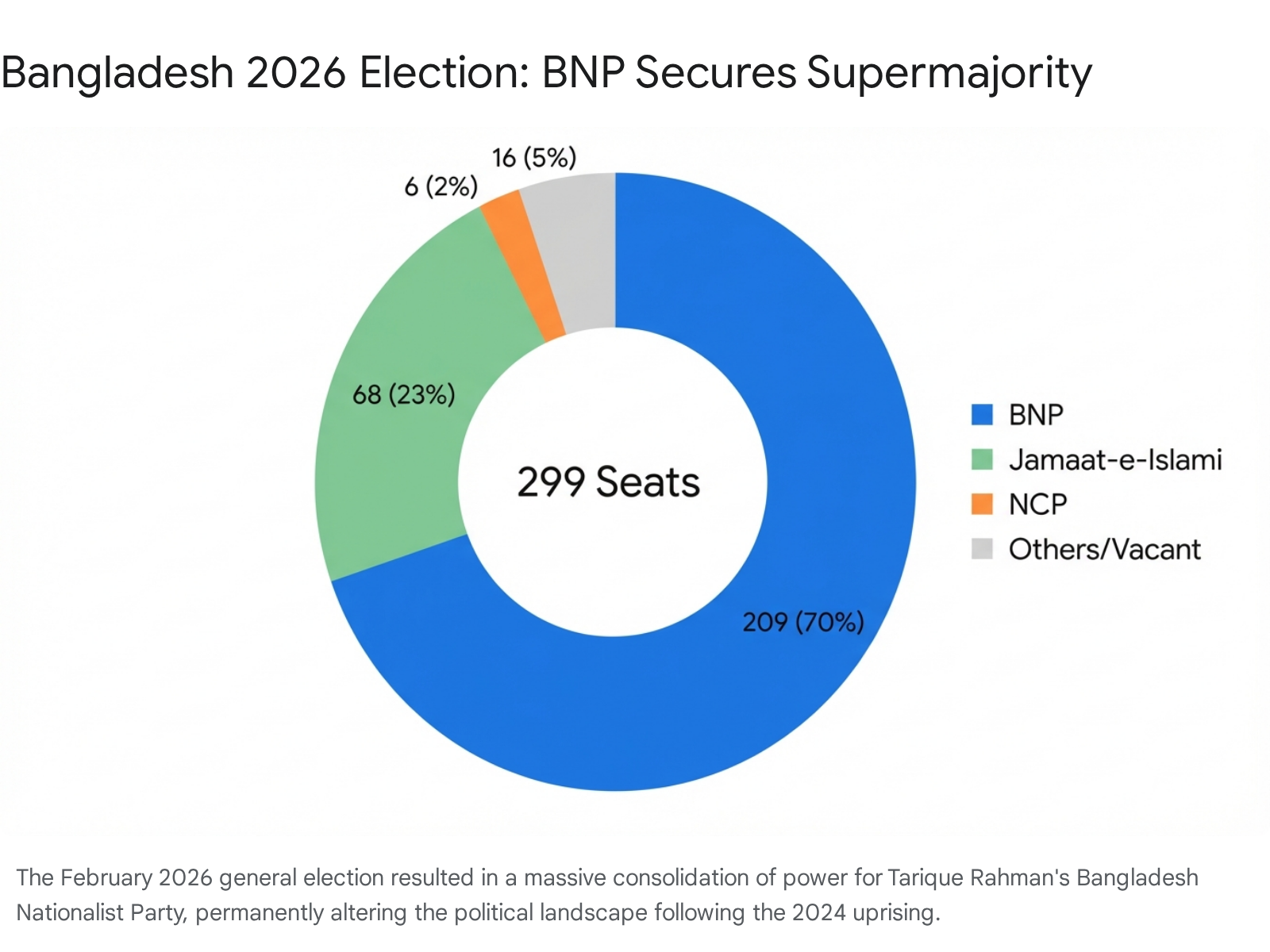
With voter turnout surging to nearly 60 percent (a massive 17.6 percentage point increase from previous boycotted elections), the electorate comprehensively repudiated the legacy of the Awami League.18 The BNP secured an absolute two-thirds supermajority with 209 parliamentary seats, granting Tarique Rahman an unassailable mandate to govern and pass constitutional amendments.18 The Islamist party Jamaat-e-Islami emerged as the primary, institutional opposition bloc with 68 seats, while the protest-born National Citizens’ Party (NCP), led by Nahid Islam, secured a foothold with six seats.18 Notably, the elections also yielded the successful election of seven women, six belonging to the BNP (including prominent figures like Rumin Farhana), indicating a broad-based consolidation of the party’s mandate across demographic lines.54 Voters also overwhelmingly backed the sweeping “July Charter” reforms in a parallel constitutional referendum, structurally redesigning the Bangladeshi state.19
For New Delhi, which closely allied itself with the ousted Hasina regime (who currently resides in highly controversial exile in India), this result constitutes a strategic disaster.51 The ascension of a BNP government, historically hostile to Indian hegemony, flanked by a powerful Jamaat-e-Islami opposition, creates a highly unpredictable eastern border for India. New Delhi must now contend with deep concerns regarding potential cross-border militancy, refugee flows, and the highly probable increase of Chinese economic and military influence in Dhaka as the new government seeks to balance Indian regional power.51
6.2 India-Pakistan Tensions and the Shadow of Operation Sindoor
India’s strategic anxiety regarding its eastern flank is compounded by acute, escalating instability on its western border with Pakistan. Rhetoric escalated sharply during the week when Pakistan’s Defense Minister Khawaja Asif publicly accused India of forging a “proxy nexus” with the Taliban government in Kabul aimed specifically at destabilizing Pakistan via cross-border terrorism.20 Most alarmingly, Asif ominously added that Pakistan would not hesitate to strike across the border and stated he could not “rule out the possibility of a war between the two countries”.55
The Indian Ministry of External Affairs, represented by spokesperson Randhir Jaiswal, firmly but calmly dismissed the allegations as transparent diversionary tactics designed to mask Pakistan’s severe internal security failures and growing domestic insurgency.20 India reiterated that Pakistani state-sponsored cross-border terrorism remains the core structural issue in bilateral relations, refusing to engage in a tit-for-tat blame game.20
However, the specter of kinetic conflict is not merely theoretical; it is heavily influenced by the psychological and strategic legacy of “Operation Sindoor”.21 In May 2025, following a devastating terrorist attack in Pahalgam, Kashmir that killed 26 Indian civilians, the Indian Armed Forces launched Operation Sindoor—a massive, five-day conventional missile strike campaign targeting militant infrastructure deep within Pakistan and Pakistan-administered Kashmir.21 The operation marked a definitive, historic shift in Indian deterrence doctrine. As India’s Chief of Defense Staff General Anil Chauhan noted shortly after, modern precision strikes create very little collateral damage, reducing the cost of war and demonstrating New Delhi’s willingness to cross the threshold of force for short-duration, high-precision punitive conflicts.21
Operation Sindoor’s chilling effect on bilateral relations remains palpable a year later. Civilian footfall at the famous Attari-Wagah border ‘Beating the Retreat’ ceremony has permanently halved, dropping from pre-conflict highs of 25,000 to barely 10,000, reflecting deep-seated societal apprehension regarding sudden conflict escalation and the suspension of basic diplomatic pleasantries like the customary handshake between the Border Security Force and Pakistan Rangers.59
Furthermore, international diplomatic pressure on Pakistan is mounting from non-governmental and cultural sectors. A high-profile, bipartisan humanitarian appeal was delivered on February 17, 2026, by a coalition of 14 former international cricket captains—including Indian legends Kapil Dev and Sunil Gavaskar, alongside Greg Chappell, Ian Chappell, Allan Border, Steve Waugh, Belinda Clark, Kim Hughes, Mike Atherton, Nasser Hussain, Mike Brearley, David Gower, Clive Lloyd, and John Wright.60 The coalition demanded humane medical treatment and fair legal access for jailed former Pakistani Prime Minister Imran Khan, whose rapidly deteriorating health and reported loss of vision has sparked international outrage, highlighting the severe domestic political fracturing within the Pakistani state that threatens regional stability.60
7. Economic Security and the Race for Technological Sovereignty
The economic trajectory of the Asian theater is no longer dictated solely by open-market dynamics; it is increasingly defined by the aggressive decoupling of critical technology supply chains and a rush by middle powers to establish sovereign capabilities in artificial intelligence (AI) and semiconductor manufacturing.
7.1 Macroeconomic Forecasts and Development Challenges
Despite intense geopolitical headwinds and the threat of severe United States tariff regimes, baseline economic growth in Asia remains surprisingly resilient, though highly vulnerable to external shocks. The World Bank and Asian Development Bank (ADB) project economic growth in developing Asia to moderate slightly to between 4.6 and 4.8 percent for 2026.61
China’s domestic economic engine continues to stutter significantly, hindered by a protracted, structural real estate contraction and weak private investment.63 This has forced Beijing to rely heavily on extensive consumer subsidies and massive state-directed manufacturing output to maintain artificial baseline growth, leading to the “front-loading” of exports ahead of anticipated Western tariffs.63 Conversely, Southeast Asian economies—specifically Malaysia, the Philippines, and Vietnam—are experiencing significant export surges, driven almost entirely by insatiable global demand for the semiconductors and advanced electronics necessary to fuel the AI revolution.63
However, this aggregate regional growth masks severe developmental vulnerabilities. The United Nations Economic and Social Commission for Asia and the Pacific (ESCAP) released a damning report on February 18, warning that the region is on track to miss an astonishing 88 percent (103 out of 117 measurable targets) of its Sustainable Development Goals (SDGs) by 2030.65 Decades of gains in poverty reduction are being actively overshadowed and eroded by climate inaction, catastrophic biodiversity loss, and continually rising carbon emissions, presenting a long-term systemic risk to regional stability.65
7.2 The India AI Impact Summit and the Pax Silica Alliance
The absolute nexus of macroeconomics and national security was on full display in New Delhi during the “India AI Impact Summit 2026,” held at the Bharat Mandapam from February 16-21.66 Positioned strategically as the Global South’s answer to Western-dominated AI governance forums, the summit successfully secured over 250 billion USD in infrastructure capital pledges and approximately 20 billion USD in deep-tech venture capital commitments.22
The scale of corporate investment is staggering. Domestic conglomerates Reliance and Adani groups announced a cumulative 210 billion USD in data center investments, while Microsoft committed a record 17.5 billion USD over four years to expand its AI infrastructure in India—its largest-ever investment in Asia.69 Global tech executives, including Google CEO Sundar Pichai, OpenAI Chief Sam Altman, and Anthropic CEO Dario Amodei, participated heavily, capitalizing on India’s lucrative 21-year tax holiday for data centers to build massive computational capacity entirely outside of China’s regulatory and geopolitical reach.22
However, the summit’s most consequential geopolitical outcome was India’s formal signing of the “Pax Silica” declaration on February 20, overseen by Union Minister Ashwini Vaishnaw and United States Under Secretary of State for Economic Affairs Jacob Helberg.23 Launched initially in late 2025 under the Transforming the Relationship Utilizing Strategic Technology (TRUST) initiative, Pax Silica is an explicit, United States-led strategic coalition comprising Australia, Japan, South Korea, the United Kingdom, Israel, Qatar, the United Arab Emirates, Singapore, and now India.23
| Supply Chain Pillar | Core Member States | Strategic Contribution to Pax Silica Alliance |
| Raw Materials & Logistics | Australia, Singapore, Qatar, UAE | Provision of unrefined critical minerals; secure maritime transit; advanced warehousing and financial infrastructure. |
| Advanced Manufacturing | Japan, South Korea, United States | High-end semiconductor fabrication; photolithography technology; advanced robotics integration. |
| Processing, Scaling & AI | India, United Kingdom, Israel | Deep engineering talent pools; massive data center infrastructure; advanced algorithm development and market scaling. |
Data reflects the stated operational integration of Pax Silica member states designed to bypass the PRC. 72
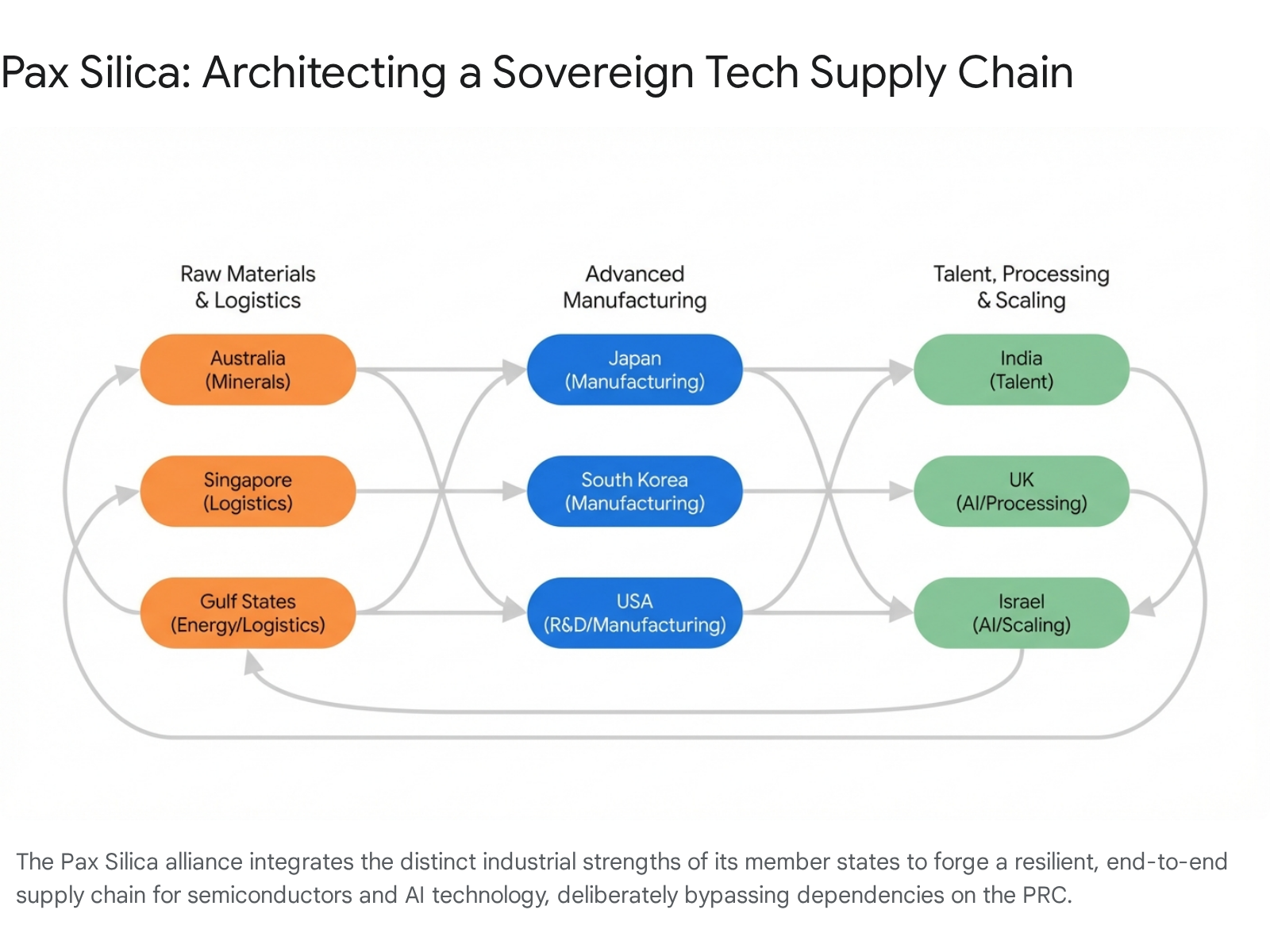
The objective of Pax Silica is to construct a resilient, trusted, end-to-end supply chain for critical minerals, semiconductor manufacturing, and AI technologies completely independent of the PRC, neutralizing Beijing’s historical monopoly on rare earth processing and its ability to utilize “coercive dependencies” against adversarial nations.23 The alliance explicitly leverages complementary regional strengths: Australia supplies the raw critical minerals, Japan and South Korea provide the advanced semiconductor fabrication, Singapore offers global logistics, and India contributes its massive talent pool, deep processing capacity, and market scale.73
Furthermore, India utilized the summit to unveil three indigenous “Sovereign AI” models, fulfilling its ambition to democratize AI architecture. Sarvam AI introduced two massive large language models trained entirely within India, boasting advanced reasoning capabilities, while Gnani.ai launched a highly resilient multilingual voice model capable of operating across 12 distinct Indian languages even under extreme low-bandwidth conditions, alongside the unveiling of BharatGen.76 These developments demonstrate tangible progress in India’s quest to achieve technological sovereignty and break the entrenched monopoly of both Western and Chinese technology conglomerates, solidifying New Delhi’s position as an indispensable node in the future global economy.76
Please share the link on Facebook, Forums, with colleagues, etc. Your support is much appreciated and if you have any feedback, please email us in**@*********ps.com. If you’d like to request a report or order a reprint, please click here for the corresponding page to open in new tab.
Sources Used
- Taiwan at the Center of a Fragile US-China Rapprochement …, accessed February 21, 2026, https://geopoliticalfutures.com/taiwan-at-the-center-of-a-fragile-us-china-rapprochement/
- America’s narrative on Taiwan needs an update, accessed February 21, 2026, https://www.brookings.edu/articles/americas-narrative-on-taiwan-needs-an-update/
- Boomtime at Bohai: China ramps up submarine production, accessed February 21, 2026, https://www.iiss.org/online-analysis/military-balance/2026/02/boomtime-at-bohai-china-ramps-up-submarine-production/
- China’s nuclear submarine production rate surpasses that of US: Report, accessed February 21, 2026, https://breakingdefense.com/2026/02/china-building-more-nuclear-subs-than-america-iiss-report/
- China now building nuclear submarines faster than US – is Washington losing its undersea edge? – The Times of India, accessed February 21, 2026, https://timesofindia.indiatimes.com/defence/news/china-now-building-nuclear-submarines-faster-than-us-is-washington-losing-its-undersea-edge/articleshow/128516934.cms
- China & Taiwan Update, February 13, 2026, accessed February 21, 2026, https://www.aei.org/articles/china-taiwan-update-february-13-2026/
- China & Taiwan Update, February 13, 2026 | ISW, accessed February 21, 2026, https://understandingwar.org/research/china-taiwan/china-taiwan-update-february-13-2026/
- North Korea Unveils AI-Guided 600mm Rocket Launchers in Pyongyang Ceremony, accessed February 21, 2026, https://united24media.com/latest-news/north-korea-unveils-ai-guided-600mm-rocket-launchers-in-pyongyang-ceremony-16062
- North Korea’s Kim opens 9th Party Congress citing economic achievements | WIN 98.5 Your Country | WNWN-FM | Battle Creek, MI, accessed February 21, 2026, https://wincountry.com/2026/02/19/north-koreas-kim-opens-9th-party-congress-citing-economic-achievements/
- As North Korea’s party congress opens, Kim asserts state’s ‘irreversible’ position while avoiding naming South, U.S., accessed February 21, 2026, https://koreajoongangdaily.joins.com/news/2026-02-21/national/northKorea/As-North-Koreas-party-congress-opens-Kim-asserts-states-irreversible-position-while-avoiding-naming-South-US/2527824
- North Korea’s Kim opens 9th party congress citing economic achievements, accessed February 21, 2026, https://www.straitstimes.com/asia/east-asia/north-korea-convenes-9th-party-congress-kcna-reports
- Korean Peninsula Update, February 17, 2026 | ISW, accessed February 21, 2026, https://understandingwar.org/research/china-taiwan/korean-peninsula-update-february-17-2026/
- IP26025 | Takaichi Romps to Victory in the Lower House: Implications for Japan’s Regional Relations, accessed February 21, 2026, https://rsis.edu.sg/rsis-publication/idss/ip26025-takaichi-romps-to-victory-in-the-lower-house-implications-for-japans-regional-relations/
- Japan moves against Chinese vessel as tensions come to the boil – bne IntelliNews, accessed February 21, 2026, https://www.intellinews.com/net-wars-japan-moves-against-chinese-vessel-as-tensions-come-to-the-boil-425834/?source=japan
- Joint Statement on the Philippines-United States Bilateral Strategic Dialogue, accessed February 21, 2026, https://asean.usmission.gov/joint-statement-on-the-philippines-united-states-bilateral-strategic-dialogue/
- PH, US flag China WPS actions – Manila Standard, accessed February 21, 2026, https://manilastandard.net/news/314704854/ph-us-flag-china-wps-actions.html
- US to deploy more missile launchers in Philippines over China’s objections | The Manila Times, accessed February 21, 2026, https://www.manilatimes.net/2026/02/18/news/national/us-to-deploy-more-missile-launchers-in-philippines-over-chinas-objections/2279251
- Bangladesh’s 2026 Election: BNP Landslide Ends ‘Two Begums’ Era, accessed February 21, 2026, https://www.asiapacific.ca/publication/bangladeshs-2026-election-bnp-landslide-ends-two-begums-era
- 2026 Bangladeshi general election – Wikipedia, accessed February 21, 2026, https://en.wikipedia.org/wiki/2026_Bangladeshi_general_election
- India Delivers Grim Terror Reminder To Pakistan After Khawaja Asif Alleges Delhi-Kabul Proxy Nexus, accessed February 21, 2026, https://timesofindia.indiatimes.com/videos/news/india-delivers-grim-terror-reminder-to-pakistan-after-khawaja-asif-alleges-delhi-kabul-proxy-nexus/videoshow/128616743.cms
- Military Lessons from Operation Sindoor | Carnegie Endowment for International Peace, accessed February 21, 2026, https://carnegieendowment.org/russia-eurasia/research/2025/10/military-lessons-from-operation-sindoor
- AI Impact Summit declaration secures support of 86 nations, two global bodies: Ashwini Vaishnaw, accessed February 21, 2026, https://timesofindia.indiatimes.com/business/india-business/ai-impact-summit-declaration-secures-support-of-86-nations-two-global-bodies-ashwini-vaishnaw/articleshow/128640425.cms
- Why Pax Silica matters to India — and how it fits into the country’s tech and strategic ambitions, accessed February 21, 2026, https://www.newindianexpress.com/business/2026/Feb/20/why-pax-silica-matters-to-india-and-how-it-fits-into-the-countrys-tech-and-strategic-ambitions
- Munich Security Conference 2026, accessed February 21, 2026, https://securityconference.org/en/msc-2026/
- Launch of the Munich Security Report 2026 – Münchner Sicherheitskonferenz, accessed February 21, 2026, https://securityconference.org/en/news/full/launch-munich-security-report-2026/
- Munich Security Conference – Wikipedia, accessed February 21, 2026, https://en.wikipedia.org/wiki/Munich_Security_Conference
- Munich Security Index 2026 – Münchner Sicherheitskonferenz, accessed February 21, 2026, https://securityconference.org/en/publications/munich-security-report/2026/munich-security-index-2026/
- Taiwan: China Is the Real Threat | China in Focus – YouTube, accessed February 21, 2026, https://www.youtube.com/watch?v=_3QDepGY0DA
- ‘Plotting to split China through Taiwan’: Beijing warns US interference could lead to confrontation, accessed February 21, 2026, https://timesofindia.indiatimes.com/world/china/plotting-to-split-china-through-taiwan-beijing-warns-us-interference-could-lead-to-confrontation/articleshow/128349137.cms
- India Attends Board of Peace Meeting Where Trump Repeats Claim of Stopping 2025 Indo-Pak Conflict, accessed February 21, 2026, https://m.thewire.in/article/diplomacy/india-attends-board-of-peace-meeting-where-trump-repeats-claim-of-stopping-2025-indo-pak-conflict
- India confirms attending Trump’s first Board of Peace meeting as ‘observer’ nation, welcomes Gaza plan, accessed February 21, 2026, https://www.livemint.com/news/india/india-confirms-attending-trumps-first-board-of-peace-meeting-as-observer-nation-welcomes-gaza-plan-11771587718787.html
- Morning Digest: India attends Trump’s Board of Peace meeting as observer nation; ECI asks 22 States and UTs to prepare for SIR expected from April, and more, accessed February 21, 2026, https://www.thehindu.com/news/morning-digest-on-february-20-2026/article70654526.ece
- India, not in Donald Trump’s ‘Board of Peace’ yet, attends its key meet as ‘observer’, accessed February 21, 2026, https://www.hindustantimes.com/india-news/india-not-in-donald-trump-board-of-peace-yet-attends-its-key-meet-as-observer-101771556051271.html
- “Attended as an observer”: MEA on India’s attendance at Board of Peace meeting, accessed February 21, 2026, https://www.aninews.in/news/world/us/attended-as-an-observer-mea-on-indias-attendance-at-board-of-peace-meeting20260220182242
- India Attends Gaza Board of Peace Meeting In Washington As Observer on 19th Feb: MEA Spokesperson – YouTube, accessed February 21, 2026, https://m.youtube.com/watch?v=l_e_3AFsrtg
- China overtakes the US in nuclear submarine production, says IISS – bne IntelliNews, accessed February 21, 2026, https://www.intellinews.com/china-overtakes-the-us-in-nuclear-submarine-production-says-iiss-426449/
- China’s nuclear submarine production rate surpasses that of US: Report, accessed February 21, 2026, https://oodaloop.com/briefs/arms-trade/chinas-nuclear-submarine-production-rate-surpasses-that-of-us-report/
- China building submarines faster than US: Report, accessed February 21, 2026, https://www.deccanherald.com/world/china-building-submarines-faster-than-us-report-3903500
- China’s submarine surge testing Pacific’s undersea balance, accessed February 21, 2026, https://asiatimes.com/2026/02/chinas-submarine-surge-testing-pacifics-undersea-balance/
- CHINA’S GLOBAL FISHING OFFENSIVE – Select Committee on the CCP |, accessed February 21, 2026, https://chinaselectcommittee.house.gov/sites/evo-subsites/selectcommitteeontheccp.house.gov/files/evo-media-document/final-china-s-global-fishing-offensive-compressed-1.pdf
- South Korea lodges protest with Japan over disputed islets, accessed February 21, 2026, https://www.aa.com.tr/en/asia-pacific/south-korea-lodges-protest-with-japan-over-disputed-islets/3835671
- S. Korea protests Japan’s territorial claims to islets, accessed February 21, 2026, https://english.news.cn/asiapacific/20260220/d2cefa8ca786448eac529759eefd9d9a/c.html
- US, PH committed to keep sea lanes open, prevent conflict in Indo-Pacific | The Manila Times, accessed February 21, 2026, https://www.manilatimes.net/2026/02/17/news/us-ph-committed-to-keep-sea-lanes-open-prevent-conflict-in-indo-pacific/2279232
- Search – Manila Bulletin, accessed February 21, 2026, https://mb.com.ph/search?query=Martin+sadongdong
- North Korea convenes 9th Party Congress, KCNA reports, accessed February 21, 2026, https://www.straitstimes.com/asia/north-korea-convenes-9th-party-congress-kcna-reports
- Urgent: DPRK’s 9th Party Congress opens in Pyongyang — KCNA – Xinhua, accessed February 21, 2026, https://english.news.cn/asiapacific/20260220/16ceb4e0b0414d8080faec9a6c049cf7/c.html
- Korean Peninsula Update, February 17, 2026 – American Enterprise Institute, accessed February 21, 2026, https://www.aei.org/articles/korean-peninsula-update-february-17-2026/
- North Korea Receives New Version of 600 mm KN-25 MLRS — What Is It Capable Of?, accessed February 21, 2026, https://militarnyi.com/en/news/north-korea-new-version-of-kn-25-mlrs/
- North Korean leader deploys 50 new rocket launchers ahead of major party congress, accessed February 21, 2026, https://apnews.com/article/north-korea-kim-jong-un-rocket-launchers-a5bc2a04eeed18f0e7f45295d283e936
- Fact Sheet: North Korea Missile Launch Activity, accessed February 21, 2026, https://armscontrolcenter.org/fact-sheet-north-korea-missile-test-activity/
- Firstpost LIVE: BNP Wins Bangladesh Elections By Landslide, Jamaat-e-Islami Loses, accessed February 21, 2026, https://www.youtube.com/watch?v=S77kbK_b0og
- Bangladesh election: BNP wins historic first vote since overthrow of Hasina – The Guardian, accessed February 21, 2026, https://www.theguardian.com/world/2026/feb/13/bangladesh-election-bnp-wins
- Unofficial election results in Bangladesh give BNP the lead: Report, accessed February 21, 2026, https://www.aa.com.tr/en/asia-pacific/unofficial-election-results-in-bangladesh-give-bnp-the-lead-report/3828465
- Who are the seven women candidates elected to Bangladesh Parliament?, accessed February 21, 2026, https://indianexpress.com/article/world/bangladesh-election-results-2026-women-candidates-bnp-rumin-farhana-tarique-rahman-10530629/
- Pakistan ‘won’t hesitate’ to strike across border amid Delhi-Kabul complicity in ‘proxy war’: Asif, accessed February 21, 2026, https://www.pakistantoday.com.pk/2026/02/20/pakistan-wont-hesitate-to-strike-across-border-amid-delhi-kabul-complicity-in-proxy-war-asif
- Transcript of Weekly Media Briefing by the Official Spokesperson …, accessed February 21, 2026, https://www.mea.gov.in/media-briefings.htm?dtl/40807/Transcript_of_Weekly_Media_Briefing_by_the_Official_Spokesperson_February_20_2026
- What Led to the Recent Crisis Between India and Pakistan? – CSIS, accessed February 21, 2026, https://www.csis.org/analysis/what-led-recent-crisis-between-india-and-pakistan
- Calibrated Force: Operation Sindoor and the Future of Indian Deterrence – RUSI, accessed February 21, 2026, https://www.rusi.org/explore-our-research/publications/commentary/calibrated-force-operation-sindoor-and-future-indian-deterrence
- Post Op Sindoor, Attari loses its charm; footfall almost halves, accessed February 21, 2026, https://timesofindia.indiatimes.com/city/chandigarh/9-months-after-op-sindoor-beating-the-retreat-footfall-still-at-50/articleshow/128433763.cms
- Indian Cricket Legends Gavaskar and Kapil Dev, Urge Pakistan for Jailed Imran Khan’s Health and Fair Treatment, accessed February 21, 2026, https://thelogicalindian.com/indian-cricket-legends-gavaskar-and-kapil-dev-urge-pakistan-for-jailed-imran-khans-health-and-fair-treatment/
- Economic Forecasts: Asian Development Outlook December 2025, accessed February 21, 2026, https://www.adb.org/outlook/editions/december-2025
- Economic Forecasts | Asian Development Bank, accessed February 21, 2026, https://www.adb.org/outlook/editions
- Global Economic Prospects — January 2026 – The World Bank, accessed February 21, 2026, https://thedocs.worldbank.org/en/doc/7ce50b5aa95bef66048680bba9926ec8-0050012026/related/GEP-Jan-2026-Analysis-EAP.pdf
- 2 February 2026 Weekly Global Economic Report – New Zealand Ministry of Foreign Affairs and Trade, accessed February 21, 2026, https://www.mfat.govt.nz/assets/Trade-General/Trade-Market-reports/Weekly-Global-Economic-Report-2-February-2026.pdf
- Decades of gains overshadowed as Asia-Pacific falls behind on sustainable development targets, accessed February 21, 2026, https://news.un.org/en/story/2026/02/1166993
- India AI Impact Summit 2026 Concludes at Bharat Mandapam with Strong Global Endorsement of India’s Responsible AI Vision, accessed February 21, 2026, https://www.pib.gov.in/PressReleasePage.aspx?PRID=2230952
- AI Impact Summit – Wikipedia, accessed February 21, 2026, https://en.wikipedia.org/wiki/AI_Impact_Summit
- India AI Summit 2026: Nation bags over $270 bn investment pledges, accessed February 21, 2026, https://newsable.asianetnews.com/india/india-ai-summit-2026-nation-bags-over-270-bn-investment-pledges-articleshow-o8qwu9i
- India’s AI showcase draws to a close, New Delhi declaration to come a day later, accessed February 21, 2026, https://www.livemint.com/ai/despite-chaos-a-steady-start-to-india-s-ai-pitch-for-the-world/amp-11771592286308.html
- India AI Impact Summit 2026: Sundar Pichai, Sam Altman, Dario Amodei, and full list of CEOs attending the summit in Delhi, accessed February 21, 2026, https://timesofindia.indiatimes.com/technology/tech-news/india-ai-impact-summit-2026-sundar-pichai-sam-altman-dario-amodei-and-full-list-of-ceos-attending-the-summit-in-delhi/articleshow/128373872.cms
- India AI Summit 2026 Day 5 highlights: All major countries signed AI Impact Summit declaration, says Vaishnaw – The Hindu, accessed February 21, 2026, https://www.thehindu.com/sci-tech/technology/india-ai-impact-summit-2026-day-5-pm-modi-artificial-intelligence-news-delhi-updates/article70654611.ece
- India Joins US-Led Pax Silica Alliance for AI and Supply Chain Security, accessed February 21, 2026, https://www.thequint.com/news/breaking-news/india-joins-us-led-pax-silica-alliance
- United States and India Sign Pax Silica Declaration, accessed February 21, 2026, https://www.state.gov/releases/office-of-the-spokesperson/2026/02/united-states-and-india-sign-pax-silica-declaration
- India US Pax Silica Initiative: Supply Chain Security, accessed February 21, 2026, https://discoveryalert.com.au/technology-supply-chain-evolution-pax-silica-2026/
- Pax Silica – United States Department of State, accessed February 21, 2026, https://www.state.gov/pax-silica
- India AI Impact Summit 2026: Championing Inclusive AI for ALL, accessed February 21, 2026, https://www.visionias.in/blog/current-affairs/india-ai-impact-summit-2026-championing-inclusive-ai-for-all