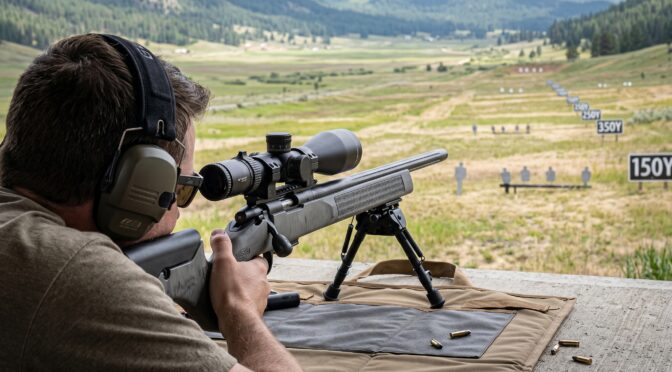
1. The Paradigm Shift in Precision Rifle Training
The landscape of precision rifle shooting has undergone a dramatic transformation over the past decade. As the competitive and tactical applications of long-range marksmanship have evolved, the physical and economic demands placed upon the shooter have increased exponentially. Centerfire cartridges engineered for extended-range precision, notably the 6.5 Creedmoor and the venerable .308 Winchester, require substantial financial investment per trigger pull. Furthermore, the accelerated barrel wear associated with high-velocity centerfire calibers limits the volume of live-fire repetitions a shooter can practically execute before requiring expensive gunsmithing services. In response to these logistical friction points, the precision shooting community has widely adopted the .22 Long Rifle ( .22LR) cartridge as a primary surrogate training tool.
Historically relegated to rudimentary marksmanship instruction and small-game hunting, the .22LR has been revitalized by the advent of premium, match-grade ammunition and highly refined firearm architectures. Modern precision rimfire training relies on a specific and highly analytical methodology. The objective is to construct a scaled-down ballistic environment where the atmospheric variables acting upon a slow, low-mass projectile at short distances perfectly mimic the variables acting upon a high-velocity, high-mass projectile at extreme distances.1 When paired with high-end platforms like the carbon-fiber-barreled Ruger 10/22 variants or precision bolt-action actions like the CZ 457, the .22LR ceases to be a recreational plinking round. Instead, it becomes a rigorous diagnostic tool that exposes flaws in a shooter’s wind reading, positional stability, and trigger control.
To fully replicate the centerfire experience, these premium rimfire barreled actions are frequently dropped into highly adjustable aftermarket chassis systems.2 By adding internal and external weights to these modular chassis, shooters can perfectly clone the exact physical weight, balance point, and length of pull of their primary centerfire competition rifles.2 The resulting hybrid platform provides an unforgiving, hyper-accurate training environment that yields maximum skill acquisition at a fraction of the operational cost. The following analysis explores the precise mechanisms, hardware, and ballistic science that make this training methodology not only viable but essential for the modern long-range marksman.
2. Ballistic Equivalency: Scaling the .22 Long Rifle Against Centerfire Titans
The core premise of precision rimfire training is built upon the mathematical concept of ballistic scaling. To truly understand the value of the .22LR as a training surrogate, one must deeply analyze its external ballistics relative to established long-range cartridges like the 6.5 Creedmoor and the .308 Winchester.3 By observing the flight characteristics of these disparate projectiles, analysts can establish direct corollaries in trajectory degradation and wind deflection.
2.1 The Centerfire Baseline: 6.5 Creedmoor and .308 Winchester
The .308 Winchester has served as the benchmark for medium-to-long-range marksmanship since its commercial introduction in 1952. Firing a 175-grain match projectile at an average muzzle velocity of 2,600 feet per second, the .308 Winchester offers highly predictable performance and excellent barrel life.3 However, it suffers from a relatively arching trajectory and significant susceptibility to wind deflection at extended ranges due to the older aerodynamic design of standard.30-caliber projectiles.3
By contrast, the 6.5 Creedmoor, introduced by Hornady in 2007, was explicitly engineered to defeat atmospheric drag and maximize hit probability at unknown distances.7 Pushing a highly aerodynamic 140-grain projectile at approximately 2,700 feet per second, the 6.5 Creedmoor features a remarkably high ballistic coefficient. This high ballistic coefficient allows the slender 6.5mm projectile to retain its velocity much more efficiently than the .308 Winchester.7 The result is a significantly flatter trajectory and roughly forty percent less wind drift at 1,000 yards when compared to the older .308 design.3
To illustrate this disparity, at 500 yards, a standard .308 Winchester load will experience over 47 inches of vertical drop and notable lateral drift in a ten-mile-per-hour crosswind.6 A 6.5 Creedmoor load under identical conditions will experience roughly 42 inches of drop and significantly less wind deflection, retaining superior kinetic energy upon impact.6 As distances stretch toward the 1,000-yard mark, the 6.5 Creedmoor completely outclasses the older .308 Winchester design in terms of raw hit probability, making it the dominant choice in modern precision rifle series competitions.4
2.2 The Rimfire Surrogate: .22LR Trajectory and Atmospheric Vulnerability
Precision rimfire training explicitly utilizes standard velocity or subsonic .22LR ammunition. High-velocity .22LR ammunition is actively avoided by precision shooters because the projectile violently destabilizes when it transitions from supersonic to subsonic speeds within the transonic zone, an event that destroys long-range accuracy. Therefore, match-grade .22LR ammunition pushes a 40-grain solid lead, round-nose bullet at a muzzle velocity ranging from 1,050 to 1,070 feet per second, keeping the bullet entirely subsonic throughout its flight path.5
Because the .22LR projectile has a low mass, low velocity, and a poor aerodynamic profile, it is highly vulnerable to gravity and wind deflection.8 The standard match .22LR bullet generates a G1 ballistic coefficient of roughly 0.130 to 0.150, which is phenomenally low compared to the 0.500 to 0.600+ ballistic coefficients seen in centerfire match bullets.8 This extreme atmospheric vulnerability is the exact mechanism that makes the .22LR a superior training tool. The ballistic degradation of the .22LR happens rapidly, forcing the shooter to make extreme scope dial adjustments and complex wind holds at distances as short as 100 to 300 yards.
Data analysis indicates a widely accepted one-third scale rule when comparing the trajectory of the .22LR to the .308 Winchester.10 A shot taken with a .22LR at 100 yards requires similar ballistic problem-solving to a .308 Winchester shot at 300 yards.10 At 200 yards, a standard 40-grain .22LR bullet will drop between 51 and 68 inches depending on localized atmospheric conditions and exact muzzle velocity.8 Furthermore, a ten-mile-per-hour full-value crosswind will deflect the .22LR bullet by nearly 19 inches at 200 yards.9 This extreme drop and drift profile means that engaging a target with a .22LR at 200 yards perfectly simulates the mathematical complexity of engaging a target with a .308 Winchester at 500 to 600 yards.8
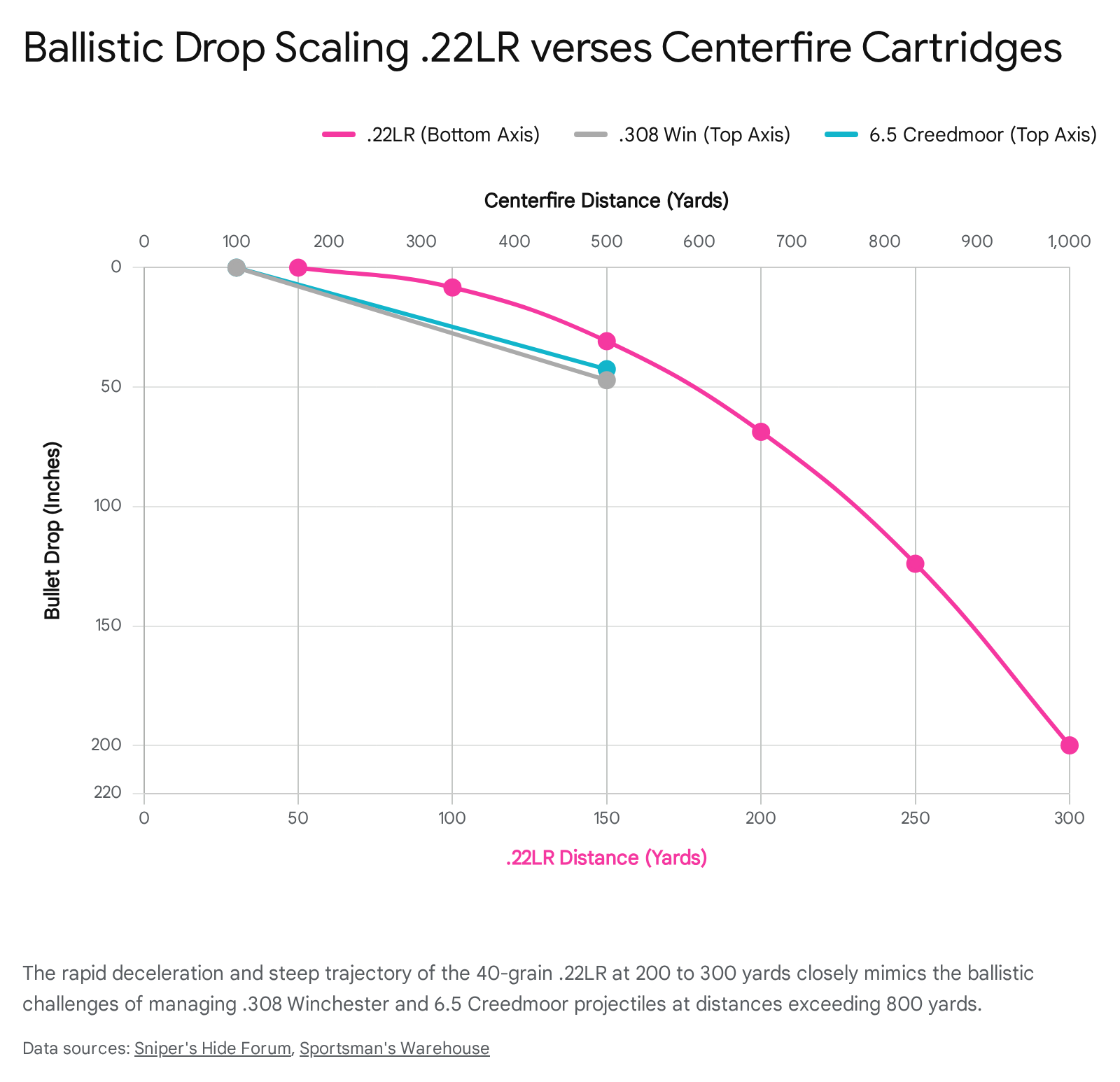
When comparing the .22LR to the much flatter-shooting 6.5 Creedmoor, the scaling ratio stretches even further, moving from one-third to approximately one-fourth or one-fifth scale.1 To replicate the exact wind-reading difficulty of a 1,000-yard 6.5 Creedmoor engagement, a shooter only needs to push their .22LR out to 250 or 300 yards.1 At 300 yards, a standard velocity .22LR bullet experiences nearly 40 inches of wind drift in a basic ten-mile-per-hour crosswind.9 Attempting to center a rimfire impact on a small steel plate at 300 yards requires an absolute mastery of wind reading, mirage observation, and trigger control.10 Because the .22LR produces virtually no recoil, the shooter can easily observe their own bullet trace and impact through the optic, allowing for immediate neurological feedback and rapid self-correction without relying on a spotter.
3. High-End Semiautomatic Platforms: The Ruger 10/22 Carbon Fiber Variants
While heavy bolt-action rifles dominate the centerfire precision landscape, high-end semiautomatic rimfire platforms have secured a deeply dedicated following. This popularity is driven by their rapid follow-up shot capability and their immense value in timed competitive stages, particularly within the National Rifle League Rimfire (NRL22) division. The Ruger 10/22 is undeniably the most ubiquitous rimfire rifle in existence, boasting over eight million units sold globally since its initial release in 1964.11 However, a standard factory 10/22 is rarely capable of the sub-Minute of Angle (MOA) accuracy required for dedicated long-range precision training. To bridge this performance gap, Sturm, Ruger & Co. developed advanced factory configurations featuring specialized materials and aerospace-grade engineering.
3.1 Engineering the Carbon Fiber Tensioned Barrel
The defining technological feature of Ruger’s premium 10/22 variants is the carbon fiber tensioned barrel. Traditional precision rimfire rifles rely on heavy, solid steel bull barrels to dampen harmonic vibrations during the violent firing sequence. While effective at increasing accuracy, solid steel bull barrels shift the balance point of the rifle drastically forward, making positional shooting off barricades incredibly difficult and fatiguing.
To solve this structural limitation, Ruger engineers utilize a 16.1-inch cold hammer-forged stainless steel barrel liner that is machined incredibly thin.13 This ultra-thin steel liner is then encased within a woven carbon fiber sleeve and placed under extreme longitudinal tension using proprietary barrel nuts.13 The carbon fiber sleeve provides superior longitudinal rigidity and rapid heat dissipation compared to traditional steel, drastically reducing barrel whip and harmonic interference.14 Because carbon fiber is exceptionally low in mass, the entire barrel assembly weighs a mere fraction of a traditional bull barrel.
This drastic weight reduction in the front of the rifle allows the shooter to add strategic balance weights to the aftermarket chassis system exactly where they want the center of gravity to rest. Furthermore, these precision tensioned barrels feature a 1:16 right-hand twist rate optimized for stabilizing 40-grain match ammunition and come threaded at 1/2″-28 to easily accommodate sound suppressors or linear compensators.13
3.2 Key Models, Trigger Mechanics, and Specifications
Ruger offers several high-performance iterations of the carbon fiber 10/22. Model 32014 represents an exceptional entry-level precision platform, pairing the tensioned carbon fiber barrel with a highly textured White Speckle Black Magpul MOE X-22 polymer stock.13 This specific model weighs a remarkably light 3.5 pounds unloaded, earning the distinction of being the lightest factory 10/22 currently produced.15 It utilizes Ruger’s upgraded BX-Trigger module, which delivers a clean, consistent break at approximately 2.5 to 3.0 pounds, providing a significant operational improvement over the notoriously heavy standard factory trigger group.15
For precision shooters demanding absolute structural rigidity, Ruger offers Custom Shop configurations, such as Model 31227, that seat the carbon fiber barreled action directly into a Grey Birch aluminum chassis.13 These specialized models feature CNC-machined receivers crafted from heat-treated and stress-relieved 6061-T6511 aluminum, providing a vastly superior and more concentric mating surface for the bolt assembly compared to traditional cast receivers.17 The inclusion of an integral 30 MOA Picatinny rail allows shooters to mount high-magnification precision optics without running out of internal elevation adjustment when dialing for extreme drop at extended distances.17
Table 1: Pricing and Vendor Data for Ruger 10/22 Carbon Fiber (Model 32014)
| Vendor Name | Product Link | Listed Price |
| KYGunCo | https://www.kygunco.com/product/ruger-10-22-22lr-16-carbon-fiber | $528.99 |
| Palmetto State Armory | https://palmettostatearmory.com/ruger-10-22-carbon-fiber-22-lr-16-10rd-semi-auto-rifle-speckled-black-32014.html | $549.99 |
| Shooting Surplus | https://shootingsurplus.com/ruger-10-22-carbon-fiber-22-lr-16-10rd-semi-auto-rifle-speckled-black-32014/ | $555.00 |
| GunMagWarehouse | https://gunmagwarehouse.com/ruger-10-22-carbon-fiber-22-lr-16-10rd-semi-auto-rifle-speckled-black-32014.html | $569.99 |
| Sportsmans Warehouse | https://www.sportsmans.com/shooting-gear-gun-supplies/rifles/ruger-1022-carbon-fiber-22-long-rifle-white-speckle-black-semi-auto-rifle-161in/p/1989869 | $599.99 |
Manufacturer URL: https://ruger.com/products/1022CarbonFiber/models.html
4. Precision Bolt-Action Platforms: The CZ 457 Series
For maximum diagnostic value in long-range training, the bolt-action rifle remains the undisputed gold standard among professionals. A bolt-action mechanism physically locks the cartridge into the chamber, entirely eliminating the slight loss of kinetic energy and the minor harmonic disruptions caused by the cycling bolt of a semiautomatic firearm. In the realm of factory-produced precision rimfire bolt-action rifles, Česká zbrojovka, universally known as CZ, dominates the global market with their highly refined CZ 457 series.19
4.1 Mechanical Superiority of the CZ 457 Architecture
The CZ 457 represents a complete modernization of CZ’s legacy 452 and 455 rimfire platforms, addressing several historical pain points for competitive shooters. The most critical mechanical upgrade for precision marksmen is the implementation of a 60-degree bolt throw.21 Traditional rimfire bolt actions often utilize a 90-degree throw, requiring the shooter to lift the bolt handle vertically before pulling it rearward to extract the spent casing. A 90-degree throw frequently causes the shooter’s hand to collide with the large ocular bells of modern, high-magnification precision riflescopes. By reducing the required rotation to a mere 60 degrees, the CZ 457 allows for the lowest possible scope mounting and facilitates incredibly fast, fluid bolt manipulation without disturbing the shooter’s delicate sight picture.21
Furthermore, the receiver of the CZ 457 has been thoughtfully slab-sided to reduce overall weight and minimize its footprint, while applying a highly durable satin nitride finish for exceptional corrosion resistance .22 It features an American-style push-to-fire safety mechanism mounted directly to the receiver, bringing the manual of arms exactly in line with popular centerfire competition actions like the Remington 700.21 The rifle utilizes a proprietary lightened striker assembly, which drastically reduces lock time, defined as the microscopic delay between the trigger breaking and the firing pin striking the rim of the cartridge.19 Faster lock time mathematically minimizes the chance of the shooter inadvertently pulling the rifle off-target during the ignition sequence.
4.2 The Varmint MTR and MATCH Chamber Technology
While standard CZ 457 models offer excellent hunting accuracy, the specialized MTR, or Match Target Rifle variants, are specifically engineered for the unforgiving demands of precision competition. The defining feature of the CZ 457 Varmint MTR, specifically SKU 02345, is its heavy, cold hammer-forged barrel equipped with a proprietary MATCH chamber.24
Standard commercial rimfire chambers are deliberately cut relatively loose to ensure reliable feeding and extraction across a massive variety of bulk ammunition types. The CZ MATCH chamber abandons this philosophy and is cut to the absolute tightest dimensional specifications allowed by the Commission Internationale Permanente, commonly known as CIP.19 This minimum-tolerance chamber physically forces the bullet to engage the rifling perfectly concentrically upon ignition, virtually eliminating any bullet deformation or yaw within the bore.
CZ officially guarantees that the MTR models are capable of shooting 15-millimeter groups at 50 meters, which equates to approximately 1 MOA accuracy, with high-quality ammunition straight out of the factory box.25 To support this mechanical accuracy, the rifle features a fully adjustable trigger mechanism, allowing the user to refine the pull weight between 1.8 and 3.4 pounds, while also independently adjusting for both pre-travel and over-travel.19
Table 2: Pricing and Vendor Data for CZ 457 Varmint MTR (SKU 02345)
| Vendor Name | Product Link | Listed Price |
| Shooting Surplus | https://shootingsurplus.com/cz-457-varmit-rifle-turkish-walnut-22lr-20-5-barrel-5rd/ | $706.91 |
| KYGunCo | https://www.kygunco.com/product/cz-usa-02345-qp-qp-only-457-varmint-mtr-22-lr-20.5-5-rds | $750.99 |
| Palmetto State Armory | https://palmettostatearmory.com/cz-usa-cz-457-varmint-mtr-22lr-bolt-action-rifle-brown-02345.html | $754.99 |
| Primary Arms | https://www.primaryarms.com/cz-usa-457-varmint-mtr-bolt-action-rifle-22-lr-205-nitride-finish | $809.99 |
| Midway USA | https://www.midwayusa.com/product/1020898627 | $859.99 |
Manufacturer URL: https://www.czfirearms.com/products/rimfire-rifles/cz-457-series/cz-457-mtr
5. Aftermarket Chassis Systems: Replicating Centerfire Ergonomics
A premium barreled action is only one half of the long-range training equation. To truly benefit from sub-caliber practice, the physical interface between the shooter and the rifle must be dimensionally identical to the shooter’s centerfire rig. A factory wooden or polymer stock is typically too light and lacks the complex geometric adjustments necessary for modern positional shooting. To rectify this, the precision rifle industry relies heavily on aftermarket aluminum and magnesium chassis systems.
These modular chassis systems utilize precision-machined, multi-point radial cut inlets or rigid V-block bedding architectures.2 This engineering approach dictates that the action drops directly into the metal frame without the need for traditional epoxy glass bedding, ensuring absolute rigidity and a stress-free mechanical mating. Most importantly, these chassis systems allow shooters to endlessly manipulate Length of Pull, cheek rest height, cast, and overall structural mass to perfectly mimic centerfire competition rifles, which frequently exceed 16 to 20 pounds in field conditions.
5.1 KRG Bravo Chassis
The Kinetic Research Group, widely known as KRG, provides the Bravo chassis as a highly effective blend of traditional hunting ergonomics and modern tactical modularity. Built around a full-length, highly rigid aluminum backbone that extends from the action to the extreme tip of the forend, the core of the chassis ensures zero flex under heavy bipod load.28 The aluminum skeleton is wrapped in a high-strength polymer skin, which keeps the shooter’s hands thermally insulated from extreme weather temperatures during extended field use.29
The Bravo features a tool-less cheek height adjustment system and a modular spacer system to precisely dial in the Length of Pull for shooters of all anatomical dimensions.28 The underside of the forend features standard M-LOK slots, allowing for the direct attachment of ARCA-Swiss rails or proprietary KRG spigot mounts.28 The KRG Bravo is widely recognized for offering top-tier precision features at an extremely competitive price point, making it a dominant, budget-conscious choice for Ruger 10/22 and CZ 457 dedicated trainers.33
Table 3: Pricing and Vendor Data for KRG Bravo Chassis (Ruger 10/22)
| Vendor Name | Product Link | Listed Price |
| Primary Arms | https://www.primaryarms.com/kinetic-research-group-10-22-bravo-chassis-black | $269.99 |
| Shooting Surplus | https://shootingsurplus.com/krg-bravo-chassis-ruger-10-22-black/ | $269.99 |
| Bereli | https://www.bereli.com/krg-bravo-chassis-for-ruger-10-22-black/ | $274.99 |
| Brownells | https://www.brownells.com/gun-parts/rifle-parts/rifle-stocks-parts/bravo-chassis-for-ruger-1022/?sku=430115498 | $279.99 |
| Midway USA | https://www.midwayusa.com/product/1023013098 | $279.99 |
Manufacturer URL: https://kineticresearchgroup.com/product/1022bravo-chassis-rimfire/
5.2 MDT XRS Chassis System
Modular Driven Technologies, operating as MDT, designed the XRS chassis specifically for shooters who desire the tactical rigidity and accessory compatibility of a metal chassis but prefer the aesthetic and sweeping grip lines of a traditional composite rifle stock.31 The XRS is built on a massive, full-length CNC-machined 6061 aircraft-grade aluminum core, which is then secured within high-strength, textured polymer outer panels to insulate the user from environmental elements.27
A critical functional element of the MDT XRS is the generous 12-inch extended forend featuring deeply integrated M-LOK slots.27 This extended forend provides ample real estate for mounting bipods substantially further forward, increasing the physical footprint and the overall stabilization of the rifle on uneven terrain. The chassis utilizes a precision aluminum V-block bedding system to capture the action perfectly and ships with interchangeable angled and vertical over-molded grips, allowing the shooter to configure the trigger reach and hand angle to their exact anatomical specifications.27
Table 4: Pricing and Vendor Data for MDT XRS Chassis (CZ 457)
| Vendor Name | Product Link | Listed Price |
| Primary Arms | https://www.primaryarms.com/mdt-xrs-chassis-system-cz-457-black | $549.95 |
| Shooting Surplus | https://shootingsurplus.com/mdt-xrs-chassis-system-cz-457-blk/ | $575.00 |
| Brownells | https://www.brownells.com/gun-parts/rifle-parts/rifle-stocks-parts/xrs-chassis-system/?sku=100048060 | $599.99 |
| Midway USA | https://www.midwayusa.com/product/1022438761 | $599.99 |
| Sportsmans Warehouse | https://www.sportsmans.com/shooting-gear-gun-supplies/gun-parts-magazines/rifle-parts/rifle-stocks/mdt-xrs-chassis-system-for-cz-457/p/1689245 | $599.99 |
Manufacturer URL: https://mdttac.com/products/xrs-chassis-system
5.3 XLR Envy Pro Chassis
The XLR Envy Pro exists at the absolute zenith of precision competition chassis engineering. Machined entirely from solid 6061 T-6 billet aluminum, the Envy Pro abandons any traditional hunting stock aesthetics in favor of pure, unadulterated mechanical advantage.36 The hallmark architectural feature of the Envy Pro is its full-length, fully integrated ARCA-Swiss and RRS dovetail rail.37 Rather than bolting an external accessory rail onto the bottom of the forend, the lower profile of the chassis itself is machined directly as an ARCA rail, allowing specialized tripods and bipods to slide infinitely along the entire bottom length of the rifle for rapid deployment and locking on complex competition barricades.38
Crucially for dedicated rimfire trainers, the Envy Pro features deep internal channels specifically designed to accept highly tunable steel and brass weights.38 A competitive shooter can insert heavy brass rods directly into the forend cavity of the chassis. When combined with external M-LOK side weights, a lightweight CZ 457 rimfire action dropped into an XLR Envy Pro can be meticulously balanced to weigh exactly the same as a 20-pound custom 6.5 Creedmoor match rifle.38 This custom tuning places the center of gravity perfectly forward of the magazine well, actively preventing the heavy rifle from rocking backward off a positional shooting bag during recoil.38
Table 5: Pricing and Vendor Data for XLR Envy Pro (CZ 457)
| Vendor Name | Product Link | Listed Price |
| Brownells | https://www.brownells.com/gun-parts/rifle-parts/rifle-stocks-parts/xlr-envy-pro-chassis-cz-457/ | $1050.00 |
| Primary Arms | https://www.primaryarms.com/xlr-industries-envy-pro-chassis-cz-457 | $1050.00 |
| Shooting Surplus | https://shootingsurplus.com/xlr-envy-pro-chassis-cz-457/ | $1085.00 |
| Midway USA | https://www.midwayusa.com/product/1024567890 | $1099.99 |
| Bereli | https://www.bereli.com/xlr-envy-pro-chassis-system-cz-457/ | $1100.00 |
Manufacturer URL: https://xlrindustries.com/products/envy-pro-2-chassis
6. Synthesis of Training Methodologies
The integration of premium rimfire rifles into a structured training regimen represents a highly efficient mechanism for neurological and physiological skill development. Extreme ammunition availability and vast cost disparities ensure that a shooter can execute thousands of live-fire repetitions with a .22LR for the exact same expenditure required to fire a few hundred rounds of 6.5 Creedmoor or .308 Winchester. By aggressively combining cold hammer-forged, tensioned carbon-fiber barrels from Ruger or minimum-specification MATCH chambers from CZ with hyper-adjustable aluminum chassis systems from XLR, KRG, or MDT, the physical gap between lightweight rimfire toys and heavy centerfire competition platforms is entirely erased.
Because the external ballistics of the .22LR degrade so rapidly due to low velocity and poor aerodynamic coefficients, a basic 250-yard rimfire range effectively becomes a highly technical 1,000-yard centerfire proving ground.1 The shooter is forced to execute exact mathematical holdovers, read incredibly subtle wind mirages, and maintain flawless trigger follow-through just to impact steel targets at moderate distances. By treating the .22LR not as a recreational tool, but as an unforgiving, data-driven precision instrument, shooters can fundamentally elevate their long-range capabilities, conquering wind deflection algorithms and positional stability techniques without suffering the severe logistical and financial penalties of high-caliber centerfire operations.
Note: Vendor Sources listed are not an endorsement of any given vendor. It is our software reporting a product page given the direction to list products that are between the minimum and average sales price when last scanned.
Please share the link on Facebook, Forums, with colleagues, etc. Your support is much appreciated and if you have any feedback, please email us in**@*********ps.com. If you’d like to request a report or order a reprint, please click here for the corresponding page to open in new tab.
Sources Used
- 22lr/centerfire distance equivalents | Sniper’s Hide Forum, accessed April 14, 2026, https://www.snipershide.com/shooting/threads/22lr-centerfire-distance-equivalents.6942925/
- 22 LR Chassis Systems for Vudoo, Tikka T1X, CZ 457, Bergara B14 – XLR Industries, accessed April 14, 2026, https://xlrindustries.com/pages/22-lr-chassis-systems
- 6.5 Creedmoor vs 308 Caliber Comparison by Ammo.com, accessed April 14, 2026, https://ammo.com/comparison/65-creedmoor-vs-308
- 6.5 Creedmoor vs. 308 Winchester – A Ballistic Comparison – Eagle Eye Ammo, accessed April 14, 2026, https://www.eagleeyeammo.com/blog/65-creedmoor-vs-308-winchester-a-ballistic-comparison/
- 22LR Ballistics Chart – Velocity, Drop & Ammo Data for .22 Long Rifle | M*CARBO, accessed April 14, 2026, https://www.mcarbo.com/22LR-Ballistics-Chart
- 6.5 Creedmoor vs .308 Winchester Ballistics Comparison – Sportsman’s Warehouse, accessed April 14, 2026, https://www.sportsmans.com/6-5-creedmoor-vs-308-winchester-cartridge
- 6.5 Creedmoor Ballistics Chart – Long-Range Drop & Velocity to 1000 Yards | M*CARBO, accessed April 14, 2026, https://www.mcarbo.com/6-5-creedmoor-ballistics-chart.aspx
- MY .22 lr to .308 win COMPARISON TABLES | Sniper’s Hide Forum, accessed April 14, 2026, https://www.snipershide.com/shooting/threads/my-22-lr-to-308-win-comparison-tables.15688/
- Wind Drift of All Rifle Cartridges: A handy table – Backfire, accessed April 14, 2026, https://backfire.tv/wind-deflection/
- Comparison to Other Calibers : r/22lr – Reddit, accessed April 14, 2026, https://www.reddit.com/r/22lr/comments/1dv3g5g/comparison_to_other_calibers/
- Ruger® 10/22® Autoloading Rifle, accessed April 14, 2026, https://ruger.com/products/1022/overview.html
- Review: Ruger 10/22 Carbon Fiber | An Official Journal Of The NRA – American Rifleman, accessed April 14, 2026, https://www.americanrifleman.org/content/review-ruger-10-22-carbon-fiber/
- Ruger® 10/22® Carbon Fiber Autoloading Rifle Models, accessed April 14, 2026, https://ruger.com/products/1022CarbonFiber/models.html
- Ruger 10/22 Carbon Fiber Tensioned Barrel – ShopRuger.com, accessed April 14, 2026, https://shopruger.com/Ruger-10_22-Carbon-Fiber-Tensioned-Barrel/productinfo/90989/
- Ruger Releases Ultra Lightweight 10/22 with Carbon Fiber Barrel Sleeve, accessed April 14, 2026, https://ruger.com/news/2024-12-19a.html?utm_source=rss
- Ruger 10/22 Carbon Fiber: The Most Accurate Semi-Auto .22? — #330 – YouTube, accessed April 14, 2026, https://www.youtube.com/watch?v=DMRJMyEiwFE
- Ruger® 10/22® Carbon Fiber Autoloading Rifle Model 31227, accessed April 14, 2026, https://ruger.com/products/1022CarbonFiber/specSheets/31227.html
- Ruger 10/22 Comp – CORE Rifle Systems, accessed April 14, 2026, https://core15rifles.com/ruger-10-22-comp/
- Rimfire CZ 457 – CZ Firearms, accessed April 14, 2026, https://www.czfirearms.com/en-us/products/rimfire-rifles/cz-457-series/cz-457
- Category – Rimfire rifles – CZ Firearms, accessed April 14, 2026, https://www.czfirearms.com/products/rimfire-rifles
- CZ-USA CZ 457 Varmint MTR .22lr Bolt Action Rifle, Brown – 02345 | Palmetto State Armory, accessed April 14, 2026, https://palmettostatearmory.com/cz-usa-cz-457-varmint-mtr-22lr-bolt-action-rifle-brown-02345.html
- CZ-USA’s 457 .22LR Chassis Rifle: Ultimate Chassis Rimfire? – Firearms News, accessed April 14, 2026, https://www.firearmsnews.com/editorial/cz-457-chassis-rimfire-22lr/504955
- CZ USA 457 Varmint 22 Long Rifle Black Nitride Left Hand Bolt Action Rifle – 20.5in, accessed April 14, 2026, https://www.sportsmans.com/shooting-gear-gun-supplies/rifles/cz-usa-457-varmint-22-long-rifle-black-nitride-left-hand-bolt-action-rifle-205in/p/1789693
- CZ 457 MTR – CZ – Česká zbrojovka a.s., accessed April 14, 2026, https://cz-usa.com/product/cz-457-varmint-mtr/
- CZ 457 MTR – CZ Firearms, accessed April 14, 2026, https://www.czfirearms.com/en-us/products/rimfire-rifles/cz-457-series-457-varmint-mtr
- CZ 457 MTR, accessed April 14, 2026, https://www.czfirearms.com/products/rimfire-rifles/cz-457-series/cz-457-mtr
- MDT XRS Chassis for CZ 457 Short Action — Black – Alexander’s Store, accessed April 14, 2026, https://alexandersstore.com/product/mdt-xrs-chassis-system-cz-457-blk/
- 10/22 Bravo Chassis – Kinetic Research Group, accessed April 14, 2026, https://kineticresearchgroup.com/product/1022bravo-chassis-rimfire/
- KRG Bravo 10/22 Chassis – Industry Outsider, accessed April 14, 2026, https://industryoutsider.com/krg-bravo-10-22-chassis/
- Kinetic Research Group Bravo Chassis Ruger 10/22 Black – MidwayUSA, accessed April 14, 2026, https://www.midwayusa.com/product/1023013098
- XRS Chassis System – MDT USA, accessed April 14, 2026, https://mdttac.com/products/xrs-chassis-system
- KRG 10/22 BRAVO CHASSIS – A&J Sporting Llc, accessed April 14, 2026, https://aandjsporting.com/krg-10-22-bravo-chassis/
- Bravo Chassis Rimfire – Kinetic Research Group, accessed April 14, 2026, https://kineticresearchgroup.com/product/bravo-chassis-rimfire/
- KINETIC RESEARCH GROUP CZ-457 BRAVO CHASSIS – Brownells, accessed April 14, 2026, https://www.brownells.com/gun-parts/rifle-parts/rifle-stocks-parts/cz-457-bravo-chassis/
- MDT XRS Chassis fits CZ-457 Rimfire Rifle, accessed April 14, 2026, https://eabco.com/mdt-xrs-chassis-fits-cz-457-rimfire-rifle/
- XLR Industries – J&A Outdoors, accessed April 14, 2026, https://jaoutdoors.com/product-category/xlr-industries/
- XLR ENVY PRO Rifle Chassis – YouTube, accessed April 14, 2026, https://www.youtube.com/watch?v=L483UJbDF2c
- XLR Envy Pro Chassis – CS Tactical, accessed April 14, 2026, https://cstactical.com/xlr-envy-pro-chassis-package/
- RPG Chassis System — Rapid. Precision. Gun., accessed April 14, 2026, https://victorcompanyusa.com/rpg-chassis-system-1
- The Best Precision Rifle Chassis- Weight Comparison – Bison Tactical, accessed April 14, 2026, https://www.bisontactical.com/2024/08/09/the-best-precision-rifle-chassis-weight-comparison/