Executive Summary
As the skies and surface domains become saturated with advanced Intelligence, Surveillance, and Reconnaissance (ISR) platforms, precision-guided munitions, and ubiquitous unmanned aerial systems, military forces and non-state actors alike are increasingly seeking refuge beneath the earth. The subterranean environment, once considered a niche or historical facet of asymmetric warfare, has rapidly matured into a primary, highly contested warfighting domain. This report provides an exhaustive strategic analysis of the evolution of subterranean warfare, tracing its trajectory from ancient siege tactics to the sprawling, multi-tiered underground fortresses of the modern era, such as those beneath Gaza and Mariupol.
Furthermore, this analysis defines the current state of the art in counter-subterranean operations, heavily emphasizing the integration of drone warfare, robotics, and autonomous systems. Traditional infantry clearing operations are fraught with catastrophic risk due to booby traps, constrained maneuverability, and sensory deprivation. Consequently, military strategists are deploying heterogeneous swarms of Unmanned Aerial Vehicles (UAVs) and Unmanned Ground Vehicles (UGVs). These systems are equipped with Simultaneous Localization and Mapping (SLAM) algorithms, Mobile Ad Hoc Networks (MANETs), and novel magnetic induction communication systems to map, navigate, and neutralize underground threats in GPS-denied environments. Finally, this report projects the future trajectory of the subterranean domain, forecasting a convergence of artificial intelligence, autonomous loitering munitions, and deep strategic hardening by peer competitors, a shift that is fundamentally altering the calculus of global deterrence and conventional conflict.
1. The Evolution of Subterranean Warfare
The utilization of the subterranean domain is not a novel concept in military strategy; rather, it is one of the oldest forms of combat engineering. However, the operational purpose, scale, and technological sophistication of underground networks have evolved dramatically. They have transitioned from rudimentary tactical tools designed to bypass walls to highly complex, multi-domain strategic infrastructure designed to ensure the survival of entire armies and their command apparatuses.
1.1 Historical Foundations: Antiquity to the 20th Century
Historically, tunneling was employed primarily as a siege tactic to bypass or undermine fortified walls. The Assyrians, Greeks, and Romans all engineered tunnels to infiltrate or collapse enemy defenses1. The geographic locus of modern subterranean conflict—Gaza—features prominently in the historical record; in 332 BCE, Alexander the Great successfully besieged the city after his forces dug tunnels beneath its walls to neutralize counter-tunnels excavated by the city’s defenders1.
In the modern industrial era, subterranean warfare expanded in scope and lethality. During the American Civil War, mining operations were used to detonate massive explosive charges beneath enemy lines, a tactic that reached a horrifying zenith during the trench battles of the First World War on the Western Front1. The true defensive potential of the subterranean domain, however, was vividly demonstrated during the Pacific Theater of the Second World War. On islands such as Tarawa, Peleliu, and Okinawa, Japanese forces constructed elaborate underground defensive networks2. The Battle of Iwo Jima serves as the paramount historical case study of subterranean efficacy. In early 1945, the United States bombarded the tiny volcanic island with over 20,000 tons of explosives for nine months, leading analysts to predict a victory within seven days3. Instead, the sprawling network of Japanese tunnels, bunkers, and hospitals blunted the superior attacking force, dragging the battle out for five bloody weeks and resulting in over 26,000 American casualties3. The sheer resilience of the subterranean infrastructure was such that two Japanese defenders managed to hold out in the tunnels for four additional years3.
The strategic utility of tunnels shifted profoundly during the Cold War era. During the Korean War, North Korean and Chinese forces constructed vast underground facilities to negate the overwhelming air superiority and artillery advantages of United Nations forces1. This paradigm was further refined during the Vietnam War. The National Liberation Front (Viet Cong) engineered the sprawling Cu Chi tunnel network, which served not merely as hiding places, but as comprehensive staging grounds featuring armories and command centers3. The Vietnamese defenders utilized hand tools to carve out a defensive matrix that neutralized American and Army of the Republic of Vietnam (ARVN) firepower, employing trap doors, narrow constraints, and evasion tactics to bleed larger conventional formations3.
1.2 The Post-9/11 Shift: Asymmetric Warfare and Non-State Actors
At the dawn of the 21st century, subterranean warfare became synonymous with asymmetric conflict. As conventional military powers developed near-perfect surface ISR and precision-strike capabilities, non-state actors were forced underground to ensure their very survival1. During the Soviet-Afghan War and later the U.S. invasion of Afghanistan, Al-Qaeda and the Taliban utilized natural cave networks and augmented tunnel systems, such as the Zhawar Kili complex and Tora Bora, to shield leadership, store ammunition, and mask the movement of forces1. The Zhawar Kili network, dating back to the 1980s, comprised over 70 interconnected tunnels housing anti-aircraft guns, tanks, and artillery, successfully remaining hidden from U.S. forces for months after the September 11 attacks1.
The Islamic State of Iraq and Syria (ISIS) subsequently industrialized tunnel warfare during the Battle of Mosul (2016–2017). ISIS fighters constructed elaborate cross-border tunnels between Syria and Iraq for logistics, and utilized urban tunnel networks to facilitate ambushes, execute tactical retreats, and launch surprise counter-attacks against Iraqi and coalition forces navigating the ruined city above1. The operational tempo was severely degraded as coalition forces were forced to systematically clear subterranean spaces to prevent enemies from re-emerging behind forward lines of troops7.
1.3 The Modern Era: Subterranean Fortresses as Strategic Equalizers
The evolution of subterranean warfare has culminated in the development of city-sized underground fortresses that seamlessly integrate with dense urban terrain. This phenomenon was starkly demonstrated during the 2022 Russian invasion of Ukraine, specifically at the Azovstal Iron and Steel Works in Mariupol. The Azovstal plant, described as a “fortress within a city,” featured an 11-square-kilometer complex containing a massive, multi-level system of Soviet-era underground tunnels and bunkers8. Despite a relentless siege, overwhelming artillery, and the deployment of Tu-22M3 long-range bombers by Russian forces, a contingent of Ukrainian marines and the Azov Regiment utilized the subterranean infrastructure to hold out for nearly three months8. This subterranean defense achieved a critical strategic objective: it tied down a significant portion of the Russian military, preventing them from redeploying to other fronts in the Donbas region for a crucial period of the war9.
Simultaneously, in the Middle East, Hezbollah and Hamas have elevated tunnel warfare to a core tenet of their military doctrines. Hezbollah has constructed sophisticated cross-border infiltration tunnels into northern Israel, dug deep into solid rock, prompting the Israel Defense Forces (IDF) to launch Operation Northern Shield in 2018 to detect and destroy them1.
However, the most extensive and strategically impactful subterranean network in modern history is located beneath the Gaza Strip. Colloquially termed the “Gaza Metro,” this network comprises an estimated 350 to 450 miles of tunnels and over 5,700 vertical shafts4. Unlike rudimentary smuggling routes, which began in the early 1980s under the Philadelphi Route, the modern Gaza network is a highly engineered military logistics system, featuring electricity, forced ventilation, communication lines, and prefabricated concrete reinforcement panels11. Some segments descend to depths of 50 meters and are wide enough to accommodate vehicular traffic, having been excavated using advanced tunnel-boring machines11. Hamas utilizes this multi-tiered architecture to seamlessly link command nodes, munitions factories, and rocket launch sites, allowing fighters to move entirely undetected by Israeli aerial surveillance11. By physically embedding their military infrastructure beneath densely populated civilian areas, non-state actors weaponize the laws of armed conflict, forcing conventional militaries to choose between incurring massive civilian casualties via airstrikes or deploying infantry into highly lethal, booby-trapped underground chokepoints12.
2. The Current State of the Art: Tactical Realities and Technological Counters
The defining characteristic of modern subterranean warfare is the extreme friction it imposes on conventional military operations. The tactical environment strips advanced militaries of their primary advantages: armor, combined arms maneuver, and close air support7. As drones fill the sky and make the surface utterly lethal, armies are descending into a domain where traditional technology fails14.
2.1 The Operational Friction of the Underground Domain
Forces operating underground face severe physiological and technological constraints. The environment is characterized by absolute darkness, neutralizing standard night-vision optics that rely on ambient starlight or moonlight2. Thermal imaging is often degraded by a lack of temperature variance in deep tunnels2. Acoustics are violently altered; the concussive force and decibel levels of gunfire and explosives are funneled and magnified exponentially, requiring active over-ear hearing protection2. Furthermore, subterranean spaces pose acute environmental hazards, including poor air quality, toxic gases, and the ever-present threat of Chemical, Biological, Radiological, and Nuclear (CBRN) contamination, necessitating the use of bulky protective masks and self-contained breathing apparatuses (SCBA) that severely limit mobility, range of motion, and combat effectiveness2. Currently, these SCBA systems are poorly integrated with tactical ballistic plate carriers, causing the air tanks to be improperly cantilevered on the user’s back, which induces severe physical stress and further degrades performance13.
Most critically, the subterranean domain is effectively opaque to the electromagnetic spectrum. GPS and Global Navigation Satellite Systems (GNSS) signals cannot penetrate rock, concrete, and soil, rendering standard navigation and blue-force tracking impossible13. Similarly, standard line-of-sight Very High Frequency (VHF) tactical radios fail upon turning a single corner in a tunnel, instantly severing command and control (C2) links between subterranean assault elements and surface commanders2. Infantry are often forced to use wire-based communications, chemical lights, or revert to hand-drawn maps2.
2.2 Advanced Subterranean Detection Methodologies
To counter the subterranean threat before committing troops, militaries have invested heavily in multi-modal detection technologies, recognizing that no single sensor can reliably penetrate the earth’s surface. The IDF, specifically through its elite Yahalom combat engineering unit, has pioneered a layered sensor approach to map the “Gaza Metro”:
- Seismic and Acoustic Arrays: Networks of highly sensitive geophones are deployed to detect the distinct vibrations associated with mechanical excavation or subterranean troop movement. While highly effective in solid rock environments (such as the Lebanon border), their efficacy is significantly decreased in the loose, sandy soil of the Gaza Strip, which dampens acoustic signatures10.
- Thermal Imaging: Airborne and surface-level thermal sensors analyze thermal gradients on the ground. Active subterranean facilities with forced ventilation often emit exhaust air that is significantly warmer or cooler than the ambient surface temperature, allowing analysts to pinpoint hidden shafts10.
- Ground Penetrating Radar (GPR): GPR utilizes radar pulses to image the subsurface, providing a non-destructive method for identifying anomalies, voids, and construction materials. However, GPR is generally limited to shallow depths and struggles against highly heterogeneous soil compositions, requiring specialized training to interpret10.
- Artificial Intelligence (AI) and Machine Learning (ML): The current state of the art involves fusing vast datasets from seismic, thermal, GPR, and satellite imagery into AI algorithms. These models analyze massive quantities of data to identify micro-indicators of tunnel activity—such as subtle ground subsidence, disturbed earth, or anomalous logistical movements on the surface—predicting tunnel vectors and dramatically increasing detection rates16.
2.3 Doctrine and Training Adaptations
Recognizing the acute lack of preparedness for this environment, military institutions have recently overhauled their doctrinal approaches. In late 2017, the U.S. Army published Training Circular 3-20.50, Small Unit Training in Subterranean Environments, signaling a paradigm shift that treats tunnels as a standard element of modern battle rather than a niche specialty17. The Asymmetric Warfare Group concurrently produced comprehensive handbooks on subterranean operations2.
To facilitate this doctrinal shift, massive investments have been made in training infrastructure. Companies like Trango Systems have developed modular, portable underground training systems constructed from ricochet-free panels that can withstand live fire17. These systems allow entire brigades to train in disorienting, low-light environments, mastering the use of sound, touch, and specialized breaching tools before facing actual subterranean combat17. To further institutionalize this knowledge, defense analysts advocate for the creation of a dedicated Underground Warfare School and a specialized “Subterranean Leader” designation to standardize tactical procedures across the force2. Additionally, units like the U.S. Army’s 2nd Infantry Division are actively training to fight in complex urban subterranean environments, such as Seoul’s extensive subway system17. NATO forces are similarly prioritizing this domain; exercises like the Allied Rapid Reaction Corps’ “Ex AVENGER TRIAD 25” are actively testing subterranean headquarters concepts and underground communications in retired mines18.
3. The Drone Revolution in Subterranean Warfare
The extreme hazards of manned subterranean clearing operations have catalyzed a paradigm shift toward unmanned systems. Militaries are increasingly deploying robotic platforms to map, explore, and secure tunnels before human infantry enter. The objective is to push autonomous sensors into the danger zone, minimizing human casualties while maximizing situational awareness in an inherently blinded environment.
3.1 The DARPA Subterranean Challenge: A Technological Inflection Point
The technological leap in underground robotics was heavily accelerated by the Defense Advanced Research Projects Agency (DARPA) Subterranean (SubT) Challenge, a multi-year competition (2018–2021) designed to revolutionize how first responders and warfighters operate underground19. Teams from around the globe were tasked with deploying autonomous robotic swarms into physical Tunnel, Urban, and Cave circuits to rapidly locate specific artifacts (e.g., survivor dummies, cell phones, backpacks, gas leaks) within a strict time limit22.
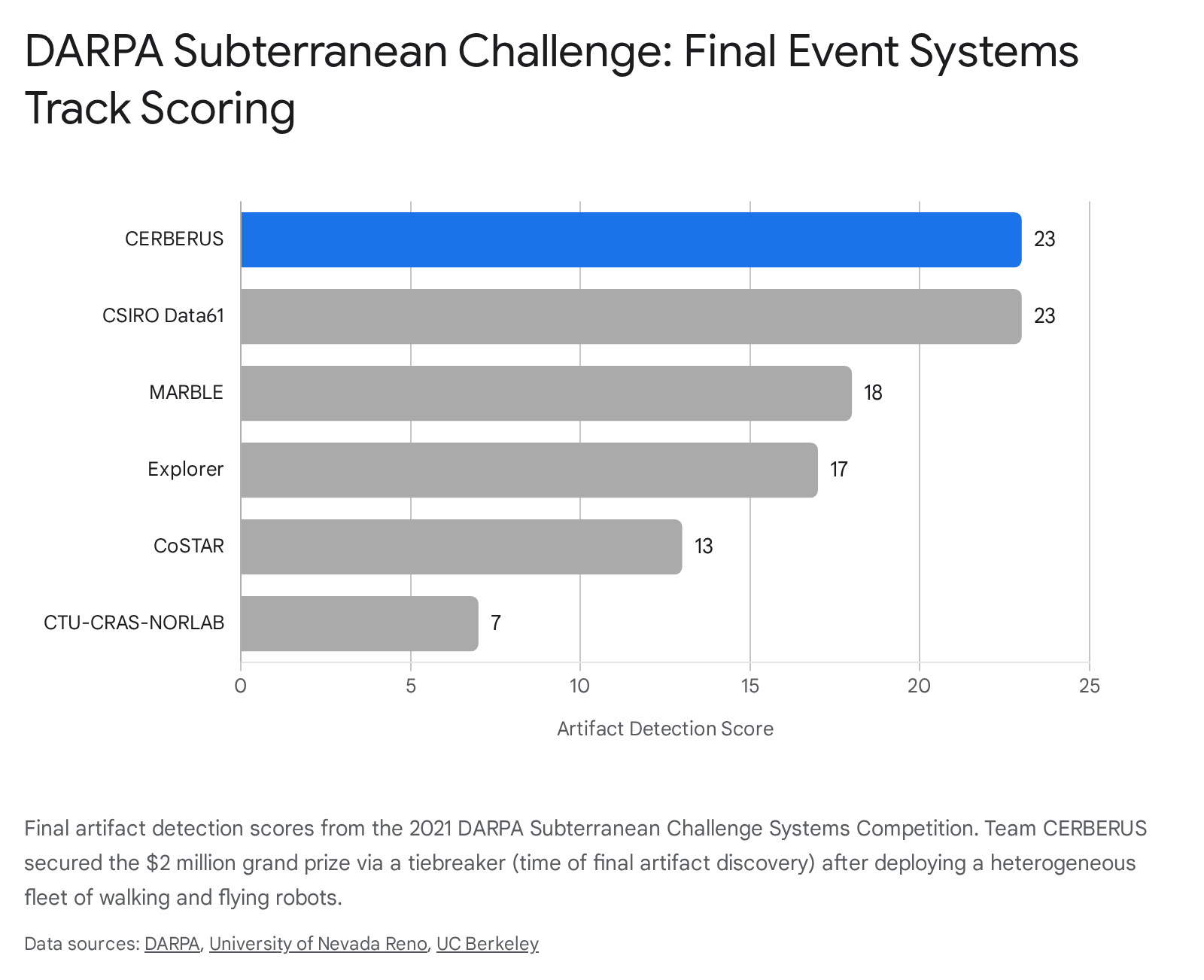
The competition demanded solutions for poor visibility, treacherous terrain, and severe communication constraints24. In the Systems Competition, Team CERBERUS (an international consortium led by the University of Nevada, Reno, and ETH Zurich) secured the $2 million grand prize via a tiebreaker, matching Team CSIRO Data61 with 23 artifact detections24. They utilized a heterogeneous fleet comprising ANYmal C quadruped legged robots and autonomous flying drones from Flyability25. Simultaneously, Team Dynamo won the Virtual Competition22. The challenge proved that autonomous robotic teams could successfully map miles of complex, degraded environments without human intervention19. To maintain connectivity as they pushed deeper, teams pioneered dynamic ‘breadcrumb’ techniques, dropping ruggedized network nodes or spherical ‘anchor balls’ at critical junctions to form ad hoc mesh networks23.
3.2 The First Robotics War: Israeli Deployment in Gaza
On the modern battlefield, particularly in Gaza, the IDF has operationalized autonomous subterranean exploration at scale. Observers have characterized the current conflict as the “first robotics war,” marked by the deployment of tens of thousands of unmanned vehicles27. The IDF inventory includes a diverse array of specialized platforms designed for specific subterranean mission profiles.
Key Unmanned Ground Vehicles (UGVs):
- D9 Panda: An autonomous, remotely operated Caterpillar bulldozer. It is used to clear heavily booby-trapped surface routes, detonate explosives buried beneath asphalt, and collapse shallow tunnel infrastructure without risking a human driver. Recent modifications allow operators to control it from tens of kilometers away28.
- ROOK & PROBOT: The ROOK is a fully autonomous 6×6 UGV developed by Elbit Systems and Roboteam. It is capable of carrying a 1,200 kg payload, making it ideal for logistical resupply, casualty evacuation (CASEVAC), or carrying heavy ISR payloads deep within secured underground areas30. The PROBOT offers similar heavy-lift utility capabilities30.
- MTGR (Micro Tactical Ground Robot): Also known as “Roni,” this lightweight, man-portable, stair-climbing robot is equipped with 360-degree cameras and manipulation arms. It is heavily utilized by both U.S. and Israeli forces to inspect booby traps and map confined tunnel spaces prior to infantry entry29.
Key Unmanned Aerial Vehicles (UAVs) and Hybrids:
- Rafael Maoz: A small loitering munition weighing roughly 3 kg, carrying a 400-gram explosive charge. It features a quiet electric motor allowing it to silently track targets in urban and confined environments before diving at speeds of 70 km/h to detonate29.
- Elbit Lanius: A highly agile, micro-suicide quadcopter designed specifically for urban and subterranean environments, capable of utilizing AI to map, identify, and engage targets autonomously in GPS-denied zones4. The proliferation of commercial off-the-shelf (COTS) FPV (First-Person View) drones has also accelerated this trend, serving as a cheap, asymmetric capability to conduct surveillance and surgical strikes inside constrained spaces32. Furthermore, Ukrainian forces have pioneered multi-domain unmanned teaming, recently utilizing an unmanned sea platform to deliver a ground robotic complex to Russian-held territory on the Kinburn Spit to execute a combat mission, demonstrating a new paradigm where machines perform the most dangerous tasks33.
- Arquimea Q-SCOUT: A specialized autonomous underground loitering system designed for stealthy tunnel reconnaissance and 3D digital mapping, utilizing a multi-sensor suite (optical, thermal, LiDAR) while navigating entirely without GNSS34.
- Robotican Rooster: Perhaps the most critical innovation in the state of the art is this hybrid aerial/ground drone.
| Feature | Robotican Rooster Specifications | Operational Benefit in Subterranean Environments |
| Dimensions & Weight | 316mm wheels, 400mm width, 1.62 kg | Highly portable; fits through narrow tunnel shafts and debris fields. |
| Hybrid Locomotion | 30 min max roll time, 12 min max hover | Conserves battery by rolling on floors; flies to bypass stairs, rubble, or vertical drops35. |
| Protective Structure | Rotating cage propeller guard | Withstands collisions with tunnel walls in total darkness without crashing36. |
| Communications | 2.1-2.5 GHz Mesh (3 platforms) | Functions in communication-deprived areas; multiple units relay signals to operators35. |
| Payload Capacity | 300g modular payload | Can carry oxygen sensors, radiation detectors, thermal cameras, or precision warheads35. |
The Rooster exemplifies the modern approach to tunnel warfare. By encasing the rotors in a rolling cage, it solves the dual problems of battery endurance and obstacle negotiation36. Furthermore, its recent weaponization—integrating a precision-guided warhead alongside AI-based object detection—transforms it from a pure reconnaissance asset into an indoor loitering munition capable of delivering surgical strikes inside tunnels without risking human operators39.
4. Technological Enablers: Navigation and Communication
Deploying a robot underground is futile if the machine cannot discern its location or transmit data back to its human commanders. The subterranean domain actively defeats the two pillars of modern military technology: GPS and Radio Frequency (RF) line-of-sight. Overcoming these barriers requires highly advanced algorithmic and networking solutions.
4.1 Navigating the GPS-Denied Environment: The Role of SLAM
Because GPS signals cannot penetrate the earth, subterranean drones must rely on absolute internal autonomy to understand their spatial positioning40. The foundational technology enabling this is Simultaneous Localization and Mapping (SLAM). SLAM algorithms process data from onboard sensors to instantaneously build a 3D map of an unknown environment while simultaneously tracking the drone’s precise location within that map, continually correcting for drift through a process known as loop closure41.
Various SLAM methodologies are deployed depending on the platform’s Size, Weight, and Power (SWaP) constraints and the specific mission environment:
| SLAM Methodology | Primary Sensor | Advantages in Subterranean Operations | Disadvantages / Limitations |
| LiDAR SLAM | Laser pulses (Time of Flight) | Extremely accurate 3D point clouds; impervious to absolute darkness; reliable in featureless environments41. | High cost; heavy payload limits use on micro-drones; requires massive onboard processing power41. |
| Visual SLAM | Standard Cameras | Highly affordable; lightweight; suitable for micro-drones; provides visual context41. | Fails in low-light/darkness; susceptible to motion blur; fails in uniform environments (e.g., smooth concrete tunnels) lacking trackable features41. |
| RGB-D SLAM | Color + Depth Cameras | Balanced approach; combines visual data with depth perception for accurate navigation41. | Struggles in poor lighting; less accurate than LiDAR in vast, open caverns41. |
| Swarm SLAM | Multi-agent data fusion | Drones share mapping data to build a single, large-scale 3D map collaboratively; highly resilient and rapid41. | Requires robust, high-bandwidth communication networks between all agents to share massive data files41. |
While LiDAR remains the gold standard for underground navigation due to its indifference to ambient lighting, the weight of the sensors often precludes their use on the smallest tactical drones43. Consequently, military research is heavily focused on optimizing visual and inertial sensor fusion, utilizing machine learning to align depth maps and semantic labels to maintain position without relying on heavy LiDAR arrays44.
4.2 Solving the Communication Paradox: MANETs and “Breadcrumbs”
The inability to transmit high-bandwidth data—such as real-time 4K video feeds or dense LiDAR point clouds—through solid rock remains the most critical vulnerability in subterranean drone operations13. To overcome the physical limitations of RF attenuation, military technologists rely on Mobile Ad Hoc Networks (MANETs).
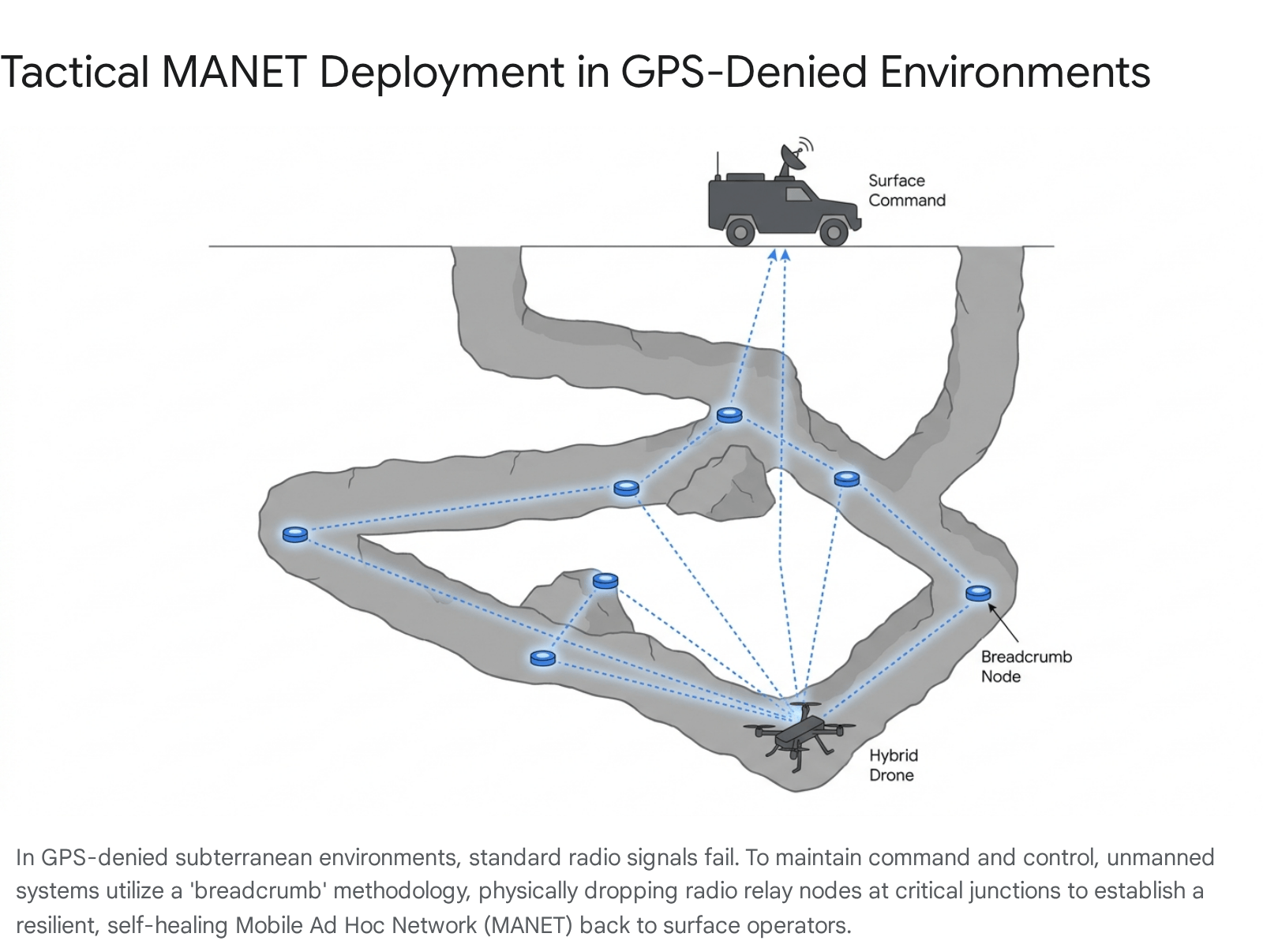
A MANET is a decentralized, self-configuring wireless network where every device (node) acts as both a transmitter and a router, dynamically forwarding data to other nodes46. Unlike traditional hub-and-spoke Wi-Fi, MANETs require no fixed infrastructure46. In tactical tunnel warfare, operators utilize a “breadcrumb” technique. A primary reconnaissance drone advances into the tunnel until signal degradation begins; it then physically drops a small, ruggedized network node to act as a repeater23.
As the drone continues, it leaves a trail of nodes around corners, through blast doors, and down vertical shafts, bouncing the high-frequency RF signal from node to node until it reaches the surface operator23. These mesh networks are inherently self-healing; if an adversary destroys a single node, or a node runs out of battery, the network’s dynamic routing protocols—such as Optimized Link State Routing (OLSR) or Ad hoc On-Demand Distance Vector (AODV) routing—instantly calculate a new path through the remaining nodes, ensuring C2 links are maintained without operator intervention46.
Leading commercial and defense contractors are aggressively miniaturizing this technology. For example, the Rajant DX2 Kinetic Mesh BreadCrumb is small and light enough to be carried by micro-drones, utilizing proprietary InstaMesh software to route around interference at the packet level while maintaining AES-256 military-grade encryption50. Similarly, Blu Wireless is deploying PhantomBlu mmWave technology, which utilizes tightly directional beams to create high-bandwidth, Low Probability of Detection (LPD) links that are extremely difficult for adversaries to intercept or jam48.
4.3 Magnetic Induction: The Future of Through-the-Earth Comms
While MANETs solve the line-of-sight issue within open tunnel corridors, they still rely on propagating electromagnetic (EM) waves through the air. For true “through-the-earth” communication—such as reaching a collapsed bunker, rescuing trapped personnel, or communicating directly through solid bedrock—EM waves suffer from massive material absorption and path loss52.
The emerging state of the art to bypass this physical limitation is Magnetic Induction (MI) communication. MI completely bypasses the limitations of traditional RF by utilizing a transmitting coil to generate a localized, low-frequency magnetic field, which induces a corresponding current in a receiving coil on the other side of the solid obstacle52. Because the magnetic permeability of rock, soil, and water is virtually identical to that of air, MI channels experience near-constant attenuation rates regardless of the medium they are passing through52.
Recently, researchers at South Korea’s Electronics and Telecommunications Research Institute (ETRI) achieved a major breakthrough in MI technology. By utilizing a current-driven magnetic induction method operating at a very low frequency of approximately 15 kHz, they successfully transmitted bidirectional voice and data through 100 meters of solid limestone bedrock53. While the current data rate is extremely limited (2-4 kbps)—sufficient for voice and basic telemetry but entirely inadequate for video transmission—MI technology promises highly resilient, unjammable C2 capabilities53. In the future, MI could connect deeply buried command posts directly to surface MANETs, ensuring continuity of operations even when all tunnel entrances are destroyed or sealed55.
5. Where the Domain is Headed: The Future of Subterranean Warfare
The convergence of historical lessons, the proliferation of cheap drones, and the strategic reality of contested airspace dictate that the future of warfare lies firmly beneath the surface7. Military strategy is rapidly adapting to this reality across doctrine, technological procurement, and geopolitical posturing.
5.1 Formalizing the Subterranean Domain and Doctrinal Shifts
The U.S. military and its allies are moving toward officially recognizing the subterranean environment as a distinct, formal warfighting domain, requiring specialized doctrine, acquisition pipelines, and dedicated units13. The U.S. Army’s Transformation in Contact initiative highlights the urgent need to integrate unmanned systems at every echelon to prepare for Large-Scale Combat Operations (LSCO) against peer adversaries56. Theorists advocate for the creation of an Unmanned Systems Command (USAUSC) to manage the massive influx of autonomous assets required to fight in these complex environments, drawing on lessons from Ukraine’s dedicated Unmanned Systems Forces56. A dedicated USAUSC would assume responsibility for these platforms, integrating them into a unified command structure, ensuring that data feeds rapidly populate a common operating picture from the tactical edge to the strategic level56.
Future training will transition from teaching infantry how to physically clear tunnels with rifles and breaching tools to teaching commanders how to deploy algorithmic, AI-driven drone swarms. The objective is to map, isolate, and neutralize underground objectives entirely via remote proxy, preserving human capital for operations where combined arms maneuver is actually effective13.
5.2 Autonomous Swarms, AI, and the “Robot Container”
The future of subterranean tactical operations will be defined by fully autonomous, heterogeneous robotic swarms. Platforms will transition from single-operator, remote-controlled devices to “Robot Containers”—integrated, deployable modular hubs housing mixed fleets of UGVs and UAVs31. An infantry unit encountering a tunnel entrance will simply drop a container, from which a synchronized swarm will deploy to establish a perimeter and push deep underground31.
These swarms will be heavily augmented by Artificial Intelligence operating at the tactical edge. Future drones will not merely map tunnels; they will utilize onboard edge computing to run semantic image labeling and target recognition algorithms in real-time37. As demonstrated by the recent weaponization of the Robotican Rooster, the distinction between an ISR drone and a loitering munition is collapsing rapidly39. Swarms of micro-drones, navigating autonomously via LiDAR and Swarm SLAM, will hunt through subterranean networks, identify armed combatants or booby traps using thermal and visual AI models, and execute precision kinetic strikes in confined spaces37. This capability will entirely sever the traditional “kill chain” timeline, allowing the swarm to detect, identify, and destroy a threat in milliseconds without requiring human authorization over a degraded network link.
5.3 Strategic Hardening and Peer Competition
At the strategic level, the proliferation of persistent surface surveillance (via satellite, HALE/MALE drones, and FPVs) and hypersonic precision-strike capabilities will force peer and near-peer competitors to drastically expand their subterranean infrastructure6. The Chinese People’s Liberation Army (PLA) continues to aggressively expand its “Underground Great Wall,” a vast, highly classified network of tunnels designed to conceal and protect intercontinental ballistic missiles (ICBMs), submarine pens (such as the naval facilities on Hainan island), and national command and control apparatuses from preemptive strikes14. Similarly, Russia has accelerated the construction of deeply buried strategic command posts to ensure continuity of government and second-strike capabilities, particularly in light of vulnerabilities exposed during the invasion of Ukraine13.
This dynamic is generating a new, highly dangerous subterranean arms race. As nations dig deeper and reinforce tunnels with advanced materials to ensure survivability, adversaries will invest heavily in subterranean-focused intelligence (such as satellite-based synthetic aperture radar, seismic sensing, and gravimetry) and next-generation deep-penetrating munitions14. The strategic stability of the mid-21st century may ultimately depend on the perceived survivability of these subterranean assets. If a state believes its underground nuclear arsenal or leadership bunkers are entirely invulnerable to detection and destruction, it may act with significantly greater aggression and impunity on the global stage, fundamentally altering the calculus of deterrence14.
Conclusions
The subterranean domain has permanently evolved from a tactical nuisance to a strategic imperative. The era in which conventional military forces could rely solely on air superiority and rapid surface maneuverability to secure decisive victory has ended, punctuated by the grueling, protracted underground resistance seen recently in Gaza and Ukraine. The current state of the art relies on mitigating the extreme friction and lethality of the underground environment by replacing human operators with advanced robotic systems.
The successful deployment of technologies like LiDAR SLAM for GPS-denied navigation, self-healing MANETs for resilient communication, and hybrid drone platforms like the Rooster demonstrate that militaries are rapidly closing the technological capability gap. Looking forward, the subterranean domain will become a primary theater for the deployment of autonomous AI, weaponized drone swarms, and through-earth magnetic induction communications. As long as the surface of the battlefield remains transparent to sensors and devastatingly lethal to exposed forces, the strategic imperative to dig deeper will persist, ensuring that the future of modern warfare is inextricably linked to the earth below.
Appendix: Glossary of Acronyms
- AI: Artificial Intelligence
- AODV: Ad hoc On-Demand Distance Vector
- ARVN: Army of the Republic of Vietnam
- C2: Command and Control
- CBRN: Chemical, Biological, Radiological, and Nuclear
- DARPA: Defense Advanced Research Projects Agency
- EM: Electromagnetic
- ETRI: Electronics and Telecommunications Research Institute
- FPV: First-Person View
- GNSS: Global Navigation Satellite System
- GPR: Ground Penetrating Radar
- ICBM: Intercontinental Ballistic Missile
- IDF: Israel Defense Forces
- ISIS: Islamic State of Iraq and Syria
- ISR: Intelligence, Surveillance, and Reconnaissance
- LiDAR: Light Detection and Ranging
- LPD: Low Probability of Detection
- LSCO: Large-Scale Combat Operations
- MANET: Mobile Ad Hoc Network
- MI: Magnetic Induction
- ML: Machine Learning
- OLSR: Optimized Link State Routing
- PLA: People’s Liberation Army
- RF: Radio Frequency
- SCBA: Self-Contained Breathing Apparatus
- SLAM: Simultaneous Localization and Mapping
- SubT: Subterranean Challenge (DARPA)
- SWaP: Size, Weight, and Power
- UAS: Unmanned Aerial System
- UAV: Unmanned Aerial Vehicle
- UGV: Unmanned Ground Vehicle
- USAUSC: Unmanned Systems Command
- VHF: Very High Frequency
Please share the link on Facebook, Forums, with colleagues, etc. Your support is much appreciated and if you have any feedback, please email us in**@*********ps.com. If you’d like to request a report or order a reprint, please click here for the corresponding page to open in new tab.
Sources Used
- Full article: Gaza’s Subterranean Warfare: Palestinian Resistance Tunnels vs. Israel’s Military Strategy – Taylor & Francis, https://www.tandfonline.com/doi/full/10.1080/1057610X.2024.2347843
- The Elephant in the Tunnel: Preparing to Fight and Win Underground – Modern War Institute, https://mwi.westpoint.edu/elephant-tunnel-preparing-fight-win-underground/
- The Way Ahead is Down: The Case for Underground Defense, https://smallwarsjournal.com/2025/10/10/the-way-ahead-is-down-the-case-for-underground-defense/
- Fighting from the Shadows: The Strategic and Tactical Significance of Underground Networks in Modern Warfare – Rabdan Security and Defence Institute, https://rsdi.ae/en/publications/fighting-from-the-shadows-the-strategic-and-tactical-significance-of-underground-networks-in-modern-warfare
- Non-State-Actors and the Subterranean Dimension – Journal of Military and Strategic Studies, https://jmss.org/article/download/74634/56038/231371
- The Future of the Battlefield – Office of the Director of National Intelligence – Global Trends, https://www.dni.gov/index.php/gt2040-home/gt2040-deeper-looks/future-of-the-battlefield
- The Future of Warfare Lies Underground: How Armies Are Training to Fight in Caves, Tunnels, and Sewers – Indian Strategic Studies, https://www.strategicstudyindia.com/2023/09/the-future-of-warfare-lies-underground.html
- Siege of Mariupol – Wikipedia, https://en.wikipedia.org/wiki/Siege_of_Mariupol
- Mariupol holds out against Russia’s siege, a symbol of Ukrainian resistance | PBS News, https://www.pbs.org/newshour/world/mariupol-holds-out-against-russias-siege-a-symbol-of-ukrainian-resistance
- Subterranean Operations: Israeli Defense Force Lessons from Gaza | Article – Army.mil, https://www.army.mil/article/288356/subterranean_operations_israeli_defense_force_lessons_from_gaza
- Tunnel warfare in the Gaza Strip – Wikipedia, https://en.wikipedia.org/wiki/Tunnel_warfare_in_the_Gaza_Strip
- What Happens Inside Gaza’s Secret Tunnels? | Unpacked – YouTube, https://www.youtube.com/watch?v=cCK4qpIl6fw
- Large-Scale Combat Operations and the Subterranean Dilemma, https://www.usanca.army.mil/LinkClick.aspx?fileticket=8LDr6_KWWtc%3D&portalid=114
- As Drones Fill the Sky, Armies Head Underground – The Defense Circuit, https://thedefensecircuit.com/2026/05/28/as-drones-fill-the-sky-armies-head-underground/
- Navigate Without Limits: Understanding GPS-Denied Drones – Flyability, https://www.flyability.com/blog/gps-denied-drone
- No. 25-1031, Subterranean Operations: Israeli Defense Force Lessons from Gaza – Army.mil, https://api.army.mil/e2/c/downloads/2025/09/09/303436de/subterranean-operations-israeli-defense-force-lessons-from-gaza.pdf
- U.S. Military Training for Underground Warfare: Modern Tactics and Approaches, https://www.trango-sys.com/modern-tactics-and-approaches-in-underground-warfare/
- Rajant Kinetic Mesh® Proves Subterranean Connectivity During NATO ARRC “Ex AVENGER TRIAD 25” Exercise, https://rajant.com/blog/rajant-kinetic-mesh-proves-subterranean-connectivity-during-nato-arrc-ex-avenger-triad-25-exercise/
- DARPA Challenge – CSIRO, https://www.csiro.au/en/research/technology-space/robotics/DARPA-Challenge
- Subterranean Challenge | U.S. Department of War, https://www.war.gov/Multimedia/Experience/Subterranean-Challenge/
- DARPA Subterranean Challenge Aims to Revolutionize Underground Capabilities, https://www.darpa.mil/news/2017/subterranean-challenge
- Subterranean Challenge Final Event – DARPA, https://www.darpa.mil/research/challenges/subterranean
- Robots Confront Challenges Underground | AFCEA International, https://www.afcea.org/signal-media/technology/robots-confront-challenges-underground
- Team CERBERUS and Team Dynamo Win DARPA Subterranean Challenge Final Event, https://www.darpa.mil/news/2021/subterranean-challenge-winners
- DARPA international robotics challenge won by University of Nevada, Reno team, https://www.unr.edu/nevada-today/news/2021/cerberus
- Team CERBERUS Wins DARPA Subterranean Challenge, https://me.berkeley.edu/news/team-cerberus-wins-darpa-subterranean-challenge/
- The Israeli defense forces will form a Robotic corps – Autonomy Global, https://www.autonomyglobal.co/the-israeli-defense-forces-will-form-a-robotic-corps/
- Inside the IDF push to deploy smarter, faster robots across the frontlines, https://www.jpost.com/defense-and-tech/article-900268
- Robots of war: IDF’s cutting-edge tech transforms Gaza battlefield | Ctech, https://www.calcalistech.com/ctechnews/article/by8i0jnia
- Roboteam – DIMSE, https://dimse.info/roboteam/
- Roboteam Unveils Gaza‑Proven UGV Fleet, New AI HUB – Autonomy Global, https://www.autonomyglobal.co/roboteam-unveils-gaza-proven-ugv-fleet-new-ai-hub/
- How attack drones are shaping conflict in Ukraine and Israel – GIS Reports, https://www.gisreportsonline.com/r/drones-ukraine-israel/
- ‘A new era of war begins’ — Ukrainian sea, ground drone team up for combat mission, https://m.youtube.com/shorts/qCoPVI6YbI8
- Q-SCOUT | Underground loitering munition system – Arquimea, https://www.arquimea.com/products/unmanned-underground-drone/
- FIRST IN, LAST OUT, https://cdn.prod.website-files.com/67b418349cd29a4f7829b4a5/68b223653d8009954daa85bc_Rooster-by-Robotican-website.pdf
- Rooster – Bavovna.AI, https://bavovna.ai/uav/rooster/
- Robotican’s Rooster hybrid unmanned air/ground vehicle increases combat experience and gets NATO Stock Number – EDR Magazine, https://www.edrmagazine.eu/roboticans-rooster-hybrid-unmanned-air-ground-vehicle-increases-combat-experience-and-gets-nato-stock-number
- Rooster – Robotican, https://robotican.net/rooster/
- Armed ROOSTER Hybrid Drone Brings Precision Indoor Strike Capability to Urban Battlefields – Autonomy Global, https://www.autonomyglobal.co/armed-rooster-hybrid-drone-brings-precision-indoor-strike-capability-to-urban-battlefields/
- Discover Autonomous GNSS-denied Drones – Fly4Future, https://fly4future.com/development-and-prototyping/autonomous-gnss-denied-drones-for-outdoor-missions-in-gps-deprived-areas/
- SLAM Technology for Drones: How It Works, Types & Future Trends (2026), https://www.thedroneu.com/blog/slam-technology/
- (PDF) GPS‐Denied LiDAR‐Based SLAM—A Survey – ResearchGate, https://www.researchgate.net/publication/397763087_GPS-Denied_LiDAR-Based_SLAM-A_Survey
- Real-Time Autonomous UAV Navigation with SLAM-Based Mapping and Direction-Oriented Exploration in Forest-like GNSS-Denied Scenarios – MDPI, https://www.mdpi.com/2504-446X/10/6/399
- SLAM Technology for GPS-Denied Navigation in UAVs – GreyB, https://xray.greyb.com/drones/slam-gps-denied-navigation
- Tunnel Vision | Engineering Solutions Fall/Winter 2023 – UMass Lowell, https://www.uml.edu/engineering/research/engineering-solutions/es-fall-2023/tunnel-vision.aspx
- Wireless ad hoc network – Wikipedia, https://en.wikipedia.org/wiki/Wireless_ad_hoc_network
- MANET Radio | Mobile Ad Hoc Networks for Drones & Unmanned Systems, https://www.unmannedsystemstechnology.com/expo/manet/
- Drone Comms in GPS-Denied Environments: Tactical Mesh Solutions, https://www.bluwireless.com/insight/gps-denied-drone-communications/
- Resilient Tactical UAV Communications in Disconnected Environments – Beechat Network Systems, https://beechat.network/2025/05/16/resilient-tactical-uav-communications-in-disconnected-environments/
- Rajant Mesh Networks for Tactical Operations: Practical Considerations for Defense Agencies, https://rajant.com/blog/rajant-mesh-networks-for-tactical-operationspractical-considerations-for-defense-agencies/
- Military Demos & Deployments – Defense Mesh – Rajant, https://rajant.com/defense/military-demos-and-deployments/
- Using Magnetic Induction to Facilitate Wireless Networking – Study.com, https://study.com/academy/lesson/using-magnetic-induction-to-facilitate-wireless-networking.html
- 100-meter underground wireless communication – Mapping Ignorance, https://mappingignorance.org/2026/03/24/underground-wireless-communication/
- Magnetic Induction Wireless System Enables Deep Underground Communication – Electronics For You, https://www.electronicsforu.com/news/magnetic-induction-wireless-system-enables-deep-underground-communication
- Underground Wireless Communication Now Possible – ISSSource, https://www.isssource.com/underground-wireless-communication-now-possible/
- Transforming in Contact: The Army Needs an Unmanned Systems Command Now, https://smallwarsjournal.com/2026/04/14/transforming-in-contact-the-army-needs-an-unmanned-systems-command-now/