
1. Executive Summary
This report provides an analytical assessment of the People’s Liberation Army’s (PLA) Systems Destruction Warfare (SDW) doctrine. Synthesizing military operational analysis, strategic intelligence indicators, and cognitive psychology, the assessment examines the theoretical foundations, operational execution, and psychological dimensions of the doctrine, alongside the strategic frameworks required to counter it. Developed through decades of observing Western military interventions, SDW represents a structural shift in Chinese military strategy. Rather than prioritizing the physical attrition of enemy forces, the PLA seeks to paralyze the adversary by disrupting, degrading, and destroying the critical nodes of its operational system.
The PLA visualizes modern military forces as a living network with eyes (intelligence), a brain (command), nerves (communications), and fists (firepower)1. SDW is the operational methodology used to sever the connective tissue of this entity. By employing a combination of kinetic strikes and non-kinetic effects across the land, sea, air, space, cyberspace, and electromagnetic domains, the PLA aims to blind adversary intelligence, sever command and control (C2) links, and disrupt logistics before a coordinated response can be mounted1.
On April 19, 2024, the PLA executed a structural reorganization designed to optimize its forces for this specific type of warfare. The dissolution of the Strategic Support Force (SSF) and the creation of the Information Support Force (ISF), Cyberspace Force (CSF), and Aerospace Force (ASF) underscore Beijing’s prioritization of information dominance and network-centric warfare3.
Furthermore, SDW extends beyond physical and digital networks into the cognitive domain. Utilizing the Three Warfares framework (public opinion, psychological, and legal warfare) and concepts of Cognitive Domain Operations (CDO), the PLA seeks to induce cognitive overload, manipulate adversary decision-making via reflexive control, and erode the psychological will to fight1.
Countering this doctrine requires an adaptation in allied force design and command philosophy. Strategies such as Joint All-Domain Command and Control (JADC2) and Mosaic Warfare aim to replace monolithic architectures with resilient, disaggregated networks6. Simultaneously, human elements must be hardened through mission command principles and cognitive stress inoculation to maintain operational effectiveness in degraded environments.
2. Theoretical Evolution of Systems Confrontation
The evolution of PLA doctrine over the past three decades reflects a continuous adaptation to the changing character of war. Observing the role of precision-guided munitions, network-centric operations, and information dominance in the 1991 Gulf War and subsequent NATO campaigns, Chinese military theorists concluded that industrial-age warfare—characterized by massed mechanized forces—was obsolete1. The PLA recognized that future conflicts would be determined by the belligerent capable of achieving information superiority and leveraging it to dismantle the opponent’s operational cohesion2.
2.1 From Attrition to Informationized Warfare
Chinese military strategy has undergone a trajectory away from Maoist concepts of territorial defense and wars of attrition. The transition moved toward “winning informationized local wars,” focusing on information dominance—depriving an adversary of battlefield awareness while protecting its own1.
This realization birthed two interrelated doctrinal concepts: Systems Confrontation (体系对抗) and Systems Destruction Warfare (体系破击战). Systems Confrontation serves as the organizing principle. It posits that warfare is a confrontation between opposing operational systems, requiring a military to possess a modular, networked force structure capable of rapid data synthesis and cross-domain coordination2. The PLA’s adoption of this concept drove its military reforms, replacing the outdated military region system with joint theater commands designed to fight as integrated entities.
2.2 Intelligence Assessments and PLA Self-Perception
Despite the advanced theoretical framework, internal PLA self-assessments have historically noted institutional anxiety regarding their capacity to execute complex joint operations. Intelligence analysis of PLA literature highlights two recurring themes: the “Two Incompatibles” (the assessment that current PLA capabilities do not meet the requirements of modern warfare) and the “Five Incapables” (the assessment that PLA operational commanders demonstrate an inability to make accurate judgments, deploy forces effectively, or manage unexpected situations).
The PLA remains conscious of its lack of recent warfighting experience and the potential deficiencies in its command human capital. These assessments drive the rapid implementation of decision-support tools intended to compensate for human operational inexperience by automating the synchronization of multi-domain operations.
3. The Operational Architecture: Target and System Design
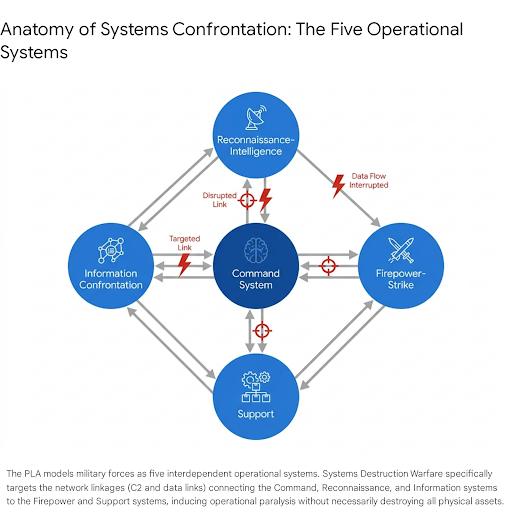
To operationalize SDW, PLA planners map the adversary—and structure their own joint task forces—according to a functional anatomy comprising distinct operational systems. This framework allows the PLA to systematically identify vulnerabilities and allocate appropriate kinetic or non-kinetic effects to exploit them1.
| Operational System | Functional Role in Systems Confrontation | Target Vulnerabilities and SDW Objectives |
| Command System | Acts as the operational “brain.” Encompasses physical command posts, leadership personnel, decision-support software, and C2 networks1. | Severing the connection between decision-makers and warfighters to induce institutional paralysis and isolate subordinate units2. |
| Reconnaissance-Intelligence System | Serves as the “eyes.” Involves the collection, processing, and dissemination of information via satellites, early warning radars, and UAVs1. | Blinding the adversary to impose a “fog of war,” preventing the location of PLA forces and the employment of precision fires2. |
| Firepower-Strike System | The kinetic “fists.” Encompasses aircraft, naval vessels, missile batteries, and artillery1. | A secondary target in SDW. Neutralizing command and reconnaissance renders these assets uncoordinated and susceptible to localized defeat. |
| Information Confrontation System | The “nerves.” Responsible for communications, defending friendly networks while degrading the adversary’s electromagnetic and cyber capabilities1. | Corrupting data integrity, jamming sensor frequencies, and deploying malware to establish information dominance1. |
| Support System | The logistical and sustainment infrastructure required to project and maintain combat power. | Striking fuel distribution networks and strategic depots to trigger cascading failures in theater-wide sustainment and force sortie rationing. |
The interaction of these systems forms the basis of the PLA’s theory of victory. Rather than engaging the firepower-strike system directly, the PLA focuses on the connective data links and logistical lifelines that allow the system to function.
4. Execution: Targeting Priorities and Modalities
The PLA translates the theoretical framework of SDW into executable targeting priorities. This operational concept aligns specific capabilities against the adversary’s operational vulnerabilities to systematically dismantle their ability to fight.
4.1 The Four Target Categories
Doctrinal literature explicitly directs PLA planners to focus on four primary target categories to maximize systemic disruption2.
| Target Category | Objective and Methodology | Primary Target Assets |
| 1. Information | Degrading or disrupting the flow of information in the adversary’s operational system by targeting networks and data links, leaving maneuver units informationally isolated2. | Key data links, information network sites, satellite communications, undersea fiber-optic cables2. |
| 2. High Value Assets | Physical or functional neutralization of high-value nodes that provide disproportionate capability to the operational system6. | C2 headquarters, AWACS/JSTARS aircraft, primary intelligence fusion centers, strategic logistics hubs2. |
| 3. Operations | Disrupt the systemic cohesion (operational architecture) that allows different elements of the adversary’s system to collaborate and support each other6. | Joint fires coordination centers, shared cloud-computing architectures, multi-domain integration nodes6. |
| 4. Speed | Distorting the adversary’s time sequence or operational tempo (the OODA loop) by introducing friction, nodal failures, and data link outages. Targets the reconnaissance, control, attack, and evaluation (RCAE) cycle2. | RCAE processes, targeting adjudication networks2. |
4.2 Kinetic and Non-Kinetic Implementation
To achieve these targeting priorities, the PLA fields an arsenal designed for anti-access/area-denial (A2/AD) and precision strikes6. Kinetic enablers include fifth-generation fighters, advanced cruisers, and land-attack cruise missiles. The PLA fields intermediate-range and anti-ship ballistic missiles designed to hold high-value essential elements—such as carrier strike groups and regional airbases—at risk from extended distances.
Non-kinetic capabilities form the vanguard of SDW, as the PLA views the space, cyberspace, and electromagnetic domains as the decisive terrain. Counter-space operations utilize direct-ascent anti-satellite missiles and directed-energy weapons to blind overhead reconnaissance and sever satellite communications. Cyber forces infiltrate networks to alter routing protocols to disrupt the flow of information. Electronic warfare units deploy broad-spectrum jamming to deny tactical data links and precision navigation, directly attacking the operational architecture.
5. Institutional Reorganization: The 2024 Reforms
To optimize the command and execution of these capabilities, the Central Military Commission (CMC) ordered a structural reform on April 19, 20243. The Strategic Support Force (SSF), established in 2015 to centralize space, cyber, and electronic warfare, was dissolved3.
In its place, the PLA established three independent arms reporting directly to the CMC, utilizing the structure of the dissolved SSF departments3:
- Aerospace Force (ASF): Formed from the SSF Aerospace Systems Department, this branch is responsible for military space operations and orbital defense4. Adhering to PLA protocol order, the ASF is now positioned as the senior force among the new arms5. The ASF manages space-based reconnaissance and the BeiDou satellite navigation system, ensuring PLA information dominance in orbit4.
- Cyberspace Force (CSF): Formed from the SSF Network Systems Department, this branch is tasked with offensive and defensive cyber operations, computer network exploitation, electronic warfare, and psychological warfare3. The CSF operates five Technical Reconnaissance Bases aligned with the five PLA theater commands, as well as a centralized Cyberspace Operations Base3.
- Information Support Force (ISF): Formed from the SSF Information Communications Base, the ISF is the cornerstone of the PLA’s network information system5. Commanded by Lieutenant General Bi Yi, with General Li Wei as Political Commissar, the ISF is mandated to maintain the integrity of the PLA’s C4ISR architecture, facilitate data sharing across joint theater commands, and defend against adversary cyber intrusions5.
The Chinese military categorizes the Information Domain as a domain of war unto itself, equal to the physical domains, and typically acts as the “supported” domain during operations5. By placing the ISF, CSF, and ASF directly under the CMC, the PLA ensures that the primary tools of Systems Destruction Warfare receive the highest levels of strategic direction5.
6. The Cognitive and Psychological Domain
The analytical frameworks of military intelligence and cognitive psychology intersect deeply in the PLA’s approach to the human element. SDW asserts that an operational system is only as resilient as the personnel commanding it. The PLA recognizes the cognitive domain as a distinct warfighting domain, seeking to manipulate perception, degrade cognitive processing, and erode the will to fight.
6.1 The Three Warfares Doctrine
The “Three Warfares” (三战) provides the foundational doctrine for PLA political and psychological operations1.
- Public Opinion Warfare: Aims to shape the narrative of a crisis to legitimize PLA actions and delegitimize the adversary through state-directed media campaigns and algorithmic amplification9.
- Psychological Warfare: Targets the morale and decision-making capacity of enemy commanders and civilian populations through tailored disinformation and demonstrations of military capability1.
- Legal Warfare (Lawfare): Utilizes legal frameworks to justify military actions, complicate adversary rules of engagement, and constrain intervention1.
Within SDW, the Three Warfares are integrated into operational design, erasing the boundary between conventional and irregular warfare1.
6.2 Reflexive Control and Decision Manipulation
To actively disrupt the adversary’s cognitive processes, the PLA utilizes concepts aligned with the doctrine of “reflexive control.” Reflexive control is the systematic practice of engineering the information environment to force an adversary to voluntarily make a decision that serves the initiator’s strategic interests.
Rather than relying on direct deception, reflexive control maps the opponent’s psychological profile, doctrinal constraints, and biases. The PLA utilizes Cognitive Domain Operations to feed specially prepared information into the adversary’s intelligence sensors and social networks. The objective is to manipulate threat perception, overload decision-makers with contradictory data, and provoke the misallocation of resources or the premature deployment of reserves.
6.3 Cognitive Overload and Information Isolation
The psychological toll of SDW is acute at the operational command level. Human decision-making relies on the prefrontal cortex for logic and planning. Under conditions of acute stress, time compression, and ambiguity, cognitive processing can be affected, leading to impulsive reactions and the degradation of explicit memory required for complex problem-solving.
The PLA engineers the battlefield to intentionally trigger this cognitive overload. Through the synchronization of kinetic strikes, electronic jamming, and cyber network disruption, the PLA deprives commanders of situational awareness. This state of “information isolation” impacts commanders confronted with a sensory void—where sensors fail and the operational picture fractures. The ensuing disorientation can induce “cognitive tunneling,” wherein leaders fixate on localized threats while losing comprehension of the broader strategic environment.
6.4 Advanced Neurocognitive Threats: NeuroStrike
Indicators demonstrate that the PLA is investing in the weaponization of neuroscience, pursuing capabilities termed “NeuroStrike”9. The CCP views NeuroStrike as a core component of its asymmetric warfare strategy9. Two dedicated PLA units, Unit 94969 and Unit 96812, are reportedly spearheading this research11.
Research conducted by the Academy of Military Medical Sciences (AMMS) involves the development of non-kinetic technologies—such as targeted infrasound and microwave directed-energy weapons—designed to directly impair the neurological functions of adversary personnel9. These infrasound weapons are categorized into neurotype and organotype models, designed to exploit resonant frequencies to disrupt brain activity and internal organs10. By targeting the human brain with resonant frequencies, these weapons seek to inflict cognitive incoherence, reduce situational awareness, and cause physical incapacitation9.
7. Allied Countermeasures and Strategic Mitigation
To defeat a doctrine designed to collapse monolithic systems, the United States and its allies must transition toward resilient, distributed, and cognitively hardened operational models. The strategic goal is to achieve deterrence by denial—convincing the PLA that its systems destruction attacks will fail to achieve the requisite operational paralysis.
7.1 Mosaic Warfare and Disaggregated Kill Webs
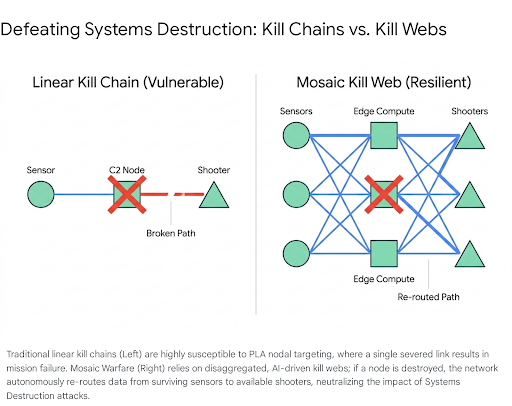
The traditional approach to warfare has relied on highly capable, multi-mission platforms operating through centralized command structures. While lethal, this platform-centric design presents single points of failure highly vulnerable to SDW targeting priorities6.
Defense concepts such as “Mosaic Warfare” propose shifting from linear “kill chains” to dynamic “kill webs”6. Mosaic Warfare disaggregates sensors, decision nodes, and shooters across an array of smaller, less expensive autonomous systems6. Functioning like individual tiles in a mosaic, these elements can be pieced together to create packages that target an adversary’s system6. If the PLA destroys a specific sensor or severs a communications link, the network leverages redundant nodes to autonomously route around the failure, connecting an alternative sensor to a different shooter6. By minimizing the critical target value of any single node, Mosaic Warfare structurally negates the foundational premise of Systems Destruction Warfare6.
7.2 Joint All-Domain Command and Control (JADC2)
To manage the complexity of disaggregated forces and operate inside the PLA’s OODA loop, military planners are implementing JADC2. This framework integrates sensors and shooters across all military services into a single, resilient data environment2.
By leveraging cloud architectures and artificial intelligence, JADC2 rapidly processes multispectral data to automatically identify targets and recommend optimal engagements2. This decision support is critical for mitigating RCAE interdiction and maintaining decision advantage in an environment saturated by PLA electronic warfare2. The architecture relies on diverse data transport layers, and the U.S. Space Force is designated to oversee the integration of the JADC2 system, as space capabilities form the cornerstone of the data architecture required to process intelligence globally7. This ensures that C2 is sustained even under severe electromagnetic attack7.
7.3 Mission Command vs. PLA Institutional Vulnerabilities
Technological solutions must be paired with human adaptation. SDW aims to induce cognitive overload, making centralized, top-down command structures a liability. Countering this requires a commitment to “Mission Command”—the principle of empowering subordinate leaders to execute operations based on commander’s intent when direct communication is lost.
To prepare for this, forces must undergo cognitive conditioning. Training environments must simulate sensory deprivation, electronic warfare, and ambiguity, forcing commanders to practice decision-making under acute physiological stress. By building automaticity in high-stress scenarios, forces can mitigate the paralyzing effects of cognitive tunneling and maintain momentum while informationally isolated.
This emphasis on decentralized execution directly exploits a structural vulnerability within the PLA. The PLA remains constrained by a highly centralized party-army culture and a reliance on consensus-based decision-making. The requirement for consensus limits rapid, autonomous action at the tactical edge. In a degraded communications environment created by mutual systems destruction attacks, adherence to Mission Command provides a distinct operational advantage over the rigid hierarchy of the PLA.
8. Conclusion
China’s Systems Destruction Warfare doctrine represents an integrated approach to modern conflict. By conceptualizing the adversary as an interconnected organism, the PLA has designed its force structure, kinetic arsenals, and non-kinetic capabilities to sever the digital and cognitive connective tissue that enables joint operations. The April 2024 establishment of the Information Support, Cyberspace, and Aerospace Forces demonstrates a commitment to achieving information dominance. Furthermore, the integration of the Three Warfares, reflexive control, and emerging NeuroStrike technologies highlights the PLA’s intent to extend the battlespace directly into the human mind, seeking cognitive paralysis before physical destruction is necessary.
Countering SDW demands a realignment of force design and command philosophy. By embracing the disaggregated resilience of Mosaic Warfare, the rapid decision advantage of JADC2, and the decentralized empowerment of Mission Command, allied forces can negate the PLA’s targeting methodology. Ultimately, the victor in a systems confrontation will not necessarily be the force with the most lethal platforms, but the one whose operational architecture and human leadership can best absorb disruption, cognitively adapt, and maintain cohesive action in a highly contested environment.
Master Summary Table: Systems Destruction Warfare vs. Countermeasures
| Dimension | PLA Systems Destruction Warfare (SDW) Application | Allied Countermeasures & Strategic Response |
| Doctrinal Objective | Operational paralysis via destruction of critical network nodes; achieving victory without requiring annihilation2. | Deterrence by denial; maintaining freedom of action and decision advantage in highly contested environments7. |
| Operational Organization | Joint Theater Commands supported by dedicated strategic arms (Aerospace, Cyberspace, Information Support Forces)3. | Integration across services via Joint All-Domain Command and Control (JADC2)2. |
| Targeting Priorities | 1. Information 2. High Value Assets 3. Operations 4. Speed (Time Sequence / Tempo)6. | Defense of key cyber terrain; predictive all-source intelligence threat modeling; securing logistical pipelines. |
| Force Design Philosophy | Targeting monolithic, high-value adversary platforms and centralized C2 structures6. | Mosaic Warfare: Disaggregated, highly redundant, autonomous “kill webs” that route around targeted nodes6. |
| Cognitive & Psychological | “Three Warfares”; Reflexive Control; Cognitive Overload; NeuroStrike (infrasound/directed energy)1. | Mission Command: Empowered decentralized execution; cognitive stress inoculation; automated decision-support AI. |
| Institutional Vulnerabilities | Centralized micromanagement; reliance on consensus; fragmented ownership of connective architecture1. | Reliance on vulnerable space architectures; complex interoperability challenges between services and allies7. |
Please share the link on Facebook, Forums, with colleagues, etc. Your support is much appreciated and if you have any feedback, please email us in**@*********ps.com. If you’d like to request a report or order a reprint, please click here for the corresponding page to open in new tab.
Sources Used
- Winning the Systems War: Why the Army Should Reorganize Itself for Modern Combat, https://www.irregularwarfare.org/winning-the-systems-war-army-reorganization/
- Blinding The Elephant: Assessing PLA Systems Confrontation And The Fight For Information Dominance | Georgetown Security Studies Review, https://gssr.georgetown.edu/the-forum/regions/asia/blinding-the-elephant-assessing-pla-systems-confrontation-and-the-fight-for-information-dominance/
- People’s Liberation Army Cyberspace Force – Wikipedia, https://en.wikipedia.org/wiki/People%27s_Liberation_Army_Cyberspace_Force
- People’s Liberation Army Strategic Support Force – Wikipedia, https://en.wikipedia.org/wiki/People%27s_Liberation_Army_Strategic_Support_Force
- The PLA’s New Information Support Force – Air University, https://www.airuniversity.af.edu/CASI/Display/Article/3749754/the-plas-new-information-support-force/
- Mosaic Warfare | Air & Space Forces Magazine, https://www.airandspaceforces.com/article/mosaic-warfare/
- The Indispensable Domain: The Critical Role of Space in JADC2 – DTIC, https://apps.dtic.mil/sti/trecms/pdf/AD1183050.pdf
- Operationalizing Intelligentized Warfare: Xi Replaces the Strategic Support Force with Three New “Arms” – PLATracker, https://www.platracker.com/post/operationalizing-intelligentized-warfare-xi-replaces-the-strategic-support-force-with-three-new-ar
- Enumerating, Targeting and Collapsing the Chinese Communist Party’s NeuroStrike Program Aggregating Intelligence Fragments an – The CCP BioThreats Initiative, https://prism-sepia-mah9.squarespace.com/s/Enumerating-Targeting-and-Collapsing-the-Chinese-Communist-Partys-NeuroStrike-Program.pdf
- The Evolution of Cognitive Warfare: NeuroStrike Capabilities and the Strategic Role of Infrasound Weapons – The CCP BioThreats Initiative, https://www.ccpbiothreats.com/initiatives/neurostrike-capabilities-and-the-strategic-role-of-infrasound-weapons
- Information Warfare Watch No. 27 | American Foreign Policy Council, https://www.afpc.org/publications/bulletins/information-warfare-watch/information-warfare-watch-no-27