Executive Summary
Between September 5 and September 19, 2026, the US and Iran maintained a delicate, high-stakes balance in their situation. Both nations traded military strikes while quietly keeping backdoor diplomatic channels open. However, this ongoing standoff has heavily drained resources on both sides. With the collapse of the Islamabad Memorandum of Understanding (MoU) and the failure of follow-up negotiations in Bürgenstock, a dangerous diplomatic vacuum has emerged—one that external powers, namely China and Russia, are eagerly stepping in to exploit to reshape the Persian Gulf’s security landscape1.
On the battlefield, US Central Command’s (CENTCOM) Operation Epic Fury has dealt severe blows to Iranian naval and air defense networks, but it has come at a steep price. A recent Congressional Budget Office (CBO) assessment estimates that the US has spent roughly $38.1 billion so far, in the process burning through up to two-thirds of its advanced missile interceptor stockpiles—a shortfall that creates serious strategic risks for US deterrence in the Indo-Pacific3. At the same time, Tehran is feeling intense economic pressure following the sudden revocation of Office of Foreign Assets Control (OFAC) General License X (GL X) and the passage of the Lindsey O. Graham Sanctioning Russia and Iran Act of 20266. Yet despite relentless military and financial headwinds, Iran has doubled down on fortifying its underground nuclear facilities at Pickaxe Mountain and Parchin, using the conflict as cover to build an almost impenetrable safeguard for its advanced centrifuge cascades9. All signs point toward a lingering war of attrition where regional proxies and global rivals continually push up the costs of US military involvement.
Detailed Operational and Diplomatic Developments
Bilateral Interactions: The Diplomatic Track and the Bürgenstock Architecture
During these two weeks, the fallout from the expired 60-day window set by the June 17, 2026, Islamabad MoU largely overshadowed diplomatic efforts. Mediated by Pakistan and Qatar, the 14-point agreement and subsequent follow-up talks at Switzerland’s Bürgenstock resort were intended to establish a lasting ceasefire, phased sanctions relief, and safe commercial shipping through the Strait of Hormuz11.
The Erosion of the Islamabad MoU and Bürgenstock Talks
Failing to convert the temporary agreement into a permanent peace treaty has led to a deep diplomatic deadlock. The formal deadline passed on August 17, leaving the Bürgenstock process hanging in uncertainty1. Initially, the talks appeared promising: a high-level US team—including Vice President JD Vance, Special Envoy Steve Witkoff, and Jared Kushner—met with senior Iranian officials, including Parliament Speaker Mohammad-Bagher Ghalibaf and Foreign Minister Abbas Araghchi11. They agreed to create a political oversight committee alongside working groups for nuclear issues, sanctions, and disputes, with Iran even offering to let International Atomic Energy Agency (IAEA) inspectors return to its nuclear facilities12.
However, conflicting strategic goals soon unraveled the process. The Iranian delegation walked out multiple times after US President Donald Trump threatened to resume strikes or levy tariffs on maritime shipping unless the Strait of Hormuz was reopened to Western traffic right away12. Tehran still maintains that the MoU remains valid on paper, pointing to a side arrangement with Oman to clear shipping in the Strait, and insists that Washington must follow through on unfreezing Iranian assets1.
Status of the Lebanon Deconfliction Cell
Perhaps the biggest flaw in the Bürgenstock agreement was that it couldn’t hold outside players accountable—a reality made clear by the breakdown of the “Lebanon deconfliction cell.” Celebrated in June by Iranian President Masoud Pezeshkian as a major breakthrough, the cell was meant to monitor and enforce a halt to combat across all regional fronts, including the Levant12. For Tehran, it was an attempt to separate its direct conflict with the US from broader regional clashes while keeping Hezbollah’s capabilities intact.
Over the past two weeks, this deconfliction framework completely fell apart. Israel, which was not part of the Bürgenstock talks, refused to abide by the US-Iran agreement. Israeli Finance Minister Bezalel Smotrich publicly dismissed the agreement, while the Israel Defense Forces (IDF) continued and expanded strikes against Hezbollah in southern Lebanon12. Since Iran views Hezbollah’s security as vital to its defense, ongoing Israeli strikes prompted Foreign Minister Araghchi to pause further talks until a ceasefire in the Levant is secured16. The collapse of this deconfliction mechanism has strengthened hardliners in Tehran, who now argue the US cannot or will not manage its key regional partner, undermining faith in the diplomatic process13.
The UNGA Diplomatic Window
Even with formal talks stalled, both Washington and Tehran seem eager to keep informal communication lines open to avoid an all-out regional war. On September 17, the US State Department confirmed it granted visas for Iran’s key leadership group—including President Pezeshkian and Foreign Minister Araghchi—to attend the UN General Assembly (UNGA) High-Level Week in New York23.
Allowing the Iranian delegation to attend—despite domestic pushback and ongoing combat—underscores the Trump administration’s commitment to maintaining a dialogue path. While the Iranian officials face strict travel boundaries and shopping restrictions in New York, their presence offers a neutral ground for quiet diplomacy23. Meanwhile, Swiss diplomats confirmed in mid-September that they are still facilitating background discussions in Bürgenstock, indicating that efforts to revive the agreement are still ongoing16.
Economic Statecraft and the Sanctions Architecture
The economic battleground has seen its own turbulence, marked by shifting policy signals from the US Treasury and new legislative sanctions. Financial restrictions remain Washington’s chief lever to squeeze Tehran’s economy and force concessions on its nuclear program and maritime actions.
The Rise and Fall of General License X (GL X)
To understand current economic pressures and the hesitation surrounding future diplomacy, one needs to look at the short lifespan of OFAC General License X. Issued on June 21, 2026, as part of the Islamabad MoU, GL X marked one of the most significant relief measures for Iranian oil exports since 197925. It temporarily permitted routine transactions linked to producing, selling, and shipping Iranian crude oil and petroleum products25. Notably, it broke with decades of policy by allowing payments to Iran to be processed directly in US dollars and permitting Iranian oil imports into the US26.
That relief was short-lived. After the ceasefire broke down in early July and the Islamic Revolutionary Guard Corps (IRGC) resumed targeting ships in the Strait of Hormuz, OFAC abruptly revoked GL X on July 7, replacing it with General License X17. GL X1 acted solely as a 10-day wind-down period, which expired on July 1725.
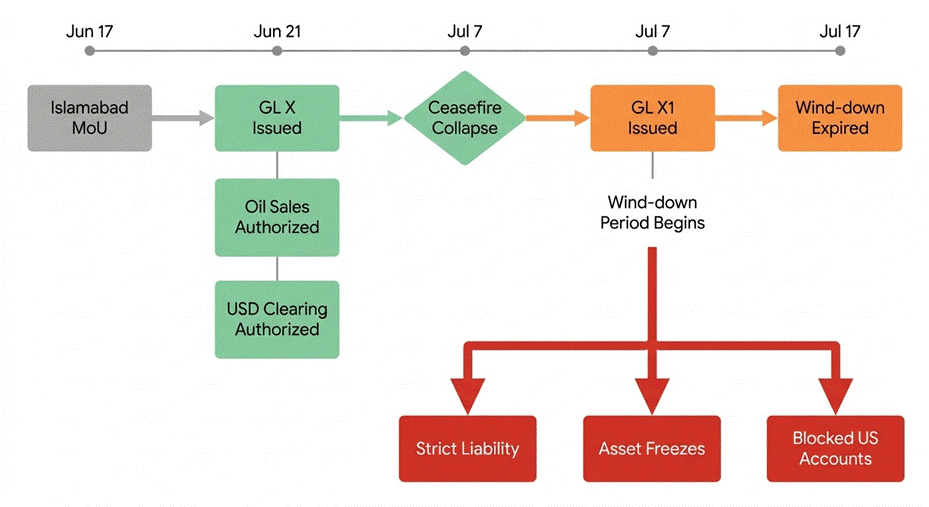
The sudden policy reversal continues to disrupt global energy markets. International energy companies, insurers, and shippers that entered into agreements under GL X suddenly faced legal and financial risks7. Strict liability rules were reinstated, meaning anyone doing business with Iranian vessels—even inadvertently—faces sanctions and asset freezes7. Additionally, GL X1 required that any funds owed to Iran be placed into blocked US accounts rather than paid directly, reversing the previous dollar-clearing rules and freezing Iranian capital7. This rapid shift has left financial institutions and shippers wary, making them far less likely to jump at future sanctions waivers even if new agreements are reached.
The Lindsey O. Graham Sanctioning Russia and Iran Act of 2026
Alongside executive actions, Congress has moved to cement economic pressure and narrow the White House’s diplomatic flexibility. On September 16, the House passed the Lindsey O. Graham Sanctioning Russia and Iran Act of 2026, which President Trump signed into law on September 186.
The law extends the original Iran Sanctions Act of 1996 for five more years, shifting its expiration date to 20318. It also introduces secondary tariffs and restrictions on financial institutions handling trade between Russia and Iran, directly targeting their growing military cooperation33. Coming at the same time as the UNGA visa approvals, the legislation illustrates the split in US policy, with congressional mandates limiting the administration’s ability to offer lasting sanctions relief in exchange for progress.
Macroeconomic Impact and Shadow Networks
The combined weight of the naval blockade, revoked licenses, and new sanctions is hitting everyday Iranians hard. Soaring inflation has created a growing humanitarian strain, with local reports describing families selling personal belongings simply to afford necessary medical treatments6.
To work around Western financial channels, Tehran relies heavily on barter trade and informal networks. Intelligence reports indicate Iran trades discounted oil with China in exchange for telecom gear, vehicles, medical supplies, and air defense components34. These transactions rely on shell companies and shift through intermediaries like Golden Global, which US Treasury Secretary Scott Bessent is currently monitoring6. While this barter system keeps Iran’s economy afloat, it leaves the country with little foreign currency, making it difficult to stabilize the rial or buy advanced technology outside its partnerships with China and Russia.
Kinetic Escalation and Theater Operations
On the military front, US Central Command’s “Operation Epic Fury” has settled into a grinding war of attrition. Both sides continue to exchange targeted strikes aimed at degrading enemy logistics, naval capabilities, and nuclear sites.
Operation Epic Fury: The Strategic Cost of Attrition
Recent unclassified reports from the CBO and the Department of Defense Inspector General highlighted the financial and strategic toll of the US campaign.
Sustaining Operation Epic Fury has proven exceptionally expensive. The CBO estimates that as of August 1, the military effort has cost around $38.1 billion4. The spending reflects the high price tag of modern air defense and missile operations:
| Cost Category | Estimated Expenditure (USD) | Description |
| Munitions Replacement | $21.7 Billion | The largest single expense. Includes $13.1 billion specifically for missile defense interceptors and $7.3 billion for land-attack cruise missiles (e.g., Tomahawks)3. |
| Increased Flying Hours | $10.4 Billion | Wear and tear, maintenance, and operational hours for the roughly 250 tactical aircraft, bombers, and ISR platforms deployed to the CENTCOM AOR3. |
| Surge Fuel Costs | $2.7 Billion | Logistical fuel requirements to sustain the naval blockade and continuous combat air patrols11. |
| Equipment Losses | $1.9 Billion | Replacement costs for major end items destroyed in combat, notably including a highly valuable THAAD radar system destroyed by Iranian kinetic fire5. |
Meanwhile, a separate DoD Inspector General report put total spending through late June at $33.4 billion, including $22.3 billion for munitions, $3.7 billion in lost equipment, and $7.4 billion in general operational expenses38.
The human cost has also mounted. The Inspector General report noted 14 US military casualties—including seven service members killed in action, six of whom died in a March 1 strike in Kuwait—and 417 wounded40. In addition, CENTCOM has lost 52 aircraft to combat, accidents, or friendly fire. Losses include up to 30 MQ-9 Reaper drones, 12 KC-135 refueling tankers, four F-15E Strike Eagles, an F-35A, an A-10, an E-3 AWACS damaged on the ground, and several search-and-rescue helicopters38. US diplomatic and military sites in Iraq, Kuwait, Saudi Arabia, and the UAE suffered roughly $184 million in damage from missile strikes, requiring ongoing repairs39.
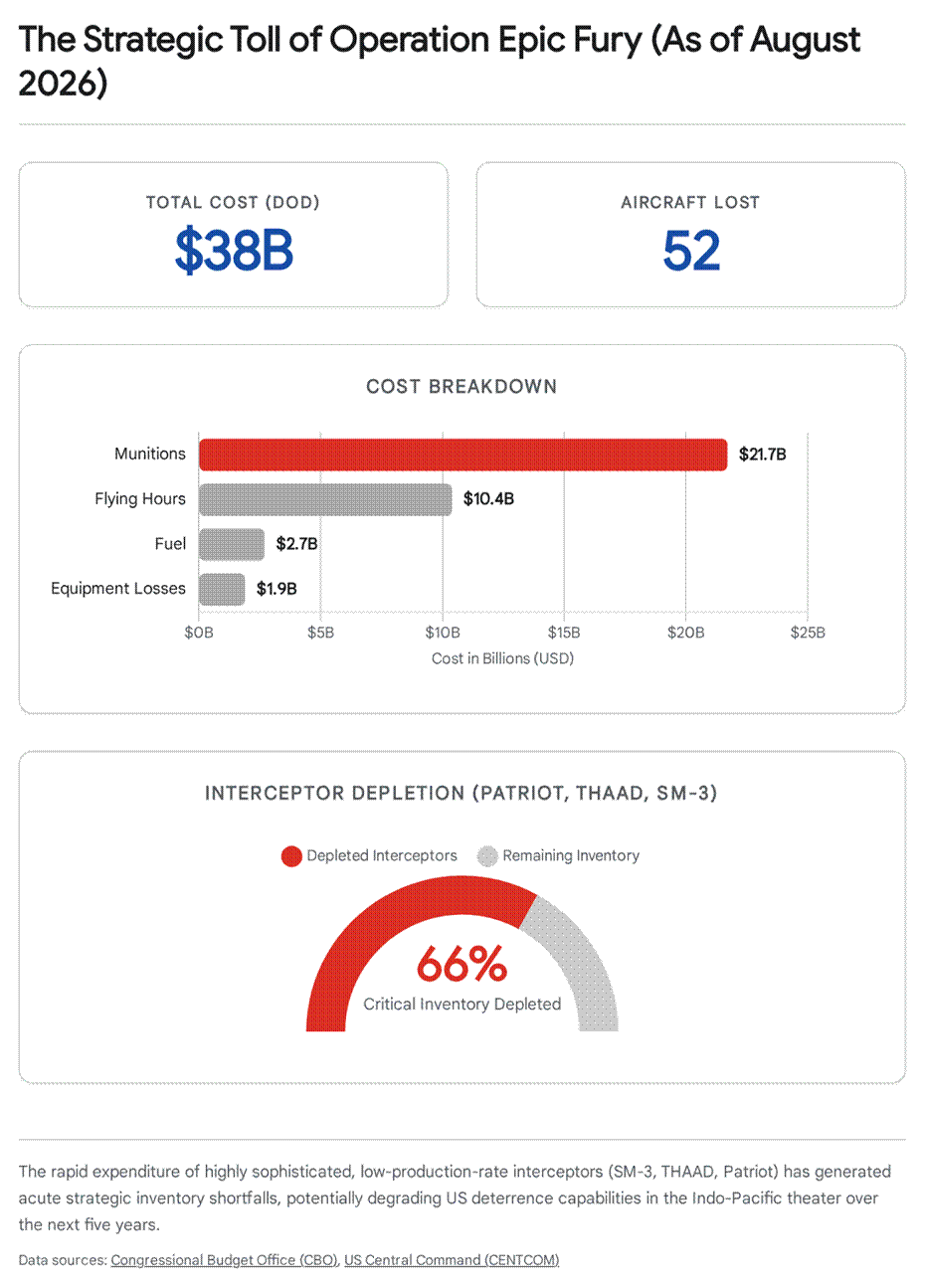
Beyond immediate spending, the CBO warns the conflict could add 0.5 percentage points to US inflation by early 2027 due to shipping disruptions4. Most concerning for military planners is the rapid burn rate of key interceptors. Estimates indicate the US has used between half and two-thirds of its global supply of Patriot, THAAD, SM-3, and SM-6 missiles since mid-20253. Given complex manufacturing and costs ranging from $4 million to $28 million per missile, restocking these inventories could take at least five years3.
This inventory drain plays directly into Iran’s asymmetric strategy. By using relatively inexpensive drones and missiles to force the US to fire expensive interceptors—with over 7,500 threats targeted by CENTCOM—Tehran has created a challenging cost dynamic for Washington3. This depletion also raises questions about readiness for potential crises in the Indo-Pacific, creating friction between military strategists and policymakers3.
The Strait of Hormuz Maritime Chokepoint
Control over the Strait of Hormuz remains a focal point of the conflict. Iran seeks to assert control over the strategic waterway, using energy shipping disruptions to exert economic pressure globally33.
The last two weeks saw several sharp naval encounters. On September 8, Iranian forces captured an unmanned US underwater drone near the Strait45. The next day, US forces responded by targeting six Iranian oil tankers, sinking one and damaging five others45. The action was intended to disrupt illicit oil shipments and demonstrate US resolve in maintaining its blockade47. To date, CENTCOM forces have checked over 140 compliant vessels, disabled 10 non-compliant ships, and allowed more than 50 humanitarian shipments through47.
In response to the tanker strikes, the IRGC launched 18 ballistic missiles toward a US facility in Jordan37. Although air defenses intercepted the salvo, the attack highlights Iran’s willingness to target US bases across the region45. Tensions remained high when another commercial tanker caught fire following an attack in the Strait on September 1835.
CENTCOM has worked to secure shipping lanes by striking Iranian radar positions, anti-ship batteries, and mine-laying operations33. Recent air raids on September 1 targeted launch sites preparing to lay sea mines43. However, Iranian forces have repeatedly repaired destroyed radar and surveillance equipment14. Reports suggest US planners are weighing options to target undersea communication lines if Iran attempts to disrupt maritime infrastructure further43.
Nuclear Hardening: Pickaxe Mountain and Taleghan 2
Away from the coast, Iran is expanding its underground nuclear facilities. Throughout September, satellite imagery analyzed by CSIS and the IAEA revealed increased work at the Pickaxe Mountain underground complex near Natanz9.
The facility, built under heavy rock, has shifted from excavation to internal building and exterior fortification9. Recent images show paved access roads, reinforced concrete tunnel entrances, and new protective barriers designed to withstand heavy ordnance, such as the US GBU-57 bunker buster9.
At the same time, reports from September 17 indicate rebuilding efforts at the Taleghan 2 site within the Parchin military compound10. Taleghan 2, previously associated with high-explosives research, had sustained heavy damage from past strikes10. Current activity is hidden beneath large covers to block aerial view, with construction crews building reinforced concrete walls32.
These building efforts serve two clear goals. First, Iran wants to secure its centrifuge operations against air strikes33. Second, it sends a political message: Tehran aims to demonstrate that military action will not stop its nuclear development, hoping to gain leverage in future negotiations20. While President Trump has warned against continued construction, analysts note that the site’s depth presents significant targeting challenges9.
Proxy Group Activities and Regional Networks
Iran’s regional allies remain active, though different groups are adapting to local conditions in ways that complicate US stabilization efforts.
Houthi Maneuvers in the Arabian Peninsula
In Yemen, Houthi forces are pursuing both military and diplomatic steps. On the ground, they have expanded control near the Bab al Mandeb Strait and carried out strikes on Saudi oil facilities33. On September 16, the Houthis launched drone and missile attacks into western Saudi Arabia, seeking to pressure Riyadh over its blockade and military campaign44.
At the same time, Houthi representatives have held quiet talks with US contacts in Oman6. Reports suggest the group offered assurances that it will refrain from targeting broader international shipping if the US avoids supporting Saudi ground operations53. This strategy aims to keep the US from expanding direct air strikes against Houthi positions while allowing the group to maintain its presence along the Red Sea coast33, 53.
Iraqi Militia Disarmament Negotiations
In Iraq, government leaders are trying to manage tensions involving aligned Shia militias without triggering wider internal conflict. The Shia Coordination Framework has been working on a multi-stage proposal to address militia weapons30. However, the current terms fall short of US expectations.
The proposal allows militias to keep their armaments as long as they do not fire them at government targets53. It also includes conditions that invalidate the agreement if foreign forces remain in Iraq, aligning with the groups’ goal of seeing US troops leave53. As a result, the talks appear unlikely to reduce the operational reach of these groups significantly.
Geopolitical Postures and Strategic Alignments
As the conflict drags on, external powers are adjusting their involvement in the region, with China and Russia taking active steps to build influence.
| Actor | Primary Posture | Key Actions & Strategic Rationale (Sept 5 – Sept 19) |
| China | Aggressive Diplomatic Mediation & Economic Sustainer | Actions: Foreign Minister Wang Yi hosted Iranian FM Araghchi in Beijing on Sept 16, calling for a return to the Islamabad MoU and a reopening of the Strait1. China also vetoed a US-backed UNSC resolution on sanctions monitoring and continues active barter trade with Iran. Rationale: Beijing aims to position itself as a practical mediator while securing energy imports. Supporting Iran economically and diplomatically allows China to balance US influence without taking on direct military roles1. |
| Russia | Covert Military Enabler & Diplomatic Spoiler | Actions: Vetoed the US UNSC draft on Sept 17, calling Western snapback efforts illegal2. Reports suggest Russian defense firms are providing tech assistance for Iranian missile systems. Rationale: Moscow benefits as US attention and military assets remain focused on the Middle East, diverting resources away from Europe3. |
| GCC / UAE / Saudi Arabia | Hedging & Regional Containment | Actions: Saudi Arabia continues military engagements with Houthis24. Arab defense officials recently joined talks with CENTCOM and Israeli representatives in Germany. Rationale: Gulf states are concerned about regional stability and missile defense supplies, balancing security ties with the US while engaging China to help reduce tensions20, 24. |
| Pakistan | Neutral Facilitator | Actions: Works alongside Qatar as a central diplomatic go-between to keep communication open between Washington and Tehran. Rationale: Islamabad seeks neighborly calm to focus on domestic economic stability, maintaining working relations with both Tehran and Washington. |
| Israel | Tactical Escalation | Actions: Maintains military pressure on Hezbollah in Lebanon, operating outside the Bürgenstock framework. Rationale: Israel focuses on reducing border threats directly, prioritizing the weakness of regional proxies over international diplomatic agreements20. |
China’s Ascension as the Primary Diplomatic Broker
China’s diplomatic efforts reflect a steady push to expand its influence in the Middle East. During the September 16 meeting in Beijing, Foreign Minister Wang Yi highlighted President Xi Jinping’s vision for regional security, calling for a return to the Islamabad MoU and urging open shipping lanes1. By advocating for dialogue, Beijing presents itself as a constructive partner to Gulf Arab nations.
The conflict provides China with useful diplomatic leverage, especially with an upcoming bilateral meeting between President Xi and President Trump. As the US seeks to curtail Iran’s financial channels, Beijing’s economic role gives it significant weight in broader international discussions34.
The Russia-China UN Security Council Veto
The alignment between Moscow and Beijing was clear on September 17, when both nations vetoed a US-backed UN Security Council resolution. The measure sought to extend the mandate of experts monitoring sanctions on Iran’s nuclear activities2.
The veto ends official UN oversight panels tracking ballistic missile and nuclear material movements6. Russian officials described the US proposal as overly focused on economic pressure rather than consensus6. By shielding Iran at the UN, Russia and China are limiting multilateral oversight, leaving the US to rely more on direct economic and military measures2. Meanwhile, other international partners are being cautious; on September 18, South Korean President Lee Jae Myung stated that Seoul would not send troops or military assets to support the US in the conflict24.
Chronological Timeline of Key Events (Sept 5 – Sept 19, 2026)
- Pre-September 5 (Context): The 60-day window from the June 17 Islamabad MoU expires without a final deal, leaving relations tense amid ongoing military exchanges and revoked sanctions waivers (GL X)1.
- September 8: Iranian forces capture a US underwater drone operating near the Strait of Hormuz35.
- September 9:
- US CENTCOM carries out strikes targeting six Iranian oil tankers, sinking one and damaging five18.
- Iran responds by launching 18 missiles at a US facility in Jordan, which are intercepted by air defenses35.
- September 10: The IAEA notes new building activity at the underground Pickaxe Mountain facility and reports Iran to the UN Security Council10, 34.
- September 13: Satellite photos reveal ongoing repairs and construction at the Taleghan 2 site in Parchin32.
- September 14: Houthi fighters clash with government forces in Yemen near the Red Sea coastline30.
- September 15: Reports from the CBO and DoD Inspector General highlight $38.1 billion in Operation Epic Fury expenses and significant missile interceptor use3.
- September 16:
- Chinese Foreign Minister Wang Yi meets Iranian FM Abbas Araghchi in Beijing to encourage renewed negotiations1.
- The US House passes the Lindsey O. Graham Sanctioning Russia and Iran Act of 20266.
- Houthi forces launch drone and missile strikes targeting sites in western Saudi Arabia53.
- September 17:
- The US State Department approves restricted travel visas for the Iranian delegation (including President Pezeshkian and FM Araghchi) to attend the UN General Assembly in New York.
- Russia and China veto a UN Security Council resolution on sanctions monitoring6.
- September 18:
- President Trump signs the Graham Sanctions Act into law8.
- An attack on an oil tanker in the Strait of Hormuz causes a shipboard fire35.
- South Korea publicly declares it will not deploy troops or military assets to support the US in the Iran war.
Please share the link on Facebook, Forums, with colleagues, etc. Your support is much appreciated and if you have any feedback, please email us in**@*********ps.com. If you’d like to request a report or order a reprint, please click here for the corresponding page to open in new tab.
Sources Used
- Beijing urges Iran, US to rebuild negotiations – Chinadaily.com.cn, https://global.chinadaily.com.cn/a/202609/17/WS6aab2b97e4b06d4aa055e758.html
- Russia and China veto US proposal for UN experts to keep, https://www.timesofisrael.com/russia-and-china-veto-us-proposal-for-un-experts-to-keep-monitoring-sanctions-on-iran/
- Iran war has cost $38 billion, depleted two-thirds of US missile, https://www.defensenews.com/news/your-military/2026/09/15/iran-war-has-cost-38-billion-depleted-two-thirds-of-us-missile-interceptors-cbo-says/
- CBO Warns Iran War Costs $38 Billion, Strains Missile Stocks, https://web.matrixnews.in/news/N36bdd61d22315245a6b1106c4960e075
- Estimating the Cost of Combat Operations Against Iran, https://www.cbo.gov/system/files/2026-09/62756-Iran.pdf
- US House passes Iran sanctions as Trump signals war may be, https://www.iranintl.com/en/202609175386
- OFAC Revoked Iran General License X: 2026 Guide, https://ofacblockedfundslawyers.com/ofac-revoked-iran-general-license-x-what-happens-to-deals/
- Iran war updates: Thousands march for Houthis in Sanaa, fighting rages, https://www.aljazeera.com/news/liveblog/2026/9/18/iran-war-live-trump-weighs-big-decision-on-iran-tanker-hit-in-hormuz
- New Satellite Imagery Analysis Reveals an Uptick in 2026 … – CSIS, https://www.csis.org/analysis/satellite-imagery-pickaxe-mountain
- Iran rapidly rebuilding site tied to past nuclear weapons research, https://www.iranintl.com/en/202609178092
- 2025–2026 Iran–United States negotiations – Wikipedia, https://en.wikipedia.org/wiki/2025%E2%80%932026_Iran%E2%80%93United_States_negotiations
- Despite Deep Divisions, US and Iran Reach Diplomatic Framework, https://www.hungarianconservative.com/articles/current/us-and-iran-reach-diplomatic-framework/
- Iran-US Relations: Assessing the Bürgenstock Negotiations, https://www.specialeurasia.com/2026/06/22/us-iran-burgenstock-negotiations/
- Beijing urges Iran, US to rebuild negotiations – Asia News Network, https://asianews.network/beijing-urges-iran-us-to-rebuild-negotiations/
- The US and Iran have started negotiations in Switzerland regarding, https://unn.ua/en/news/the-us-and-iran-have-started-negotiations-in-switzerland-regarding-the-nuclear-program-and-the-strait-of-hormuz
- Kurdistan24 Inquiry Prompts Swiss Confirmation of Continuing U.S., https://www.kurdistan24.net/en/story/921058/kurdistan24-inquiry-prompts-swiss-confirmation-of-continuing-us-iran-talks
- The U.S. and Iran will negotiate at Bürgenstock after all – Bluewin, https://www.bluewin.ch/en/news/switzerland/the-us-and-iran-will-negotiate-at-buergenstock-after-all-li.3289723
- Wang Yi: China encourages Iran, US to return to Islamabad MoU, https://news.cgtn.com/news/2026-09-16/China-s-top-diplomat-holds-talks-with-Iranian-FM-1QtR93WHzfG/p.html
- Pezeshkian hails Lebanon deconfliction cell as major achievement, https://www.middleeasteye.net/live-blog/live-blog-update/pezeshkian-hails-lebanon-deconfliction-cell-major-achievement
- How will the Iran war reshape the Persian Gulf? | Chatham House, https://www.chathamhouse.org/publications/the-world-today/2026-09/how-will-iran-war-reshape-persian-gulf
- Iran War Updates: 2 ships attacked in Strait of Hormuz as Trump, https://www.cbsnews.com/live-updates/iran-war-trump-us-strait-of-hormuz-oil-houthis/
- Iran, US to pursue technical talks in Switzerland – SWI swissinfo.ch, https://www.swissinfo.ch/eng/foreign-affairs/iran-us-to-pursue-technical-talks-in-switzerland/91626267
- U.S. will let Iranian leaders attend U.N. General Assembly in New York, https://www.washingtonpost.com/politics/2026/09/17/us-will-let-iranian-leaders-attend-un-general-assembly-new-york/
- Early Edition: September 18, 2026 – Just Security, https://www.justsecurity.org/157793/early-edition-september-18-2026/
- OFAC Revokes Iran General License X: GL X1 Wind-Down, https://sanctionslawcenter.com/en/blog/ofac-iran-general-license-x-z/
- OFAC Rescinds Iranian Sanctions Relaxation Following Renewed, https://www.foley.com/insights/publications/2026/07/ofac-rescinds-iranian-sanctions-relaxation-following-renewed-conflict/
- United States Authorizes Iranian Oil Transactions – Bracewell LLP, https://www.bracewell.com/resources/united-states-authorizes-iranian-oil-transactions/
- OFAC Issues a General License Authorizing Transactions in Iranian, https://www.blankrome.com/news-and-events/ofac-issues-a-general-license-authorizing-transactions-in-iranian-oil-petrochemical-products-and-petroleum-products-for-60-days/
- OFFICE OF FOREIGN ASSETS CONTROL Iranian Transactions and, https://ofac.treasury.gov/media/936446/download?inline
- Issuance of Amended Iran-related General License, https://ofac.treasury.gov/recent-actions/20260707
- OFAC Reinstates U.S. Sanctions Related to Sales of Iranian Oil, https://www.thompsonhinesmartrade.com/2026/07/ofac-reinstates-u-s-sanctions-related-to-sales-of-iranian-oil/
- Trump signs bill imposing sanctions on Russia and giving him more power to levy tariffs, https://www.theguardian.com/us-news/2026/sep/18/trump-signs-russia-sanctions-bill
- Iran Update, September 14, 2026 | ISW, https://understandingwar.org/research/middle-east/iran-update-september-14-2026/
- IAEA sees new activity at Iran’s Pickaxe Mountain – Bloomberg, https://www.iranintl.com/en/202609109102
- Araghchi, Wang Yi meet ahead of Xi-Trump talks; China urges return to Islamabad pact, https://www.indiatoday.in/world/story/araghchi-wang-yi-meet-ahead-of-xi-trump-talks-china-urges-return-to-islamabad-pact-2996187-2026-09-16
- Deep Dive: How Much Has the Iran War Cost Americans, Really?, https://inkstickmedia.com/deep-dive-how-much-has-the-iran-war-cost-americans-really/
- On The Hour – September, 9, 2026 | IRAN ATTACKS U.S. WARSHIPS, https://www.youtube.com/watch?v=pwcAT35be24
- Pentagon classifies mission statement for Operation Epic Fury, https://taskandpurpose.com/news/pentagon-iran-war-epic-fury-classified/
- $33.4 billion spent, weapons stockpiles hit: What Pentagon report on Iran war revealed, https://timesofindia.indiatimes.com/defence/international/33-4-billion-spent-weapons-stockpiles-hit-what-pentagon-report-on-iran-war-revealed/articleshow/134254601.cms
- Op Epic Fury cost US $33.4 billion. 7 killed in action, 417 wounded, 52 aircraft & drones lost, https://theprint.in/world/op-epic-fury-cost-us-33-4-billion-7-killed-in-action-417-wounded-52-aircraft-drones-lost/3044475/
- Shredded tents, destroyed jet: Images reveal hidden scale of Iranian strikes on US Gulf bases, https://www.aninews.in/news/world/us/shredded-tents-destroyed-jet-images-reveal-hidden-scale-of-iranian-strikes-on-us-gulf-bases20260917065627
- Iran war has cost $38 billion, depleted two-thirds of US missile, https://www.militarytimes.com/news/your-military/2026/09/15/iran-war-has-cost-38-billion-depleted-two-thirds-of-us-missile-interceptors-cbo-says/
- Iran Update, September 2, 2026 | ISW, https://understandingwar.org/research/middle-east/iran-update-september-2-2026/
- Iran Update, September 16, 2026, https://understandingwar.org/research/middle-east/iran-update-september-16-2026/
- Conflict With Iran | Global Conflict Tracker, https://www.cfr.org/global-conflict-tracker/conflict/confrontation-between-united-states-and-iran
- ‘Surge in construction’ at suspected Iranian nuclear site: Analysts, https://www.youtube.com/watch?v=amLPT8iCJec
- Operation Epic Fury, Report to Congress, April 1, 2026-June 30, 2026, https://media.defense.gov/2026/Sep/09/2003993626/-1/-1/1/OEF_Q3_JUN2026_FINAL_508%20SECURE.PDF
- Marines Take EABO Into Combat for the First Time in Epic Fury, https://migflug.com/afterburner/usmc-eabo-first-combat-use-farp-epic-fury-31st-meu-2026/
- Iran and U.S. Trade Blows with Potential to Return to Full-Scale, https://thesoufancenter.org/intelbrief-2026-september-1/
- Grossi: Imagery shows new construction activity at Iran’s Pickaxe, https://www.jpost.com/middle-east/iran-news/article-908299
- Fresh activity emerges at Iran’s deeply buried nuclear site as Trump, https://www.wfmd.com/2026/09/17/fresh-activity-emerges-at-irans-deeply-buried-nuclear-site-as-trump-warns-iran-not-to-get-cute/
- Iran Adds Defenses at Deeply Buried Nuclear Site as Trump Warns, https://ground.news/article/iran-adds-defenses-at-deeply-buried-nuclear-site-as-trump-warns-against-further-activity
- US-Iran Conflict: Chinese FM Wang Yi holds talks with Iranian FM, https://news.cgtn.com/news/2026-09-17/VHJhbnNjcmlwdDkyNDgx/index.html
- Scoop: U.S., Israeli and Arab military chiefs held secret meeting on Iran, https://www.axios.com/2026/09/15/military-commanders-us-israel-arab-countries-iran-meeting-germany
- How the Lebanon framework reshapes the US-Iran standoff, https://www.newarab.com/opinion/how-lebanon-framework-reshapes-us-iran-standoff
- China encourages Iran, U.S. to return to Islamabad MoU: top diplomat, https://www.1lurer.am/en/2026/09/17/China-encourages-Iran-U-S-to-return-to-Islamabad-MoU-top-diplomat/1578122
- ‘Exercise restraint’: China urges Iran, US to reopen Strait of Hormuz, https://timesofindia.indiatimes.com/world/middle-east/exercise-restraint-china-urges-iran-us-to-reopen-strait-of-hormuz/articleshow/134283849.cms
- China urges Iran and US to return to Islamabad agreement, https://www.iranintl.com/en/202609161098