1. Executive Summary
During the seven-day observation period from July 12 to July 18, 2026, the geopolitical and security environment surrounding the Islamic Republic of Iran experienced rapid and severe destabilization. The brief period of diplomatic engagement established by the June 17 Islamabad Memorandum of Understanding collapsed entirely, giving way to a renewed and expanded military conflict between the United States and Iran1. Hostilities escalated from localized naval skirmishes in the Strait of Hormuz to a regional exchange of ballistic missiles, drone strikes, and aerial bombardments spanning multiple sovereign territories across the Middle East3.
The primary catalyst for this renewed conflict was the failure of the Islamabad agreement to secure freedom of navigation. Iran engaged in the systematic targeting of commercial vessels in the Strait of Hormuz, an action designed to assert hegemonic control over the waterway and coerce international shipping into adhering to regime-approved transit protocols5. In direct response, the United States formally abandoned the parameters of the interim ceasefire, reinstated a naval blockade of Iranian ports, and launched eight consecutive nights of aerial strikes targeting Iranian coastal defenses, early warning radars, and key civilian infrastructure7.
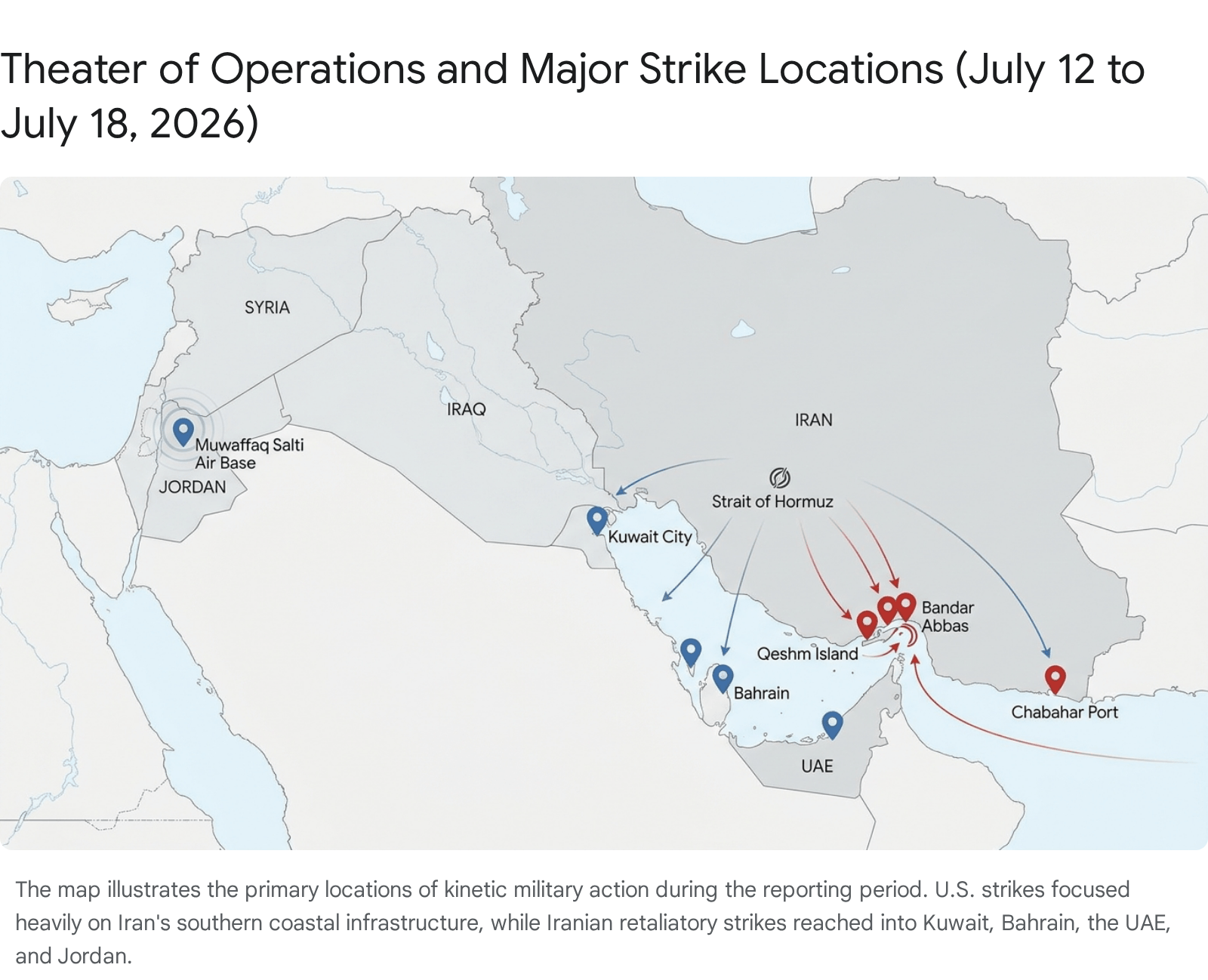
Iran retaliated by activating its regional network of proxy forces and executing direct strikes against United States military installations and allied infrastructure in Kuwait, Bahrain, the United Arab Emirates, and Jordan3. The escalation reached a critical threshold on July 17 when an Iranian missile and drone attack on the Muwaffaq Salti Air Base in Jordan resulted in the deaths of two United States service members and left a third missing in action10. By July 18, Iranian diplomatic officials formally announced the suspension of all commitments to the Islamabad agreement, effectively closing the diplomatic window2.
Domestically, the Iranian regime is facing an unprecedented convergence of systemic pressures that threaten internal stability. The nation’s electricity grid is operating at a severe deficit of 13,640 megawatts, a crisis exacerbated by targeted United States strikes on power generation and water desalination facilities12. The resulting blackouts have crippled industrial output, inflicting hundreds of trillions of tomans in economic losses and driving the national currency to historic lows14. Politically, the state apparatus is undergoing a highly opaque succession process. Following the death of Supreme Leader Ali Khamenei in February 2026, his son Mojtaba Khamenei assumed the role of Supreme Leader16. Operating almost entirely out of public view, Mojtaba Khamenei’s leadership indicates a decisive shift away from traditional clerical consensus toward a highly securitized governance model dominated by the Islamic Revolutionary Guard Corps17. Furthermore, satellite intelligence indicates that Iran is utilizing the geopolitical chaos to advance construction at deeply buried nuclear facilities, in violation of recent diplomatic understandings19.
2. Body of the Report
July 12 to July 13: The Fracture of the Ceasefire and Naval Blockade Reinstatement
The reporting period commenced with the definitive collapse of the Islamabad Memorandum of Understanding. This framework, signed at the Palace of Versailles on June 17, 2026, had temporarily paused the conflict initiated in February and sought to establish a 60-day window for broader negotiations1. The core dispute driving the resumption of hostilities centered on maritime access through the Strait of Hormuz. Despite commitments to allow unimpeded transit, Iranian naval and paramilitary forces began harassing commercial shipping, demanding adherence to regime-mandated routes in an effort to establish a toll-collection mechanism and reassert territorial dominance5.
The period opened in the immediate aftermath of Iranian forces firing upon three commercial vessels on July 6 and July 7, which had prompted the United States to declare the interim truce over5. By July 12 and July 13, the United States executed targeted aerial strikes against Iranian coastal defense systems, surface-to-air missile sites, and drone launch facilities located in southern provinces, specifically around Bandar Abbas, Jask, and Qeshm Island3. According to Hossein Amir Teymouri, the governor of Qeshm township, 10 to 11 projectiles struck military targets on the island, though he reported no initial casualties22.
On July 13, the United States administration submitted formal notification to the United States Congress that hostilities had officially resumed on July 7, initiating a new 60-day window under the War Powers Act for military engagement without explicit congressional authorization23. Furthermore, the United States announced the immediate reinstatement of the naval blockade against Iranian ports, effectively revoking the waivers that had briefly allowed Iran to export crude oil to global markets to stabilize energy prices7. While the United States briefly considered imposing a 20 percent security tariff on commercial shipping utilizing the strait, the administration opted instead to seek investment commitments from Gulf Arab states to subsidize security operations25.
Recognizing the economic strangulation posed by the reinstated naval blockade, the Iranian military command broadened its retaliatory parameters beyond the immediate waters of the strait. Early on July 14, Iran launched coordinated cruise missile and drone strikes against maritime assets and military installations hosted by United States allies in the Persian Gulf3. The United Arab Emirates Ministry of Defense reported that two of its national tankers, the Mombasa and the Al Bahiyah, were struck by Iranian cruise missiles while operating in Omani territorial waters3. The strikes caused significant structural fires on both vessels, resulting in the death of one Indian crew member and injuries to eight others of Indian and Ukrainian nationality3. The Islamic Revolutionary Guard Corps publicly claimed responsibility for the attack, asserting the vessels had ignored repeated warnings and entered a designated minefield3. Bahrain and Kuwait also activated their air defense networks to intercept incoming Iranian munitions during this initial wave of retaliation3.
The escalation was not limited to the immediate Gulf region. In Yemen, the Houthi rebel movement, an integral component of Iran’s regional proxy network, threatened to target critical Saudi Arabian oil infrastructure27. This threat followed a preemptive strike by the Royal Saudi Air Force against Sanaa International Airport, an operation designed to prevent an Iranian aircraft from returning a Houthi delegation that had attended the funeral of former Supreme Leader Ali Khamenei in Tehran27. The Houthi delegation was ultimately forced to land at an alternative, rebel-controlled airstrip, highlighting the interconnected nature of the Iranian alliance network and the willingness of regional actors to enforce airspace blockades29.
July 14 to July 15: Blockade Enforcement, Ground Force Casualties, and Factional Strife
The United States maintained its aerial campaign throughout July 14 and July 15, transitioning to daylight operations to signal a heightened operational tempo and demonstrate air superiority24. In a significant escalation of military pressure on Iranian ground forces, United States aircraft struck a barracks housing the 388th Mechanized Infantry Brigade in the Sistan and Baluchestan province24. Iranian state television confirmed that the bombardment involved at least 13 precision-guided munitions and resulted in the deaths of at least seven military personnel, including career soldiers and conscripts, while wounding an unspecified number of others24. The targeting of a mechanized infantry unit indicates a strategic objective to degrade conventional Iranian ground capabilities in addition to coastal and anti-aircraft defenses.
Simultaneously, the United States actively enforced the reinstated naval blockade. In the Persian Gulf, United States aircraft disabled the Curacao-flagged oil tanker M/V Belma by firing a missile directly into its smokestack9. United States Central Command reported that the vessel, which was sailing toward Iran’s primary oil export terminal at Kharg Island, had ignored multiple radio warnings to alter its course24. This kinetic enforcement demonstrated a commitment to strictly interdicting any commercial vessels attempting to circumvent the embargo.
Amid the intensifying military violence, a parallel diplomatic channel yielded a singular result on July 15. Dena Karari, a dual United States-Iranian citizen and technology professional, was permitted to leave Iranian territory32. Karari had been subjected to a coercive exit ban since December 2024 and was interrogated repeatedly by the Ministry of Intelligence on allegations of espionage and collaboration with a hostile state, charges stemming from her involvement with a United States-registered charitable foundation32. Karari, who had recently suffered a heart attack while in custody, was released in what the United States characterized as a gesture of goodwill32. However, reflecting the deep internal divisions within the Iranian state, the judiciary-affiliated Mizan News Agency subsequently published statements denying that any exchange or release of a convicted spy had occurred36.
This contradictory messaging regarding Karari’s release was indicative of a broader factional war erupting within the Iranian political establishment. On July 14, a massive state ceremony held at Tehran’s Musalla, ostensibly organized to project unity and cement the hereditary succession of Mojtaba Khamenei, devolved into open factional hostility37. Hardline elements within the crowd chanted aggressive slogans directed at President Masoud Pezeshkian and Parliament Speaker Mohammad Bagher Ghalibaf, accusing them of compromise and weakness for their involvement in the June negotiations37.
President Pezeshkian publicly admonished the state broadcaster for exacerbating the rift between the civilian government and the military apparatus37. Ghalibaf was forced to issue a detailed public defense of his actions, arguing that tactical negotiation was a necessary component of national resistance37. Conversely, ultra-hardline clerics, including Guardian Council member Alireza Arafi, demanded a total termination of the nuclear memorandum and insisted the state must not yield to economic anxieties or the costs of war37. This internal rupture suggests that the civilian government possesses limited authority to de-escalate the conflict, with strategic policy increasingly dictated by ideological hardliners and the military command.
| Date (2026) | Location / Entity | Actor | Action Description |
| July 14 | Strait of Hormuz | Iran | Cruise missile strike on UAE tankers Mombasa and Al Bahiyah; 1 killed, 8 wounded. |
| July 15 | Sistan and Baluchestan | US | Airstrike on 388th Mechanized Infantry Brigade barracks; 7 soldiers killed. |
| July 15 | Persian Gulf | US | Missile strike disables M/V Belma tanker attempting to breach naval blockade. |
| July 15 | Tehran (Diplomatic) | Iran | Release of detained dual-citizen Dena Karari, despite judicial denials. |
| July 16 | Iranian Universities | Sarbedaran | Cyberattack disrupting 900 web portals across 12 institutions. |
Table 1: Key Military and Security Incidents (July 14 – July 16, 2026).
July 16: Targeting Critical Infrastructure and the Amplification of Civilian Vulnerabilities
By July 16, the conflict parameters shifted from targeting purely military installations to the systematic degradation of critical civilian and dual-use infrastructure. United States strikes targeted transportation arteries in the southern Hormozgan province, specifically hitting highway and railway bridges near the city of Bandar Khamir overnight into July 179. These strikes appeared strategically designed to sever the logistical supply lines connecting Iran’s central industrial regions to its primary maritime facility at Bandar Abbas9. Furthermore, a maritime surveillance tower at the Chabahar port on the Gulf of Oman was destroyed9. While Iran claimed the tower oversaw commercial traffic, United States Central Command asserted it housed radar networks utilized by the Islamic Revolutionary Guard Corps to track and target vessels in the strait9.
Further compounding the regime’s internal vulnerabilities, a dissident organization identifying itself as “Sarbedaran” executed a massive cyberattack on July 1639. The group, which claims alignment with the exiled People’s Mojahedin Organization of Iran, targeted the administrative portals and online infrastructure of 12 prominent Iranian universities, disrupting over 900 individual web portals39. This operation highlighted critical weaknesses in Iranian domestic cybersecurity during a period of heightened national alert.
The most severe escalation in this infrastructure campaign involved the targeting of water and power resources in an extremely arid region. United States munitions struck the Bonji desalination plant and associated power generation facilities in southern Iran40. According to Abdolhamid Hamzehpour, head of the Hormozgan Province water and wastewater company, the facility’s raw water intake station and electrical transformers were completely destroyed42. State-run media reported that this strike immediately severed drinking water supplies to approximately 20 villages and 10,000 residents40. Another desalination plant on the strategic Qeshm Island also sustained damage during the bombardment40.
Iran adopted a symmetrical strategy, launching retaliatory strikes against the energy sector of United States allies. Following an initial attack on July 16, Iranian forces conducted a second, more severe strike on July 18 targeting a vital water desalination plant and an adjacent oil facility in Kuwait12. The Kuwait Petroleum Corporation reported injuries and significant material damage at the oil site, while the Kuwait Fire Force battled blazes at the desalination plant that forced multiple power generation units offline12. Prompted by these consecutive attacks, the Kuwaiti Ministry of Electricity activated emergency protocols and urged citizens to strictly conserve power during peak daylight hours42. The mutual targeting of water infrastructure marks a severe escalation in the humanitarian cost of the conflict.
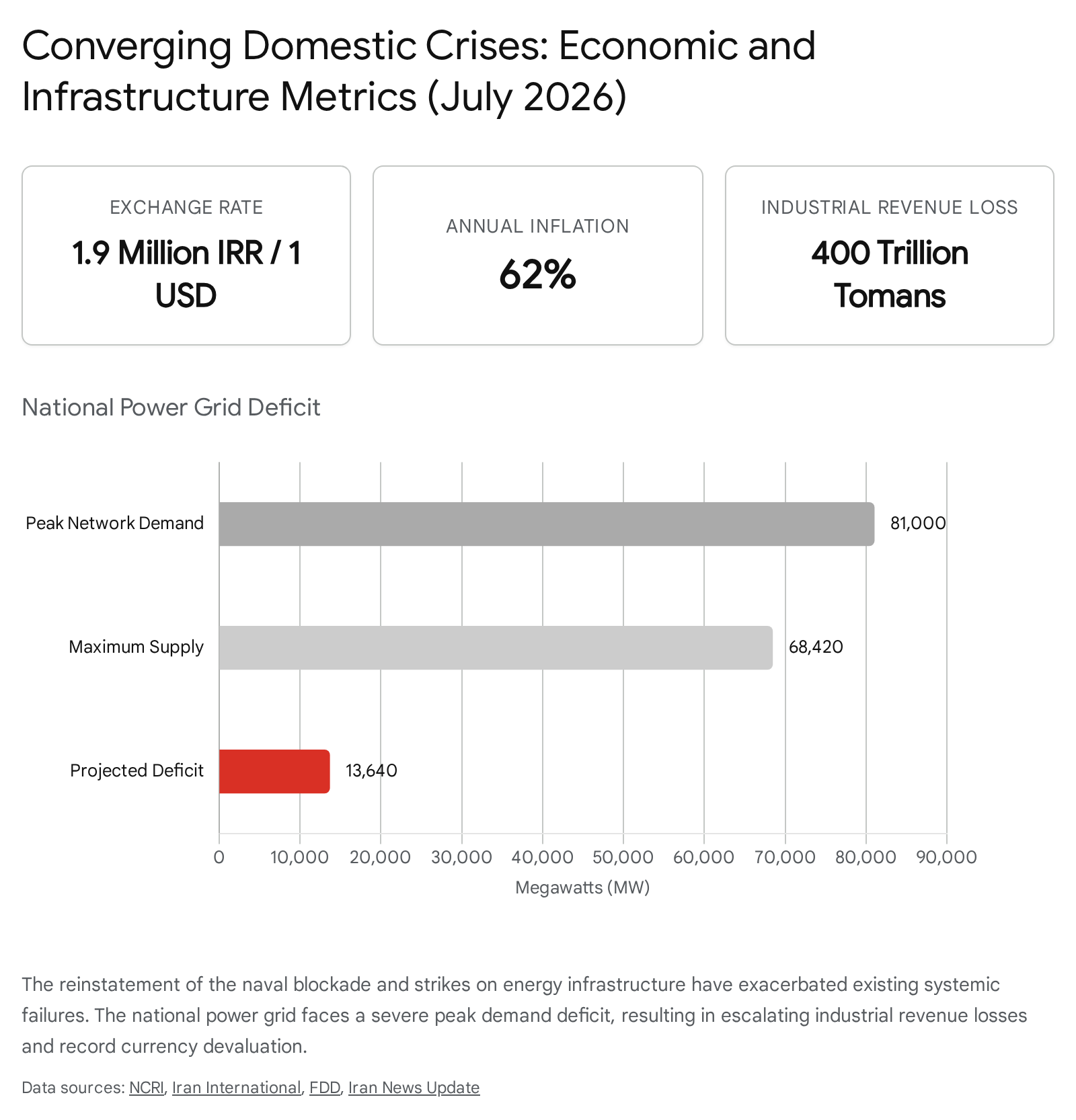
The strikes on electrical infrastructure critically exacerbated a pre-existing domestic energy crisis within Iran. Entering the peak summer months, the national power grid faced a structural deficit of 13,640 megawatts, measured against a projected peak demand of 81,000 megawatts13. The Parliamentary Research Center had previously indicated that wartime damage incurred earlier in the year had removed 4,800 megawatts of self-supplied industrial power from the grid13. Consequently, the Ministry of Industry, Mine and Trade reported that mandatory power rationing had cost the industrial sector nearly 400 trillion tomans in lost revenue during the 2025-2026 fiscal cycle15. Steel, cement, and petrochemical facilities were subjected to rolling blackouts of up to two days a week, fundamentally disrupting continuous manufacturing processes15.
The anticipation of a prolonged conflict and the reality of a reinstated naval blockade caused catastrophic damage to the Iranian economy. By July 17, the unofficial exchange rate for the United States dollar surged past 1.9 million Iranian rials14. This rapid currency devaluation accelerated domestic inflation, which reached 62 percent annually, with food inflation exceeding 134 percent46. The labor market contracted severely, with an estimated one million jobs lost due to the conflict and 800,000 individuals exiting the labor force entirely46. An alleged internal government report indicated that public dissatisfaction was reaching critical levels, with over 90 percent of the populace desiring political change46.
| Economic Indicator | Metric / Value (July 2026) | Source Data Context |
| Unofficial Exchange Rate | > 1.9 Million IRR to 1 USD | Driven by renewed naval blockade |
| Annual Inflation Rate | 62.0% | Food inflation > 134% |
| Industrial Revenue Loss | 400 Trillion Tomans | Attributed to electricity rationing |
| National Power Deficit | 13,640 Megawatts | ~17% of total projected demand |
| Job Losses (Conflict-related) | 1,000,000 estimated | Broad contraction of labor market |
Table 2: Iranian Domestic Economic and Energy Indicators.
July 17: Fatalities in Jordan and the Expansion of the Theater of War
The conflict reached its most lethal point for United States personnel on July 17. Iranian ballistic missiles and unmanned aerial vehicles struck the Muwaffaq Salti Air Base near Azraq, Jordan10. This facility serves as a critical strategic hub for United States and coalition forces, housing dozens of fighter jets and facilitating air-to-air refueling operations for the broader regional campaign10. The attack resulted in the deaths of two United States service members, left a third missing in action, and necessitated the medical evacuation of four additional personnel to Jordanian hospitals for trauma care10.
The Islamic Revolutionary Guard Corps explicitly claimed responsibility for the strike, stating that long-range missiles successfully destroyed hangars, command centers, and aircraft parked on the apron48. While United States Central Command withheld the identities of the deceased pending next-of-kin notification, Secretary of Defense Pete Hegseth publicly addressed the incident, asserting that the fatalities would only stiffen the resolve of the military coalition10. The Jordanian Armed Forces reported intercepting multiple incoming projectiles during the barrage, though several munitions clearly breached the defensive perimeter48.
The fatal strike in Jordan catalyzed international alarm. United Nations Secretary-General António Guterres directed his spokesperson to express deep concern over the escalating violence, specifically condemning the mutual targeting of civilian infrastructure and reiterating that there was no military solution to the conflict over the Strait of Hormuz51.
Simultaneously, open-source intelligence analysis revealed that Iran had utilized the brief diplomatic window established by the June memorandum to advance its nuclear infrastructure. Surveillance imagery analyzed by nonproliferation experts indicated ongoing construction and tunneling activity at Pickaxe Mountain, a deeply buried facility located near the Natanz complex19. Analysts assess that Iran is actively hardening this site against deep-penetrating munitions to safeguard its most sensitive operations19.
According to baseline estimates published prior to the conflict, Iran possesses exactly 440.9 kilograms of uranium enriched to 60 percent purity, a material stockpile that could theoretically be further enriched to weapons-grade levels in a matter of weeks if appropriate centrifuge cascades are operational54. The continued construction at Pickaxe Mountain constitutes a direct violation of the status quo parameters outlined in the June ceasefire agreements, raising significant concerns that Iran intends to reconstitute its enrichment capabilities beyond the reach of international inspectors, who have been barred from accessing damaged sites since the war began53.
| Nuclear Metric / Facility | Status Estimate (July 2026) | Strategic Concern |
| Pickaxe Mountain Site | Active construction; tunneling | Deeply buried; potentially impervious to standard airstrikes. |
| 60% Enriched Uranium | 440.9 Kilograms | Capable of rapid breakout to weapons-grade material. |
| 20% Enriched Uranium | 184.1 Kilograms | Substantial stockpile requiring dilution under proposed deals. |
| IAEA Inspection Access | Severely Restricted | Inability to verify centrifuge inventory or material diversion. |
Table 3: Declared Nuclear Stockpiles and Intelligence Assessments.
July 18: Formal Suspension of Diplomatic Frameworks and the Posture of the New Supreme Leader
Following the United States fatalities in Jordan, Central Command initiated an eighth consecutive night of aerial bombardments across Iran on July 188. These strikes were explicitly designed to punish the Islamic Revolutionary Guard Corps, targeting coastal surveillance nodes, air defense radars, and underground weapons storage sites utilized by the paramilitary organization8. The persistent aerial campaign prompted the Iranian Ministry of Health to report that over 50 individuals had been killed and 500 wounded across the country since the resumption of hostilities2.
In the immediate aftermath of the Jordanian base attack, the diplomatic facade was completely dismantled. Iranian Deputy Foreign Minister Kazem Gharibabadi appeared on state television to declare that Tehran had officially suspended all of its commitments under the Islamabad Memorandum of Understanding2. Gharibabadi asserted that the United States had violated the framework first by failing to lift sanctions and resuming airstrikes, leaving Iran with no obligation to comply with its terms and prioritizing national defense over negotiation2.
In response to the intensified United States campaign, the newly installed Supreme Leader, Mojtaba Khamenei, issued a rare written directive to the nation56. He warned that the United States would face “unforgettable lessons” from Iran and its allied Axis of Resistance, declaring that the actions of the United States proved the signature of its president was “worthless and invalid”56. He characterized the United States as the “Great Satan” and emphasized that totalitarianism and brutality were inseparable components of American doctrine58.
The format of this communication highlights a profound and structural shift in Iranian domestic politics. Since assuming the role of Supreme Leader following the death of his father, Ali Khamenei, in the initial February 2026 strikes, Mojtaba Khamenei has not appeared in public16. His reliance on written edicts has fueled intense speculation regarding his physical health, potential war injuries, and acute security paranoia regarding assassination60.
More significantly, his invisible leadership style signals a transition away from the charismatic, religiously grounded authority of his predecessors17. Intelligence analysts assess that Mojtaba Khamenei’s succession was engineered primarily by the Islamic Revolutionary Guard Corps to prioritize state survival over ideological purity17. The rapid elevation of the son effectively bypassed traditional clerical consensus mechanisms, transforming the Islamic Republic into a highly securitized, quasi-hereditary entity where civilian institutions are entirely subordinate to the military apparatus17. This consolidation of power ensures that the regime will prioritize internal discipline and military deterrence over domestic reform or international compromise.
3. Conclusion
Based on the factual developments observed between July 12 and July 18, 2026, the trajectory of the United States-Iran relationship has definitively reverted to unrestricted, regional kinetic conflict. The collapse of the Islamabad Memorandum of Understanding demonstrates that neither party currently possesses the political capital or strategic incentive to sustain a diplomatic framework. The crossing of critical operational thresholds, specifically the mutual targeting of vital civilian infrastructure and the infliction of direct military fatalities at forward operating bases in Jordan, ensures that retaliatory escalation will continue in the near term.
For the Iranian regime, the strategic imperative relies on imposing unacceptable economic and security costs on regional United States allies and global energy markets through the disruption of the Strait of Hormuz. However, this strategy is inherently perilous given Iran’s profound domestic vulnerabilities. The targeted degradation of the Iranian power grid, combined with the catastrophic devaluation of the rial and unprecedented industrial revenue losses, threatens to catalyze widespread social unrest.
The regime’s increasing reliance on the Islamic Revolutionary Guard Corps to enforce internal order, operating under the opaque and highly securitized leadership of Mojtaba Khamenei, indicates that Tehran views its current situation through an existential lens. Consequently, the regime is likely to tolerate extreme domestic hardship to maintain its strategic posture, making further asymmetric military responses and a rapid acceleration of its concealed nuclear infrastructure highly probable in the coming weeks.
4. Appendix: Methodology and Data Sources
The synthesis of this report relied on a comprehensive, multi-source intelligence gathering methodology designed to capture a holistic view of the conflict. Open-source data, international media reports, official state broadcasts, and military press releases spanning the dates of July 12 to July 18, 2026, were systematically collected and cross-referenced to establish a verified chronological timeline of events.
Conflicting claims regarding battle damage, operational success, and diplomatic intent were analyzed for consistency. For example, claims made by the Islamic Revolutionary Guard Corps regarding the destruction of United States aviation assets in Jordan were weighed against official statements from United States Central Command and regional host nations to determine the factual baseline. Economic data, including currency valuations, inflation metrics, and industrial revenue losses, were sourced from published Iranian parliamentary research documents, domestic labor reports, and financial market tracking. Nuclear intelligence was derived from nonproliferation watchdog analyses of commercial satellite imagery and baseline estimates provided by the International Atomic Energy Agency.
Structured List of Data Sources
- Al Jazeera: US hits Iran for 8th consecutive night
- Al-Monitor: Trump sends Congress formal notice that Iran conflict has resumed
- Arms Control Association: Assessing the Islamabad MOU and the U.S.-Iran Nuclear Negotiations
- Associated Press: Iran’s supreme leader warns of ‘unforgettable lessons’
- Associated Press: US airstrikes hit northern Iran as it disables ship trying to run blockade
- Associated Press: US expands attacks on Iran
- CBS News: Trump touts Iran agreement to wrap up G7 summit in France
- CBS News: Trapped U.S. citizen departs Iran
- Foundation for Defense of Democracies: Iran Continues Work at Key Nuclear Site
- Foundation for Defense of Democracies: Washington Should Prepare for a Summer of Unrest in Iran
- Gulf International Forum: Mojtaba Khamenei’s Iran and the Politics of Succession
- Iran International: Power cuts for Iranian industries rise to two days a week
- Iran International: War damage adds new strain to Iran’s blackout-prone power grid
- Iran News Update: Iran’s Power Crisis Costs Industry Billions
- Lawfare: Reconstructing Iran’s Nuclear Baseline
- National Council of Resistance of Iran: Factional Warfare in Iran over US Talks
- National Council of Resistance of Iran: Iran News in Brief – July 18, 2026
- PBS NewsHour: Iran says it is suspending commitments to interim deal with U.S.
- The Aviationist: Two U.S. Service Members Killed, One Missing in Iranian Attack on Jordanian Base
- The Guardian: Why is Trump risking midterm disaster by resuming the unpopular Iran war?
- The Times of Israel: Mojtaba Khamenei’s absence signals shifting role for Iranian leader
- The Washington Post: Iran releases US citizen in goodwill gesture
Please share the link on Facebook, Forums, with colleagues, etc. Your support is much appreciated and if you have any feedback, please email us in**@*********ps.com. If you’d like to request a report or order a reprint, please click here for the corresponding page to open in new tab.
Sources Used
- Islamabad Memorandum – Wikipedia, https://en.wikipedia.org/wiki/Islamabad_Memorandum
- Iran declares Islamabad agreement suspended, blames US violations, https://www.middleeasteye.net/news/iran-declares-islamabad-agreement-suspended-blames-us-violations
- US attacks Iran and Tehran retaliates across the Middle East as both vie for control of strait, https://apnews.com/article/iran-us-hormuz-strait-war-july-13-2026-6c2c44cfdd089d6393d18fa5930ed620
- 2026 Iran war – Wikipedia, https://en.wikipedia.org/wiki/2026_Iran_war
- 2026 Iran war | Deal, Explained, United States, Israel, Strait of Hormuz, Map, & Conflict, https://www.britannica.com/event/2026-Iran-war
- The US and Iran have blown past red lines as they lurch back toward all-out war, https://apnews.com/article/iran-us-war-escalation-shipping-strait-hormuz-179973cfe1fb3fa1b7ea7b816648ad9c
- The U.S. and Iran blow past red lines as they lurch back toward all-out war, https://www.wosu.org/npr-news/2026-07-18/the-u-s-and-iran-blow-past-red-lines-as-they-lurch-back-toward-all-out-war
- Two US service members killed, another missing after Iranian attack in Jordan: CENTCOM, https://www.foxnews.com/live-news/iran-war-trump-israel-hormuz-oil-july-18-2026
- US and Iran escalate strikes across Mideast, https://apnews.com/article/iran-us-hormuz-strait-war-july-17-2026-2ad0cfe592eb258cb15a9eb04411d58a
- Two Americans Killed, One Missing, as Iran Attacks US Base in Jordan, https://www.airandspaceforces.com/2-americans-killed-one-missing-as-iran-attacks-u-s-base-in-jordan/
- Iran says MoU suspended after ‘US violated its commitments’, https://www.aa.com.tr/en/us-israel-iran-war/iran-says-mou-suspended-after-us-violated-its-commitments/4002301
- U.S. military launches new airstrikes to punish Iran for deaths of US troops | PBS News, https://www.pbs.org/newshour/world/us-military-launches-new-airstrikes-to-punish-iran-for-deaths-of-us-troops
- War damage adds new strain to Iran’s blackout-prone power grid, https://www.iranintl.com/en/202606115946
- Iran News in Brief – July 19, 2026 – NCRI, https://www.ncr-iran.org/en/news/iran-news-in-brief-news/iran-news-in-brief-july-19-2026/
- Iran’s Power Crisis Costs Industry Billions as Blackouts Deepen Economic Decline, https://irannewsupdate.com/news/economy/irans-power-crisis-costs-industry-billions-as-blackouts-deepen-economic-decline/
- Who is Mojtaba Khamenei, Iran’s new supreme leader amid war? – Al Jazeera, https://www.aljazeera.com/features/2026/3/8/who-is-mojtaba-khamenei-a-contender-for-irans-leadership-amid-war
- Mojtaba Khamenei’s Iran and the Politics of Succession – Gulf International Forum, https://gulfif.org/mojtaba-khameneis-iran-and-the-politics-of-succession/
- The end of one-man rule? Iran tests life after Khamenei, https://www.iranintl.com/en/202607070775
- Iran Continues Work at Key Nuclear Site, Violating U.S.-Iran Agreement, https://www.fdd.org/analysis/2026/07/08/iran-continues-work-at-key-nuclear-site-violating-u-s-iran-agreement/
- The US-Iran Interim Deal: A Fragile Ceasefire – Arab Center Washington DC, https://arabcenterdc.org/resource/the-us-iran-interim-deal-a-fragile-ceasefire/
- US hits Iran with ‘powerful strikes’ after attacks on commercial ships in Strait of Hormuz, https://www.foxnews.com/live-news/us-iran-khamenei-funeral-july-7-2026
- West Asia war updates: Projectiles hit Iran’s Gulf island of Qeshm, state media says, https://www.thehindu.com/news/international/west-asia-war-iran-us-ceasefire-donald-trump-tehran-attacks-strait-of-hormuz-ships-live-updates-july-12-2026/article71212951.ece
- Trump sends Congress formal notice that Iran conflict has resumed – AL-MONITOR, https://www.al-monitor.com/originals/2026/07/trump-sends-congress-formal-notice-iran-conflict-has-resumed
- US airstrikes hit northern Iran as it disables ship trying to run the blockade, https://apnews.com/article/iran-us-hormuz-strait-war-july-15-2026-b7c592f269d822407dd6b5641602bf25
- US launches third night of strikes on Iran as Trump announces Hormuz blockade, https://www.theguardian.com/world/2026/jul/13/us-launches-third-night-of-strikes-on-iran-as-trump-announces-hormuz-blockade
- US reimposes its blockade on Iran after Tehran’s attacks on ships in the Strait of Hormuz, https://apnews.com/article/iran-us-hormuz-strait-war-july-14-2026-abd060c55feea216625689e57d8f76be
- Yemen’s Houthis fire missiles at Saudi Arabia, https://www.ft.com/content/cf774813-aed0-486d-be4e-c2c4174d8161?syn-25a6b1a6=1
- US launches seventh night of Iran strikes as Hormuz conflict escalates, https://www.theguardian.com/world/2026/jul/17/us-launches-seventh-night-of-iran-strikes-as-hormuz-conflict-escalates
- Riyadh Strikes Houthi-Controlled Airport To Block Flight From Iran, https://www.fdd.org/analysis/2026/07/15/riyadh-strikes-houthi-controlled-airport-to-block-flight-from-iran/
- U.S. expands attacks on Iran, which calls Strait of Hormuz a ‘red line’ as it strikes back, https://www.pbs.org/newshour/amp/world/u-s-expands-attacks-on-iran-which-calls-strait-of-hormuz-a-red-line-as-it-strikes-back
- US expands strikes into northern Iran and disables ship trying to run blockade, https://www.opb.org/article/2026/07/16/us-expands-strikes-into-northern-iran-and-disables-ship-trying-to-run-blockade/
- U.S. citizen departs Iran after being barred from leaving for over a year, https://www.cbsnews.com/news/trapped-u-s-citizen-departs-iran/
- American Freed From Iran Identified As Dena Karari, Suffered Heart Attack In Custody, https://jp.ibtimes.com/american-freed-iran-identified-dena-karari-suffered-heart-attack-custody-102733
- Iran releases U.S. citizen in goodwill gesture, Trump says, https://www.washingtonpost.com/world/2026/07/16/iran-releases-us-citizen-goodwill-gesture-trump-says/
- Who is Dena Karari? Why was the Iranian-American tech professional detained by Iran, https://m.economictimes.com/news/international/global-trends/who-is-dena-karari-why-was-the-iranian-american-tech-professional-detained-by-iran/articleshow/132431126.cms
- Iranian Judiciary Denies Releasing Dena Karari After Trump’s Praise, https://hostageaid.org/iranian-judiciary-denies-releasing-dena-karari-after-trumps-praise/
- Factional Warfare in Iran Over US Talks, Succession Mutiny, and Currency Collapse, https://www.ncr-iran.org/en/news/factional-warfare-in-iran-over-us-talks-succession-mutiny-and-currency-collapse/
- US hits more bridges in Iran in an expansion of its airstrike campaign, https://apnews.com/article/iran-us-hormuz-strait-war-july-16-2026-f98ff56554de2336f0e85bb5fdcae769
- Iran News in Brief – July 18, 2026 – NCRI, https://www.ncr-iran.org/en/news/iran-news-in-brief-news/iran-news-in-brief-july-18-2026/
- US hits Iran for 8th consecutive night; Tehran returns fire on Gulf bases – Al Jazeera, https://www.aljazeera.com/news/2026/7/19/us-launches-eighth-consecutive-night-of-attacks-on-iran
- Iran says it is suspending commitments to interim deal with U.S. as they exchange attacks, https://www.pbs.org/newshour/amp/world/iran-says-it-is-suspending-commitments-to-interim-deal-with-u-s-as-they-exchange-attacks
- Iran says attack on desalination plant cuts drinking water to 20 villages, https://www.iranintl.com/en/202607188862
- US military says 2 troops are dead and 1 is missing after Iran attacks a base in Jordan, https://www.denvergazette.com/2026/07/18/us-military-says-2-troops-are-dead-and-1-is-missing-after-iran-attacks-a-base-in-jordan/
- Heat, war and Trump’s threats push Iran toward an electricity crisis, https://www.calcalistech.com/ctechnews/article/iqj8149jk
- Power cuts for Iranian industries rise to two days a week | Iran International, https://www.iranintl.com/en/202607122571
- Washington Should Prepare for a Summer of Unrest in Iran, https://www.fdd.org/analysis/2026/07/17/washington-should-prepare-for-a-summer-of-unrest-in-iran/
- 2 US Service Members Killed, 1 Missing In Jordan As Iran Steps Up Attacks, Threats, https://www.rferl.org/a/centcom-soldiers-killed-jordan-iran-missile-attack/33806519.html
- 2026 Iranian strikes on Jordan – Wikipedia, https://en.wikipedia.org/wiki/2026_Iranian_strikes_on_Jordan
- Third Strike on Prince Sultan, Still No HQ-9 Intercept – House of Saud, https://houseofsaud.com/third-strike-prince-sultan-hq9-no-intercept/
- 2 US troops killed as Iran strikes Jordan, Kuwait and Bahrain. What happened?, https://indianexpress.com/article/world/us-iran-war-live-updates-troops-killed-jordan-gulf-strikes-10793063/
- US-Iran war: UN chief calls for new diplomatic push following attacks on civilian areas, https://news.un.org/en/story/2026/07/1167973
- Reconstructing Iran’s Nuclear Baseline, https://www.lawfaremedia.org/article/reconstructing-iran-s-nuclear-baseline
- Enriched uranium, the latent threat at the center of the dispute between the US and Iran, https://english.elpais.com/international/2026-07-15/enriched-uranium-the-latent-threat-at-the-center-of-the-dispute-between-the-us-and-iran.html
- Nuclear Power in Iran, https://world-nuclear.org/information-library/country-profiles/countries-g-n/iran
- Iran threatens unforgettable lessons, as two US troops killed – A News, https://www.anews.com.tr/world/2026/07/18/iran-threatens-unforgettable-lessons-as-two-us-troops-killed/amp
- Iran Supreme Leader’s message to US: Mojtaba Khamenei calls Trump’s signature worthless, issues new warning, https://timesofindia.indiatimes.com/world/middle-east/iran-supreme-leaders-message-to-us-mojtaba-khamenei-calls-trumps-signature-worthless-issues-new-warning/articleshow/132484102.cms
- Iran supreme leader warns of ‘unforgettable lessons’ if US attacks continue, https://www.aljazeera.com/amp/news/2026/7/18/iran-supreme-leader-warns-of-unforgettable-lessons-if-us-attacks-continue
- “Great Satan”: Khamenei calls Trump’s signature “worthless”, warns of “unforgettable lessons” if US strikes continue, https://www.aninews.in/news/world/middle-east/great-satan-khamenei-calls-trumps-signature-worthless-warns-of-unforgettable-lessons-if-us-strikes-continue20260719005534
- Warmongering US to Be Given Unforgettable Lessons: Ayatollah Khamenei – Politics news, https://www.tasnimnews.ir/en/news/2026/07/18/3650492/warmongering-us-to-be-given-unforgettable-lessons-ayatollah-khamenei
- Mojtaba Khamenei’s absence signals shifting role for Iranian leader – The Times of Israel, https://www.timesofisrael.com/mojtaba-khameneis-absence-signals-shifting-role-for-iranian-leader/