
1. Executive Summary
The seven-day monitoring period from July 12 to July 18, 2026, was defined by changes to global security architectures, disruptions to international maritime trade, and internal political crises within allied and adversarial states. The most significant development was the collapse of the preliminary ceasefire between the United States and the Islamic Republic of Iran. This rupture triggered a resumption of active military hostilities centered on the Strait of Hormuz. The United States launched multi-wave airstrikes against Iranian military installations, coastal defense networks, and civilian infrastructure, simultaneously reimposing a naval blockade on Iranian ports. Iran countered with a coordinated campaign of asymmetric warfare, launching ballistic missile and drone strikes against U.S. military assets and allied host nations across the Middle East. This included the first direct Iranian strikes within Syrian territory and the strategic mobilization of Houthi proxy forces in Yemen to threaten the Red Sea.
Concurrently, the domestic political landscape of Ukraine experienced destabilization. Ukrainian President Volodymyr Zelensky ousted Defense Minister Mykhailo Fedorov, a technocrat credited with architecting Ukraine’s advanced drone warfare capabilities and anti-corruption initiatives. This dismissal, rooted in a doctrinal and personal conflict between Fedorov and Commander-in-Chief Oleksandr Syrskyi, sparked protests in Kyiv. The resulting political friction coincided with the resignation of the Ukrainian Prime Minister and left the administration working to project unity amid a war of attrition with the Russian Federation. In the maritime domain, the Russian Federation restricted shipping to Ukrainian ports, while Ukraine targeted Russian energy shipping in the Sea of Azov.
Secondary global developments introduced additional systemic variables. In the Indo-Pacific, the State of Japan initiated the creation of its first centralized intelligence agency since World War II and enacted revisions to its Imperial House Law, actions taken alongside a demographic decline. In the United States, domestic political and economic variables were prominent ahead of the November elections. The death of veteran Senator Lindsey Graham altered the legislative balance of power, while the Department of State proposed a financial bond requirement for legal immigrants. Furthermore, the structures of international law were challenged as the United States launched a diplomatic campaign to dismantle the International Criminal Court, following the suspension of its Chief Prosecutor, Karim Khan, by British legal authorities over allegations of misconduct.
2. Body of the Report
July 12, 2026: Ceasefire Collapse and Immediate Military Re-engagement
The preliminary peace agreement between the United States and Iran, initially signed in mid-June 2026 to end previous hostilities, formally collapsed on July 12, as reported by NPR1. The catalyst for this breakdown occurred on June 25, when an Iranian drone struck a cargo ship transiting an alternative, U.S.-protected route through the Strait of Hormuz2. Following escalating tensions, Iranian naval forces intercepted and disabled the M/V GFS Galaxy, a Cyprus-flagged container ship, as it navigated near the coast of Oman, according to The Washington Post3. Following this interception, the Islamic Revolutionary Guard Corps issued a formal declaration stating that the Strait of Hormuz was closed to all international maritime traffic until further notice, accusing the United States of interference in regional waterways3.
In response to the strait’s closure, U.S. President Donald Trump ordered a wave of retaliatory strikes. Operating under direct presidential authority, U.S. Central Command struck approximately 140 Iranian military sites2. A CENTCOM press release noted the targets included advanced air defense systems, coastal radar locations, ballistic missile launch sites, and small fast-attack boats utilized by the Revolutionary Guard5. For the first time in the duration of the conflict, the U.S. military deployed one-way attack sea drones alongside traditional fighter aircraft and cruise missiles to degrade Iranian maritime capabilities5. Iran retaliated by launching a coordinated barrage of ballistic missiles and aerial drones against U.S. military installations and allied host nations. Iranian strikes hit the Prince Hassan Air Base in Jordan, the al-Udeid Air Base in Qatar, the U.S. Navy’s 5th Fleet headquarters in Bahrain, and an offshore drilling platform affiliated with the Kuwait Oil Company2.
In concurrent global events, veteran U.S. Senator Lindsey Graham died from an aortic dissection at the age of 71, as confirmed by CBS News6. His death removed a central figure in U.S. foreign policy formulation. In Europe, allied nations supporting Ukraine convened in Paris to coordinate future military and financial aid packages2. Meanwhile, in the United Kingdom, Andy Burnham secured internal support to formally succeed Keir Starmer as the nation’s next Prime Minister, preparing to assume office during the parliamentary summer recess1.
The breakdown of the U.S.-Iran ceasefire placed political pressure on the Trump administration. Facing a competitive national election cycle in November, President Trump found his administration engaged in a Middle Eastern conflict he had previously campaigned against9. The physical closure of the Strait of Hormuz represented a challenge for U.S. strategic and economic interests3. The administration projected military strength to deter further Iranian actions while attempting to keep diplomatic channels open. President Trump paired the military strikes with public statements indicating a willingness to negotiate, although a Washington Post-Ipsos poll indicated that 29 percent of Americans approved of his handling of the Iranian conflict, with 61 percent disapproving of his overall performance10. Furthermore, the death of Senator Graham removed one of the Republican Party’s foreign policy hawks, changing congressional dynamics regarding national security funding, defense authorizations, and foreign military aid6.
The closure of the Strait of Hormuz, a maritime chokepoint that historically accommodates roughly one-fifth of the world’s traded crude oil and natural gas, triggered shocks across global energy markets1. The disruption of commercial shipping routes exacerbated inflationary pressures worldwide. Shipping conglomerates faced elevated insurance premiums, the physical threat of Iranian naval actions, and the logistics of rerouting global supply chains1. This economic fallout placed pressure on central banks globally, which were managing restrictive interest rates against core inflation3. Within Iran, the regime utilized the external conflict to justify internal security measures, suppressing domestic dissent and labor protests driven by economic conditions, according to the National Council of Resistance of Iran13.
July 13, 2026: Strategic Positioning and the Battle for Maritime Control
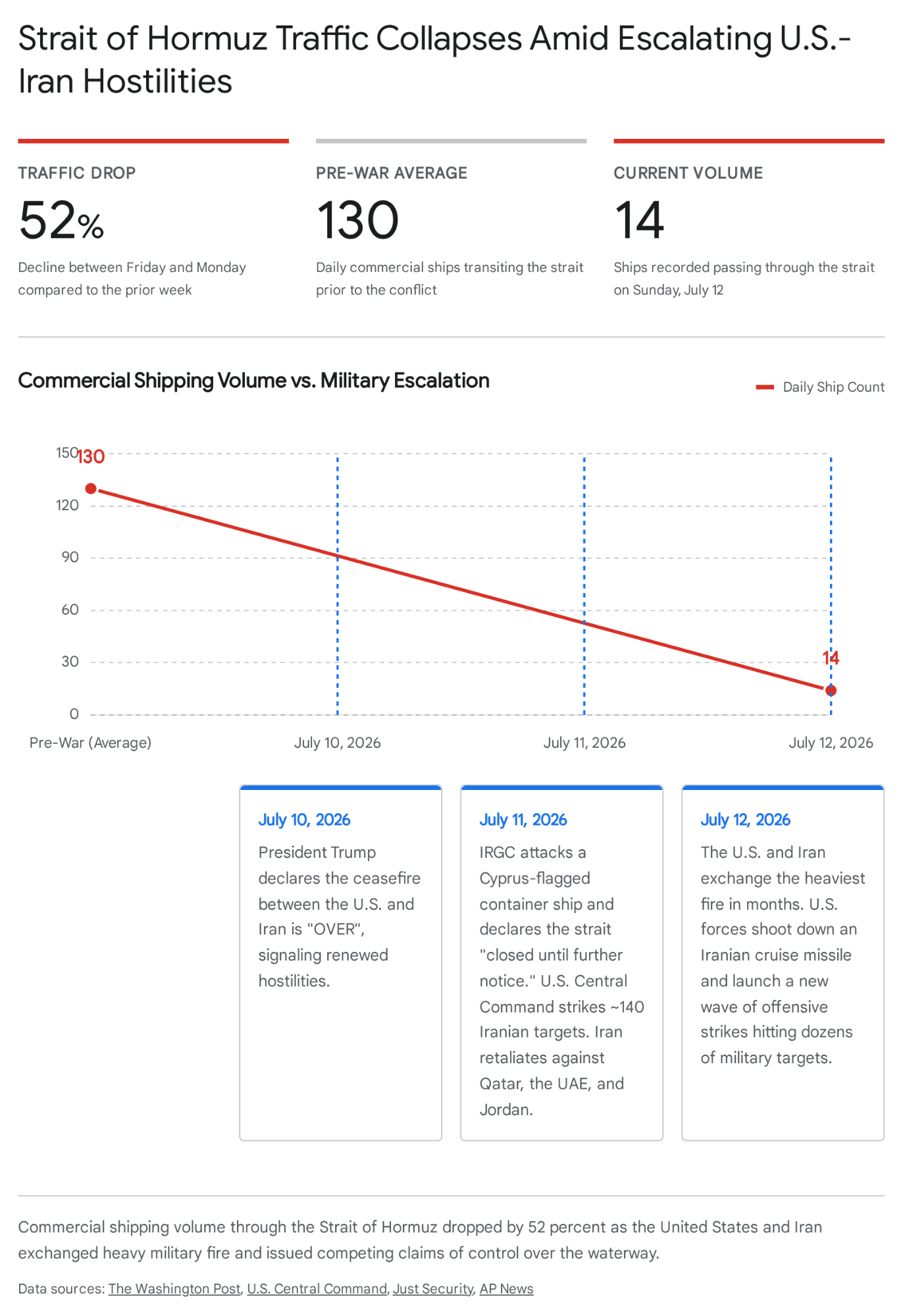
Following the bombardment of the previous night, both the United States and Iran issued competing declarations of control over the Strait of Hormuz8. The Trump administration issued a demand that Iran publicly acknowledge the strait’s openness and cease firing on commercial vessels, warning of escalatory consequences for non-compliance, according to Just Security4. In a shift in U.S. maritime policy, President Trump proposed charging financial tolls for international ships passing through the strait under U.S. naval protection. He argued that the United States should be reimbursed for providing security in the region, as reported by AP News14. This proposal caused concern among international shipping authorities and allied nations, as it challenged the United Nations Convention on the Law of the Sea and norms regarding the freedom of navigation6. The volume of shipping traffic through the strait declined immediately, with crossings dropping by 52 percent compared to the same period in the previous week14.
In Eastern Europe, Ukrainian military forces expanded their asymmetric maritime warfare tactics against the Russian Federation. Ukraine’s General Staff reported that deep-strike aerial and naval drones successfully damaged 21 Russian tankers and logistical vessels in the Sea of Azov. In response to this vulnerability, Russian authorities restricted commercial shipping in the Sea of Azov, citing security concerns16. This restriction effectively halted a quarter of Russia’s grain exports.
The competing claims over the Strait of Hormuz highlighted a diplomatic and legal stalemate. Iranian officials argued that the preliminary ceasefire agreement signed in June implicitly granted them the sovereign right to manage maritime traffic and establish a formal Persian Gulf Strait Authority to vet all transiting crews and cargo6. The United States rejected this interpretation, asserting that the waterway must remain an open, toll-free international corridor. The proposal by President Trump to charge protection tolls faced backlash from Gulf Arab allies, who viewed the move as a violation of international norms15. In Washington, domestic political friction was evident during the confirmation hearing for Acting Attorney General Todd Blanche, where Democratic senators accused the Justice Department of political bias18. Furthermore, Senate Democrats defeated a motion to proceed with a $1.15 trillion annual defense authorization bill, citing the administration’s failure to secure congressional authorization for the resumed war with Iran.
The 52 percent drop in Hormuz traffic illustrated the application of asymmetric economic warfare by Iran. By utilizing drones and small attack boats to threaten commercial vessels, Tehran constrained global energy supplies and commanded international attention without requiring a conventional naval presence12.
Meanwhile, Ukraine’s targeting of Russian shipping in the Sea of Azov demonstrated Kyiv’s strategic intent to apply economic pressure against Moscow. By crippling Russian grain and oil exports, Ukraine sought to impose a financial cost on the Russian state that mirrored the economic destruction inflicted upon Ukrainian infrastructure.
July 14, 2026: The Resumption of Naval Blockades and Institutional Legal Battles
President Trump formally announced the reinstatement of a U.S. naval blockade on Iranian ports and coastal areas19. Abandoning his earlier proposal to charge operational tolls for commercial ships, Trump stated that regional leaders had instead agreed to a different arrangement, pledging to invest directly into the United States in exchange for continued U.S. naval protection and regional security guarantees17. The military conflict continued its escalation. The United Arab Emirates Defense Ministry reported that Iranian forces launched cruise missiles at two commercial tankers, the Mombasa and the Al Bahiyah, resulting in the death of one Indian national and injuries to eight other crew members15. In retaliation, U.S. forces carried out strikes targeting Iranian coastal defense systems, mechanical infantry brigades, and missile sites for over seven hours15.
In a diplomatic action amidst the fighting, Iranian authorities released Dena Karari, a 53-year-old U.S.-Iranian dual national and California technology professional, as detailed by IBTimes21. Karari had been trapped in Iran under an exit ban for 19 months after traveling to Shiraz to visit family22. She was repeatedly interrogated by the Ministry of Intelligence over her affiliation with the Children of Mehr Foundation, a U.S.-registered charity, and faced accusations of espionage22. Karari, who suffered a heart attack while under state custody in early July, was permitted to leave the country in what President Trump publicly characterized as a gesture of goodwill by Tehran21.
In the United Kingdom, the Bar Standards Board formally upheld the interim suspension of Karim Khan, the Chief Prosecutor of the International Criminal Court, over allegations of sexual misconduct involving a female aide, according to The Times of Israel25. Concurrently, U.S. Secretary of State Marco Rubio announced a campaign designed to dismantle the ICC26. Rubio outlined economic sanctions, asset freezes, and travel bans against court staff, their families, and any member states that cooperated with the institution26.
In East Asia, the Japanese government initiated the formal creation of its first centralized intelligence agency since the conclusion of World War II, partnering with the United States, Germany, and Australia to counter espionage and military threats from Russia, China, and North Korea. Internal government data released the same day revealed the depth of Japan’s demographic decline, confirming that a quarter of all Japanese municipalities had lost over 10 percent of their total populations between 2020 and 202528. In the United States, the Governor of New York signed an executive order establishing a moratorium on the development of new hyperscale data centers, citing the energy consumption associated with artificial intelligence infrastructure, according to WXXI News29.
The reinstatement of the naval blockade required a reallocation of U.S. military resources, relying on at least 19 warships, two aircraft carriers, and an amphibious assault ship stationed in the Arabian Sea. The direct Iranian attack on civilian tankers placed political pressure on the UAE and other Gulf states to respond militarily, raising the possibility of a region-wide conflict7. The unexpected release of Dena Karari provided the Trump administration with a domestic political development, demonstrating that backchannel diplomacy remained viable during active engagements21.
The U.S. campaign against the ICC represented a fracture in the international legal order. The Trump administration’s posture was driven by previous ICC arrest warrants issued for top Israeli officials, as well as ongoing investigations into U.S. military personnel operating in Afghanistan26. This approach placed European allies in a difficult diplomatic position, forcing the European Union to publicly condemn the U.S. threats and pledge alternative financial and legal mechanisms to ensure the court’s continued operation.
The physical blockade of Iranian ports and the continued targeting of commercial shipping sent shockwaves through global energy and logistics markets12. The U.S. domestic landscape saw emerging economic and immigration policies as the Department of State reviewed a proposal to require certain green card applicants to post a financial bond of up to $100,000 before receiving an immigrant visa, as highlighted by The Economic Times31. This policy aimed to ensure new immigrants would be self-sufficient and not become dependent on public assistance programs.
To illustrate the financial adjustments this proposed policy would place on prospective immigrants, the following table compares the current standard costs associated with family and employment-based immigration against the proposed bond structure:
| Immigration Expense Category | Current Standard Amount (USD) | Refundable Status | Proposed Policy Impact (USD) |
| Family-Based Immigrant Visa Application | $325 | Non-Refundable | No Change to Base Fee |
| Employment-Based Immigrant Visa Application | $345 | Non-Refundable | No Change to Base Fee |
| Affidavit of Support Review Surcharge | $120 | Non-Refundable | No Change to Base Fee |
| Proposed Green Card Surety Bond | N/A | N/A | Up to $100,000 (Refundable upon Naturalization) |
This proposal sparked criticism from legal advocacy groups, who argued it created a wealth-based barrier to lawful immigration, impacting family reunification pipelines and skilled workers from developing nations such as India32. In Japan, the demographic decline highlighted socio-economic challenges, threatening the sustainability of local municipal governance and driving the nation toward an increased reliance on artificial intelligence and advanced robotics to supplement a shrinking workforce28.
July 15, 2026: Infrastructure Targeting and the Rupture of Ukrainian Command
The U.S. military shifted its targeting doctrine in Iran, initiating daylight strikes and focusing on civilian and dual-use infrastructure. U.S. aerial forces struck bridges and highway networks in Iran’s southern Hormozgan province, specifically targeting the transportation corridors connecting the port city of Bandar Abbas to the Iranian interior, as reported by AP News9. Furthermore, strikes collapsed a maritime surveillance tower at the Chabahar port on the Gulf of Oman11. U.S. aircraft also actively enforced the naval blockade by disabling the Curacao-flagged oil tanker Belma, firing a missile directly into the ship’s smokestack after it ignored multiple warnings while attempting to sail toward Kharg Island20. In response, Iranian authorities threatened to halt all energy exports from the entire Middle East, stating that oil and gas exports would be guaranteed for everyone or no one.
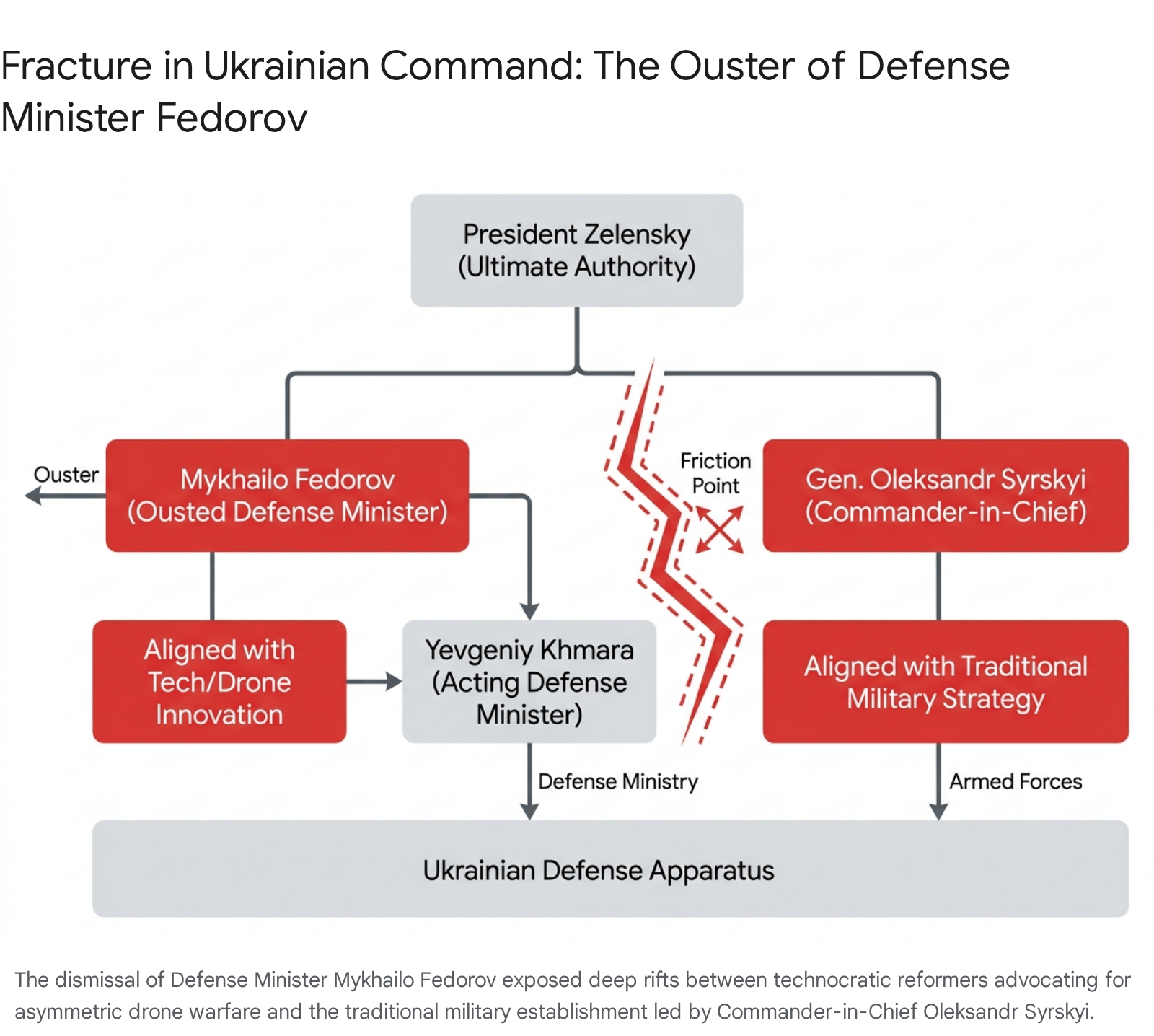
In Ukraine, a political and military crisis emerged. President Zelensky formally ousted Defense Minister Mykhailo Fedorov, a 35-year-old technocrat respected for advancing Ukraine’s drone warfare capabilities, modernizing military procurement, and integrating commercial satellite systems into the military framework, according to The Washington Post36. Fedorov was replaced by Yevgeniy Khmara, the head of the SBU security service, in an acting capacity38. Fedorov publicly attributed his sudden dismissal to a doctrinal conflict with Commander-in-Chief Oleksandr Syrskyi37. Fedorov accused the general of resisting technological modernization, relying on traditional strategies of mass attrition, and dividing the country’s leadership structure37.
The deliberate targeting of Iranian civilian infrastructure marked an escalation by the United States. By destroying bridges and internal logistics networks, the U.S. aimed to force Tehran into negotiations through domestic economic disruption9. However, this tactic carried political risks, as it increased civilian casualties and provoked Iran to threaten a regional energy embargo, which would impact the global economy9.
In Ukraine, the dismissal of Fedorov exposed fractures within the wartime leadership apparatus. Fedorov was regarded by Western allies and international donors for his anti-corruption efforts and his ability to secure defense technology from the private sector, as detailed by the Financial Times39. His ouster was viewed as a victory for the traditional military establishment led by Syrskyi, who favored orthodox, manpower-focused strategies over the asymmetric, technology-driven warfare championed by Fedorov36. This internal struggle placed President Zelensky in a precarious political position, forcing him to balance the tactical demands of his military commanders against the reform expectations of the civilian populace and international donors37.
The dismissal of Fedorov sparked social unrest across Ukraine. Thousands of protesters gathered in central Kyiv and other major cities, carrying placards demanding Fedorov’s reinstatement and the dismissal of General Syrskyi36. The protests highlighted societal exhaustion and frustration with military bureaucracy, casualty rates, and the pace of anti-corruption reforms within the defense sector36. The public reaction was fueled by the human cost of the conflict.
To contextualize the social pressures driving the Ukrainian populace to protest the military establishment, the following table summarizes the widely varying estimates of military casualties since the beginning of the war, illustrating the scale of human loss as compiled by Russia Matters:
| Reporting Entity | Publication Date | Estimated Ukrainian Military Casualties | Fatality Specifics |
| U.S. Presidential Estimate (Trump) | December 2024 | 400,000 killed or injured | N/A |
| Ukrainian Presidential Estimate (Zelenskyy) | April 2025 | 100,000 killed | N/A |
| Center for Strategic and International Studies (CSIS) | January 2026 | 500,000 to 600,000 total casualties | 100,000 to 140,000 fatalities |
| Netherlands Military Intelligence | April 2026 | 500,000 permanent losses | N/A |
| Center for Strategic and International Studies (CSIS) | July 2026 | 525,000 to 625,000 total casualties | N/A |
The data provided by various intelligence services underscores the societal impact that made Fedorov’s technological, casualty-mitigating approach to warfare popular among the civilian population42. In the United States, domestic economic policies were leveraged in the political arena as the House of Representatives advanced the FY27 National Security Appropriations bill, which reduced foreign assistance spending by 6 percent to align with the “America First” ideological agenda, according to Majority Leader releases43.
July 16, 2026: Institutional Restructuring and Legislative Shifts
The United States continued its aerial campaign against Iranian assets, launching further daylight strikes specifically targeting coastal defense systems and cruise missile storage facilities located on the strategically vital Greater Tunb Island45. In a televised primetime address to the nation, President Trump asserted that the United States was winning the military conflict. During the same address, he unexpectedly pivoted to accuse the People’s Republic of China of actively meddling in U.S. elections, signaling a broadening of geopolitical tensions beyond the Middle East, as reported by Kyodo News12.
In Ukraine, the political fallout from Fedorov’s dismissal escalated. Civilian protests in Kyiv swelled to approximately 10,000 people gathered outside the Ivan Franko National Academic Drama Theatre, according to the Kyiv Post48. The demonstrators expanded their demands, shifting from merely calling for Fedorov’s reinstatement to explicitly demanding the dismissal of General Syrskyi20. Amid this domestic unrest, the Ukrainian parliament formally accepted the resignation of Prime Minister Yulia Svyrydenko and approved Serhii Koretskyi, the former CEO of the state-owned energy company Naftogaz, as the new premier41.
In Japan, the Diet passed a series of legislative reforms during an active session. The parliament revised the 1947 Imperial House Law for the first time, permitting the adoption of males from former imperial branches to maintain the male-line succession, and allowing female members to retain their royal status after marrying commoners47. The Diet also enacted a law introducing criminal penalties for the desecration of the Japanese national flag.
The mass protests in Kyiv undermined President Zelensky’s political capital and domestic authority. The restructuring of the cabinet, including the appointment of a new Prime Minister, was an attempt to project institutional stability and refresh the administration’s public image ahead of the coming winter. However, the continued presence of 10,000 protesters demanding the removal of his top military general indicated a disconnect between the government and segments of the populace.
In Japan, the revision of the Imperial House Law reflected political anxieties regarding the long-term sustainability of the monarchy amidst a broader national demographic decline. The simultaneous passage of the flag desecration law highlighted a rising tide of conservative nationalism within the ruling political establishment, seeking to enforce domestic cohesion as regional security threats from China and North Korea continue to mount35.
The U.S. military strikes and the persistent Iranian blockade threats continued to paralyze the Strait of Hormuz. Commercial shippers resorted to disabling location tracking devices to avoid detection by Iranian forces, while major marine insurers refused to underwrite voyages through the active conflict zone, severing an artery of the global industrial economy12. In the United States, macroeconomic policy remained intertwined with national security objectives, as new legislation was proposed by allies of the late Senator Graham to impose tariffs of up to 100 percent on the top global buyers of Russian energy, aiming to curtail Moscow’s primary source of war funding.
July 17, 2026: Regional War Expansion and Strategic Reassessments
The Middle East conflict expanded in geographical scope as Iran launched its first direct, acknowledged military strike inside Syrian territory. Iranian state media reported that the Revolutionary Guard attacked a U.S. special operations command center located in al-Tanf, Syria, in retaliation for previous U.S. strikes that had killed Iranian soldiers, according to Just Security50. Concurrently, Iran directed its Houthi proxy forces in Yemen to prepare for the closure of the Bab el-Mandeb Strait and the Red Sea oil route, explicitly threatening to attack Saudi Arabian oil facilities and airports if Riyadh escalated its involvement in the conflict. The U.S. military maintained its operational tempo, striking railway junctions and civilian infrastructure in Iran for a sixth consecutive night12.
In Ukraine, the intensity and scale of the civilian protests led President Zelensky to reconsider his military command structure. Senior sources close to the administration indicated to Meduza that Zelensky was convening military commanders to evaluate potential replacements for General Syrskyi48. The administration’s goal was to find a successor who could ensure a transition of power without disrupting frontline defenses against Russian advances.
Iran’s decision to strike U.S. forces in Syria and mobilize the Houthis represented an escalation designed to demonstrate its capacity to project military power across multiple theaters simultaneously. By threatening the Red Sea, Tehran sought to multiply the economic pressures inflicted on the global market, thereby increasing international diplomatic pressure on the United States to halt its aerial campaign. The U.S. administration faced a strategic decision regarding whether to strike Iranian domestic power infrastructure directly, a move that could trigger the Houthi closure of the Red Sea and ignite a regional conflagration.
In Kyiv, President Zelensky’s willingness to entertain the dismissal of General Syrskyi highlighted the influence of domestic civil society in shaping wartime policy. The Ukrainian administration recognized that sustaining the war effort required public trust and morale. Syrskyi’s perceived inability to articulate a convincing theory of victory beyond attrition, coupled with public anger over Fedorov’s ouster, rendered his position as Commander-in-Chief increasingly scrutinized.
The dual threat to both the Strait of Hormuz and the Bab el-Mandeb Strait presented a significant risk to global maritime trade. The potential simultaneous closure of both waterways would force global shipping to reroute around the Cape of Good Hope, adding weeks to transit times and increasing global freight costs. Domestically, the Iranian regime faced mounting internal social pressures as citizens protested economic mismanagement and worsening living conditions, though the government suppressed these demonstrations under wartime security protocols.
July 18, 2026: Sustained Military Retaliation and Global Fallout
The U.S. military executed a new series of retaliatory airstrikes against Iranian targets on Saturday evening, as reported by NPR51. These strikes were ordered directly by President Trump in response to the deaths of two American service members who were killed during an Iranian attack in Jordan the previous day. The U.S. strikes were aimed at further degrading Iran’s ability to threaten commercial shipping in the Strait of Hormuz, indicating that the U.S. strategy remained focused on maritime deterrence. In South Asia, marking a milestone in commercial spaceflight amidst global tensions, Indian space-tech startup Skyroot Aerospace prepared to launch Vikram-1, the country’s first privately developed orbital rocket, reflecting the continued advancement of technology sectors insulated from the immediate Middle Eastern conflict52.
By the end of the seven-day monitoring period, the global geopolitical landscape had hardened into militarized fault lines. The United States and Iran were locked in a cycle of escalatory violence that neither side appeared willing or able to de-escalate without extracting public concessions. The domestic political pressures on the Trump administration to secure a visible victory before the November elections clashed directly with Iran’s imperative to maintain regional leverage through asymmetric maritime warfare.
Economically, the sustained, physical disruption of Middle Eastern energy routes and the restriction of Russian agricultural exports in the Sea of Azov strained global supply chains. Socially, governments worldwide faced domestic unrest. The Ukrainian populace demonstrated a demand for transparent, modernized governance by effectively forcing the potential removal of the military’s top commander. Similarly, the Japanese government’s legislative actions underscored a society grappling with the socio-economic impacts of rapid demographic decline, while the U.S. administration faced internal backlash over restrictive new immigration proposals.
3. Conclusion
Based on the factual developments of the past seven days, the immediate trajectory of global security points toward sustained, multi-theater instability and the continued degradation of international norms.
The U.S.-Iran conflict has crossed multiple thresholds, transitioning from isolated retaliatory strikes to the targeting of civilian infrastructure and the geographic expansion of the war into Syria and Yemen. Absent a diplomatic breakthrough, the conflict is likely to draw in regional allies, further degrading maritime security in both the Strait of Hormuz and the Red Sea. The compounding economic fallout from these disruptions will persist, maintaining upward pressure on global energy prices and exacerbating worldwide inflation.
In Ukraine, the political crisis precipitated by the ouster of Defense Minister Fedorov reveals a maturation of Ukrainian civil society, which is challenging traditional military administration. If President Zelensky proceeds with the dismissal of Commander-in-Chief Syrskyi, the Ukrainian military will face a challenging transition period during active combat operations. However, resolving the command fracture is essential for Kyiv to restore domestic unity, maintain troop morale, and retain the confidence of its international financial backers.
Globally, the foundational institutions of international law are eroding. The U.S. diplomatic campaign against the International Criminal Court, combined with the internal scandal surrounding its Chief Prosecutor, weakens the court’s moral authority and practical enforcement capabilities. As major powers prioritize unilateral economic coercion and military force over multilateral agreements, the international system is transitioning into a period defined by transactional alliances and zero-sum strategic competition.
4. Appendix: Methodology and Data Sources
Methodology This intelligence report was synthesized through a detailed review of open-source reporting, official government statements, and military press releases published between July 12 and July 18, 2026. The analytical framework prioritized the identification of primary factual events, followed by an assessment of the second- and third-order political, economic, and social pressures driving those events. Contradictory reports were cross-referenced to establish a verified chronological timeline, and causal relationships were evaluated to project near-term geopolitical trajectories.
Please share the link on Facebook, Forums, with colleagues, etc. Your support is much appreciated and if you have any feedback, please email us in**@*********ps.com. If you’d like to request a report or order a reprint, please click here for the corresponding page to open in new tab.
Sources Used
- Frank Kelly’s Geopolitical Week Ahead
- U.S. strikes Iran, Iran declares Strait of Hormuz closed
- The U.S. and Iran blow past red lines
- CENTCOM Completes Another Wave of Strikes Against Iran
- Iran attacks ships using a route bypassing its control
- US attacks Iran and Tehran retaliates across the Middle East
- Bridges and electrical infrastructure hit in Iran
- A quarter of Japan municipalities see population drop
- Face the Nation full transcript on Senator Graham’s passing
- Lindsey Graham dies at 71
- Early Edition: July 13, 2026 (Iran War, Japan Intelligence, Ukraine)
- Five things to know: U.S., Iran claim control of Strait
- Both Iran and the US say they control the Strait of Hormuz
- US airstrikes hit northern Iran as it disables ship
- US reimposes blockade on Iran
- House Republicans advance FY27 National Security Appropriations
- Responsibly Funding the America First Agenda
- Hochul draws cheers, jeers over statewide data center moratorium
- Trump says U.S. to resume blockade on Iran
- Russian restrictions in the Sea of Azov
- Russia-Ukraine War Report Card
- Immigration News Update: Green Card Bond Proposal
- Sen. Lindsey Graham tariffs on Russian oil buyers
- Attorney General Nominee Todd Blanche Hearing
- U.S. expands airstrikes to bridges in Iran
- Trump approval stuck in 30s
- Japan logs record cannabis cases, demographic issues
- Iran strikes U.S. base in Syria
- Iran domestic unrest and political uncertainty
- Japan revises Imperial House Law, enacts flag law
- Today’s News Headlines for School Assembly
- U.S. launches new airstrikes for troop deaths
- Dena Karari released from Iran
- Iran releases US citizen, goodwill gesture
- American freed from Iran identified as Dena Karari
- Dena Karari career and release context
- Zelensky fires Defense Minister Fedorov
- Zelensky ousts popular defense minister
- Ukraine military leadership row
- Fedorov removed over Syrskyi dispute
- Ukrainian protests over Fedorov ouster
- Bitter row splits Ukraine’s military leadership
- FT and Meduza: Zelensky weighs firing Syrskyi
- Kyiv protests grow demanding Syrskyi dismissal
- UK legal watchdog upholds ICC prosecutor’s suspension
- US threatens to dismantle ICC
- UK legal watchdog upholds suspension of ICC prosecutor Karim Khan
- State Department considers $100,000 green card bond
- Green Card Applicants Could Face $100,000 Bond
- US weighs $100,000 bond for green card applicants
Works cited
- The U.S. and Iran blow past red lines as they lurch back toward all-out war, https://www.iowapublicradio.org/news-from-npr/2026-07-18/the-u-s-and-iran-blow-past-red-lines-as-they-lurch-back-toward-all-out-war
- Frank Kelly’s Geopolitical Week Ahead | July 12, 2026 – DWS, https://www.dws.com/en-us/insights/the-world/geopolitics/frank-kelly-geopolitical-week-ahead-07122026/
- Iran launches attacks on Gulf states amid heaviest U.S. strikes in months, https://www.washingtonpost.com/world/2026/07/11/us-strikes-iran-it-declares-strait-hormuz-closed-fires-ship/
- Early Edition: July 13, 2026 – Just Security, https://www.justsecurity.org/146893/early-edition-july-13-2026/
- CENTCOM Completes Another Wave of Strikes Against Iran, https://www.centcom.mil/MEDIA/PUBLIC-RELEASES/Article/4541002/centcom-completes-another-wave-of-strikes-against-iran/
- Full transcript of “Face the Nation with Margaret Brennan,” July 12, 2026 – CBS News, https://www.cbsnews.com/news/face-the-nation-full-transcript-07-12-2026/
- Site Map – July 12, 2026 – The Washington Post, https://www.washingtonpost.com/sitemap/2026/7/12/
- Five Things to Know, July 13, 2026 | The American Legion, https://www.legion.org/information-center/news/security/2026/july/five-things-to-know-july-13-2026
- US and Iran escalate strikes across Mideast, https://apnews.com/article/iran-us-hormuz-strait-war-july-17-2026-2ad0cfe592eb258cb15a9eb04411d58a
- Trump approval stuck in the 30s amid pessimism on Iran and economy, poll finds, https://www.washingtonpost.com/politics/2026/07/16/trump-approval-stuck-30s-post-ipsos-poll-shows/
- The US and Iran have blown past red lines as they lurch back toward all-out war, https://apnews.com/article/iran-us-war-escalation-shipping-strait-hormuz-179973cfe1fb3fa1b7ea7b816648ad9c
- US hits more bridges in Iran in an expansion of its airstrike campaign, https://apnews.com/article/iran-us-hormuz-strait-war-july-16-2026-f98ff56554de2336f0e85bb5fdcae769
- Iran News in Brief – July 17, 2026 – NCRI, https://www.ncr-iran.org/en/news/iran-news-in-brief-news/iran-news-in-brief-july-17-2026/
- FACT FOCUS: A look at US and Iranian claims of control over the Strait of Hormuz, https://apnews.com/article/trump-iran-strait-of-hormuz-8df557699c900b29fb33172e6da7f3e9
- US attacks Iran and Tehran retaliates across the Middle East as both vie for control of strait, https://apnews.com/article/iran-us-hormuz-strait-war-july-13-2026-6c2c44cfdd089d6393d18fa5930ed620
- Early Edition: July 15, 2026 – Just Security, https://www.justsecurity.org/147315/early-edition-july-15-2026/
- US reimposes its blockade on Iran after Tehran’s attacks on ships in the Strait of Hormuz, https://apnews.com/article/iran-us-hormuz-strait-war-july-14-2026-abd060c55feea216625689e57d8f76be
- Thursday morning news: July 16, 2026 | WORLD – WNG.org, https://wng.org/podcasts/thursday-morning-news-july-16-2026-1784146049
- Kyodo News Digest: July 14, 2026, https://english.kyodonews.net/articles/-/79855
- US airstrikes hit northern Iran as it disables ship trying to run the blockade, https://apnews.com/article/iran-us-hormuz-strait-war-july-15-2026-b7c592f269d822407dd6b5641602bf25
- Iran releases U.S. citizen in goodwill gesture, Trump says, https://www.washingtonpost.com/world/2026/07/16/iran-releases-us-citizen-goodwill-gesture-trump-says/
- American Freed From Iran Identified As Dena Karari, Suffered Heart Attack In Custody, https://jp.ibtimes.com/american-freed-iran-identified-dena-karari-suffered-heart-attack-custody-102733
- Who is Dena Karari? Why was the Iranian-American tech professional detained by Iran, https://m.economictimes.com/news/international/global-trends/who-is-dena-karari-why-was-the-iranian-american-tech-professional-detained-by-iran/articleshow/132431126.cms
- U.S. citizen held in Iran since December 2024 departs country after Trump intervention, https://eciks.org/14059-45547-dena-karari-released-iran-detention
- UK legal watchdog upholds ICC prosecutor’s suspension, as decision on his firing looms, https://www.timesofisrael.com/uk-legal-watchdog-upholds-icc-prosecutors-suspension-as-decision-on-his-firing-looms/
- UK watchdog upholds ICC prosecutor Khan’s suspension as US threatens to ‘dismantle’ court, https://apnews.com/article/international-criminal-court-karim-khan-uk-suspension-655cae302400c4a5e5d18cb3d3650cd9
- UK legal watchdog upholds suspension of ICC prosecutor Karim Khan | king5.com, https://www.king5.com/article/syndication/associatedpress/uk-legal-watchdog-upholds-suspension-of-icc-prosecutor-karim-khan/616-96771b36-bb34-4af1-b7ae-49845590effe
- Kyodo News Digest: July 12, 2026, https://english.kyodonews.net/articles/-/79754
- Hochul draws cheers, jeers over statewide data center moratorium – WXXI News, https://www.wxxinews.org/new-york-public-news-network/2026-07-14/hochul-draws-cheers-jeers-over-statewide-data-center-moratorium
- ICC prosecutor Khan loses appeals on UK legal bar suspension – Israel & Jewish News, https://www.jns.org/news/world/icc-prosecutor-khan-loses-appeals-on-uk-legal-bar-suspension
- US: Immigration News Update – July 16, 2026, https://corporateimmigrationpartners.com/us-immigration-news-update-july-16-2026/
- July 17, 2026 – Weekly Immigration News Update – KRS – GreenCardMaker.com, https://www.greencardmaker.com/july-17-2026-weekly-immigration-news-update/
- Trump administration weighs $100,000 bond for some green card applicants, https://m.economictimes.com/nri/migrate/trump-administration-weighs-100000-bond-for-some-green-card-applicants/articleshow/132457009.cms
- US weighs $100,000 bond for some Green Card applicants abroad: What it means for Indians, https://timesofindia.indiatimes.com/world/us/us-weighs-100000-bond-for-some-green-card-applicants-abroad-what-it-means-for-indians/articleshow/132434169.cms
- Kyodo News Digest: July 16, 2026, https://english.kyodonews.net/articles/-/80022
- Ukrainians protest and Z-bloggers celebrate after Zelensky fires the defense minister who cut Russia off from Starlink and flooded the front with drones – Meduza, https://meduza.io/amp/en/feature/2026/07/17/ukrainians-protest-and-z-bloggers-celebrate-after-zelensky-fires-the-defense-minister-who-cut-russia-off-from-starlink-and-flooded-the-front-with-drones
- Zelensky ousts popular defense minister, an architect of Ukraine’s drone program, https://www.washingtonpost.com/world/2026/07/16/zelensky-ousts-popular-defense-minister-an-architect-ukraines-drone-program/
- Largest protests since 2022: Bitter row splits Ukraine’s military leadership after defence minister ousted, https://today.rtl.lu/news/world/bitter-row-splits-ukraines-military-leadership-after-defence-minister-ousted-607998741
- Volodymyr Zelenskyy sacks Ukraine’s popular defence minister, https://www.ft.com/content/c2b9d7ff-ac32-4cea-82b2-b4dc0a64c014?syn-25a6b1a6=1
- Bitter row splits Ukraine’s military leadership after defense minister ousted, https://courthousenews.com/bitter-row-splits-ukraines-military-leadership-after-defense-minister-ousted/
- Ukrainian’s Zelenskyy faces major backlash for ousting defense chief Mykhailo Fedorov amid progress vs. Russia – CBS News, https://www.cbsnews.com/news/ukrainian-protest-zelenskyy-oust-defense-chief-mykhailo-fedorov-russia-war/
- The Russia-Ukraine War Report Card, July 15, 2026, https://www.russiamatters.org/news/russia-ukraine-war-report-card/russia-ukraine-war-report-card-july-15-2026
- The Leader’s Floor Lookout: Week of July 13, 2026, https://www.majorityleader.gov/news/documentsingle.aspx?DocumentID=6005
- The Republican Recap: Week of July 13, 2026, https://www.majorityleader.gov/news/documentsingle.aspx?DocumentID=6012
- Today News Headlines for School Assembly, July 16, 2026: OpenAI enters hardware with Codex Micro, https://indianexpress.com/article/education/today-news-headlines-for-school-assembly-july-16-2026-us-launches-new-attacks-on-iran-england-face-argentina-in-wednesdays-fifa-world-cup-semifinal-messi-trump-10787954/
- School Assembly News Headlines Today, July 16, 2026: US attacks Iran, ICC revamps World Cup format, England face Argentina and more, https://m.economictimes.com/news/new-updates/school-assembly-news-headlines-today-july-16-2026-us-attacks-iran-icc-revamps-world-cup-format-england-face-argentina-and-more/articleshow/132417824.cms
- Kyodo News Digest: July 17, 2026, https://english.kyodonews.net/articles/-/80099
- FT and Meduza: Zelensky weighs firing top general Oleksandr Syrsky amid protests over ousted defense minister, https://meduza.io/en/news/2026/07/18/ft-and-meduza-zelensky-weighs-firing-top-general-oleksandr-syrsky-amid-protests-over-ousted-defense-minister
- Kyiv Protests Grow: Calls to Reinstate Fedorov and Oust Ukraine’s Commander-in-Chief, https://www.kyivpost.com/post/80610
- Early Edition: July 17, 2026, https://www.justsecurity.org/147767/early-edition-july-17-2026/
- U.S. launches new airstrikes to ‘punish’ Iran for troop deaths, https://www.tpr.org/news/2026-07-18/u-s-launches-new-airstrikes-to-punish-iran-for-troop-deaths
- Today News Headlines for School Assembly, July 17, 2026: India’s gets its first hydrogen train, NEET Re-exam result out, https://indianexpress.com/article/education/today-news-headlines-for-school-assembly-july-17-2026-skyroot-to-launch-vikram-1-indias-first-privately-developed-orbital-rocket-10789558/