1.0 Executive Summary
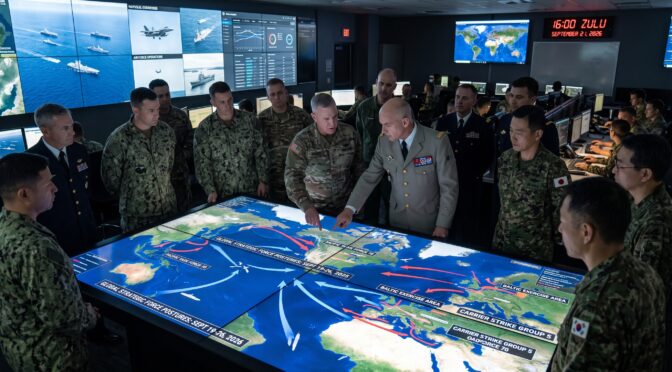
A review of global military exercises from the past week, ending September 26, 2026, shows that allied nations are quickly adopting autonomous drones, anti-drone defenses, and joint operations across multiple combat domains. Across the Indo-Pacific, Europe, and Central Asia, militaries focused on keeping troops supplied over long distances and improving how they coordinate command in challenging conditions. The modern battlefield requires forces to defend against cheap, unconventional air threats while maintaining the capability to launch precise, long-range artillery strikes.
The biggest shift in military thinking right now is moving anti-drone systems from side projects to a central part of everyday combat. This shift is necessary to defend against smart, independent drone swarms1. We saw this clearly in the joint India-United States Exercise Yudh Abhyas 2026 and NATO’s Exercise Namejs 20262. Both exercises tested how well ground troops could spot, track, and neutralize drone swarms using layered electronic jammers and physical weaponry alongside ongoing attacks3.
Defense partnerships are also focusing more on tech sharing and supply networks. For instance, Japan sent fighter jets to India for the first time during Exercise Veer Guardian 2026, coinciding with discussions to co-build naval stealth antennas5. Allied forces in Europe showed a similar emphasis on building strong logistical foundations. During Namejs 2026, Latvia tested how quickly it could call up civilian reserves and plug everyday public infrastructure into military supply chains3.
However, pushing for rapid upgrades and complex maneuvers comes with real risks. The tragic deaths of service members during Kazakhstan’s Khazar Korgany 2026 exercise highlight the hazards naval forces face when severe weather strikes without warning7. The subsequent criminal investigations and arrests of senior commanders show that peacetime safety checks and risk planning remain crucial weak spots that can undermine military readiness7. Overall, recent exercises show modern militaries urgently preparing for high-stakes conflicts against peer adversaries, placing heavy emphasis on electronic warfare, precision artillery, and resilient supply lines.
1.1 Summary Table of Key Exercises
| Exercise Name | Participating Nations and Forces | Location and Dates | Primary Objectives |
| Yudh Abhyas 2026 | United States (11th Airborne Div), India (14th Infantry Div, Garhwal Reg, 451 Army Aviation Sqn) | Auli and Mahajan Field Firing Range, India (September 15 to September 28, 2026) | High-altitude mountain warfare, counter-terrorism, mixed group operations, anti-drone defense, and long-range precision firing. |
| Namejs 2026 | Latvia (National Armed Forces), Canada, United States, Estonia, Lithuania (NATO Multinational Division North) | Nationwide across Latvia (September 2 to October 8, 2026) | Nationwide defense, calling up reserve forces, adding drone systems, and military-civilian supply teamwork. |
| Veer Guardian 2026 | India (Indian Air Force), Japan (Japan Air Self-Defense Force) | Air Force Station Jodhpur, Rajasthan, India (September 9 to September 22, 2026) | Air combat teamwork, testing supply lines for long-distance deployment, and sharing defense technology. |
| Nomadic Elephant 2026 | India (Indian Army), Mongolia (Mongolian Armed Forces) | Foreign Training Node, Pithoragarh, Uttarakhand, India (September 21 to October 3, 2026) | United Nations peacekeeping, anti-rebel operations, helicopter drops, and drone warfare in tough terrain. |
| Khazar Korgany 2026 | Kazakhstan (Naval Forces, Border Guard Service, Air Defense Forces) | Caspian Sea, Mangystau Region, Kazakhstan (September 22, 2026 to present) | Coastal combat readiness, sea mapping, and coastal defense teamwork. |
| Power of Unity 2026 | Azerbaijan, Türkiye, Uzbekistan | Khojavend, Nakhchivan, and Caspian Sea, Azerbaijan (September 22, 2026 to present) | Leadership training, fast decision-making, managing units, and teamwork among Turkic nations. |
| Tarang Shakti 2026 | India (Indian Air Force) and Multinational Air Forces | Air Force Station Jodhpur, Rajasthan, India (September 26 to October 12, 2026) | Planning large international air missions, keeping crowded airspace safe, and teamwork between allied air forces. |
| REPMUS and Dynamic Messenger 2026 | North Atlantic Treaty Organization (36 participating navies) | Tróia and Sesimbra, Portugal (August 31 to September 25, 2026) | Testing sea drones, hunting submarines, and linking battle networks. |
| CF-18 Readiness Training | Canada (Royal Canadian Air Force 4 Wing Cold Lake) | 19 Wing Comox, Vancouver Island, British Columbia, Canada (September 14 to September 21, 2026) | Practice air support missions, low-level flying skills, and North American airspace defense readiness. |
| Burebista 26 | Romania (Romanian Air Force) | Nationwide across Romania (September 14 to September 25, 2026) | Country-wide air defense, monitoring airspace, and teamwork in the air. |
2.0 Details: Global Military Exercises
The following sections break down the key military exercises active across the globe over the past week.
2.1 Exercise Yudh Abhyas 2026
Participating Forces, Geographic Focus, and Stated Objectives The 22nd iteration of Exercise Yudh Abhyas marks a major step forward in defense cooperation between the United States and India. Active from September 15 through September 28, 2026, the exercise involved roughly 1,200 troops, split evenly between both nations2. The U.S. contingent was led by the 1st Mobile Brigade Combat Team of the 11th Airborne Division under Colonel Ben Jackman2. Indian forces were commanded by Major General Amaresh Gunjan of the 14th Infantry Division, primarily featuring troops from the Garhwal Regiment alongside helicopter support from the 451 Army Aviation Squadron10. The core goal was to improve interoperability, streamline command structures, and practice combined operations across diverse environments2.
Tactical Maneuvers, Multi-Domain Integration, and Doctrinal Concepts For the first time, the exercise used a dual-location setup to test vastly different combat environments simultaneously13. Troops deployed to Auli in Uttarakhand—about 95 kilometers from the Chinese border—for high-altitude mountain warfare, cold-weather drills, and jungle operations12. Meanwhile, armor and artillery units headed to the Mahajan Field Firing Range in Rajasthan for desert warfare, zeroing in on long-range precision firing and rapid ground strikes8.
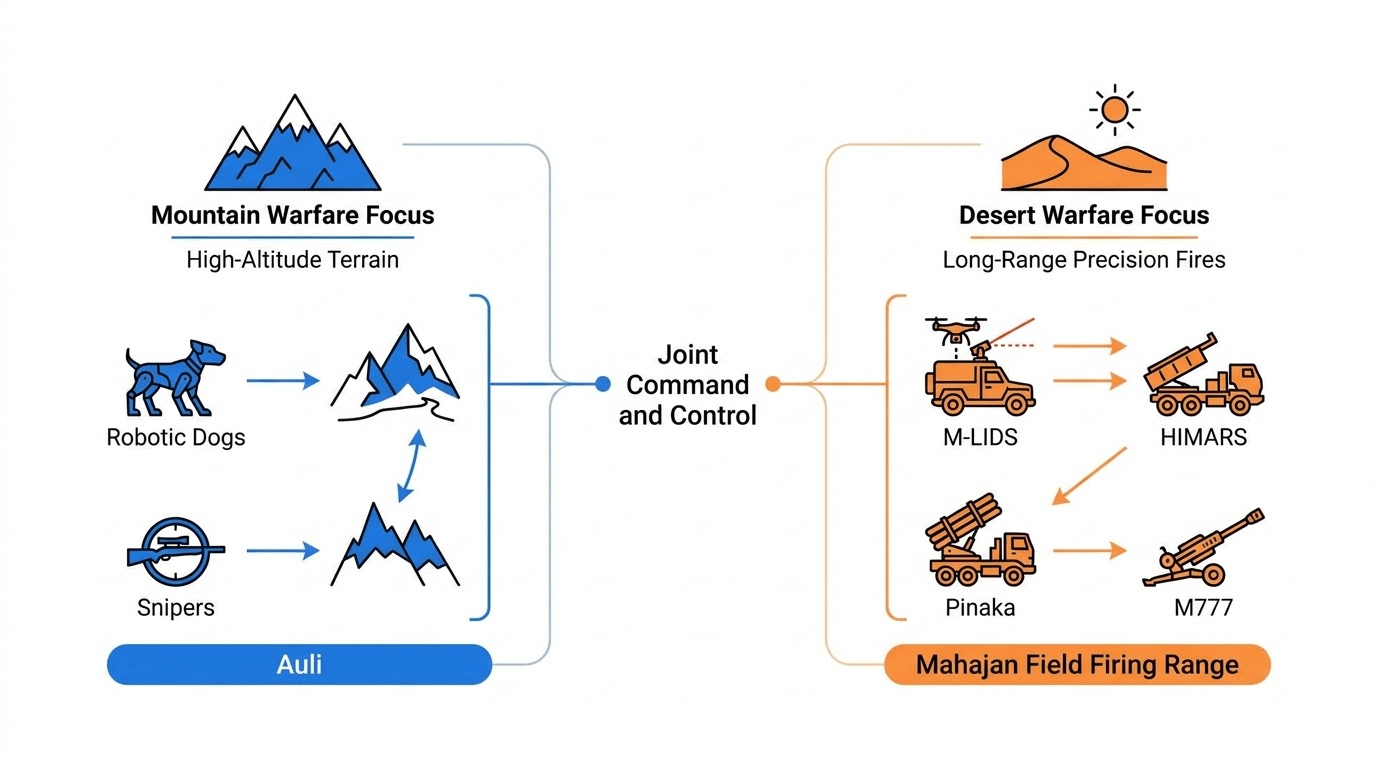
Both locations integrated modern tech and unmanned systems heavily. In Auli, joint teams ran room-clearing counter-terrorism drills. In one scenario, combined forces surrounded a simulated hideout, breached the entryway, and sent in a robotic dog to scout ahead before soldiers moved in to secure the building2. This highlighted how effectively specialized infantry and robotic assets can pair up in close quarters14. In addition, sniper teams engaged targets between 500 and 580 meters out11. U.S. soldiers trained on the Indian Army’s Sako TRG sniper rifle (.338 Lapua Magnum), noting its operational similarity to the U.S. Army Mark 2211. Spotter and shooter roles translated seamlessly between both forces thanks to shared targeting metrics11.
Out at the Mahajan Range, the focus turned to combined firepower. The U.S. brought the HIMARS rocket system, firing alongside India’s Pinaka launchers, Dhanush artillery, and M777 ultra-light howitzers13. The lightweight M777 proved its worth by being airlifted via heavy-lift helicopters, allowing commanders to drop artillery straight into rugged mountain zones where vehicles can’t go13. Spotters from both armies worked together to acquire targets, coordinate fire orders, and practice shoot-and-scoot drills to avoid counter-battery fire15.
A key highlight was the deployment of the U.S. Army’s M-LIDS counter-drone system4. Combining radar, optical sensors, electronic jammers, and a 30mm cannon, M-LIDS delivers a layered defense against drone swarms4. Indian and American crews trained side by side to detect, track, and destroy simulated aerial threats, integrating the system into a broader air-defense network with L70 guns and Stinger missiles4.
Lessons Learned and Intelligence Takeaways The main takeaway from Yudh Abhyas 2026 is that both armies can integrate operations smoothly and rapidly shift ground forces across extreme terrains2. Operating HIMARS and Pinaka side by side offered a clear contrast: while the U.S. platform emphasizes precise, modular strikes, India’s Pinaka was built for area saturation. However, recent tests of India’s 120km Guided Extended Range rockets show a clear move toward adding guided precision capabilities16.
| Artillery System | Origin | Primary Doctrinal Focus | Key Characteristics |
| High Mobility Artillery Rocket System | United States | Precision Deep Strike | Highly mobile, modular ammunition pods, carries six guided rockets or one tactical missile. |
| Pinaka Multi-Barrel Rocket Launcher | India | Wide Area Fire | High-volume area bombardment, currently developing extended-range guided munitions. |
| M777 Ultra-Light Howitzer | United States / United Kingdom | Agile Mountain Fire support | 155-millimeter caliber, lightweight titanium construction, transportable via heavy-lift helicopter. |
| Dhanush Howitzer | India | Conventional Artillery | 155-millimeter caliber, heavily upgraded indigenous design based on the Bofors architecture. |
Pairing counter-drone units directly with conventional air defense shows a shared recognition that defeating drones is now a baseline requirement for battlefield survival2. Seamless communication between spotters and gunners from both nations demonstrates solid tactical cohesion, laying the groundwork for even more advanced joint training down the line11.
2.2 Exercise Namejs 2026
Participating Forces, Geographic Focus, and Stated Objectives Running from September 2 to October 8, 2026, Exercise Namejs 2026 was a major national defense exercise held across Latvia3. The drill mobilized about 12,000 personnel, including the Latvian National Armed Forces, the National Guard, State Defense Service recruits, and reservists20. Organized alongside NATO Multinational Division North HQ, it featured allied forces from Canada, the U.S., Estonia, and Lithuania3. Canada played a leading role for the multinational framework in Latvia, embedding staff officers directly at HQ in Ādaži to assist with regional defense planning22. The primary objective was testing total-defense readiness, integration with allies, and force mobilization3.
Tactical Maneuvers, Multi-Domain Integration, and Doctrinal Concepts Namejs 2026 put Latvia’s evolving force structure to the test. A core element was evaluating the call-up speed of the National Guard’s 1st Riga Brigade and 2nd Vidzeme Brigade3. Commanders stress-tested recall systems, equipment staging, and rapid arming protocols before sending units into field scenarios3.
On the ground, maneuvers incorporated lessons from current European conflicts, particularly around heavy drone usage3. In eastern Latvia near the Russian and Belarusian borders, drone ops ran at a relentless pace3. This reflects modern tactical reality, where small UAVs serve as organic air support for squad-level elements25. At the same time, counter-drone teams practiced detecting and neutralizing hostile UAVs in cluttered civilian settings3.
For realistic opposing-force training, a 300-strong Danish battle group acted as the aggressor against Latvian units along the eastern border19. This required close coordination not just between militaries, but with local police to manage civilian traffic as armored columns moved through villages19. In parallel, Latvia continued fortifying its border defenses via the Vilkatis program and the broader Baltic Defense Line initiative24.
Lessons Learned and Intelligence Takeaways The exercise marks a clear shift in Eastern Flank defense strategy: moving away from mere deterrent presence to exercising full-scale wartime logistics, fast reserve mobilization, and unified multinational command20.
The extensive civil-military coordination in Namejs 2026 underscores Latvia’s total-defense strategy. Spearheaded by the Crisis Management Centre, government agencies, municipalities, and private firms tested telecom, power grids, transport networks, and supply chains under crisis conditions3. The focus on C-UAS drills is especially timely following recent airspace incursions, such as the September 14 downing of a suspected military drone in neighboring Lithuania27. The overarching takeaway is that Baltic defense plans now treat civilian infrastructure and military logistics as a single, resilient system capable of enduring kinetic and electronic threats3.
2.3 Exercise Veer Guardian 2026
Participating Forces, Geographic Focus, and Stated Objectives Wrapping up on September 22, 2026, the bilateral air exercise Veer Guardian 2026 took place at Air Force Station Jodhpur in Rajasthan, India5. This second iteration brought together the Indian Air Force and the Japan Air Self-Defense Force. India fielded Su-30MKI, Rafale, and indigenous Tejas fighters, while Japan deployed F-2A fighters29. The objectives were sharpening tactical air combat skills, improving operational alignment, and deepening strategic defense ties30.
Tactical Maneuvers, Multi-Domain Integration, and Doctrinal Concepts The major highlight of Veer Guardian 2026 was Japan deploying fighter jets to Indian territory for the first time5. Doing so required establishing a long-range supply chain across the Indo-Pacific, putting Japan’s expeditionary logistics and maintenance capacity to the test32. Over two weeks, aircrews carried out complex flight profiles focused on visual air combat maneuvering, large-force engagements, and airspace management in unfamiliar territory5.
Ground support crews also worked closely on mission planning, airframe maintenance, and aviation safety protocols30. Leadership engagement was prominent: JASDF Chief of Staff Gen. Takehiro Morita flew in a dual-seat Indian Tejas piloted by Group Capt. I Samrat, with Indian Air Chief Marshal AP Singh leading the formation flight28. Morita praised the indigenous fighter as a showcase of India’s growing aerospace capabilities31.
Lessons Learned and Intelligence Takeaways Deploying Japanese fighters to India highlights Japan’s evolving posture toward expeditionary readiness, building the capability to project air power far beyond its home waters5. The exercise offered a practical venue for harmonizing tactics, sharing operational procedures, and bridging differences between distinct command frameworks5.
Crucially, these maneuvers align with deeper technological defense ties. Recent bilateral talks advanced plans to co-produce Japan’s UNICORN stealth antenna system for the Indian Navy, tapping Bharat Electronics Limited alongside Japanese firms like Yokohama Rubber and NEC6. The UNICORN system integrates multiple antennas into a single stealthy housing, significantly reducing a vessel’s radar cross-section6. Combining technical collaboration, air tactics, and mutual logistics agreements reflects a growing strategic alignment between New Delhi and Tokyo aimed at maintaining sea-lane security across the Indo-Pacific32, 33.
2.4 Exercise Nomadic Elephant 2026
Participating Forces, Geographic Focus, and Stated Objectives The 18th edition of the India-Mongolia Joint Military Exercise, Nomadic Elephant 2026, launched on September 21, 2026, running through October 3, 202635. Held at the Foreign Training Node in Pithoragarh, Uttarakhand, the exercise features 45 personnel each from the Indian Army and the Mongolian Armed Forces34, 36. This annual platoon-level engagement focuses on enhancing joint capabilities for UN peacekeeping mandates and counter-insurgency operations35.
Tactical Maneuvers, Multi-Domain Integration, and Doctrinal Concepts Training is centered on semi-urban and mountainous terrain, reflecting likely operational environments36. Drills focused on small-arms handling, weapons familiarity, room clearing, and cordon-and-search tactics36.
Notably, the 2026 iteration incorporated modern asymmetric threats, with troops training on cybersecurity and C-UAS tactics for micro-drones in tactical settings36. Heliborne insertion and extraction drills were also featured to practice rapid deployment in rough terrain36.
Lessons Learned and Intelligence Takeaways Nomadic Elephant 2026 reflects an ongoing modernization of basic infantry and peacekeeping doctrines to counter emerging threats like reconnaissance drones and loitering munitions36. For Mongolia, training alongside Indian forces offers valuable exposure to counter-insurgency tactics honed in challenging operational environments36. For India, sustained military diplomacy helps solidify its footprint in Central Asia and demonstrates its commitment to regional stability and global peacekeeping initiatives36.
2.5 Exercise Khazar Korgany 2026
Participating Forces, Geographic Focus, and Stated Objectives Launched on September 22, 2026, Exercise Khazar Korgany 2026 mobilized over 500 personnel in Kazakhstan’s Caspian Sea sector, operating primarily from the Mangystau Region7. Forces included naval surface units, hydrographic vessels, Border Guard Service personnel, and Air Defense aircraft7. The objective was testing coastal defense readiness, maritime maneuvering, and inter-agency coordination in littoral waters7.
Tactical Maneuvers, Multi-Domain Integration, and Doctrinal Concepts The exercise was cut short when severe storm conditions hit on September 24, 20267. High winds and rough seas swept 19 servicemen into open waters, suddenly shifting the training event into a full-scale emergency rescue effort7.
Defense Minister Lt. Gen. Dauren Kosanov directed a massive multi-agency search and rescue operation7. A joint crisis cell coordinated assets from the Defense Ministry, Border Service, Emergency Situations Ministry, and regional authorities7. Rescue operations deployed 252 personnel, 34 ground units, 37 divers, 14 vessels, and over 20 aircraft, including four helicopters7. The operation concluded with three servicemen rescued and 14 confirmed fatalities7.
Lessons Learned and Intelligence Takeaways The incident during Khazar Korgany 2026 highlights the severe operational risks of maritime drills in volatile weather, exposing gaps in meteorological forecasting, small-craft sea-keeping, and real-time safety protocols7.
A government commission headed by Deputy Prime Minister Kanat Bozumbayev was formed, and the President declared a national day of mourning7. The Prosecutor General’s Office opened criminal investigations into negligence and maritime safety violations7. Five senior officers were arrested, including the Chief of Staff/First Deputy Commander-in-Chief of Naval Forces, two unit commanders, a marine company commander, and a vessel captain7. This fallout will likely lead to overhauled safety mandates and leadership restructuring across Kazakhstan’s Armed Forces, temporarily impacting naval readiness7.
2.6 Exercise Power of Unity 2026
Participating Forces, Geographic Focus, and Stated Objectives The Power of Unity 2026 joint exercise launched in Azerbaijan, bringing together forces from Azerbaijan, Türkiye, and Uzbekistan38. Recent activities focused primarily on staff-level planning and command drills38. The main goal was refining operational headquarters skills, helping commanders streamline decision-making and unit coordination in joint environments31.
Tactical Maneuvers, Multi-Domain Integration, and Doctrinal Concepts Drills spanned three key locations in Azerbaijan: Gizilgaya Training Center (Khojavend district), Garabaghlar Training Center (Nakhchivan Autonomous Republic), and Boyuk-Zira Training Area in the Caspian Sea38. Foregoing live-fire drills, the exercise prioritized command-and-control workflows. Staff worked through setting up joint command posts, securing comms lines in active environments, and practicing force concealment38. Commanders faced simulated high-stress scenarios to test rapid situational assessment and joint orders dispatch across partner forces38.
Lessons Learned and Intelligence Takeaways This trilateral drill highlights growing defense integration among Turkic nations. By emphasizing command-and-control mechanics over field maneuvers, Azerbaijan, Türkiye, and Uzbekistan are building foundational interoperability38. Standardizing decision-making, military terminology, and operational management across three distinct forces ensures a more cohesive command structure for future joint operations in the Caucasus and Caspian regions38.
2.7 REPMUS and Dynamic Messenger 2026
Participating Forces, Geographic Focus, and Stated Objectives Running from August 31 to September 25, 2026, NATO conducted two major exercises—Robotic Experimentation and Prototyping with Maritime Unmanned Systems (REPMUS) and Dynamic Messenger—off Tróia and Sesimbra, Portugal21. This large-scale testing event brought together over 1,500 personnel from 36 allied and partner navies21.
Tactical Maneuvers, Multi-Domain Integration, and Doctrinal Concepts While specific technologies remain classified, the primary focus was integrating maritime drones into operational naval routines21. Participating navies tested autonomous underwater vehicles, uncrewed surface vessels, and aerial drones across mine countermeasures, anti-submarine warfare, and ISR missions21.
Lessons Learned and Intelligence Takeaways The scale of REPMUS and Dynamic Messenger 2026 underscores NATO’s push toward maritime autonomous capabilities. Allied navies are moving past early experimentation toward standardizing data protocols, building secure command links, and establishing doctrine to operate uncrewed swarms alongside crewed fleets in contested waters21.
2.8 Canadian Armed Forces CF-18 Readiness Training
Participating Forces, Geographic Focus, and Stated Objectives From September 14 to September 21, 2026, the Royal Canadian Air Force ran intensive fighter training out of 19 Wing Comox on Vancouver Island, British Columbia10. The exercises featured CF-18 Hornet fighters deployed from 4 Wing Cold Lake, Alberta, aimed at maintaining aircrew and support crew readiness for domestic and international deployments10.
Tactical Maneuvers, Multi-Domain Integration, and Doctrinal Concepts Training focused heavily on close air support and low-altitude tactical flying10. Pilots flew through designated low-level corridors over remote terrain including Kingcome, Knight, and Bute Inlets, as well as the Mount Waddington area10. CF-18 aircrews executed high-speed, low-altitude runs, testing pilot endurance and ground-control coordination in challenging mountain topography39.
Lessons Learned and Intelligence Takeaways Though routine, this exercise remains crucial for maintaining core tactical skills. Deploying aircraft and ground support from Alberta to the Pacific coast tests Canada’s internal logistics and rapid redeployment capacity39. Furthermore, mastering low-level navigation and close air support supports both territorial defense and Canada’s ongoing NORAD commitments10.
2.9 Exercise Tarang Shakti 2026
Participating Forces, Geographic Focus, and Stated Objectives Scheduled from September 26 to October 12, 2026, the second edition of Exercise Tarang Shakti launched at Air Force Station Jodhpur in Rajasthan41. Serving as India’s flagship multinational air exercise, it brings together multiple international air forces alongside the host Indian Air Force41.
Tactical Maneuvers, Multi-Domain Integration, and Doctrinal Concepts Kicking off right after Veer Guardian concluded at the same airbase, Tarang Shakti expands the operational scope from bilateral to multilateral coordination41. The exercise involves complex joint air missions, tactical knowledge sharing, and coalition mission planning in crowded airspace41. For the Indian Air Force, flying frontline fighters alongside diverse foreign aircraft offers a prime opportunity to test comms protocols and airspace deconfliction41.
Lessons Learned and Intelligence Takeaways Tarang Shakti reinforces India’s role as a key regional defense hub in the Indo-Pacific. Hosting multiple partner air forces simultaneously lets New Delhi build a broader network of aligned partners. Managing complex airspace, sharing tactical intelligence, and coordinating joint strike packages across diverse air forces demonstrates advanced command and logistical capabilities41.
2.10 Exercise Burebista 26
Participating Forces, Geographic Focus, and Stated Objectives Held from September 14 to September 25, 2026, Exercise Burebista 26 took place nationwide across Romania21. Led by the Romanian Air Force, the major national exercise focused on evaluating air defense readiness and integration21.
Tactical Maneuvers, Multi-Domain Integration, and Doctrinal Concepts The exercise covered nationwide airspace monitoring, air-to-air combat coordination, and linking ground-based air defense systems with interceptor fighters21.
Lessons Learned and Intelligence Takeaways Coinciding with Latvia’s Namejs 2026, Burebista 26 demonstrates a coordinated effort along NATO’s Eastern Flank to ensure national forces can safeguard sovereign airspace against potential incursions amid ongoing Black Sea tensions21.
Please share the link on Facebook, Forums, with colleagues, etc. Your support is much appreciated and if you have any feedback, please email us in**@*********ps.com. If you’d like to request a report or order a reprint, please click here for the corresponding page to open in new tab.
Sources Used
- Agentic Drone Swarms: Countermeasures and Strategic Implications, https://blog.roninsgrips.com/agentic-drone-swarms-countermeasures-and-strategic-implications/
- Exercise Yudh Abhyas 2026 strengthens India-U.S. defense, https://ipdefenseforum.com/2026/09/exercise-yudh-abhyas-2026-strengthens-india-u-s-defense-partnership/
- From 2 September to 8 October Comprehensive National Defence, https://www.mod.gov.lv/en/news/2-september-8-october-comprehensive-national-defence-exercise-namejs-2026-will-take-place
- US Army Deploys M-LIDS Counter-Drone System at Mahajan, https://dharmakshethra.com/us-army-deploys-m-lids-counter-drone-system-at-mahajan-during-yudh-abhyas-2026/
- Exercise Veer Guardian 2026: Building Capability and Interoperability, https://japan-forward.com/exercise-veer-guardian-2026-building-capability-interoperability/
- New Warship Antenna Systems And Upgraded 2008 Security Pact, https://www.indiandefensenews.in/2024/08/new-warship-antenna-systems-and.html
- Nine Servicemen Die in Incident During Caspian Sea Military Exercise, https://astanatimes.com/2026/09/nine-servicemen-die-in-incident-during-caspian-sea-military-exercise/
- India-US joint military drill Exercise Yudh Abhyas 2026 underway in, https://www.facebook.com/james750/posts/-exercise-yudh-abhyas-2026-india-us-joint-military-drill-underwayseptember-23202/28925326783719360/
- News – Tag 25th Infantry Division – PACOM, https://www.pacom.mil/Media/News/Tag/306782/25th-infantry-division/
- Military training in Yukon September to October 2026 – Facebook, https://www.facebook.com/100094519653468/posts/public-service-announcement-from-our-friends-at-canadian-armed-forcesmilitary-tr/956514994175814/
- U.S., Indian Army Snipers Train on Long-Range Marksmanship, https://www.war.gov/News/News-Stories/Article/Article/4611821/us-indian-army-snipers-train-on-long-range-marksmanship/
- Indian and US Army troops train side by side in Exercise Yudh Abhyas 2026 to boost combat readiness, https://www.aninews.in/news/world/asia/indian-and-us-army-troops-train-side-by-side-in-exercise-yudh-abhyas-2026-to-boost-combat-readiness20260922184255
- India-US troops to train across two theatres in Yudh Abhyas, https://www.newindianexpress.com/india/2026/Aug/21/india-us-troops-to-train-across-two-theatres-in-yudh-abhyas
- Top 20 Tactical Training Programs In the US for Law Enforcement, https://blog.roninsgrips.com/top-20-tactical-training-programs-in-the-us-for-law-enforcement/
- India-US troops conduct artillery drills with M777, Dhanush, Pinaka during Exercise Yudh Abhyas 2026, https://www.aninews.in/news/world/asia/india-us-troops-conduct-artillery-drills-with-m777-dhanush-pinaka-during-exercise-yudh-abhyas-202620260923061305
- Pinaka and HIMARS Take Centre Stage in India-US Integrated, https://dharmakshethra.com/pinaka-and-himars-take-centre-stage-in-india-us-integrated-firepower-drills-at-mahajan/
- Yudh Abhyas 2026: M777 howitzers roar as Indian, US forces showcase firepower in Rajasthan, https://timesofindia.indiatimes.com/defence/news/yudh-abhyas-2026-m777-howitzers-roar-as-indian-us-foces-showcase-firepower-in-rajasthan/articleshow/134364756.cms
- ‘Namejs’ military exercises coming in September, https://eng.lsm.lv/article/society/defence/24.08.2026-namejs-military-exercises-coming-in-september.a660079/
- Danish soldiers train for the defence of Latvia, https://nordicdefencesector.com/en/article/danish-soldiers-train-for-latvias-defence
- Latvia gearing up for year’s most heavy-duty defense drill, https://www.trend.az/baltics/4082699.html
- NATO Exercises 2026: The Complete Guide to Allied Readiness, https://www.grosswald.org/nato-exercises-2026/
- Operation REASSURANCE – Canada.ca, https://www.canada.ca/en/department-national-defence/services/operations/military-operations/current-operations/operation-reassurance.html
- Canada to send more military officers to Latvia / Article – LSM, https://eng.lsm.lv/article/society/defense/canada-to-send-more-military-officers-to-latvia.a456562/
- Latvian and Allied military vehicles are moving across the country as, https://www.facebook.com/ukrnewsfeed/posts/latvian-and-allied-military-vehicles-are-moving-across-the-country-as-latvia-con/122182890218654935/
- The Evolution of FPV Drone Tactics in Modern High-Intensity Conflicts, https://blog.roninsgrips.com/the-evolution-of-fpv-drone-tactics-in-modern-high-intensity-conflicts/
- map – Rybar in English – Telegram, https://t.me/s/rybar_in_english/28034?q=%23map
- Belarus Drills, NATO Monitoring & Rising Russia Tensions – YouTube, https://www.youtube.com/shorts/7D2jlDs4UFs
- Japanese F-2 fighters fly alongside Tejas, Rafale in India-Japan drill, https://www.indiatoday.in/india/story/india-japan-veer-guardian-2026-japanese-fighters-fly-from-indian-soil-first-time-ptag-2998841-2026-09-20
- India-Japan Air Exercise Veer Guardian 2026 Begins, https://www.namanias.com/current-affairs/india-japan-veer-guardian-2026-air-exercise
- https://www.pib.gov.in/PressReleasePage.aspx?PRID=2313413
- India Japan Strengthen Indo-Pacific Ties With Veer Guardian Exercise, https://www.youtube.com/watch?v=x-rBACzrWUw
- Japan’s Air Force Chief Flies Tejas as Fighter Deployment Expands, https://defencesecurityasia.com/en/japan-air-chief-tejas-flight-f2-fighters-india-veer-guardian-2026/
- India-Japan air exercise Veer Guardian signals growing strategic alignment in the Indo-Pacific, https://timesofindia.indiatimes.com/defence/news/india-japan-air-exercise-veer-guardian-signals-growing-strategic-alignment-in-the-indo-pacific/articleshow/134380553.cms
- Japanese fighter aircraft took off from Indian soil for the first time this week: Why it matters, https://indianexpress.com/article/explained/japan-india-aircraft-military-exercise-importance-china-interoperability-10892695/
- India-Mongolia joint military exercise ‘Nomadic Elephant 2026’ underway in Uttarakhand, https://www.aninews.in/news/national/politics/india-mongolia-joint-military-exercise-nomadic-elephant-2026-underway-in-uttarakhand20260926122301/
- Uttarakhand: India-Mongolia joint military exercise Nomadic Elephant commences at Pithoragarh, https://www.aninews.in/news/world/asia/uttarakhand-india-mongolia-joint-military-exercise-nomadic-elephant-commences-at-pithoragarh20260921173742
- India-Mongolia joint military exercise Nomadic Elephant 2026 in, https://www.facebook.com/61579574517759/posts/nomadic-elephant-2026-strengthens-indiamongolia-defence-cooperation-through-join/122171373176985817/
- Command and staff training conducted as part of “Power of Unity – 2026” joint military exercise, https://azertag.az/en/xeber/command_and_staff_training_conducted_as_part_of_power_of_unity___2026_joint_military_exercise-4428186
- Aircraft from 4 Wing Cold Lake training over Comox Valley, https://comoxvalleyrecord.com/2026/09/16/aircraft-from-4-wing-cold-lake-training-over-comox-valley-campbell-river/
- What an incredible experience this morning! I caught four CF-18, https://www.facebook.com/joel.maurice.948/videos/what-an-incredible-experience-this-morning-i-caught-four-cf-18-hornets-taxiing-o/1068186006009454/
- ‘Exercise Tarang Shakti is back’: IAF announces resumption of multinational air exercise, https://timesofindia.indiatimes.com/defence/news/exercise-tarang-shakti-is-back-iaf-announces-resumption-of-multinational-air-exercise/articleshow/134382479.cms