1.0 Executive Summary
The geopolitical and military operational environment observed during the defense tradeshows and military exercises of early to mid-June 2026 reflects a period of acute doctrinal transition and industrial realignment. Intelligence collected from open-source reporting across global defense exhibitions and multinational live-fire exercises indicates three dominant strategic shifts currently defining the international security architecture. First, the European defense industrial base is undergoing a significant fracturing and subsequent rapid reconstitution, most visibly highlighted by the total collapse of the Franco-German-Spanish Future Combat Air System manned fighter component. This political and industrial rupture has accelerated nationalized and alternative coalition efforts toward uncrewed collaborative combat aircraft and sixth-generation ecosystem development, fundamentally altering procurement timelines for the next two decades. Nations are actively abandoning the pursuit of singular, exquisite manned platforms in favor of scalable, software-defined systems of systems.
Second, the North Atlantic Treaty Organization and allied forces globally have completely transitioned their operational focus from static deterrence and counter-insurgency operations to high-intensity, multi-domain combat against peer adversaries possessing advanced anti-access and area-denial capabilities. Exercises across the European theater over the past week demonstrate a total reliance on Agile Combat Employment doctrines. Air and naval assets are no longer relying on hardened main operating bases; instead, they are actively training to disperse across civilian infrastructure, reserve highway strips, and remote operational locations to ensure survivability against preemptive long-range ballistic and cruise missile strikes. This operational shift demands a complete overhaul of military logistics, requiring secure, redundant, and highly mobile support networks capable of sustaining advanced fifth-generation platforms in austere environments.
Third, the protection of critical civilian and military infrastructure—particularly subsea energy and data networks—has been elevated to a primary tactical objective for allied maritime forces. Driven by the proliferation of deniable hybrid warfare tactics, naval forces are reorienting their patrols and technological acquisitions toward persistent seabed surveillance and anti-submarine warfare. Simultaneously, the integration of advanced artificial intelligence algorithms for predictive electronic warfare, decentralized drone swarms, and synthetic training environments is no longer conceptual; these systems are currently being fielded, tested, and validated in live combat scenarios and major multinational exercises from the Baltic Sea to the Indo-Pacific. The events of the past week underscore a global military landscape racing to integrate autonomous logic, secure vulnerable supply lines, and demonstrate interoperable lethality across evolving geopolitical alliances.
1.1 Summary Table of Key Events and Lessons Learned
| Event Name | Event Type | Location & Dates | Key Lessons Learned |
| HEMUS 2026 | Tradeshow | Plovdiv, Bulgaria (June 3-6, 2026) | Eastern European defense sectors are prioritizing the rapid prototyping of counter-unmanned aerial systems and long-range tele-operated drone platforms to counter immediate asymmetric threats, seeking a larger role in continental rearmament. |
| BALTOPS 2026 | Exercise | Baltic Sea (June 4-19, 2026) | Execution marks the transition of command to Allied Joint Force Command Brunssum; operations highlight a strategic reprioritization toward securing critical subsea infrastructure and energy lines of communication against deniable hybrid attacks. |
| Direct Action Ground Reconnaissance 2026 | Exercise | West Java, Indonesia (June 7, 2026) | Validation of tactical interoperability between United States special operations forces and Indonesian rapid reaction corps in austere environments, with a specific focus on airstrike target identification and combat medical evacuation. |
| Exercise Ramstein Flag 2026 (RAFL 26) | Exercise | Northern Europe to Spain (June 8-19, 2026) | Successful mass dispersal of fifth-generation fighter aircraft using Agile Combat Employment concepts across austere reserve highway bases; formalizes the shift from peacetime air policing to collective multi-domain defense. |
| ILA Berlin | Tradeshow | Berlin, Germany (June 10-14, 2026) | Official confirmation of the termination of the Future Combat Air System manned fighter component; prompt formation of the German industrial coalition “Team Gen 6”; rapid acceleration of uncrewed collaborative combat platforms. |
| Eurosatory 2026 | Tradeshow | Paris, France (June 15-19, 2026) | Introduction of next-generation hybrid powertrains for heavy tracked vehicles designed to reduce logistical burdens and thermal signatures; deployment of software-defined, multi-domain active and passive sensor integration architectures. |
| MILEX 26 | Exercise | Zaragoza, Spain (Spring – June 18, 2026) | Practical validation of the European Union Rapid Deployment Capacity; stress-testing of multi-level command structures from the Military Planning and Conduct Capability in Brussels down to tactical battle groups deployed in the field. |
2.0 Details: Military Tradeshows and Defense Expos
2.1 ILA Berlin 2026
The International Aerospace Exhibition (ILA Berlin 2026), held at the Berlin ExpoCenter Airport from June 10 through June 14, 2026, functioned as the epicenter for a major strategic realignment within the European defense aerospace sector.1 The event was opened by the German Chancellor, who utilized the platform to formally announce the termination of the manned Next Generation Fighter component of the Franco-German-Spanish Future Combat Air System.1 The collapse of this initiative stems from a profound and unresolved disagreement regarding program governance and intellectual property workshare distribution between the primary aerospace contractors, Airbus and Dassault Aviation.2 Dassault Aviation had increasingly sought an eighty percent workshare, citing its technical expertise in manned fighter design, while Airbus demanded adherence to initial agreements outlining an equal division of labor representing both German and Spanish industrial interests.2 Consequently, the program remained indefinitely stalled at Phase 1B, failing to transition to the development of a physical demonstrator, pushing any theoretical entry-into-service timeline well beyond the year 2045.2
In direct response to this policy shift and the resulting capability gap, the German Ministry of Defense is actively evaluating three immediate alternatives: procuring additional American-made F-35 Lightning II aircraft as a bridging solution, joining the United Kingdom-Italy-Japan Global Combat Air Programme, or launching an entirely new sovereign national effort headed by Airbus.2 Intelligence regarding the Global Combat Air Programme option indicates hesitation; the Chief Executive Officer of Leonardo, a key partner in the consortium, noted that while German financial capital and industrial know-how would be beneficial, integrating a new partner at this stage severely risks delaying the program’s strict 2035 delivery schedule—a delay that partner nations, particularly Japan, are reportedly unwilling to accept.2
Simultaneously, German industry utilized ILA Berlin to announce the formation of “Team Gen 6”.2 Acting as the lead entity, Airbus formed this new industrial coalition alongside Autoflug, Diehl Defence, Hensoldt, Liebherr, MBDA Deutschland, MTU Aero Engines, and Rohde & Schwarz.2 This collective signed a strategic positioning paper to assume responsibility for developing a sovereign European sixth-generation fighter aircraft architecture, matched by the formation of a complementary Spanish industrial group comprising Indra, Airbus, Grupo Oesia, GMV, ITP Aero, and Sener.2
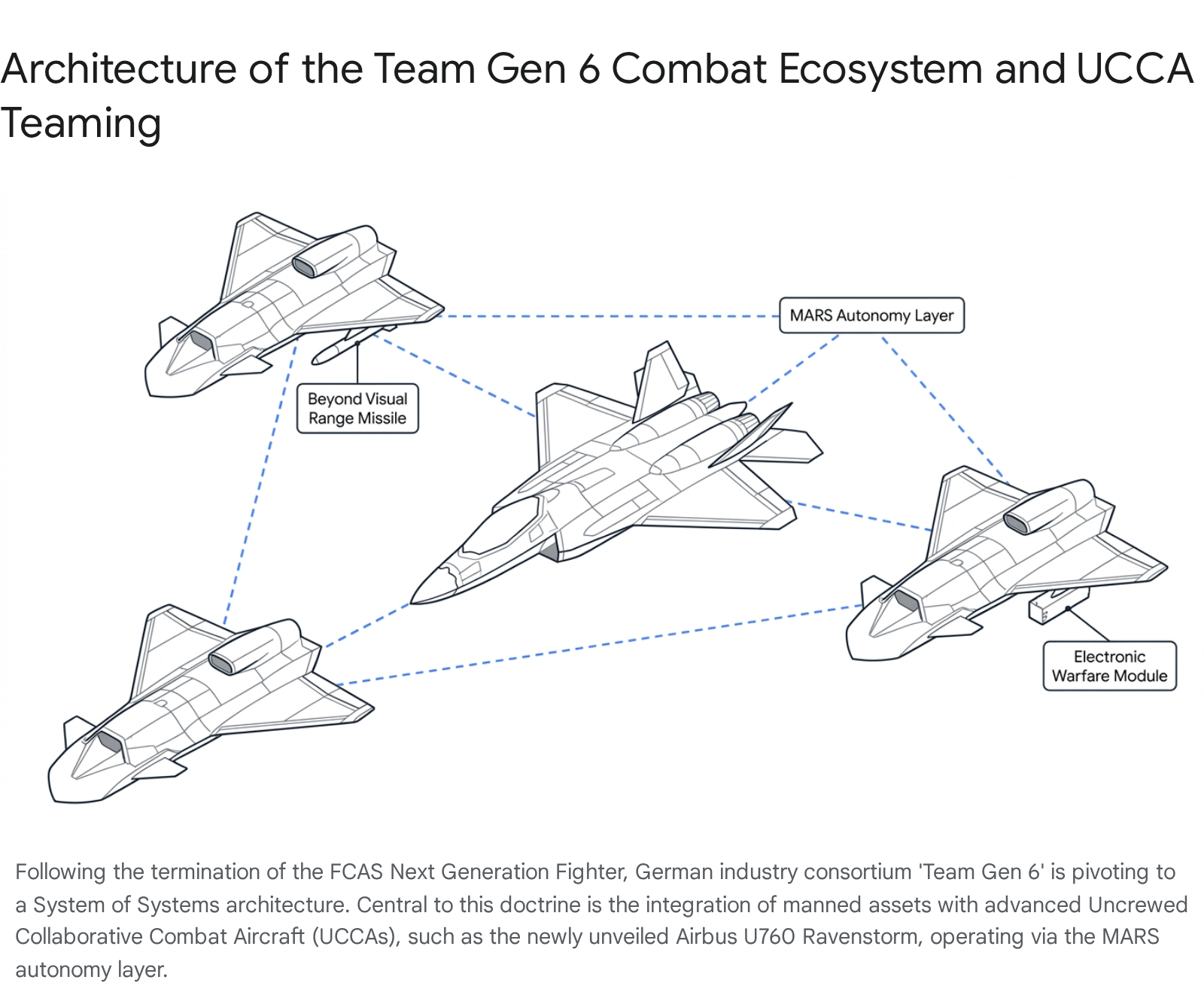
Technological debuts at the exhibition heavily emphasized uncrewed systems to offset the delays associated with manned fighter development. Airbus showcased its reorganized unmanned aerial systems portfolio, centralizing its drone operations under a new nomenclature powered by the MARS Autonomy Stack, which serves as a sovereign mission system layer.1 Debuts included the U760 Ravenstorm Uncrewed Collaborative Combat Aircraft, designed to operate collaboratively alongside fourth- and fifth-generation fighters.2 Analysis of the U760 Ravenstorm reveals a ten-meter wingspan, thirteen-meter length, top-mounted engine intakes, and a shovel-like nose configuration resembling the United States-made Kratos XQ-58A Valkyrie.2 The platform is engineered to carry medium- and long-range anti-aircraft missiles, such as the Meteor Beyond Visual-Range air-to-air missile, to execute offensive counter-air missions and the suppression of enemy air defenses via both kinetic strikes and non-kinetic electronic warfare jamming.2
Airbus also detailed the U680 Bird of Prey interceptor drone, a counter-unmanned aerial systems platform built upon a modified Do-DT25 target drone base.2 With a maximum take-off weight of one hundred and sixty kilograms, the system autonomously searches, classifies, and engages hostile kamikaze drones using a Mark I air-to-air missile developed by Frankenburg Technologies.2 The interceptor is designed for seamless integration into the North Atlantic Treaty Organization’s air defense architecture via the Airbus Integrated Battle Management System, functioning as a cost-effective kinetic effector within a layered air defense grid.2
Furthermore, Airbus confirmed ongoing development and upgrades to its support fleets, specifically the A330 Multi-Role Tanker Transport, which features Automatic Air-to-Air Refueling technology designed to optimize fuel transfer rates and reduce operator workload.2 The upgraded A330 MRTT+ variant, utilizing Rolls-Royce Trent 7000 engines, provides an increased maximum take-off weight of two hundred and forty-two tonnes, carrying up to one hundred and eleven tonnes of fuel alongside forty-five tonnes of cargo or up to three hundred passengers.2
Intelligence regarding the global context of sixth-generation platforms was also highlighted by tracking the parallel progress of the United States Air Force’s Next Generation Air Dominance program. Open-source tracking confirms that the Boeing F-47 conceptual fighter is currently beginning production at Boeing’s St. Louis facility in Missouri, leveraging the Advanced Coatings Centre and Advanced Assembly Facility.2 The United States platform is anticipated to feature a combat radius exceeding one thousand nautical miles, stealth capabilities surpassing the F-22 Raptor, and internal weapons bays optimized for the Joint Advanced Tactical Missile, with an operational fleet target of one hundred and eighty-five aircraft augmented by collaborative combat aircraft.2 The contrast between the rapid production commencement in the United States and the organizational collapse of the European Future Combat Air System underscores a critical intelligence takeaway: the European defense aerospace sector is compensating for diplomatic stalemates in manned fighter development by aggressively accelerating the deployment of autonomous, artificial intelligence-driven collaborative platforms to maintain parity in the airspace.
2.2 HEMUS 2026
The seventeenth International Exhibition of Defence Equipment and Services (HEMUS 2026) convened in Plovdiv, Bulgaria, from June 3 through June 6, 2026.4 Taking place against the backdrop of sustained, high-intensity conflict in Eastern Europe, the exhibition demonstrated how former Warsaw Pact nations are leveraging their established industrial infrastructure and historical manufacturing bases to secure highly lucrative roles in current European rearmament initiatives and joint weapons production programs.4
Participating firms focused intensely on the direct tactical lessons learned from the Ukrainian theater, specifically regarding the ubiquity of drone warfare, the necessity of counter-unmanned aerial systems, and the survivability of ground forces under constant aerial surveillance. Technological debuts reflected a strict prioritization of electronic warfare, robotic ground platforms, and localized artificial intelligence processing at the tactical edge.4 Avilus demonstrated the operational maturity of its Bussard unmanned aircraft by piloting the vehicle in North Sea airspace using a ground control station located eight hundred kilometers away in Munich, proving the viability of secure, long-range tele-operation in contested environments.5
Regional manufacturers also debuted operationalized solutions. Reactive Drone showcased its SHMAVIK and Kazhan unmanned aerial vehicle systems, highlighting drone technologies that have been iteratively developed through direct feedback from active modern defense missions.5 Turkish defense contractor ASELSAN exhibited a highly integrated drone defense network capable of coordinating multiple advanced detection and destruction subsystems specifically engineered to neutralize diverse micro-drone and loitering munition swarms.6 Furthermore, collaborative ventures resulting in rapid capability fielding were highly visible; the strategic partnership between Hypercraft and Fortem Technologies resulted in the debut of low-signature mobile platforms equipped with advanced radar for persistent, all-domain airspace denial at the tactical edge.6 Similarly, ARCYN Defense announced a Cooperative Research and Development Agreement with the United States Army DEVCOM Armaments Center to evaluate and mature its Iron Rain counter-drone technologies.6
The primary intelligence takeaway from HEMUS 2026 is the rapid democratization of advanced sensor and mitigation technology. Eastern European defense supply chains are shifting away from large, exquisite, multi-decade procurement programs in favor of agile, software-updatable platforms that can be mass-produced and iteratively improved based on real-time battlefield telemetry. The heavy emphasis on systems like the Iron Rain and ASELSAN networks indicates that ground forces globally anticipate operating continuously under hostile aerial surveillance, necessitating organic, highly mobile air defense systems integrated directly at the platoon and company levels.
2.3 Eurosatory 2026
Eurosatory 2026, scheduled for June 15 through June 19, 2026, at the Paris Nord Villepinte exhibition center, represents the largest land and air-land defense exhibition globally, anticipating over two thousand exhibitors from sixty-one countries and seventy-six thousand professional visitors.7 Pre-event intelligence and finalized exhibitor announcements released over the past week reveal major shifts in land warfare doctrine, specifically concerning battlefield logistics, power generation, and multi-domain sensor fusion.
A critical technological debut planned for the event is a new hybrid powertrain based on the highly successful mtu Series 199 engine architecture.9This system is being developed into a comprehensive powertrain platform spanning a power range from two hundred and sixty to one thousand three hundred and fifty kilowatts, utilizing six-, eight-, 10-, and twelve-cylinder configurations specifically optimized for heavy military tracked vehicles.9The transition to hybrid powertrains for heavy armor addresses critical tactical vulnerabilities observed in recent conflicts. Traditional diesel powertrains produce massive acoustic signatures, high thermal output easily detectable by overhead infrared sensors, and require an immense, highly vulnerable logistical tail for sustained fossil fuel delivery to the frontline. Hybrid systems offer critical “silent watch” capabilities—allowing systems and sensors to operate without the main engine running—and brief periods of silent mobility, drastically reducing the vehicle’s footprint across both the electromagnetic and thermal spectrums.9
In the sensor and electronic warfare domain, Hensoldt will debut its Battle Lab, a demonstration environment designed to prove the viability of software-defined, multi-domain networking that fuses sensors, effectors, and command levels in real time.11The system integrates data from passive arrays, such as the Twinvis radar, which detects hostile aircraft, cruise missiles, and drones by analyzing reflections from existing civilian communication transmitters without emitting its own trackable energy.11This is paired with active arrays like the TRML-4D, equipped with the latest active electronically scanned array radar technology for rapid target tracking and classification.11Hensoldt will also display the TAERVUS cross-domain system for modern electromagnetic reconnaissance and combat. This architecture highlights an emerging doctrinal shift toward “predictive jamming,” wherein integrated artificial intelligence autonomously supports signal analysis, prioritizes hostile transmissions, and optimizes electronic attack measures faster than human operators can calculate the required frequencies.11
Further demonstrating the push toward autonomous and miniaturized capabilities, Maris-Tech will introduce an ultra-compact platform integrating edge artificial intelligence, advanced video processing, and fiber optics connectivity specifically designed for loitering munitions and surveillance drones.13 Vizgard and Syzygy Integration will demonstrate localized artificial intelligence retraining capabilities, allowing algorithms to be updated and adapted to new battlefield environments in hours rather than weeks.13 Additionally, Alva Industries is scheduled to unveil new slotless motor innovations for defense applications, while Advanced Navigation and Team Defence Australia will exhibit precision guidance systems.13 Intelligence takeaways from the preparations for Eurosatory indicate that procurement priorities are shifting heavily toward systems that minimize logistical dependency through hybrid power while maximizing passive detection, automated electronic warfare execution, and real-time algorithmic adaptability.
3.0 Details: Military Exercises
3.1 Exercise Ramstein Flag 2026
Running from June 8 through June 19, 2026, Ramstein Flag 2026 constitutes the largest air exercise in the history of the North Atlantic Treaty Organization.15 Operating under the framework of the enhanced Vigilance Activity Eastern Sentry, the exercise integrates more than two hundred aircraft from eighteen allied nations, operating across a vast geographical expanse spanning three Joint Operations Areas from northern Finland to southern Spain.16 The primary strategic objective is to validate collective defense capabilities under Article 5 scenarios, heavily prioritizing Integrated Air and Missile Defence, Counter Anti-Access/Area Denial operations, rapid information-sharing, and Agile Combat Employment.17
The tactical maneuvers tested during Ramstein Flag represent a fundamental doctrinal abandonment of legacy peacetime air policing models in favor of survivable, distributed lethality required for peer-state conflict. The exercise utilized more than twenty operational locations, relying heavily on austere environments and civilian infrastructure.16 In the Nordic region, which served as a primary operational hub hosted jointly by Finland, Sweden, Norway, and Denmark, allied forces successfully executed Agile Combat Employment concepts by operating high-value assets directly from reserve highway strips.16 Specifically, the Finnish reserve road base at Tervo was utilized for dispersed basing operations.16 This decentralized basing strategy ensures that allied airpower cannot be systematically neutralized by a preemptive ballistic or cruise missile strike against a handful of known, centralized main operating bases.
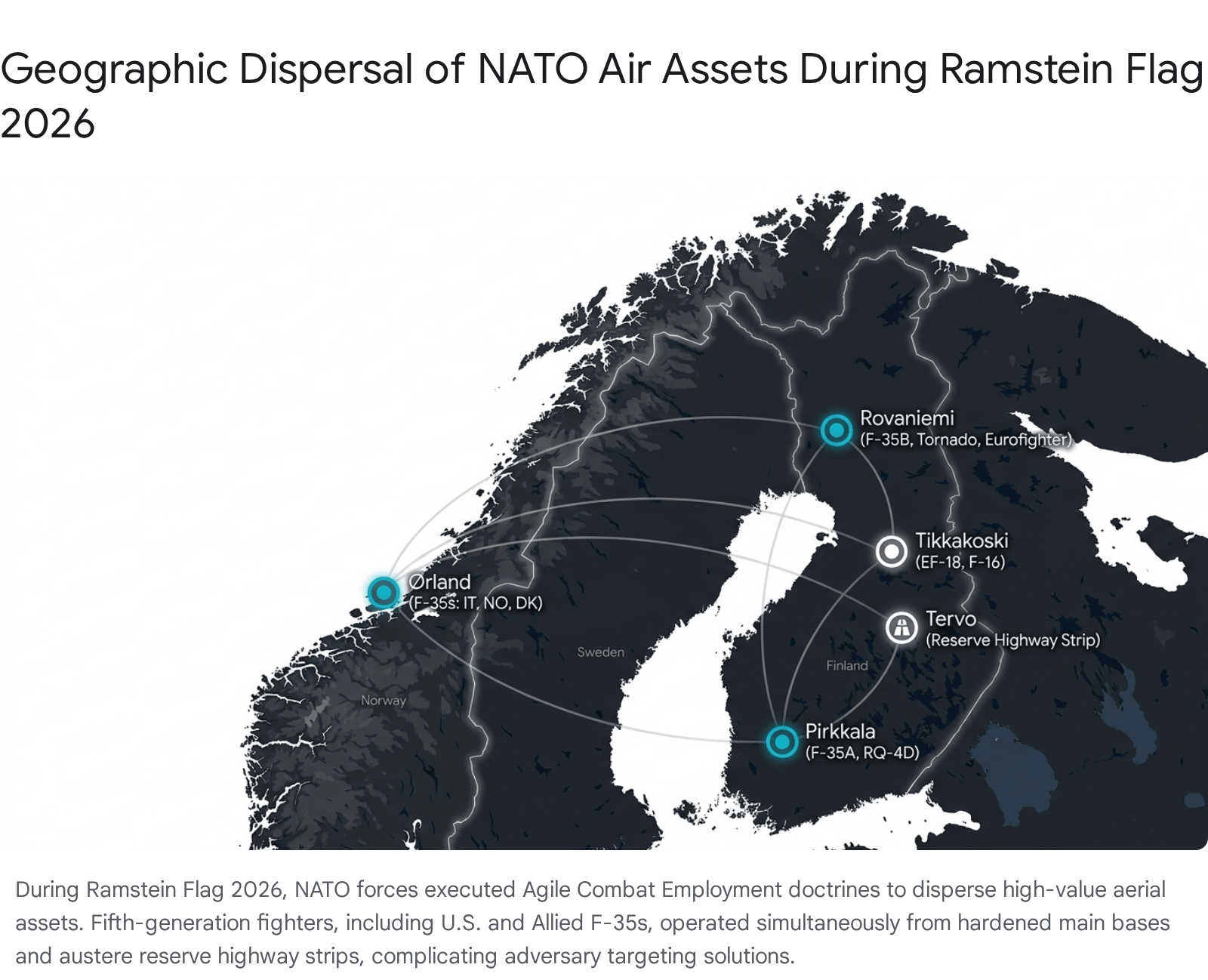
The integration of fifth-generation stealth platforms was a major focal point of the exercise. F-35 variants from the United States, Italy, Norway, and Denmark synchronized operations across multiple locations. United States Marine Corps F-35B short take-off and vertical landing aircraft deployed to Rovaniemi in northern Finland alongside German Tornado and Eurofighter jets, while United States Air Force F-35A conventional take-off variants operated from Pirkkala in southern Finland.16 Concurrently, Italian, Norwegian, and Danish F-35s conducted operations from Ørland, Norway, while Spanish EF-18s and Polish F-16s operated from Tikkakoski in central Finland.16 These combat sorties, generating upwards of one hundred and fifty flights daily, were closely coordinated with high-altitude intelligence enablers, including NATO E-3A Airborne Warning and Control System aircraft and the RQ-4D Phoenix remotely piloted aircraft.16
The intelligence takeaway from Ramstein Flag highlights severe logistical and interoperability challenges inherent to executing Agile Combat Employment at scale. Dispersing aircraft to highway strips fundamentally fragments the logistical supply chain; it requires massive, secure, and highly redundant Host Nation Support to ensure that aviation fuel, specialized munitions, and maintenance personnel are constantly transported to unpredictable, austere locations via road networks rather than centralized pipelines.18 The exercise proves the alliance is actively transforming its logistical tail to survive in a highly contested electromagnetic and kinetic environment, shifting the burden from fixed infrastructure to mobile sustainment units.
3.2 Exercise BALTOPS 2026
The fifty-fifth iteration of Baltic Operations (BALTOPS 2026) commenced on June 4, 2026, as twenty allied ships departed the port of Gdynia, Poland.21 Scheduled to conclude on June 19 in Kiel, Germany, the exercise involves approximately six thousand personnel representing fifteen North Atlantic Treaty Organization member states operating across a massive maritime theater covering the western, southern, and central Baltic Sea, stretching from Skagen to the Gulf of Riga.23
A critical doctrinal shift observed in this year’s iteration is the fundamental transition of command and control architecture. For the first time since the exercise’s inception in 1972, the exercise is being specifically led and directed by the Allied Joint Force Command Brunssum.23 The Deputy Commander of Joint Force Command Brunssum, Lieutenant General John Mead, explicitly defined the strategic purposes as deterring threats, building readiness, and strengthening cohesion, emphasizing that “deterrence is not something we can simply talk about. We must demonstrate it”.23 This administrative and operational shift directly integrates the maritime exercise into the alliance’s broader Eastern Flank deterrence strategy.25
Tactically, while the exercise continues to drill traditional competencies such as amphibious operations, air defense, and anti-submarine warfare, the primary strategic focus has pivoted drastically toward the protection of critical subsea infrastructure.23 Driven directly by the context of recent deniable hybrid warfare attacks on the Nord Stream gas pipelines, electricity interconnectors, and telecommunications data cables linking Northern and Eastern Europe, naval forces are prioritizing the absolute safeguarding of these sea lines of communication.23 Offshore wind farms and their associated transmission cables have increasingly become central to Baltic security planning due to their inherent vulnerability to covert sabotage.23 The integration of unmanned maritime systems for mine countermeasures and subsea surveillance during the exercise underscores a primary intelligence takeaway: the Baltic Sea is now viewed as a highly vulnerable, active hybrid warfare zone. Naval tactical maneuvers and procurement priorities are heavily reorienting toward establishing persistent, autonomous surveillance over static, undefendable seabed assets to prevent severe economic and energy disruption orchestrated by adversary submersibles and remote underwater vehicles.25
3.3 Exercise MILEX 26 / RDC LIVEX 26
The European Union’s Crisis Management Military Exercise 2026 (MILEX 26), incorporating the Live Exercise deployment phase (RDC LIVEX 26), is currently culminating at the San Gregorio Training Centre in Zaragoza, Spain.28 Following months of strategic coordination, the physical deployment and combat enhancement training phases ran from late May through the Distinguished Visitors Day live-fire demonstration scheduled for June 18, 2026.29
MILEX 26 is specifically designed to stress-test the European Union’s Rapid Deployment Capacity, an ambitious initiative aimed at enabling the European Union to project a force of up to five thousand troops globally to manage crises outside its borders without relying on external sovereign logistical support, effectively replacing the previous EU Battlegroup concept.29 The exercise involves two thousand five hundred soldiers from thirteen member states, including Austria, Belgium, Croatia, France, Germany, Luxembourg, Latvia, Lithuania, Spain, Romania, Portugal, the Czech Republic, and Sweden.29
The validation of interoperability across three distinct command structures is central to the exercise. At the strategic level, the Military Planning and Conduct Capability in Brussels serves as the Operational Headquarters.28 At the operational level, Eurocorps personnel manage the Force Headquarters deployed directly at the Zaragoza training grounds.28 At the tactical level, Spain serves as the lead nation for the Central Battle Group, deploying over sixteen hundred personnel.28 The core unit of this force is the 16th Canary Islands Brigade.28
The tactical group deployed in Zaragoza integrates highly diverse assets to simulate a full-spectrum crisis response. Based on the 9th Soria Infantry Regiment, the force includes a Portuguese Army company, artillery units from RACA 93, engineer units from BZ XVI, and specialized combat logistics support.28 Aviation support is provided by BHELMA VI utilizing Super Puma and AB-212 helicopters, while an intelligence, surveillance, target acquisition, and reconnaissance tactical group features cavalry units equipped with Leopard 2A4 and Pizarro main battle tanks.28 Furthermore, the deployment integrates critical non-kinetic capabilities, including electronic warfare sections from the 31st Electronic Warfare Regiment, information operations teams, and border control units from the Guardia Civil.28
The intelligence takeaway from MILEX 26 centers on the European Union’s continued, aggressive pursuit of strategic autonomy. The exercise was preceded by a Main Planning Conference in Segovia, divided into specialized syndicates addressing steering issues, information and communications frameworks, and the logistics of moving multinational forces across the continent.29 By navigating these complex logistical hurdles and testing the capability of the Military Planning and Conduct Capability to function as a credible, unified command structure, the European Union is attempting to prove it can act as a cohesive geopolitical military actor.29 However, the necessity of the exercise highlights ongoing interoperability challenges regarding cross-border military transit, the secure integration of disparate national communications systems, and the establishment of a unified logistical backbone—hurdles the Rapid Deployment Capacity must definitively overcome before achieving true operational capability in a non-permissive environment.29
3.4 Exercise Direct Action Ground Reconnaissance 2026
On June 7, 2026, the Quick Reaction Corps of the Indonesian Air Force concluded a high-intensity bilateral exercise with the United States Air Force Special Operations Command in the Bandung District of West Java, Indonesia.32The drill, officially designated as Direct Action Ground Reconnaissance 2026, focused entirely on strengthening personnel combat readiness and establishing deep tactical interoperability between the two highly specialized units.32
Tactical maneuvers executed during the exercise emphasized speed, precision, and coordination in austere tropical environments. The operational scenarios focused on joint mission planning, the rapid identification of airstrike targets for close air support coordination, and complex combat medical evacuation procedures.32 This exercise highlights a continuing, critical strategic shift by United States Indo-Pacific Command to deepen tactical ties and interoperability with non-aligned Southeast Asian nations. The intelligence takeaway indicates that the United States is actively working to ensure its special operations forces can seamlessly integrate with regional partner militaries, establishing the foundational relationships required to deploy forward targeting nodes and conduct rapid personnel recovery operations in the event of a broader, high-intensity conflict within the first island chain.33
3.5 Preparatory and Ongoing Operations: African Lion and Valiant Shield
Intelligence collection over the past week also highlights major developments in ongoing and upcoming multi-domain exercises, reflecting a global synchronization of emerging tactical doctrines. In North and West Africa, the ongoing United States Africa Command exercise African Lion 2026—hosted by Morocco, Ghana, Senegal, and Tunisia—has heavily integrated autonomous warfare systems into its operational planning.34 Reports from the field indicate the execution of inaugural drone academics, focusing intensely on artificial intelligence-assisted targeting systems, counter-drone technologies, autonomous combat vehicles, and the adaptation of asymmetric warfare tactics directly observed in the Ukrainian and Iranian theaters.34 This rapid incorporation demonstrates a shortened tactical feedback loop where battlefield innovations from active global conflicts are immediately institutionalized into allied training doctrines.
Concurrently, preparations for the upcoming multilateral exercise Valiant Shield 2026, scheduled for June 22 through July 1 in the Indo-Pacific theater across Hawaii, Guam, and Japan, reveal a heavy reliance on decentralized, commercial space-based intelligence architecture.36 Notably, space monitoring firm LeoLabs announced that its new Scout-S transportable space tracking radar, developed via private investment and United States Space Force backing, became operational in June and will deploy directly to Hawaii to participate in the exercise.36 Fitting entirely within a standard twenty-foot shipping container, the radar utilizes direct radiating array technology to monitor low Earth orbit and very low Earth orbit objects.36 Furthermore, the United States Air Force is actively soliciting low-cost, commercially available space-based data platforms to provide downward-looking intelligence, surveillance, and reconnaissance data during Valiant Shield to enable rapid access to actionable data in highly contested electromagnetic environments.38
In a major infrastructural shift supporting Agile Combat Employment in the Pacific, Valiant Shield 2026 will also see the United States Air Force recommence operations from the historic North Field on the remote island of Tinian, following four years of intensive jungle clearing and rehabilitation.37 A detachment of two hundred and fifty personnel will support operations from this austere location to simulate high-intensity conflict.37 Finally, bilateral planning between the United States and Japan is heavily emphasizing synthetic training environments; stakeholders are establishing linked Exercise Control Facilities across Misawa and Iwakuni to integrate virtual training simulators directly into live exercises.39 The collective intelligence takeaway is highly significant: the United States is actively expanding its network of austere Pacific airfields to disperse high-value target sets, while simultaneously integrating mobile, commercial space-domain awareness radars and synthetic training links to ensure that satellite communication, reconnaissance capabilities, and command-and-control networks survive anti-satellite warfare and intense jamming in a peer-state conflict.36
Please share the link on Facebook, Forums, with colleagues, etc. Your support is much appreciated and if you have any feedback, please email us in**@*********ps.com. If you’d like to request a report or order a reprint, please click here for the corresponding page to open in new tab.
Sources Used
- shownews – ILA 2026: Germany’s airshow in a post-FCAS era, accessed June 13, 2026, https://www.fw-mag.com/shownews/1121/ila-2026-germany-s-airshow-in-a-post-fcas-era
- German Industry Announce “Team Gen 6” to Develop FCAS …, accessed June 13, 2026, https://theaviationist.com/2026/06/12/germany-team-gen-6-to-develop-fcas-alternative/
- Europe’s most versatile drone portfolio | Airbus, accessed June 13, 2026, https://www.airbus.com/en/newsroom/press-releases/2026-06-airbus-showcases-europes-most-versatile-drone-portfolio-at-ila-berlin
- HEMUS 2026 Highlights Bulgaria’s Growing Role in … – ССBS, accessed June 13, 2026, https://www.ccbsnews.info/en/news/detail/7749
- HEMUS 2026 | June 3–6, 2026 | Plovdiv, Bulgaria – Unmanned Systems Technology, accessed June 13, 2026, https://www.unmannedsystemstechnology.com/events/hemus/
- HEMUS 2026 | June 3–6, 2026 | Plovdiv, Bulgaria – Defense Advancement, accessed June 13, 2026, https://www.defenseadvancement.com/events/hemus/
- Eurosatory 2026 – Electro Optic Systems, accessed June 13, 2026, https://eos-aus.com/events/eurosatory-2026/
- Events for June 2026 › Exhibition › – CET Sandbox, accessed June 13, 2026, https://cetsandbox.com/events/category/exhibition/
- Eurosatory 2026: Rolls-Royce is developing the mtu Series 199 into a powertrain platform for Europe’s land forces and unveiling a new hybrid powertrain, accessed June 13, 2026, https://www.rolls-royce.com/media/press-releases/2026/11-06-2026-rr-is-developing-the-mtu-series-199-into-a-powertrain-platform-for-europes-land-forces-and-unveiling-a-new-hybrid-powertrain.aspx
- Rolls-Royce Share Price Jumps as FTSE 100 Rally and Defence Update Put RR Stock Back in Focus, accessed June 13, 2026, https://www.bez-kabli.pl/rolls-royce-share-price-jumps-as-ftse-100-rally-and-defence-update-put-rr-stock-back-in-focus/
- HENSOLDT at Eurosatory 2026, accessed June 13, 2026, https://www.hensoldt.net/news/hensoldt-at-eurosatory-2026
- HENSOLDT auf der Eurosatory 2026, accessed June 13, 2026, https://www.hensoldt.net/de/news/hensoldt-at-eurosatory-2026
- Eurosatory 2026 | June 15-19 | Paris – Unmanned Systems Technology, accessed June 13, 2026, https://www.unmannedsystemstechnology.com/events/eurosatory/
- Meet our team at Eurosatory 2026 | Advanced Navigation, accessed June 13, 2026, https://www.advancednavigation.com/events-webinars/eurosatory-2026/
- NATO’s Largest Air Exercise Ever is Now Underway – High North News, accessed June 13, 2026, https://en.highnorthnews.com/politics/natos-largest-air-exercise-ever-is-now-underway/1113459
- NATO Holds Ramstein Flag 26 with Finland as Northern Hub …, accessed June 13, 2026, https://nordicdefencesector.com/en/article/nato-holds-ramstein-flag-26-with-finland-as-northern-hub
- RAMSTEIN FLAG 2026 is ready for Take-off … – Allied Air Command, accessed June 13, 2026, https://ac.nato.int/archive/2026/ramstein-flag-2026-is-ready-for-takeoff-18-nations–200-aircraft–and-more-than-20-operational-locations-all-over-europe
- Ramstein Flag 2026 begins today with more than 200 Allied aircraft across Europe, accessed June 13, 2026, https://ac.nato.int/ramstein-flag/news/news/ramstein-flag-2026-begins-today-across-europe-with-more-than-200-allied-aircraft-.aspx
- NATO’s Ramstein Flag 26 exercise reaches from Finland to Spain – Ilmavoimat, accessed June 13, 2026, https://ilmavoimat.fi/en/-/nato-s-ramstein-flag-26-exercise-reaches-from-finland-to-spain
- NATO fifth-generation fighters integrate across northern Europe during Ramstein Flag 2026, accessed June 13, 2026, https://ac.nato.int/archive/2026/nato-fifthgeneration-fighters-integrate-across-northern-europe-during-ramstein-flag-2026.aspx
- BALTOPS 2026 Takes Sail from Gdynia, Poland – Navy.mil, accessed June 13, 2026, https://www.navy.mil/Press-Office/News-Stories/display-news/Article/4509758/baltops-2026-takes-sail-from-gdynia-poland/
- BALTOPS 2026 Takes Sail from Gdynia, Poland – U.S. Naval Forces Europe, accessed June 13, 2026, https://www.c6f.navy.mil/Press-Room/News/Article/4508924/baltops-2026-takes-sail-from-gdynia-poland/
- BALTOPS 2026 launches from Gdynia under NATO command for …, accessed June 13, 2026, https://balticwind.eu/baltops-2026-launches-from-gdynia-under-nato-command-for-the-first-time/
- NATO launches its largest Baltic military exercise – Defence24.com, accessed June 13, 2026, https://defence24.com/armed-forces/navy/nato-launches-its-largest-baltic-military-exercise
- BALTOPS 2026 KICKS OFF: WHAT MAKES THE 55TH EDITION DIFFERENT?, accessed June 13, 2026, https://jfcbs.nato.int/page5964943/2026/baltops-2026-kicks-off-what-makes-the-55th-edition-different
- Nato’s flagship Baltic drill begins at half strength amid global tensions – The Times of India, accessed June 13, 2026, https://timesofindia.indiatimes.com/defence/international/natos-flagship-baltic-drill-begins-at-half-strength-amid-global-tensions/articleshow/131476122.cms
- Putin’s next move? Five Russian attack scenarios Europe must prepare for – Atlantic Council, accessed June 13, 2026, https://www.atlanticcouncil.org/in-depth-research-reports/report/putins-next-move-five-russian-attack-scenarios-europe-must-prepare-for/
- Deployment is underway for the European exercise ‘MILEX 26 …, accessed June 13, 2026, https://emad.defensa.gob.es/en/prensa/noticias/2026/06/Listado/260601-ni-inicio-milex26.html
- MILEX 26 | EEAS, accessed June 13, 2026, https://www.eeas.europa.eu/eeas/milex-26_en
- MILEX 26 / RDC LIVEX 26: Building EU Rapid Response through Multinational Planning and Deployment – Eurocorps, accessed June 13, 2026, https://www.eurocorps.org/livex-26-planning-conferences/
- MILEX 26 Underway: Preparing Europe’s Rapid Deployment Capacity – EEAS, accessed June 13, 2026, https://www.eeas.europa.eu/eeas/milex-26-underway-preparing-europe%E2%80%99s-rapid-deployment-capacity_en
- Indonesia and US air force hold high-intensity joint military exercise – ANTARA News, accessed June 13, 2026, https://en.antaranews.com/news/418513/indonesia-and-us-air-force-hold-high-intensity-joint-military-exercise
- Indonesia and US air force hold high-intensity joint military exercise, accessed June 13, 2026, https://babel.antaranews.com/berita/565975/indonesia-and-us-air-force-hold-high-intensity-joint-military-exercise
- Autonomous Warfare Has Arrived | African Lion 2026 Exclusive with Gen. Anderson & Lt. Gasparri, accessed June 13, 2026, https://www.youtube.com/watch?v=B66Zl-Zd2DI
- African Lion 2026 – US Army Europe and Africa, accessed June 13, 2026, https://www.europeafrica.army.mil/What-We-Do/Exercises/African-Lion/dvpTag/A-26/
- LeoLab’s new, mobile space-watch radar to participate in Valiant Shield exercise, accessed June 13, 2026, https://breakingdefense.com/2026/06/leolabs-new-mobile-space-watch-radar-to-participate-in-valiant-shield-exercise/
- Historic Tinian airfield slated for debut flight operations as Pentagon expands Pacific network, accessed June 13, 2026, https://theaircurrent.com/defense/historic-tinian-north-field-pentagon-pacific-usaf-china/
- AMA: Call for Commercial ISR Solutions – Valiant Shield 2026, accessed June 13, 2026, https://apex-innovates.org/events/ama-call-commercial-isr-solutions-valiant-shield-2026
- Pacific Forces Unite: PMTEC Stakeholder Synchronization Accelerates Indo-Pacific Training Integration, Strengthening Joint Warfighter Readiness – DVIDS, accessed June 13, 2026, https://www.dvidshub.net/news/555029/pacific-forces-unite-pmtec-stakeholder-synchronization-accelerates-indo-pacific-training-integration-strengthening-joint-warfighter-readiness