1. Executive Summary
Geissele Automatics, based in North Wales, Pennsylvania, operates as a manufacturer of firearms, precision fire control groups, and advanced weapons components1. Established in 2004, the firm began as a specialized producer of match-grade triggers for civilian competitive shooting2. Over the subsequent two decades, the company executed a strategic transition, evolving from an accessory vendor into a defense contractor and weapons systems integrator for the United States Special Operations Command (USSOCOM) and various federal law enforcement agencies2.
The company’s initial entry into the defense sector was prompted by the Department of Defense (DoD) adopting its Super Select-Fire (SSF) trigger for M4 carbine platforms2. Leveraging this military validation, Geissele expanded its engineering scope to address specific operational deficiencies in standard military small arms3. This resulted in the development of the Upper Receiver Group Improved (URGI), proprietary metallurgical advancements such as Carpenter 158+ steel, the Nanoweapon solid lubricant coating, and the Super 42 braided wire recoil management system4. To address different market segments, the firm also established a sister company, ALG Defense, focusing on enhanced mil-spec components8.
Geissele presently serves three primary demographics: civilian enthusiasts, military special operations, and federal law enforcement. Recent procurement data indicates a notable increase in the company’s federal contracting footprint, highlighted by multi-million-dollar agreements with Immigration and Customs Enforcement (ICE), Customs and Border Protection (CBP), and the Drug Enforcement Administration (DEA) for complete duty rifles10. Concurrently, the company is engaged in advanced materials research, holding Cooperative Research and Development Agreements (CRADAs) with the U.S. Army Combat Capabilities Development Command (DEVCOM) to develop next-generation rifle barrels utilizing GNB 200 alloy14.
While the brand maintains an established position within the industry, it has navigated market controversies regarding the structural rigidity of early handguard iterations and its corporate pricing and litigation strategies16. Moving forward, Geissele Automatics relies on its proprietary materials science, growing patent portfolio, and government relationships to sustain its position as a major supplier in the small arms market18.
2. Corporate Origins and Historical Evolution
The foundation of Geissele Automatics is closely tied to the mechanical background and engineering pursuits of its founder, William (Bill) H. Geissele. The company’s trajectory reflects a pattern of identifying mechanical deficiencies in existing firearm platforms and engineering targeted solutions.
2.1. Founder Background and Early Mechanical Influences Bill Geissele’s mechanical training began at the age of 15 when he secured an apprenticeship in a local, one-man machine shop3. This early exposure provided foundational instruction in reading technical drawings, setting up machinery, fabricating dies, and maintaining the operational cleanliness required for precision machining3. Concurrently, Geissele developed a practical interest in motorcycle mechanics, further refining his understanding of mechanical systems3.
Pursuing a formal engineering education, Geissele temporarily left his studies to work in heavy industrial sectors, including periods in coal mining operations and the railway system, before returning to New Jersey to complete his degree3. By the early 2000s, while employed in the railway sector, Geissele sought to establish a secondary income stream to support a family, focusing on his recreational pursuits3.
2.2. The Genesis of the Match Trigger (2004) Geissele was an active competitive shooter, participating in sanctioned Civilian Marksmanship Program (CMP) and National Rifle Association (NRA) Hi-Power Rifle matches using the AR-15 platform2. In high-power rifle competition, precise trigger control is a critical variable for maintaining high scores3. Geissele evaluated the match triggers available at the time and found them lacking in mechanical consistency and durability3.
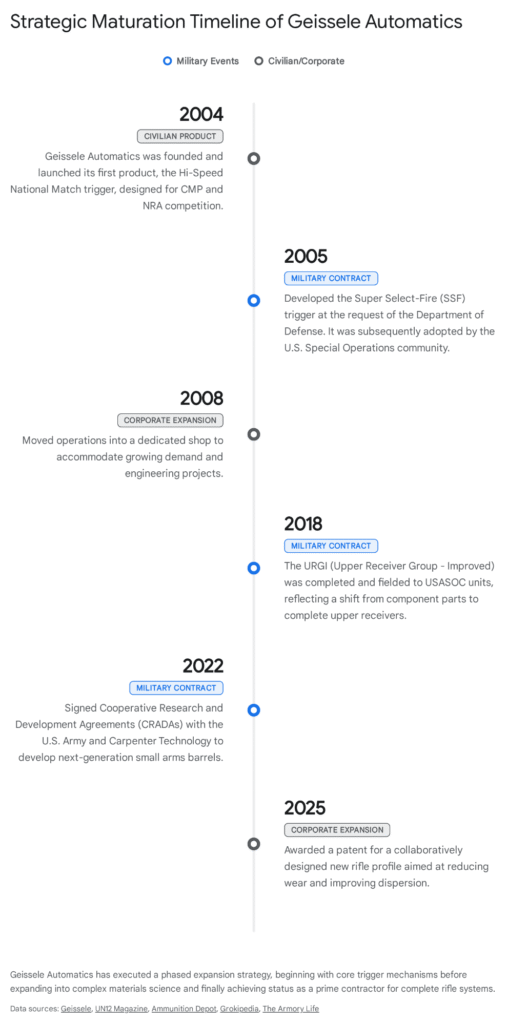
Applying his engineering education and machinist background, he began conceptualizing a two-stage trigger system designed to yield a highly predictable trigger press3. Operating out of the basement of his Pennsylvania row house, Geissele drafted designs and utilized a network of machinist contacts to assist in fabricating the initial components3. In 2004, these efforts culminated in his first production fire control group: the Hi-Speed National Match trigger2. This product formed the commercial foundation of Geissele Automatics, targeting a specialized demographic of civilian competitive shooters2.
2.3. Military Adoption and Corporate Expansion (2005–2008) The transition from a civilian accessory manufacturer to a defense supplier occurred organically. The Hi-Speed trigger gained traction among civilian competitors, drawing the attention of shooters affiliated with the Department of Defense3. During a weekend shooting match, Geissele was introduced to the team captain of a DoD shooting team and confirmed his trigger utilized a standard mil-spec A1 hammer spring3. This detail—critical because reduced-power springs common in match triggers often lead to reliability issues—fostered initial interest from military personnel3.
Although designed strictly for target shooting, the U.S. Military evaluated the Hi-Speed trigger and identified its potential application in semi-automatic sniper weapon systems2. In 2005, the DoD formally approached Geissele Automatics with a specific request: to develop a select-fire fire control group that maintained the precise break and reset characteristics of the civilian Hi-Speed model2.
In response, Bill Geissele engineered the Super Select-Fire (SSF) trigger2. The SSF underwent military evaluation, including official safety certification by the Crane Naval Surface Warfare Center20. Following successful testing, the SSF was formally adopted by entities within the U.S. Special Operations community, becoming a standard trigger for M4 carbine-based weapons within USSOCOM2.
The success of the SSF in military circles generated civilian demand for Geissele products. By 2008, the volume of requested DoD components and commercial sales outpaced basement production capabilities, prompting Geissele to resign from his primary engineering job and relocate operations into a dedicated commercial manufacturing facility3.
3. Product Portfolio and Technical Capabilities
The product catalog of Geissele Automatics has expanded significantly beyond its origins. Today, the company manufactures critical components of the AR-15/M4 platform, emphasizing materials science, proprietary coatings, and mechanical optimization.
3.1. Precision Fire Control Groups (Triggers) Triggers remain a central element of Geissele’s product line. The company offers a diverse array of mechanisms designed for specific operational requirements, ranging from competitive shooting to home defense and military applications. The triggers are manufactured from tool steel and typically coated in a corrosion-resistant black oxide finish1. For platform compatibility, Geissele AR-15 triggers are not compatible with pistol caliber carbines (PCCs) such as the SIG MPX, and users with older Colt rifles must verify whether their receiver utilizes small or large diameter trigger pins1.
The table below outlines the primary trigger models, their specifications, and their intended applications:
| Trigger Model | Stage Type | Pull Weight | Intended Application & Features |
| Hi-Speed National Match | Two-Stage (Adjustable) | Variable (1.5 – 5.5 lbs) | Competitive shooting (CMP, NRA High Power, DMR). Tunable via specific spring sets. Features wire EDM-cut sears and a low-mass hammer1. |
| Super Select-Fire (SSF) | Two-Stage (Select-Fire) | Non-Adjustable | Military use (USSOCOM). Permits semi-automatic and fully automatic fire. Crane Naval Surface Warfare Center safety certified2. |
| Super Semi-Automatic (SSA) | Two-Stage | 1st: 2.75-3 lbs / 2nd: 1.5-1.75 lbs | Law enforcement, home defense, and civilian use. The non-select-fire derivative of the military SSF2. |
| SSA-E & SSA X | Two-Stage | Lighter than SSA | Precision shooting. The SSA X variant utilizes a proprietary chrome nitride nanocoating for operation under heavy fouling20. |
| Single-Stage Precision (SSP) | Single-Stage | 3.0 – 3.75 lbs | Duty use and close-quarters engagements. Features negligible take-up, a clean break, and a fast reset20. |
| Geissele 2 Stage (G2S) | Two-Stage | Identical to SSA | Budget-oriented alternative. Lacks laser markings, uses a different pin retention design, and undergoes batch magnetic particle spot-checking rather than individual inspection20. |
| Super Dynamic 3 Gun (SD-3G) | Single-Stage Hybrid | Variable via spring | Competitive 3-Gun shooting. Features a flat trigger bow for faster tactile indexing21. |
3.2. Upper Receiver Groups and the URGI Program In the mid-2010s, Geissele entered into a collaboration with the United States Army Special Operations Command (USASOC) to address limitations in the existing M4A1 and MK18 upper receiver groups4. Special Operations Forces identified a need for enhanced reliability and durability, a requirement driven largely by the military’s adoption of the M855A1 Enhanced Performance Round (EPR)4. The M855A1 operates at higher chamber pressures than legacy ammunition, which accelerated wear on internal components and caused overactive bolt cycling4.
The resulting product was the Upper Receiver Group – Improved (URGI). The URGI project culminated in initial fielding to USASOC units, including Special Forces and the 75th Ranger Regiment, beginning in 20184. The URGI differs significantly from legacy systems like the MK18 (which is defined by a 10.3-inch barrel and Daniel Defense RIS II quad rail)26. The URGI incorporates several proprietary components designed to mitigate high-pressure ammunition:
- Geissele Super Modular Rail (SMR) MK16: The URGI replaces the legacy Picatinny quad-rail system with the MK16 M-LOK handguard, protected by US Patent D844,0944. The MK16 mounts directly to an extended proprietary barrel nut, a design intended to promote rigidity by eliminating independent rail flex and aid in heat dissipation during sustained fire4. The rail is slim, measuring 1.58 inches in diameter25.
- Gas System Optimization: To abate the overactive cycling caused by M855A1 ammunition, Geissele altered the gas port location. The URGI utilizes a mid-length gas system combined with a pinned, low-profile Super Gas Block4. Moving the gas port further forward from the chamber reduces port pressure, allowing expanding gas more volume before reaching the gas tube. This reduces bolt velocity, lessens felt recoil, and decreases stress on internal components4.
- Barrel Configurations and Muzzle Devices: The military-issue URGI is fielded in two primary lengths: a 10.3-inch variant with a carbine-length gas system for Close Quarters Battle (CQB) and suppressed operations, and a 14.5-inch variant with a mid-length gas system serving as a general-purpose carbine26. Military configurations utilize cold hammer-forged barrels sourced from Daniel Defense23. The muzzle is typically fitted with a SureFire four-prong flash hider or WARCOMP to accept SureFire SOCOM suppressors23.
3.3. Advanced Rail Systems and Optic Mounts Beyond the MK16, Geissele manufactures a variety of Super Modular Rails (SMR) for the civilian and law enforcement markets, including the MK4, MK8, and MK14 series1. The rails are machined from 6061-T6 or 7000-series aluminum depending on the model, and are available in varying lengths1. The MK4 series incorporates short Picatinny rail sections at the muzzle end for laser aiming devices, while the MK8 and MK14 rely on M-LOK attachment slots to reduce weight1. The components are known for their standard “Desert Dirt Color” (DDC) anodized finish, alongside black oxide and phosphate options1.
Geissele also produces the Super Precision line of aluminum optic mounts, accommodating 30mm tubes and specific optics1. Additionally, the company manufactures functional components such as the Maritime Bolt Catch, which features oversized textured pads to aid in weapon manipulation, and the Super Charging Handle (SCH)21.
3.4. Advanced Coatings and Metallurgy (Nanoweapon & REBCG) Geissele’s investment in materials science is primarily manifested in the Reliability Enhanced Bolt Carrier Group (REBCG). Standard military specification bolt carrier groups are typically constructed from 8620 steel carriers and Carpenter 158 steel bolts. To increase longevity, Geissele collaborated with metallurgists at Carpenter Steel to develop a proprietary alloy known as Carpenter 158+6. This material is refined to possess fewer impurities than standard C158, resulting in a cleaner metallic matrix6. The company utilizes a forging process for the bolt—manipulating the grain structure of the metal to follow the contours of the part—which Geissele states yields a component capable of outlasting a standard mil-spec bolt by a factor of five6. The cam pin is machined from H13 tool steel, a material commonly used in medical instrumentation29. The carrier is machined from mil-spec 8620 steel and features extended upper rails for greater stability29.
To protect these components, Geissele utilizes Nanoweapon, a proprietary Durable Solid Lubricant (DSL) coating developed in collaboration with the U.S. Army’s ARDEC at Picatinny Arsenal6. Geissele engineers spent over three years fine-tuning the coating6. Applied at low temperatures to ensure it does not alter the underlying heat treatment, the finish achieves a surface hardness equivalent to 82 HRC (Rockwell Hardness Scale C)6. This extreme hardness makes it highly resistant to abrasion and allows the firearm to operate with minimal liquid lubrication by natively repelling carbon buildup6. Every Geissele bolt is High Pressure Tested (HPT) and Magnetic Particle Inspected (MPI) prior to coating29.
3.5. Recoil Management Systems (Super 42) Addressing the reciprocating mass of the AR-15 operating system, Geissele developed the Super 42 Braided Wire Buffer Spring and Buffer Combo7. Deviating from standard single-coiled springs, the Super 42 utilizes three independent strands of wire braided together, a design conceptually derived from the recoil spring of the German MG42 machine gun7.
This braided construction functions as a harmonic damper7. During the firing cycle, the three independent strands flex separately, creating internal friction that displaces excess kinetic energy and dampens the recoil impulse7. This mitigates the audible “twang” reverberation commonly heard in standard AR-15s and reduces the probability of spring failure7.
Compared to a stock spring, the Super 42 maintains its original length and return force over a higher round count and provides a 15% stronger average return force7. This stronger return aids in stripping rounds from the magazine and driving the bolt into battery when the weapon is fouled7. The spring is paired with proprietary buffers in varying weights (H1, H2, H3), which utilize tungsten inserts to allow users to tune the rifle’s timing based on barrel length, gas port size, and suppressor use7. Due to the smaller internal diameter of the braided wire, the Super 42 requires a buffer with a reduced shoulder and will not fit over a standard mil-spec buffer35. The system is designed for carbine-length receiver extensions and is not compatible with rifle-length or A5 tubes; it is also not recommended for use with 300 Blackout subsonic ammunition, as the stronger return force may induce short-stroking malfunctions7.
3.6. ALG Defense: Market Segmentation Strategy To capture a broader segment of the market without diluting the premium branding of Geissele Automatics, Amy Lynn Geissele founded ALG Defense in 20128. Operating as a registered woman-owned business, ALG Defense shares manufacturing facilities and engineering teams with Geissele but executes a different strategic purpose: providing performance-enhanced versions of standard mil-spec components8.
This is evident in their trigger offerings, such as the ALG Quality Mil-Spec (QMS) and Advanced Combat Trigger (ACT), which do not alter the fundamental geometry or pull weight of a standard M4 trigger9. Instead, ALG takes raw 8620 alloy castings, polishes the sear surfaces, and applies advanced coatings9. The ACT utilizes a process ALG refers to as “HardLubing,” applying an electroless Nickel plate enhanced with an integral modifier (Boron or Teflon) to increase surface hardness and corrosion resistance, resulting in a smoother trigger pull9.
ALG Defense also expanded into non-AR-15 platforms, developing the AKT series of triggers for the AK-47 and AK-74 weapon systems8. Models like the AKT-EL (Enhanced) feature a broader, flatter trigger bow designed to enhance rapid trigger control, contrasting with the precision focus of Geissele-branded triggers37. ALG also produces custom rails and fulfills contracts for both governmental and non-governmental clients8.
4. Market Segmentation and Customer Demographics
Geissele Automatics caters to three primary demographics, leveraging its reputation in military testing to drive sales within the civilian and law enforcement sectors.
4.1. Civilian and Competitive Shooting Market The civilian sector encompasses competitive shooters, hunting enthusiasts, and individuals seeking home defense or training rifles4. This demographic evaluates brand prestige and technical specifications. Geissele serves this market by selling individual components (triggers, rails, REBCGs) and complete firearms, such as the Super Duty line27.
The commercial availability of “clone-correct” military equipment represents a reliable revenue stream. Civilians actively purchase the 14.5-inch URGI upper receiver, which Geissele sells with a permanently attached muzzle device to meet the National Firearms Act (NFA) 16-inch minimum length requirement without necessitating a tax stamp24. Geissele fosters brand loyalty by providing a 10% discount for active-duty military, law enforcement, first responders, and veterans1.
4.2. Military and Special Operations Geissele’s footprint is entrenched within the U.S. military, particularly USSOCOM and USASOC4. The relationship, which began with the adoption of the SSF trigger, expanded to encompass the design and fielding of the URGI program4. While military contracts demand strict adherence to technical data packages and high-volume delivery timelines, they provide the company with stable revenue and field data used to iterate future designs.
4.3. Federal Law Enforcement and Homeland Security A growing segment for Geissele is federal law enforcement, specifically agencies operating under the Department of Homeland Security (DHS) and the Department of Justice (DOJ).
Federal procurement data spanning 2024 through 2026 reveals a significant increase in spending directed toward Geissele Automatics. According to an oversight report published by Senator Adam Schiff, ICE increased its overall contracts for weapons, ammunition, and accessories from $16 million in 2024 to over $76 million in 2025, while CBP doubled its corresponding contracts over the same period13.
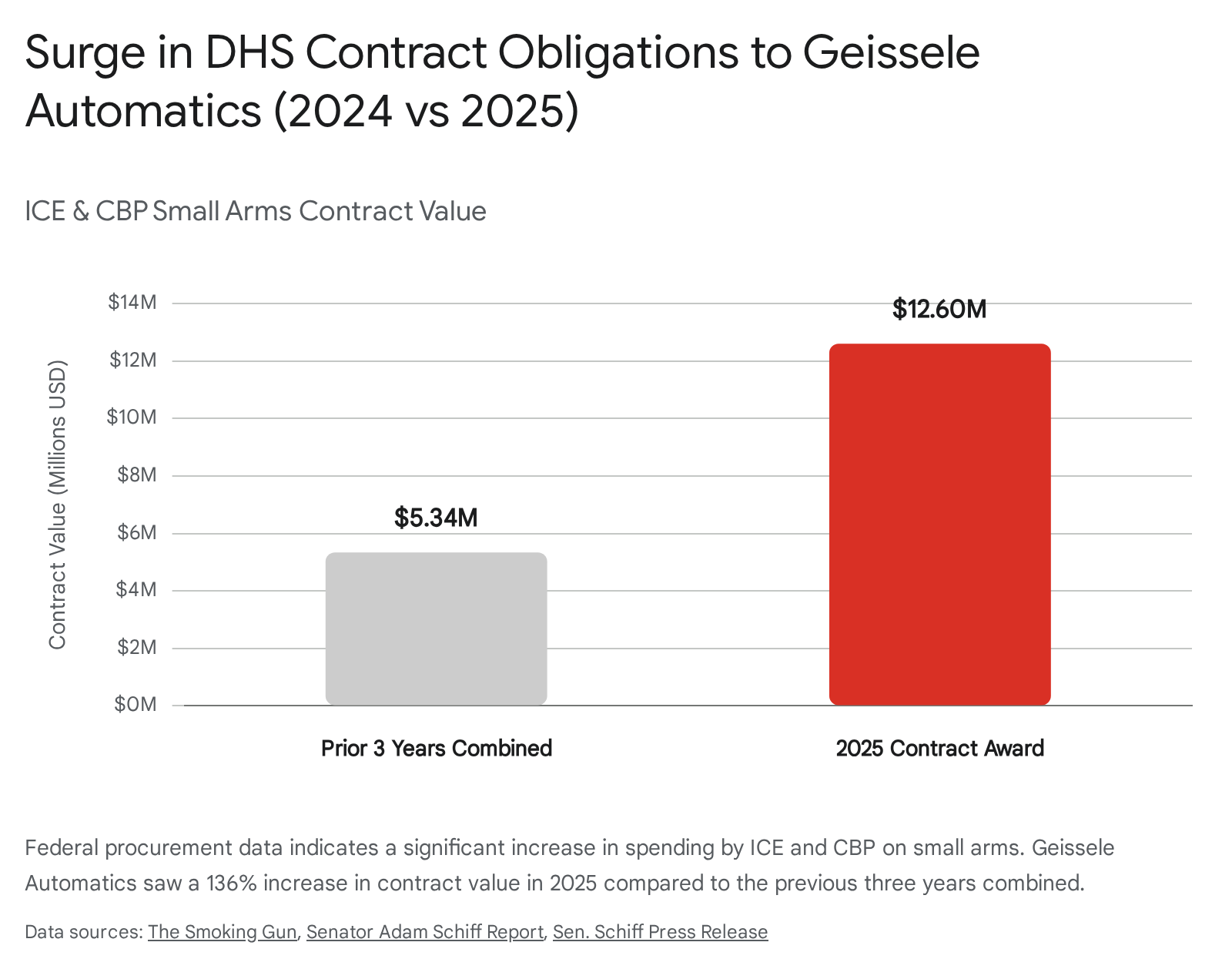
Geissele was a primary beneficiary of this procurement. In 2025, the company was awarded a $12.6 million contract to provide AR-15 style rifles, magazines, and replacement parts to ICE and CBP, representing a 136% increase over Geissele’s contracts from the previous three years combined5. ICE finalized delivery orders in late 2025 for the “Geissele Border Patrol Rifle,” a military-specification AR-style rifle available in multiple configurations5. Based on commercial retail pricing of approximately $1,700 to $1,900 per rifle, these contracts indicate the procurement of thousands of weapon systems13.
Additional federal contracts further underscore this trajectory. Customs and Border Protection executed a separate order for $3.06 million for duty rifles in September 202512. The Department of Veterans Affairs Office of Inspector General (OIG) placed orders for $123,860 to replace standard-issue shotguns with Geissele rifles, and the Drug Enforcement Administration (DEA) Office of Training issued a delivery order for $71,477 for Geissele AR Platform Rifles10. These contracts indicate that Geissele is establishing itself as a standard-issue supplier for multiple federal tactical units.
5. Industry Reputation, Brand Equity, and Controversies
Geissele Automatics holds an established reputation in the firearms industry, noted for quality and precision manufacturing. All products are machined in North Wales, Pennsylvania, allowing for in-house quality control1. “Geissele” is frequently utilized as an industry baseline; users routinely upgrade stock firearms by installing a Geissele trigger to maximize performance20. However, the company’s high profile has also subjected it to scrutiny regarding product engineering and corporate behavior.
5.1. The MK16 Rail Controversy A notable engineering controversy surrounding Geissele emerged shortly after the initial fielding of the URGI platform, centering on the structural integrity of the Super Modular Rail MK16. Around 2018-2019, a PowerPoint slide allegedly originating from a U.S. Army testing presentation circulated online, claiming that during drop testing, the Geissele MK16 rail suffered a 10+ MOA shift in laser zero and physical deformation, compared to a 3 MOA shift on a standard quad-rail17.
Civilian end-users attempted to replicate the drop tests with their commercial MK16 rails and documented similar failures17. The community diagnosed the mechanical failure points: the slim profile (1.58 inches) of the handguard created substantial leverage upon impact when heavily weighted at the muzzle end with infrared laser devices like the MAWL17. When dropped, the rail would flex inward, and due to tight internal clearances, the inside of the rail would impact the rigid, pinned gas block17. This impact caused the 6061-T6 aluminum to deform, destroying the laser’s zero17.
5.2. Engineering Revisions and Public Relations Backlash Geissele’s corporate response to the drop-test data was heavily criticized by users. Rather than issuing a technical explanation or product recall, the company’s social media managers deleted critical threads and banned users asking questions on platforms like AR15.com, Facebook, and Instagram16. Bill Geissele issued statements attributing minor rail profile changes to “worn extruder dies” and dismissed the drop-test concerns28.
Geissele subsequently instituted unannounced engineering revisions to the MK16 production line. The company transitioned production from standard 6061-T6 aluminum to a stronger “7000 series” aluminum, matching the tensile strength of the 7075-T6 upper receiver to ensure impact forces were shared more equally27. Engineers also radiused the internal corners of the gas tube channel at the top of the handguard, removing 90-degree angles to eliminate a natural stress riser and increase structural resistance28. Following these revisions, the bending issue was resolved, and USASOC continued to field the MK16 rail, though the public relations response left a lingering negative perception among a subset of the civilian market16.
5.3. Pricing Strategies and Market Perception Geissele has faced scrutiny over its firm pricing and litigation strategies. During the COVID-19 pandemic demand surge, the company experienced consumer backlash for increasing prices across its product lines while some users alleged a simultaneous lowering of finishing standards, citing rusted hardware and poor anodizing16. The company also attempted to sell standard D&H aluminum magazines at an inflated price of $22; following rapid market backlash, the company issued an apology and reduced the price16. The proprietary Geissele Reaction Rod was also criticized for its high price ($99) and tendency to damage index pins if torqued improperly, compared to less expensive alternatives16.
Furthermore, Geissele actively protects its market position through litigation. The company sued Joe Bob’s Outfitters for selling Geissele triggers below the established Minimum Advertised Price (MAP), and engaged in a lawsuit against Jewell, a manufacturer of fully adjustable match triggers16. Critics allege that Jewell produced a trigger that offered finer adjustability and that Geissele’s litigation effectively forced a competitor out of the market16. These actions have contributed to a market perception of the company as an entity focused on aggressively protecting its market share and premium pricing structure16.
6. Future Trajectory and Strategic Initiatives
Geissele Automatics is executing a strategy to expand beyond its status as an accessories provider, investing heavily in research, development, and intellectual property to solve next-generation military challenges.
6.1. Advanced Research: DEVCOM CRADA and GNB 200 Alloy In 2022, Geissele Automatics and Carpenter Technology entered into Cooperative Research and Development Agreements (CRADAs) with the U.S. Army Combat Capabilities Development Command (DEVCOM) Armaments Center14. The objective was to develop small arms gun barrels capable of withstanding the extreme pressures and temperatures generated by modern, high-velocity ammunition without relying on hazardous hexavalent chromium coatings14.
In response, Carpenter Technology developed GNB 200, a premium remelted alloy steel formulated for high-temperature wear resistance and high tensile strength14. Because GNB 200 operates near the upper limit of what can be reliably forged, DEVCOM partnered with Geissele for its specialized manufacturing expertise to perform the cold hammer forging and develop manufacturability parameters14. The DEVCOM team tested the Geissele-forged GNB 200 barrels in M240L machine guns over a three-year period ending in spring 2025, where the alloy demonstrated significantly improved performance over standard barrels15. Following this, Geissele’s CRADA was renewed for an additional three years to further refine advanced barrel coatings15.
6.2. Intellectual Property and the F41A21/18 Profile During the CRADA collaboration, DEVCOM and Geissele engineers co-developed a new internal rifling profile, designated as the F41A21/18 profile, designed to reduce wear and improve shot dispersion14. This geometry deviates from standard Sporting Arms and Ammunition Manufacturers’ Institute (SAAMI) rifling by defining a cross-sectional profile consisting of a proprietary mixture of arcuate (curved) and linear portions19.
Geissele and DEVCOM successfully patented this rifling profile (U.S. Patent 12,203,716 B2) on January 21, 202515. The company maintains an active patent portfolio, demonstrating a commitment to protecting its intellectual property. Recent filings include a hardened cam race designed to fit within the upper receiver to increase durability (Patent 12656072, granted June 2026), and proprietary release mechanism assemblies for collapsible stocks (Publication 20260078980)19.
6.3. Transition to Prime Contractor and Heavy Weapons The fulfillment of multi-million dollar contracts for complete Border Patrol Rifles signifies Geissele’s operational transition into a prime contractor for complete small arms5. Furthermore, Geissele’s strategic acquisition of the 240LW and 240LWS machine gun designs from Barrett Firearms in 2020 indicates an ambition to compete in the heavy, crew-served weapons market18.
By combining the proven 240LW design with the newly developed GNB 200 alloy, Nanoweapon coatings, and cold hammer forging expertise, Geissele is positioning itself to bid on future military hardware replacements18. As military testing concludes and next-generation systems are adopted, it is probable that Geissele will integrate these military-grade advancements into its commercial lines, leveraging military research to drive commercial sales18.
7. Conclusion
Geissele Automatics has executed a consistent, multi-decade expansion strategy. Beginning as a small-scale operation fabricating triggers for competitive marksmen, the company has evolved into an industrial supplier for the U.S. military and federal law enforcement.
The company’s primary competitive advantage lies in its pursuit of materials science—evidenced by Nanoweapon coatings, Carpenter 158+ steel, the Super 42 braided wire system, and GNB 200 barrel alloys—and its ability to translate military research directly into commercial products. While Geissele has faced market criticism regarding early product engineering flaws and corporate public relations tactics, the firm has demonstrated the engineering agility required to revise and improve its mechanical platforms.
Looking forward, Geissele’s trajectory points toward complete systems integration. Backed by renewed federal research agreements, a growing patent portfolio, and significant federal procurement contracts extending through 2026, Geissele Automatics is positioned to remain an influential entity in the small arms industry.
Please share the link on Facebook, Forums, with colleagues, etc. Your support is much appreciated and if you have any feedback, please email us in**@*********ps.com. If you’d like to request a report or order a reprint, please click here for the corresponding page to open in new tab.
Sources Used
- Geissele Automatics Triggers and AR Components | Ammunition Depot, https://www.ammunitiondepot.com/geissele-automatics-triggers-and-ar-components
- Our History – Geissele Automatics, https://geissele.com/history/
- GEISSELE – UN12Magazine, https://un12magazine.com/geissele/
- Geissele URGI – Grokipedia, https://grokipedia.com/page/Geissele_URGI
- Gun Industry Made Millions Arming ICE and Border Patrol Agents, https://smokinggun.org/gun-industry-made-millions-arming-ice-and-border-patrol-agents/
- Reliability Enhanced Bolt Carrier Group, 5.56mm, Nanoweapon® – Geissele Automatics, https://geissele.com/reliability-enhanced-bolt-carrier-group-5-56mm-nanoweapon.html
- Geissele – Super 42® Braided Wire Buffer Spring/Buffer Combo H1, https://www.milehighshooting.com/geissele-super-42-braided-wire-buffer-spring-and-buffer-combo-h1/
- ALG Defense – Geissele Automatics, https://geissele.com/alg-home
- ALG Defense | Soldier Systems Daily, https://soldiersystems.net/2012/12/10/alg-defense/
- CONTRACT to GEISSELE AUTOMATICS LLC | USAspending, https://www.usaspending.gov/award/CONT_AWD_36C10M25N50079_3600_70B06C22D00000020_7014/
- Contract 15DDTR25F00000161 Geissele Automatics – HigherGov, https://www.highergov.com/contract/70B06C22D00000020-15DDTR25F00000161/
- CONTRACT to GEISSELE AUTOMATICS LLC | USAspending, https://www.usaspending.gov/award/CONT_AWD_70B06C25F00000677_7014_70B06C22D00000020_7014
- ice and cbp’s multi-million dollar surge to amass weapons and munitions – Adam Schiff, https://www.schiff.senate.gov/wp-content/uploads/2026/02/ARMED-FOR-VIOLENCE-REPORT2.18.26.pdf
- Army, Geissele, Carpenter Partner on Next-Gen Barrels | The Armory Life Forum, https://www.thearmorylife.com/forum/threads/army-geissele-carpenter-partner-on-next-gen-barrels.25784/
- Army forges partnership with Pennsylvania companies to create next generation small arms gun barrel | Article, https://www.army.mil/article/291072/army_forges_partnership_with_pennsylvania_companies_to_create_next_generation_small_arms_gun_barrel
- No Geissele love on Reddit? Did Bill upset folks : r/ar15, https://www.reddit.com/r/ar15/comments/11z52h5/no_geissele_love_on_reddit_did_bill_upset_folks/
- Rethinking Rails: Cutting it Too Close – The New Rifleman, https://thenewrifleman.com/rethinking-rails-cutting-it-too-close/
- Army, Geissele, Carpenter Partner on Next-Gen Barrels | thefirearmblog.com, https://www.thefirearmblog.com/blog/army-geissele-carpenter-partner-on-next-gen-barrels-44826928
- William H. Geissele Inventions, Patents and Patent Applications, https://patents.justia.com/inventor/william-h-geissele
- Geissele Triggers: A Comprehensive Comparison And Performance Analysis, https://blog.primaryarms.com/guide/geissele-trigger-guide/
- Geissele Automatics – Redcon1 Tactical LLC, https://redcon1tactical.com/geissele-automatics
- Geissele Triggers for ARs and Space Guns – Accurate Shooter Bulletin, https://bulletin.accurateshooter.com/2007/12/geissele-ar-trigger/
- USSOCOM UPPER RECEIVER: Geissele URGI – SWAT Survival | Weapons | Tactics, https://www.swatmag.com/article/ussocom-upper-receiver-geissele-urgi/
- Geissele Automatics URG-I – GUNS Magazine, https://gunsmagazine.com/guns/rifles/geissele-automatics-urg-i/
- A Look at the Geissele Automatics URG-I – The Shooter’s Log, https://blog.cheaperthandirt.com/review-geissele-automatics-urg/
- URG-I Build Hub | Clone-Correct Geissele USSOCOM Upper — CCC, https://charliescustomclones.com/urg-i/
- they ever fix that mk16 rail thingy? i havnt bought a geissele in a few years. – Reddit, https://www.reddit.com/r/GeisseleAutomatics/comments/1f7ae1j/they_ever_fix_that_mk16_rail_thingy_i_havnt/
- Has the bendy rail been fixed by geissele? : r/URGI – Reddit, https://www.reddit.com/r/URGI/comments/170sfdv/has_the_bendy_rail_been_fixed_by_geissele/
- Geissele Automatics 5.56 Enhanced AR-15 Bolt Carrier Group – Nanoweapon, https://aerospacearms.com/geissele-automatics-5-56-enhanced-ar-15-bolt-carrier-group-nanoweapon/
- Geissele Reliability Enhancement Kit®, H2, 5.56mm, https://geissele.com/reliability-enhancement-kit-h2-5-56mm.html
- Reliability Enhanced Bolt Carrier and Gas Key – Geissele Automatics, https://geissele.com/reliability-enhanced-bolt-carrier-and-gas-key.html
- Geissele Reliability Enhanced Bolt Carrier Group (BCG) for AR15 / M4 / M16, https://charliescustomclones.com/geissele-reliability-enhanced-bolt-carrier-group-bcg-for-ar15-m4-m16/
- Super 42® Braided Wire Buffer Spring and Buffer Combo, H1 – Geissele Automatics, https://geissele.com/super-42-braided-wire-buffer-spring-and-buffer-combo-h1.html
- Geissele Automatics Super 42 Braided Buffer Spring and H2 Buffer – Primary Arms, https://www.primaryarms.com/geissele-automatics-super-42-braided-buffer-spring-and-h2-buffer
- SUPER 42 – Geissele Automatics, https://geissele.com/amfile/file/download/file/2ca40377556471fc7b78b6803964463c/
- Introducing the “Super 42 Braided Wire Buffer Kit” – YouTube, https://www.youtube.com/watch?v=G8eyRMeEJQY
- ALG Defense – Overview of the ATK AK Trigger – Recoil Magazine, https://www.recoilweb.com/alg-defense-overview-of-the-atk-ak-trigger-67721.html
- ALG Defense – Gunbuyer, https://www.gunbuyer.com/brand/alg-defense.html
- MK16 revisions? : r/URGI – Reddit, https://www.reddit.com/r/URGI/comments/16sfvmk/mk16_revisions/
- NEWS: In New Report, Sen. Schiff Exposes Over $140 Million Dedicated to ICE and CBP’s Deadly Arsenal of Weapons and Munitions Since Start of Second Trump Administration, https://www.schiff.senate.gov/news/press-releases/news-in-new-report-sen-schiff-exposes-over-140-million-dedicated-to-ice-and-cbps-deadly-arsenal-of-weapons-and-munitions-since/
- Bill Geissele released a video apology regarding his latest price gouging incident. – Reddit, https://www.reddit.com/r/ar15/comments/jww3n5/bill_geissele_released_a_video_apology_regarding/
- U.S. Army Testing Improved Gun Barrel Material | An Official Journal Of The NRA, https://www.americanrifleman.org/content/u-s-army-testing-improved-gun-barrel-material/