Executive Summary
From a mechanical standpoint, a firearm operates as a heat engine that relies on delicate springs—such as recoil, hammer, striker, trigger, and extractor springs—moving through tight metal tolerances1. Because these springs exert a set amount of force, the thickness and consistency of your gun oil directly impact overall reliability2. When an oil thickens into syrup, freezes into wax, or bakes into a hard residue, the extra friction easily overcomes spring tension. This causes light primer strikes, failure to return to battery, sluggish trigger resets, or completely jammed actions3.
A review of user feedback across shooting forums and online communities highlights five main takeaways:
- Common Oils Reported for Gumming Up: User complaints center around four main categories:
- Bio-Based Firearm Lubricants: FrogLube (Paste and Liquid), FIREClean, Seal 1, and Tracklube3.
- Volatile Water-Displacers and Household Oils: WD-40, 3-In-One Oil, and Liquid Wrench9.
- Legacy Solvent-Cut CLPs and PTFE-Bearing Oils: Break-Free CLP, Rem Oil, and Outers Gun Oil10.
- Improvised Cooking and Wood Oils: Olive oil, canola oil, soybean oil, Crisco shortening, Boiled Linseed Oil (BLO), Pure Tung Oil, Danish Oil, and Teak Oil5.
- What Is Actually Happening? Gun owners often blame “polymerization” whenever an oil becomes sticky or solid, but testing reveals four distinct underlying causes:
- True Chemical Hardening (Polymerization) occurs in plant oils containing unsaturated fats (FIREClean, olive oil, canola oil, Crisco, linseed oil, and tung oil)5.
- Freezing, Evaporation, Chemical Breakdown, and Gelation explain the issues seen with FrogLube. It consists mostly (~92%) of coconut fat that freezes into wax at or below 48°F, thickens in days as light solvents evaporate, smokes and gums at 150°F, goes rancid over time, and forms a thick gel when mixed with petroleum oils3.
- Solvent Evaporation and Long-Term Varnish cause the sticky residue left by WD-40, 3-In-One Oil, and solvent-heavy CLPs. Thin solvents evaporate quickly, leaving behind heavier oils that collect dust and slowly cure into a hard shell over time9.
- Heat Degradation and Carbon Paste occur in Teflon-bearing oils (above 500°F–752°F) and thick polymer oils like Lucas Extreme Duty Gun Oil. These do not chemically harden on their own but mix with carbon soot during heavy shooting to form a dark paste13.
- What Drives True Oil Polymerization? True oil hardening happens when oxygen breaks down unsaturated fatty chains25. Inside a firearm, this chemical process speeds up due to 300°F to 500°F+ firing heat, thin oil films exposed to air, and friction-exposed iron and copper particles that act as catalysts1.
- Which Products Are Most at Risk? An oil’s risk of hardening depends on its double-bond content (measured by iodine value) and evaporation rate25. Drying wood finishes (linseed, tung, walnut) harden in hours or days; semi-drying cooking and bio-oils (FIREClean, soybean, canola, olive) gum up over weeks or months5.
- Will Ronin’s Grips HRO and HRO PRSC Polymerize? No. Both HRO (Original 10W-30) and HRO PRSC (0W-16) rely on a 99.5% pure synthetic Gas-to-Liquid base containing no double bonds, crude wax, or Teflon1. Neither oil will turn sticky, go rancid, or freeze into wax because the formulation includes ZDDP to break down oxidation products and dispersants to keep soot in suspension. However, shooters should mind cold-weather limits: HRO Original performs best at 40°F and above (or down to 0°F when wiped thin), as 10W-30 weight oil becomes too thick to cycle actions at extreme sub-zero temperatures2. For temperatures under 40°F—or for handguns, rimfires, and shotguns—shooters should use HRO PRSC (0W-16), which is designed for -22°F to 86°F conditions2.
1. Social Media and Forum Reports of Lubricant Polymerization
On forums like AR15.com, Reddit, Sniper’s Hide, and The High Road, reports of gun oils “gumming up” or turning into “varnish” are frequent troubleshooting topics3. These user reports generally fall into four product categories.
1.1 FrogLube (and Similar Coconut-Oil Bio-Lubes: Seal 1 and Tracklube)
Among modern commercial firearm lubricants, FrogLube (along with chemically similar bio-pastes Seal 1 and Tracklube) is the most frequently cited product in user reports of gumming, sluggish action cycling, and solidification3. Sold as a food-grade, biodegradable, non-petroleum weapons care system that absorbs into metal pores when heated3, FrogLube is regularly reported by shooters and gunsmiths as turning tacky, syrupy, waxy, or rancid over time3.
User reports describe a repeatable pattern linked to how the lubricant is applied and stored:
- Migration into Enclosed Internal Spaces During Heating: Following product instructions and common forum practices, users warm metal firearm parts with a hair dryer, heat gun, or oven (often to about 200°F), apply FrogLube paste or liquid, let the parts cool, and wipe away the visible surface excess40. While warm and thin, however, the liquid seeps into enclosed internal areas—such as firing pin channels, striker tunnels, sear pivots, decocker levers, recoil spring tubes, and revolver internals—where excess oil cannot be wiped away without full disassembly3.
- Thickening, Cold Freezing, and Storage Seizure: When treated firearms sit in a safe for 1 to 7 months, or are taken into temperatures below 50°F, users report that the trapped lubricant turns into a maple-syrup consistency, a solid wax, or a brown glue-like residue3.
- Reported Malfunctions:
- Firing Pin and Striker Failures: Failures to fire caused by gummed firing pin channels in AR-15 carbines during training courses3, Benelli M4 shotguns failing to ignite primers twice in a row6, SIG Sauer P239 pistols with locked firing pins46, and bolt-action rifles with brown, gummed firing pins47.
- Slide, Bolt Carrier, and Battery Failures: Heckler & Koch VP9 pistols failing to return to battery after 400 rounds with sticky barrels (even after following the manufacturer’s degreasing steps)4, 1911 pistols and .40 S&W handguns with slides seized or dragging after 1 to 6 months in storage42, Glock slides running sluggishly with undissolved coconut solids in the liquid formula4, and AR-15 bolt carrier groups (BCGs) gumming up4.
- Trigger, Sear, and Decocker Drag: SIG Sauer P229 decocker levers returning slowly “as if treated with maple syrup” after 500 rounds3, CZ P-07 pistol triggers losing their tactile reset until cleaned out4, custom CZ 527 rifle triggers feeling like “contact adhesive” after two months22, and ball-bearing pocket knives gumming up within days or weeks, requiring hot water, G96 CLP, or gasoline to remove the residue3.
1.2 FIREClean (Plant-Based Vegetable Oil Blend)
In September 2015, FIREClean became the subject of widespread online debate (“CanolaOilGate”) after firearms blogger Andrew Tuohy (Vuurwapen Blog) and chemist Everett Baker published infrared (FTIR) spectroscopy tests comparing FIREClean to commercial cooking oils, concluding that FIREClean was “probably a modern unsaturated vegetable oil, virtually the same as many oils used for cooking” such as Crisco canola and soybean oil48.
During the federal lawsuit that followed (FireClean, LLC v. Tuohy), court filings and patent documents clarified the product’s actual formula:
- Vegetable Oil Composition: FIREClean’s owners stated in court filings that the product is “at least 99% vegetable oil” (specifically, more than 99% plant-based oils and less than 1% other ingredients)51. Their patent application describes a blend of at least three plant-based triglyceride oils chosen from a list of 16 botanical oils (forum reviewers noted patent examples using combinations of rice bran oil, walnut oil, sesame oil, and soybean oil), with a preference for at least one high-oleic (monounsaturated) oil5.
- Differences Between Frequent Use and Long-Term Storage: Discussions on Sniper’s Hide, Reddit, Rokslide, and CanadianGunNutz showed two different user experiences. Shooters who fired 2,000+ rounds over short intervals and wiped their guns down regularly reported that FIREClean kept carbon soft and easy to wipe off with paper towels47. By contrast, other users and lubrication specialists noted that because vegetable oils are unsaturated, leaving FIREClean on guns in storage or exposing it to repeated heat cycles and air causes it to oxidize, polymerize, and form a sticky film5. During the lawsuit, FIREClean filed a Motion in Limine Regarding Withdrawn Gumming Claims asking the court to exclude evidence or testimony claiming that FIREClean polymerizes, gums, or becomes sticky on firearms55.
1.3 WD-40, 3-In-One Oil, and Legacy Solvent/PTFE CLPs
Long before bio-based gun lubes appeared, gunsmiths and armorers frequently pointed to household water-displacers and all-in-one aerosols as common causes of gummed internal parts9:
- WD-40: Across AR15.com, The Firing Line, The High Road, BladeForums, and Reddit, gunsmiths report repairing firearms that were sprayed internally with WD-40 and left in storage, where the residue turned into a sticky yellow film or hard brown varnish that froze sears, triggers, and firing pins9. In one account on AR15.com, a gunsmith’s assistant described a hunting rifle treated with WD-40 for 10 to 15 years that was varnished into its wooden stock after the fluid seeped into the wood and hardened11. Hardware store workers report similar issues when WD-40 is sprayed into door locks, where it traps dust and binds the lock cylinders9. (By contrast, users who spray WD-40 only to displace water after rain or snow and immediately wipe or blow the metal dry before applying gun oil report no gumming9.)
- 3-In-One Oil and Liquid Wrench: Users on AR15.com and The High Road also advise against using 3-In-One Oil and Liquid Wrench inside firearms, noting that 3-In-One Oil thickens into a gummy residue during storage10.
- Break-Free CLP and Rem Oil (Solvent Evaporation and PTFE Deposits): Legacy Cleaner-Lubricant-Preservative (CLP) products receive two main criticisms on Reddit, The High Road, and BobIsTheOilGuy. First, standard CLPs contain a high percentage of volatile solvents for cleaning carbon, which evaporate within about a week of storage and leave behind a thin or tacky residue14. Second, shooters point to the solid PTFE (Teflon) powder suspended in commercial Break-Free CLP and Rem Oil (noting that Mil-Spec Royco CLP does not contain PTFE)13. Commenters on The High Road note that under sustained rapid fire in high-heat areas, PTFE particles can break down into gummy bore or gas-system deposits and release harmful fluorinated fumes when overheated13.
1.4 Improvised Cooking Oils and Wood Stock Finishing Oils
A fourth group of reports involves shooters applying household cooking oils or wood stock finishes to metal firearm parts:
- Cooking Oils (Olive Oil, Canola Oil, Crisco): On Reddit (r/guns) and Rokslide, users warn that kitchen cooking oils polymerize on gun metal5. One shooter lubricated a pump-action shotgun with olive oil; within one week, the action was glued shut so firmly that the owner had to hold the shotgun by the forend pump and slam the buttstock against the ground several times to break it open5. On AR15.com’s black powder forum, experienced muzzleloader and cap-and-ball revolver shooters warn against using Crisco or vegetable oils to “season” bores and cylinders like cast-iron pans, noting that vegetable fats polymerize under heat into an uneven layer of baked-on soot that harms accuracy and binds revolver cylinders (whereas mineral oil, Vaseline, paraffin wax, and mutton or beef tallow do not polymerize)18.
- Wood Stock Oils (Boiled Linseed Oil, Tung Oil, Danish Oil, Teak Oil): On Reddit (r/M1Rifles) and AR15.com, military surplus restorers note that wood finishes—such as Boiled Linseed Oil (BLO), raw linseed oil, pure tung oil, Danish oil, and teak oil—are meant to soak into wood and harden through cross-link polymerization16. When applied too heavily or left under M1 Garand front handguard ferrules and metal spacers without being blown clear with compressed air, they cure into a crusty or gummy film on the metal16. (Restorers also warn of the opposite problem: petroleum gun oils soaking into wood stocks never harden, instead softening and rotting the wood black over time17.)
| Product / Lubricant Category | Primary Chemical Base Stock | Reported Symptoms | Documented Mechanical Problems |
| FrogLube (Paste & Liquid), Seal 1, Tracklube | Coconut oil (~92% saturated lauric fat), mint/tree oil scent, bio-surfactants8 | Thickens to syrup in 4 days; freezes to wax at or below 48°F; smokes at 150°F; turns to brown glue over months3 | Stuck firing pins (AR-15, Benelli M4, SIG P239, bolt rifles); slow SIG P229 decockers; HK VP9 battery failures; muted CZ P-07 trigger reset; seized 1911 slides3 |
| FIREClean | >99% Blend of at least 3 plant-based vegetable oils (preferring high-oleic oils)51 | Sticky film buildup and gumming after heating and extended storage5 | Gumming and stickiness on actions when left uncleaned over long storage or heating intervals5 |
| WD-40 | Volatile aliphatic hydrocarbons (mineral spirits) + light petroleum mineral oil + propellant9 | Evaporates quickly leaving a tacky film; forms yellow-brown lacquer/varnish over years9 | Gummed internal receiver parts and locks; dust buildup; hunting rifle action varnished into wooden stock after 10–15 years9 |
| 3-In-One Oil | Light petroleum/mineral oil blend (mistakenly called vegetable-based on some forums)10 | Thickens into a sticky, gummy residue during long-term storage10 | Gummed internal firearm actions and household mechanisms over extended storage10 |
| Break-Free CLP / Rem Oil | Synthetic/mineral oil blend + volatile solvents + solid PTFE particles13 | Solvent carrier evaporates in ~1 week; PTFE gels above 621°F and decomposes above 500°F–752°F13 | Drying out that allows rust; PTFE and carbon buildup in bores and gas systems during sustained rapid fire13 |
| Cooking Oils (Olive, Canola, Crisco) | Monounsaturated & polyunsaturated plant triglycerides5 | Oxidizes and cross-links into sticky cast-iron-style seasoning5 | Pump shotgun action glued shut in 7 days; baked-on bore and chamber fouling in black powder revolvers5 |
| Stock Oils (BLO, Tung, Danish, Teak) | Conjugated & polyunsaturated drying oils + cobalt/manganese/iron driers16 | Cross-links into a crusty or gummy polymer film when exposed to air16 | Gummy film buildup under M1 Garand front handguard ferrules and metal contact surfaces17 |
2. Technical Diagnosis: Did They Actually Polymerize?
In everyday forum discussions, almost any oil that turns thick, sticky, or hard is said to have “polymerized”5. In lubrication engineering, however, polymerization has a specific meaning: a chemical reaction in which individual oil molecules form permanent chemical bonds (cross-links) with one another, building a linked three-dimensional polymer network20. Checking the reported products against this definition shows that only some oils underwent true chemical polymerization, while others failed through freezing, evaporation, or heat degradation.
2.1 Group 1: True Chemical Cross-Link Polymerization (FIREClean, Cooking Oils, and Stock Oils)
- Did they actually polymerize? Yes.
- Technical Explanation: FIREClean, olive oil, canola oil, soybean oil, sunflower oil, Crisco shortening, linseed oil (raw and boiled), and tung oil are all plant-based triglycerides (three fatty acid chains linked to a glycerol molecule) that contain unsaturated carbon-carbon double bonds (C=C)5. When exposed to oxygen, heat, light, and metal ions, these double bonds undergo free-radical oxidation, forming peroxide (R-O-O-R), ether (R-O-R), and carbon-carbon (R-R) cross-links between neighboring oil molecules5.
- Why FIREClean’s “High-Oleic” Formula Still Gummed in Storage: In its patent filing, FIREClean stated a preference for at least one high-oleic oil (rich in monounsaturated oleic acid, C18:1, which has one C=C double bond) over polyunsaturated oils (which have two or three C=C bonds), arguing that high-oleic oils have better storage stability and a “non-drying and non-gumming nature”53. While monounsaturated oleic acid oxidizes at 1/10th the speed of linoleic acid (two C=C bonds) and 1/25th the speed of linolenic acid (three C=C bonds)25, it still contains an active C=C double bond that oxidizes over time25. In addition, FIREClean blended at least three vegetable oils from a patent list that included polyunsaturated walnut, soybean, sesame, and rice bran oils5. Under firing heat (300°F–500°F+), thin-film air exposure, and contact with iron on steel parts, both olive oil and blended vegetable oils cross-link into a sticky polymer varnish—the same chemical reaction that creates the hard coating on a seasoned cast-iron skillet1.
2.2 Group 2: Freezing, Evaporation, Ester Breakdown, and Surfactant Gelation (FrogLube, Seal 1, and Tracklube)
- Did they actually polymerize? Mostly No in short-term and cold-weather failures (which are caused by freezing into wax and evaporation of light scent/carrier oils); Partially Yes over long storage or high heat (via heat breakdown, ester hydrolysis, and oxidation of minor unsaturated components).
- Technical Explanation: Chemical analyses discussed on firearms forums showed that FrogLube (along with Seal 1 and Tracklube) consists mainly of coconut oil blended with mint/wintergreen or tree oils for scent, stabilizers, and bio-surfactants4. Unlike canola or linseed oil, coconut oil is ~92% saturated fatty acids—specifically ~47% lauric acid (C12:0), ~18% myristic acid (C14:0), ~9% caprylic acid (C8:0), ~9% palmitic acid (C16:0), ~6% capric acid (C10:0), and ~3% stearic acid (C18:0)—giving it a very low Iodine Value of 6 to 1126. Because ~92% of its fatty acid chains have no C=C double bonds, pure coconut oil has a 2-to-3-year shelf life at room temperature and resists rapid drying-oil polymerization25.
- The Four Actual Causes of FrogLube Failures:
- Cold-Weather Freezing (<= 48°F): Pure coconut oil naturally melts between 20°C and 24°C (68°F to 75°F)67. According to US Patent 10,066,180 B1, formulated FrogLube solidifies at 48°F (8.9°C)23. In a 2-hour freezer test at 20°F (-6.7°C), FrogLube froze into a firm, opaque wax that held a clear fingerprint3. When a treated firearm fails in cool weather, FrogLube has not polymerized; it has frozen into solid coconut wax inside the firing pin channel or slide rails3.
- 4-Day Evaporative Thickening and Settling: In The Firing Line test where liquid FrogLube thickened from a “baby oil” consistency into a non-running “maple syrup” in 4 days3, the change happened too quickly to be saturated fat oxidation26. Instead, the volatile essential oils (mint/tree oils) or light carrier fluids evaporated into the air, while undissolved coconut fat solids settled and thickened at room temperature3.
- High-Heat Smoking and Gumming (>= 150°F): US Patent 10,066,180 B1 notes that FrogLube begins smoking at 150°F (65.5°C), and after smoking, leaves behind a sticky, gummy residue23. Because pistol barrels (during 400-round strings), AR-15 BCGs, and parts heated with heat guns or ovens to 200°F exceed 150°F, heat breaks down the coconut oil and essential oil additives into a tacky residue4.
- Multi-Month Ester Hydrolysis (Rancidity) and Surfactant Gelation: Although coconut oil has a low Iodine Value, lipid research shows that under humid conditions or in the presence of microbes and fungi, ester hydrolysis splits the coconut oil triglycerides back into free fatty acids with rancid odors22. These free fatty acids act as pro-oxidants on lipid hydroperoxides68, speeding up the oxidation of the remaining ~8% unsaturated fat fraction and scented plant oils25 while promoting rust on bare steel—which explains why guns stored for 2 to 7 months develop a rancid, brown glue-like buildup and surface corrosion4. In addition, because FrogLube is designed to dissolve petrochemicals on contact and lifts leftover petroleum oils like a surfactant, applying it over traces of standard gun oil produces a thick, dirty gel22.
2.3 Group 3: Solvent Evaporation and Long-Term Varnishing (WD-40, 3-In-One Oil, and High-Solvent CLPs)
- Did they actually polymerize? No in the short term (solvent evaporation and dust collection); Yes over multi-year storage (slow oxidation of petroleum residues into varnish).
- Technical Explanation: Forum posts occasionally claim that WD-40 gums up because it contains “fish oil” and that 3-In-One Oil is “vegetable based”11. Both claims are incorrect: WD-40 is a mixture of a volatile, lightweight aliphatic hydrocarbon solvent (similar to mineral spirits), a light petroleum mineral oil, and aerosol propellant9.
- Two-Stage Breakdown Process:
- Short-Term Solvent Evaporation (Days to Weeks): Within seconds to days after spraying WD-40 or a solvent-heavy CLP, the light mineral spirits evaporate, leaving behind a thin film of heavier petroleum oil9. If left wet inside an action, this tacky film traps dust, lint, and unburnt powder residue, gumming up lock cylinders and small arms mechanisms9.
- Long-Term Varnish Formation (1 to 15 Years): When left inside a firearm receiver or allowed to soak into a wood stock over 10 to 15 years, those uninhibited petroleum fractions react with powder residue and oxygen through slow hydrocarbon oxidation, hardening into a yellow-brown varnish or lacquer9.
2.4 Group 4: PTFE Gelation/Decomposition and Carbon-Polymer Paste (PTFE Oils and Heavy Polymer Blends)
- Did they actually polymerize? No.
- Technical Explanation for PTFE (Teflon) Oils (Break-Free CLP, Rem Oil): Polytetrafluoroethylene (PTFE) is already a fully polymerized fluorocarbon solid, (C2F4)n, suspended as a fine powder in the liquid oil15. While forum users sometimes write that “PTFE melts at about 450°F” and turns gummy13, materials data shows that virgin PTFE has a glass transition between 115°C and 130°C (239°F–266°F), a continuous service limit of 260°C (500°F), a short-term limit of 300°C (572°F), and a crystalline melting point of 327°C (621°F)31. Even above 621°F, PTFE does not flow like a normal melted plastic because of its very high melt viscosity; instead, it turns into a non-flowing translucent gel that fuses (sinters) under pressure at 360°C–380°C (680°F–716°F)31. In addition, PTFE begins slow thermal breakdown between 260°C and 350°C (500°F–662°F) and rapid decomposition (pyrolysis) above 400°C (752°F), giving off toxic fluorinated gases and acidic fumes at high temperatures13. Inside a rifle bore or gas system operating at 35,000–50,000 psi and high sustained heat, the liquid carrier oil boils away while the PTFE particles gel, fuse, and char with carbon soot into stubborn deposits13.
- Technical Explanation for Heavy Polymeric Oils (Lucas Extreme Duty Gun Oil): Lucas Extreme Duty Gun Oil uses a refined petroleum/semi-synthetic base oil blended with heavy hydrocarbon polymers and ~15% ZDDP29. It does not chemically cross-link or polymerize on its own29. However, because it relies on thick polymers to stay in place under gas blowback and does not use succinimide dispersants, those heavy polymers trap carbon soot and dust over high round counts, forming a thick, dark carbon paste that requires strong solvents to clean out29.
3. What Causes Oil to Polymerize? Chemical and Physical Mechanisms
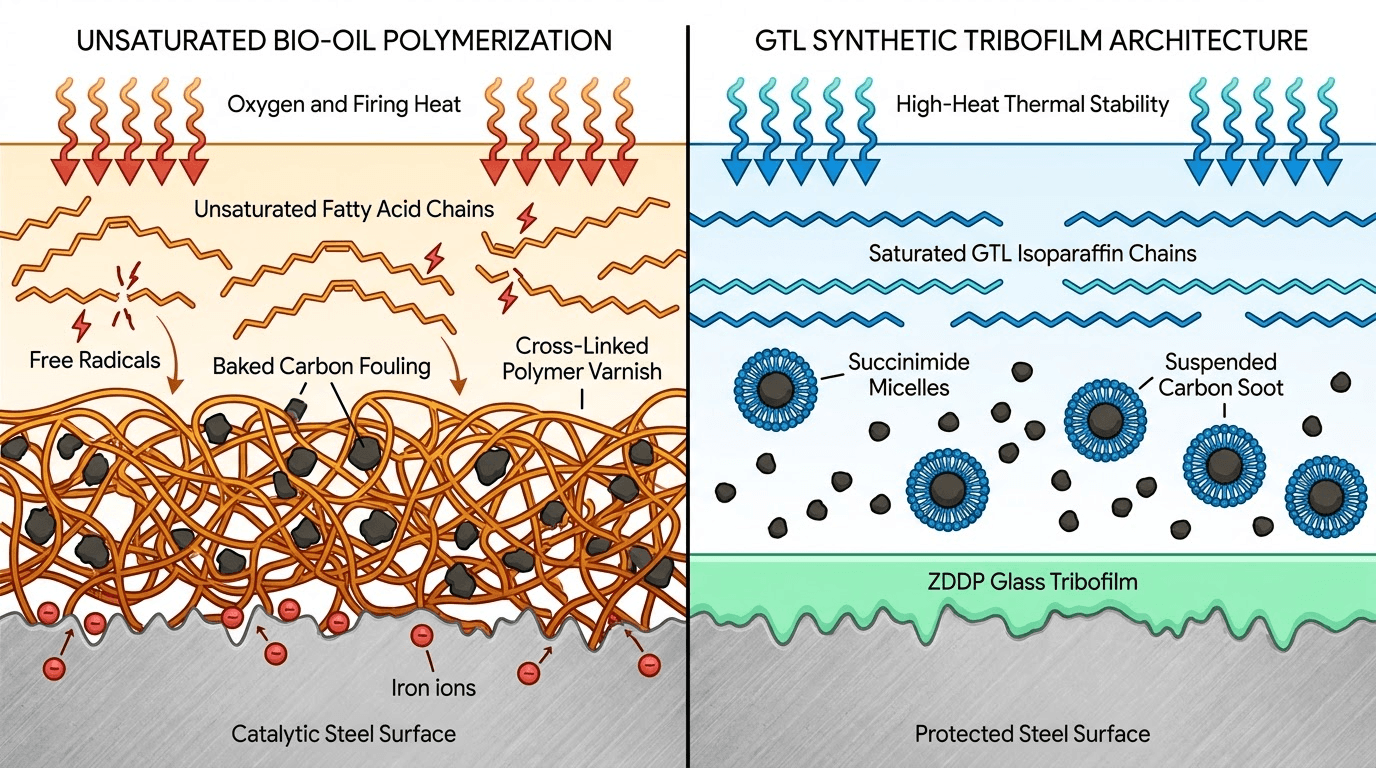
In simple terms, oil polymerization is a chain reaction driven by heat, oxygen, metal friction, and unsaturated fats21.
3.1 The Four-Stage Free-Radical Oxidation Process
Petroleum hydrocarbons and plant fats break down in four main steps: initiation, propagation, branching, and hardening33:
Stage 1: Initiation (Creating Free Radicals)
Firing heat, friction, or tiny steel and copper particles kick off the process by creating unstable, highly reactive radical molecules21:
R – R –> R* + R* (heat or shear splitting a C-C bond)
RH –> R* + H* (removing a hydrogen atom from a carbon chain)
Oils with unsaturated fats break down much faster because their chemical bonds are easier for oxygen to attack25. Saturated oils have stronger bonds that naturally resist this initial breakdown1.
Stage 2: Propagation (Oxygen Reaction and Chain Continuation)
Once radicals form, they quickly combine with air oxygen to create peroxy radicals that spread through the fluid33:
R* + O2 –> ROO*
The peroxy radical (ROO*) then drives the rate-limiting step of oxidation in one of two ways34:
- Hydrogen Atom Transfer: ROO* pulls a weak hydrogen atom off a neighboring oil molecule (RH), forming a hydroperoxide (ROOH) and a new carbon radical (R*) that keeps the chain reaction going33:ROO* + RH –> ROOH + R*
- Peroxyl Radical Addition: In unsaturated or conjugated double-bond systems (such as pure tung oil, which has alternating C=C-C=C-C=C double bonds), the peroxy radical attaches directly across a C=C double bond, creating an immediate peroxide bridge and a new carbon radical25:ROO* + -CH=CH- –> -CH(OOR)-CH*-
Stage 3: Chain Branching (Hydroperoxide Breakdown and Acid Formation)
As breakdown products build up, heat and metal contact split them into even more reactive fragments33:
ROOH –> RO* + HO* (driven by heat and metal catalysts)
This multiplies the rate of breakdown, creating unpleasant odors, moisture, and organic acids inside the action33.
RO* + RH –> ROH + R*
HO* + RH –> H2O + R*
Stage 4: Termination and Cross-Link Polymerization (Liquid –> Gum –> Hard Varnish)
As unsaturated oil absorbs oxygen (up to 10% of its weight)25, a thin skin forms over the surface. Beneath and within this layer, individual oil molecules begin bonding directly to one another20:
R* + R* –> R – R (carbon-carbon cross-link)
R* + RO* –> R – O – R (ether cross-link)
R* + ROO* –> R – O – O – R (peroxide cross-link)
As these molecular chains link together, the fluid transitions from a free-flowing liquid into a thick syrup, then a sticky gum, and finally a hard varnish film3.
3.2 Measuring Polymerization Risk: Iodine Value (IV) and the 1 : 10 : 25 Oxidation Ratio
Lubrication and coatings engineers measure an oil’s tendency to polymerize using two main benchmarks:
- The 1 : 10 : 25 Fatty Acid Oxidation Ratio: Chemical testing shows that the relative oxidation speed of Oleic Acid (1 C=C bond) to Linoleic Acid (2 nearby C=C bonds) to Linolenic Acid (3 nearby C=C bonds) is 1 : 10 : 2525. Having two nearby double bonds increases oxidation speed 10 times; having three nearby double bonds increases oxidation speed 25 times25.
- Iodine Value (Iodine Number, IV): Measured using the Wijs Method (with iodine monochloride, ICl) or Hanus Method (with iodine bromide, IBr) under international standards ISO 3961:2018, AOCS Cd 1-25, and AOAC 920.158, the Iodine Value is the grams of iodine absorbed by 100 grams of oil25. Because iodine reacts directly with C=C double bonds, a higher Iodine Value means more double bonds and a faster polymerization rate25.
| Oil / Base Stock Type | Iodine Value (g I2 / 100g) | Primary Chemical Structure | Drying / Polymerization Category | Behavior Inside a Firearm |
| GTL Synthetic Base (Ronin’s Grips HRO / PRSC) | ~0 | 99.5% pure saturated branched alkanes (0% C=C bonds)1 | Non-Polymerizing Synthetic | Stays liquid; does not cross-link or cure into varnish1 |
| Refined Mineral / Paraffin Oil | ~0 to 2 | Saturated paraffins & naphthenes (API Group I–III)1 | Non-Drying Mineral | Does not polymerize at room temp; uninhibited cuts can oxidize over years or high heat1 |
| Coconut Oil (FrogLube Base) | 6 to 11 | ~92% Saturated fats (47% lauric C12:0, 18% myristic C14:0)26 | Non-Drying Saturated Fat | Freezes into wax <=48°F; smokes/gums at 150°F; breaks down into rancid free acids23 |
| Palm Kernel Oil | 14 to 21 | ~82% Saturated lauric/myristic fats26 | Non-Drying Saturated Fat | Semi-solid at room temperature; hardens in cool weather26 |
| Butter / Clarified Butter | 25 to 42 | Saturated & monounsaturated milk fats5 | Non-Drying Animal Fat | Solidifies at room temp; turns rancid and gums with heat5 |
| Beef / Mutton Tallow | 42 to 48 | Saturated stearic/palmitic & monounsaturated oleic18 | Non-Drying Animal Tallow | Traditional black-powder bullet grease; resists bore polymerization18 |
| Palm Oil | 50 to 55 | ~50% Saturated palmitic / ~50% unsaturated5 | Non-Drying Semi-Saturated | Breaks down and gums with firing heat and air exposure5 |
| Olive Oil | 75 to 94 | ~73% Monounsaturated Oleic Acid (C18:1)21 | Non-Drying (Slow-Gumming) | Oxidizes in thin films on steel; glued a pump shotgun shut in 1 week5 |
| Canola Oil | 110 to 126 | ~60% Monounsaturated Oleic + ~30% Linoleic/Linolenic21 | Semi-Drying Oil | Polymerizes into sticky amber cast-iron seasoning under heat and iron contact5 |
| Sunflower Oil | 110 to 143 | ~59%–65% Polyunsaturated Linoleic Acid (C18:2)21 | Semi-Drying Oil | Cross-links into tacky gum and cast-iron seasoning21 |
| Soybean Oil | 124 to 139 | ~61% Polyunsaturated Linoleic/Linolenic Acids26 | Semi-Drying Oil | Forms sticky varnish on metal surfaces over weeks5 |
| Linseed / Tung / Walnut Oil | 140 to 204 | ~68% Polyunsaturated Linolenic (C18:3) or Conjugated5 | True Drying Oil | Polymerizes into a hard film in hours (BLO) to 5–7 days (raw linseed)16 |
3.3 Why Firearms Speed Up Oxidation (And How Additives Prevent It)
A firearm action speeds up oil oxidation compared to normal bottle storage because it combines four factors:
- Metal Catalysts (Iron and Copper): In wood finishing, raw linseed oil (which takes 5 to 7 days to harden) is turned into fast-curing “Boiled” Linseed Oil (which sets in hours) by adding metal salts—specifically cobalt, manganese, iron, or lead ions—that speed up hydroperoxide breakdown16. Inside a firearm, sliding steel-on-steel contact on bolt rails, cam pins, locking lugs, and sears continually exposes bare iron (Fe2+/Fe3+), while brass cases and bullet jackets leave copper (Cu+/Cu2+) deposits1. Combining unsaturated double bonds with oxygen, heat, and iron as a catalyst speeds up polymerization21.
- High Firing Temperatures (300°F to 500°F+): In direct-impingement rifles, short-barreled rifles (SBRs), and suppressed firearms, hot propellant gases blow back into the action, raising bolt carrier group temperatures to 300°F to 500°F+ (with brief peak temperatures reaching 800°F)1. Because oxidation and evaporation rates rise sharply above a fluid’s thermal threshold, firing heat starts free-radical reactions while boiling away light oil fractions1.
- Thin Oil Films and Air Exposure: Because gun oils are spread as thin films over metal parts19, they have a large surface area exposed to air, allowing unsaturated oils to absorb up to 10% oxygen by weight while mixing with carbon soot, unburnt powder, lead, and copper fouling9.
- Pro-Oxidant Free Fatty Acids: When bio-based esters (such as coconut oil or plant oils) react with moisture and split into free fatty acids, those free acids act as pro-oxidants on hydroperoxides, speeding up rancidity and acid breakdown25.
To stop this process in high-performance lubricants, engineers use saturated synthetic base oils combined with up to four types of oxidation inhibitors1:
- Peroxide Decomposers (High-Temperature Antioxidants): Phosphorus and sulfur compounds—such as Zinc Dialkyldithiophosphate (ZDDP), trialkylphosphites, and sulfurized additives—that break down hydroperoxides (ROOH) into stable molecules without creating new free radicals, while also providing anti-wear and rust protection1.
- Chain-Breaking Antioxidants (Radical Scavengers): Compounds such as hindered phenols (for example, Vitamin E / alpha-tocopherol) that react with peroxy radicals (ROO*) to convert them into stable radicals that cannot continue the chain reaction25.
- Metal Deactivators: Nitrogen- and sulfur-containing compounds that bind dissolved metal ions into inactive complexes (chelates) so iron and copper cannot speed up hydroperoxide breakdown71.
- UV Absorbers: Additives that absorb ultraviolet light and release the energy as harmless heat to prevent light-driven oxidation71.
4. Risk Ranking: Firearm Lubricants Most Likely to Polymerize
Grouping base oils by their Iodine Value, saturation level, evaporation rate (NOACK volatility), and additive package provides a six-tier ranking of firearm lubricants and maintenance products from highest to lowest risk of gumming or polymerizing5:
| Risk Tier | Chemical Family / Base Stock | Representative Brands & Products | Primary Failure Mode in Small Arms | Time to Failure / Trigger Condition |
| Tier 1: Very High Risk | Polyunsaturated & Conjugated Drying Oils (Iodine Value 140–204) | Boiled Linseed Oil (BLO), Raw Linseed Oil, Pure Tung Oil, Danish Oil, Teak Oil, Walnut Oil5 | Fast, heat-generating free-radical cross-linking across multiple C=C double bonds25 | Hours (BLO) to 5–7 days (raw linseed) at room temperature when exposed to air16 |
| Tier 2: High Risk | Monounsaturated & Semi-Drying Plant Oils (Iodine Value 75–143) | FIREClean, Olive Oil, Canola Oil, Soybean Oil, Sunflower Oil, Safflower Oil, Crisco5 | Heat- and iron-catalyzed free-radical oxidation across C=C double bonds into sticky gum5 | 1 week (olive oil in shotgun) to several months in storage; sped up by >300°F firing heat1 |
| Tier 3: High Risk (Freezing / Hybrid) | Saturated Coconut / Lauric Fats & Scent Oils (Iodine Value 6–11) | FrogLube CLP (Paste & Liquid), Seal 1, Tracklube, coconut oil blends7 | Freezes into wax <=48°F; evaporation thickens liquid in 4 days; smokes/gums at 150°F; ester breakdown & gelation with petro-oils3 | Immediate <=48°F (wax at 20°F); 4 days for syrupy thickening; 1–6 months for glue-like seizure3 |
| Tier 4: Moderate-High Risk (Evaporative) | Volatile Solvents + Uninhibited Petroleum Oils | WD-40, 3-In-One Oil, Liquid Wrench, high-solvent aerosols9 | Fast evaporation of mineral spirits leaves tacky oil residues that trap dust/powder and oxidize into lacquer9 | Days to weeks for solvent dry-out and dust binding; multi-year (10–15 yr) storage for hard varnish11 |
| Tier 5: Low-Moderate Risk (Heat / Fouling) | Mineral/Synthetic Blends with Solid PTFE or Heavy Polymers | Break-Free CLP, Rem Oil (PTFE-bearing); Lucas Extreme Duty Gun Oil (heavy polymer blend)13 | CLP solvent evaporates in ~1 week (>15% NOACK loss); PTFE gels >621°F and decomposes >500°F–752°F; Lucas forms dark carbon paste13 | ~1 week evaporation for solvent CLPs; sustained rapid or suppressed fire for PTFE/carbon paste13 |
| Tier 6: Minimal / Negligible Risk | Saturated GTL & PAO Synthetics + Antioxidants & Dispersants | Ronin’s Grips HRO, Ronin’s Grips HRO PRSC, Slip 2000 EWL, Mobil 1 Synthetic [cite: 1, 2, 13, 37, 74] | Saturated GTL/PAO chains have no C=C bonds or wax; ZDDP breaks down peroxides; dispersants hold carbon in suspension1 | Does not polymerize or gum in storage or across recommended operating ranges (40°F to >435°F for HRO Original [0°F wiped film]; -22°F to >399°F for HRO PRSC [-31°F wiped film])1 |
5. Engineering Evaluation: Will Ronin’s Grips HRO and HRO PRSC Polymerize?
To determine whether Ronin’s Grips High Reliability Oil (HRO Original Formulation) and HRO Pistol, Rimfire, Shotgun & Cold Weather (HRO PRSC) can polymerize, gum up, or turn into varnish, both products can be evaluated against each of the chemical and physical failure modes described above1.
Engineering Assessment: Neither Ronin’s Grips HRO nor HRO PRSC will polymerize, gum up, turn rancid, or harden into varnish. Both lubricants use a 99.5% pure Gas-to-Liquid (GTL) synthetic base oil and an additive package designed to prevent the chemical and physical causes of lubricant solidification in firearms1.
5.1 99.5% Pure Gas-to-Liquid (GTL) Synthetic Base Oil (No C=C Double Bonds, No Wax)
Unlike bio-based lubricants made from plant oils or traditional gun oils refined from crude oil (API Group I and Group II mineral oils), both HRO Original and HRO PRSC use a 99.5% pure Gas-to-Liquid (GTL) synthetic base oil made from natural gas1. This process builds uniform, saturated isoparaffin (branched alkane) hydrocarbon molecules1.
From a lubrication engineering standpoint, this base oil provides three main benefits:
- Resistance to Drying-Oil Polymerization (Iodine Value ~ 0): Because GTL hydrocarbon chains are fully saturated with single carbon-carbon (C-C) and carbon-hydrogen (C-H) bonds, they have no unsaturated carbon-carbon double bonds (C=C) and no weak bis-allylic C-H bonds1. As a result, neither HRO nor HRO PRSC can undergo the cross-linking reactions that turn FIREClean, olive oil, and canola oil into sticky varnish1.
- Absence of Crude Oil Impurities: Conventional mineral oils refined from crude oil contain aromatic rings and trace impurities that break down and oxidize into dark sludge under high heat1. HRO’s 99.5% GTL purity removes these sludge-forming compounds1.
- Zero Paraffin Wax (No Cold Wax Crystallization): Because GTL synthesis produces no crude paraffin wax, neither oil undergoes the waxy freezing that turns FrogLube into a solid at 48°F2.
5.2 Boundary Wear Protection and Peroxide Breakdown via ZDDP
Across the Ronin’s Grips High Reliability Lubricants (HRL) line, the GTL synthetic base oil is paired with oil-soluble Zinc Dialkyldithiophosphate (ZDDP) dissolved directly into the fluid1. In firearms lubrication, ZDDP serves two roles:
- High-Temperature Peroxide Breakdown (Antioxidant Action): Organometallic dithiophosphates act as peroxide decomposers that break down hydroperoxides (ROOH) into stable molecules without forming new free radicals, stopping the oxidation chain before thickening can occur33. While mineral-based Lucas Extreme Duty Gun Oil uses a heavy ~15% ZDDP concentration in part to protect its petroleum base oil, HRO’s 99.5% pure GTL base resists heat breakdown on its own, allowing the ZDDP additive to focus on surface protection rather than being used up by a degrading base oil30.
- Heat-Activated 200 nm Zinc Polyphosphate Glass Film: In HRO Original, when impact, sliding friction, and heat at travel stops or on suppressed AR-15 cam pins, gas rings, locking lugs, and slide rails exceed 130°C (266°F), ZDDP reacts with the steel surface to form a sacrificial zinc polyphosphate glass protective film (tribofilm) up to 200 nanometers thick, backed by iron oxides and a sulfur-rich layer1. Unlike bulk oil polymerization (which turns the liquid oil into a sticky glue), this microscopic 200 nm glass layer forms only on high-friction steel contact points, preventing metal-on-metal galling while covering bare iron surfaces so they do not catalyze oil oxidation1.
5.3 Carbon Suspension via Succinimide Dispersants
To prevent the baked-on carbon sludge common in suppressed carbines, direct-impingement rifles, and blowback pistol-caliber carbines (PCCs), HRO Original includes calcium-based detergents and ashless polyisobutylene succinimide dispersants1. These dispersants surround microscopic carbon soot, unburnt powder, copper, and lead particles to form micelles, keeping fouling suspended in the liquid oil so it does not clump or bake onto 400°F+ bolt tails and cam pins—even across 1,000+ round competitive stages1. Similarly, HRO PRSC uses its low-drag 0W-16 GTL fluid and micellar suspension to flush blowback carbon and lead dust away from tight handgun, .22 LR rimfire, and shotgun clearances so residue wipes off with a dry cloth2.
5.4 Viscosity, Evaporation, and Cold-Weather Limits: HRO (Original) vs. HRO PRSC
To handle different firearm operating demands—from hot, high-backpressure suppressed rifles to low-impulse .22 LR rimfires and sub-zero hunting guns—Ronin’s Grips makes two viscosity grades in the HRO oil line, along with two calcium sulfonate grease products (HRCG Combat Grease and HRLA Lubrication Armor NLGI Grade 00)1:
- Ronin’s Grips HRO (Original Formulation — 10W-30 Rifle & Suppressed Weapon Oil):
- Viscosity and High-Heat Film Strength: Formulated as a 10W-30 equivalent oil with a kinematic viscosity of 60.5 cSt (60.5 mm2/s) at 104°F (40°C), a Viscosity Index (VI) of 150–154, and a High-Temperature High-Shear (HTHS) viscosity of 3.1 cP (3.1 mPa*s) at 400°F (204°C)1. This keeps a protective fluid cushion in place when a suppressed bolt carrier group reaches 400°F and cycles at high speed1.
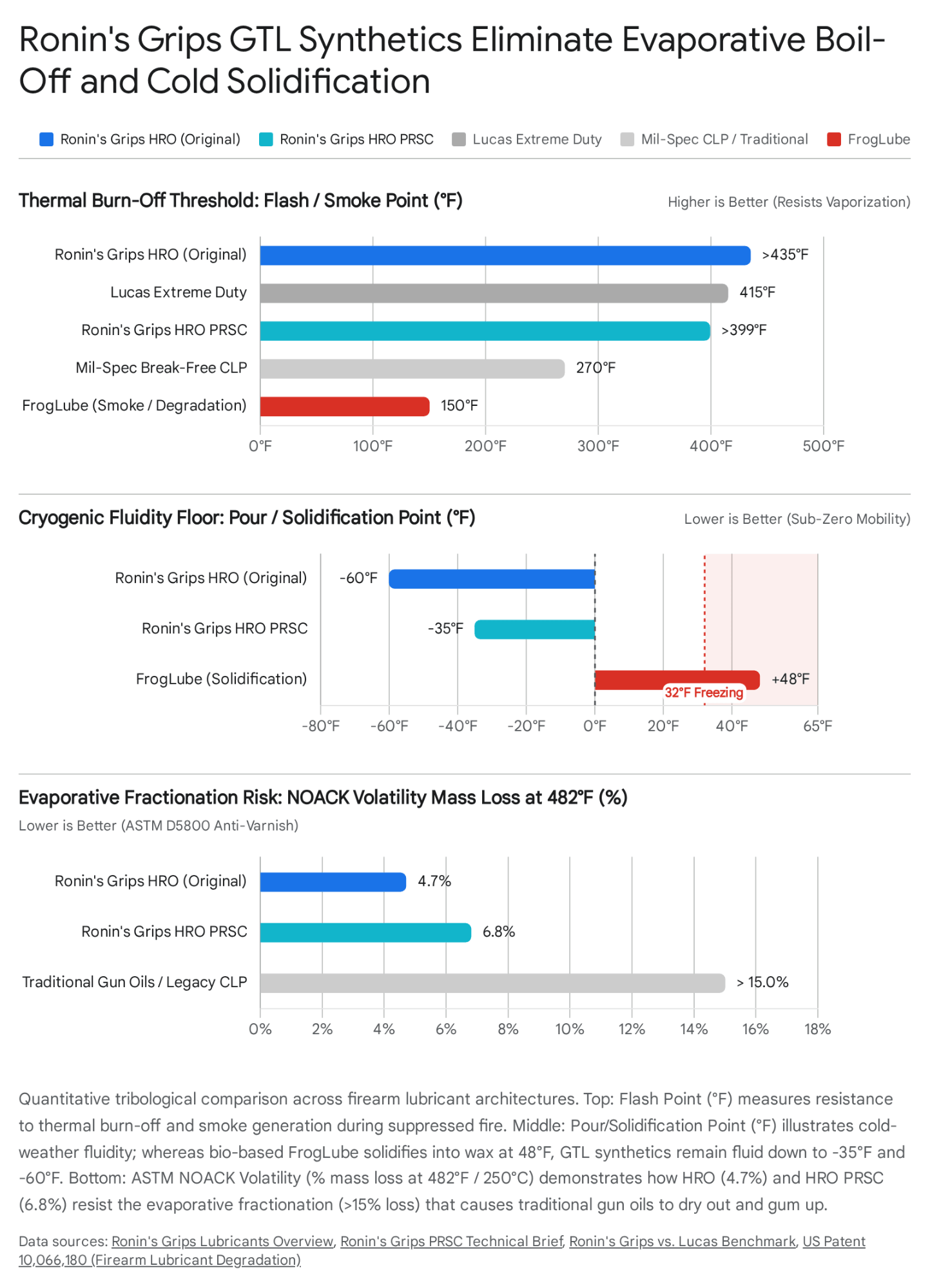
- Flash Point and Low Evaporation: Has a flash point of >435°F (>224°C) and an ASTM D5800 NOACK evaporation loss of 4.7% at 482°F (250°C) (compared to >15% evaporation loss for traditional gun oils)30. It resists burning off during heavy firing and will not dry out during years of safe storage30.
- Recommended Cold Floor (40°F) vs. Laboratory Pour Point (-60°F): In small arms maintenance, it is important to separate a lubricant’s recommended operating temperature floor inside a firearm from its ASTM D97 laboratory pour point2. HRO Original has a recommended operating floor of 40°F (4.4°C) for most weapons when applied wet (and can be used down to 0°F [-18°C] only when wiped down to a thin film)37. While HRO Original’s wax-free GTL base oil has a laboratory pour point of -60°F (mathematically -51.1°C, also listed in source tables as -48°C [-54.4°F])—meaning the oil in a test container can still pour at -60°F—a 10W-30 weight oil becomes much thicker as temperatures drop well below freezing2. At -60°F, most weapons will not operate with HRO Original because the 10W-30 oil is too thick for firearm recoil and firing pin springs to overcome the fluid drag2. That sub-zero thickness is normal, reversible cold viscosity rather than chemical polymerization, and it is why Ronin’s Grips offers HRO PRSC for cold weather below 40°F2.
- Ronin’s Grips HRO PRSC (Pistol, Rimfire, Shotgun & Cold Weather — 0W-16 Low-Drag Oil):
- Why Low-Impulse Guns and Cold Weather Need HRO PRSC: Semi-automatic handguns, .22 LR / .17 HMR rimfires, inertia-driven shotguns, and firearms used in freezing weather below 40°F have lighter slides or lower recoil energy; heavier 10W-30 oils create fluid drag that slows slide speed and causes short-stroking or failures to return to battery2.
- Viscosity and Evaporation: Formulated as a low-drag 0W-16 equivalent oil with a kinematic viscosity of 35.6 cSt (35.6 mm2/s) at 104°F (40°C), a flash point of >399°F (>204°C), and a NOACK evaporation loss of 6.8% at 482°F (250°C)2.
- Sub-Zero Operating Range: Has an ideal operating window of -22°F to 86°F (-30°C to 30°C), a usable wiped-film cold floor down to -31°F (-35°C), and a laboratory pour point of -35°F (-37°C)2.
- 0% PTFE and Polymer/Seal Safety: Both HRO and HRO PRSC contain 0% PTFE (Teflon) and no solid particles, avoiding particle settling, bore buildup, and fluorinated acid or polymer fume fever off-gassing during indoor suppressed shooting1. Both oils are chemically non-reactive and safe on polymer handgun frames (Glock, SIG Sauer, Smith & Wesson) and Viton rubber O-rings2.
| Technical Metric / Property | Ronin’s Grips HRO (Original) | Ronin’s Grips HRO PRSC | Lucas Extreme Duty Gun Oil | Mil-Spec / Break-Free CLP | FrogLube CLP (Paste / Liquid) |
| Base Oil Chemistry | 99.5% Pure Gas-to-Liquid (GTL) Synthetic1 | 99.5% Pure Gas-to-Liquid (GTL) Synthetic2 | Refined Petroleum / Semi-Synthetic + Heavy Polymers29 | Synthetic / Mineral Blend + Volatile Solvents27 | Bio-Based Coconut Oil (~92% Saturated) + Mint Oil4 |
| Viscosity Class / Profile | 10W-30 Equivalent (VI 150–154)29 | 0W-16 Low-Drag Equivalent2 | Heavy Polymeric Oil29 | Light-Medium Solvent-Cut Oil14 | Variable (Thin Liquid to Waxy Paste)3 |
| Kinematic Viscosity | 60.5 cSt @ 104°F (40°C)30 | 35.6 cSt @ 104°F (40°C)2 | 15.0 cSt @ 212°F (100°C)30 | Medium (thins & spreads quickly)58 | Liquid thickens to syrup in 4 days in air3 |
| HTHS Viscosity @ 400°F (204°C) | 3.1 cP (3.1 mPa*s)1 | Low-Drag Mobile Film2 | Relies on thick polymer cushion29 | Film thins under high heat/shear1 | Melts thin then smokes at 150°F4 |
| Flash Point / Smoke Threshold | >435°F (>224°C)1 | >399°F (>204°C)2 | 415°F (212°C–213°C)29 | 149°F (Mil-Spec min) to 270°F (Break-Free)30 | Smokes at 150°F (65.5°C)23 |
| NOACK Volatility @ 482°F (250°C) | 4.7% Mass Loss29 | 6.8% Mass Loss2 | Light petroleum fractions boil off37 | >15% Mass Loss (evaporates in ~1 week)27 | Leaves sticky gummy residue after smoking23 |
| Recommended Cold Floor vs. Lab Pour Point | 40°F (4.4°C) Recommended Floor for most weapons (0°F wiped film); -60°F Lab Pour Point (too thick at -60°F for weapon cycling) [cite: 2, 37] | -22°F to 86°F Ideal Window (-31°F wiped-film cold floor); -35°F (-37°C) Lab Pour Point2 | Thickens noticeably in cold weather30 | -65°F (-53.9°C) Pour Point80 | Solidifies into wax at +48°F (+8.9°C); hard wax at +20°F3 |
| Anti-Wear / Boundary Additive | ZDDP (>130°C activation; up to 200 nm glass film)1 | ZDDP (HRL boundary protection; 0% PTFE)2 | ~15% ZDDP (0% PTFE)30 | Solid PTFE particles (in Break-Free CLP)13 | None (relies on coconut oil polarity)4 |
| Fouling & Carbon Control | Ashless polyisobutylene succinimide dispersants + Ca detergents1 | Micellar suspension; flushes blowback carbon & lead2 | Forms dark paste with carbon over extended firing29 | Solvent cut; PTFE degrades >500°F–752°F13 | Bio-surfactants gel with leftover petro-lubes22 |
| Polymerization / Gumming Risk | Negligible [cite: 1, 30, 37] | Negligible [cite: 2, 37] | Low (dark carbon paste buildup, not cross-linking)29 | Moderate (solvent dry-out & high-heat PTFE fouling)13 | Very High (cold wax, evaporation thickening, rancidity, heat gum)3 |
5.5 Operating Temperature Limits and Application Rules
Even when using synthetic oils like HRO and HRO PRSC that do not polymerize inside a firearm action, shooters should follow two important application rules2:
- Suppressor Heat Limits (1,000°F to 1,500°F+): While a suppressed AR-15 bolt carrier group operates around 300°F to 500°F+ (within the working range of HRO’s >435°F flash point, 4.7% NOACK rating, and ZDDP glass film), the outer tube, internal baffles, and mounting threads of a suppressor reach 1,000°F to 1,500°F+ (538°C to 815°C+)1. Above 1,000°F, any liquid hydrocarbon oil will quickly burn off, smoke heavily, or char into hard carbon crusts2. For this reason, Ronin’s Grips advises keeping liquid oil off suppressors and suppressor mount threads2.
- Parts That Should Remain Dry: Operators should keep liquid oil out of striker channels, firing pin tunnels, gas blocks, gas pistons, chambers, bores (aside from a light preservative wipe followed by a dry patch before firing), magazines, and ammunition2. Oil inside a striker or firing pin channel can cause hydraulic resistance (hydro-locking) and trap powder residue, while excess oil left in a barrel bore or chamber can create a pressure hazard when firing2.
6. Practical Firearm Lubrication Guidelines
To avoid lubricant-related malfunctions during long-term storage, high-volume suppressed shooting, and cold-weather use, firearm owners and armorers can follow four practical guidelines:
- Remove Bio-Based Oils and Evaporative Sprays from Internal Parts: Avoid using vegetable oils (FIREClean, cooking oils), coconut-oil pastes (FrogLube, Seal 1, Tracklube), and evaporative household sprays (WD-40, 3-In-One Oil) on internal firearm mechanisms3. If a gun was previously treated with FrogLube, detail-strip the action and clean out all internal channels (especially firing pin tunnels, striker channels, sears, and recoil spring tubes) using a degreaser, heated ultrasonic cleaner, or solvent before applying synthetic oil so leftover bio-surfactants do not gel3.
- Use Ronin’s Grips HRO (Original 10W-30) for Centerfire Rifles at 40°F and Above: Apply HRO Original to centerfire rifles, direct-impingement AR-15/M4 carbines, short-barreled rifles (SBRs), suppressed bolt carrier groups (cam pins, gas rings, locking lugs, carrier rails), and full-auto firearms operating at or above its 40°F (4.4°C) recommended floor for standard wet lubrication (or down to 0°F [-18°C] only when wiped to a thin film)1. Do not use HRO Original in deep sub-zero cold (such as -60°F), where a 10W-30 oil becomes too thick for weapon springs to cycle reliably2.
- Use Ronin’s Grips HRO PRSC (0W-16) for Handguns, Rimfires, Shotguns, PCCs, and Cold Weather Below 40°F:
- Semi-Automatic Handguns (9mm, .40 S&W, .45 ACP, 10mm): Apply 1 drop to each slide rail groove, barrel hood, and guide rod2.
- Rimfire Rifles & Pistols (.22 LR, .17 HMR): Apply 1–2 drops to the bolt assembly and guide springs to prevent low-impulse short-stroking2.
- Gas & Inertia Shotguns (12ga, 20ga): Lightly coat action bars, bolt body, and the stock recoil spring tube (keep gas pistons and magazine tubes dry per manufacturer instructions)2.
- Pistol-Caliber Carbines (PCCs): Apply 2 drops to blowback bolt carrier rails to flush blowback carbon and maintain cycling speed2.
- Cold-Weather & Sub-Zero Use (< 40°F down to -31°F): Use HRO PRSC across its ideal operating range of -22°F to 86°F (-30°C to 30°C), or as a thin wiped film down to -31°F (-35°C), where its 0W-16 viscosity prevents cold-weather drag2.
- Use HRLA or HRCG Where Semi-Fluid or Heavy Grease Is Needed: For shooters who want self-leveling cling on slide rails or sear and cam surfaces between 20°F and 250°F (-7°C to 121°C; upper heat limit 350°F / 177°C), pair HRO with HRLA Lubrication Armor (an NLGI Grade 00 50/50 blend of calcium sulfonate grease and synthetic oil), or use HRCG Combat Grease for high-pressure contact points and long-term rust protection37.
Please share this post with colleagues, on forums, etc. Your support is much appreciated, and if you have any feedback, please email us in**@*********ps.com. If you’d like to request a report or order a reprint, please click here for the corresponding page to open in new tab.
Sources Used
- Revolutionizing Suppressed Firearm Lubrication with HRO, https://blog.roninsgrips.com/revolutionizing-suppressed-firearm-lubrication-with-hro/
- HRO Pistol, Rimfire, Shotgun & Cold Weather (HRO PRSC), https://blog.roninsgrips.com/hro-pistol-rimfire-shotgun-cold-weather-prsc/
- Froglube fails miserably…..A word of caution. – The Firing Line, https://thefiringline.com/forum/threads/froglube-fails-miserably-a-word-of-caution.533770/
- Frog Lube blahed my gun | Sniper’s Hide Forum, https://www.snipershide.com/shooting/threads/frog-lube-blahed-my-gun.6916502/
- Fireclean is just Crisco oil : r/guns – Reddit, https://www.reddit.com/r/guns/comments/3kssmi/fireclean_is_just_crisco_oil/
- Firing pin or Froglube problem? – Calguns.net, https://www.calguns.net/forum/general-discussion/general-gun-discussions/842731-firing-pin-or-froglube-problem
- FrogLube on your AR15? Yes or no and why or why not? – Reddit, https://www.reddit.com/r/ar15/comments/6ioh3y/froglube_on_your_ar15_yes_or_no_and_why_or_why_not/
- February 2016 – on target shooter nz, https://flicense.blogspot.com/2016/02/
- WD-40 is not the firearm Cure-All | Page 4 | The Firing Line, https://thefiringline.com/forum/threads/wd-40-is-not-the-firearm-cure-all.468687/latest
- Rem-oil vs other lubricants | The High Road, https://www.thehighroad.org/index.php?threads/rem-oil-vs-other-lubricants.692955/
- WD40 to clean AR chamber? > General Discussion > AR15.COM, https://ar15.com/forums/general/WD40_to_clean_AR_chamber_/5-568350/
- WD-40, why not to use it – BladeForums.com, https://www.bladeforums.com/threads/wd-40-why-not-to-use-it.1160243/
- Gun oil and teflon (ptfe) ? | The High Road, https://www.thehighroad.org/index.php?threads/gun-oil-and-teflon-ptfe.641066/
- What does WD-40 look like when its really old? | The High Road, https://www.thehighroad.org/index.php?threads/what-does-wd-40-look-like-when-its-really-old.33120/
- Break-Free CLP Aerosol (Non-Chlorinated Formula), https://www.uww.edu/riskmanagement/msds/data/break-free_clp_aerosol-non-chlorinated_formula-break-free-_incorporated_5.4.93.pdf
- Stock Finish Questions : r/M1Rifles – Reddit, https://www.reddit.com/r/M1Rifles/comments/1ut0y33/stock_finish_questions/
- How to remove Garand front handguard ferule/spacer? – AR15.com, https://ar15.com/forums/armory/How-to-remove-Garand-front-handguard-ferule-spacer-/6-541040/
- Cap and ball revolver: Vaseline or Crisco okay for chamber?, https://www.ar15.com/forums/armory/Cap-and-ball-revolver-Vaseline-or-Crisco-okay-for-chamber-/16-537589/?
- A Tikka “Cleaning” Regimen. A Little Brake Clean and Homemade, https://rokslide.com/forums/threads/a-tikka-cleaning-regimen-a-little-brake-clean-and-homemade-olive-oil-is-all-you-need.400928/
- Oiling Internal Wood Structure of Stock : r/M1Rifles – Reddit, https://www.reddit.com/r/M1Rifles/comments/1tdjty0/oiling_internal_wood_structure_of_stock/
- Unscented Gun Oil – The Firing Line, https://thefiringline.com/forum/threads/unscented-gun-oil.571480/
- Frog Lube gummed up Mantra? – Spyderco Forums, https://forum.spyderco.com/viewtopic.php?t=74037
- Use of high temperature oils to enhance mechanical device, https://patents.google.com/patent/US10066180B1/en
- Browning Maxus Shotgun Troubleshooting | Page 5, https://browningowners.com/forum/index.php?threads/browning-maxus-shotgun-troubleshooting.608/page-5
- Wood, Oil and Water – Dolmetsch Online, https://www.dolmetsch.com/woodoilwater.htm
- Understanding Iodine Value of Coconut Oil | Quality Parameters, https://nutioils.com/blog/coconut-oil-iodine-value
- From 14 years ago: local news report on military gun lubes – Reddit, https://www.reddit.com/r/guns/comments/1js76gg/from_14_years_ago_local_news_report_on_military/
- What Lube for 1911? | The High Road, https://www.thehighroad.org/index.php?threads/what-lube-for-1911.950182/
- The Evolution of Small Arms Lubrication in Modern Warfare, https://blog.roninsgrips.com/the-evolution-of-small-arms-mechanics-and-lubrication/
- Ronin’s Grips HRO vs. Lucas Extreme Duty Gun Oil, https://blog.roninsgrips.com/comparing-firearm-lubricants-ronins-grips-hro-vs-lucas-extreme-duty-gun-oil/
- PTFE Material Properties – Temperature Limits Explained, https://adtech.co.uk/blog/ptfe-material-properties-temperature-limits-explained/
- Polytetrafluoroethylene – Wikipedia, https://en.m.wikipedia.org/wiki/PTFE_structured_packing
- Research Progress of Antioxidant Additives for Lubricating Oils – MDPI, https://www.mdpi.com/2075-4442/12/4/115
- Free Radical Oxidation | Xu Lab, https://faculty.washington.edu/libinxu/free-radical-oxidation/
- Oxidation and polymerization reaction mechanisms. – ResearchGate, https://www.researchgate.net/figure/Oxidation-and-polymerization-reaction-mechanisms_fig1_226486771
- Lubricating Your AR-15 – The Shooter’s Log, https://blog.cheaperthandirt.com/lubricating-your-ar-15/
- Ronin’s Grips High Reliability Lubricants (HRL Ecosystem), https://blog.roninsgrips.com/ronins-grips-high-reliability-lubricants-hrl/
- WD-40, The Best Gun Cleaner in the World > General Discussion, https://www.ar15.com/forums/General/-ARCHIVED-THREAD-WD-40-The-Best-Gun-Cleaner-in-the-World/5-509356/?page=2
- FireClean for your AR, Gun Oil, and the Canadian connection | Page 3, https://www.canadiangunnutz.com/forum/threads/fireclean-for-your-ar-gun-oil-and-the-canadian-connection.1290086/post-11788445
- INSTRUCTIONS | United States – FrogLube, https://www.froglube.com/froglube-instructions
- American Cop – 2014 – 01 | PDF | Mail | Glove – Scribd, https://www.scribd.com/document/704140649/American-Cop-2014-01
- Anybody looking to try out Frog Lube? Don’t waste your time, slightly, https://www.reddit.com/r/ar15/comments/1968oib/anybody_looking_to_try_out_frog_lube_dont_waste/
- Frog Lube… Time will tell.. – Mossberg Owners, https://mossbergowners.com/forum/index.php?threads/frog-lube-time-will-tell.18093/
- Does anyone else use frog lube? : r/knifeclub – Reddit, https://www.reddit.com/r/knifeclub/comments/5ugkeb/does_anyone_else_use_frog_lube/
- The Conclusion to my FrogLube Adventure – Fastidious Elegance, https://www.sacrideo.us/the-conclusion-to-my-froglube-adventure/
- To oil, or not to oil? That is the question. : r/Firearms – Reddit, https://www.reddit.com/r/Firearms/comments/16s4jo9/to_oil_or_not_to_oil_that_is_the_question/
- froglube and tw25b not that great? | Sniper’s Hide Forum, https://www.snipershide.com/shooting/threads/froglube-and-tw25b-not-that-great.241998/
- Is FireClean(tm) really just Canola oil?, https://www.artfulbullet.com/index.php?threads/is-fireclean-tm-really-just-canola-oil.529/
- Blogger Doing Investigative Research Defeats Personal Jurisdiction, https://blog.ericgoldman.org/archives/2016/07/blogger-doing-investigative-research-defeats-personal-jurisdiction-fireclean-v-tuohy.htm
- District Judge Dismisses FireClean Lawsuit Against Bloggers, https://gunsamerica.com/digest/judge-dismisses-fireclean-lawsuit-bloggers/
- FireClean LLC et al v. Tuohy, No. 4:2016cv00604 – Justia Law, https://law.justia.com/cases/federal/district-courts/arizona/azdce/4:2016cv00604/998750/71/
- Fireclean LLC v. Tuohy | No. CV-16-00604-TUC-JAS (EJM) | D. Ariz., https://www.casemine.com/judgement/us/5af927363f5bae2082277b30
- Fireclean v. the Firearm Blog – Santa Clara Law Digital Commons, https://digitalcommons.law.scu.edu/cgi/viewcontent.cgi?article=2943&context=historical
- FireCLEAN Files Lawsuit against Bloggers – GunsAmerica, https://gunsamerica.com/digest/fireclean-files-lawsuit-against-bloggers/
- IN THE UNITED STATES DISTRICT COURT FOR THE EASTERN, https://blog.vuurwapen.com/wp-content/uploads/2017/06/doc-380-fireclean-motion-in-limine-gum.pdf
- WD-40: Best and worse uses? : r/homeowners – Reddit, https://www.reddit.com/r/homeowners/comments/1cvvp27/wd40_best_and_worse_uses/
- The Myth that WD40 is bad for guns | Page 2 – The High Road, https://www.thehighroad.org/index.php?threads/the-myth-that-wd40-is-bad-for-guns.811984/page-2
- Best CLP, Gun Oils, And Gun Cleaners In 2024, https://cedarmillfirearms.com/pages/blog/top-gun-cleaners-clps-and-gun-oils-review-unveiling-the-best-picks-for-2024/
- Break Free Performance Synthetic Gun Oil 4oz Liquid – MidwayUSA, https://www.midwayusa.com/product/1106132483
- Straight from a SEAL’s mouth! | Page 2 | BobIsTheOilGuy, https://bobistheoilguy.com/forums/threads/straight-from-a-seals-mouth.49551/page-2
- Oil/treatment for bare wood furniture > AK Discussions > AR15.COM, https://ar15.com/forums/ak-47/Oil_treatment_for_bare_wood_furniture/64-151320/
- Best smelling cleaning agent? : r/liberalgunowners – Reddit, https://www.reddit.com/r/liberalgunowners/comments/1uczgsq/best_smelling_cleaning_agent/
- To grease or not to grease, that is the question | The Firing Line, https://thefiringline.com/forum/threads/to-grease-or-not-to-grease-that-is-the-question.423055/
- Thanks to CAS numbers and Data Sheets, I just learned that Gun Oil, https://www.reddit.com/r/chemistry/comments/zsx2t4/thanks_to_cas_numbers_and_data_sheets_i_just/
- Society of Cosmetic Chemists > Education > Blog > How much do, https://www.scconline.org/Education/Blog/How-much-do-you-really-know-about-Fats-and-Oils
- 16.3: Fats and Other Lipids – Chemistry LibreTexts, https://chem.libretexts.org/Bookshelves/Introductory_Chemistry/Chemistry_for_Changing_Times_(Hill_and_McCreary)/16%3A_Biochemistry/16.03%3A_Fats_and_Other_Lipids
- Fatty Acid Composition Of Some Major Oils, https://www.chempro.in/fattyacid.htm
- Lipid Oxidation Mechanism in the Oil-Based Food Products, https://encyclopedia.pub/entry/42362
- FROGLUBE DOCUMENTS | United States, https://www.froglube.com/froglube-documents
- Everything to Know About Teflon Melting Point – Peflon, https://peflon.com/everything-to-know-about-teflon-melting-point/
- Oxidative Stability of Vegetal Oil-Based Lubricants – PMC – NIH, https://pmc.ncbi.nlm.nih.gov/articles/PMC8900678/
- Disposing towels soaked with mineral oil – Reddit, https://www.reddit.com/r/BeginnerWoodWorking/comments/1mp8x24/disposing_towels_soaked_with_mineral_oil/
- 1. Coconut oil (naryal ka tel) means the oil exp – FSSAI, https://www.fssai.gov.in/upload/uploadfiles/files/3_%20Chapter%202_2%20(Fats,%20oils%20and%20fat%20emulsions).pdf
- Best Gun Oil, CLP, and Grease [2026] – Pew Pew Tactical, https://www.pewpewtactical.com/best-gun-oil-grease/
- Chemical Compatibility of Ronin’s Grips High Reliability Oil (HRO, https://blog.roninsgrips.com/chemical-compatibility-of-ronins-grips-high-reliability-oil-hro-with-modern-firearm-polymers/
- HRO Archives – Ronin’s Grips – roninsgrips.com, https://blog.roninsgrips.com/tag/hro/
- Tag Archives: High Reliability Oil – Ronin’s Grips, https://blog.roninsgrips.com/tag/high-reliability-oil/
- Ronin’s Grips High Reliability Oil (HRO): Technical Marketing Brief, https://blog.roninsgrips.com/ronins-grips-high-reliability-oil-hro-technical-marketing-brief/
- Ronin’s Grips Analytics – Ronin’s Grips, https://blog.roninsgrips.com/
- 8 Best Gun Oil Choices in 2026: Cleaners, Lubricants, & More, https://gununiversity.com/best-gun-oil/
- Suppressor Analytics Archives – Ronin’s Grips, https://blog.roninsgrips.com/category/analytics-and-reports/suppressor-analytics/