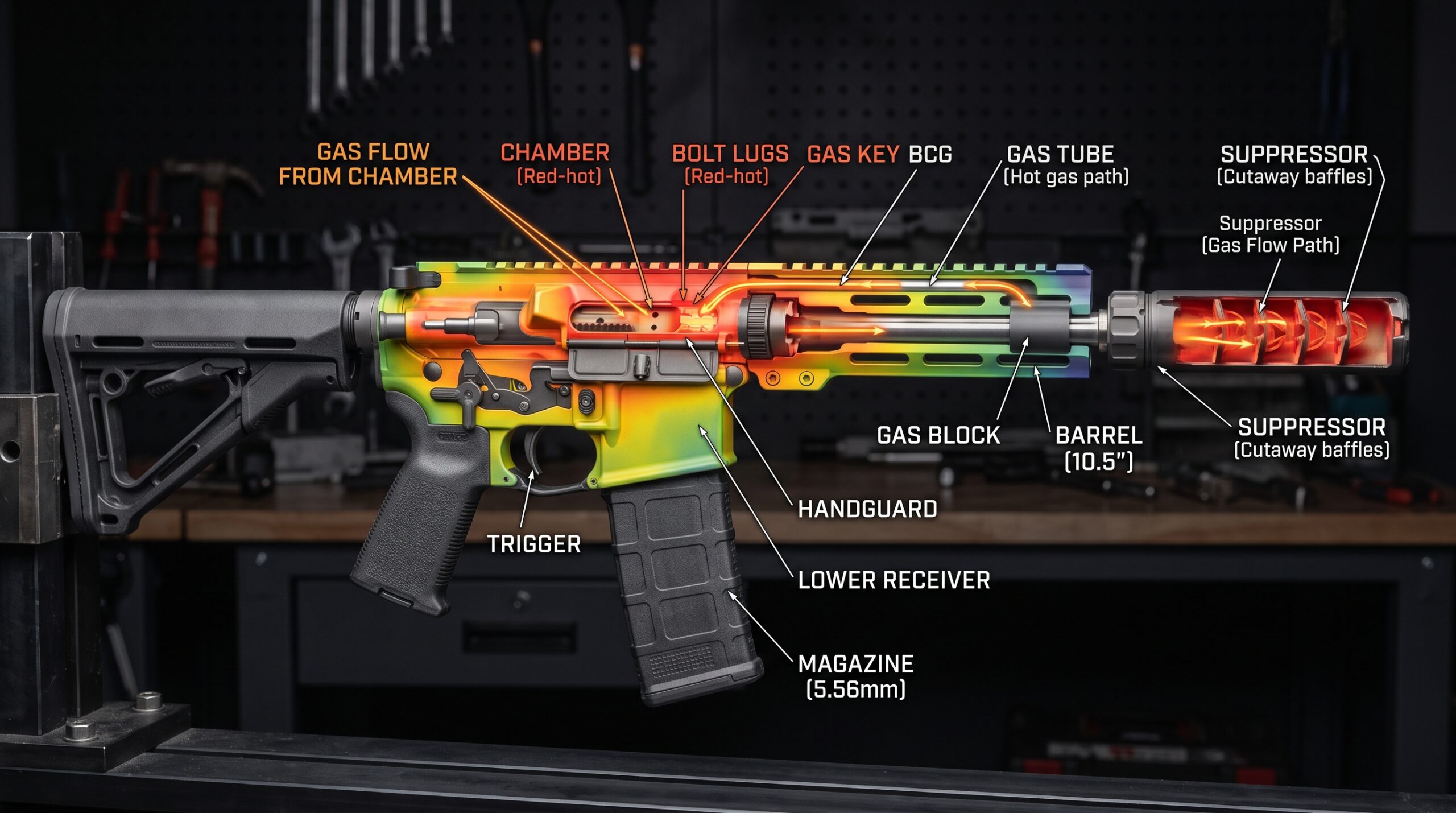
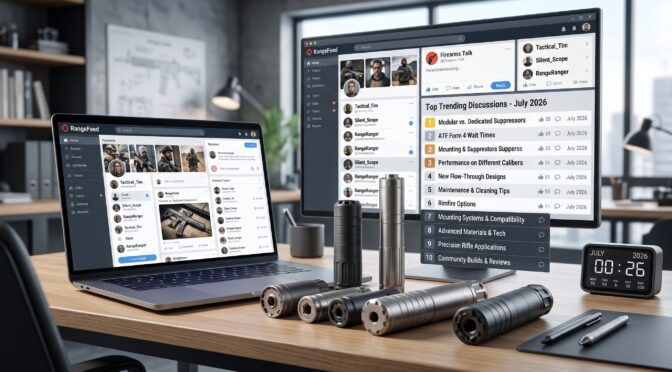
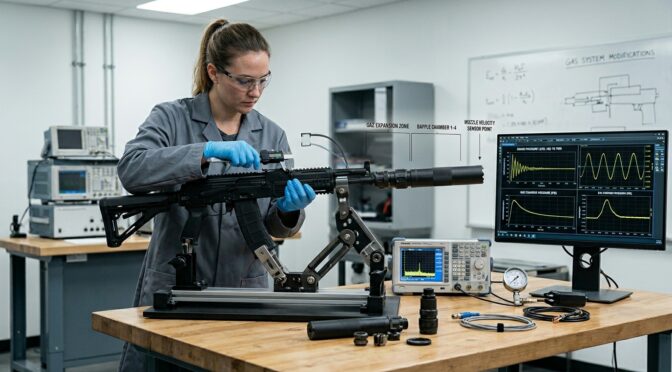
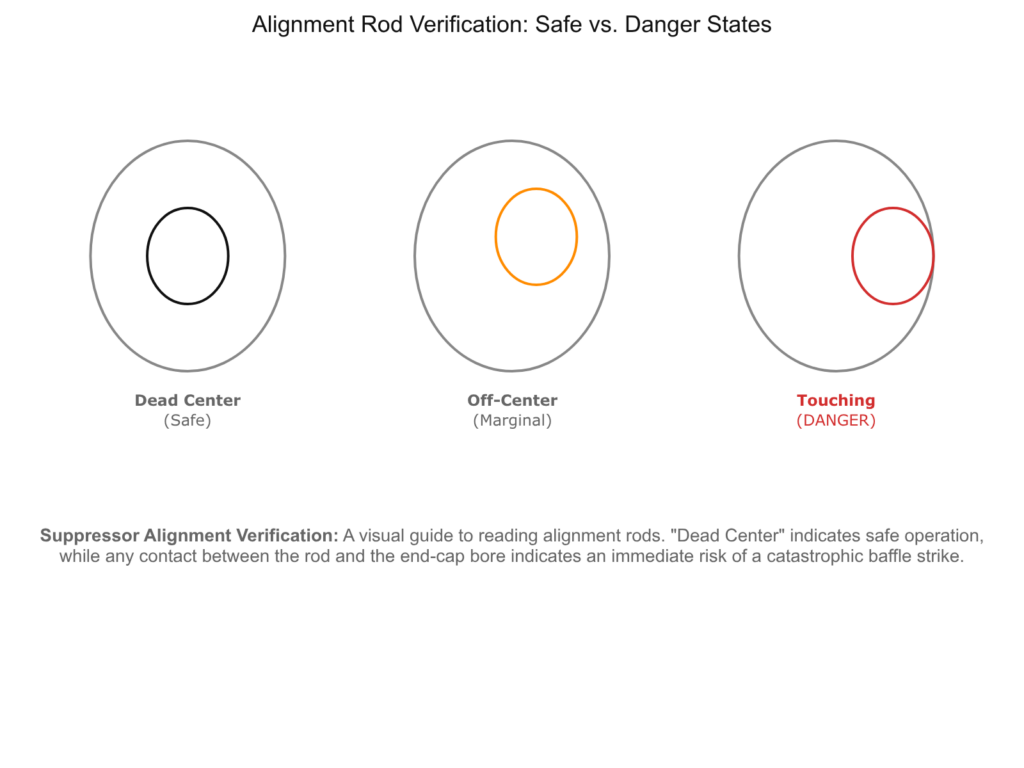
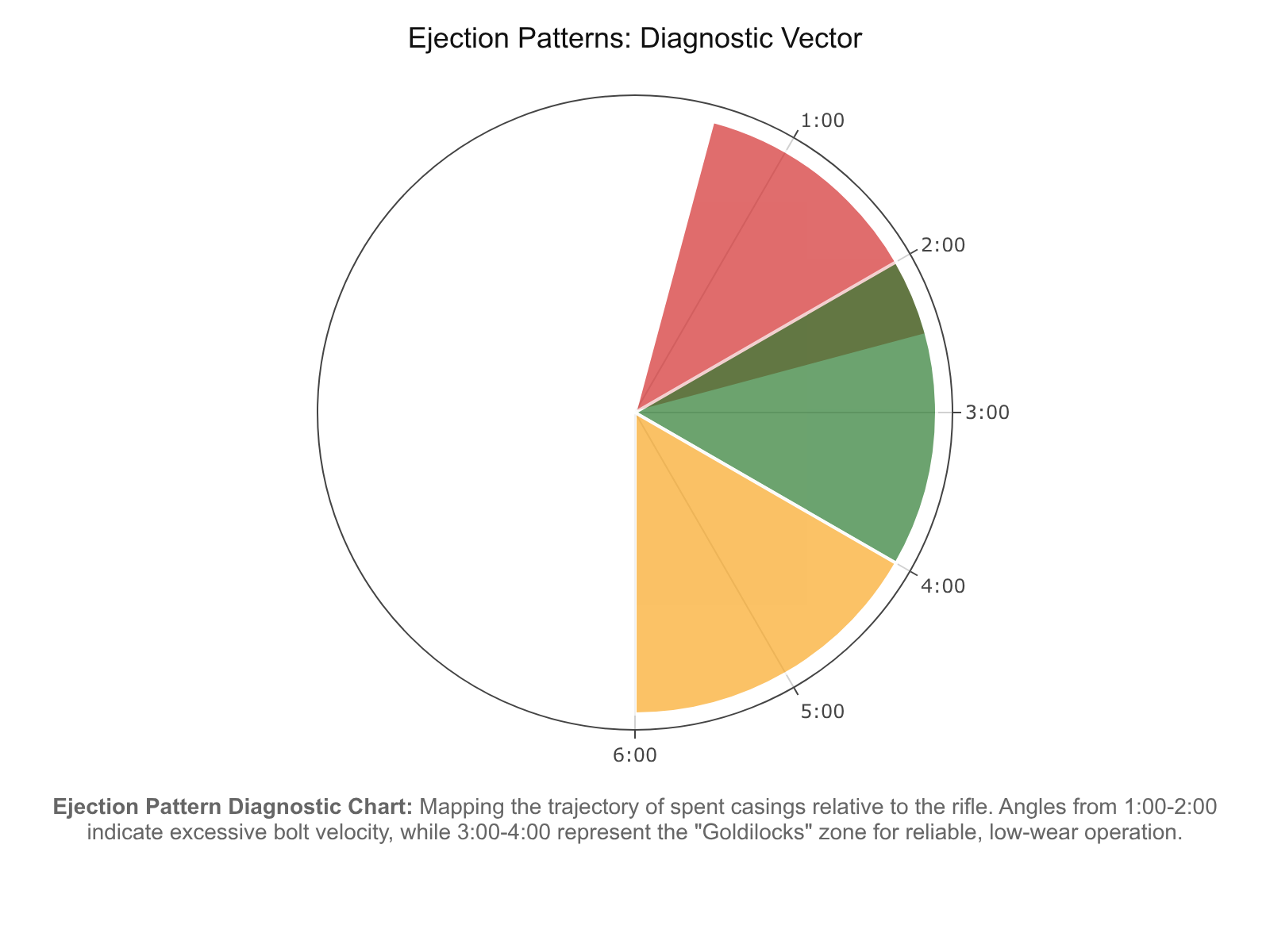
A Firearm Suppressor (technically known as a sound moderator and legally defined in the US as a “silencer”) is a muzzle device designed to reduce the acoustic intensity of a gunshot and the visual signature of the muzzle flash.
It functions by modulating the speed and pressure of the propellant gases that escape the barrel behind the projectile. While it is often compared to a car muffler, a more accurate analogy for its tactical function is a pressure release valve that controls the release of energy.
If you’ve had trouble finding our articles or shop products through search engines recently, you aren’t alone. We want to be clear about what’s been happening at Ronin’s Grips, how we’re fixing it, and where we plan to go from here.
What Happened: The July 2026 Shift
In mid-July 2026, major search engines, notably Google, updated their core ranking systems. These updates prioritized AI-generated summaries while applying stricter automated filters to assess content quality across entire sites. As a result, our traffic volumes from search engines to the blog and online store dropped by about 93%.
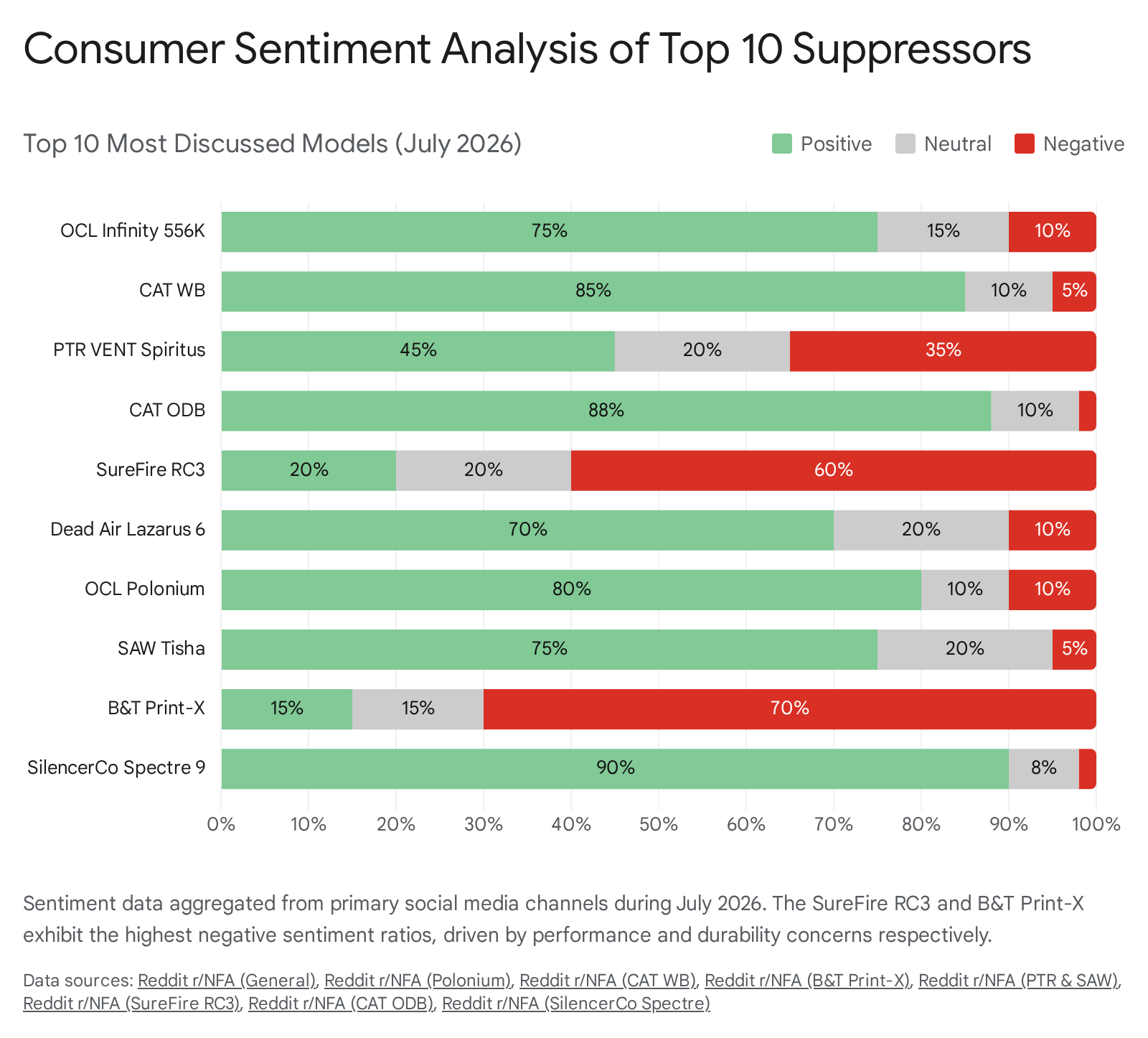
Rather than evaluating pages individually, these algorithms calculate a site-wide quality rating. If an automated system flags a specific section, it lowers the overall score for the entire domain. Ironically, the very thing we wanted to accomplish, providing social media analytics in a more template-driven manner so you get data to make decisions instead of just our opinion, ended up being our undoing!
Unfortunately, this filter caught our extensive archive of product reviews and comparison guides. Because the search engines evaluate interconnected sections together, reduced visibility on our AI and template-driven blog posts ended up dragging down search rankings for our main store as well.
The Steps We Have Taken So Far
We won’t let automated algorithms compromise our store or the quality of our content. To restore our search visibility and help new customers find us, we’ve taken immediate technical steps.
To safeguard our domain’s overall rating, we added noindex tags to our legacy comparison reports and reviews. The pages are still fully accessible to you directly, but search crawlers are instructed to skip indexing them. This prevents older content from weighing down the main Ronin’s Grips storefront in search rankings.
Where We Go From Here: A Proposal for the Community
While adding noindex tags addresses the immediate search penalties, it prompts us to rethink how we publish in-depth technical guides moving forward. Publicly hosting detailed product comparisons without risking algorithmic downgrades has become increasingly challenging. We remain committed to delivering thorough reviews, but we need a format free from shifting search engine criteria.
That brings us to a new concept we’re exploring: A Private, Members-Only Community.
We’re considering a dedicated, non-indexed community space for Ronin’s Grips members. This private hub would host our data-driven social media analyses of small arms-related matters removed from public search crawlers.
Maintaining this platform independently of public search traffic requires dedicated effort, so we’re considering a small subscription model to support it. Before making any decisions, we want to hear your thoughts.
We would love your input on the following:
What are your thoughts on moving our deep-dive reviews and comparisons into a private, members-only section?
Would you be willing to pay a monthly fee to support this content?
If so, is a price point of $5/month acceptable to you for this level of detail and access?
Please share your thoughts in the comments below or contact us directly. Your support has built Ronin’s Grips from day one, and your feedback will help guide our next steps.
Please note the author is not a lawyer and this is not legal advice.
In August 2026, the rules for small arms in the U.S. changed dramatically, creating a complex new reality for owners and dealers. It all started with the 2025 “One Big Beautiful Bill Act,”1 which slashed the federal tax on National Firearms Act (NFA) items to zero. Soon after, a federal judge in Texas issued a permanent injunction in the cases of Silencer Shop Foundation v. ATF2 and Jensen v. ATF3. The court reasoned that since the NFA is based on Congress’s power to tax, removing the tax essentially removed the constitutional reason to enforce registration for suppressors, short-barreled rifles (SBRs), and short-barreled shotguns (SBSs) for those involved in the lawsuit.
This ruling made buying a suppressor as easy as buying a standard rifle in twenty-seven states, but it also created a major legal trap for people in states like Michigan. Michigan law strictly bans suppressors and short-barreled firearms unless they are federally licensed or approved. Ironically, the federal injunction—which removes the requirement to register—could actually make possession illegal in Michigan because it bypasses the very federal paperwork that makes them legal under state law.
This report breaks down what Michigan residents need to know. We will look at how the 2026 injunction interacts with state law (MCL 750.224 and 750.224b), why “Voluntary Form 4” registration is a vital safety net, and the strict rules for bringing NFA items across state lines.
Understanding the 2026 Federal Changes
To stay safe, Michigan consumers first need to understand the Silencer Shop Foundation v. ATF injunction that started on August 13, 2026. The rules have become fragmented, leaving owners to manage a confusing mix of federal and state requirements.
Why the Ruling Happened
The 1934 National Firearms Act was built on the government’s power to tax. By charging a fee for certain items like suppressors and SBRs, the federal government had the legal right to maintain a strict registry and a long approval process.
When the 2025 law dropped that tax to $0, the financial reason for the NFA vanished. Plaintiffs argued that a federal registry can’t be justified under a tax law if no tax is being collected. The court agreed, stopping the ATF from enforcing NFA registration, fingerprinting, and wait times for those covered by the ruling.
Who Does the Injunction Cover?
It is important to note that this isn’t a total end to the NFA. The ruling only protects the named plaintiffs, members of their organizations, and their customers. Following the logic of cases like Mock v. Garland, the court decided that to truly protect a business, you also have to protect the people who buy from them.
This means consumers who buy suppressors from retailers or dealers associated with groups like the Silencer Shop Foundation or Gun Owners of America are shielded from federal NFA prosecution. However, while “Any Other Weapons” (AOWs) are also included, that relief only applies to specific plaintiffs.
The Gun Control Act (GCA) Still Applies
Even though the NFA process has been disrupted, the Gun Control Act of 1968 (GCA) is still fully in effect. This has two major impacts on how you buy firearms.
First, suppressors are still “firearms” under the GCA. Dealers must still run a NICS background check and have you fill out a Form 4473, just like buying a standard rifle.
Second, a specific part of the GCA (18 U.S.C. § 922(b)(4)) still blocks SBR and SBS transfers. Dealers cannot deliver these items unless specifically authorized by the Attorney General. Historically, the Form 4 served as this authorization. Since the court didn’t provide a new way to get this permission, SBRs and SBSs still require a Form 4, even in states where suppressors are now deregulated.
The Michigan Legal Problem (MCL 750.224)
While people in states like Indiana can now buy suppressors over the counter, Michigan residents face a much higher risk. Michigan law is tied directly to the federal registry—if you don’t have federal paperwork, you’re breaking state law.
Michigan’s Suppressor Ban
Under MCL 750.224(1)(b), it is a felony to sell or possess a silencer in Michigan. This definition is very broad and includes parts intended to build a silencer.
However, there is an exception. The ban doesn’t apply to people who are licensed or approved by the federal government to possess these items.
In 2011, the Michigan Attorney General clarified that possessing a suppressor is only legal if the owner has an approved ATF Form 4 or Form 1. In short, your federal tax stamp is your “license” in the eyes of Michigan.
Michigan Statutory Offense
Code Section
Classification
Maximum Penalty
Core Legal Defense
Possession of Unregistered Silencer
MCL 750.224(1)(b)
Class E Felony
5 years / $2,500
Valid ATF Form 4 / Form 111
Possession of Unregistered SBR/SBS
MCL 750.224b(1)
Class E Felony
5 years / $2,500
Valid ATF Form 4 / Form 111
Failure to Carry Registration (SBR >26″)
MCL 750.224b(5)
State Civil Infraction
$100 Fine / Seizure
Present registration within 45 days19
Felon in Possession of Firearm
MCL 750.224f
Felony
Variable by offense
Restoration of rights met20
The Danger of Deregulation
This situation creates a paradox. Because of the federal injunction, a Michigan resident could potentially buy a suppressor online without a Form 4.
But as soon as you bring that suppressor into Michigan without federal paperwork, you are committing a felony. The crime isn’t just owning the device; it’s owning it without federal registration. Since Michigan doesn’t have its own permit system, that federal paperwork is your only defense. A $0 federal tax doesn’t change state law; an unregistered suppressor is still a felony in Michigan. Currently, there is no evidence that a federal injunction would protect you from these state charges.
Why Voluntary Registration is Essential
Because the state penalties are so high, legal experts advise Michigan residents to continue using the ATF Form 4 process. While the ATF can’t force you to register if you are covered by the injunction, they can still process voluntary applications.
Choosing a “Voluntary Form 4” is the safest path. By paying the $0 tax and going through the standard approval process, you get the documentation Michigan requires for legal possession. The same applies to those building their own with a Form 1.
Faster Approvals with eForms
In the past, the biggest downside was the long wait—sometimes nearly a year for paper forms. However, the system has improved significantly.
The ATF now processes eForm 4s almost as soon as the FBI background check is cleared.
By mid-2026, many individual eForm 4s were approved in just 4 to 9 days, sometimes even hours. Legal entities like Trusts or LLCs take a bit longer—usually 18 to 33 days—because the ATF has to check every “Responsible Person” listed.
Despite the extra time, many people still use NFA Trusts. This allows multiple family members to legally have access to the items without risking “constructive possession” charges.
Rules for SBRs and SBSs
Short-barreled rifles and shotguns have even more layers of rules, mixing federal law with Michigan’s unique classification of handguns.
The Mandatory Form 4
Since the federal court didn’t change the GCA’s transfer rules, the Form 4 process is still mandatory for buying a factory-built SBR or SBS anywhere in the U.S.. If you’re building your own33, you must use an eForm 1 and engrave the receiver correctly.
Michigan Length Rules (MCL 750.224b)
Michigan law (MCL 750.224b) also exempts SBRs and SBSs that are “lawfully possessed under federal law”. However, your compliance depends on the gun’s length:
1. Longer than 26 inches: You must carry a copy of your federal registration whenever you transport or use the gun. If you can’t show it to an officer, you face a $100 fine and seizure, with a 45-day window to prove it’s legal.
1. Configurations Greater Than 26 Inches: Under MCL 750.224b(5), if the registered SBR or SBS has an overall length exceeding 26 inches, the possessor is legally mandated to carry a copy of the federal registration (the approved Form 4 or Form 1) at all times while transporting or using the firearm19. Failure to present this documentation to a peace officer upon request constitutes a state civil infraction subject to a $100 fine and immediate seizure of the weapon19. The owner is then granted a 45-day cure period to produce the federal paperwork to the seizing agency; failure to do so results in permanent civil forfeiture under MCL 600.470119.
2. 26 inches or shorter: Michigan law classifies any firearm 26 inches or shorter as a “pistol,” regardless of its federal classification.
For these short firearms, you must follow Michigan’s pistol sales record rules. This involves a Sales Record (RI-060) or License to Purchase, which the seller must submit to local law enforcement within 10 days.
The Out-of-State CPL Loophole
If you hold a concealed pistol license from another state (like Arizona or New Hampshire), you are exempt from Michigan’s pistol registration requirement. This allows you to own a short NFA item without it being listed in the state’s pistol database.
Buying Across State Lines
It might be tempting to drive to a “Free State” like Ohio to buy a suppressor over the counter, but this is illegal and will likely lead to prosecution.
Under federal law (GCA), dealers cannot sell firearms to people from another state unless it’s a standard rifle or shotgun—and even then, it must obey the laws of both states. A suppressor is a “firearm” but not a “rifle”. This means an out-of-state dealer must ship the suppressor to a Michigan dealer. Once the suppressor is in Michigan, the local dealer cannot release it to you without the voluntary Form 4 paperwork.
The 18 U.S.C. § 922(b)(3) Blockade
Under the GCA (18 U.S.C. § 922(b)(3)), it is federally unlawful for an FFL to sell or deliver any firearm to a person who does not reside in the state where the licensee’s business is located41. The statute provides a narrow exception allowing the interstate sale of rifles and shotguns to non-residents, provided the transaction complies with the laws of both the buyer’s and seller’s respective states41.
However, under federal definitions, a standalone suppressor is classified broadly as a “firearm,” but it is explicitly not a rifle or a shotgun16. Therefore, the rifle/shotgun exception does not apply. An Indiana FFL is federally prohibited from transferring a suppressor directly to a Michigan resident over the counter41.
Furthermore, 18 U.S.C. § 922(a)(3) prohibits a non-licensee from transporting into or receiving in their state of residence any firearm obtained outside that state43. Consequently, an out-of-state FFL must ship the purchased suppressor directly to a licensed FFL within the state of Michigan46. Once the suppressor arrives at the Michigan FFL, Michigan jurisdiction governs the transaction. Because Michigan requires federal licensure for possession, the local FFL cannot legally release the suppressor without processing the voluntary ATF Form 4 to secure the state-level legal exemption4. Thus, the overlapping restrictions of the GCA and state penal code entirely seal the “Free State” loophole.
Interstate Travel Rules
For Michigan consumers who already lawfully possess NFA items, the logistics of interstate travel depend entirely on the classification of the item being transported. The ATF mandates specific notification protocols for certain firearms that cross state lines.
NFA Firearm Classification
ATF Form 5320.20 Required for Travel?
Legal Ramification of Failure to File
Short-Barreled Rifles (SBR)
Yes (Prior Approval Required)
Federal Felony (Up to 10 years / $250k)48
Short-Barreled Shotguns (SBS)
Yes (Prior Approval Required)
Federal Felony (Up to 10 years / $250k)4
Machine Guns
Yes (Prior Approval Required)
Federal Felony (Up to 10 years / $250k)49
Suppressors (Silencers)
No (Voluntary/Optional)
None (Must obey destination state laws)50
Any Other Weapons (AOW)
No (Voluntary/Optional)
None (Must obey destination state laws)48
If you already own NFA items and want to travel out of state, the rules depend on the item. For SBRs or SBSs, you must file a 5320.20 form and get approval before you leave Michigan. Failure to do so is a federal felony.
Suppressors are different. You can take them across state lines without notifying the ATF, as long as they are legal in your destination and any states you travel through. If you are moving permanently, it’s a sensible idea to file the form anyway to update your address in the registry.
Hunting with Suppressors in Michigan
In the tactical and recreational context, Michigan is a highly permissive environment for the operational deployment of NFA items, specifically regarding hunting and wildlife management.
Michigan is quite suppressor-friendly when it comes to hunting. In 2016, the state authorized their use for all lawful hunting18. You can use them for everything from deer to coyotes on both public and private land. Just remember to carry your approved Form 4 with you as proof of legal ownership.
Hunters still need to follow general DNR firearm rules. In the past, Southern Michigan had a “Limited Firearms Zone” that only allowed certain types of guns, like those using straight-walled cartridges54.
That changed in early 2026 when the NRC eliminated that zone55. Now, starting with the 2026 season, you can use any legal firearm throughout the Lower Peninsula57. This gives hunters a lot more flexibility in picking a suppressed platform for their next trip57.
What the Future Holds
The current balance in Michigan is fragile. There are a few things that could disrupt the market in the near future.
Risk: ATF Stops Processing Forms
If the ATF decides it no longer has the authority to process voluntary applications for items that aren’t being taxed, buying a new suppressor in Michigan would become impossible overnight. The state would need to change its laws or a court would have to intervene to resolve the issue.
If the federal mechanism for registration is disabled, it will become legally impossible to acquire a new suppressor in Michigan22. Under this scenario, the market would freeze entirely. Relief would only materialize if the Michigan legislature amended MCL 750.224 to decouple state legality from the federal registry, or if state appellate courts issued an emergency declaratory judgment interpreting the federal injunction as satisfying the state’s “licensed or approved” requirement56.
Opportunity: Supreme Court Intervention
In 2026, the Fifth Circuit ruled in United States v. Comeaux that suppressors are protected “Arms” under the Second Amendment. While they upheld the NFA as a constitutional system for now, it marked a major shift in how silencers are viewed legally.
This case could go to the Supreme Court. If the Court decides that suppressors cannot be subjected to a federal registry at all, Michigan’s registration laws would effectively be dismantled.
This ruling creates a direct circuit split, as other appellate courts have previously ruled that suppressors are mere “accessories” devoid of Second Amendment protections entirely57. If the United States Supreme Court grants certiorari to resolve the split and determines that suppressors are protected arms that cannot be subjected to the NFA’s invasive registry under any circumstances, the Michigan hook-law would be forced into immediate obsolescence, as the federal registry it relies upon would be dismantled completely57.
The Bottom Line for Michigan Owners
For now, Michigan residents must stay disciplined. While the news says NFA items are deregulated, that only applies if your state laws allow it. In Michigan, avoiding a felony still depends on following the federal eForms system to the letter.
Always use voluntary Form 4s for suppressors, follow GCA rules for SBRs, and pay close attention to length requirements. Even though wait times are now very short, that federal stamp is still your only ticket to legal ownership in Michigan.
Please note the author is not a lawyer and this is not legal advice.
Executive Summary
Between 2025 and 2026, the regulatory landscape for the small arms industry, federal firearms licensees (FFLs), and consumers underwent a major realignment. Following several judicial defeats and significant legislative tax changes, the Bureau of Alcohol, Tobacco, Firearms and Explosives (ATF) has shifted its enforcement strategy and begun a substantial rewrite of its administrative regulations1.
Federal courts consistently ruled that major agency rulemakings, specifically those regarding pistol stabilizing braces, forced reset triggers, and unfinished frames and receivers, exceeded statutory authority or were unconstitutionally vague5. Simultaneously, the One Big Beautiful Bill Act (P.L. 119-21) eliminated the $200 National Firearms Act (NFA) making and transfer tax for most items as of January 1, 20268. This legislative shift led to a landmark ruling in Silencer Shop Foundation v. ATF, which barred the federal government from enforcing registration requirements for these untaxed items against covered plaintiffs10.
In response, the ATF launched a “New Era of Reform” in early 2026. This package of 34 rules aims to rescind unenforceable regulations, modernize electronic recordkeeping, and authorize non-over-the-counter transfers4. This report analyzes these legal adjustments and provides actionable compliance workflows for FFLs and buyers navigating the 2026 market.
1. The Vacatur of the Stabilizing Brace Rule
1.1 Context and Judicial Defeat
In January 2023, the ATF’s Final Rule 2021R-08F reclassified millions of braced pistols as short-barreled rifles (SBRs) under the NFA1. This change subjected an estimated 40 million owners to potential felony charges unless they registered their firearms, paid a $200 tax, or destroyed the brace5. The rule used a subjective “multi-factor test” to determine if a firearm was intended to be fired from the shoulder1.
By 2024, appellate courts found the rule arbitrary and capricious, noting it lacked objective standards1, 14. A nationwide vacatur was issued in Mock v. Garland, and by July 2025, the DOJ formally ceased its appeal, ending the rule’s enforcement permanently5.
1.2 ATF’s 2026 Regulatory Reversion
The ATF formally rescinded the brace rule in May 2026 through NPRM 1140-AA98. The agency cited the court-identified violations and restored regulatory definitions to align with the original statutory text of the GCA and NFA2.
Despite the rule’s demise, the ATF indicated in court filings, specifically in a March 2026 brief for State of Texas v. ATF, that it retains case-by-case statutory authority under the underlying NFA to classify configurations that appear clearly designed to be fired from the shoulder, even without the 2023 regulatory framework5. This assertion drew immediate pushback from lawmakers, with a group of 13 U.S. senators challenging the agency’s lingering enforcement posture5. However, without the codified factoring criteria, the agency lacks a formalized, broad regulatory mechanism to reclassify standard braced pistols en masse.
1.3 Practical Mechanics and Compliance Example
Compliance has reverted to historical norms. Standard braced pistols are once again classified as pistols, meaning buyers do not need to submit NFA paperwork or payments for standard configurations5, 16.
For example, a buyer purchasing a standard AR-15 style pistol with a brace now processes the transaction via a standard Form 4473 and NICS check. FFLs no longer bear the burden of extended NFA wait times or the risk of subjective classification for these items1.
2. Forced Reset Triggers (FRTs): Rejecting the Machine Gun Classification
2.1 Context and Judicial Defeat
In March 2022, the ATF classified forced reset triggers (FRTs) as “machine guns,” arguing that their mechanical assistance allowed automatic fire with a “single function of the trigger”20. This reclassification overnight criminalized the possession of standard components manufactured after 198621.
The Supreme Court’s 2024 decision in Garland v. Cargill dismantled this logic, ruling that the ATF exceeded its authority by classifying bump stocks as machine guns2. Lower courts applied this to FRTs, noting the trigger must still independently reset for each shot6. By May 2025, the DOJ settled the litigation, returning FRTs to federal legality23.
2.2 Practical Mechanics and Compliance Example
Despite federal legality, FRTs face a patchwork of state-level bans. Compliance requires FFLs to utilize geo-fenced shipping filters to avoid jurisdictions with restrictive “rate-of-fire” or “combination of parts” statutes25, 20.
For an FFL operating an e-commerce platform, selling FRTs requires strict compliance filters. While an FFL in Texas can legally stock and sell FRTs over the counter, shipping that same device to a buyer in New York, New Jersey, or Connecticut poses severe legal risks. These states have clear “combination of parts” laws and constructive possession clauses that ban components designed to assemble a machine gun or increase the rate of fire under state definitions20.
A compliant retailer in 2026 must utilize geo-fenced shipping restrictions, prominently publish their shipping policies regarding trigger-activation devices, and actively decline sales to jurisdictions with locality carve-outs20. Furthermore, industry analysts recommend that buyers and sellers avoid irreversible payment methods, such as wire transfers or cryptocurrency, which are often associated with non-compliant or fraudulent vendors operating in the regulatory gray areas surrounding controversial accessories20.
3. The Frame or Receiver Rule: As-Applied Constitutional Injunctions
3.1 The Supreme Court Facial Ruling (VanDerStok)
The ATF’s 2022 “Ghost Gun” rule redefined “firearm” to include parts kits that “may readily be converted” to expel a projectile25, 27. This allowed the agency to regulate blocks of metal or plastic based on extrinsic factors like marketing or instructions28.
In 2025, the Supreme Court upheld the rule’s facial validity in Bondi v. VanDerStok but noted that some products are too far from finished frames to be regulated27, 7. This allowed for “as-applied” constitutional challenges.
3.2 The District Court Injunction (Defense Distributed v. Blanche)
Following the Supreme Court’s remand, the constitutional challenges proceeded in the Northern District of Texas. On August 17, 2026, Chief Judge Reed O’Connor issued an opinion and order in Defense Distributed v. Blanche (the successor case to VanDerStok), granting summary judgment to the plaintiffs7.
In August 2026, a district court ruled the rule unconstitutionally vague under the Fifth Amendment, finding that the term “readily” lacked a clear threshold7, 29. The court also found the rule violated the Second Amendment by contradicting the historical tradition of personal gunsmithing7.
Furthermore, the court ruled that the regulations violated the Second Amendment. Using the historical tradition test from Bruen, the court looked at the DOJ’s historical analogues, which included colonial barrel-proofing requirements and gunpowder-storage laws7. The court said that these old laws were more about keeping people safe and preventing accidents than about stopping crime or finding missing parts. Concluding that the rule contradicted the actual historical tradition of unregulated personal gunsmithing and self-manufacture of firearms, the court struck down the provisions as applied to the plaintiffs7.
3.3 Practical Mechanics and Compliance Example
The resulting order from Judge O’Connor did not vacate the frame and receiver rule nationwide. Instead, it resulted in a declaratory judgment and permanent injunction protecting only the specific plaintiffs (Defense Distributed and the Second Amendment Foundation) and their current and future members29. The permanent injunction explicitly covered specific Defense Distributed products, such as their M1911 80% Frames, G80 Build Kits, and unfinished receivers7.
This creates a bifurcated compliance environment for FFLs and buyers. If a consumer is an active, verified member of the Second Amendment Foundation (SAF), the ATF cannot enforce the 2022 frame or receiver serialization and background check requirements against them when they acquire a covered Defense Distributed 80% frame29. However, if a non-member attempts to purchase a generic partially complete receiver from a non-plaintiff vendor, the 2022 ATF rule remains in full effect29.
For the non-member, the item is legally a firearm, must bear a serial number applied by a licensed manufacturer, and must be transferred via an FFL utilizing a Form 4473 and a NICS check31. FFLs operating in this space must institute rigorous verification protocols to confirm both the specific membership status of the buyer and the exact product origin before executing any unserialized transfer of an 80% kit, ensuring they fall within the protective bounds of the injunction and do not inadvertently commit a federal firearms violation32.
4. The Elimination of the NFA Tax and the Collapse of Registration
4.1 The One Big Beautiful Bill Act
The One Big Beautiful Bill Act (P.L. 119-21) reduced the NFA transfer tax to $0 for silencers, SBRs, and SBSs, effective January 1, 20268. Initially, the ATF maintained that all registration requirements remained mandatory despite the $0 tax3.
Initially, the industry viewed this legislation purely as a financial reprieve for consumers, removing a barrier to entry that had existed since 19343. In late December 2025, the ATF temporarily shut down its eForms system to reconfigure the software and update tax fields to reflect the $0 balance, while still requiring the entire NFA regulatory process, including Form 1 and Form 4 applications, fingerprint cards, passport photographs, and the waiting period for ATF pre-approval. Form 1, used for making an NFA firearm, was also revised to remove the Chief Law Enforcement Officer (CLEO) notification requirement and expand digital signature capabilities37.
4.2 Silencer Shop Foundation v. ATF and the Constitutional Ruling
Plaintiffs in Silencer Shop Foundation v. ATF successfully argued that because the NFA was enacted under Congress’s power to tax, reducing the tax to $0 stripped the registration scheme of its constitutional basis10, 11. In August 2026, the court enjoined registration requirements for untaxed items for covered parties43.
On August 5, 2026, U.S. District Judge James Wesley Hendrix of the Northern District of Texas agreed. In a 66-page opinion, the court ruled that the NFA’s registration, application, and pre-approval requirements for untaxed items exceeded Congress’s enumerated powers and were unconstitutional11. Judge Hendrix explicitly rejected the DOJ’s attempt to retroactively justify the registry using the Commerce Clause or the Necessary and Proper Clause, noting that the NFA resides entirely within Title 26 (the Internal Revenue Code) and was structured clearly as a tax measure10. The court entered a permanent injunction but stayed its effect for seven days to allow the government to seek appellate relief. The DOJ failed to file a notice of appeal or seek an emergency stay within that window, resulting in the permanent injunction taking full effect on August 13, 202643.
4.3 Practical Mechanics: Suppressors vs. SBRs/SBSs
The application of the Silencer Shop injunction is highly nuanced. It is not a nationwide repeal of the National Firearms Act. The injunction protects only the named plaintiffs, their agencies, political subdivisions, and their current and future members and qualifying customers (e.g., Gun Owners of America members and Silencer Shop customers)10. For any citizen not covered by these specific plaintiff groups, the full NFA Form 4 process and its associated felony penalties remain fully enforceable10.
Furthermore, the injunction creates a clear difference in how suppressors and SBRs or SBSs are transferred, due to overlapping statutes in the Gun Control Act (Title 18).
Suppressors: In “Free States,” covered buyers can acquire suppressors as Title I firearms via a standard Form 4473 and NICS check, bypassing NFA registration entirely44.
SBRs/SBSs: While registration is enjoined, separate GCA requirements for “Attorney General authorization” lead FFLs to continue using the Form 4 process (at $0 tax) for these items to avoid federal violations32, 44.
State Law Conflicts: Historically, fifteen states (including Michigan, Ohio, and Washington) had laws that made lawful possession of a suppressor depend on federal NFA registration, but advocacy groups successfully removed these laws in three of those states in 202610. In these remaining jurisdictions, utilizing the federal injunction to bypass the Form 4 process renders the suppressor illegal under state law, as the state safe harbor requires the physical federal tax stamp or approval paperwork51. FFLs in these remaining states must continue filing Form 4s for all transfers to protect their customers from state-level prosecution.
Interstate Transport: The injunction did not strike down 26 U.S.C. § 5861(j), which prohibits the interstate transport, delivery, or receipt of an unregistered NFA firearm10. Therefore, covered owners possessing an unregistered suppressor acquired purely via a 4473 transfer risk federal prosecution if they transport it across state lines, even if traveling to another “Free State,” or if they ship it to a manufacturer for warranty repair44. Additionally, under the Gun Control Act, 18 U.S.C. § 922(a)(4) still requires explicit authorization for the interstate transportation of short-barreled rifles and short-barreled shotguns, meaning buyers cannot move them across state lines without ATF permission, regardless of the injunction50.
5. ATF’s “New Era of Reform”: The 2026 Rulemaking Package
Facing a landscape where multiple high-profile regulations had been vacated and the core of the NFA was fracturing under judicial scrutiny, the ATF altered its posture. In late April and early May 2026, the agency published a major package of 34 regulatory actions, branded the “New Era of Reform,” designed to align with statutory text, reduce administrative burdens, and modernize the industry13. Deputy Attorney General Todd Blanche referred to this as the most comprehensive regulatory reform package in the agency’s history54.
5.1 Redefining “Willfully” and Ending Zero Tolerance (RIN 1140-AA88)
Under previous “Zero Tolerance” policies, FFLs faced license revocation for minor clerical errors55, 4. NPRM 1140-AA88 proposes a more precise definition of “willfully,” requiring proof that an FFL acted with actual knowledge of illegality or deliberate indifference56. This shift protects compliant dealers from losing their livelihoods over simple paperwork mistakes.
Through NPRM 1140-AA88, the ATF proposed defining “willfully” in the civil and administrative context to match the prevailing standard established by federal appellate courts. The proposed definition clarifies that an FFL acts willfully only when they act with “actual knowledge that the person’s conduct is unlawful” and either intentionally engage in the forbidden conduct or act with deliberate indifference to their legal obligations56. This officially ends the practice of revoking licenses for simple transcription errors or isolated administrative oversights that result from inadvertent error, thereby protecting the livelihoods of compliant dealers4.
5.2 Modernization of Retail Operations and Recordkeeping
The “Modernize” and “Reduce Burden” groups of the regulatory package focus heavily on updating the compliance framework to reflect current technology and business practices12.
Non-Over-the-Counter (NOTC) Sales (RIN 1140-AB05): A highly significant update for modern retail, this proposed rule formally authorizes FFLs to conduct remote sales to residents of the same state12. Recognizing the advancement of secure digital verification technology, FFLs are permitted to utilize remote platforms for photo identification and residency verification. Provided a NICS background check is completed and documented, FFLs can facilitate online sales, layaway pickups, and direct in-state shipping without requiring the buyer to physically visit the storefront, expanding e-commerce capabilities while maintaining Brady Act safeguards12.
Electronic Recordkeeping Defaults (RIN 1140-AA94): The ATF formalized authorization for FFLs to generate, maintain, and store Form 4473s and Acquisition and Disposition (A&D) bound books entirely electronically by default12. This includes the integration of digital document attachments. Previously, FFLs utilizing digital bound books were often required to maintain separate physical files for supporting documents like state permits or supplementary residency proof. This rule standardizes electronic recordkeeping, reducing transcription errors and manual data entry12.
Record Retention Limits (RIN 1140-AA95): The ATF proposed eliminating the requirement that FFLs retain Form 4473s and A&D records indefinitely for the life of the license2. Acknowledging the physical storage burden on dealers, the proposal establishes defined retention periods of either 20 or 30 years for primary records. Furthermore, the rule mandates only a 90-day retention period for private-party transfer records and voluntary firearm handler checks and a 5-year retention period for multiple sales reports and incomplete transactions12.
5.3 NFA Burden Reductions and Alignments
The regulatory package also addresses administrative friction points within the NFA framework.
NFA Interstate Transport (RIN 1140-AA89): Seeking to reduce delays for lawful owners, this proposal eliminates the requirement for individuals to submit an ATF Form 5320.20 and await approval prior to transporting registered NFA firearms across state lines for short-term trips of 365 days or fewer (e.g., for hunting trips, training courses, or temporary relocations)59. Long-term or permanent relocations still require notification to the ATF to update the registry, but no longer require the owner to wait for pre-approval before moving62.
Spousal Joint Registration (RIN 1140-AB00): To reduce the administrative complexity and legal expense of establishing an NFA Gun Trust solely for family possession, this proposal allows married couples to file a joint application as makers or transferees of NFA firearms. Under this joint registration, both spouses can lawfully possess the firearm, and a transfer between the spouses would not constitute a separate NFA transfer requiring additional paperwork59.
Rescinding “Engaged in the Business” (RIN 1140-AB01): Following legal challenges and an admission that the expanded definitions failed to produce anticipated enforcement outcomes regarding licensing and civil forfeitures, the ATF proposed rolling back the “rebuttable presumptions” it previously applied to determine who must possess a dealer’s license. The rule reverts to the strict statutory language codified by Congress in the Bipartisan Safer Communities Act (BSCA)2.
Machine Gun Definition Revision (RIN 1140-AA60): Acting as a direct consequence of the Supreme Court’s binding legal interpretation in Garland v. Cargill, the ATF issued a proposed rule removing the two sentences from the regulatory definition of a “machine gun” that had unlawfully incorporated non-mechanical bump stocks2.
6. Conclusion
The 2026 landscape reflects a significant contraction of executive power. Courts have rejected subjective “factoring tests” for reclassifying firearms, while legislative tax reforms have undermined the NFA’s registration foundation. The result is a fractured but more modernized compliance environment.
In response, the ATF’s “New Era of Reform” signifies a substantial operational pivot. By adopting the appellate courts’ civil definition of “willfully,” authorizing Non-Over-the-Counter digital sales, and formalizing electronic recordkeeping with defined retention limits, the agency is transitioning from an adversarial enforcement posture to a modernized, compliance-supportive framework aligned strictly with the statutory text provided by Congress.
For FFLs and compliance specialists, the primary challenge in 2026 is no longer adapting to rapidly expanding federal regulations, but rather navigating a highly fragmented legal environment. An FFL must now determine compliance based on a matrix of variables: the buyer’s specific organizational membership, the state of residency, the exact product origin, and the distinct statutory differences between firearms (such as the GCA requirements for SBRs versus suppressors). Navigating these divergent pathways safely requires rigorous, documented verification protocols and a precise understanding of which federal provisions were, and were not, enjoined by the courts.
Master Summary Table: Key 2026 Compliance Shifts
Regulatory Subject
Court / Legislative Catalyst
2026 Status & ATF Action
Practical Impact for FFLs & Buyers
Stabilizing Braces
Mock v. Bondi (Vacatur)
Rescinded. ATF proposed RIN 1140-AA98 to remove factoring criteria from CFR.
Braced pistols transfer as standard handguns via Form 4473. No NFA Form 4 or wait times required.
Enforced with Exceptions. SCOTUS upheld rule facially; Judge O’Connor enjoined it as-applied to specific plaintiffs.
Unserialized 80% kits can only be transferred without 4473/NICS to verified members of protected plaintiff groups (e.g., SAF). Others require standard serialized transfer.
In 27 “Free States”, covered members acquire suppressors via 4473/NICS only (no Form 4). In states that still tie legality to NFA registration, Form 4 is still required to comply with state law.
SBRs / SBSs
One Big Beautiful Bill Act & Silencer Shop v. ATF
$0 Tax / Form 4 practically required. Registration enjoined, but GCA § 922(b)(4) remains.
Despite the injunction on registration, FFLs must still process via Form 4 to satisfy the separate GCA requirement for “Attorney General authorization” to transfer.
Dealer License Revocations
Federal Appellate Precedent
“Zero Tolerance” Ended. ATF proposed RIN 1140-AA88 to define “willfully”.
FFLs protected from license revocation for inadvertent clerical errors. ATF must prove actual knowledge of illegality or deliberate indifference.
Remote Firearm Sales
ATF “New Era of Reform”
NOTC Authorized. ATF proposed RIN 1140-AB05 for Non-Over-the-Counter sales.
FFLs can verify ID/residency digitally and ship firearms directly to in-state residents following a NICS check, without a physical storefront visit.
Record Retention Limits
ATF “New Era of Reform”
Indefinite Storage Ended. ATF proposed RIN 1140-AA95.
FFLs only required to retain Form 4473s and A&D bound books for 20 or 30 years, rather than for the life of the license.
NFA Interstate Travel
ATF “New Era of Reform”
Prior Approval Removed. ATF proposed RIN 1140-AA89.
Owners can transport registered NFA items interstate for up to 365 days without submitting Form 5320.20 for prior ATF approval.
Please note the author is not a lawyer and this is not legal advice.
Executive Summary
The federal district court ruling in August 2026—covering the consolidated cases of Silencer Shop Foundation v. ATF and Jensen v. ATF—has caused the most significant disruption to U.S. gun laws since the National Firearms Act (NFA) was first passed in 19341. By declaring that NFA registration and approval requirements are unconstitutional for specific untaxed firearms—mainly suppressors, short-barreled rifles (SBRs), and short-barreled shotguns (SBSs)—the court has fundamentally changed how the firearms industry operates1.
Despite this major shift, the new regulatory landscape is deeply fractured. Because the court issued a party-specific injunction rather than a nationwide mandate, the legality of buying a suppressor without registration depends entirely on which organizations the buyer and seller belong to, as well as where the sale happens5. Additionally, the ruling creates friction between the NFA and the Gun Control Act (GCA) of 1968, leaving short-barreled firearms in a regulatory “no-man’s land”9. This report examines the legal reasons behind the ruling, the specific limits of the injunction, the resulting market surge, the compliance hurdles for dealers, and the legal risks for consumers.
I. The Historical and Constitutional Architecture of the NFA
To understand why Silencer Shop Foundation v. ATF is so impactful, we must look at the National Firearms Act of 1934 and how modern legislation unintentionally began to dismantle it11.
The Original Taxing Power Justification
In 1934, Congress faced constitutional hurdles in directly banning certain firearms3. To bypass these limits, they framed the NFA as a tax law rather than a public safety measure, using their power to “lay and collect Taxes” under Article I of the Constitution1.
The law placed a steep $200 tax on suppressors, SBRs, SBSs, and machine guns3. In 1934, this amount was meant to be so expensive that the average person couldn’t afford them3. To collect this tax, Congress created a complex system of requirements: registration in a federal database, fingerprinting, and the use of specific ATF forms2.
In the 1937 case Sonzinsky v. United States, the Supreme Court ruled that these registration rules were legal because they helped the government collect revenue4. For ninety years, the NFA stood because Congress officially viewed it as a tax law, not a ban1.
The Legislative Catalyst: The One Big Beautiful Bill Act
This structure changed with the “One Big Beautiful Bill Act,” signed on July 4, 20251. Starting in 2026, the tax for suppressors, SBRs, and SBSs was reduced to $016. While the law zeroed out the tax, it didn’t mention removing the registration requirements9. Machine guns kept their $200 tax status4.
By removing the tax revenue, Congress inadvertently took away the only constitutional reason the NFA’s registration system was allowed to exist in the first place1.
II. The Legal Demolition: Silencer Shop Foundation v. ATF
The end of the transfer tax led to immediate lawsuits, resulting in the consolidated cases of Silencer Shop Foundation v. ATF and Jensen v. ATF in a Texas federal court2.
The Core Constitutional Ruling
On August 5, 2026, Judge James Wesley Hendrix ruled that because these firearms are no longer taxed, the government can no longer force people to register them2. He noted that for a tax to be constitutional, it must actually collect money4. Since the tax is now $0, the registration requirements no longer have a constitutional basis1. As the judge explained, if the tax is gone, the rules supporting it must also go3.
As Judge Hendrix articulated, by zeroing out the transfer and making taxes, Congress effectively eliminated the constitutional basis for the regulations that had previously supported those taxes3.
The Rejection of Department of Justice Defenses
During litigation, the Department of Justice (DOJ) attempted to salvage the registration requirements by constructing three primary escape routes, all of which were dismantled by the court2.
First, the DOJ argued that registration was still needed for the Special Occupational Tax (SOT) paid by dealers3. Judge Hendrix disagreed, noting that the SOT has its own registration system, which the parties did not challenge. He found it unreasonable to require millions of private citizens to register just to help collect a tax from a small number of businesses4.
Second, the court rejected the “Necessary and Proper” defense. The judge compared it to a hypothetical scenario: if the government taxed grocers $1 a year, it couldn’t use that as an excuse to demand fingerprints from everyone who buys vegetables4.
Finally, the government tried to use the Commerce Clause to justify the rules1. The court ruled that the government cannot swap the constitutional basis of a law decades later1. Since the NFA was written as a tax law (Title 26), it must be judged as one8. If Congress wants to regulate firearms under commerce power, they must pass new legislation3.
III. Scope of the Injunction: The End of Universal Relief
Although the legal victory is significant, it applies very narrowly. Many consumers mistakenly believe the NFA is completely dead across the country7. This misunderstanding puts many at risk of unintentional criminal charges9.
The Restriction of the Universal Injunction Doctrine
In the past, one court ruling could stop a law nationwide. However, following a 2025 Supreme Court decision, lower courts can now only provide relief to the specific people and groups involved in the lawsuit4. Because of this, Judge Hendrix’s ruling only protects the named plaintiffs and their members22.
The ATF is only barred from enforcing registration against these specific groups and their customers8. For everyone else, the NFA still applies exactly as it did before5.
Defining the Protected Classes
Determining who is legally protected by the injunction requires a precise audit of organizational affiliations and supply chain sourcing. The injunction covers transactions strictly involving the following entities5:
Plaintiff Category
Covered Entities & Organizations
Extent of Injunctive Protection
Commercial Plaintiffs
Silencer Shop Foundation, B&T USA, Palmetto State Armory (PSA), SilencerCo, and Hot Shots Custom LLC.
Protects these corporate entities, their distributor networks, and the downstream retail customers purchasing their suppressors in qualifying transactions5.
Advocacy Group Plaintiffs
Gun Owners of America (GOA), Gun Owners Foundation (GOF), Firearms Regulatory Accountability Coalition (FRAC), Citizens Committee for the Right to Keep and Bear Arms (CCRKBA), FPC Action Foundation, and the Texas State Rifle Association (TSRA).
Protects verified members of these organizations from federal registration enforcement when engaging in the acquisition or manufacturing of covered items. Note: Members of the Jensen plaintiff groups (TSRA, CCRKBA, FPC) do not receive coverage for Any Other Weapons (AOWs)2.
State Plaintiffs
Alaska, Georgia, Idaho, Indiana, Kansas, Louisiana, Montana, North Dakota, Oklahoma, South Carolina, South Dakota, Texas, Utah, West Virginia, and Wyoming.
Protection extends strictly to state agencies and political subdivisions (e.g., local police departments). It does not grant blanket protection to the civilian populations residing within those states6.
If you aren’t a member of one of these protected groups or buying from a covered company, the injunction doesn’t protect you. For these individuals, they still have to go through the full registration and waiting process. This leads to a strange situation where two people at the same store might have completely different rules to follow based on whether they joined an advocacy group7.
IV. Consumer Market Mechanics: The GCA and the SBR Anomaly
The implementation of the injunction shifts the regulatory burden from the National Firearms Act (Title 26) to the Gun Control Act of 1968 (Title 18), but this transition introduces severe operational inconsistencies between different categories of firearms.
The GCA Form 4473 Transition for Suppressors
For protected individuals, buying a suppressor is now much simpler. Since registration isn’t required, these items fall under standard Gun Control Act (GCA) rules8. Because suppressors are defined as “firearms” under the GCA, they are still subject to background checks, even without the NFA tax8.
Buying a suppressor from a covered dealer is now like buying a standard rifle: the buyer fills out Form 4473 and undergoes a NICS background check9. There’s no federal registry entry, no fingerprints, and no months of waiting17. Once the background check clears, the buyer can take the suppressor home that same day19.
This deregulation is part of the ATF’s broader “New Era of Reform” modernization efforts led by Acting Attorney General Todd Blanche and ATF Director Robert Cekada, which mainly focused on reducing burdens through remote identity verification (NIST SP 800-63-4) and direct-to-door intrastate shipping for standard Title I firearms, rather than dismantling the NFA.
The Short-Barreled Firearm Trap
While the ruling explicitly struck down the NFA registration requirements for suppressors, SBRs, and SBSs, the practical market impact for short-barreled firearms is vastly different because of a strong statutory trap built into the Gun Control Act.
While suppressors have a clear path, short-barreled firearms remain ensnared in a “trap.” A specific part of the GCA makes it illegal for dealers to sell SBRs or SBSs unless the Attorney General specifically authorizes it6.
Currently, the NFA Form 4 is the only way the government provides this authorization9. This creates a circular problem: registration is unconstitutional under the NFA, but mandatory to satisfy the GCA9. Until the ATF creates a new authorization process, SBRs and SBSs remain functionally stuck under the old rules9.
V. State-Level Preemption and Jurisdictional Friction
The federal injunction only stops federal enforcement; it doesn’t change state laws14. States generally fall into three categories regarding how they handle this change6:
Industry analysts categorize the states into three distinct regulatory blocks regarding how the injunction impacts local consumers6:
In 27 “Free States” (like Texas and Florida), state law doesn’t require federal registration. In these places, immediate transfers are happening for protected buyers17.
In 15 “NFA States” (like Michigan and Pennsylvania), state law explicitly says you must follow federal registration rules to possess a suppressor16. If a resident in these states skips the Form 4 process, they are breaking state law6. The remaining 8 states and D.C. have total bans on suppressors, which haven’t changed17.
The Washington State Conundrum
Washington State is particularly confusing. State law doesn’t explicitly ban suppressors, but it says you can’t use one unless it is “legally registered and possessed in accordance with federal law”27.
This creates a paradox: if federal law no longer requires registration for a covered person, is an unregistered suppressor still “legal” in Washington? State Patrol interprets the law strictly, meaning anyone using an unregistered suppressor still risks prosecution38.
Some analysts argue that because the federal Form 2 (filed by the commercial manufacturer at the time of fabrication) places the item in the NFRTR initially, the suppressor is technically “registered,” and the buyer’s subsequent possession without a Form 4 is lawful under the injunction, thus satisfying both prongs of the Washington statute38. However, the Washington State Patrol has issued guidance stating that nothing changes at the state level; they interpret the statute to mean that any use of a suppressor not explicitly registered to the end-user via a Form 4 remains a state crime27. Until a state appellate court definitively resolves this ambiguity, Washington consumers purchasing suppressors over-the-counter risk state prosecution the moment they attach the device to a host firearm and discharge it38.
VI. Market Impact and Industry Disruption
The commercial response to the combination of the $0 tax stamp and the subsequent federal injunction has been explosive, reshaping market dynamics and straining supply chains.
Suppressor sales were already growing before the ruling40. Registered items jumped from 285,000 in 2010 to over 3.5 million by 202424. When the tax dropped to $0 in early 2026, the ATF saw a record 1.62 million applications42.
After the injunction began on August 13, 2026, demand skyrocketed. Silencer Shop quickly moved to over-the-counter sales in 27 states17. Payment processors saw record-breaking transaction volumes as thousands of customers used the new system across the dealer network29.
The deregulation has had a particularly pronounced effect on niche accessory markets, such as shotgun suppressors, freeing consumers to focus on key selection factors like material science and mounting systems without the friction of tax stamps44. Previously hindered by the $200 tax which often represented 20% to 30% of the suppressor’s actual retail cost, the $0 tax and instant transfer capability have accelerated adoption in the sporting and hunting sectors.
Top Shotgun Suppressors (2026)
Market Profile
MSRP
Form 4473 Viability (In Free States)
SilencerCo Salvo 12
Best overall modularity (6-12 inch configs), 136.8 dB suppression, and widely stocked.
$993
Eligible for instant transfer via covered dealers45.
Silencer Central BANISH 12
Ultra-light titanium (17.6 oz), fixed length, optimized for hunters.
$1,218
Covered, but currently utilizes Form 4 compliance protocols as policy45.
YHM VICTRA-12
Value-priced modular option, quietest published rating (135 dB).
$979.95
Dependent on dealer plaintiff status45.
Market data indicates that shotgun suppressors, traditionally a low-volume NFA item, are rapidly gaining market share as financial and regulatory barriers evaporate45.
VII. Operational Paralysis for FFLs
While sales are up, dealers are facing a nightmare with record-keeping. The current federal inventory system still ties to the NFA registry (NFRTR)7.
For nearly a century, the FFL regulatory framework has been inextricably tied to the National Firearms Registration and Transfer Record (NFRTR)9. When an FFL receives a suppressor from a distributor, it is logged into their physical A&D book and registered to their specific federal license number in the NFRTR database via a tax-exempt Form 3 transfer7.
If a dealer sells a suppressor over-the-counter, they can log it out of their books, but it stays listed in their name in the federal database7. During an audit, the ATF will expect to see the item. Since the dealer no longer has it, they could face violations. The ATF hasn’t explained how to fix the issue, leaving many dealers worried about their licenses5.
Furthermore, the injunction did not strike down the Special Occupational Tax (SOT) requirement4. Importers, manufacturers, and dealers must continue paying the $500 or $1,000 annual SOT to legally engage in the business of manufacturing or distributing NFA items, even if the end consumer ultimately purchases the item without an NFA transfer4.
To help navigate this liability, advocacy groups have introduced compliance bridges. For example, Gun Owners of America (GOA) established a specific “Corporate Membership” program to extend the court’s injunctive protection to the owners, officers, and employees of participating FFLs, providing an easier way for dealers to prove their covered status5. Additionally, because the court did not block the NFA’s interstate transport restrictions, FFLs must continue to use tax-exempt Form 3s when transferring covered items across state lines between manufacturers, distributors, and dealers48.
VIII. Severe Risk Assessment for Consumers
Assuming the NFA is completely “dead” is a dangerous mistake. Consumers who misinterpret the ruling could face federal or state prosecution9.
Form 1 Manufacturing vs. NFA Marking Requirements
Some think they can now build their own SBR or suppressor without an ATF Form 1. This scenario is a massive risk. While registration is currently blocked for some, marking requirements are a separate issue14.
One group of plaintiffs (the Jensen group) received an injunction against marking requirements4. However, the Silencer Shop group (which includes GOA members) did not receive an injunction against the marking requirements. This means a GOA member who builds a firearm without engraving their information on it is committing a felony23.
However, the Silencer Shop plaintiffs (including GOA and GOF members) did not request or receive an injunction against the marking requirements23. If a GOA member builds an SBR without submitting a Form 1, they are protected from the registration requirement, but if they fail to physically engrave the weapon with their maker information, they have committed a federal felony under the unenjoined sections of the NFA23.
Enhanced Sentencing and Interstate Commerce Hazards
Additionally, using an unregistered item in self-defense carries extreme risk. Even if a local court clears you of a shooting, the presence of an unregistered NFA item can trigger a 30-year mandatory federal sentence14.
Finally, the injunction doesn’t cover interstate transport. Moving an unregistered suppressor across state lines remains a felony, as the ATF has no system to grant travel exemptions for unregistered items6.
IX. Strategic Outlook and Future Developments
This ruling is just one step in a larger legal battle. The current situation is unstable and difficult for dealers and police to manage22.
The Fifth Circuit Appeal Deadline
The DOJ has until October 5, 2026, to appeal. If a higher court freezes the injunction during the appeal, the market will instantly snap back to the old rules25. This would leave thousands of people who bought suppressors in “legal limbo,” with no word on whether the government would confiscate those items6.
If a stay is granted, the legal status of the thousands of suppressors transferred without registration between August 13 and the date of the stay becomes highly precarious. It is uncertain whether the ATF would demand the retroactive registration of these items or attempt to confiscate them as contraband6.
Parallel Litigation and Congressional Intervention
Meanwhile, other lawsuits are moving through the courts. As more judges agree with this tax-based logic, it becomes more likely that the Supreme Court will eventually have to decide the issue for the entire country8.
Lawmakers are also pressuring the DOJ to drop the appeals and formally adopt these changes as permanent federal policy25. Until then, everyone in the firearms market should be very careful.
Conclusion
The federal district court’s ruling in Silencer Shop Foundation v. ATF exposes the fragile constitutional architecture of the National Firearms Act. By zeroing out the making and transfer taxes in 2026, Congress inadvertently destroyed the Article I Taxing Power foundation that supported the registration of suppressors, SBRs, and SBSs for ninety years.
However, this unprecedented legal victory has yielded acute operational chaos. Because the injunction strictly limits itself to specific plaintiffs and their customers, the industry has fractured into two distinct regulatory realities operating simultaneously. FFLs find themselves trapped between the conflicting mandates of the NFA, the GCA, and state laws, and they operate entirely without clear guidance from an unresponsive ATF. Consumers who misinterpret the scope of this ruling—especially regarding home manufacturing, interstate transport, or state-level preemption—face severe felony exposure and enhanced mandatory minimum sentencing.
The small arms market remains in a state of high-velocity transition. Until the Fifth Circuit rules on the pending DOJ appeal or the ATF provides clear administrative guidance on the GCA transfer process, participants in the suppressor and short-barreled firearm markets must navigate this regulatory vacuum with extreme caution, prioritizing strict legal compliance over the theoretical promise of a deregulated marketplace.
Understanding Modern Firearm Lubrication and Suppressors
The way we use modern firearms has changed dramatically over the last twenty years. The heat and mechanical stress inside these weapons now far exceed what their original designs anticipated, due to the rise of short-barreled rifles (SBRs), intense training schedules, and the common use of suppressors. Older, standard lubricants—like those meeting the military’s MIL-PRF-63460F specification for CLP—often fail to protect a gun under these harsh conditions3. Because today’s shooters deal with high backpressure, extreme heat, and heavy carbon buildup, we need to rethink how we lubricate our weapons1.
To understand why traditional oils fail and how advanced options like Ronin’s Grips High Reliability Oil (HRO) and Lucas Extreme Duty Gun Oil help, we have to look at what happens inside a suppressed firearm. Adding a suppressor does more than just quiet the shot; it changes the gas pressure, heat, and speed of the moving parts2. In a standard AR-15, the suppressor blocks gas from escaping quickly, forcing a much higher volume of hot gas back into the bolt carrier group (BCG)2.
This extra gas creates a domino effect. The BCG is slammed backward much faster than intended, which puts extreme pressure on the bolt as it unlocks1. The cam pin and locking lugs are forced to move while chamber pressures are still very high2. This creates so much friction that the protective layer of oil is often squeezed out, leaving metal to grind against metal2.
At the same time, the weapon gets incredibly hot. A suppressor can heat up from 300°F to over 850°F in just a few minutes of rapid shooting1. After 200 rounds of continuous fire, it can even reach 1,200°F1. This heat, combined with abrasive carbon and unburnt powder being blown back into the receiver, creates a brutal environment2, 4. In these conditions, the quality of your lubricant determines whether your gun keeps running or locks up completely.
The Impact of Suppressors on Lubrication
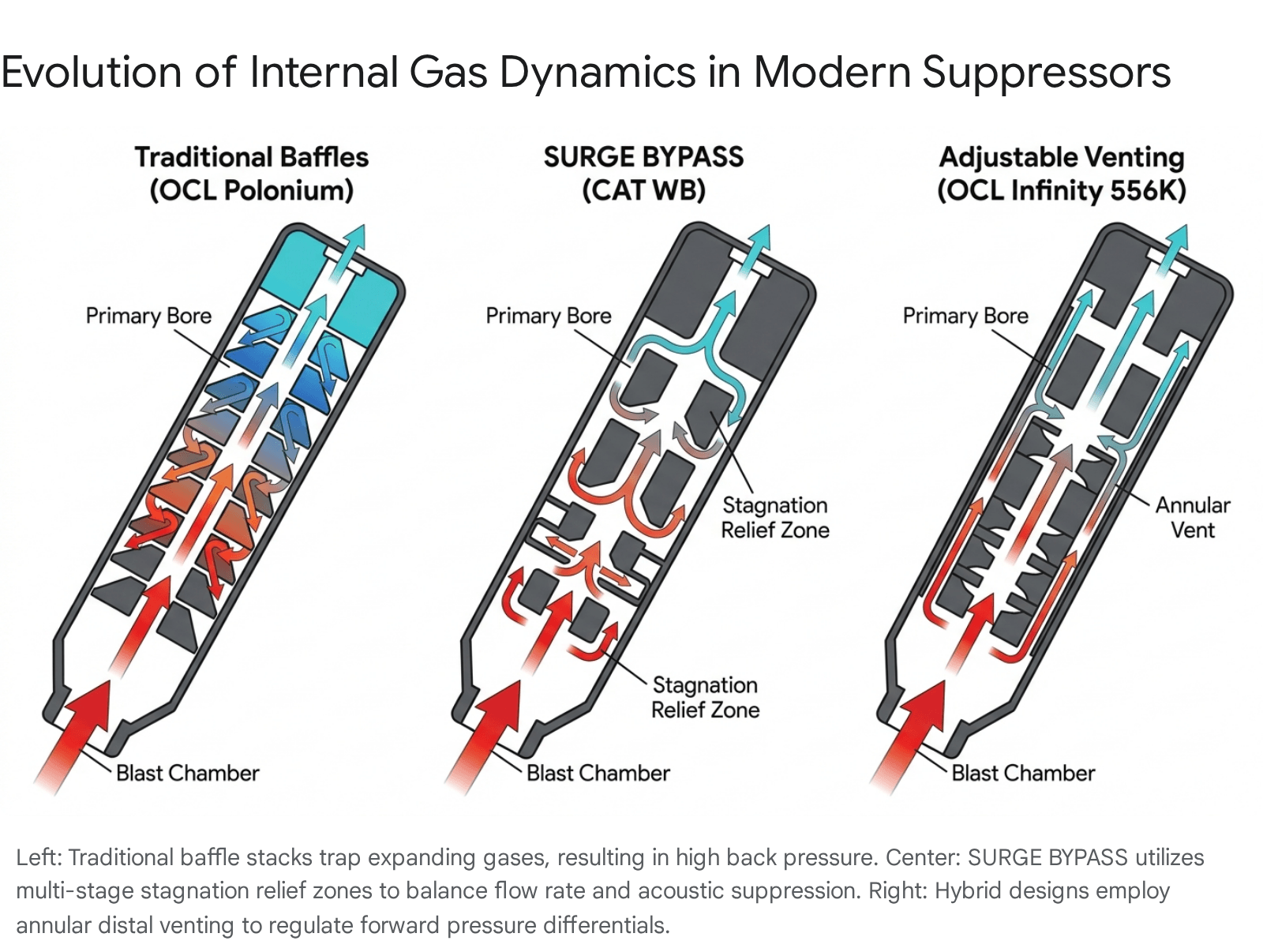
Using a suppressor makes lubricating a firearm even more difficult. Suppressors are essentially metal cans with internal walls, or baffles, that trap and slow down expanding gases to reduce noise5. Whether they are made of stacked cones or machined from a single block of titanium, they all face the same challenges5.
When you fire that first shot, the oxygen inside the suppressor can cause a mini-explosion of unburnt powder, leading to sudden heat spikes6. This heat and carbon buildup can actually cause the suppressor to “carbon lock” to the barrel, making it almost impossible to remove1. While some designs are easier to clean than others, all are at risk of seizing up if not properly maintained6.
Many shooters try to fix the issue by using heavy grease or anti-seize on the threads7. However, standard oils often evaporate instantly, leaving behind a sticky sludge that makes the problem worse. A truly effective lubricant needs to handle temperatures over 800°F without turning into glue7. The ability to keep carbon from baking onto metal surfaces is what separates modern, purpose-built oils from the older alternatives10.
The Foundation: What’s in the Bottle?
Most of what is in a bottle of gun oil (about 75% to 90%) is the “base stock.” How this base oil handles heat and stress determines how well the lubricant works overall. The differences between Lucas Extreme Duty and Ronin’s Grips HRO start right here at the molecular level.
Lucas Extreme Duty: Petroleum-Based Strength
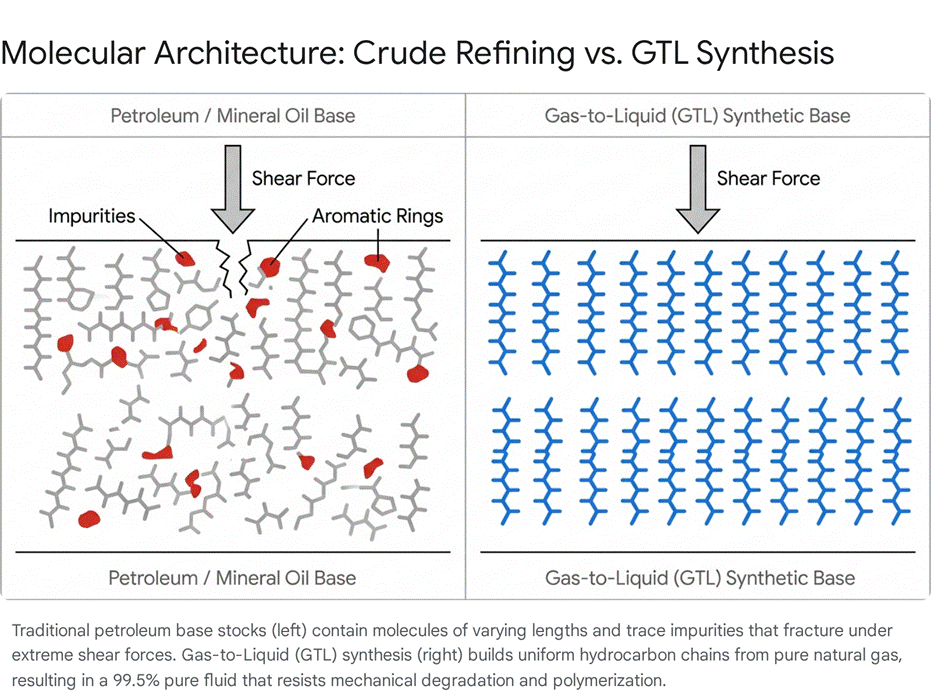
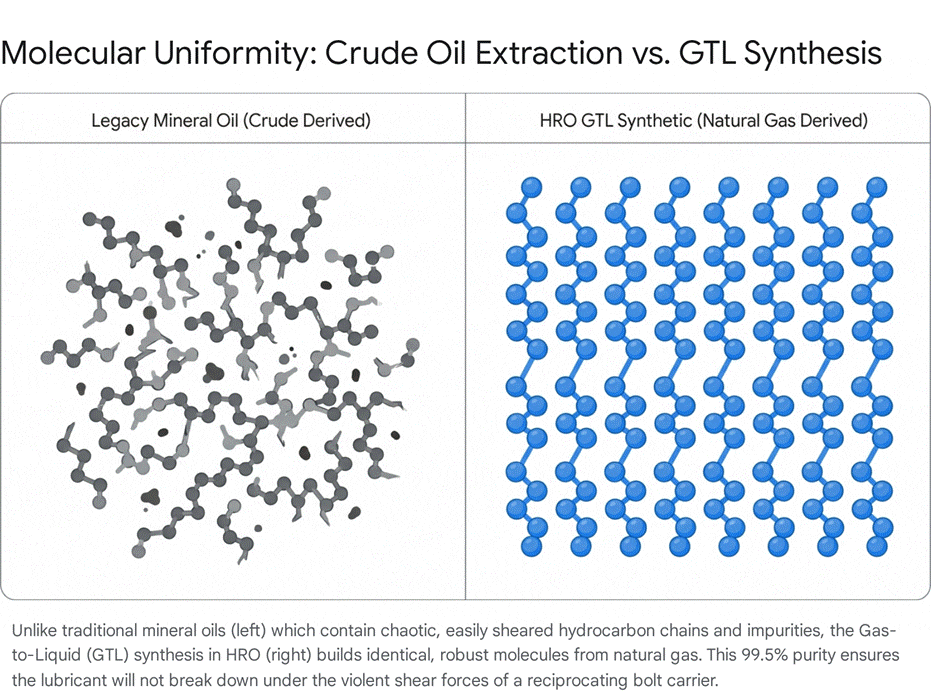
Lucas Extreme Duty Gun Oil is made from highly refined mineral and petroleum oils11. While modern refining techniques have made these oils much better than they used to be, they still contain tiny amounts of impurities like sulfur and nitrogen1. These mineral bases aren’t perfectly uniform because they are extracted from crude oil.
Because these molecules vary in size and shape, they can break down under the extreme heat of a suppressed weapon2, 3. When the inside of your gun gets hotter than 500°F, the impurities in petroleum oils can oxidize and thicken2. When this process happens and mixes with carbon fouling, it creates a thick, baked-on sludge that slows down the moving parts of your rifle2.
To solve this, Lucas makes their oil exceptionally thick and “tacky” using a special polymer technology9. This high viscosity helps the oil stick to the metal surfaces and resist being blown off by the gas pressure of a suppressed AR-157. Essentially, Lucas uses a thick physical layer to ensure protection remains even if the oil begins to degrade.
Instead of trying to clean up dirty crude oil, the GTL process takes pure natural gas and builds the oil molecules from scratch4. This means every molecule is exactly the same size and shape3. Imagine the difference between a pile of random sticks (crude oil) versus a stack of identical bricks (GTL synthetic). The uniform “bricks” in HRO stay strong and won’t break down under pressure like petroleum oils do3.
Because these molecules are so uniform, they handle extreme heat and stress exceptionally well4. HRO doesn’t fracture, even when hot gas blasts your bolt carrier during rapid fire. It’s free from the impurities that cause sludge, so the oil stays slick and keeps working long after traditional oils would have failed3.
Thermodynamics, Burn-Off Resistance, and Volatility
The true test of a gun oil is how it handles heat. When your firearm gets hotter than 500°F, cheap oils simply evaporate or “burn off.” This leaves the moving parts dry and unprotected, leading to rapid wear or a jammed gun.
Flash Point and High-Temperature Survival
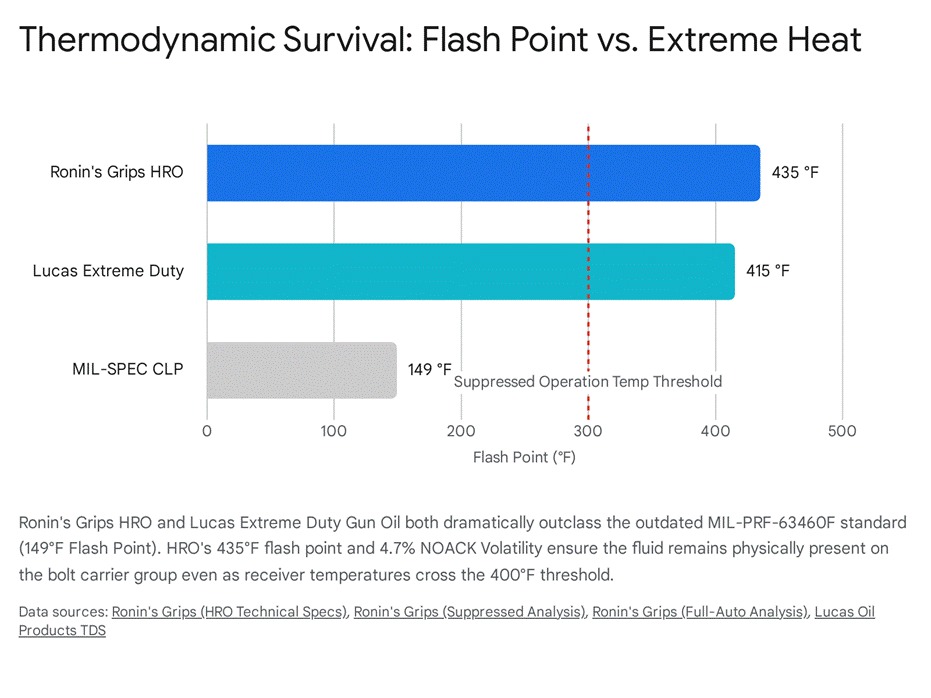
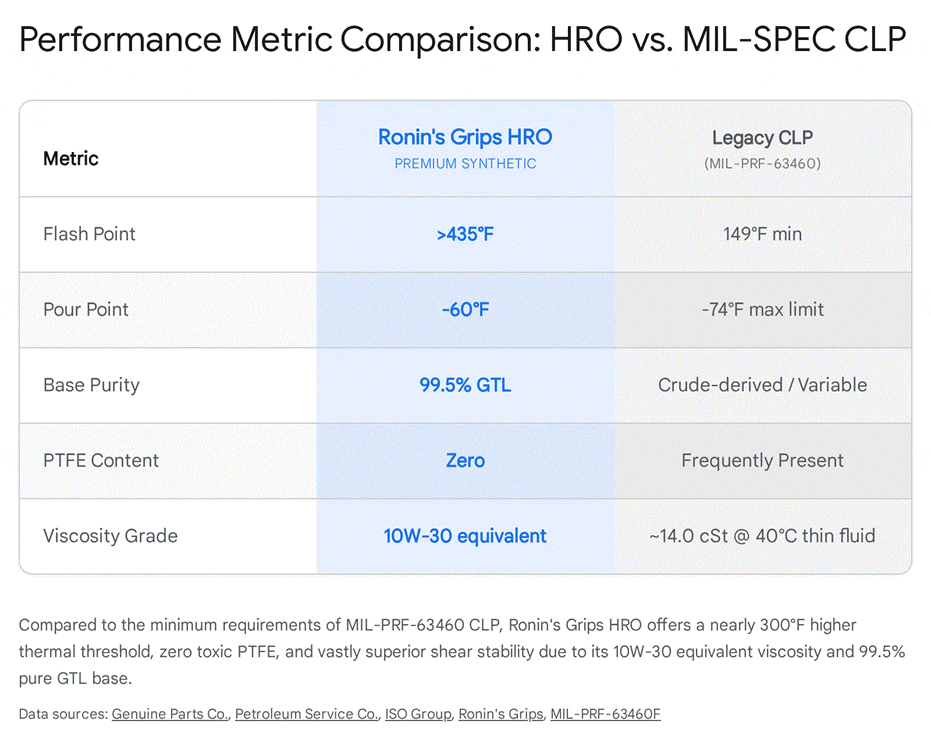
A lubricant’s “flash point” is the temperature at which it starts to turn into a vapor that can catch fire. It’s a useful way to see how much heat an oil can handle. While the military’s minimum standard is only 149°F, both Lucas and Ronin’s Grips HRO far exceed that, offering much better protection1.
Lucas Extreme Duty has a high flash point of 415°F15. This means it won’t smoke or evaporate easily during heavy shooting13. Its thick polymers keep the oil in place on the bolt carrier group even when things get very hot9.
Ronin’s Grips HRO goes even further with a flash point over 435°F3. This high limit makes it very resistant to burning off. HRO is also designed to be “low-smoke.” It won’t create a thick cloud of toxic smoke when you’re shooting with a suppressor, which is a huge advantage if you are shooting in enclosed spaces3.
NOACK Volatility and Evaporative Mass Loss
While flash point is about fire risk, “NOACK Volatility” is the real test of how much oil physically boils away under heat4. In this test, oil is heated to 482°F for an hour, and scientists measure how much of the oil was lost to evaporation4.
Traditional firearm oils often lose more than 15% of their mass in this test4. However, Ronin’s Grips HRO loses only 4.7%3. This means that even when your gun is superheated, the oil stays on the parts to protect them4. It also won’t evaporate while sitting in your safe, so your gun is ready to go even years later3.
Lucas Oil relies on its thickness to stay in place. While its heavy formula resists evaporation better than thin oils, some of the petroleum will still boil away under intense heat. This leaves behind the heavier polymers, which still offer protection but change how the oil feels during long shooting sessions.
Boundary Lubrication and Mechanochemical Shielding
Inside a gun, the parts move back and forth so violently that oil can be physically squeezed out from between them. When this happens, the microscopic bumps on the metal surfaces grind against each other2. To prevent wear and jamming, advanced oils use special chemical additives that bond directly to the steel.
The system instantly enters the boundary lubrication regime, a state where the microscopic peaks and valleys of the metal (asperities) come into direct, violent contact2. To prevent catastrophic metal-to-metal galling, accelerated wear, and mechanical binding, advanced lubricants cannot rely on fluid film thickness alone; they must deploy highly reactive anti-wear (AW) and extreme pressure (EP) chemical additives that bond directly to the steel surface.
The Mechanochemistry of Zinc Dialkyldithiophosphate (ZDDP)
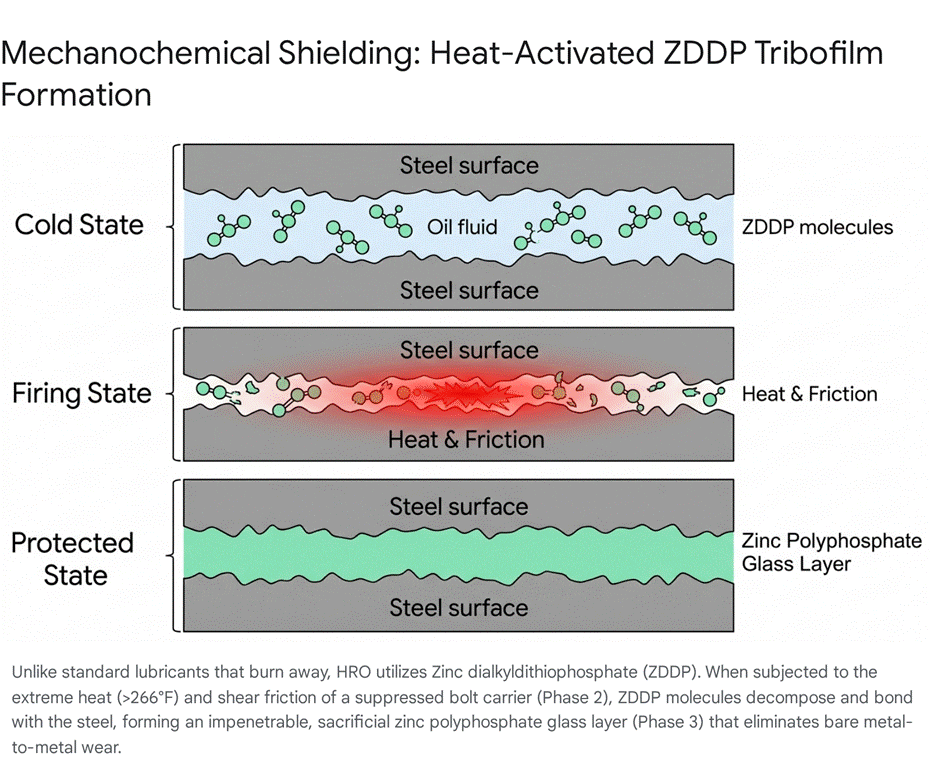
Both HRO and Lucas use Zinc Dialkyldithiophosphate (ZDDP), a highly effective additive that has been around since the 1940s4, 16. ZDDP is unique because it only activates when it feels heat and pressure.
When a suppressed weapon is fired, the extreme contact pressure and localized flash temperatures at the rubbing metal asperities cause the ZDDP molecules suspended in the oil to chemically decompose16. Before the formation of the final protective film, ZDDP decomposes to form intermediate zinc sulfide and iron sulfide species, which are mechanically mixed into the iron oxides on the rubbing steel surfaces19.
When you fire your gun, the friction and heat cause the ZDDP to react and form a thin, glassy protective layer on the metal16, 19. This layer acts as a sacrificial shield. Instead of the steel parts grinding together, these microscopic glassy layers take the hit, slowly wearing away and then reforming from the oil as you keep shooting19, 22.
This means that the more you shoot, the more these oils work to protect your gun’s cam pin, rails, and gas rings. Lucas Oil contains about 15% of this additive, giving it a massive reserve for protection17. HRO uses its pure GTL base to let the ZDDP work even more efficiently, ensuring it doesn’t waste its strength on a degrading base oil3.
The Polytetrafluoroethylene (PTFE) Hazard in High-Heat Environments
Some lubricants use Polytetrafluoroethylene (PTFE), or Teflon, to reduce friction. While this works well for sliding doors or at room temperature, it can be dangerous in a suppressed rifle1.
When Teflon gets hotter than 500°F, it breaks down and releases toxic gases that are harmful to breathe1. This can cause “polymer fume fever,” with symptoms like chest tightness and flu-like aches.
Ronin’s Grips HRO is 100% free of PTFE and other hazardous aerosols3. Lucas Extreme Duty also avoids using PTFE, relying instead on high-quality oil and ZDDP to protect your firearm safely.
Managing Carbon Fouling
Cleaning carbon is one of the most frustrating parts of owning a suppressed firearm. The backpressure from a suppressor drives abrasive soot and lead deep into the gun’s action2. How your oil interacts with this carbon determines how long you can shoot before your gun needs a deep clean.
Polyisobutylene Succinimide (PIBSI) Dispersants in HRO
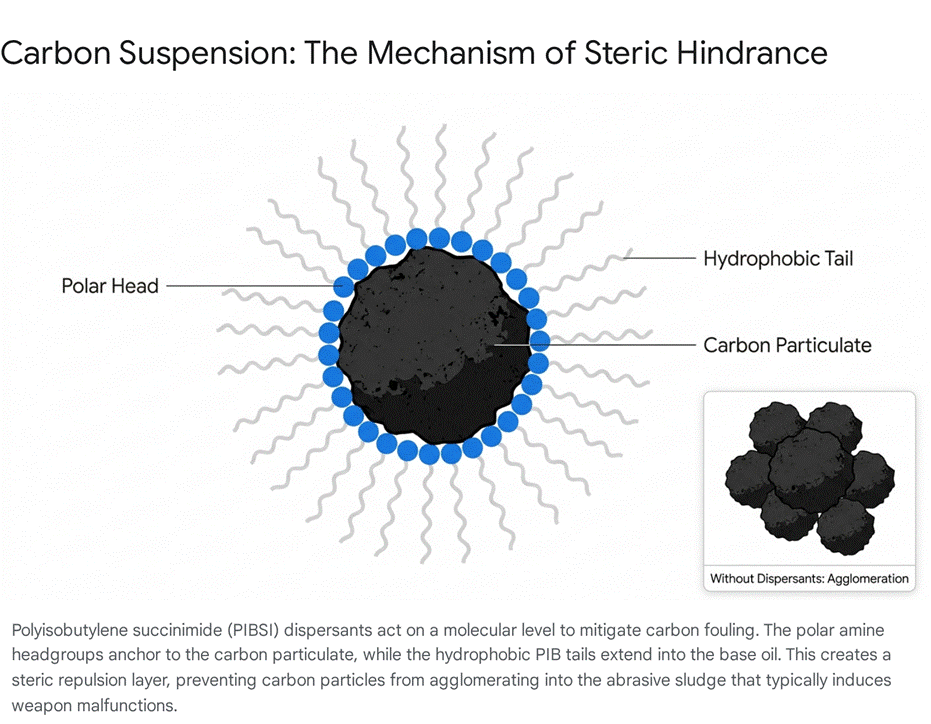
Ronin’s Grips HRO uses specialized “Active Cleansing Agents” to manage carbon1, 3. These agents, called PIBSI dispersants, act like tiny magnets for carbon particles25, 26.
The inclusion of PIBSI represents a masterclass in organic chemistry applied to small arms tribology. PIBSI is made by reacting polyisobutylene succinic anhydride (PIBSA) with polyalkylene polyamines, creating a molecule with very distinct functional zones. It consists of a long, oil-soluble, hydrophobic polyisobutylene (PIB) tail and a highly polar polyamine headgroup26.
When carbon soot enters the receiver, the polar amine headgroup of the PIBSI molecule is immediately attracted to the highly charged surface of the soot particles26. Through strong dipole-dipole and acid-base interactions, the polar heads anchor themselves firmly to the carbon26. The long, hydrophobic PIB chains then extend outward into the surrounding synthetic oil phase27.
When carbon enters the gun, these dispersants surround each particle, keeping them separated so they can’t clump together into a gritty paste24, 26, 27. This keeps the carbon floating in the oil rather than sticking to your gun’s parts2. This makes the weapon essentially “self-cleaning” because you can simply wipe away the dirty oil without having to scrape off baked-on carbon2.
Polymeric Film Technology in Lucas Extreme Duty
Lucas Extreme Duty uses its thick polymer film to protect surfaces13. This sticky film creates a tough physical barrier that blocks out rust and moisture while staying in place even during intense movement7.
This film exhibits incredibly high tackiness and resilience to mechanical shock. In a direct-impingement weapon, expanding gas inevitably attempts to blow the lubricant out of the ejection port. Lucas Oil’s heavy polymeric film resists this violent blowback, keeping the oil exactly where it is applied on the BCG and severely reducing the amount of fluid migrating into the operator’s face or safety glasses9.
However, this stickiness is a trade-off. While it stays on your gun well, it also attracts dust and carbon29. Over many shots, the residue can turn into a thick, dark paste30. While the gun will still cycle reliably, it usually requires a more thorough cleaning with strong solvents to get all that paste out of the action compared to the HRO29.
Rheology, Viscosity Index, and Environmental Operating Windows
Rheology—the study of the deformation and flow of matter—is a critical factor in small arms lubrication. A lubricant must possess low enough viscosity to penetrate microscopic surface pores and flow smoothly into the tight, exacting tolerances of gas rings, yet high enough viscosity (film strength) to form a tenacious, clinging boundary cushion on the highly loaded cam channel and receiver rails3.
Viscosity Profiles and High-Speed Mechanisms
Ronin’s Grips HRO is designed to thicken similar to 10W-30 motor oil3. It has a high “Viscosity Index,” which means it stays stable regardless of the temperature3. It won’t get too thin when hot or too thick when freezing, keeping your gun cycling at the right speed in any environment3.
Lucas Extreme Duty is a much thicker oil, closer to a 40 or 50 weight oil15. This thickness is what keeps it in place and makes it a favorite among gunners9. It provides a massive cushion against wear, though it might feel a bit more “sluggish” than the thinner HRO.
Arctic Operations and Pour Points
The pour point (evaluated via ASTM D97) of a lubricant determines its fundamental viability in extreme cold-weather operations. Standard crude-derived mineral oils contain inherent wax impurities that begin to crystallize and interlock at sub-zero temperatures, causing the entire fluid matrix to congeal. This induces severe cold-weather sluggishness, dramatically reduces cyclic rates, and directly causes failure-to-return-to-battery malfunctions as the buffer spring struggles to overcome the frozen fluid drag3.
Lucas Extreme Duty works down to -38°F, which is plenty for almost anyone shooting in the winter15.
However, Ronin’s Grips HRO is the champion of cold weather. Because it is a pure synthetic with zero wax, it stays liquid down to -60°F3. This makes it the best choice for extreme arctic conditions, where other oils would freeze solid3.
Corrosion Resistance and Long-Term Preservation
Beyond kinematic lubrication, a weapons oil must serve as an impenetrable barrier against oxidation, galvanic corrosion, and pitting. The industry standard for evaluating corrosion resistance is the ASTM B117 salt spray test, which subjects treated steel to a continuous brine fog at elevated temperatures to measure the hours until red rust appears31.
Lucas Extreme Duty is fantastic at preventing rust7, 32. Its thick, tacky film locks out moisture and salt from your hands7. If you are storing a gun for a long time in a humid basement or near the ocean, Lucas is an elite choice for keeping it rust-free12.
HRO also protects against rust and won’t evaporate over time, but it doesn’t have the same thick, “greasy” feel as Lucas3. Most shooters find it excellent for general storage, but Lucas remains the king of heavy-duty rust prevention.
Packaging, Distribution, and Market Economics
You can find Lucas Extreme Duty almost anywhere—sporting goods stores, auto parts stores, and online33. It also comes in a great 1-ounce bottle with a precision needle tip, which makes it easy to put oil exactly where you need it28. It’s also very affordable, usually under $10 for a small bottle34.
To distill the engineering data, the following table maps the critical technical properties and operational features of both fluids.
Technical Metric / Feature
Ronin’s Grips HRO (High Reliability Oil)
Lucas Extreme Duty Gun Oil
Base Stock Architecture
99.5% Pure Gas-to-Liquid (GTL) Synthetic3
Highly Refined Petroleum/Mineral Oil Blend11
Flash Point (Burn-off Resistance)
> 435°F (224°C)3
415°F (212°C)15
Pour Point (Arctic Operation)
-60°F (-48°C)3
-38°F (-39°C)15
Viscosity Profile
10W-30 Equivalent (60.5 cSt @ 40°C)3
Heavy Viscosity (15.0 cSt @ 100°C)15
Anti-Wear Additive Shield
Zinc Dialkyldithiophosphate (ZDDP)4
Zinc Alkyldithiophosphate (~15%)17
Carbon Management Strategy
Polyisobutylene succinimide (PIBSI) Dispersants1
Heavy Polymeric Adhesion Film13
Polytetrafluoroethylene (PTFE)
0% (Eliminates toxic off-gassing)1
0% (Uses heavy oil/ZDDP instead)17
Volatility (NOACK Evaporative Loss)
4.7% (Extreme stability)3
Unpublished (Mitigated by heavy viscosity)13
Synthesis of Pros and Cons
Lucas Extreme Duty Gun Oil The primary advantage of Lucas Extreme Duty is its exceptional film strength. The heavy viscosity and proprietary polymeric film technology ensure the oil clings aggressively to metal, preventing dry starts even after long periods of storage in unconditioned environments12. This heavy weight provides immense blowback resistance; it significantly reduces the amount of fluid migrating off the bolt carrier and into the operator’s face during suppressed fire, maintaining clear vision12. Furthermore, it serves as a tier-one preservative, neutralizing acids from human hands and locking out moisture12. Packaged in an excellent precision needle oiler, it is highly accessible and cost-effective12.
Conversely, the primary drawback of Lucas Extreme Duty is its propensity for debris attraction. The thick, petroleum-based polymeric film is inherently sticky. While it protects the underlying metal flawlessly, it aggressively attracts environmental dust, lint, and heavy carbon blowback29. Over hundreds of suppressed rounds, this forms a thick paste that requires heavier, solvent-intensive cleaning regimens30. Additionally, while a -38°F pour point is highly effective for general use, it cannot match the deep-arctic fluidity of a pure GTL synthetic3.
Ronin’s Grips High Reliability Oil (HRO) The overwhelming advantage of HRO is its unmatched thermal stability and purity. The 99.5% pure GTL base and minimal 4.7% NOACK volatility rating ensure that the fluid refuses to evaporate or burn off under rapid-fire conditions, fundamentally preventing the formation of crude-based sludge3. Its active carbon suspension is unparalleled; the integration of PIBSI dispersants micellizes carbon soot via steric hindrance, keeping it in fluid suspension and rendering the weapon essentially self-cleaning2. Furthermore, the lack of volatile petroleum impurities guarantees a low-smoke profile, preventing blinding, toxic smoke from obscuring the operator’s vision during suppressed mag-dumps1. Finally, the extreme temperature operating window enables flawless kinematic cycling, ranging from -60°F to receiver temperatures exceeding 500°F.
The limitations of HRO lie primarily in its market presence and physical feel. As a specialized, boutique synthetic, it lacks the ubiquitous retail availability of Lucas and requires targeted procurement3. Additionally, while possessing an elite viscosity index for high-speed parts, it operates closer to a 10W-30 equivalent3. Operators accustomed to the ultra-thick, sticky, shock-absorbing feel of heavy polymeric grease or oil may find HRO’s thinner film build to feel less substantial, even though the chemical ZDDP barrier provides equal or superior microscopic protection against wear.
Final Engineering Verdict
Choosing between these two oils depends entirely on how you use your gun.
If you want a reliable, heavy-duty oil that is easy to find and great for preventing rust during storage, Lucas Extreme Duty Gun Oil is a fantastic choice. It sticks to parts well and provides a thick cushion for your gun’s action. It’s perfect for the average shooter who wants great protection at a good price, though it might take a little more work to clean up afterward.
If you shoot suppressed, use full-auto, or shoot in extreme cold, Ronin’s Grips High Reliability Oil (HRO) is the clear winner. Its synthetic formula won’t burn off or turn into sludge under heat. It keeps carbon floating so you can just wipe your gun clean, and it won’t smoke you out of a room. It is a high-end solution for shooters who demand absolute reliability from their gear.
Shooter Lube Solvent Test. This GM9 has siezed shut multiple times. Already been sent back to gemtech 3x. Today I decided to try and soak and shake it in shooter lube gun cleaning solvent.. ive tried ATF/Mineral spirits mix, Kroil, and Clp before. Ill see how the results are tomorrow evening. : – Reddit, https://www.reddit.com/r/NFA/comments/mtqizr/shooter_lube_solvent_test_this_gm9_has_siezed/
Nano- and Micro-Tribological Investigations of Boundary Layers on Axial Bearing Washers Tested under WEC Critical Conditions – MDPI, https://www.mdpi.com/2075-4442/10/8/198
The operational parameters for modern small arms have undergone a radical transformation over the last decade. The integration of sound suppressors has changed from a specialized need to a common standard because of improvements in tactical doctrine and the widespread use of short-barreled rifles (SBRs). Concurrently, professional training mandates high-volume, rapid-fire drills that generate unprecedented thermal and mechanical stress profiles. These shifting paradigms have pushed the internal thermodynamics and tribological loads of direct-impingement and short-stroke piston systems far beyond their original engineering specifications.
Traditional firearms lubricants, often anchored in legacy military specifications and outdated crude-oil refining methods, consistently fail to protect weapon systems under these extreme modern conditions. The intersection of severe backpressure, extreme thermal saturation, and aggressive carbon fouling necessitates a fundamental reevaluation of weapon tribology. This analysis investigates the mechanical realities of suppressed weapon operation and deconstructs the chemical architecture of Ronin’s Grips High Reliability Oil (HRO)—a custom, ultra-premium fluid formulated from a proprietary, advanced 10W-30 equivalent synthetic architecture. By examining its Gas-to-Liquid (GTL) base stock, advanced additive package, and mechanochemical activation properties, this report provides a scientifically rigorous framework to position HRO as the definitive, validated solution for suppressed weapon reliability.
Part I: The Hostile Environment of the Suppressed Weapon System
To comprehend the failure mechanisms of traditional lubricants, we must conduct an exhaustive analysis of the operating environment within a suppressed direct-impingement (DI) firearm, such as the AR-15 platform. The addition of a suppressor does not merely alter the acoustic signature; it fundamentally disrupts the gas dynamics, thermal equilibrium, and mechanical velocity of reciprocating components.
1.1 Gas Dynamics, Backpressure, and Kinematic Stress
A sound suppressor functions by stripping, trapping, and delaying the expansion of high-pressure propellant gases through a complex series of internal baffles1. While highly effective at reducing acoustic and visual signatures, this impedance creates severe residual backpressure within the bore. Because the expanding gas cannot rapidly escape the muzzle, it seeks the path of least resistance. In the AR-15 system, this results in a significantly higher volume and pressure of gas driven rearward through the gas tube and directly into the internal expansion chamber of the bolt carrier group (BCG)1.
Thermal map of a suppressed SBR AR-15 with a direct impingement gas system . Red denotes hot zones.
This amplified gas volume induces immediate and severe mechanical consequences. The BCG is driven rearward at velocities far exceeding standard unsuppressed design parameters. A typical cycling event, which occurs in under 0.1 seconds under pressures exceeding 50,000 psi, is compressed further, violently increasing the impact on the buffer system and accelerating the bolt’s unlocking phase3. Furthermore, standard mil-spec BCGs vent these excess gases at a 90-degree angle to the bore through un-shrouded porting systems, directing carbon and pressure directly into the upper receiver4.
As the carrier accelerates abnormally fast, the cam pin is forced to travel along its helical track, rotating the bolt out of battery while chamber pressures remain elevated. This dynamic places immense shear stress on the cam pin and the locking lugs4. Even when components are precision-machined from military-specification 8620 steel (for the carrier) and Carpenter 158 or 9310 steel (for the bolt), the increased cyclic rate induces rapid fatigue stress, leading to premature cracking and eventual shearing of the locking lugs3. The addition of a suppressor delays muzzle gas expansion, forcing superheated propellant gases backward through the gas tube. This drastically increases BCG operating temperatures and accelerates carrier velocity, amplifying shear stress on the cam pin and locking lugs1.
1.2 Thermal Saturation and Heat Transfer
The standard AR-15 bolt carrier group absorbs significant thermal energy even under unsuppressed conditions. However, the introduction of a suppressor essentially creates a thermal trap. During a moderate to high-volume string of rapid fire (50 to 100 rounds), the internal temperature of the suppressor rapidly scales from 300°F to over 850°F, severely compromising its structural integrity and heat dissipation capabilities2. After 200 rounds of sustained automatic fire, the suppressor can reach a critical thermal saturation point between 900°F and 1,200°F2.
This heat migrates backward. Concurrently, the trapped, superheated gases blast directly into the internal expansion chamber of the BCG, driving the operating temperatures of the bolt, gas rings, and carrier rails well beyond 400°F during suppressed rapid fire. This thermal saturation point is critical because it vastly exceeds the operational ceiling and flash points of most traditional, legacy firearm lubricants, rendering them incapable of maintaining a protective fluid film.
1.3 Carbon Fouling and Particulate Accumulation
Modern small arms ammunition utilizes smokeless powder, which, upon deflagration, leaves behind a highly abrasive residue composed of carbon, unburnt powder, and trace copper and lead particulates. In a suppressed system, the extreme backpressure acts as a pneumatic ram, driving this particulate matter deep into the action and receiver1.
When this heavy carbon load is introduced to an inferior liquid lubricant under high heat, the two combine to form a viscous, highly abrasive sludge8. This sludge alters the precise tolerances required by the gas rings, impedes the free movement of the firing pin, and creates immense friction drag on the carrier rails. The resulting mechanical binding manifests as catastrophic weapon malfunctions, including failures to extract, eject, and return to battery.
Part II: Tribological Fundamentals and the Boundary Lubrication Regime
To engineer a lubricant capable of surviving the suppressed AR-15 environment, one must analyze the specific lubrication regimes present in reciprocating firearms. Tribology defines three primary regimes of lubrication: hydrodynamic, elastohydrodynamic, and boundary lubrication.
In hydrodynamic lubrication, a full fluid film entirely separates the moving surfaces. This is typical in high-speed, continuously rotating journal bearings where fluid is dragged into a wedge, preventing metal-to-metal contact. However, firearms operate on linear, reciprocating motion. The bolt carrier group must come to a complete, momentary stop at both the rearward limit (striking the buffer tube) and the forward limit (locking into the barrel extension) of its travel. At these points of zero velocity, the hydrodynamic fluid film inevitably collapses9.
Consequently, firearms spend a significant portion of their operational cycle in the boundary lubrication regime. In this state, the bulk fluid film is insufficient to separate the surfaces, and the microscopic peaks of the metal (asperities) come into direct, violent contact9. When a suppressed weapon is fired, the extreme heat, elevated pressures, and sheared fluids force the gas rings, cam pin, and rails into severe boundary contact. If the lubricant lacks advanced anti-wear additives capable of chemically bonding to the steel to form a sacrificial solid film, the resulting adhesive and abrasive wear will rapidly destroy the components10.
Part III: The Chemical and Structural Failure of Legacy Lubricants
For decades, military operators and civilian shooters have relied on MIL-PRF-63460 standard CLP (Cleaner, Lubricant, Preservative) alongside various boutique mineral-oil-based formulations. While these fluids are marginally adequate for manually operated bolt-action rifles or unsuppressed platforms firing low round counts, their chemical architecture guarantees structural failure in modern suppressed applications.
3.1 The Volatility and Flash Point Deficit of MIL-SPEC CLP
The military specification for CLP (MIL-PRF-63460F) establishes performance baselines that are dangerously inadequate for suppressed fire. The specification mandates a minimum kinematic viscosity of merely 14.0 cSt at 40°C, meaning the fluid is exceptionally thin to facilitate its solvent-like “cleaning” properties13. Furthermore, the specification only requires a minimum flash point of 65°C (149°F)13.
When a lubricant with a 149°F flash point is introduced to a suppressed BCG operating at temperatures well over 300°F, it instantaneously vaporizes and suffers from extreme thermal degradation2. This vaporization, commonly referred to as “burn-off,” has severe consequences:
Loss of Boundary Protection: The protective fluid film is completely destroyed, leaving bare steel asperities to grind against bare steel at high velocities.
Aerosolization and Visual Impairment: The thin fluid instantly flashes into a thick, blinding smoke that exits the ejection port and charging handle slot, obscuring the operator’s vision and causing severe respiratory distress in confined spaces4.
3.2 The Polytetrafluoroethylene (PTFE) Hazard
In an attempt to improve boundary lubrication without addressing base oil quality, many legacy and boutique firearms lubricants rely on suspended Polytetrafluoroethylene (PTFE), commonly known as Teflon. While PTFE offers a low coefficient of friction at room temperature, it presents a lethal hazard in suppressed direct-impingement systems. PTFE begins to structurally degrade and decompose at temperatures above 500°F. When burned inside the high-heat environment of a suppressed AR-15, it releases highly toxic fluoropolymer decomposition gases, posing a severe inhalation hazard to the operator. Furthermore, PTFE is a solid particulate that can agglomerate, clump, and settle out of suspension, leading to inconsistent lubrication application.
3.3 Mineral Oil Hydrocracking and Sludge Polymerization
Traditional mineral oils, classified as API Group I or Group II base stocks, are refined from crude oil. Despite extensive hydrocracking processes, these base stocks retain inherent organic impurities, including sulfur, nitrogen, and aromatic hydrocarbon rings8. Additionally, the hydrocarbon chains in crude-derived oils vary wildly in size, weight, and geometric shape8.
Under the extreme thermal stress and violent mechanical shear forces of a suppressed weapon, these irregular molecules fracture and break apart. The inherent sulfur and nitrogen impurities oxidize rapidly, triggering a chain reaction of polymerization8. When these oxidized, broken hydrocarbon chains bind with the heavy carbon fouling generated by the supersonic rifle cartridge, they create a dense, hard-baked sludge that physically chokes the weapon’s reciprocating mass and accelerates abrasive wear8.
Part IV: The Core Chemical Architecture of High Reliability Oil (HRO)
Ronin’s Grips High Reliability Oil (HRO) represents a fundamental departure from legacy firearms lubrication. The product completely abandons hydrocracked crude oil. Instead, HRO is a custom, ultra-premium tribological barrier built upon a proprietary 10W-30 equivalent Gas-to-Liquid (GTL) architecture8. By adapting some of the most advanced synthetic chemistries on the planet for small arms application, HRO delivers a spectrum of performance metrics that purpose-built, boutique “gun oils” simply cannot replicate.
4.1 Gas-to-Liquid (GTL) Synthesis and Absolute Molecular Uniformity
The technological cornerstone of HRO is its base stock, derived via a revolutionary Gas-to-Liquid (GTL) synthesis process8. Rather than attempting to filter impurities out of dirty crude oil, the GTL process utilizes Fischer-Tropsch synthesis to chemically build the base oil molecule-by-molecule from pure methane natural gas8.
This advanced synthesis yields a crystal-clear synthetic base fluid that achieves 99.5% purity8. Because it is synthesized directly from natural gas, it contains zero sulfur, nitrogen, or aromatic impurities that plague Group I and Group II mineral oils8.
Crucially, the GTL process guarantees absolute molecular uniformity. The synthesized isoparaffinic molecules are identical in size, weight, and structure, functioning microscopically as millions of perfectly spherical ball bearings8. This uniformity dramatically reduces internal fluid friction, minimizes surface tension, and provides an unbroken boundary layer. The uniform structure maximizes film adhesion against the vertical surfaces of the weapon’s action, resisting the extreme mechanical shear and cyclic G-forces of a suppressed BCG8.
4.2 Rheological and Thermal Superiority: Flash Point and NOACK Volatility
To survive the intense 300°F to 500°F operating environment of a suppressed AR-15 without breaking down, a lubricant must resist both rapid evaporation and thermal burn-off. HRO outclasses all military-grade CLPs in this domain through exceptional thermal metrics based on its advanced GTL 10W-30 equivalent specification:
Extreme Flash Point: HRO possesses an independently verified Cleveland Open Cup (COC) flash point exceeding 224°C (435°F)7. This staggering thermal threshold dictates that the fluid refuses to combust, oxidize, or aerosolize under severe firing schedules. For the tactical operator, this translates directly to zero blinding smoke billowing from the charging handle or ejection port, ensuring clear vision, respiratory comfort, and uncompromised situational awareness during sustained engagements8.
Negligible Volatility: The NOACK Volatility test (ASTM D5800) measures the percentage of a lubricant’s mass that evaporates under sustained high temperatures. HRO achieves an exceptional NOACK Volatility rating of merely 4.7% weight loss8. By comparison, standard synthetic blends, legacy military oils, and conventional formulations frequently suffer evaporation rates exceeding 12% to 15%18. Because HRO effectively does not evaporate, it remains inside the weapon during long-term storage and continues to provide fluid hydrodynamic lubrication through thousands of suppressed rounds, preventing the weapon from running dry.
High-Temperature High-Shear (HTHS) Stability: Measured via ASTM D4683, HTHS determines a fluid’s dynamic viscosity under severe thermal (150°C) and mechanical shear stress, simulating the conditions of a rapidly moving bolt carrier18. Premium synthetic architectures in this class achieve an optimal HTHS viscosity of 3.1 cP18. This metric ensures that even when the BCG is operating at 400°F and slamming into the receiver extension at high velocity, the hydrodynamic fluid film remains robust, intact, and highly protective8.
4.3 Arctic Operations and Kinetic Fluidity
While extreme heat generated by suppressors is the primary catalyst for lubricant failure, extreme cold environments present an equally catastrophic threat to weapon reliability. Traditional crude-derived oils inherently contain microscopic paraffin waxes. When the ambient temperature drops below freezing, these waxes crystallize, causing the oil to gel and effectively gluing the bolt carrier to the upper receiver walls8. This cold-weather thickening drastically slows cyclic rates, resulting in sluggish extraction and failures to return to battery.
Because HRO’s GTL base is synthesized directly from natural gas, it contains absolutely zero crude wax impurities8. Validated by ASTM D97 testing, HRO exhibits an extreme pour point of -48°C (-54°F to -60°F) and an exceptional Viscosity Index ranging from 150 to 1758. In deep arctic environments, the fluid remains highly kinetic and avoids gelation, ensuring immediate boundary lubrication, unhindered carrier velocity, and full-speed weapon cycling from the very first shot regardless of ambient temperature drops8.
Part V: Mechanochemical Additive Packages and Active Fouling Suspension
Base oil purity and high flash points alone are insufficient to protect precision weapon systems from the immense pressures, shear forces, and carbon fouling generated by supersonic rifle cartridges. The true genius of HRO’s architecture lies in its highly sophisticated, synergistic additive package.
5.1 Mechanochemical Shielding via Zinc Dialkyldithiophosphate (ZDDP)
At the heart of HRO’s anti-wear capability is a highly potent, oil-soluble organometallic compound known as Zinc dialkyldithiophosphate (ZDDP)9. While some boutique gun oils rely on solid particulates like Teflon or molybdenum disulfide (which can clump, settle, and off-gas), ZDDP remains fully dissolved and molecularly integrated into the GTL base oil.
ZDDP is a highly specialized mechanochemically activated additive. It remains completely dormant in a cold, static firearm. However, it requires a combination of high thermal energy (an activation threshold typically above 130°C / 266°F) and extreme mechanical friction/shear stress to deploy9. The moment the operator begins firing a suppressed weapon, the explosive heat and violent metal-on-metal friction of the reciprocating bolt carrier group trigger a profound chemical reaction9.
Under these extreme boundary lubrication conditions, the ZDDP molecules decompose. The cleavage of their phosphorus-sulfur bonds initiates a process where the compound undergoes absorption directly onto the sliding steel surfaces9. This tribochemical reaction forms a sacrificial layer of amorphous zinc polyphosphate glass, augmented by iron oxides and a sulfur-rich layer near the substrate surface9. This solid tribofilm can rapidly grow up to 200 nanometers thick, effectively burying the microscopic steel asperities9.
This creates a profound operational advantage unique to HRO’s chemistry: The harder and hotter the weapon runs, the stronger the HRO tribofilm becomes. Rather than degrading under thermodynamic stress like legacy oils, HRO utilizes the weapon’s own heat and friction to forge a microscopic glass shield that prevents direct steel-on-steel contact, virtually eliminating adhesive and abrasive wear on highly stressed components such as cam pins, gas rings, and locking lugs5.
5.2 Active Carbon Suspension and Detergency
Severe carbon fouling is an unavoidable byproduct of direct-impingement systems, heavily exacerbated by the backpressure of a suppressor. When inferior, easily oxidized oils encounter this hot carbon, they rapidly coagulate into a baked-on, abrasive sludge that induces malfunctions. HRO mitigates this through a heavy concentration of metallic calcium-based detergents and ashless polyisobutylene succinimide dispersants11.
Because the GTL base oil is 99.5% pure and highly resistant to oxidation, these active cleansing agents do not waste their chemical energy fighting the degradation of the base oil itself8. Instead, 100% of the additive package is dedicated to seeking out, isolating, and encapsulating carbon, soot, copper, and lead particulates8. The polyisobutylene succinimide dispersants effectively form stable micelles around the carbon molecules, keeping them permanently suspended in the fluid matrix and preventing them from agglomerating into larger clusters or baking onto the critical geometry of the bolt tail8.
For the end-user, this translates to vastly simplified maintenance procedures and extended mean time between failures (MTBF). The weapon remains in a state of high hydrodynamic and boundary reliability during thousands of rounds of suppressed fire. When maintenance is finally required, the suspended carbon does not need to be violently scraped with steel tools or bathed in highly toxic chemical solvents; it simply wipes away with a standard dry cloth, taking the encapsulated fouling out of the receiver with minimal effort8.
Part VI: ASTM Standardized Tribological Validation
The custom chemical engineering behind Ronin’s Grips HRO is validated by uncompromising physical metrics. By analyzing ASTM standard testing data, the superiority of the HRO architecture over standard CLPs and competing synthetics becomes undeniable.
The Four-Ball Wear Test (ASTM D4172) is the premier tribological standard for determining a lubricant’s ability to prevent wear under immense pressure and sliding contact22. In this procedure, three steel balls are clamped together and covered in the test lubricant, while a fourth ball is pressed against them and rotated at high speed under a specific load (often 40 kgf) for a sustained period22. The resulting damage, or “wear scar,” is measured in millimeters; a smaller scar indicates superior boundary protection32.
Testing on top-tier 10W-30 synthetic architectures reveals remarkable results. While un-additized conventional oils, poor-quality CLPs, and lesser synthetics allow significant scarring (often exceeding 0.60 mm to 0.85 mm), premium synthetics utilizing advanced ZDDP and base architectures in the HRO weight class routinely achieve wear scars of 0.40 mm or less32. The synergistic effect of the ZDDP tribofilm and the highly uniform GTL base ensures that the friction interface is protected by a solid boundary layer, resulting in unparalleled protection for high-friction areas like AR-15 cam pins and pistol slide rails.
Part VII: Consumer Persuasion and The HRO Value Proposition
The primary challenge in adopting modern lubrication standards is overcoming the deeply entrenched dogmas of the firearms community. Many consumers default to legacy CLPs out of habit, failing to realize that the advanced chemical engineering behind synthetic tribology vastly eclipses the legacy formulas of military specifications35.
To effectively position HRO for law enforcement, military professionals, and uncompromising civilian shooters, the analysis must focus relentlessly on the advanced science of its composition. The narrative rests on three core pillars that prove HRO is superior:
7.1 Bridging the Modern Performance Gap
The operational parameters of firearms have fundamentally changed. The proliferation of suppressors and SBRs means legacy lubricants designed decades ago are now structurally obsolete and ill-equipped to handle current thermodynamic realities8. HRO provides a critical “modern solution for modern weapon systems” by addressing the specific, high-heat parameters induced by suppressors.
7.2 Health, Safety, and Low-Smoke Operation
Tactical operators are increasingly aware of the toxic gas blowback associated with suppressed weapons in confined spaces. HRO provides profound health and safety merits. With a >435°F flash point and a complete absence of PTFE (Teflon), the user will not be subjected to blinding smoke or toxic hydrofluoric acid gas off-gassing during high-volume indoor training or close-quarters combat8. This ensures clear vision, respiratory comfort, and uncompromised situational awareness.
7.3 A Custom Tribological Solution
The proprietary synthesis of HRO ensures its premium positioning. The terminology utilized correctly frames its capabilities: HRO is a Custom, Ultra-Premium Synthetic Tribological Barrier. Its advantages stem directly from proven chemical innovations:
Gas-to-Liquid (GTL) Synthesis: Built molecule-by-molecule from clean natural gas, abandoning the inherent impurities of dirty crude oil8.
Active Carbon Suspension: The 99.5% pure base fluid allows specialized polyisobutylene succinimide dispersants to isolate and float carbon, making the weapon essentially self-cleaning and eliminating the need for destructive scraping tools8.
Mechanochemical Shielding: The specialized ZDDP additive functions as an advanced heat-activated anti-wear matrix. The intense friction and heat of the weapon actually triggers a chemical zinc polyphosphate glass barrier that physically stops metal-to-metal wear10.
Table 7.1: Value Proposition Alignment for Target Demographics
Target Demographic
Primary Operational Pain Point
HRO Solution (Targeted Marketing Angle)
Special Operations / SWAT
Suppressed weapon heat, toxic gas blowback, extreme cold-weather sluggishness in varied environments.
Extreme Range Reliability: A >435°F flash point prevents blinding smoke; a -60°F pour point ensures kinetic cycling in arctic conditions. Zero PTFE toxicity guarantees respiratory safety.
Competitive Shooters (3-Gun)
High round counts causing sluggish cycling, thermal degradation, and sludge accumulation mid-match.
Active Fouling Suspension: 99.5% GTL purity and succinimide dispersants encapsulate carbon. Keeps the bolt carrier gliding flawlessly through 1,000+ round stages without mid-match cleaning.
High-End Civilian / Enthusiast
Wear on expensive internal parts (locking lugs, cam pins); tedious deep-cleaning sessions after range days.
Mechanochemical Protection: Heat-activated barrier eliminates metal-on-metal wear on expensive components. Carbon wipes away effortlessly with a dry cloth—no scraping required.
Conclusion
The thermodynamic and kinematic physics of suppressed weapon operation—characterized by intense backpressure, extreme heat saturation exceeding 400°F, and massive carbon fouling—have rendered traditional crude-based oils and MIL-SPEC CLPs structurally and chemically obsolete. When subjected to these modern stresses, legacy fluids evaporate rapidly, release toxic PTFE gases, and polymerize into abrasive sludge that induces catastrophic weapon malfunctions.
Ronin’s Grips High Reliability Oil (HRO) neutralizes these extreme threats by leveraging the absolute pinnacle of synthetic tribological engineering. By utilizing a 99.5% pure Gas-to-Liquid (GTL) base stock, HRO provides absolute molecular uniformity, a staggering >435°F flash point, and arctic-level cold weather fluidity down to -60°F. Furthermore, its mechanochemical ZDDP additive package turns the intense heat and friction of the weapon into an operational advantage, forging a protective zinc polyphosphate glass barrier over critical steel components, while advanced polyisobutylene succinimide dispersants keep abrasive carbon permanently suspended.
For the professional operator, law enforcement officer, or dedicated civilian who pushes their equipment to the absolute limit, HRO is not merely a lubricant; it is an operational insurance policy. By educating the market on the science of GTL synthesis and active heat-activated tribofilms, it is clear that when the weapon absolutely must fire, HRO will not fail.
The small arms suppressor market experienced a massive paradigm shift in the first half of 2026. Driven by the elimination of the $200 National Firearms Act transfer tax on January 1, 20261, and the subsequent reduction of eForm 4 approval times to a median of 11 days, consumer adoption has reached unprecedented levels across the United States. This regulatory relief has allowed consumers to redirect capital toward premium hardware, accelerating the adoption of additively manufactured silencers utilizing advanced superalloys like Haynes 282 and Inconel 718. The market is no longer constrained by the financial barriers that historically favored budget tier options.
An analysis of social media sentiment and digital discussion volume for the month of July 2026 reveals a highly technical consumer base. Discussions have pivoted away from basic sound reduction and now focus intensely on gas dynamics, specifically the mitigation of system back pressure, thermal management, and material science. Hybrid internal geometries (such as SURGE BYPASS and Purposely Induced Porosity) dominate the discourse, rendering traditional sealed baffle designs increasingly obsolete for semi automatic and fully automatic host weapons1. This report identifies and analyzes the top 10 most discussed suppressors for July 2026, detailing their engineering principles, market reception, and overarching consumer sentiment. The analysis begins with the most discussed unit and concludes with the least discussed among the top ten.
Summary of Top 10 Most Discussed Suppressors
Rank
Suppressor Model
Positive Sentiment
Negative Sentiment
Neutral Sentiment
Critical Discussion Point
1
Otter Creek Labs Infinity 556K
75%
10%
15%
Haynes 282 construction and tunable back pressure end caps.
2
CAT WB (Woodpecker’s Blood)
85%
5%
10%
SURGE BYPASS technology balancing sound and gas reduction.
3
PTR VENT Spiritus 556
45%
35%
20%
Exceptional acoustic performance overshadowed by strict cleaning schedules.
4
CAT ODB (Old Dirty Bastard)
88%
2%
10%
Subsonic 300 BLK performance and cross platform versatility.
5
SureFire SOCOM556-RC3
20%
60%
20%
Poor flash suppression and high muzzle blast relative to retail cost.
6
Dead Air Lazarus 6
70%
10%
20%
Triskelion baffle geometry and robust thermal management.
7
Otter Creek Labs Polonium / K
80%
10%
10%
Budget dominance and traditional baffle high back pressure behavior.
8
SAW Tisha
75%
5%
20%
Premium pricing and internal geometric updates to titanium models.
9
B&T Print-X
15%
70%
15%
Viral structural failure incidents and additive manufacturing limits.
10
SilencerCo Spectre 9
90%
2%
8%
Ultra lightweight titanium tubeless design for pistol caliber platforms.
The July 2026 Macroeconomic and Regulatory Landscape
To properly contextualize the social media discourse surrounding these specific silencers, one must first understand the unprecedented market conditions of July 2026. On July 4, 2025, the federal government passed the “One Big Beautiful Bill Act” (Public Law 119-21)2. Among sweeping legislative changes, this bill explicitly reduced the transfer and making tax for National Firearms Act items (specifically silencers, short barreled rifles, and short barreled shotguns) from $200 to $02. This provision officially took effect on January 1, 2026.
The immediate removal of this 90 year old financial barrier triggered a surge in consumer demand that fundamentally shocked the manufacturing supply chain. On January 1, 2026, the Bureau of Alcohol, Tobacco, Firearms and Explosives processed over 150,000 eForm submissions in a single day, compared to their normal daily volume of approximately 2,5006. This momentum did not wane as the year progressed. By June 2026, NFA background checks had surged 177 percent year over year, reaching 166,677 checks in a single month7.
Concurrent with the tax elimination, the regulatory body vastly optimized their internal processing architecture. The median wait time for an individual eForm 4 application plummeted from a historical average of 6 to 12 months down to a median of 11 days by January 2026, with many users reporting approvals in as little as 3 to 8 days by mid summer2. This combination of zero dollar tax stamps and near instant gratification fundamentally altered buyer expectations. According to retail data analytics, despite overall firearm sales declining in the first quarter of 2026, suppressor sales soared by 16.9 percent, and standing retailer inventory levels dropped by a staggering 23.5 percent9. Consumers, no longer forced to budget $200 for a tax stamp, began reallocating those funds directly into the hardware itself. This catalyzed the widespread adoption of premium, exotic superalloys and complex additive manufacturing techniques, effectively forcing manufacturers to innovate beyond traditional stainless steel baffles.
The Metallurgical Shift to Additive Superalloys
The discourse in July 2026 revealed a consumer base highly educated in metallurgical properties, specifically debating the merits of Inconel 718 versus Haynes 282. Historically, Inconel 718 has been the aerospace standard for high temperature structural applications in the firearms industry. It is a precipitation hardenable nickel chromium iron alloy that relies primarily on gamma double prime precipitation for its strength10. It provides excellent resistance to blast baffle erosion on short barreled carbines up to approximately 650 degrees Celsius11.
However, discussions in July 2026 highlighted a rapid industry transition toward Haynes 282. Haynes 282 is a gamma prime strengthened wrought superalloy engineered with high cobalt and molybdenum content10. Unlike Inconel 718, which begins to lose structural rigidity and experience gamma double prime coarsening during sustained thermal exposure above 650 degrees Celsius, Haynes 282 relies on slow gamma prime precipitation10. This gives it vastly superior thermal creep resistance and rupture life in the 650 to 925 degree Celsius window12. Consumers have realized that for short barreled 5.56NATO rifles subjected to high volume firing schedules, Haynes 282 maintains its structural rigidity and strength at peak operating temperatures much more effectively than Inconel, surpassing Inconel’s strength around 750 degrees Celsius11.
Both of these alloys are notoriously difficult to machine using traditional subtractive methods. Consequently, the industry has universally adopted Laser Powder Bed Fusion and Direct Metal Laser Sintering 3D printing13. This additive manufacturing process allows for the creation of intricate internal flow path that were previously impossible to cut on a lathe13.
While Titanium (Grade 5 and Grade 9) remains popular for its extreme lightweight properties, consumers are increasingly aware of its limitations. Titanium suffers from poor erosion resistance under high velocity jet impingement and exhibits severe sparking under night vision devices, making it less suitable for aggressive supersonic firing schedules compared to nickel based superalloys15.
Evolution of Fluid Dynamics and Acoustic Engineering
The evaluation of a suppressor’s efficiency is no longer limited to basic decibel reduction at the muzzle. Modern engineering analysis, heavily influenced by independent testing from organizations like PEW Science14, focuses on complex gas dynamics1. Suppressor architecture currently falls into three primary categories.
Conventional designs (such as the traditional cone baffle) trap expanding gases to achieve high acoustic suppression at the muzzle. However, this creates a high Omega metric (extreme system back pressure), which accelerates the weapon’s bolt carrier group, increases cyclic rates, and forces toxic gas back through the ejection port into the operator’s face17.
High Flow Rate designs (often referred to as flow through technology) solve the back pressure problem by routing gases forward through annular or toroidal pathways17. While this minimizes the Omega metric and reduces gas blowback, the rapid forward venting often results in poor subsonic sound signature suppression and sometimes brighter muzzle flash21.
The most discussed suppressors of July 2026 fall into a third category known as Hybrid designs. These architectures utilize specialized geometric features to manipulate pressure differentials. Technologies like SURGE BYPASS incorporate multi stage pressure reducing regions with localized stagnation relief zones21. This allows the silencer to bleed off high pressure shockwaves early in the blast chamber while still providing enough resistance to delay the bulk of the gas expansion, striking a delicate balance between operator comfort and raw sound reduction21. Other hybrid approaches include Purposely Induced Porosity (PIP), which utilizes metallic foam matrices, and variable back pressure end caps that allow the user to manually tune the distal vent area of the suppressor19.
Comprehensive Analysis of the Top 10 Suppressors (July 2026)
1. Otter Creek Labs Infinity 556K
The Otter Creek Labs Infinity 556K dominated social media conversations throughout the month, propelled by the release of comprehensive PEW Science laboratory data on July 29, 2026.
Specification
Detail
Material
Haynes 282 Superalloy
Manufacturing
3D Printed (LPBF)
Weight
14.5 oz (without mount)
Length
5.5 inches
Mounting Standard
HUB (1.375×24 tpi)
Key Feature
Swappable Back Pressure End Caps
Engineering and Design Focus: The Infinity 556K represents a major evolutionary step for Otter Creek Labs, transitioning from traditional stainless steel baffles to additive manufacturing. The core is 3D printed from Haynes 282, which provides unmatched thermal stability and durability during aggressive firing schedules on short barreled carbines19. The defining architectural feature is its tunable distal flow rate. The suppressor features a proprietary interchangeable end cap system allowing users to install solid, partially vented, or fully vented front caps19. This design acknowledges that back pressure is a systemic variable dependent on barrel length, gas port size, and buffer weight.
Sentiment Analysis and Critical Discussion: With a 75 percent positive sentiment rating, consumers praised the mechanical versatility. On an untuned factory MK18 with a 10.3 inch barrel, the solid end cap achieved a high PEW Science Suppression Rating of 36.4, providing excellent raw acoustic reduction at the cost of noticeable ejection port blast19. By swapping to the partially vented end cap, annular gas flow is allowed to escape distally, reducing the blowback hazard to the operator’s face while still maintaining an overall composite score of 38.019.
Negative sentiment (10 percent) largely centered on minor quality control issues, specifically reports of the included proprietary wrench breaking during end cap removal, necessitating the use of anti seize compounds26. However, the general consensus is that the Infinity 556K is a technological triumph. Users widely praise the material selection and tunable nature of the suppressor, noting that the Infinity represents a significant technological advancement for the company and serves as an optimized solution for semiautomatic 5.56 weapon systems25.
2. CAT WB (Woodpecker’s Blood)
Combat Application Technologies maintained an imposing presence in the digital landscape. The CAT WB is a dedicated 5.56 NATO suppressor that has established itself as the premier benchmark for hybrid low back pressure designs.
Specification
Detail
Material
Inconel 718 or Grade 5 Titanium
Manufacturing
3D Printed (DMLS)
Weight
15.7 oz (Inconel, actual tested)
Length
5.45 inches
Mounting Standard
HUB or Proprietary QD (Spooky)
Key Feature
SURGE BYPASS Gas Management
Engineering and Design Focus: The WB utilizes CAT’s proprietary SURGE BYPASS technology. Unlike early generation flow through silencers that simply routed gas around the core, SURGE BYPASS relies on complex internal geometries to create stagnation relief zones15. This allows the silencer to significantly reduce the alpha parameter (early time shock propagation) while avoiding a total dump of external gas momentum27. The result is a silencer that cycles the host weapon cleanly, drastically reducing toxic gas exposure to the shooter, while still suppressing muzzle blast and flash with the efficiency of a sealed design21.
Sentiment Analysis and Critical Discussion: The CAT WB achieved an outstanding 85 percent positive sentiment rating. The primary discussion point was the suppressor’s ability to operate flawlessly on untuned, over-gassed factory rifles. Many users directly compared the WB to competing pure flow through models, noting that the WB possesses a much deeper, more pleasant acoustic tone without the sharp, boomy characteristics typical of high flow rate cans23.
Negative sentiment (5 percent) was minimal and mostly focused on retail scarcity and the premium price tag. Users frequently highlighted the functional balance of the design, with one user noting: “if I tune my AGB on my 10.5 inch to where it starts reliably locking back on an empty PMAG + two clicks past and then take off the CAT WB, the system suddenly turns into a bolt action… There’s definitely some back pressure but not anywhere near the level of traditionally baffled cans”29.
3. PTR VENT Spiritus 556
The PTR VENT Spiritus emerged as the most polarizing suppressor of July 2026. It represents a radical departure from conventional physics but demands significant logistical compromises.
Specification
Detail
Material
Inconel
Manufacturing
3D Printed
Weight
Not Disclosed
Length
6.0 inches
Mounting Standard
HUB Compatible
Key Feature
Purposely Induced Porosity (PIP)
Engineering and Design Focus: The Spiritus utilizes Purposely Induced Porosity (PIP). Instead of solid metal baffles, the internal structure is 3D printed with a highly porous matrix that resembles metallic foam23. This geometry forces acoustic energy and high pressure gas to bleed through microscopic lattice structures, resulting in rapid thermal and kinetic energy dissipation30. From a pure acoustic standpoint, this technology effectively neutralizes both muzzle blast and ejection port noise, providing staggering decibel reduction numbers on 5.56 platforms31. The Spiritus is 3D printed from Inconel and measures 6 inches in length32.
Sentiment Analysis and Critical Discussion: Sentiment was deeply fractured, resulting in 45 percent positive, 35 percent negative, and 20 percent neutral. While the sound characteristics were universally praised, the operational realities drove heavy criticism. The primary point of contention was the manufacturer’s mandated cleaning schedule. Due to the micro porous nature of the PIP matrix, carbon fouling rapidly occludes the gas pathways31. The manufacturer explicitly recommends a complete chemical cleaning cycle every 5,000 rounds33, though some users have voiced concerns regarding performance degradation beginning closer to 1,500 rounds33.
Furthermore, analysts highlighted significant warranty concerns. If the internal matrix suffers a catastrophic carbon lock or structural failure, the suppressor cannot be repaired34. Under federal regulations, replacing a destroyed core requires the issuance of a new serial number and a subsequent NFA transfer (though the $200 fee no longer applies as of 2026)5. The combination of strict cleaning intervals and a rigid warranty replacement policy alienated a substantial portion of high volume shooters31.
4. CAT ODB (Old Dirty Bastard)
The CAT ODB, a 7.62mm caliber suppressor, generated immense discussion for its remarkable cross platform versatility, proving that overbored silencers can still dominate if properly engineered20.
Specification
Detail
Material
Inconel 718 or Grade 5 Titanium
Manufacturing
3D Printed (DMLS)
Weight
16.1 oz (Inconel core), 8.7 oz (Ti core)
Length
6.8 inches
Mounting Standard
HUB (1.375×24 tpi)
Key Feature
Superior Subsonic 300 BLK Performance
Engineering and Design Focus: Sharing the same SURGE BYPASS technology as the 5.56 WB model, the ODB is manufactured via Direct Metal Laser Sintering in either Inconel 718 or Titanium15. The engineering anomaly of the ODB is its performance with subsonic ammunition. Traditionally, high flow rate silencers perform poorly with subsonic 300 Blackout because they lack the necessary dwell time to disrupt the lower velocity acoustic wave22. However, the stagnation relief zones within the ODB efficiently trap the acoustic signature while simultaneously allowing the physical gas to vent quickly, resulting in exceptional sound suppression22.
Sentiment Analysis and Critical Discussion: The ODB enjoyed an overwhelming 88 percent positive sentiment rating. Negative sentiment was almost non existent (2 percent), primarily limited to minor complaints about the weight of the Inconel variant during long patrols. Users praised its ability to serve as a single solution for multiple calibers without sacrificing performance. Laboratory testing confirmed that its performance on 5.56 NATO weapon systems matches or exceeds many dedicated 5.56 suppressors, effectively eliminating the erratic flow rates typically associated with overbored cans21.
User commentary heavily reinforced the laboratory data. “ODB is a phenomenal choice. Mine lives on an SBR’d SCAR 15P in .300BLK and it’s superb. Legitimately zero gas to the face,” noted one analyst36.
5. SureFire SOCOM556-RC3
The SureFire RC3 was highly anticipated as the technological successor to the legendary RC2, which has served as the military standard for a decade. However, its reception in July 2026 was defined by intense scrutiny, frustration, and critical failure in the civilian market.
Specification
Detail
Material
Inconel and Stainless Steel
Manufacturing
3D Printed Sections and Laser Welded
Weight
17.0 oz
Length
6.3 inches
Mounting Standard
Proprietary SOCOM Fast-Attach
Key Feature
60% Reduction in Toxic Gas Blowback
Engineering and Design Focus: The RC3 was specifically engineered to mitigate the heavy back pressure issues inherent in the RC2 design. SureFire transitioned to an Inconel based additive manufacturing process to create a low back pressure core capable of venting gas forward, claiming a 60 percent reduction in toxic gas exposure to the operator37. The suppressor retained backward compatibility with the existing proprietary SOCOM muzzle devices37.
Sentiment Analysis and Critical Discussion: Sentiment was remarkably poor for a flagship product from an industry giant, registering at 20 percent positive, 60 percent negative, and 20 percent neutral. The negative sentiment was driven by a perceived failure to justify the premium price point given the objective performance metrics. Independent laboratory data heavily influenced the discourse, revealing that the high flow rate of the RC3 resulted in severe first round pop and consistent explosive muzzle flash1.
Analysts noted that the RC3’s flow rate was poorly optimized. The high amplitude muzzle signature effectively coalesced with the ejection port blast, completely nullifying the acoustic benefits of the low back pressure design to the operator38. Furthermore, the internal gas dynamics proved highly sensitive to the chosen muzzle device, with closed tine flash hiders severely exacerbating the flash hazard38. As one highly upvoted comment stated, “RC3 = overpriced and underwhelming… If someone is dead set on a Surefire can… a tuned RC2 is the clear move over the newer RC3. Yes, if you want Surefire, it’s clear now that a tuned RC2 with SF3P flash hider is the winner”38.
6. Dead Air Lazarus 6
Following a turbulent corporate history regarding customer service, Dead Air re established credibility in July 2026 with the Lazarus 6, a robust and highly consistent suppressor designed for hard use.
Specification
Detail
Material
Haynes 282 Superalloy
Manufacturing
3D Printed (Additive)
Weight
16.5 oz (with Xeno mount)
Length
5.89 inches (with Xeno mount)
Mounting Standard
HUB (1.375×24 tpi)
Key Feature
Triskelion Baffle Geometry
Engineering and Design Focus: The Lazarus 6 is constructed entirely from Haynes 282 alloy, ensuring extreme thermal durability across heavy firing schedules with no barrel length restrictions39. Its defining feature is the proprietary Triskelion baffle geometry. This complex, additive only design routes gas through spiral pathways that maximize internal surface area39. This promotes rapid thermal transfer from the core to the outer skin, enhancing cooling during high volume strings of fire41. The suppressor utilizes early blast chamber venting and circumferential distal venting to achieve a high flow rate39.
Sentiment Analysis and Critical Discussion: Sentiment was 70 percent positive, 10 percent negative, and 20 percent neutral. Positive sentiment focused heavily on its structural durability and its remarkably consistent blast propagation42. Engineers praised the design because the Triskelion geometry makes the suppressor exhibit a low degree of performance reduction when changing mounting devices, such as swapping between a direct thread adapter or a quick detach flash hider28.
While its gross acoustic suppression is slightly lower than some competing advanced models, the tone is tuned to a lower frequency that is generally more pleasing to the human ear40. Negative sentiment was largely residual skepticism regarding the manufacturer’s past warranty fulfillment timelines, rather than mechanical critiques of the Lazarus 6 itself.
7. Otter Creek Labs Polonium / Polonium K
Despite being an older generation design utilizing traditional subtractive manufacturing, the OCL Polonium series remained a dominant force in digital discussions, serving as the absolute benchmark for cost to performance ratios in the $0 tax stamp era.
Specification
Detail
Material
17-4 Stainless Steel
Manufacturing
Machined and Welded (Subtractive)
Weight
11.4 oz (K version, actual tested)
Length
4.80 inches (K version)
Mounting Standard
HUB (1.375×24 tpi)
Key Feature
Extreme Acoustic Reduction at Low Cost
Engineering and Design Focus: The Polonium series is constructed from 17-4 stainless steel and features a conventional cone baffle geometry44. This design relies on pure geometric restriction; blast loads enter the silencer and are unable to expediently clear off the first reflector19. This intentional restriction traps expanding gases incredibly efficiently, which leads to excellent overall acoustic metrics at the muzzle19. However, this trapped gas creates a very high Omega metric (extreme back pressure), significantly elevating chamber pressure for a longer duration, accelerating the bolt carrier group, and exacerbating ejection port blast hazards to the operator19.
Sentiment Analysis and Critical Discussion: Sentiment was 80 percent positive, 10 percent negative, and 10 percent neutral. The positivity is anchored entirely in its exceptional value proposition; it provides top tier acoustic reduction for half the retail cost of Inconel 3D printed models42. However, the critical discussion point universally mandated the use of extensive weapon tuning. Users continually shared schematics for optimizing host weapons, involving adjustable gas blocks, restricted gas tubes, and heavier buffer systems (such as the VLTOR A5) to mitigate the violent gas blowback42.
The consensus indicated that while the Polonium is incredibly quiet, optimizing the platform requires significant secondary investment. As users debated, by the time money is spent tuning the rifle to run smoothly, consumers could have purchased a modern low back pressure silencer from the start42. Conversely, users on highly tuned hosts maintained that the Polonium “knocks the pants off” competing models in pure sound reduction15.
8. SAW Tisha
The SAW Tisha generated consistent, highly technical discussion among premium buyers searching for the absolute peak of acoustic performance in an exceptionally compact footprint.
Specification
Detail
Material
Inconel or Titanium
Manufacturing
3D Printed
Weight
Varies by material
Length
Sub compact class
Mounting Standard
HUB Compatible
Key Feature
Extreme Length to Suppression Ratio
Engineering and Design Focus: The Tisha is available in both Inconel and Titanium. In July 2026, engineering discussions highlighted a critical update to the Titanium variant. While titanium is favored for weight reduction, it suffers from severe erosion when subjected to high temperature, high velocity jet impingement upon the primary blast baffle16. To solve this, SAW engineers altered the exterior simplified reflector geometry of the Titanium model to mitigate this erosion hazard while striving to maintain the acoustic efficiency of the denser Inconel model16.
Sentiment Analysis and Critical Discussion: Sentiment was 75 percent positive, 5 percent negative, and 20 percent neutral. The neutral sentiment was largely related to its premium retail price, keeping it out of reach for casual consumers. Discussions often debated empirical sound data versus perceived sound. While independent testing demonstrated that the Tisha generates incredible sound reduction numbers for its size, field reports indicated that the tone was often higher pitched than its competitors, which altered the subjective experience for the operator47. Nevertheless, it is universally recognized as a marvel of compact efficiency.
9. B&T Print-X
The B&T Print-X series entered the top 10 most discussed suppressors in July 2026 not for its innovation, but due to a highly publicized, catastrophic malfunction that sparked intense industry debate.
Specification
Detail
Material
Varies (Inconel/Titanium blends)
Manufacturing
3D Printed (LPBF)
Mounting Standard
Proprietary / NATO
Key Feature
Reduced Back Pressure (RBS)
Engineering and Design Focus: B&T has heavily invested in additive manufacturing to create complex internal geometries aimed at reducing back pressure while maintaining the structural integrity necessary for military contracts15. The Print-X series integrates standard NATO mounting interfaces and aims to provide advanced fluid dynamics in a lighter package.
Sentiment Analysis and Critical Discussion: Sentiment was severely impacted by social media virality, resulting in 15 percent positive, 70 percent negative, and 15 percent neutral. A thread titled “Catastrophic B&T Print-X Can Failure” trended heavily across technical forums, dominating all brand related conversation50.
The discussion rapidly evolved from a product critique into a highly technical debate regarding the structural limits of laser powder bed fusion. Analysts discussed how printed components, if subjected to improper heat treatments, rapid cooling, or inadequate stress relief annealing, can develop internal stresses leading to intergranular fractures53. When subjected to the violent, cyclic pressure spikes of short barreled 5.56 NATO rifles, these fractures propagate rapidly, leading to the explosive failure of the outer pressure vessel. This incident served as a stark reminder to the consumer base that additive manufacturing, while revolutionary, requires flawless quality assurance processes to prevent catastrophic material failure under pressure.
10. SilencerCo Spectre 9
Concluding the top ten, the SilencerCo Spectre 9 dominated discussions in the pistol caliber and submachine gun categories, representing a significant technological leap for 9mm platform suppression.
Specification
Detail
Material
Grade 5 and Grade 9 Titanium
Manufacturing
Welded Tubeless Architecture
Weight
3.9 oz
Length
4.76 inches
Mounting Standard
Alpha (1.125×28) / 3-Lug / Piston
Key Feature
Ultra lightweight and Full Auto Rated
Engineering and Design Focus: Constructed entirely from Grade 5 and Grade 9 Titanium, the Spectre 9’s defining engineering feature is its tubeless architecture54. By eliminating the heavy outer pressure tube and integrating structural integrity directly into the baffle stack via circumferential welds, SilencerCo achieved an astonishing overall weight of just 3.9 ounces and a length of 4.76 inches54. Despite this minimal mass, the unit is fully automatic rated for 9mm and rated for subsonic 300 BLK54.
Sentiment Analysis and Critical Discussion: Sentiment was overwhelmingly positive at 90 percent, with 2 percent negative and 8 percent neutral. The negative comments were extremely minor, limited to the inherent sparking phenomenon associated with titanium suppressors under night vision. The primary point of praise was the drastic improvement in the handling dynamics of the host weapon. Traditional 9mm suppressors add significant weight to the muzzle of a tilting barrel handgun, requiring specialized Nielsen devices (boosters) to function and severely altering the weapon’s balance56.
At 3.9 ounces, the Spectre 9 virtually eliminates these kinematic disruptions, allowing for faster target transitions and less fatigue during extended training sessions since the weight is barely noticeable on the firearm54. As noted by industry vendors, the design produces a suppressor that handles sustained fire while weighing less than a loaded pistol magazine, setting a new standard for pistol caliber suppression56.
The empirical data and digital discourse from July 2026 clearly indicate that the small arms suppressor market has matured from a rudimentary acoustic accessory industry into a highly advanced, aerospace adjacent manufacturing sector. The elimination of the $200 NFA transfer tax via the One Big Beautiful Bill Act acted as a massive market catalyst4. By removing the financial barrier to entry, consumers immediately began absorbing the higher hardware costs associated with direct metal laser sintering and exotic superalloys.
Technologically, the industry is irrevocably coalescing around hybrid internal geometries. True flow through designs, while highly effective at mitigating back pressure and cyclic rate issues, often sacrifice too much acoustic performance and lack viability for subsonic ammunition profiles. Systems like SURGE BYPASS (CAT) and adjustable distal venting (OCL Infinity) represent the optimal engineering compromise, allowing users to fine tune flow rates without suffering the extreme flash and acoustic penalties seen in earlier low back pressure models.
Furthermore, the rapid market adoption of Haynes 282 over Inconel 718 signifies a necessary evolution in thermal management. As manufacturers push the boundaries of internal volume and wall thickness to save weight, materials must possess superior thermal creep resistance to maintain structural integrity under extreme heat. Looking forward, manufacturers who fail to adopt advanced additive manufacturing and hybrid gas routing will rapidly lose market share to those who can deliver the exact balance of durability, acoustic suppression, and operator comfort that the modern, highly educated consumer now demands.
Appendix: Methodology and Data Sources
This report utilized a multimodal data aggregation approach to ensure an exhaustive and highly accurate sentiment analysis for the period of July 2026.
Digital Discourse Scraping: Primary consumer sentiment and qualitative user commentary were extracted from leading digital forums, specifically focusing on the r/NFA and r/suppressors subreddit communities. Data was filtered utilizing boolean search parameters to isolate discussions occurring concurrently with the July 2026 market timeframe.
Acoustic and Fluid Dynamic Empirical Data: Quantitative acoustic metrics, blast load propagation behavior, and fluid dynamic characterizations were sourced from independent laboratory publications, principally PEW Science test reports. Notable inputs included Report 6.233 for the OCL Infinity 556K, Report 6.120 for the CAT ODB, and Report 6.151 for the SureFire RC319.
Macroeconomic and Retail Analytics: Industry sales volume, wait time metrics, and inventory data were cross referenced against the RetailBI Report and official ATF eForm processing dashboards2.
Manufacturer Specifications: Material science data, dimensional specifications, and mounting ecosystem compatibilities were verified against primary manufacturer technical documentation and authorized retail distributors.
Sentiment Classification: Extracted user commentary was algorithmically grouped into Positive, Negative, and Neutral classifications based on contextual lexical analysis. Statements affirming acoustic performance, material durability, or kinematic improvements were classified as positive. Statements criticizing warranty policies, catastrophic failures, or excessive back pressure were classified as negative. Purely objective inquiries regarding mounting parameters or dimensional specifications were classified as neutral.
Note: Vendor Sources listed are not an endorsement of any given vendor. It is our software reporting a product page given the direction to list products that are between the minimum and average sales price when last scanned.
Manufacturing Legacy: The AK platform utilizes a paradigm of “reliability through abundance,” where over-gassing and loose manufacturing tolerances (specifically non-concentric threading) were intentional design features for battlefield durability.1
Concentricity Risks: Non-concentric threads are a byproduct of manufacturing methods that prioritized the barrel’s outside diameter over the bore’s center-line, requiring mandatory verification with alignment rods.4
Structural Degradation: Suppressing an AK increases “dwell time,” accelerating bolt carrier velocity and leading to trunnion battering, rivet “egging,” and mushrooming of the carrier tail.8
Mechanical vs. Aerodynamic Mitigation: The KNS Adjustable Piston vents excess gas at the source, while modern flow-through suppressors like the Zastava ZVUK and Huxwrx Flow-Through utilize complex internal geometries to reduce backpressure at the muzzle.12
Precision Tuning Protocol: Optimization requires balancing gas port pressure and spring tension, with a consistent 3:00 to 4:00 ejection pattern serving as the diagnostic benchmark.16
Table of Contents
The Kalashnikov Design Paradigm: Reliability vs. Precision
The Engineering Heritage of Non-Concentricity
The Thermodynamics of Over-Gassing
Structural Failure Modes: Bolt Carrier Battering
Mechanical Mitigation: The KNS Adjustable Gas Piston
The Paradigm Shift: Flow-Through and PIP Technology
The Ultimate Tuning Guide for Suppressed Combloc Rifles
Technical Conclusion
1. The Kalashnikov Design Paradigm: Reliability vs. Precision
The engineering foundation of the AK-47 and AK-74 is rooted in the 1940s Soviet philosophy of “state-of-the-art manufacture for a second-tier nation”.1 This design prioritized durability in frozen mud or sand over the aerospace-grade tolerances seen in Western platforms.1 The “long-stroke” gas system is notoriously over-gassed by design, delivering significantly more kinetic energy to the bolt carrier than required for cycling.3 While adding a suppressor introduces backpressure that can disrupt this balance, turning a reliable tool into a self-destructive machine.9
2. The Engineering Heritage of Non-Concentricity
The most immediate hurdle to AK suppression is the lack of concentricity between muzzle threads and the internal bore. Historically, Eastern Bloc factories turned barrels on lathes using the outside diameter (OD) as the primary reference, leading to threads that are concentric to the OD but often eccentric to the internal bore center-line.4
Coaxial Alignment and the Physics of Thread Runout
A deviation of just 0.005 inches at the muzzle can translate to a 0.100-inch offset at the end cap of a suppressor, leading to catastrophic baffle strikes.6 Modern solutions include “face-mounting,” where a gunsmith squares the muzzle face to the bore, ensuring the suppressor indexes off the front edge of the barrel rather than the crooked shoulder.4
3. The Thermodynamics of Over-Gassing
The AK gas system bleeding off high-pressure gases follows the pressure/area relationship P=F/A20 Because the AK piston has a larger surface area than an AR-15 gas key, it is extremely sensitive to pressure spikes.20 Suppressing the system increases “dwell time”—the duration the system remains pressurized after the bullet passes the gas port.11 This increases the impulse-momentum m x v = F x t of the carrier, driving velocity far beyond design specifications.3
Over-gassing leads to “trunnion battering.” Kinetic energy increases with the square of velocity KE-1/2(m x v^2); a 20% increase in carrier speed yields a ~44% increase in the impact force delivered to the rear trunnion.3
Rivet “Egging”: Receiver holes elongate under extreme shear stress.13
Metallurgy: Forged trunnions (standard in original Combloc and high-end units) withstand these stresses better than cast components, which are prone to “ductile tearing” or brittle fracture.14
5. Mechanical Mitigation: The KNS Adjustable Gas Piston
The KNS Adjustable Piston replaces the factory piston to allow “subtractive” gas regulation. By opening a bypass valve at the piston head, excess gas vents through the piston rather than driving the carrier rearward.12 This drop-in solution reduces carrier velocity without permanent gas port modifications.18
6. The Paradigm Shift: Flow-Through and PIP Technology
Modern designs address the root cause: backpressure.
Zastava ZVUK: Utilizes “Purposely Induced Porosity” (PIP) technology—a 3D-printed titanium lattice that acts as a radiator and diffuser to bleed pressure smoothly.14
Huxwrx Flow-Through: Uses helical paths to spin gases forward, virtually eliminating the bolt velocity increase associated with traditional baffle stacks.27
7. The Ultimate Tuning Guide for Suppressed Combloc Rifles
Optimizing a suppressed AK requires a systematic approach based on kinetic readout.
7.1. Pre-Installation Inspection
Mandatory alignment rod verification is the only safe way to confirm bore-to-thread concentricity before firing.
7.2. Diagnostic Vector: Ejection Patterns
The ejection trajectory is the window into the rifle’s internal timing.16
1:00 to 2:00: Violently over-gassed. Carrier is bouncing brass forward off the deflector.16
3:00 to 4:00: Ideal State. Balanced carrier velocity for reliability and longevity.16
5:00 to 6:00: Under-gassed. Insufficient velocity for reliable ejection.17
7.3. Ancillary Hardware
Extra Power Springs: +15% springs (Wolff/ALG) add resistance to slow the carrier.31
Polyurethane Buffers: Act as a cushion to prevent metal-on-metal peening, though they should not replace proper gas tuning.13
8. Technical Conclusion
Suppressing the AK platform is a transition from 20th-century tolerances to 21st-century material science. Through mechanical bypass systems like the KNS piston and forward-venting aerodynamics like PIP technology, the “reliability through abundance” of the AK can be safely translated into the world of precision suppression.12