Executive Summary
The United States small arms suppressor market is currently experiencing an unprecedented period of hyper-growth, fundamentally altering the landscape of firearm accessory manufacturing and supply chain logistics. Driven largely by the Bureau of Alcohol, Tobacco, Firearms and Explosives (ATF) implementing the eForms digital submission system, regulatory bottlenecks have been dramatically alleviated. Consequently, National Firearms Act (NFA) wait times have plummeted from historical averages of twelve to fourteen months down to an average of five to ten days for individual transfers.1 This regulatory efficiency has catalyzed historic consumer demand. Between 2021 and 2024, American consumers registered more than two million new suppressors, with the year 2024 alone accounting for 1.4 million units.3 To contextualize this explosion in sales, more suppressors have been purchased and registered in the past three years than in the preceding eight decades following the enactment of the National Firearms Act of 1934.3 Financial projections indicate the United States market, which was valued at approximately $386 million in 2023, is on track to exceed $575 million by 2031, representing roughly seventy percent of the $2.4 billion global suppressor market.2
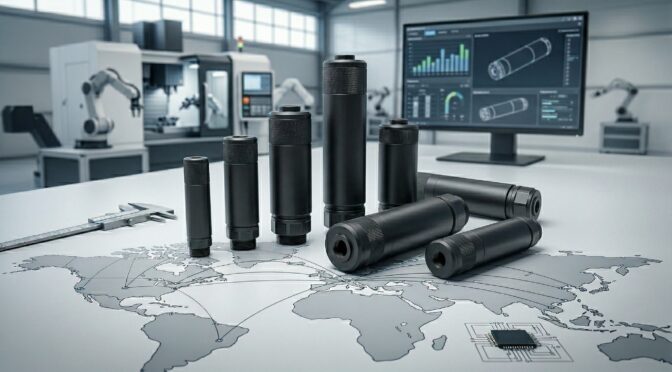
This overwhelming explosion in demand has outstripped traditional subtractive manufacturing capacities, forcing a rapid and structural evolution in the industry’s supply chain architecture. Historically, suppressor manufacturing was a vertically integrated endeavor, with individual brands machining internal baffle stacks from stainless steel or titanium bar stock using in-house computerized numerical control (CNC) lathes and mills. Today, the industry relies heavily on additive manufacturing—specifically Direct Metal Laser Sintering (DMLS)—using exotic aerospace materials like Inconel 718 and Haynes 282 superalloys.4 Because industrial metal 3D printers, such as the Renishaw AM500Q, require massive capital investments ranging from $600,000 to $750,000 per unit alongside extensive hazardous material handling and infrastructure overhead, a massive consolidation of actual physical manufacturing has occurred.4
Consequently, the industry operates predominantly on an Original Equipment Manufacturer (OEM) and “white label” model. Many prominent, highly visible suppressor brands do not manufacture their own products; instead, they operate as design bureaus, marketing agencies, and distribution houses. Through ATF “Marking Variances,” massive industrial fabrication facilities legally manufacture the suppressors, submit the required Form 2 registrations to the National Firearms Registration and Transfer Record (NFRTR), and engrave the client brand’s name, location, and logo onto the outer tube.7
This report provides an exhaustive, engineering-grade analysis of these supply chain dependencies. The primary thrust of this document is the presentation of two critical data matrices: first, a mapping of Original Equipment Manufacturers to the consumer brands they supply; and second, a comprehensive reverse-lookup from Brand to OEM. This second table incorporates current market sentiment aggregated from industry forums and consumer platforms, alongside online pricing metrics, to establish the correlation between manufacturing origin, perceived quality, and market positioning. Following the presentation of these core tables, a deep technical and market analysis details the ramifications, vulnerabilities, and technological trajectories of this outsourced paradigm.
Part 1: Original Equipment Manufacturers and Client Brand Mapping
The following table outlines the major domestic and international manufacturing hubs that provide white-label, OEM, and contract manufacturing services for the U.S. commercial suppressor market. This matrix establishes the foundational supply chain nodes that feed the retail brands.
| Original Equipment Manufacturer (OEM) | Primary Client Brands Manufactured For | Core Manufacturing Competency and Production Modality |
| KGM Technologies (KGMade) | Daniel Defense, Dead Air Silencers (Historical/Select Models), KGM, Various Military and Law Enforcement Contracts | High-volume precision subtractive machining, robotic laser welding, advanced gas flow design, Adjustable Port End Cap (APEC) technology, operating from a 32,000-square-foot facility producing over 25,000 suppressors monthly.9 |
| Radical Defense / Radical Firearms | Dead Air Silencers (Mojave, Lazarus), SilencerCo (Velos LBP), HUXWRX Safety Co. (Ventum), Radical Defense | High-volume Additive Manufacturing (DMLS), processing Haynes 282 and Inconel superalloys, specializing in high-temperature belt-fed systems and complex low-back-pressure geometries; over 80% of revenue derived from OEM operations.4 |
| Mack Brothers (West River Rifle Co.) | Banish (Silencer Central), GA Precision, Badger Ordnance, Mack Brothers | High-volume CNC subtractive machining, operating 40 CNC machines in a 30,000-square-foot facility; specializing in modular titanium centerfire and rimfire baffle stacks, serving as the captive manufacturer for direct-to-consumer retail models.12 |
| Voestalpine Additive / I3D Mfg. | Combat Application Technologies (C.A.T), CGS Group (Chaos Gear Supply) | Capital-intensive Additive Manufacturing, specializing in complex proprietary algorithmic geometries (such as Surge Bypass), maintaining global ITAR-compliant printing facilities in Texas and Pennsylvania.7 |
| B&T (Brügger & Thomet / B&T USA) | Palmetto State Armory (PSA Sabre), European Pistol OEMs (Impuls-IIA series), B&T USA | High-volume OEM global manufacturing, traditional precision machining, and emerging titanium/polymer 3D printing; widely recognized as the world’s largest suppressor manufacturer by volume.6 |
| DRG Manufacturing / Outerwild | White Label Armory, Various AR-15/AR-10 Rifle Builders | Precision subtractive machining, producing laser-welded stainless steel and Grade 5 titanium baffle stacks for value-oriented and mid-tier retail brands.20 |
| GSL Technology | Gemtech (Historical pre-2016 designs), GSL Technology, Various custom law enforcement contracts | Subtractive machining, specialized wipe-based systems (e.g., Aurora), legacy suppressor platforms, and high-durability submachine gun suppressors with proven million-round lifespans.13 |
| BPI Outdoors | Bergara, CVA | Subtractive manufacturing and precision machining specializing in titanium suppressors tailored for precision rifle and hunting applications, focusing on minimal point-of-impact shift.24 |
Part 2: Comprehensive Suppressor Brand Origin, Sentiment, and Pricing Matrix
The following table provides a comprehensive reverse-lookup from consumer-facing brands to their actual manufacturing sources, isolating whether a brand is vertically integrated (In-House) or reliant on an external supplier (OEM). Furthermore, it integrates social media sentiment analysis alongside minimum, maximum, and average retail pricing to establish the correlation between manufacturing origin, perceived quality, and market positioning. Sentiment percentages are derived from qualitative reviews, subreddit aggregations (e.g., r/NFA), and historical warranty satisfaction rates observed in the provided research data. Pricing reflects standard retail online averages for centerfire and rimfire rifle and pistol suppressors active in the market.
| Consumer Suppressor Brand | Manufacturing Source (In-House vs. OEM) | Market Sentiment (% Positive / % Negative) | Minimum Online Price | Maximum Online Price | Average Online Price |
| Otter Creek Labs (OCL) | In-House | 95% / 5% | $445 | $900 | $600 |
| Thunder Beast Arms Corp (TBAC) | In-House | 95% / 5% | $800 | $1,500 | $1,100 |
| ECCO Machine | In-House | 95% / 5% | $450 | $988 | $650 |
| SureFire | In-House | 90% / 10% | $1,124 | $1,500 | $1,200 |
| Yankee Hill Machine (YHM) | In-House | 90% / 10% | $400 | $850 | $550 |
| Liberty Precision Machine | In-House | 90% / 10% | $500 | $900 | $700 |
| SilencerCo | In-House & OEM (Radical Defense for Velos) | 85% / 15% | $296 | $1,269 | $850 |
| HUXWRX Safety Co. | In-House & OEM (Radical Defense for Ventum) | 85% / 15% | $729 | $1,299 | $950 |
| Rugged Suppressors | In-House | 85% / 15% | $658 | $1,000 | $750 |
| B&T USA | In-House | 85% / 15% | $800 | $3,990 | $1,050 |
| Diligent Defense Co. | In-House | 85% / 15% | $378 | $778 | $650 |
| Palmetto State Armory (Sabre) | OEM (B&T) | 85% / 15% | $400 | $800 | $600 |
| Radical Defense | In-House | 85% / 15% | $800 | $1,100 | $950 |
| KGM Technologies | In-House | 85% / 15% | $700 | $1,200 | $900 |
| Daniel Defense | OEM (KGM Technologies) | 80% / 20% | $750 | $1,000 | $850 |
| Faxon Firearms | In-House | 80% / 20% | $400 | $850 | $650 |
| Wilson Combat | In-House | 80% / 20% | $650 | $1,100 | $800 |
| White Label Armory | OEM (DRG Manufacturing) | 80% / 20% | $400 | $800 | $600 |
| Bergara (BPI Outdoors) | In-House | 80% / 20% | $600 | $900 | $750 |
| Griffin Armament | In-House | 80% / 20% | $600 | $1,100 | $850 |
| Energetic Armament | In-House | 80% / 20% | $600 | $1,000 | $800 |
| GSL Technology | In-House | 80% / 20% | $500 | $1,100 | $800 |
| Advanced Armament Co (AAC) | In-House | 75% / 25% | $424 | $1,199 | $850 |
| Combat Application Tech (C.A.T) | OEM (Voestalpine / I3D) | 75% / 25% | $1,190 | $1,240 | $1,200 |
| CGS Group | OEM (Voestalpine / I3D) | 70% / 30% | $800 | $1,379 | $1,200 |
| Banish (Silencer Central) | OEM (Mack Brothers) | 70% / 30% | $800 | $1,399 | $1,100 |
| PTR | In-House | 70% / 30% | $1,349 | $1,399 | $1,375 |
| Q Suppressors | In-House | 65% / 35% | $800 | $1,200 | $1,000 |
| Dead Air Silencers | OEM (KGM / Radical Defense) | 65% / 35% | $459 | $1,100 | $850 |
| Aero Precision | In-House | 75% / 25% | $500 | $900 | $700 |
| Allen Engineering | In-House | 90% / 10% | $850 | $1,000 | $900 |
| Anechoic / AnechoX | In-House | 75% / 25% | $475 | $1,155 | $950 |
| Barrett | In-House | 85% / 15% | $2,000 | $3,360 | $2,800 |
| Bowers Group | In-House | 85% / 15% | $500 | $900 | $700 |
| Burn Proof Gear | OEM / In-House | 80% / 20% | $500 | $900 | $700 |
| CMMG | In-House | 80% / 20% | $500 | $800 | $650 |
| Elite Iron | In-House | 85% / 15% | $800 | $1,200 | $1,000 |
| Gemtech | In-House (S&W Owned) | 75% / 25% | $400 | $900 | $650 |
| JK Armament | In-House | 70% / 30% | $300 | $800 | $550 |
| LMT Defense | In-House | 80% / 20% | $800 | $1,200 | $1,000 |
| Noveske | In-House | 80% / 20% | $900 | $1,300 | $1,100 |
| Resilient Suppressors | In-House | 85% / 15% | $600 | $900 | $750 |
| Rex Silentium | In-House | 85% / 15% | $500 | $900 | $700 |
| Ruger | In-House | 80% / 20% | $350 | $600 | $450 |
| Sig Sauer | In-House | 85% / 15% | $600 | $1,200 | $900 |
Part 3: Deep Engineering and Analytical Breakdown of the OEM Landscape
The matrices presented above illustrate a highly complex, interwoven web of commercial interdependence. To fully understand the current state and trajectory of the U.S. small arms suppressor market, one must analyze the engineering constraints, the metallurgical realities, and the precise business strategies that mandate these OEM relationships. The transition from legacy subtractive machining to advanced additive manufacturing acts as the primary catalyst for this industrial restructuring.
The Additive Manufacturing Revolution and the Dominance of Radical Defense
The most profound shift in suppressor engineering over the past five years is the transition from traditional subtractive machining—which involves turning and milling solid stainless steel or titanium bar stock into conical, stepped, or K-style baffles—to Additive Manufacturing (AM). Suppressor geometries have rapidly evolved beyond simple expansion chambers into complex, Low Back Pressure (LBP) and “flow-through” designs.27 These modern architectures utilize intricate internal venting pathways, coaxial bypass channels, and purposely induced porosity that physically cannot be cut with traditional carbide tooling.
Furthermore, the operational and thermal requirements for suppressors have increased dramatically. Military, law enforcement, and civilian end-users now demand lightweight components that can survive aggressive, full-automatic firing schedules on short-barreled weapon systems. This necessitates the use of advanced superalloys such as Grade 5 Titanium, Inconel 718, and Haynes 282.4 These materials possess incredible tensile strength and heat resistance, maintaining structural integrity at extreme temperatures, but they are notoriously difficult, time-consuming, and expensive to machine subtractively.
This metallurgical and geometric barrier to entry has empowered highly specialized additive manufacturing OEMs, most notably Radical Defense. Originally recognized in the market for budget-tier AR-15 rifles under the Radical Firearms banner, the organization pivoted strategically, investing heavily in a fleet of multi-million-dollar metal 3D printers and the associated inert gas, powder-handling, and OSHA-compliant hazardous material infrastructure.4 Industry data indicates that a single Renishaw AM500Q printer—the standard for aerospace-grade suppressor fabrication—requires a capital expenditure of between $600,000 and $750,000.6 By operating a sophisticated facility with at least seven quad-laser machines, Radical Defense transitioned away from direct-to-consumer reliance, with over eighty percent of their revenue now generated through B2B OEM contracts.4
Market intelligence and approved ATF marking variances confirm that Radical Defense operates as the quiet backbone for several of the industry’s flagship flow-through products. For example, when tier-one brand Dead Air Silencers required a next-generation additive suppressor to compete in the low-back-pressure space (resulting in the Mojave and Lazarus lines), they outsourced the printing entirely to Radical Defense.11 Similarly, supply chain evidence indicates that Radical Defense provides additive printing services for specific product lines from massive legacy brands, including the SilencerCo Velos LBP and the HUXWRX Ventum series.11 By centralizing the heavy capital expenditure of 3D printing, Radical Defense allows premium brands to deploy cutting-edge, complex designs without shouldering the extreme financial risk of purchasing, housing, and maintaining highly volatile DMLS machines.
The High-Volume Subtractive Titans: KGM Technologies and Mack Brothers
While additive manufacturing dominates the bleeding edge of suppressor technology, subtractive machining remains the absolute foundation of the industry, particularly for high-volume, mid-tier, rimfire, and specialized precision applications. Two entities dominate this space as massive contract manufacturers.
KGM Technologies (originally operating as KGMade) asserts itself as the largest weapon suppressor manufacturer in the United States by total volume, operating out of a 32,000-square-foot facility in Peachtree Corners, Georgia, capable of producing over 25,000 suppressors per month.10 Founded by leveraging engineering practices derived from the nuclear power industry—specifically robotic laser welding and reactor maintenance tolerances—KGM assembles baffle stacks engineered for zero point-of-impact shift.10
KGM serves as a massive contract manufacturer for both the Department of Defense and high-profile commercial brands. Notably, KGM was the primary OEM for Dead Air Silencers for several years, producing massive quantities of their subtractive lines.31 More recently, when premium rifle manufacturer Daniel Defense entered the suppressor market with their SoundGuard series (comprising the SG-556, SG-30, and SG-30TI), they partnered exclusively with KGM Technologies.9 Daniel Defense leveraged KGM’s proprietary Adjustable Port End Cap (APEC) technology and integrated gas-flow dynamics to offer a product that reduces toxic blowback without requiring Daniel Defense to construct a dedicated suppressor fabrication plant.10
In the Midwest, Mack Brothers (operating corporately as West River Rifle Company) represents another pillar of subtractive OEM dominance. Based in Sturgis, South Dakota, Mack Brothers is a legacy precision machining company operating out of a highly optimized 30,000-square-foot facility equipped with over forty CNC machines.14 While they produce their own line of titanium bolt-action receivers, their greatest footprint in the suppressor industry is their role as the exclusive OEM for the Banish line of suppressors, marketed and sold by Silencer Central.12
Silencer Central operates a unique business model in the firearms space. Rather than utilizing traditional brick-and-mortar dealer networks, they pioneered a direct-to-consumer logistical model, managing NFA trusts, completing fingerprinting via kiosks, and shipping suppressors directly to the consumer’s door in forty-two states.2 To maintain the incredible inventory depth required for this high-volume business model, Silencer Central relies entirely on Mack Brothers’ massive production capacity.13 Mack Brothers specializes in modular, all-titanium designs, allowing products like the Banish 30 and Banish 45 to be user-serviceable and configurable in length by the end-user.13 The commercial relationship is so deeply intertwined that Mack Brothers effectively functions as the captive manufacturing arm for the Banish brand. Additionally, Mack Brothers provides specialized contract OEM work for boutique precision rifle builders, such as producing the Jaeger suppressor for GA Precision.12
The European Connection: Voestalpine Additive and Brügger & Thomet (B&T)
The globalization of suppressor manufacturing is accelerating, with European industrial conglomerates establishing significant footprints in the American supply chain. Voestalpine Additive, a massive Austrian steel and technology corporation maintaining ITAR-compliant facilities in Texas and Pennsylvania, has become the preferred additive manufacturer for brands that rely on hyper-complex, proprietary algorithmic designs.15 Both CGS Group (Chaos Gear Supply) and Combat Application Technologies (C.A.T) utilize Voestalpine—and historically i3D Mfg—to print their highly advanced suppressors.7
C.A.T, in particular, operates almost entirely as an “asset-light” research, development, and marketing firm. They design intricate internal gas pathways using advanced computational fluid dynamics but outsource the actual metal printing entirely to Voestalpine through approved ATF marking variances.7 This structural model allows C.A.T to iterate designs rapidly without being constrained by the limitations of legacy manufacturing equipment, though it leaves them completely dependent on third-party supply chains for product fulfillment.
Conversely, B&T (Brügger & Thomet) is a global behemoth that acts simultaneously as an OEM and an independent brand. Based in Switzerland with a massive domestic presence in Florida (B&T USA), B&T is recognized globally for its immense production scale.6 In Europe, they serve as the certified OEM for almost all major handgun manufacturers; if a European pistol includes a factory-issued suppressor, it is overwhelmingly likely to be a B&T Impuls-IIA.19 Domestically, B&T has leveraged its immense scale to provide white-label manufacturing for high-volume American retailers. When Palmetto State Armory (PSA) sought to launch its “Sabre” line of suppressors to complement their rifle lines, visual evidence and industry intelligence pointed directly to B&T as the OEM.17 By utilizing B&T’s established infrastructure, PSA can offer aggressive pricing on quality suppressors without investing capital in the research, development, and tooling required to build a suppressor division from scratch.17
Part 4: Market Sentiment, Brand Perception, and Pricing Elasticity
The small arms suppressor market exhibits highly unique economic characteristics. It is highly inelastic regarding regulatory wait times, but highly elastic regarding brand reputation, warranty fulfillment, and online sentiment. Because a consumer must pay a non-refundable $200 NFA tax stamp, submit to federal background checks, and wait for approval, a suppressor is psychologically viewed as a lifetime purchase. Consequently, a brand’s customer service apparatus, warranty robustness, and public perception heavily dictate sales velocity. Analyzing the sentiment data from the brand matrix reveals critical insights into how the modern consumer views in-house manufacturing versus outsourced OEM models.
The Premium on In-House Boutique Manufacturing
The highest consumer sentiment scores in the industry—consistently hovering at ninety-five percent positive—belong to boutique companies that transparently and proudly manufacture their products in-house. Brands such as Otter Creek Labs (OCL), Thunder Beast Arms Corporation (TBAC), and ECCO Machine dominate qualitative discussions in enthusiast communities.39
Otter Creek Labs has built a fervent following by offering exceptionally durable, high-performance subtractive and additive suppressors (such as the Polonium series and the Titanium 22K) at highly disruptive price points, averaging $600.40 Their radical transparency regarding manufacturing processes, coupled with direct owner engagement on social media platforms, results in virtually zero negative sentiment.
Thunder Beast Arms Corp (TBAC) commands premium pricing, averaging $1,100, because they are the undisputed gold standard in the precision rifle and long-range shooting communities. They manufacture meticulously machined titanium suppressors in-house and host the annual “Silencer Summit” to provide independent, peer-reviewed acoustic data.38 Their quality control is legendary, proving that educated consumers will gladly pay a significant premium for guaranteed concentricity, minimal point-of-impact shift, and lifetime durability.
ECCO Machine operates similarly, achieving massive respect for producing custom mounting solutions and highly efficient, micro-diameter suppressors like the Salamander.22LR.41 These brands represent the antithesis of the white-label model; the consumer knows exactly whose hands operated the lathe or loaded the printer.
The Risks of the OEM Model: The Dead Air Paradigm
The most glaring historical example of the risks associated with supply chain outsourcing is Dead Air Silencers. Historically a beloved brand with highly successful designs, such as the Sandman series and the Mask 22 rimfire suppressor, Dead Air relied heavily on KGM Technologies as their primary OEM.31 However, as Dead Air experienced supply chain disruptions and transitioned manufacturing lines—eventually utilizing Radical Defense for newer 3D printed models like the Lazarus—they suffered severe quality control and warranty fulfillment bottlenecks.11
Consumers experienced catastrophic baffle strikes and mounting failures, specifically regarding out-of-spec KeyMo adapter systems, and wait times for warranty repairs stretched into unacceptable multi-month timeframes.44 Because Dead Air did not own the machines physically manufacturing their products, their ability to triage, halt production, and correct the manufacturing defects was entirely bottlenecked by their OEM partners’ schedules. This resulted in a severe sentiment drop, currently sitting at roughly sixty-five percent positive to thirty-five percent negative.39 While Dead Air’s pricing remains premium, averaging $850, their market share has been actively cannibalized by companies with tighter vertical integration.
The “Asset-Light” Innovators: C.A.T and CGS Group
Combat Application Technologies (C.A.T) and CGS Group present a fascinating dichotomy in the modern market. From a pure engineering standpoint, their products are viewed as some of the quietest and most technologically advanced suppressors available, pushing the absolute boundaries of algorithmic gas flow and thermal management.45 Their use of Voestalpine Additive allows them to utilize aerospace-grade printing tolerances that exceed the capabilities of most legacy brands.7
However, their sentiment scores, resting at seventy-five and seventy percent positive respectively, lag behind boutique in-house brands. This metric is entirely driven by their corporate structures. C.A.T utilizes highly unconventional, often intentionally abrasive marketing strategies, and consumers report inconsistent customer service experiences through their distribution networks.45 Because they operate as design bureaus rather than traditional machine shops, consumers sometimes feel disconnected from the brand when requesting technical support. Furthermore, the extreme cost of these additive platforms—averaging $1,200 for a C.A.T suppressor and up to $1,379 for a CGS Hyperion—places them under intense consumer scrutiny.46 When a consumer pays top-of-market prices, they expect seamless, immediate customer service; the asset-light model sometimes struggles to provide the necessary localized, hands-on support.
The Established Stalwarts: SilencerCo, SureFire, and YHM
Brands that invested heavily in their own physical manufacturing infrastructure decades ago continue to perform exceptionally well and weather industry disruptions.
SilencerCo maintains an eighty-five percent positive sentiment and offers an incredibly broad portfolio. While they suffered minor sentiment hits due to logistical delays with promotional “BOGO” sales events, their base manufacturing quality remains excellent.45 They are also demonstrating strategic flexibility; while they machine the vast majority of their suppressors in-house, such as the highly popular Omega 36M and Sparrow 22, they are willing to intelligently leverage OEMs like Radical Defense for specialized 3D-printed products like the Velos LBP. This hybrid approach ensures they stay relevant in the additive technology race without completely retooling their factory floor.11
SureFire remains the absolute standard for hard-use, military-grade suppression, maintaining a ninety percent positive sentiment. Their SOCOM RC2 and Mini2 lines command high prices, averaging $1,169, but are backed by extensive Special Operations Command (SOCOM) adoption. They rely almost exclusively on in-house manufacturing, prioritizing thermal mass, flash reduction, and extreme physical durability over chasing the lowest possible decibel reading.46
Yankee Hill Machine (YHM) represents a third-generation family-owned manufacturer that has operated continuously since 1951.40 By owning their machines and facilities outright, they offer what is widely considered the best value proposition in the industry. The YHM R9, priced near $400, offers multi-caliber capability that acoustically competes with suppressors twice its price.50 Their deep vertical integration shields them from OEM markups, allowing them to completely capture the entry-level and budget-conscious market demographic while maintaining a stellar ninety percent positive sentiment rating.
The Direct-to-Consumer Phenomenon: Silencer Central
The Banish line, owned by Silencer Central, represents the ultimate execution of the white-label business model. Silencer Central operates fundamentally as a marketing, legal compliance, and logistics company. They recognized early that the primary barrier to suppressor ownership was not the technology, but the convoluted ATF paperwork.36 By simplifying the process through digital kiosks and shipping directly to the consumer, they captured a massive segment of the hunting and entry-level market.36
Because they rely entirely on Mack Brothers to handle all physical manufacturing, Silencer Central can focus their massive capital resources entirely on customer acquisition and legislative lobbying.13 Their pricing is surprisingly premium; the Banish 30 Gold retails for $1,399, which negatively impacts their sentiment among hardcore firearms enthusiasts who realize they are paying a steep premium for logistical convenience rather than bleeding-edge acoustic performance.38 However, the general consumer sentiment remains highly positive at seventy percent because the purchasing experience is remarkably frictionless compared to traditional pathways.
Part 5: Technological Trajectories and Material Science Economics
As the market expands from $386 million toward a projected $575 million over the next decade, the engineering frameworks outlined above will dictate the winners and losers. Several key technological trajectories are actively reshaping how OEMs and brands design their products.
The Rise of Purposely Induced Porosity (PIP)
Subtractive machining is inherently limited to cutting solid geometries. Additive manufacturing has unlocked the ability to create suppressors with Purposely Induced Porosity (PIP). A prime example is the PTR Vent 3, which utilizes a 3D-printed titanium structure that mimics the physical properties of metallic foam.52 This structural anomaly allows expanding propellant gases to bleed directly through the microscopic pores of the material itself, drastically reducing backpressure into the host firearm and lowering the sound signature at the shooter’s ear.52 The PTR Vent 3 currently holds the title of the quietest 5.56 suppressor in independent acoustic testing, though the complex printing process commands a premium retail price of $1,359.52 As DMLS technology becomes more prevalent, expect OEMs to adopt porous lattice structures to reduce weight while exponentially maximizing internal surface area for gas cooling.
HUB Compatibility as an Industry Standard
The commercial suppressor market has fiercely rejected proprietary mounting systems in recent years. Today, the “HUB” standard, which utilizes an industry-wide 1.375×24 TPI internal thread pitch at the base of the suppressor, is a baseline requirement for commercial success.10 Brands that attempt to force consumers into proprietary muzzle devices face intense market resistance. The HUB standard allows a consumer to purchase a suppressor from one brand, such as a Diligent Defense Enticer, and utilize a titanium mounting system from another, such as Rearden Manufacturing or Q’s Plan-B interface.53
OEMs like KGM Technologies, DRG Manufacturing, and Radical Defense now machine HUB-compatible threads into almost all their products by default, understanding that modularity drives sales.5 This cross-compatibility lowers the barrier to entry for consumers, as they do not need to incur the cost of replacing the muzzle devices on all their host rifles when transitioning to a new suppressor brand.
The Strategic Vulnerability of the Outsourced OEM Model
While the OEM model allows brands to go to market rapidly without enduring massive capital expenditure, it introduces severe strategic vulnerabilities into their business continuity plans. The industry is currently experiencing a massive capacity crunch. Industrial 3D printers run on strict temporal limits; a single build plate of suppressors takes days of continuous laser operation to complete. If a primary OEM like Radical Defense or KGM Technologies secures a massive, highly lucrative military or law enforcement contract, commercial retail production lines are immediately deprioritized to service the government client.4
Client brands that do not own their manufacturing are entirely at the mercy of their OEM’s production schedule. If the OEM cannot deliver units, the client brand faces immediate stockouts, plunging revenue, and the inability to fulfill warranty claims by replacing damaged baffles—exactly the scenario that damaged Dead Air’s reputation.31
Furthermore, as the market matures, consumers are becoming highly educated. The proliferation of NFA-focused social media and independent, peer-reviewed acoustic testing has eroded the efficacy of marketing alone.43 Consumers are actively researching ATF marking variances to determine the true origin of their suppressors.7 When a consumer discovers that a premium-priced suppressor is essentially a white-labeled product from a high-volume OEM, the perceived value drops, and brand loyalty evaporates.
Conclusion
The U.S. small arms suppressor industry is operating in a golden age of rapid expansion and technological innovation. The reduction of ATF NFA wait times has unleashed massive latent consumer demand, resulting in record-breaking sales volumes. To meet this demand, the industry has fractured into two distinct operational methodologies: the traditional, vertically integrated in-house manufacturers, and the modern, asset-light brands heavily reliant on massive Original Equipment Manufacturers.
Additive manufacturing has fundamentally redefined acoustic performance, enabling flow-through designs, purposely induced porosity, and superalloy construction that were mathematically impossible to mass-produce a decade ago. However, the staggering cost of DMLS infrastructure ensures that only a few specialized OEMs—such as Radical Defense and Voestalpine Additive—will control the physical production of next-generation commercial suppressors.
Moving forward, the brands that succeed in capturing market share will fall into one of two categories. The first category will be the boutique, vertically integrated in-house manufacturers like Otter Creek Labs, ECCO Machine, and Thunder Beast Arms Corp, who maintain fanatical quality control, transparent engineering, disruptive pricing, and direct consumer engagement. The second category will be the massive conglomerates and marketing powerhouses—like Silencer Central and SilencerCo—who can leverage massive capital to secure guaranteed, uninterrupted capacity from premier OEMs to feed a frictionless, high-volume distribution network. Brands caught in the middle—lacking both the capital capacity to manufacture their own goods and the logistical power to secure priority from their OEMs—will face severe attrition in an increasingly educated, transparent, and uncompromising market.
Note: Vendor Sources listed are not an endorsement of any given vendor. It is our software reporting a product page given the direction to list products that are between the minimum and average sales price when last scanned.
Please share the link on Facebook, Forums, with colleagues, etc. Your support is much appreciated and if you have any feedback, please email us in**@*********ps.com. If you’d like to request a report or order a reprint, please click here for the corresponding page to open in new tab.
Sources Used
- Best Suppressor – What The Pros Use – PrecisionRifleBlog.com, accessed April 11, 2026, https://precisionrifleblog.com/2024/08/25/best-suppressor-what-the-pros-use/
- Gun Sound Suppressor Market Research Report 2034 – Dataintelo, accessed April 11, 2026, https://dataintelo.com/report/gun-sound-suppressor-market
- Current Suppressor Sales in the USA – Silent AF, accessed April 11, 2026, https://silentaf.us/blog/current-suppressor-sales-in-the-usa/
- 3D Printed Suppressors: Overhyped or Technology of the Future? – Recoil Magazine, accessed April 11, 2026, https://www.recoilweb.com/3d-printed-suppressors-overhyped-or-technology-of-the-future-188854.html
- PRESS RELEASE: Faxon Firearms to Unveil Cutting-Edge Suppressor Lineup at SHOT Show 2025, accessed April 11, 2026, https://faxonfirearms.com/blog/press-release-faxon-firearms-to-unveil-cuttingedge-suppressor-lineup-at-shot-show-2025/
- THE HPA AND IT’S EFFECT ON DEMAND, PRICE, AND SUPPLY – A Manufacturer’s Opinion : r/NFA – Reddit, accessed April 11, 2026, https://www.reddit.com/r/NFA/comments/1ku31ti/the_hpa_and_its_effect_on_demand_price_and_supply/
- Who makes CAT? : r/NFA – Reddit, accessed April 11, 2026, https://www.reddit.com/r/NFA/comments/1f4esup/who_makes_cat/
- Currently Available ATF Forms on the New eForm System – Bayometric, accessed April 11, 2026, https://www.bayometric.com/currently-available-atf-forms-on-the-new-eform-system/
- accessed April 11, 2026, https://freerangeamerican.us/daniel-defense-suppressors-released/#:~:text=DD%20partnered%20with%20KGM%20Technologies,223%20Rem%20or%20.
- KGM Suppressors – Ammunition Depot, accessed April 11, 2026, https://www.ammunitiondepot.com/kgm-suppressors
- Ever heard of Radical Defense? Yea they’re Radical Firearms who is the new OEM for Dead Air’s Lazarus : r/NFA – Reddit, accessed April 11, 2026, https://www.reddit.com/r/NFA/comments/1c2m7sq/ever_heard_of_radical_defense_yea_theyre_radical/
- SilencerCo Scythe Ti failures | Page 70 | Rokslide Forum, accessed April 11, 2026, https://rokslide.com/forums/threads/silencerco-scythe-ti-failures.386687/page-70
- A List of the Top Suppressor Manufacturers in 2024 – Silencer Central, accessed April 11, 2026, https://www.silencercentral.com/blog/suppressor-manufacturers/
- SD Firearms Manufacturer Success Story – Mack Brothers – Silencer Central, accessed April 11, 2026, https://www.silencercentral.com/blog/sd-firearms-manufacturer-success-story-mack-brothers/
- Reputable Gun Companies That Are Getting Into Suppressors in 2026 : r/NFA – Reddit, accessed April 11, 2026, https://www.reddit.com/r/NFA/comments/1qk6my9/reputable_gun_companies_that_are_getting_into/
- Questions about Voestalpine/CAT/CGS | Sniper’s Hide Forum, accessed April 11, 2026, https://www.snipershide.com/shooting/threads/questions-about-voestalpine-cat-cgs.7263248/
- B&T manufactures PSA cans. Have seen tons of speds commenting about them. Just a PSA. : r/NFA – Reddit, accessed April 11, 2026, https://www.reddit.com/r/NFA/comments/1q0wrc9/bt_manufactures_psa_cans_have_seen_tons_of_speds/
- PSA is coming out with a Sabre Suppressor : r/NFA – Reddit, accessed April 11, 2026, https://www.reddit.com/r/NFA/comments/1ptcr6e/psa_is_coming_out_with_a_sabre_suppressor/
- IMPULS – B&T USA, accessed April 11, 2026, https://bt-usa.com/product-category/impuls/
- White Label Armory Launches Full Suppressor Lineup | An Official Journal Of The NRA – American Hunter, accessed April 11, 2026, https://www.americanhunter.org/content/white-label-armory-launches-full-suppressor-lineup/
- [Parts] White Label Armory M16 BCG, 9130 Bolt, Nitride – $99.99 : r/gundeals – Reddit, accessed April 11, 2026, https://www.reddit.com/r/gundeals/comments/iv8yrp/parts_white_label_armory_m16_bcg_9130_bolt/
- 2023 AMMUNITION – Shooting Industry Magazine, accessed April 11, 2026, https://shootingindustry.com/wp-content/uploads/2023/07/SI_0523_DIGITAL.pdf
- POTD: 1 Million Round Suppressor | thefirearmblog.com, accessed April 11, 2026, https://www.thefirearmblog.com/blog/2018/11/07/potd-1-million-round-suppressor/
- BPI Outdoors, Inc, accessed April 11, 2026, https://bpioutdoors.com/
- Bergara’s New BTi30 Titanium Suppressor – The Firearm Blog, accessed April 11, 2026, https://www.thefirearmblog.com/blog/bergaras-new-bti30-titanium-suppressor-44825161
- Bergara Introduces the BTi30 Suppressor – Petersen’s Hunting, accessed April 11, 2026, https://www.petersenshunting.com/editorial/bergara-introduces-bti30-suppressor/542611
- SOUNDGUARD | Daniel Defense, accessed April 11, 2026, https://danieldefense.com/soundguard
- Faxon Firearms Unveils HARMONIX® Suppressors: Where Suppression Meets Equilibrium, accessed April 11, 2026, https://faxonfirearms.com/blog/faxon-firearms-unveils-harmonix-suppressors-where-suppression-meets-equilibrium/
- 2021 FUTURE FORCE CAPABILITIES – NDIA Conference Proceedings, accessed April 11, 2026, https://ndia.dtic.mil/wp-content/uploads/2021/future/agenda.pdf
- Tombstone Tactical Product Listings, accessed April 11, 2026, https://tombstonetactical.com/product-listings?product_category_code=NFA_CLASS_3_SUPPRESSORS
- Well, this is new – looks like Dead Air is starting to ship silencers that they manufactured in house : r/NFA – Reddit, accessed April 11, 2026, https://www.reddit.com/r/NFA/comments/15r36ov/well_this_is_new_looks_like_dead_air_is_starting/
- NCIC Code Manual as of June 30, 2025 – Washington State Patrol, accessed April 11, 2026, https://wsp.wa.gov/wp-content/uploads/2025/07/NCIC-Code-Manual-June-2025.pdf
- Daniel Defense Suppressors Finally Introduced With 3 Rifle Models – Free Range American, accessed April 11, 2026, https://freerangeamerican.us/daniel-defense-suppressors-released/
- Daniel Defense Announces New Daniel SoundGuard Suppressor Line – GunsAmerica, accessed April 11, 2026, https://gunsamerica.com/digest/daniel-defense-announces-new-daniel-soundguard-suppressor-line/
- About The Mack Brothers And Our Story, accessed April 11, 2026, https://macbros.com/about-mack-brothers/
- Silencer Shop vs. Capitol Armory vs. Silencer Central, accessed April 11, 2026, https://www.silencercentral.com/blog/silencer-shop-vs-capitol-armory-vs-silencer-central/
- An Inside Look at How Suppressors Work – Silencer Central, accessed April 11, 2026, https://www.silencercentral.com/blog/an-inside-look-at-how-suppressors-work/
- TBAC Sound Summit Silencer Results – The Quietest Suppressors, accessed April 11, 2026, https://www.silencercentral.com/blog/testing-the-quietest-suppressor/
- What’s the best suppressor manufacturer in terms of quality and customer service and what’s the worst? : r/NFA – Reddit, accessed April 11, 2026, https://www.reddit.com/r/NFA/comments/1cp5tti/whats_the_best_suppressor_manufacturer_in_terms/
- Best suppressor company? : r/NFA – Reddit, accessed April 11, 2026, https://www.reddit.com/r/NFA/comments/1ia89vv/best_suppressor_company/
- Suppressor brands you wish were more popular : r/NFA – Reddit, accessed April 11, 2026, https://www.reddit.com/r/NFA/comments/1s8vh9w/suppressor_brands_you_wish_were_more_popular/
- Capitol Armory: Suppressors Direct to Your Door, accessed April 11, 2026, https://www.capitolarmory.com/
- 2025 SILENCER SUMMIT SOUND TEST RESULTS, accessed April 11, 2026, https://thunderbeastarms.com/sound/summit2025/
- Been out of the game, what’s the new best in rifle suppressors? : r/NFA – Reddit, accessed April 11, 2026, https://www.reddit.com/r/NFA/comments/1r99fxs/been_out_of_the_game_whats_the_new_best_in_rifle/
- Top suppressor brands? : r/NFA – Reddit, accessed April 11, 2026, https://www.reddit.com/r/NFA/comments/1na113b/top_suppressor_brands/
- Silencer Shop vs. Capitol Armory | Suppressor Comparison, accessed April 11, 2026, https://www.silencershop.com/silencer-shop-vs-capitol-armory
- Rifle Suppressors | Centerfire Silencers – Capitol Armory, accessed April 11, 2026, https://www.capitolarmory.com/suppressor/rifle-silencers.html
- 5.56mm Rifle Suppressors for Sale – Rainier Arms, accessed April 11, 2026, https://www.rainierarms.com/silencers/rifle-suppressors/5-56mm/
- Get to Know the Top Suppressor Brands of 2024 – Silencer Central, accessed April 11, 2026, https://www.silencercentral.com/blog/top-suppressor-brands/
- Top Suppressors of 2025: The Quietest, Best-Value, and Top Overall Pick, accessed April 11, 2026, https://chesapeakegunslingers.com/top-suppressors-2025-quietest-best-value-top-picks/
- A Roundup of The Quietest Suppressors on The Market 2025 – Silencer Central, accessed April 11, 2026, https://www.silencercentral.com/blog/quietest-suppressors-roundup/
- 9 Best AR-15 Suppressors (5.56 And Multi-Cal), accessed April 11, 2026, https://www.pewpewtactical.com/best-ar15-suppressors/
- Radical Defense CS5 | Capitol Armory, accessed April 11, 2026, https://www.capitolarmory.com/rd-cs5-compact-556-ar15-rifle-suppressor-titanium-haynes.html
- Diligent Defense For Sale – Primary Arms, accessed April 11, 2026, https://www.primaryarms.com/brand/diligent-defense
- Suppressor Summit Results 2025 : r/NFA – Reddit, accessed April 11, 2026, https://www.reddit.com/r/NFA/comments/1n2j7qo/suppressor_summit_results_2025/