1. Executive Summary
The modern sporting rifle market experienced a significant structural realignment in the latter half of 2025 and early 2026. This realignment was catalyzed by Sturm, Ruger & Company, Inc. acquiring the manufacturing assets of Anderson Manufacturing. Finalized in July 2025, this acquisition provided Ruger with a substantial increase in production capacity, a skilled workforce, and a fully equipped manufacturing facility located in Hebron, Kentucky. Rather than maintaining the budget-focused Anderson brand, Ruger elected to discontinue it entirely. The company absorbed the manufacturing capabilities to launch a completely re-engineered line of AR-pattern firearms. The first direct result of this strategic consolidation is the Ruger Harrier series.
The Ruger Harrier represents a calculated maneuver to dominate the entry-level to mid-tier segment of the AR-15 market. By offering modern features that have increasingly become consumer baseline expectations, such as mid-length gas systems, free-float M-LOK handguards, and upgraded Magpul furniture, Ruger is positioning the Harrier as a highly competitive alternative to legacy platforms. With a manufacturer suggested retail price of $749.00 for the upgraded Model 28600 and $699.00 for the baseline Model 28601, the Harrier exerts immediate pricing pressure on direct competitors. The most notable competitors in this specific pricing bracket are the Palmetto State Armory Guardsman and the Smith & Wesson M&P 15 Sport III.
This comprehensive report provides an exhaustive analysis of the Ruger Harrier AR-15. It examines the strategic implications of the Anderson Manufacturing acquisition and how it facilitated the immediate production of this new platform. The report conducts a granular review of the Harrier’s technical specifications, focusing on receiver fitment, barrel metallurgy, and gas system dynamics. Furthermore, it analyzes the Harrier’s pricing against direct competitors and evaluates field performance based on initial journalistic reviews and consumer sentiment across social media platforms. Finally, it assesses the broader market impact of Ruger’s strategy on the firearms industry ecosystem, projecting future trends in the mid-tier rifle segment.
2. Strategic Context: The Anderson Manufacturing Acquisition
To fully understand the market positioning and production viability of the Ruger Harrier, it is necessary to examine the foundational business maneuvers that made its rapid deployment possible. On July 1, 2025, Sturm, Ruger & Company officially announced the purchase of Anderson Manufacturing.1 Prior to this acquisition, Anderson Manufacturing operated as a family-owned enterprise based in Hebron, Kentucky, and stood as one of the most prolific producers of AR-style weapons and lower receivers in the United States.1
2.1 The Historical Significance of Anderson Manufacturing
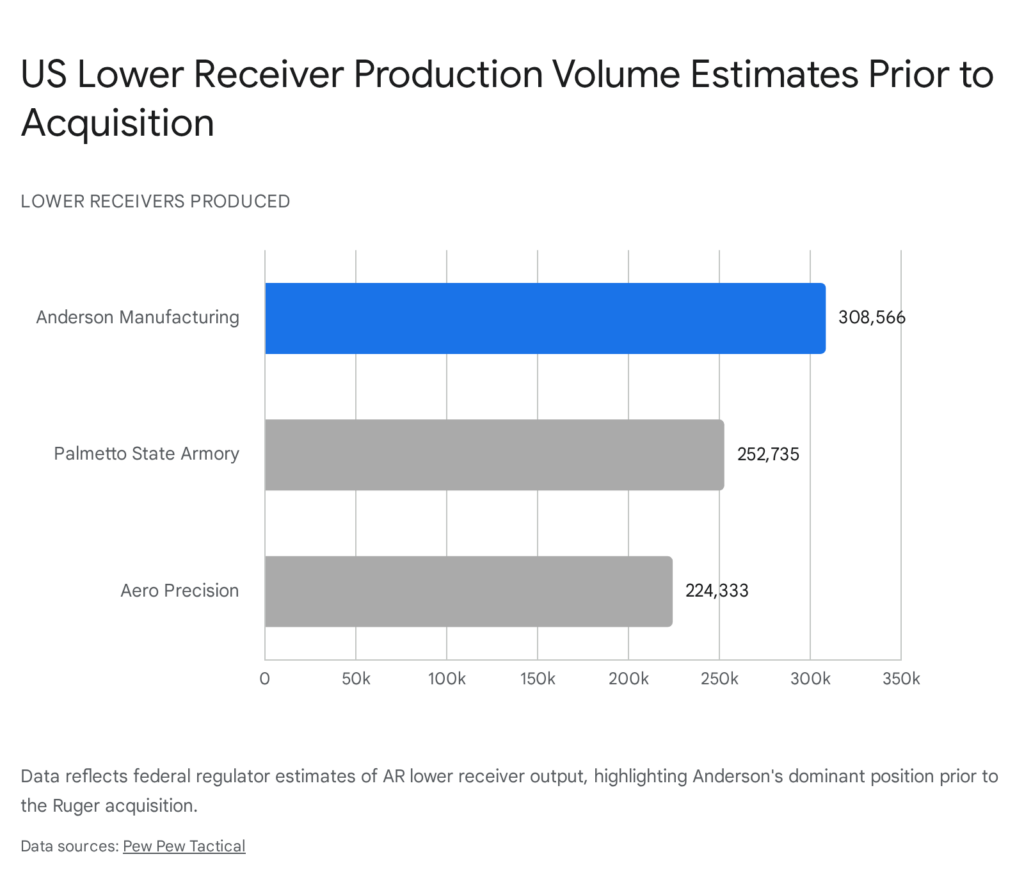
Anderson Manufacturing held a unique and occasionally polarizing position within the firearms industry. Often referred to colloquially within the shooting community as the “poverty pony” due to its highly affordable pricing and its distinctive horse logo, the company operated primarily as a volume-driven manufacturer. According to federal regulators monitoring industry output, Anderson’s production of AR lower receivers reached an estimated 308,566 units in a single measured period. This volume significantly surpassed both Palmetto State Armory, which produced 252,735 units, and Aero Precision, which produced 224,333 units.3 Between the years 2017 and 2023, the company also manufactured and sold 109,457 complete rifles.4
While Anderson was a legendary force in the budget AR segment and provided the foundational components for countless custom builds, the brand also faced mixed perceptions regarding its quality control processes. Consumers frequently noted issues with machining tolerances and finishing inconsistencies. Despite these consumer perception challenges, the physical manufacturing infrastructure in Kentucky represented a highly valuable asset. The localized operation in a gun-friendly state with an experienced workforce was an ideal acquisition target for any major firearms corporation looking to scale rapidly without the delays associated with greenfield construction.2
2.2 The Strategic Logic and Financial Mechanics of the Acquisition
For Ruger, the acquisition of the Hebron facility was a calculated maneuver of vertical integration and capacity expansion. Financial disclosures indicate that Ruger executed a capital expenditure of $15 million to complete the Anderson acquisition.5 Ruger was already recognized as one of the nation’s leading firearms manufacturers, but the sustained consumer demand for modern sporting rifles necessitated further scaling of their production capabilities. By purchasing the Anderson facility outright utilizing existing cash on hand, Ruger successfully bypassed the multi-year process required to build a new factory, acquire heavy CNC machinery, and train a specialized workforce.7
The $15 million purchase price is notably efficient when analyzed against the cost of modern industrial machinery. The acquisition provided Ruger immediate access to rows of horizontal machining centers, automated anodizing lines, and assembly infrastructure specifically tuned for AR-pattern firearms. This strategic purchase allowed Ruger to increase its capacity, strengthen its manufacturing capabilities, and broaden its product offerings with minimal interruption to its existing supply chain.7
2.3 Brand Consolidation and Industry Supply Chain Disruption
Crucially, upon finalizing the acquisition, Ruger made the definitive corporate decision to discontinue the Anderson Manufacturing brand entirely. Furthermore, Ruger immediately ceased warranty services on all legacy Anderson products.2 This decisive action served several strategic purposes that directly paved the way for the Harrier’s success. First, it eliminated any potential brand dilution. By ensuring that all products rolling out of the Hebron facility would be subject to Ruger’s internal quality control standards and bear the Ruger name, the company protected its reputation for reliability.2
Second, this move removed a major supplier of ultra-budget lower receivers from the civilian market, indirectly shifting the balance of power among remaining parts manufacturers. With Anderson out of the way, companies like Aero Precision and Palmetto State Armory stood poised to claim the top spots as the most prolific lower receiver makers in the country.3 Finally, the complete absorption of the facility allowed Ruger to dedicate specific production lines entirely to the new Harrier platform. This meant Ruger could launch a massive new product initiative without disrupting the output of their existing models manufactured in their Newport, New Hampshire, or Mayodan, North Carolina facilities.1
3. Technical Evaluation and Engineering Analysis of the Ruger Harrier
The Ruger Harrier is not merely a rebranded Anderson rifle assembled from leftover parts. According to corporate statements, it is a completely re-engineered line of modern sporting rifles designed to represent the latest evolution in AR-pattern firearms.10 Ruger launched the Harrier in two primary configurations, both natively chambered in 5.56 NATO with dual-use capability for.223 Remington.10 The baseline Model 28601 is geared toward strict budget constraints and institutional buyers, while the Model 28600 represents the modern standard for general-purpose carbines intended for civilian and enthusiast use.
3.1 Receiver Architecture, Forgings, and Fitment Tolerances
Both Harrier models utilize upper and lower receivers forged from 7075-T6 aluminum.10 The use of 7075-T6 aluminum is the established military specification standard for receiver construction. This specific aluminum alloy is heavily alloyed with zinc, magnesium, and copper, providing a tensile strength that rivals many structural steels while maintaining a low weight profile. These forgings are subsequently finished with Type III hard-coat anodizing.9 Type III anodizing provides exceptional surface hardness, scratch resistance, and corrosion resistance, vastly outperforming the inferior and thinner Type II anodizing occasionally found on lower-tier firearms or novelty colored parts.10
A notable engineering inclusion in the lower receiver is an integrated nylon-tipped tension screw.10 In mass-produced AR-15s, dimensional tolerances between the upper and lower receivers often result in slight movement or “slop.” While this minimal movement rarely affects mechanical reliability or terminal accuracy, it can degrade the perceived quality of the firearm and cause an annoying rattle during handling. The tension screw allows the end-user to apply upward pressure against the rear lug of the upper receiver, effectively eliminating play and creating a rigid, monolithic feel.13 This feature, historically reserved for aftermarket lower receivers or premium boutique builds, demonstrates Ruger’s clear intent to elevate the perceived quality of the Harrier above standard entry-level offerings.
The lower assembly is completed with a mil-spec diameter carbine buffer tube, a properly staked castle nut, a standard recoil spring, and a carbine-weight buffer.10 The staking of the castle nut is a critical quality control step wherein material from the end plate is mechanically displaced into the notches of the castle nut. This prevents the receiver extension from unthreading during rigorous use or heavy impacts, a detail sometimes omitted by budget manufacturers looking to save assembly time.10 Each flat-top upper receiver includes standard Picatinny rail slots, a forward assist, a dust cover, a brass deflector, and a mil-spec charging handle.10
3.2 Barrel Metallurgy, Profile, and Nitride Finishing
The Harrier models feature a 16.1-inch Government profile barrel.13 The 16.1-inch length is optimal for civilian market compliance, ensuring the rifle does not fall under the purview of the National Firearms Act as a Short Barreled Rifle, while remaining highly maneuverable in confined spaces.11 The Government profile is thicker behind the gas block and slightly thinner toward the muzzle. This specific contour was originally designed by the military to allow the mounting of an M203 grenade launcher on M16A2 rifles. While the utility of this profile on a civilian semi-automatic rifle is highly debated among modern shooters who often prefer lighter “pencil” profiles or heavier continuous profiles, the Government contour remains an industry standard that balances weight distribution and heat dissipation reasonably well.13
The barrel incorporates 1:8 inch twist button rifling.10 This twist rate is widely considered the ideal compromise for the 5.56 NATO cartridge in a 16-inch barrel. A 1:8 twist possesses the gyroscopic stability required to accurately stabilize a exceptionally wide range of projectile weights, from lightweight 55-grain target and varmint loads to heavier 77-grain match grade ammunition preferred for defensive use and precision shooting.16
To ensure longevity and corrosion resistance, Ruger treats the 4140 chrome-moly steel barrel with a black-nitride finish.10 It is important to distinguish nitriding from traditional chrome lining. Chrome lining adds a distinct layer of chromium material to the inside of the bore, which provides excellent heat resistance but can occasionally cause microscopic variations in the internal rifling dimensions. Nitriding, conversely, is a thermochemical case-hardening process that alters the surface of the steel itself without adding a dimensional layer. This results in a barrel that boasts high resistance to throat erosion and rust while theoretically maintaining the exact, precise internal dimensions of the original button rifling.10 The muzzle is threaded in the standard 1/2×28 pitch and comes factory-equipped with a classic A2 “birdcage” flash hider, which efficiently mitigates muzzle flash and compensates for muzzle rise.10
3.3 Gas System Dynamics: Carbine vs. Mid-Length Design
The most significant mechanical divergence between the two Harrier models lies in their respective gas operating systems. The direct impingement system, utilized by the AR-15 platform, relies on tapping high-pressure gas from the barrel through a gas port and directing it back into the receiver via a gas tube to cycle the bolt carrier group.
The base Model 28601 utilizes a traditional carbine-length gas system.10 When paired with a 16.1-inch barrel, a carbine-length system results in a relatively long “dwell time.” Dwell time is defined as the duration the bullet remains in the barrel after passing the gas port. This extended dwell time directs a larger volume of high-pressure gas into the action. This over-gassing ensures reliable cycling even when the rifle is heavily fouled with carbon or when using underpowered, low-quality ammunition. However, it also results in a sharper recoil impulse, faster bolt carrier velocity, accelerated wear on internal components, and harsher extraction forces.17
In stark contrast, the upgraded Model 28600 features a mid-length gas system.10 The mid-length system moves the gas port further down the barrel toward the muzzle, reducing the dwell time to a mathematically optimal duration for a 16.1-inch barrel. This configuration delays the extraction process slightly, allowing chamber pressures to drop to safer levels before the casing is pulled from the chamber.18 The resulting mechanical behavior is a substantially smoother recoil impulse, reduced parts wear over the lifespan of the rifle, improved extraction reliability, and an overall flatter-shooting rifle that allows for faster follow-up shots.11 The inclusion of a mid-length gas system on the Model 28600 is a major competitive advantage in this price bracket and reflects Ruger’s understanding of modern shooting preferences.
3.4 Bolt Carrier Group and Trigger Assembly Details
The bolt carrier group serves as the mechanical heart of any AR-15, responsible for chambering, firing, extracting, and ejecting every round. The Harrier’s bolt carrier, bolt, and gas key are treated with a black nitride finish, matching the exterior treatment of the barrel.10 This finish provides intrinsic lubricity and makes the components easier to clean by preventing hard carbon adhesion. The gas key is properly staked to prevent the retaining screws from backing out under the intense vibration of the firing cycle.13 Initial engineering analyses suggest the BCG is built to standard military specifications regarding internal dimensions, ensuring full compatibility with aftermarket replacements or upgrades if the user desires.
The trigger group utilized across the entire Harrier line is a standard GI single-stage mil-spec trigger.10 In practical application, this typically translates to a pull weight between 6.0 and 8.5 pounds, with noticeable creep before the break. Journalistic reviewers have noted the trigger feels somewhat “stagey” out of the box, though it is expected to smooth out as the friction surfaces wear together over time.19 While this is decidedly not a match-grade component designed for precision marksmanship, the mil-spec trigger is prioritized for absolute reliability and safety against drop-fires over light, crisp pulls. This makes the factory trigger entirely appropriate for a general-purpose, defensive, or duty-oriented rifle where a light trigger could be a liability under stress.
3.5 Ergonomics and Magpul Furniture Integration
The aesthetic and ergonomic appeal of the Model 28600 is largely driven by Ruger’s partnership with Magpul Industries, a leader in polymer firearm accessories. The Model 28600 is outfitted with a Magpul MOE-K2 pistol grip.10 The K2 grip features a more vertical angle compared to the legacy A2 grip. This verticality optimizes wrist biomechanics for shooters utilizing modern, squared-up tactical shooting stances with shorter lengths of pull, preventing wrist strain during prolonged engagements.11
The stock is a Magpul DT Carbine stock, which provides a lightweight profile with a solid lockup that minimizes annoying rattling on the buffer tube.10 The handguard is a rigid, free-floated 15-inch aluminum extrusion featuring M-LOK accessory attachment slots at the 3, 6, and 9 o’clock positions, allowing for the direct mounting of weapon lights, laser aiming modules, and vertical grips.10 The handguard also features an uninterrupted full-length STANAG-spec Picatinny top rail for bridging optics or mounting backup iron sights.20 The free-float design ensures that external pressure applied to the handguard by slings, bipods, or barricades does not transfer to the barrel, preserving the barrel’s harmonic consistency and maintaining a stable point of impact.11
Conversely, the baseline Model 28601 reduces manufacturing costs by substituting these premium components with a classic A2 pistol grip, a standard M4-style collapsible stock, and a lighter-profile free-float handguard that features only a partial top rail.10
4. Retail Economics and Pricing Strategy
Ruger has strategically priced the Harrier series to capture the high-volume segment of the market, targeting consumers who demand modern features without paying a premium for boutique brand names.
4.1 MSRP vs. Street Price Dynamics
The manufacturer’s suggested retail price is $749.00 for the premium Model 28600 and $699.00 for the baseline Model 28601.13 However, the firearms industry traditionally operates with significant margins between the suggested retail price and the actual “street price” offered by high-volume online distributors.
Market data indicates that the Model 28600 is widely available at price points well below the suggested retail. This aggressive pricing strategy places the Harrier squarely in the crosshairs of first-time buyers, local law enforcement department budget acquisitions, and seasoned shooters looking for a reliable, inexpensive base for extensive aftermarket customization. By leveraging the immense production capacity acquired from Anderson Manufacturing, Ruger is able to achieve an economy of scale that allows for these reduced street prices while maintaining profitable margins.
4.2 Verified Vendor Pricing and Availability
Below are verified vendor listings offering the Ruger Harrier, sorted to demonstrate the current market pricing spread from minimum observed to average retail values. These links represent authorized dealers operating within the parameters of this market analysis.
- Manufacturer Website: https://ruger.com/products/harrier/models.html 20
- Vendor 1 (KYGunCo): Priced at $585.99. This represents the lowest observed retail price for the Model 28600. (https://www.kygunco.com/product/ruger-harrier-5.56-nato-16.1-30rd-black) 21
- Vendor 2 (Scheels): Priced at $599.99. A prominent sporting goods retailer offering the rifle slightly above the minimum market floor. (https://www.scheels.com/p/ruger-harrier-magpul-stock-5.56-nato-rifle/736676-28600/) 22
- Vendor 3 (Sportsmans Warehouse): Priced at $619.99. This represents an average big-box retail price. (https://www.sportsmans.com/shooting-gear-gun-supplies/rifles/ruger-28600-harrier-556mm-nato-black-hardcoat-anodize-semi-automatic-tactical-rifle-161in/p/1983228) 23
- Vendor 4 (Midway USA): Priced at $649.99. A major online distributor showing pricing closer to the upper tier of the discount margin. (https://www.midwayusa.com/product/1029374861) 24
- Vendor 5 (Palmetto State Armory): Listed as an authorized dealer for the Ruger Harrier, with pricing variable based on real-time stock availability in their retail stores and online portal. (https://palmettostatearmory.com/ruger-harrier-magpul-16-1-5-56-nato-30rd-rifle-black-28600.html) 12
The aggressive street pricing, frequently falling below the $600 threshold at high-volume retailers like KYGunCo, underscores Ruger’s clear intent to undercut competitors through sheer volume.
5. Competitive Landscape Analysis: The Mid-Tier AR-15 Battlefield
The introduction of the Ruger Harrier directly challenges established incumbents in the mid-tier and budget categories. Consumers operating within the $600 to $800 price bracket typically conduct rigorous comparative research, often cross-shopping the Harrier against two primary alternatives, the Palmetto State Armory Guardsman-15 and the Smith & Wesson M&P 15 Sport III.
5.1 Palmetto State Armory Guardsman-15
The Palmetto State Armory Guardsman-15 sits strategically above PSA’s entry-level “Freedom” line and below their premium “SABRE” tier.18 Priced highly competitively around the $600 to $650 mark depending on configuration and sales events, the Guardsman is explicitly designed to offer substantive durability upgrades for hard use.18
The standout engineering feature of the Guardsman is its barrel and bolt carrier group construction. It features a chrome-lined, phosphate-coated barrel with a tapered profile.18 Chrome lining provides superior resistance to extreme heat degradation and chemical corrosion, a feature historically reserved for military-grade hardware designed for high-volume, sustained rapid fire.18 Furthermore, the Guardsman utilizes a pinned gas block on a mid-length gas system. A pinned gas block is mechanically far more secure against severe impacts or drops than the set-screw configurations often used on commercial free-float setups, ensuring the rifle will not lose gas pressure in austere environments.18
The BCG in the Guardsman is individually high-pressure tested and magnetic particle inspected, built with a Carpenter 158 steel bolt, Sprinco gas rings, and OCKS screws.18 These specifications ensure an incredibly high degree of metallurgical integrity, reducing the likelihood of catastrophic bolt failure. Additionally, the Guardsman includes a flat bow single-stage trigger, an ambidextrous safety selector, and Magpul MOE and PR furniture.18
5.2 Smith & Wesson M&P 15 Sport III
Smith & Wesson’s M&P 15 Sport line has long been considered the ubiquitous benchmark for entry-level AR-15s. The third generation, the Sport III, features significant modernizations necessary to maintain its market relevance in an increasingly crowded field.16
With an MSRP of $799.00, it is the most expensive of the three baseline models analyzed in this report.16 The Sport III utilizes a 16-inch 4140 chrome-moly steel barrel with an Armornite nitride finish.16 The defining characteristic of the Sport III’s barrel is its 1:8 twist 5R rifling.16 5R rifling uses five lands and grooves instead of the traditional six, with slanted land edges. This unique geometry reduces projectile deformation, decreases copper fouling in the grooves, and theoretically improves inherent accuracy and ease of cleaning over the lifespan of the rifle.16
Like the Harrier 28600 and the Guardsman, the Sport III has transitioned to a mid-length gas system to soften felt recoil and includes a 15-inch free-float M-LOK handguard.16 However, the Sport III ships with relatively basic polymer furniture, distinctly lacking the Magpul grip and stock upgrades found on the Harrier 28600 and the Guardsman.16
5.3 Comparative Specifications Table
The following table summarizes the critical specifications and retail parameters across the three competing platforms, providing a clear reference matrix for technical evaluation.
| Feature | Ruger Harrier (Model 28600) | PSA Guardsman-15 | S&W M&P 15 Sport III |
| MSRP | $749.00 13 | ~$600.00 – $650.00 (Street) 25 | $799.00 16 |
| Barrel Length | 16.1 inches 13 | 16.0 inches 26 | 16.0 inches 16 |
| Gas System | Mid-Length 13 | Mid-Length 18 | Mid-Length 16 |
| Barrel Finish/Lining | Black Nitride 10 | Phosphate / Chrome-Lined 18 | Armornite (Nitride) 16 |
| Rifling / Twist | 6-groove, 1:8 RH 13 | Standard, Tapered Profile 18 | 5R Rifling, 1:8 RH 16 |
| Handguard | 15-inch Free-Float M-LOK 10 | Free-Float M-LOK 18 | 15-inch Free-Float M-LOK 27 |
| Grip / Stock | Magpul MOE-K2 / Magpul DT 11 | Magpul MOE / Magpul PR 18 | Standard Polymer / M4 Style 16 |
| Receiver Material | 7075-T6 Aluminum (Tension Screw) 10 | 7075-T6 Aluminum 29 | Aluminum Alloy 16 |
5.4 Value Proposition Analysis
The Ruger Harrier 28600 finds its primary market strength in its out-of-the-box ergonomic completeness. By including premium Magpul DT and K2 furniture along with a full-length top rail, it offers a ready-to-run package for users who desire modern ergonomics without incurring immediate aftermarket expenditure.11 The addition of the tension screw also adds a premium feel to the receiver fitment, addressing common complaints regarding standard mil-spec rattle.13
The PSA Guardsman appeals strongly to the durability-focused, highly technical consumer. Its chrome-lined barrel, pinned gas block, and rigorously inspected Carpenter 158 BCG represent features typically reserved for duty rifles costing significantly more.18 For extreme hard use, sustained rapid fire, or applications where maximum corrosion resistance and extreme temperature tolerance are paramount, the Guardsman offers unparalleled metallurgical specifications for the price.18
The S&W Sport III relies heavily on its legacy brand reputation and the specific mechanical advantage of its 5R rifling technology.16 However, its higher MSRP and lack of upgraded furniture make it a slightly less attractive value proposition on paper when compared directly to the aggressive, feature-dense offerings from Ruger and PSA.16
6. Field Performance and Consumer Sentiment
Technical specifications documented on paper must ultimately be validated by field performance. Since the release of the Harrier, independent reviewers, firearms journalists, and consumer feedback across social media platforms like Reddit and YouTube have provided a robust preliminary consensus on the rifle’s real-world capabilities.
6.1 Journalistic and Professional Evaluations
Initial professional evaluations have been highly positive regarding the Harrier’s functional reliability under stress. Reviewers at Hook & Barrel magazine subjected the Harrier to a standardized 200-round operational test utilizing both 5.56 NATO and.223 Remington ammunition. This test involved firing the rifle both suppressed and unsuppressed.31 The rifle exhibited zero failures to feed, fire, or eject straight out of the box, demonstrating excellent baseline reliability without the need for an initial break-in period or specialized lubrication regimens.19
Journalistic outlets have accurately categorized the Harrier as a working rifle rather than a showpiece.19 The standard mil-spec trigger was identified as a potential point for user upgrade if match-grade precision is desired for varmint hunting or competitive shooting, but the rifle successfully accomplished its primary goal of running hard and fast under varied environmental conditions.19 The mid-length gas system on the Model 28600 was repeatedly highlighted across multiple reviews for providing a noticeably smoother recoil impulse compared to legacy carbine-length systems, a feature that significantly improves rapid follow-up shot accuracy and reduces shooter fatigue during extended range sessions.11
6.2 Social Media and Community Feedback
On enthusiast forums, specifically the r/ar15 and r/ruger subreddits, the Harrier has generated substantial and nuanced discussion. Users have reported excellent firsthand experiences with the rifle’s performance. One early adopter noted firing 300 rounds suppressed and unsuppressed with various magazines without a single malfunction, praising the rifle’s inherent accuracy and validating the platform as an excellent first purchase for new enthusiasts.32
However, community discussions also reveal a degree of analytical skepticism stemming directly from the Anderson Manufacturing lineage. Because the Harrier is produced in the former Anderson plant, some users harbor residual concerns regarding Anderson’s historical quality control.33 Specifically, technical analysts on YouTube, such as those associated with the School of the American Rifle, have historically pointed out assembly issues like improperly torqued barrel nuts or slightly clocked barrel extensions on older Ruger models.33 Consumers are closely watching to see if Ruger’s corporate quality control oversight at the Hebron facility effectively rectifies these legacy production flaws.33 The inclusion of the receiver tension screw is widely seen by these technical communities as a positive step toward ensuring better fit and finish.13
When comparing the options directly in social media debates, sentiment often leans toward the PSA Guardsman for strictly specification-driven buyers, citing the chrome-lined barrel as a definitive advantage that Ruger does not offer.28 Yet, Ruger’s historical reputation for unparalleled customer service remains a massive intangible asset. Users frequently recount stories of Ruger repairing or replacing firearms without hassle, providing a layer of consumer peace of mind for the Harrier that smaller manufacturers or budget brands sometimes fail to match.36 Regarding the S&W Sport III, community consensus frequently suggests that while it is an undeniably reliable platform, it may be overpriced relative to the feature sets offered by the Harrier and the Guardsman.28
7. Broader Market Impact and Future Projections
Ruger’s aggressive entry into the modern mid-tier AR market with the Harrier is not merely a product launch, it represents a structural realignment of industry standards and consumer expectations.
7.1 The Obsolescence of the “Basic” Entry-Level AR
For over a decade, the standard entry-level AR-15 was defined by a specific set of basic features, a carbine-length gas system, a two-piece plastic drop-in handguard, an A2 front sight post, and a heavy, gritty trigger. Rifles like the first generation M&P 15 Sport and the original Ruger AR-556 defined this era of manufacturing. The release of the Harrier 28600, operating alongside the updated S&W Sport III and the PSA Guardsman, definitively proves that this era is over.
The new baseline standard for a respectable entry-level rifle now mandates a free-float aluminum M-LOK handguard, a mid-length gas system, and upgraded ergonomic furniture. Manufacturers attempting to sell legacy configurations with plastic handguards at the $700 price point will likely face severe market rejection as consumers recognize that vastly superior modern features are now available at the exact same cost.
7.2 Secondary Supply Chain Ripples
The absorption of Anderson Manufacturing by Ruger has pronounced secondary effects on the home-builder market. Anderson was previously the foundational supplier of stripped lower receivers for hobbyists, often selling these components for as little as $40 to $50.1 By completely discontinuing the Anderson brand, Ruger has removed a massive volume of cheap, serialized components from the retail ecosystem.2
This sudden absence creates a massive supply vacuum that will likely be filled by Aero Precision and Palmetto State Armory, who must scale their operations to meet the demand.3 Consequently, while the consumer market gains a highly competitive complete rifle in the Ruger Harrier, the overall cost floor for custom AR-15 builds may rise slightly due to reduced competition and consolidation in the standalone stripped receiver manufacturing space.
7.3 Future Projections for the Harrier Line
Ruger executive leadership has explicitly indicated that the initial two Harrier models are only the beginning of what is expected to be a long and highly diverse product lineup.9 Given the extensive manufacturing capabilities of the Hebron plant and the modularity of the AR platform, it is highly probable that Ruger will expand the Harrier family rapidly. Industry analysts anticipate the introduction of pistol variants featuring 10.5-inch or 11.5-inch barrels, as well as alternative caliber models chambered in.300 Blackout, 6.5 Grendel, and potentially 6mm ARC. Furthermore, the integration of the Anderson facility was explicitly intended to grow Ruger’s established accessories business, suggesting that Harrier-branded upper receivers, bolt carrier groups, and aftermarket builder parts may soon be available as standalone retail items.1
8. Conclusions
The Ruger Harrier Model 28600 represents a formidable and highly disruptive entry into the highly competitive modern sporting rifle market. By combining a 16.1-inch nitrided barrel, an optimally tuned mid-length gas system, a rigid free-float M-LOK handguard, and premium Magpul furniture, Ruger has engineered a rifle that meets the rigorous demands of modern shooters right out of the box without requiring immediate, costly upgrades.
Strategic market pricing, with actual retail street values frequently dipping well below the $600 threshold, ensures that the Harrier applies immense economic pressure on legacy competitors like Smith & Wesson and aggressive volume producers like Palmetto State Armory. While the PSA Guardsman remains a highly compelling alternative for specific users prioritizing the extreme durability parameters of chrome-lined barrels, the Harrier offers superior out-of-the-box ergonomics and the powerful backing of one of the largest, most respected customer service networks in the firearms industry.
Ultimately, Ruger’s $15 million acquisition of Anderson Manufacturing and the subsequent rapid launch of the Harrier demonstrate a masterful execution of corporate vertical integration. The Harrier is not just a successful consumer product, it is undeniable proof of concept that Ruger possesses the manufacturing capacity and strategic intent to dictate the terms, baseline features, and economic pricing of the American AR-15 market for the foreseeable future.
9. Appendix: Methodology
This report was generated through an exhaustive, multi-step analytical framework designed to synthesize disparate data sources into a cohesive, expert-level industry analysis.
First, raw data aggregation and verification were conducted. Primary manufacturer documentation from Ruger, Smith & Wesson, and Palmetto State Armory was analyzed alongside corporate financial disclosures, including Ruger 10-K and 10-Q filings and 8-K press releases. Journalistic firearms reviews from publications such as Hook & Barrel and Recoil Web were integrated. Vendor pricing and stock availability were verified through checks of specified retail URLs to establish an accurate street price baseline versus MSRP.
Second, a technical and mechanical assessment was performed. Mechanical specifications were evaluated using established principles of small arms engineering. Concepts such as gas dwell time, port pressure, metallurgical properties regarding nitriding versus chrome lining, and harmonic interference were analyzed to translate raw manufacturer specifications into practical field implications.
Third, market sentiment was synthesized. Qualitative data was extracted from community discussions, predominantly from the r/ar15 and r/ruger subreddits, to gauge real-world consumer sentiment. This process identified recurring themes regarding reliability, perceived value, and brand reputation, providing a counterbalance to manufacturer marketing claims.
Fourth, a competitive benchmarking analysis was conducted. A direct comparative analysis was executed between the Ruger Harrier, the PSA Guardsman, and the S&W M&P 15 Sport III. This involved mapping features against price points to determine the objective value proposition of each platform within the current economic landscape.
Finally, strategic business contextualization was applied. Corporate maneuvers, specifically Ruger’s acquisition of the Anderson Manufacturing facility in Hebron, Kentucky, were analyzed to explain the macroeconomic supply chain mechanics and production capacity that enabled the aggressive pricing and feature density of the Harrier line.
Note: Vendor Sources listed are not an endorsement of any given vendor. It is our software reporting a product page given the direction to list products that are between the minimum and average sales price when last scanned.
Please share the link on Facebook, Forums, with colleagues, etc. Your support is much appreciated and if you have any feedback, please email us in**@*********ps.com. If you’d like to request a report or order a reprint, please click here for the corresponding page to open in new tab.
Sources Used
- Ruger Buys Anderson Manufacturing of Kentucky – The Smoking Gun, accessed April 10, 2026, https://smokinggun.org/ruger-buys-anderson-manufacturing-of-kentucky/
- Sturm, Ruger & Company, Inc. Announces Asset Purchase of Anderson Manufacturing, accessed April 10, 2026, https://ruger.com/news/2025-07-01.html
- Budget Brand Anderson Manufacturing Closes After Ruger Buyout, accessed April 10, 2026, https://www.pewpewtactical.com/ruger-buys-anderson-manufacturing/
- Ruger Acquires Anderson Manufacturing: Evaluating The Impact, accessed April 10, 2026, https://shootingindustry.com/dealer-advantage/ruger-acquires-anderson-manufacturing-evaluating-the-impact/
- November 6, 2025 – STURM, RUGER & COMPANY, INC, accessed April 10, 2026, https://ruger.com/corporate/PDF/8K-2025-11-06.pdf
- RGR – Sturm Ruger & Company, Inc. | News – OTC Markets, accessed April 10, 2026, https://www.otcmarkets.com/stock/RGR/news/Sturm-Ruger–Company-Inc-Reports-Fourth-Quarter-and-Full-Year-2025-Results?e&id=3418540
- Sturm, Ruger & Company, Inc. Reports Second Quarter Results – Ruger News, accessed April 10, 2026, https://ruger.com/news/2025-07-30.html
- Quarterly Report for Quarter Ending September 27, 2025 (Form 10-Q) – Public Technologies (PUBT), accessed April 10, 2026, https://www.publicnow.com/view/03C7C7FCF987F02131343C4E20BE1F4AC3F0686C
- Ruger Introduces Harrier AR-15 Rifles | An Official Journal Of The NRA – American Rifleman, accessed April 10, 2026, https://www.americanrifleman.org/content/ruger-introduces-harrier-ar-15-rifles/
- Ruger Introduces Ruger Harrier Rifles – Ruger News, accessed April 10, 2026, https://www.ruger.com/news/2025-12-31.html
- Ruger Harrier AR-15 (MPN 28600) Review & Specs: A Modern 5.56/.223 Free-Float M-LOK Rifle Built for the Range | DLD VIP, accessed April 10, 2026, https://dld-vip.com/guides/gsc_guideruger-harrier-ar5-semi-auto-rifle-556-nato223/
- Ruger Harrier Magpul 16.1″ 5.56 Nato 30rd Rifle, Black – 28600 | Palmetto State Armory, accessed April 10, 2026, https://palmettostatearmory.com/ruger-harrier-magpul-16-1-5-56-nato-30rd-rifle-black-28600.html
- Ruger® Harrier™ Autoloading Rifle Model 28600, accessed April 10, 2026, https://ruger.com/products/harrier/specSheets/28600.html
- Harrier – Ruger – Beverly Hills Guns, accessed April 10, 2026, https://beverlyhillsguns.com/firearms/sporting-long-guns/ruger-harrier–rug28600
- Ruger® Harrier™ Autoloading Rifle Model 28601, accessed April 10, 2026, https://ruger.com/products/harrier/specSheets/28601.html
- M&P®15 SPORT III | Smith & Wesson, accessed April 10, 2026, https://www.smith-wesson.com/product/mp-15-sport-iii
- Ruger Harrier: The New Workhorse AR15 Rifle – Blog.GritrSports.com, accessed April 10, 2026, https://blog.gritrsports.com/new-ruger-harrier-ar15-rifle/
- Palmetto State Armory Guardsman-15: Improved, Refined, Still …, accessed April 10, 2026, https://www.recoilweb.com/palmetto-state-armory-guardsman-15-improved-refined-still-budget-friendly-190579.html
- New Ruger Harrier AR-15 Review: A Rugged Workhorse | Hook & Barrel Magazine, accessed April 10, 2026, https://www.hookandbarrel.com/shooting/ruger-harrier-review
- A completely re-engineered line of modern sporting rifles that represents the latest evolution in AR-pattern firearms. – Ruger, accessed April 10, 2026, https://ruger.com/products/harrier/models.html
- RUGER Harrier 5.56 NATO 16.1″ 30rd w/ Magpul MOE-K2 Stock …, accessed April 10, 2026, https://www.kygunco.com/product/ruger-harrier-5.56-nato-16.1-30rd-black
- Ruger Harrier Magpul Stock 5.56 NATO Rifle | SCHEELS.com, accessed April 10, 2026, https://www.scheels.com/p/ruger-harrier-magpul-stock-5.56-nato-rifle/736676-28600/
- Ruger 28600 Harrier 5.56mm NATO Black Hardcoat Anodize Semi …, accessed April 10, 2026, https://www.sportsmans.com/shooting-gear-gun-supplies/rifles/ruger-28600-harrier-556mm-nato-black-hardcoat-anodize-semi-automatic-tactical-rifle-161in/p/1983228
- Ruger Harrier Magpul Semi Automatic Rifle 5.56x45mm NATO 16.1 Nitride – MidwayUSA, accessed April 10, 2026, https://www.midwayusa.com/product/1029374861
- Turn 18 next month and narrowed my options for my first rifle down to these two : r/ar15, accessed April 10, 2026, https://www.reddit.com/r/ar15/comments/1rv1ydy/turn_18_next_month_and_narrowed_my_options_for_my/
- New Product Highlight: Palmetto State Armory Guardsman Series AR-15s, accessed April 10, 2026, https://www.pewpewtactical.com/new-product-highlight-psa-guardsman/
- Smith & Wesson M&P15 Sport III 5.56 NATO 16″ 30rd – Alexander’s Store, accessed April 10, 2026, https://alexandersstore.com/product/sw-mp15-sport-iii-556-16-30rd-blk/
- Psa guardsman : r/ar15 – Reddit, accessed April 10, 2026, https://www.reddit.com/r/ar15/comments/1miduqy/psa_guardsman/
- PSA Guardsman 10.3′ : r/ar15 – Reddit, accessed April 10, 2026, https://www.reddit.com/r/ar15/comments/1oi0a1t/psa_guardsman_103/
- Which one would you choose? : r/ar15 – Reddit, accessed April 10, 2026, https://www.reddit.com/r/ar15/comments/1r19s9y/which_one_would_you_choose/
- NEW Ruger Harrier AR-15 Review: A Rugged Workhorse – YouTube, accessed April 10, 2026, https://www.youtube.com/watch?v=65iJZOFoSoU
- Thinking ab getting the harrier, but seeing mixed reviews : r/ruger – Reddit, accessed April 10, 2026, https://www.reddit.com/r/ruger/comments/1rc5wsg/thinking_ab_getting_the_harrier_but_seeing_mixed/
- Thoughts on the Ruger Harrier as a first AR-15 for range/home defense use? – Reddit, accessed April 10, 2026, https://www.reddit.com/r/guns/comments/1rvs0sj/thoughts_on_the_ruger_harrier_as_a_first_ar15_for/
- New Ruger AR15 – Harrier : r/liberalgunowners – Reddit, accessed April 10, 2026, https://www.reddit.com/r/liberalgunowners/comments/1q0lky9/new_ruger_ar15_harrier/
- Why isn’t the Psa Guardsman more popular than it is? : r/ar15 – Reddit, accessed April 10, 2026, https://www.reddit.com/r/ar15/comments/1ordyve/why_isnt_the_psa_guardsman_more_popular_than_it_is/
- Do any of yall have experience with the new ruger harrier? : r/ar15 – Reddit, accessed April 10, 2026, https://www.reddit.com/r/ar15/comments/1s1hkgc/do_any_of_yall_have_experience_with_the_new_ruger/
- The Ruger Harrier is an Affordable Blue Collar Black Rifle – Guns and Ammo, accessed April 10, 2026, https://www.gunsandammo.com/editorial/ruger-harrier-review/548262
- Ruger Acquires Anderson Manufacturing | An Official Journal Of The NRA, accessed April 10, 2026, https://www.shootingillustrated.com/content/ruger-acquires-anderson-manufacturing/