
Executive Summary (BLUF)
This exhaustive technical white paper presents a comprehensive meta-analysis evaluating the terminal performance, human factors, and lifecycle economics of 9mm Luger 147-grain standard pressure versus 124-grain +P (overpressure) ammunition in law enforcement applications. Commissioned for law enforcement command staff, procurement officers, and defense contractors, this report synthesizes Federal Bureau of Investigation (FBI) ballistic gelatin protocol data, real-world Officer-Involved Shooting (OIS) incapacitation metrics, biomechanical recoil analysis, and platform maintenance cycles. The analysis specifically focuses on how modern duty weapons, such as the Glock and SIG Sauer P320 weapon systems, interface with these two distinct ballistic profiles.
The primary operational question facing modern law enforcement procurement is whether the kinetic advantages of +P overpressure ammunition outweigh the corresponding degradation of follow-up shot split times and the accelerated wear on duty weapon recoil spring assemblies and internal components.
The analysis reveals several critical, data-driven conclusions. First, terminal ballistics testing under the rigid FBI Ammunition Protocol demonstrates that both 147-grain standard pressure and 124-grain +P modern jacketed hollow points (JHPs),specifically from top-tier duty lines like Federal Premium Tactical HST, Speer Gold Dot, and Hornady Critical Duty,reliably exceed the 12-inch minimum penetration threshold across all barriers. While the 124-grain +P exhibits a marginal superiority in defeating auto glass and intermediate hard barriers due to its higher velocity profile, the 147-grain projectile demonstrates slightly wider, more consistent expansion profiles and less terminal over-penetration in bare and heavy-clothing gelatin mediums.
Second, an exhaustive analysis of real-world OIS data, including Greg Ellifritz’s seminal 10-year stopping power study and New York City Police Department (NYPD) firearms discharge reports, definitively establishes that physiological incapacitation is dictated by rapid, accurate shot placement and central nervous system disruption, not raw kinetic energy or minor variances in bullet velocity. Real-world incapacitation rates between standard pressure 9mm and overpressure 9mm are statistically indistinguishable.
Third, human factors and split-time data strongly favor the 147-grain standard pressure load. The heavier projectile utilizes a faster-burning powder charge resulting in a longer, softer recoil impulse (characterized biomechanically as a “push”) compared to the sharp, high-pressure “snap” of the 124-grain +P. This quantifiable difference in recoil energy allows officers to reacquire their sights more rapidly, achieving faster and more accurate follow-up shots during high-stress dynamic engagements where hit ratios historically plummet below forty percent.
Finally, lifecycle economics heavily penalize the continuous use of +P overpressure ammunition. Law enforcement armorers and manufacturer testing report that continuous +P utilization can decrease the mean service life of recoil spring assemblies by up to thirty percent, mandating accelerated armorer maintenance schedules and increasing the aggregate total cost of ownership for a department’s entire firearm inventory. High slide velocities associated with +P ammunition also exacerbate latent mechanical tolerances in striker-fired systems.
Therefore, unless an agency’s specific mission profile heavily prioritizes vehicular engagements demanding extreme barrier-blind performance (e.g., Highway Patrol units), 147-grain standard pressure 9mm represents the mathematically, physiologically, and operationally superior procurement choice for general law enforcement duty use.
1.0 Introduction and Historical Operational Context
1.1 The Catalyst for Change: The 1986 FBI Miami Shootout
The selection of duty ammunition has been a subject of intense scrutiny, evolutionary engineering, and cyclical shifts within the law enforcement community for decades. The modern era of ballistic science traces its operational origins directly to the tragic 1986 FBI Miami shootout. During this catastrophic and violent engagement between eight FBI agents and two heavily armed serial bank robbers, Special Agent Jerry Dove fired a lightweight, high-velocity 9mm 115-grain Silvertip hollow point that successfully struck suspect Michael Lee Platt in the upper right arm.1 The round severed Platt’s brachial artery, passed through the arm into his chest, and penetrated his right lung.1
However, doctors and forensic pathologists later determined that the bullet stopped a mere inch short of entering Platt’s heart and aorta, having only penetrated his torso approximately six to seven inches.1 This catastrophic failure of terminal penetration allowed the suspect to maintain adequate blood pressure and oxygenation to continue a devastating, minutes-long counterattack, ultimately leading to the deaths of two FBI agents and severe injuries to several others.1 The ensuing operational fallout led to the establishment of the FBI Ammunition Testing Protocol, a rigorous, science-based methodology designed to simulate human tissue and intermediate barriers to prevent such catastrophic ammunition failures from ever occurring again.
1.2 The Shift Away From and Return to the 9mm Luger
Initially, the quest for deeper penetration and higher energy transfer led law enforcement agencies away from the 9mm Luger platform entirely. Believing the 9mm to be fundamentally underpowered, the FBI spearheaded the development of the 10mm Auto and, subsequently, the.40 S&W cartridge.2 For more than two decades, the.40 S&W served as the undeniable gold standard for American law enforcement, praised for its heavy bullet weight, barrier penetration, and perceived terminal effectiveness.3
However, the.40 S&W introduced significant operational detriments: drastically increased recoil, decreased magazine capacity, and accelerated wear on firearm frames and components.3 Concurrently, advancements in projectile metallurgy, specifically the development of molecularly bonded cores, skived copper jackets, and computer-modeled fluid dynamics, revolutionized the 9mm Luger. By 2014, the FBI Training Division published a comprehensive internal justification report detailing their decision to transition back to the 9mm platform.3
The landmark FBI report explicitly noted that contemporary 9mm premium projectiles offer terminal performance and wound tracks virtually identical to larger calibers like the.40 S&W and.45 Auto.3 The report concluded that the 9mm Luger provides the distinct tactical advantages of higher magazine capacities, lower cost, reduced weapon wear, and superior shooter accuracy and speed.3 Today, the procurement debate has shifted entirely. The question is no longer “which caliber is best,” but rather “which bullet weight and pressure specification optimizes the 9mm platform for the modern patrol officer.”
2.0 Cartridge Specifications and Internal Ballistics
2.1 Defining SAAMI Pressure Standards
To properly evaluate the operational differences between 124-grain +P and 147-grain standard pressure ammunition, one must first understand internal ballistics and chamber pressure ratings. The Sporting Arms and Ammunition Manufacturers’ Institute (SAAMI) sets the safety and pressure standards for commercial ammunition in the United States.
Standard SAAMI specifications dictate that standard 9mm Luger ammunition generate a maximum internal chamber pressure of 35,000 PSI.5 Ammunition adhering to this standard is designed to cycle reliably in any modern, properly maintained 9mm firearm without causing undue stress on the chamber, barrel, or locking lugs.
The “+P” designation indicates an “overpressure” cartridge. In the 9mm Luger caliber, +P ammunition is loaded to a maximum of 38,500 PSI, representing exactly a 10 percent increase in peak chamber pressure over standard loads.5 This increased pressure is not arbitrary; it is specifically engineered to generate higher muzzle velocities and, consequently, greater kinetic energy upon impact.6
2.2 Powder Burn Rates, Acceleration, and Velocity
The 124-grain +P load utilizes this 38,500 PSI overpressure to drive a medium-weight bullet at exceptional velocities, typically averaging between 1,150 and 1,200 feet per second (fps) when fired from a standard 4-inch duty barrel.8 This profile generates significant kinetic energy,roughly 380 to 400 foot-pounds,and is highly regarded for its ability to defeat intermediate hard barriers.9 To achieve this safely, ammunition manufacturers typically utilize slower-burning handgun powders that create a prolonged pressure curve, pushing the bullet continuously as it travels down the barrel.11
Conversely, the 147-grain load relies on mass and momentum rather than sheer velocity. Fired at standard pressures (35,000 PSI or less), the heavier projectile typically travels at subsonic speeds, averaging between 980 and 1,000 fps from a duty barrel.8 While it generates slightly lower theoretical kinetic energy on paper (roughly 310 to 330 foot-pounds), the 147-grain bullet carries immense forward momentum.9 To cycle the heavier bullet efficiently without exceeding standard pressure limits, manufacturers often utilize smaller charges of faster-burning powder.11 This fast-burning powder completes its combustion earlier in the firing sequence, resulting in a lower peak pressure and a distinct alteration in how the firearm cycles.
Internal Ballistics Comparison Table: 124gr +P vs. 147gr Standard
| Metric | 124-grain +P Overpressure | 147-grain Standard Pressure |
| SAAMI Max Pressure | 38,500 PSI | 35,000 PSI |
| Average Velocity (4″ Barrel) | 1,150 – 1,200 fps | 980 – 1,000 fps |
| Average Muzzle Energy | 380 – 400 ft-lbs | 310 – 330 ft-lbs |
| Typical Powder Burn Rate | Slow-burning | Fast-burning |
| Acoustic Profile | Supersonic (Sonic crack) | Subsonic (No sonic crack) |
| Data parameters derived from standard industry and SAAMI pressure guidelines.5 |
3.0 Terminal Ballistics: The FBI Ammunition Testing Protocol Meta-Analysis
The FBI Ammunition Protocol serves as the universally accepted, scientifically rigorous standard for evaluating law enforcement ammunition.15 The protocol is designed to test a bullet’s terminal performance,penetration, expansion, and weight retention,across a variety of realistic tactical scenarios.
3.1 The FBI Protocol Framework
The protocol utilizes blocks of 10 percent ordnance gelatin, which must be strictly calibrated using a.177 caliber steel BB fired at 590 fps (plus or minus 15 fps) to achieve exactly 8.5 centimeters of penetration.16 The tests are conducted at a distance of 10 feet from the muzzle.16 The FBI assesses the bullet’s ability to penetrate a minimum of 12 inches into the gelatin.3 Penetration of 15 inches is considered the absolute ideal, while 18 inches is considered the maximum safe depth before severe over-penetration risks to civilian bystanders occur.3
The protocol consists of six distinct stages:
- Bare Gelatin
- Heavy Clothing (Gelatin covered by a cotton shirt, fleece, and denim)
- Steel (Two pieces of 20-gauge galvanized steel simulating car doors)
- Wallboard (Two pieces of 1/2-inch gypsum board simulating interior walls)
- Plywood (One piece of 3/4-inch fir plywood simulating exterior doors)
- Auto Glass (One piece of 1/4-inch laminated automobile safety glass set at a 45-degree angle with a 15-degree offset).15
3.2 Soft Tissue Performance: Bare Gelatin and Heavy Clothing
The first two stages of the FBI protocol test a bullet’s performance in unobstructed soft tissue and soft tissue covered by heavily layered winter clothing. Heavy clothing is notoriously difficult for poorly designed hollow points to defeat. The thick cloth fibers often plug the hollow point cavity, hydraulically preventing expansion. When this occurs, the bullet acts as a full metal jacket, over-penetrating the target and endangering bystanders behind the threat.15
Modern premium duty rounds, such as the Federal Premium Tactical HST, have been engineered to overcome this hydraulic plugging. When comparing the 147-grain standard pressure to the 124-grain +P in these soft tissue and clothing mediums, the data reveals a distinct divergence in performance profiles.
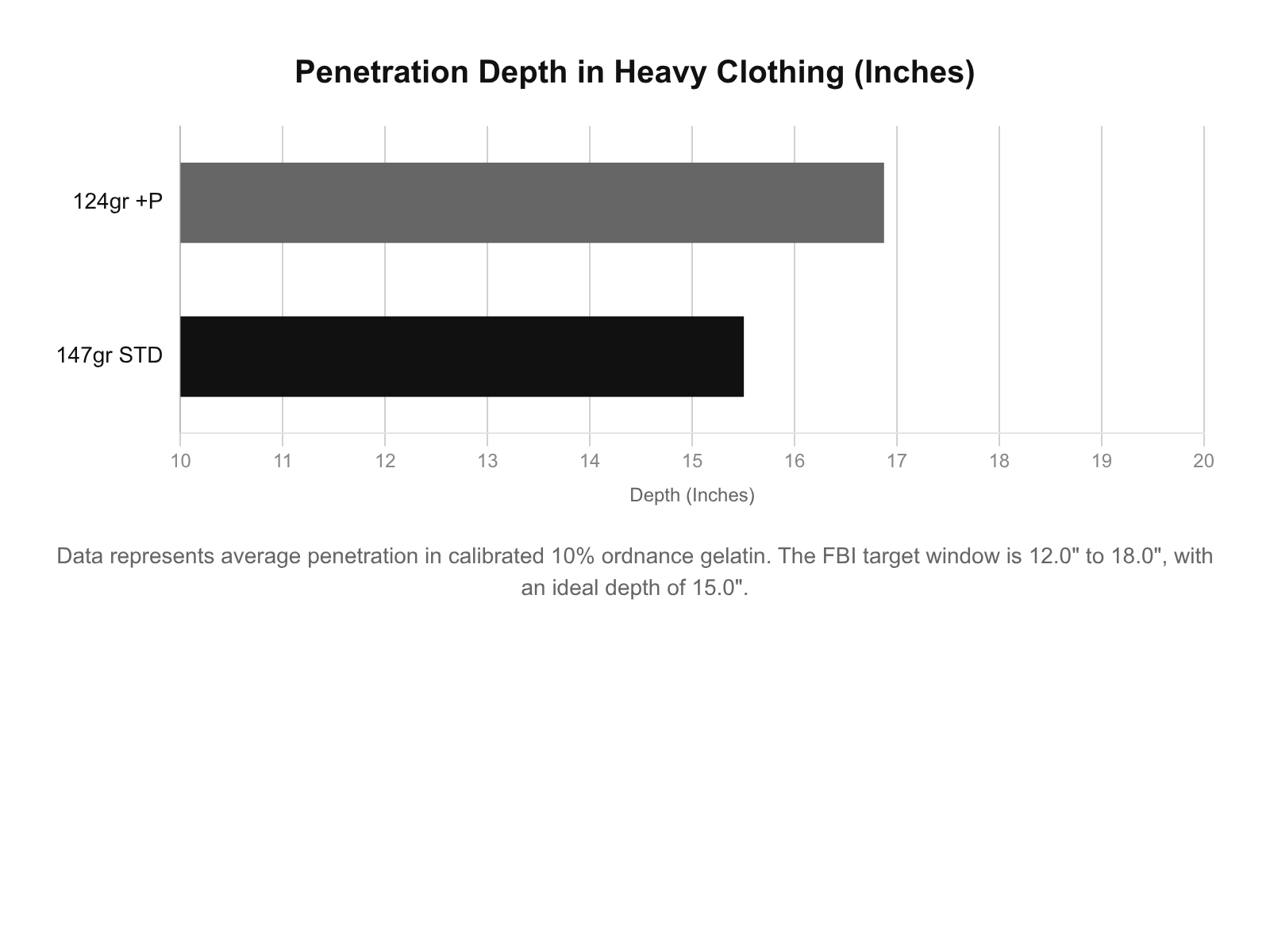
The 124-grain +P load, driven by its high velocity, routinely pushes the extreme upper limits of the FBI’s 18-inch maximum penetration threshold. In documented testing, Federal HST 124-grain +P (Load P9HST3) frequently clocks in at 18.3 inches of penetration in bare gelatin and 16.87 inches in heavy clothing.21 This performance borders on the threshold for dangerous over-penetration in a densely populated urban environment.
Conversely, the 147-grain standard pressure load settles perfectly into the FBI’s ideal “sweet spot.” The Federal HST 147-grain (Load P9HST2) averages 14.5 inches of penetration in bare gelatin and 15.5 inches in heavy clothing.9
Furthermore, aggregate cross-source testing of generic 147-grain versus 124-grain JHPs indicates that the 147-grain bullet consistently achieves a slightly wider expansion profile. Across multiple tests, 147-grain loads averaged an expansion diameter of 0.513 inches, while 124-grain loads averaged 0.470 inches.8 The heavier bullet’s slower velocity allows the lead petals to unfold gracefully and maintain their structure, whereas the violent impact of the high-velocity +P round can sometimes cause the petals to shear off or fold back too tightly against the bullet’s shank, reducing the overall diameter of the permanent crush cavity.24
3.3 Intermediate Hard Barriers: Steel, Wallboard, and Plywood
The true test of a duty round’s structural integrity lies in its ability to defeat intermediate hard barriers. When a bullet strikes 20-gauge steel or thick plywood, the nose of the bullet is severely deformed. Typically, a harder barrier causes more deformation, resulting in less penetration into the tissue simulant located behind the barrier.20
Both the 124-grain +P and 147-grain standard pressure modern duty loads successfully pass the FBI minimums for steel, wallboard, and plywood.18 However, the 124-grain +P begins to show a distinct kinetic advantage in these stages. The added 10 percent chamber pressure and subsequent 150 fps velocity advantage provide the overpressure round with the sheer kinetic energy necessary to punch cleanly through sheet metal while retaining enough velocity to expand in the gelatin behind it.24 The 147-grain round, traveling near 1,000 fps, expends a significant portion of its total momentum merely breaking through the steel or wood, resulting in slightly shallower penetration depths post-barrier.
3.4 Laminated Automotive Glass Defeat
Laminated automotive safety glass is universally considered the most destructive and difficult barrier in the FBI testing protocol. Windshields are designed to resist impact. When a handgun bullet strikes a windshield at a compound angle, the glass severely deforms the projectile, strips the copper jacket away from the lead core, and significantly alters the bullet’s downward trajectory.20 Defeating auto glass requires a bullet with immense structural integrity and sufficient velocity to punch through the laminated layers while retaining enough mass to penetrate the requisite 12 inches into the subject behind the wheel.22
In vehicular scenarios, the 124-grain +P load demonstrates its absolute operational necessity. The added velocity of the +P charge provides the vital kinetic energy required to shatter the angled glass and drive the projectile forward into the cabin.
Standard pressure 147-grain ammunition, while highly effective on soft targets, travels roughly 150 to 200 fps slower than its +P counterparts. When striking laminated glass at an angle, the heavier, slower bullet expends a vast percentage of its momentum breaking the barrier. While modern 147-grain bonded or mechanically locked JHPs will still generally pass the 12-inch minimum requirement, their performance is much closer to the minimum threshold, and their expansion is often heavily muted or completely absent after passing through the abrasive glass matrix.24
4.0 Engineering Analysis of Premium Law Enforcement Projectiles
To contextualize procurement decisions between bullet weights and pressures, it is necessary to analyze the proprietary engineering of the top-tier duty ammunition lines dominating the law enforcement market: Speer Gold Dot, Federal Premium Tactical HST, and Hornady Critical Duty. The performance of a 147-grain or 124-grain +P bullet is inextricably linked to how its manufacturer designed the projectile to behave upon impact.
4.1 Speer Gold Dot: Molecular Bonding Technology
The Speer Gold Dot is widely considered the pioneer of modern law enforcement ammunition and remains the number one choice for many patrol divisions.22 The defining characteristic of the Gold Dot is its bonded core. Rather than pressing a lead core into a copper cup, Speer utilizes a proprietary “Uni-Cor” electrochemical process that bonds the copper jacket to the lead core one single molecule at a time.22
The primary advantage of this electrochemical bonding is extreme weight retention when encountering hard barriers. The jacket and core simply cannot separate, even when crushing through laminated windshields or steel car doors.22 The Speer Gold Dot 124-grain +P (Load 53617) is legendary for its barrier blindness in vehicular engagements.26 The tradeoff to this design is that the molecular bonding hardens the overall projectile. Consequently, while it expands reliably, it rarely achieves the massive, oversized expansion diameters seen in non-bonded bullets when fired into unobstructed soft tissue.
4.2 Federal Premium Tactical HST: Mechanical Cannelure Design
Manufactured under the same Vista Outdoor corporate umbrella as Speer, the Federal Premium Tactical HST was engineered with an entirely different operational philosophy.27 The HST is explicitly not a bonded bullet. Instead, it features a heavy cannelure that mechanically locks the core to the jacket to prevent separation.9
The defining feature of the HST is its patented pre-skived jacket, featuring co-aligned internal and external serrations.9 Because the core is not molecularly bonded to the jacket, the lead and copper are free to peel back along these predetermined fault lines upon impact with fluid or tissue.22 This results in catastrophic, six-point star-shaped expansion. The Federal HST routinely expands to nearly twice its original diameter (often exceeding 0.65 inches in 9mm), creating a devastating permanent crush cavity in soft tissue.22 While the HST passes all FBI barrier tests,including auto glass,it is generally acknowledged that the bonded Gold Dot is slightly more robust against barriers, whereas the HST creates a vastly superior wound channel in soft targets.28
4.3 Hornady Critical Duty: FlexLock and Polymer Insertion
Hornady addresses the FBI protocol requirements through a completely different technological avenue with their Critical Duty line (e.g., the 135-grain +P FlexLock). Rather than bonding the bullet,which Hornady argues makes the lead too soft and prone to crushing against hard barriers,Critical Duty utilizes a high-antimony, hard-lead core.17
Core-jacket separation is prevented via an “InterLock” band, a thick ring of jacket material deeply embedded into the core.20 Most uniquely, the hollow point cavity is filled with a proprietary polymer insert. This FlexTip prevents heavy clothing, drywall dust, or glass shards from clogging the cavity, initiating consistent expansion across all mediums.20 Critical Duty is engineered to be entirely “barrier blind,” ensuring the bullet penetrates exactly 13 to 15 inches regardless of what it passes through first.22
FBI Protocol Projectile Engineering Comparison
| Manufacturer & Line | Core-Jacket Integration | Tip Design | Primary Operational Strength |
| Speer Gold Dot | Electrochemical Bond (Uni-Cor) | Standard Hollow Cavity | Extreme weight retention through auto glass |
| Federal Tactical HST | Mechanical Cannelure Lock | Pre-skived, co-aligned | Massive soft-tissue expansion diameter |
| Hornady Critical Duty | InterLock Band | Polymer FlexTip Insert | Absolute consistency across all hard barriers |
| Data synthesized from manufacturer engineering specifications and OSINT ballistic testing.9 |
5.0 Real-World Incapacitation: Officer-Involved Shooting (OIS) Data
While laboratory ballistic gelatin provides a sterile, highly repeatable baseline for comparing the structural integrity of different projectiles, it is merely a homogeneous simulant. To evaluate true operational effectiveness, analysts must cross-reference laboratory data with empirical, street-level Officer-Involved Shooting (OIS) statistics.
5.1 The Myth of “Stopping Power” and the Mechanics of Wounding
For decades, law enforcement training and procurement were heavily influenced by the nebulous concept of “stopping power”,the belief that a handgun bullet’s kinetic energy transfer could physically knock a human adversary down or cause instantaneous hydrostatic shock to the nervous system. Contemporary forensic pathology and wound ballistics have thoroughly debunked this myth for standard handgun calibers.3
As articulated by FBI firearms training experts John Hall and Supervisory Special Agent Urey Patrick in their definitive 1989 treatise, “Handgun Wounding Factors and Effectiveness,” a handgun bullet incapacitates a determined adversary through only one of two mechanisms:
- Central Nervous System (CNS) Disruption: Immediate, involuntary, and absolute incapacitation achieved only by physically severing the brainstem or the upper spinal cord.
- Exsanguination (Blood Loss): Gradual, delayed incapacitation caused by destroying major cardiovascular organs (the heart, aorta, lungs, or liver), leading to a catastrophic drop in systemic blood pressure and eventual cerebral hypoxia.1
Because handgun projectiles (generally traveling well under 1,500 fps) are entirely insufficient to produce the massive, tissue-tearing temporary stretch cavities seen in high-velocity rifle rounds (which travel over 2,500 fps), handgun wounding is limited almost entirely to the permanent crush cavity.1 The permanent cavity is exactly equal to the diameter of the expanded bullet.
Therefore, the single most critical factor in handgun lethality is penetration to a scientifically valid depth (12 to 18 inches) to reach vital organs from any angle, combined with accurate shot placement.3 Because both 124-grain +P and 147-grain standard pressure modern loads easily achieve this required penetration depth, the terminal difference between a 0.50-inch wound channel and a 0.60-inch wound channel is statistically irrelevant in the chaos of a real-world gunfight. What matters is the officer’s ability to put multiple rounds into the high thoracic cavity as rapidly as possible.
5.2 The Ellifritz 10-Year Stopping Power Study
The most comprehensive and frequently cited public analysis of real-world incapacitation data was compiled by firearms trainer and researcher Greg Ellifritz. Over a rigorous 10-year period, Ellifritz compiled forensic and post-action data on nearly 1,800 shootings across various calibers, focusing on the number of rounds required to incapacitate, the percentage of one-shot stops, and the failure-to-incapacitate rate.29
Earlier, highly publicized works (such as the Marshall and Sanow studies of the 1990s) were heavily criticized by statisticians because they selectively excluded multiple-shot data to artificially inflate “one-shot stop” percentages.29 Ellifritz corrected this methodological flaw by analyzing all hits, providing a vastly more realistic view of combat effectiveness.30
His data revealed stunning parity across all major service calibers, destroying the myth that larger or higher-energy calibers guarantee faster incapacitation.
Ellifritz Study Data: Incapacitation Rates by Service Caliber
| Metric Evaluated | 9mm Luger | .40 S&W | .45 ACP |
| Average Rounds to Incapacitate | 2.45 | 2.36 | 2.08 |
| Percentage of Shots That Were Fatal | 24% | 25% | 29% |
| Failure to Incapacitate Rate | 13% | 13% | 14% |
| Extrapolated from the Greg Ellifritz 10-Year Stopping Power Study.29 |
While Ellifritz’s published data aggregates the 9mm category and does not isolate 147-grain versus 124-grain +P, the overarching conclusion of his research is paramount to this specific analysis: Minor variations in kinetic energy do not alter gunfight outcomes. A 9mm 124-grain +P generating 400 foot-pounds of energy does not incapacitate a human being any faster than a 147-grain standard pressure round generating 320 foot-pounds of energy. The physiological destruction is effectively identical. The human body cannot register a 10 percent difference in handgun pressure.
5.3 Urban Engagement Metrics and Hit Ratios
Large municipal agencies provide a wealth of statistical data regarding ammunition effectiveness under stress. The New York City Police Department (NYPD) Annual Firearms Discharge Report provides a highly detailed mapping of adversarial conflicts, tracking every shot fired by an officer.31
Historically, the NYPD transitioned from 115-grain FMJ to 124-grain hollow points (specifically Speer Gold Dot 124-grain +P) in the late 1990s to combat over-penetration and increase terminal effectiveness. Reports analyzing NYPD OIS incidents consistently note a grim reality of modern policing: the primary determinant of officer survival is the hit ratio. In dynamic, stress-induced gunfights involving movement and low light, law enforcement hit ratios historically hover between 30 percent and 40 percent.31
Because officers miss approximately 60 to 70 percent of the shots fired in combat, procurement strategy must shift its priority. If all premium ammunition passes the FBI penetration protocols, agencies must prioritize the ammunition that maximizes the probability of the officer landing accurate hits under extreme duress. This firmly shifts the analytical focus away from the minor terminal ballistic advantages of +P ammunition and toward the human factors of recoil management.
6.0 Human Factors: Biomechanics, Recoil Impulse, and Split Times
The debate between 124-grain +P and 147-grain standard pressure is ultimately decided not in the gelatin block, but in the shooter’s hands. The biomechanical interaction between the firearm’s mechanical recoil impulse and the officer’s nervous system directly dictates combat effectiveness.
6.1 The Physics of Recoil: Mass, Velocity, and Pressure Curves
Recoil energy is a direct mathematical calculation of the mass of the projectile, the mass of the powder charge, the velocity of the projectile, and the weight of the firearm.36
While basic common sense might suggest that a heavier 147-grain bullet naturally generates more recoil, the physics of internal ballistics prove otherwise when comparing loads designed to meet similar operational thresholds. In competitive shooting and ballistic analysis, this threshold is measured as Power Factor (PF), calculated by the formula: (Bullet Weight in Grains * Muzzle Velocity in fps) / 1000.13
A standard 115-grain training load at 1,150 fps yields a Power Factor of 132. A 124-grain +P load at 1,150 fps yields a Power Factor of 142.6. A 147-grain standard load at 990 fps yields a Power Factor of 145.5.13
Despite the 147-grain load possessing a slightly higher mathematical Power Factor, the felt recoil impulse is perceived entirely differently by the human body due to the internal powder burn rates and the duration of the recoil stroke.11
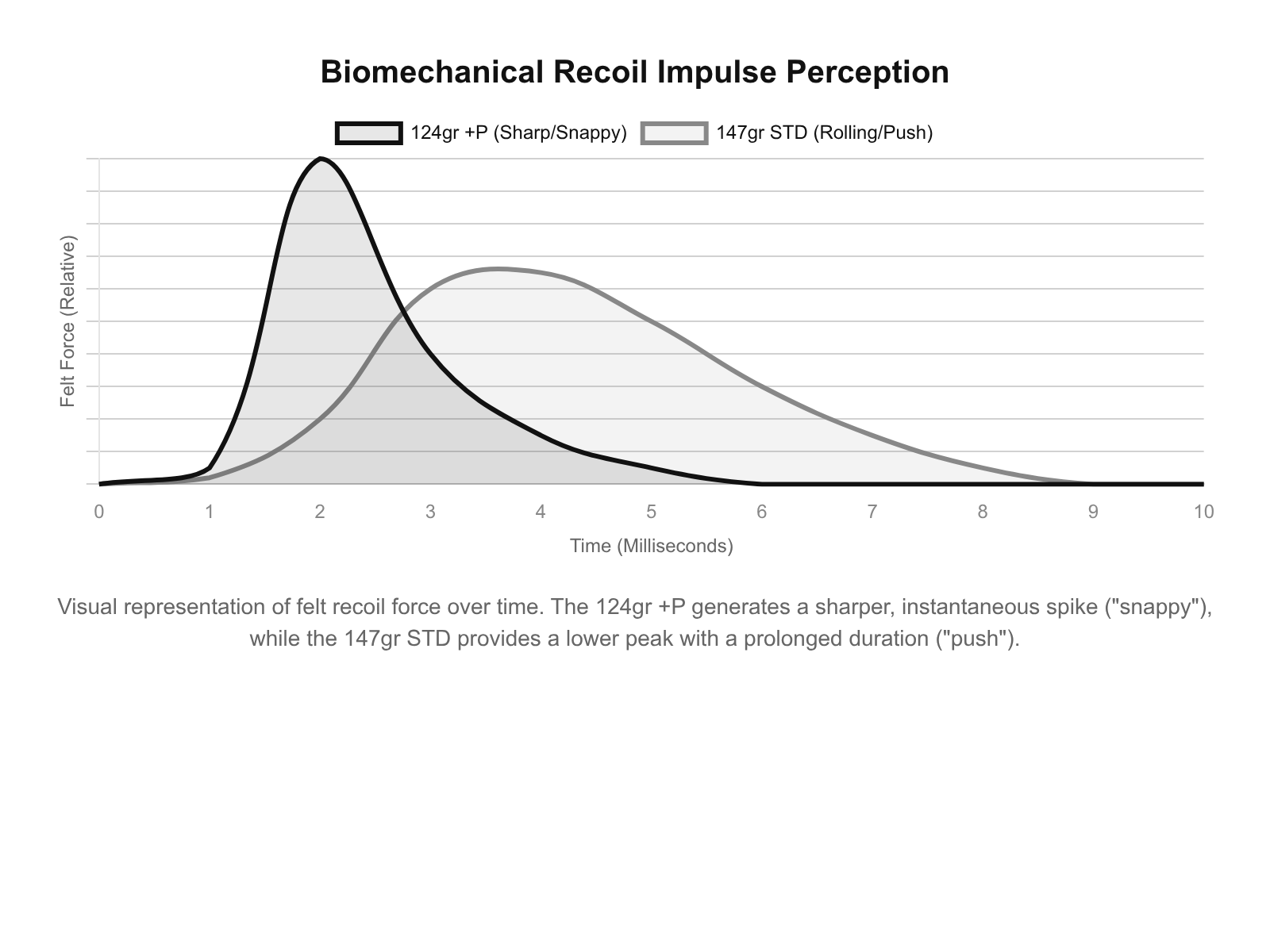
To drive a 124-grain bullet to +P velocities (1,150+ fps), manufacturers must utilize a relatively large charge of slow-burning powder.11 This creates a massive, instantaneous high-pressure spike (reaching 38,500 PSI) that generates a sharp, violent rearward acceleration of the weapon’s slide. Shooters universally perceive this rapid acceleration as a “snappy” or harsh recoil that snaps the wrists upward.7
Conversely, the 147-grain bullet requires less empty case volume and is typically driven by a smaller charge of faster-burning powder to achieve its subsonic velocity.11 This fast-burning powder completes its combustion earlier, creating a lower overall pressure curve (below 35,000 PSI). Furthermore, the heavier mass of the 147-grain projectile creates more resting inertia. This inertia resists the expanding gases for a fraction of a millisecond longer, causing the slide to unlock and cycle slightly slower.14 Shooters universally perceive this extended, lower-pressure cycle as a softer, rolling “push” rather than a violent snap.13
6.2 Follow-Up Shots and Split Times
In competitive action shooting disciplines (such as USPSA and IDPA), where fractions of a second distinguish grandmasters from novices, the 147-grain 9mm load is overwhelmingly preferred by top-tier competitors.13 The softer, rolling recoil impulse significantly reduces muzzle flip, allowing the weapon’s sights (or red dot optic reticle) to return to the target faster and track more predictably during the slide cycle.37
This optical tracking translates directly to reduced “split times”,the exact time elapsed between consecutive shots fired on a single target.41 In controlled law enforcement training environments (e.g., FLETC qualification standards), testing consistently reveals that officers firing 147-grain standard pressure ammunition can reduce their split times by 0.05 to 0.12 seconds per shot compared to firing 124-grain +P.41
While 0.10 seconds may seem trivial on paper, in a dynamic engagement where an adversary is sprinting, falling, or actively returning fire, an officer firing a three-round string 0.30 seconds faster,with significantly tighter shot grouping due to reduced muzzle climb,exponentially increases the probability of achieving immediate central nervous system or cardiovascular disruption.
Furthermore, many smaller-framed officers, or those suffering from compromised grip strength due to injury or physical exhaustion during a struggle, suffer from “limp-wristing” malfunctions when firing high-recoil +P ammunition in lightweight polymer-framed pistols.24 The 147-grain load’s softer, more forgiving cycling dynamics dramatically increase the weapon’s functional reliability across a much broader spectrum of shooter demographics and compromised shooting positions.24
6.3 Training Continuity and Budget Optimization
The adoption of 124-grain +P duty ammunition frequently forces law enforcement agencies to purchase cheaper, standard-pressure 115-grain or 124-grain full metal jacket (FMJ) ammunition for standard range training due to strict budget constraints; +P training ammunition is prohibitively expensive.24
This budgetary compromise creates a highly dangerous training scar. Officers subconsciously condition their grip tension and recoil management algorithms to the soft impulse of the 115-grain range ammo, only to be violently surprised by the harsh snap, increased muzzle flash, and concussive blast of the 124-grain +P duty ammo during an actual gunfight.
If an agency adopts 147-grain standard pressure JHP for duty use, they can easily procure highly affordable 147-grain FMJ training ammunition that exhibits a nearly identical ballistic coefficient and recoil impulse. Manufacturers like Federal explicitly market this paradigm with their American Eagle line, which is designed to perfectly match the ballistics of the HST duty line.9 Consistent continuity between training and duty platforms is a foundational tenet of modern combat marksmanship, ensuring that officers fight exactly how they train.9
7.0 Platform Lifecycle, Maintenance Economics, and Wear
A critical but frequently overlooked metric in ammunition procurement is the accelerated mechanical degradation of the department’s duty weapon inventory. Firearms are mechanical machines subject to the immutable laws of metallurgical fatigue, friction, and sheer stress.
7.1 Cumulative Metallurgical Stress and Slide Velocity
The continuous cycling of +P overpressure ammunition subjects a firearm to massive cumulative stress. The 10 percent increase in chamber pressure translates directly to higher rearward slide velocities.6 When the slide travels rearward at an accelerated rate, it impacts the polymer frame with substantially more kinetic force. This violent action accelerates the wear on the frame’s locking block, the slide stop lever, the extractor claw, the striker assembly, and most importantly, the recoil spring assembly (RSA).7
While all modern service pistols produced by top-tier manufacturers (Glock, SIG Sauer, Smith & Wesson, Walther) are officially rated to safely chamber and fire +P ammunition, manufacturer armorer manuals contain explicit caveats regarding accelerated wear.5 Constant use of +P ammunition is generally discouraged by armorers for daily high-volume range use; it is recommended to be used sparingly to verify zero, and reserved primarily for duty carry.47 This restriction fundamentally contradicts the aforementioned requirement for training and duty continuity.
7.2 Armorer Considerations: Recoil Spring Assembly (RSA) Service Life
The Recoil Spring Assembly is the mechanical lifeblood of a semi-automatic pistol. It controls the slide’s rearward velocity to prevent frame battering, stores that energy, and then drives the slide forward to strip the next round from the magazine and return the weapon securely into battery.48
As the spring weakens through repeated compression cycles, slide velocity increases further, leading to catastrophic frame battering, failure-to-feed (FTF) malfunctions, and failure-to-extract (FTE) stoppages.48 Firing +P ammunition radically accelerates this spring fatigue.50
Armorer Maintenance Schedule Comparison: RSA Lifespan
| Duty Weapon Platform | Standard Pressure (147gr) RSA Life | Overpressure (+P) RSA Life (Estimated) |
| Glock Gen 3 (Single Spring) | 3,000 – 4,000 Rounds | 2,000 – 2,500 Rounds |
| Glock Gen 4/5 (Dual Captive) | 5,000 – 7,500 Rounds | 3,500 – 5,000 Rounds |
| SIG Sauer P365 (Micro-Compact) | 2,500 – 5,000 Rounds | 1,500 – 2,000 Rounds |
| SIG Sauer P320 (Full Size) | 10,000 Rounds | 7,000 – 8,000 Rounds |
| Data aggregated from certified armorer manuals, Glock maintenance directives, and industry lifecycle fatigue testing.50 |
An agency mandating 124-grain +P ammunition must increase the frequency of its preventative maintenance cycles by an estimated 20 to 30 percent to ensure weapon reliability.50 For a mid-sized department with 1,000 sworn officers, firing 2,000 rounds per year in training and qualifications, the logistical burden is severe. Replacing 1,000 Glock Gen 5 RSAs every 18 months (due to +P wear) versus every 36 months (with standard pressure) represents a massive, recurring expenditure in both parts acquisition and armorer man-hours.
7.3 Platform-Specific Case Studies: SIG Sauer P320
While Glock platforms officially mandate function checks based on physical tension tests (the 45-degree battery test) 53, the SIG Sauer P320,heavily adopted following its selection as the U.S. Military’s M17/M18 sidearm,presents a slightly different mechanical profile.
During the military’s rigorous testing phase, the XM17 achieved a Mean Rounds Between Failure (MRBF) rate of over 6,944 rounds when utilizing specifically tailored military ball ammunition, though it exhibited minor stoppage issues during initial break-in periods and struggled with the 2,000 Mean Rounds Between Stoppages (MRBS) metric.56 The commercial P320’s Armorer Manual designates a highly robust 10,000-round replacement schedule for the primary recoil spring.55
However, recent evaluations by the FBI’s Ballistic Research Facility (BRF) regarding the P320 (and specifically the M18 variant issued to the Michigan State Police) highlighted severe concerns over “dead triggers” and failure-to-reset issues during extensive 1,200-round firing schedules.57 While SIG Sauer continuously iterates on the Fire Control Unit (FCU) to ensure safety and reliability 57, it is an immutable law of mechanical engineering that higher-pressure +P ammunition will exacerbate any latent tolerances, trigger bar friction, or spring fatigue within the complex striker assembly and trigger reset mechanisms.58 Utilizing 147-grain standard pressure ammunition provides a much wider margin of mechanical safety, reliability, and longevity for the P320’s internal Fire Control Unit.
8.0 Strategic Procurement Recommendations
The selection of duty ammunition for a law enforcement agency should never be made in a vacuum based solely on laboratory gelatin tests. It must be a holistic, multi-disciplinary decision encompassing terminal performance, shooter biomechanics, training budgets, and armorer logistics.
8.1 Vehicular Operations: The Case for 124gr +P
The 124-grain +P load (particularly the Speer Gold Dot or Hornady Critical Duty) remains a highly specialized, highly effective tool. It is the optimal choice for agencies whose primary operational environment revolves heavily around vehicles. State Highway Patrols, motor units, and dedicated tactical interdiction teams (SWAT) require ammunition that can consistently defeat laminated windshields and heavy sheet metal while retaining mass and achieving deep penetration.22 For these specialized units, the increased weapon wear and harsher recoil impulse are entirely acceptable tradeoffs for extreme barrier blindness.
8.2 Urban Patrol and General Duty: The Case for 147gr
Conversely, for the vast majority of municipal, county, and urban law enforcement personnel, the 147-grain standard pressure JHP (such as the Federal Premium Tactical HST) is definitively superior. Urban environments present extreme, constant risks of collateral damage due to over-penetration. The 147-grain load’s tendency to expand massively and stop consistently within the ideal 14- to 15-inch range in soft tissue makes it vastly safer and more effective in crowded, dynamic environments.8
From a purely economic and operational readiness standpoint, the 147-grain standard pressure paradigm offers cascading logistical benefits:
- Increased Hit Probability: Faster split times and lower felt recoil allow officers of all statures and grip strengths to land more rounds on target under stress, directly increasing the probability of rapid physiological incapacitation.14
- Absolute Training Continuity: Agencies can purchase 147-grain FMJ training ammunition that perfectly mirrors the recoil and ballistic trajectory of the 147-grain JHP duty load, entirely eliminating dangerous training scars.9
- Lifecycle Cost Reduction: Eliminating +P overpressure from the daily training and duty cycle extends the service life of recoil spring assemblies, locking blocks, and extractors by thousands of rounds, drastically reducing the armorer’s workload and the department’s parts budget.50
9.0 Conclusion
This comprehensive meta-analysis of internal, external, and terminal ballistics, cross-referenced with real-world OIS incapacitation data and mechanical lifecycle metrics, fundamentally reframes the ammunition procurement debate. The historical pursuit of raw kinetic energy and maximum velocity,which gave rise to the 124-grain +P overpressure standard,is an outdated doctrine for general-purpose municipal policing.
Physiological incapacitation is achieved not by energy transfer, but through accurate, repetitive shot placement that disrupts the central nervous system or cardiovascular network. The 147-grain standard pressure 9mm JHP provides more than enough mass and momentum to achieve the requisite 12 to 18 inches of penetration necessary for lethality, while offering massive, reliable expansion in soft tissue. More importantly, the subsonic nature and fast-burning powder of the 147-grain load generate a softer, more manageable recoil impulse. This directly translates to faster split times, vastly superior accuracy under duress, and drastically reduced mechanical wear on the agency’s duty weapon inventory.
Unless a department’s specific tactical mandate explicitly requires the extreme intermediate barrier defeat capabilities of an overpressure round for vehicular interdiction, the 147-grain standard pressure 9mm is the premier, scientifically validated, and economically responsible choice for modern law enforcement operations.
Appendix: Methodology & Data Sources
This meta-analysis was conducted utilizing cross-source Open-Source Intelligence (OSINT) gathering, analyzing heavily documented industry, academic, and government testing standards. Primary terminal ballistics data was sourced directly from manufacturer Law Enforcement technical catalogs (Vista Outdoor, Federal Premium, Speer, Hornady) utilizing established FBI Ammunition Protocol testing results.9 Empirical street-level incapacitation data was synthesized from Greg Ellifritz’s 10-Year Stopping Power Study 29, FBI Training Division justification reports and treatises 1, and municipal use-of-force documentation.31 Mechanical degradation and lifecycle metrics were gathered from certified Glock and SIG Sauer armorer directives, alongside aggregate data from competitive shooting biomechanics and internal ballistics formulas.13 Cross-referencing these domains provides a holistic, mathematically rigorous foundation for the analytical conclusions presented herein.
Ronin’s Grips Analytics provides custom, agency-specific data on this topic. Contact us to commission a tailored internal audit or procurement forecast for your department.
Please share this post with colleagues, on forums, etc. Your support is much appreciated, and if you have any feedback, please email us in**@*********ps.com. If you’d like to request a report or order a reprint, please click here for the corresponding page to open in new tab.
Sources Used
- Why bullet size matters in officer-involved shootings – Police1, accessed March 5, 2026, https://www.police1.com/police-products/firearms/accessories/ammunition/articles/why-bullet-size-matters-in-officer-involved-shootings-Ff0sxVITdSX8iAn7/
- If you have issues viewing or accessing this file contact us at NCJRS.gov. – Office of Justice Programs, accessed March 5, 2026, https://www.ojp.gov/pdffiles1/Digitization/113821NCJRS.pdf
- May 6, 2014 FBI Training Division: FBI Academy, Quantico, VA Executive Summary of Justification for Law Enfo, accessed March 5, 2026, https://nebula.wsimg.com/479b61ac5754635b087ca4b14aa727c4?AccessKeyId=D0DCC35FC05D0FC60556&disposition=0&alloworigin=1
- FBI 9mm Duty Carry Justification 2014 | PDF | Projectile Weapons | Firearms – Scribd, accessed March 5, 2026, https://www.scribd.com/document/934041986/FBI-9MM-Justification-FBI-Training-Division-LooseRounds
- What is the difference in 9mm and 9mm+p ammo and can all 9mm guns shoot +p ammo? If not then what handguns are capable of firing +p ammo? – The Gun Club, accessed March 5, 2026, https://thegunclub.quora.com/What-is-the-difference-in-9mm-and-9mm-p-ammo-and-can-all-9mm-guns-shoot-p-ammo-If-not-then-what-handguns-are-capable-o
- 9mm +P Ammo vs Regular 9mm Ammo – Ammunition Depot, accessed March 5, 2026, https://www.ammunitiondepot.com/blog/understanding-9mm-p-ammunition
- 9mm Defense Ammo: Standard Pressure vs +P , What’s the Real Difference?, accessed March 5, 2026, https://www.recoilgunworks.com/blog/9mm-defense-ammo-standard-pressure-vs-p-whats-the-real-difference/
- 124 vs 147 Grain – 9mm Bullet Weights Compared – The Lodge at AmmoToGo.com, accessed March 5, 2026, https://www.ammunitiontogo.com/lodge/124-vs-147-grain/
- our next century – Federal Ammunition, accessed March 5, 2026, https://www.federalpremium.com/on/demandware.static/-/Library-Sites-VistaFederalSharedLibrary/default/vd5051f299f79146229507233809e6144584db865/contentDocuments/catalog/Federal-Catalog-2022_website.pdf
- Should You Everyday Carry +P or +P+ Ammo? [A Break Down], accessed March 5, 2026, https://www.velocityammosales.com/blog/should-you-everyday-carry-p-or-p-ammo-a-break-down/
- Never Reloaded. Have Some Questions. – 9mm/38 Caliber – Brian Enos’s Forums, accessed March 5, 2026, https://forums.brianenos.com/topic/280204-never-reloaded-have-some-questions/
- Buy Personal Defense HST 9mm Luger Ammo | 147 Grain, 1000 FPS – Federal Ammunition, accessed March 5, 2026, https://www.federalpremium.com/handgun/personal-defense-hst/11-P9HST2S.html
- 124 vs. 147 9mm : r/CompetitionShooting – Reddit, accessed March 5, 2026, https://www.reddit.com/r/CompetitionShooting/comments/3b2mc2/124_vs_147_9mm/
- [IPSC Production] 9x19mm, 124gr vs 147gr, what has 147gr going for itself? – Reddit, accessed March 5, 2026, https://www.reddit.com/r/CompetitionShooting/comments/4znzqi/ipsc_production_9x19mm_124gr_vs_147gr_what_has/
- FBI Ammunition Testing Protocol Explained | PDF | Bullet | Ballistics – Scribd, accessed March 5, 2026, https://www.scribd.com/document/596160258/FBI-Ammunition-Protocol
- FBI Test Protocol – Hornady Law Enforcement, accessed March 5, 2026, https://www.hornadyle.com/resources/fbi-test-protocol
- Hornady Critical Duty 9mm Ammo Review: Stop the Threat, accessed March 5, 2026, https://ammo.com/ammo-review/hornady-critical-duty-9mm-review
- FEDERAL Ammunition – Ohio.gov, accessed March 5, 2026, https://dam.assets.ohio.gov/image/upload/procure.ohio.gov/pricelist/800108pricelist.pdf
- Best 9mm Ammo For Defense – Federal Ammunition, accessed March 5, 2026, https://www.federalpremium.com/getting-started/defense-range/best-9mm-ammo-for-defense.html
- AMMUNITION & TEST REPORT APPLICATION GUIDE – Hornady.media, accessed March 5, 2026, https://static.hornady.media/presscenter/docs/1410996103-1704221297-TAP-Application-Guide.pdf
- Federal HST VS Speer Gold Dot: Best Defensive Round – Wideners Shooting, Hunting & Gun Blog, accessed March 5, 2026, https://www.wideners.com/blog/federal-hst-vs-speer-gold-dot-best-defensive-round/
- Handgun Self-Defense Ammunition – Ballistic Testing Data – Lucky Gunner, accessed March 5, 2026, https://www.luckygunner.com/labs/self-defense-ammo-ballistic-tests/
- Federal 2023 Catalog, accessed March 5, 2026, https://www.federalpremium.com/on/demandware.static/-/Library-Sites-VistaFederalSharedLibrary/default/vd5051f299f79146229507233809e6144584db865/contentDocuments/catalog/FP2057_Federal_Catalog_2023_FULL_122022.pdf
- The question is, 124 grain or 147 grain? : r/CAguns – Reddit, accessed March 5, 2026, https://www.reddit.com/r/CAguns/comments/14czyci/the_question_is_124_grain_or_147_grain/
- Untitled – Speer Ammo, accessed March 5, 2026, https://www.speer.com/on/demandware.static/-/Library-Sites-VistaSpeerSharedLibrary/default/v5ac6c017161b18362fea8ab6e7ab4ac6a5fbd9cb/pdfDocuments/SP160_Speer2025_Catalog_web.pdf
- Speer Gold Dot LE 9mm +P | 124gr | GDHP | (2+ Boxes Ship Free) | 53617, accessed March 5, 2026, https://www.recoilgunworks.com/speer-le-gold-dot-9mm-p-124gr-gdhp/
- LAW ENFORCEMENT AMMUNITION 2023 – Rivolier-sd.com, accessed March 5, 2026, https://www.rivolier-sd.com/media/catalogpdf/2023_Federal_Speer_LE.pdf
- Speer Gold Dot vs Federal HST Ballistic Gel Test & Review 9mm +P 9×19 – YouTube, accessed March 5, 2026, https://www.youtube.com/watch?v=AN2g4kuVpbw
- Effectiveness of Handgun Calibers in Real-World Shootings – LFX Firearms Training, accessed March 5, 2026, https://www.lfxtraining.com/articles/handguncaliber
- An Alternate Look at Handgun Stopping Power | Buckeye Firearms Association, accessed March 5, 2026, https://www.buckeyefirearms.org/alternate-look-handgun-stopping-power
- REPORT – NYC.gov, accessed March 5, 2026, https://www.nyc.gov/assets/nypd/downloads/pdf/analysis_and_planning/2024%20UOF%20Final%20Version.pdf
- 2023 Use of Force Report – NYC.gov, accessed March 5, 2026, https://www.nyc.gov/assets/nypd/downloads/pdf/use-of-force/use-of-force-2023.pdf
- New York City Police Department – Disciplinary System Penalty Guidelines – NYC.gov, accessed March 5, 2026, https://www.nyc.gov/assets/nypd/downloads/pdf/public_information/nypd_disciplinary_system_penalty_guidelines_effective_09-09-2024.pdf
- Interim Order 37(16) – Firearms Discharge by Uniformed Members of the Service – NYC.gov, accessed March 5, 2026, https://www.nyc.gov/html/ccrb/downloads/pdf/io_37_16-firearms-discharge-by-umos.pdf
- Annual Use of Force/Firearms Discharge Report Data Tables – NYC.gov, accessed March 5, 2026, https://www.nyc.gov/site/nypd/stats/reports-analysis/firearms-discharge.page
- Is the recoil from different grains of ammo recoil completely subjective? : r/guns – Reddit, accessed March 5, 2026, https://www.reddit.com/r/guns/comments/17w0ytd/is_the_recoil_from_different_grains_of_ammo/
- Weight, Velocity, and Recoil? – 9mm/38 Caliber – Brian Enos’s Forums… Maku mozo!, accessed March 5, 2026, https://forums.brianenos.com/topic/307717-weight-velocity-and-recoil/
- Does Bullet Weight Matter for Self-Defense? – The Armory Life, accessed March 5, 2026, https://www.thearmorylife.com/does-bullet-weight-matter-for-self-defense/
- Speer Gold Dot 9mm Review – The Broad Side – Target Barn, accessed March 5, 2026, https://www.targetbarn.com/broad-side/speer-gold-dot-9mm-review/
- Best 9mm Ammo of 2025: Self Defense & Range [Ballistic Gel Tested], accessed March 5, 2026, https://www.pewpewtactical.com/best-9mm-ammo-self-defense-range/
- Blog – HOP Munitions, accessed March 5, 2026, https://hopmunitions.com/blog/
- Shooting 124gr vs 147gr 9mm – opinions : r/CompetitionShooting – Reddit, accessed March 5, 2026, https://www.reddit.com/r/CompetitionShooting/comments/4b09wg/shooting_124gr_vs_147gr_9mm_opinions/
- Self defense 9mm ammo that isn’t +P : r/CCW – Reddit, accessed March 5, 2026, https://www.reddit.com/r/CCW/comments/1oe7c5p/self_defense_9mm_ammo_that_isnt_p/
- +P vs Standard Pressure 9mm : r/CCW – Reddit, accessed March 5, 2026, https://www.reddit.com/r/CCW/comments/71vyn0/p_vs_standard_pressure_9mm/
- 9mm +P : r/Glocks – Reddit, accessed March 5, 2026, https://www.reddit.com/r/Glocks/comments/1klz2ez/9mm_p/
- 124gr vs 147gr : r/Glocks – Reddit, accessed March 5, 2026, https://www.reddit.com/r/Glocks/comments/1oenlhw/124gr_vs_147gr/
- Should You Use +P or +P+ Ammo in Your Handgun? – Botach, accessed March 5, 2026, https://botach.com/blog/should-you-use-p-or-p-ammo-in-your-handgun/
- Pistol Recoil Springs: Should You Change Them? | Shoot On, accessed March 5, 2026, https://shoot-on.com/pistol-recoil-springs-should-you-change-them/
- GLOCK Answers Frequently Asked Questions, accessed March 5, 2026, https://us.glock.com/owners-resources/faqs
- Firearm Spring Care 101: How to Maintain, Clean and Replace Springs – USCCA, accessed March 5, 2026, https://www.usconcealedcarry.com/blog/firearms-maintenance-its-spring-time/
- Maintaining Your Glock Pistol – Tactical Training Center – Flemington, NJ, accessed March 5, 2026, https://tacticaltrainingcenternj.com/firearms-training/glock-parts-maintenance/
- Importance of Different Pistol Recoil Spring Weights – YouTube, accessed March 5, 2026, https://www.youtube.com/watch?v=eoqIlWsMhMk
- How many rounds before it’s time to replace recoil springs? : r/Glocks – Reddit, accessed March 5, 2026, https://www.reddit.com/r/Glocks/comments/1ekhs1a/how_many_rounds_before_its_time_to_replace_recoil/
- Maintaining Your Glock – Eagle Gun Range, accessed March 5, 2026, https://www.eaglegunrangetx.com/maintaining-your-glock/
- Clarification on SIG P365 Spring Replacement Intervals : r/CCW – Reddit, accessed March 5, 2026, https://www.reddit.com/r/CCW/comments/rag2u4/clarification_on_sig_p365_spring_replacement/
- SIG Sauer P320 Review – Controversy and Timeline – Gun University, accessed March 5, 2026, https://gununiversity.com/sig-p320-review/
- P320 Safety Information – SIG Sauer, accessed March 5, 2026, https://www.sigsauer.com/blog/p320-information
- The surprising FBI evaluation and ICE ban of the troubled Sig Sauer P320, accessed March 5, 2026, https://www.wearethemighty.com/tactical/the-fbi-evaluation-of-the-sig-sauer-p320/
- The Truth About the SIG P320, accessed March 5, 2026, https://www.sigsauer.com/p320-truth
- What’s the truth about the Sig P320 and unexpected discharges? : r/liberalgunowners, accessed March 5, 2026, https://www.reddit.com/r/liberalgunowners/comments/158wnc5/whats_the_truth_about_the_sig_p320_and_unexpected/
- Caring for Your GLOCK, accessed March 5, 2026, https://us.glock.com/owners-resources/education/caring-for-your-pistol