1. Executive Summary
The strategic calculus governing the Taiwan Strait is undergoing a profound transformation. As the People’s Republic of China (PRC) accelerates the modernization of the People’s Liberation Army (PLA) with the stated capability benchmark of executing a forced unification by 2027, the traditional paradigms of deterrence are eroding. In response, military planners within the Republic of China (Taiwan) and the United States Indo-Pacific Command (INDOPACOM) are fundamentally reevaluating Taiwan’s defense posture. This reevaluation is heavily driven by the observable successes and failures of modern combat operations in Ukraine and the Middle East, which have validated the battlefield efficacy of massed, low-cost, and attritable unmanned systems.
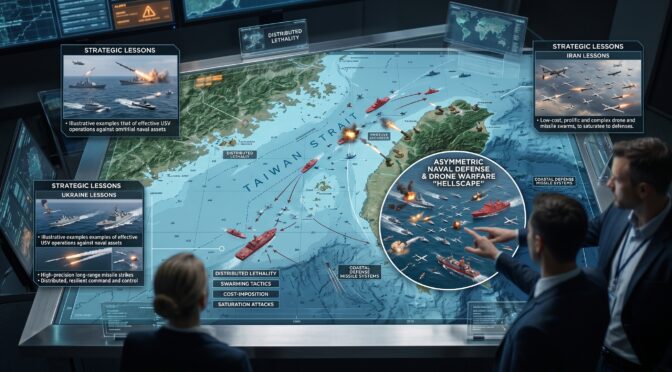
At the center of this doctrinal shift is the “Hellscape” concept, a multi-layered, asymmetric defense strategy designed to transform the Taiwan Strait into a saturated, lethal environment of autonomous aerial, surface, and underwater drones. The primary objective of the Hellscape doctrine is not to achieve conventional sea control, but to execute total sea denial, disrupting and degrading a PLA amphibious invasion fleet long before it reaches Taiwan’s shores. By leveraging cross-domain, multidirectional fires generated by commercial-grade, artificial intelligence-enabled systems, military strategists aim to wear down the Chinese invasion fleet and complicate the PLA’s amphibious landing choreography.
However, operationalizing the Hellscape doctrine presents severe industrial, bureaucratic, and geographic challenges. While Ukraine’s naval drone campaign in the Black Sea and Iran’s deployment of loitering munitions offer vital tactical blueprints for asymmetric warfare, the operational environment of the Taiwan Strait requires highly localized adaptations. The harsh hydrology of the Strait, combined with the extreme density of PLA electronic warfare (EW) and counter-unmanned aerial system (C-UAS) capabilities, dictates that Taiwan cannot simply replicate Ukrainian or Iranian hardware. Furthermore, Taiwan’s reliance on building a “non-red” supply chain—an industrial ecosystem entirely free of Chinese components—introduces significant procurement delays and cost premiums, widening the gap between Taiwan’s current industrial output and the necessary scale of autonomous systems required to secure the island. This report provides an intelligence analysis of the Hellscape doctrine, evaluating Taiwan’s indigenous unmanned capabilities, the applicability of lessons from foreign theaters, and the structural vulnerabilities inherent in the island’s defense architecture.
2. Strategic Context and the Evolution of Taiwan’s Defense Posture
To understand the necessity of the Hellscape doctrine, it is essential to analyze the deteriorating security environment surrounding Taiwan and the limitations of its historical defense strategies. Beijing’s approach to the island has increasingly relied on “gray zone” tactics—actions calibrated to fall below the threshold of armed conflict that achieve strategic objectives through cumulative pressure rather than decisive military action.1
The Erosion of Strategic Depth via Gray Zone Tactics
The 180-kilometer-wide Taiwan Strait has long served as the ultimate guarantor of Taiwan’s security, providing a geographic barrier that reinforced a sense of strategic insulation.2 However, the convergence of hybrid warfare tactics and advances in unmanned aerial vehicle (UAV) technology is rapidly altering this reality. The pressure on Taiwan’s outer islands, particularly Kinmen and Matsu, exemplifies this shift. These island groups, administered by Taiwan but located within visible distance of the Chinese mainland, are subjected to sustained campaigns of administrative boundary testing.1
These gray zone incursions manifest as fishing vessels anchored in contested waters, civilian sand dredgers operating in restricted zones, and military aircraft completing circuits that stop just short of Taiwanese airspace.1 More recently, the deployment of small, commercially available quadcopters and fixed-wing drones over these offshore islands has demonstrated a new level of technical asymmetry.3 These drones, possessing small radar cross-sections and low-altitude flight paths, are difficult to detect and track using military radar systems designed for larger, faster threats.3 This tactical reality indicates that the risk of Chinese drone incursions is no longer confined to the offshore islands; it extends directly over military and civilian critical infrastructure on the main island of Taiwan, effectively shrinking the operational geography and eroding the strategic depth once provided by the Strait.3
The Porcupine Strategy and its Limitations
For the past two decades, Taiwan’s overarching defense framework has been anchored in the “Porcupine Strategy”.4 This doctrine acknowledges the impossibility of symmetrical competition with the PRC and instead focuses on making Taiwan an indigestible military target.4 The core tenets of the Porcupine Strategy include surviving an initial precision bombardment through infrastructure hardening, thwarting an amphibious invasion using highly mobile, short-range defensive weapons, stockpiling critical supplies to withstand a prolonged naval blockade, and avoiding destabilizing offensive capabilities.4
Despite formally adopting this asymmetric posture, systemic bureaucratic friction within Taiwan’s Ministry of National Defense (MND) has routinely hindered its full implementation.4 The MND has consistently prioritized the procurement of high-cost, conventional “prestige” platforms that suffer from low survivability in modern, high-intensity conflict environments.4 A primary example is Taiwan’s indigenous diesel-electric submarine program, the Hai Kun (SS-711) class. Priced at approximately US$16 billion for the planned fleet of eight vessels, the submarines face significant operational critiques.4 They currently lack Air-Independent Propulsion (AIP) for sustained submerged endurance, do not feature towed sonar arrays for optimal acoustic decoupling and contact classification, and utilize a hull design that creates potential acoustic vulnerabilities.4 In a conflict scenario, Taiwan’s conventionally powered submarines would be vastly outnumbered and technically outclassed by the PLA Navy’s (PLAN) fleet of over 60 submarines, which operate within an extensive, multidimensional anti-submarine warfare (ASW) network.4 Similarly, reliance on 4th-generation F-16 fighter aircraft presents a strategic liability, as their airbases are highly susceptible to the PRC’s massive stockpile of ballistic and cruise missiles.4
Friction with the United States over Defense Urgency
These misalignments in defense spending have generated friction with the United States, which has historically maintained a policy of strategic ambiguity regarding Taiwan’s defense.4Analysts affiliated with the Trump administration have publicly criticized Taiwan for an “alarming lack of urgency” in dramatically strengthening its defenses against an acute, lethal, and existential threat.4While Taiwan proposed a defense budget of NT30.27 billion) for 2025, representing 3.32 percent of its GDP, this expenditure is viewed by some U.S. strategists as woefully inadequate.4These misalignments in defense spending have generated friction with the United States, which has historically maintained a policy of strategic ambiguity regarding Taiwan’s defense.4Analysts affiliated with the Trump administration have publicly criticized Taiwan for an “alarming lack of urgency” in dramatically strengthening its defenses against an acute, lethal, and existential threat.4While Taiwan proposed a defense budget of NT$949.5 billion (US$30.27 billion) for 2025, representing 3.32 percent of its GDP, this expenditure is viewed by some U.S. strategists as woefully inadequate.4
Critics point out that nations facing lesser existential threats, such as Poland and Israel, spend closer to 4 or 5 percent of their GDP on defense.4 Furthermore, the PRC’s official defense budget is approximately 12 times larger than Taiwan’s, with actual spending estimated to be closer to US$700 billion.4 This means Taiwan is spending up to 37 times less on defense than the country threatening to invade it.4 By directing the bulk of its limited spending toward expensive, big-ticket items rather than scalable asymmetric capabilities, Taiwan operates under the assumption that the United States can always be counted on to come to its rescue.4 This assumption is increasingly risky, as U.S. leaders demand that allies take greater responsibility for their own defense and share the collective security burden.4
3. The Hellscape Doctrine: Operational Anatomy
Recognizing the fragility of Taiwan’s legacy platforms and the political imperative to demonstrate self-reliance, the “Hellscape” doctrine has emerged as the definitive evolution of the Porcupine Strategy. Championed by US INDOPACOM Commander Admiral Samuel Paparo, the concept envisions flooding the Taiwan Strait with thousands of unmanned submarines, surface ships, and aerial drones the moment a conflict begins.8 The Hellscape is designed to decouple Taiwan’s defense from the assumption of immediate, direct U.S. military intervention, establishing a credible deterrent that relies entirely on scalable, commercial-grade technology integrated with advanced artificial intelligence.4
To support this operational vision from the U.S. side, the Department of Defense launched the Replicator Initiative in 2023, which aims to rapidly field thousands of “attritable autonomous systems” within a short timeframe.12 The procurement of systems like the Switchblade-600 loitering munitions and unmanned interceptor vessels reflects an urgent drive to augment existing capabilities and set the theater for large-scale combat operations.12
The Hellscape doctrine is not a generalized swarm tactic; it is a highly structured, defense-in-depth operational concept that divides the maritime and aerial domains of the Taiwan Strait into four distinct geographic and tactical tiers.2 The objective is to continuously attrit the Chinese invasion fleet from the point of embarkation to the beaches, creating a cascading logistical failure for the PLA.
Tier 1: The Over-the-Horizon Outer Layer (80 km to 40 km)
The outermost layer of the Hellscape begins approximately 80 kilometers from Taiwan’s coast, extending inward to the 40-kilometer mark.2 In this zone, long-range one-way attack (OWA) drones, anti-ship cruise missiles, uncrewed surface vessels (USVs), and uncrewed underwater vehicles (UUVs) are deployed to disrupt PLA naval formations.2 The primary tactical goal in Tier 1 is not necessarily to sink capital ships, but to force the PLAN to expend its limited stockpiles of advanced defensive interceptors against cheap, disposable targets.4 By stripping the fleet of its defensive magazine depth early in the transit, the surviving vessels become highly vulnerable to subsequent layers. Networked drones in this tier also provide critical intelligence, surveillance, and reconnaissance (ISR) functions, filling the gaps between satellite imaging and crewed overflights to develop a complete picture of the evolving battlefield.10
Tier 2: The “Muddy Middle” Layer (35 km to 5 km)
Spanning 35 kilometers and terminating just 5 kilometers from the Taiwanese shoreline, the second layer focuses on canalization and high-volume saturation strikes.2 This zone is heavily seeded with smart sea mines designed to restrict the navigable waters and force PLA amphibious transport docks (LPDs) and landing craft into narrow, predictable corridors.2 Taiwan’s geography is especially favorable to a sea denial campaign utilizing mines, as the shallow waters and mudflats surrounding the island’s west coast naturally limit the avenues of approach.13 Uncrewed subsurface vessels designed for minelaying could be deployed to rapidly establish these minefields.13 Once the invasion force is funneled into these predictable routes, Taiwan plans to deploy massive swarms of aerial drones and loitering munitions to execute vertical strikes on the trapped vessels.2
Tier 3: The Final Run to the Shore (5 km to 0 km)
In the final 5-kilometer approach, the density and intensity of the Hellscape increase exponentially.6 This layer relies on short-range missiles, rockets, and drones to engage Chinese ships within visual range.2 Because the PLA vessels must slow down or stop completely to deploy landing craft and amphibious assault vehicles (AAVs), they become static or slow-moving targets ideal for low-tier, inexpensive suicide drones.6 Taiwan’s maritime strikes in this tier depend heavily on layered air defenses, including drone interceptors, to deny the PRC air superiority directly over the coastline.6
Tier 4: The Beach Landing Layer
For any PLA forces that survive the maritime gauntlet and successfully establish a beachhead, the final layer consists of a dense “FPV (First-Person View) drone wall”.2 This tactical formation is designed to complement and replicate the effects of traditional Taiwanese artillery barrages.2 By utilizing passive beach defenses and concentrating short-range strikes, the FPV drone wall aims to bombard dismounted infantry, command posts, light armor, and landing craft directly on the beaches of Taiwan.2
Crucially, the success of the Hellscape is entirely dependent on autonomous operations. During an invasion, the PLA will deploy overwhelming electronic warfare (EW) capabilities, heavily degrading the electromagnetic spectrum and jamming GPS networks over a wide area.4 Consequently, Taiwanese uncrewed systems cannot rely on continuous human control or fragile long-range kill chains.4 They must be equipped with onboard AI capable of autonomous perception, target discrimination, and mesh-networked swarm coordination.17 In highly contested environments, planners must rely on area-designated “kill boxes” rather than precision targeting, using autonomous logic to sow chaos and deplete interceptor stockpiles.4
4. Indigenous Unmanned Systems and AI Integration
To resource the Hellscape and transition the concept from theory into operational reality, Taiwan has initiated aggressive procurement and development programs for indigenous unmanned systems across both the aerial and maritime domains. These efforts are guided by a dual-track strategy: embedding AI autonomy into small and medium platforms in the near term, while simultaneously developing larger capabilities for high-end combat.17
Aerial Platforms and Loitering Munitions
Taiwan’s National Chung-Shan Institute of Science and Technology (NCSIST) has developed several platforms functionally aligned with the long-range attritable strike paradigm necessary for Tier 1 and Tier 2 operations.
The Chien Hsiang is an autonomous anti-radiation drone that shares a close design resemblance with Israel’s Harpy loitering munition.17 It is specifically engineered to detect and engage enemy radar emitters autonomously, requiring no terminal-phase human intervention.17 With a strike range of approximately 1,000 kilometers—nearly six times the average 180-kilometer width of the Taiwan Strait—it can hold PLA early-warning sensors and integrated air defense networks on China’s eastern seaboard at risk from protected positions deep within Taiwan proper.2 Mass, coordinated employment of these drones could systematically degrade the command-and-control architecture of any cross-strait operation.17 Currently, the Republic of China Air Force (ROCAF) Air Defense and Missile Command fields approximately 200 of these units.17
Building on the same architectural baseline, the Mighty Hornet II represents a multi-role evolution of the Chien Hsiang.17 It extends the mission set by incorporating Electro-Optical/Infrared (EO/IR) targeting, allowing it to engage a wider variety of dynamic targets at a lower cost per unit.17
At the higher end of the capability spectrum is the Tianqin Project (天琴專案), a NT$9 billion initiative designed to develop an AI-enabled “loyal wingman” combat aircraft.17 Drawing on the Kratos XQ-58 Valkyrie airframe architecture and utilizing F124-derived propulsion, this platform is intended to operate alongside Taiwan’s Indigenous Defense Fighter (IDF).17 If successfully realized, it will represent Taiwan’s first indigenous high-end autonomous combat aircraft.17
Maritime Unmanned Surface Vessels (USVs)
Drawing direct inspiration from the attrition strategies employed in the Black Sea theater, Taiwan is rapidly prototyping maritime drones to challenge the PLAN’s surface superiority and execute the naval components of the Hellscape doctrine.18
The Kuai Chi (快奇) is a domestically produced attack USV featuring twin outboard diesel motors.18 Rather than acting solely as a kinetic impactor, it serves as a launch platform, utilizing six launch tubes for onboard “Ching Feng I” (勁蜂1型) FPV suicide drones.18 The Kuai Chi relies on external intelligence, surveillance, and reconnaissance (ISR) relayed by NCSIST’s “Albatross II” (銳鳶二型) aerial drones, allowing for sophisticated joint sea-air strike operations.18 It is specifically hardened to operate in complex electronic warfare environments, capable of launching its onboard drones to jam and suppress an enemy’s close-in defenses before executing a high-impact explosive suicide attack against dynamic targets.18
The Endeavor Manta, designed by CSBC Corporation, utilizes a trimaran hull optimized for high-speed maneuvering above 35 knots.18 It features a low-radar-observability stealth profile and is equipped with advanced autonomy, anti-jamming communication, encrypted control links, and sensor fusion combining EO/IR, planar radar, and AI-based target recognition.18 Built for portable, land-based deployment, the Manta is designed for swarm operations, where future capability plans envision a single operator controlling up to 50 USVs simultaneously.18
The Sea Shark (海鯊) series, developed by Thunder Tiger Corporation, represents another critical coastal defense asset.18 These drones feature AI-enabled swarm control, swarming formation capabilities, and high EW resilience.18 The SeaShark 800 variant is significantly larger and is capable of deploying massive explosive payloads of up to 1,000 kilograms (2,204 pounds).18
To ensure these platforms can operate effectively in the heavily jammed electromagnetic spectrum anticipated during a Chinese invasion, NCSIST established a partnership in February 2026 with the U.S. defense technology firm Shield AI.17 This partnership focuses on integrating the “Hivemind” autonomy platform across Taiwan’s indigenous unmanned systems.17 Hivemind delivers real-time autonomous perception, decision-making, and swarm coordination without the need for continuous human control, designed specifically for GPS-denied and communications-contested environments.17
| System Category | Platform Name | Developer / Origin | Key Capabilities & Specifications | Primary Mission Role |
| Aerial (Loitering Munition) | Chien Hsiang | NCSIST (Taiwan) | 1,000 km range; autonomous anti-radiation targeting; ~200 units deployed. | SEAD (Suppression of Enemy Air Defenses) / Radar Strike |
| Aerial (Loitering Munition) | Mighty Hornet II | NCSIST (Taiwan) | 1,000 km range; EO/IR terminal targeting; lower cost architecture. | Multi-role precision strike |
| Aerial (Loyal Wingman) | Tianqin Project | NCSIST (Taiwan) | NT$9B AI-enabled combat aircraft; XQ-58 Valkyrie-inspired architecture. | High-end autonomous air combat |
| Maritime (USV) | Kuai Chi | NCSIST (Taiwan) | Twin outboard motors; launches “Ching Feng I” FPVs; linked to Albatross II UAVs. | Sea-air joint strikes, suicide attacks, EW suppression |
| Maritime (USV) | Endeavor Manta | CSBC Corp. (Taiwan) | Trimaran stealth hull; 35+ knots; AI sensor fusion (Radar/EO/IR); swarm capable (up to 50). | Anti-surface warfare, reconnaissance, mine countermeasures |
| Maritime (USV) | Sea Shark 800 | Thunder Tiger (Taiwan) | AI swarm control; EW resilient; up to 1,000 kg explosive payload capacity. | High-yield asymmetric coastal defense |
5. Strategic Lessons from the Black Sea: The Ukrainian USV Playbook
The integration of unmanned surface vessels into the Hellscape doctrine is largely predicated on Ukraine’s unprecedented success in the Black Sea. Since the Russian invasion in 2022, Ukrainian forces have demonstrated that a nation without a functional conventional navy could systematically degrade a superior maritime power through the mass employment of uncrewed surface vessels.15 This naval drone campaign provides vital tactical blueprints for Taiwan.
The defining characteristic of the Ukrainian campaign has been the imposition of highly unfavorable cost-exchange ratios upon the Russian Black Sea Fleet. Across many Ukrainian attacks, USV losses of approximately 40 to 50 percent were considered entirely acceptable if they yielded successful operations.19During the February 2024 attack on the Russian corvette Ivanovets, Ukraine deployed a swarm of ten MAGURA V5 USVs.19While four drones were destroyed by the ship’s point defenses, the remaining six successfully evaded fire and sank the vessel.19The destroyed Russian corvette was valued at approximately US$60–70 million and carried over 30 trained personnel, whereas the attacking MAGURA drones cost roughly US$250,000 to US$273,000 each.19
This operation validated a foundational tenet of the Hellscape strategy: swarm saturation guarantees mission kills against high-value manned assets while putting zero defending sailors at risk.19The defining characteristic of the Ukrainian campaign has been the imposition of highly unfavorable cost-exchange ratios upon the Russian Black Sea Fleet. Across many Ukrainian attacks, USV losses of approximately 40 to 50 percent were considered entirely acceptable if they yielded successful operations.19
During the February 2024 attack on the Russian corvette Ivanovets, Ukraine deployed a swarm of ten MAGURA V5 USVs.19While four drones were destroyed by the ship’s point defenses, the remaining six successfully evaded fire and sank the vessel.19The destroyed Russian corvette was valued at approximately US250,000 to US$273,000 each.19This operation validated a foundational tenet of the Hellscape strategy: swarm saturation guarantees mission kills against high-value manned assets while putting zero defending sailors at risk.19
Furthermore, Ukraine demonstrated rapid tactical adaptation to counter adversary countermeasures. Initially, Ukrainian USV programs relied on Starlink terminals for remote piloting, but they quickly integrated backup Kymeta satellite antennas to resolve dropped connections and improve resilience.19 When Russia deployed Ka-27 and Mi-8 helicopters equipped with thermal imagers to hunt USVs at sea, Ukrainian intelligence retrofitted MAGURA V5 variants with R-73 infrared-homing air-to-air missiles.19 In late 2024, these modified drones scored the first aerial kills by unmanned surface vessels in history, downing Russian helicopters near Cape Tarkhankut.19 By May 2025, a larger MAGURA V7 armed with AIM-9 Sidewinder missiles successfully destroyed two Su-30SM reconnaissance jets.19
The Ukrainian Security Service (SBU) also developed the Sea Baby platform, which entered combat in July 2023 by striking the Kerch Bridge.19 Subsequent variants carried up to 860 kilograms of explosives, and by December 2025, a submersible variant reportedly struck a Russian Varshavyanka (Kilo)-class submarine in Novorossiysk, extending the maritime drone threat beneath the surface.19
For Taiwan, the Ukrainian playbook reveals that USVs cannot remain static in their design; they must rapidly evolve into multi-domain platforms capable of organic air defense to survive the transit to their targets. Furthermore, the Ukrainian strategy of targeting logistics vessels—such as the civilian roll-on/roll-off tanker SIG, which suffered a total mission kill from a single strike to its engine compartment—highlights a critical vulnerability in amphibious operations.19 In a Taiwan Strait scenario, degrading the operational tempo of amphibious assaults by targeting Type 072, Type 075, and Type 071 heavy landing ships, as well as civilian roll-on/roll-off ferries utilized for troop transport, could yield devastating effects on the invasion’s logistics.19
6. Geographic Realities: The Taiwan Strait vs. The Black Sea
While the tactical lessons from Ukraine are invaluable, translating the Black Sea playbook to the Indo-Pacific requires acknowledging severe geographic and environmental disparities. The 180-kilometer-wide Taiwan Strait is a fundamentally harsher operating environment than the Black Sea, presenting distinct challenges and opportunities for autonomous naval warfare.2
Hydrology and Sea States
Ukrainian USVs operated with high success rates in relatively calm waters, where wave heights generally did not exceed 1.6 meters.19 In contrast, the Taiwan Strait features mean significant wave heights ranging from 1 meter in September to punishing peaks of 2.8 meters during the winter monsoons.19
These heavy sea states mandate divergent platform philosophies. While Ukrainian designs optimized for speed and range across smooth waters, Taiwanese platforms like the Kuai Chi and Endeavor Manta must deliberately sacrifice range and velocity to prioritize high-sea-state stability.19 Consequently, there is a substantial range gap of over 400 kilometers between Taiwanese USVs and their closest Ukrainian peers.19 However, the rough weather provides a distinct tactical advantage. On the smooth Black Sea, a USV’s wake creates a high-contrast trail visible to high-altitude surveillance for dozens of kilometers.19 In the Taiwan Strait, the heavy seas, persistent cloud cover, and poor visibility offer natural concealment, making rough weather and darkness necessary conditions for USVs to approach Chinese ships undetected by sophisticated optical sensors.19 Furthermore, harsh sea states restrict manned operations; Chinese Type 075 amphibious ships are limited to Sea State 4, and Landing Craft Air Cushion (LCAC) vehicles are restricted to Sea State 2–3.19 USVs lack human fatigue vulnerabilities, allowing them to continue operating when manned operations must be suspended.19
Bathymetry and Coastal Funneling
The bathymetric realities of the Strait actively aid the defender. The nearshore geography of Taiwan’s west coast features shallow waters, strong tidal currents, and massive mudflats that extend up to 200 meters during ebb tides.13 The natural funnel of the Penghu Channel restricts amphibious forces into highly predictable transit corridors.19 Twice-daily tides of up to two meters and water depths dropping to under 15 meters within the final 20 kilometers of the Taiwanese coast mean that if PLA amphibious forces attempt to disperse to avoid USV swarms, they risk involuntary grounding.19 This geographic restriction validates the Tier 2 “Muddy Middle” Hellscape strategy, allowing Taiwan to concentrate its sea mines and drone swarms in unavoidable kill zones.13
Launch Logistics and Vulnerability
A significant vulnerability for Taiwan lies in its launch logistics. Unlike Ukraine, which enjoyed vast strategic depth to conceal its USV facilities, Taiwan’s western coast consists of highly populated, heavily urbanized plains directly exposed to the Strait.19 This lack of depth makes coastal launch sites highly observable and susceptible to pre-emptive PLA missile strikes.19 Utilizing outlying island bases, such as Penghu (127 square kilometers) or Kinmen (located mere kilometers from the Chinese mainland), imposes severe logistical constraints.19 Supporting these forward bases requires lengthy, hazardous transit times of 3.5 to 13 hours from southern logistical hubs like Kaohsiung.1
7. Strategic Lessons from the Middle East: Swarm Economics and Dispersal
Parallel to the maritime lessons from Ukraine, the aerial domain offers profound insights derived from Iranian drone warfare. Operations over the Middle East have validated a permanent shift in military economics, moving away from high-cost, exquisite platforms toward mass-produced, low-cost systems integrated with artificial intelligence.17
The Iranian Shahed-136—and its evolved derivatives like the Low-cost Unmanned Combat Attack System (LUCAS)—embodies this new strategic logic. Produced at roughly US$35,000 per unit (approximately 1/850th the cost of a U.S. MQ-9 Reaper), these platforms integrate AI-enabled targeting, Starlink-hardened navigation, and mesh-networked swarm coordination across strike, reconnaissance, and electronic warfare roles.17 When Russia adopted the Shahed architecture (domesticated as the “Geran-2”) against Ukraine, it engineered an unsustainable economic attrition loop for the defender.18
Ukraine was repeatedly forced to intercept US$20,000–$50,000 loitering munitions using U.S.-supplied Patriot missiles costing US$3–$4 million each.[18] This created a devastating 100:1 cost exchange ratio in favor of the attacker.[18] Iran utilized similar cost-imposition tactics against U.S. forces in the region. In March 2026, Tehran successfully targeted the Prince Sultan Airbase in Saudi Arabia, using cheap loitering munitions to damage a US$270 million E-3 Sentry AWACS radar aircraft. This attack demonstrated how inexpensive autonomous systems can effectively blind advanced, high-value monitoring and detection networks at minimal cost.18
The success of these tactics has shifted global procurement demands. Recognizing the inability of expensive U.S. Patriot systems to perfectly counter mass drone launches, Middle Eastern nations such as the United Arab Emirates, Qatar, Kuwait, and Saudi Arabia have begun seeking purchases of Ukraine’s low-cost interceptor drones.18 To fight back against this economic asymmetry symmetrically, Ukraine developed its own GPS-guided loitering UAV called “The Sting,” which costs only US$2,000 per unit to help balance the attrition tug-of-war.18
For Taiwan, the lesson is twofold. Offensively, low-cost airframes upgraded with networked autonomy serve as highly credible instruments of asymmetric power projection.17 Defensively, Taiwan must adopt symmetric low-cost innovation to avoid being bankrupted by Chinese drone swarms.18 Furthermore, to survive the initial PLA bombardment, Taiwan must heed the lessons of Iranian asset dispersal. While U.S. forces have the flexibility to reposition, Taiwan will face the full brunt of Chinese attacks at short range.22 By parking wheeled missile and drone launchers in “small garages” concealed within the island’s densely populated urban, rural, and mixed-use terrain, Taiwan can preserve its offensive firepower.22
8. The T-Dome Vulnerability and the Economics of Air Defense
Despite the clear economic warnings emanating from the Ukraine and Middle East conflicts, the Taiwanese political leadership is concurrently pursuing defense architectures that risk replicating these exact vulnerabilities. In October 2025, President Lai Ching-te announced the development of the “T-Dome” (Taiwan Dome), a US$32 billion multi-layered air and missile defense system explicitly modeled after Israel’s Iron Dome.5 The supplementary defense budget targets this specific initiative, working toward a goal of raising defense spending to 5 percent of GDP by 2030.7 The T-Dome aims to integrate existing air defense infrastructure into a unified command platform, utilizing a sensor-to-shooter network similar to the U.S. Integrated Battle Command System (IBCS) to detect, match, and engage incoming projectiles from various altitudes while ignoring harmless decoys.5
While air defense remains an integral component of Taiwan’s security, military analysts view the T-Dome as economically impracticable and highly vulnerable to the PRC’s advanced mass drone-swarm strategy.5 Taiwan’s interceptor stockpiles are highly finite and prohibitively expensive. The cheapest domestic air-defense missile, the Sky Bow (Tien Kung-2 and Tien Kung-3), costs approximately US3.7 million each.18While air defense remains an integral component of Taiwan’s security, military analysts view the T-Dome as economically impracticable and highly vulnerable to the PRC’s advanced mass drone-swarm strategy.5 Taiwan’s interceptor stockpiles are highly finite and prohibitively expensive. The cheapest domestic air-defense missile, the Sky Bow (Tien Kung-2 and Tien Kung-3), costs approximately US3.7 million each.18
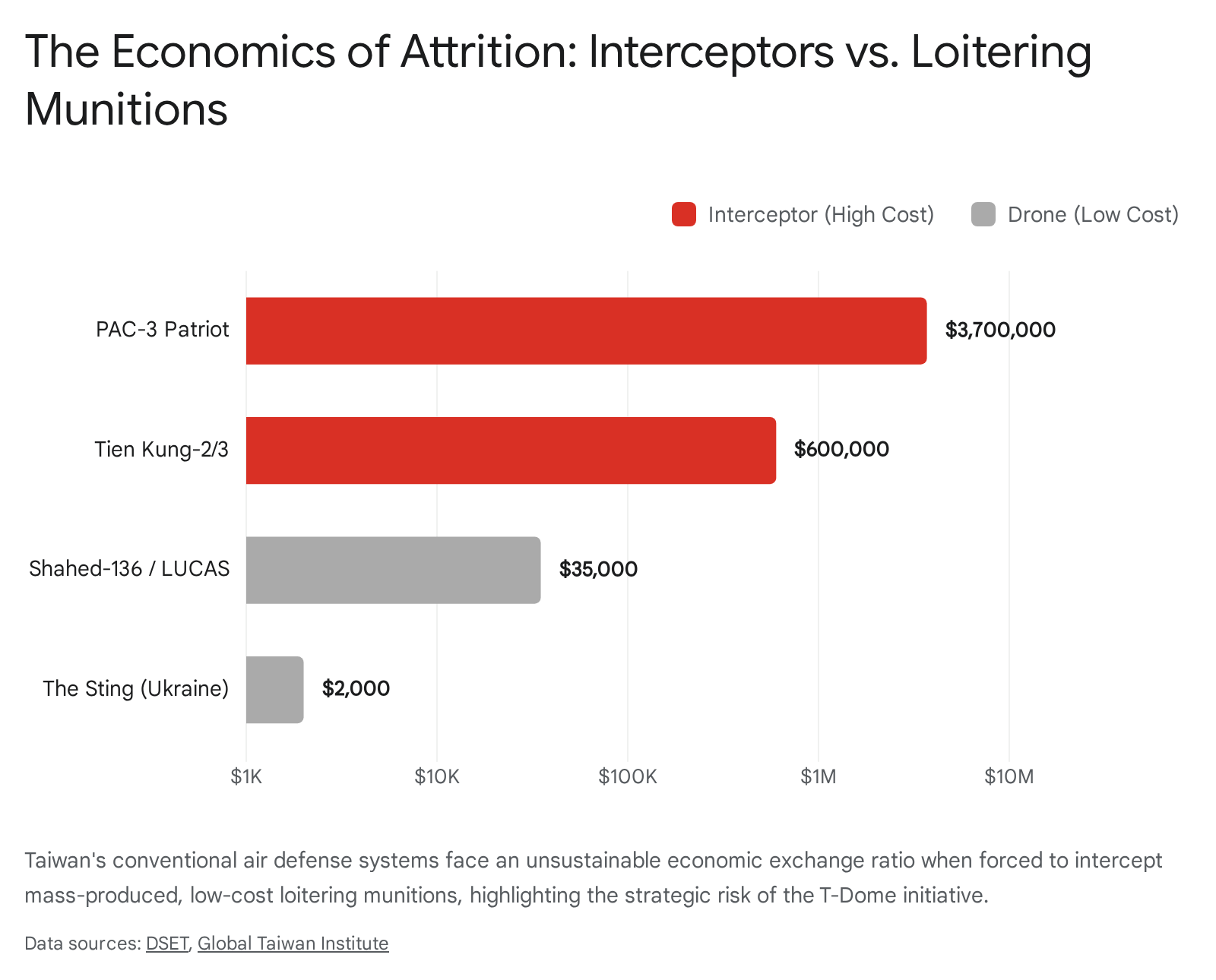
The PRC possesses an estimated 2,000 ballistic missiles and hundreds of land-attack cruise missiles, meaning Taiwan’s stockpile of roughly 500 Patriot missiles could be rapidly depleted by cheap drone swarms. If the PLA utilizes expendable decoy drones to exhaust the T-Dome’s interceptors before launching advanced kinetic strikes, the US$32 billion system will be effectively neutralized. Consequently, analysts argue that while the T-Dome represents a politically reassuring symbol of safety, it diverts critical funding away from the offensive Hellscape drone acquisitions that offer true asymmetric deterrence and cost-benefit rebalancing.[5, 14, 18] Taiwan’s counter-drone (C-UAS) policies remain characterized by highly targeted, albeit limited, procurement, such as the NT$4.35 billion initiative to protect critical military infrastructure and the planned acquisition of 635 portable C-UAS units between 2026 and 2028.17
9. Adversary Capabilities and PLA Countermeasures
The execution of the Hellscape doctrine must account for the reality that the PRC is not a static adversary. The PLA is actively observing the same conflicts in Ukraine and the Middle East and is rapidly developing sophisticated countermeasures to defeat saturated unmanned environments.
The PLAN is a significantly more capable adversary than the Russian naval forces encountered by Ukraine.19 Chinese naval vessels, such as the Type 054A frigates, are heavily armed with advanced point defenses, including the Type 1130 Close-In Weapon Systems (CIWS) capable of firing 11,000 rounds per minute.19 These vessels also deploy 3D air/surface search radars with a 28-kilometer detection range and robust EW jamming arrays designed to sever the command links of incoming USVs.19 Recognizing the asymmetric maritime threat, China has proactively fielded dedicated counter-USV platforms, including the UB1 Sharp Shark 10 and low-profile-optimized YLC-48 radars, ensuring their fleets are better prepared to repel surface attacks.19
Furthermore, China threatens to deploy its own dominant Hellscape against Taiwan. The PLA has developed advanced AI-enabled drone swarms specifically engineered to bypass electronic warfare systems.18 A notable development is the PLA’s “Atlas” drone swarm operations system (Swarm-2), which is capable of deploying 48 drones and coordinating up to 96 autonomous units simultaneously from a single ground vehicle.4 China is also developing minelaying drones to autonomously enforce blockades, disrupting maritime access stealthily.25 Given China’s massive industrial base and expanding magazine depth, a pure quantitative competition in unmanned systems heavily favors Beijing.5
10. Industrial Capacity, Supply Chain Security, and Bureaucratic Friction
The most profound vulnerability in Taiwan’s Hellscape strategy is not tactical or doctrinal, but industrial. Weapons and operational concepts are irrelevant without the manufacturing capacity to field them at scale. Currently, a daunting chasm exists between Taiwan’s drone production capabilities and the minimum threshold required to deter the PLA.4
The Unmanned Production Gap
To execute the Hellscape concept and maintain continuous defensive pressure, Taiwan requires an immense baseline stockpile of strike USVs and UAVs. Using Black Sea benchmarks—which indicate that roughly 10 USVs are required to guarantee a kill on a single defended target—Taiwan would need 1,500 to 5,600 maritime drones just to offset early losses to Chinese missile barrages and effectively degrade an amphibious fleet.19
However, Taiwan’s drone sector currently outputs roughly 10,000 units annually. The government has set an ambitious target to scale Uncrewed Aerial Vehicle (UAV) production capacity to 180,000 units annually by the year 2030, aiming to increase the industry’s value to US$1.24 billion.[4, 21] These targets are supported by the MND’s landmark 2024 tender for 3,422 commercial-grade drones valued at NT$6.8 billion, and a 2025 cross-agency plan to acquire 47,000 UAV units over three years. Despite these initiatives, current production levels fall drastically short of requirements. For context, the Ukrainian defense industry scaled up to producing an estimated 200,000 drones per month (roughly 4.5 million annually) in 2025 to sustain its war effort.4
Supply Chain Security and the “Non-Red” Mandate
Taiwan’s scaling challenges are exacerbated by geopolitical supply chain constraints. Driven by security concerns over supply disruption, espionage, and battlefield vulnerabilities, Taiwan has mandated the creation of a “non-red” supply chain—an industry entirely free of Chinese components.17
While strategically necessary to build a trusted defense ecosystem, this mandate imposes severe economic penalties. China dominates the global commercial drone market; its leading manufacturer, DJI, has held over 78.8 percent of the global market share since 2019.18 China also controls over 70 percent of global lithium-ion battery production and up to 90 percent of the rare-earth processing required for the magnets used in USV propulsion.19 If a blockade were initiated, these inputs would be immediately severed.19 By sourcing “non-red” components, the manufacturing cost of Taiwanese-made drones is currently about 25 percent higher than equivalent Chinese platforms, hindering rapid domestic scale-up.4 Taiwan also relies on allied imports for core components, specifically the “Three Chips, Two Softwares,” and faces bottlenecks due to stringent U.S. export controls on military-grade technology like thermal cameras.4
To circumvent these bottlenecks, Taiwan is actively engaging in “drone diplomacy.” On December 12, 2025, the Taiwan Excellence Drone International Business Opportunities Alliance (Tediboa)—a government-backed group led by Aerospace Industrial Development Corp.—signed a strategic Memorandum of Understanding (MOU) with the Polish Chamber of Unmanned Systems.4 The MOU aims to collaboratively develop secure, non-China supply chains, advocate for favorable market laws, and conduct joint testing.4 Taiwan has also initiated track-two dialogues with the Ukrainian IRON Cluster—a collaborative hub of over 200 drone firms—to leverage their active combat manufacturing expertise.18
Overcoming Bureaucratic Friction
Beyond industrial scaling, the Hellscape strategy faces significant resistance from entrenched military bureaucracy. Historically, the Taiwanese military has viewed drones through a narrow lens, treating them merely as surveillance tools rather than primary strike and denial assets.4 There is currently a lack of a coherent theory of victory that integrates uncrewed systems across air, sea, and land into a unified operational concept.4
To overcome this, defense analysts argue that the Lai administration must institutionalize “Drone Labs”—structured innovation sessions that bring frontline operators, conscripts, and civilian tech experts together to rapidly prototype and refine unmanned tactics, fostering the bottom-up innovation that defined Ukraine’s success.4 Furthermore, the MND must explicitly release an unclassified drone operational concept to signal its resolve to domestic industry partners, ensuring manufacturers design systems that align precisely with the military’s strategic kill chains.4
11. Strategic Conclusions
The defense of Taiwan stands at a critical juncture. The traditional Porcupine Strategy, reliant on expensive, highly vulnerable legacy platforms and the implicit guarantee of American intervention, is rapidly becoming obsolete against a modernized, numerically superior PLA. The proposed Hellscape doctrine—a layered, defense-in-depth architecture driven by tens of thousands of autonomous, attritable systems—represents the most viable asymmetric alternative for securing the island and deterring a forced unification.
Lessons extracted from the Black Sea and the Middle East undeniably validate the tactical efficacy of drone-centric warfare. Ukraine has proven that a nation can establish sea denial against a superior naval force using low-cost USVs, while Iran’s utilization of loitering munitions has demonstrated the devastating economic toll of drone swarms on conventional air defense networks. However, Taiwan’s unique operational environment—characterized by the treacherous hydrology of the Taiwan Strait, highly exposed coastal launch logistics, and an adversary equipped with world-class EW and CIWS capabilities—dictates that foreign playbooks cannot be imported without significant technical and tactical localization.
Ultimately, the success of the Hellscape doctrine does not hinge on technological theory, but on industrial capacity and bureaucratic execution. Taiwan’s political leadership must aggressively redirect defense expenditures away from prestige platforms and legacy air defense projects like the T-Dome, and channel those resources toward the rapid scaling of domestic, “non-red” drone manufacturing. Only by bridging the massive gap between its current 10,000-unit annual production rate and the requirements of total theater saturation can Taiwan hope to establish a credible deterrent. In the absence of such radical structural realignment, the Hellscape remains a conceptual strategy rather than an operational reality, leaving the island dangerously exposed in the closing window before 2027.
Please share the link on Facebook, Forums, with colleagues, etc. Your support is much appreciated and if you have any feedback, please email us in**@*********ps.com. If you’d like to request a report or order a reprint, please click here for the corresponding page to open in new tab.
Sources Used
- The “gray zone” pressure on Taiwan’s outer island chain from drones to maritime incursions, accessed May 26, 2026, http://www.milwaukeeindependent.com/explainers/gray-zone-pressure-taiwans-outer-island-chain-drones-maritime-incursions/
- Hellscape Defense in Taiwan: Would It Work? – Modern War Institute, accessed May 26, 2026, https://mwi.westpoint.edu/hellscape-defense-in-taiwan-would-it-work/
- Shrinking the Strait: How Drone Warfare and Hybrid Tactics are Erasing Taiwan’s Strategic Depth, accessed May 26, 2026, https://globaltaiwan.org/2026/01/shrinking-the-strait/
- Hellscape Taiwan: A Porcupine Defense in the Drone Age, accessed May 26, 2026, https://warontherocks.com/hellscape-taiwan-a-porcupine-defense-in-the-drone-age/
- The Perfect Swarm: Taiwan’s T-Dome in the Era of Drone Warfare – Small Wars Journal, accessed May 26, 2026, https://smallwarsjournal.com/2026/03/17/taiwan-t-dome-drone-warfare/
- Hellscape for Taiwan – CNAS, accessed May 26, 2026, https://www.cnas.org/publications/reports/hellscape-for-taiwan
- Lai’s US$40bn defense budget to center on T-Dome: Lin – Taipei Times, accessed May 26, 2026, https://www.taipeitimes.com/News/taiwan/archives/2025/11/26/2003847877
- U.S. Plan To Unleash ‘Hellscape’ in Taiwan Strait if China Attacks – YouTube, accessed May 26, 2026, https://www.youtube.com/watch?v=TlSZS3wcSbI
- Unmanned Vehicle “Hellscape” Will Play a Crucial Role in the Defense of Taiwan, accessed May 26, 2026, https://www.americansecurityproject.org/unmanned-vehicle-hellscape-will-play-a-crucial-role-in-the-defense-of-taiwan/
- NATO needs a ‘hellscape’ defense at ‘Replicator’ speed – Atlantic Council, accessed May 26, 2026, https://www.atlanticcouncil.org/in-depth-research-reports/report/nato-needs-a-hellscape-defense-at-replicator-speed/
- The Pentagon Is Planning a Drone ‘Hellscape’ to Defend Taiwan : r/geopolitics – Reddit, accessed May 26, 2026, https://www.reddit.com/r/geopolitics/comments/1evyhs2/the_pentagon_is_planning_a_drone_hellscape_to/
- Rethinking Denial: The People’s Liberation Army’s Laser Systems and the Future Challenges, accessed May 26, 2026, https://innovation.army.mil/News/Article-View/Article/4029077/rethinking-denial-the-peoples-liberation-armys-laser-systems-and-the-future-cha/
- Delay, Disrupt, Degrade: Mine Warfare in Taiwan’s Porcupine Defense – War on the Rocks, accessed May 26, 2026, https://warontherocks.com/delay-disrupt-degrade-mine-warfare-in-taiwans-porcupine-defense/
- Report Calls for Taiwan to Build Drone-Based “Hellscape” to Deter Chinese Invasion, accessed May 26, 2026, https://www.hstoday.us/subject-matter-areas/unmanned-vehicles/report-calls-for-taiwan-to-build-drone-based-hellscape-to-deter-chinese-invasion/
- The Autonomous Arsenal in Defense of Taiwan: Technology, Law, and Policy of the Replicator Initiative | The Belfer Center for Science and International Affairs, accessed May 26, 2026, https://www.belfercenter.org/replicator-autonomous-weapons-taiwan
- A Defense of Taiwan with Ukrainian Characteristics: Lessons from the war in Ukraine for the Western Pacific | ISW, accessed May 26, 2026, https://understandingwar.org/research/russia-ukraine/a-defense-of-taiwan-with-ukrainian-characteristics-lessons-from-the-war-in-ukraine-for-the-western-pacific/
- [DSET Drone Newsletter] Taiwan’s Lessons from U.S.-Iran Shahed …, accessed May 26, 2026, https://dset.tw/en/research/newsletter7-eng/
- A Cost Too High to Protect the Sky? Lessons for Taiwan from the …, accessed May 26, 2026, https://globaltaiwan.org/2026/05/a-cost-too-high-to-protect-the-sky/
- Ukraine’s Naval Drone Warfare Playbook Applied to The Taiwan …, accessed May 26, 2026, https://www.sofx.com/ukraines-naval-drone-warfare-playbook-applied-to-the-taiwan-strait/
- The “Hellscape” Strategy • US Military Defending the Taiwan Strait – YouTube, accessed May 26, 2026, https://www.youtube.com/watch?v=XyoIz2ahzQ0
- Taiwan, Partners Work To Develop Self-Reliant Drone Ecosystem, accessed May 26, 2026, https://www.eurasiareview.com/24052026-taiwan-partners-work-to-develop-self-reliant-drone-ecosystem/
- Tough Lessons for Taiwan From Iran – Domino Theory, accessed May 26, 2026, https://dominotheory.com/tough-lessons-for-taiwan-from-iran/
- T-Dome – Wikipedia, accessed May 26, 2026, https://en.wikipedia.org/wiki/T-Dome
- to enhance Taiwan’s multi-layer air defense capabilities – OCAC.R.O.C.(TAIWAN) – News, accessed May 26, 2026, https://www.ocac.gov.tw/OCAC/Pages/Detail.aspx?nodeid=329&pid=80273032
- China’s drone-laid mines aim to trap US in a Taiwan war – Asia Times, accessed May 26, 2026, https://asiatimes.com/2026/04/chinas-drone-laid-mines-aim-to-trap-us-in-a-taiwan-war/