1. Executive Summary
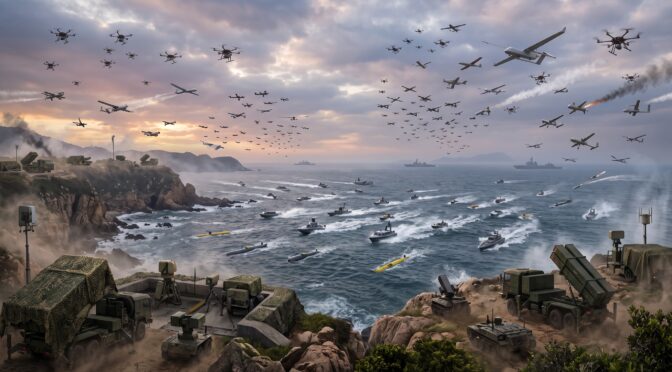
The geopolitical calculus in the Indo-Pacific theater is currently undergoing a rapid and profound paradigm shift, driven by the unprecedented convergence of autonomous systems, artificial intelligence, and asymmetric military doctrine. At the epicenter of this strategic transformation is the “Hellscape” strategy, a conceptual warfare framework initially articulated in 2024 by Admiral Samuel Paparo, Commander of the U.S. Indo-Pacific Command (INDOPACOM). The strategy envisions transforming the 180-kilometer Taiwan Strait into a saturated, highly lethal, multi-domain gauntlet of tens of thousands of uncrewed surface, sub-surface, and aerial systems in the event of an amphibious invasion by the People’s Republic of China (PRC).1
Designed fundamentally as an asymmetric delaying action, the American iteration of the Hellscape aims to make a cross-strait invasion “utterly miserable for a month,” thereby securing the critical temporal window required for U.S. and allied forces—such as Marine Littoral Regiments, Army Multi-Domain Task Forces, and Navy Carrier Strike Groups—to mobilize and transit into the contested theater.1 Simultaneously, defense analysts and regional strategists have proposed a localized, Taiwanese adaptation of the Hellscape, transitioning the island’s longstanding but historically under-implemented “porcupine strategy” into the modern drone age. This localized approach heavily favors high-volume, short-range, and entirely expendable tactical drones aimed at defeating the People’s Liberation Army (PLA) precisely at the water’s edge, thereby shifting the burden of defense from delayed external rescue to immediate internal denial.2
The necessity for this comprehensive strategic overhaul stems from profound geographic and industrial realities that currently disadvantage traditional force structures. The PLA Navy (PLAN) currently enjoys a numerical superiority in active warships compared to the U.S. Navy, compounded by significant geographic advantages and a severely constrained U.S. shipbuilding industrial base that cannot replace multi-billion-dollar vessels at a pace commensurate with modern high-intensity conflict.4 To counteract this mass, the U.S. Department of Defense launched the Replicator initiative, an accelerated acquisition mechanism intended to rapidly field All-Domain Attritable Autonomous (ADA2) systems at a scale of multiple thousands.5
However, the Hellscape strategy is not without critical vulnerabilities, and its realization is far from guaranteed. Operational implementation requires overcoming severe political, organizational, and industrial hurdles within Taiwan, including a deeply ingrained military culture that favors expensive “prestige” platforms over attritable systems.2 Furthermore, the PLA is not a static adversary; it is actively developing a robust, multi-layered counter-swarm architecture. Recognizing the logistical and economic limitations of traditional kinetic interceptors, Chinese defense research is aggressively advancing Directed Energy Weapons (DEWs), including high-power microwave (HPM) systems and scalable tactical lasers, designed specifically to neutralize autonomous swarms at the speed of light.8 Alternatively, Beijing may choose to bypass the Hellscape entirely through a quarantine or blockade strategy, leveraging economic coercion and long-range missile barrages to achieve capitulation without ever triggering the amphibious bloodbath the Hellscape is designed to repel.10
This report provides a highly granular, nuanced examination of the Hellscape strategy, detailing its multi-domain operational architecture, the specific technological capabilities underpinning it, its strategic strengths and institutional limitations, and the adversarial countermeasures shaping the future of autonomous warfare in the Taiwan Strait.
2. Strategic Imperatives and the Evolution of Cross-Strait Deterrence
The conceptualization and rapid institutional backing of the Hellscape strategy are direct responses to a steadily deteriorating conventional military balance in the Western Pacific, coupled with the uncompromising strategic constraints imposed by physical geography and defense industrial capacity.
2.1 The Tyranny of Distance and the Naval Imbalance
The Taiwan Strait, measuring approximately 180 kilometers (100 miles) wide, has historically served as the ultimate guarantor of Taiwan’s security—both a defensive moat for Taipei and a treacherous logistical chokepoint for any invading force.7 However, in the era of modern precision strike and hypersonic glide vehicles, this geography heavily favors the PRC in a rapid escalation scenario. U.S. naval assets, particularly Carrier Strike Groups that remain heavily dependent on distant regional basing architectures, face a significant “tyranny of distance” that severely complicates rapid force projection.7 By the time forward-deployed American vessels navigate from Hawaii or distant allied ports to the South China Sea or the Philippine Sea in response to a sudden invasion, a rapid Chinese amphibious assault could already be securing vital beachheads and rolling over coastal defenses.4
This geographic disadvantage is exponentially exacerbated by current global shipbuilding metrics and industrial realities. The PLAN has systematically achieved a numerical advantage, currently boasting 234 active warships compared to the U.S. Navy’s 219.4 While the United States retains an overarching superiority in total fleet tonnage and specific advanced capabilities (such as guided-missile cruisers and destroyers), the PLAN has largely circumvented the supply chain friction and labor shortages currently plaguing the American defense industrial base.4 Current data indicates a staggering 11-year delay for U.S. shipbuilding capacity; for example, DDG-51 Arleigh Burke-class destroyers require approximately four years to build, with costs escalating to an estimated $2.5 billion per vessel.4 Relying on multi-billion-dollar exquisite platforms to intercept high volumes of inbound, low-cost threats is fiscally and operationally unsustainable in a protracted conflict. The mathematical reality of modern peer-to-peer conflict demands a shift away from singular, expensive assets toward distributed, attritable mass.
2.2 The Evolution of the Porcupine Strategy
For over two decades, Western defense analysts and forward-thinking Taiwanese strategists have advocated for the adoption of a “porcupine strategy”—an asymmetric defense posture relying on large numbers of mobile, hard-to-target weapons like coastal defense cruise missiles, smart sea mines, and fast attack missile boats to make the island indigestible to a larger aggressor.2 The core theory dictates that rather than attempting to match the PLA ship-for-ship or fighter-for-fighter, Taiwan should exploit its unique geographic advantages, which include a 170-kilometer strait, highly restricted landing beaches, mountainous jungles, and dense urban terrain that naturally favor a determined defender.2
Despite formally adopting this asymmetric doctrine in theory, practical implementation by Taiwan’s Ministry of National Defense (MND) has severely lagged. The military apparatus has historically remained wedded to the acquisition of prestige platforms. Current procurement emphasizes fourth-generation F-16 fighter jets, aging Mirage 2000s, and an indigenously developed diesel-electric submarine program costing upwards of $16 billion.2 In a high-intensity, saturation-strike conflict with the PLA, these high-signature, runway-dependent assets possess incredibly low survivability and offer minimal return on investment once hostilities commence.2 Furthermore, Taiwan’s current iteration of the porcupine strategy relies heavily on highly expensive, conventional anti-ship weapons (like the Harpoon missile) that simply cannot be procured in large enough quantities to mathematically match the PLA’s overwhelming numerical superiority in landing craft and escort vessels.2
2.3 The Catalyst of Modern Conflict
The war in Ukraine provided a real-time, undeniable catalyst for reevaluating this stagnant defense posture. The highly successful deployment of cheap, commercially derived drone technology to stall, degrade, and destroy conventional Russian armored columns and Black Sea naval assets demonstrated definitively that uncrewed systems could offset immense numerical and conventional disadvantages at a fraction of the traditional cost.3 The Hellscape strategy, therefore, effectively acts as “Porcupine 2.0.” It substitutes the insufficient stockpiles of expensive anti-ship missiles with hundreds of thousands of autonomous, attritable systems to create an impenetrable, multi-domain defense in depth that scales affordably and operates with absolute lethality.2
Furthermore, the urgency for this shift was highlighted during the Fourth Taiwan Strait Crisis following Speaker Nancy Pelosi’s visit in August 2022. During this period, the PLA established military drill zones surrounding the island and, notably, began sending unmanned aerial vehicles (UAVs) over Taiwan’s Dongyin Island—a well-defended outpost in the Matsu Islands.13 This marked a definitive shift in Chinese tactics, utilizing drone incursions not just for intelligence, but to psychologically shrink the operational geography around Taiwan, proving that the strait itself is no longer an absolute barrier.11 The Hellscape is the required technological and doctrinal response to this evaporating geographic moat.
3. The U.S. INDOPACOM Hellscape vs. The Taiwanese Operational Concept
While the term “Hellscape” is utilized broadly, there exists a critical doctrinal divergence between how the United States military envisions the strategy and how it must be adapted for Taiwanese self-defense.
3.1 The American Strategic Delay
Admiral Paparo’s vision for the INDOPACOM Hellscape is fundamentally an American operational concept heavily reliant on long-range, relatively expensive, and highly sophisticated autonomous systems launched from distant regional bases outside the First Island Chain.2 The objective of the American Hellscape is strategic delay. By flooding the Taiwan Strait with massive numbers of uncrewed ships, aircraft, and submarines, the U.S. intends to execute an asymmetric delaying action that makes the crossing “utterly miserable for a month”.1
This high-end, frustrating disruption is not necessarily designed to single-handedly destroy the entire PLA, but rather to buy the critical temporal window required for the U.S. and its allies to establish logistics, transit major combat forces, and deploy forward-based units in the Western Pacific.1 It assumes a scenario where the U.S. intervenes militarily, utilizing the drone swarm as a vanguard to bleed the enemy while the heavy armor and carrier groups move into position.
3.2 The Taiwanese Strategy of Denial
Conversely, defense experts—such as those authoring the(https://www.cnas.org/publications/reports/hellscape-for-taiwan) report—argue that Taiwan cannot rely on the assumption of delayed American rescue, particularly given the shifting winds of U.S. political strategy and the long-held policy of strategic ambiguity.3 Therefore, Hellscape must be localized as a strictly Taiwanese operational concept for immediate self-defense.
Taiwan is geographically positioned to employ high volumes of cheap, short-range, and highly expendable drones that have proven so decisive in Eastern Europe.2 The localized Hellscape concept seeks to deny Beijing its military objective of forced unification entirely, stopping the invasion at the water’s edge without requiring external naval intervention.3 By making the amphibious assault prohibitively costly and dangerously unpredictable through an autonomous gauntlet, Taiwan aims to generate a state of “deterrence by denial,” convincing the CCP that the military objective is physically unattainable, thereby preventing the invasion from launching in the first place.2
4. Operational Architecture: The Four-Layered Gauntlet
The operational execution of the Hellscape strategy relies on deliberately dividing the geographic reality of the 180-kilometer Taiwan Strait into a series of highly lethal, spatially defined layers. This all-domain gauntlet is carefully structured to inflict cascading, exponential attrition on the PLA’s amphibious invasion fleet, systematically dismantling the highly choreographed logistics, air cover, and sealift capacity required for a successful beach landing.2 The spatial mapping of this defense divides the strait into four distinct kill zones, escalating in density and intensity as the invading force approaches the shoreline.
4.1 Tier 1: The Over-the-Horizon Outer Layer (80 km to 40 km offshore)
The engagement strictly begins as the PLA fleet traverses the median line of the Taiwan Strait, entering the outer layer roughly 80 kilometers from the Taiwanese coast and extending inward to 40 kilometers.3 In this Tier 1 zone, Taiwan floods the maritime and aerial battlespace with long-range kamikaze drones, aerial decoys, anti-ship cruise missiles, armed Uncrewed Surface Vessels (USVs), and covert Uncrewed Underwater Vehicles (UUVs).2
The primary objective in this outer layer is not the total annihilation of the fleet, but the generation of massive chaos and the absolute disruption of the PLA’s invasion timetable. Below the surface, UUVs wait on the seabed to detonate against heavy troop transports, while surface drone boats aggressively ram hulls and launch loitering munitions directly at radar installations.2 Concurrently, waves of cheap aerial decoys are utilized to force PLA air defense destroyers to exhaust their finite stockpiles of expensive surface-to-air interceptors.2
A critical factor in Tier 1 is the electromagnetic environment. The battlespace will be subjected to intense Chinese electronic warfare (EW) and communications jamming. Therefore, autonomous weapons deployed here are pre-programmed to strike any vessel exhibiting a specific physical or thermal signature within designated “kill boxes,” completely severing their reliance on fragile long-range communication networks or GPS.2 To enable these strikes and protect the launch platforms, Taiwanese mobile surface-to-air missile (SAM) batteries utilize highly aggressive “shoot-and-scoot” tactics. This denies the PLA air superiority and selectively engages Chinese combat aircraft, creating brief operational windows during which ground teams can emerge from hardened hides to launch drone salvos without fear of immediate aerial reprisal.2
4.2 Tier 2: The Muddy Middle Layer (40 km to 5 km offshore)
As surviving vessels push through the chaos and close the distance, they enter the middle layer (spanning a 35-kilometer zone from 40 kilometers down to 5 kilometers offshore), which focuses explicitly on sinking the specific platforms required for the actual landing: amphibious landing craft, air-cushioned hovercraft, and troop transport helicopters.3 The foundation of this tier relies heavily on dense, continuously reseeded sea minefields laid by autonomous platforms.2
The sea mines serve a dual tactical purpose: they inflict direct, catastrophic hull damage and simultaneously canalize the Chinese fleet, forcing the landing craft out of wide formations and into predictable, narrow transit lanes.7 Once funneled into these maritime kill zones, the constrained vessels are targeted by coordinated, high-volume salvos of medium-range attack drones and loitering munitions.7 Overhead, Taiwan deploys loitering SAMs—conceptually akin to the Iranian 358 missile design—which function as persistent “aerial minefields.” These slow-moving, autonomous interceptors patrol the airspace specifically to destroy incoming transport helicopters and force Chinese fighter escorts to clear the area, stripping the amphibious fleet of its vital close air support and vertical envelopment capabilities.2
4.3 Tier 3: The Final Run to the Shore (Within 5 km)
The combat geometry compresses significantly in the third layer, as Chinese landing craft finally enter visual range of the Taiwanese coast. The time required to cross this final five-kilometer stretch is approximately ten minutes, during which the density and intensity of the cross-domain fires reach their absolute peak.2
Taiwanese ground-based defensive strike teams emerge to launch First-Person View (FPV) drones, short-range anti-ship missiles, and laser-guided rockets directly into the incoming formations.2 Recognizing that PLA electronic warfare and jamming efforts will be most intense near the shoreline to protect the disembarking infantry, defensive drones in this tier rely entirely on simple autonomous terminal guidance. Utilizing pixel-lock technology—extensively combat-proven in the Ukraine conflict—these drones can visually lock onto the physical signature of a landing craft and strike it automatically, even if the radio control link to the human operator on the beach is entirely severed.2
4.4 Tier 4: The Beach Landing Layer
Any PLA forces that miraculously survive the three-ring maritime gauntlet will arrive at the beachhead scattered, disorganized, highly degraded, and largely devoid of their heavy armor and critical engineering equipment.2 The final defensive tier replaces traditional static artillery lines with an impenetrable “FPV drone wall”.7
Dense, pre-laid minefields block all viable beach exits, physically pinning the surviving infantry in place on the exposed sand. Overhead, multi-rotor drone bombers and kamikaze drones systematically eliminate the remaining forces.2 Furthermore, the accumulation of wrecked and burning landing craft in the shallows serves as an unintentional, compounding obstacle. These wrecks physically choke the narrow beach approaches, depriving the PLA of the vital sealift capacity and clear water required to execute follow-on reinforcement crossings, effectively ending the invasion logistics at the shoreline.2
5. Autonomous Platforms and the Replicator Initiative
The realization of the Hellscape requires a vast, interoperable, and highly resilient ecosystem of multi-domain platforms. While Taiwan is tasked with reforming its industrial base to scale the domestic production of short-range systems, the U.S. military is rapidly procuring advanced autonomous assets through the Department of Defense’s Replicator initiative.9 Announced in August 2023 by former Deputy Secretary of Defense Kathleen Hicks, Replicator 1 aimed to field multiple thousands of All-Domain Attritable Autonomous (ADA2) systems within an aggressive 18 to 24-month timeframe (by August 2025) to specifically counter China’s military mass.5 Managed by the Defense Innovation Unit (DIU) under Deputy Director Aditi Kumar, the initiative bypasses traditional, sluggish acquisition programs to field commercial partnerships rapidly.6 However, subsequent assessments in late 2025 revealed an operational shortfall; while the initiative successfully delivered hundreds of uncrewed systems to end users on an accelerated schedule, it ultimately failed to meet the original goal of fielding “multiple thousands” of systems before the deadline.14
5.1 Aerial Assets: Precision, Endurance, and Lethality
A centerpiece of the Replicator portfolio and the airborne Hellscape is the AeroVironment Switchblade 600. Selected as a primary loitering munition, this extended-range kamikaze drone is equipped with high-resolution electro-optical/infrared (EO/IR) gimbaled sensors and an anti-armor warhead specifically designed to engage hardened targets.17
| Specification | Switchblade 300 (Block 20) | Switchblade 600 |
| Primary Target | Personnel / Soft Targets | Armored Vehicles / Hardened Targets |
| Operational Range | 10 km (6.2 mi) | 40+ km (25 mi) baseline; 90+ km (55+ mi) w/ forward pass 18 |
| Loitering Endurance | 20+ minutes | 40+ minutes 18 |
| Cruise / Sprint Speed | 63 mph / 100 mph | 70 mph / 115 mph 18 |
| System Weight | 7.2 lbs (All-Up Round) | 65 lbs (All-Up Round) 18 |
| Key Features | Tube-launched, man-portable | Wave-off/recommit capability, encrypted C2, 10-minute setup 18 |
The Switchblade 600’s patented wave-off and recommit capability allows operators to abort a strike mid-flight and re-engage if the battlespace dynamics shift, while encrypted control links provide resilient navigation against electronic countermeasures.18 Other selected aerial platforms confirmed under Replicator 1 include the Anduril Altius-600 and Ghost-X, alongside the Performance Drone Works C-100.6
To provide the overarching situational awareness required to direct these attritable swarms, the U.S. Navy relies on High-Altitude Long Endurance (HALE) platforms. The MQ-4C Triton operates persistently above 50,000 feet, boasting a 7,400 nautical mile range and integrating directly into the Navy’s Maritime Patrol and Reconnaissance Force, networking target data down to the Hellscape assets below.1
5.2 Maritime Surface and Sub-Surface Platforms
To threaten the PLAN at the water level, the U.S. has integrated highly autonomous Uncrewed Surface Vessels (USVs). Notable among these is the MARTAC Muskie M18, an 18-foot attritable attack drone designed exclusively for high-speed, asymmetric one-way missions. Capable of burst speeds exceeding 50 knots and possessing an open-ocean cruising range of up to 500 nautical miles, the M18 carries a devastating 1,000-pound kinetic payload.1 Designed for rapid logistics, these vessels can be easily transported inside standard 20-foot CONEX boxes and prepositioned via C-130 or C-17 cargo aircraft.1 Crucially, the M18 features advanced swarming autonomy via the MantaFleet system, allowing multiple vessels to coordinate attacks with significantly reduced human oversight.1 To further bolster this maritime capability, the U.S. Navy awarded a large Production Other Transaction (OT) contract in May 2025 to rapidly equip the fleet—specifically Unmanned Surface Vessel Squadron Seven (USVRON-7)—with “sUSV Next” vessels designed for complex manned-unmanned teaming (MUM-T) and maritime domain operations.
For persistent intelligence gathering in GPS-denied or highly contested environments, platforms like the Saildrone Surveyor SD-3000 act as forward observers. This massive 20-meter, 15-ton USV uses wind and solar power for extreme endurance, employing sensor fusion (radar, optical cameras, and machine learning) to detect “dark” vessels that are not actively transmitting Automatic Identification System (AIS) coordinates.1
Below the surface, the Navy is rapidly advancing Unmanned Underwater Vehicles (UUVs). The REMUS medium UUV (and its Razorback variant) can now be covertly launched and recovered directly from the torpedo tubes of Virginia-class fast-attack submarines. This is facilitated by specialized Shock and Fire Enclosure Capsules (SAFECAP) developed by HII, which safely manage the UUV’s lithium-ion batteries and protect the submarine crew during deployment, allowing for stealthy undersea mining and reconnaissance operations deep within the Hellscape.1
5.3 Command and Control (C2) Integration: The Software Backbone
Deploying thousands of isolated, uncommunicative drones does not constitute a Hellscape; it merely creates target practice. These systems must be networked into a cohesive, lethal web. The U.S. Navy addresses this colossal command and control challenge through Project Overmatch, its specific contribution to the Joint All-Domain Command and Control (JADC2) framework.1
A critical component of this C2 architecture is the software developed by defense contractors like EpiSci. Their TacticalAI software provides a domain- and hardware-agnostic mission autonomy application.1 This software enables heterogeneous swarms of UAVs and USVs from vastly different manufacturers to seamlessly collaborate, share sensor telemetry, and execute joint automated engagement plans with minimal human intervention, ensuring the swarm acts as a unified organism rather than a collection of disparate assets.1 Powering this persistent network at sea requires innovative logistics, such as utilizing Ocean Power Technologies’ PB3 PowerBuoys, which can be deployed to securely transfer data and physically recharge USVs and UUVs in the open ocean.1
6. Systemic Vulnerabilities and Taiwanese Institutional Friction
Despite its operational brilliance and strategic logic, the practical implementation of the Hellscape strategy faces profound organizational, industrial, and societal hurdles, particularly within the domestic structures of Taiwan.
6.1 The Organizational Challenge: Culture and Procurement Deficits
Transitioning a traditional military to a drone-centric asymmetric defense requires a fundamental, often painful restructuring of Taiwan’s military culture. Historically, state militaries acquire large, traditional assets to project state sovereignty, secure international recognition, and satisfy institutional pride.7 A strategy reliant on tens of thousands of expendable plastic drones forces the Republic of China (ROC) Armed Forces to sacrifice the acquisition of prestige systems, a shift deeply resisted by entrenched institutional leadership.2
Currently, Taiwan is drastically under-equipped for a Hellscape scenario. Beyond the lack of advanced anti-ship missiles, the military possesses fewer than fifty Medium-Altitude Long-Endurance (MALE) drones and a meager four dedicated minelayers.7 To achieve the density required for the Hellscape, Taiwan requires an estimated inventory of 180,000 drone units by 2028.2 However, its current domestic output sits at roughly 10,000 units annually.2 While President Lai Ching-te’s administration has encouraged domestic commercial drone production, the industrial base is severely hampered by high manufacturing costs stemming from the strict necessity to avoid PRC-reliant supply chains—forcing reliance on a nascent, often more expensive “non-red” global drone alliance.2
6.2 The Garrison State Dilemma and Public Will
The Hellscape strategy essentially accepts a grim reality: that major kinetic conflict will occur directly on Taiwan’s shores. If the PLA manages to breach the robotic layers and establish a beachhead, the defense of Taipei devolves into an urban insurgency leveraging the island’s mountainous passes and dense city sprawl.7 Proponents often point to Ukraine as a successful model of this asymmetric defense, but the resulting reality in Eastern Europe is a protracted, highly destructive war of attrition that has left over 30% of Ukrainian territory severely damaged or occupied.3
For the Taiwanese electorate, which only recently emerged from decades of martial law, the prospect of transforming their liberal democracy into a highly militarized, Cold War-style “garrison state” is politically unpalatable.7 Preparing for a Hellscape requires hardening passive defenses, establishing city-based trenches, and mobilizing vast numbers of civilians to handle short-range drones. Furthermore, deep political polarization between the Democratic Progressive Party (DPP) and the Kuomintang (KMT) prevents cohesive legislative consensus on defense approaches, with some factions actively proposing to freeze counter-drone funding.7
Crucially, sociological research indicates that the Taiwanese public’s willingness to fight is closely correlated with their confidence in traditional, visible military capabilities. Divesting from visible prestige platforms like fighter jets and destroyers in favor of a decentralized drone insurgency—especially if perceived as a cheap substitute for direct U.S. intervention—could paradoxically collapse public morale and the national will to mount a resistance.7
7. Adversarial Countermeasures: The PLA’s Anti-Swarm Architecture
The Hellscape strategy does not exist in a vacuum; the PLA is an adaptive, learning adversary. Watching the rapid proliferation of drones in Ukraine, the Chinese military establishment is acutely aware of the threat posed by autonomous swarms and is rapidly developing countermeasures designed to dismantle the Hellscape before it can be effectively deployed.24 The rapid innovation cycle has spurred China to aggressively integrate counter-UAS (C-UAS) systems into its operational doctrine across all theater commands.24
7.1 The Limitations of Kinetic and Electronic Interception
The PLA currently fields highly capable conventional air defenses, such as the HQ-17 Surface-to-Air Missile and the PGZ-95 Self-Propelled Antiaircraft Artillery (AAA). However, these systems present notable limitations against the highly autonomous, massive swarms envisioned by the Hellscape.9 Primarily, they are incredibly uneconomical; utilizing a multi-million-dollar missile to shoot down a $2,000 drone means ammunition stocks would be rapidly depleted long before the swarm is neutralized.9 Furthermore, a 2024 PLA training exercise demonstrated that their AAA systems achieved only a 40% damage rate against drone swarms, highlighting the severe inefficiency of kinetic projectiles against saturation attacks.26
The PLA also employs passive countermeasures, such as armored vehicle smoke screens fired from the ZBD-05 Amphibious Assault Vehicle. These create atmospheric obscuration to degrade the optical targeting of incoming UAVs. However, this method is highly unsustainable against large, continuous swarms, as the smoke munitions are finite and dissipate rapidly in the open maritime environment.9
Similarly, while Chinese electronic warfare jammers (like the vehicle-mounted JN1101 or man-portable jamming rifles) are versatile, they rely heavily on disrupting external signals.9 As U.S. and Taiwanese drones become fully autonomous—relying on pixel-lock terminal guidance rather than GPS or RF operator links—the efficacy of standard jamming is projected to degrade.2 However, it is crucial to note that against current-generation threats, dedicated jammers like the JN1101 have demonstrated extremely high reliability, often drastically outperforming their directed-energy counterparts in austere environments. Other tactical experiments, such as deploying counter-swarms (using the CH-901 loitering munition) or aerial net interception systems (like the Tianwang No. 1), remain nascent, limited in supply, and entirely unsuited for stopping high-speed, massed targets.9
7.2 The Directed Energy Revolution: HPM and Lasers
Recognizing the mathematical impossibility of defeating swarms with kinetics, the PLA is pivoting heavily toward Directed Energy Weapons (DEWs). DEWs theoretically offer a “deep magazine,” firing at the speed of light at a cost of pennies per engagement, limited only by the platform’s onboard power generation and thermal cooling capacity.27
High-Power Microwave (HPM) Systems: Unlike lasers or bullets, which must target individual drones sequentially, HPM weapons emit a wide, arcing burst of concentrated electromagnetic energy. This energy pulse physically damages or destroys semiconductor circuitry across a broad spatial area, causing multiple drones to drop from the sky simultaneously without requiring precise individual tracking.28 The PLA has prominently unveiled the Hurricane-3000, a highly mobile, truck-mounted HPM system developed by the China South Industries Group Corporation (CSGC) and marketed by NORINCO. Showcased at the 2024 Zhuhai Airshow and the 2025 China Victory Day Parade, the system utilizes gallium nitride (GaN) materials and boasts a rated power of 2,000 to 3,500 megawatts, generating an effective microwave damage range of 3 kilometers and a radar detection range of 6 kilometers. Featuring an advanced AI engine for autonomous target prioritization, this system automatically identifies the most dangerous clusters within a swarm and adjusts its pulse frequencies to bypass enemy electronic hardening, providing a highly lethal “soft-kill” solution with zero physical debris or collateral damage.8
Tactical Laser Systems: For precision “hard-kills,” the China Aerospace Science and Industry Corporation (CASIC) has developed highly mobile laser defense systems like the LW-30 (30 kW) and LW-60 (60 kW).9 Additionally, the Poly Technologies Silent Hunter—a 30 kW fiber-optic laser—has been exported and utilized internationally by Saudi Arabia to counter Houthi attack drones.9 The PLA’s research trajectory focuses heavily on laser power scaling to achieve outputs exceeding 100 kW, enabling the physical destruction of heavily hardened targets.9
Real-World Operational Limitations: While often touted by manufacturers as flawless, real-world deployments of these laser systems have revealed severe operational limitations. Reports from operators during the Saudi Arabian deployment of the Silent Hunter showed that the system struggled massively in austere environments. Sand and dust severely disrupted optical tracking and caused physical abrasion to the lenses, while high desert heat forced the system to divert critical power away from the laser and into its cooling mechanisms. Consequently, operators reported that it sometimes took 15 to 30 minutes of continuous laser illumination to guarantee a single drone kill, rendering the laser virtually useless against a fast-moving, high-volume swarm. Despite these limitations, the system’s proliferation continues; in 2025, the Silent Hunter was observed being utilized by Russian forces during the invasion of Ukraine. Furthermore, the extraordinarily rapid development of China’s HPM capabilities has raised concerns among Western analysts regarding potential knowledge sharing and technological acceleration between Beijing and Moscow.33
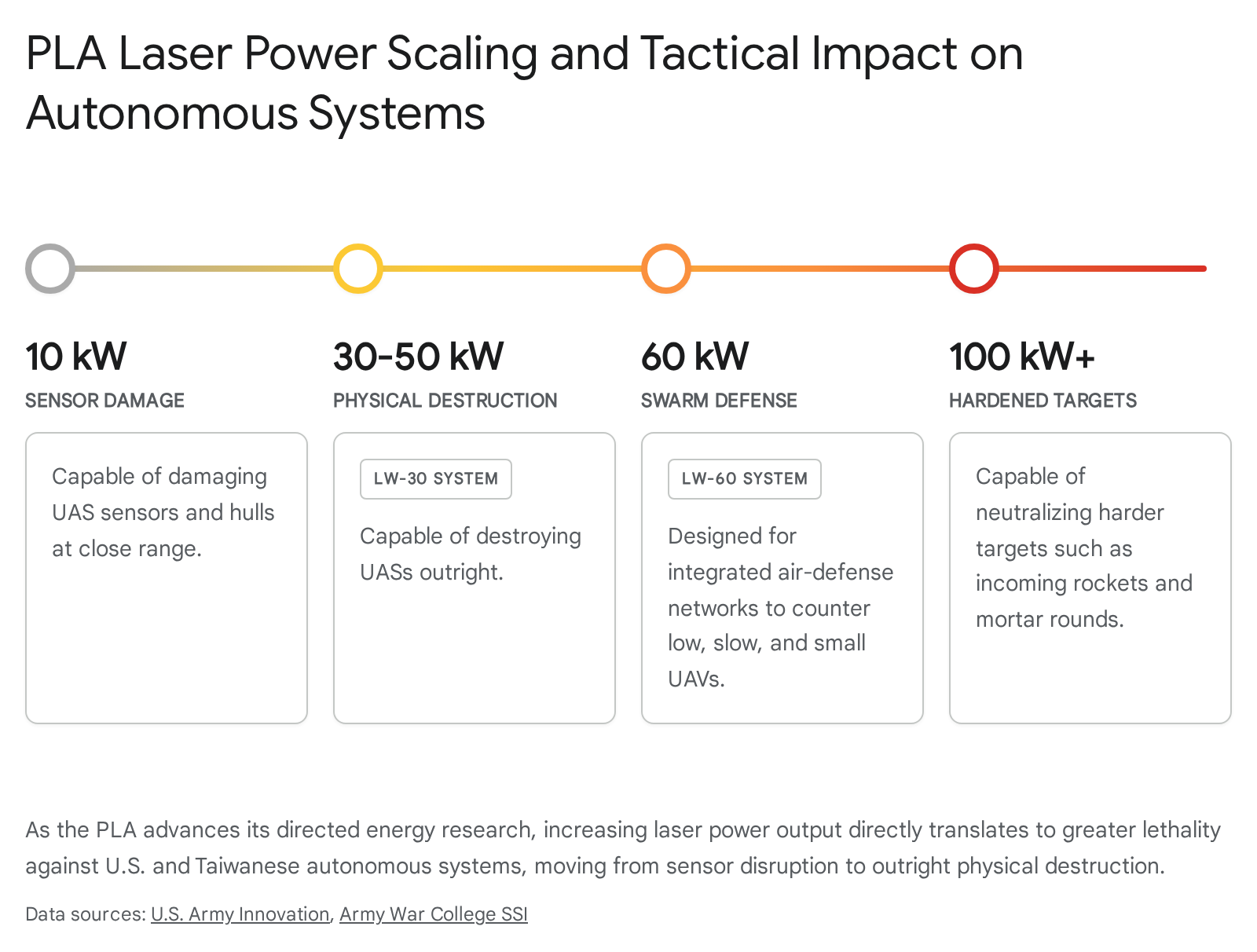
Table 1: Comprehensive Comparison of PLA Counter-UAS Capabilities
| System Type | Specific Platforms | Tactical Strengths | Vulnerabilities against Hellscape Swarms |
| High-Power Microwave (HPM) | Hurricane-3000 | Wide-area soft kill, simultaneous multi-target engagement, deep magazine, AI target prioritization. | Limited effective range compared to kinetic interceptors; requires immense continuous power generation. |
| Directed Energy Lasers | LW-30, LW-60, Silent Hunter | Speed-of-light hard kill, precision targeting, can be networked into multi-laser arrays.9 | Highly susceptible to environmental degradation (sand, dust, heat). Requires prolonged continuous illumination for hard kills; must sequentially target one drone at a time. |
| Anti-Aircraft Artillery / SAMs | PGZ-95, HQ-17 | Highly proven against large, slow, conventional platforms.9 | Catastrophically uneconomical cost-exchange, highly vulnerable to magazine depletion, demonstrated only 40% swarm efficacy.26 |
| Electronic Warfare Jamming | JN1101, Handheld rifles | Highly reliable in current austere operations; versatile multi-domain disruption. | Efficacy degrades significantly against autonomous “pixel-lock” terminal guidance; high EM emissions make jammers priority targets for anti-radiation swarms.2 |
| Armored Vehicle Smoke Screens | ZBD-05 Amphibious Assault Vehicle | Provides atmospheric obscuration to degrade optical targeting and line of sight.9 | Finite munition supply; smoke dissipates rapidly, making it highly unsustainable against continuous swarms.9 |
8. The Strategic Bypass: Quarantine, Blockade, and Economic Coercion
While military planners obsess over defeating the Hellscape tactically, perhaps the most dangerous and viable countermeasure available to the PLA is the strategic decision to simply bypass it entirely. Watching the protracted endurance of irregular forces in the Middle East—such as Iran successfully leveraging the Strait of Hormuz to extract massive geopolitical concessions without winning traditional conventional battles—Beijing recognizes a potent alternative model.10 The PLA does not strictly require a bloody amphibious invasion to achieve unification.
Instead, the PLA could employ a “Hormuz chokepoint” strategy: initiating a comprehensive quarantine or blockade of Taiwan.10 Utilizing a combination of covert sea mines, swarms of maritime militia forces, crippling cyberattacks on critical infrastructure, and the credible, over-the-horizon threat of DF-21D and DF-26 anti-ship ballistic missile barrages, China could completely sever the island from global trade.10
The global economic ramifications of such an act serve as Beijing’s primary weapon. Taiwan produces over 90% of the world’s advanced logic chips and controls roughly 60% of global contract semiconductor manufacturing.10 An effective blockade would instantly sever vital global supply chains for advanced electronics, AI development, and defense systems. Analysts project that this economic shock could exceed $10 trillion, triggering a 5% to 10% contraction in global GDP.10 By operating below the explicit threshold of a kinetic shooting war, Beijing could successfully paralyze American decision-making, divide regional alliances (such as Australia, Japan, and the Philippines), and exhaust the political will of the West to intervene. In this scenario, the Hellscape drones would remain idle on the beaches while Taiwan is economically strangled into capitulation without a single PLA soldier attempting a contested landing.10
9. The Evolution of Autonomous Warfare: Replicator 2 and C-UAS
Recognizing the rapid maturation of adversarial drone capabilities and the devastating potential of enemy swarms, the U.S. Department of Defense is actively evolving its strategic focus beyond purely offensive drone deployment. The lethal realities of drone warfare were driven home decisively in January 2024, when an Iranian-backed militia in Iraq utilized a single drone to strike Tower 22, a U.S. military outpost in Jordan, resulting in three American fatalities and over 40 casualties.15
In direct response to this vulnerability, Secretary of Defense Lloyd Austin announced in September 2024 that the second iteration of the initiative, Replicator 2, will pivot away from fielding offensive ADA2 systems and focus entirely on Counter-small Unmanned Aerial Systems (C-sUAS) for force protection and critical installation defense.6 To combat the cheap drone threat, the DOD is actively transitioning promising Directed Energy technologies into programs of record. Systems like the Epirus Leonidas, a highly mobile, software-defined HPM effector, and the Air Force’s THOR (Tactical High-power Operational Responder) are being rigorously tested.28 During a 2023 demonstration at Kirtland Air Force Base, THOR successfully engaged and disabled a massive, real-world swarm utilizing wide-beam HPM pulses, proving the efficacy of speed-of-light defense.32
Simultaneously, the Defense Innovation Unit is aggressively addressing the critical command and control (C2) bottleneck required for effective C-UAS defense. Future defensive systems require a “tactical edge based C2 system” that dramatically reduces the cognitive load on human defenders.22 DIU’s objective is a system that enables a single operator, utilizing solely a laptop or portable tablet, to seamlessly ingest multi-sensor data, generate automated engagement plans, and autonomously manage multiple simultaneous kinetic and non-kinetic (DEW) counter-drone fires.22 The ongoing arms race in the Taiwan Strait is therefore no longer solely about the physical mass of ships or the sheer number of drones manufactured; it is rapidly becoming a battle of algorithmic efficiency, command-and-control network resilience, and the rapid, scalable deployment of directed electromagnetic energy.
10. Conclusion
The Hellscape strategy represents a necessary, albeit highly complex, evolution in Indo-Pacific military deterrence. Driven by an urgent, undeniable need to offset the PLA’s overwhelming geographic advantages and unparalleled shipbuilding capacity, flooding the Taiwan Strait with attritable, autonomous systems offers a credible, mathematically sound mechanism to halt an amphibious invasion at the water’s edge. It correctly identifies the asymmetry of financial cost as a decisive factor in modern warfare, aiming to rapidly exhaust Chinese high-end defense capabilities through sheer autonomous mass, decentralized resilience, and localized terminal guidance.
However, as an overarching strategic solution, the Hellscape is not a panacea. Its ultimate success is heavily contingent on overcoming deeply entrenched, traditional military procurement cultures in Taiwan, securing fragile, non-red global supply chains, and deftly navigating the delicate domestic politics of preparing a civilian population for devastating attritional defense. Furthermore, the rapid advancement of PLA directed energy weapons—specifically AI-driven high-power microwaves and networked tactical lasers—combined with the looming, highly viable threat of a non-kinetic economic blockade, suggest that the Hellscape may only solve one specific vector of Chinese aggression. Ultimately, maintaining stability across the Taiwan Strait will require a continuous, hyper-rapid cycle of technological innovation, doctrinal flexibility, and unwavering political resolve, ensuring that the architecture of deterrence consistently outpaces the instruments of invasion.
Appendix: Methodology
The analysis presented in this comprehensive report was constructed through the meticulous synthesis and critical evaluation of contemporary defense literature, strategic policy briefs, and military capability assessments. Primary data was sourced from established defense think tanks (such as the Center for a New American Security), official government press statements, Department of Defense acquisition mandates, and specialized defense industry publications.
Data Collation and Synthesis: Information regarding the conceptual origins, geographic imperatives, and operational architecture of the Hellscape strategy was primarily derived from frameworks outlined by the U.S. Indo-Pacific Command and defense strategists advocating for Taiwanese asymmetric reform. This included parsing the detailed mapping of the four distinct geographic layers of defense across the 180-kilometer strait and categorizing the specific autonomous technologies allocated to each respective domain (air, surface, and sub-surface).
Technical and Strategic Evaluation: Quantitative and qualitative data concerning specific hardware platforms—such as the AeroVironment Switchblade 600, MARTAC Muskie M18, and Saildrone Surveyor, alongside U.S. Navy command and control software initiatives like Project Overmatch and EpiSci’s TacticalAI—were systematically cross-referenced against the stated goals and timelines of the Department of Defense’s Replicator 1 and Replicator 2 initiatives.
Adversarial countermeasures were evaluated by analyzing the People’s Liberation Army’s (PLA) current and projected operational capabilities. This methodology included reviewing the stated tactical limitations of traditional kinetic air defenses against swarms, and subsequently examining the aggressive developmental trajectory of Chinese Directed Energy Weapons (DEWs), specifically focusing on High-Power Microwave (HPM) systems (e.g., Hurricane-3000) and scalable tactical lasers (e.g., LW-30/LW-60).
Analytical Framework: The report applied a rigorous net assessment methodology, carefully weighing the intended tactical advantages of cost-imposition and asymmetric deterrence against systemic, real-world vulnerabilities. These vulnerabilities included Taiwanese defense procurement constraints, industrial supply chain bottlenecks, public morale considerations, and the broader geopolitical threat of alternative coercion strategies (specifically the Hormuz-style maritime blockade). Deep second and third-order insights were derived by explicitly examining the direct interplay between technological advancement (e.g., the necessity of pixel-lock autonomy) and counter-technologies (e.g., environmental limitations of laser arrays), ensuring a highly nuanced, objective, and comprehensive assessment of the future operational environment in the Taiwan Strait.
Please share the link on Facebook, Forums, with colleagues, etc. Your support is much appreciated and if you have any feedback, please email us in**@*********ps.com. If you’d like to request a report or order a reprint, please click here for the corresponding page to open in new tab.
Sources Used
- Breaking Down the U.S. Navy’s ‘Hellscape’ in Detail – Naval News, accessed July 6, 2026, https://www.navalnews.com/naval-news/2024/06/breaking-down-the-u-s-navys-hellscape-in-detail/
- Hellscape Taiwan: A Porcupine Defense in the Drone Age – War on the Rocks, accessed July 6, 2026, https://warontherocks.com/hellscape-taiwan-a-porcupine-defense-in-the-drone-age/
- Hellscape for Taiwan – CNAS, accessed July 6, 2026, https://www.cnas.org/publications/reports/hellscape-for-taiwan
- Unmanned Vehicle “Hellscape” Will Play a Crucial Role in the Defense of Taiwan, accessed July 6, 2026, https://www.americansecurityproject.org/unmanned-vehicle-hellscape-will-play-a-crucial-role-in-the-defense-of-taiwan/
- US Navy’s ‘Hellscape’ strategy to prevent China from capturing Taiwan ! – YouTube, accessed July 6, 2026, https://www.youtube.com/watch?v=vYJoqnIGzLQ
- Deep Dive: Pentagon’s Replicator Initiative Raises Questions – Inkstick Media, accessed July 6, 2026, https://inkstickmedia.com/deep-dive-pentagons-replicator-initiative-raises-questions/
- Hellscape Defense in Taiwan: Would It Work? – Modern War Institute, accessed July 6, 2026, https://mwi.westpoint.edu/hellscape-defense-in-taiwan-would-it-work/
- The Dragon’s Shield: China’s Next-Gen Directed Energy Weapons, accessed July 6, 2026, https://www.militarydronepro.com/china-directed-energy-weapons-laser-hpm-2026-analysis/
- Rethinking Denial: The People’s Liberation Army’s Laser Systems …, accessed July 6, 2026, https://innovation.army.mil/News/Article-View/Article/4029077/rethinking-denial-the-peoples-liberation-armys-laser-systems-and-the-future-cha/
- Hormuz 2.0: China’s coming chokepoint strategy in the Taiwan Strait, accessed July 6, 2026, https://www.washingtonexaminer.com/op-eds/4628188/china-iran-hormuz-chokepoint-strategy-taiwan-strait/
- Shrinking the Strait: How Drone Warfare and Hybrid Tactics are Erasing Taiwan’s Strategic Depth, accessed July 6, 2026, https://globaltaiwan.org/2026/01/shrinking-the-strait/
- Hellscape Taiwan: Drones, Deterrence, and the Future of Asymmetric Defense, accessed July 6, 2026, https://www.irregularwarfare.org/hellscape-taiwan-drones-deterrence-and-the-future-of-asymmetric-defense/
- Tracking the Fourth Taiwan Strait Crisis | ChinaPower Project – CSIS, accessed July 6, 2026, https://chinapower.csis.org/tracking-the-fourth-taiwan-strait-crisis/
- DOD touts ‘successful transition’ for Replicator initiative — but questions linger, accessed July 6, 2026, https://defensescoop.com/2025/09/03/dod-replicator-drone-tech-transition-fielding-questions-linger/
- Pentagon’s Replicator Initiative Sets Sights on Counter-UAS – National Defense Magazine, accessed July 6, 2026, https://www.nationaldefensemagazine.org/articles/2024/12/16/pentagons-replicator-initiative-sets-sights-on-counteruas
- DOD Innovation Official Discusses Progress on Replicator – Department of War, accessed July 6, 2026, https://www.war.gov/News/News-Stories/Article/Article/3999474/dod-innovation-official-discusses-progress-on-replicator/
- Switchblade 600 kamikaze drones in the running for Replicator mass production, accessed July 6, 2026, https://defensescoop.com/2024/02/02/switchblade-600-kamikaze-drones-replicator-mass-production/
- Switchblade® 600 – AeroVironment, accessed July 6, 2026, https://www.avinc.com/solution/switchblade-600/
- Switchblade 600 Loitering Munition – YouTube, accessed July 6, 2026, https://www.youtube.com/watch?v=P_3EOSH6ha0
- AeroVironment Switchblade – Wikipedia, accessed July 6, 2026, https://en.wikipedia.org/wiki/AeroVironment_Switchblade
- AV’s Switchblade 600 Selected for Tranche 1 of the U.S. Department of Defense’s Replicator Initiative – AeroVironment, accessed July 6, 2026, https://www.avinc.com/2024/05/07/avs-switchblade-600-selected-for-tranche-1-of-the-u-s-department-of-defenses-replicator-initiative/
- DIU confronting C2 challenge for counter-drone phase of Replicator – DefenseScoop, accessed July 6, 2026, https://defensescoop.com/2024/12/12/replicator-diu-confronting-command-control-challenge-counter-drone-phase/
- China readying drone fleet: MAC – Taipei Times, accessed July 6, 2026, https://www.taipeitimes.com/News/taiwan/archives/2026/05/18/2003857523
- Lessons-learned with Chinese Characteristics: Understanding the Limits of PLA Efforts to Adapt to Contemporary Warfare – ISW, accessed July 6, 2026, https://understandingwar.org/research/china-taiwan/lessons-learned-with-chinese-characteristics-understanding-the-limits-of-pla-efforts-to-adapt-to-contemporary-warfare/
- Rethinking Denial: The People’s Liberation Army’s Laser Systems and the Future Challenges for Hellscape > US Army War College, accessed July 6, 2026, https://ssi.armywarcollege.edu/ssi-media/recent-publications/article/4029077/rethinking-denial-the-peoples-liberation-armys-laser-systems-and-the-future-cha/
- China’s PLA found ‘shooting at drone swarms challenging’ in recent air defence drills. First round of anti-aircraft artillery launched against drone swarm during PLA exercise achieved only 40 per cent damage, CCTV report says. : r/LessCredibleDefence – Reddit, accessed July 6, 2026, https://www.reddit.com/r/LessCredibleDefence/comments/1f7fihr/chinas_pla_found_shooting_at_drone_swarms/
- DRDO’S New Microwave Weapon Explained – YouTube, accessed July 6, 2026, https://www.youtube.com/watch?v=aSM6q_TKcTs
- A Counter to Drone Swarms: High-Power Microwave Weapons – DroneShield, accessed July 6, 2026, https://www.droneshield.com/blog/a-counter-to-drone-swarms-high-power-microwave-weapons
- Phaser High-Power Microwave System | Raytheon – RTX, accessed July 6, 2026, https://www.rtx.com/raytheon/what-we-do/integrated-air-and-missile-defense/phaser-high-power-microwave
- Counter-UAS Mission Seen as Killer App for Directed Energy – National Defense Magazine, accessed July 6, 2026, https://www.nationaldefensemagazine.org/articles/2026/1/20/counterdrone-mission-seen-as-killer-app-for-directed-energy
- China’s counter-UAV efforts reveal more than technological advancement – Defense One, accessed July 6, 2026, https://www.defenseone.com/technology/2025/05/chinas-counter-uav-efforts-reveal-more-technological-advancement/405031/
- AFRL conducts swarm technology demonstration, accessed July 6, 2026, https://www.afrl.af.mil/News/Article-Display/Article/3396995/afrl-conducts-swarm-technology-demonstration/
- China’s new integrated direct-energy C-UAS capabilities go on display, accessed July 6, 2026, https://www.unmannedairspace.info/counter-uas-systems-and-policies/chinas-new-integrated-direct-energy-c-uav-capabilities-go-on-display/