1.0 Executive Summary
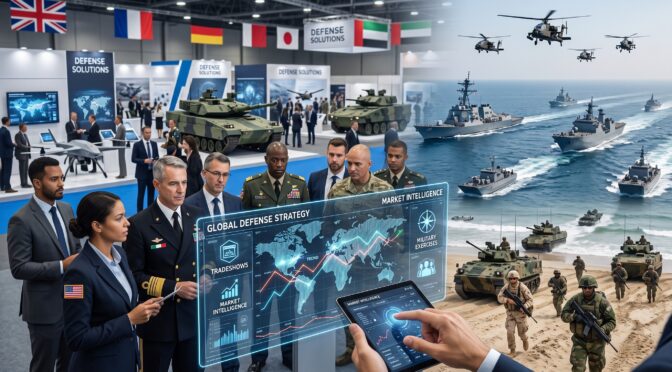
Throughout this period from July 20 to July 26, 2026 the global military and defense industrial complex experienced successive high profile defense exhibition coupled with huge multinational military exercises. Open source intelligence intelligence analysis of these parallel events reveals a defining strategic shift in all the world‘s armed forces to autonomous systems, distributed lethality and more robust localized defense industrial bases. This combination of exercises and tradeshows indicate that we are in the midst of a high intensity major-power competition milieu, where both the North Atlantic Treaty Organization (NATO) and its Indo-Pacific Ms are learning to improving their interoperability, power projection, and combat mass generating capabilities.
The sheer strategic importance of the defense industry at the Farnborough International Airshow 2026 overshadowed any move towards commercial aviation, a fact reflecting the new operational realities of ongoing, high-intensity conflicts across the Eastern European and Middle Eastern theaters.1 This manifested through the unveilings of various new technologies that revealed an industry-wide transition to ‘effect-centric’ warfare. The emergence of autonomous Collaborative Combat Aircraft (CCA), such as the BAE Systems Brontanax, and the incorporation of kinetic effects on uncrewed platforms by MBDA, demonstrate the Western militaries’ summation of efforts to create a ‘combat mass’ without significantly relying on costly crewed platforms against oncoming formidable integrated air defense systems (IADS).2 Simultaneously, the preservation of supply chains in the European theater through the national production of the Next Generation Rotorcraft (NGRC) by Sikorsky, was evidence of the desire to provide survivability within the European NATO structure against systemic logistical shocks.4 Finally, hybrid-electric propulsion for aircraft provided a potential change to the existing tactical logistics within theaters by reducing the present reliance upon fifth-thirty sources of fuel.5
Meanwhile, transnational military transits exposed crucial doctrinal shifts and reinforced geopolitical alignments. In the Indo-Pacific, the biennial Rim of the Pacific (RIMPAC) exercise and the biannual Australian Exercise Pitch Black showcased the most extensive multilateral integration in history focused on deterring regional aggression in the absence of formal treaties.6 While RIMPAC 2026 became a megaton field test for asymmetric naval operations, in particular one-way attack USVs against large-displacement capital vessels bringing Black Sea operational concepts to the Pacific.8 Exercise Pitch Black reveal the unparalleled logistical reach and coalition formation ability of twenty-one nations, including the integration of Japanese and Indonesian airpower, in concert with European aviation forces operating far from home7.
However, the obvious partnership between Beijing and Moscow was displayed in a tangible fashion with recent Exercise Joint Sea in the Yellow Sea. The inaugural occurrence of joint conventional submarine operations by the PLAN with the Russian navy showcases the growing military partnership that is now able to deliver a seamless multi-terrain convergence at the operational level10. Such phenomena suggest an escalation of international military modernization evolving fast with the infusion of un-occupied capabilities and the enhancement of regional defense networks.
1.1 Summary Table of Key Events and Lessons Learned
| Event Name | Event Type | Location & Dates | Key Lessons Learned |
| Farnborough International Airshow 2026 | Tradeshow/Expo | Farnborough, United Kingdom July 20–24, 2026 | Shift toward Collaborative Combat Aircraft (CCA) and uncrewed loyal wingmen to generate combat mass. Defense industrial base localizing production (e.g., European NGRC lines) to secure supply chains. Maturation of hybrid-electric propulsion for military logistics. |
| Exercise Rim of the Pacific (RIMPAC) 2026 | Exercise (Multilateral) | Hawaiian Islands & Pacific Ocean June 24–July 31, 2026 | Validation of kamikaze Uncrewed Surface Vessels (USVs) against large capital ships. High-fidelity structural damage data acquired from SINKEX of forty thousand-ton Tarawa-class LHA and Ticonderoga-class cruiser. Integration of 3D printing and advanced manufacturing at sea. |
| Exercise Pitch Black 2026 | Exercise (Multilateral) | Northern Territory, Australia July 20–August 7, 2026 | High-level interoperability among twenty-one nations demonstrating unified regional deterrence without formal defense pacts. Validation of extreme long-range strategic airlift and logistical deployment by European air forces into the Indo-Pacific. |
| Exercise Joint Sea 2026 | Exercise (Bilateral) | Qingdao & Yellow Sea, China July 6–13, 2026 | Transition of Sino-Russian naval cooperation from surface maneuvers to complex subsurface integration. First joint deployment of conventional attack submarines, indicating high levels of strategic trust and shared anti-submarine warfare doctrine. |
2.0 Details: Military Tradeshows and Defense Expos
2.1 Farnborough International Airshow 2026: Macro Trends and Industrial Shifts
The Farnborough International Airshow 2026 (FIA), held at the Farnborough International Exhibition and Conference Centre in Farnborough, Hampshire, United Kingdom from July 20 to July 24, 2026, takes a leading spot among worldwide indicators of aerospace and defense industrial health.12 While the show has traditionally been a well-balanced indicator of commercial aviation procurements and defense systems procurements, the 2026 show was heavily renormed to defense.1 This renorming has been driven by the rise in worldwide defense budgets, and the pressing need for procurments driven by protracted and high-intensity warfare in Ukraine and the Middle East1
Participation by exhibitors grew dramatically to 1,636 exhibitors 15 percent more than the 2024 show.14 Such growth highlights the industry‘s reaction to an environment that remains challenging amidst persistent demand, a demanding supply chain, a global climate of geopolitical instability, and accelerating maturity of artificial intelligence and digital technology.14 Defense shares the limelight with commercial aviation and highlighted an aerospace industry on the cusp of a global pivot to military modernization, uncrewed systems, high-performance missile defense, and adoption of artificial intelligence.1 Additionally, the positive order outlook indicated a change in industry deal making, with the ongoing aircraft supply chain constraints now exerting influence on pricing, timing, and ordering patterns across commercial and defense.14
2.2 Debut of the BAE Systems Brontanax and the Proliferation of Collaborative Combat Aircraft
Another important highlight of FIA 2026 was the inaugural public presentation of the BAE Brontanax prototype Britain‘s first sovereign, un-manned CCA [Collaborative Combat Aircraft]3 by BAE Systems.3 As part of the UK‘s Storm Fighter program, the Brontanax prototype was designed as a highly autonomous “loyal wingman” to flown fighters such as the existing Eurofighter Typhoon and the new Tempest sixth-generation air combat system.3
The Brontanax mock up presented a medium-sized platform, similar size to a BAE Hawk trainer aircraft.3 Its primary design principle is a modular, open architecture.3 This modularity allows the airframe to be quickly configured for different roles, shifting seamlessly from kinetic missile launcher to electronic warfare (EW) platform to forward sensor extension to precision ground attack fighter.3 Built on a proven platform, as a result of BAE FalconWorks uncrewed systems research that has spanned over twenty-five years, the system is primarily instructed by autonomic programming but can be directed at the command of a crewed fighter pilot or ground command.3 Brontanax is currently in ground testing in Warton, with flight trials planned for 2027 in the UK, targeting front line deployment by the end of the 2020‘s.3
The implications of the intelligence gained from the Brontanax debut reveals an effect of a systemically and unalterably changed approach to western air doctrine: the focus on producing ‘combat mass’ at a sustainable price. Today‘s peer adversary air defense environment is excessively lethal and sufficiently dense that the attrition of crewed, multi-hundred million dollar fighter aircraft is a strategic and political non-start. As a result, air forces may increase overall fleet lethality and threaten the entire spectrum of enemy air defenses, by fielding affordably modular, attritable or recoverable unmanned effectors, while simultaneously saturating enemy radar bandwidth with lower-cost, attritable or recoverable unmanned effectors, or penetrating the most contested airspace with the lowest-cost, attritable or recoverable unmanned effectors. In short, the nature of the adversary environment dictates that a new homebreed operating construct of wonderful crewed platforms and an ever-expanding swarm of autonomous, modular effectors must be embraced.
2.3 MBDA’s Effect-Centric Doctrine and Uncrewed Integration
European missile consortium MBDA Systems exploited the FIA 2026 platform to describe a broad strategic shift to an “effect-centric” future for uncrewed air systems.2 This doctrinal shift holds that the weapon itself, or the particular kinetic or non-kinetic effect produced, is no longer just an add-on attached to an aircraft, but the platform‘s overall defining relevance.2
To see this effect-focused approach come to fruition, the MBDA announced major industry and government alliances to accelerate weapon integration onto uncrewed systems. The MBDA emphasized its long-standing partnership with General Atomics, which is working to develop an integration pathway for the SPEAR missile system onto both the MQ-9B SkyGuardian armed UAV and the Gambit Collaborative Combat Aircraft (CCA).2 The SPEAR delivers a unique combination of stand-off range, exceptional precision, and flexible mission sets.2 When integrated onto the Gambit CCA, it enables users to target high value assets with the command hook outside the engagement envelopes of advanced IADSs;2 this builds on the recent success in penetrating IADS 7.62-mm guns2 by integrating the Brimstone 3 missile with the RAF‘s MQ-9B Protector.2
In the meantime, MBDA unveiled a partnership with Hybrid Drones Ltd, a UK SME.2 A second investment round was recently completed by MBDA investments in the SME with the combination of the MBDA experience and intricate weapons specialization with the agility of the SME to provide a dual use capability with real combat value.2 MBDA is providing systems engineering expertise, technical mentorship and the will to push the community from concept to operational capability.2
MBDA is beginning to resonate messaging around a key industry awareness that a conventional defense acquisition program schedule will never fit the ‘wartime pace’ of the modern, fast moving conflict.2 By engaging modern, agile SMEs and abandoning a platform-centric approach and instead focusing on the payload carried, defense vendors are trying to achieve the best cost- per-effect ratio.2 The capacity to use an uncrewed platform to deliver mixed kinetic/non-kinetic effects facilitates lethal, immediate insertion into high threat-density environments for the whole force, a capability that was previously limited to very expensive, stealthy, crewed bomber fleets.2
2.4 Lockheed Martin and Sikorsky: Next Generation Rotorcraft (NGRC) Production Localization
To address a key need for modern rotary wings and resilience of supply chains, Sikorsky, a Lockheed Martin company, seized the opportunity at the show to reaffirm its commitment to of establishing a local european production line for the NGRC.4 The NGRC program, started in 2022, is run under a dedicated support partnership by the NATO Support and Procurement Agency (NSPA).4It intends to design a medium-class multi-role helicopter to substitute over nine hundred medium lift rotorcraft flown worldwide by NATO states that will reach the end of their service lives between 2030 and 2050,21 including France, Germany, Italy, the United Kingdom, the Netherlands and Canada.21 The United States and Spain attend as observers.22 Greece withdrew from the program after the concept phase.22
Although some final airframes have yet to enter the concept phase, Sikorsky assured that it is already researching new airframe layout concepts, open architecture avionics, and mission equipment that will meet the needs of NATO‘s future deterrence concepts.4 It proposed to work with established European aerospace companies, industry, and local suppliers to build a comprehensive manufacturing infrastructure within Europe that promotes technology transfers, employment, and long-term sustainment.4 Meanwhile, Lockheed Martin announced that it is conducting similar developmental work to produce an international variant of the X2 compound co-axial rotor platform in Asia.4
Choosing to undertake a localized NGRC production line in Europe is directly in response to the considerable European and global supply chain fragility that has been laid bare by the recent years’ events.4 As stated by Dr. Dennis Goege, Lockheed Martin‘s chief executive for Europe, “the NGRC program will be used to bolster the defense industrial base of Europe and improve NATO readiness.4 By transferring all development, part manufacturing and final assembly operations back to the theater, Lockheed Martin will generate conditions for the creation of new local supply chains, providing NATO forces with an incredible, scalable, rapid response logistics capability.4 This represents a fundamental change in the approach of the European defense industry from distant, overly centralized manufacturing centers to resilient, dispersed industrial networks that can endure a maximum use of high intensity warfare in the area of operation.
2.5 Advancements in Tactical Logistics via Hybrid-Electric Propulsion
One notable technological achievement with far-reaching consequences for military logistics was achieved and demonstrated at FIA 2026 by GE Aerospace. In partnership with NASA’s Electrified Powertrain Flight Demonstration program as well as the electric aerospace company BETA Technologies, GE Aerospace demonstrated the world‘s first hybrid-electric propulsion aided high-altitude flight.5
The test aircraft, a modified Saab 340B, was demonstrated to operate successfully at the target cruise altitude of thirty thousand feet and above, comparable to those of normal commercial passenger aircraft.5 The test aircraft was equipped with a high-voltage hybrid system located on the right side of the aircraft inside an inverted nacelle, built by Boeing subsidiary Aurora Flight Sciences, to provide additional cooling.5 The hybrid architecture employed six GE Aerospace developed motor/generators, associated power converters, inverters, controllers, a conventional CT7 turbine, and battery systems supplied by BAE Systems.5 On the test aircraft, the electric powertrain was used to drive the propeller during the most stressful flight conditions and generate power to the batteries during less stressful flight conditions.5 BETA Technologies pilots successfully flew the aircraft across the North Atlantic to airshows while operating in hybrid-electric mode on every leg of the journey, with the longest continuous duration hybrid flight being greater than two hours.5
This reality is widely acknowledged by the aerospace industry in terms of commercial aviation decarbonisation. However, hybrid-electric engines carry important tactical and strategic implications for military logistics. A hybrid-electric tactical transport or reconnaissance airplane will have inherently lower thermal and acoustic signatures, thus have far lower detection ranges against adversaries’ sensors.17 Most importantly however, hybridisation diminishes the total fuels requirement for aviation. In a highly contested logistics environment as vast as the Indo-Pacific maritime expanse diminishing the total liquid fuels required to sustain an airbridge is a huge operational force multiplier.17 It has the immediate effect of reducing the fragility of the logistical tail lines and freeing up strategic tanker capacity for frontline aircraft.
2.6 Data Analytics and Aviation Sustainment Developments
Apart from flagship platform introductions, FIA 2026 also emphasized the growing focus on Software-as-a-Service (SaaS) and localized MRO to maintain fleet readiness. Several company adoption of software were announced, such as FlightPulse an app on mobile which has operational data directly linked into pilots’ decision making environment through each flight for Austrian airlines and ITA airlines, as well as Fuel Insight software18. Also, ABL Aviation entered a 5-year contract to adopt the GE Aerospace Asset Transfer System (ATS) to track aircraft in high volume transfers.18
Regarding the defense sustainment issue, GE Aerospace and Magellan Aerospace Corporation jointly signed an MOU with Canada in this regard to set up a full scope MRO depot in the country for the F414-GE-39E engine.18 The engine is installed on the Saab JAS 39 Gripen E fighter.18 Whether the MOU implementation would materialize or not hinges on the decision made by the Canadian government for shopping the Gritten E fighter in the future RCAF fighter fleet.18 This agreement further manifests the industrial phenomenon which demands prime contractor(s) capable of providing credible and sovereign sustainment and maintenance support to be awarded any future national defense procurement.18
3.0 Details: Military Exercises
3.1 Exercise Rim of the Pacific (RIMPAC) 2026: Scale and Interoperability
The 30th RIMPAC, sponsored by the United States Navy Pacific Fleet, took place in the waters around the Hawaiian Islands from 24 June-31 July 2026.6 According to the US Navy, RIMPAC 2026 was the world‘s largest international maritime exercise. RIMPAC 2026 involved a coalition force of more than thirty-thousand personnel,30-40 surface ships,5 submarines,15 national land forces and140-190 aircraft.6 Thirty to thirty-five allied and partner nations participated in the five-week multilateral event.6
The overarching theme of RIMPAC 2026 was “Partners: Integrated and Prepared”.6 The focus of the exercise was on increasing interoperability of participants, taking disparate forces of the participating nations and making them into an integrated force multiplier ready for any contingencies, from humanitarian aid to high-end maritime conflict.6 According to Major General Valerie Jackson of the U.S. Marine Corps: the crux of the exercise was to make sure that the allied participants had a common level of proficiency and a common grasp of the environment when the clouds descended.19 In addition, command noted the growing use of gray-zone tactics –information operations, including cyber, information manipulations and economic coercion – and incorporated scenarios to counter operations that do not reach high-end warfare.19
3.2 Asymmetric Naval Strike and Kamikaze USV Validation
The live-fire SINKEX against the ex-USS Peleliu (LHA 5), a forty-thousand-ton Tarawa-class amphibious assault ship was a certain defining, tactically revelatory event of RIMPAC 2026.8 The event, which took place on 17 July, was the first kinetic event in history to be orchestrated with multiple conventional (and asymmetric) munitions harpoons, spikes, Long Range Anti-Ship Missiles (LRASM) dropped by active units Spanish Navy Ship ESPS Alvaro De Bazan, U.S. Army AH-64 Apache’s IRO Spikes NLOS and unmanned (predominantly one-way attack) surface exoatmospheric vehicles – kamikaze USVs.8 The imagery and subsequent reports reveal the kamikazes wheeling in on the old gyro, blowing right through the water line, and detonating.8
The tactical site of action employed at the SINKEX involves an extremely well-coordinated, multi-window attack sequence that saturates all shipboard point defenses.8 An attack in which both airborne, sea-skimming cruise missiles hit the ships superstructure and the low-profile USVs hit the waterline creates a two-axis attack that is extremely difficult to defend against.
The relative level of intelligence gain from the event is significantly higher and the use of kamikaze USVs is a doctrinal transfer from the Black Sea theater where the Ukrainians have implemented a successful asymmetric surface force to massively degrade the Russian Black Sea Fleet. The Naval blockade into the major operational event of RIMPAC, Japan is making it clear that the focus is on driving the indigenous octopus into rapidly deploying extremely autonomous and attritable surface attack drones into the Indo-Asia-Pacific.8 The tactical gain can be seen in the low radar cross-section and terminal attack pattern of the USV. Intercepting at the waterline causes instant catastrophic flooding which is often more deadly to large displacement capital ships than the localized fire and superstructure damage generated by countermeasures against sea skimming anti-ship missiles.8
3.3 High-Fidelity Structural Survivability Data Acquisition
The decision of the particular host ships for the RIMPAC ‘SINKEX’ constituted exclusive, high-fidelity learning opportunities for allied navies in the area of contemporary warship survivability and damage control. First, the ex-USS Mobile Bay (CG 53), a Ticonderoga class guided-missile cruiser, was sunk on the 12 th of July.21 Later, the ex-USS Peleliu was sunk on the 17 th of July.22 Both ships were left in unfathomable depths of over fifteen thousand feet, in adherence to official environmental policy.23
The contrasting architectures of the two targets are the real ‘intelligent’ achilles’ heel of the exercise. The ex-USS Mobile Bay was the classic Cold War cruiser aversion of compact, dense, high capacitance and highly compartmented survivability profile driven by the Cold War design paradigm of being built on the Aegis anti-air platform21. The huge 834 feet, eight hundred and thirty-four feet, amphibious assault ship (the sizes of a World War II Essex class aircraft carrier) the ex-USS Peleliu presented the opposite analytical problem.20 Plenty of internal volumes, hangar decks, a well deck, a huge buoyancy margin, marks of a big deck amphibious warship that from previous experience are very difficult ships to sink within a matter of hours/ days.21
For naval engineers, it is crucial to see precisely how a modern combatant efficiently takes damage, sensor by sensor, hit by hit, until it finally drowns.21 The combination of a tightly packed cruiserwith a large, high volume amphibious ship provided the multinational experiment to observe the terminal effects of the types of threat most actively feared.21 As China’s extensive anti-ship missile arsenal becomes more effective within the Pacific, understanding how large ships perisist under saturation attack will be key to designing ships that can survive future engagements with these weapons.21
3.4 Contested Logistics and Advanced Manufacturing at Sea
In addition to kinetic strike exercises, the strategic focus of RIMPAC 2026 included a significant emphasis on logistical endurance and near-term experimental testing through realistic scenarios.17 RIMPAC 2026 also featured a large scale manufacturing demonstration, which provided an opportunity for military, academic and commercial collaborators to demonstrate new technologies in an operational context.17
In particular, the Exercise included the concept of operating 3D printers from ships to produce parts on call, supported by autonomous surface vessels providing ferry services between ships for 3D printer components and raw materials.19 This highlights a pressing operational necessity to separate front line naval assets from exposed, immobile, shore based logistics chains. The capacity to produce spare parts and carry out repairs at sea drastically reduces operational down time. In a fiercely contested naval environment where conventional logistics supply routes are frequently threatened by interdiction, reducing the logistical tail to support a combat fleet remains one of the war-fighter‘s most valuable lessons.19
3.5 Exercise Pitch Black 2026: Unprecedented Indo-Pacific Interoperability
Organised by the Royal Australian Air Force (RAAF) Exercise Pitch Black 2026 is the Australian military‘s own air combat exercise scheduled to take place from 20 July to 7 August 2026.7 Commander by RAAF, the exercise is based in RAAF bases Darwin and Tindal in the Northern Territory and RAAF Base Amberley in Queensland, and comprises more than 2500 personnel and more than 100 aircraft from 21 countries.7
The 2026 iteration of Pitch Black saw the most expansive and diverse regional air participation since its beginning in 1983.7 This iteration saw the first participation of Japanese Air Self-Defense Force JASDF F-35A Lightning II stealth fighters; F-35A jets and E-2D airborne early warning aircraft; Japanese T-50I Golden Eagle light combat jets and F-16s.7 Additional platforms represented at the exercise included Indian Air Force Rafale jets; South Korean air-force F-16 jets; Philippine FA-50PH jets; Thai air-force F-16 jets; Singapore F-16s and G550 jets; United States’ Air-Force F-22A Raptors (by the recent history of political-military deployments) and F-35A jets; and a broad range of Australian-equipped platforms, including F-35A fighters, EA-18G Growler jets, and E-7A Wedgetail jets.10 Also exhibiting at this iteration of Pitch Black was embedded personnel from regional neighbors Fiji and Papua New Guinea (who operated PAC-750 jets), as well as additional personnel from Finland, Sweden, New Zealand, Canada and Malaysia.7
Table 3.1: Selected Participating Nations and Key Platforms at Exercise Pitch Black 2026
Nation
| Key Platforms Deployed | Operational Role | |
| Australia (Host) | F-35A, EA-18G, F/A-18F, E-7A, KC-30A | Multi-role combat, EW, AEW&C, Tanker |
| United States | F-35A, C-130, KC-135 | Multi-role stealth, Airlift, Tanker |
| Japan | F-35A, E-2D | Multi-role stealth, AEW&C |
| India | Rafale | Multi-role combat |
| Indonesia | T-50I, F-16 | Light attack and Multi-role combat. |
| Philippines | FA-50PH | Light attack |
| Republic of Korea | F-16 | Multi-role combat |
| Singapore | F-16, G550 | Multi-role combat, AEW&C |
| Germany/Spain | EF2000 Typhoon, A400M, MRTT | Multi-role combat, Airlift, Tanker |
In Pitch Black, the tactical activities conducted took place in the most globally integrated, multi-national combat air operating environment, in a vast un-congested military training airspace.7 Scenarios involved the execution of highly complex multi-domain integration, air-to-air refueling, intelligence, surveillance and reconnaissance (ISR), and strategic and tactical airlift.10
An imperative issue emerges from the starting point of Xbox… The strategic overlay of Pitch Black 2026 is the speed and improvisation with which the Indo-Pacific nations are coalescing into a coalition in the face of regional tensions – especially, the development of assertive regional regional posture of the People‘s Republic of China, which was notably absent7. As Peter Layton, retired RAAF group captain observed, the exercise operates as a form of signalling, showing that all of these many nations could potentially coalesce together in a time of crisis, without the need for a formal, rigid DEFENSIVE alliance7. That twenty-one different air forces with their idiosyncratic mix of both fourth and fifth generation platforms and differing national command, control, communication and intelligence ( C 3 I ) structures all cohered into a cohesive air combat exercise suggests a remarkable level of interoperability10. This inter-operability is a solid demonstration that in the expansive skies of the Indo-Pacific, a multilateral force can be generated quickly and be commanded efficiently.
3.6 Pitch Black and Extreme Long-Range Strategic Deployment
Exercise Pitch Black 2026 was also a very demanding test of the global logistical reach and power projection capabilities of European air forces. This is evidenced by the fact that to participate in this exercise the RAF soldiers and aircraft had to travel enormous inter-continental distances.9 The RAF soldiers flew from the UK to Alaska via Guam, before walking another two thousand eight hundred and fifty kilometers to RAAF Base Amberley in Queensland, then walking another two thousand eight hundred and fifty kilometers to RAAF Base Darwin.9 This total distance of fourteen thousand one hundred and fifty kilometers is indicative of the magnitude of this logistics task.9
In addition, the Action resulted in the substantial use of European combat resources including German and Spanish Air Force Eurofighter Typhoons and A400M tactical airlifters, supported extensively by a Multinational MultiRole Tanker Transport Unit and RAF Voyager aircraft.10
The ability to project European air power into the Northern Territory of Australia demonstrates the ability of NATO members to quickly reinforce the Indo-Pacific area in a crisis situation. 9 It demonstrates the absolute critical importance of strategic air-to-air refueling aircraft such as the A330 MRTT, RAF Voyager, and USAF KC-135 in overcoming the tyranny of distance for operations in the Pacific. 10 It, however, also demonstrates the significant logistical footprint associated with deploying and maintaining European Fighter aircraft in Australia has vulnerabilities to the availability of aviation fuel, sustainment logistics, and basing resilience in an area where intermediate staging bases may be targeted.
3.7 Exercise Joint Sea 2026: Deepening Sino-Russian Naval Subsurface Trust
Just before the main reporting period, the Chinese People‘s Liberation Army Navy (PLAN) and the Russian Navy executed the ” Joint Sea 2026 ” exercise from 6 July to 13 July 2026.25 Based at a military installation in Qingdao, in China‘s Shandong Province, the maritime dimension was in the Yellow Sea and involved combined maritime patrols into the wider Pacific Ocean.25
The exercise was conducted with a combined flotilla of ten naval vessels, including surface combatants, support ships, and most importantly submarines.25 The Chinese task group consisted of the guided-missile destroyers Kaifeng and Anshan, guided-missile frigate Wuhu and Honghu replenishment ship; while the Russian task force was led by the guided-missile cruiser Varyag along with Rezkiy and the Igor Belousov submarine rescue ship.11 The main declared theme of the exercises was “to jointly confront maritime security dangers” while the firing exercises included joint reconnaissance, air and missile defense, and surface attack.26
Nevertheless, the most significant tactical development that took place during Joint Sea 2026 was the fact that time the two countries sent their submarines. Although both navies operated diesel-electric submarines, it was the first time ever that submarines from both states operated together in the context of the yearly Sea series.11 For the China, the 039B Yuan-class was the submarine of choice, whereas for Russia the diesel-electric Ufa the Project 636.3 Varshavyanka (NATO designator: Improved Kilo class).11 As part of the exercise, they practiced complicated anti-submarine warfare (ASW) scenarios and joint submarine rescue missions to determine if the navies could work together in complicated undersea conditions.11
The evolution from the surface-only maneuvers of “Joint Sea” 1.0 to the complex combined undersea fighting of “Joint Sea” 2.0 is a significant leap in both the scope of military trusts and the degree of jointness permeating the Beijing Moscow security relations.11 As attack submarines operate in a transitory environment in the undersea domain, the sharing of sensitive weapon, communications, and tactical data would be a significant drain on both navies’ combat information and operational security.11 Not working counter to an over arching strategic goal however, the PLAN and RUSNAVCOM managed to operate their conventional attack submarines in close proximity with no incidents or exchanges of fire. If this is not a demonstration of the incremental build up of joint pretensions of contesting the transitory undersea battlefield then it is certainly a large step towards that calling. The Chinese chief director stressed that the exercise was highly combat-oriented strengthening strategic mutual trust and that the participating ships subsequently conducted a joint patrol deep into the Pacific Ocean, clearly seeking to challenge the US led maritime hegemony.25 26
Works cited
- Farnborough Airshow 2026 Shifts Toward Defense As Global Conflicts Drive Military Spending, accessed July 26, 2026, https://thedefensewatch.com/aerospace-aviation/farnborough-airshow-2026-defense-aircraft-orders-conflicts/
- Farnborough International Airshow 2026: MBDA Champions an …, accessed July 26, 2026, https://www.mbda-systems.com/farnborough-international-airshow-2026-mbda-champions-effect-centric-future-uncrewed-air-systems
- BAE Systems unveils Brontanax autonomous loyal wingman – New Atlas, accessed July 26, 2026, https://newatlas.com/military/bae-systems-brontanax-loyal-wingman/
- Media – Lockheed Martin – Releases, accessed July 26, 2026, https://news.lockheedmartin.com/2026-07-16-Sikorsky-Eyes-Europe-for-Next-Generation-Rotorcraft-NGRC-Production
- GE Aerospace completes first high-altitude hybrid-electric flight – Quartz, accessed July 26, 2026, https://qz.com/ge-aerospace-hybrid-electric-flight-30000-feet-farnborough-072126
- US conducts massive RIMPAC joint naval drills – World Socialist Web Site, accessed July 26, 2026, https://www.wsws.org/en/articles/2026/07/07/sxtj-j07.html
- War games in the skies take off from the Top End, accessed July 26, 2026, https://aapnews.aap.com.au/news/war-games-in-the-skies-take-off-from-the-top-end
- U.S. Navy Deploys Ukraine-Style Kamikaze Sea Drones During …, accessed July 26, 2026, https://www.navalnews.com/naval-news/2026/07/u-s-navy-deploys-ukraine-style-kamikaze-sea-drones-during-pacific-sinkex/
- From Brize to the Bush: Journeying to Pitch Black | Royal Air Force, accessed July 26, 2026, https://www.raf.mod.uk/news/articles/from-brize-to-the-bush-journeying-to-pitch-black/
- Exercise Pitch Black 2026 participants – Royal Australian Air Force, accessed July 26, 2026, https://www.airforce.gov.au/our-work/exercises/exercise-pitch-black/exercise-pitch-black-2026-participants
- China and Russia Deploy Submarines Together for First Time in Joint Sea 2026 Drills, accessed July 26, 2026, https://united24media.com/world/china-and-russia-deploy-submarines-together-for-first-time-in-joint-sea-2026-drills-20755
- accessed July 26, 2026, https://www.farnboroughairshow.com/visit/faqs/#:~:text=When%20is%20the%20Farnborough%20International,to%20Friday%2024%20July%202026.
- Farnborough International Airshow 2026, accessed July 26, 2026, https://www.farnborough.com/what-s-on/events/farnborough-international-airshow-2026/
- Farnborough 2026 spotlights defense-led demand, supply bottlenecks—and all-electric flight demos from Beta Technologies – Hype /aviation, accessed July 26, 2026, https://hype.aero/cluster/conflicts-aircraft-orders-in/f2722d63-e7f9-4a5c-b024-2c0bf2a6e698/
- BCG at the Farnborough International Airshow, accessed July 26, 2026, https://www.bcg.com/industries/aerospace-defense/farnborough-international-airshow
- Farnborough 2026: Lockheed Martin to establish European NGRC production line – Janes, accessed July 26, 2026, https://www.janes.com/defence-intelligence-insights/defence-news/air/farnborough-2026-lockheed-martin-to-establish-european-ngrc-production-line
- GE Aerospace unveils breakthrough in hybrid-electric flight – Europe – The Jakarta Post, accessed July 26, 2026, https://www.thejakartapost.com/world/2026/07/21/ge-aerospace-unveils-breakthrough-in-hybrid-electric-flight
- Farnborough Airshow 2026: All the News That Made Headlines – GE Aerospace, accessed July 26, 2026, https://www.geaerospace.com/news/articles/farnborough-airshow-2026-all-news-made-headlines
- Exercise RIMPAC 2026 features uncrewed vessels, other emerging technologies, accessed July 26, 2026, https://ipdefenseforum.com/2026/07/exercise-rimpac-2026-features-uncrewed-vessels-other-emerging-technologies/
- U.S. and Partner Nations conduct SINKEX during RIMPAC 26 – Third Fleet – Navy, accessed July 26, 2026, https://www.c3f.navy.mil/News/Article/4553146/us-and-partner-nations-conduct-sinkex-during-rimpac-26/
- A 40,000-ton assault ship and a Tomahawk-veteran Aegis cruiser: the two warships the US Navy will sink at RIMPAC 2026 – Zona Militar, accessed July 26, 2026, https://www.zona-militar.com/en/2026/07/18/a-40000-ton-assault-ship-and-a-tomahawk-veteran-aegis-cruiser-the-two-warships-the-us-navy-will-sink-at-rimpac-2026/
- Exercise Pitch Black 2026 flying schedule – Royal Australian Air Force, accessed July 26, 2026, https://www.airforce.gov.au/our-work/exercises/exercise-pitch-black/exercise-pitch-black-2026-flying-schedule
- Exercise Pitch Black returns in 2026 – Defence, accessed July 26, 2026, https://www.defence.gov.au/news-events/releases/2026-05-07/exercise-pitch-black-returns-2026
- Exercise Pitch Black 2026 takes to the skies – Defence, accessed July 26, 2026, https://www.defence.gov.au/news-events/releases/2026-07-16/exercise-pitch-black-2026-takes-skies
- China-Russia Joint Sea-2026 Ends with Powerful Naval Show of Force, Signaling Deeper Military Alliance Across the Indo-Pacific – Defence Security Asia, accessed July 26, 2026, https://defencesecurityasia.com/en/china-russia-joint-sea-2026-naval-exercise-qingdao-indo-pacific-military-alliance/
- China and Russia conclude Joint Sea-2026 naval exercises – Caliber.Az, accessed July 26, 2026, https://caliber.az/en/post/china-and-russia-conclude-joint-sea-2026-naval-exercises
- China, Russia wrap up joint naval exercise – Xinhua, accessed July 26, 2026, https://english.news.cn/20260713/9379d756304e40088458553afd2c8264/c.html