1.0 Executive Summary
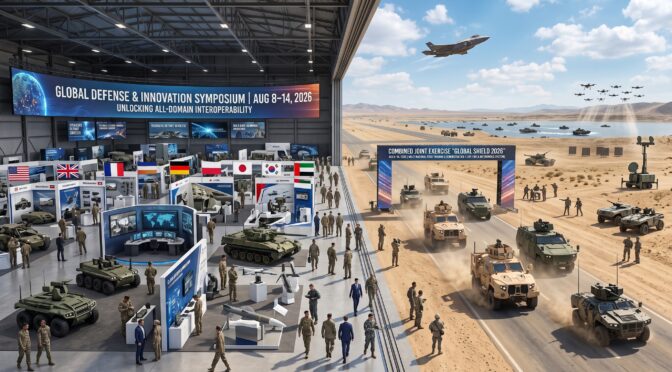
During the week of August 8 through August 14, 2026, international defense organizations conducted two major industry tradeshows and high-level bilateral military staff engagements. The intelligence derived from these events indicates a strategic shift among allied and partner nations toward two core objectives: the operationalization of layered homeland defense and the revitalization of industrial bases for conventional operations.
The 2026 Space and Missile Defense Symposium highlighted a shift in the United States’ defensive posture. The transition of the Golden Dome initiative from a theoretical framework to an operational architecture, evidenced by the establishment of its first operational site and the passage of initial design gates for space-based interceptors, signals a commitment to layered homeland defense. However, reliance on legislative reconciliation packages for funding introduces variables regarding the 2028 operational targets. Furthermore, statements from United States Space Command underscored a paradigm shift in the space domain, prioritizing sustained maneuverability and survivability against counter-space capabilities.
In the ground domain, the Ground Vehicle Systems Engineering and Technology Symposium demonstrated a reliance on commercial-military integration. The United States is reconstituting its automotive industrial base in the Midwest to iterate on infantry mobility and hybrid-electric architectures.
Simultaneously, while no large-scale field exercises occurred during this specific reporting window, bilateral engagements took place. The inaugural Air Staff Talks between India and Germany served as a planning mechanism to institutionalize the operational integration achieved during past exercises, reflecting a commitment to incorporating European security apparatuses into the Indo-Pacific theater.
1.1 Summary Table of Key Events and Lessons Learned
| Event Name | Event Type | Location & Dates | Key Lessons Learned |
| Space and Missile Defense Symposium | Tradeshow/Expo | Huntsville, Alabama, United States (August 11–13, 2026) | Space is recognized as an operational domain requiring sustained maneuver capabilities; homeland missile defense is shifting toward layered architectures with a focus on life-cycle affordability, though fiscal vulnerabilities remain. |
| Ground Vehicle Systems Engineering & Technology Symposium | Tradeshow/Expo | Novi, Michigan, United States (August 11–13, 2026) | The ground combat vehicle supply chain is using the commercial automotive industrial base, with engineering priorities on hybrid-electric drives, high-fidelity simulation, and advanced human-machine interfaces. |
| Inaugural India-Germany Air Staff Talks | Bilateral Military Engagement | New Delhi, India (August 11–13, 2026) | European and Indian air forces are deepening strategic partnerships and operational exchanges to ensure interoperability within the Indo-Pacific region. |
2.0 Details: Military Tradeshows and Defense Expos
2.1 Space and Missile Defense Symposium 2026
The annual Space and Missile Defense Symposium, held at the Von Braun Center in Huntsville, Alabama, serves as a forum for assessing the trajectory of the United States military space and air defense enterprise. The 2026 iteration brought together over 9,000 attendees and 300 exhibiting organizations, functioning as an interface between military requirements and industrial capacity1.
2.1.1 Participating Nations and Major Defense Contractors
The symposium featured participation from the United States Department of Defense, including the Missile Defense Agency, United States Space Command, and the United States Army Space and Missile Defense Command1. Industry participation included prime contractors and specialized technology firms. Key defense contractors exhibiting hardware and software architectures included Lockheed Martin, Northrop Grumman, Raytheon, Boeing, L3Harris, Moog, and Circor2. Non-traditional defense entities involved in quantum computing, such as D-Wave, showcased processing architectures designed for national security applications4.
2.1.2 Technological Debuts, Systems Emphasized, and Capabilities Demonstrated
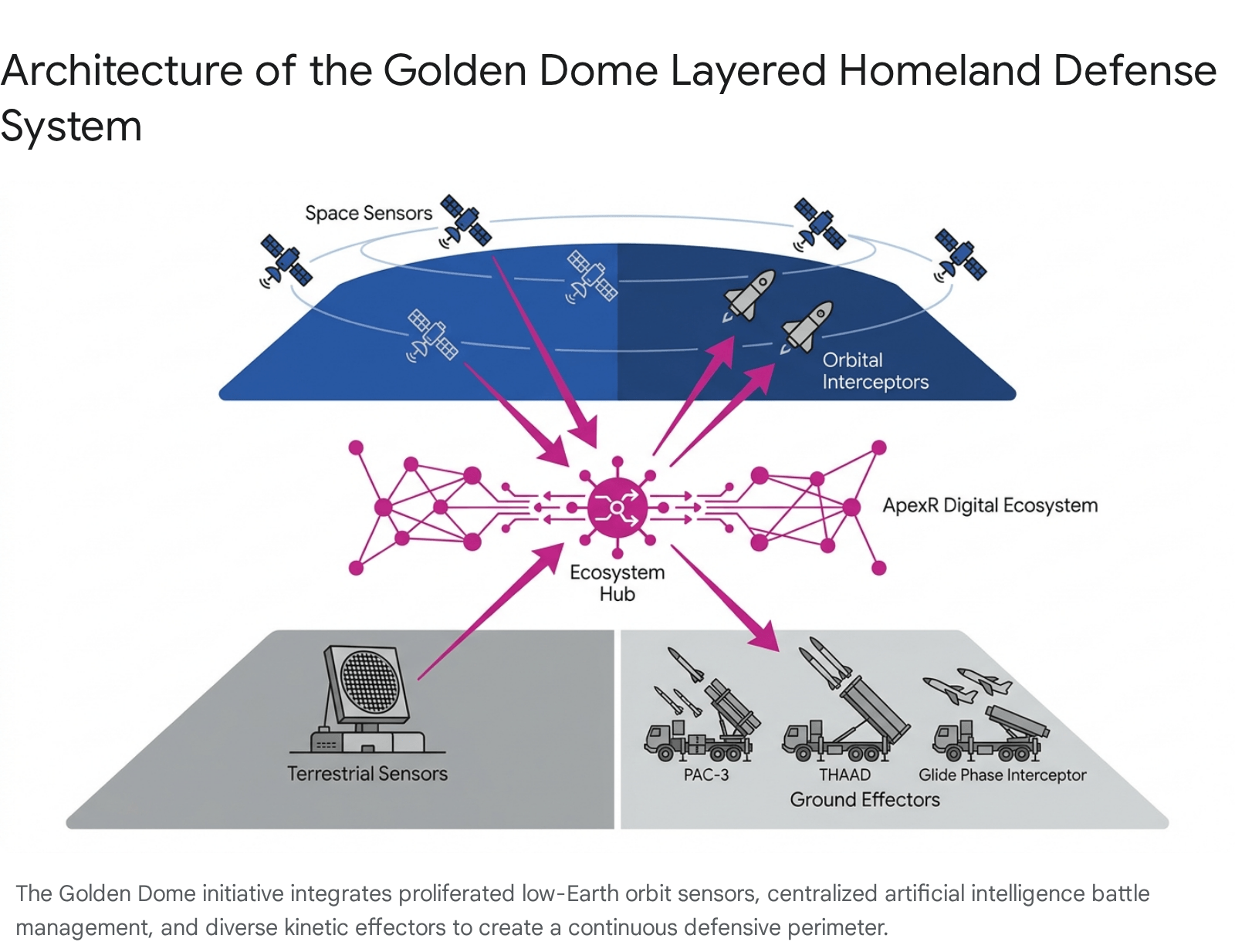
The focal point of the symposium was the Golden Dome initiative, a layered homeland air and missile defense architecture designed to intercept ballistic, hypersonic, and cruise missile threats5. General Michael Guetlein, the director of the initiative, announced that the program had progressed beyond theoretical design, citing the establishment of the first operational site at Joint Expeditionary Base Fort Story, Virginia, and an integrated test at White Sands Missile Range in New Mexico earlier in the summer7.
The technical architecture of the Golden Dome is defined as a system of systems. Rather than relying on a monolithic weapon, the Department of Defense is integrating disparate elements across multiple domains6. To support this integration, the Department of Defense announced the launch of the Golden Dome Ecosystem Hub, a centralized portal designed to intake commercial and non-traditional technologies spanning artificial intelligence, electronic warfare, and sensor networks6.
The exhibition floor reflected this multi-domain approach, featuring a wide array of advanced tracking and interception hardware.
| Contractor / Exhibitor | System Demonstrated | Primary Domain / Function | Operational Context |
| Northrop Grumman | Glide Phase Interceptor | Upper Atmosphere / Exosphere | Designed as a layered defense against regional hypersonic missile threats prior to terminal descent2. |
| Raytheon | Lower Tier Air and Missile Defense Sensor & SM-3 | Terrestrial & Maritime | Advanced radar tracking paired with Standard Missile-3 interceptors for ballistic threat neutralization2. |
| Lockheed Martin | PAC-3 and THAAD Interceptors | Terrestrial | Terminal phase and high-altitude area defense interceptors serving as the kinetic backbone of ground-based air defense2. |
| Boeing | IFPC Increment 2 & Ground-launched SDB | Terrestrial | Indirect Fire Protection Capability intended to counter cruise missiles, unmanned aerial systems, and rotary-wing threats4. |
| L3Harris | Red Wolf Munition | Air / Precision Strike | Highlighted as an advanced munition capability within broader defense portfolios2. |
| Moog | METEORITE Satellite Bus | Space | Expanded bus capacity designed to support larger payloads for space-based sensor networks4. |
| Circor | MEMS G-switches | Component Level | Micro-electromechanical systems designed to trigger actions during midflight acceleration for missiles and aircraft4. |
| D-Wave | Annealing Quantum Processor | Cyber / Data Processing | Quantum computing hardware applied to national security data routing and cryptographic challenges4. |
2.1.3 Lessons Learned and Intelligence Takeaways
Analysis of the symposium yields several strategic shifts in the United States defense posture. The doctrine regarding space operations has changed. General Stephen Whiting explicitly stated that the United States is no longer preparing for a hypothetical future conflict; space is currently an operational warfighting domain3. Satellites can no longer rely on altitude for defense, as they are predictably situated within the weapons engagement zones of adversarial forces3. Consequently, the engineering priority has shifted toward sustained space maneuver, equipping assets with the propulsion and logistical support required to actively evade threats without exhausting finite launch fuel reserves3.
The economic asymmetry of modern air defense is forcing a pivot in procurement strategy. Lieutenant General Heath Collins noted that life-cycle costs and magazine depth are paramount considerations9. The initiation of the Low-Cost Interceptor program, which mandates a unit cost below 750,000 dollars for modular effectors, indicates that the Department of Defense recognizes the requirement to utilize cost-effective interceptors to neutralize proliferated drone and cruise missile threats9.
Fiscal vulnerabilities were identified. General Guetlein warned that the Golden Dome initiative risks delays due to its reliance on a 350 billion dollar legislative reconciliation package for fiscal year 2027 funding8. Because the program bypassed standard budget appropriations in favor of the One Big Beautiful Bill Act in 2025, which provided 25 billion dollars to initiate the project, the lack of political consensus on future reconciliation measures threatens the 2028 operational deadline8. The Pentagon is seeking 17.5 billion dollars for the project in fiscal year 2027, with 97 percent intended to come from the reconciliation package and only 400 million dollars in the base budget8.
2.2 Ground Vehicle Systems Engineering & Technology Symposium 2026
The Ground Vehicle Systems Engineering and Technology Symposium, hosted by the National Defense Industrial Association Michigan Chapter, took place in Novi, Michigan, serving as the primary locus for military mobility and ground combat innovation11.
2.2.1 Participating Nations and Major Defense Contractors
The symposium was integrated with the United States Army Combat Capabilities Development Command Ground Vehicle Systems Center and the Tank-automotive and Armaments Command, both located in nearby Warren, Michigan11. Industry participation was anchored by commercial automotive manufacturers actively transitioning into the defense space, most notably GM Defense, alongside specialized defense engineering firms such as GS Engineering and VES11.
2.2.2 Technological Debuts, Systems Emphasized, and Capabilities Demonstrated
The technical agenda of the symposium centered on aligning ground maneuver concepts with modern technological realities.
| Technology Focus Area | Demonstrated System / Capability | Strategic Implication |
| Tactical Mobility | GM Defense Infantry Squad Vehicle | Represents a shift toward highly mobile, lightweight tactical vehicles designed to replace legacy platforms within the new Mobile Brigade Combat Team structure11. |
| Power Generation | 160 kilowatts HMPT800EG from L3 | Inline Starter Generators and improved motor components for hybrid-electric drives are critical for increasing onboard electrical generation capacity to support advanced sensor suites14. |
| Simulation & Modeling | High-fidelity motion-base simulators | Researchers presented methodologies for integrating high-fidelity vehicle dynamics with commercial gaming engines to create advanced simulators for crew training and rapid prototyping15. |
2.2.3 Lessons Learned and Intelligence Takeaways
The primary strategic takeaway from the symposium is the United States Department of Defense’s effort to physically and economically tether the military ground vehicle supply chain back to the commercial automotive industrial base in the Midwest11. Recognizing that the Tank-automotive and Armaments Command manages and sustains approximately 60 percent of the Army’s equipment, the Pentagon is leveraging the manufacturing capacity and commercial research and development of the Detroit sector11.
By engaging commercial entities, the military seeks to accelerate the acquisition cycle and improve the reliability of complex, software-defined ground vehicles. The focus on integrated experimentation, as highlighted by senior officials during panel discussions, demonstrates a shift away from multi-decade procurement cycles toward iterative, software-driven hardware development13.
3.0 Details: Military Exercises
Note: Open-source research indicates that no major multinational live-fire or field maneuvers were executed during the specific August 8–14, 2026 reporting window. However, bilateral military staff-level engagements were conducted during this timeframe to advance coalition interoperability and fulfill joint planning objectives.
3.1 Inaugural India-Germany Air Staff Talks
Following the integration milestones achieved during previous multinational exercises, the Indian Air Force and the German Air and Space Force convened in New Delhi from August 11 through August 13, 2026, for their first-ever bilateral Air Staff Talks16.
3.1.1 Participating Forces, Geographic Focus, and Stated Objectives
The bilateral engagement involved senior commanders and strategic planners from both the Indian Air Force and the German Air and Space Force16. Centered in New Delhi, the explicit objective of the talks was to formally widen military cooperation between the two nations, with a specific focus on training methodologies, operational exchanges, and joint capability development16.
3.1.2 Tactical Maneuvers, Multi-Domain Integration, and Doctrinal Concepts Tested
As a staff-level engagement, live aerial maneuvers were not conducted. Instead, the doctrinal focus centered on formalizing the operational integration achieved during previous deployments16. The talks served as the strategic planning mechanism to build upon complex integrations, such as the tactical alignment of indigenous Indian platforms with advanced European fighters, which were initially validated when German Eurofighters deployed for the Tarang Shakti exercise in August 202416.
3.1.3 Lessons Learned and Intelligence Takeaways
The primary intelligence takeaway from the Air Staff Talks is the deliberate institutionalization of European military presence and operational familiarity within the Indo-Pacific theater16. By establishing formal, recurring staff-level dialogues, Germany and India are signaling a transition from episodic joint exercises to sustained strategic alignment. This adds a key European air force to the Indian Air Force’s bilateral calendar, reflecting a hardening of international defense architectures designed to establish credible deterrence and ensure regional stability across South Asia16.
Please share the link on Facebook, Forums, with colleagues, etc. Your support is much appreciated and if you have any feedback, please email us in**@*********ps.com. If you’d like to request a report or order a reprint, please click here for the corresponding page to open in new tab.
Sources Used
- SMD Symposium, https://smdsymposium.org/
- A peek at Day 1 of the 2026 Space and Missile Defense Symposium, https://breakingdefense.com/2026/08/a-peek-at-day-1-of-the-2026-space-and-missile-defense-symposium/
- In space ‘there is no safe harbour’: Whiting details threats, Huntsville move at SMD, https://256today.com/in-space-there-is-no-safe-harbour-whiting-details-threats-huntsville-move-at-smd/
- Day 3 of the 2026 Space and Missile Defense Symposium, https://breakingdefense.com/2026/08/day-3-of-the-2026-space-and-missile-defense-symposium/
- Military leaders discuss Golden Dome’s future at SMD Symposium – 256 Today, https://256today.com/military-leaders-discuss-golden-domes-future-at-smd-symposium/
- DoD opens ‘Golden Dome’ industry portal for missile defense technologies, https://www.militaryaerospace.com/home/article/55397652/dod-opens-golden-dome-industry-portal-for-missile-defense-technologies
- Guetlein: Golden Dome has ‘first operational site’ and completed two tests, https://aerospaceamerica.aiaa.org/guetlein-golden-dome-has-first-operational-site-and-completed-two-tests/
- Budget Instability Puts Golden Dome at Risk, Guetlein Warns – Air & Space Forces Magazine, https://www.airandspaceforces.com/budget-instability-golden-dome-guetlein-warns/
- JUST IN: Missile Defense Agency Wants Cheaper Interceptors, Director Says, https://www.nationaldefensemagazine.org/articles/2026/8/14/missile-defense-agency-wants-to-be-less-expensive-director-says
- Guetlein: Golden Dome in jeopardy due to 2027 funding uncertainty, https://defensescoop.com/2026/08/12/guetlein-golden-dome-in-jeopardy-due-to-2027-funding-uncertainty/
- At 18th GVSETS: Defense Tech Startups Have a Chance to Win More Than $30,000 at GVSETS Pitch Competition – Michigan Business Network, https://michiganbusinessnetwork.com/esd-18th-annual-gvsets-2/
- As the Pentagon Turns Back to Detroit, America’s Military Mobility Industry Converges at GVSETS 2026 – PR Newswire, https://www.prnewswire.com/news-releases/as-the-pentagon-turns-back-to-detroit-americas-military-mobility-industry-converges-at-gvsets-2026-302820963.html
- 2026 GVSETS Agenda – NDIA – Michigan Chapter, https://ndia-mich.org/gvsets-2026-agenda/
- Chapter: 7 Forward Operating Base Power – National Academies of Sciences, Engineering, and Medicine, https://www.nationalacademies.org/read/26052/chapter/10
- A PERSPECTIVE ON GVSC CREWSTATION DEVELOPMENT AND ADDRESSING FUTURE GROUND COMBAT VEHICLE NEEDS – ResearchGate, https://www.researchgate.net/publication/386028621_A_PERSPECTIVE_ON_GVSC_CREWSTATION_DEVELOPMENT_AND_ADDRESSING_FUTURE_GROUND_COMBAT_VEHICLE_NEEDS
- India Germany air talks in New Delhi focus on training and operational exchanges, https://indiadefencewire.com/articles/india-germany-air-talks-iaf-german-air-space-force