Executive Summary
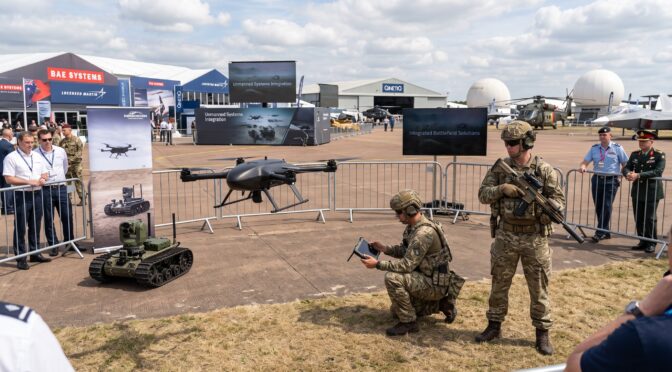
The 2026 Farnborough International Airshow offered a clear look at how the aerospace and defense sectors are reacting to today’s blend of conventional and unconventional conflicts. Although the event has traditionally focused on commercial flight, defense contractors and military delegations took up a much larger portion of the show this year. In fact, defense exhibitors made up nearly half of the record 1,636 participating companies—a noticeable jump from the usual 40%1. While commercial aviation still saw a massive £36.2 billion in orders on the first day, the real analytical heart of the exhibition was found in defense autonomy, tactical drones, and the modernization of infantry equipment1.
One major theme from the show was the industry’s push to fix the “cost exchange ratio” problem that currently plagues modern air defenses. To do this, companies are developing localized, autonomous, and cheaper ways to intercept threats. In the world of unmanned aerial vehicles (UAVs), the focus has moved away from expensive, one-of-a-kind platforms toward Collaborative Combat Aircraft (CCA) and “attritable” systems—tactical drones built to be deployed in large numbers even if they are lost in combat3. Platforms like the Anduril Thunder and Boeing MQ-28 Ghost Bat show how much progress has been made in autonomous flight and modular designs that don’t require traditional runways5. At the same time, the counter-drone (C-UAS) sector is diversifying. To stop fast, jet-powered attack drones, manufacturers are now using high-speed interceptor drones, airborne microwave systems, and adapted, low-cost missiles2.
In the small arms category, Farnborough 2026 put a spotlight on bringing artificial intelligence and microprocessing directly to the individual soldier. Systems like the SmartShooter SMASH and IWI ARBEL suggest we are moving from simple scopes to active fire control systems (FCS)9. By automating complex calculations and using smart trigger mechanisms, these tools turn standard rifles into the very first line of defense against short-range aerial threats11. This report breaks down the technical details and shifting strategies showcased at the event.
1. Introduction and Defense Industry Dynamics
Spanning 500,000 square meters, the 2026 airshow served as a clear sign of how military buying habits are changing12. The event highlighted a shift toward building systems that are both scalable and cost-effective. The sheer number of autonomous drones and interception technologies on display shows that the industry is moving away from old, expensive models to better handle modern, high-attrition warfare13.
This change is a direct reaction to what is happening on the ground in Eastern Europe and the Middle East. The massive use of various drone types and loitering munitions has put an incredible strain on traditional air defenses14. Because of this, the systems at Farnborough focused on two goals: creating air power that doesn’t rely on vulnerable runways and finding ways to defend against drones without spending millions of dollars on every shot6. The old way of using multi-million dollar missiles to stop cheap drones is being replaced by hybrid solutions ranging from microwave emitters to computerized rifles2.
2. Unmanned Aerial Systems: From Strategic to Tactical
The UAV platforms presented at Farnborough 2026 reflected a divergence in design philosophy. Development is splitting between sophisticated loyal wingmen intended to operate within contested airspace and attritable, high-volume tactical systems meant for logistics, decoy operations, and point strikes.
2.1 Collaborative Combat Aircraft (CCA) and Loyal Wingmen
The development of Collaborative Combat Aircraft (CCA) points toward a doctrine of distributed aerial lethality. These systems are designed to operate alongside manned fifth- and sixth-generation fighters, functioning as forward sensors, electronic warfare nodes, or weapons carriers.
Boeing showcased the MQ-28 Ghost Bat, marking the platform’s first appearance at Farnborough16. Developed initially with the Royal Australian Air Force, the MQ-28 utilizes artificial intelligence to support surveillance and combat capabilities independently or in formation12. The strategic utility of the Ghost Bat was validated by a partnership announcement between Boeing and Rheinmetall to integrate the MQ-28 into the German Air Force’s architecture by 20295. General Atomics also displayed a full-scale model of its FQ-42A Dark Merlin CCA.
At the multinational level, the Global Combat Air Programme (GCAP)—developed by Britain, Italy, and Japan—received £4.6 billion in funding in July 2026 to continue development toward a 2035 in-service date5. Canada was also announced as an observer to the GCAP program17. Within GCAP, participating nations are pursuing domestic CCA airframe development; notably, BAE Systems unveiled the UK-made Brontanax collaborative combat aircraft, positioned to meet the Royal Air Force’s Storm Fighter requirement4.
2.2 Runway Independence and Hybrid VTOL Platforms
A recurring vulnerability identified in recent conflicts is the susceptibility of static airbases and conventional runways to long-range precision fires. Consequently, there is an industrial pivot toward runway-independent platforms that can disperse combat power.
Anduril Industries, in partnership with Archer Aviation, unveiled the “Thunder” Group 5 autonomous attack rotorcraft6. The Thunder utilizes a hybrid-electric powertrain and an optimum-speed tiltrotor (OSTR) configuration, allowing for vertical takeoff and landing (VTOL) followed by forward flight5. The system is capable of self-deployment on a global scale but can also be packed and transported in standard shipping containers5. Its modular internal main and nose payload bays can accommodate precision munitions, electronic warfare payloads, counter-UAS force protection modules, or cargo5. Powered by Anduril’s Lattice for Mission Autonomy software, the Thunder can coordinate effects and act on pilot intent at machine speed5.
Beyond Vision similarly highlighted VTOL capabilities with its Class 3 BVT516 (VTOne) hybrid fixed-wing drone18. BETA Technologies exhibited the MV250 military version of its A250 tiltrotor, developed with a GE Aerospace turbogenerator engine and incorporating Lockheed Martin’s MATRIX autonomy suite for logistics missions.
2.3 Heavy-Lift, Logistics, and Tactical Strike UAVs
At the tactical and logistical level, the focus remains on payload capacity, range, and cost-imposition tactics.
| Platform | Manufacturer | Primary Function | Key Specifications |
| AR6 Family | TEKEVER | Heavy Lift / Logistics | 200 kg payload capacity, 500 km range. |
| ULTRA | Windracers | Dual-Use Heavy Lift | Autonomous logistics, rapid rigging and deployment in challenging environments19. |
| Liutyi | UDI (Ukraine) | Deep Strike / Decoy | Fixed-wing, 50-150 kg payload. Displayed with four 20 kg warhead missiles20. |
| Astore Levante | Leonardo / Baykar | Strike / Surveillance | Based on the TB3 platform. |
The Ukrainian Defence Industry (UDI) presented the Liutyi fixed-wing UAV, demonstrating a shift toward complex deep-strike and decoy operations21. The Liutyi, capable of carrying a 50-150 kg payload, was showcased with four wing-mounted missiles21. UDI representatives outlined an operational doctrine for the Liutyi: utilizing the platforms in a loitering decoy mode near adversarial borders21. By launching munitions from the UAV, operators force enemy air defense radars to activate and expend interceptors21. UDI noted that large-scale barrage attacks often utilize 50 or more decoy UAVs preceding the main strike package21.
3. Counter-Unmanned Aerial Systems (C-UAS): Shifting the Cost Curve
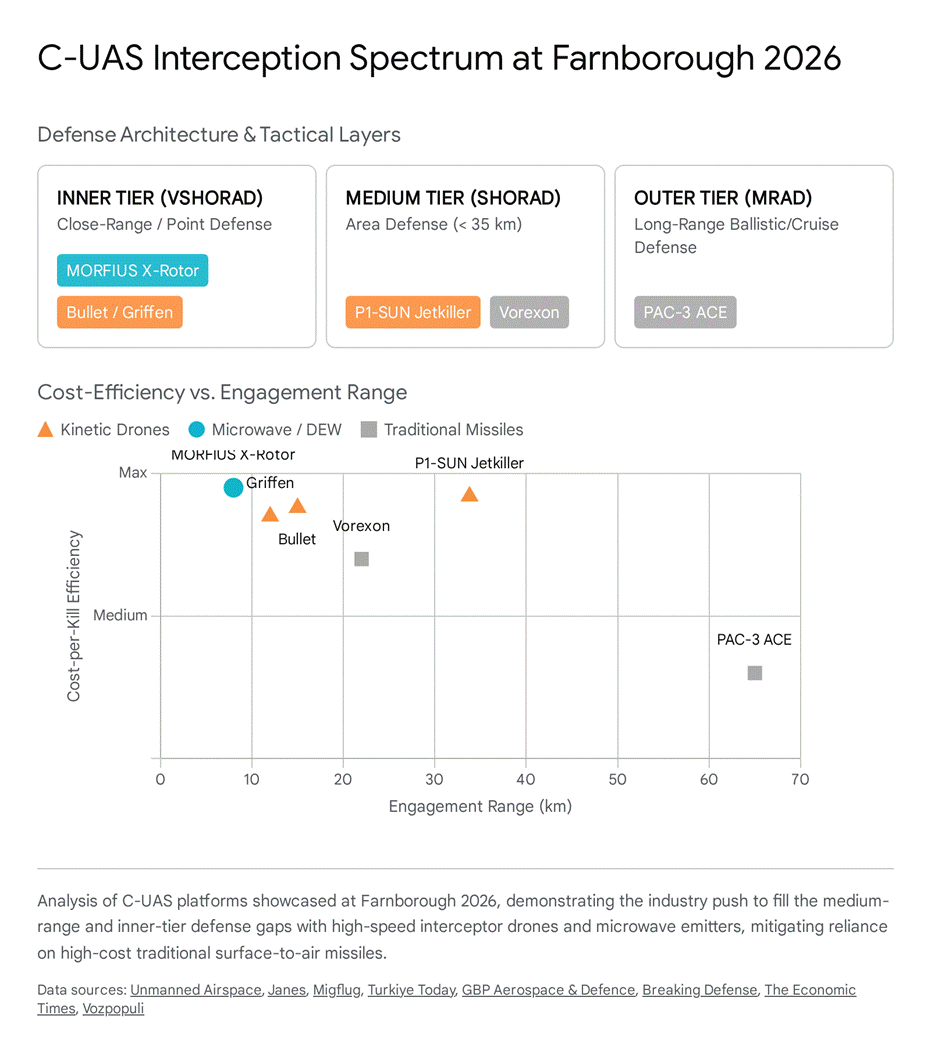
The primary defense theme at Farnborough 2026 was the requirement to counter the proliferation of UAVs. The industry is focused on addressing the economic asymmetry of using multi-million dollar interceptors against highly attritable threat drones2. The C-UAS market, valued at $2.08 billion in 2025, is projected to reach $19 billion by 20353.
3.1 High-Speed Kinetic Interceptor Drones
The introduction of jet-powered attack drones, such as upgraded Shahed variants capable of reaching 500 km/h, has reduced the reaction time for ground-based air defenses22. Propeller-driven interceptors are increasingly ineffective against these targets due to speed compression, creating a requirement for high-speed, drone-on-drone kinetic interceptors.
Ukrainian firms displayed several solutions to this specific threat matrix. Skyfall unveiled the P1-SUN Jetkiller, an interceptor drone capable of speeds up to 370 km/h and an operational altitude of 9,000 meters8. Designed to intercept targets within a 30 km range, the Jetkiller carries a 500-gram warhead and can remain airborne for 15 minutes24. Because high-closure-rate intercepts leave minimal margin for human operator error, the AI system autonomously detects, tracks, and locks onto targets at distances up to one kilometer. The base P1-SUN model reportedly intercepted over 5,500 drones since November 2025, and Skyfall plans to mass-produce the Jetkiller at a rate of 50,000 units per month starting in August 202615.
Other manufacturers also highlighted jet-powered interceptors to meet this speed requirement. Firebolt Engineering presented the Griffen, currently capable of 350 km/h but developing a new engine with Dynamic Propulsion to reach 400 km/h23. General Cherry showcased the Bullet interceptor, targeting speeds between 400 and 500 km/h. Rafael Advanced Defense Systems presented its family of kinetic interceptors, including the Hunter Eagle and Ghost Hunter, designed to provide hard-kill solutions for unmanned aerial threats16.
3.2 Airborne Microwave and Directed Energy Solutions
Non-kinetic and directed energy effectors offer an alternative method for achieving favorable cost exchange ratios against drone swarms. Lockheed Martin introduced the MORFIUS X-Rotor, an airborne, reusable high-power microwave (HPM) system2.
The MORFIUS X-Rotor is designed to navigate into a swarm and emit microwave energy, disabling the electronic circuitry of over 50 hostile drones in a single flight before returning to base18. The system is sensor and command-and-control agnostic, meaning it does not require a dedicated fire-control radar and can integrate into existing air defense networks18.
Rafael highlighted a layered directed-energy architecture, featuring the Iron Beam (a 100kW class high-energy laser weapon system), Iron Beam 450, Iron Beam-M, and Lite Beam26. The integration of Iron Beam into the Iron Dome battle management system (MiCAD) allows commanders to allocate threats between laser engagements and kinetic interceptors. MBDA also exhibited its Sky Warden modular system, featuring the CILAS HELMA-P laser weapon, omni and directional jammers, and hit-to-kill interceptors.
3.3 Adapted and Lower-Cost Surface-to-Air Missiles (SAMs)
Recognizing that legacy SAMs remain critical for defeating cruise and ballistic missiles, manufacturers are developing lower-cost variants to sustain magazine depth. Lockheed Martin unveiled the Patriot Advanced Capability-3 Adapted Capability Effector (PAC-3 ACE)2. The ACE interceptor utilizes the existing PAC-3 software and fire control infrastructure but is manufactured at less than half the cost of the standard PAC-3 Missile Segment Enhancement (MSE) variant (reported at approximately $2 million versus $4 million)2. It is designed to counter airbreathing threats, cruise missiles, and short-range ballistic missiles using a blast fragmentation warhead27.
MBDA displayed the Counter Mass Interceptor (CMI), a lower-cost SAM integrated into the Supacat Raven 5 short-range air defense (SHORAD) vehicle29. By pairing two lower-cost CMI missiles (for the VSHORAD layer under 10 km) with standard SL ASRAAMs (for the 10-20 km SHORAD layer), the system provides a tiered defense capability that prevents the over-expenditure of high-tier munitions on low-tier threats.
Destinus previewed the Vorexon, a Mach 2 ground-based interceptor specifically designed to provide selective point defense against artillery rockets, cruise missiles, and glide bombs at ranges beyond 20 km30. Intended to complement existing counter-battery systems by 2027, the Vorexon operates within an integrated sensor network, utilizing external radars for midcourse updates before an active radar seeker initiates terminal homing. Additionally, X-Bow Systems unveiled the Buckler interceptor, designed to defeat Group 3 UAS with a price point under $100,000.
4. Small Arms and Infantry Anti-Air Modernization
One of the most interesting trends at Farnborough 2026 was the way advanced fire control systems (FCS) are moving from heavy vehicles down to individual infantry weapons, a shift visible across the small arms optics31 industry. This change effectively turns standard issue rifles into capable anti-drone tools.
4.1 The Shift from Volume Fire to Precision Optics
Traditionally, soldiers have tried to stop drones using “volume fire”—basically firing long, continuous bursts at a point in front of the drone’s path32. While this can work, it wastes ammo, gives away the shooter’s position, and is often ineffective against small, fast drones.
To solve this, optics makers are now putting AI and smart triggers into rifle sights, replacing old methods with computerized precision11. Infantry units are also pairing these sights with handheld jammers. For instance, the DroneBuster Block 4 can detect and scramble drones across a wide frequency range, giving a squad a non-kinetic way to defend themselves.
4.2 Advanced Fire Control Systems (FCS)
SmartShooter’s SMASH series exemplifies this precision capability. Mounted on standard Picatinny rails, the optic allows the user to visually acquire a target. The onboard computer calculates the target’s trajectory, the shooter’s movement, and environmental ballistics in real-time. The system utilizes a “lock and launch” trigger interlock; the operator depresses the trigger, but the weapon only discharges when the microprocessor determines the barrel is aligned for a guaranteed hit.
| SMASH Variant | Key Specifications and Operational Focus |
| SMASH 2000L | Weighs ~740g. Optimized for dismounted infantry. 72-hour battery life (3,600 assisted shots). Effective against small UAVs up to 250m. |
| SMASH 4X | Integrates 4x optical magnification and an upgraded processor for sharpshooters engaging Group 1 and 2 UAVs at greater distances. |
| SMASH Hopper | A 15kg remote weapon station equipped with SMASH fire control, mountable on vehicles or static defensive positions9. |
Operational deployments confirm the utility of these systems. The U.S. Joint Interagency Task Force 401 executed a $6.1 million contract for 210 SmartShooter Smash 2000LE systems34. The U.S. Marine Corps is also fielding the SMASH 2000L to deploying units, enabling standard M4 carbines to defeat small UAS35.
Israel Weapon Industries (IWI) advanced this concept further by unveiling the ARBEL computerized small arms system10. Rather than functioning solely as an optic, ARBEL integrates a computer-based platform and an electronic trigger mechanism directly into the weapon’s lower receiver (compatible with AR-15 platforms and the NEGEV LMG)1. The system senses operator fatigue and micro-movements, firing at the optimal millisecond to achieve an 80-90% hit rate on moving targets1. Operating independently of specific optics and boasting a 60-hour battery life, ARBEL enhances infantry lethality and effectively counters short target lifespans1.
4.3 Autonomous Robotic Infantry Support
While smart optics enhance human operators, Allen Control Systems (ACS) introduced the “Bullfrog,” an AI-enabled autonomous robotic gun designed to mitigate human targeting limitations36. Mounted with a 7.62mm M240 machine gun on a rotating turret, the Bullfrog utilizes proprietary computer vision software and high-end motor encoders to track drones pulling rapid accelerations (up to 5Gs)29.
At under 400 pounds, it is deployable on Joint Light Tactical Vehicles (JLTVs), providing mobile ground units with automated defense against FPV drones29.
4.4 Next-Generation Infantry Rifles and Ammunition
Underpinning the optics revolution is the modernization of the base kinetic platforms across global small arms markets37. The UK Ministry of Defence is preparing for Project Grayburn, seeking 170,000 new weapon systems to replace the aging SA80 assault rifle family38. Beretta Defense Technologies (BDT) positioned its New Assault Rifle Platform (NARP) and Sako Arctic Rifle Generation (ARG) for this tender, emphasizing modularity, multi-caliber flexibility, and domestic UK production capacity26.
Simultaneously, the integration of the US Army’s Next Generation Squad Weapon (NGSW) program was highlighted, featuring the XM7 rifle (replacing the M4) and XM250 light machine gun (replacing the M249)39. Chambered in the high-velocity 6.8x51mm cartridge and paired with the XM157 fire control optic, these platforms provide the ballistic energy necessary to defeat modern body armor at extended ranges while natively supporting the smart optic paradigm.
Other notable small arms developments included Grand Power’s M4M1 carbine, the new standard-issue 5.56x45mm rifle for the Slovak Armed Forces40. MKU and Thales formalized strategic cooperation to co-develop optronic devices and manufacture the F90 close-quarter battle (CQB) rifle in India41.
In parallel with rifle modernization, specialized C-UAS ammunition is being developed to increase hit probabilities. Slow Shot LLC demonstrated a low-collateral-damage 12-gauge shotgun round designed specifically for engaging drones in populated areas without causing unintended downstream impacts. Testing has also occurred on specialized 5.56mm cartridges designed to lose gyroscopic stability after 10-15 meters, creating a wide “cone of destruction” to act similarly to a shotgun blast at close range.
5. Ground Platform Integration and Power Requirements
The integration of advanced optics, directed energy weapons, and expansive sensor suites places significant power generation demands on modern tactical vehicles. The U.S. Army’s Infantry Squad Vehicle (ISV-H) competition reflects this engineering challenge. The Army awarded prototype contracts to Ford, GM Defense, and BC Customs to develop an ISV capable of exporting 60 kW of continuous high-voltage DC power42. This substantial power load is explicitly required to allow soldiers to operate counter-drone systems, electronic warfare modules, and directed energy weapons directly from the vehicle.
Other armored platforms on display demonstrated modular approaches to force protection. General Dynamics showcased the AJAX Armoured Fighting Vehicle for the British Army, designed to accommodate mission-specific command-and-control and surveillance systems21. The Patria 6×6 Armored Personnel Carrier offered an amphibious, modular chassis capable of integrating with heavy mortar systems while providing STANAG Level 2 to Level 4 ballistic protection.
Beyond vehicular integration, data display technologies for personnel are advancing. Zeiss showcased holographic cockpit and cabin displays, utilizing microoptical engineering to embed wide-field, high-brightness data directly into transparent surfaces and Head-Up Displays43. Project Flytrap (Iteration 5.0, scheduled for March-April 2026) evaluates the integration of these technologies—combining RF detection, jamming, smart optics, and kinetic shooters—into a cohesive, layered C-UAS network for forward-deployed land forces.
6. Conclusion
The 2026 Farnborough Airshow proved that the defense industry is now prioritizing endurance, scalability, and economic sense. As drone technology splits into high-end wingmen and mass-produced strike drones, defense systems must adapt. The industry is meeting this challenge with reusable microwave platforms, high-speed interceptors, and more affordable missile variants.
Ultimately, putting AI-powered fire control into the hands of individual soldiers closes a major gap in modern defense. By moving from wasteful “volume fire” to guaranteed precision, ground forces are building a much more sustainable and decentralized way to protect themselves from unmanned threats.
Master Summary Table: Key Systems and Technologies Profiled
| Category | System / Platform | Manufacturer | Key Technological Advancements | Primary Operational Function |
| UAV / CCA | MQ-28 Ghost Bat | Boeing | AI integration, loyal wingman teaming | Surveillance, EW, fighter support5 |
| UAV / CCA | Brontanax | BAE Systems | UK-domestic autonomous wingman | Meeting RAF Storm Fighter requirement1 |
| UAV / CCA | Thunder | Anduril / Archer | Hybrid-electric, VTOL, runway independent | Long-range strike, logistics5 |
| UAV / Strike | Liutyi | UDI (Ukraine) | 50-150kg payload, multi-missile mount | Decoy operations, deep strike21 |
| C-UAS Kinetic | P1-SUN Jetkiller | Skyfall | 370 km/h top speed, AI terminal guidance | High-speed drone interception19 |
| C-UAS Directed | MORFIUS X-Rotor | Lockheed Martin | Airborne, reusable high-power microwave | Drone swarm neutralization18 |
| C-UAS / EW | DroneBuster Block 4 | DZYNE | RF detection, wideband jamming, GNSS spoofing | Handheld anti-drone disruption |
| Air Defense | PAC-3 ACE | Lockheed Martin | Half the cost of PAC-3 MSE, identical software | Cost-effective missile interception42 |
| Air Defense | Raven / CMI | MBDA / Supacat | Mixed SL ASRAAM and lower-cost CMI loadout | Multi-layered SHORAD/VSHORAD |
| Small Arms | SMASH 2000L / 4X | SmartShooter | Trigger-interlock, AI trajectory tracking | Precision infantry C-UAS optic |
| Small Arms | ARBEL | IWI | Computerized lower receiver, electronic trigger | Moving target accuracy enhancement1 |
| Robotics | Bullfrog | Allen Control Sys. | Autonomous tracking, 5G acceleration handling | Miniaturized, precise CIWS defense29 |
| Infantry Rifles | NARP / ARG | Beretta / Sako | Multi-caliber flexibility, modularity | UK SA80 Replacement candidates26 |
| Infantry Rifles | XM7 / XM250 | SIG Sauer | 6.8x51mm cartridge, integrated XM157 fire control | US Army Next Gen Squad Weapon |
Please share the link on Facebook, Forums, with colleagues, etc. Your support is much appreciated and if you have any feedback, please email us in**@*********ps.com. If you’d like to request a report or order a reprint, please click here for the corresponding page to open in new tab.
Sources Used
- Farnborough highlights future war as drones, AI and space reshape air power – Chosunbiz, https://biz.chosun.com/en/en-science/2026/07/26/NHMTEMKQLJDS3GO3NXOYHBL6JQ/
- Lockheed unveils cheaper Patriot interceptor at Farnborough – Türkiye Today, https://www.turkiyetoday.com/world/lockheed-unveils-cheaper-patriot-interceptor-at-farnborough-3224271
- FirstFT: Hopes for Strait of Hormuz deal grow, https://www.ft.com/content/30e02828-a59e-4121-8956-8cb1c29742d6?syn-25a6b1a6=1
- Next-Generation Combat Systems, Industrial Integration Governance, and Canadian Observer Participation in the Global Combat Air Programme (GCAP)|Takumi – note, https://note.com/_takumi_inoue_/n/nad866c4841ac?hl=en
- Farnborough 2026: Drones, Fighter Jets and Sovereignty – Kyiv Post, https://www.kyivpost.com/post/80647
- Farnborough 2026: Anduril Industries unveils Thunder autonomous attack rotorcraft – Janes, https://www.janes.com/defence-intelligence-insights/defence-news/air/farnborough-2026-anduril-industries-unveils-thunder-autonomous-attack-rotorcraft
- Lockheed Unveils MORFIUS X-Rotor Counter-Drone System – GBP Aerospace & Defence, https://gbp.com.sg/stories/lockheed-unveils-morfius-x-rotor-counter-drone-system/
- Ukraine’s Skyfall unveils new drone interceptor to strike Russian Shaheds faster, https://breakingdefense.com/2026/07/ukraines-skyfall-unveils-new-drone-interceptor-to-strike-russian-shaheds-faster/
- Smart Shooter – Israel Electronics News, https://techtime.news/tag/smart-shooter/
- IWI Unveils World’s First Computerized Small Arms System revolutionizing Combat Lethality and Survivability – ADU – Aviation Defence Universe, https://www.aviation-defence-universe.com/iwi-unveils-groundbreaking-arbel-worlds-first-computerized-small-arms-system-revolutionizing-combat-lethality-and-survivability/
- Infantry-Portable Anti-Drone Options – European Security & Defence, https://euro-sd.com/2026/03/articles/armed-forces/49834/infantry-portable-anti-drone-options/
- Farnborough Int’l Airshow | Day 3 | Boeing Showcases MQ-28 Ghost Bat Drones – YouTube, https://www.youtube.com/watch?v=dGPiwB1nbPA
- Farnborough 2024 vs 2026: How Two Years Changed Everything | Fruition Group, https://www.fruitiongroup.com/resources/blog/farnborough-2024-vs-2026–how-two-years-changed-everything/
- Israeli military, defense firms race to find solution to FPV drone threats, https://breakingdefense.com/2026/05/israeli-military-defense-firms-race-to-find-solution-to-fpv-drone-threats/
- A tiny, cheap Ukrainian drone nicknamed ‘the bird’ is knocking Russian Shaheds out of the sky one after another – Vozpopuli, https://www.vozpopuli.com/indux/en/a-tiny-cheap-ukrainian-drone-nicknamed-the-bird-is-knocking-russian-shaheds-out-of-the-sky-one-after-another/8033/
- Frontline Flight: Farnborough Air Show 2026 – Defense Security Monitor, https://dsm.forecastinternational.com/2026/07/17/frontline-flight-farnborough-air-show-2026/
- Frontline Flight: Farnborough Air Show 2026, Day 2 – Defense Security Monitor, https://dsm.forecastinternational.com/2026/07/21/frontline-flight-farnborough-air-show-2026-day-2/
- Beyond Vision to Unveil Collaborative Autonomous Systems & Next-Generation Drones at Farnborough Airshow 2026 | UST, https://www.unmannedsystemstechnology.com/2026/07/beyond-vision-to-unveil-collaborative-autonomous-systems-next-generation-drones-at-farnborough-airshow-2026/
- Windracers ULTRA at Farnborough Airshow 2026, https://windracers.com/blog/windracers-farnborough-international-airshow-2026/
- Farnborough 2026: Ukrainian defence industry unveils Liutyi equipped with four missiles, https://www.janes.com/defence-intelligence-insights/defence-news/air/farnborough-2026-ukrainian-defence-industry-unveils-liutyi-equipped-with-four-missiles
- WHAT WILL DRIVE THE FUTURE OF LAND WARFARE? IAV 2026 VEHICLE EXHIBIT PREVIEW – Defence IQ, https://www.defenceiq.com/content-auto-download/69bac9c1a54023035202c080
- Ukraine Unveils P1-SUN Jetkiller, Built to Hunt Russia’s Jet-Powered Shaheds, https://united24media.com/war-in-ukraine/ukraine-unveils-p1-sun-jetkiller-built-to-hunt-russias-jet-powered-shaheds-20945
- As Russia deploys jet-powered Shaheds, companies turn to faster interceptor drones, https://m.economictimes.com/news/defence/as-russia-deploys-jet-powered-shaheds-companies-turn-to-faster-interceptor-drones/articleshow/132529327.cms
- New Ukrainian JetKiller drone can intercept targets at altitudes of 9 kilometers, https://english.nv.ua/russian-war/skyfall-unveils-jetkiller-interceptor-for-jet-powered-shaheds-50626135.html
- Ukrainian SkyFall unveils P1-SUN JetKiller interceptor for jet-powered Shahed drones – photos, video, https://www.pravda.com.ua/eng/news/2026/07/21/8045166/
- RAFAEL Highlights Combat-Proven Defence Portfolio at Farnborough Airshow 2026 – dbdc, https://dbdcgroup.com/rafael-highlights-combat-proven-defence-portfolio-at-farnborough-airshow-2026/
- PAC-3 ACE: Lockheed’s Half-Price Patriot Interceptor – MiGFlug, https://migflug.com/jetflights/lockheed-pac-3-ace-half-price-patriot-interceptor-farnborough-2026/
- Farnborough 2026: Lockheed Martin unveils PAC-3 ACE low-cost interceptor – Janes, https://www.janes.com/defence-intelligence-insights/defence-news/weapons/farnborough-2026-lockheed-martin-unveils-pac-3-ace-low-cost-interceptor
- Farnborough 2026: MBDA reveals CMI lower-cost SAM as Raven evolves further – Janes, https://www.janes.com/defence-intelligence-insights/defence-news/weapons/farnborough-2026-mbda-reveals-cmi-lower-cost-sam-as-raven-evolves-further
- Farnborough 2026 – Destinus unveils Mach 2 C-UAS/ artillery shell interceptor concept, https://www.unmannedairspace.info/counter-uas-systems-and-policies/farnborough-2026-destinus-unveils-mach-2-c-uas-artillery-shell-interceptor-concept/
- Small Arms Optics Analytics and Reporting – Ronin’s Grips, https://blog.roninsgrips.com/small-arms-optics-analytics-and-reporting/
- Using Small Arms to Defend against Unmanned Aircraft Systems (UAS) – The Last Line of Defense – The Lightning Press, https://www.thelightningpress.com/using-small-arms-defend-unmanned-aircraft-systems-uas/
- SMARTSHOOTER Wins Innovation Award for AI-Driven Precision Fire Control Solutions – Army Technology, https://www.army-technology.com/featured-company/smartshooter-smashfire-modular-ai-precision-fire-control-innovation/
- Joint Interagency Task Force Awards Critical Counter-UAS Contract – Department of War, https://www.war.gov/News/News-Stories/Article/Article/4443046/joint-interagency-task-force-awards-critical-counter-uas-contract/
- Marines to field new smart scope to help shoot down small drones – Task & Purpose, https://taskandpurpose.com/news/marines-smash-2000l-smart-scope/
- Pentagon Tests AI-Enabled Autonomous Robotic Gun to Tackle Drone Threats – Impact Lab, https://www.impactlab.com/2024/11/18/pentagon-tests-ai-enabled-autonomous-robotic-gun-to-tackle-drone-threats/
- AK-Series Rifles and Pistols: Analytics and Reporting – Ronin’s Grips, https://blog.roninsgrips.com/ak-series-analytics-and-reporting/
- Candidates line up to replace UK’s SA80 assault rifle – Janes, https://www.janes.com/defence-intelligence-insights/defence-news/defence/candidates-line-up-to-replace-uks-sa80-assault-rifle
- The XM7 rifles and XM250 LMGs are being delivered to the US Army – MILMAG, https://milmag.pl/en/the-xm7-rifles-and-xm250-lmgs-are-being-delivered-to-the-us-army/
- Eurosatory 2026: Grand Power M4M1 and offerings for security services – MILMAG, https://milmag.pl/en/eurosatory-2026-grand-power-m4m1-and-offerings-for-security-services/
- MKU Equipped To Deliver Solutions For Requirement In Electro-Optics And Protection With State Of The Art Solutions – Aviation Defence Universe, https://www.aviation-defence-universe.com/mku-equipped-to-deliver-solutions-for-requirement-in-electro-optics-and-protection-with-state-of-the-art-solutions/
- Ford, GM Defense, BC Customs to compete for US Army’s new infantry squad vehicle, https://www.defensenews.com/news/your-military/2026/07/29/ford-gm-defense-bc-customs-to-compete-for-us-armys-new-infantry-squad-vehicle/
- ZEISS brings holographic cockpit and cabin display concepts to Farnborough 2026 – Aerospace Global News, https://aerospaceglobalnews.com/news/zeiss-holographic-cockpit-cabin-displays-farnborough-airshow-2026/