
1. Executive Summary
This intelligence assessment evaluates the historical trajectory, semantic evolution, and current demographic distribution of American public opinion regarding socialism from the post-World War II era to 2026. Analysis of longitudinal polling data, including regular surveys by Gallup, the Pew Research Center, the General Social Survey (GSS), and the American National Election Studies (ANES), indicates that the American electorate’s perception of socialism has undergone a measurable shift. What was once a broad rejection rooted in Cold War geopolitics has transitioned into a polarized, demographically segmented landscape.
A key factor in this shift is semantic drift, influenced by generational replacement. In the immediate post-war era, the American public defined socialism almost exclusively as state ownership of the means of production, heavily conflating it with Soviet communism1. Today, a segment of the electorate—particularly Millennials and Generation Z—defines socialism in terms of social egalitarianism, expansive welfare states, and the Nordic model of social democracy1. Consequently, the stigma historically attached to the term has decreased among younger voters and the political left.
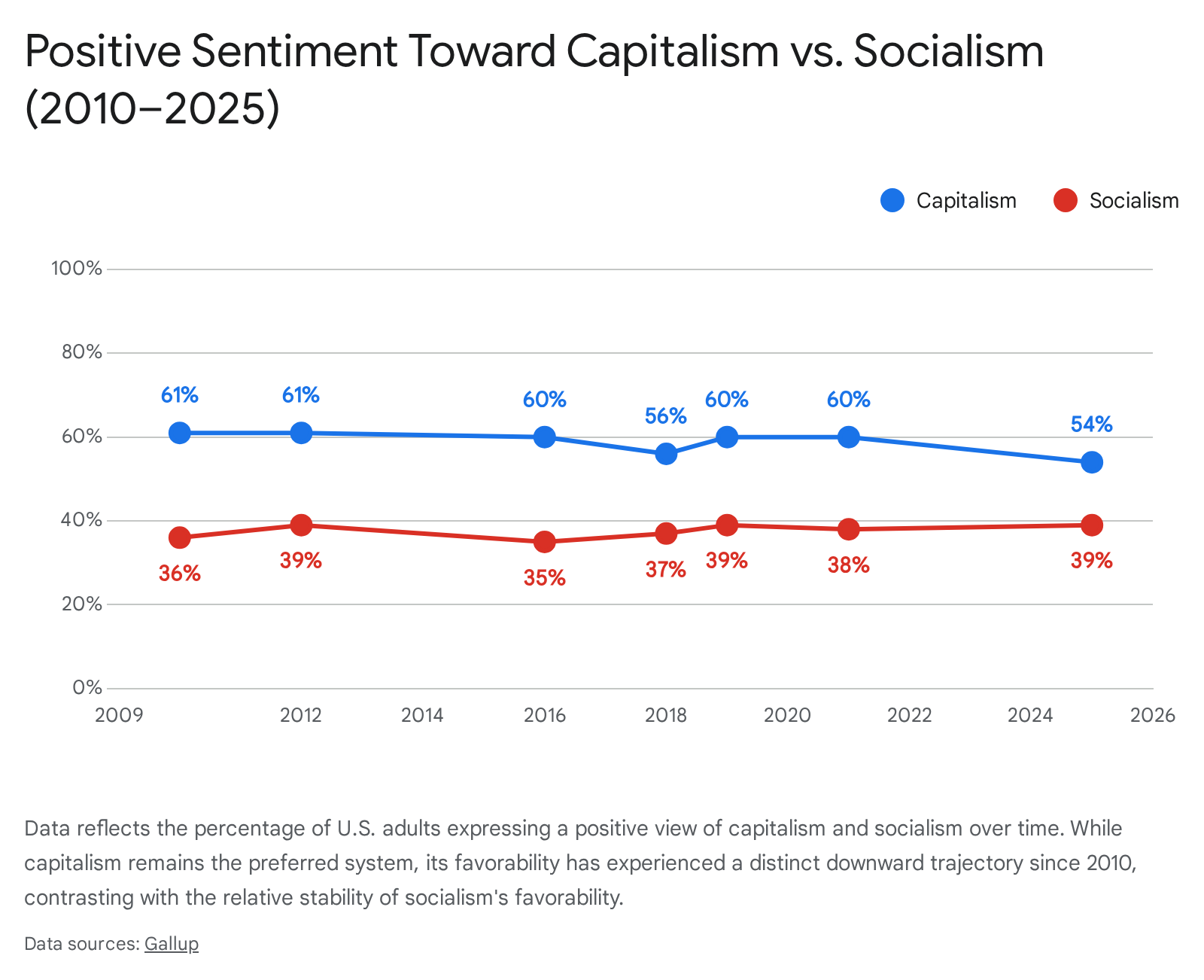
Simultaneously, confidence in capitalism has experienced a decline, driven by diminishing trust in large corporate institutions, stagnant middle-class wage growth, and concerns over wealth inequality following the 2008 Global Financial Crisis6. While capitalism remains the preferred economic system for a majority of Americans, positive sentiment decreased to 54% in 2025, while positive views of socialism stabilized at roughly 39% across the general population9.
This macro-level stability obscures internal polarization. The data reveals a substantial partisan divide: as of 2025, 66% of Democrats view socialism favorably, compared to 14% of Republicans9. This ideological bifurcation corresponds with demographic realignments, wherein high-status voters have increasingly aligned with the Democratic Party, correlating with a higher tolerance for state intervention and redistributive policies11.
The findings suggest that the domestic debate over socialism is less anchored to classical Marxist-Leninist frameworks. Instead, the term often functions as a proxy for debates over the social safety net, healthcare administration, wealth distribution, and the regulatory boundaries of free enterprise.
2. Historical Baseline: The Cold War Consensus and the Anti-Socialist Paradigm
To understand contemporary attitudes toward socialism, it is necessary to establish the post-World War II baseline. This era was characterized by an anti-socialist consensus influenced by the geopolitical realities of the Cold War and domestic political campaigns designed to associate state intervention with foreign ideologies.
2.1 The Semantic Anchoring of the 1940s and 1950s
In the years immediately following World War II, public opinion polling began to systematically capture American economic attitudes. A 1942 Roper/Fortune survey found that 40% of Americans believed socialism would be a “bad thing” for the country, while 25% viewed it as a “good thing,” and 34% held no opinion13. By 1949, as the geopolitical rivalry with the Soviet Union intensified, domestic opposition hardened. A 1949 Gallup poll revealed that 63% of the public wanted the country to move “less in the direction of socialism,” while only 14% desired a move toward socialism2.
The 1949 data provides insight into how the public defined the term during the early Cold War. When asked to explain their understanding of socialism, the most common response (34%) was “government ownership or control,” specifically citing state control of business, banks, and utilities2. Only 12% associated the term with “equality,” and just 2% defined it as the provision of social services or medicine2.
2.2 The “Socialized Medicine” Campaign
The strategic use of the term “socialism” in domestic policy disputes crystallized during the Truman administration. In 1945, President Harry S. Truman proposed a national health insurance program intended to alleviate physician shortages, lower medical costs, and provide income replacement for the severely ill14. Initial public polling indicated broad support, with a November 1945 Gallup poll showing 59% approval for the plan14.
The American Medical Association (AMA) launched an organized counter-campaign, retaining the political consulting firm Whitaker and Baxter to manage the opposition14. The firm adopted a strategy of labeling Truman’s plan as “socialized medicine” to align it with Cold War anxieties14. The AMA distributed over 43 million pieces of literature in 1950 alone, equating government health insurance with foreign totalitarianism2. This campaign successfully blocked the 1945 National Health Act and entrenched the term “socialist” as a standard critique used against federal interventions in the healthcare market15. When Medicare was enacted in 1965, its architects specifically designed it to apply only to the elderly to mitigate the “socialized medicine” stigma18.
2.3 McCarthyism and the Erasure of the Socialist Left
The 1950s saw the marginalization of the American socialist left during the Second Red Scare19. While the Socialist Party of America had occasionally captured between 3% and 6% of the presidential vote in the early 20th century under Eugene V. Debs, the Cold War environment rendered explicit socialist identification politically unviable2.
From 1937 to 1948, Gallup polls tracking party identification found approximately 1% of the public identifying as socialist2. By the mid-1950s, institutional socialism was virtually eliminated from mainstream electoral politics. A 1965 Gallup poll found that 37% of Americans identified the U.S. system as “capitalism,” while 31% identified it as “moderate socialism,” indicating some public recognition of the expanding welfare state, but pure socialism remained highly unpopular, garnering only 3% identification2.
3. Semantic Drift: Redefining Socialism (1990–Present)
The collapse of the Soviet Union in 1991 removed the primary geopolitical anchor that had defined socialism for the American public. In the ensuing decades, the definition of socialism has undergone a semantic shift, evolving from a strictly economic doctrine of state control to a broader concept associated with equity and state-sponsored benefits.
3.1 The Erosion of the Classical Definition
Longitudinal polling data highlights this definitional shift. When Gallup updated its 1949 question regarding the meaning of socialism in 2018, the results demonstrated a divergence from Cold War understandings1. In 1949, 34% of respondents defined socialism as government ownership of business and the means of production; by 2018, this figure had fallen by half, to 17%1.
Conversely, the percentage of Americans associating socialism with “equality” (including equal rights and the equal distribution of wealth) rose from 12% in 1949 to 23% in 20183. The association of socialism with the provision of benefits and free social services grew from 2% to 10%3.
Furthermore, 2020 survey data indicates that while 32% of Americans still identify socialism as a system where the government owns all property, a nearly equal segment (31%) defines socialism as a system allowing for a free market alongside a robust welfare state20.
| Concept Associated with “Socialism” | 1949 Polling Data | 2018 Polling Data | Trend |
| Government Ownership / Control | 34%2 | 17%1 | Decrease |
| Equality / Equal Distribution | 12%2 | 23%3 | Increase |
| Benefits / Free Social Services | 2%2 | 10%3 | Increase |
3.2 Competing Ideological Frameworks
The modern public understanding of socialism is heavily dependent on partisan affiliation and age. Research indicates that critics of socialism view the ideology through a historical lens, associating it with restrictions on individual freedom, stifled innovation, weakened work ethics, and the economic failures of states like Venezuela or the former Soviet Union21. Specifically, 62% of Republicans believe socialism “restricts people’s individual freedoms”21.
In contrast, proponents of socialism—predominantly younger adults and Democrats—view the ideology through a social-democratic lens1. They are more likely to describe socialism as a fairer system that ensures basic human needs (such as food, healthcare, and housing) are met21. When asked for examples of successful socialist states, these proponents frequently cite Nordic countries like Denmark and Finland21.
4. The Decline of Capitalist Sentiment and Big Business Trust
The shifting receptivity to socialism correlates with a decline in confidence in American capitalism, specifically regarding large corporate entities and systemic economic mobility.
4.1 The Macro Trend: Capitalism vs. Socialism
While capitalism remains the dominant and preferred economic system in the United States, its image has suffered a steady degradation over the last decade. According to Gallup, the percentage of Americans holding a positive view of capitalism peaked around 61% in 2010, but has slipped to 54% as of 20259.
Conversely, positive views of socialism have remained relatively flat on a macro level, hovering between 35% and 39% across the same fifteen-year period9. The divergence is illustrated below by tracking Gallup’s historical positive and negative sentiment polling.
The data indicates that a significant subset of the population does not view these economic systems as mutually exclusive binaries. Surveys show that approximately 21% to 25% of Americans hold positive views of both capitalism and socialism, suggesting an openness to a hybrid system that marries free-market innovation with state-sponsored social safety nets24.
4.2 The Decline of Trust in Big Business
While the American public generally favors the abstract concept of “free enterprise,” confidence in the mechanics of modern corporate capitalism has declined. Gallup polling reveals that in 2010, 49% of Americans held a positive image of “big business”7. By 2025, that figure decreased to 37%, with only 15% of Americans expressing a “great deal” or “quite a lot” of confidence in big business—one of the lowest readings since Gallup began tracking the metric in 19737.
This distrust spans the political spectrum. Only 17% of Democrats hold a positive view of big business26. While Republicans are traditionally more supportive of corporate entities, their assessments have also grown more negative in recent years26. In contrast, 70% of Americans report high confidence in small business, suggesting that the public’s grievance is focused on perceived corporate monopolization rather than commerce itself7.
4.3 Economic Anxiety and Class Divides
Economic trends have challenged the traditional narrative of upward mobility6. Since the 1970s, income inequality has widened, with real wages for the middle and lower classes experiencing relative stagnation6.
This expanding class divide correlates directly with societal happiness and political satisfaction. GSS data from 1972 to 2016 demonstrates a growing class divide in well-being, where high-socioeconomic status (SES) adults have maintained their life satisfaction while low-SES adults have seen a steady decline27. The perception of an unfair economic system has eroded the ideological support of traditional capitalism among younger cohorts28.
5. The Generational Divide: Millennials and Generation Z
The most prominent variable in contemporary attitudes toward socialism is age. The data reveals a generational divide, with Millennials and Generation Z exhibiting higher levels of support for socialism than older cohorts.
5.1 Receptivity to Socialism Among Youth
The absence of lived experience during the Cold War has altered how young Americans evaluate economic systems. Millennials (born 1981–1996) and Generation Z (born 1997–2012) evaluate socialism primarily through the context of recent economic experiences, which include the 2008 Global Financial Crisis and escalating student debt1.
According to a May 2025 Cato/YouGov survey, 62% of Americans aged 18 to 29 hold a favorable view of socialism, compared to a baseline of 43% for the general adult population19. Additionally, survey data showed that 49% of Gen Z and 47% of Millennials held favorable views of socialism, compared to just 39% of Generation X and 34% of Baby Boomers22. The Silent Generation remains highly opposed to socialism, reflecting their lifelong anchoring to the Cold War paradigm22.
| Generation | Positive View of Capitalism | Positive View of Socialism | Support Gradual Elimination of Capitalism |
| Generation Z | 52%22 | 49%22 | 31%22 |
| Millennials | 43%22 | 47%22 | 35%22 |
| Generation X | 58%22 | 39%22 | Insufficient Data |
| Baby Boomers | 62%22 | 34%22 | Insufficient Data |
| Silent Generation | 69%22 | 27%22 | Insufficient Data |
5.2 Conceptions of Fairness and Meritocracy
The appeal of socialism among younger demographics is closely linked to shifting perceptions of meritocracy. Recent studies indicate that younger adults are increasingly frustrated by what they perceive as unearned success and systemic economic inequality20. A 2022 survey found that 48% of Gen Z and roughly half of Millennials agree with the premise that “rewards and benefits in society should be distributed according to what people need, not what they produce,” whereas the broader adult population firmly rejects this notion20.
5.3 The Harvard Youth Poll Trajectory
Longitudinal data from the Harvard Youth Poll confirms an erosion of faith in capitalism among young adults. In 2016, the poll found that 51% of Americans aged 18 to 29 did not support capitalism, while 42% expressed support28. By 2025, support for capitalism among this demographic had fallen to 39% (down from 45% in 2020)33.
However, this decline in capitalist support does not uniformly translate into explicit support for orthodox socialism. The same 2025 Harvard Youth Poll indicated that support for the strict label of “socialism” was trending downward, sitting at 21% overall among the youth33. Yet, the label “democratic socialism” retained broader appeal, capturing 29% support overall and 63% support among young Democrats33.
6. Partisan Polarization and the New Realignment
While generational differences are evident, partisan affiliation remains the strongest predictor of economic ideology in the United States. Over the past fifteen years, the Democratic and Republican parties have experienced an ideological divergence regarding both capitalism and socialism.
6.1 The Democratic Embrace of Socialism
A notable shift in American public opinion over the last decade has been the increased acceptance of socialism within the Democratic Party. According to Gallup’s 2025 tracking data, 66% of Democrats view socialism favorably, a figure that has hovered near two-thirds since 20199.
Concurrently, Democratic support for capitalism has declined. In 2010, 51% of Democrats viewed capitalism favorably; by 2025, that number had fallen to 42%9. Consequently, Democrats are the only major partisan group that views socialism more favorably than capitalism, maintaining a 24-point preference gap for socialism as of 20259.
6.2 Republican Retrenchment and Independent Ambivalence
Conversely, the Republican Party remains a bastion of traditional capitalist support and anti-socialism. In 2025, 74% of Republicans expressed a positive view of capitalism, while only 14% held a positive view of socialism9. The Republican base views socialism primarily in negative terms, defining it by government overreach and the restriction of liberties3.
Political independents, who reached a record high of 45% of the U.S. adult population in 2025, occupy the middle ground34. Independents remain modestly more pro-capitalist (51%) than pro-socialist (38%)9. However, their support for capitalism has declined by 8 percentage points since 20219.
| Political Affiliation | Positive View of Capitalism (2025) | Positive View of Socialism (2025) | Net Capitalist Preference |
| Democrats | 42%9 | 66%9 | -24 points |
| Republicans | 74%9 | 14%9 | +60 points |
| Independents | 51%9 | 38%9 | +13 points |
6.3 Socioeconomic Realignments and Affective Polarization
The shifting attitudes toward socialism are intertwined with a broader demographic realignment. General Social Survey (GSS) and American National Election Studies (ANES) data from 1980 to 2020 reveal that high-status white voters—those with the highest decile incomes, college degrees, and white-collar jobs—have systematically moved toward the Democratic Party11.
As these affluent cohorts have realigned with the Democratic Party, they have adopted more favorable views toward state intervention, welfare expansion, and economic equality11. In 2024, GSS data showed that over 60% of Democrats believed it was the government’s responsibility to reduce economic inequality, compared to just 18% of Republicans35. Nearly 50% of Democrats called for increased welfare spending, representing an all-time high35.
Animosity between the political parties has become durable, persisting beyond election cycles36. In this environment, the term “socialism” acts as a cultural flashpoint. Evidence of this divide is clear in how the word is used: 46% of Baby Boomers consider calling someone a “socialist” an insult, compared to just 27% of Generation Z31.
7. Electoral Viability and Future Outlook
Despite the normalization of socialist sentiment among Democrats and the youth, the American public remains pragmatic regarding actual policy implementation.
7.1 Electoral Viability of Socialist Candidates
The word “socialist” retains a degree of electoral vulnerability at the national level. Gallup polling indicates that less than half of Americans (47%) would vote for a qualified presidential candidate who is a socialist, a figure that remained stagnant from 2015 to 201913. This is notably the lowest level of support for any tested demographic or ideological characteristic, trailing behind willingness to vote for an atheist (60%) or a Muslim (66%)37.
However, a 2024 YouGov poll revealed that when forced to choose between communism and fascism, 28% of Americans stated they would pick communism, while 17% chose fascism38. Among “very liberal” Americans, 61% chose communism, while among “very conservative” Americans, 37% chose fascism38. This data suggests that while the socialist label is a hurdle for mainstream candidates, fringe ideologies possess distinct traction among specific voting blocs.
7.2 The Normalization of Interventionist Policy
Moving forward, the debate over socialism in America will likely continue to center on the expansion of the welfare state rather than the nationalization of industry. Because younger generations decouple socialism from the authoritarianism of the Soviet Union, they are highly receptive to policies that redistribute wealth, tax corporations, and provide universal services. The success of these initiatives relies heavily on domestic branding, utilizing familiar terms to bypass the entrenched stigma of the word “socialism” among older, moderate voters.
8. Conclusion
The intelligence picture regarding American attitudes toward socialism is one of transition. The monolithic anti-socialist consensus forged during the Cold War has eroded. In its place, a fractured ideological landscape has emerged, defined primarily by age and partisan affiliation.
For the Republican Party and older generations, socialism remains a major concern, defined by the historical failures of the Soviet bloc and viewed as a mechanism for state control. For the Democratic Party, Millennials, and Generation Z, socialism has been increasingly associated with equality, environmental justice, and the expansion of the welfare state. This semantic shift allows a segment of the electorate to express support for socialism while simultaneously participating in private enterprise.
The driving force behind this shift is strongly correlated with a decline in confidence in contemporary capitalism. The perception of systemic inequality, coupled with a distrust of large corporations and stagnant upward mobility, has led nearly half the country to look outside traditional free-market orthodoxies for solutions to modern economic grievances. As generational replacement continues, the aversion to socialist-aligned policies will likely continue to evolve, reshaping the boundaries of American economic policy.
Master Summary Table
| Metric | Historical Data | Contemporary Data | Key Shift / Insight |
| Capitalism Favorability | 61% Positive (2010)9 | 54% Positive (2025)9 | Gradual erosion of support, primarily driven by Democrats and younger demographics. |
| Socialism Favorability | 36% Positive (2010)9 | 39% Positive (2025)9 | Macro-level stability obscures internal demographic polarization. |
| Democratic Partisanship | 50% favor Socialism (2010)9 | 66% favor Socialism (2025)9 | Democrats now favor socialism over capitalism (42%), indicating an ideological realignment. |
| Republican Partisanship | 19% favor Socialism (2010)9 | 14% favor Socialism (2025)9 | Republicans maintain a rigid anti-socialist stance (74% favor capitalism). |
| Definition of Socialism | 34% “Govt Ownership” (1949)2 | 17% “Govt Ownership” (2018)1 | Semantic drift: The public increasingly defines socialism as “equality” (23%) and “benefits” (10%). |
| Youth Sentiment (18-29) | 68% favor Capitalism (2010)20 | 62% favor Socialism (2025)19 | Shift in economic philosophy among Gen Z and Millennials, following the 2008 GFC. |
| Trust in Big Business | 49% Positive (2010)7 | 37% Positive (2025)7 | Anti-corporate sentiment; only 15% have high confidence in big business. |
| “Socialist” as an Insult | Not measured directly in mid-century | 46% Boomers vs. 27% Gen Z (2019)31 | The pejorative power of the word is lower among younger cohorts. |
Please share the link on Facebook, Forums, with colleagues, etc. Your support is much appreciated and if you have any feedback, please email us in**@*********ps.com. If you’d like to request a report or order a reprint, please click here for the corresponding page to open in new tab.
Sources Used
- Socialism: A short primer – Brookings Institution, https://www.brookings.edu/articles/socialism-a-short-primer/
- Gallup Vault: Americans’ Views of Socialism, 1949-1965, https://news.gallup.com/vault/240749/gallup-vault-americans-views-socialism-1949-1965.aspx
- The Meaning of “Socialism” to Americans Today – Gallup News, https://news.gallup.com/opinion/polling-matters/243362/meaning-socialism-americans-today.aspx
- Ben Carson says the number of Americans who ‘believe in socialism…is increasing’, https://www.politifact.com/factchecks/2015/aug/16/ben-carson/ben-carson-says-number-americans-who-believe-socia/
- What do Americans think socialism looks like? – YouGov, https://yougov.com/en-us/articles/32310-what-do-americans-think-socialism-looks
- Prisoners of the American Dream? Americans’ Attitudes toward Taxes and Inequality in the New Gilded Age – New York University, https://as.nyu.edu/content/dam/nyu-as/faculty/documents/PrisonersoftheAmericanDream.pdf
- How Do Americans Feel About Business? – Gallup News, https://news.gallup.com/poll/270296/americans-dislike-big-business.aspx
- “Opulence and Freedom”: What Adam Smith Could Teach Us about the Future of Capitalism | Social Philosophy and Policy, https://www.cambridge.org/core/journals/social-philosophy-and-policy/article/opulence-and-freedom-what-adam-smith-could-teach-us-about-the-future-of-capitalism/54537B2B0A51E02FAB59A63C58345940
- Image of Capitalism Slips to 54% in U.S. – Gallup News, https://news.gallup.com/poll/694835/image-capitalism-slips.aspx
- Image of Capitalism Slips to 54% in U.S., https://institutodelibertadeconomica.org/en/publications/image-of-capitalism-slips-to-54-in-u-s/
- Elites moved toward democrats more than nonelites moved away: Income, education, and occupational class in US presidential elections, 1980–2020 – PMC, https://pmc.ncbi.nlm.nih.gov/articles/PMC12974467/
- Culture wars and classism: Christian nationalism, economic position, and Americans’ approval of inequality | Social Forces | Oxford Academic, https://academic.oup.com/sf/advance-article/doi/10.1093/sf/soag034/8661693
- Four in 10 Americans Embrace Some Form of Socialism – Gallup News, https://news.gallup.com/poll/257639/four-americans-embrace-form-socialism.aspx
- Signing of the Medicare and Medicaid Act of 1965 | July 30, 2025 – Truman Library Institute, https://www.trumanlibraryinstitute.org/signing-of-the-medicare-and-medicaid-act-of-1965/
- Give ‘Em Health, Harry – PMC – NIH, https://pmc.ncbi.nlm.nih.gov/articles/PMC4364422/
- “The Voluntary Way is the American Way”: The AMA’s Campaign for Private Health Insurance, 1945–1950 | Journal of Policy History, https://www.cambridge.org/core/journals/journal-of-policy-history/article/voluntary-way-is-the-american-way-the-amas-campaign-for-private-health-insurance-19451950/83D90184942B0303EE9E04AA81AE00AA
- 69 years ago, a president pitches his idea for national health care – PBS, https://www.pbs.org/newshour/health/november-19-1945-harry-truman-calls-national-health-insurance-program
- Medicare for All’s Surprising Origins in Health Care – TIME, https://time.com/5586744/medicare-for-all-history/
- Socialism in the United States – Wikipedia, https://en.wikipedia.org/wiki/Socialism_in_the_United_States
- Millennials, Gen Zs, Capitalism, Socialism, and Confusion | Robert Whaples, https://www.independent.org/tir/2025-spring/millennials-gen-zs-capitalism-socialism-and-confusion/
- Modest Declines in Positive Views of ‘Socialism’ and ‘Capitalism’ in U.S., https://www.pewresearch.org/politics/2022/09/19/modest-declines-in-positive-views-of-socialism-and-capitalism-in-u-s/
- Moving Beyond Transactional Coursework to Enhance Student Success in University Classes – ScholarWorks, https://scholarworks.waldenu.edu/cgi/viewcontent.cgi?article=1798&context=jerap
- Socialism – Research and data from Pew Research Center, https://www.pewresearch.org/topic/politics-policy/political-ideals-systems/socialism/
- Stark partisan divisions in Americans’ views of ‘socialism,’ ‘capitalism’, https://www.pewresearch.org/short-reads/2019/06/25/stark-partisan-divisions-in-americans-views-of-socialism-capitalism/
- Deconstructing Americans’ Views of Socialism, Capitalism – Gallup News, https://news.gallup.com/opinion/polling-matters/358178/deconstructing-americans-views-socialism-capitalism.aspx
- What Americans think about socialism and capitalism, according to a new Gallup poll | The Associated Press, https://www.ap.org/news-highlights/spotlights/2025/what-americans-think-about-socialism-and-capitalism-according-to-a-new-gallup-poll/
- (PDF) The Expanding Class Divide in Happiness in the United States, 1972–2016, https://www.researchgate.net/publication/342376098_The_expanding_class_divide_in_happiness_in_the_United_States_1972-2016
- Young Americans aren’t as hostile to capitalism as they claim – CapX, https://capx.co/are-young-americans-as-hostile-to-capitalism-as-they-claim
- Today’s Young Adults Want to Redesign Capitalism. But Into What? – YES! Magazine, https://www.yesmagazine.org/economy/2018/04/05/todays-young-adults-want-to-redesign-capitalism-but-into-what
- Young Americans Like Socialism Too Much—That’s a Problem Libertarians Must Fix, https://www.cato.org/blog/young-americans-socialism-too-much-thats-problem-libertarians-must-fix
- Annual Report on US Attitudes Toward Socialism, Communism, and Collectivism, https://victimsofcommunism.org/wp-content/uploads/2019/12/VOC-YG_US-Attitudes-Socialism-Communism-and-Collectivism-2019.pdf
- 29th Edition – Spring 2016 | The Institute of Politics at Harvard University, https://iop.harvard.edu/youth-poll/29th-edition-spring-2016
- Harvard Youth Poll Reveals Mounting Strain on Young Americans — Financial, Institutional, and Social, https://iop.harvard.edu/press-releases/harvard-youth-poll-reveals-mounting-strain-young-americans-financial-institutional
- New High of 45% in U.S. Identify as Political Independents – Gallup News, https://news.gallup.com/poll/700499/new-high-identify-political-independents.aspx
- Socialist America? – George Hawley – Law & Liberty, https://lawliberty.org/socialist-america/
- Persistent polarization: The unexpected durability of political animosity around US elections, https://pmc.ncbi.nlm.nih.gov/articles/PMC11373587/
- Public Opinion Review: Americans’ Reactions to the Word ‘Socialism’ – Gallup News, https://news.gallup.com/opinion/polling-matters/287459/public-opinion-review-americans-word-socialism.aspx
- Would Americans choose communism or fascism? – YouGov, https://yougov.com/en-us/articles/50737-would-americans-choose-communism-or-fascism