
Executive Summary
Since the conclusion of the Second World War, the strategic architecture of the transatlantic alliance has been defined by an unwritten but structurally profound macroeconomic division of labor. Under this paradigm, the United States assumed the primary financial, operational, and nuclear burden of existential defense against external adversaries. Concurrently, Western European nations directed their vast fiscal resources inward, focusing on economic reconstruction and the establishment of the most expansive social welfare states in human history. This paradigm, initiated by the European Recovery Program (the Marshall Plan) and codified by the North Atlantic Treaty Organization (NATO), succeeded in its primary objective: stabilizing the European continent against Soviet communist expansion and preventing the resurgence of catastrophic intra-European warfare.
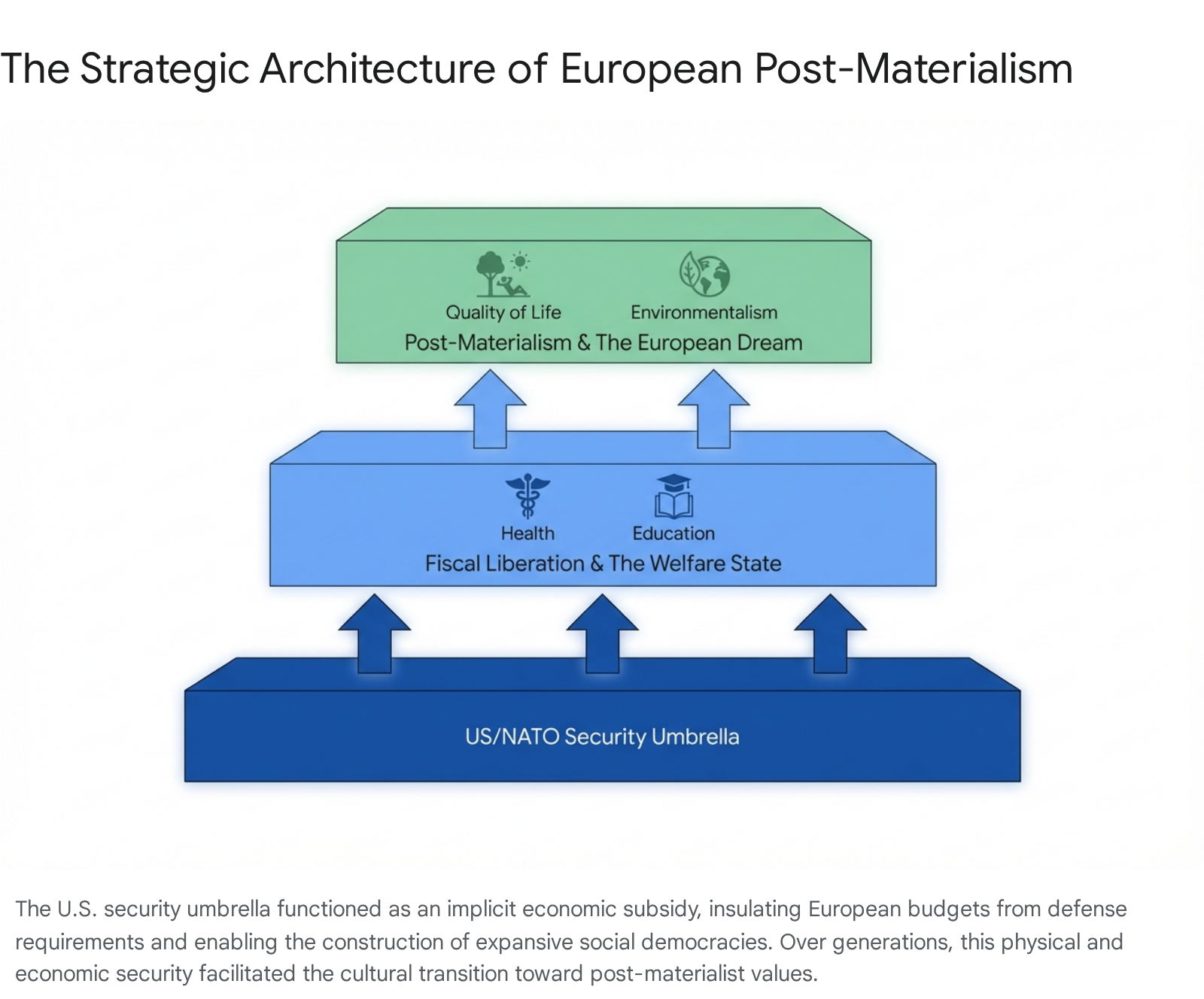
However, over the subsequent eight decades, this asymmetrical burden-sharing generated profound, second-order ideological and cultural consequences. The implicit financial subsidy provided by the United States’ security umbrella effectively shielded European governments from the severe “guns versus butter” fiscal trade-offs that have historically constrained sovereign states. Unburdened by the necessity of maintaining massive, self-sufficient military apparatuses, European nations were able to funnel an unprecedented percentage of their Gross Domestic Product (GDP) into public health, education, and social safety nets.
This intelligence assessment addresses two critical questions regarding the long-term sociological impacts of this paradigm. First, did the United States inadvertently create a “new breed of socialists” in Europe? The analysis indicates that the U.S. did not create orthodox Marxist socialists seeking the total abolition of private property; rather, it incubated a unique, highly successful form of “welfare capitalism” or social democracy. Over generations, the material security guaranteed by American hard power allowed European populations to adopt “post-materialist” values. These populations increasingly prioritized quality of life, environmentalism, social equity, and leisure over the aggressive accumulation of wealth and global military projection. The American capitalist engine underwrote European social democracy.
Second, does the European polity “look down” on the United States and its capitalist model? The evidence overwhelmingly confirms that they do. Culturally and politically, significant segments of the European populace and its elite have come to view the American socioeconomic model, characterized by hyper-capitalism, residual social safety nets, high inequality, and immense defense spending, with skepticism, aversion, and frequently, condescension. The “European Dream” of social cohesion and work-life balance is consistently contrasted favorably against an “American Dream” perceived as ruthlessly competitive, isolating, and focused entirely on financial accumulation.
Current intelligence from 2025 and 2026, however, indicates that this paradigm is actively collapsing. The return of large-scale conventional warfare to the European continent following the Russian invasion of Ukraine, coupled with the shifting, often transactional priorities of the United States under the second Trump administration, has forced a sudden and painful strategic reckoning in Europe. Nations like Germany are attempting a historic Zeitenwende (turning point), struggling to rapidly rearm while managing populations that fiercely resist reductions in the social welfare programs they have come to view as fundamental human rights. As the post-Cold War era ends, the transatlantic relationship is transitioning from a values-based alliance anchored by dependency into a highly volatile partnership defined by the friction between European strategic vulnerabilities and the reassertion of harsh geopolitical realities.
I. The Architectural Subsidization of the European Social State
To comprehend the ideological drift of the European continent, it is imperative to analyze the structural macroeconomic environment established by the United States after 1945. The modern European welfare state, while often viewed by contemporary Europeans as an intrinsic cultural achievement, was fundamentally enabled by American geopolitical strategy and financial subsidization.
The Marshall Plan: Capitalizing the Post-War State
In the immediate aftermath of World War II, Europe faced profound economic devastation. Cities lay in ruins, populations faced the bitter winter of 1946–1947 with minimal shelter or fuel, and the collapse of societal infrastructure created a highly fertile environment for communist exploitation.1 In 1947, recognizing that “the patient is sinking while the doctors deliberate,” U.S. Secretary of State George C. Marshall initiated a comprehensive program to rebuild the continent.2
Congress appropriated over $13.3 billion for the European Recovery Program, colloquially known as the Marshall Plan.1 This was not an act of mere philanthropy; it was a calculated strategic maneuver. It was driven by the “Crawford thesis,” which sold the plan to the U.S. Congress by framing it as a strategic partnership where American businesses would provide technology and materials to Europe, effectively creating reliable trading partners while containing the Soviet threat.4 The Marshall Plan generated a resurgence of European industrialization, pushed Europeans toward political and economic cooperation, and institutionalized U.S. foreign aid.1
Most importantly, U.S. policymakers were convinced that only a prosperous, socially stable Europe could resist the appeal of communism.5 By successfully engineering this rapid economic revival and emphasizing social stability to counter the Soviet threat, the United States provided the foundational capital for European states to build robust, interventionist public sectors. The modern European welfare state is a direct byproduct of the transformative, disruptive nature of the Second World War, and the U.S. financial backstop excused the broad-based tax increases necessary to fill the gap with public funds.6
NATO and the Reversal of the “Crowding Out” Effect
The economic concept of the production possibility frontier dictates that a society’s output is divided between “guns” (defense) and “butter” (civilian goods and social welfare).7 Historically, the European continent was defined by the relentless need to fund “guns,” leading to cycles of devastating conflict. The establishment of NATO in 1949 fundamentally altered this calculus for Western Europe.
By stretching its nuclear and conventional security umbrella over Western Europe, the United States absorbed the immense, existential costs of containing the Soviet Union.8 Econometric studies consistently demonstrate a “crowding-out” relationship between military spending and social welfare expenditures.11 High military spending inherently reduces available public resources for education, healthcare, and social protections.13 Because the United States assumed the burden of defense spending, European nations experienced this phenomenon in reverse: the absence of massive defense requirements resulted in a massive “crowding in” of social programs.15
During the 1950s and through the Vietnam era, U.S. defense spending frequently hovered between 8% to 10% of its GDP, a massive allocation of national resources.16 Even after the Cold War, current U.S. military spending remains historically high in absolute terms, approaching $850 billion annually, representing roughly 3% of national income and half of all federal discretionary budget outlays.16 In stark contrast, Western European nations were liberated from the necessity of matching Soviet or global military expenditures.
Analysts at the Hoover Institution and other geopolitical think tanks have long noted the “moral hazard” and “free-riding” implications of this arrangement.17 Protected by the U.S. military, Western Europeans constructed the most elaborate welfare states known to history using resources they would otherwise have been forced to allocate to their own territorial defense.15
Comparative Resource Allocation
The resulting divergence in fiscal allocation is stark. The United States effectively traded its own potential welfare state expansion to fund global security, while Europe capitalized on that security to build a comprehensive social safety net.15 A historical review of Organisation for Economic Co-operation and Development (OECD) data reveals that while U.S. public social spending remained relatively low, European public social expenditure routinely climbed to account for roughly one-fifth to one-third of their national GDPs.21
| Welfare Model Type | Representative Nations | Defining Characteristics of Social Expenditure |
| Social-Democratic | Sweden, Norway, Denmark | Universal access, high taxation, extensive public services, high gender egalitarianism.23 |
| Corporatist-Conservative | Germany, France, Austria | Benefits tied to employment status, focus on family preservation, strong non-profit collaboration.23 |
| Liberal (European context) | United Kingdom | Means-tested assistance combined with massive public infrastructure (e.g., National Health Service).23 |
| Residual (U.S. Model) | United States | Limited public safety net, reliance on employer-sponsored benefits, high reliance on consumer credit.23 |
In all European variations, the state assumes a massive redistributive role, aiming to support individuals facing poverty, unemployment, or old age by redistributing resources across households.26 This structural reality was made politically and economically viable because the existential threat to the state was mitigated by an external guarantor, the United States.
II. Societal Value Shifts: The Emergence of Post-Materialism and the “European Dream”
The sustained period of unprecedented peace and subsidized prosperity in Western Europe from 1945 to the end of the Cold War triggered a profound sociological transformation. By isolating European civilian populations from the harsh realities of geopolitical survival, the transatlantic architecture fostered a cultural evolution that gradually alienated European values from American ones.
The Inglehart Hypothesis and Intergenerational Change
The shift in European values is best understood through the lens of “post-materialism,” a sociological concept popularized by political scientist Ronald Inglehart in his 1977 work, The Silent Revolution.27 The core thesis, built upon the scarcity hypothesis and the socialization hypothesis, posits that when generations grow up under conditions of extreme economic and physical security, where basic survival is taken for granted, their value systems undergo a fundamental transformation.27
Prior to World War II, European societies were highly “materialist,” prioritizing physical security, economic growth, and military strength out of sheer necessity.27 However, the post-war generations, shielded by the NATO umbrella and sustained by robust welfare states, experienced an intergenerational value replacement.27 By the 1990s, populations in advanced European industrial societies heavily favored “post-materialist” goals: environmental protection, quality of life, gender equality, autonomy, and work-life balance.27
Data from extensive longitudinal studies demonstrates that while materialists outnumbered post-materialists in Western Europe by a ratio of 4 to 1 in 1970, this ratio fell dramatically as younger generations came of age.29 By the mid-1990s, post-materialists had become almost as numerous as materialists, shifting societies heavily toward secular-rational and self-expression values.28 While the American electorate experienced a similar trend, the U.S. retained a much higher degree of traditional and materialist values, continuously prioritizing economic dynamism and national security to a greater extent than their European counterparts.28 The accepted wisdom in political science notes that class divisions that defined the left and right until roughly 1970 were replaced by these cultural issues, though recent far-right resurgences complicate this narrative.30
The “European Dream” versus the “American Dream”
This sociological divergence culminated in the formulation of a distinct continental identity, often conceptualized as the “European Dream.” As articulated by economist Jeremy Rifkin, the European Dream stands in direct contrast to the American Dream.31
While the American Dream emphasizes individual autonomy, upward mobility, and the accumulation of wealth, the idea that anyone can succeed through hard work and self-reliance, the European Dream prioritizes community, sustainable development, deep social safety nets, and the quality of life.31 Europeans tend to view the American concept of freedom as fundamentally isolating; in the American ethos, to be free is to be autonomous and untethered from external control.31 In contrast, the European framework views true freedom as being embedded in a secure, supportive community where the state protects individuals from the harsh, coercive consequences of market failures.31 As one analysis notes, freedom from necessity and coercion by necessity is the central animating ideal of the European social model.34
Extensive polling of European citizens confirms this ideological preference. Europeans consistently identify greater financial security and free time as the primary keys to happiness, harboring deep desires to strengthen, not weaken, their welfare models.32 There is near-universal consensus in Europe for massive public investment in healthcare, education, and pensions.32 In contrast to the American focus on competition and performance, European respondents overwhelmingly favor solidarity and equality.32 Rifkin famously summarized this dichotomy by asserting that while the American dream may be worth dying for, the new European dream is worth living for.32
Did the U.S. Create a “New Breed of Socialists”?
To directly address the intelligence query: Did the United States inadvertently create a “new breed of socialists”? The evidence suggests a highly nuanced reality. Europe did not embrace Soviet-style state communism or orthodox Marxism, which seeks the total public ownership of the means of production.35 Rather, it embraced democratic socialism and social democracy, systems that operate within a global capitalist framework but impose massive regulatory, redistributive, and labor-empowering mechanisms.35
The history of democratic socialism traces back to the 19th century, heavily influenced by the gradualist form of socialism promoted by the British Fabian Society and Eduard Bernstein’s evolutionary socialism in Germany.35 Following the rise of authoritarian Soviet socialism, “democratic socialism” became a distinct philosophy aimed at balancing market efficiency with extreme public welfare.35
The critical insight is that this European social democracy was parasitic upon, or at least heavily subsidized by, American capitalism. Because the American engine stayed fiercely capitalist, generated massive technological innovation, and assumed the global security burden, Europe could “afford” to integrate socialist principles into its governance without suffering the geopolitical vulnerabilities that usually accompany massive diversions of state resources away from defense.37 In essence, American hyper-capitalism made European democratic socialism possible.37
The contemporary youth of Europe (Generation Z and Millennials) exhibit a distinct political socialization driven by these realities.38 While older generations remember the failures of the Soviet bloc and the Cold War, younger cohorts across both the U.S. and Europe increasingly view the term “socialism” not as an authoritarian threat, but as a proxy for universal healthcare, affordable housing, and climate action.37 However, in Europe, these concepts are not radical insurgencies; they are the established baseline of the social contract.38
III. Ideological Friction: European Condescension Toward American “Hyper-Capitalism”
The structural divergence in economic models has generated significant, long-standing cultural friction. Empowered by the internal success of their social market economies and shielded from external threats, European elites and publics have developed a distinct superiority complex regarding the United States. The intelligence confirms that there is a pervasive tendency to “look down” on American society, viewing it as a cautionary tale of unchecked capitalism and social dysfunction.24
The Academic and Cultural Critique of “Hyper-Capitalism”
In European sociological, legal, and economic discourse, the United States is frequently depicted as the epicenter of “hyper-capitalism” or neoliberalism run amok.44 European sociologists argue that the American model has rendered capitalism invisible, treating extreme individualism, entrepreneurialism, and zero-sum rivalry as natural human traits rather than psychological responses to a harsh, under-regulated economic environment.49
This critique identifies several “capitalist syndromes” inherent to the U.S. model, such as the Gain Primacy Syndrome (perpetual accumulation) and Zero-Sum Rivalry Syndrome (competitive ethos eroding social bonds).49 American-style capitalism is viewed as reinforcing zero-sum thinking at every level: corporate governance structures pit shareholders against workers, compensation systems signal that executives are worth hundreds of times more than laborers, and tax policies reward capital over wages.50
From the European perspective, the American system suffers from profound structural dysfunctions:
- The Residual Safety Net: The American welfare state is widely viewed in Europe as a “laggard,” offering only basic, means-tested assistance to the desperately poor rather than universal protections.24 The reliance on employer-sponsored health insurance and consumer credit to cover basic needs is seen as a mechanism of coercion rather than freedom.25 The COVID-19 pandemic served as a stark stress test highlighting this divide; while European governments instituted massive wage-support programs to keep citizens on payrolls, the U.S. saw tens of millions thrown into unemployment, relying on temporary, emergency stimulus checks from Congress.51
- The Collapse of Upward Mobility: European observers frequently note that the traditional “American Dream” of absolute upward mobility has severely eroded. Studies indicate that while 90% of U.S. children born in 1940 earned more than their parents, only 50% of those born in 1980 achieved the same.25 Contrary to self-conception, relative social mobility in the U.S. is now demonstrably lower than in many European social democracies.25
- The Tyranny of Merit and Inequality: Utilizing frameworks developed by economists like Thomas Piketty, Europeans critique the waning of social democracy globally and the advent of massive inequality in the U.S..47 The hubris and condescension of the “winners” in the American meritocracy are seen as generating intense humiliation and resentment among the working class, fueling populist uprisings.52
Public Opinion and the Rejection of the U.S. Model
This academic critique permeates the broader European public consciousness. When surveyed, Europeans overwhelmingly reject the idea of importing the American economic model. Polling indicates that large majorities in Germany (78%), France (73%), and Spain (58%) are explicitly opposed to their economies becoming “more like the US”.53 Europeans express deep concern over the power of multinational corporations and consistently favor strengthening regulations and worker protections over deregulation.53
This dynamic generates a specific strain of elitist anti-Americanism. As noted by geopolitical analysts, European elites have a long history of looking down on American culture, viewing Americans as either ruthless materialists obsessed with zero-sum competition, or as excessively religious and insufficiently rational actors devoid of robust social solidarity.43
The Irony of Moral Hazard
The profound irony of this European condescension, a fact rarely acknowledged in European domestic political discourse, is that the “superior” European social model relies almost entirely on the very American system it critiques. The United States’ capacity to project global military power, which secured European borders for eighty years, is funded by the dynamic, unequal, and highly taxed economic engine of American hyper-capitalism.
The U.S. security umbrella created a profound “moral hazard” in international relations.10 By insulating Europe from geopolitical consequences, the U.S. allowed European politicians to campaign purely on domestic welfare expansion, ignoring the brutal realities of hard power.55 The European public grew accustomed to criticizing American military interventions and defense spending, failing to recognize that this American militarism effectively subsidized their own peaceful, post-materialist lifestyle.15 As analysts observe, Europeans could afford their moral high ground precisely because Americans patrolled the perimeter.37 The moral hazard became so deeply ingrained that when Washington repeatedly signaled that it was not prepared to underwrite Europe’s security indefinitely, European capitals largely ignored the warnings, choosing to fund social integration rather than territorial defense.20
IV. Generational Dynamics and the Post-Cold War Cohort
To fully grasp the current ideological landscape, it is necessary to analyze the generational divide within Europe. The attitudes toward capitalism, socialism, and the United States are not uniform across age cohorts; they are heavily influenced by the historical context of an individual’s formative years.
The Erasure of the Soviet Memory
Sociological research identifies three broad political generations in Europe: the pre-Cold War generation, the Cold War generation (who came of age between 1945 and 1989), and the post-Cold War generation (who came of age after the fall of the Berlin Wall).57
For the Cold War generation, particularly in Central and Eastern Europe, the memory of Soviet communism serves as a stark inoculation against radical left-wing ideologies. However, for the post-Cold War generation, Millennials and Generation Z, this memory is entirely absent.57 This cohort has grown up entirely under the hegemony of global capitalism and its local manifestations, witnessing the 2008 financial crisis, rising inequality, and the erosion of stable employment.59
Consequently, younger Europeans are significantly more critical of the capitalist status quo. In Europe, socialism is often not seen as a threat, but as an ideal that blends substantial social welfare with regulated market policies.38 Interestingly, while Millennials display a distinct penchant for socialism, Generation Z shows signs of a more fragmented ideological development, often blending left-wing economic critiques with various forms of alternative or right-wing populism.38
Declining Faith and Hybrid Extremisms
The post-Cold War generation’s disillusionment is palpable. In comprehensive surveys, a surprisingly bleak view regarding the quality of life for future generations emerges, with diminishing faith in the promise of hard work to achieve prosperity.32 More than half the population in Europe (53% in Western Europe and 58% in Central and Eastern Europe) believe that success in life is largely determined by forces outside their control, a stark contrast to the persistent American belief in individual agency.38
This lack of agency and economic anxiety fuels new political realities. Youth deliberative workshops across Europe reveal deep concerns about the slow progress of EU integration, declining public trust in institutions, and the growing threat of autocratization.61 This environment breeds “hybridized extremisms,” where traditional left-right boundaries blur. Young voters, motivated by opposition to capitalism or perceived elite condescension, are increasingly drawn to populist movements that promise radical systemic change, challenging the established liberal democratic order.39
V. The Paradigm Collapse: Zeitenwende and the Return of Fiscal Trade-Offs
The comfortable equilibrium of European post-materialism began to fracture in 2014 with the Russian annexation of Crimea and shattered entirely with the full-scale Russian invasion of Ukraine in 2022. Suddenly, the premise that military force was obsolete, a core tenet of the European Dream, was invalidated. Simultaneously, shifting political currents in the United States signaled that the era of the unconditional American security subsidy was coming to an end.
Germany’s Zeitenwende and the Fiscal Shock
The crisis of this paradigm collapse is most acutely visible in Germany, the economic and political anchor of Europe. Following the invasion of Ukraine, Chancellor Olaf Scholz announced a Zeitenwende , a historic turning point, promising a massive €100 billion special fund (Sondervermögen) to rebuild the severely depleted German armed forces (the Bundeswehr) and a commitment to finally meet NATO’s 2% GDP defense spending target.62
However, the execution of the Zeitenwende highlights the immense difficulty of reversing decades of post-materialist socialization and systemic underinvestment. For over thirty years, Germany allowed its military capabilities to atrophy. Between 1989 and 2024, Germany accumulated an estimated €618 billion in defense underinvestment relative to its commitments.62 Prior to the crisis, Germany’s defense spending languished at around 1.1% to 1.4% of GDP.62
| Year | German Defense Expenditure Landscape | Strategic Impact & Status |
| 2016 | €35.1 billion (1.13% of GDP) | Severe underfunding; military readiness and capabilities severely degraded.62 |
| 2022 | €51.2 billion (1.49% of GDP) | Zeitenwende announced; €100B Sondervermögen (Special Fund) created following invasion of Ukraine.62 |
| 2024 | Base budget + €20B from Special Fund | First time NATO 2% target met since 1991; reliance on off-balance-sheet funding begins.62 |
| 2025 | €86 billion (Projected Total) | Reliance on special funds continues to mask structural base budget deficits.65 |
| 2026 | €82.6 billion base + Special Fund (~€108B total) | Significant planned increases, yet bureaucratic procurement hurdles and capability gaps remain severe.65 |
While Germany has successfully injected capital to meet the 2% target temporarily, the distinction between capacity (sheer size and quantity of forces) and capability (long-term innovation, readiness, and modern infrastructure) remains stark.63 The German procurement process remains famously cumbersome; for instance, the parliament debated the procurement of armed drones for over a decade.66 New legislation, such as the “Bundeswehr Planning and Procurement Acceleration Act” slated for 2026, attempts to streamline this, but structural inertia is high.65
The Collision of “Guns and Butter”
The transition back to military readiness is generating severe domestic political friction. German strategic documents, such as the National Security Strategy (NSS), have been sharply criticized by defense analysts for ignoring strategic trade-offs. The strategy creates the “illusion Germany can have it all: territorial security and generous social spending to ensure social cohesion; environmental protection and limitless economic prosperity”.67
This simultaneity is an economic impossibility. The reallocation of tens of billions of euros toward defense hardware natively conflicts with the expectations of a population accustomed to ever-expanding social welfare.67 A successful Zeitenwende entails deeply costly trade-offs in public spending and political capital to pass difficult reforms.68 As energy prices fluctuate, economic growth stagnates, and inflation bites, the European public’s willingness to support sustained military spending and aid to Ukraine is showing signs of extreme fragility.69
The post-materialist generation is being violently pulled back into a materialist world, and the European political establishment is struggling to explain why social programs may face austerity to fund tank battalions, cybersecurity, and ammunition.70 This friction is creating a highly volatile domestic environment across the continent.
VI. Geoeconomic Fragmentation and the 2026 Transatlantic Posture
As Europe wrestles with the immense financial and cultural burden of self-defense, the ideological divide with the United States has widened into a structural geopolitical fracture. Current intelligence, polling, and strategic analysis from late 2025 and early 2026 demonstrate that the transatlantic relationship is undergoing its most profound transformation since the end of World War II.
The Perception of U.S. Unreliability and the End of the Values Consensus
The return of “America First” foreign policies and the inauguration of the second Trump administration have fundamentally altered European calculations. The United States is no longer universally viewed as a reliable guarantor of European security or a trusted partner in global governance.72 Threatening rhetoric regarding NATO commitments, including explicit contempt for allies failing to meet spending targets, and extreme policy proposals have severely undermined the perception of the U.S. as a steady leader.56 For example, the U.S. administration’s floated contemplation of annexing Greenland, a territory of a NATO ally, brusquely stirred Europeans from their post-Cold War slumber, signaling a rupture in the liberal order.56
Furthermore, American officials have openly criticized European internal policies. In early 2025, U.S. officials accused European governments of retreating from fundamental values, shutting down free speech, and succumbing to overregulation.74 The U.S. National Security Strategy of the era overtly blamed Europe’s economic stagnation and “decline” on its social and regulatory models, warning of Europe’s “civilizational erasure”.74 This abrasive rhetoric has deeply offended European sensibilities, further widening the cultural gulf.
The Fragmentation of the European Electorate
Comprehensive global public opinion surveys conducted by the European Council on Foreign Relations (ECFR) in late 2025 and early 2026 reveal a deeply fragmented European polity regarding the transatlantic relationship and the global order.75 The European public is no longer a unified bloc of pro-American Atlanticists.
Data indicates that the European electorate is currently fractured into six distinct segments or “islands” of opinion regarding their geopolitical alignment:
| European Public Opinion Segment (2025/2026) | Share of Electorate | Core Geopolitical Posture & View of the United States |
| The Renegades | 27% | Anti-EU, highly pessimistic about the future, and oppose involvement in major international conflicts. They are highly skeptical of American intentions and view the U.S. as an unreliable actor.75 |
| The Hesitants | 17% | Characterized by uncertainty. They support a role for the EU but are deeply skeptical of both the U.S. alliance and the necessity of increased domestic military spending. They doubt Europe’s ability to compete with China in technology.75 |
| The Europeanists | 15% | Support the EU and advocate for stronger, independent European defense capabilities. They view the U.S. strictly as a “necessary partner” rather than a values-based ally, pushing for strategic autonomy.75 |
| The Atlanticists | 12% | The traditional, post-WWII core. They support NATO, increased defense spending, and continue to view the United States as a crucial, trusted, and values-aligned ally.75 |
| The Nationalists | 11% | Favor strong national military buildup but are highly skeptical of EU cooperation. They doubt the EU’s ability to deal on equal terms with global giants like the U.S. or China.75 |
| The Trumpists | 5% | A populist, right-wing minority (prominent in specific nations). They view the EU poorly but view the U.S. under Trump favorably, seeing his aggressive policies as positive for their own national interests.75 |
The overarching consensus derived from this data is striking: traditional ‘Atlanticists’ who view the U.S. as a trusted, values-based ally make up only 12% of the population. The vast majority of Europeans now view the United States merely as a “transactional” and “necessary partner” rather than an “ally that shares our interests and values”.72 In several major European nations, including France, Germany, and Spain, a quarter or more of respondents now view the U.S. as a rival or even an adversary, particularly in the spheres of economic competition and technology.75 Meanwhile, many Europeans increasingly view China’s rise as inevitable and largely unthreatening, viewing Beijing as a necessary partner in technology and green energy.77
The Illusion of Strategic Autonomy and Structural Dependencies
Driven by this widespread public skepticism and the perceived unreliability of Washington, European leadership is increasingly echoing the Gaullist ambition of “strategic autonomy.” French President Emmanuel Macron and other leaders argue that Europe must be organized so that it depends on no one, emphasizing that independence is not an ideological ambition but a structural requirement of international power politics.78
However, escaping the American umbrella is proving to be a monumental, perhaps impossible, task in the near term. The transatlantic divide is characterized by Europe’s historical strategic failures and deep asymmetric reliance on the U.S. military-industrial complex.56
For decades, the United States utilized a “de facto veto” over European defense integration. U.S. policy explicitly discouraged the formation of independent EU defense structures, arguing they would “duplicate” NATO.79 Washington wanted Europeans to spend more on defense, but aggressively lobbied against European efforts to develop their own defense industrial and technological base, seeking to ensure American defense contractors retained market dominance.79 Consequently, European militaries remain a fragmented “hodgepodge” of national forces lacking the critical “enabling capabilities”, such as high-end surveillance, strategic airlift, and intelligence integration, required to operate independently.79
The reality of this dependency was laid bare during the Ukraine conflict. Despite massive financial contributions from the EU, Europe remains entirely reliant on the U.S. for a “logistical backbone” and industrial scale.56 Alarmingly for proponents of European autonomy, between 2020 and 2024, European arms imports from the U.S. actually rose from 52% to 64%, deepening the continent’s strategic reliance on American equipment.56
Furthermore, the geoeconomic landscape is equally fraught. In their desperate and necessary attempt to detach from Russian energy dependencies, Europe essentially traded one vulnerability for another, becoming heavily reliant on the United States for 60% of its Liquefied Natural Gas (LNG) imports.56 Intelligence indicates that the U.S. administration has proven highly willing to leverage this strategic energy vulnerability to extract European policy concessions regarding trade, technology regulation, and relations with China.56
Thus, Europe finds itself caught in a profound geopolitical trap. Culturally and ideologically, the European public and political elite remain deeply hostile to American “hyper-capitalism” and highly resentful of perceived American hubris. Yet, structurally, they remain entirely dependent on American military logistics, defense technology, and energy exports to maintain their sovereignty in an increasingly hostile, post-Western world.
VII. Strategic Intelligence Conclusion
This comprehensive assessment confirms the core thesis regarding the transatlantic security-welfare nexus. The United States, through its post-1945 security guarantees and massive economic stabilization mechanisms, did inadvertently incubate the modern European social-democratic model. By absorbing the existential costs of territorial defense and nuclear deterrence, Washington granted European capitals the unprecedented fiscal space required to construct massive, highly redistributive welfare states. Over multiple generations, this structural macroeconomic reality fostered a deep sociological shift toward “post-materialist” values.
Consequently, a profound ideological divide materialized. A significant portion of the European public and its intellectual elite genuinely view American capitalism as an overly harsh, hyper-competitive, and excessively militarized system. They “look down” upon the U.S. socioeconomic model from the comfortable vantage point of their own heavily subsidized social safety nets. However, this perspective is built upon a foundation of severe moral hazard; it fails to recognize that the peaceful, equitable “European Dream” was fundamentally secured by the American military-industrial complex and the relentless economic engine of American capitalism.
Today, as of 2026, this paradigm is rapidly unraveling. The return of great power competition, the aggression of the Russian Federation, and the increasing transactionalism of American foreign policy have shattered the illusion that Europe can perpetually substitute defense capability for social welfare. As European nations undertake the painful process of rearmament, exemplified by Germany’s turbulent Zeitenwende , they face severe domestic blowback from populations unwilling to surrender their post-materialist lifestyle or endure the fiscal austerity required to fund modern militaries.
Moving forward, the transatlantic relationship will no longer be defined by a comfortable consensus of shared liberal values. Instead, it will be characterized by intense friction. Europe is desperately attempting to build strategic autonomy and retain its unique social model, while simultaneously navigating its deeply entrenched, inescapable reliance on the very American superpower it has come to resent. For U.S. intelligence and diplomatic strategy, recognizing this profound structural resentment, combined with Europe’s material dependency, is essential for navigating the highly volatile, transactional alliance politics of the coming decade.
Please share the link on Facebook, Forums, with colleagues, etc. Your support is much appreciated and if you have any feedback, please email us in**@*********ps.com. If you’d like to request a report or order a reprint, please click here for the corresponding page to open in new tab.
Sources Used
- Marshall Plan, 1948 – Milestones in the History of U.S. Foreign Relations – Office of the Historian, accessed April 11, 2026, https://history.state.gov/milestones/1945-1952/marshall-plan
- The Marshall Plan, accessed April 11, 2026, https://www.marshallfoundation.org/the-marshall-plan/
- Marshall Plan (1948) | National Archives, accessed April 11, 2026, https://www.archives.gov/milestone-documents/marshall-plan
- Marshall Plan – Wikipedia, accessed April 11, 2026, https://en.wikipedia.org/wiki/Marshall_Plan
- The Marshall Plan – Hoover Institution, accessed April 11, 2026, https://www.hoover.org/research/marshall-plan
- WWII’s Impact: The Birth of Europe’s Extensive Welfare System …, accessed April 11, 2026, https://www.cato.org/blog/wwiis-impact-birth-europes-extensive-welfare-system
- U.S. MILITARY SPENDING IN THE COLD WAR ERA: OPPORTUNITY COSTS, FOREIGN CRISES, AND DOMESTIC CONSTRAINTS, accessed April 11, 2026, https://www.sas.upenn.edu/~dludden/USmilitarybudget02a.htm
- Introduction – Europe’s Nuclear Umbrella – Cambridge University Press & Assessment, accessed April 11, 2026, https://www.cambridge.org/core/books/europes-nuclear-umbrella/introduction/D585C6F991E22B2A7CF29F8FF1714969
- What If the USA Closes Its Nuclear Umbrella Over Europe? | DGAP, accessed April 11, 2026, https://dgap.org/en/research/publications/what-if-usa-closes-its-nuclear-umbrella-over-europe
- Dangerous allies? Small states and great power entrapment risks | European Journal of International Security – Cambridge University Press, accessed April 11, 2026, https://www.cambridge.org/core/journals/european-journal-of-international-security/article/dangerous-allies-small-states-and-great-power-entrapment-risks/69E964B382378F6742A6BC6377BC9B9E
- Military spending vs. social welfare expenditures by country – ResearchGate, accessed April 11, 2026, https://www.researchgate.net/figure/Military-spending-vs-social-welfare-expenditures-by-country_fig1_271929724
- Lin, E. S., Ali, H. E., & Lu, Y. L. (2015). Does Military Spending Crowd Out Social Welfare Expenditures Evidence from a Panel of OECD Countries. Defence and Peace Economics, 26, 33-48. – References – Scirp.org., accessed April 11, 2026, https://www.scirp.org/reference/referencespapers?referenceid=3682772
- (PDF) The Crowding-Out Relationship Between Defense Expenditures and Public Education Expenditures: NATO Countries Analysis – ResearchGate, accessed April 11, 2026, https://www.researchgate.net/publication/369560132_The_Crowding-Out_Relationship_Between_Defense_Expenditures_and_Public_Education_Expenditures_NATO_Countries_Analysis
- A tale of five stories: Defence spending and economic growth in NATO´s countries – PMC, accessed April 11, 2026, https://pmc.ncbi.nlm.nih.gov/articles/PMC7799761/
- NATO Expansion? It’s Just Welfare for Europe | Hoover Institution …, accessed April 11, 2026, https://www.hoover.org/research/nato-expansion-its-just-welfare-europe
- U.S. Defense Spending in Historical and International Context | Econofact, accessed April 11, 2026, https://econofact.org/u-s-defense-spending-in-historical-and-international-context
- No ‘free-riding’ here: European defense spending defies US critics – Atlantic Council, accessed April 11, 2026, https://www.atlanticcouncil.org/blogs/new-atlanticist/no-free-riding-here-european-defense-spending-defies-us-critics/
- Understanding NATO’s Burden-Sharing Debate: Political Rhetoric and Defense Spending Realities | Small Wars Journal by Arizona State University, accessed April 11, 2026, https://smallwarsjournal.com/2025/05/06/understanding-natos-burden-sharing-debate/
- U.S. Taxpayer Subsidies for European Welfare States Continue | Cato at Liberty Blog, accessed April 11, 2026, https://www.cato.org/blog/us-taxpayer-subsidies-european-welfare-states-continue
- Crisis of Legitimacy: Deep Contestation, Inequality, and the Liberal International Order – Oxford Academic, accessed April 11, 2026, https://academic.oup.com/book/62001/chapter/548551481
- Social expenditure dashboard – OECD, accessed April 11, 2026, https://www.oecd.org/en/data/dashboards/social-expenditure-dashboard.html
- Sizing up Welfare States: How do OECD countries compare?, accessed April 11, 2026, https://oecdstatistics.blog/2023/02/02/sizing-up-welfare-states-how-do-oecd-countries-compare/
- The Substantial Difference Between USA and EU Welfare – ResearchGate, accessed April 11, 2026, https://www.researchgate.net/publication/387536036_The_Substantial_Difference_Between_USA_and_EU_Welfare
- A European view on the American welfare state* – Centre de droit …, accessed April 11, 2026, https://droit-public-et-social.ulb.be/wp-content/uploads/2024/03/European-View-on-American-Welfare-State.pdf
- The American Dream is less of a reality today in the United States, compared to other peer nations – Equitable Growth, accessed April 11, 2026, https://equitablegrowth.org/the-american-dream-is-less-of-a-reality-today-in-the-united-states-compared-to-other-peer-nations/
- Social spending – OECD, accessed April 11, 2026, https://www.oecd.org/en/topics/sub-issues/social-spending.html
- Postmaterialism – Wikipedia, accessed April 11, 2026, https://en.wikipedia.org/wiki/Postmaterialism
- Inglehart–Welzel Cultural Map – WVS Database, accessed April 11, 2026, https://www.worldvaluessurvey.org/WVSContents.jsp?CMSID=Findings
- The Shift toward Postmaterialist Values, 1970-1994 – Harry Ganzeboom, accessed April 11, 2026, http://www.harryganzeboom.nl/Teaching/SocPart/Readings/Inglehart%20-%201997%20-%20Chapter%205.pdf
- How post-materialism fuelled the rise of the far right – LSE Inequalities – LSE Blogs, accessed April 11, 2026, https://blogs.lse.ac.uk/inequalities/2025/09/03/how-post-materialism-fuelled-the-rise-of-the-far-right/
- Testing the European Dream: Social Ideals and Cultural Realities in a Unified Europe – DigitalCommons@Macalester College, accessed April 11, 2026, https://digitalcommons.macalester.edu/cgi/viewcontent.cgi?article=1000&context=gerrus_honors
- Untitled – Foundation for European Progressive Studies -, accessed April 11, 2026, https://feps-europe.eu/wp-content/uploads/downloads/publications/ed_web.pdf
- A United Europe in the 21st Century: Eclipsing the American Dream? by Rick Steves, accessed April 11, 2026, https://www.ricksteves.com/tv-programmers/pledge/a-united-europe-in-the-21st-century-eclipsing-the-american-dream
- Socialism, Social Democracy, and Capitalism: A debate on which is right for America – Center for Research on the Wisconsin Economy, accessed April 11, 2026, https://crowe.wisc.edu/wp-content/uploads/sites/313/2020/03/Updated-CROWE-Debate-Booklet.pdf
- Democratic socialism – Wikipedia, accessed April 11, 2026, https://en.wikipedia.org/wiki/Democratic_socialism
- Why did social democracy take root primarily in Europe and not elsewhere? – Reddit, accessed April 11, 2026, https://www.reddit.com/r/SocialDemocracy/comments/1nivohk/why_did_social_democracy_take_root_primarily_in/
- American Capitalism Made European Democratic Socialism Possible – Uptown Standard, accessed April 11, 2026, https://uptownstandard.com/2025/11/07/american-capitalism-made-european-democratic-socialism-possible/
- TURNING THE TIDE – European Union Institute for Security Studies |, accessed April 11, 2026, https://www.iss.europa.eu/sites/default/files/EUISSFiles/Transatlantic%20relations%20book.pdf
- HOW YOUNG PEOPLE FACING DISADVANTAGE VIEW DEMOCRACY IN EUROPE – Foundation for European Progressive Studies -, accessed April 11, 2026, https://feps-europe.eu/wp-content/uploads/2024/01/How-Young-People-Facing-Disadvantage-View-Democracy-in-Europe.pdf
- Socialism: A short primer – Brookings Institution, accessed April 11, 2026, https://www.brookings.edu/articles/socialism-a-short-primer/
- What Americans think about socialism and capitalism, according to a new Gallup poll, accessed April 11, 2026, https://www.ap.org/news-highlights/spotlights/2025/what-americans-think-about-socialism-and-capitalism-according-to-a-new-gallup-poll/
- The Battle for Modernity | Heinrich Böll Stiftung | Washington, DC Office – USA, Canada, Global Dialogue, accessed April 11, 2026, https://us.boell.org/en/2016/10/11/battle-modernity
- Understanding Anti-Americanism, accessed April 11, 2026, https://www.files.ethz.ch/isn/31429/rieas109.pdf
- The Crisis of Hyper-Consumerism: Capitalism’s – Squarespace, accessed April 11, 2026, https://static1.squarespace.com/static/52fc51b7e4b077a7ac15cd68/t/59b0ab2be3df28a69b412325/1504750418967/The+Crisis+of+Hyper-Consumerism.pdf
- Neoliberalism – Wikipedia, accessed April 11, 2026, https://en.wikipedia.org/wiki/Neoliberalism
- Full article: Cultural Economy: An Opportunity to Boost Employment and Regional Development? – Taylor & Francis, accessed April 11, 2026, https://www.tandfonline.com/doi/full/10.1080/00343401003732639
- Thomas Piketty Takes On the Ideology of Inequality – Boston Review, accessed April 11, 2026, https://www.bostonreview.net/articles/marshall-steinbaum-another-world-possible/
- The Sharing Economy at the Crossroads. A Conflict Between Social Values and Market Mechanisms, accessed April 11, 2026, https://ecsdev.org/ojs/index.php/ejsd/article/download/592/589/1175
- The crisis we are not naming: The psychology of capitalism – PMC, accessed April 11, 2026, https://pmc.ncbi.nlm.nih.gov/articles/PMC12813585/
- The American Obsession with Winning: How Zero-Sum Thinking Conquered a Nation, accessed April 11, 2026, https://raybwilliams.medium.com/the-american-obsession-with-winning-how-zero-sum-thinking-conquered-a-nation-91ac9782d278
- Pandemic shows contrasts between US, European safety nets | PBS News Weekend, accessed April 11, 2026, https://www.pbs.org/newshour/world/pandemic-shows-contrasts-between-us-european-safety-nets
- Full article: The rise of populism and the new cleavage – Taylor & Francis, accessed April 11, 2026, https://www.tandfonline.com/doi/full/10.1080/01402382.2025.2591874
- Europeans Do Not Want American-Style Capitalism | Cato at Liberty Blog, accessed April 11, 2026, https://www.cato.org/blog/europeans-do-not-want-american-style-capitalism
- ‘Tariff for Oligarchs’: Top Economist Urges Europe to Fight Trump by Punishing US Billionaires | Jake Johnson – Films For Action, accessed April 11, 2026, https://www.filmsforaction.org/articles/tariff-for-oligarchs-top-economist-urges-europe-to-fight-trump-by-punishing-us-billionaires/
- All alone? What US retrenchment means for Europe and NATO – Centre for European Reform, accessed April 11, 2026, https://www.cer.eu/sites/default/files/publications/attachments/pdf/2012/rp_089_km-6278.pdf
- The anatomy of a transatlantic divide – LSE European Politics, accessed April 11, 2026, https://blogs.lse.ac.uk/europpblog/2026/02/11/europe-us-security-strategic-autonomy-transatlantic-divide/
- Increasingly Unequal Turnout in Eastern European New Democracies: Communist and Transitional Legacies versus New Institutions – QMRO, accessed April 11, 2026, https://qmro.qmul.ac.uk/xmlui/bitstream/handle/123456789/50264/Northmore-Ball%20Increasingly%20unequal%20turnout%20in%20Eastern%20European%20new%20democracies:%20Communist%20and%20transitional%20legacies%20versus%20new%20institutions%202016%20Accepted.pdf?isAllowed=y&sequence=1
- Democracy in Transition: A Micro perspective on System Change in Post-Socialist Societies | The Journal of Politics: Vol 72, No 4, accessed April 11, 2026, https://www.journals.uchicago.edu/doi/10.1017/S0022381610000551
- post-cold-war inequalities in central and eastern europe draft of august 21, 2023 – CEULearning, accessed April 11, 2026, https://ceulearning.ceu.edu/pluginfile.php/623513/mod_folder/content/0/Post%20Cold%20War%20Inequalities_Zentai_2023-2024_draft.pdf?forcedownload=1
- Young guns: Understanding a new generation of extremist radicalization in the United States – Institute for Strategic Dialogue, accessed April 11, 2026, https://www.isdglobal.org/wp-content/uploads/2023/08/Young-guns_Understandings-a-new-generation-of-extremist-radicalization-in-the-United-States.pdf
- RECAS Youth Deliberative Workshops: Perspectives on Europe and Political Futures, accessed April 11, 2026, https://recas.info/recas-youth-deliberative-workshops-perspectives-on-europe-and-political-futures/
- Germany’s record defence modernisation drive (as of 22 October 2025) – Business Sweden, accessed April 11, 2026, https://www.business-sweden.com/insights/blogs/germany-a-new-era-for-investment/germanys-record-defence-modernisation-drive-as-of-22-october-2025/
- Assessing the Zeitenwende – US Army War College – Strategic Studies Institute, accessed April 11, 2026, https://ssi.armywarcollege.edu/SSI-Media/Recent-Publications/Article/4080125/assessing-the-Zeitenwende /
- Germany’s Military Reawakening and the Future of European Security – Small Wars Journal, accessed April 11, 2026, https://smallwarsjournal.com/2026/03/31/germanys-military-reawakening/
- Germany’s Path to Kriegstüchtigkeit: The 2026 Defence Budget, accessed April 11, 2026, https://atlasinstitute.org/germanys-path-to-kriegstuchtigkeit-the-2026-defence-budget/
- Will Germany rearm quickly enough? | Chatham House – International Affairs Think Tank, accessed April 11, 2026, https://www.chathamhouse.org/2025/08/will-germany-rearm-quickly-enough
- Assessing the Zeitenwende – US Army War College – Strategic Studies Institute, accessed April 11, 2026, https://ssi.armywarcollege.edu/SSI-Media/Recent-Publications/Article/4080162/assessing-the-Zeitenwende /
- Whose Zeitenwende ? Germany Cannot Meet Everyone’s Expectations | DGAP, accessed April 11, 2026, https://dgap.org/en/research/publications/whose-Zeitenwende -germany-cannot-meet-everyones-expectations
- The politics of Germany’s Zeitenwende – GIS Reports, accessed April 11, 2026, https://www.gisreportsonline.com/r/germany-Zeitenwende -politics/
- Germany’s security and defence policies after the Zeitenwende : New government, new direction? – NUPI, accessed April 11, 2026, https://www.nupi.no/content/pdf_preview/30288/file/NUPI_report_4_2025_Etzold.pdf
- Germany wants to double its defense spending. Where should the money go?, accessed April 11, 2026, https://www.atlanticcouncil.org/blogs/new-atlanticist/germany-wants-to-double-its-defense-spending-where-should-the-money-go/
- ECFR: European public opinion and the long shadow of Trump, accessed April 11, 2026, https://icds.ee/en/ecfr-european-public-opinion-and-the-long-shadow-of-trump/
- The Near-term Future of the Transatlantic Relationship – European …, accessed April 11, 2026, https://www.europarl.europa.eu/RegData/etudes/STUD/2026/782657/EPRS_STU(2026)782657_EN.pdf
- Introduction: Under Destruction – Munich Security Conference – Münchner Sicherheitskonferenz, accessed April 11, 2026, https://securityconference.org/en/publications/munich-security-report/2026/introduction/
- The European archipelago: Building bridges in a post-Western Europe, accessed April 11, 2026, https://ecfr.eu/publication/the-european-archipelago-building-bridges-in-a-post-western-europe/
- What Does the New US National Security Strategy Mean for Europe? | Opinion – ifo Institut, accessed April 11, 2026, https://www.ifo.de/en/econpol/opinion/2026-01-09/what-does-new-us-national-security-strategy-mean-for-europe
- Europe after Trump: what EU citizens think about the US, China and a post-Western world, accessed April 11, 2026, https://decode39.com/13138/europe-after-trump-what-eu-citizens-think-about-the-us-china-and-a-post-western-world/
- EU leaders echo de Gaulle, saying Europe must depend on no-one. But where should autonomy begin? | Chatham House, accessed April 11, 2026, https://www.chathamhouse.org/2026/01/eu-leaders-echo-de-gaulle-saying-europe-must-depend-no-one-where-should-autonomy-begin
- The Case for EU Defense – Center for American Progress, accessed April 11, 2026, https://www.americanprogress.org/article/case-eu-defense/
- Europe’s dependence on US foreign military sales and what to do about it – Bruegel, accessed April 11, 2026, https://www.bruegel.org/policy-brief/europes-dependence-us-foreign-military-sales-and-what-do-about-it