The geopolitical landscape of 2026 represents a critical inflection point for the North Atlantic Treaty Organization (NATO) and the broader European security architecture. Confronted with a resurgent, fully mobilized Russian war economy and an explicit strategic pivot by the United States toward hemispheric defense and the Indo-Pacific, the structural viability of the transatlantic alliance is undergoing its most severe stress test since its inception. The central analytical question—whether NATO has devolved into a “paper tiger”—requires a rigorous deconstruction of latent power versus operational capacity. In aggregate economic output and demographic terms, the European pillar of NATO possesses overwhelming potential. However, military effectiveness in high-intensity modern conflict is dictated not by aggregate wealth, but by integrated capabilities, logistical velocity, advanced industrial capacity, and the political will to employ force.
Currently, NATO’s European pillar relies almost entirely on the United States for its foundational warfighting architecture: Intelligence, Surveillance, and Reconnaissance (ISR), integrated Command and Control (C2), strategic airlift, advanced logistics, and extended nuclear deterrence.1 If the United States begins to systematically withdraw this support, reallocate critical assets, or impose severe transactional conditionality on Article 5 guarantees, the alliance crosses a threshold where forward deterrence by reinforcement is no longer operationally viable. Contending with the Russian Federation in this environment demands that Europe execute a rapid, unprecedented defense-industrial mobilization, transitioning from fragmented national armies into an integrated, continental warfighting force. This report analyzes the exact thresholds of NATO’s viability, the mechanisms of American retrenchment, the evolving nature of the Russian threat, and the comprehensive economic, military, and nuclear strategies Europe is deploying to secure its sovereignty.
1. The American Retrenchment: Doctrine, Conditionality, and the Viability Threshold
The strategic calculus in Washington has undergone a radical and formalized realignment. The publication of the 2026 National Defense Strategy (NDS) codifies a deliberate departure from previous doctrines of integrated global deterrence, explicitly relegating the conventional defense of Europe to a secondary priority behind United States homeland defense and the containment of the People’s Republic of China.2 This document replaces previous eras of strategic ambiguity with stark conditionality, fundamentally altering the transatlantic paradigm from “burden sharing” to a framework of absolute “burden shifting”.1
1.1 The 2026 National Defense Strategy and the “One Plus” Construct
The 2026 NDS mandates that European nations must assume primary responsibility for their own conventional defense, with the United States acting strictly in a supplementary or supporting role.2 The strategy formally abandons the premise that a conventional conflict with Russia serves as a primary driver for US force sizing, indicating a planned “calibration”—effectively a reduction—of US military forces stationed in the European theater.2 This shift is underscored by the explicit adoption of a “One Plus” conflict construct. This doctrine dictates that if the United States becomes militarily engaged in the Indo-Pacific region, the defense of Europe against Russian aggression would fall entirely to European allies, as the US would not maintain the capacity or the will to fight two major theater wars simultaneously.2
The new strategy frames borders, air and missile defense, cyber resilience, and the Western Hemisphere as the core military priorities, openly reviving a Monroe Doctrine-style approach that names Greenland, the Panama Canal, and the Gulf of Mexico as key terrain to be controlled and defended.3 In this context, the political rhetoric emanating from the US administration—frequently characterizing the alliance as a “paper tiger” and threatening to withdraw unless allies meet newly demanded, stringent defense spending thresholds—has severely eroded the psychological component of deterrence.4 The administration has demanded a 5% of GDP defense spending benchmark, a massive increase from the previous 2% standard, formalizing the expectation that Europe must handle European security independently.3
1.2 Defining the Threshold of Non-Viability
While a formal, legal withdrawal from the 1949 North Atlantic Treaty would require complex domestic maneuvering within the United States—particularly considering the War Powers Resolution and the constitutional authority of Congress over declarations of war 8—the practical hollowing out of the alliance does not require treaty abrogation. The threshold of non-viability is reached the moment the United States withdraws its high-end enablers and common funding.
The financial cost of replacing the US security umbrella is staggering. Independent defense analysis indicates that directly replicating the US military contribution to the defense of Europe would require an immediate, sustained investment of approximately $1 trillion from European capitals.9 Beyond direct combat forces, the United States currently underwrites a highly disproportionate share of the alliance’s common-funded budgets. For the 2026–2027 funding cycle, the US is assessed at 14.9039% of the common funding at 32 nations, supporting the NATO Command Structure, early warning systems, and the NATO Security Investment Programme (NSIP).10
| Nation | Cost Share Valid 2024–2025 (%) | Cost Share Valid 2026–2027 (%) |
| United States | 15.8813 | 14.9039 |
| United Kingdom | 10.9626 | 10.3277 |
| Türkiye | 4.5927 | 6.3010 |
| Sweden | 1.9277 | 1.9787 |
If the US withdraws or heavily conditions its financial and material assets, NATO’s viability as an effective fighting force ceases at the point where European forces can no longer detect incoming threats or coordinate a joint multi-domain response. Without US satellite architecture, theater-level ISR, and integrated C2, European forces risk rapid fragmentation into isolated national commands, easily paralyzed by Russian anti-access/area-denial (A2/AD) bubbles.1 Furthermore, the legal mechanisms of Article 5 do not guarantee automatic military intervention; they require each member to take action it “deems necessary,” which the US administration could interpret as merely providing diplomatic support or limited munitions rather than combat forces.12
2. Command, Control, and the Potential Fracturing of the NATO Architecture
The operational effectiveness of NATO is derived from its highly integrated command structure. The prospect of reduced American involvement necessitates a fundamental rethink of the EU-NATO relationship, recognizing both the unique role of NATO’s defense planning and the EU’s emerging role as a security player with distinct regulatory and financial tools.14
2.1 The Crisis of Supreme Allied Command
Historically, the position of Supreme Allied Commander Europe (SACEUR) has always been held by a United States flag officer, symbolizing the ultimate guarantee of American military commitment.15 However, the European pillar of the alliance is increasingly debating a rebalancing of this command structure, with proposals for more Europeans in top leadership positions to reflect the reality of burden shifting.16 While some analysts view this as a necessary evolution toward European strategic autonomy, relinquishing the SACEUR role voluntarily would send a devastating signal regarding the cohesion of the alliance, potentially undermining American influence while simultaneously exposing European command vulnerabilities.15
The current NATO Command Structure—consisting of Allied Command Operations (ACO) in Belgium and Allied Command Transformation (ACT) in Virginia, supported by operational commands in Brunssum, Naples, and Norfolk—was optimized for peacetime requirements and crisis management.17 It is not currently optimized for major theater war against Russia without the massive integration of US staff and C2 infrastructure.17 If the US curtails its involvement, Washington is expected to relinquish command of NATO forces in Naples and Norfolk, forcing European officers to assume control of highly complex maritime and southern flank operations without the requisite intelligence backing.16
2.2 Transcending the Strategy of Reassurance
The geopolitical environment of 2026 has shifted the focus of alliance relations from emphasizing political unity to enforcing hard spending levels and capability generation.2 A reduced US commitment to conventional defense requires European allies to contribute exponentially more capabilities to ensure that US decisions do not result in fatal gaps in deterrence.6 The alliance is struggling to define what constitutes truly defense-related spending under the new 5% goal, guarding against the risk that nations might reclassify civilian infrastructure projects to meet arbitrary targets without actually increasing lethality or readiness.6 If these metrics are not strictly enforced, the new spending goals will fail to assuage US transactional concerns, reassure allied citizens, or generate the combat power necessary to deter Russian aggression.6
3. The Critical Dependency Gap: Intelligence, Space, and Strategic Mobility
To evaluate how Europe will contend with Russia, the analysis must isolate the specific dependencies that render the current European posture inadequate for high-intensity, peer-to-peer conflict. The modern battlefield is heavily reliant on space-based assets and the rapid logistical movement of heavy armor.
3.1 The Space Domain and ISR Deficits
Space capabilities represent the absolute prerequisite for modern warfare, forming the backbone of the entire “kill-chain ecosystem.” Currently, the strategic imbalance is severe: in recent years, the United States accounted for 81% of global effective space launches, and only a handful of EU member states (primarily France, Germany, Italy, and Spain) operate dedicated military reconnaissance satellites.18 European militaries are acutely, and dangerously, dependent on the US for high-end space situational awareness (SSA), missile early warning, secure satellite communications, and high-resolution Earth observation.19
In a scenario where US satellite data is withheld, European forces would face severe operational blindness. This vulnerability is not hypothetical; it was starkly exposed in the spring of 2025 when the US administration temporarily withheld critical satellite data from Ukrainian forces, utilizing the intelligence as diplomatic leverage to pressure the government into negotiations.11 The war in Ukraine has underscored that continuous streams of intelligence from commercial and governmental Earth Observation (EO) satellites are essential for tracking troop movements and identifying targets.11
To rectify this, the European Union has accelerated the European Space Shield, a flagship project of the 2030 defense roadmap. This initiative builds on the existing Galileo positioning, navigation, and timing (PNT) constellation, while funding feasibility studies for a new prototype low Earth orbit (LEO) satellite constellation dedicated to ISR.18 In parallel, the European Space Agency (ESA) has marked an unprecedented shift toward defense activities, allocating budgets for space-based ISR capabilities to support the Earth Observation Governmental Services (EOGS) initiative.18 However, the timeline for these sovereign constellations remains dangerously slow compared to the immediate threat horizon posed by a fully mobilized Russia.20
3.2 Strategic Mobility and the “Military Schengen”
A secondary, yet equally critical, vulnerability in NATO’s eastern posture is the lack of organic European strategic mobility.1 Europe has historically relied on US heavy airlift and sealift to project power across the continent. If a crisis erupts in the Baltic states, the inability to rapidly move heavy armored divisions from Western Europe across the continent would be fatal to the doctrine of deterrence by reinforcement.1
To address the logistical friction of cross-border troop movements, the European Commission is pushing an aggressive “Military Mobility” regulatory framework, aiming to establish a functional “Military Schengen” by 2027.22 The legislation introduces common rules and standardized templates for military transport, establishing a maximum three-day processing time for diplomatic clearances in peacetime, and specific rapid-clearance rules for emergency situations.23
Crucially, the regulation establishes the European Military Mobility Enhanced Response System (EMERS), a mechanism to be activated during crises that enables EU-wide prioritization of military movements, granting armed forces priority access to civilian transport networks, airports, and seaports.23 This is supported by €1 billion in funding from the Connecting Europe Facility (CEF) Alternative Fuels Infrastructure Facility (AFIF) to upgrade dual-use transport corridors.25 Despite these legislative strides, physical infrastructure bottlenecks—such as incompatible rail gauges, insufficient rolling stock, and bridges unable to support the massive weight of modern main battle tanks—remain persistent operational hurdles that require years of sustained capital investment to resolve.1
4. The Russian Threat Matrix: Force Reconstitution and Sub-Threshold Warfare
Contending with Russia requires an accurate assessment of its military posture in 2026. Following the intense, grinding positional warfare of the Ukraine conflict, the Russian military has undergone a comprehensive, forced transformation.26 Intelligence assessments indicate that it cannot and will not revert to its pre-2022 force structure.26 Instead, Moscow is optimizing its forces to fight a protracted, technologically enhanced positional war while attempting to reconstitute a force capable of mechanized maneuver.26
4.1 Force Reconstitution Pathways
Russian strategic planning is currently navigating several theoretical reconstitution pathways. The defense industrial base has demonstrated a remarkable, and previously underestimated, capacity to scale the production of asymmetric systems, particularly artillery shells, loitering munitions, and electronic warfare (EW) platforms.20
| Reconstitution Pathway | Quantitative Change | Qualitative Change | Strategic Implications for Europe |
| Revisiting Old Models | Significant increase in mass; emphasis on conscription and mobilization. | Minimal high-end investments; focus on domestic production of legacy systems. | Threatens the Baltics through sheer attrition and numerical superiority; relies heavily on nuclear blackmail.28 |
| A New, New Look | Decrease in overall mass. | Emphasis on precision, AI, and quality over mass.28 | Highly lethal but vulnerable to sustained industrial warfare; mimics Western operational models. |
| Hybrid Operational Model | Moderate mass increase. | Selective integration of EW and drone technologies.28 | The most likely outcome: a force optimized for distributed kill-chains and rapid localized escalation.27 |
By 2027, intelligence assessments project that Russia could reconstitute its ground forces to mirror their February 2022 numerical strength, but with a highly adapted, battle-hardened command structure optimized for high-intensity, drone-assisted warfare.9
4.2 The Grey Zone and Sub-Threshold Escalation
Despite the reconstitution of conventional forces, the most acute and immediate threat to Europe in 2026 is not a massed armored invasion across the Suwałki Gap. Instead, the greatest risk lies in an escalation of unconventional, hybrid warfare designed to stay deliberately below the threshold of a NATO Article 5 response.29 Russia’s “slow-burn” strategy aims to paralyze European decision-making, rattle financial markets, and expose the political fragility of the alliance without triggering a unified military retaliation.29
This strategy is already fully operational and escalating in severity. The effects of Russia’s campaign in the ‘grey zone’ are most visceral on NATO’s eastern flank. On September 9, 2025, NATO experienced a highly coordinated escalation when a wave of up to 23 Russian-launched unmanned aerial vehicles (UAVs) violated Polish airspace from Belarus.30 Despite pre-warnings and continuous tracking by ground and air assets, European air defenses were only able to intercept a maximum of four UAVs.30 While post-incident investigations revealed the drones were unarmed decoys utilizing Russian Gerbera systems, the incursion successfully mapped critical gaps in NATO’s integrated air defenses.30 This event forced Poland to invoke Article 4 of the North Atlantic Treaty—only the ninth time in the history of the Alliance—triggering emergency consultations.30
Similar drone intrusion episodes have been recorded in Denmark, demonstrating that the threat extends beyond the immediate border states.31 These physical incursions are rapidly followed by coordinated online disinformation campaigns designed by Russian intelligence to confuse the public, assign blame, and undermine trust in state authorities.31 The strategic intent is coercion: by continuously testing red lines and forcing European states to absorb minor, deniable violations of sovereignty, Moscow aims to fracture the political resolve of the alliance.32
This dynamic is exacerbating a profound strategic and cultural divide within Europe itself. Eastern and Northern states increasingly treat these hybrid activities as immediate, existential security threats requiring kinetic or severe asymmetric responses. Conversely, many Western and Southern European capitals continue to view them as peripheral, manageable provocations.32 This mismatch in threat perception weakens political urgency and undermines Europe’s ability to develop credible, unified deterrence.32
5. The European Defense Industrial Mobilization: The 2030 Readiness Roadmap
Faced with the dual realities of American retrenchment and persistent Russian aggression, the European Union has catalyzed an unprecedented defense-industrial mobilization. Moving away from the illusion that economic interdependence guarantees peace, the European Commission launched the White Paper on European Defence – Readiness 2030 and the associated ReArm Europe Plan in late 2025 and early 2026.21 This toolbox aims to turn the strategic “wake-up call” into lasting, structural capacity by addressing years of under-investment, fragmented procurement, and the existence of isolated national silos.21
5.1 Financial Architecture and the ReArm Europe Plan
The ReArm Europe initiative represents a historic shift from ad-hoc emergency aid to structural defense integration, aiming to leverage an unprecedented €800 billion in defense expenditures.21 The strategy is constructed upon several innovative financial pillars:
- Stability and Growth Pact Activation: The Commission has invited member states to activate the national escape clause, providing budgetary flexibility for additional defense expenditures of up to 1.5% of GDP for at least four years, a move expected to leverage up to €650 billion.21
- Security Action for Europe (SAFE): A novel financial instrument established under Article 122 of the Treaty on the Functioning of the European Union (TFEU). This allows the EU to raise up to €150 billion on capital markets, provided as competitively priced loans to member states to fund joint procurements in missile defense, drones, and cyber security.21
- European Investment Bank (EIB) Engagement: The EIB is mandated to invest €2 billion annually in defense-related technologies, coupled with the creation of a €1 billion “Fund of funds” to support defense-related scale-ups.21
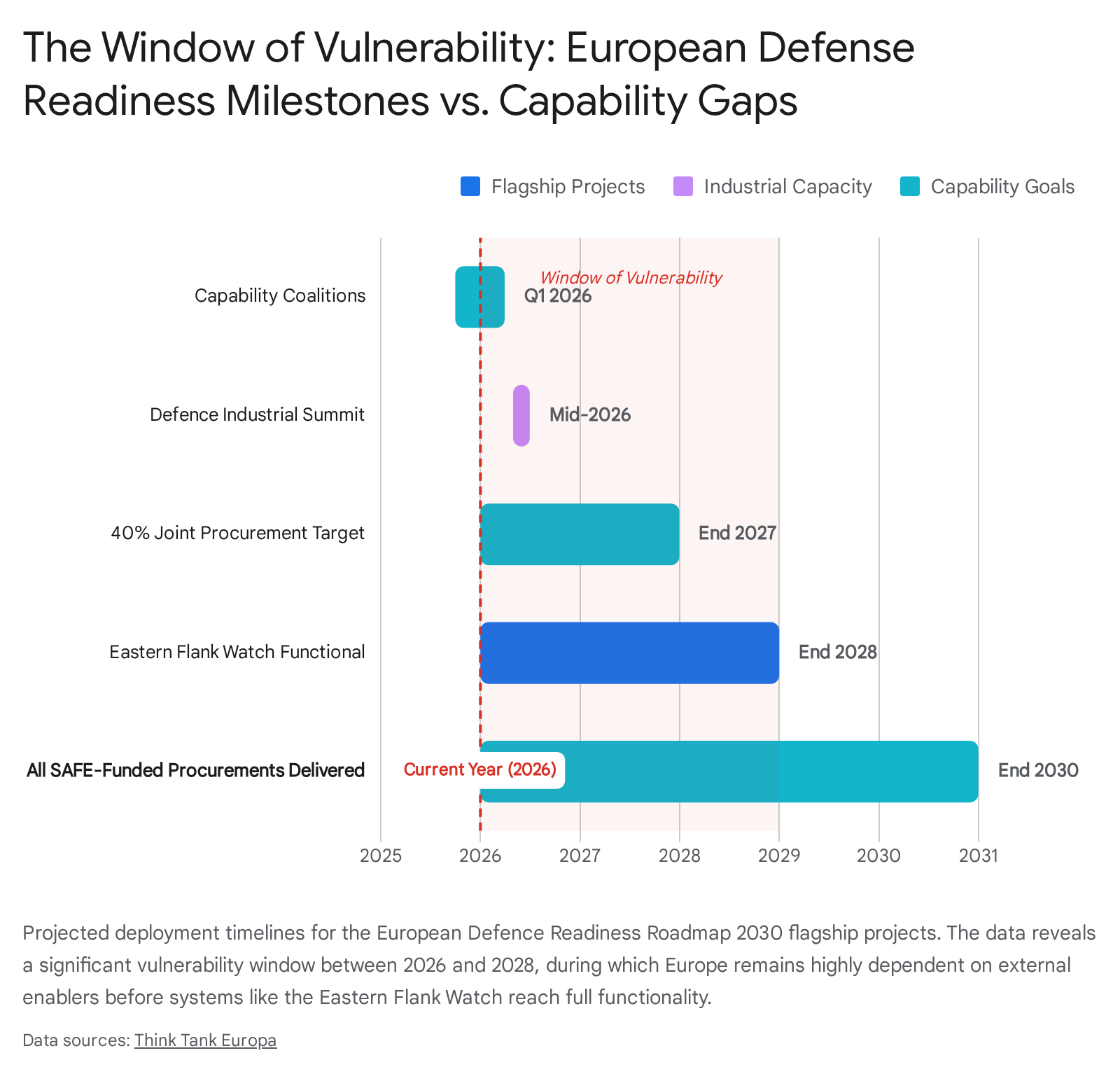
The ultimate objective of this financial architecture is to drastically reduce Europe’s reliance on third-country suppliers. As of mid-2023, 78% of EU defense acquisitions were sourced externally, with the US representing 63% of that total.35 To reverse this, the 2030 Roadmap mandates a strict procurement target: at least 55% of all defense investments must be procured from within the European Defence Technological and Industrial Base (EDTIB) by 2030, with 40% of all procurement organized jointly by 2027.21
To expedite this process and bypass the requirement for absolute union-wide unanimity, the EU is utilizing “Capability Coalitions”—flexible groups of member states collaborating on specific technological domains.21 Furthermore, the roadmap explicitly integrates the Ukrainian defense industry into the EDTIB. By rolling out initiatives like ‘Brave Tech EU’, Europe aims to tap into Ukrainian battlefield innovation and real-world wartime experience, funding the testing of new technological solutions while providing Ukraine with the production scale it desperately needs.21
6. The Shielding Imperative: Air Defense, Drone Walls, and the Eastern Flank
To mitigate the risk of a rapid Russian land grab and continuous sub-threshold coercion, frontline European states have abandoned the legacy concept of defense-in-depth in favor of rigid forward defense, creating heavily fortified borders designed to deny access from the first inch of territory.
6.1 Fortifications and the Eastern Flank Watch
The physical manifestation of this strategy is taking shape across the entire eastern frontier.
- The Baltic Defence Line: A joint initiative by Estonia, Latvia, and Lithuania to construct a vast network of physical fortifications, hardened bunkers, and counter-mobility obstacles along their borders with Russia and Belarus. The objective is to delay incursions and disrupt Russian logistical momentum long enough for allied reinforcements to deploy.36
- Poland’s East Shield: A massive defense infrastructure project extending up to 50 kilometers inland from the borders with the Kaliningrad exclave and Belarus. It integrates physical barriers with advanced ISR networks and dual-use mobility infrastructure, pursuing a strategy to dominate the terrain through predefined choke points and engagement zones (kill boxes).37
These national initiatives are being integrated into the EU’s broader Eastern Flank Watch, a flagship project jointly led by Finland and Poland.34 Scheduled to begin implementation in 2026 and reach full functionality by 2028, the Watch aims to create a continuous, interlocking network of multi-domain surveillance, counter-drone capabilities, and electronic warfare across the entire eastern frontier, spanning from Norway to Bulgaria.34 The EU expects this network to work in seamless coordination with existing NATO operations, such as Baltic Air Policing and Operation Eastern Sentry, provided the C2 networks remain intact.34
6.2 The Air Defense Dilemma and Industrial Fragmentation
Despite ground fortifications, air defense remains Europe’s most critical vulnerability. The high consumption rates of interceptors in both the Ukraine theater and the broader Middle East (such as Operation Epic Fury) have severely depleted Western stockpiles.39 Relying on US-manufactured interceptors, particularly the Patriot PAC-3 MSE and THAAD systems, is no longer a viable long-term strategy given America’s shifting priorities and severely constrained domestic production capacity.39
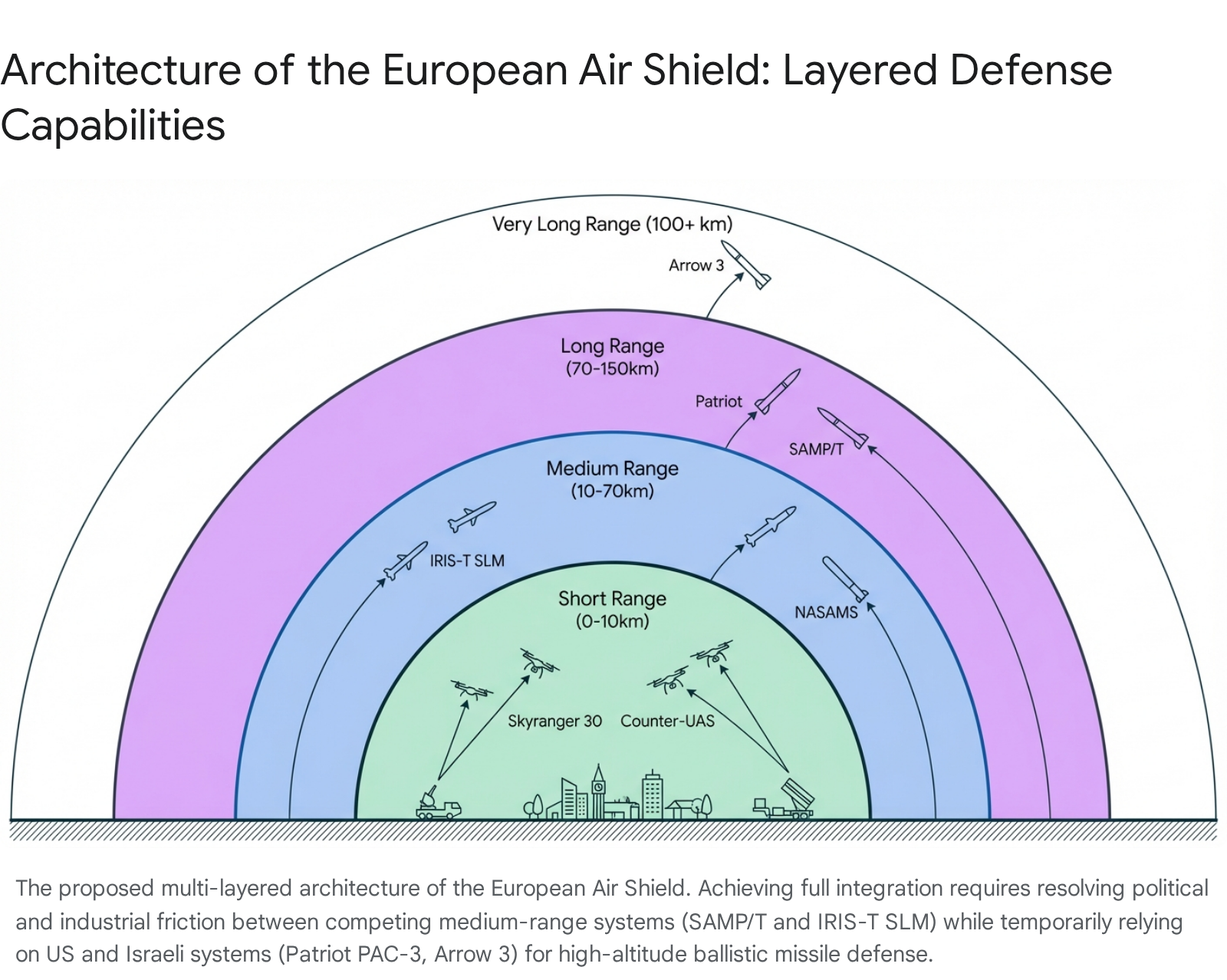
The European Air Shield initiative seeks to establish a fully interoperable, continent-wide Integrated Air Defence System (IADS) capable of defeating the full spectrum of aerial threats.21
| Defense Layer | Altitude / Range | Primary European Systems | US / External Reliance |
| Short Range / VSHORAD | 0 – 10 km | Skyranger 30, Tridon Mk2, Counter-UAS directed energy | None; European advantage 40 |
| Medium Range | 10 – 70 km | IRIS-T SLM (Germany), NASAMS (Norway) | Minimal 40 |
| Long Range | 70 – 150 km | SAMP/T (France/Italy) | Patriot PAC-3 MSE (US) 40 |
| Exoatmospheric | 100+ km | None currently operational | Arrow 3 (Israel), THAAD (US) 40 |
However, the rapid deployment of this shield is hampered by deep defense-industrial fragmentation. Strategic friction exists between nations championing domestic systems: Berlin heavily promotes the Diehl IRIS-T SLM, Paris and Rome insist on the Eurosam SAMP/T, and Oslo pushes the NASAMS framework.41 This fragmentation prevents the economies of scale required to mass-produce interceptors rapidly. For example, Denmark recently opted to purchase the French-Italian SAMP/T over the Patriot to cover its long-range needs, marking the first EU export success for the system and illustrating a desire to pivot away from US dependency, though it complicates integration with the seven other EU nations that already operate the Patriot.42
To resolve this bottleneck, analysts are advocating for a centralized “ASAP for Air Defense” mechanism—modeled on the 2023 Act in Support of Ammunition Production—utilizing EU funds to forcibly consolidate and rapidly expand domestic production lines for systems where European alternatives exist.39
6.3 The Technological Kill-Chain: AI, EW, and Multi-Domain Operations
The character of warfare has been irrevocably altered by the proliferation of autonomous systems. NATO’s traditional deterrence relied on the assumption of rapid air superiority and the unhindered use of expensive, exquisite precision-guided munitions.43 The Ukraine conflict has proven that in a highly contested EW environment, where GPS is jammed and C2 nodes are actively targeted by systems like the Russian “Sinitsa” and “Pole-21,” legacy precision systems degrade rapidly.43
Russia has fully institutionalized unmanned aerial vehicle doctrine, utilizing First-Person View (FPV) drones for massed strikes and AI-assisted ISR platforms like the Orlan-30 to provide real-time targeting data for artillery, reducing strike latency to under ten minutes.27 Conversely, Ukraine demonstrated that low-cost, deep-penetration kamikaze drones could strike strategic Russian aviation assets as far away as Siberia, effectively challenging Russian control asymmetrically.27
Deterrence in the 21st century rests on the resilience of the kill-chain ecosystem. European militaries are shifting their procurement toward decentralized, autonomous systems.43 By pairing long-range precision fires with close-combat drone swarms, European forces intend to disrupt Russian force concentration and neutralize their numerical advantage in artillery.1 However, this hardware must be supported by software. To operate effectively without US theater-level coordination, Europe requires a unified multi-domain open system architecture. Exercises like the US Army-led Sword 26 in the Baltic region are currently testing these exact parameters, utilizing AI-enabled C2 systems to filter live sensor data and accelerate decision-making at the tactical edge, attempting to validate the Eastern Flank Deterrence Initiative (EFDI) before any potential US drawdown takes full effect.44
7. Economic Asymmetry: Sanctions, Decoupling, and the War Economy
Military deterrence cannot be separated from economic leverage. How Europe contends with Russia is fundamentally tied to its ability to sustain economic warfare and sever the financial arteries funding the Russian war machine.
Prior to 2022, the European Union maintained deep economic interdependence with Russia, operating under the assumption that trade ties—particularly German reliance on Gazprom and the Nord Stream pipelines—would foster democratic stability.45 This paradigm has been entirely dismantled. Through the REPowerEU regulatory framework, the EU has executed a rapid, permanent decoupling from Russian energy. By early 2025, the EU’s dependency on Russian natural gas had plummeted from 45% of overall imports to merely 12%, while oil imports shrank from 27% to just 2%.46 The remaining gas imports are scheduled to be entirely phased out under the binding EU/261/2026 regulation, permanently denying Moscow approximately €10 billion in annual revenue from the European market alone.46
This energy decoupling has been reinforced by an unprecedented regime of economic sanctions. Since 2022, the EU has implemented 13 substantial sanctions packages (with a 14th in preparation for 2026), targeting over 2,100 individuals and entities, and freezing €200 billion worth of Russian state assets.47 The macroeconomic impact on the Russian Federation has been severe: total export revenues decreased by 29% in 2023 compared to the previous year, the ruble lost more than 30% of its value, and soaring inflation forced the Russian central bank to hike key interest rates to a crippling 16%.47
However, economic leverage has its limits. The Russian economy has demonstrated resilience by transitioning to a total war footing and finding alternative markets in Asia. Furthermore, Russia actively evades Western sanctions through the use of a massive “shadow fleet” of aging oil tankers that transport crude outside the price cap mechanisms.48 To tip the strategic balance, European policymakers are currently attempting to implement legally unassailable sanctions against this shadow fleet, primarily by pressuring flagging states and maritime insurance markets in the UK and EU to deny coverage to vessels participating in illicit trade.48 Success in this economic domain is paramount; without restricting the capital inflows from fossil fuels, Russia can sustain its current rate of military industrial production indefinitely, outpacing the slower European rearmament cycle.
8. The Nuclear Umbrella: Forward Deterrence and European Strategic Autonomy
Conventional capabilities and economic sanctions ultimately rest beneath the shadow of the nuclear umbrella. Since 1954, European territorial integrity has been definitively underwritten by United States extended nuclear deterrence. Under highly institutionalized NATO nuclear-sharing agreements, an estimated 125 to 130 US-controlled tactical B61 gravity bombs are forward-deployed within specialized vaults across six bases in Belgium, Germany, Italy, the Netherlands, and Turkey.49 These weapons are slated for delivery by European dual-capable aircraft (DCA), such as the transitioning fleet of F-35s and legacy Tornados.51 The US Air Force is actively modernizing this capability, replacing legacy B61-3 and B61-4 variants with the new, precision-guided B61-12 bomb.52
If the United States withdraws these physical assets, or simply casts deep political doubt on its willingness to risk a strategic exchange over Eastern European territory, Europe faces a profound and immediate deterrence gap. Russian military doctrine explicitly relies on the threat of limited, non-strategic nuclear strikes to backstop conventional losses and enforce de-escalation on terms favorable to Moscow.53 Without a highly credible, equivalent deterrent, Europe would be highly susceptible to nuclear coercion and blackmail, effectively neutralizing its conventional buildup.54
8.1 The Improbability of a Common EU Deterrent
Developing a unified, multilateral European Union nuclear force is strategically and politically unviable. The EU lacks a singular, sovereign executive authority capable of making the rapid, existential decisions required for nuclear employment.55 A committee-based, majority-decision model for nuclear launch holds zero deterrent value against an adversary with a highly centralized command structure.55 Furthermore, stringent non-proliferation treaties and historical domestic politics prevent economic powerhouses like Germany from developing indigenous nuclear weapons.55
Consequently, the entire burden of European nuclear deterrence, absent the United States, falls squarely on the United Kingdom and France. The UK maintains an independent arsenal of approximately 225 warheads deployed on Vanguard-class submarines; however, these systems rely heavily on US-designed Trident D5 missiles and testing facilities, meaning true operational independence from Washington is debatable.55
8.2 Macron’s Doctrine of “Forward Deterrence”
In a historic pivot aimed at filling the emerging strategic void, French President Emmanuel Macron delivered a landmark address at the Île Longue nuclear submarine base in March 2026, fundamentally altering France’s nuclear posture.56 Moving away from a strictly national defense doctrine that historically focused solely on French territorial survival, Macron articulated the concept of dissuasion avancée (“forward deterrence”), explicitly extending the European dimension of France’s vital interests.53
The new French doctrine introduced four highly significant shifts:
- Arsenal Expansion: Reversing decades of post-Cold War downsizing, France announced an increase in its operational stockpile from 290 warheads to an undisclosed higher number.56
- Strategic Ambiguity: Ending the practice of publicly disclosing exact total stockpile numbers, aligning closer to US and Russian postures.58
- Forward-Basing: Permitting the unprecedented temporary deployment of French strategic air forces and nuclear-capable jets to allied bases in Eastern and Northern Europe.58
- Institutionalized Cooperation: Establishing formal strategic partnerships with seven European nations (including Germany, Poland, and Sweden) to participate in French nuclear exercises and targeting consultations, mimicking aspects of NATO’s Nuclear Planning Group.56
While welcomed in Berlin and Warsaw as a vital geopolitical lifeline in an era of uncertainty, the French offer possesses inherent operational limitations. France strictly maintains the doctrinal concept of a “unique and non-renewable nuclear warning shot” rather than engaging in the flexible, gradual escalation management practiced by the United States.59 Relying solely on French and British arsenals—which are significantly smaller than Russia’s vast array of non-strategic nuclear weapons—leaves Europe severely disadvantaged in lower-rung escalation scenarios.53
Therefore, European defense planners recognize a stark reality: independent nuclear forces must be backed by a massive, highly lethal, and resilient conventional force. If European conventional deterrence fails and a Russian victory seems imminent, stiff conventional resistance is required to make the possibility of France actually utilizing nuclear force on behalf of its allies significantly more credible in the eyes of Moscow.60
Conclusion
To classify NATO as a “paper tiger” in 2026 is to misunderstand the architecture of the crisis. The alliance is not inherently weak in its aggregate potential, but it has become acutely brittle. Decades of under-investment, deep industrial fragmentation, and an over-reliance on a single geopolitical node—the United States—have created critical single points of failure in ISR, strategic mobility, integrated air defense, and nuclear deterrence.
The threshold of non-viability is clearly delineated: if the United States executes a rapid withdrawal of its physical enablers, space assets, and political guarantees, the alliance, in its current structural form, ceases to be viable as a continent-wide, forward-deployed warfighting machine. A collection of localized, blinded national armies cannot deter a fully mobilized Russian state.
However, the explicit American pivot has triggered an irreversible strategic awakening across the continent. To contend with a reconstituted Russia, Europe is currently executing a massive, €800 billion defense-industrial mobilization. By establishing the Eastern Flank Watch, centralizing procurement through SAFE and the EDF, permanently decoupling from the Russian energy sector, and tentatively embracing France’s “forward deterrence” nuclear posture, Europe is laying the essential foundation for true strategic autonomy.
The fundamental, unyielding variable in this equation is time. With critical capabilities like the European Air Shield and the Space Shield not expected to reach full operational functionality until 2028 or 2030, Europe currently resides in a perilous window of vulnerability. Deterring Russian aggression and sub-threshold coercion in the interim requires absolute political cohesion, the rapid scaling of asymmetric drone technologies, and an unwavering commitment to fortifying the eastern frontier. If Europe can survive the transition period without a catastrophic fracturing of political will, it possesses the latent capacity to emerge as an independent, formidable military pole capable of securing its own hemisphere.
Please share the link on Facebook, Forums, with colleagues, etc. Your support is much appreciated and if you have any feedback, please email us in**@*********ps.com. If you’d like to request a report or order a reprint, please click here for the corresponding page to open in new tab.
Sources Used
- For NATO in 2027, European leadership will be key to deterrence against Russia, accessed April 11, 2026, https://www.atlanticcouncil.org/in-depth-research-reports/issue-brief/for-nato-in-2027-european-leadership-will-be-key-to-deterrence-against-russia/
- The 2026 National Defense Strategy by the Numbers: Radical Changes, Moderate Changes, and Some Continuities – CSIS, accessed April 11, 2026, https://www.csis.org/analysis/2026-national-defense-strategy-numbers-radical-changes-moderate-changes-and-some
- America’s new Defence Strategy and Europe’s moment of truth, accessed April 11, 2026, https://www.epc.eu/publication/americas-new-defence-strategy-and-europes-moment-of-truth/
- Can Trump pull the US out of Nato – and why is he considering it? – The Guardian, accessed April 11, 2026, https://www.theguardian.com/world/2026/apr/01/trump-nato-explainer
- What would happen if the United States pulled out of NATO?, accessed April 11, 2026, https://news.northeastern.edu/2026/04/09/trump-pulling-out-of-nato-explained/
- What counts as ‘defense’ in NATO’s potential 5 percent spending goal? – Atlantic Council, accessed April 11, 2026, https://www.atlanticcouncil.org/blogs/new-atlanticist/what-counts-as-defense-in-natos-potential-5-percent-spending-goal/
- NATO is Vital to U.S. National Security – Belfer Center, accessed April 11, 2026, https://www.belfercenter.org/research-analysis/nato-vital-us-national-security
- NATO’s Article 5 Collective Defense Obligations, Explained | Brennan Center for Justice, accessed April 11, 2026, https://www.brennancenter.org/our-work/research-reports/natos-article-5-collective-defense-obligations-explained
- Defending Europe Without the United States: Costs and …, accessed April 11, 2026, https://www.iiss.org/research-paper/2025/05/defending-europe-without–the-united-states-costs-and-consequences/
- Funding NATO | NATO Topic, accessed April 11, 2026, https://www.nato.int/en/what-we-do/introduction-to-nato/funding-nato
- European Autonomy in Space – Stiftung Wissenschaft und Politik, accessed April 11, 2026, https://www.swp-berlin.org/publikation/european-autonomy-in-space
- NATO’s Article 5 Explained: How Collective Defense Works and When It’s Triggered, accessed April 11, 2026, https://www.belfercenter.org/research-analysis/natos-article-5-explained-how-collective-defense-works-and-when-its-triggered
- How Might NATO Allies Respond if the United States Retrenches from Europe? – RAND, accessed April 11, 2026, https://www.rand.org/content/dam/rand/pubs/research_reports/RRA2800/RRA2807-2/RAND_RRA2807-2.pdf
- Defending Europe with less America – European Council on Foreign Relations, accessed April 11, 2026, https://ecfr.eu/publication/defending-europe-with-less-america/
- Why America Should Keep the NATO Command Chair | Hudson Institute, accessed April 11, 2026, https://www.hudson.org/national-security-defense/why-america-should-keep-nato-command-chair-rebeccah-heinrichs
- Trump’s attacks on NATO revive debate over ‘European pillar’ – what …, accessed April 11, 2026, https://www.euractiv.com/news/trumps-attacks-on-nato-revive-debate-over-european-pillar-what-does-it-mean/
- A new NATO command structure | Atlantic Council, accessed April 11, 2026, https://www.atlanticcouncil.org/wp-content/uploads/2024/05/A-New-NATO-Command-Structure.pdf
- Europe in Space: Closing the Capability Gap with the US – European Relations, accessed April 11, 2026, https://europeanrelations.com/briefing/europe-in-space-closing-the-capability-gap-with-the-us/
- Advancing European Military Capacity in Space – The International Institute for Strategic Studies, accessed April 11, 2026, https://www.iiss.org/research-paper/2026/03/advancing-european-military-capacity-in-space/
- Is Europe Moving Fast Enough to Close its Space Defense Gaps? | April/May 2026, accessed April 11, 2026, https://interactive.satellitetoday.com/via/april-may-2026/is-europe-moving-fast-enough-to-close-its-space-defense-gaps
- European Defence Readiness Tracker | Think Tank Europa, accessed April 11, 2026, https://thinkeuropa.dk/en/explainer/2026-02-european-defence-readiness-tracker
- Croatia monthly briefing: The Commission’s Military Mobility Proposal and the Limits of the EU’s.. – China-CEE Institute, accessed April 11, 2026, https://china-cee.eu/2026/01/29/croatia-monthly-briefing-the-commissions-military-mobility-proposal-and-the-limits-of-the-eus-cross-border-readiness/
- Military mobility | EEAS – European Union, accessed April 11, 2026, https://www.eeas.europa.eu/eeas/what-is-military-mobility_en
- Military Mobility – Defence Industry and Space – European Commission, accessed April 11, 2026, https://defence-industry-space.ec.europa.eu/eu-defence-industry/military-mobility_en
- ECE_TRANS_2026_19e.docx – UNECE, accessed April 11, 2026, https://unece.org/sites/default/files/2026-02/ECE_TRANS_2026_19e.docx
- The Russian Military: Forecasting the Threat | ISW, accessed April 11, 2026, https://understandingwar.org/research/defense-of-europe/the-russian-military-forecasting-the-threat/
- How are Drones Changing War? The Future of the Battlefield – CEPA, accessed April 11, 2026, https://cepa.org/article/how-are-drones-changing-war-the-future-of-the-battlefield/
- How Will Russia Reconstitute Its Military After the Ukraine Conflict? – RAND, accessed April 11, 2026, https://www.rand.org/pubs/research_briefs/RBA2713-2.html
- Global Risks to the EU in 2026: What are the main conflict threats for …, accessed April 11, 2026, https://www.iss.europa.eu/publications/commentary/global-risks-eu-2026-what-are-main-conflict-threats-europe
- The Military Balance 2026: Fortifying NATO’s eastern flank, accessed April 11, 2026, https://www.iiss.org/publications/the-military-balance/2026/the-military-balance-2026/fortifying-natos-eastern-flank/
- From shield to sword: Europe’s offensive strategy for the hybrid age, accessed April 11, 2026, https://ecfr.eu/publication/from-shield-to-sword-europes-offensive-strategy-for-the-hybrid-age/
- How Russia’s Hybrid Warfare Will Escalate in 2026 and What Europe Must Do? | GLOBSEC, accessed April 11, 2026, https://www.globsec.org/what-we-do/commentaries/how-russias-hybrid-warfare-will-escalate-2026-and-what-europe-must-do
- European Cohesion for Security and Defense | DGAP, accessed April 11, 2026, https://dgap.org/en/research/publications/european-cohesion-security-and-defense
- Europe’s Drone Wall – Ready, EDDI, Go! – European Security …, accessed April 11, 2026, https://euro-sd.com/2026/03/articles/exclusive/49854/europes-drone-wall-ready-eddi-go/
- REPORT on flagship European defence projects of common interest | A10-0014/2026, accessed April 11, 2026, https://www.europarl.europa.eu/doceo/document/A-10-2026-0014_EN.html
- Eastern Flank Watch and European Drone Wall | Epthinktank …, accessed April 11, 2026, https://epthinktank.eu/2025/10/23/eastern-flank-watch-and-european-drone-wall/
- Poland’s East Shield – Konrad-Adenauer-Stiftung, accessed April 11, 2026, https://www.kas.de/en/monitor/detail/-/content/poland-s-east-shield
- Deterring Aggression: Poland Takes Bold Steps on NATO’s Eastern Border, accessed April 11, 2026, https://www.nato-pa.int/news/deterring-aggression-poland-takes-bold-steps-natos-eastern-border
- Europe Needs an ASAP Program for Air Defense – CSIS, accessed April 11, 2026, https://www.csis.org/analysis/europe-needs-asap-program-air-defense
- European Sky Shield Initiative – Wikipedia, accessed April 11, 2026, https://en.wikipedia.org/wiki/European_Sky_Shield_Initiative
- A Sky Shield for Europe – European Policy Centre (EPC), accessed April 11, 2026, https://www.epc.eu/publication/a-sky-shield-for-europe/
- Denmark picks French-Italian SAMP/T air defense system over Patriot, accessed April 11, 2026, https://www.defensenews.com/global/europe/2025/09/12/denmark-picks-french-italian-sampt-air-defense-system-over-patriot/
- The Future of War: Kill-Chain Supremacy and Ukraine’s Lessons – Digital Commons @ USF – University of South Florida, accessed April 11, 2026, https://digitalcommons.usf.edu/cgi/viewcontent.cgi?article=2592&context=jss
- US Army Europe and Africa leads NATO integration and readiness efforts in Sword 26, accessed April 11, 2026, https://www.army.mil/article/291587/us_army_europe_and_africa_leads_nato_integration_and_readiness_efforts_in_sword_26
- From values to economic security: The transformation of the EU’s economic model 2016-2026 – European Parliament, accessed April 11, 2026, https://www.europarl.europa.eu/RegData/etudes/BRIE/2026/783766/EPRS_BRI(2026)783766_EN.pdf
- REPowerEU – phase out of Russian energy imports, accessed April 11, 2026, https://energy.ec.europa.eu/strategy/repowereu-phase-out-russian-energy-imports_en
- Cost of aggression: EU sanctions against Russia two years on, accessed April 11, 2026, https://www.epc.eu/publication/Cost-of-aggression-EU-sanctions-against-Russia-two-years-on-58f570/
- Stiffening European sanctions against the Russian oil trade – Brookings Institution, accessed April 11, 2026, https://www.brookings.edu/articles/stiffening-european-sanctions-against-the-russian-oil-trade/
- US allies question extended deterrence guarantees, but have few options, accessed April 11, 2026, https://www.iiss.org/online-analysis/military-balance/2025/03/us-allies-question-extended-deterrence-guarantees-but-have-few-options/
- Nuclear Disarmament NATO, accessed April 11, 2026, https://www.nti.org/analysis/articles/nato-nuclear-disarmament/
- Nuclear sharing – Wikipedia, accessed April 11, 2026, https://en.wikipedia.org/wiki/Nuclear_sharing
- NATO Tactical Nuclear Weapons Exercise And Base Upgrades, accessed April 11, 2026, https://fas.org/publication-term/nuclear-sharing/
- Macron Offers a Promising Vision for Nuclear Deterrence in Europe – RUSI, accessed April 11, 2026, https://www.rusi.org/explore-our-research/publications/commentary/macron-offers-promising-vision-nuclear-deterrence-europe
- Mind the Deterrence Gap: Assessing Europe’s Nuclear Options – Münchner Sicherheitskonferenz, accessed April 11, 2026, https://securityconference.org/assets/02_Dokumente/01_Publikationen/2026/ENSG/Mind_the_Deterrence_Gap%E2%80%93Report_of_the_ENSG.pdf
- What If the USA Closes Its Nuclear Umbrella Over Europe? | DGAP, accessed April 11, 2026, https://dgap.org/en/research/publications/what-if-usa-closes-its-nuclear-umbrella-over-europe
- Europe’s New Nuclear Deterrence Debate and France’s Answer, accessed April 11, 2026, https://www.cnas.org/publications/podcast/europes-nuclear-deterrence-debate
- President delivers speech on France’s nuclear deterrence | France in the United Kingdom, accessed April 11, 2026, https://uk.diplomatie.gouv.fr/en/president-delivers-speech-frances-nuclear-deterrence
- What Macron’s changes to French nuclear policy mean for European security, accessed April 11, 2026, https://www.atlanticcouncil.org/dispatches/what-macrons-changes-to-french-nuclear-policy-mean-for-european-security/
- French nuclear deterrence: Vive l’évolution, accessed April 11, 2026, https://www.iiss.org/online-analysis/missile-dialogue-initiative/2026/03/french-nuclear-deterrence-vive-levolution/
- Taking the Pulse: Is France’s New Nuclear Doctrine Ambitious Enough?, accessed April 11, 2026, https://carnegieendowment.org/europe/strategic-europe/2026/03/taking-the-pulse-is-frances-new-nuclear-doctrine-ambitious-enough