1. Executive Summary
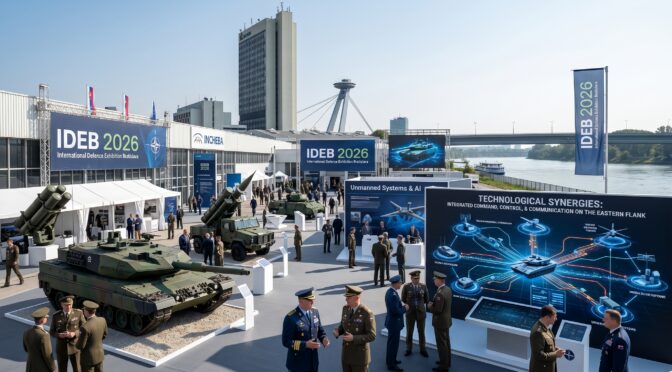
The International Defence Exhibition Bratislava (IDEB) Defence & Security, held from May 12 to May 14, 2026, at the Incheba Exhibition and Congress Centre in Slovakia, served as a definitive barometer for the rapidly maturing defense industrial base of Central and Eastern Europe.1As allied nations across NATO’s Eastern Flank accelerate the modernization of their land forces, the 2026 exhibition underscored a decisive paradigm shift.3Regional defense ministries are moving away from the direct procurement of foreign, off-the-shelf systems, prioritizing instead the development of sovereign, intra-regional joint ventures that retain intellectual property and capital within the local economic bloc.4
The technological reveals at IDEB 2026 demonstrated a clear doctrinal focus on strategic mobility, modular combat architectures, and layered platform survivability. Among the most significant announcements was the global premiere of the CFL-120 Karpat medium tank, representing a strategic partnership between the Czech Republic’s Czechoslovak Group (CSG) and Turkey’s FNSS.5 Concurrently, Poland’s Polska Grupa Zbrojeniowa (PGZ) debuted an export-configured variant of the Borsuk Infantry Fighting Vehicle (IFV), deliberately paired with the Slovak-manufactured Turra 30V9 unmanned turret to capture international market share.7 In the realm of indirect fire support, Konštrukta-Defence introduced the highly mobile EVA M3 6×6 self-propelled howitzer, reflecting a transition toward lighter, automated artillery systems capable of rapid displacement.9
Furthermore, the event highlighted sweeping modernization efforts within the Armed Forces of the Slovak Republic. These domestic initiatives range from the total adoption of AR-15 platform service rifles produced by local manufacturer Grand Power to a fundamental transition toward newly designed combat uniforms and advanced ballistic protection systems.10 The analytical takeaways from the exhibition indicate that the European ground warfare paradigm is adapting to the realities of high-intensity, sensor-rich environments. The historical reliance on raw armored mass is being supplemented by a critical demand for rapid deployment capabilities, active protection systems capable of defeating loitering munitions, and passive electronic warfare networks that shield friendly forces from electromagnetic detection. The industrial alignment witnessed at the exhibition points to a robust, increasingly independent regional supply chain that is highly capable of competing on the global export market.
2. Strategic Context: The Maturation of the Central European Defense Industry
The geopolitical landscape of the mid-2020s has forced a systemic reevaluation of supply chain resilience, force readiness, and technological sovereignty across NATO allied nations.13 The IDEB 2026 exhibition provided a physical manifestation of these shifting strategic policies.14 Historically, Eastern European militaries operated legacy Soviet-era equipment, gradually replacing these platforms with imports from Western European or North American manufacturers. However, the current phase of modernization is characterized by deep domestic production initiatives and bilateral industrial synergies designed to insulate the region from global logistical shocks.
The emphasis at IDEB 2026 was squarely on building competitive, European-developed defense solutions.8 This approach mitigates the risk of supply chain disruptions during extended conflicts and builds critical intellectual property within the local defense sector. By showcasing products developed through joint initiatives—such as the Polish-Slovak Borsuk export variant or the Czech-Turkish-Slovak CFL-120 Karpat—the regional defense industry signaled its intent to not merely supply its own armed forces but to aggressively pursue global defense export markets, with companies citing regions like the Middle East and Southeast Asia as promising avenues for expansion.5
The exhibition also served as an open forum for the Armed Forces of the Slovak Republic, acting under the professional auspices of the Ministry of Defence, the Ministry of Interior, and the Defence and Security Industry Association.16 Elite units, including the Rapid Response Police Unit, conducted live dynamic demonstrations emphasizing the integration of newly procured technologies in realistic intervention scenarios.16 One such event was the highly publicized “NO ESCAPE” demonstration, which simulated a realistic tactical intervention against an armed offender, showcasing the seamless integration of robotics, unmanned systems, and modern small arms.16
The broader regional commitment to integrated security was also highlighted by the introduction of the European SAFE initiative to Slovakia for the first time, signaling deeper alignment with European Union crisis management and civil protection frameworks.16 These strategic alignments indicate that the Eastern Flank is no longer a peripheral consumer of defense technology, but a central node of innovation and manufacturing.
3. Financial and Industrial Underpinnings: The CSG Model
The rapid development of advanced heavy armored platforms and artillery systems requires an industrial base with immense financial liquidity and operational momentum. The Czechoslovak Group (CSG), which maintained the largest presence at IDEB 2026 second only to the Slovak Ministry of Defence, serves as the primary case study for this industrial expansion.17
CSG’s strategic roadmap involves aggressive vertical integration and the acquisition of historic defense players across the European continent, including the Tatra truck manufacturing segment and Italian ammunition manufacturer Fiocchi.5 This consolidation strategy provides the capital required to fund complex research and development cycles, such as the CFL-120 Karpat project. According to the company’s Q1 2026 trading statement, CSG generated €1,544 million in revenue during the first three months of the year, representing a 13.8% year-over-year growth trajectory.18 This growth was disproportionately driven by the company’s core Defence Systems businesses, which saw a 26.5% operational increase.18
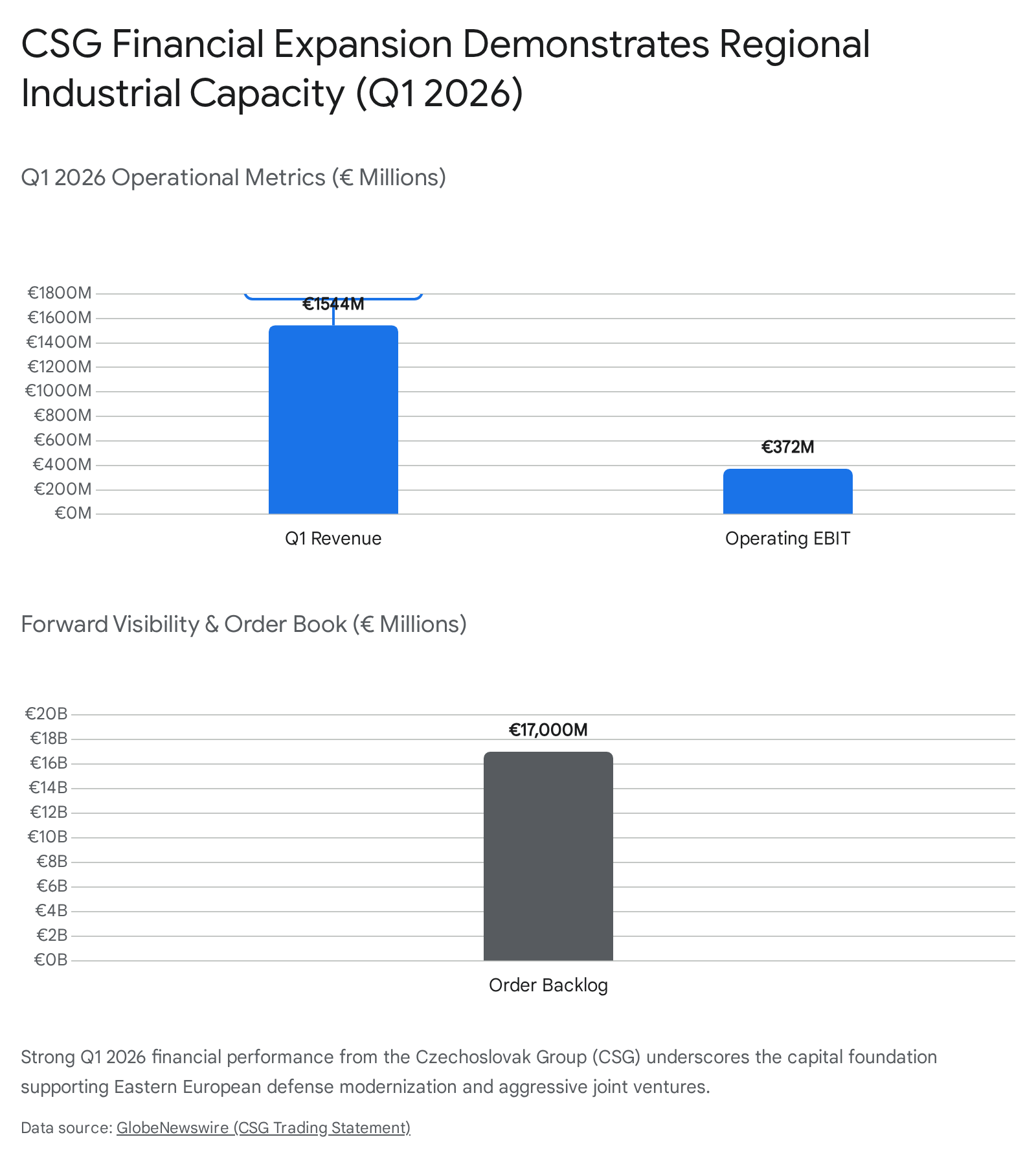
Perhaps the most critical indicator of future production capacity is CSG’s order backlog, which expanded by 15.1% to reach a staggering €17 billion, largely led by gains in the Land Systems sector.18 This financial security allows the group to execute long-term strategic plans aimed at reducing supply chain vulnerabilities. A primary example showcased alongside IDEB 2026 was the establishment of a new MACS artillery propellant charge facility in Slovakia.18 Formed as a joint venture between ZVS Holding and EURENCO, this facility represents a material step toward in-house propellant production. By deepening vertical integration across its distributed manufacturing network, CSG is scaling its own large-caliber (artillery and tank) ammunition production capacity to exceed 800,000 rounds, fundamentally shifting the company away from simple recommissioning activities toward sovereign, ground-up manufacturing.18 The presence of MSM Group holding companies at IDEB 2026—including ZVS, VOP Nováky, ZVI, and Fábrica de Municiones de Granada—further emphasized this expansive portfolio, displaying medium and large-caliber munitions meeting both NATO and Eastern standards.17
4. Land Mobility and Heavy Platform Evolution
The ongoing reevaluation of ground combat doctrine was highly visible in the armored vehicle segment at IDEB 2026. Military planners are currently balancing the traditional requirement for heavy, densely armored Main Battle Tanks (MBTs) with the urgent need for operational mobility, reduced bridge-weight classifications, and lower logistical footprints. The modern battlefield heavily penalizes slow, logistically demanding formations, pushing designers toward highly mobile, digitally networked platforms.
4.1 The CFL-120 Karpat Medium Tank
One of the most significant unveilings at the exhibition was the CFL-120 Karpat, developed through a strategic partnership between CSG and Turkish defense manufacturer(https://www.fnss.com.tr/en).5 Classified as a medium or light tank, the Karpat is engineered to deliver the striking power of a classic heavy MBT but with vastly superior strategic and tactical flexibility, reducing the immense logistical demands typically associated with armored brigades.11
The platform utilizes the combat-proven KAPLAN MT tracked chassis, an architecture originally developed by FNSS to meet the specific geographical and infrastructural constraints of the Indonesian armed forces.5 However, the Karpat significantly upgrades the vehicle’s lethality by integrating the Leonardo HITFACT Mk-II turret. This advanced turret module is armed with a highly capable 120/45 mm smoothbore gun that is fully compatible with all standard NATO 120 mm ammunition.5 This armament choice is critical; it ensures that the 34-ton Karpat can successfully engage and destroy enemy MBTs at extended ranges, matching the firepower of vehicles that weigh twice as much.5 Alternatively, the turret can be fitted with a less powerful but lighter NATO-standard 105/52 mm rifled gun depending on customer requirements.5
The engineering architecture of the CFL-120 Karpat deliberately deviates from standard Infantry Fighting Vehicle (IFV) conversions, which often place the engine in the front to allow for a rear troop ramp. Instead, the Karpat mirrors traditional MBT design by positioning the turbodiesel powerplant at the rear of the hull.5 This configuration allows for optimized frontal glacis protection geometry. Furthermore, the vehicle emphasizes survivability through a turret design that isolates ammunition storage strictly outside the primary crew compartment.5 In the event of an ammunition cook-off resulting from an enemy penetration, blowout panels direct the explosive force outward rather than into the fighting compartment, significantly increasing overall vehicle and crew survivability.5
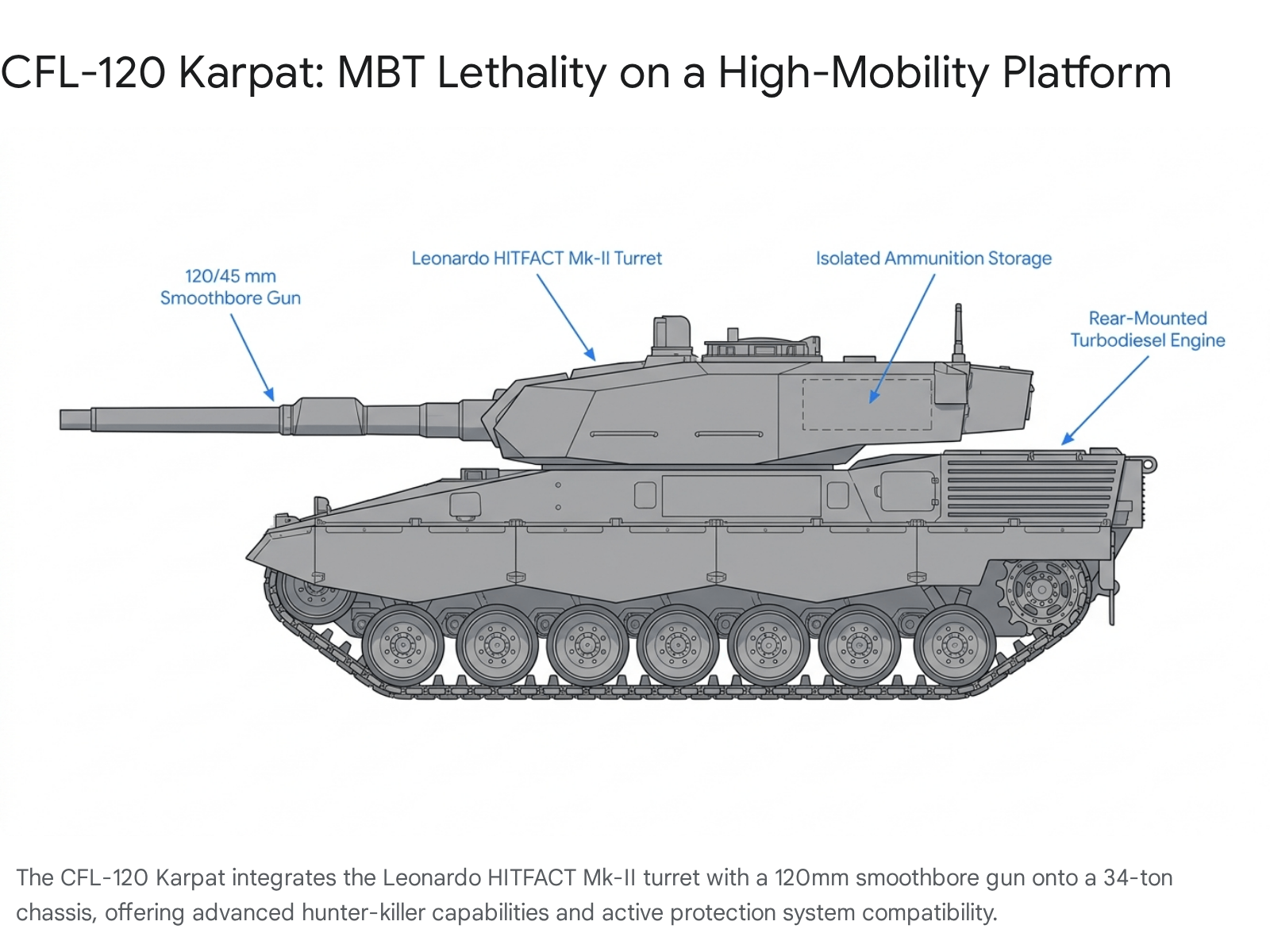
Tactical and operational specifications of the CFL-120 Karpat include an approximate combat weight of 34 tonnes, allowing for safe passage over standard civilian infrastructure and rapid deployment via tactical airlift, which heavier tanks like the M1A2 Abrams or Leopard 2 struggle to achieve.5 The vehicle boasts a top speed of 70 km/h and an operational range of 450 km.5 The fire control suite provides true fire-on-the-move capabilities against moving targets, supported by advanced hunter-killer and killer-killer target engagement protocols enabled by independent day/night, all-weather observation systems for both the commander and the gunner.5 Furthermore, the platform is designed to operate within fully networked modern operational environments, integrating seamlessly with various Battle Management Systems (BMS).5
The Karpat represents a deliberate industrial strategy rather than just a product launch. CSG’s agreement with FNSS focuses on technology transfer processes and the incorporation of the local Slovak supply chain, signaling an intent to establish domestic production lines within Slovakia.5 The Slovak Ministry of Defence is reportedly evaluating the platform to potentially form the backbone of its modernized armored fleet, operating in a complementary role alongside the heavy CV9035 MkIV IFVs recently procured from BAE Systems.11 By combining Turkish platform expertise with Czech and Slovak industrial manufacturing bases, the Karpat aims to offer a highly competitive alternative in the European market.6
4.2 The Borsuk IFV: Export Configuration
Another major development in the armored sector was the debut of the export-configured Borsuk Infantry Fighting Vehicle.7 Developed through a consortium led by Huta Stalowa Wola (a subsidiary of Poland’s state defense group, Polska Grupa Zbrojeniowa – PGZ), the Borsuk is Poland’s next-generation platform designed to replace thousands of aging, highly vulnerable Soviet-era BMP-1 and BWP-1 vehicles currently in Polish Army service.7
At IDEB 2026, PGZ presented the Borsuk integrated not with its standard domestic ZSSW-30 turret, but with the Slovak-manufactured Turra 30V9 unmanned turret from EVPÚ.7 This specific configuration represents Huta Stalowa Wola’s strategy to leverage its Universal Modular Tracked Platform (UMPG) hull into international sales by offering flexible, internationalized weapon and electronic architectures tailored to client specifications.7
The Borsuk chassis is constructed from advanced aluminum alloys layered with modular composite armor, achieving a delicate balance between ballistic protection and buoyancy.7 The vehicle remains fully amphibious without requiring extensive preparation—a critical tactical requirement for navigating the river-dense geography of Eastern Europe and the Baltic states.7 The internal compartment is designed to transport a crew of three and six fully equipped infantry dismounts.7
The presentation of the Borsuk-Turra 30 combination was highly calculated. By utilizing an unmanned turret system that has already been introduced into serial production and operational service within the Armed Forces of the Slovak Republic, PGZ offers potential export clients a technologically mature, low-risk solution with proven reliability.8 Arkadiusz Bąk, First Vice-President of PGZ, emphasized that this joint offering directly addresses the growing global demand for modular combat platforms and reflects a deep industrial partnership based on the exchange of competencies and technologies.4 The Polish Ministry of Defense has previously indicated that it views the Borsuk as a potential export hit, explicitly stating that international promotion of the vehicle is a primary objective for 2026.21
4.3 Wheeled Modular Platforms: Patria AMV XP 8×8
While tracked platforms dominated the heavy vehicle reveals, the wheeled segment was represented by ongoing developments in the Slovak 8×8 program. At IDEB 2026, the Finnish defense group Patria showcased the Patria AMV XP 8×8 armored modular vehicle, which was selected by Slovakia in 2022 to form the core of its mechanized infantry wheeled fleet.1
Patria’s presence highlighted the continued execution of its cooperation agreements with local Slovak industry, ensuring that the manufacturing and lifecycle sustainment of the vehicles generate domestic economic value.1 Alongside the vehicle platform, Patria presented its Sustainment Solutions business area, specifically the Patria OPTIME lifecycle service offering. This system covers comprehensive maintenance support for a wide range of platforms and integrates with the ILIAS Digital Defense Platform to provide data-driven predictive maintenance, ensuring that fleet readiness rates remain high while reducing long-term logistical costs.1
5. Advanced Unmanned Turret Systems and Active Protection
The survivability of armored platforms increasingly relies on keeping crews safe within heavily protected hulls while utilizing external, unmanned systems for target acquisition, situational awareness, and kinetic engagement. The Slovak defense company EVPÚ, headquartered in Nová Dubnica, demonstrated absolute dominance in this sector at IDEB 2026 by showcasing multiple generations of its remote-controlled weapon stations.7
5.1 The Turra 30 V9: Mature Hunter-Killer Architecture
The Turra 30 family of unmanned turrets allows vehicle designers to drastically reduce the overall volume and profile of the vehicle, as no crew members are seated within the turret basket.7 This architectural choice lowers the vehicle’s center of gravity and allows for all crew members to be seated low in the hull, maximizing their protection from direct fire and blast threats.
The Turra 30V9, prominently displayed atop the export Borsuk IFV, features a robust armament package centered around the modernized GTS-30/A automatic cannon. Produced by ZTS Špeciál, this cannon is chambered in the standard Eastern-bloc 30x165mm caliber, ensuring compatibility with existing ammunition stockpiles across the region.7 Secondary armament includes a PKT 7.62mm coaxial machine gun and a dual launcher for Rafael Spike LR2 Anti-Tank Guided Missiles (ATGMs), providing the vehicle with the capability to defeat heavily armored MBTs far beyond the effective range of the main 30mm cannon.7
Crucially, the V9 variant utilizes a sophisticated fire control system featuring a true hunter-killer protocol.7 In combat, the vehicle commander utilizes a highly stabilized, independent panoramic sight (such as the CMS-1) to search the battlefield, identify threats, and lase targets.7 Once a target is designated, the system automatically slews the turret and hands the target off to the gunner, who engages using the CRANE-XLR or CMS-1G targeting optics.7 Simultaneously, the commander returns to searching for the next threat. This parallel processing significantly reduces the engagement cycle time, increasing the vehicle’s lethality in fast-moving combat scenarios against multiple adversaries.7
5.2 The Turra 30 V10: Counter-UAS and Sensor Fusion
While the V9 represents a mature, fielded technology, EVPÚ used IDEB 2026 to push the boundaries of armored warfare even further, winning the GRAND PRIX IDEB 2026 award for its newly unveiled Turra 30 V10 remote-controlled turret.16 The V10 iteration is an aggressive modernization aimed squarely at defending against the proliferation of loitering munitions, anti-tank guided missiles, and First-Person View (FPV) drones that currently dominate the airspace in modern conflicts.22
The V10 upgrade introduces several key capability enhancements designed to create a localized protective dome around the host vehicle. The most significant integration is the Harpia Active Protection System (APS).22 Developed by EVPU Defence, the Harpia is an AI-driven hard-kill system designed to detect and physically defeat incoming ATGMs, rocket-propelled grenades, and hostile UAVs before they impact the vehicle’s armor.22
To augment situational awareness and offensive reach, the V10 incorporates a Multi-Canister Drone Launcher.22 This signals a massive leap in battlefield capabilities, allowing the vehicle crew to deploy their own loitering munitions or intelligence, surveillance, and reconnaissance (ISR) drones directly from the turret.22 By launching organic drones, the crew can extend their sensor reach far beyond the line of sight, inspecting defilades, urban canyons, or reverse slopes without exposing the host vehicle to ambush. For layered close-in defense, the turret also mounts the Gladius TWIN Mini Remote Weapon Station, providing an independent secondary axis of fire against infantry and small drones.22
The effectiveness of these disparate systems is tied together by an advanced tactical situational awareness system. The V10 fuses data from a multi-mission radar, anti-tank firing detectors, and acoustic gunshot locators.22 Advanced AI-based algorithms synthesize this data, providing the crew with optimized engagement solutions and automating defensive responses to incoming threats.24 The main gun armament has also been upgraded, offering the battle-proven 30 mm 2A42 automatic cannon or the Western standard Mk44 Bushmaster II chain gun, delivering 550 rounds per minute fed through a dual-belt system.22 The integrated opto-electronic suite—featuring a cooled thermal camera, TV camera with zoom, and laser rangefinder—ensures targeting precision in all weather conditions.22
| Subsystem Capability | Turra 30 V9 Configuration | Turra 30 V10 Configuration |
| Primary Armament | 30mm GTS-30/A | 30mm Mk44 Bushmaster II or 2A42 |
| Secondary Armament | 7.62mm Coaxial MG | 7.62mm Coaxial MG + Gladius TWIN Mini RCWS |
| Anti-Tank Capability | Dual Spike LR2 ATGM Launcher | Integrated Dual ATGM Tubes |
| Active Protection (APS) | Modular / Add-on compatibility | Integrated Harpia AI-based APS |
| Organic ISR/Strike | None | Multi-Canister Drone Launcher |
| Fire Control & Sensors | Hunter-Killer Optronics | AI-Fused Radar, Acoustic, and Optronic Data |
The modularity of the Turra architecture was previously demonstrated at IDET 2025, where Rheinmetall and its partners exhibited a Boxer 8×8 fitted with the Turra 30 V10, proving that the system can be rapidly adapted to both tracked IFVs and heavy wheeled personnel carriers to turn them into multirole assault platforms.23
6. Next-Generation Artillery and Automation
The demand for highly mobile, long-range indirect fire has surged across NATO militaries in response to the static, artillery-heavy attrition warfare observed in recent conflicts. Modern artillery systems must be capable of rapid emplacement, delivering devastating volume of fire, and executing immediate displacement to avoid highly precise counter-battery fire.
6.1 The EVA M3 6×6 Self-Propelled Howitzer
At IDEB 2026, the Slovak defense sector introduced its newest artillery asset: the EVA M3 6×6 self-propelled howitzer, which serves as the new flagship product for(https://kotadef.sk/projekty/eva/?lang=en).9 The system was engineered specifically to provide a lighter, more rapidly deployable alternative to the heavier, fully armored Zuzana 2 8×8 howitzers currently in service with the Slovak Armed Forces.9
The EVA M3 marries the proven lethality of a 155 mm / 52 caliber weapon system with the extreme off-road mobility of the latest generation Tatra Force 3 truck chassis in a 6×6 configuration.9 The platform is designed around a highly automated firing process, enabling the crew of three to operate the system entirely from within a newly designed armored cabin located at the front of the truck.9 This cabin provides necessary protection against small arms fire, shell splinters, and CBRN (Chemical, Biological, Radiological, and Nuclear) threats, ensuring the crew remains safe during high-intensity operations.28
The automation extends deeply into the ammunition handling system. The EVA M3 carries a ready-to-fire combat load of 20 projectiles and 20 propellant charges.9 The autoloader permits a sustained rate of fire of 5 rounds within the first minute, or 13 rounds over three minutes.27 This high initial burst capability is critical for “shoot-and-scoot” tactics. Furthermore, the advanced onboard fire control system supports Multiple Rounds Simultaneous Impact (MRSI) fire missions.28 During an MRSI mission, the onboard ballistic computer calculates varying barrel elevations and propellant charge increments to fire a sequence of shells along different trajectories so that they all arrive on the target at the exact same moment. This maximizes shock, lethality, and surprise before the enemy can seek cover.28
When deploying into a firing position from the march, the vehicle hydraulically lowers heavy anchor spades on each side at the rear of the chassis to stabilize the truck against the intense recoil forces generated by the 155mm gun.27 Firing modern Extended Range Full Bore – Base Bleed (ERFB-BB) ammunition, the EVA M3 can accurately engage targets at a maximum range of 41 kilometers.29 The system’s high strategic mobility, reduced combat weight of approximately 20.2 tonnes, and automated efficiency led the Slovakian armed forces to secure an initial procurement order of 16 units to replace older artillery assets.11
7. Infantry Modernization: Small Arms and Soldier Systems
While heavy armor, autonomous turrets, and automated artillery dictate the operational flow of large-scale combat, the ultimate tactical reality remains grounded in the capabilities, protection, and lethality of the individual infantry soldier. IDEB 2026 provided a detailed view of the Slovak Armed Forces’ comprehensive transition to new small arms ecosystems, ergonomic body armor, and advanced field uniforms.
7.1 Grand Power’s NATO-Standard Transition
For decades, many Eastern Flank militaries relied heavily on modernized variants of the Soviet-era AK platform, chambered in 7.62x39mm or 5.45x39mm. Maintaining non-standard calibers creates significant logistical friction during multinational NATO deployments. Slovakia used IDEB 2026 to publicly confirm its complete, systemic transition to the NATO-standard 5.56x45mm AR-15 architecture.11 The Ministry of Defense strategically selected domestic firearms manufacturer Grand Power to supply the new family of infantry weapons.11 This decision establishes a secure, localized supply chain for spare parts and maintenance, while enabling continuous, iterative development based on immediate, hands-on feedback provided by professional soldiers.11
The future standard service rifle of the Slovakian armed forces is the Grand Power M4M assault rifle.11 While Grand Power manufactures a standard direct-impingement M4 model, the M4M variant selected utilizes an innovative short-stroke gas piston operating system.30 In a direct-impingement system, hot expanding gases from the fired cartridge are blown directly back into the receiver to cycle the action, which can lead to rapid carbon fouling and overheating. The M4M’s short-stroke piston system mitigates this by tapping the gas near the front of the barrel to strike an operating rod, which then pushes the bolt carrier group rearward. This keeps the receiver significantly cooler and cleaner, drastically improving reliability, particularly when operating with sound suppressors.32 The M4M also features an adjustable gas block, nitride/QPQ treated barrels for enhanced longevity and corrosion resistance, and fully ambidextrous controls for bilateral operation.31
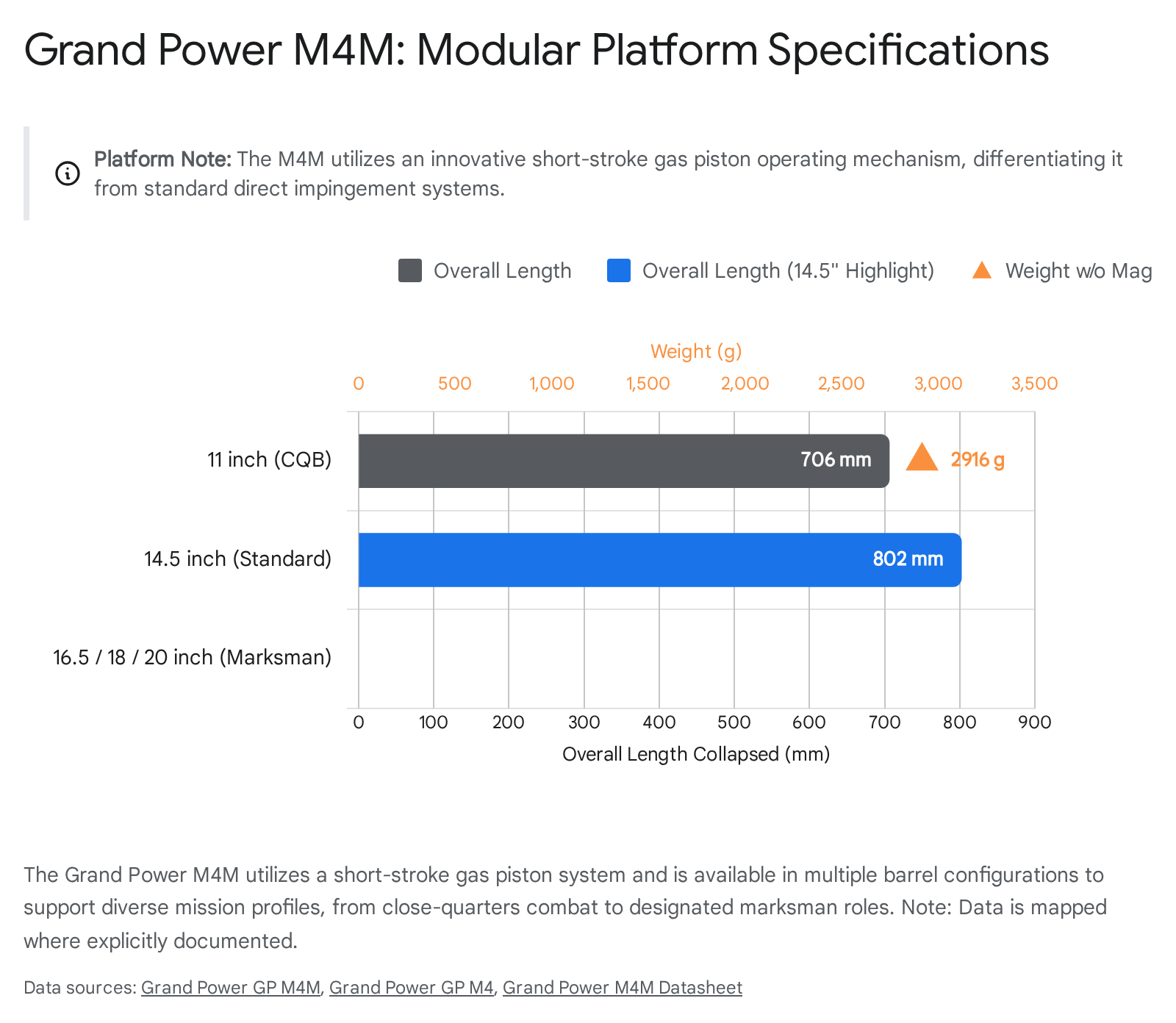
The procurement strategy involves a tiered deployment of the M4M platform to support diverse tactical requirements. The standard rifle will be issued to regular infantry formations, while a shortened variant—the 11-inch barrel model—is being procured specifically for special operations units requiring compact firepower for close-quarters battle.11
Beyond the primary service rifle, the Grand Power contract encompasses a complete small arms ecosystem:
- GP R10 Sniper Rifle: Designed to support long-range precision engagements at the squad and platoon levels.11
- Stribog SP9 A3 Submachine Guns: Chambered in 9x19mm, these highly compact weapons are being issued to military police, special units, and specifically to tank and armored vehicle crews who require potent personal defense weapons within the confined spaces of vehicle interiors.11
- Grand Power Q1 Pistol: The Q1 will serve as the new standard-issue sidearm.11 It features the company’s signature rotating barrel locking mechanism, which significantly reduces perceived recoil and muzzle flip compared to standard tilting-barrel designs, allowing for faster follow-up shots.34
Deliveries of this comprehensive weapons package are expected to commence in 2026 and continue over a structured two-year rollout program.11
7.2 Next-Generation Camouflage and Ballistic Protection
To complement the lethality of the new weaponry, the Slovak army used IDEB 2026 to reveal a fundamental overhaul of its combat uniforms and individual protection equipment. The military is formally abandoning its legacy VZ07 pixelated digital camouflage pattern, which has served as the standard for years.10 The replacement pattern, officially designated VZOR 25 (VZ25), relies on large, macro-pattern disruptions that closely resemble the classic British Disruptive Pattern Material (DPM).10 This aesthetic shift suggests a tactical refocusing toward effective concealment in the dense, organic woodland environments characteristic of Central and Eastern Europe, moving away from multi-terrain compromise patterns.
The uniform designs themselves have been upgraded to align with premium modern Western standards. The procurement includes two distinct sets designed for different operational profiles.10 The “Field Uniform” is designed for daily garrison service and standard field problems, featuring ergonomic, highly pocket-friendly layouts.10 The “Combat Suit,” conversely, is engineered for direct action. It integrates a breathable combat shirt designed specifically to be worn underneath heavy body armor and plate carriers without causing severe heat stress to the operator.10 The combat pants feature integrated knee protection and dynamic stretch panels, heavily mimicking high-end tactical designs popularized by manufacturers like Crye Precision.10 To balance economic constraints with material quality, the base fabric is sourced from specialized textile mills in Croatia, while the final assembly, cutting, and sewing are conducted domestically within Slovakia.10
In the realm of headborne protection, the Croatian manufacturer Šestan-Busch was awarded the PRIX IDEB 2026 award for its advanced ballistic helmets.16 Modern combat helmets are no longer simple shrapnel deflectors; they are complex platforms that must safely mount heavy night vision goggles (NVGs), communication headsets, strobes, and battery packs without fatiguing the operator’s neck over long patrols. Šestan-Busch’s designs are recognized for utilizing hybridized aramid material solutions that offer high-level ballistic resistance (often meeting NIJ IIIA standards against handgun threats) and blunt trauma protection, while aggressively reducing overall system weight.35 The inclusion of standardized ARC rails and NVG shrouds facilitates seamless integration with modern communication and optical systems, ensuring the infantryman remains a networked node on the battlefield.
8. Combat Engineering and Specialized Logistics
A recurring strategic lesson from contemporary high-intensity conflicts is that offensive maneuver and defensive fortification rely absolutely on robust combat engineering capabilities. Mechanized spearheads require engineers to breach obstacles, while defensive lines require rapid entrenchment to survive artillery barrages. At IDEB 2026, CSM Industries demonstrated its prowess in this vital sector, winning the PRIX IDEB 2026 award for its UDS4 VTV 4×4 exhibit.16
(https://www.uds.sk/), a highly experienced Slovakian firm with a history dating back to 1967 and over 30,000 machines produced, specializes in the Universal Finishing Machine (UDS) series of multi-purpose telescopic excavators.38 These heavy military excavator vehicles are highly specialized assets engineered for rapidly altering battlefield topography under extreme conditions.
During rigorous operational testing conducted by the Armed Forces at the Military Training and Testing area in Lešť, Slovakia, CSM’s platforms demonstrated exceptional performance metrics. The testing evaluated the excavator’s ability to construct infantry trenches, anti-tank obstacles, and massive tank trenches.40 The UDS system demonstrated the ability to construct a complete, precisely dimensioned tank trench—measuring 4.5 meters wide, 7 meters long, and 1.5 meters deep, complete with entry ramps—in just 50 minutes, significantly exceeding standard military engineering time limits.40
The integration of such specialized, high-power engineering equipment onto modern, off-road capable 4×4, 6×6, and 8×8 military truck chassis (often sourced from Tatra) ensures that combat engineering elements can maintain pace with rapid mechanized advances.41 This tactical mobility allows engineers to rapidly deploy anti-tank obstacles to channel enemy armor, dig infantry fortifications ahead of an assault, and clear urban debris under contested conditions without falling behind the main body of the force.
9. Electromagnetic Spectrum Dominance and Counter-UAS
The proliferation of cheap, highly capable unmanned aerial systems (UAS) has rendered traditional physical camouflage and concealment highly vulnerable. Ground forces are under constant, pervasive surveillance from the sky. Furthermore, the use of active radar emissions to detect these drones acts as a brilliant beacon for enemy anti-radiation missiles and electronic intelligence gathering, making the cure almost as dangerous as the disease. Surviving the modern battlefield requires dominating the electromagnetic spectrum without exposing one’s own position.
Addressing this critical vulnerability, the Swedish aerospace and defense company Saab showcased its Sirius Compact L24R at IDEB 2026.4 The Sirius Compact is a highly advanced, passive electronic warfare (EW) sensor designed for both strategic national security applications and tactical situational awareness.4
Unlike traditional air defense radar, which emits strong pulses of electromagnetic energy to illuminate and detect targets, passive sensors like the Sirius Compact emit absolutely zero signals.43 Instead, they act as highly sensitive listening devices across the electromagnetic spectrum. They detect, classify, and accurately geolocate the radio frequency (RF) emissions of enemy drones, data links, communication nodes, and hostile radar systems.13
This passive detection capability allows small tactical units or fixed strategic installations to build a comprehensive, real-time map of the airspace and ground environment without ever revealing their own physical location to enemy electronic intelligence.13 When integrated into broader battle management architectures—such as Saab’s scalable 9Air C4I system—the data gathered by passive sensors can instantly cue kinetic counter-drone engagements, direct precision artillery fire against enemy electronic nodes, or alert friendly units to seek hard cover before an enemy drone swarm arrives.13
10. Strategic Lessons Learned and Future Outlook
The 2026 iteration of the IDEB Defence & Security exhibition clearly articulated the technological, doctrinal, and industrial trajectory of NATO’s Eastern Flank. By analyzing the aggregate data from the exhibitions, product configurations, and executive statements, distinct macro-trends emerge regarding the future of defense procurement and ground combat operations.
First, the vulnerability of globalized supply chains during extended military crises has triggered a sharp, irreversible pivot toward regional industrial autarky. Poland, Slovakia, and the Czech Republic are no longer content to act solely as end-users of imported Western technology. The Borsuk export variant (combining a Polish chassis with a Slovak turret) and the CFL-120 Karpat (integrating Turkish/Czech intellectual property with Slovak production capacity) are prime examples of collaborative risk-sharing.5 By exchanging core competencies, these nations establish redundant, secure manufacturing nodes within European borders. This industrial strategy fulfills domestic political mandates to keep defense spending local while simultaneously creating highly competitive, export-ready products.21
Second, the hardware revealed in Bratislava reflects a highly pragmatic response to the tactical realities of contemporary conflict, characterized by a “light and lethal” paradigm shift. The prominence of the Karpat medium tank and the EVA M3 6×6 howitzer highlights a growing preference for strategic mobility over sheer mass. While heavy 70-ton MBTs and massive tracked self-propelled guns boast unparalleled physical survivability, they severely strain logistical infrastructure, consume immense quantities of fuel, and are notoriously difficult to transport rapidly across crumbling civilian bridges or muddy terrain. The new generation of ground platforms accepts a reduction in raw passive armor mass in exchange for the speed required to maneuver rapidly, strike decisively, and displace before the enemy can coordinate counter-battery fire.
Finally, with the deliberate reduction in passive armor, vehicle survivability is increasingly achieved through technological intervention and autonomy. The evolution from the Turra 30 V9 to the V10 demonstrates the rapid, non-negotiable adoption of Active Protection Systems and organic counter-UAS capabilities.22 The modern armored vehicle is no longer a standalone bunker; it is a digitally networked sensor node. By utilizing unmanned turrets, commanders keep their crews deep within the armored hull while AI-driven optronics, radar, and acoustic sensors identify and neutralize incoming threats automatically.7
Ultimately, IDEB 2026 proved that Central and Eastern European defense conglomerates are actively securing their national supply chains and positioning themselves not just as capable allies, but as primary architects of the next generation of European defense technology.
Please share the link on Facebook, Forums, with colleagues, etc. Your support is much appreciated and if you have any feedback, please email us in**@*********ps.com. If you’d like to request a report or order a reprint, please click here for the corresponding page to open in new tab.
Sources Used
- Patria at IDEB Defence & Security 2026, accessed May 20, 2026, https://www.patriagroup.com/newsroom/meet-patria-at-events/patria-at-ideb-defence-security-2026
- IDEB Defence & Security – Bratislava – Incheba.sk, accessed May 20, 2026, https://www.incheba.sk/en/fairs-and-exhibitions/ideb-defence-security-2/
- Invitation – Saab, accessed May 20, 2026, https://www.saab.com/globalassets/markets/slovakia/saab_invitation_ideb_2026_svk_generic.pdf
- PGZ unveils export version of Borsuk infantry fighting vehicle with Turra 30 turret at IDEB 2026 – Defence Industry Europe, accessed May 20, 2026, https://defence-industry.eu/pgz-unveils-export-version-of-borsuk-infantry-fighting-vehicle-with-turra-30-turret-at-ideb-2026/
- shownews – IDEB 2026: FNSS … – FW-MAG Future Warfare Magazine, accessed May 20, 2026, https://www.fw-mag.com/shownews/1078/ideb-2026-fnss-unveils-the-cfl-120-karpat-light-tank-and-signs-cooperation-agreement-with-csg
- CSG and FNSS Unveil Strategic Cooperation and Introduce the New CFL-120 Karpat Combat Vehicle | ASDNews, accessed May 20, 2026, https://www.asdnews.com/news/defense/2026/05/12/csg-fnss-unveil-strategic-cooperation-introduce-new-cfl120-karpat-combat-vehicle
- Poland debuts export Borsuk fighting vehicle at IDEB 2026 – The Defence Blog, accessed May 20, 2026, https://defence-blog.com/poland-debuts-export-borsuk-fighting-vehicle-at-ideb-2026/
- Attention! A New Predator in Bratislava – ASDNews, accessed May 20, 2026, https://www.asdnews.com/news/defense/2026/05/12/attention-new-predator-bratislava
- News from KONŠTRUKTA – Defence, a.s. | www.incheba.sk, accessed May 20, 2026, https://www.incheba.sk/en/novinky_na_veltrhu/news-from-konstrukta-defence-a-s/
- The new Slovak uniform | SPARTANAT, accessed May 20, 2026, https://spartanat.com/en/die-neue-slowakische-uniform
- IDEB 2026: Slovakian army presents its new weapons – Militär Aktuell, accessed May 20, 2026, https://militaeraktuell.at/en/ideb-2026-slovakian-army-presents-its-new-weapons/
- The new Slovak uniform – SPARTANAT.com, accessed May 20, 2026, https://www.spartanat.com/en/die-neue-slowakische-uniform
- Slovakia – Saab, accessed May 20, 2026, https://www.saab.com/markets/slovakia
- IDEB Defence &Security | www.incheba.sk, accessed May 20, 2026, https://www.incheba.sk/en/fairs-and-exhibitions/ideb-defence-security/
- Eastern Flank Review, 06.05-12.05.2026, accessed May 20, 2026, https://easternflank.org/eastern-flank-review-06-05-12-05-2026/
- Final Press Release IDEB Defence & Security 2026 | www.incheba.sk, accessed May 20, 2026, https://www.incheba.sk/en/news/final-press-release-ideb-defence-security-2026/
- CSG to Showcase Modern Vehicles and New Projects at the IDEB 2026 Defense Technology Exhibition in Bratislava | DEFENSEMAGAZINE.com, accessed May 20, 2026, https://www.defensemagazine.com/article/csg-to-showcase-modern-vehicles-and-new-projects-at-the-ideb-2026-defense-technology-exhibition-in-bratislava
- CSG Q1 2026 Trading Statement: Strong Start to the Year in – GlobeNewswire, accessed May 20, 2026, https://www.globenewswire.com/news-release/2026/05/20/3298164/0/en/CSG-Q1-2026-Trading-Statement-Strong-Start-to-the-Year-in-Q1-FY-2026-Guidance-Reaffirmed.html
- CSG and FNSS Unveil Strategic Partnership and CFL-120 Karpat at IDEB 2026, accessed May 20, 2026, https://www.defensemagazine.com/article/csg-and-fnss-unveil-strategic-partnership-and-cfl-120-karpat-at-ideb-2026
- Türkiye and Czech Republic Reveal CFL-120 Karpat Medium Tank as New NATO and M1A2 Abrams Alternative – Army Recognition, accessed May 20, 2026, https://www.armyrecognition.com/news/army-news/2026/tuerkiye-and-czech-republic-reveal-cfl-120-karpat-medium-tank-as-new-nato-and-m1a2-abrams-alternative
- Polish army receives first Borsuk fighting vehicles – The Defence Blog, accessed May 20, 2026, https://defence-blog.com/polish-army-receives-first-borsuk-fighting-vehicles/
- Slovakia’s TURRA 30 V10 Packs Lethal Punch with 30mm Autocannon RCWS ATGMs and Drones – MilitaryLeak.COM, accessed May 20, 2026, https://militaryleak.com/2025/07/14/slovakias-turra-30-v10-packs-lethal-punch-with-30mm-cannon-and-anti-tank-missiles/
- Boxer (armoured fighting vehicle) – Wikipedia, accessed May 20, 2026, https://en.wikipedia.org/wiki/Boxer_(armoured_fighting_vehicle)
- DSEI 2025 – FFG showcases its Condor future air defence vehicle – EDR Magazine, accessed May 20, 2026, https://www.edrmagazine.eu/dsei-2025-ffg-showcases-its-condor-future-air-defence-vehicle
- BOXER 8×8 Highly Protected Wheeled Armored Vehicle | DEFENSEMAGAZINE.com, accessed May 20, 2026, https://www.defensemagazine.com/article/boxer-8×8-highly-protected-wheeled-armored-vehicle
- News from Quantum Systems GmbH | www.incheba.sk, accessed May 20, 2026, https://www.incheba.sk/en/novinky_na_veltrhu/news-from-quantum-systems-gmbh/
- Konstrukta Defence of Slovakia unveils its EVA a new 6×6 155 mm self-propelled howitzer at IDET 1905155 – Army Recognition, accessed May 20, 2026, https://www.armyrecognition.com/archives/archives-land-defense/land-defense-2015/konstrukta-defence-of-slovakia-unveils-its-eva-a-new-6×6-155-mm-self-propelled-howitzer-at-idet-1905155
- EVA – KONŠTRUKTA – Defence, accessed May 20, 2026, https://kotadef.sk/projekty/eva/?lang=en
- 155 mm SpGH EVA – Wikipedia, accessed May 20, 2026, https://en.wikipedia.org/wiki/155_mm_SpGH_EVA
- GP M4 – GRAND POWER Ltd, accessed May 20, 2026, https://grandpower.eu/products/product-categories/law-enforcement-and-military/gp-m4/
- The GP M4M is a robust, reliable, short stroke piston operated, select fire rifle chambered in popular 5,56×45 NATO calibre. M, accessed May 20, 2026, https://grandpower.eu/wp-content/uploads/2024/10/M4M-Datasheet.pdf
- GP M4 & GP M4M USER MANUAL Basic Description The GRAND POWER M4 / M4M is a modern semiautomatic rifle chambered in .5.56 NA – Trueaim, accessed May 20, 2026, https://trueaim.fi/kauppa/storage/2023/04/safety-manual-R15-rifles-EN.pdf
- GP M4M – GRAND POWER Ltd, accessed May 20, 2026, https://grandpower.eu/products/product-categories/law-enforcement-and-military/gp-m4m/
- GRAND POWER: High quality firearms, accessed May 20, 2026, https://grandpower.eu/
- Top 5 Ballistic Helmets in 2026 – ActionStreamer, accessed May 20, 2026, https://actionstreamer.com/blog/top-5-ballistic-helmets-in-2026
- SESTAN-BUSCH | Company – Enforce Tac, accessed May 20, 2026, https://www.enforcetac.com/en/exhibitors/sestan-busch-2547848
- Busch Protective awarded FBI ballistic helmet contract – Police1, accessed May 20, 2026, https://www.police1.com/police-products/duty-gear/helmets/busch-protective-awarded-fbi-ballistic-helmet-contract
- CSM Industry s.r.o. – FindIn.sk, accessed May 20, 2026, https://findin.sk/en/company/csm-industry-sro/b18201ec-9bcc-ee11-a854-fa163e0a3f57
- Company – CSM Industry s.r.o., accessed May 20, 2026, https://csm.sk/
- Rheinmetall UDS Multi-tool Heavy Military Excavator Vehicle – Tank Trench – YouTube, accessed May 20, 2026, https://www.youtube.com/watch?v=Zxm29rDRJwk
- CSM Industry Debuts At IDEX With Its Military Exacavator Together With IGG UAE, accessed May 20, 2026, https://www.globaldefensecorp.com/2021/02/25/csm-industry-debuts-at-idex-with-its-military-exacavator-together-with-igg-uae/
- Azerbaijan orders 96 Slovak SAM120 mortars in €210 mln deal signed in Riyadh, accessed May 20, 2026, https://defence-industry.eu/azerbaijan-orders-96-slovak-sam120-mortars-in-e210-mln-deal-signed-in-riyadh/
- The passive sensor Sirius Compact from Saab – Militär Aktuell, accessed May 20, 2026, https://militaeraktuell.at/en/the-passive-sensor-sirius-compact-from-saab/
- Poland signs a record €17.2 billion contract for 1400 Borsuk armoured vehicles, accessed May 20, 2026, https://www.defensemagazine.com/article/poland-signs-a-record-eur172-billion-contract-for-1400-borsuk-armoured-vehicles