
1. Executive Summary
The 19th edition of the Defence Services Asia (DSA) and National Security (NATSEC) Asia exhibition, held at the Malaysia International Trade and Exhibition Centre (MITEC) in Kuala Lumpur from April 20 to 23, 2026, represented a vital barometer for the evolving security architecture of the Indo-Pacific region. Operating under the theme “Enhancing Capabilities and Resilience Through Technology,” the event convened 1,456 exhibiting companies from 63 countries and featured 37 national pavilions.1 This scale, which surpassed the previous 2024 edition, reflects a region undergoing rapid military modernization and force structure realignment in response to intensifying geopolitical friction and global supply chain vulnerabilities.2
An analysis of the technological platforms, strategic partnerships, and doctrinal shifts demonstrated at the exhibition reveals several dominant trends shaping Southeast Asian defense procurement. Foremost is a structural pivot away from total reliance on imported, off-the-shelf weapon systems toward sovereign industrial capacity and localized manufacturing. The enforcement of Malaysia’s National Defence Industry Policy (DIPN), which mandates a minimum of 30% local component integration in new defense acquisitions, catalyzed a surge in joint ventures and technology transfer agreements, heavily promoted by the newly formed Coalition of Defence Industry Malaysia (CDIM).1
Operationally, regional ground forces are prioritizing distributed lethality, high mobility, and electronic warfare (EW) resilience. The proliferation of autonomous systems has moved from experimental concepts to deeply integrated doctrinal assets. This shift is evidenced by the debut of artillery-launched loitering munition swarms, low-cost tactical strike drones, and multimission unmanned ground vehicles (UGVs) designed for complex urban terrain.6 Furthermore, traditional mechanized infantry and light cavalry formations are undergoing targeted modernization. Rather than exclusively procuring entirely new heavy armored fleets, militaries are focusing on pragmatic life-extension programs for legacy tracked vehicles and integrating heavy anti-armor capabilities onto highly mobile, domestically produced 4×4 platforms.8
This report provides an in-depth technical and strategic analysis of the products, partnerships, and lessons learned from DSA 2026, categorizing developments across the defense industrial base, infantry and small arms, armored mobility, unmanned systems, maritime defense, and command and control architectures.
2. Geopolitical Security Environment and Threat Calculus
The technological acquisitions and force posture adjustments showcased at DSA 2026 must be contextualized within the broader macro-security environment of the Indo-Pacific and neighboring regions. Defense procurement in Southeast Asia is currently driven by a confluence of rising maritime tensions, the economic shockwaves of the West Asia crisis, and the operational lessons observed in contemporary Eastern European and Middle Eastern conflicts.2
2.1 Maritime Security and the Strait of Malacca
The strategic importance of the Strait of Malacca continues to dictate naval and coastal defense priorities. At the 10th Bettonation Forum held concurrently with the exhibition timeline, Malaysian Foreign Minister Datuk Seri Mohamad Hasan emphasized that the security of the Strait must remain an ASEAN-consensus issue, managed collectively by littoral states including Malaysia, Indonesia, Singapore, and Thailand.10 This diplomatic stance was a direct response to external naval maneuvers, such as the reported transit of the United States warship USS Miguel Keith through the strait on April 18, acting under the US 7th Fleet operations.10
The requirement to monitor, deter, and manage incidents in these congested waterways is driving a regional demand for enhanced maritime domain awareness (MDA) sensors, coastal defense missile batteries, and rapid-intervention littoral vessels. Consequently, Southeast Asian nations are actively seeking platforms that can enforce sovereignty without unnecessarily escalating regional tensions.
2.2 Regional Defense Cooperation and Military Drills
To counter the potential for unilateral actions by external powers, regional defense networks are intensifying their cooperative frameworks. The Five Power Defence Arrangements (FPDA)—comprising Malaysia, Singapore, Australia, New Zealand, and the United Kingdom—announced plans to organize larger and more sophisticated multi-domain military drills in Southeast Asia.11 This commitment to complex, interoperable training exercises directly influences procurement demands, as member states require standardized communication architectures, compatible data links, and shared logistical nodes to effectively operate within a coalition environment.
2.3 The Shift Toward Asymmetric and Hybrid Threats
The overarching theme of DSA 2026 underscored a shift from preparing for conventional, peer-to-peer, set-piece battles toward countering asymmetric and hybrid security threats.3 Modern adversaries are increasingly employing irregular tactics, utilizing commercially available drone technology, cyber intrusions, and localized proxy engagements. In response, regional ministries of defense are recalibrating their budgets to prioritize smart systems, electronic warfare countermeasures, and rapid-response capabilities over massive investments in legacy heavy armor or deep-water capital ships.3
3. Defense Industrial Base Realignment and Sovereign Capacity
A central lesson learned from recent global supply chain disruptions is the strategic peril of relying entirely on foreign original equipment manufacturers (OEMs) for critical munitions, spare parts, and platform maintenance. DSA 2026 served as the launchpad for a highly coordinated effort to insulate the regional defense industrial base.
3.1 The National Defence Industry Policy (DIPN) and Local Content Mandates
Malaysia utilized its position as the host nation to aggressively promote its National Defence Industry Policy (DIPN). A cornerstone of this policy is the mandate that new defense platforms and systems must incorporate at least 30% local component integration.1 This threshold is designed to force foreign defense contractors into establishing local supply chains, facilitating technology transfers, and upskilling the domestic workforce. The economic impact of this policy was immediately visible at the exhibition, with the Malaysian Ministry of Defence sealing contracts and Industrial Collaboration Programme (ICP) agreements valued at approximately RM 3.54 billion, contributing to a total of RM 9.4 billion in contracts signed over the course of the event.2
3.2 The Coalition of Defence Industry Malaysia (CDIM)
To organize and amplify the capabilities of domestic manufacturers, the government facilitated the establishment of the Coalition of Defence Industry Malaysia (CDIM). Preceding the exhibition, a pro tem meeting chaired by Secretary General Datuk Seri Isham Ishak gathered 85 representatives from 30 defense companies to outline the coalition’s strategic direction.13 Ultimately, 156 companies engaged with the CDIM framework.14
At DSA 2026, the dedicated CDIM Pavilion served as a centralized hub for 368 exhibiting Malaysian companies to demonstrate their readiness to compete on the global stage.1 The pavilion highlighted the domestic defense sector’s transition from low-level assembly and maintenance tasks to complex systems integration, proprietary software development, and the manufacture of high-tolerance military components.5 By unifying the fragmented domestic industry, CDIM provides foreign OEMs with a streamlined interface for identifying capable local partners to satisfy the 30% ICP requirements.
3.3 Sovereign Ammunition and Propellant Production
One of the most critical vulnerabilities addressed at the exhibition was the supply of small arms ammunition and the raw materials required for its production. The global surge in demand for defense materials has caused the price of imported propellants to increase by three to four times, placing severe budgetary strain on military training and operational readiness.16
To mitigate this risk, Malaysia’s Ketech Asia showcased the output of the country’s first highly automated ammunition manufacturing facility, located on a 40.4-hectare site in Lipis, Pahang.16 The RM 150 million facility has achieved full-scale operations and is currently capable of producing up to 130 million rounds of 9mm and 5.56mm ammunition annually, effectively meeting the base requirements of domestic security and law enforcement agencies.16
Furthermore, Ketech Asia announced strategic expansion plans. By 2027, the company intends to expand its product line to include two additional ammunition calibers.16 More significantly, the firm is actively collaborating with researchers from the National Defence University of Malaysia (UPNM) to achieve sovereign propellant production. Following successful laboratory testing, Ketech Asia is providing technical assistance and utilizing its factory for live-fire testing to scale the UPNM research into a viable mass-production capability.16
Concurrently, legacy manufacturer SME Ordnance sought to expand its regional footprint by signing a strategic Memorandum of Understanding (MoU) with Indonesia’s PT. Dwimitra Pasifik Internasional.11 As a licensed distributor based in Jakarta, PT. Dwimitra’s partnership with SME Ordnance illustrates a growing trend of intra-ASEAN defense trade, aiming to establish localized, resilient supply networks that are insulated from Western or Eastern European production bottlenecks.
4. Strategic Alliances, Technology Transfers, and Joint Ventures
The operational requirement to meet local content mandates has fundamentally altered the behavior of foreign defense contractors operating in Southeast Asia. The exhibition floor at MITEC demonstrated that traditional direct commercial sales are being replaced by complex joint ventures, co-production agreements, and extensive technology transfers.
4.1 The Strategic Penetration of the Turkish Defense Ecosystem
A defining characteristic of DSA 2026 was the outsized and highly integrated presence of the defense industry of the Republic of Türkiye. Turkish firms have successfully positioned themselves not merely as vendors, but as foundational partners willing to offer the deep technological integration that Western contractors have historically restricted.1
This strategic penetration is evidenced by a dense web of bilateral agreements spanning multiple operational domains. The following table illustrates the key technology transfer and joint venture relationships established between Turkish original equipment manufacturers and Malaysian domestic industries:
| Turkish Contractor | Malaysian Partner / Platform | Technological Domain & Capability Integration | Strategic Implication |
| ASELSAN | Boustead | Satellite Communication (SATCOM) | Teaming agreement to develop SATCOM capabilities across ground and space segments, targeting Malaysia’s potential GEO satellite program. Includes localization and MAF training.18 |
| Roketsan | MILDEF (Tarantula 4×4) | Anti-Tank Guided Missiles (ATGM) | Integration of the OMTAS medium-range ATGM system directly onto locally manufactured armored platforms, bypassing the need for imported launch vehicles.8 |
| Turkish Aerospace Industries (TAI) & ASFAT | AIROD | Aerospace MRO and Advanced Jet Training | Agreements to collaborate on aerospace manufacturing, maintenance, and the potential localization of platforms like the Hürjet advanced jet trainer and ANKA drones.11 |
| STM | Royal Malaysian Navy (LMS) | Naval Shipbuilding | Construction of Littoral Mission Ships (LMS) serving as the hull platform for the integration of third-party weapon systems, such as South Korean missiles.20 |
These partnerships reflect a deliberate strategy by Ankara to expand its export market by accommodating the sovereign industrial ambitions of client states. By offering unrestrictive technology transfers, Türkiye is rapidly capturing market share in Southeast Asia’s defense modernization programs.
4.2 Russian Export Strategies Amidst Sanctions
Despite heavy international sanctions and the operational demands of ongoing conflicts, the Russian Federation maintained a notable presence at DSA 2026. Hosted by the state corporation JSC Rosoboronexport, the Russian pavilion aimed to leverage historical ties and existing platform commonality to sustain its export revenues in the Asia-Pacific.21
Rosoboronexport Director General Alexander Mikheev explicitly positioned the Su-57E fifth-generation multirole fighter as the centerpiece of their export pitch to the Royal Malaysian Air Force (RMAF).21 The marketing strategy for the Su-57E centers on its operational combat experience and, crucially, its logistical compatibility with Malaysia’s existing fleet. Because the Su-57E shares a significant number of subsystems, weapons interfaces, and maintenance protocols with the RMAF’s active Su-30MKM fleet, Rosoboronexport argues that it presents a highly cost-effective modernization pathway requiring minimal infrastructural overhaul.21 Additionally, Russia highlighted its latest loitering munitions and tactical UAVs, attempting to capitalize on the region’s intense interest in uncrewed combat systems.21
4.3 Western and South Korean Industrial Positioning
Western European and United States contractors maintained a substantial footprint, focusing on high-end electronics, command and control architectures, and interoperability.1 The UK defense sector, organized through the ADS Group, emphasized funding for innovation and NATO-aligned interoperability, promoting a long-term partnership model.22
South Korea continues to aggressively expand its influence, positioning its defense conglomerate, Hanwha Aerospace, and LIG Defense & Aerospace as highly reliable suppliers of artillery systems, precision-guided munitions, and armored vehicle upgrades.1 The South Korean approach mirrors the Turkish model, showing high flexibility in localizing production and integrating systems with domestic Malaysian prime contractors.
5. Infantry Modernization, Small Arms, and Soldier Systems
The modernization of dismounted infantry forces remains a persistent priority for ASEAN militaries facing the distinct challenges of triple-canopy jungles, complex littoral zones, and expanding urban centers. DSA 2026 highlighted a comprehensive approach to soldier lethality, focusing on weight reduction, modularity, and the integration of advanced optics into the small arms ecosystem.
5.1 Next-Generation Small Arms and Ergonomics
Global small arms manufacturers, including Beretta, Sig Sauer, and Glock, exhibited their latest platforms, reflecting a broad industry shift toward modular, polymer-framed, striker-fired handguns and highly customizable assault rifles.23 The presence of Beretta’s APX, PMX, and ARX platforms, alongside Sig Sauer’s MHS-winning designs, underscored a regional demand for weapons that offer interchangeable calibers and modular grip modules to accommodate diverse operator profiles.24
The underlying trend in small arms procurement is the optimization of soldier mobility through the utilization of advanced composite materials. Militaries are demanding reductions in weapon weight to mitigate fatigue during prolonged dismounted patrols, while simultaneously requiring enhanced recoil management and the capability to seamlessly integrate networked Internet of Things (IoT) sensors and digital shot counters into the weapon’s chassis.23
5.2 Enhancing Organic Anti-Armor Capabilities
A major tactical lesson absorbed by regional commanders is the necessity of providing light infantry squads with organic, highly lethal anti-armor capabilities that do not rely on external fire support.
At DSA 2026, Spain’s Instalaza debuted the C90 Reusable in the Asian market.6 Originally introduced as the single-use “Hispano,” this 90mm shoulder-fired weapon has been re-engineered with a highly robust, reusable launch tube. Weighing a mere 3.9 kilograms (excluding ammunition), it is currently one of the lightest reusable launchers in its class.6 This design evolution directly addresses the logistical constraints of light intervention forces; by shedding the weight of disposable firing mechanisms, a single operator can carry a higher volume of specialized munitions tailored to the immediate tactical environment.
The C90 Reusable features a “point and shoot” recoilless architecture, engaging point targets at 350 meters and area targets up to 800 meters.6 Tactical flexibility is achieved through a diverse ammunition family, encompassing shaped-charge anti-armor rounds, dual-purpose blast-fragmentation warheads for fortified positions, anti-bunker variants for reinforced concrete, and specialized enhanced-blast munitions designed to generate massive overpressure within enclosed urban spaces.6
To maximize the efficacy of these munitions, the system integrates the advanced e-IVISION electro-optic sight. This battery-powered unit replaces traditional optical sights with a high-resolution electronic display, featuring dynamic brightness control and selectable ballistic reticles optimized for the loaded munition type.6 This optical advantage drastically improves target acquisition speeds and first-round hit probabilities in degraded visual environments, such as dusk, dawn, or the interior of unlit structures.
Furthermore, the Malaysian Army is actively modernizing its medium-range anti-tank guided weapon (ATGW-MR) inventory. Roketsan confirmed that Malaysia will be the launch export customer for the KARAOK man-portable, fire-and-forget ATGM system. The initial procurement covers 18 launchers and 108 missiles (six per launcher), with deliveries scheduled by early 2026.26 Crucially, the contract includes an extensive simulation package featuring one indoor and three outdoor simulator platforms, ensuring operators attain high proficiency before expending live ordnance.26
5.3 Future Soldier Systems and Situational Awareness
Under the umbrella of the Future Soldier System (FSS) program, the Malaysian Army is systematically upgrading personal protection equipment (PPE) and individual sensor suites. The program encompasses the widespread distribution of Kevlar helmets, advanced body armor, protective eyewear, and the integration of SOPMOD (Special Operations Peculiar Modification) kits onto standard-issue M4 carbines.28
Night vision and thermal imaging capabilities are central to this modernization effort. Systems comparable to the AIM HuntIR thermal sight—which provides cooled thermal imaging for superior range performance, deep depth of focus, and target classification capabilities equivalent to armored vehicle gunner sights—are becoming baseline requirements for infantry combat.29 The tactical imperative is to enable dismounted squads to achieve target identification and execute precision engagements deep into the battlespace, irrespective of obscurants or zero-illumination conditions.29
6. Armored Mobility and Mechanized Infantry Evolution
The terrain of Southeast Asia presents severe limitations for traditional heavy Main Battle Tanks (MBTs). Consequently, regional land forces are seeking a careful equilibrium between the high mobility required for rapid deployment and the ballistic protection necessary for high-intensity conflict. DSA 2026 showcased both pragmatic upgrades to existing tracked fleets and the rapid evolution of wheeled tactical platforms.
6.1 Pragmatic Modernization: The MIFV-CH25 Program
Recognizing the prohibitive cost of replacing its entire mechanized infantry fleet, the Malaysian Army has partnered with domestic firm Cendana Auto and South Korea’s Hanwha Aerospace to execute a comprehensive life-extension program for its aging K200 Infantry Fighting Vehicles (IFVs). The result of this collaboration, the MIFV-CH25, was unveiled as a live-fire prototype at the exhibition.9
The modernization package addresses three decades of operational wear across all primary vehicle domains. Mobility is restored via the installation of a new MAN-Doosan D2848T V-8 powerplant, generating 350 horsepower, coupled with a highly reliable Allison X200-5K automatic transmission.9 Lethality and crew protection are fundamentally transformed through the removal of manned pintle mounts in favor of a Hanwha remote-controlled weapon station (RCWS). Configured for a 12.7mm heavy machine gun, the RCWS features advanced image stabilization, an automatic tracking lock, and a remote auto-reload mechanism, allowing the gunner to maintain continuous suppressive fire while remaining fully under armor.9
Survivability in modern threat environments is enhanced by the integration of the Pilar V acoustic gunshot detection system, which rapidly triangulates the origin of incoming fire. This is paired with a 360-degree sensor network of thermal and infrared cameras, significantly expanding the vehicle crew’s situational awareness.9 Furthermore, the refurbishment includes the installation of a modern cabin cooling system—an absolute necessity for crew endurance during extended operations in tropical climates—and a hydraulic assist ramp door to accelerate infantry dismount speeds under fire.9 This upgrade strategy ensures the tactical relevance of the 111-vehicle fleet for the foreseeable future.
6.2 The Proliferation of Specialized 4×4 Tactical Vehicles
MILDEF International Technologies dominated the wheeled mobility segment by presenting a suite of 4×4 platforms engineered for highly specific mission profiles, moving away from the concept of a generalized armored personnel carrier.
The integration of heavy anti-armor systems onto light, high-mobility chassis was a defining trend. MILDEF displayed its mine-resistant Tarantula 4×4 High Mobility Armoured Vehicle outfitted with a Turkish Roketsan remote weapon station. This specific turret configuration features a central 12.7mm machine gun flanked by twin launchers for the OMTAS medium-range ATGM.6 This integration effectively transforms the Tarantula from a troop transport into a mobile, anti-armor strike node. It allows light motorized cavalry units to engage enemy mechanized formations at stand-off ranges up to 4 kilometers, executing “shoot-and-scoot” tactics that maximize survivability in contested environments.6
For domestic security, counter-terrorism, and specialized urban interventions, MILDEF debuted a unique configuration of the Ribat 4×4 High Mobility Light Tactical Vehicle.6 Unlike standard military variants, this law enforcement model intentionally omits the installation of an RCWS to maintain a low visual silhouette.6 Instead, the vehicle is optimized for dynamic entry, featuring a flat roof platform and an angled frontal ramp system. This geometry permits a tactical assault team to position themselves securely while the vehicle is in motion, facilitating near-instantaneous breaches of elevated entry points, such as second-story windows or hijacked aircraft doors, drastically reducing the time terrorists have to react.6
Additionally, MILDEF unveiled the Mirsad 4×4 Infantry Support Vehicle (ISV), designed specifically for rapid reconnaissance and initial assault operations in restrictive terrain.32 The Mirsad explicitly trades heavy modular armor for superior speed, agility, and maneuverability. It utilizes run-flat tire technology that permits the vehicle to continue movement for up to 50 kilometers after sustaining severe ballistic damage.32 Featuring front and rear mounts for 12.7mm weapon systems, the Mirsad provides light infantry units with mobile fire support suited for dense jungle patrols or border security missions where heavier MRAPs cannot operate effectively. The vehicle is currently undergoing internal prototype testing, with formal Malaysian Army evaluations expected to commence following June 2026.32
| Vehicle Platform | Manufacturer / Origin | Primary Mission Profile | Key Technological Enhancements & Weapon Systems |
| MIFV-CH25 | Cendana Auto & Hanwha Aerospace | Mechanized Infantry Support (Tracked) | 350hp MAN-Doosan V-8, Allison transmission, Hanwha 12.7mm RCWS, Pilar V acoustic detection, thermal/IR sensor network.9 |
| Tarantula 4×4 | MILDEF (Malaysia) | Anti-Armor Strike / Protected Mobility | Mine-resistant hull, Roketsan RCWS integrating twin OMTAS ATGM launchers (4km engagement range).6 |
| Ribat 4×4 | MILDEF (Malaysia) | Counter-Terrorism / Hostage Rescue | Frontal assault ramp, flat roof staging platform, ultra-low visual silhouette (RCWS omitted).6 |
| Mirsad 4×4 ISV | MILDEF (Malaysia) | Light Reconnaissance / Rapid Assault | High agility configuration, run-flat tires (50km post-damage range), dual 12.7mm weapon mounts.32 |
For lighter platforms requiring augmented firepower without the weight of heavy turrets, Belgium’s FN Herstal presented the deFNder Medium RWS. This system optimizes mission flexibility by accommodating a wide spectrum of weaponry, ranging from standard 7.62mm general-purpose machine guns up to 30mm cannons.19 This scalability allows commanders to tailor the lethality of their light vehicle fleets based on specific mission requirements, ensuring that even unarmored utility vehicles can project significant suppressive fire while keeping operators protected under armor.19
7. Artillery, Autonomous Swarms, and Tactical Aerial Systems
The decisive operational impact of unmanned aerial systems (UAS) and loitering munitions in the conflicts of the mid-2020s has catalyzed a rapid shift in Asian military doctrine. DSA 2026 demonstrated that drones are no longer relegated solely to intelligence, surveillance, and reconnaissance (ISR) roles; they are now primary strike assets deeply integrated into artillery and infantry architectures.
7.1 Deep Precision Fires: The Autonomous “Thinking Swarm”
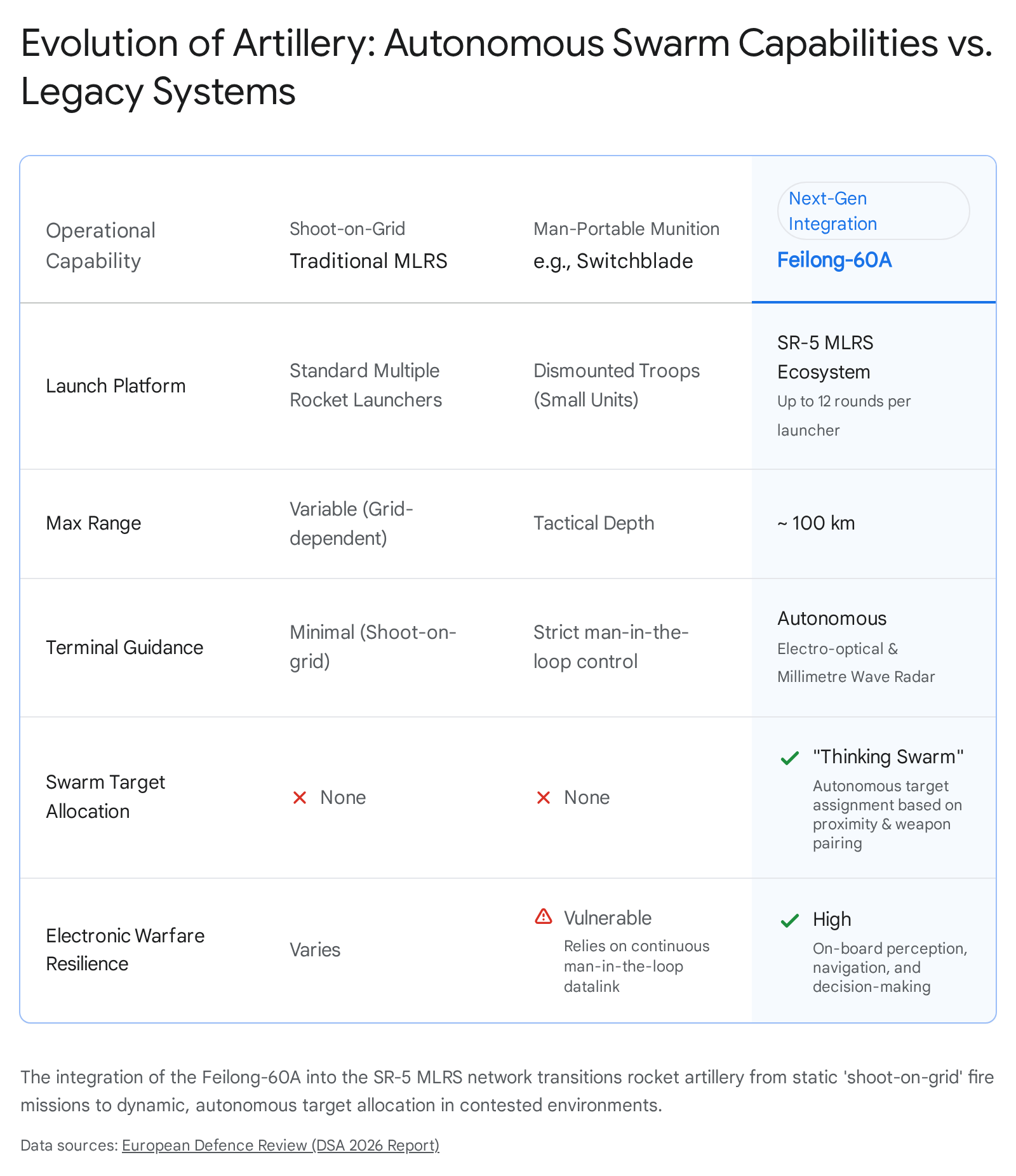
The most significant doctrinal disruption in the artillery domain was presented by China’s Norinco with the debut of the Feilong-60A (FL-60A), colloquially known as the “Flying Dragon”.6 The FL-60A fundamentally redefines multiple launch rocket systems (MLRS) by converting them into networked, semi-autonomous precision-strike platforms. Designed to pair with the existing SR-5 MLRS, the system acts as a direct capability upgrade. A single SR-5 launcher can accommodate two six-tube canisters, enabling the rapid deployment of up to twelve FL-60A loitering munitions in a single salvo, which can be intermixed with conventional guided rockets.6
The physical and aerodynamic design of the munition is optimized for volumetric efficiency. Measuring under three meters in length with a rectangular fuselage, the FL-60A utilizes an interlocking, twin-panel wing arrangement that remains folded during storage and deploys fractions of a second post-launch to achieve a wingspan of 2.1 meters.6 The propulsion system is a sophisticated hybrid design: a solid-fuel booster provides the initial high-subsonic to supersonic acceleration required to rapidly clear the launch area and transit to the operational zone, after which the munition transitions to a quiet, high-endurance electric motor equipped with a two-blade propeller for extended loitering.6 This dual-stage propulsion yields an operational radius of approximately 100 kilometers.
The defining technological leap of the Feilong-60A is its onboard autonomy and “Thinking Swarm” intelligence.6 Unlike portable tactical drones that rely on a constant “man-in-the-loop” data link, the FL-60A features a multi-layered guidance suite combining inertial/GNSS navigation with a millimeter-wave radar for autonomous target detection and recognition in the terminal phase.6 Once a swarm of FL-60A rounds is deployed, the munitions communicate autonomously to allocate targets among themselves. This allocation matrix is based on proximity to the target, remaining flight endurance, and pre-programmed weapon-to-target pairing rules.6
This high degree of onboard processing allows the swarm to operate effectively even in heavily contested electromagnetic environments where external data links and GPS are degraded or entirely denied by enemy electronic warfare. By acting as autonomous forward scouts that can either independently strike targets using their shaped-charge fragmentation warheads or cue follow-on mass fires from conventional rockets, the Feilong-60A allows artillery batteries to transition from traditional static “shoot-on-grid” missions to dynamic, deep-strike target hunting.6
7.2 Tactical Strike and Persistent Surveillance Drones
At the tactical echelon, Malaysian domestic industry demonstrated its ambition to establish sovereign strike-drone manufacturing capabilities. HeiTech unveiled the HDS-NSS, a locally developed, fixed-wing loitering munition optimized for battalion-level tactical operations.7 With an operational range of 20 kilometers, the HDS-NSS provides ground commanders with a low-cost, organic precision-strike option that circumvents the need to request high-value close air support or utilize expensive guided missile inventories.7 While the system is not yet tied to a public production contract, its development signals a strategic intent by Malaysia to master the guidance stacks, data links, and networking architectures required to dominate the lower-tier airspace.7
In the realm of persistent surveillance, the Aerodyne Group, a Kuala Lumpur-based analytics firm, showcased specialized long-duration surveillance drones engineered specifically for continuous operation in severe tropical conditions.33 These platforms are critical for maintaining continuous overwatch of porous borders and dense jungle canopies. Complementing this, DefTech highlighted its DT UAV, designed explicitly for military reconnaissance and the interdiction of illegal border incursions, enabling real-time detection and tracking in environments where ground patrols face severe mobility constraints.33 The strategic integration of these sovereign surveillance platforms aligns with the Ministry of Defence’s plan to deploy an advanced network of ISR drones by 2026 to monitor the critical border zones near Kalimantan and Thailand.34
8. Robotic Combat Systems and Ground Autonomy
The drive to remove human operators from the most hazardous threat vectors has accelerated the development of highly capable Unmanned Ground Vehicles (UGVs) and the resilient communication networks required to command them.
8.1 Multimission Ground Robotics
Spain’s EM&E Group introduced the aunav.BEST, a medium-class, teleoperated combat UGV, marking its debut in the Asian market.6 Weighing less than 390 kilograms and capable of operating at a radius of up to 20 kilometers, the fully electric vehicle is built around a highly adaptable chassis featuring four tracked flippers.6
A critical engineering feature of the aunav.BEST is its variable geometry; the platform can actively adjust its height from 685 mm to 950 mm.6 This allows operators to dynamically shift the vehicle’s center of gravity to optimize ground clearance based on the immediate terrain, facilitating the navigation of complex urban obstacles such as steep stairs, rubble, or structural ramps.6 To alleviate the cognitive burden on the remote operator, the UGV incorporates advanced automation algorithms that manage real-time driving aids and automatic platform stabilization.6
The aunav.BEST is a truly multimission platform. While it can be configured with specialized toolkits for explosive ordnance disposal (EOD) or CBRN reconnaissance, its combat configuration displayed at DSA 2026 integrated an EM&E Guardian Aspis RCWS armed with a 7.62mm machine gun.6 Uniquely, the platform also features the capacity to deploy a tethered unmanned aerial system (UAV). This tethered drone operates as an elevated electro-optical mast, creating a localized, low-altitude ISR “bubble” that provides the remote UGV operator with superior situational awareness and target acquisition capabilities within dense, line-of-sight restricted urban canyons.6
8.2 Software-Defined Communication Architectures
The operational viability of robotic combat systems like the aunav.BEST is entirely dependent on the resilience of their communication links. To address the vulnerability of these links to deliberate jamming, European defense conglomerate KNDS unveiled the Phorio tactical radio.6
Engineered specifically for autonomous vehicles and teleoperated weapons across land, sea, and air domains, Phorio is a new-generation software-defined tactical radio (SDR).6 Unlike legacy voice communication networks, Phorio is designed as a high-throughput, multi-purpose digital node capable of simultaneously processing command and control (C2) directives, platform telemetry, and high-definition video feeds from multiple thermal and daytime sensors without experiencing latency.6
Its most critical capability is its operational resilience in heavily contested electromagnetic environments. Phorio utilizes advanced transmission-security protocols and dynamic frequency-hopping techniques to sustain an unbroken data link despite active electronic warfare (EW) interference or severe signal degradation caused by urban clutter.6 Because it operates on a software-defined architecture, militaries can continuously upgrade the radio’s anti-jamming algorithms and introduce new, secure waveforms via software patches, extending the system’s operational lifespan without requiring expensive hardware replacements.6
9. Maritime Defense and Coastal Security
As naval tensions in the Indo-Pacific rise, regional navies are modernizing their fleets to protect exclusive economic zones (EEZs) and ensure the security of vital shipping lanes. DSA 2026 served as a platform for significant announcements regarding naval air defense and rapid maritime intervention capabilities.
9.1 Advanced Ship-Based Air Defense
In a major milestone for South Korean defense exports, LIG Defense & Aerospace (formerly LIG Nex1) finalized a $94 million USD contract with the Malaysian Ministry of Defence for the procurement of the Haegung (K-SAAM) surface-to-air missile system.20 This agreement marks the first successful overseas export of the K-SAAM platform.20
Developed indigenously by South Korea, the K-SAAM is a highly sophisticated defensive interceptor designed to neutralize a complex spectrum of aerial threats, ranging from high-altitude hostile aircraft to low-flying, sea-skimming anti-ship cruise missiles.20 The missile achieves its high intercept probability through the utilization of an advanced dual-mode seeker. By combining a radio frequency (RF) radar sensor with an imaging infrared (IIR) terminal guidance system, the K-SAAM can effectively distinguish true threats from intense background clutter and electronic countermeasures commonly deployed in littoral combat environments.20
In a prime example of the emerging trend of cross-national platform integration, the K-SAAM batteries are scheduled to be installed aboard the Royal Malaysian Navy’s new fleet of Littoral Mission Ships (LMS). Notably, these vessels are currently under construction by the Turkish defense engineering firm STM.20 This tripartite integration—a Turkish hull armed with South Korean effectors operated by a Southeast Asian navy—highlights the highly collaborative and diversified nature of modern defense procurement.
9.2 Rapid Intervention and Coastal Patrol
For operations below the threshold of high-intensity missile combat, naval and coast guard forces require highly durable, high-speed platforms for interdiction and coastal patrol. ASIS Boats utilized the exhibition to demonstrate their advanced maritime vessels, engineered specifically for mission-critical reliability in demanding littoral operations.35 The focus on customized, high-performance maritime solutions reflects the operational necessity for rapid-response units capable of boarding operations, counter-smuggling patrols, and the protection of offshore energy infrastructure.35
10. Cybersecurity, C4ISR, and Electromagnetic Warfare
The digitization of the battlefield dictates that physical weapon systems are only as effective as the sensor networks that guide them and the cyber defenses that protect their data links. Regional militaries are heavily investing in Command, Control, Communications, Computers, Intelligence, Surveillance, and Reconnaissance (C4ISR) architectures.
10.1 Multi-Layered Air Defense and Sensor Networks
Turkish defense giant ASELSAN presented a comprehensive suite of integrated C4ISR and radar systems aimed at “rewiring the battlespace”.6 A focal point of their exhibit was the “Steel Dome” multi-layered air defense concept, designed to integrate various sensor feeds and effectors into a unified, impenetrable defensive network.18
To counter the specific and pervasive threat of commercial and military drones, ASELSAN showcased the KORKUT Anti-Drone System and the EJDERHA Electromagnetic Counter-UAV (C-UAV) System.18 These platforms utilize directed electromagnetic energy and rapid-fire kinetic interception to disable hostile drone swarms before they can penetrate critical airspace. Furthermore, ASELSAN highlighted advanced aerial payloads, including the ASELFLIR 500 Electro-Optical Reconnaissance system, the TOLUN Guided Munition, and the ANTIDOT Electronic Warfare Pod, providing regional air forces with turn-key solutions for precision strike and electronic attack.18
The integration of advanced radar technology was a concurrent theme across the exhibition. Defense Advancement highlighted the integration of Echodyne’s advanced EchoShield radar technology, which provides critical detection and tracking capabilities for sophisticated air defense and counter-UAS programs.36 Similarly, the ongoing integration of systems like the Thales GM400 Alpha radars into Malaysia’s national air defense network illustrates a commitment to achieving total volumetric airspace awareness.37
10.2 Sovereign Cyber Defense Capabilities
Recognizing that national security is increasingly dependent on the integrity of digital infrastructure, Malaysian firms demonstrated significant advancements in sovereign cybersecurity.
BitRanger Sdn. Bhd., a commercial spin-off from the Universiti Sains Malaysia (USM) Cybersecurity Research Centre (CYRES), debuted the OwlSight platform.38 Operating as a Security Operations Centre (SOC)-as-a-Service, OwlSight represents a maturation of domestic cyber defense capabilities. Rather than relying entirely on automated algorithms that can be bypassed by novel zero-day exploits, OwlSight champions a “human-in-the-loop” operational model.38 By seamlessly integrating state-of-the-art heuristic threat detection technology with the cognitive analysis of expert cyber operators, the platform is designed to identify, isolate, and neutralize complex, state-sponsored cyber intrusions targeting military networks and critical civilian infrastructure.38
11. Human Capital, Training, and Simulation
The acquisition of highly advanced, multi-domain weapon systems generates a corresponding requirement for sophisticated training regimes. Without highly proficient operators, the technological advantages of fifth-generation fighters or autonomous swarms are nullified.
Recognizing this critical gap, the School of Information Operations (SOIO) and the Malaysian engineering and consulting firm Grayline Sdn Bhd formalized a Memorandum of Understanding (MoU) during the exhibition.39 This strategic partnership aims to design, develop, and deliver operationally focused, multi-domain training courses exclusively for the Malaysian Armed Forces.39 The curriculum will specifically target contemporary operational concepts that are difficult to simulate in traditional field exercises, including cyber defense, complex electromagnetic activities, information operations, and advanced electronic warfare.39
This emphasis on simulation and cognitive training is mirrored in hardware procurement contracts. As noted previously, the acquisition of the Roketsan KARAOK ATGM system includes a heavy emphasis on simulated training, providing the end-user with multiple indoor and outdoor digital simulators to build muscle memory and tactical proficiency prior to live-fire engagements.27
12. Strategic Conclusions and Future Trajectory
The announcements, technological debuts, and strategic partnerships forged at the 2026 Defence Services Asia exhibition clearly delineate the future trajectory of Southeast Asian military doctrine and procurement.
The region has decisively moved away from a model of purely transactional platform acquisition. Driven by the vulnerabilities exposed by global conflicts and enforced by policies like Malaysia’s 30% local content mandate, regional militaries are demanding—and securing—deep industrial partnerships that guarantee technology transfer and sovereign manufacturing capabilities.1 The success of the Coalition of Defence Industry Malaysia (CDIM) and the operationalization of sovereign ammunition facilities like Ketech Asia demonstrate that this transition is well underway.5
Tactically, ground forces are embracing distributed lethality and high mobility. The integration of medium-range anti-tank guided missiles onto domestically produced 4×4 vehicles, such as the MILDEF Tarantula, provides light cavalry units with unprecedented organic firepower, reducing their reliance on vulnerable heavy armor.6 Simultaneously, the rapid integration of autonomous systems—most notably the Feilong-60A loitering swarm and the HDS-NSS tactical strike drone—indicates a doctrinal shift toward stand-off engagement, allowing commanders to project precise lethal force while minimizing the physical exposure of their personnel.6
Ultimately, the effectiveness of this modernized, highly distributed force posture relies entirely on the resilience of the digital networks connecting the sensors to the shooters. As demonstrated by the proliferation of software-defined radios, advanced EW pods, and domestic cybersecurity platforms like OwlSight, mastering the electromagnetic spectrum and the cyber domain will be the decisive factor in any future Indo-Pacific conflict.18
Please share the link on Facebook, Forums, with colleagues, etc. Your support is much appreciated and if you have any feedback, please email us in**@*********ps.com. If you’d like to request a report or order a reprint, please click here for the corresponding page to open in new tab.
Sources Used
- Inside DSA 2026 Malaysia: New Weapons, Drones and Combat Systems Revealed, accessed May 1, 2026, https://www.youtube.com/watch?v=1TDwPTWlVZU
- DSA & NATSEC Asia 2026 Kicks Off in KL Showcasing Global Defence Power and Innovation – YouTube, accessed May 1, 2026, https://www.youtube.com/watch?v=teOgbIhASh4
- Ministry of Defence Boosts National Resilience with Cutting-Edge Technology at DSA 2026, accessed May 1, 2026, https://www.nabalunews.com/post/ministry-of-defence-boosts-national-resilience-with-cutting-edge-technology-at-dsa-2026
- DSA 2026 Expands Military Capability Showcase In Malaysia As Regional Security Pressure Grows – The Defense Watch, accessed May 1, 2026, https://thedefensewatch.com/asian-defense-security/dsa-2026-malaysia-showcases-advanced-military-capability-and-security-systems/
- DSA & NATSEC Asia 2026 Returns Amid Global Tensions – Asian Defence Journal, accessed May 1, 2026, https://adj.com.my/2026/04/17/dsa-natsec-asia-2026-returns-amid-global-tensions/
- DSA 2026 – EDR Magazine, accessed May 1, 2026, https://www.edrmagazine.eu/dsa-2026
- Malaysia Introduces HDS NSS Low-Cost Strike Drone for 20 km Tactical Operations, accessed May 1, 2026, https://www.armyrecognition.com/archives/archives-defense-exhibitions/2026-archives-news-defense-exhibitions/dsa-2026/malaysia-introduces-hds-nss-low-cost-strike-drone-for-20-km-tactical-operations
- “Precision Firepower Surge: ROKETSAN OMTAS Missile Integration into MILDEF Vehicles Elevates Malaysia’s Anti-Tank Strike Capability” – Defence Security Asia, accessed May 1, 2026, https://defencesecurityasia.com/en/roketsan-omtas-missile-mildef-vehicle-malaysia-anti-tank-capability/
- Malaysia tests upgraded K200 fighting vehicle – The Defence Blog, accessed May 1, 2026, https://defence-blog.com/malaysia-tests-upgraded-k200-fighting-vehicle/
- DSA & NATSEC Asia 2026 highlights strength of local defence industry – YouTube, accessed May 1, 2026, https://www.youtube.com/watch?v=q2X7r-W5HEo
- Tag: malaysia – Asian Defence Journal, accessed May 1, 2026, https://adj.com.my/tag/malaysia/
- Defence Ministry Seals RM3.54 Billion Contracts At DSA 2026 – Business Today, accessed May 1, 2026, https://www.businesstoday.com.my/2026/04/23/defence-ministry-seals-rm3-54-billion-contracts-at-dsa-2026/
- PRO TEM COALITION OF DEFENCE INDUSTRY MALAYSIA (CDIM) MEETING – Kementerian Pertahanan, accessed May 1, 2026, https://www.mod.gov.my/index.php/en/media3/news/pro-tem-coalition-of-defence-industry-malaysia-cdim-meeting
- SECRETARY GENERAL’S ENGAGEMENT SESSION WITH DEFENCE INDUSTRY PLAYERS – Kementerian Pertahanan, accessed May 1, 2026, https://www.mod.gov.my/index.php/en/media3/news/secretary-generals-engagement-session-with-defence-industry-players
- Show Features – DSA 2026, accessed May 1, 2026, https://www.dsaexhibition.com/show-features
- Local Ammunition Sector Explores Oil Palm Biomass For Propellant To Boost Resilience, accessed May 1, 2026, https://bernama.com/en/news.php//politics/news.php?id=2548400
- Ketech Asia Achieves Full Scale Ammunition Production – GBP Aerospace & Defence, accessed May 1, 2026, https://gbp.com.sg/stories/ketech-asia-achieves-full-scale-ammunition-production/
- ASELSAN Leads with Broad Portfolio and Local Partnerships at DSA 2026 | Al Defaiya, accessed May 1, 2026, https://www.defaiya.com/news/Defense%20News/Asia/2026/04/21/aselsan-leads-with-broad-portfolio-and-local-partnerships-at-dsa-2026
- DSA 2026 Official Online Daily News | Army Recognition, accessed May 1, 2026, https://www.armyrecognition.com/archives/archives-defense-exhibitions/2026-archives-news-defense-exhibitions/dsa-2026
- LIG Signs First Export Deal for K-SAAM with Malaysia – Naval News, accessed May 1, 2026, https://www.navalnews.com/naval-news/2026/04/lig-signs-first-export-deal-for-k-saam-with-malaysia/
- ROSOBORONEXPORT to showcase latest Russian weapons at DSA 2026 exhibition in Malaysia, accessed May 1, 2026, https://roe.ru/en/media/posts/kategoriya-1/rosoboroneksport-pokazhet-noveyshie-rossiyskie-vooruzheniya-na-vystavke-dsa-2026-v-malayzii/
- The World Leading Defence and Security Event – ADS Group, accessed May 1, 2026, https://www.adsgroup.org.uk/wp-content/uploads/2025/09/DSEI-Brochure-2025-online.pdf
- Asia-Pacific Small Arms & Light Weapons Market 2026 Industry Updates, Future Growth, Business Prospects, Forecast to 2033 · Apiary, accessed May 1, 2026, https://asiapacificsmallarmslightweaponsmarket2.docs.apiary.io/
- A New Handgun for the U.S. Army and the People – Small Arms Defense Journal, accessed May 1, 2026, https://sadefensejournal.com/a-new-handgun-for-the-u-s-army-and-the-people/
- DEFENCE SERVICES ASIA 2018: A Tour With Pew Doodles – Part 1 | thefirearmblog.com, accessed May 1, 2026, https://www.thefirearmblog.com/blog/2018/06/08/defence-services-asia/
- FPDA to be More Relevant for Future RMAF at 66 – LIMA 2025, accessed May 1, 2026, https://lima2025.com/img/in-the-news/adj-may-june2024.pdf
- List of equipment of the Malaysian Army – Wikipedia, accessed May 1, 2026, https://en.wikipedia.org/wiki/List_of_equipment_of_the_Malaysian_Army
- Malaysian Army – Wikipedia, accessed May 1, 2026, https://en.wikipedia.org/wiki/Malaysian_Army
- AIM HuntIR – Small Arms Defense Journal, accessed May 1, 2026, https://sadefensejournal.com/aim-huntir/
- Mildef Ribat HMLTV – Wikipedia, accessed May 1, 2026, https://en.wikipedia.org/wiki/Mildef_Ribat_HMLTV
- Mildef Unveils Ribat Hostage Rescue Vehicle – GBP Aerospace & Defence, accessed May 1, 2026, https://gbp.com.sg/stories/mildef-unveils-ribat-hostage-rescue-vehicle/
- Mildef Unveils Mirsad 4×4 Vehicle To Expand Malaysia Infantry Mobility, accessed May 1, 2026, https://thedefensewatch.com/military-ordnance/mildef-unveils-mirsad-4×4-military-vehicle-at-dsa-2026-in-malaysia/
- Ukraine Could Open Its Drone Export Market to Malaysia for First Time – DSA 2026, accessed May 1, 2026, https://www.dsaexhibition.com/ukraine-could-open-its-drone-export-market-to-malaysia-for-first-time
- Trade report for the Ministry of Foreign Affairs of Republic of Estonia – Opportunities in Malaysia, accessed May 1, 2026, https://www.vm.ee/sites/default/files/documents/2025-03/Malaysia%20Strategy_Defence.pdf
- DSA 2026 Recap: A Successful Wrap in Malaysia – ASIS Boats, accessed May 1, 2026, https://asisboats.com/news/dsa-2026-recap/
- DSA 2026 | Defence Services Asia Exhibition and Conference | April 20-23, accessed May 1, 2026, https://www.defenseadvancement.com/events/dsa-defence-services-asia/
- DSA 2026, accessed May 1, 2026, https://www.dsaexhibition.com/
- usm selected to showcase at defence services asia (dsa) 2026 and national security (natsec) asia 2026 – Public Technologies (PUBT), accessed May 1, 2026, https://www.publicnow.com/view/E7E5DDF3A8FCC8E9D4D64B0EA7ECBFCDEE40BCBD?1776678866
- Soio and Grayline sing MOU at DSA 2026 | AIDN – Australian Industry and Defence Network, accessed May 1, 2026, https://aidn.org.au/soio-and-grayline-sing-mou-at-dsa-2026/