
1. Executive Summary
The global operational environment over the past seven days has been defined by the unprecedented institutionalization of unmanned systems and the aggressive fielding of AI-enabled autonomous capabilities across all major combatant commands. Observations from the ongoing conflicts in Eastern Europe and the Middle East dictate that the experimental phase of drone warfare has definitively concluded. Military forces are now firmly operating within an era of industrialized, multi-domain autonomous warfare. The formal establishment of specialized unmanned task forces—such as U.S. Central Command’s (CENTCOM) Task Force Falcon Strike and the maturation of Ukraine’s Unmanned Systems Forces (USF)—signals a profound doctrinal shift. In this new paradigm, attritable, uncrewed mass is no longer viewed merely as an enabler for traditional maneuver elements or intelligence, surveillance, and reconnaissance (ISR) gathering. Instead, autonomous systems have become the primary mechanism for delivering strategic fires, executing suppression of enemy air defenses (SEAD), and establishing localized area denial.
A central trend emerging from the intelligence cutoff period is the acute focus on the offense-defense cost paradox and the subsequent optimization of the “cost-per-kill” metric. The rapid proliferation of low-cost, long-range one-way attack (OWA) systems—most notably the U.S. Low-Cost Uncrewed Combat Attack System (LUCAS) and the Russian Geran-2—has severely stressed legacy integrated air defense architectures. These attritable platforms threaten to deplete expensive interceptor magazines, forcing a reevaluation of air defense economics. In response to this asymmetric threat, engineering efforts across the defense industrial base are pivoting heavily toward resilience and alternative countermeasures. The ongoing integration of fiber-optic tethered drones by the U.S. Marine Corps to achieve total electromagnetic interference (EMI) immunity, combined with the U.S. Army’s focus on non-kinetic laser dazzling to blind satellite-based electro-optical sensors, highlights an accelerating race to either dominate or entirely bypass the contested electromagnetic spectrum (EMS). Concurrently, the Department of Defense (DoD) Replicator-2 initiative is accelerating the acquisition of low-collateral, highly scalable counter-UAS (C-UAS) effectors, including high-power microwave (HPM) and kinetic interceptor networks, to restore the defense’s cost advantage.
Strategically, the defense industrial base is undergoing a forced, rapid restructuring to accommodate the demands of industrialized drone warfare. Programs such as the U.S. Army’s SkyFoundry and the Defense Advanced Research Projects Agency’s (DARPA) “Deep Thoughts” project emphasize a transition away from the procurement of exquisite, multi-million-dollar platforms burdened by decade-long development cycles. The new acquisition mandate prioritizes the mass production of modular, open-architecture systems that can be rapidly iterated upon within months, if not weeks. This hardware agility is coupled with a massive push for software superiority, recognizing that autonomous navigation, machine vision, and swarming logic are the true differentiators in contested environments. Furthermore, the integration of collaborative combat aircraft (CCA), such as the MQ-28 Ghost Bat, into joint and allied architectures underscores the baseline requirement for manned-unmanned teaming (MUM-T) in future air superiority campaigns.
Ultimately, the events of the past week demonstrate a fundamental realignment of military power. Future strategic supremacy will rely less on possessing the most technologically exquisite individual platform, and more on a nation’s capacity to rapidly manufacture, dynamically network, and algorithmically coordinate swarms of autonomous nodes across the air, land, sea, and space domains. The integration of commercial sector innovation, backed by substantial capital inflows and streamlined procurement vehicles, is proving critical to maintaining this necessary industrial and technological tempo.
2. Global Situation Log
U.S. Central Command (CENTCOM) & Middle East Theater
Event & Development: On August 13, 2026, U.S. Central Command officially announced the establishment of Task Force Falcon Strike, designated as the U.S. military’s first multi-domain, multinational attack drone task force1. Expanding upon the aerial-focused Task Force Scorpion Strike—which was established in December 2025 and achieved the first launch of an aerial attack drone from a U.S. Navy warship—Falcon Strike integrates uncrewed systems across the air, surface, and subsurface domains1. The operational core of this task force relies heavily on the Low-cost Uncrewed Combat Attack System (LUCAS), an attritable one-way attack (OWA) drone engineered by SpektreWorks. The LUCAS platform is a direct reverse-engineered derivative of the Iranian HESA Shahed-136, featuring a nearly identical delta-wing pusher-propeller configuration, a 215cc internal combustion engine, and an operational range of approximately 500 miles5. The unit is spearheaded by personnel from U.S. Special Operations Command Central (SOCCENT), headquartered at MacDill Air Force Base, and relies upon deep integration with regional allied partners across the 21-country area of responsibility7. Concurrently, validating the massive industrial demand for ISR and persistent surveillance platforms in the region, defense contractor AEVEX Aerospace announced on August 13 a $650 million acquisition of BlackSea Technologies, a move designed to consolidate mid-tier maritime unmanned surface vessel (USV) and unmanned underwater vehicle (UUV) production9.
Tactical & Operational Lessons: The deployment of the LUCAS platform introduces highly modular, scalable mass to CENTCOM’s regional arsenal. From an engineering perspective, the LUCAS design embodies open-architecture principles, allowing forward-deployed units to rapidly execute payload swaps based on mission requirements. These payloads include explosive warheads for kinetic strikes, electro-optical/infrared (EO/IR) sensors for ISR, and communications packages to establish mesh relay networks in denied environments11. Operationally, the system’s launch versatility is a significant tactical multiplier; the drones can be deployed via catapults, rocket-assisted takeoff (RATO), mobile ground vehicles, and naval surface vessels, entirely negating the need for vulnerable, fixed runway infrastructure6. By operating within a networked swarm powered by AI-enabled autonomous navigation—and reportedly utilizing resilient communications architectures such as SpaceX’s Starshield—these systems can execute coordinated, multi-vector saturation attacks. Such tactics are explicitly designed to exploit the radar horizon and track-handling limits of adversary point-defense systems, overwhelming finite interceptor magazines. Furthermore, the AEVEX acquisition of BlackSea Technologies indicates a logistical and operational maturation in the maritime domain, ensuring that Task Force Falcon Strike will have sustained access to high-volume USV and UUV platforms capable of executing operations analogous to the recent unmanned strikes on Iranian port facilities at Bandar Abbas2.
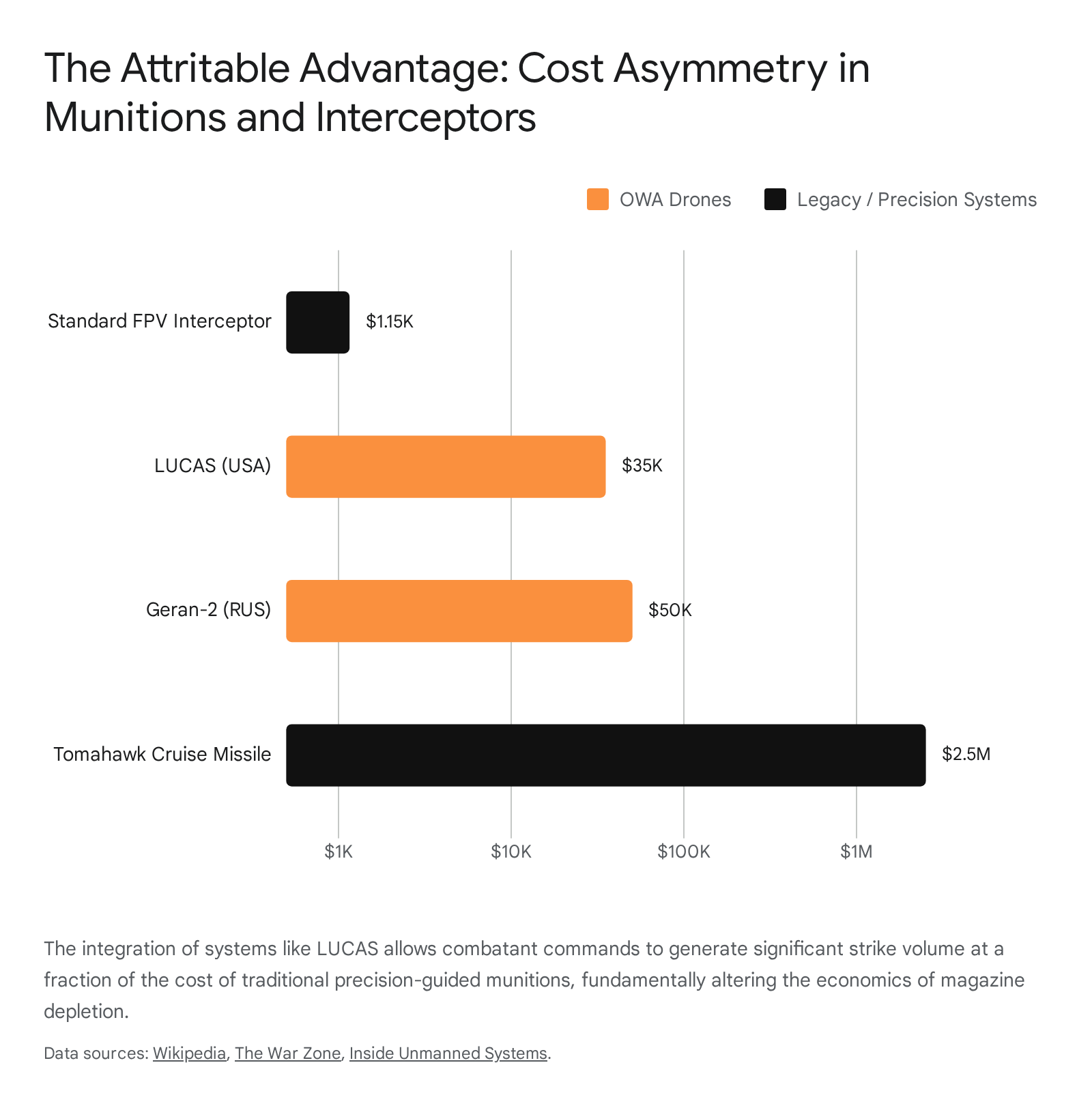
Strategic Lessons: Task Force Falcon Strike represents the practical execution of the “Arsenal of Democracy” concept, aggressively adapted for the AI era. By reverse-engineering an adversary’s primary asymmetric weapon, the DoD has effectively neutralized Iran’s regional monopoly on cheap, long-range loitering munitions, creating a cost-effective deterrent that does not rely on the depletion of exquisite, multi-million-dollar precision-guided munitions like the Tomahawk Land Attack Missile (TLAM)12. The multi-domain focus of the task force acts as a profound strategic force multiplier, complicating adversary defensive planning by expanding the threat vector to include subsurface and surface autonomous vessels. Crucially, the multinational component of Falcon Strike serves as a regional deterrent framework. By inviting Arab Gulf states to formally join the task force, CENTCOM is actively pooling ISR data and distributing launch capabilities across multiple sovereign territories, thereby creating an interconnected, highly resilient kill web that can absorb localized losses without degrading overall operational effectiveness7. This networked approach directly counters the Iranian threat network model with a technologically superior, coalition-based equivalent.
Eastern European Theater (Ukraine-Russia Conflict)
Event & Development: Building upon the recent one-year anniversary of the Unmanned Systems Forces (USF) as a distinct military branch, the Armed Forces of Ukraine (AFU) continue to scale their autonomous capabilities14. Operational data derived from the Delta situational awareness system confirms that USF units generated over 33,000 confirmed Russian casualties per month during the spring of 2026, neutralizing more than 350,000 enemy targets since the branch’s inception13. Ukraine has formally institutionalized the “Drone Line” tactical doctrine, utilizing specialized Drone-Assault Units (DAUs) to establish deep operational kill zones15. During the reporting period, Ukraine continued its deep-strike campaign against Russian strategic infrastructure, utilizing long-range autonomous drones—including the indigenous Batyar and the joint American-European Artemis ALM-20—to successfully strike a refinery in Leningrad Oblast and a major Wildberries logistics warehouse in Tver Oblast, complementing an early-August strike on the Syzran oil refinery17. Conversely, Russian forces executed intense, mixed-composition strike packages against civilian and industrial infrastructure in Kyiv and Zaporizhzhia. Supported by an estimated operational stockpile of roughly 6,200 Geran-type drones, these strikes utilized smaller drone salvos mixed with newly introduced Parodiya decoy drones, Kh-59/69 cruise missiles, and North Korean-provided KN-23 ballistic missiles launched from the Voronezh and Kursk regions19.
Tactical & Operational Lessons: The implementation of the Drone-Assault Unit (DAU) framework represents a fundamental paradigm shift in infantry maneuver warfare. Tactically, Ukrainian ground assaults no longer begin with physical troop advancements or traditional preparatory artillery barrages. Instead, operations are initiated by integrated reconnaissance-strike drone networks that identify, suppress, and destroy adversary assets at an operational depth of 10 to 15 kilometers1. This systematic employment is heavily supported by real-time C2 data fusion platforms, which integrate satellite imagery, acoustic signatures, and drone video feeds into a unified common operating picture21. To overcome the dense Russian electronic warfare (EW) jamming environments at the tactical edge, Ukrainian developers have heavily integrated machine-vision and AI-enabled terminal guidance modules. By allowing the munition to autonomously recognize the target and navigate the critical “last mile” without relying on active operator RF datalinks, engagement success rates have reportedly surged from around 10 to 20 percent to around 70 to 80 percent21.
On the defensive side of the equation, Russia’s integration of the cheap, radar-reflecting Parodiya decoys into massive Shahed and Gerbera swarms serves a strict magazine-depletion function18. The operational intent is to force Ukrainian air defense operators to expend limited, high-value interceptors—such as U.S.-supplied Patriot missiles—on non-lethal targets. Once the defensive magazines are depleted or the radar systems are saturated tracking the decoys, Russian forces launch high-velocity Iskander-M and North Korean KN-23 ballistic missiles, which have a significantly higher probability of penetrating the exhausted defense network20.
| System Designation | Origin | Operational Range | Payload / Warhead | Primary Guidance Mechanism | Strategic Function |
| LUCAS (FLM-136) | United States | ~800 km (500 miles) | Modular (Strike/ISR/Relay) | GNSS, INS, Starshield, AI-enabled | Attritable mass, network relay, SEAD |
| Geran-2 | Russian Federation | Up to 2,500 km | 52 kg / 90 kg options | GNSS (Kometa-M), INS | Strategic infrastructure terror, magazine depletion |
| Batyar | Ukraine | ~800 km | 18 kg (long-range config) | Optical terrain matching, INS | Deep-strike against C2 and energy infrastructure |
| Artemis ALM-20 | US/Europe (Joint) | Not publicly disclosed | 45 kg | Auterion onboard computer, AI | Precision deep-strike |
| Parodiya | Russian Federation | Varies (Decoy) | None (Luneberg lens payload) | Basic INS/GNSS | Radar spoofing, air defense exhaustion |
Table 1: Technical and operational comparison of primary one-way attack (OWA) systems and decoys currently shaping the strategic landscape in Eastern Europe and the Middle East.
[cite: 5, 20, 24]
Strategic Lessons: The maturation of the AFU’s Unmanned Systems Forces demonstrates that uncrewed systems require their own dedicated institutional infrastructure—complete with distinct tactical doctrine, specialized acquisition pathways, and tailored training pipelines—to achieve strategic effects14. The “Drone Line” concept is actively transitioning the AFU from a traditional military force that uses drones to augment legacy systems into a modern force where legacy systems (such as artillery and armor) exist primarily to augment and exploit the effects generated by drone operations16. Meanwhile, the Russian strike calculus underscores the enduring strategic value of industrial depth over exquisite platform superiority. By stockpiling thousands of relatively primitive Geran drones and integrating foreign-supplied ballistic missiles from North Korea, Russia maintains a continuous, grueling operational tempo19. This tempo is designed specifically to exploit critical bottlenecks in Western interceptor supply chains, highlighting that the ultimate victor in a prolonged autonomous conflict may be the belligerent capable of sustaining the highest rate of industrial replacement.
U.S. Homeland, INDOPACOM, & Force Modernization
Event & Development: Driving the U.S. military’s current industrial strategy are the ongoing efforts by the U.S. Marine Corps (I Marine Expeditionary Force) and the Defense Innovation Unit (DIU) to scale fiber-optic tethered first-person view (FPV) drones—a capability formally evaluated earlier this year at Camp Pendleton under the Project G.I. initiative26. Evaluating systems from vendors such as Auterion, Kraken, ModalAI, Neros, and Nokturnal AI, the ongoing rollout focuses on utilizing physical fiber-optic cables to maintain C2 and high-definition video feeds in severely signal-degraded environments27. Concurrently, the DoD is advancing its Drone Dominance Program (DDP) following recent solicitations for “reusable bomber/dropper platforms” capable of 15-30 km ranges and automated target recognition (ATR), signaling an initial commitment of $32 million for up to 1,200 prototype systems8. To support these massive acquisition targets, the U.S. Army is actively executing its “SkyFoundry” pilot program, aiming to domestically mass-produce 10,000 small unmanned aerial systems (sUAS) per month by the end of 20267. The Army is also advancing its “Launched Effects” (LE) drone initiative, mandating that swarming and electronic warfare-capable systems be fielded to every Army division and Multi-Domain Task Force12. Meanwhile, the high-profile Replicator initiative continues to navigate the transition from DIU oversight to the Special Operations Command’s (SOCOM) Defense Autonomous Warfare Group (DAWG), amid reports of software integration challenges and the necessity of a $300 million reprogramming request30.
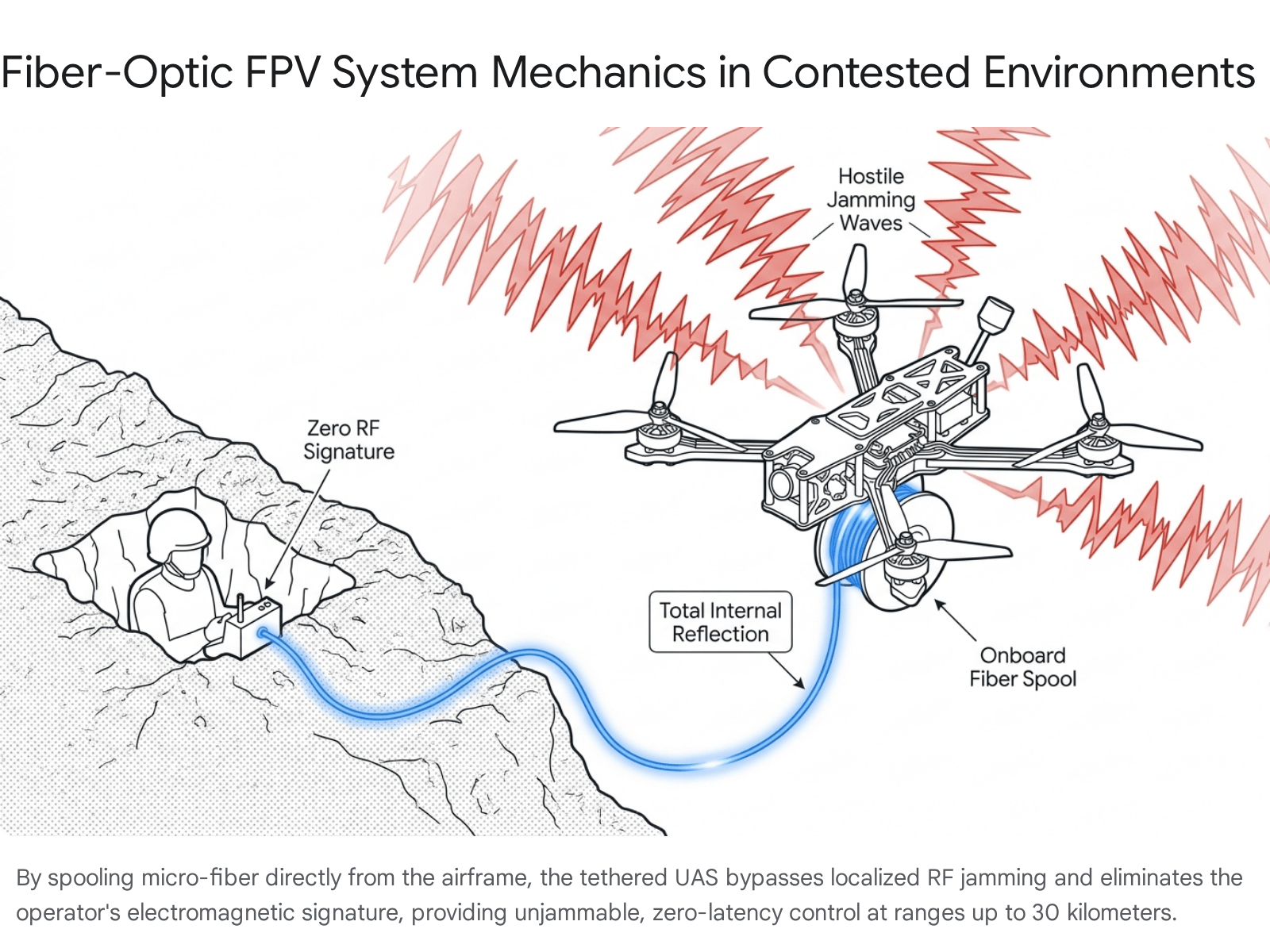
Tactical & Operational Lessons: The shift toward fiber-optic tethered FPV systems represents a direct engineering countermeasure to the dense, highly lethal EW environments currently defining modern battlefields. By physically connecting the drone to the operator via an ultra-thin spooling glass fiber, the system relies entirely on total internal reflection for data transmission. This mechanical innovation completely eliminates radio frequency (RF) emissions, ensuring zero-latency control, providing an unjammable high-definition video feed, and, critically, preventing the operator’s physical location from being triangulated by adversary signals intelligence (SIGINT) assets26. Mechanically, the fiber spool is housed on the drone itself rather than at the base station, meaning the aircraft lays the fiber along its flight path. This eliminates the aerodynamic drag associated with dragging a heavy cable through the air, allowing for unprecedented tethered operational ranges of 5 to 30 kilometers32.
The Army’s aggressive push for Launched Effects (LE) emphasizes the need for organic, squad-level over-the-horizon capabilities. These modular systems are designed to launch from existing rotary-wing aircraft or ground vehicles to extend the sensor perimeter12. Operating at ranges between 40 and 200 kilometers, LE swarms act as a forward screening element, utilizing radio frequency payloads to conduct electronic attack (EA) operations while relaying precise targeting data back to long-range precision fires (LRPF) batteries12. The addition of reusable bomber drones under the Drone Dominance Program further decentralizes kinetic effects, pushing close air support (CAS) capabilities directly down to the infantry platoon level8.
Strategic Lessons: Initiatives such as SkyFoundry and the ongoing evolution of the Replicator initiative represent a critical, albeit friction-heavy, correction in the U.S. defense acquisition apparatus7. The Pentagon increasingly recognizes that traditional, exquisite systems cannot survive the horrific attrition rates inherent in peer-level conflict. SkyFoundry serves a dual purpose: acting as a massive domestic manufacturing base while simultaneously functioning as a software experimentation hub. Army leadership acknowledges that the true strategic value of a modern sUAS is “not the plastic and metal that goes into it,” but the AI, autonomy software, and target recognition algorithms governing its behavior7. However, the institutionalization of these systems requires parallel, massive efforts in sustainment. Replicator’s growing pains—evidenced by paused software contracts with major defense contractors like L3Harris and the shift in program oversight—highlight the immense difficulty of integrating thousands of autonomous nodes into existing Command and Control (C2) architectures without inducing catastrophic fratricide or network overload30. As Replicator-2 pivots to focus heavily on C-UAS defeat systems, it underscores the reality that fielding drone swarms is only half the battle; defending against the adversary’s equivalent swarms is equally vital30.
Multi-Domain & Allied Developments (Space, Sea, Air)
Event & Development: The operational integration of autonomous systems has rapidly expanded beyond the terrestrial domain. On August 13, 2026, the U.S. Army Space and Missile Defense Command (SMDC) announced a concentrated focus on space superiority through ground-based counter-ISR satellite operations13. This specifically includes the development of laser dazzling systems designed to temporarily or permanently blind adversary low-Earth orbit (LEO) optical sensors13. This effort runs parallel to the Space Force’s ongoing expansion of the “Golden Dome” missile defense architecture, heavily supported by prior multi-billion dollar contracts awarded to SpaceX for advanced space-based tracking and communication layers36. In the maritime domain, industry response continues for DARPA’s “Deep Thoughts” program, an initiative seeking the rapid development of small autonomous undersea vehicles (AUVs). The program emphasizes novel pressure vessels and advanced manufacturing techniques designed to slash development timelines from years down to weeks38. In the air domain, defense reporting from August 13-14 indicates that Boeing and Rheinmetall have formalized plans to propose the MQ-28 Ghost Bat Collaborative Combat Aircraft (CCA) to the German Air Force, aiming for a 2029 deployment40. The MQ-28 recently achieved a significant milestone by becoming the first CCA to participate in a multinational joint operational exercise during Valiant Shield 202640. Furthermore, NATO’s recent C-UAS TIE23 exercise in the Netherlands brought together 15 allied nations to evaluate over 70 distinct C-UAS sensors, jammers, and effectors, emphasizing alliance-wide standardization43.
Tactical & Operational Lessons: The mechanics of multi-domain autonomy require vastly different engineering approaches than standard aerial platforms. In the realm of counter-satellite laser operations, engineering assessments indicate that functional, irreversible damage to satellite-based CCD/CMOS thermal and electro-optical arrays occurs at specific energy density thresholds of approximately 3 J/cm244. At lower power levels, the use of spatial light modulation and continuous wave lasers causes saturation crosstalk, effectively blinding the adversary’s targeting kill chain temporarily without creating kinetic, long-lived space debris in orbit13.
In the undersea domain, the “Deep Thoughts” AUV requirements highlight a unique physics challenge: seawater severely attenuates RF communications, meaning underwater systems cannot rely on continuous remote piloting or GPS uplinks. Therefore, DARPA’s push for next-generation AUVs inherently requires highly advanced on-board AI for fully autonomous navigation, obstacle avoidance, and target classification, relying heavily on acoustics, pressure sensors, and inertial navigation systems (INS)38.
In the air, the integration of the MQ-28 Ghost Bat CCA demonstrates the operational value of modularity. The Ghost Bat is designed to push sensor perimeters hundreds of miles ahead of highly valuable crewed assets like the F-35 or Eurofighter. The open architecture of the MQ-28’s modular nose allows ground crews to rapidly swap electronic warfare, ISR, or kinetic payloads depending on the immediate threat environment. This allows the uncrewed CCA to absorb extreme tactical risk and execute autonomous mission tasks (such as target interception), while a human operator safely maintains overarching engagement oversight from a standoff distance40.
| Domain | Key Program/Platform | Lead Agency/Nation | Primary Capability Focus | Strategic Objective |
| Air | MQ-28 Ghost Bat (CCA) | Boeing / RAAF / Germany | Modular payloads, MUM-T, Mach 0.9 | Extend sensor/strike range of 5th-gen fighters |
| Sea (Subsurface) | Deep Thoughts AUV | DARPA (U.S.) | Rapid prototyping, GPS-denied autonomy | Persistent seabed monitoring, rapid deployment |
| Space/Ground | Golden Dome / SMDC | Space Force / Army SMDC | Ground-based laser dazzling, tracking | Blind adversary LEO ISR without kinetic debris |
| Information/EMS | Project G.I. (Fiber-Optic) | DIU / U.S. Marine Corps | Zero RF emissions, total internal reflection | Assured C2 in severely EW-contested environments |
Table 2: Matrix of critical multi-domain autonomous programs demonstrating the expansion of uncrewed systems beyond traditional aerial ISR roles. Citations 13, 26, 36, 38, 48
Strategic Lessons: The spectrum of warfare has irrecoverably expanded into the stratosphere, orbital layers, and the deep ocean. The U.S. Army SMDC’s explicit focus on non-kinetic, reversible (and irreversible) counter-satellite measures highlights an evolving doctrine centered on blinding the enemy’s ubiquitous sensing grid. By blinding adversary satellites, U.S. forces aim to deny adversaries the exact type of real-time situational awareness that the U.S. is currently mastering via AI-fused C2 networks13. DARPA’s “Deep Thoughts” program underscores the urgent strategic need to protect critical seabed infrastructure—such as the fiber-optic cables that carry the vast majority of global internet traffic—and establish a persistent, autonomous sub-surface presence capable of deterring adversary submarine activity49. Finally, the export and integration of CCAs like the Ghost Bat into Australia and its proposed integration with Germany’s Luftwaffe indicates that autonomous wingmen and MUM-T architectures are rapidly becoming the baseline standard for NATO air superiority41. This ensures that future coalition conflicts will be fought with interoperable, digitally integrated systems, sharing a common technological and logistical foundation across the alliance.
Please share the link on Facebook, Forums, with colleagues, etc. Your support is much appreciated and if you have any feedback, please email us in**@*********ps.com. If you’d like to request a report or order a reprint, please click here for the corresponding page to open in new tab.
Sources Used
- CENTCOM Launches First-Ever Multinational Attack Drone Task Force, https://www.centcom.mil/MEDIA/PUBLIC-RELEASES/Article/4573159/centcom-launches-first-ever-multinational-attack-drone-task-force/
- CENTCOM launches multinational one-way attack drone force – Breaking Defense, https://breakingdefense.com/2026/08/centcom-launches-multinational-one-way-attack-drone-force/
- CENTCOM launches multinational attack drone task force – Military Times, https://www.militarytimes.com/news/pentagon-congress/2026/08/14/centcom-launches-multinational-attack-drone-task-force/
- US establishes new multi-domain attack drone task force – Naval Today, https://www.navaltoday.com/2026/08/14/us-establishes-new-multi-domain-attack-drone-task-force
- Low-cost Uncrewed Combat Attack System – Wikipedia, https://en.wikipedia.org/wiki/Low-cost_Uncrewed_Combat_Attack_System
- U.S. Deploys Shahed-136 Clones To Middle East As A Warning To Iran – TWZ, https://www.twz.com/air/u-s-deploys-shahed-136-clones-to-middle-east-as-a-warning-to-iran
- Army aims to manufacture 10,000 drones per month by 2026 – DefenseScoop, https://defensescoop.com/2025/10/14/army-small-drones-skyfoundry/
- Pentagon adds ‘bombers’ to Drone Dominance Program – DefenseScoop, https://defensescoop.com/2026/07/22/pentagon-adds-bombers-to-drone-dominance-program/
- Defense Tech Daily — 2026-08-13 – Buttondown, https://buttondown.com/defensetech/archive/defense-tech-daily-2026-08-13/
- AEVEX (AVEX) Q2 2026 Earnings Call: Revenue Doubles, Guidance Raised, BlackSea Deal Announced, https://www.tradingkey.com/news/transcripts/262105278-tradingkey
- LUCAS Drone Explained: America’s Low-Cost Answer to the Shahed-136 – YouTube, https://www.youtube.com/watch?v=cIBZIdmYOHs
- Army issues solicitation for ‘launched effects’ autonomous drones – DefenseScoop, https://defensescoop.com/2025/08/06/army-launched-effects-solicitation-autonomous-drones/
- Army gears up to ‘engage’ enemy surveillance satellites – Breaking Defense, https://breakingdefense.com/2026/08/army-gears-up-to-engage-enemy-surveillance-satellites/
- Ukraine’s Unmanned Systems Forces: one year of a branch the world had never seen, https://armyinform.com.ua/en/2026/06/11/ukraines-unmanned-systems-forces-one-year-of-a-branch-the-world-had-never-seen/
- Drone Line: implementing a new warfare doctrine | MoD News, https://mod.gov.ua/en/news/drone-line-implementing-a-new-warfare-doctrine
- Drone-Assault Units: A New Tactical Doctrine in the Age of Total Drone Warfare – Resurgam, https://resurgamhub.org/opinion/oleksii-jasko/drone-assault-units-a-new-tactical-doctrine-in-the-age-of-total-drone-warfare
- ISW Russian Offensive Campaign Assessment, August 14, 2026, https://www.kyivpost.com/post/82376
- Russian Offensive Campaign Assessment, August 14, 2026 | ISW, https://understandingwar.org/research/russia-ukraine/russian-offensive-campaign-assessment-august-14-2026/
- Russian Offensive Campaign Assessment, August 12, 2026, https://understandingwar.org/research/russia-ukraine/russian-offensive-campaign-assessment-august-12-2026/
- Russian Offensive Campaign Assessment, August 11, 2026, https://understandingwar.org/research/russia-ukraine/russian-offensive-campaign-assessment-august-11-2026/
- Ukraine’s Future Vision and Current Capabilities for Waging AI-Enabled Autonomous Warfare – CSIS, https://www.csis.org/analysis/ukraines-future-vision-and-current-capabilities-waging-ai-enabled-autonomous-warfare
- Russian Offensive Campaign Assessment, August 8, 2026 | ISW, https://understandingwar.org/research/russia-ukraine/russian-offensive-campaign-assessment-august-8-2026/
- Russian Offensive Campaign Assessment, August 13, 2026 | ISW, https://understandingwar.org/research/russia-ukraine/russian-offensive-campaign-assessment-august-13-2026/
- HESA Shahed 136 – Wikipedia, https://en.wikipedia.org/wiki/HESA_Shahed_136
- A Swift Answer to the Unknown: How the U.S. Army Can Seize a Central Role in Drone Warfare, https://www.armyupress.army.mil/Journals/Military-Review/English-Edition-Archives/March-April-2026/A-Swift-Answer-to-the-Unknown/
- U.S. Marine Corps conducts first field evaluation of fiber-optic FPV drones for contested operations – Defence Industry Europe, https://defence-industry.eu/u-s-marine-corps-conducts-first-field-evaluation-of-fiber-optic-fpv-drones-for-contested-operations/
- JUST IN: Marines Conduct First Fiber Optic FPV Drones Test – National Defense Magazine, https://www.nationaldefensemagazine.org/articles/2026/2/19/marines-testing-first-person-view-drones-for-electronic-warfare
- I MEF Marines evaluate fiber-optic FPV drones during DIU challenge – DVIDS, https://www.dvidshub.net/news/557860/mef-marines-evaluate-fiber-optic-fpv-drones-during-diu-challenge
- Strategic & Spectrum Missions Advanced Resilient Trusted Systems (S2MARTS) Request for Solutions (RFS) – Drone Dominance Program, https://dronedominance.mil/assets/S2MARTS%20Drone%20Dominance%20G2%20RFS%20-%20Phase%202.5%20Mission%20C.pdf
- DoD promised a ‘swarm’ of attack drones. We’re still waiting. – Responsible Statecraft, https://responsiblestatecraft.org/replicator/
- Military services face sustainment burdens from Replicator systems – DefenseScoop, https://defensescoop.com/2024/05/15/replicator-systems-sustainment-burdens-military-services/
- Anti-Jamming FPV Fiber Systems: Zero-Latency UAV Transmission – ZION Communication, https://www.zion-communication.com/Anti-Jamming-FPV-Fiber-Systems-Zero-Latency-UAV-Transmission-id48873775.html
- Fiber-Optic Drone Technologies: A Multidisciplinary Review from Communication Fundamentals to Military Applications – ResearchGate, https://www.researchgate.net/publication/392512531_Fiber-Optic_Drone_Technologies_A_Multidisciplinary_Review_from_Communication_Fundamentals_to_Military_Applications
- DIU, NorthCom partner up to confront the military’s ‘most pressing’ counter-drone challenges | DefenseScoop, https://defensescoop.com/2025/05/05/diu-northcom-partner-up-to-confront-the-militarys-most-pressing-counter-drone-challenges/
- Move Fast and Scale: A Brief Insiders’ History of the Replicator Initiative – Belfer Center, https://www.belfercenter.org/research-analysis/move-fast-and-scale-brief-insiders-history-replicator-initiative
- SpaceX Wins $6.45B to Build Golden Dome’s Space Layer – AeroMorning.com, https://aeromorning.com/en/spacex-wins-6-45b-to-build-golden-domes-space-layer/
- Golden Dome is the missile defense the US needs – Atlantic Council, https://www.atlanticcouncil.org/in-depth-research-reports/issue-brief/golden-dome-is-the-missile-defense-the-us-needs/
- Deep Thoughts – DARPA, https://www.darpa.mil/research/programs/deep-thoughts
- DARPA calls for proposals for autonomous underwater drones — gov’t looking for a small, cheap autonomous sub that can be developed and built quickly | Tom’s Hardware, https://www.tomshardware.com/tech-industry/darpa-calls-for-proposals-for-autonomous-underwater-drones-govt-looking-for-a-small-cheap-autonomous-sub-that-can-be-developed-and-built-quickly
- Boeing’s MQ-28 Ghost Bat made its first appearance at Farnborough, and the jet it is built to escort – OkDiario, https://okdiario.com/techy/en/boeings-mq-28-ghost-bat-made-its-first-appearance-at-farnborough-and-the-jet-it-is-built-to-escort/7413/
- Boeing, Rheinmetall Advance MQ-28 Ghost Bat CCA Plans for Germany, https://www.govconexec.com/2026/08/boeing-rheinmetall-mq-28-ghost-bat-germany-cca/
- Rheinmetall and Boeing to offer Ghost Bat combat drone to German air force, https://www.aerospacetestinginternational.com/news/defense/rheinmetall-and-boeing-to-offer-ghost-bat-combat-drone-to-german-air-force.html
- NATO conducts counter-drone technology tests in the Netherlands, https://militaryembedded.com/unmanned/counter-uas/nato-conducts-counter-drone-technology-tests-in-the-netherlands
- Dazzling Evaluation of High-repetition-rate CO2 Pulsed Laser on Infrared Imaging Systems, https://www.preprints.org/manuscript/202402.0512
- Dazzling Evaluation of the Impact of a High-Repetition-Rate CO2 Pulsed Laser on Infrared Imaging Systems – PMC, https://pmc.ncbi.nlm.nih.gov/articles/PMC10974727/
- Sensor protection against laser dazzling – ResearchGate, https://www.researchgate.net/publication/241203405_Sensor_protection_against_laser_dazzling
- Defense Advanced Research Projects Agency (DARPA) Archives | DefenseScoop, https://defensescoop.com/tag/darpa/
- MQ-28 Ghost Bat – Boeing, https://www.boeing.com/defense/autonomous-and-unmanned-systems/mq-28-ghost-bat
- Marines evaluate fiber-optic FPV Drones during DIU challenge, https://www.marines.mil/News/Marines-TV/videoid/995779/