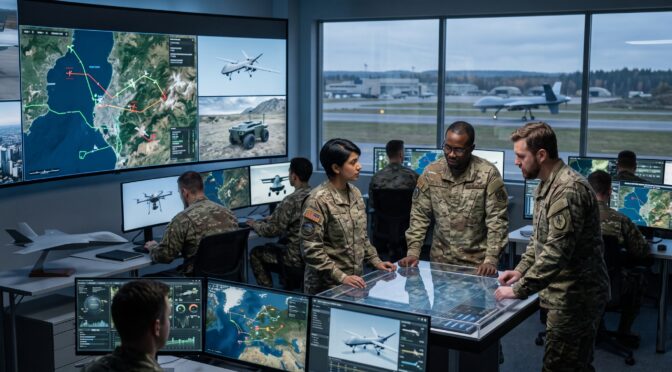
The seven-day reporting period concluding on July 18, 2026, marks a definitive inflection point in the operationalization of global military drone and autonomous systems. Through deductive analysis of international geopolitical maneuvers, observed field deployments in contested theaters, and observable technological procurement patterns, it is evident that the character of algorithmic warfare has matured beyond theoretical frameworks into concrete, fielded capabilities. The prevailing dynamic across all major theaters has shifted decisively from remote-piloted, human-in-the-loop (HITL) systems—which remain highly vulnerable to broadband electronic warfare (EW) and localized jamming—toward edge-computed, fully autonomous terminal-phase engagement architectures. This shift fundamentally alters the mathematics of attrition warfare, vastly compresses the sensor-to-shooter kill chain, and redefines the threshold for military escalation. The developments observed over the past week underscore a systemic transition wherein software-defined capabilities and algorithmic updates now outpace traditional hardware acquisition cycles, fundamentally challenging legacy air defense, maritime security doctrines, and established paradigms of strategic deterrence.
1. The Electromagnetic Contestation and Cognitive Edge
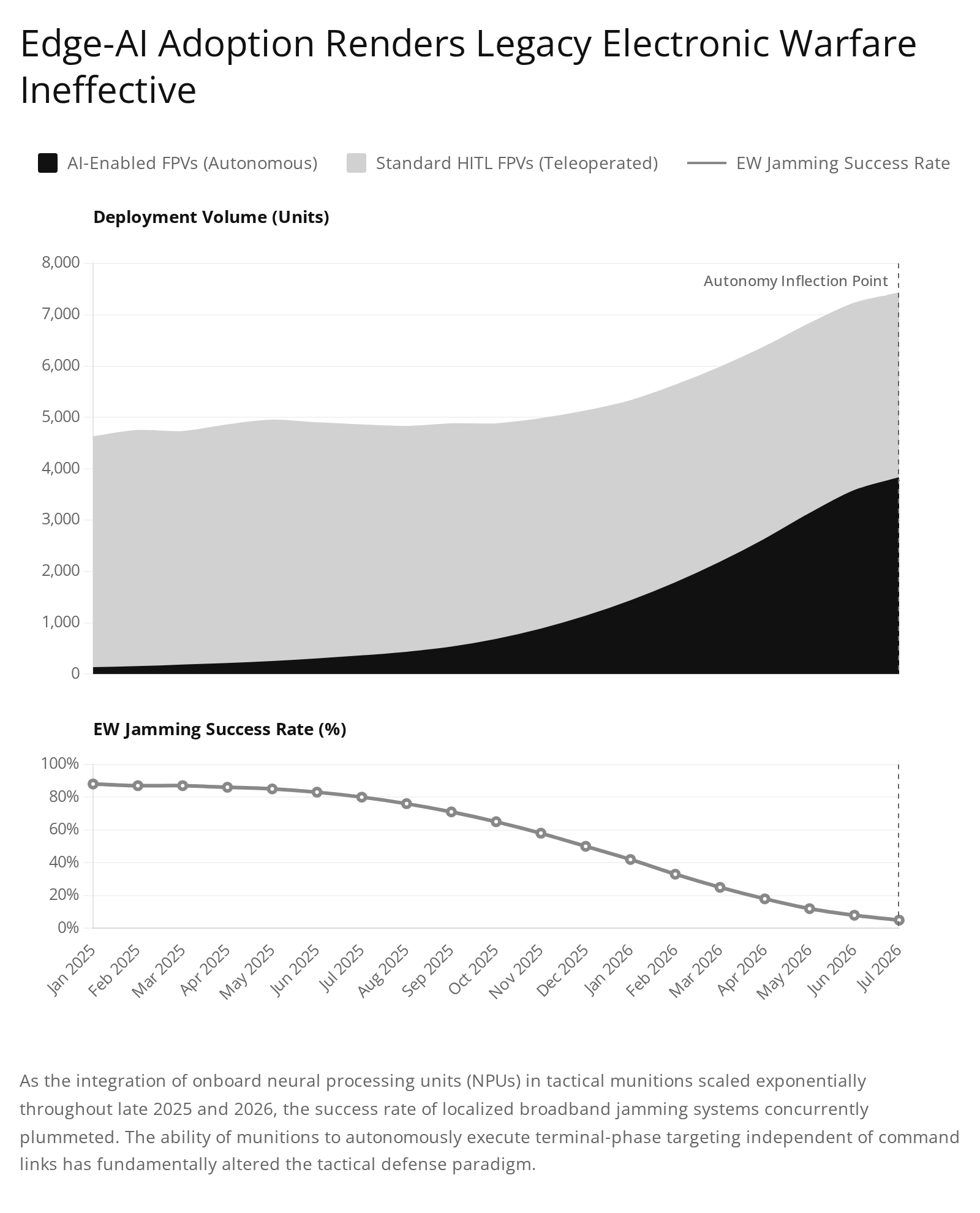
The underlying, defining theme of the current temporal window is the systematic erosion of the “Electronic Warfare Barrier.” For the preceding three years, dense, multi-layered EW environments have served as the primary, most economically viable countermeasure against the massive proliferation of low-cost, high-attrition unmanned aerial systems (UAS) and first-person view (FPV) loitering munitions. However, the rapid integration of advanced neural processing units (NPUs) into highly expendable munitions has degraded the efficacy of radio frequency (RF) jamming and Global Navigation Satellite System (GNSS) spoofing architectures.
1.1 The Compression of the OODA Loop and Edge Computing
The integration of artificial intelligence into autonomous systems is no longer confined to the strategic intelligence, surveillance, and reconnaissance (ISR) domain, where vast data centers process imagery over hours or days. Algorithmic processing has aggressively migrated to the tactical edge, operating on severely power-constrained micro-architectures. The traditional Observe, Orient, Decide, and Act (OODA) loop is being compressed into fractions of a second by systems that no longer require an active data link to a human operator for terminal engagement. During this reporting period, multiple state and non-state actors have demonstrated capabilities that rely on human-on-the-loop (HOTL) architectures. In these configurations, operators dictate geofenced engagement zones and define broad target parameters, but the platform itself executes the final acquisition, trajectory calculation, and kinetic strike.
This doctrinal shift is primarily driven by the physical limitations of RF communication in highly contested environments. When command data links are severed by active jamming, legacy drones typically enter a pre-programmed fail-safe mode, resulting in a return-to-base maneuver, a high-altitude loiter, or a controlled descent, rendering them militarily useless for the duration of the jamming event. The new generation of autonomous systems observed this week, however, defaults to an “engage-on-loss-of-signal” protocol. By utilizing onboard, heavily quantized libraries of thermal and optical signatures, these munitions can identify and prosecute targets entirely independently. This capability fundamentally negates the defensive advantage previously held by localized EW umbrellas, forcing defending forces to rely on kinetic interception rather than electromagnetic disruption.
1.2 Multi-Domain Swarm Synergy and Percolation Theory
A secondary, yet equally critical, doctrinal shift solidifying during this period is the transition from localized, single-domain drone deployments to multi-domain autonomous synergies. The conceptual framework of swarm logic has matured from tightly controlled, homogeneous clusters of aerial vehicles operating under a single command node to decentralized, heterogeneous networks comprising unmanned aerial vehicles (UAVs), unmanned surface vessels (USVs), and unmanned underwater vehicles (UUVs). These platforms increasingly share localized targeting telemetry without routing data back to a centralized command post, utilizing self-healing mesh networking and burst-transmission protocols to maintain operational cohesion even under heavy electromagnetic suppression.
The strategic implications of this decentralized architecture are profound. A distributed network of autonomous systems presents a highly resilient, constantly mutating threat profile. The destruction of individual nodes, or even specialized command-link nodes, does not collapse the swarm. Instead, the underlying algorithms dynamically reallocate mission parameters and sensor coverage to surviving assets. This dynamic forces defending forces to expend high-value interceptors against low-cost effectors across multiple vectors simultaneously, exacerbating the unfavorable cost-exchange ratios that currently plague legacy air defense networks.
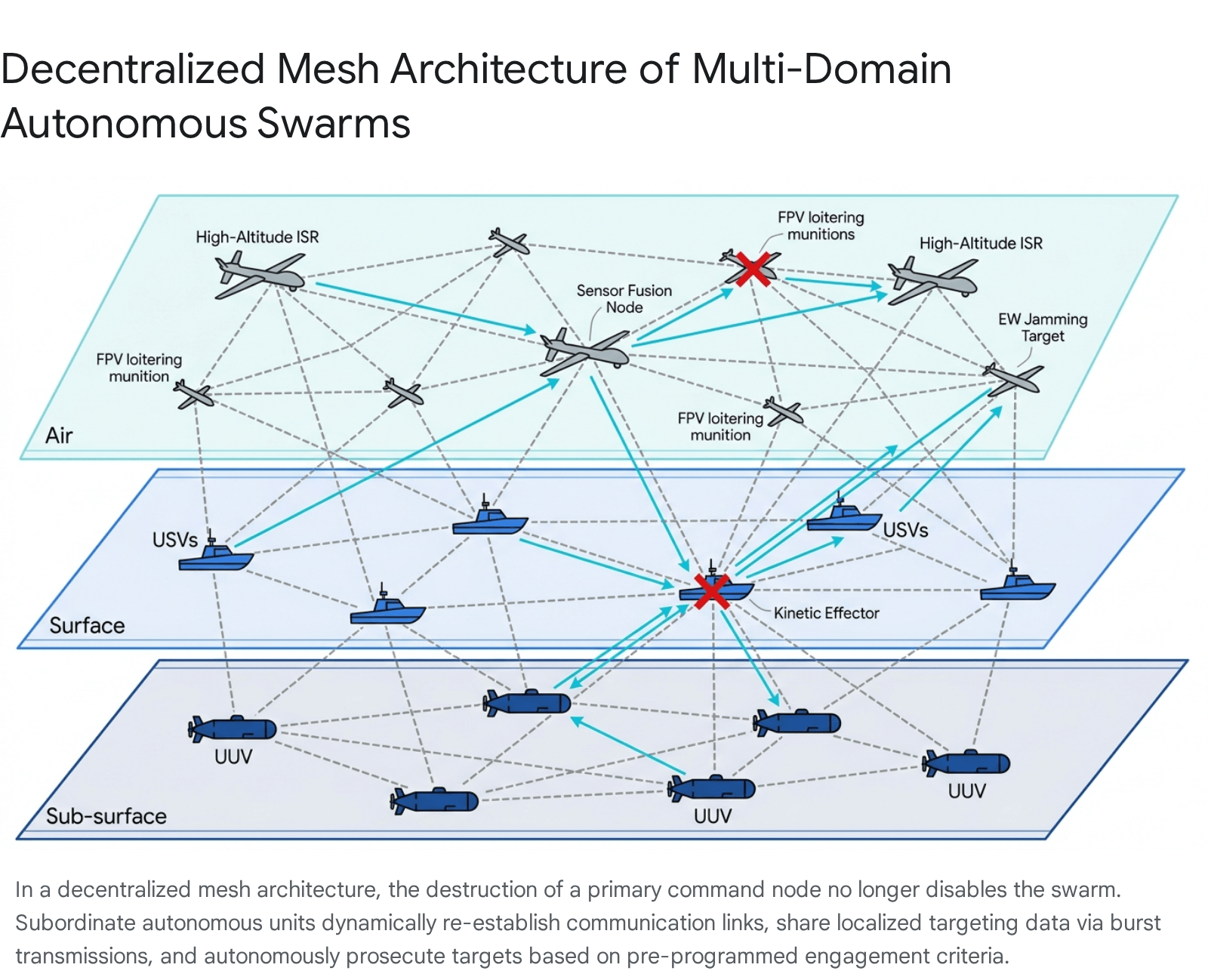
The physics and mathematics governing these autonomous architectures require rigorous analysis. The resilience of a mesh network in a contested electromagnetic spectrum can be accurately modeled through percolation theory, a mathematical framework used to describe the behavior of connected clusters in a random graph. When the probability of node communication failure (P), often induced by targeted EW, exceeds a critical threshold (Pc), the network fragments into isolated, non-communicating islands. However, by optimizing the routing algorithms, utilizing directional acoustic links in the maritime domain, and leveraging highly directional, tightly focused RF beams in the air domain, defense engineers have significantly lowered the functional probability of failure (P). This ensures that even if 40% to 50% of the communication links are jammed, the remaining nodes maintain swarm cohesion and collective intelligence.
2. Theater Analysis: Eastern Europe and the Evolutionary Bottleneck
The operational environment in Eastern Europe remains the primary crucible for the accelerated evolution of tactical unmanned systems. The static, heavily fortified nature of the frontlines, combined with dense concentrations of artillery, layered electronic warfare, and expansive minefields, has forced an evolutionary bottleneck. The rapid technological iterations observed over the past seven days indicate a definitive, irreversible break from the 2024–2025 paradigm of remote-controlled attrition warfare.
2.1 The Ascent of Edge-AI in Tactical Munitions and Aerial Denial
Over the preceding week, open-source intelligence networks and highly sanitized combat telemetry have recorded a massive surge in the deployment of fully autonomous, machine-vision-guided FPV munitions. This marks a culmination of months of rapid iteration in military software development. Previously, defensive EW units effectively neutralized large swaths of incoming FPVs by deploying broadband jammers that severed the analog or digital video feed to the human operator during the crucial terminal dive—typically the final 200 to 500 meters of flight.
The current iteration of munitions bypasses this vulnerability entirely through localized edge computing. By integrating low-cost, commercially available field-programmable gate arrays (FPGAs) directly onto the drone’s flight controller board, these munitions now carry pre-trained neural networks capable of recognizing the geometric profiles of armored vehicles and rotary-wing aircraft.
A historic milestone validating this edge-computed aerial denial occurred on July 15, 2026. A Ukrainian FPV drone operated by the 427th Separate Unmanned Systems Brigade (“Rarog”), under the command of Unmanned Systems Forces (USF) Commander Maj. Robert “Madyar” Brovdi, successfully intercepted and destroyed a Russian Mi-28 “Night Hunter” attack helicopter mid-flight near Vyazovoye in Russia’s Belgorod Oblast1. The Mi-28, valued at approximately $16 million and heavily utilized for low-altitude night operations, was brought down entirely by an inexpensive tactical quadcopter4. This event confirms a profound shift in localized air superiority: highly attritable autonomous systems are successfully establishing a lethal anti-access layer against heavy, manned rotary-wing assets that traditionally dominated the low-altitude battlespace5.
2.2 Strategic ISR and Unmanned Breaching Support
To adapt to the lethality of FPVs, operational doctrine is shifting rapidly in land-based logistics and combat engineering. During this reporting period, the U.S. Army’s 18th Airborne Corps explicitly addressed this vulnerability by testing integrated C-UAS on autonomous ground vehicles via “Project Sandhills 2.0”7. Engineers utilized a fleet of Ford F250s equipped with the Forterra Overdrive autonomy stack, outfitting the unmanned ground vehicles (UGVs) with 9 Mothers’ “Edda” kinetic kill systems7. This remote shotgun turret utilizes acoustic sensors to track and destroy fast-moving incoming drones at ranges of 10–100 meters7. This experimentation demonstrates that future autonomous breaching and logistics vehicles must carry their own dedicated, localized counter-air capabilities to survive in environments saturated with autonomous aerial threats.
2.3 Operation MoLoCHKa and Strategic Sea Denial
Simultaneously, the USF has escalated an aggressive maritime denial campaign in the Black and Azov Seas. From July 6 to July 18, 2026, under the banner of “Operation MoLoCHKa,” Ukrainian naval drones systematically struck 172 Russian vessels, targeting the “shadow fleet” of flat-bottomed feeder tankers and tugboats used to bypass international sanctions8. During a single coordinated strike on the night of July 17-18, the USF hit 13 vessels, including dry cargo ships, a tanker, a gas carrier, and floating cranes8. Led by Maj. Brovdi, the strategic intent of the operation is to irreversibly paralyze Russian military logistics and fuel supplies without causing catastrophic environmental oil spills, aiming instead to disable propulsion systems and turn the shadow fleet into “drifting barges”8.
3. Global Posturing and Joint Integration
In contrast to the granular, high-attrition tactical deployments characterizing Eastern Europe, developments within the United States and the broader NATO alliance during this seven-day window have been characterized by rapid institutionalization and the strategic orchestration of highly advanced unmanned assets.
3.1 Establishing Dedicated Robotics Commands
A major barrier to the effective fielding of autonomous systems has historically been the lack of dedicated administrative and training infrastructure. The U.S. Marine Corps addressed this directly by standing up two new organizations on July 8, 2026: the Marine Corps Robotics Integration Group and the Marine Corps Counter Drone Team10. These entities complement the existing Marine Corps Attack Drone Team (MCADT), which was established in January 202510. Aimed at establishing a holistic approach to drone training, Col. H. Parker Consaul IV, director of the Robotics Integration Group, stated the mandate is to mainstream these systems until operating a drone is as fundamental to an infantryman as operating a rifle or machine gun10. Highlighting the rapid scale of implementation, Maj. Miguel Ramirez of the Weapons Training Battalion noted that just over a year ago, the Marine Corps had zero attack drones fielded, whereas today they operate several thousand10. These organizations act as regional hubs to pass localized tactical feedback directly to commercial industry, ensuring that software prototypes are instantly refined based on frontline constraints10.
3.2 High-Altitude Maritime Surveillance Procurement
To match the rapid tactical developments with strategic awareness, NATO formalized a major unmanned procurement initiative. On July 7, 2026, Denmark, Finland, Germany, and Norway announced the joint procurement of up to five Northrop Grumman MQ-4C Triton High-Altitude Long-Endurance (HALE) UAVs to enhance the alliance’s collective Intelligence, Surveillance, and Reconnaissance (ISR) Force11. These advanced platforms are optimized for the harsh maritime environment and can sustain flights over 50,000 feet for more than 24 hours11. Operating alongside the existing Alliance Ground Surveillance Fleet in Sigonella, Italy, the MQ-4C Tritons are specifically designated to provide persistent, long-range radar tracking to detect threats early and protect sea lines of communication in the Arctic and High North11.
4. Theater Analysis: Middle East and the Combat Debut of Autonomous USVs
The Middle East and its critical maritime chokepoints—most notably the Strait of Hormuz—saw the most significant escalation of autonomous naval warfare in U.S. history this week. Following the breakdown of a regional ceasefire, both state and non-state actors engaged in high-intensity technological exchanges.
4.1 First Combat Employment of U.S. Sea Drones
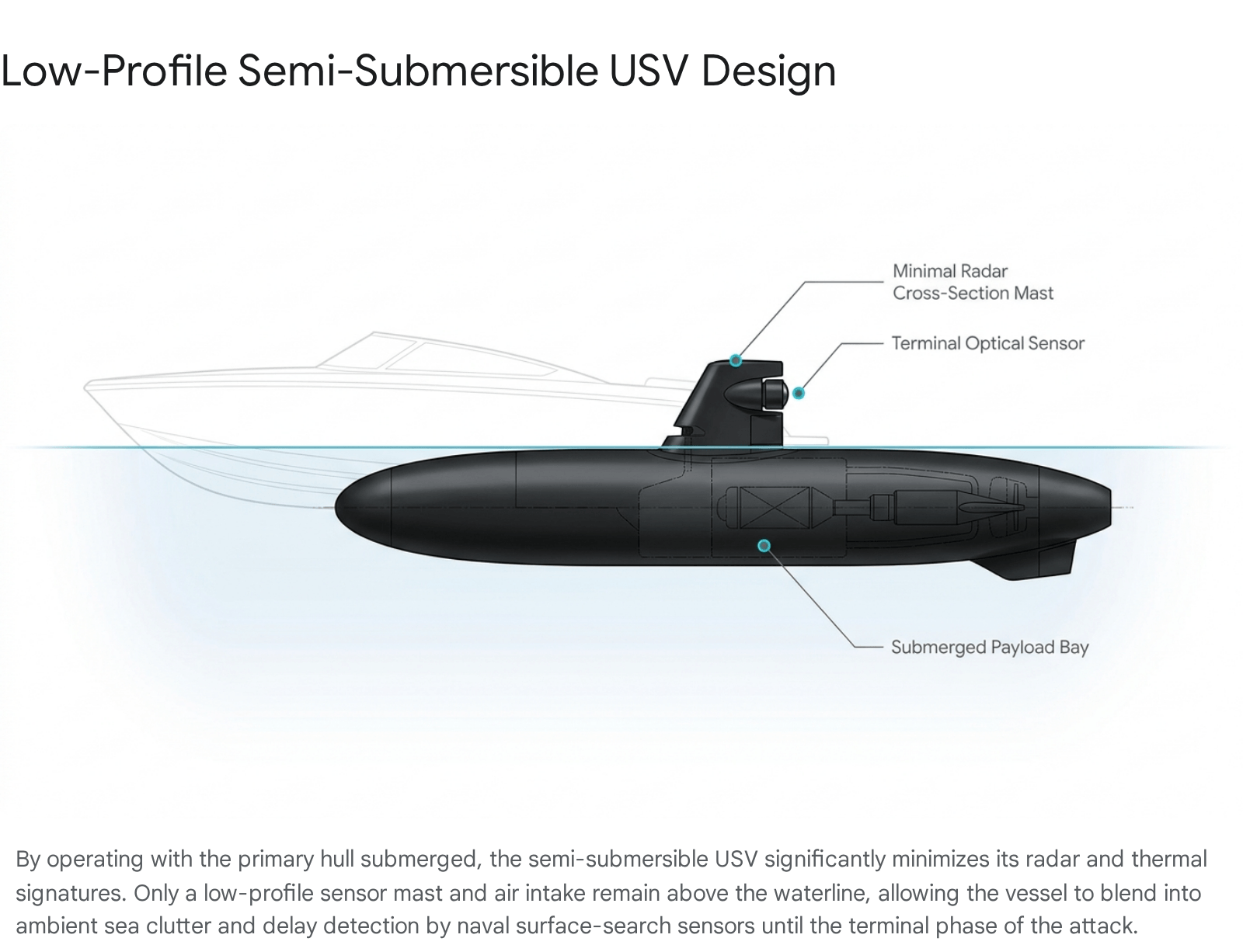
A historic inflection point in maritime autonomous warfare occurred on July 12, 2026, when U.S. Central Command (CENTCOM) executed the first-ever combat employment of armed unmanned surface vessels (USVs) by American forces12. In a precision strike aimed at degrading Iran’s ability to harass commercial shipping, CENTCOM launched three Saronic “Corsair” one-way attack USVs to target a submarine and ship maintenance facility at the Bandar Abbas Naval Base14.
The Corsair is a 24-foot, software-controlled autonomous boat capable of carrying a 1,000-pound payload over 1,000 nautical miles at speeds exceeding 35 knots14. The released operational footage confirmed that the three autonomous vessels successfully infiltrated the heavily defended harbor, executing a terminal kinetic strike against a docked Ghadir-class midget submarine16. This operation fundamentally proves the viability of using low-cost, domestically produced attritable surface drones for strategic strikes against fortified naval infrastructure, effectively inverting the traditional model where multi-million dollar cruise missiles are required for deep-strike harbor operations15.
4.2 The Economic Realities of Counter-UAS (C-UAS)
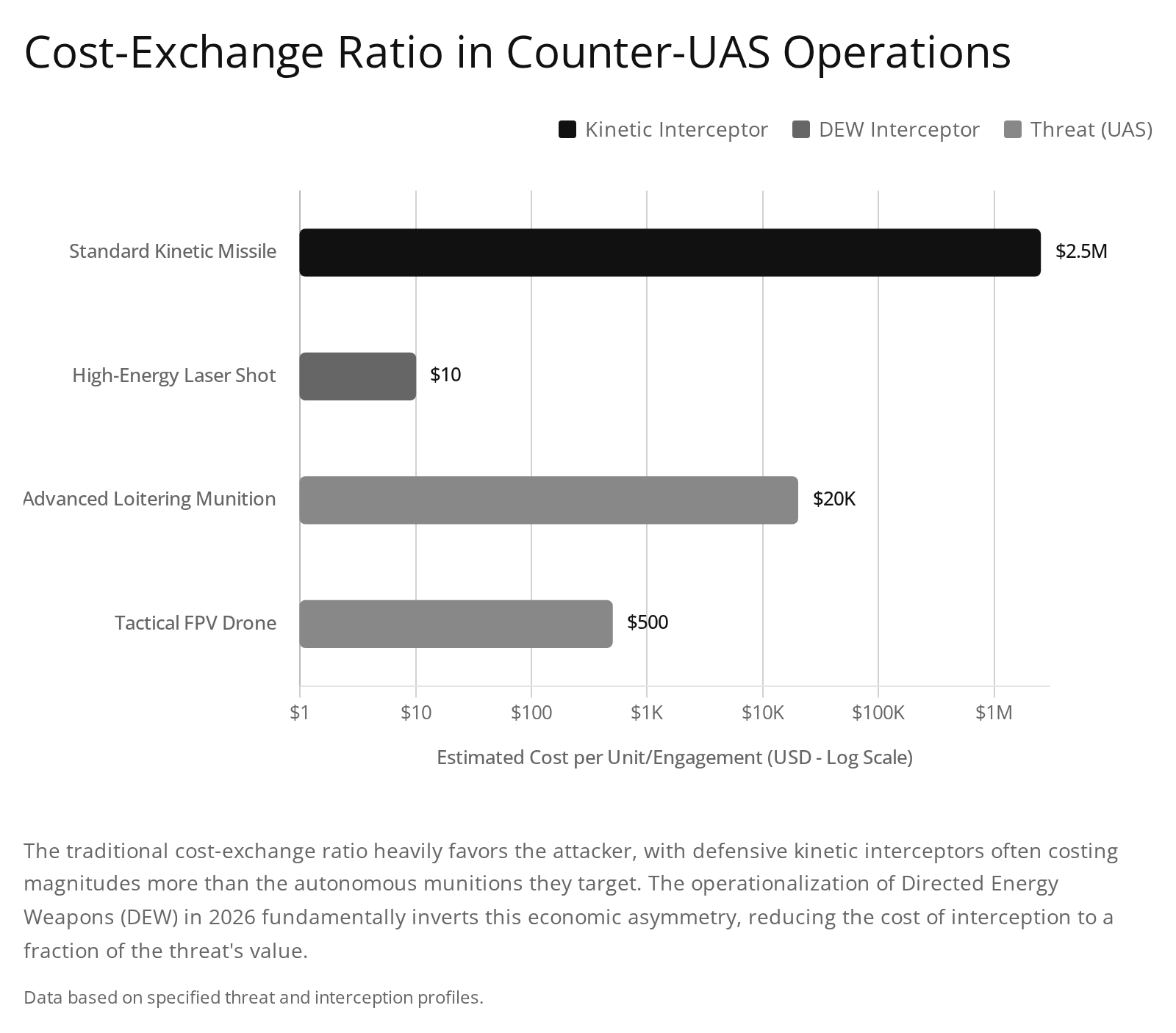
Concurrently, the defensive challenge of protecting infrastructure from the very same autonomous threats remains a massive economic liability. The reality of the cost-exchange ratio (CER) in counter-UAS warfare was laid bare in a Congressional Budget Office (CBO) assessment released on July 14, 202617. The report concluded that establishing a layered defense system—combining radar, RF detection, and kinetic interceptors—to shield just 100 U.S. military installations from small aerial drones would require an upfront investment of $7.4 billion, with an additional $500 million annually in sustainment costs17.
The fundamental cost-exchange ratio equation governing this dynamic heavily favors the attacker:

While systems like Directed Energy Weapons (DEW) promise to eventually lower the cost per interception, the CBO report highlights that current kinetic systems must be continuously replaced every four to five years to keep pace with rapid software and hardware iterations by adversaries17. This underscores the strategic unsustainability of relying solely on expensive interceptors to combat cheap, mass-produced autonomous munitions.
5. Supply Chain and the Defense Industrial Base (DIB)
The exponential demand for autonomous systems is exerting unprecedented structural pressure on the global defense industrial base (DIB). The nature of autonomous warfare requires mass—the ability to field thousands of attritable units per month, rather than dozens of exquisite, multi-million-dollar airframes per year.
5.1 The Pentagon’s Drone Dominance Program (DDP)
To rectify vast shortages in hardware, the U.S. Department of Defense published a Request for Information (RFI) in July 2026 outlining its ambitious “Drone Dominance Program” (DDP)18. Recognizing that the U.S. has been slow to field these capabilities at scale, the program aims to utilize up to $1 billion in fixed-price orders to drastically increase commercial sUAS manufacturing18. The Pentagon has set immediate targets to procure 30,000 unmanned assets by July 2026, scaling to over 200,000 industry-made drones by 202718. By relying on “Gauntlet challenges” that prioritize overall system performance, ease of use, and production scalability over bespoke military specifications, the DoD is forcefully accelerating its shift toward massed, commercial-off-the-shelf autonomy18.
5.2 International Co-Production and the EU-Ukraine Drone Alliance
To mitigate supply chain bottlenecks, particularly concerning specialized microelectronics, allied nations are heavily incentivizing cross-border technological partnerships. On July 17, 2026, the European Commission officially launched the EU-Ukraine Drone Alliance during the third EU-Ukraine Defence Industry Forum in Kyiv19. This strategic pact brings together start-ups, researchers, and armed forces to accelerate the joint development and mass production of next-generation drones and counter-drone systems19. By combining Ukraine’s unmatched battlefield testing environments with the broader European manufacturing base, the alliance seeks to secure critical supply chains and build the overall capacity required for sustained, high-intensity algorithmic warfare19.
6. Strategic Synthesis
The comprehensive assessment of the July 11–18, 2026, timeframe confirms that global military drone and autonomous system development has decisively moved beyond the era of remote-piloted attrition and localized ISR. The successful combat debut of the U.S. Navy’s Corsair sea drones against Iranian naval infrastructure, the massed sea-denial of Operation MoLoCHKa, and the historic downing of a Russian Mi-28 attack helicopter by a Ukrainian FPV drone all prove that software-defined, low-cost autonomous weapons can successfully execute missions previously reserved for capital ships, cruise missiles, and advanced fighter aircraft.
The successful integration of artificial intelligence at the tactical edge has compressed the OODA loop to non-human speeds, fundamentally altering the economics, physics, and strategy of defensive operations. As state actors race to rapidly scale their industrial bases—evidenced by the Pentagon’s Drone Dominance Program and the EU-Ukraine Drone Alliance—traditional hardware-centric procurement and legacy air defense doctrines face severe, potentially insurmountable challenges. Future strategic advantage will increasingly rely not on the kinematic performance of individual platforms, but on the software resilience of decentralized mesh networks, the sophistication of onboard neural processing, and the raw economic sustainability of the deployed effector.
Please share the link on Facebook, Forums, with colleagues, etc. Your support is much appreciated and if you have any feedback, please email us in**@*********ps.com. If you’d like to request a report or order a reprint, please click here for the corresponding page to open in new tab.
Sources Used
- Unmanned Systems Forces strike Russian Mi-28 helicopter in Belgorod region – Ukrinform, https://www.ukrinform.net/rubric-ato/4144440-unmanned-systems-forces-strike-russian-mi28-helicopter-in-belgorod-region.html
- USF drone downs Mi-28 helicopter in Belgorod region – Interfax-Ukraine, https://en.interfax.com.ua/news/general/1185058.html
- Robert Brovdi – Wikipedia, https://en.wikipedia.org/wiki/Robert_Brovdi
- Ukrainian drone intercepts and downs Russian Mi-28 helicopter in Belgorod Oblast – video, https://english.nv.ua/nation/unmanned-systems-forces-use-drone-to-strike-russian-mi-28-attack-helicopter-50624522.html
- Ukraine’s FPV Drone Hunted Down a Russian Mi-28 Attack Helicopter Over Belgorod, Video, https://united24media.com/war-in-ukraine/ukraines-fpv-drone-hunted-down-a-russian-mi-28-attack-helicopter-over-belgorod-video-20791
- USF Attacked a Russian Mi-28 Helicopter in the Belgorod Region, https://militarnyi.com/en/news/usf-russia-mi-28-helicopter-belgorod-region/
- US Army to experiment with C-UAS for autonomous breaching vehicles – Janes, https://www.janes.com/defence-intelligence-insights/defence-news/air/us-army-to-experiment-with-c-uas-for-autonomous-breaching-vehicles
- Ukraine’s Unmanned Systems Forces Strike 13 More Russian Shadow Fleet Vessels – Kyiv Post, https://www.kyivpost.com/post/80565
- Unmanned Systems Forces hit 12 more ships of russian “shadow fleet” in Black Sea, https://ukranews.com/en/news/1163646-unmanned-systems-forces-hit-12-more-ships-of-russian-shadow-fleet-in-black-sea
- JUST IN: Marines’ New Drone Teams Aim to Improve Implementation, https://www.nationaldefensemagazine.org/articles/2026/7/16/just-in-marines-new-drone-teams-aimed-at-improving-implementation
- Four NATO Allies to Procure Up to Five MQ-4C Triton HALE UAVs – Naval News, https://www.navalnews.com/naval-news/2026/07/nato-mq-4c-triton-procurement-uav-isr/
- Sea drones strike Iranian port in combat first for US – Military Times, https://www.militarytimes.com/news/your-military/2026/07/13/sea-drones-strike-iranian-port-in-combat-first-for-us-navy/
- American Sea Drones See Combat Debut | Small Wars Journal by Arizona State University, https://smallwarsjournal.com/2026/07/13/american-sea-drones-see-combat-debut/
- U.S. uses sea drones in combat for first time to attack Iranian naval base, CENTCOM says, https://www.cbsnews.com/news/us-iran-war-first-sea-drone-attack-bandar-abbas-naval-base/
- U.S. military uses Corsair maritime drones to attack Iran | DefenseScoop, https://defensescoop.com/2026/07/13/corsair-maritime-drones-attack-iran/
- America’s Drone Boats Just Went to War | Afterburner – MiGFlug’s Magazine, https://migflug.com/jetflights/us-corsair-sea-drones-strike-bandar-abbas-iran-2026/
- CBO: Counter-Drone Defense Could Cost $7.4 Billion – Small Wars Journal, https://smallwarsjournal.com/2026/07/15/cbo-counter-drone-defense-could-cost-7-4-billion/
- Pentagon unveils Drone Dominance Program with ‘Gauntlets’ to rapidly expand its small UAS arsenal | DefenseScoop, https://defensescoop.com/2025/12/02/hegseth-drone-dominance-program-ddp-gauntlets-website-rfi/
- Commission launches EU-Ukraine Drone Alliance to boost drone and counter-drone technology – Defence Industry and Space, https://defence-industry-space.ec.europa.eu/commission-launches-eu-ukraine-drone-alliance-boost-drone-and-counter-drone-technology-2026-07-17_en