1. Executive Summary
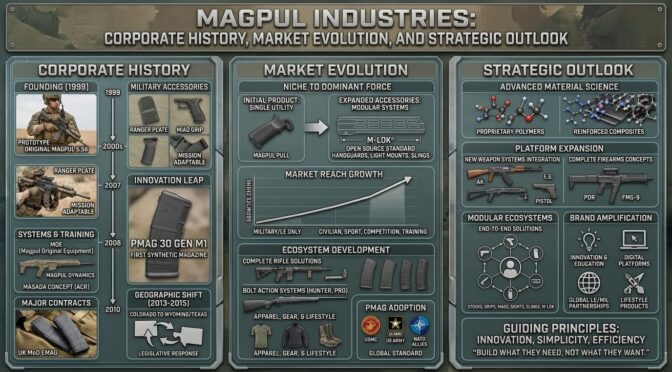
Magpul Industries Corporation operates as a primary designer, manufacturer, and distributor of firearms accessories, conceptual weapon systems, and tactical equipment. Founded in 1999 by a former United States Marine, the company initially focused on a single polymer device designed to facilitate the rapid extraction of rifle magazines under stressful operational conditions. Over the subsequent decades, the firm expanded its portfolio to encompass a vast array of polymer and metallic firearm components, soft goods, and advanced electro-optical fire control systems.
This report provides an analysis of Magpul’s corporate trajectory. It examines the company’s origins, its relocation from Colorado to Wyoming and Texas due to legislative changes, and its corporate leadership structure. The analysis evaluates the firm’s product evolution, with a primary focus on the PMAG (Polymer Magazine) series and the industry-standard M-LOK modular mounting system. A review of the 2017 United States Special Operations Command (USSOCOM) testing at Naval Surface Warfare Center (NSWC) Crane illustrates the empirical data surrounding Magpul’s position in the negative-space rail interface market.
Furthermore, the report assesses Magpul’s buyer demographics and its relationship with defense procurement agencies. It tracks the institutional transition from initial military skepticism regarding polymer components to the adoption of the GEN M3 PMAG across branches of the United States Armed Forces. The report also analyzes Magpul’s brand reputation, which is built upon product reliability, participation in firearms training doctrine via Magpul Core, and its public engagement with the civilian firearms market. Finally, the analysis projects the company’s future strategic direction, focusing on its partnership with Maztech Industries to develop the X4 sensor fusion system, signaling a pivot from passive mechanical components to active, integrated electronic accessories.
2. Corporate Origins and Historical Trajectory
2.1 Founding and Early Product Development
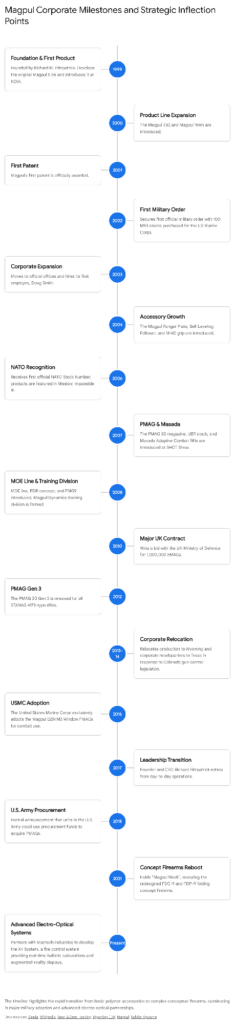
Magpul Industries Corporation was founded in 1999 in Boulder, Colorado, by Richard M. Fitzpatrick, a former Force Reconnaissance Sergeant in the United States Marine Corps1. During his military service in 1991, Fitzpatrick observed a field-expedient practice where military personnel would tape parachute cord (paracord) to the bottom of their aluminum STANAG (Standardization Agreement) magazines to create a loop4. This loop allowed for faster extraction of the magazine from tactical pouches during reloads. Recognizing the inconsistency of this improvised method, Fitzpatrick conceptualized a friction-style polymer band that could slide over the base of a standard magazine, providing a standardized pull ring4.
After his military service, Fitzpatrick refined the design and utilized his personal savings to order a small-scale injection mold4. The resulting product, named the “Magpul” (an abbreviation for Magazine Puller), was officially introduced to the defense sector at the National Defense Industrial Association (NDIA) symposium in 19991. The initial 5.56x45mm NATO version demonstrated sufficient market viability to warrant the introduction of 7.62x51mm and 9x19mm variants by 20001. The original Magpul device remains in active production7.
The company transitioned to a formal commercial facility in 2003, concurrent with the hiring of its first official employee, Doug Smith, who would subsequently become President and Chief Operating Officer3. Between 2004 and 2006, the firm expanded its product lines, introducing the Ranger Plate, the Self-Leveling Follower, and the MIAD (MIssion ADaptable) modular pistol grip1. By 2006, Magpul received its first official NATO Stock Number (NSN), marking its formal transition into a recognized defense supplier1.
2.2 Facility Relocation and Political Strategy
A critical shift in the company’s corporate history occurred in 2013, driven by state-level legislative changes. Following the 2012 Aurora theater shooting, the Colorado State Legislature enacted House Bill 13-12243. This legislation prohibited the sale and transfer of ammunition magazines capable of holding more than 15 rounds9. Given that the 30-round PMAG was a core product, the legislation presented an operational conflict for the company within its home state13.
Magpul adopted a public political stance, publishing statements detailing its intention to leave Colorado if the legislation was enacted3. In conjunction with the “Free Colorado” advocacy organization, Magpul sponsored the “Farewell to Arms Freedom Festival” to raise funds for political recall efforts against politicians who supported the bill3. During this event, the company initiated the “Boulder Airlift,” selling discounted standard-capacity magazines to supporters, with 1,500 units given away to early attendees3.
Upon the passage of the legislation, Magpul executed a bifurcated relocation plan, moving its manufacturing and distribution operations to Wyoming, and its corporate headquarters to Texas9.
| Operational Unit | Destination | State Support and Financial Incentives |
| Manufacturing, Distribution, & Shipping | Cheyenne, Wyoming | Supported by Gov. Matt Mead, the Wyoming Business Council, and Cheyenne LEADS. Magpul utilized an $8.3 million grant/loan package through Laramie County to purchase an existing 135,000-square-foot facility formerly owned by Jeld-Wen. Magpul received a five-year lease-payment waiver, transitioning to $3-$4.50 per square foot over the subsequent ten years.12 |
| Corporate Headquarters | Austin, Texas | Supported by Gov. Rick Perry and the Texas Economic Development Corporation. Selected for its tax environment and regulatory predictability.3 |
This relocation strategy allowed the company to rapidly occupy an existing footprint in Wyoming, avoiding a secondary move and ensuring supply chain continuity7. The transition of 92 percent of its current workforce outside of Colorado was completed within a 16-month timeframe13.
2.3 Leadership Succession and Corporate Structure
The organizational structure established in the early 2000s remained stable until 2017. In February of that year, Richard Fitzpatrick announced his retirement as Chief Executive Officer, effective March 2, 20178. Fitzpatrick departed from day-to-day operations but retained his position as a major shareholder and member of the Magpul Board of Directors8.
Following Fitzpatrick’s retirement, the executive hierarchy was restructured. Doug Smith assumed the title of President and COO, maintaining oversight of operations and business functions8. Duane Liptak, a former United States Marine Corps Officer who joined the company in 2012, was promoted to Executive Vice President and assumed further responsibility over product vision and marketing8. Other key figures in the corporate governance structure include Chief Financial Officer Todd Neiberger and board members Darren Farber and Rashad Rahman16.
3. Product Portfolio and Technical Evolution
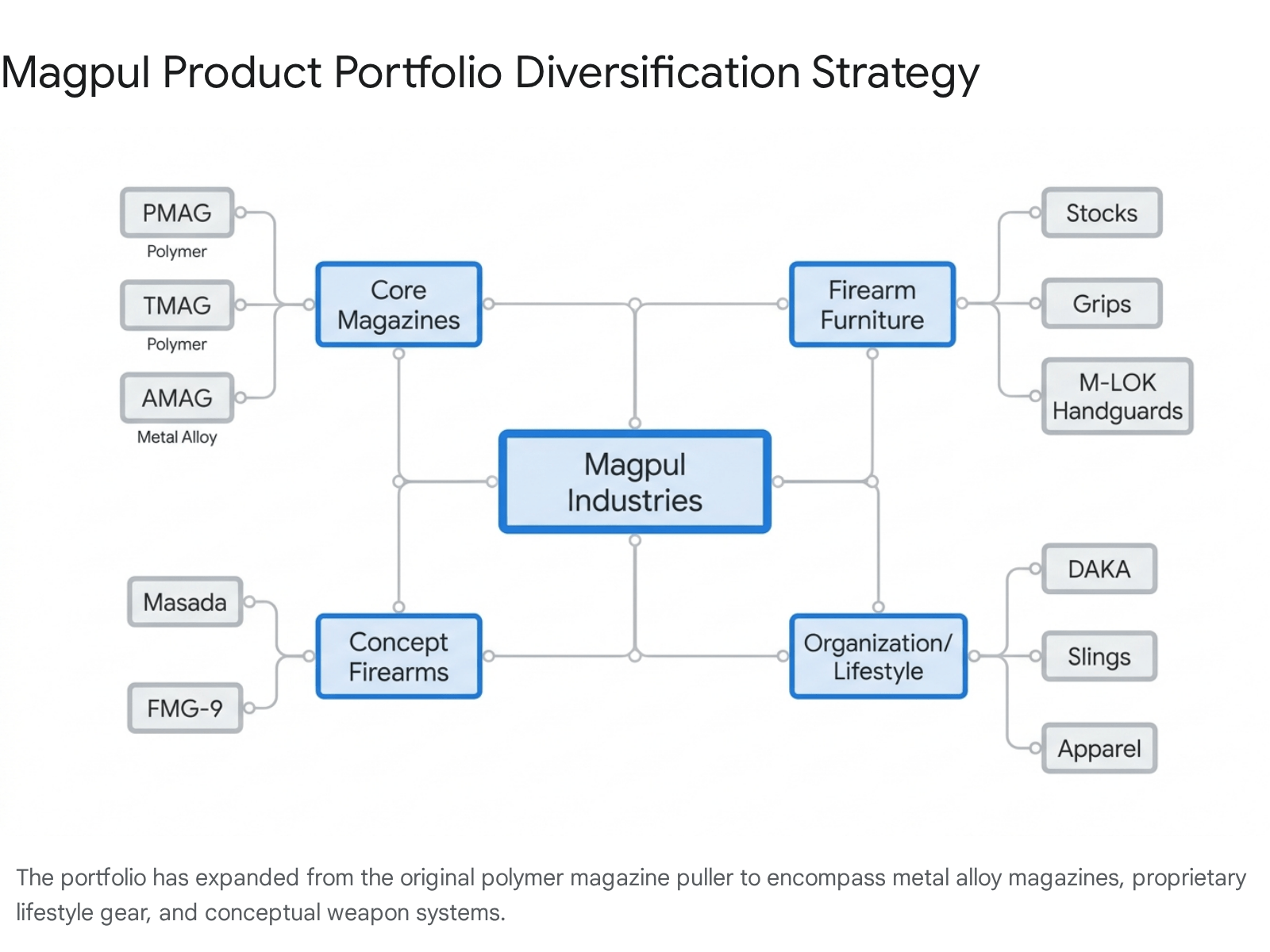
Magpul’s product strategy is defined by the substitution of traditional materials—specifically stamped steel and extruded aluminum—with impact-resistant polymers. This material science approach reduces the overall weight of the weapon system and allows for rapid scaling of production via injection molding.
3.1 The Polymer Magazine Revolution: PMAG
The foundation of Magpul’s commercial and military product line is the PMAG (Polymer Magazine). Prior to the PMAG’s introduction in 2007, the industry standard was the USGI aluminum STANAG magazine3. While functional, aluminum magazines are susceptible to plastic deformation, where a dented feed lip can cause failures to feed4. Previous attempts by manufacturers to produce polymer magazines had suffered from poor reliability, durability, and consistency in manufacture4.
Magpul addressed these issues through proprietary polymer blends and internal testing. The PMAG featured a constant-curve internal geometry, which allowed the tapered 5.56x45mm cartridge to stack naturally1. This geometry was paired with a self-leveling, anti-tilt follower that prevented the ammunition stack from diving inside the magazine body1. The original PMAG underwent iterative improvements, leading to the GEN M3 in 20121. The GEN M3 was modified for universal compatibility across all STANAG 4179-type platforms, including the AR-15, the M27 Infantry Automatic Rifle (IAR), the Heckler & Koch HK416, and the British SA801. This universal compatibility eliminated the previous need for a separate EMAG (Export Magazine) product line1.
The PMAG ecosystem has expanded beyond the standard 5.56mm 30-round configuration. The company developed 10, 20, and 40-round variants, as well as high-capacity drum magazines (the D-60 and D-50 series)3. Caliber support grew to include 7.62x51mm, 7.62x39mm, 5.45x39mm, .300 Blackout, 6mm ARC, and 9x19mm (supporting Glock pistols and CZ Scorpion platforms)7.
3.2 Firearm Furniture and the MOE Ecosystem
Following its magazines, Magpul systematically designed replacements for contact points on the AR-15 rifle. The MOE (Magpul Original Equipment) line, introduced in 2008, provided a highly durable alternative to standard military furniture1. The design philosophy focused on ergonomics and intuitive user interfaces, operating on the principle that the visual and tactile features of the product should instruct the user on its operation4.
| Product Category | Notable Lines & Platforms Supported |
| Adjustable Stocks | CTR (Compact/Type Restricted), UBR (Utility/Battle Rifle), PRS (Precision Rifle/Sniper), MOE SL (Slim Line) series.3 |
| Grips & Handguards | MIAD (MIssion ADaptable), MOE Handguards, specialized grips for Ruger RXM and LCP MAX platforms.3 |
| Precision Rifle Chassis | Hunter 700, Pro 700 (for Remington 700 footprint), Ruger American, MOE X-22 (Ruger 10/22).10 |
| Shotgun Furniture | SGA Stocks and MOE forends for Remington 870 and Mossberg 500/590 platforms.17 |
3.3 Concept Firearms
While primarily an accessory manufacturer, Magpul has engaged in advanced conceptual firearm design, serving as an incubator for weapon systems that are often later licensed for mass production by established firearm manufacturers.
- Magpul Masada (Adaptive Combat Rifle): Unveiled at the 2007 SHOT Show, the Masada was designed as a modular upgrade to the AR-15. It retained commonality only with the AR-15’s barrel, fire control group, and front sight post. Magpul licensed the design to Bushmaster and Remington in 2008, where it was branded and sold commercially as the Bushmaster ACR3.
- Magpul Massoud: A scaled-up derivative of the Masada chambered in 7.62x51mm, named in honor of Ahmad Shah Massoud9.
- Magpul PDR (Personal Defense Weapon): A conceptual 5.56mm caliber personal defense weapon which utilizes a bullpup design principle3.
- Magpul FMG-9 to FDC-9: Originally introduced at the 2008 SHOT Show as the FMG-9 (Folding Machine Gun). During “Magpul Week” in 2021, Magpul announced the FDC-9 (Folding Defensive Carbine) and FDP-9 (Folding Defensive Pistol) as redesigned versions of the prototype3.
3.4 Diversification: DAKA, AMAG, and TMAG
Magpul has expanded beyond traditional firearms components. The DAKA product line provides durable organizational solutions, including the DAKA GRID and hard cases for rifle transport and hunting applications21.
Furthermore, the company has broken its strict historical adherence to polymer-only magazine construction with the introduction of the AMAG (Alloy Magazine) and TMAG (Translucent Magazine) series. The AMAG line features metal bodies designed for high-capacity micro-compact and duty pistols, specifically targeting the SIG Sauer P365 and P320/M17 platforms in 10 to 21-round capacities17. The TMAG represents a translucent polymer magazine, allowing users to visually verify ammunition counts and cartridge types20.
4. The Rail Interface Paradigm: M-LOK versus KeyMod
A significant development in modern small arms accessory design is the transition to “negative space” mounting systems. A negative space system involves cutting slots or holes into a smooth tubular handguard, allowing users to bolt accessories directly to the surface only where needed. This approach reduces the physical weight of the firearm and decreases the overall circumference of the handguard14. The industry competition in this sector was waged primarily between two competing systems: KeyMod and M-LOK.
4.1 Development and Licensing Models
KeyMod, introduced as a joint venture between VLTOR and Noveske in 2012, utilizes rows of keyhole-shaped cutouts24. The user inserts an accessory lug into the wide circular end and slides it forward into the narrow channel to tighten the fastening screw23. KeyMod was released as an open-source design, allowing any manufacturer to produce rails and accessories without paying royalties or signing regulatory agreements24.
Magpul introduced the M-LOK (Modular Lock) system in 2014. Evolving from their earlier MOE slot design, M-LOK utilizes rectangular slots14. The system relies on T-shaped, bi-directional nuts attached to the accessory. When the accessory is pushed into the slot and the screw is turned, the T-nut rotates 90 degrees and locks perpendicularly across the interior of the slot14. Magpul opted for a “free licensing” model rather than an open-source model. Third-party manufacturers must sign an agreement to ensure dimensional consistency and quality control across all manufacturers23.
4.2 NSWC Crane Testing and USSOCOM Adoption
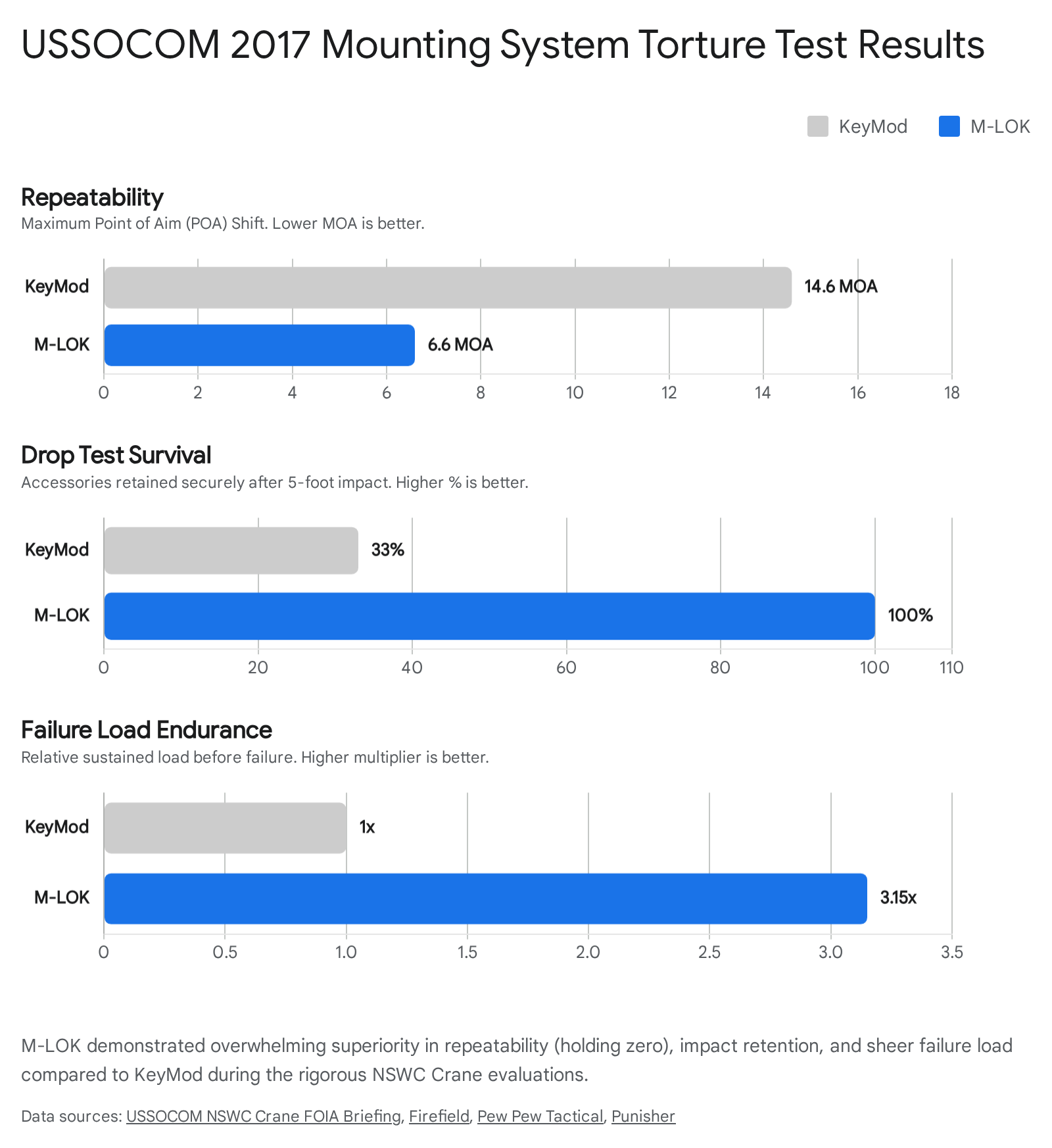
Mechanical performance comparisons were evaluated in a 2017 study conducted by the United States Special Operations Command (USSOCOM) at the Naval Surface Warfare Center (NSWC) Crane Division22. Seeking a unified interface, Crane procured commercial off-the-shelf handguards from identical manufacturers in both KeyMod and M-LOK configurations to ensure a direct comparison of the mounting geometry25.
The testing evaluated five specific parameters: repeatability, endurance, rough handling, drop testing, and static failure load25.
| Test Category | NSWC Crane Testing Methodology & Results | M-LOK vs. KeyMod Conclusion |
| Repeatability (POA Shift) | Accessories with targeting lasers were mounted, zeroed, removed, and remounted. Point of Aim (POA) shift was measured in Minute of Angle (MOA). | M-LOK achieved a 73% improvement in average POA shift over KeyMod. KeyMod exhibited shifts ranging from 0.2 to 14.6 MOA. M-LOK varied only from 0.0 to 6.6 MOA.22 |
| Endurance & Rough Handling | Rifles with mounted accessories were subjected to a recoil simulator mimicking 10,200 rounds of automatic fire (340 magazine changes). | Both KeyMod and M-LOK successfully passed these baseline cyclic load tests without critical failure.22 |
| Drop Testing | Rifles were dropped from a height of five feet directly onto a solid steel plate to measure impact retention. | 100% of M-LOK accessories remained attached to the handguard. Only 33% of KeyMod accessories remained attached; 67% detached completely.22 |
| Static Failure Load | The sheer force required to rip an accessory off the rail from a 90-degree off-axis angle was measured. | The average sustained load of M-LOK was over 215% (more than three times) greater than KeyMod. KeyMod failed at the handguard interface; M-LOK failed at the accessory mount, preserving the rail.25 |
4.3 Industry Standardization
Following the publication of the USSOCOM data, M-LOK transitioned into the global standard for negative space mounting22. The empirical testing data proving its superiority in maintaining a reliable zero, surviving severe impacts, and sustaining higher structural loads solidified its position. Today, M-LOK enjoys approximately three times the industry support of KeyMod23.
5. Buyer Demographics and Defense Procurement
Magpul’s market penetration is distributed across three primary buyer segments: the civilian sporting and defense market, law enforcement agencies, and international military organizations.
5.1 Buyer Segments and Early Adoption
In the civilian sector, Magpul’s products are favored due to their affordability, modularity, and high performance. Law enforcement agencies adopted PMAGs for their patrol rifles to ensure reliability; they are currently utilized by a vast majority of police agencies4.
Initial military adoption occurred at the individual and unit level. The PMAG became a preferred magazine for Special Operations units and frontline infantry who privately purchased them due to reliability in harsh environments19. In 2010, the United Kingdom Ministry of Defence executed a contract for 1,000,000 EMAGs to be delivered over four years for use in the SA80 weapon system1.
5.2 The 2012 Polymer Ban and Institutional Resistance
Despite organic popularity, the widespread proliferation of unauthorized, privately purchased polymer magazines from various manufacturers caused concern regarding quality control within the U.S. military19. Following the Combat Marksmanship Symposium of 2012, the U.S. Army and Marine Corps issued a directive effectively banning the use of all unauthorized polymer magazines in combat and training environments19.
5.3 The 2017 Paradigm Shift: USMC, USAF, and Army Adoption
The 2012 ban forced standardized testing. Over the next several years, the PMAG GEN M3, along with other commercial and government-issued magazines, underwent trials across multiple weapon platforms (M4, M16, M27 IAR) at government testing facilities18.
Throughout the testing, the GEN M3 PMAG experienced zero magazine-related stoppages19. Furthermore, the testing revealed that the PMAG GEN M3 produced less chamber and feed ramp damage than other magazines when feeding the Army’s M855A1 ammunition, extending weapon life18. The PMAG also surpassed all requirements for durability in extreme cold and hot temperatures, chemical resistance, salt fog corrosion, and dust ingress18.
Consequently, military adoption occurred across multiple branches:
- December 2016 (USMC): The United States Marine Corps published official message traffic (DTG191737Z Dec 16) selecting the Magpul GEN M3 Window PMAG as the only authorized magazine for combat use, assigning it official National Stock Numbers18.
- July 2017 (USAF): The United States Air Force formalized approval of the PMAG for use with the M4/M4A1, GUU-5P, and M249 platforms, phasing out the Enhanced Performance Magazine through attrition28.
- December 2017 (DOD Contract): The Defense Logistics Agency awarded Magpul a $12.7 million contract to field GEN M3 PMAG magazines30.
- September 2018 (US Army): The U.S. Army formally authorized unit commanders to utilize procurement funds to acquire PMAGs for general issue3.
5.4 Second-Order Logistical Impacts
The military adoption of the PMAG resulted in secondary logistical adjustments. Following the USMC adoption, the service found that the new polymer magazines fit tightly within standard-issue nylon load-bearing pouches29. This necessitated a subsequent Request for Information (RFI) by the Marine Corps in 2018 to procure between 60,000 and 500,000 newly dimensioned pouches capable of smoothly accommodating the polymer design29.
6. Market Position, Financials, and Brand Reputation
6.1 Financial Metrics and Scale
Magpul Industries operates as a privately held corporation. Aggregated financial intelligence platforms estimate the company’s annual revenue to be between $21 million and $50 million, with some models suggesting peak revenues around $23 million in recent fiscal years32.
The company employs a workforce estimated between 170 and 707 employees across its Texas headquarters and Wyoming manufacturing hub33. Magpul competes in a densely populated sector against heritage firearms manufacturers like Colt’s Manufacturing, as well as specialized accessory and optics firms like Trijicon, Knight’s Armament, and Wilcox Industries34. The firm has seen significant activity in the private equity space. Notably, in March 2024, a 100% stake in Magpul was acquired by NorthBridge PE in a transaction valued at approximately $120 million32. Financial data points estimate historical revenues reaching up to $380 million in past modeling32.
6.2 Consumer Reputation and Cultural Influence
Magpul’s brand reputation is strong among its primary buyers. The company’s willingness to relocate operations out of Colorado to protect its core product line generated favorable consumer sentiment and brand loyalty among its civilian demographic5.
Furthermore, the prominent inclusion of Magpul accessories in major media properties, notably the video game Call of Duty 4: Modern Warfare (2007) and the film Mission: Impossible III (2006), introduced the brand to a massive global audience of younger demographics3.
6.3 Magpul Core and Tactical Doctrine
Beyond physical manufacturing, the company established Magpul Dynamics in 2008, a training division later rebranded as Magpul Core3. This training division produces instructional materials and conducts courses in firearms handling, tactics, and personal defense6. Instructors utilizing Magpul equipment in training scenarios provided organic marketing that continuously validated the hardware’s operational effectiveness4.
7. Future Strategic Direction: Electronics and Sensor Fusion
While Magpul’s historical success relies on polymer injection molding, the company’s strategic trajectory involves a pivot into electro-optics and digital sensor fusion.
7.1 The Maztech X4 System Partnership
To execute this pivot, Magpul entered a strategic partnership with Maztech Industries to develop the X4 System36. The X4 System is a suite of interconnected, firearm-mounted electronic devices designed to expand situational awareness and automate ballistic calculations36.
The system was initially developed as a prototype entrant for the U.S. Army’s Next Generation Squad Weapon – Fire Control (NGSW-FC) tender, which sought an advanced optic for the XM7 assault rifle and XM250 light machine gun39. Although that specific military contract was ultimately awarded to Vortex Optics, Magpul and Maztech refined the X4 technology for the commercial market39.
7.2 Core Architecture of the X4 System
The X4 ecosystem comprises several modular, interconnected components:
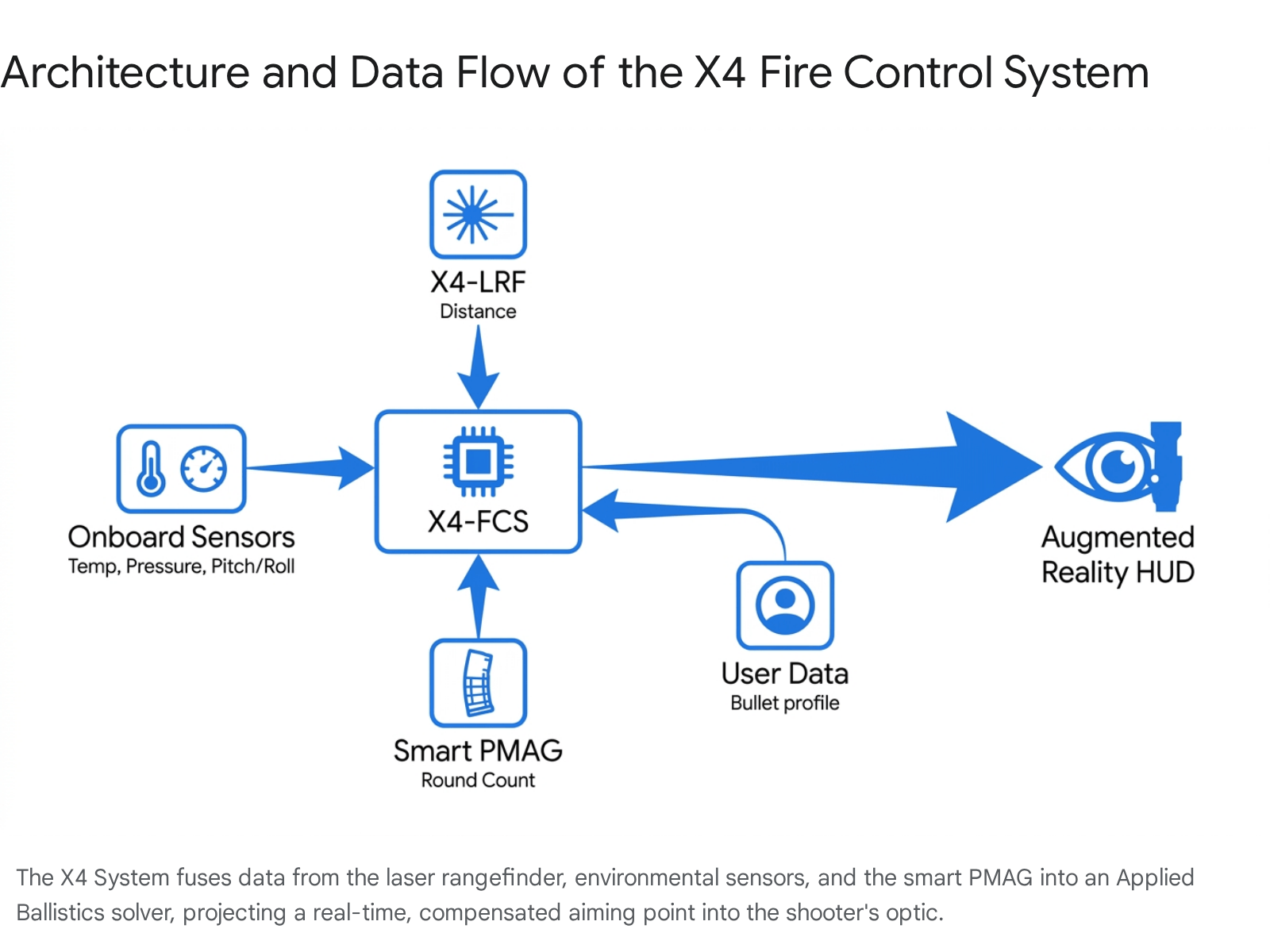
- X4-FCS (Fire Control System): This is the core computational hub. It is a hard-anodized aluminum cantilever mount designed to house a standard 30mm or 34mm Low-Power Variable Optic (LPVO)36. The mount contains an integrated Applied Ballistics solver and onboard environmental sensors36. Crucially, the FCS projects a Heads-Up Display (HUD) overlay directly into the optical path of the LPVO, providing a real-time, ballistically compensated offset aiming point36. If the system loses battery power, the shooter retains the native, unpowered reticle of their optic40.
- X4-LRF (Laser Rangefinder): A high-performance, rail-mounted laser rangefinder utilizing a military-grade 1534 nm laser, which operates outside the spectrum detectable by standard enemy night-vision devices39. It provides precise ranging solutions and communicates the exact target distance to the FCS via a wired connection36.
- Electronic Round Counter PMAG: Magpul is developing a specialized variant of the PMAG equipped with an electronic tracking system. This magazine communicates the exact number of rounds remaining to the X4-FCS, displaying the precise count on the rifle’s display networks36.
- Peripheral Mounts and Remotes: The system architecture includes a “Diving Board Mount” allowing the LRF to sit directly above the scope to save rail space, as well as rail-mounted or low-profile remote keypads36.
7.3 Strategic Implications of the X4
The introduction of the X4 system marks Magpul’s entry into the defense electronics market. The pricing structure—$3,495 for the FCS and up to $4,995 for the LRF—positions it far above typical commercial accessories17. This premium pricing model indicates a strategic targeting of elite precision shooters, specialized law enforcement units, and future military solicitations.
8. Conclusion
Magpul Industries has dictated the material and ergonomic trajectory of the modern sporting and combat rifle. The company’s evolution from a startup producing a single rubber loop to a defense contractor is a study in incremental innovation and material science.
The military adoption of the GEN M3 PMAG broke an institutional reliance on aluminum magazines, structurally altering the logistics of infantry combat. Concurrently, the data-backed evaluation of the M-LOK system over KeyMod established Magpul’s proprietary design as a global standard for firearm accessory integration. Furthermore, the company demonstrated corporate agility, utilizing legislative hostility in Colorado to optimize its manufacturing footprint in Wyoming and Texas while simultaneously reinforcing its brand identity.
Magpul’s strategic response—the development of the Maztech X4 electro-optical system—indicates a clear recognition that the future of small arms lies in digital integration, sensor fusion, and augmented reality. If the company can successfully commercialize and scale this technology, it is positioned to alter how individual operators compute ballistics and engage targets.
Please share the link on Facebook, Forums, with colleagues, etc. Your support is much appreciated and if you have any feedback, please email us in**@*********ps.com. If you’d like to request a report or order a reprint, please click here for the corresponding page to open in new tab.
Sources Used
- Magpul Industries History: Founding, Timeline, and Milestones – Zippia, https://www.zippia.com/magpul-industries-careers-1108540/history/
- Magpul Industries: History and Evolution – Mounting Solutions Plus, https://www.mountsplus.com/magpul-industries-history-and-evolution.html
- Magpul – Wikipedia, https://en.wikipedia.org/wiki/Magpul
- MAGPUL TWENTY TWO YEARS – COBBS Industries, https://cobbsindustries.com/magpul-twenty-two-years/
- 2018 Pioneer of the Year Award: Richard Fitzpatrick | An Official Journal Of The NRA, https://www.americanhunter.org/content/2018-pioneer-of-the-year-award-richard-fitzpatrick/
- Magpul: From Humble Beginnings to Industry Leader – The Freedom Warehouse, https://thefreedomwarehouse.com/blogs/news/magpul-from-humble-beginnings-to-industry-leader
- Magazines – Firearms Accessories – Magpul, https://magpul.com/firearm-accessories/pmags/magazine-accessories.html
- Magpul Announces Retirement of Richard Fitzpatrick | Soldier Systems Daily, https://soldiersystems.net/2017/02/15/magpul-announces-retirement-of-richard-fitzpatrick/
- Magpul | Gun Wiki – Fandom, https://guns.fandom.com/wiki/Magpul
- A Decade Later, The Magpul PMAG Is The Torchbearer In Magazine Reliability – NRA Blog, https://www.nrablog.com/articles/2017/4/a-decade-later-the-magpul-pmag-is-the-torchbearer-in-magazine-reliability
- Company Makes Good On Leaving Colorado Over Gun Laws – CBS News, https://www.cbsnews.com/colorado/news/company-makes-good-on-leaving-colorado-over-gun-laws/
- Magpul Moving Forward on Beginning Operations in Cheyenne, https://cheyenneleads.org/magpul-beginning-move-to-cheyenne/
- Magpul Relocating Operations to Texas, Wyoming – Deer & Deer Hunting, https://www.deeranddeerhunting.com/content/articles/deer-news/magpul-relocating-operations-to-texas-wyoming
- Magpul M-LOK: Versatile Attachment Options, https://magpul.com/m-lok
- Magpul 2026 Company Profile: Valuation, Funding & Investors | PitchBook, https://pitchbook.com/profiles/company/52864-30
- Magpul Industries CEO And Leadership: Executives and Demographics – Zippia, https://www.zippia.com/magpul-industries-careers-1108540/executives/
- Firearm Accessories- PMAGs, Stocks, Grips, M-LOK, And More – Magpul, https://magpul.com/firearm-accessories.html
- Marines Adopt Magpul GEN M3 Window PMAG – Wyoming Economic Development Association, https://www.wyomingeda.org/about/news/p/item/22498/marines-adopt-magpul-gen-m3-window-pmag
- Marines approve Magpul’s signature polymer ammunition magazine – Military Times, https://www.militarytimes.com/news/your-military/2017/01/08/marines-approve-magpul-s-signature-polymer-ammunition-magazine/
- Magpul Magazines- PMAG, TMAG, AMAG, https://magpul.com/firearm-accessories/pmags.html
- Magpul – High-Quality Firearms Accessories & Tactical Gear, https://magpul.com/
- MLOK vs. KeyMod – Firefield.com, https://firefield.com/blogs/news/mlok-vs-keymod
- KeyMod vs M-LOK: Military Chooses The Winner – Pew Pew Tactical, https://www.pewpewtactical.com/keymod-vs-m-lok/
- The battle between KeyMod and M-LOK – Guns.com, https://www.guns.com/news/2017/05/15/keymod-vs-m-lok
- Details On The USSOCOM Sponsored KeyMod vs M-LOK Test Conducted at NSWC-Crane, https://soldiersystems.net/2017/05/05/details-on-the-ussocom-sponsored-keymod-vs-m-lok-test-conducted-at-nswc-crane/
- KeyMod vs M-LOK: A Deep Dive Into the Best Rail Interface System – Outdoor Life, https://www.outdoorlife.com/gear/keymod-vs-mlock/
- M-Lok vs KeyMod: Advantages and Disadvantages from the US Army’s Perspective, https://punisher.com.ua/en/m-lok-proty-keymod-perevahy-ta-nedoliky-z-pohliadu-armii-ssha/
- Air Force Follows Marine Corps And SOCOM In Adopting The Formidable PMAG, https://taskandpurpose.com/news/air-force-follows-marine-corps-socom-adopting-formidable-pmag/
- The Corps is in search of a better fitting pouch for its new Magpul magazine, https://www.marinecorpstimes.com/news/your-marine-corps/2018/10/09/the-corps-is-in-search-of-a-better-fitting-pouch-for-its-new-magpul-magazine/
- Magpul Awarded $12 Million DOD Contract, Possibly PMAGs for every Marine, https://www.thefirearmblog.com/blog/2017/12/14/magpul-awarded-12-million-dod-contract-possibly-pmags-every-marine/
- Magpul Awarded DOD Contract for GEN M3 PMAG Magazines | An Official Journal Of The NRA – American Rifleman, https://www.americanrifleman.org/content/magpul-awarded-dod-contract-for-gen-m3-pmag-magazines/
- Magpul Industries Corp. Company Profile: Financials, Valuation, and Growth | PrivCo, https://www.privco.com/company/magpul-industries_private_stock_annual_report_financials
- Magpul Industries Corp – $21.1 M Revenue, Employees & Growth | Kona Equity, https://www.konaequity.com/company/magpul-industries-corp-4393867886/
- Magpul Industries Revenue: Annual, Quarterly, and Historic – Zippia, https://www.zippia.com/magpul-industries-careers-1108540/revenue/
- Magpul Industries Corp. Contacts, Email Format & Decision Makers | Seamless.AI, https://seamless.ai/b/magpul-industries-corp-81235230
- Maztech Partnership – Magpul, https://magpul.com/maztech
- First Look: Magpul & Maztech X4 System | An Official Journal Of The NRA, https://www.americanrifleman.org/content/first-look-magpul-maztech-x4-system/
- Magpul x Maztech X4 System – YouTube, https://www.youtube.com/watch?v=LHE1k5CLFE4
- MagPul Maztech X4 fire control system, now available – GUNSweek.com, https://gunsweek.com/en/optics/news/magpul-maztech-x4-fire-control-system-now-available
- A True Future Soldier System: Magpul Maztech X4 System [SHOT Show 2022] – YouTube, https://www.youtube.com/watch?v=UyHigbxo5aQ