Executive Summary
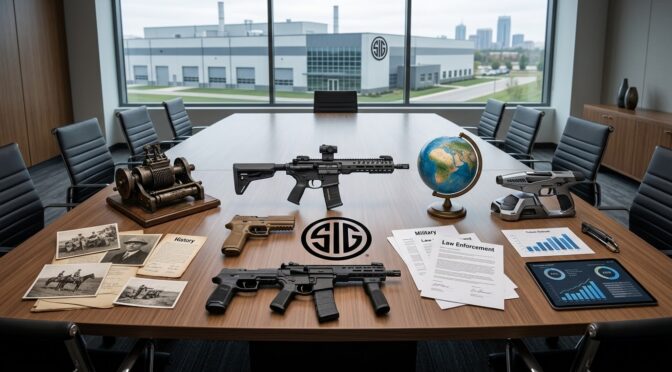
SIG Sauer operates as a primary manufacturer within the global small arms and defense industry. Evolving from a 19th-century Swiss railcar manufacturer into a vertically integrated defense contractor headquartered in the United States, the company’s trajectory illustrates a continuous structural adaptation to international export laws, market demands, and military procurement cycles1. At present, SIG Sauer functions as a principal supplier for the United States military, the Indian Armed Forces, and various global law enforcement agencies, while maintaining a substantial market share in the commercial civilian firearms sector3.
The company’s strategic operational shift occurred in the mid-2000s under the leadership of CEO Ron Cohen. During this period, the organization transitioned from an importer of European pistols into a diversified manufacturer of complete weapon systems5. This model expanded the company’s output to include proprietary electro-optics, advanced suppressors, and hybrid ammunition, which insulated the firm from localized fluctuations in the standalone firearms market7. The implementation of this systems-integration strategy was a central factor in securing the 2022 United States Army Next Generation Squad Weapon (NGSW) contract, a procurement program designed to alter standard squad-level infantry armament9.
Concurrently, the organization has navigated specific operational and legal challenges. The 2020 closure of its legacy German manufacturing facility highlighted the logistical and political difficulties of operating within stringent European export control frameworks11. Furthermore, the company has managed a period of litigation regarding its P320 pistol platform, negotiating settlements and implementing voluntary upgrade programs to address allegations of unintended discharges, while defending its engineering in federal courts14.
This report provides an analysis of the corporate history, product ecosystem, market penetration, consumer relationships, and future trajectory of SIG Sauer, utilizing available market data, contract awards, and historical records to document the company’s position within the global defense industrial base.
1. Corporate Origins and Historical Evolution
1.1 Early Swiss Foundations (1853–1970)
The corporate lineage of SIG Sauer originates in heavy industrial manufacturing rather than the arms trade. The enterprise was founded on November 2, 1853, as Schweizerische Waggonfabrik (Swiss Wagon Factory) in Neuhausen am Rheinfall, Canton of Schaffhausen, Switzerland1. The founders—entrepreneurs Friedrich Peyer im Hof, Heinrich Moser, and Johann Conrad Neher—initially focused on manufacturing railway wagons and locomotives. This early business model capitalized on the expansion of European railway infrastructure, utilizing the hydropower generated by the nearby Rhine Falls to operate heavy metalworking equipment1.
The transition into defense manufacturing was catalyzed by a procurement competition initiated by Switzerland’s Federal Ministry of Defence. In 1860, the company submitted a rifle design developed by gunsmith Jean-Louis Joseph Prélaz and army officer Edouard Burnand1. The design won the competition, resulting in an 1864 government contract to produce 30,000 muzzle-loading Prelaz-Burnand rifles, adopted by the Swiss military as the M18631. Following this pivot toward armaments, the company changed its name to Schweizerische Industrie Gesellschaft (SIG), signaling its broader industrial focus1.
For the subsequent century, SIG operated primarily as a supplier for the Swiss armed forces, developing precision firearms. A notable milestone was the 1947 introduction of the SIG P210 semi-automatic pistol, which was adopted by the Swiss military in 1949 under the designation “Pistole 49”1. The P210 was based heavily on the French Modèle 1935 pistol, which utilized Charles Petter’s licensed refinements of the John Moses Browning Hi-Power design. The P210 utilized external slide rails running inside the frame, a design choice that minimized mechanical play and yielded high accuracy1. While the P210 established the brand’s reputation for premium engineering, production volumes remained constrained by the small size of the Swiss military and the country’s strict export regulations1.
1.2 The Swiss-German Alliance: Formation of SIG Sauer (1970s–1990s)
During the 1970s, SIG sought to expand its revenue through international arms exports. However, Swiss neutrality laws imposed severe restrictions on the ability of domestic companies to export military-grade weaponry to foreign markets1. To bypass these regulatory barriers, SIG required a foreign partner located in a jurisdiction with more permissive export controls.
In 1976, SIG acquired J.P. Sauer & Sohn, a historic German firearms manufacturer based in Eckernförde, West Germany1. Sauer & Sohn brought a lineage dating back to 1751 and extensive experience in mass military production. From 1941 to 1945, Sauer operated within the centrally directed war economy of Nazi Germany, producing firearms such as the Sauer 38H pistol for the Wehrmacht, Luftwaffe, and Waffen-SS1. Following World War II, Sauer’s primary facilities were captured by the East German government, leading the company to relocate and resume business in West Germany in 195118. The 1976 joint venture between SIG and Sauer resulted in the brand name “SIG Sauer,” allowing the precision designs conceived by Swiss engineers to be manufactured in Germany and exported globally18. The first major product of this era was the P220 semi-automatic pistol, launched in 1975 and adopted by the Swiss Army as the P7518.
By 1985, the company recognized the potential of the American civilian and law enforcement markets and established a United States subsidiary, SIGARMS, Inc., in Tyson’s Corner, Virginia, to facilitate the importation of the P220 and P230 models2. In 1987, the subsidiary relocated to a larger facility in Herndon, Virginia, introducing the P225, P226, and P228 models. In 1990, to reduce import reliance and tailor products directly to American consumer preferences, SIGARMS relocated its headquarters to Exeter, New Hampshire, transitioning toward domestic manufacturing2.
1.3 Corporate Restructuring and the Rise of the American Division (2000–Present)
At the turn of the millennium, the Swiss parent company divested its firearms divisions to focus on packaging technology. In 2000, the German investment group L&O Holding—owned by Michael Lüke and Thomas Ortmeier—acquired the small arms operations6. This acquisition fractured the legacy corporate structure into distinct entities under the L&O umbrella.
| Corporate Entity | Location | Operational Status | Historical Function |
| SIG Sauer AG (formerly SAN Swiss Arms AG) | Neuhausen, Switzerland | Active | Production of arms for Swiss military (e.g., SG 550 series). |
| SIG Sauer GmbH & Co. KG | Eckernförde, Germany | Defunct (Closed 2020) | Legacy manufacturing of European catalog products and sports weapons. |
| SIG Sauer, Inc. (formerly SIGARMS) | New Hampshire, USA | Active | Primary global headquarters, R&D, and manufacturing hub. |
| Table 1: Corporate structure of SIG Sauer entities under L&O Holding. [cite: 1, 2, 20] |
The American division, which officially rebranded as SIG Sauer, Inc. in 2007, subsequently eclipsed its European counterparts in revenue and operational scale. Operating largely independently of the German facility, the New Hampshire-based entity became the primary driver of corporate strategy, research, and global sales, eventually establishing its modern headquarters in Newington, New Hampshire2.
2. Strategic Transformation and Business Strategy
The modern iteration of SIG Sauer is defined by the strategic initiatives implemented following the appointment of Ron Cohen as CEO in the mid-2000s. Prior to his arrival, the American division faced financial difficulties. By 2004, the company was constrained by declining profits, with merely 130 employees spread across entities in Switzerland, Germany, and America5.
2.1 The Shift to Systems Integration (2004–Present)
Cohen’s turnaround strategy began with product diversification. In 2004, the company introduced AR-15 style rifles to its catalog, capturing a segment of the American commercial market and injecting capital into the firm5. This financed an expansion in personnel and manufacturing capability, transitioning the company from a boutique importer to a mass-market domestic producer.
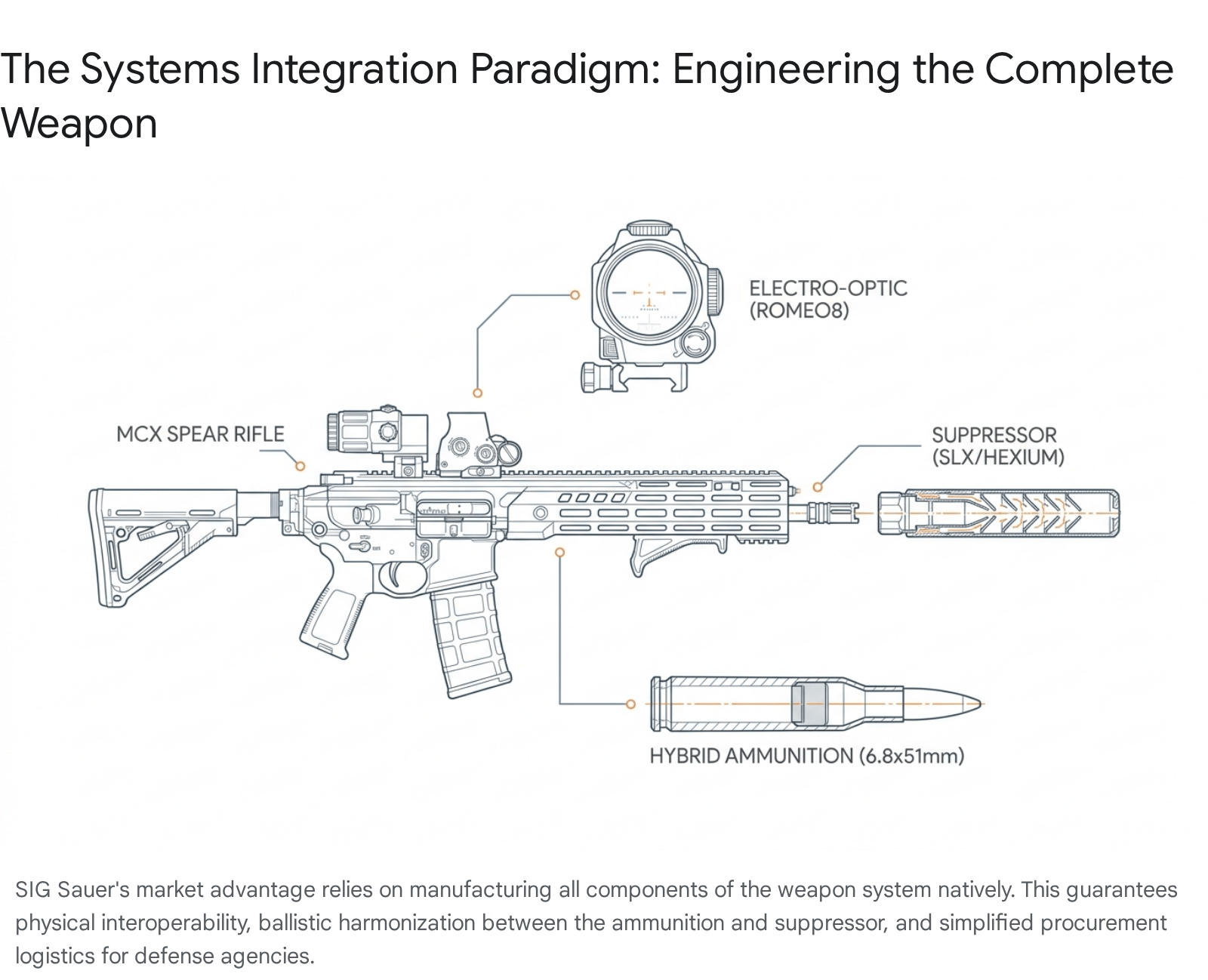
By 2015, SIG Sauer executed a shift in its business model, moving from a standalone firearms manufacturer to a “complete weapons system” provider5. The company established specialized divisions to design and manufacture electro-optics, advanced sound suppressors, proprietary ammunition, and airguns7.
The strategic rationale for this expansion was rooted in military procurement dynamics. Historically, defense agencies procured rifles, optics, and suppressors from disparate vendors, placing the burden of integration and compatibility on the military end-user. By developing all components in-house, SIG Sauer positioned itself as a single-source contractor capable of ensuring interoperability7. The company expanded its New Hampshire footprint substantially, culminating in the establishment of the SIG Experience Center and SIG Sauer Academy in Epping, New Hampshire, which serves as a training facility, flagship retail space, and corporate museum22.
2.2 The Closure of European Manufacturing (2020)
As the American division achieved growth, the legacy German division, SIG Sauer GmbH in Eckernförde, faced compounding operational hurdles. In June 2020, L&O Holding announced the permanent closure of the German facility, resulting in the termination of approximately 130 employees12.
The rationale provided by the company cited “locational disadvantages” inherent to the German defense industrial base. Legislation in Germany had restricted the domestic sports shooting market, limiting civilian sales12. Furthermore, SIG Sauer found itself systematically disadvantaged in domestic government procurement. Both the German Bundeswehr and federal police agencies predominantly awarded contracts to domestic rivals; for example, the Berlin police selected the Heckler & Koch SFP9 TR in 201713. German military tenders also excluded SIG Sauer due to the heavy inclusion of “U.S. technology” in modern SIG platforms.
Additionally, the German division had faced legal repercussions for export control violations. In 2019, a German court handed former and current managers suspended prison sentences and financial penalties for illegally shipping 38,000 pistols to the Colombian National Police in 2009 without proper end-user authorization11. The combination of a strict regulatory environment, limited domestic sales, and the productivity of the New Hampshire operations rendered the Eckernförde plant economically unviable12. Currently, the brand’s global manufacturing operations reside almost entirely in the United States.
3. Product Ecosystem and Technical Specifications
SIG Sauer’s catalog reflects an architectural philosophy focused on modularity, weight reduction, and systems integration. The product matrix is divided into specific verticals catering to distinct operational requirements7.
3.1 Handgun Platforms
The foundation of SIG Sauer’s commercial and defense sales relies on its pistol lines, which have evolved from traditional double-action/single-action (DA/SA) mechanisms to modular striker-fired designs.
- The P320 Series: Introduced to compete in the striker-fired market, the P320’s primary engineering innovation is its serialized Fire Control Unit (FCU). Unlike traditional handguns where the serialized component is the external frame, the P320’s legal “firearm” is a stainless-steel chassis housing the trigger group. This allows the user to interchange the FCU into various un-serialized polymer or metal grip modules (such as the AXG, XFULL, or XCOMPACT), changing the caliber and size of the weapon without requiring multiple background checks or purchasing distinct firearms7.
- The P365 Series: Targeted at the concealed carry market, the P365 offered a double-stack magazine capacity within the physical dimensions of a traditional single-stack subcompact pistol.
- Legacy Platforms (P226, P220, 1911):SIG retains production of its historic DA/SA metal-framed pistols, servicing law enforcement segments, competitive shooters, and the premium collector market (e.g., the Legion series)18.
3.2 Next-Generation Rifles and Machine Guns
The company has invested in rifle platforms that utilize short-stroke gas piston operations, which perform with greater reliability when suppressed compared to standard AR-15 direct-impingement systems8.
- MCX Series and the XM7 (MCX Spear): Designed for military application, the MCX Spear is an adaptive platform utilizing a short-stroke gas piston system. It features an adjustable gas block allowing it to function with suppressors and utilizes ambidextrous controls. The civilian variant of this rifle is currently available on the commercial market8.
- M250 and MMG (Medium Machine Gun): Replacing traditional belt-fed systems, the M250 light machine gun is designed to be highly man-portable. It features a side-folding feed cover and side-ejecting brass links. Engineering data states the SIG LMG is up to 40% lighter than legacy systems like the M249, while incorporating a proprietary recoil mitigation system to stabilize high-velocity ammunition. The MMG variant is chambered in heavier calibers, including .338 Norma Magnum8.
- The CROSS Rifle: A lightweight bolt-action platform engineered for the precision hunting and long-range competitive shooting markets23.
- SIG716: An enhanced AR platform chambered in 7.62 NATO, featuring a 16-inch barrel, M-LOK handguard, and a four-position adjustable gas system26.
3.3 Ancillary Divisions: Electro-Optics, Suppressors, and Ammunition
SIG Sauer’s ancillary divisions operate at a scale rivaling dedicated accessory manufacturers.
- Electro-Optics: This division produces red dot sights (ROMEO), magnified riflescopes (TANGO, WHISKEY), thermal observation units, and binoculars (ZULU6). The division utilizes the SBT (SIG Ballistic Turret) system for trajectory compensation and targets market share by offering an “Infinite Guarantee,” providing fully transferable lifetime warranties without receipt requirements28.
- Suppressors: Anticipating the normalization of sound suppression in military engagements, SIG developed lines such as the SLX, Hexium, TiN CAN, and Endure. These designs utilize materials like Inconel and Titanium. They prioritize flow-through technology to reduce toxic gas backflow, while integrated flash-hider suppressors combine visual signature reduction with acoustic masking10.
- Ammunition: Operating out of a dedicated facility in Arkansas, the ammunition division manufactures commercial target rounds, defensive hollow-points, and the proprietary high-pressure hybrid cartridges required for military contracts8.
4. Buyer Demographics and Contract Analysis
SIG Sauer’s buyer demographic is diversified, segmenting into three primary verticals: United States defense procurement, international military sales, and the domestic civilian and law enforcement market.
4.1 The United States Military Modernization Programs
The foundation of SIG Sauer’s current financial profile is its relationship with the United States Department of Defense. In 2017, the U.S. Army selected the SIG P320 to replace the Beretta M9 as its standard-issue sidearm under the Modular Handgun System (MHS) program, resulting in the fielding of the M17 and M18 pistols16.
In April 2022, SIG Sauer was awarded the initial delivery order for the U.S. Army’s Next Generation Squad Weapon (NGSW) program3. The NGSW represents a shift in infantry armament, replacing the 5.56 NATO M4 carbine and M249 squad automatic weapon in the close combat force9. The Army’s procurement logic was driven by the necessity for greater lethality, longer effective ranges, and the capability to defeat modern adversary body armor. Standard 5.56mm NATO rounds lacked the terminal ballistics to achieve this at extended distances.
SIG Sauer engineered a solution centered around the 6.8 Common Cartridge Family of Ammunition, specifically the 6.8x51mm Hybrid cartridge8. By utilizing a hybrid metallic case—combining a stainless-steel base with a brass body—the cartridge withstands higher chamber pressures than traditional brass. This allows the projectile to reach velocities necessary to penetrate armor without increasing the overall size of the weapon to that of a heavy caliber sniper rifle8. SIG’s selection meant the Army bypassed polymer-based case designs developed by competitors like True Velocity25.
The NGSW contract is structured as a 10-year firm-fixed-price agreement. It carries an initial testing delivery value of $20.4 million, with the Army projecting expenditures of $1.4 billion on the system over the next five years3. The procurement encompasses 15,000 XM7 rifles and 13,000 XM250 automatic rifles in its initial rollout phases24. Furthermore, 29,000 XM157 Fire Control optics will be delivered under a $2.7 billion contract won by Vortex Optics subsidiary Sheltered Wings, which integrate directly onto the SIG platforms9.
| NGSW Program Designation | SIG Sauer Platform | Replaces Legacy Platform | Primary Cartridge |
| XM7 (Rifle) | MCX Spear | M4 Carbine | 6.8x51mm Hybrid |
| XM250 (Automatic) | M250 LMG | M249 SAW | 6.8x51mm Hybrid |
| SLX Suppressor | SLX Series | Unsuppressed systems | N/A |
| Table 2: Overview of the U.S. Army Next Generation Squad Weapon procurement. [cite: 3, 8, 9, 10, 24] |
4.2 International Defense Sales and the Indian Subcontinent
SIG Sauer has executed an expansion into the Asian defense market, capitalizing on geopolitical developments between India, Pakistan, and China. The Indian Armed Forces, operating in mountainous terrain along the Line of Control, required a battle rifle with a longer effective range than their domestic 5.56mm INSAS rifles and 7.62x39mm Kalashnikov variants4.
In 2019, the Indian Ministry of Defence awarded SIG Sauer a fast-track contract valued at $90 million for 72,400 SIG716 rifles chambered in the heavier 7.62x51mm NATO cartridge4. The fast-track procedure required deliveries to be completed within one year. The operational fielding of this platform resulted in a follow-on procurement in August 2024 for an additional 73,000 rifles, bringing the total Indian inventory to 145,400 units4. The rifles for this contract are manufactured at SIG Sauer’s facilities in the United States26.
To align with the Indian government’s “Make in India” initiative aimed at domestic self-reliance, SIG Sauer announced a joint venture in November 2024 with Nibe Defence and Aerospace Limited31. This memorandum of understanding, signed in Pune, establishes domestic small-arms and ammunition manufacturing operations in India, transitioning SIG from a foreign importer to an embedded domestic defense partner31. Furthermore, components for SIG weapons are increasingly sourced from suppliers like Indo-MIM (Metal Injection Molding), which operates facilities in both India and Texas26.
4.3 Civilian and Law Enforcement Markets
The commercial and law enforcement markets provide consistent revenue streams. The domestic civilian market frequently views military adoption as an endorsement of reliability. Consequently, commercial variants of military platforms—such as the P320, P365, and the semi-automatic MCX Spear (with an MSRP approaching $7,999)—experience high demand7. SIG supports this demographic through extensive accessory ecosystems and the SIG Sauer Academy, which trains law enforcement personnel and civilians7.
5. Reputation, Litigation, and Quality Control
Despite engineering developments and federal contract awards, SIG Sauer’s reputation has been subjected to scrutiny, primarily stemming from mechanical allegations surrounding the P320 pistol platform, subsequent litigation, and discussions regarding manufacturing volume.
5.1 The P320 Unintended Discharge Allegations
Following its introduction and military adoption, reports surfaced regarding “unintended discharges” involving the P320. Initial reports in 2017 indicated that the pistol was susceptible to discharging if dropped at a specific angle16. The underlying mechanical cause was determined to be the physical mass of the trigger shoe, sear, and striker mechanism; kinetic energy from a specific impact could cause the components to move via inertia, resulting in a discharge16.
Concurrently, a separate wave of allegations emerged from both law enforcement officers and civilians claiming that the weapon fired while fully holstered, without physical interaction with the trigger17. Over 80 injuries were reported in these incidents since 201617. In July 2023, a Maine police deputy filed a lawsuit claiming his holstered P320 discharged while his hands were full, and in May 2022, a North Carolina man filed a $30 million lawsuit claiming his P320 discharged in his pocket17. Plaintiffs alleged that the weapon possessed design defects rendering it unsafe for standard carry.
5.2 The Voluntary Upgrade Program and Legal Resolutions
In response to the drop-safety concerns, SIG Sauer initiated a Voluntary Upgrade Program (VUP) in August 2017. The company offered to retrofit all existing P320s at no cost. The engineering remediation involved installing an alternate design that reduced the physical weight of the trigger, sear, and striker to mitigate inertial movement, while adding a mechanical disconnector to prevent the firearm from discharging when out of battery15.
Legally, SIG Sauer has maintained a defense against claims that the weapon can fire autonomously. The company asserts that internal and independent testing confirms that a post-upgrade P320 physically cannot discharge without a trigger pull14. This defense has been successful in federal courts. In Glasscock v. SIG Sauer, Inc. (2026), the United States Court of Appeals for the Eighth Circuit unanimously dismissed a class-action lawsuit, noting the plaintiff’s claim of a “hypothetical defect” was speculative as the plaintiff had never experienced an unintended discharge14. Similarly, cases in Massachusetts and Colorado were withdrawn with prejudice when plaintiffs and their expert witnesses were unable to replicate a discharge without pulling the trigger. In the Massachusetts case, an internal police department investigation determined the plaintiff’s handling of the weapon violated departmental rules14.
Despite these courtroom outcomes, the company opted to settle a separate class-action lawsuit in March 2020 to avoid the costs of prolonged litigation. Without admitting fault, SIG Sauer agreed to reimburse owners who had previously paid for repairs due to cartridge failure events and offered a transferable limited lifetime warranty on the platform for current owners16.
| Legal Issue | Nature of Claim | SIG Sauer Response | Outcome |
| Drop Safety | Weapon discharges upon specific impact angles. | Initiated Voluntary Upgrade Program (VUP) in 2017. Added mechanical disconnector and lighter components. | VUP implemented globally; mechanics rectified. |
| Autonomous Discharge | Weapon fires in holster without trigger pull. | Asserted impossibility based on engineering and testing. | Won dismissals (e.g., Glasscock, Mass., Colo.) due to lack of replication. |
| Class Action (2020) | Financial damages for repairs of pre-2017 models. | Agreed to settle to avoid prolonged litigation costs; no admission of fault. | Settlement approved; lifetime warranty provided; repair costs refunded. |
| Table 3: Summary of legal actions and corporate responses regarding the P320 platform. [cite: 14, 15, 16, 17, 34, 35] |
5.3 Corporate Culture and Manufacturing Volume
The rapid expansion of the company has led to secondary critiques regarding quality control. Investigations by independent journalists and statements from former employees allege that the corporate culture established under CEO Ron Cohen prioritizes production volume over quality control6. In previous interviews, Cohen analogized the company to Mercedes-Benz, questioning how to grow a company “to be four times bigger while not losing your edge of being the quality leader”6. SIG Sauer’s corporate communications deny any degradation in manufacturing standards, dismissing such critiques as coordinated campaigns by “engagement hacking grifters” and asserting they stand behind the safety and design of all products6.
6. Future Outlook and Market Trajectory
6.1 Global Supply Chain and Joint Ventures
SIG Sauer’s forward trajectory involves the expansion of its localized global manufacturing footprint. The joint venture with Nibe Defence in India serves as an operational template31. By establishing manufacturing nodes directly within allied nations, SIG Sauer circumvents export delays, complies with domestic self-reliance initiatives, and creates regional hubs capable of servicing localized contracts without straining the New Hampshire supply lines.
6.2 The Ecosystem Strategy
The commercial and defense sectors demonstrate a trend toward systems-level integration. Future tenders from NATO-aligned nations will increasingly require platforms that are pre-harmonized with optics, rangefinders, and sound suppression. SIG Sauer’s investment in electro-optics and suppressor technology has created a structural advantage for their core firearms business. Competitors who operate solely as rifle manufacturers are increasingly required to bid as consortiums, which carry higher integration risks than a single-vendor solution7. In the civilian sector, this translates to ecosystem capture; a consumer who purchases a SIG Sauer modular pistol is statistically likely to purchase a SIG Sauer proprietary optic to match the factory-milled slide, creating a compounding revenue model.
Conclusion
SIG Sauer’s evolution from a Swiss industrial manufacturer to an American-led systems integration company represents a successful structural adaptation within the defense sector. By insulating itself from the export laws of Europe and rooting its operations in the United States, the company captured market share in both the civilian and defense sectors. The execution of the U.S. Army’s MHS and NGSW contracts secures the company’s financial stability and operational relevance in military procurement. While rapid scaling has resulted in product liability litigation and localized manufacturing closures in Germany, SIG Sauer has navigated these issues through engineering revisions, legal defense strategies, and strategic joint ventures. The company’s commitment to delivering integrated tactical ecosystems—combining the firearm, optic, suppressor, and ammunition—positions it as a central entity in future global infantry modernization programs.
Please share the link on Facebook, Forums, with colleagues, etc. Your support is much appreciated and if you have any feedback, please email us in**@*********ps.com. If you’d like to request a report or order a reprint, please click here for the corresponding page to open in new tab.
Works cited
- SIG Sauer – Wikipedia, https://en.wikipedia.org/wiki/SIG_Sauer
- SIG Sauer – Grokipedia, https://grokipedia.com/page/SIG_Sauer
- Sig Sauer Awarded US Army 6.8mm NGSW Contract | Joint Forces News, https://www.joint-forces.com/defence-equipment-news/53083-sig-sauer-awarded-us-army-6-8mm-ngsw-contract
- Sig 716 7.62 | laststandonzombieisland, https://laststandonzombieisland.com/tag/sig-716-7-62/
- The History of SIG Sauer and Their Recent Challenges – Blog.GritrSports.com, https://blog.gritrsports.com/history-of-sig-sauer/
- Even a Decade of Unintentional Shootings Could Not Slow America’s Top Pistol Maker, https://www.thetrace.org/2026/02/sig-sauer-safety-manufacturing-p320/
- WEB_2023_LE_CATLOG_FINAL, https://www.sigsauer.com/media/sigsauer/resources/WEB_2023_LE_CATLOG_FINAL_10-17-23.pdf
- defense – SIG Sauer, https://www.sigsauer.com/media/sigsauer/resources/FULL_DEFENSE_CAT_26_PRINT.pdf
- Army chooses Sig Sauer to build its Next Generation Squad Weapon, https://www.armytimes.com/news/your-army/2022/04/19/army-chooses-sig-sauer-to-build-its-next-generation-squad-weapon/
- SIG Sauer Wins Army NGSW Contract | An Official Journal Of The NRA – Shooting Illustrated, https://www.shootingillustrated.com/content/sig-sauer-wins-army-ngsw-contract/
- Sig Sauer | War Resisters’ International, https://wri-irg.org/en/taxonomy/term/690
- Statement by SIG SAUER AG Switzerland on closure of the location in Eckernförde, https://www.sigsauer.swiss/media/files/statement-by-sig-sauer-ag-switzerland-on-closure-of-the-location-in-eckernfoerde.pdf
- Sports and law enforcement/military firearms manufacturer SIG Sauer is apparently not bankrupt, after all. But production in Germany is to be discontinued, the Eckernförde plant will be closed | all4shooters, https://www.all4shooters.com/en/shooting/culture/sports-and-law-enforcement-military-firearms-manufacturer-sig-sauer-is-bankrupt-production-in-germany-is-to-be-discontinued-the-eckernfoerde-plant-will-be-closed/
- Federal Court of Appeals Orders Dismissal of P320 Class Action Lawsuit in Unanimous Decision – Sig Sauer, https://www.sigsauer.com/blog/federal-court-of-appeals-orders-dismissal-of-p320-class-action-lawsuit-in-unanimous-decision
- P320 Voluntary Upgrade Program – Sig Sauer, https://www.sigsauer.com/p320-voluntary-upgrade-program
- Sig Sauer to Settle Lawsuit Over Alleged Safety Glitch in P320 Pistol – Military.com, https://www.military.com/daily-news/2020/03/19/sig-sauer-settle-lawsuit-over-alleged-safety-glitch-p320-pistol.html
- Sig Sauer® P320 Lawsuit | P320 Lawyer, Attorney – The Schmidt Firm, PLLC, https://www.schmidtlaw.com/sig-sauer-p320-lawsuit/
- History of SIG Sauer: From Tumultuous Past to Industry Leader – Athlon Outdoors, https://athlonoutdoors.com/article/history-of-sig-sauer/
- SIG Sauer History, https://www.wideners.com/blog/sig-sauer-history/
- SIG Sauer AG – Wikipedia, https://en.wikipedia.org/wiki/SIG_Sauer_AG
- SIG Sauer GmbH Ended By Hostile Business Climate, Lack of Demand | An Official Journal Of The NRA – American Rifleman, https://www.americanrifleman.org/content/sig-sauer-gmbh-ended-by-hostile-business-climate-lack-of-demand/
- ICYMI: Headlines From July 11–July 15, 2022, https://shootingindustry.com/dealer-advantage/icymi-headlines-from-july-11-july-15-2022/
- SIG SAUER Firearms, Ammunition, Optics & Suppressors, https://www.sigsauer.com/
- AND THE WINNER IS: SIG SAUER wins NGSW – SPARTANAT.com, https://spartanat.com/en/and-the-winner-is-sig-sauer-gewinnt-ngsw
- SIG Sauer Wins US Army Next Generation Squad Weapon Contract | The Armory Life Forum, https://www.thearmorylife.com/forum/threads/sig-wins-sig-sauer-wins-us-army-next-generation-squad-weapon-contract.11316/
- Indian Army Orders an Additional 73000 SIG716 Rifles | Soldier Systems Daily, https://soldiersystems.net/2024/08/26/indian-army-orders-an-additional-73000-sig716-rifles/
- SIG Sauer SIG716 Wins Rifle Contract From India Ministry of Defense – Athlon Outdoors, https://athlonoutdoors.com/article/sig-sauer-sig716-rifle-contract-india/
- Optics for Shooting & Gun Optics – Sig Sauer, https://www.sigsauer.com/electro-optics.html
- Firearm Suppressors |Clutch Lok & Direct Thread | Sig Sauer, https://www.sigsauer.com/suppressors.html
- Integrated Flash Hider Suppressors – SIG Sauer, https://www.sigsauer.com/shop/integrated-flash-hider-suppressors
- SIG Sauer signs agreement with India’s Nibe Defence – Janes, https://www.janes.com/defence-intelligence-insights/defence-news/industry/sig-sauer-signs-agreement-with-indias-nibe-defence
- Indian Army Orders an Additional 73,000 SIG716 Rifles – Sig Sauer, https://www.sigsauer.com/blog/indian-army-orders-an-additional-73000-sig716-rifles
- SIG SAUER and Nibe Defence Announce Joint Venture in India, https://www.sigsauer.com/blog/sig-sauer-and-nibe-defence-announce-joint-venture-in-india-
- P320 Upgrade Program Information – SIG Sauer, https://www.sigsauer.com/blog/p320-upgrade-program-information
- A Settlement has been reached in a class action lawsuit about SIG Sauer’s P320 pistol., https://www.sigsauer.com/pub/media/sigsauer/resources/Short-Form-Agreement-Notice.pdf