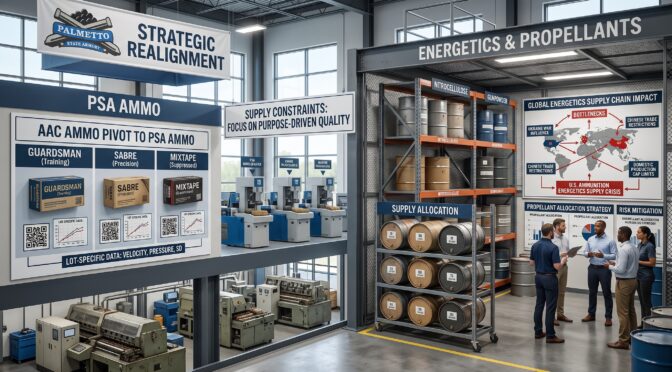
Executive Summary
The U.S. commercial ammunition industry is currently undergoing a massive shift, driven by severe supply chain shortages and changing global defense needs. At the center of this transition is Palmetto State Armory (PSA) and its parent company, JJE Capital Holdings. In early 2026, the market was shaken when JJE’s Advanced Armament Company (AAC) facility in South Carolina indefinitely suspended operations, highlighting the hidden risks of relying on external chemical suppliers1.
While many feared the closure was the end of PSA’s ammo manufacturing, those concerns proved premature. By July 2026, the venture returned under a new name and a completely restructured business model: PSA Ammo4. This report breaks down the closure of AAC, the global gunpowder crisis that caused it, and the strategic pivot toward verified quality that defines the new PSA Ammo line. We also look at the broader landscape of foreign buyouts and European expansion currently reshaping the market.
The Fall of AAC: Where Vertical Integration Met Its Match
When AAC production halted in late 2025, JJE Capital Holdings initially called it a temporary pause due to a powder shortage5. However, looking closer at the supply chain reveals that the closure was bound to happen because of a specific weak point in JJE’s strategy2.
Building a Self-Sustaining Ecosystem
JJE Capital Holdings follows a clear philosophy: acquire established brands and bring as much of their manufacturing in-house as possible2. Their companies cover everything from raw forging and precision machining to retail7. In 2020, JJE bought the intellectual property for the AAC brand and launched an ambitious ammo plant in West Columbia, South Carolina8. Their goal was to keep PSA’s shelves stocked and protect firearm sales from the frequent ammo shortages that plague the industry3.
By making their own brass cases, copper jackets, and lead cores, JJE protected themselves from metal shortages8. But this “metal-first” approach had a major flaw: they still depended on outside vendors for the chemical side of the business—the gunpowder and primers3. As the industry often says, the chemist eventually outranks the machinist.
The Chemical Crisis: War and Explosions
This dependency became a disaster in late 2025. The U.S. market for gunpowder is controlled by a very small number of producers2. For example, St. Marks Powder in Florida provides the vast majority of the powder used in high-velocity rifle rounds like 5.56mm. Usually, they sell their surplus to commercial loaders like AAC, but that surplus vanished overnight2.
First, the war in Ukraine created a massive global demand for artillery propellant2. To put it in perspective, a single 155mm artillery shell uses enough powder to load over 7,000 rounds of 5.56mm ammo10. As global stockpiles shrank, European manufacturers began prioritizing NATO contracts, leaving nothing for the civilian market.
Then, tragedy struck closer to home. In October 2025, a massive explosion at the Accurate Energetic Systems (AES) facility in Tennessee killed 16 people and shut down a vital processing hub6. Reports later linked JJE’s AAC brand to this facility, suggesting they relied on AES to blend or process their powder shipments10.
Between federal investigations slowing down production and the U.S. government using the Defense Production Act to prioritize military orders, AAC’s powder supply was cut off2. JJE was forced to close the plant and lay off workers by early 20263.

Quality Control Issues and the Suppressor Community
Even before the powder shortage, AAC was facing a crisis of trust. Many shooters, particularly those using suppressors, reported that the copper jackets on AAC bullets were separating in flight12. This wasn’t just an accuracy problem—it was a recipe for expensive equipment damage.
The Mechanics of Suppressor Baffle Strikes
The failure usually happened with 55-grain 5.56mm loads. If the copper jacket isn’t bonded perfectly to the lead core, the high spin rate from the barrel’s rifling can cause it to tear off13. When this happens inside a suppressor, the fragments hit the internal baffles, causing a “baffle strike” that can permanently ruin a regulated item that costs $200 and months of waiting to replace12.
This phenomenon is severely exacerbated by modern AR-15 barrel twist rates. Many consumers utilize 1:7 or even 1:5 twist barrels to stabilize heavy, long projectiles, such as 77-grain Open Tip Match (OTM) or 220-grain subsonic rounds14. Firing a lighter 55-grain projectile through a 1:5 twist barrel at velocities exceeding 2,800 feet per second results in extreme centrifugal forces15. While premium projectiles manufactured by companies like Hornady or Sierra possess jackets robust enough to withstand this rotational stress, the economy-grade projectiles utilized in AAC’s bulk 55-grain loads routinely failed under the same conditions14.
When a jacket separates in free space, it presents as a minor accuracy issue. However, when it separates inside the confined expansion chambers of a suppressor, the fragments violently impact the internal baffles and the end cap13. This results in a baffle strike, permanently damaging a regulated NFA item that requires extensive waiting periods and a $200 tax stamp to replace12.
The Public Relations Fallout
The prevalence of AAC jacket separation led to widespread warnings across digital platforms, with consumer reports documenting bullet fragments and lead debris exiting suppressors alongside visible damage to muzzle devices and end caps12. Furthermore, suppressor manufacturers reportedly grew fatigued by the influx of warranty claims stemming directly from the use of AAC ammunition17.
PSA’s customer service response initially made things worse. While they were happy to refund the cost of the ammo, they often denied responsibility for the damaged suppressors, blaming poor mounting or other user errors instead12. This friction burned bridges with high-volume shooters. By the time production could resume, the AAC name was too tarnished to save. A clean break was necessary13.
A Fresh Start: The Birth of PSA Ammo
In July 2026, PSA announced that its ammunition operations had been completely rebranded as PSA Ammo4. The AAC name has been moved exclusively to suppressors, creating a clear line between the two products and leaving the quality issues of the past behind4.
The Pivot from Volume to Verified Quality
This rebranding isn’t just about a new sticker on the box. Because gunpowder is still scarce, PSA has shifted away from flooding the market with cheap training ammo4. Instead, they are focusing on specialized, high-quality rounds where they can justify a higher price and ensure better reliability for the customer4.
Under the previous AAC model, the primary objective was to flood the market with high-volume, low-margin commodity ammunition, serving as a value-add to drive sales for their core rifle business4. In the post-2025 reality, allocating scarce, highly expensive powder to cheap plinking ammunition is a severe misallocation of resources. Instead, PSA Ammo is deliberately focusing on lower-volume, specialized, purpose-driven ammunition4. By focusing on high-margin, niche calibers and premium projectile weights, PSA can justify a higher price point per round, effectively monetizing their limited propellant supply while simultaneously rebuilding consumer trust4.
Radical Transparency: No More Guesswork
To fix their reputation, PSA Ammo introduced something rare in the industry: total data transparency4. Usually, ammo boxes only give you rough estimates of speed and performance. Now, every box of PSA Ammo has a lot number that you can look up on their website to see the exact test results for that specific batch4.
Shooters can see actual muzzle velocity, chamber pressure, and how consistent the batch is4. This is vital for long-range precision or for ensuring that subsonic rounds stay quiet and cycle properly. By sharing this data, PSA is proving they care about quality as much as their customers do4.

Product Segmentation: The Three Pillars of PSA Ammo
To execute this strategic shift, PSA has divided its ammunition portfolio into three distinct, purpose-built product lines, deliberately moving away from the commodity approach that defined the AAC era4.
The Guardsman, Sabre, and Mixtape Portfolios
| Product Line | Target Application | Core Engineering Priority | Key Feature | Initial Focus Calibers |
| Guardsman | High-Volume Training & Range Use | Reliability and consistent point of impact | Clean-burning performance and reloadable brass cases | 5.56mm NATO, .300 Blackout (125gr FMJ) |
| Sabre | Precision, PRS/NRL Competition, Long-Range Hunting | Extreme consistency at distance | Verified lot ballistics designed to feed directly into ballistic solvers | .300 Blackout (110gr V-MAX / Black Tip) |
| Mixtape | Suppressed Platforms & Short-Barreled Setups | Subsonic cycling reliability and acoustic signature reduction | Comprehensive host-weapon, barrel length, and suppressor validation data | 9mm (158gr), .300 Blackout (220gr), 8.6 Blackout |
The Guardsman line is positioned for high-round-count practical training, specifically utilizing high-quality reloadable brass cases to cater to the domestic reloading market4. This allows shooters to amortize the cost of the ammunition over multiple reloading cycles, which is relevant given current component shortages4. The Sabre line targets precision shooters, offering premium Hornady projectiles and verified lot data that removes the guesswork of chronographing every new case4. The Mixtape line is exclusively engineered for suppressed platforms, directly addressing the core demographic alienated by past quality control issues4.
The Mixtape Launch and the SAAMI Testing Controversy
The PSA Ammo brand officially went live on Friday, July 17, 2026, launching with two heavy subsonic .300 Blackout loads under the Mixtape line: a 220-grain TMJ (Total Metal Jacket) designed for affordable training, and a 220-grain OTM (Open Tip Match) utilizing Hornady projectiles for precision and enhanced terminal performance4.
However, the launch immediately sparked a technical controversy regarding its testing methodology. Although the Mixtape line is clearly marketed for short-barreled, suppressed platforms (like the PSA Sabre 8-inch PDWs), the initial lot data from PSA showed that the ammunition was tested with a 16-inch barrel and an AAC Ranger 7 suppressor. Consumers correctly noted that 16-inch barrels are an extreme anomaly for subsonic .300 Blackout applications, which are typically optimized for 7- to 10-inch barrels due to the cartridge’s rapid powder burn rate24.
PSA representatives defended the data, explaining that the company must follow SAAMI (Sporting Arms and Ammunition Manufacturers’ Institute) procedures, which require a 16-inch test barrel for the .300 Blackout cartridge specification24. This highlighted the friction between outdated laboratory standards and modern tactical applications, where ammunition that works in a 16-inch test barrel may not produce enough gas pressure to cycle a short-barreled platform with a high-flow rate suppressor4. Despite this controversy, the product line continues to expand rapidly, with PSA scheduling the release of a highly anticipated 158-grain 9mm TMJ subsonic load for August 28, 202628. In internal testing, this heavy 9mm load averaged approximately 900 feet per second from handguns and 1,000 feet per second from pistol-caliber carbines (PCCs), keeping both platforms reliably below the supersonic threshold28.
The Drive for Tier 1 Sovereignty: The Organic Powder Plant Initiative
The rebranding and segmentation of PSA Ammo is a sophisticated stop-gap measure designed to maximize revenue while navigating a constrained supply chain. However, JJE Capital Holdings’ ultimate objective is to achieve true Tier 1 operational sovereignty—the complete vertical integration of both metal machining and chemical synthesis6.
To break the oligopolistic hold of the legacy energetic suppliers and insulate themselves from future Defense Production Act prioritizations, JJE Capital announced an ambitious initiative in early 2026: the construction of a proprietary gunpowder manufacturing facility in West Columbia, South Carolina, adjacent to the local airport infrastructure5.
Engineering and Regulatory Realities
Company representatives initially communicated an optimistic timeline, suggesting the new powder plant could be operational within a year6. From an industrial engineering and regulatory standpoint, this timeline is exceptionally aggressive for a greenfield energetics project30.
The production of nitrocellulose and double-base smokeless powder involves highly volatile chemical processes, including nitration, washing, and kettle drying30. Domestic energetic manufacturing is governed by a labyrinth of federal and state regulations. The facility must comply with the Environmental Protection Agency’s (EPA) Explosives Manufacturing Effluent Guidelines (40 CFR Part 457), which strictly regulate the discharge of aqueous wastes, caustic scrubbers, and spill washdowns32. Furthermore, if the facility utilizes open burning or open detonation (OB/OD) for the disposal of hazardous explosive waste, it triggers extreme regulatory scrutiny under RCRA Subpart X (Miscellaneous Units)33. This dictates stringent explosive siting requirements, protective distances, and continuous environmental media monitoring to protect surrounding communities from noise, vibration, and contamination30.
At the state level, the South Carolina Department of Environmental Services (SCDES) requires extensive air quality, wastewater, and construction permitting before ground can be broken35. Given these regulatory hurdles, the vast land requirements (often 50 to 300 hectares to satisfy explosive safety distances), and the complex procurement of chemical processing equipment, industry analysts project that bringing a modern nitrocellulose facility online safely will extend well beyond the initial 12-month estimate, pushing full operational capacity closer to late 2027 or 20286.
The Macroeconomic Landscape: Conglomerate Consolidation and European Expansion
The localized struggles and strategic pivots of Palmetto State Armory are occurring against a backdrop of historic disruption in the broader global ammunition market. As of the third quarter of 2026, the industry is characterized by massive foreign consolidation of U.S. manufacturing assets and unprecedented European capacity expansion.
The Czechoslovak Group (CSG) Acquisition of The Kinetic Group
The most seismic shift in the domestic market is the acquisition of The Kinetic Group by the Czechoslovak Group (CSG)38. The Kinetic Group—formerly the Sporting Products division of Vista Outdoor—controls the absolute lion’s share of the U.S. commercial ammunition market through its ownership of heritage brands, including Federal Premium, CCI, Speer, and Remington39.
Following a protracted, 14-month bidding war that involved unsolicited offers from MNC Capital and the Colt CZ Group, Vista Outdoor stockholders overwhelmingly approved the sale to CSG on November 25, 2024, with 97.89% of votes cast in favor of the transaction40. To secure the deal, CSG increased the base purchase price multiple times, finalizing the transaction at $2.225 billion, which delivered $25.75 in cash per share to Vista stockholders alongside equity in the newly separated Revelyst outdoor brand38. Concurrently, Revelyst was sold to Strategic Value Partners (SVP) in a separate $1.125 billion transaction expected to close in January 202540.
The CSG transaction faced intense political scrutiny from U.S. lawmakers, including Vice President-elect J.D. Vance and Representative Clay Higgins, regarding the potential risks of transferring critical U.S. ammunition manufacturing capabilities to foreign ownership40. However, CSG—owned by Czech billionaire Michael Strnad—emphasized its NATO ties and successfully navigated U.S. regulatory approvals, finalizing the deal and taking control of massive manufacturing facilities in Arkansas, Idaho, Minnesota, and Oregon40. With Olin Winchester (who recently acquired AMMO Inc.’s manufacturing assets) and CSG now controlling nearly the entire domestic market, smaller assemblers like JJE Capital face an increasingly consolidated, duopolistic supply chain that possesses organic energetics capacity2.
European Capacity Expansion and Sovereign Supply
In stark contrast to the constricted U.S. commercial market, the European defense industrial base is undergoing a generational expansion, driven heavily by EU subsidies (such as the ASAP plan) and NATO demands stemming from the Ukraine conflict30.
The German defense conglomerate Rheinmetall is aggressively executing “Project Firepower,” aiming to produce 1.5 million 155mm artillery shells annually by 2030 across its international network48. To support this massive output, Rheinmetall is investing over €650 million to expand its propellant powder capacity to 20,000 tonnes by 203049. In July 2026, the company broke ground on a massive expansion of the Nitrochemie Aschau plant in Bavaria49. This specific site will receive €350 million of the total investment, expanding its footprint from 90 to 110 hectares and doubling its output to add 2,500 tonnes of powder and over 1 million modular propellant charges annually by 202849.
Concurrently, EURENCO—a European leader in energetic materials operating in France, Belgium, and Sweden—has secured nearly €76 million in European Commission grants47. The company is rapidly scaling its operations, laying the foundation stone for expanded facilities in Belgium in July 2025, and aiming to multiply its powder production by ten while doubling its ammunition loading capacity47.
While these European expansions are monumental achievements in industrial capacity, they offer zero immediate relief to the U.S. civilian market. European production is entirely absorbed by NATO replenishment programs and direct supply lines to Ukraine2. Consequently, the traditional pipeline of European commercial powder—from manufacturers such as Bofors, Nitrochemie, and Vihtavuori—flowing into the U.S. reloading market remains functionally closed for the foreseeable future2.
Commercial Pricing Trends and the Retail Reality (August 2026)
The downstream effect of these upstream chemical shortages, regulatory hurdles, and corporate consolidations is acute price inflation at the retail level. Contrary to common internet narratives blaming consumer panic buying or hoarding, the 2026 price increases are driven entirely by raw material costs (specifically commodity metals like copper), transportation logistics, and the absolute scarcity of nitrocellulose propellant54.
As of August 2026, the pricing for standard training ammunition reflects a market under severe structural strain.
Current Ammunition Pricing and Availability Metrics
| Caliber | Market Condition | August 2026 Observed Pricing | Retail Inventory Status |
| 5.56x45mm NATO | Inflationary | $0.614 – $0.775 per round | Depleted; 14% – 22% of normal SKUs available |
| .300 AAC Blackout | Boutique/Scarcity | $0.84 – $1.00+ per round | Severely Depleted; 0% – 20% of normal SKUs available |
| 9x19mm Luger | Mild Inflation | $0.22 – $0.25 per round | Recovering; Subject to rolling distributor allocations |
Prices for 5.56x45mm NATO have surged significantly from their pre-crisis baselines. Current tracking indicates a median observed price of approximately $0.775 per round across broad retail channels, with specialized tracking indexes showing training-grade 5.56mm bottoming out at $0.614 per round58. For context, AAC previously acted as a vital market anchor, keeping 5.56 prices suppressed in the $0.40 to $0.50 range prior to their operational halt2.
The absence of high-volume producers has pushed calibers like .300 Blackout back into boutique pricing territory, frequently exceeding $0.80 to $1.00+ per round, though PSA Ammo’s recent Mixtape drop successfully offered 220-grain subsonics around $0.84 per round25. Distributors report that overall SKU availability for core calibers remains severely depleted, operating between 0% and 22% of normal historical inventory levels, creating a phenomenon of “ghost inventory” where items are listed but functionally unavailable to consumers61.
With major manufacturers—including The Kinetic Group—implementing semi-annual price increases of 3% to 12% across rifle, handgun, and shotshell platforms to offset rising material costs, analysts forecast no significant decline in retail ammunition pricing through the remainder of 202657.
Strategic Forecast and Analyst Conclusions
PSA’s journey from the mass-market AAC label to the specialized PSA Ammo brand is a perfect example of how the U.S. industry is changing in 2026. The days of endless cheap ammo are gone, replaced by a focus on chemical independence and verified performance.
The energetics crisis has definitively proven that ammunition assembly is not true vertical integration. Companies that rely on the broader merchant market for critical chemical components, such as primers and powder, are entirely at the mercy of military procurement priorities and macro-level supply shocks. The failure of the AAC plant demonstrates that without organic energetics capacity, commercial-scale manufacturing is dangerously vulnerable to disruption2.
Furthermore, the jacket separation issues that plagued the AAC brand demonstrated that cutting corners on material bonding to achieve low price points is a false economy, particularly within the highly demanding suppressor market13. PSA’s implementation of lot-specific data transparency is a brilliant, necessary pivot to reclaim consumer trust in an environment where shooters are increasingly technical and data-driven4.
However, the domestic supply of commercial ammunition will not return to pre-2025 stability until global nitrocellulose stocks are replenished and new domestic powder facilities—such as JJE’s planned West Columbia plant—come online. Given the severe regulatory and environmental complexities of explosive manufacturing, this represents a multi-year horizon6.
While prices are higher and shelves are emptier, PSA’s pivot shows that they are willing to adapt to keep their customers shooting. Whether they can truly win back the trust of the community will depend on how well they can deliver on the promise of their new data-driven approach in the years to come2.
Please share the link on Facebook, Forums, with colleagues, etc. Your support is much appreciated and if you have any feedback, please email us in**@*********ps.com. If you’d like to request a report or order a reprint, please click here for the corresponding page to open in new tab.
Sources Used
- AAC 77gr OTM Nearly 1/2MOA – Love the performance, when will, https://www.reddit.com/r/PalmettoStateArms/comments/1u0g98d/aac_77gr_otm_nearly_12moa_love_the_performance/
- American Ammo Company Out of Businesses?! | Sniper’s Hide Forum, https://www.snipershide.com/shooting/threads/american-ammo-company-out-of-businesses.7279305/
- Analysis of the PSA AAC Ammunition Facility Closure, the, https://blog.roninsgrips.com/analysis-of-the-psa-aac-ammunition-facility-closure-the-energetics-crisis-and-the-collapse-of-tier-2-vertical-integration/
- AAC Ammo Is Now PSA Ammo: Guardsman, Sabre & Mixtape Lines, https://www.rifleconfigurator.com/articles/psa-ammo-launch
- AAC Ammo pausing production – Ammunition – Palmetto State Armory, https://palmettostatearmory.com/forum/t/aac-ammo-pausing-production/42812
- JJE Capital Pauses AAC Ammo Production Facility and Plans to, https://blog.roninsgrips.com/jje-capital-pauses-aac-ammo-production-facility-and-plans-to-build-gunpowder-production-facility/
- JJE Capital Holdings: They Own Palmetto State Armory, AAC, H&R, https://blog.roninsgrips.com/jje-capital-holdings-revolutionizing-americas-firearms-industry/
- Palmetto State Armory’s AAC Ammunition Venture: A Strategic, https://blog.roninsgrips.com/palmetto-state-armorys-aac-ammunition-venture-a-strategic-analysis-of-market-disruption-and-execution/
- Alliant Powder Future Distribution Question | Shooters’ Forum, https://forum.accurateshooter.com/threads/alliant-powder-future-distribution-question.4108134/
- https://forums.sassnet.com/index.php?/topic/397576-palmetto-state-armory-shutters-ammunition-plant-analysis-of-what-happened-and-other-factors/
- This Might Be a Dot…. Got Ammo? – New Jersey Gun Forums, https://njgunforums.net/t/this-might-be-a-dot-got-ammo/3477
- Do NOT shoot AAC 55gr 5.56 Suppressed! : r/NFA – Reddit, https://www.reddit.com/r/NFA/comments/15cs36h/do_not_shoot_aac_55gr_556_suppressed/
- Do NOT shoot AAC 55gr 5.56 Suppressed! : r/ar15 – Reddit, https://www.reddit.com/r/ar15/comments/15cs0y7/do_not_shoot_aac_55gr_556_suppressed/
- My experience with palmetto state 556 55gr jacket separation, has, https://www.reddit.com/r/NFA/comments/16jtifh/my_experience_with_palmetto_state_556_55gr_jacket/
- Well, that’s a first for me. Bullet fragments/jacket in my suppressor, https://www.reddit.com/r/NFA/comments/1bgivq9/well_thats_a_first_for_me_bullet_fragmentsjacket/
- Baffle strike questions. > Silencers > AR15.COM, https://ar15.com/forums/armory/Baffle-strike-questions-/20-550547/
- Can someone from PSA speak to this video? : r/PalmettoStateArms, https://www.reddit.com/r/PalmettoStateArms/comments/1kep099/can_someone_from_psa_speak_to_this_video/
- PSA AAC 300bo jacket separation : r/NFA – Reddit, https://www.reddit.com/r/NFA/comments/15e0740/psa_aac_300bo_jacket_separation/
- AAC Ammo is Now PSA Ammo – Here’s Everything You Need to Know, https://palmettostatearmory.com/blog/aac-ammo-is-now-psa-ammo—heres-everything-you-need-to-know.html
- AAC Ammo Is Now PSA Ammo: What Gun Owners Need To Know, https://www.ammoland.com/2026/07/aac-ammo-is-now-psa-ammo-what-the-rebrand-means-for-gun-owners/
- PSA Mixtape .300 Blackout 220 Grain TMJ Bulk Ammo, 250Rds with, https://palmettostatearmory.com/psa-mixtape-300-blackout-220-grain-tmj-bulk-ammo-250rds-with-can.html
- New PSA Ammo – .300 Blackout | 220gr TMJ & 220gr OTM, https://ads.palmettostatearmory.com/blog/new-300-blackout–220gr-tmj–220gr-otm-psa-ammo.html
- PSA Mixtape .300 Blackout 220 Grain OTM Bulk Ammo, 250Rds, https://palmettostatearmory.com/psa-mixtape-300-blackout-220-grain-otm-bulk-ammo-250rds-with-can.html
- PSA Ammo Mixtape 300 Blackout is here! : r/PalmettoStateArms, https://www.reddit.com/r/PalmettoStateArms/comments/1uzb8hx/psa_ammo_mixtape_300_blackout_is_here/
- PSA just dropped their 300 blackout ammo : r/300BLK – Reddit, https://www.reddit.com/r/300BLK/comments/1uzbkmq/psa_just_dropped_their_300_blackout_ammo/
- PSA Sabre Mixtape Vol 1 Review: 300 BLK Tested – Lynx Defense, https://lynxdefense.com/reviews/psa-sabre-mixtape-vol-1/
- Mixtape Trial and Error : r/PalmettoStateArms – Reddit, https://www.reddit.com/r/PalmettoStateArms/comments/1tsbrwv/mixtape_trial_and_error/
- PSA Mixtape 9mm Ammo Subsonic 158gr – New Product Launch, https://palmettostatearmory.com/blog/psa-ammo-9mm-subsonic-158gr—new-product-launch.html
- Where’s the Ammo Plant Gonna Be Located? – Page 4 – PSA Products, https://palmettostatearmory.com/forum/t/where-s-the-ammo-plant-gonna-be-located/10864?page=4
- Rheinmetall expands nitrocellulose production – Defense Magazine, https://www.defensemagazine.com/article/rheinmetall-builds-on-czech-csg-and-expands-nitrocellulose-production
- ARMY AMMUNITION PLANT MODERNIZATION PLAN – USAASC, https://asc.army.mil/web/news-army-ammunition-plant-modernization-plan/
- Explosives Manufacturing Effluent Guidelines | US EPA, https://www.epa.gov/eg/explosives-manufacturing-effluent-guidelines
- Subpart X Hazardous Waste Permits for Treatment of Explosive, https://www.epa.gov/hwpermitting/subpart-x-hazardous-waste-permits-treatment-explosive-wastes
- Explosive Hazardous Wastes | US EPA, https://www.epa.gov/hwpermitting/explosive-hazardous-wastes
- Permit Central | South Carolina Department of Environmental Services, https://des.sc.gov/permits-regulations/permit-central
- ePermitting | South Carolina Department of Environmental Services, https://des.sc.gov/permits-regulations/permit-central/epermitting
- All Forms & Applications | South Carolina Department of, https://des.sc.gov/permits-regulations/permit-central/all-forms-applications
- Document – SEC.gov, https://www.sec.gov/Archives/edgar/data/1616318/000162828024032389/exhibit991-8xk72224.htm
- Vista Outdoor Inc., https://s29.q4cdn.com/177147254/files/doc_financials/2024/q3/Q3-FY24-Webslides_vFINAL.pdf
- Vista Outdoor Closes $2B Sale of Ammo Brands to Czech Firm, https://smokinggun.org/vista-outdoor-closes-2b-sale-of-ammunition-brands-to-czech-firm/
- CSG has completed the acquisition of The Kinetic Group, https://csg.com/en/news/csg-acquisition-kinetic-group
- Vista Outdoor Stockholders Approve CSG Transaction to Acquire, https://investors.vistaoutdoor.com/Investors/news/news-details/2024/Vista-Outdoor-Stockholders-Approve-CSG-Transaction-to-Acquire-The-Kinetic-Group/default.aspx
- Vista Outdoor Enters Into Definitive Agreement with SVP to Sell, https://investors.vistaoutdoor.com/Investors/news/news-details/2024/Vista-Outdoor-Enters-Into-Definitive-Agreement-with-SVP-to-Sell-Revelyst-for-1.125-Billion-Delivers-an-Estimated-45-Per-Share-in-Cash-in-Combination-with-CSG-Transaction/default.aspx
- Olin Winchester Agrees to Buy Ammunition Business from Ammo Inc., https://smokinggun.org/olin-winchester-agrees-to-buy-ammunition-business-from-ammo-inc/
- Olin – Winchester to Acquire Ammunition Assets of AMMO, Inc., https://www.nasdaq.com/press-release/olin-winchester-acquire-ammunition-assets-ammo-inc-2025-01-21
- Ammunition Industry 2026: How Production Capacity, Supply, https://www.strategicmarketresearch.com/blogs/ammunition-market-global-production-supply-chain-2026
- THE EUROPEAN COMMISSION AWARDS SEVERAL GRANTS TO, https://eurenco.com/the-european-commission-awards-several-grants-to-support-eurencos-capacity-expansion-under-the-asap-plan/
- European Ammunition and Energetics Capacity: Plants, Propellants, https://www.grosswald.org/european-ammunition-and-energetics-tracker/
- Rheinmetall expands Aschau powder plant to increase German, https://defence-industry.eu/rheinmetall-expands-aschau-powder-plant-to-increase-german-propellant-output-for-artillery-ammunition/
- Rheinmetall breaks ground on major German plant to expand, https://seekingalpha.com/news/4617801-rheinmetall-breaks-ground-on-major-german-plant-to-expand-ammunition-output
- Rheinmetall supplies artillery ammunition to Ukraine, https://www.rheinmetall.com/en/media/news-watch/news/2026/07/2026-07-07-rheinmetall-is-supplying-artillery-ammunition-to-ukraine-funded-by-a-nato-member-state
- Our latest news | Eurenco, https://eurenco.com/category/our-latest-news/page/3/
- Our news | Eurenco, https://eurenco.com/our-news/
- State of the Ammo Industry Spring 2026, https://blog.ammosquared.com/state-of-the-ammo-industry-spring-2026/
- The 2026 Ammo Shortage Explained in 12 Minutes – YouTube, https://www.youtube.com/watch?v=X7B96MghpOQ
- 2026 Gunpowder Shortage: What Reloaders Need to Know, https://detroitammoco.com/blog/the-2026-gunpowder-shortage-what-reloaders-need-to-know
- Ammo Shortage Tracker: 2026 Prices and Supply, https://popularammo.com/ammo-shortage-tracker/
- 5.56 NATO Ammo Prices — Practice Loads $0.54/rd – IronScout, https://www.ironscout.ai/caliber/556-nato
- 5.56 NATO Ammo Price Per Round: Monthly History, https://www.rifleconfigurator.com/ammo-prices/556-nato
- In Stock 300 BLK Ammo – WikiArms, https://www.wikiarms.com/group/300blk/4
- 2026 Ammunition Supply Report – Firehole, https://firehole.com/arms/2026-supply/
- Ammunition in 2026: Supply Conditions, Price Pressures, and, https://blog.targetsportsusa.com/2026-ammunition-outlook-supply-pricing-availability/
- Ammo prices to have a major price increase due to powder shortage, https://www.reddit.com/r/Firearms/comments/1trdh11/ammo_prices_to_have_a_major_price_increase_due_to/