
Executive Summary
During the reporting period of July 11, 2026, to July 18, 2026, the People’s Republic of China (PRC) demonstrated a coordinated expansion of its military and intelligence operations across multiple global domains. The strategic posture of the People’s Liberation Army (PLA) reveals a concurrent pursuit of internal restructuring and external power projection. Internally, the promotion of new generals to key command and discipline roles indicates that Chairman Xi Jinping is prioritizing institutional stabilization and political control following ongoing anti-corruption investigations within the senior officer corps.
In the maritime domain, the conclusion of the “Joint Sea-2026” exercises with the Russian Federation marked a notable development in bilateral military integration. For the first time, Chinese and Russian conventionally powered submarines operated in a coordinated environment, demonstrating advanced mutual trust and underwater communication capabilities. This exercise transitioned into joint naval patrols in the Pacific Ocean. This activity was preceded by a submarine-launched ballistic missile (SLBM) test into the South Pacific, breaking a 44-year precedent and demonstrating China’s sea-based nuclear deterrent capabilities. Concurrently, Beijing maintained sustained gray-zone operations in the South China Sea and the Taiwan Strait, utilizing both the China Coast Guard (CCG) and the PLA Navy (PLAN) to establish a continuous presence inside contested waters.
Technologically, the reporting window highlighted advancements alongside identified vulnerabilities. Open-source intelligence indicated that China’s J-20 stealth fighter fleet has expanded to approximately 500 airframes. However, recent defense assessments published this week confirmed that China’s counter-stealth radar networks, specifically the YLC-8B systems exported to Iran, were completely bypassed by allied electronic warfare during combat operations in the Middle East earlier in the year. In the cyber domain, a suspected state-sponsored Chinese threat group deployed a split-model Artificial Intelligence (AI) architecture to conduct espionage against government and telecommunications targets in Taiwan, Thailand, and Afghanistan.
Cumulatively, the events of the past seven days indicate that the PRC is increasing its operational tempo, hardening its military alliances with states such as Russia and Belarus, and deploying advanced cyber capabilities, all while navigating internal adjustments to its military command structure.
Main Body: Key Developments and Analysis
Internal Military Posture, Restructuring, and Defense Economics
The PLA is currently navigating a transitional phase characterized by modernization offset by internal political restructuring. The upper echelons of the PLA command structure are being systematically reorganized to ensure loyalty to the Chinese Communist Party (CCP).
Command Replenishment and Disciplinary Control According to an analysis by The Strategist, the promotion of General Zhang Shuguang to oversee the Central Military Commission (CMC) Discipline Inspection Commission and Supervisory Commission places him in direct control of the military’s anti-corruption apparatus, indicating that internal political reliability remains a top priority1. Concurrently, General Wang Gang was formally promoted to Commander of the PLA Air Force (PLAAF), a move Oregon Public Broadcasting notes is intended to return the service’s personnel structure to an institutionalized track following recent leadership vacuums1. The Indian Express reports that these adjustments reflect a broader consolidation of command ahead of the next party congress, following the removal of numerous flag officers1.
Defense Budget and Modernization Priorities The systemic restructuring is backed by sustained fiscal commitments. The PRC’s 2026 defense budget has been set at approximately $281 billion (RMB 1.935 trillion). The International Institute for Strategic Studies calculates this as a 6.9 percent nominal increase and a 6.4 percent real-term growth from the previous year4. A report by FT.lk observes that these funds are directed toward the integrated development of mechanization, new combat domains, and the modernization of military logistics required for joint operations4. In response to this rapid capitalization, the House Select Committee on the CCP highlighted that the U.S. Department of War added 65 entities to the Section 1260H list of Chinese military companies to restrict access to American capital markets6.
| Metric | 2025 Figure | 2026 Figure | Year-Over-Year Change | Strategic Focus Areas |
| Official Defense Budget | ~$262.8 Billion | ~$281 Billion (RMB 1.935 Trillion) | + 6.9% (Nominal) | Mechanization, Joint Operations, AI Integration |
| Real-Term Growth | 6.0% | 6.4% | + 0.4% | Quantum Communications, Space Forces |
| Share of GDP | 1.28% | 1.32% | Highest in a decade | Naval Expansion, Strategic Logistics |
| General Officer Removals | ~40 | > 100 | Unprecedented | Rocket Force, Central Military Commission |
Maritime Operations, Joint Exercises, and Strategic Deterrence
The most visible manifestation of Chinese military activity during the reporting window occurred in the maritime domain, specifically through bilateral operations with Russia and the demonstration of a sea-based nuclear deterrent.
Conclusion of “Joint Sea-2026” and Sino-Russian Integration The maritime phase of the “Joint Sea-2026” exercise concluded on July 13 at a military port in Qingdao, as reported by Xinhua7. The Global Times highlighted a unique feature of the 2026 drills: the coordinated deployment of conventional submarines, specifically a Chinese Type 039B and the Russian Ufa11. The Australian Naval Institute noted the drills were conducted dynamically without fixed scripts, adapting to changing electromagnetic conditions13.
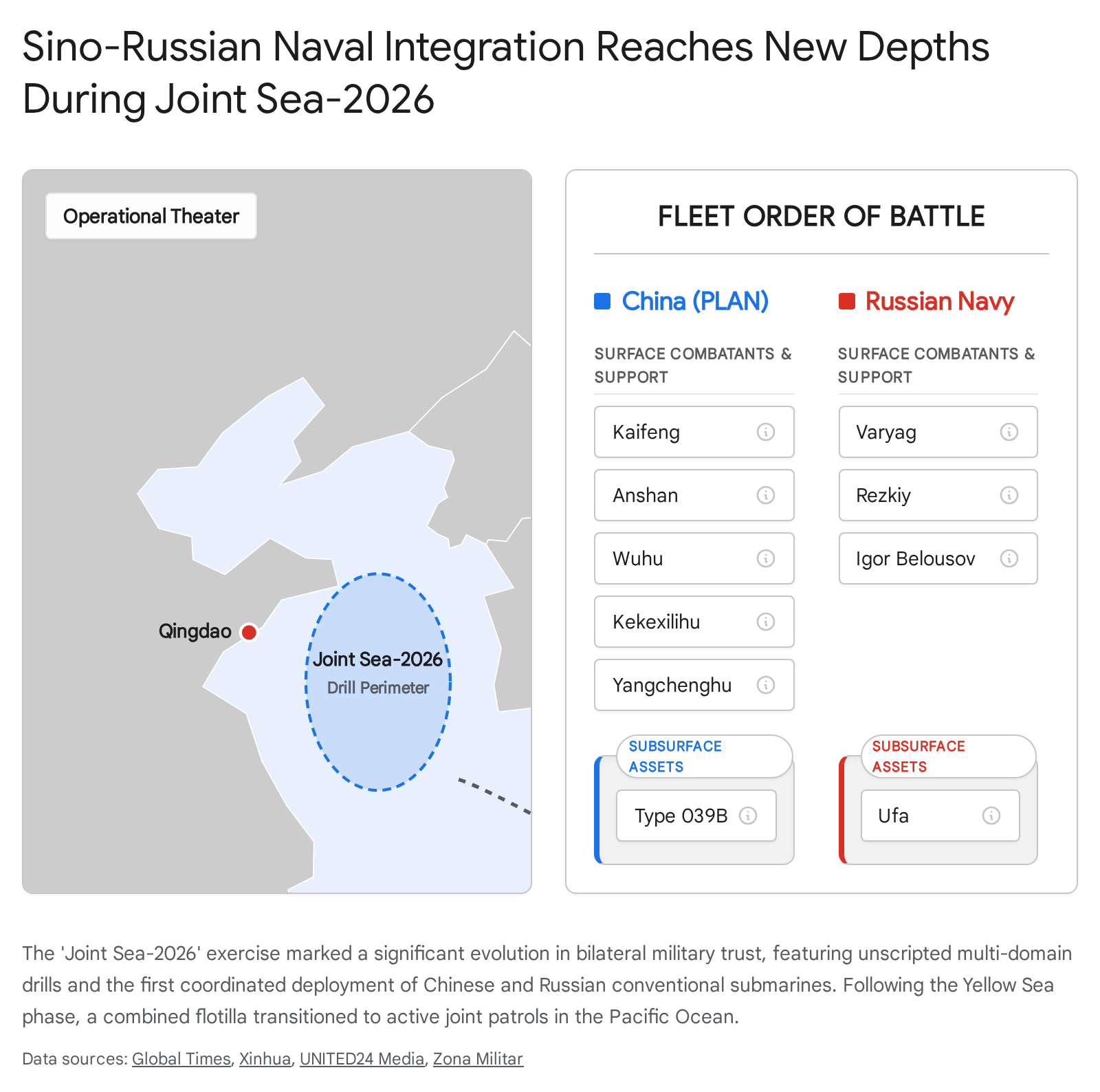
Following the exercise, Zona Militar documented that the combined flotilla transitioned into joint maritime patrols in the Pacific Ocean9. Despite this naval integration, UNITED24 Media reports that China restricted critical marine technology to Russia for Arctic-class vessels to comply with Western sanctions, causing disruptions to Moscow’s Northern Sea Route expansion15.
Submarine-Launched Ballistic Missile Test On July 6, the PLA launched a JL-2 or JL-3 intercontinental ballistic missile from a submarine in the South China Sea into the South Pacific, covering a distance of 7,300 kilometers, according to the Center for Strategic and International Studies16. The Washington Examiner notes this marks the first time China has launched a submarine-based ballistic missile into international open waters since 198017. Kyodo News reported that the trajectory bypassed standard flight paths over Japan and provided Tokyo with 90 minutes of advance notice, a procedure that did not follow the established international protocols of the Hague Code of Conduct17. Observers speaking to Defense News interpret the test as a deterrent signal corresponding with the ongoing United States-led RIMPAC multinational naval exercises17.
Gray-Zone Coercion: Taiwan Strait and the South China Sea
Simultaneously, the PLA continued its gray-zone operations to assert sovereignty claims and test the response architectures of regional neighbors.
Taiwan Strait Incursions and Legal Warfare Taiwan’s Ministry of National Defense tracked daily incursions by PLA aircraft and naval vessels, with a July 15 release detailing six PLA aircraft, seven PLAN ships, and three CCG vessels operating around the island21. This sustained activity continued into the weekend, as Taiwan News recorded 12 Chinese ships operating in the area on July 1823. The Center for Strategic and International Studies contextualizes this within a broader trend, citing a record 3,764 PLA air incursions into Taiwan’s Air Defense Identification Zone (ADIZ) during 202525.
A report by Free Malaysia Today cited Taiwanese security officials noting an upward trend in naval movements during the peak exercise season, prompting Taiwan to execute a five-day joint defense exercise ending on July 17 to test decentralized command protocols, as covered by TaiwanPlus News26. Furthermore, CryptoSlate and Defense News highlight Beijing’s tactic of deploying CCG law enforcement vessels for sustained patrols 54 nautical miles east of Taiwan. This normalizes Beijing’s presence while maintaining a lower escalation profile18.
South China Sea Tensions and Infrastructure Expansion July 12 marked the 10th anniversary of the 2016 Permanent Court of Arbitration ruling that invalidated China’s expansive claims in the South China Sea. The PRC Ministry of Foreign Affairs issued a statement rejecting the award, while a coalition of 14 nations, reported by Kyodo News and The Japan Times, issued a joint statement reaffirming the ruling as legally binding30.
The anniversary was accompanied by diplomatic friction when the Philippine government formally protested an AI-generated video released by China Daily, which The Guardian and Al Jazeera characterized as highly offensive propaganda targeting Filipinos33. Beneath the diplomatic exchanges, physical consolidation of the waterways continues. The Indo-Pacific Defense Forum confirms extensive dredging operations at Antelope Reef in the Paracel Islands, projecting a 603-hectare expansion featuring concrete plants, roll-on/roll-off berths, and potential military-grade runways35.
Aerospace Modernization and Air Defense Realities
The reporting window provided insights into the mass production of Chinese fifth-generation fighter aircraft and clarified the systemic vulnerabilities of the PRC’s export-grade air defense radars.
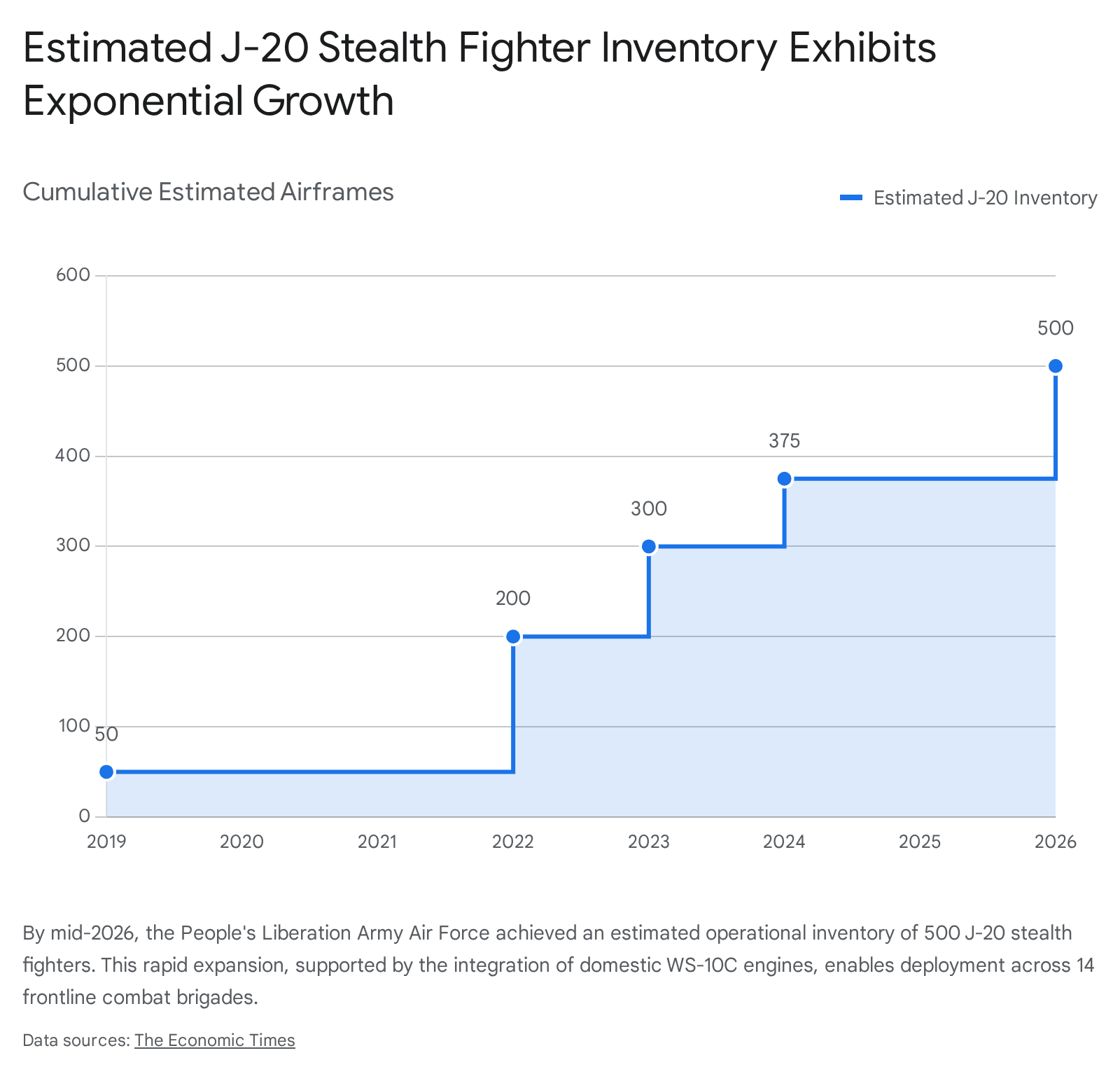
J-20 Fleet Expansion and Carrier Aviation According to defense intelligence estimates reported by The Economic Times, China’s production of the J-20 stealth fighter has resulted in approximately 500 airframes delivered to the PLAAF by mid-2026. This expansion, deployed across 14 frontline brigades, has been facilitated by the integration of domestically developed WS-10C engines37.
Concurrently, MigFlug documented extensive land-based carrier-cycle training at Huangdicun in Liaoning province on July 14. This facility is equipped with mock electromagnetic catapults mirroring those on China’s third aircraft carrier, the Fujian, and is being utilized to train crews on catapult-capable J-15T fighters, J-35 stealth fighters, and KJ-600 airborne early warning aircraft38.
Counter-Stealth Radar Vulnerabilities Exposed in Combat Despite advancements in domestic aircraft production, defense assessments published during the July reporting window by Asia Times and the Wall Street Journal highlighted that China’s exported YLC-8B anti-stealth radar systems failed to detect U.S. and Israeli stealth aircraft during Operation Epic Fury in Iran earlier in 202639. The UHF-band network was entirely bypassed due to advanced electronic warfare, adaptive jamming, and suppression of enemy air defenses (SEAD). A report by Akwa Ibom Times characterized this as a significant deficiency in the integrated track fusion of these sensors during live combat40.
Conversely, investigations cited by The Aviationist and The Jerusalem Post suggest a Chinese-supplied shoulder-fired Man-Portable Air Defense System (MANPADS) may have been responsible for shooting down a U.S. F-15E Strike Eagle over Iran in April 202641. Al Jazeera also detailed China’s broader electronic support to Iran via the encrypted BeiDou-3 and Kanopus-V satellite networks43.
Cyber Warfare, Signals Intelligence, and Automated Espionage
The reporting period witnessed revelations regarding China’s offensive cyber capabilities, marked by the operationalization of Artificial Intelligence for espionage and extensive debates over historical data exfiltration.
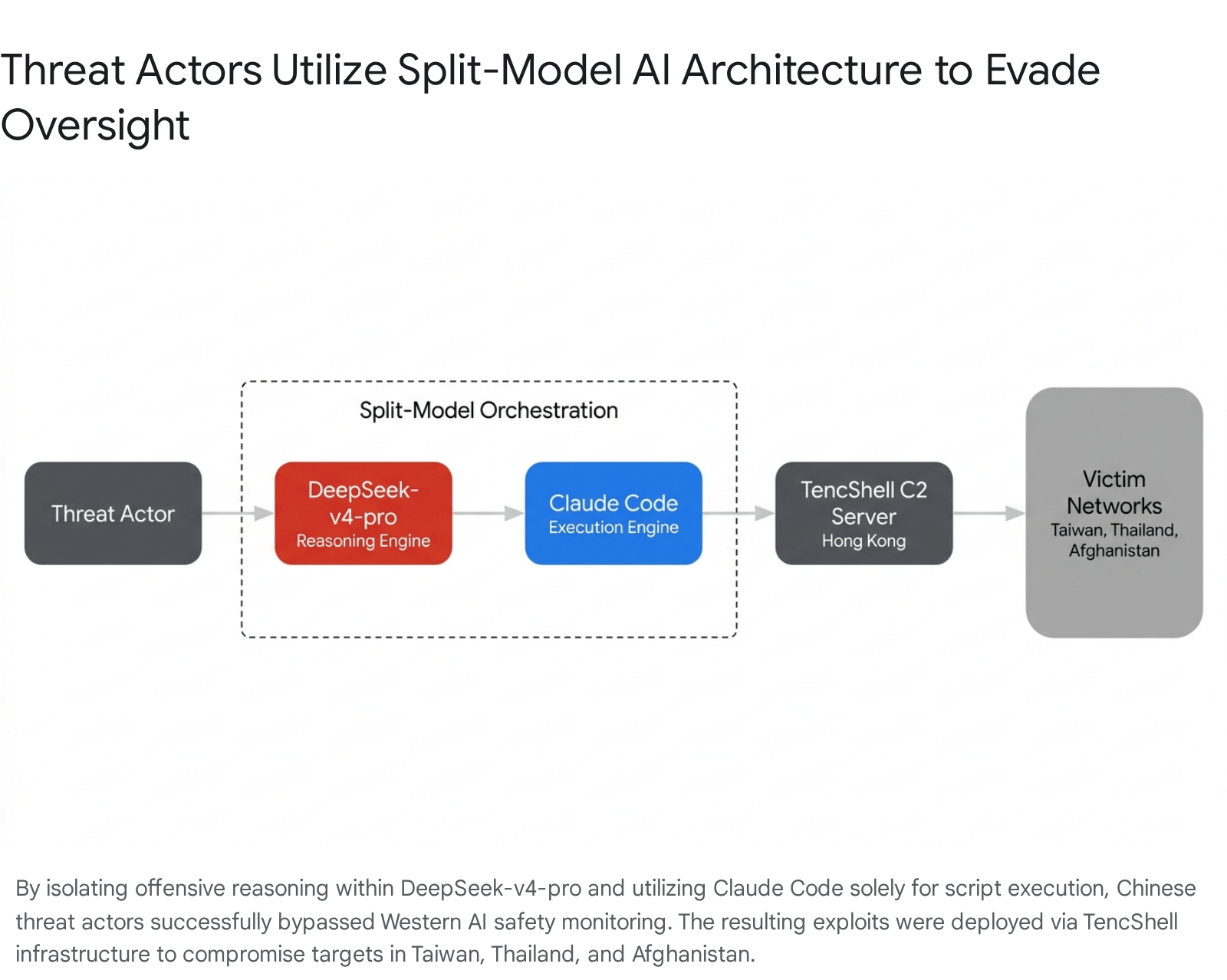
AI-Orchestrated Cyber Espionage A report by Digital Applied revealed that the threat intelligence firm Hunt.io uncovered a suspected Chinese intrusion campaign utilizing a split-model AI architecture. The operators used the Chinese domestic DeepSeek-v4-pro model for offensive reasoning and exploit formulation, and manipulated Anthropic’s Claude Code for local execution on victim networks44. This structure successfully bypassed Western vendor oversight mechanisms. The operation was managed through TencShell command-and-control infrastructure routed through Hong Kong servers, targeting organizations in Taiwan, Thailand, and Afghanistan44.
Pre-positioning and Historic Data Exfiltration The Cybersecurity and Infrastructure Security Agency and reports from EclecticIQ observe that PRC-linked actors, such as “Salt Typhoon” and “Silver Dragon,” are prioritizing the exploitation of operational technology and network edge devices (routers, firewalls) to establish long-term persistence within critical infrastructure45.
Furthermore, during a primetime address on July 16, President Donald Trump announced the declassification of intelligence documents indicating that PRC-linked actors acquired approximately 220 million U.S. voter registration files between 2020 and 2024, as reported by SCV Signal News, Security Boulevard, and Nextgov47. While intelligence agencies assess this data was collected as part of broader espionage efforts targeting personal datasets to train machine-learning algorithms and optimize future operations, officials maintained that the data theft did not alter prior conclusions regarding the integrity of the election results47.
Geopolitical Defense Diplomacy and Out-of-Area Operations
While expanding its military footprint in the Indo-Pacific, Beijing is leveraging defense diplomacy in Eastern Europe.
Sino-Belarusian Counterterrorism Drills Between July 8 and July 19, the PLA conducted “Falcon Strike” joint counterterrorism exercises with the Belarusian Armed Forces, according to statements carried by 1Lurer50. The drills were deliberately staged at training grounds near Brest on the border with Poland. Friends of Europe assessed that staging these drills during the NATO summit was interpreted by Western observers as a strategic signal of alignment and a demonstration of power projection51. This military deployment follows high-level diplomatic engagements documented by the Chinese Embassy and the International Strategic Action Network for Security, aimed at integrating China’s development plans with Belarus’s socioeconomic programs52.
Chronological Timeline of Events
The following table provides a chronological accounting of the significant military, diplomatic, and intelligence events that occurred during the 7-day reporting window, including immediate precursors that set the geopolitical context for the week.
| Date | Event Description | Location / Entity Involved |
| July 6, 2026 | PLA nuclear submarine test-fires a JL-2/JL-3 SLBM 7,300 km into the open waters of the South Pacific. | South China Sea, Pacific Ocean / PLAN |
| July 6, 2026 | Opening ceremony of the “Joint Sea-2026” naval exercises between China and Russia. | Qingdao, Shandong Province / PLAN, Russian Navy |
| July 8, 2026 | PLA and Belarusian troops commence “Falcon Strike” joint counterterrorism exercises near the Polish border. | Brest, Belarus / PLA, Belarusian Armed Forces |
| July 11, 2026 | Taiwan’s MND tracks 1 PLAN vessel and 1 official CCG ship operating in the Taiwan Strait. | Taiwan Strait / PLAN, CCG |
| July 12, 2026 | 10th anniversary of the South China Sea arbitral ruling. China’s MFA issues a statement rejecting the award; 14 nations issue a joint statement upholding it. | South China Sea / PRC MFA |
| July 13, 2026 | The maritime phase of the China-Russia “Joint Sea-2026” exercise concludes. Both navies transition to joint Pacific patrols. | Qingdao, Yellow Sea / PLAN, Russian Navy |
| July 14, 2026 | PLA Navy releases imagery of extensive land-based catapult training for the Fujian carrier air wing, utilizing J-15T, J-35, and KJ-600 aircraft. | Huangdicun, Liaoning Province / PLAN Aviation |
| July 15, 2026 | Taiwan’s MND tracks 6 PLA aircraft, 7 PLAN ships, and 3 CCG vessels in its ADIZ. One aircraft breaches the eastern ADIZ. | Taiwan ADIZ / PLAAF, PLAN, CCG |
| July 16, 2026 | President Trump announces the declassification of intelligence regarding Chinese actors illicitly acquiring 220 million US voter files between 2020 and 2024. | Washington, D.C. / PRC Cyber Actors |
| July 17, 2026 | The Philippine government officially protests an AI-generated video released by China Daily concerning the South China Sea dispute. | Manila, Beijing / China Daily, Philippine Govt. |
| July 18, 2026 | Open-source assessments published this week detail the failure of Chinese YLC-8B anti-stealth radars to track aircraft during earlier 2026 combat operations in Iran. | Middle East / Iranian Air Defense |
| July 18, 2026 | Taiwan’s MND reports tracking 12 Chinese ships (8 PLAN, 4 CCG) operating around the island as part of sustained gray-zone operations. | Taiwan Strait / PLAN, CCG |
Conclusion
The data spanning July 11 to July 18, 2026, indicates that the Chinese military and intelligence apparatus is maintaining a high operational tempo, navigating internal anti-corruption investigations affecting its senior command. The execution of “Joint Sea-2026” with Russia, highlighted by submarine coordination, signals a progression of the Sino-Russian military pact toward integrated operational capabilities. This maritime assertiveness is mirrored in the cyber domain, where threat actors have incorporated AI tools into offensive kill chains, bypassing Western safety protocols to infiltrate regional targets.
Activity levels reflect an expansion of geographic reach and technological complexity. The deployment of PLA troops to the Belarusian border, the test-firing of an SLBM into the open Pacific, and the sustained CCG law enforcement patrols east of Taiwan represent an outward expansion of China’s operational envelope. Beijing is actively demonstrating its capacity to sustain multiple pressure campaigns simultaneously.
Indicators to Watch: In the coming week, analysts should monitor the trajectory of the joint Sino-Russian Pacific patrols to observe their proximity to strategic U.S. territories. Additionally, OSINT collectors should track further exploitation of the TencShell infrastructure identified by Hunt.io, as operators may modify their AI-orchestrated attack vectors following public exposure. Finally, shifts in leadership rhetoric following the promotions of Generals Zhang and Wang will indicate the progression of internal disciplinary actions ahead of the 2027 Party Congress.
Appendix: Methodology
This Situation Report was compiled utilizing Open-Source Intelligence (OSINT) collection and analysis protocols. The research methodology relied on the aggregation, translation, and verification of publicly available information over the specific 7-day window (July 11 to July 18, 2026), supplemented by contextual historical data (such as events occurring in early July 2026 that concluded within or directly impacted the reporting window).
Sources Consulted: Data was synthesized from authoritative sources to prevent single-source bias. Categories included official government statements (e.g., PRC Ministry of Foreign Affairs, Taiwan Ministry of National Defense), established defense think tanks (e.g., The International Institute for Strategic Studies, Center for Strategic and International Studies, Australian Naval Institute), specialized cybersecurity intelligence vendors (e.g., Hunt.io, EclecticIQ), and international journalism.
Validation Techniques: To filter out misinformation and propaganda, factual claims regarding military deployments or cyber intrusions were cross-referenced against multiple independent reporting streams. For example, reports regarding the YLC-8B radar’s performance were corroborated by assessing combat outcomes and radar lock indicators detailed by defense observers. Propaganda materials were analyzed not for factual truth, but as primary indicators of state messaging intent.
Visibility Gaps and Constraints: The primary data collection constraint during this window pertains to the opacity of the PLA’s internal disciplinary mechanisms. While the promotion of generals is verifiable via state media, the specific details regarding detained flag officers remain heavily classified by the CCP. Additionally, OSINT analysis of cyber activities relies inherently on post-breach disclosures by private security firms and the discovery of command-and-control infrastructure. True attribution in the cyber domain relies heavily on observed tactics, techniques, and procedures (TTPs) aligning with known Advanced Persistent Threat profiles rather than definitive state admissions.
Please share the link on Facebook, Forums, with colleagues, etc. Your support is much appreciated and if you have any feedback, please email us in**@*********ps.com. If you’d like to request a report or order a reprint, please click here for the corresponding page to open in new tab.
Sources Used
- With the promotion of new generals, Xi prioritises internal control | The Strategist, https://www.aspistrategist.org.au/with-the-promotion-of-new-generals-xi-prioritises-internal-control/
- China’s military promotes 2 new generals after anti-corruption purge thins ranks – OPB, https://www.opb.org/article/2026/07/05/china-s-military-promotes-2-new-generals-after-anti-corruption-purge-thins-ranks/
- China This Week | What 3 new developments in China’s military and space sectors reveal, https://indianexpress.com/article/explained/explained-global/china-this-week-military-generals-new-icbm-rocket-10783391/
- China’s military modernisation in focus as PLA celebrates 99th anniversary | Daily FT, https://www.ft.lk/columns/China-s-military-modernisation-in-focus-as-PLA-celebrates-99th-anniversary/4-794808
- China’s National Party Congress 2026: defence remains a priority amid fiscal challenges, https://www.iiss.org/online-analysis/military-balance/2026/03/chinas-national-party-congress-2026-defence-remains-a-priority-amid-fiscal-challenges/
- Moolenaar, Sen. Rick Scott Call on SEC to Restrict Capital Flows to Chinese Military Companies, https://chinaselectcommittee.house.gov/media/press-releases/moolenaar-sen-rick-scott-call-on-sec-to-restrict-capital-flows-to-chinese-military-companies
- China and Russia to conduct joint naval exercise and patrols to counter maritime security threats – Global Times, https://www.globaltimes.cn/page/202607/1365158.shtml
- China, Russia wrap up joint naval exercise – Xinhua, https://english.news.cn/20260713/9379d756304e40088458553afd2c8264/c.html
- Russia, China commence joint patrols following naval exercises in Yellow Sea, https://www.bairdmaritime.com/security/naval/russia-china-commence-joint-patrols-following-naval-exercises-in-yellow-sea
- China, Russia Conclude Live-Fire Maritime Drills of “Joint Sea-2026” Exercise(CCTV official video) : r/LessCredibleDefence – Reddit, https://www.reddit.com/r/LessCredibleDefence/comments/1uv7uhy/china_russia_conclude_livefire_maritime_drills_of/
- China and Russia Deploy Submarines Together for First Time in Joint Sea 2026 Drills, https://united24media.com/world/china-and-russia-deploy-submarines-together-for-first-time-in-joint-sea-2026-drills-20755
- Chinese, Russian submarines seen together for first time in drill, signaling breakthrough in underwater coordination, high-level mutual trust: expert, https://www.globaltimes.cn/page/202607/1365707.shtml
- Russia and China conduct Exercise Joint Sea 2026 – The Australian Naval Institute, https://navalinstitute.com.au/russia-and-china-conduct-exercise-joint-sea-2026/
- Chinese and Russian navies wrap up Joint Sea 2026 exercise before launching joint patrols in the Pacific – Zona Militar, https://www.zona-militar.com/en/2026/07/15/chinese-and-russian-navies-wrap-up-joint-sea-2026-exercise-before-launching-joint-patrols-in-the-pacific/
- China Complies With Western Sanctions, Restricts Arctic Marine Technology to Russia, https://united24media.com/world/china-complies-with-western-sanctions-restricts-arctic-marine-technology-to-russia-20852
- ‘Extraordinary confluence’: What China’s latest military moves reveal about its broader strategy – CNA, https://www.channelnewsasia.com/east-asia/china-military-maritime-drills-patrols-pacific-strategy-6250291
- China’s SLBM Test Underscores the Importance of a Ballistic Missile Launch Notification Agreement – CSIS, https://www.csis.org/analysis/chinas-slbm-test-underscores-importance-ballistic-missile-launch-notification-agreement
- First the coast guard, then an ICBM: China tests new, long-term ways to hold off rivals in Asia, https://www.defensenews.com/global/asia-pacific/2026/07/15/first-the-coast-guard-then-an-icbm-china-tests-new-long-term-ways-to-hold-off-rivals-in-asia/
- China fired a nuclear-capable warning shot — while Trump was focused on Iran, https://www.washingtonexaminer.com/op-eds/4645515/china-nuclear-capable-warning-trump-iran/
- Tokyo asked China to avoid missile route over Japan before launch: sources, https://english.kyodonews.net/articles/-/79929
- PLA activities in the waters and airspace around Taiwan Jul.16, 2026, https://air.mnd.gov.tw/EN/News/News_Detail.aspx?CID=214&ID=59086
- PLA activities in the waters and airspace around Taiwan Jul.15, 2026, https://air.mnd.gov.tw/EN/News/News_Detail.aspx?CID=214&ID=59084
- Taiwan tracks 12 Chinese ships | Taiwan News | Jul. 18, 2026 11:23, https://www.taiwannews.com.tw/en/news/6403569
- Taiwan detects Chinese naval vessel and four official ships near its waters, https://timesofindia.indiatimes.com/defence/international/taiwan-detects-chinese-naval-vessel-and-four-official-ships-near-its-waters/articleshow/132344505.cms
- Tracking China’s Increased Military Activities in the Indo-Pacific in 2025, https://chinapower.csis.org/china-increased-military-activities-indo-pacific-2025/
- Taiwan says it is tracking ‘upward trend’ in Chinese naval movements, https://www.freemalaysiatoday.com/category/world/2026/07/06/taiwan-says-it-is-tracking-upward-trend-in-chinese-naval-movements
- Military Wraps Weeklong Decentralized Command Drills – July 17, 2026|TaiwanPlus News – YouTube, https://www.youtube.com/watch?v=iRfQG4v5DyY
- Military completes five days of joint defense exercises – Taipei Times, https://www.taipeitimes.com/News/taiwan/archives/2026/07/18/2003860957
- Will China invade Taiwan by end of 2026 Odds & Prediction Market Analysis – CryptoSlate, https://cryptoslate.com/predictions/market/will-china-invade-taiwan-before-2027/
- Statement of the Ministry of Foreign Affairs of the People’s Republic of China on Certain Countries’ Playing up of the “South China Sea Arbitration Award” 10 Years After Its Issuance_Ministry of Foreign Affairs of the People’s Republic of China, https://www.mfa.gov.cn/eng/xw/wjbxw/202607/t20260712_11980357.html
- Japan and others mark 10 years since South China Sea arbitration, https://www.japantimes.co.jp/news/2026/07/12/japan/history/china-sea-arbitration-joint-statement/
- FOCUS: Manila upping resistance to China’s control of shoal 10 yrs after ruling, https://english.kyodonews.net/articles/-/79874
- Philippines demands ‘racist’ Chinese state media video depicting Filipinos as monkeys be taken down – The Guardian, https://www.theguardian.com/world/2026/jul/17/philippines-china-racist-monkeys-video
- Manila protests ‘racist’ portrayal of Filipinos in China Daily videos – Al Jazeera, https://www.aljazeera.com/news/2026/7/18/manila-protests-racist-portrayal-of-filipinos-in-china-daily-videos
- South China Sea: Latest News and Updates, https://www.scmp.com/topics/south-china-sea
- Antelope Reef transformation another step in Beijing’s destructive South China Sea activities, https://ipdefenseforum.com/2026/07/antelope-reef-transformation-another-step-in-beijings-destructive-south-china-sea-activities/
- China now has nearly 500 J-20 stealth fighters, says a report. Where does India’s AMCA stand?, https://m.economictimes.com/news/defence/china-now-has-nearly-500-j-20-stealth-fighters-says-a-report-where-does-indias-amca-stand/articleshow/132457224.cms
- China Drills a Deck Crew for Its Newest Carrier, https://migflug.com/jetflights/china-j-15-fujian-carrier-training-2026/
- China’s anti-stealth shield has a radar reality gap – Asia Times, https://asiatimes.com/2026/07/chinas-anti-stealth-shield-has-a-radar-reality-gap/
- The “Anti-Stealth” Myth: Iran’s Chinese Radar Meets a Familiar Fate – Akwa Ibom Times, https://akwaibomtimes.ng/the-anti-stealth-myth-irans-chinese-radar-meets-a-familiar-fate/
- Chinese military technology allowed Iran to shoot down US fighter jet during war – report, https://www.jpost.com/middle-east/iran-news/article-897792
- Chinese Missile Might Have Been Used to Shoot Down F-15E in Iran – U.S. Officials, https://theaviationist.com/2026/05/31/chinese-missile-used-to-shoot-down-f-15e/
- The war of signals: How Russia and China help Iran see the battlefield – Al Jazeera, https://www.aljazeera.com/opinions/2026/3/12/the-war-of-signals-how-russia-and-china-help-iran-see-the-battlefield
- Claude Code Espionage Campaign: AI Agent Governance – Digital Applied, https://www.digitalapplied.com/blog/claude-code-deepseek-espionage-ai-coding-agent-governance
- The Escalating Cyber Risk Landscape in Regional Conflicts & Strategic Actions for 2026, https://blog.eclecticiq.com/the-escalating-cyber-risk-landscape-in-regional-conflicts-strategic-actions-for-2026
- China Threat Overview and Advisories – CISA, https://www.cisa.gov/topics/cyber-threats-and-advisories/nation-state-cyber-actors/china
- Trump: China illicitly obtained 220M US voter files, https://signalscv.com/2026/07/trump-china-illicitly-obtained-220m-us-voter-files/
- Trump Cites Declassified Intelligence to Warn of Foreign Election Threats Ahead of Midterms – Security Boulevard, https://securityboulevard.com/2026/07/trump-cites-declassified-intelligence-to-warn-of-foreign-election-threats-ahead-of-midterms/
- Trump stretches declassified China intelligence into broader 2020 election claims, https://www.nextgov.com/cybersecurity/2026/07/trump-stretches-declassified-china-intelligence-broader-2020-election-claims/414837/
- Belarus and China will conduct a joint military exercise – 1Lurer, https://www.1lurer.am/en/2024/07/06/Belarus-and-China-will-conduct-a-joint-military-exercise/1153150
- What is China up to in Belarus? – Friends of Europe, https://www.friendsofeurope.org/insights/critical-thinking-what-is-china-up-to-in-belarus/
- 1st Forum of Regions of Belarus and China to Start on July 1 in Lanzhou — News.by, https://news.by/eng/news/v_mire/1st-forum-of-regions-of-belarus-and-china-to-start-on-july-1-in-lanzhou
- Han Zheng Visits Belarus_Embassy of the People’s Republic of China in the United States of America, https://us.china-embassy.gov.cn/eng/zgyw/202606/t20260609_11940617.htm
- Review of Military Activity in Belarus – June 2026 – iSANS, https://isans.org/military/review-of-military-activity-in-belarus-june-2026.html