
1. Executive Summary
During the trailing seven-day reporting period of April 24 to May 1, 2026, the global operational environment experienced a profound and irreversible structural shift in the integration, deployment, and institutionalization of unmanned systems across the air, land, sea, and space domains. Open-source intelligence from this period indicates a definitive transition away from the conceptual testing and localized deployment of autonomous systems. In its place, military planners and defense industrial bases are executing the massed, algorithmic application of these platforms in active combat theaters, fundamentally altering traditional military organizational structures.
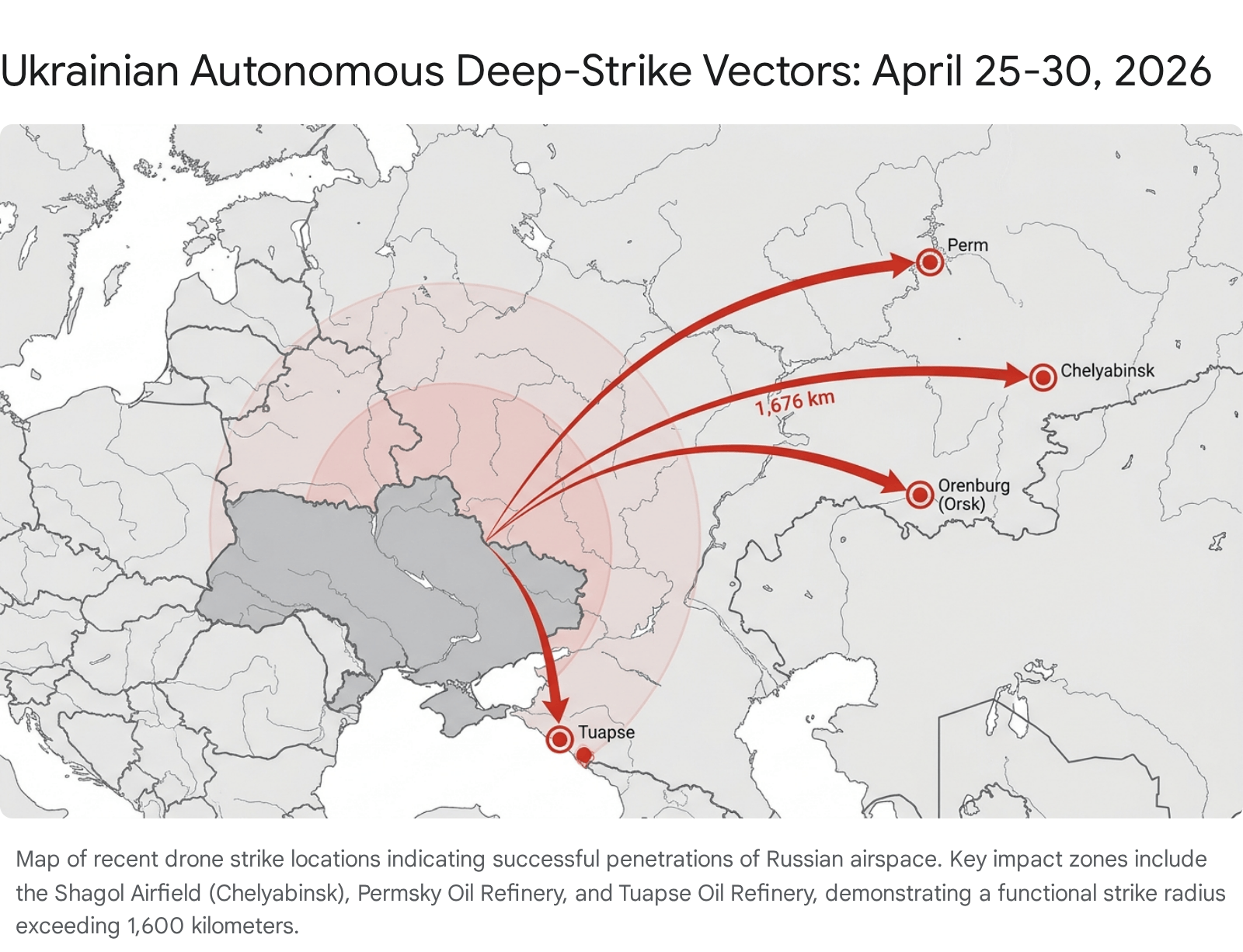
Four primary strategic vectors emerged during this reporting cycle, each carrying significant implications for future force posturing and defense procurement. First, the validation of deep-strike asymmetry utilizing highly attritable platforms was starkly demonstrated by successful Ukrainian long-range strikes against advanced Russian aerospace assets and critical downstream energy infrastructure. Striking targets at distances exceeding 1,600 kilometers from the forward line of troops, these operations continue to thoroughly negate the traditional strategic depth historically relied upon by major military powers.1 The geometric expansion of the battlespace necessitates a total reevaluation of rear-echelon air defense and critical infrastructure protection.
Second, the institutionalization of autonomous warfare within the United States military reached a critical, irreversible milestone. Leadership announcements regarding the establishment of a sub-unified command dedicated exclusively to autonomous warfare, supported by a historic $54.6 billion research, development, test, and evaluation (RDT&E) budget request for the Defense Autonomous Warfare Group (DAWG), signify the elevation of unmanned systems from a supplementary toolset to a primary warfighting domain.27 This systemic reorganization is mirrored at the combatant command level with the formal activation of the U.S. Southern Command (SOUTHCOM) Autonomous Warfare Command (SAWC) on April 21, tasked with linking tactical unmanned missions to theater-wide strategic deterrence.35
Third, international defense consortiums and state regulatory bodies are actively codifying the operational perimeters and supply-chain realities of these systems. The North Atlantic Treaty Organization (NATO) executed complex, multi-layered counter-unmanned aerial system (C-UAS) exercises in Romania to establish definitive interoperability standards against drone swarms.3 Concurrently, the Civil Aviation Administration of China (CAAC) implemented stringent, firmware-level hardware compliance mandates to exert total centralized control over its domestic low-altitude airspace.4
Fourth, the expansion of autonomous warfare into the space domain rapidly accelerated, highlighted by major capital injections into sovereign autonomous spacecraft development and deep-space navigation systems designed to operate entirely independently of vulnerable ground-control links. Collectively, these events underscore a global defense industrial base that is rapidly adapting to a battlefield where software-defined resilience, distributed lethality, and the economics of attritable mass dictate tactical outcomes and long-term strategic viability.
2. Global Situation Log
The following situation log details kinetic engagements, military exercises, and operational events involving uncrewed and autonomous systems. The intelligence is sorted strictly chronologically by the date of the event, and subsequently alphabetically by the primary country involved in the operation.
April 24, 2026
Lithuania
The United States Army officially commenced Project Flytrap in Pabradė, Lithuania, initiating a highly complex C-UAS and autonomous vehicle integration exercise scheduled to run from April 27 to May 31, with initial deployments and site testing beginning on April 24.6 Elements of the 2nd Squadron, 2nd Cavalry Regiment were tasked with evaluating the operational mobility, acoustic stealth, and payload performance of the UNEX Unmanned Ground Vehicle (UGV), developed by ABRIS Design Group.6
The UNEX system was deployed specifically for casualty evacuation (CASEVAC) scenarios across contested, heavily forested, and sandy terrain.6 The exercise tested the viability of robotic medical extraction in drone-saturated environments. In modern combat theaters characterized by persistent first-person view (FPV) drone surveillance, human medical personnel and traditional unarmored transport vehicles face continuous observation and targeting risks, resulting in unsustainable casualty rates during extraction operations. Project Flytrap served as a broader integration hub, incorporating the assessment of more than 50 industry-supplied systems spanning early-warning radars, launched kinetic effects, radio-frequency (RF) defeat technologies, and specialized unmanned ground platforms designed to accelerate decision-making under sustained electronic warfare pressure.6
Romania
NATO Allied Command Transformation (ACT), operating in strict coordination with the Romanian Ministry of National Defence, initiated the Layered Counter-Uncrewed Aerial System Initiative (LCI-X) Crucible 1-26 at the Capu Midia Training Range.3 The experimentation event represented one of the largest C-UAS stress tests conducted on the alliance’s eastern flank, involving approximately 500 personnel and roughly 215 to 250 distinct technical systems.3
The primary objective was to accelerate Integrated Air and Missile Defence (IAMD) integration against coordinated drone swarms operating over the Black Sea, simulating tactics utilized extensively by Russian forces. The exercise mandated the fusion of disparate detection layers, networking acoustic, radio-frequency, and electro-optical/infrared (EO/IR) detectors with both kinetic and non-kinetic effectors.3 A critical operational validation occurred during the deployment of the Sky Dome system—a joint venture between Romanian firm Optoelectronica and Israeli firm SkyLock Systems. Utilizing directed-energy lasers guided by multi-modal radar, the Sky Dome reported a 100 percent intercept rate against incoming UAS targets during the exercise 8, proving the efficacy of light-speed, infinite-magazine effectors against attritable swarm threats.
Ukraine
Russian aerospace and missile forces executed a massive, highly coordinated combined drone and missile strike against Ukrainian infrastructure overnight on April 24 into April 25. The operational package consisted of an estimated 666 uncrewed aerial systems and ballistic missiles, heavily utilizing Iranian-designed Shahed-136 loitering munition variants alongside newer domestic platforms.36
The primary targeting vector was directed at Dnipro City and the broader Dnipropetrovsk Oblast, where the sheer volume of incoming munitions successfully saturated and penetrated regional defensive umbrellas, resulting in the deaths of at least six civilians and injuring 47 others, alongside severe damage to industrial infrastructure.36 This assault is part of a broader attritional campaign; official Ukrainian data indicates that Russia launched approximately 1,900 strike drones over the preceding week, and a record 6,583 long-range attack drones throughout April 2026, forcing Ukrainian air defenses to maintain a 88-to-90 percent interception rate simply to prevent total grid collapse.37
United States
U.S. Naval Forces Southern Command and the U.S. 4th Fleet initiated the annual Fleet Experimentation (FLEX) 2026 event operating out of Key West, Florida.9 Running through April 30, the multi-domain exercise focused intensely on operationalizing advanced robotic and autonomous surface systems to combat transnational organized crime, cartel logistics, and narcoterrorism across the expansive Caribbean maritime domain.
A primary feature of FLEX 2026 was the operational deployment of the TSUNAMI Unmanned Surface Vessel (USV) family. The exercise successfully demonstrated a sophisticated, AI-driven kill chain designed to autonomously find, track, and engage captured drug-running vessels across vast maritime spaces.11 By bridging commercial maritime ingenuity with military C2 requirements, the 4th Fleet demonstrated how uncrewed surface platforms can persistently patrol zones where manned deployments are financially and logistically prohibitive, while integrating surface-to-air kinetic engagement (STAKE) systems to defeat counter-drone threats launched by cartel elements.14
April 25, 2026
Russia
The Ukrainian Unmanned Systems Forces (USF) executed a highly complex, historic deep-strike operation against the Shagol Airfield in the Chelyabinsk region.1 Located an extraordinary 1,676 kilometers from the Ukrainian international border, the military base houses elite strategic and tactical aviation assets belonging to the Russian Aerospace Forces.
Satellite battle damage assessments, later confirmed by USF Commander Robert “Madyar” Brovdi, verified that the autonomous drone strike successfully penetrated deeply layered Russian air defenses to impact four high-value aircraft.2 Specifically, the strikes damaged two advanced Su-57 fifth-generation stealth fighter jets, one Su-34 multi-role fighter-bomber, and a fourth unidentified aircraft.2 The operation demonstrated Ukraine’s rapidly maturing capacity to utilize long-range, attritable platforms to bypass forward early warning networks and hold critical Russian aerospace assets at risk deep within the Russian interior, forcing the Kremlin to relocate surviving airframes into enclosed hangars further east.2
April 28, 2026
Ukraine
A localized, penetrating drone strike impacted residential infrastructure in the Lukianivska Square neighborhood, recognized as one of Kyiv’s most heavily targeted urban districts.17 While the specific origin vector and payload characteristics of the drone were not detailed in broad operational summaries, the event underscores the continuous vulnerability of densely populated urban centers to intermittent drone penetration. Despite boasting some of the highest concentrations of air defense systems globally, Kyiv continues to suffer from the psychological and infrastructural attrition generated by individual loitering munitions slipping through the net, resulting in severe anxiety disorders among the civilian populace and compounding the economic strain on municipal services.17
April 29, 2026
Russia
Continuing its systematic and highly effective campaign against Russian energy infrastructure and economic lifelines, Ukrainian forces utilized long-range autonomous drones to strike the Orsknefteorgsintez Oil Refinery in Orsk, Orenburg Oblast.1 The strike successfully bypassed regional air defense grids, impacting the facility and igniting a substantial fire.1 This strike contributes directly to the targeted degradation of Russian downstream oil processing capabilities, intended to starve the Russian military of refined fuel while simultaneously damaging the state’s primary export revenue generation mechanism.
United States
During sworn testimony before the House Armed Services Committee (HASC) regarding the Department of Defense’s Fiscal Year 2027 budget request, Secretary of Defense Pete Hegseth announced the imminent establishment of a sub-unified command dedicated exclusively to autonomous warfare.27 This organizational restructuring aims to permanently centralize the procurement, doctrinal development, and deployment of unmanned systems across the joint force.18
Hegseth’s testimony contextualized this monumental shift as a direct, urgent response to battlefield lessons learned from the grinding war in Ukraine and recent Middle Eastern operations (Operation Epic Fury), explicitly noting the strategic necessity for the United States to dominate the production of both “exquisite” high-end drones and massive “attritable swarms”.27 The structural elevation of autonomous warfare was backed by a budget request featuring $54.6 billion allotted specifically for the Defense Autonomous Warfare Group (DAWG) in research, development, test, and evaluation (RDT&E) funding.27
April 30, 2026
Lebanon
Tensions along the highly volatile Israel-Lebanon border escalated sharply as an autonomous Hezbollah drone breached Israeli airspace and successfully struck an Israel Defense Forces (IDF) artillery position near the northern border community of Shomera.38 The kinetic engagement resulted in 12 IDF soldiers sustaining wounds.38 Concurrently, an Arab-Israeli civilian contractor was killed near Bint Jbeil when a Hezbollah drone accurately struck the heavy engineering equipment he was operating to dismantle regional tunnel networks.38 These incidents highlight the persistent, lethal threat of low-flying, radar-evading tactical drones operated by non-state actors in heavily contested, topographically complex border regions.
Russia
Overnight, transitioning into May 1, Ukrainian drone formations executed massive, coordinated strikes against two critical Russian oil processing facilities: the Tuapse Oil Refinery in Krasnodar Krai and the Permsky Oil Refinery in Perm Krai.1 This engagement marked the fourth successful strike on the Tuapse facility since April 1 alone. Ukrainian battle damage assessments indicated profound destruction, completely destroying at least 24 oil tanks, damaging four more, and forcing the total suspension of plant operations as localized fires burned for days.1
The simultaneous strike on the Permsky facility, located deep within the Russian interior, successfully damaged the critical AVT-4 primary oil refining unit.1 Driven by these persistent, highly accurate drone strikes, intelligence from analytics firm OilX indicated that the average daily processing output of Russian refineries dropped to 4.69 million barrels a day by the end of the reporting period, marking the lowest processing average the Russian Federation has experienced since December 2009.1
May 1, 2026
China
The Civil Aviation Administration of China (CAAC) officially activated and began enforcing two mandatory national standards: GB 46750-2025 and GB 46761-2025.4 These sweeping regulations fundamentally alter the operational and manufacturing landscape for domestic civil unmanned aircraft in China. The standards mandate deeply integrated hardware and software controls, requiring all newly produced drones to incorporate firmware that strictly limits flight altitudes to 120 meters Above Ground Level (AGL) and enforces a mandatory real-name registration system tied directly to state identity databases via WeChat.19
Drones operating without compliance risk automatic flight restriction, grounding, or state confiscation. The CAAC also mandated retrofitting obligations for legacy fleets.4 These standards indicate Beijing’s intent to exert absolute, real-time tracking and control over its low-altitude economy, effectively transforming every civilian drone into a highly regulated, state-monitored node.
Russia
Demonstrating an understanding of drone logistics, Ukrainian forces conducted a tactical mid-range strike targeting a dedicated Russian drone storage and logistics hub near Dalny in the Belgorod Oblast, situated near the international border northeast of Kupyansk.22 The destruction of the drone warehouse was executed proactively to disrupt the immediate supply chain of Russian Molniya loitering munitions and reconnaissance platforms operating in the Kupyansk and Velykyi Burluk directions, showcasing an effort to kill the “archer” (the drone logistics) before the “arrows” (the FPV drones) can be launched.22
[Image: High-resolution timeline graphic detailing the rapid succession of kinetic drone engagements and strategic policy announcements across April 24 to May 1, 2026]
3. Product Developments
The reporting period featured significant technological milestones characterized by the rapid transition of autonomous prototypes into mass-produced combat platforms. Capital allocation across the global defense industrial base has demonstrably shifted away from basic platform kinematics—such as raw speed and maximum range—toward software resilience, autonomous perception at the tactical edge, and the harsh economics of attritable mass.
April 24, 2026
Israel / Romania: ParaZero DefendAir System
On April 24, ParaZero Technologies officially partnered with New Akord Security to deploy its DefendAir counter-UAS system for the Romanian Ministry of Defense.39 DefendAir utilizes advanced personal net launchers and net pods to execute non-kinetic, physical capture of incoming drone threats.39 This procurement provides a vital, low-collateral-damage effector layer for NATO’s eastern flank, specifically optimized to neutralize fast-moving FPV drones without the risks associated with explosive or high-energy interceptors in populated or sensitive areas.39
Lithuania (US Testing): UNEX Unmanned Ground Vehicle (UGV)
Demonstrated extensively under arduous conditions during Project Flytrap in Lithuania, the UNEX UGV developed by ABRIS Design Group showcased critical advancements in autonomous ground mobility and vital logistical sustainment.6 Engineered with a highly modular open architecture, the system is rapidly configurable for varied mission profiles, notably casualty evacuation and forward ammunition resupply.6
A defining feature of the UNEX is its fully electric drivetrain, which significantly reduces both acoustic and thermal signatures—a critical survivability trait. On modern battlefields, enemy FPV drones are routinely equipped with thermal optics, making traditional internal combustion engine (ICE) transport vehicles highly visible and easily targeted at night.6 With amphibious capabilities, a high-clearance chassis capable of overcoming one-meter vertical obstacles, and a massive payload capacity of 1,700 kg, the UNEX platform serves as a vital, low-signature sustainment link across the lethal “last tactical mile”.6
April 28, 2026
United States: Autonomous Spacecraft Capabilities
Addressing the critical need for space domain autonomy, major milestones were reached in late April to secure U.S. deep space infrastructure. Northrop Grumman advanced its LR-450 deep space navigation system, engineered to enable autonomous spacecraft positioning and navigation without relying on vulnerable, continuous ground-control updates in contested cislunar environments.40 Concurrently, True Anomaly secured a massive $650 million Series D funding round to aggressively accelerate the development of its sovereign autonomous spacecraft and space security networks. These parallel developments highlight the rapid militarization of orbital infrastructure and the necessity for spacecraft to operate independently under heavy electronic warfare pressure.
April 30, 2026
United States: TSUNAMI Unmanned Surface Vessels (USVs)
Textron Systems, leveraging a strategic partnership with recreational boat builder Brunswick Corporation, achieved major operational milestones with its TSUNAMI family of USVs, culminating in a Defense Innovation Unit (DIU) contract award on April 30.23 Tested rigorously during the U.S. 4th Fleet’s FLEX 2026 exercises, the TSUNAMI platform is engineered for scalable, multi-mission maritime dominance, focusing heavily on counter-narcotics, intelligence, surveillance, and reconnaissance (ISR), and cooperative surface warfare.15
Built rigidly upon a modular open systems architecture, the TSUNAMI vessels can seamlessly integrate varied payloads, including advanced electro-optical/infrared (EO/IR) cameras, maritime surface search radars, and beyond-line-of-sight (BLOS) satellite communications.24 Designed to endure punishing Sea State 4 conditions, the platforms leverage common outboard or inboard propulsion configurations—ranging from 300HP to 400HP gasoline engines—to drastically simplify global logistics and maintenance pipelines.15 The DIU contract mandates the immediate delivery of these vessels to SOUTHCOM to provide persistent, uncrewed patrol capabilities across vast maritime expanses where crewed vessel deployment is cost-prohibitive or tactically dangerous.23
May 1, 2026
United States: Low-Cost Uncrewed Combat Attack System (LUCAS)
Extensive operational details regarding the deployment of the Low-Cost Uncrewed Combat Attack System (LUCAS) emerged as U.S. Central Command (CENTCOM) fully operationalized the platform within Task Force Scorpion Strike in the Middle East.41 Methodically reverse-engineered and aggressively iterated upon from captured Iranian Shahed-136 variants retrieved from Ukraine, LUCAS is a one-way attack kamikaze drone optimized entirely for attritable mass production.41
The platform features a 10-foot length, an 8-foot wingspan, and is powered by a reliable 215 cc carbureted internal-combustion engine, providing an operational strike range of approximately 500 miles (800 km).26 Crucially, manufacturing innovations have compressed the unit cost to roughly $35,000 per drone.26 While kinematically similar to its Iranian predecessor, the Pentagon has integrated highly sophisticated, Western-grade networking capabilities into LUCAS. The system utilizes advanced satellite datalinks—reportedly leveraging the SpaceX Starshield military architecture—allowing for autonomous target hunting, complex mesh-network swarming, and real-time terminal retargeting in heavily GPS-denied environments.41
Romania: Sky Dome Counter-UAS System
During the NATO LCI-X Crucible exercises, the Sky Dome system—developed collaboratively by Romanian defense firm Optoelectronica and Israeli company SkyLock Systems—demonstrated exceptional operational maturity.8 The system represents a leap in layered defense architecture, incorporating a powerful directed-energy laser component tightly synchronized with 3D radar, electro-optical/infrared targeting optics, and acoustic detection layers.8 During live-fire simulated drone swarm scenarios at Capu Midia, Optoelectronica reported a flawless 100 percent intercept rate against all assigned UAS targets, proving the maturity of laser-based effectors against agile, low-altitude aerial threats.8
Technical Specifications Comparison: Tactical Unmanned Vehicles
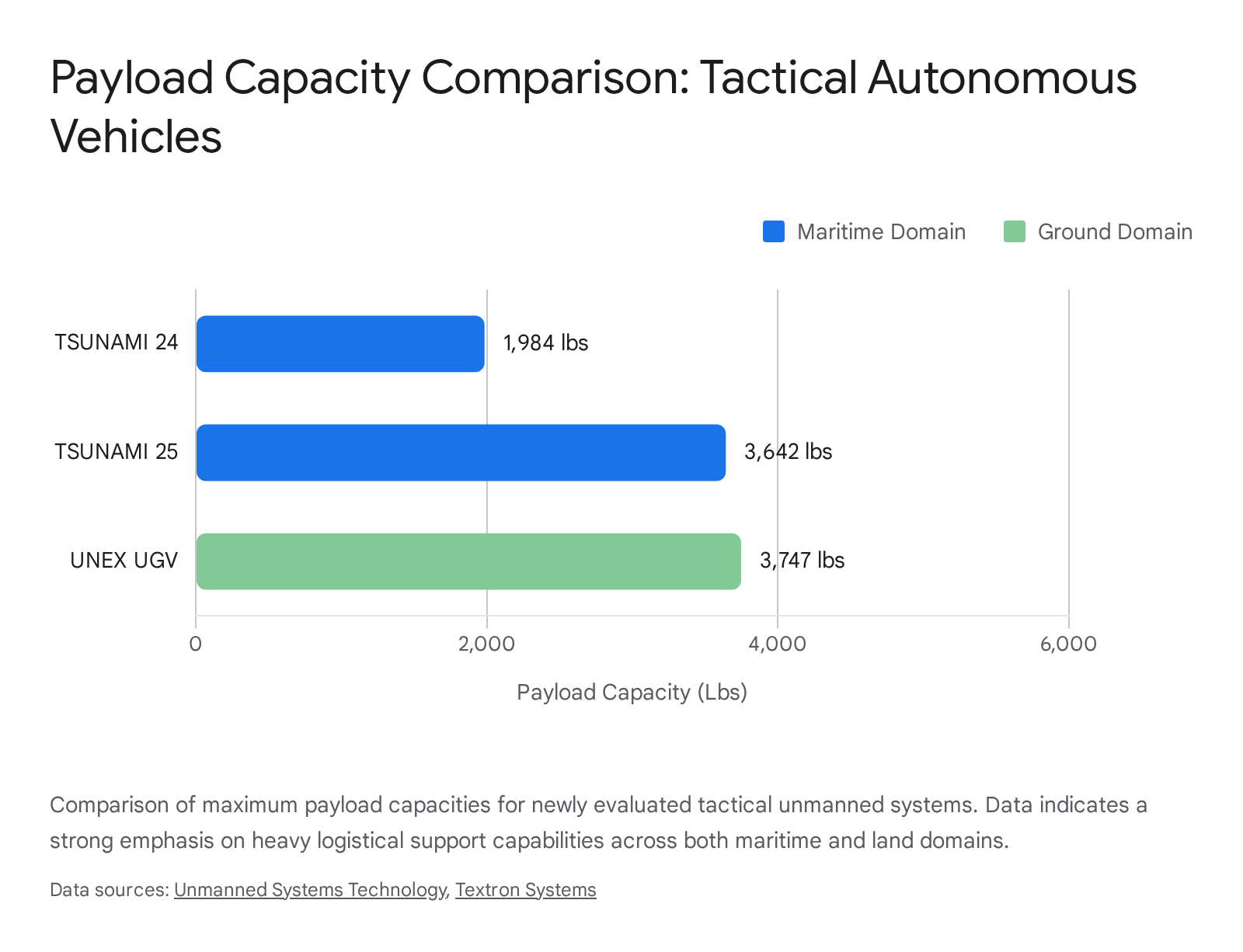
To provide a structured analytical overview of the payload and mobility characteristics defining these newly revealed autonomous platforms, the following table aggregates operational specifications based on manufacturer disclosures and recent military testing data.6
| Platform Name | Domain | Primary Manufacturer | Payload Capacity | Top Speed / Mobility | Propulsion Type | Unit Cost (Est.) |
| TSUNAMI 24 | Maritime (USV) | Textron / Brunswick | 1,984 lbs (900 kg) | 43 knots | 1x 300HP Gasoline | Classified |
| TSUNAMI 25 | Maritime (USV) | Textron / Brunswick | 3,642 lbs (1,652 kg) | 41 knots | 1x 400HP Gasoline | Classified |
| UNEX UGV | Ground (UGV) | ABRIS Design Group | 3,747 lbs (1,700 kg) | Amphibious / 1m Obstacle | Fully Electric | Classified |
| LUCAS | Air (UAV) | U.S. DoD / SpektreWorks | Kamikaze Warhead | 500 miles (Range) | 215cc Internal Combustion | ~$35,000 |
4. Strategic Lessons Learned
The aggregation of kinetic events, massive procurement requests, and rapid technological reveals during the April 24 to May 1 reporting period yields several distinct, paradigm-shifting strategic lessons. These deductions are actively forcing the rewriting of military doctrine and physically altering the geographic posturing of global defense forces.
The Institutionalization of Autonomous Warfare (United States)
Historically, the procurement and tactical deployment of military drones were fragmented across disparate service branches. Drones were often treated as secondary aviation assets, localized intelligence tools, or niche special operations equipment. The announcements regarding the U.S. Department of Defense’s Fiscal Year 2027 budget and the radical restructuring of combatant commands indicate a profound, permanent doctrinal shift.27
The Pentagon’s request for $54.6 billion to fund the Defense Autonomous Warfare Group (DAWG) in RDT&E—part of a broader $74 billion aggregated drone budget—parallels the historical evolution and formalization of cyber warfare and special operations.27 By moving to establish a sub-unified command under the Secretary of Defense, and with the Senate Armed Services Committee (SASC) concurrently pushing for a full Robotic and Autonomous Systems Combatant Command led by a four-star general, military leadership is explicitly acknowledging that autonomy is no longer merely a feature of a platform.27 It has matured into a distinct warfighting domain requiring its own doctrine, unique acquisition authorities, and dedicated operational architecture. This centralization is specifically designed to solve historical interoperability bottlenecks and ensure the U.S. military can field and coordinate swarms of low-cost, attritable systems seamlessly across the entire joint force. The concurrent establishment of SOUTHCOM’s SAWC on April 21 further demonstrates the immediate operationalization of this concept, pushing autonomous integration directly down to the geographic combatant command level for immediate deployment.35
Deep Strike Asymmetry and the Inversion of Cost-Exchange Ratios (Russia/Ukraine)
The Ukrainian strikes on the Shagol Airfield and the Tuapse and Perm oil refineries definitively prove that long-range, attritable drones have permanently collapsed traditional concepts of strategic depth.1 Russia’s strategic aviation fleets and downstream energy infrastructure, located upwards of 1,600 kilometers from the forward line of troops, are now subject to persistent, high-volume targeting.1
The profound strategic lesson here is the severe inversion of the cost-exchange ratio in modern conflict. The United States’ deployment of the LUCAS drone in the Middle East—costing a mere $35,000 per unit—mirrors the tactical math utilized by Ukraine and Iran.26 When an adversary can launch dozens of sub-$50,000 kinetic effectors that boast a 500-to-1,000-mile operational range, defending against them with traditional air defense interceptors—often costing millions of dollars per missile—becomes economically and logistically unsustainable.26 Future base defense, infrastructure protection, and global force projection strategies must actively account for an environment where sanctuary no longer exists, and offensive mass can be generated cheaply, covertly, and continuously.
The Imperative of Layered Counter-UAS (C-UAS) Architecture (NATO/Global)
The NATO LCI-X Crucible exercises in Romania clearly highlighted that no single “silver bullet” platform exists to reliably defeat autonomous drone swarms.3 Reliance on singular kinetic systems ensures eventual base failure through either magazine depletion or sensor saturation. The critical strategic deduction from NATO’s experimentation is that effective defense requires a deeply networked, multi-layered architecture.3
This layered approach mandates the tight integration of disparate detection methodologies—fusing acoustic sensors, electro-optical tracking, and radio-frequency (RF) detectors to identify incoming drones operating in heavily GPS-denied or highly contested electronic warfare (EW) environments.3 Furthermore, the effector layer must blend traditional kinetic interceptors with non-kinetic solutions. The highly successful demonstration of directed-energy systems (such as the Sky Dome laser) in Romania 8, alongside the rapid procurement of physical net-capture systems like ParaZero’s DefendAir 39, indicates that a blend of high-power energy and low-collateral kinetic capture systems is replacing legacy interceptors. These non-kinetic and rapid-reload effectors provide the elusive “infinite magazine” required to counter cheap autonomous swarms economically and continuously.
The Expansion of Autonomy into Deep Space (United States)
The revelation of advanced deep space navigation systems like the LR-450 and the massive $650 million capital injection into True Anomaly underscore the expansion of autonomous warfare into the space domain. As orbital and cislunar environments become increasingly congested and contested by adversary anti-satellite (ASAT) capabilities, traditional human-in-the-loop ground control becomes highly vulnerable to communication delays and severing.40 The strategic deduction is that future military spacecraft must possess the onboard edge-computing and navigational autonomy required to independently detect threats, maneuver, and sustain operations when isolated from Earth-based command architectures.
Logistics and the “Last Tactical Mile” Crisis (Global)
The modern battlefield, as observed daily in Ukraine and heavily modeled by U.S. combat forces, is characterized by persistent, pervasive enemy drone surveillance. This reality has created an acute crisis in the “last tactical mile”—the highly lethal and vulnerable space between forward support units and the active line of contact.33 Traditional unarmored logistics trucks and human medical evacuation teams are highly susceptible to FPV kamikaze drones and loitering munitions.6
The rigorous testing of the UNEX UGV by the U.S. Army during Project Flytrap signals a necessary doctrinal pivot toward entirely automating battlefield sustainment.6 By utilizing low-signature, battery-electric, autonomous ground vehicles for casualty evacuation and frontline ammunition resupply, commanders can drastically limit human exposure in high-threat environments where airspace cannot be secured. The strategic lesson is that future force sustainment will require a vast, interoperable ecosystem of ground and aerial drones to push critical supplies through contested zones where human operation is deemed statistically unsurvivable.
Regulatory Dominance and Supply Chain Decoupling (China)
Beyond kinetic operations and battlefield tactics, the reporting period revealed the strategic use of domestic regulation to control the broader drone ecosystem. The implementation of China’s GB 46750-2025 and GB 46761-2025 aviation standards mandates strict firmware controls, rigid altitude ceilings, and mandatory real-name registration for all civilian drones.4
Strategically, this maneuver serves a vital dual purpose for the Chinese state. Internally, it ensures total state surveillance, compliance, and control over the burgeoning low-altitude economy, mitigating potential domestic security risks posed by untraceable aerial platforms.20 Externally, because Chinese manufacturing firms heavily dominate the global commercial drone market, these deeply embedded hardware and software tracking mechanisms present catastrophic operational security concerns for foreign users and militaries. This highly regulated landscape reinforces the urgent strategic necessity of the U.S. Department of Defense’s initiatives to actively decouple from Chinese electronics supply chains and foster an allied-led defense industrial base capable of producing trusted, secure autonomous systems at scale without the risk of foreign firmware intervention.34
Please share the link on Facebook, Forums, with colleagues, etc. Your support is much appreciated and if you have any feedback, please email us in**@*********ps.com. If you’d like to request a report or order a reprint, please click here for the corresponding page to open in new tab.
Sources Used
- Russian Offensive Campaign Assessment, May 1, 2026 | ISW, accessed June 13, 2026, https://understandingwar.org/research/russia-ukraine/russian-offensive-campaign-assessment-may-1-2026
- Ukraine strikes Russian airfield nearly 1,700 kilometers away, damages 4 fighter jets, military confirms – The Kyiv Independent, accessed June 13, 2026, https://kyivindependent.com/ukraine-strikes-russian-airfield-damaging-2-fighter-jets/
- NATO Allies test layered counter-drone defences in Romania in support of Eastern Sentry, accessed June 13, 2026, https://ac.nato.int/archive/2026/nato-allies-test-layered-counterdrone-defences-in-romania-in-support-of-eastern-sentry-
- Every Drone in China Goes Dark on May 1 Unless Its Owner Registers. Beijing Planned This for Years. – Low-Altitude Economy, accessed June 13, 2026, https://lowaltitudeeconomy.aero/evtol-news-and-electric-aircraft-news/cargo-drones/china-drone-identification-standards-2026
- CAAC Releases Two Mandatory National Standards for UAV, accessed June 13, 2026, https://www.caac.gov.cn/English/News/202512/t20251224_229562.html
- U.S. Army Tests UNEX UGV for Medical Evacuation Training in Lithuania | UST, accessed June 13, 2026, https://www.unmannedsystemstechnology.com/2026/06/u-s-army-tests-unex-ugv-for-medical-evacuation-training-in-lithuania/
- IAMD COE Participation in the LCI-X Crucible 1-26 / EASTERN PHOENIX – NATO Integrated Air & Missile Defence Centre of Excellence, accessed June 13, 2026, https://iamd-coe.org/2026/05/iamd-coe-participation-in-the-lci-x-crucible-1-26-eastern-phoenix/
- NATO Tests Layered C-UAS Architecture in Romania Under Eastern Sentry, accessed June 13, 2026, https://insideunmannedsystems.com/nato-tests-layered-c-uas-architecture-in-romania-under-eastern-sentry/
- U.S. Naval Forces Southern Command/U.S. 4th Fleet Completes …, accessed June 13, 2026, https://www.fourthfleet.navy.mil/Press-Room/News/Article/4475392/us-naval-forces-southern-commandus-4th-fleet-completes-flex-in-key-west/
- SOUTHCOM Videos, accessed June 13, 2026, https://www.southcom.mil/MEDIA/VIDEO-AND-IMAGERY/VIDEOS/?videoid=1004652&dvpmoduleid=1366
- Navy’s unmanned vessels key to $81 million cocaine seizure in Caribbean, accessed June 13, 2026, https://seapowermagazine.org/navys-unmanned-vessels-key-to-81-million-cocaine-seizure-in-caribbean/
- FLEX 2026 in Key West, Florida [Image 6 of 7] – DVIDS, accessed June 13, 2026, https://www.dvidshub.net/image/9641295/flex-2026-key-west-florida
- SOUTHCOM Videos, accessed June 13, 2026, https://www.southcom.mil/MEDIA/VIDEO-AND-IMAGERY/VIDEOS/?videoid=1004651&dvpmoduleid=1366
- U.S. Naval Forces Southern Command/U.S. 4th Fleet Completes FLEX in Key West – Navy.mil, accessed June 13, 2026, https://www.navy.mil/Press-Office/News-Stories/display-news/Article/4476496/us-naval-forces-southern-commandus-4th-fleet-completes-flex-in-key-west/
- TSUNAMI® | Textron Systems, accessed June 13, 2026, https://www.textronsystems.com/products/tsunami
- Ukrainian drones struck Su-57 and Su-34 fighter jets at airfield in Russia — General Staff | Ukraine Top News – Головне в Україні, accessed June 13, 2026, https://glavnoe.in.ua/en/news-en/ukrainian-drones-struck-su-57-and-su-34-fighter-jets-at-airfield-in-russia-general-staff
- ‘Looks like Chornobyl’: life in Kyiv’s most bombed neighbourhood as Ukraine braced for new mass strike, accessed June 13, 2026, https://www.theguardian.com/world/2026/jun/13/lukianivska-square-kyiv-most-bombed-neighbourhood-ukraine
- The Pentagon’s New Sub-Unified Command for Autonomous Warfare: What It Means and Where It Might Land | Inside Government Contracts, accessed June 13, 2026, https://www.insidegovernmentcontracts.com/2026/05/the-pentagons-new-sub-unified-command-for-autonomous-warfare-what-it-means-and-where-it-might-land/
- Weekly SITREP Military Drones (May 30 – June 6, 2026) – Ronin’s Grips, accessed June 13, 2026, https://blog.roninsgrips.com/weekly-sitrep-military-drones-may-30-june-6-2026/
- Drone Registration in China (Updated Apr 14, 2026), accessed June 13, 2026, https://www.mercierzeng.com/drone-photography-in-china
- Drone Photography Guidelines in China for 2026 – Young Pioneer Tours, accessed June 13, 2026, https://www.youngpioneertours.com/drone-photography-guidelines-in-china/
- Russian Offensive Campaign Assessment, May 1, 2026 | ISW, accessed June 13, 2026, https://understandingwar.org/research/russia-ukraine/russian-offensive-campaign-assessment-may-1-2026/
- Textron Systems Awarded Contract From Defense Innovation Unit (DIU) To Provide Tsunami® USVS To Southcom And U.S. Navy Fourth Fleet, accessed June 13, 2026, https://investor.textron.com/news-releases/news-details/2026/Textron-Systems-Awarded-Contract-From-Defense-Innovation-Unit-DIU-To-Provide-Tsunami-USVS-To-Southcom-And-U-S–Navy-Fourth-Fleet-2026-iQAYM-hxDI/default.aspx
- TSUNAMI™ USVs | Rapidly deployable autonomous surface vessels for naval operations – Unmanned Systems Technology, accessed June 13, 2026, https://www.unmannedsystemstechnology.com/company/textron-systems/tsunami-usvs/
- TSUNAMI Autonomous Maritime Surface Vessels, US – Naval Technology, accessed June 13, 2026, https://www.naval-technology.com/projects/tsunami-autonomous-maritime-surface-vessels-us/
- Low-cost Uncrewed Combat Attack System – Wikipedia, accessed June 13, 2026, https://en.wikipedia.org/wiki/Low-cost_Uncrewed_Combat_Attack_System
- Hegseth: Autonomous warfare sub-unified command coming soon – DefenseScoop, accessed June 13, 2026, https://defensescoop.com/2026/04/29/hegseth-autonomous-warfare-sub-unified-command/
- Senators want a new robot warfare-focused combatant command, accessed June 13, 2026, https://www.defenseone.com/policy/2026/06/senators-want-new-robot-warfare-focused-combatant-command/414133/
- Senate pushes DOD to create new combatant command for unmanned systems, accessed June 13, 2026, https://defensescoop.com/2026/06/11/senate-pushes-dod-to-create-new-combatant-command-for-unmanned-systems/
- Ukraine destroys four Russian jets in Shagol airfield strike, commander shows aftermath, accessed June 13, 2026, https://newsukraine.rbc.ua/news/ukraine-destroys-four-russian-jets-in-shagol-1777660769.html
- LUCAS Kamikaze Drones Lauded As “Indispensable” By U.S. Admiral In Charge Of Iran War, accessed June 13, 2026, https://www.twz.com/news-features/lucas-kamikaze-drones-lauded-as-indispensable-by-u-s-admiral-in-charge-of-iran-war
- NATO Advances Counter-UAS Integration Through LCI-X Crucible 2-26 in Finland, accessed June 13, 2026, https://www.act.nato.int/article/lci-x-crucible-2/
- Army wants unmanned ground vehicle for ‘last tactical mile’ – DefenseScoop, accessed June 13, 2026, https://defensescoop.com/2026/04/17/army-ugv-autonomous-unmanned-ground-vehicle-last-tactical-mile/
- Unleashing American Drone Dominance – FDD, accessed June 13, 2026, https://www.fdd.org/analysis/2026/05/01/unleashing-american-drone-dominance/
- SOUTHCOM Establishes Autonomous Warfare Command, accessed June 13, 2026, https://www.southcom.mil/News/PressReleases/Article/4466083/southcom-establishes-autonomous-warfare-command/
- Russian Offensive Campaign Assessment, April 25, 2026 | ISW, accessed June 13, 2026, https://understandingwar.org/research/russia-ukraine/russian-offensive-campaign-assessment-april-25-2026/
- Russia in Review, April 24–May 1, 2026, accessed June 13, 2026, https://www.russiamatters.org/news/russia-review/russia-review-april-24-may-1-2026
- Israel Update: April 30, 2026 – Jewish Federation of Greater Dallas, accessed June 13, 2026, https://www.jewishdallas.org/news/israel-update-april-30-2026/
- Counter-Drone Net Technology Receives First Tier-1 Defense Order | UST, accessed June 13, 2026, https://www.unmannedsystemstechnology.com/2026/06/counter-drone-net-technology-receives-first-tier-1-defense-order/
- Northrop Grumman Unveils LR-450 Navigation System To Expand Deep Space Mission Capability – The Defense Watch, accessed June 13, 2026, https://thedefensewatch.com/cyber-space-defense/northrop-grumman-introduces-lr-450-deep-space-navigation-system/
- LUCAS: Scaling the Drone War – Defense Security Monitor – Forecast International, accessed June 13, 2026, https://dsm.forecastinternational.com/2025/12/22/lucas-scaling-the-drone-war/