1. Executive Summary
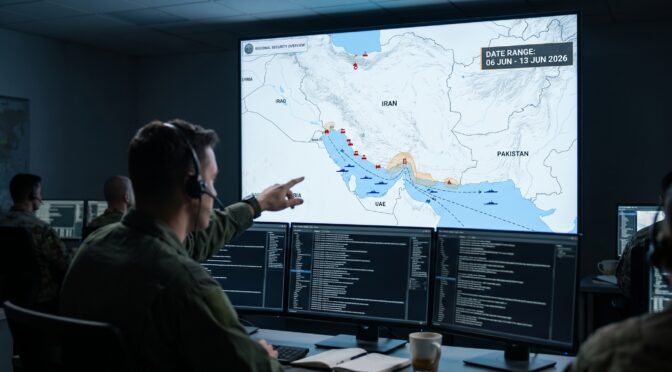
Over the past seven days (June 6 – June 13, 2026), the geopolitical and military environment between the United States and the Islamic Republic of Iran has been characterized by intense, simultaneous kinetic escalation and high-stakes diplomatic maneuvering. The strategic paradigm shifted rapidly from a robust exchange of asymmetric and conventional military strikes across multiple regional theaters to the precipice of a finalized diplomatic framework aimed at terminating the conflict. The intelligence picture indicates that both belligerents engaged in a calibrated campaign of brinkmanship, utilizing maximum military and economic pressure to optimize their respective negotiating positions ahead of a mutually recognized settlement window. Early in the week, the United States aggressively escalated its enforcement of a comprehensive maritime blockade, resulting in the direct kinetic disabling of three commercial oil tankers in the Gulf of Oman. These enforcement actions resulted in the first confirmed civilian seafarer fatalities of the blockade, triggering a severe diplomatic secondary crisis involving the Republic of India and drawing international condemnation regarding the safety of commercial navigation. In parallel, regional proxy forces—specifically Lebanese Hezbollah and the Yemeni Houthis—synchronized their operations with Tehran, launching ballistic missiles and drones at Israeli and maritime targets to maximize leverage against the US-led coalition and its regional partners.
Simultaneously, the US Department of the Treasury expanded its “Economic Fury” campaign, systematically dismantling illicit Iranian procurement networks concentrated in the People’s Republic of China and Hong Kong while executing the seizure of approximately $1 billion in Iranian cryptocurrency assets. This maximum pressure campaign culminated in a critical strategic juncture on June 11, when a planned, large-scale US military strike against Iranian sovereign territory was abruptly halted. The cessation of these strikes was brokered through emergency intervention by the leadership of the State of Qatar, the United Arab Emirates (UAE), and the Islamic Republic of Pakistan, who assured Washington that a preliminary framework agreement was within reach.
By the end of the reporting period, the contours of a Memorandum of Understanding (MoU) had materialized in the public domain, though the exact parameters remain highly contested and subject to intense informational warfare. Iranian state media preemptively leaked a 14-point draft heavily favoring Tehran—including the release of $24 billion in frozen assets and an immediate end to the naval blockade—which was swiftly denounced by the US administration as fabricated. Despite acute disagreements over the future management of the Strait of Hormuz, the sequencing of sanctions relief, and the scope of future nuclear negotiations, Pakistani officials announced that a final, agreed-upon text is ready, with diplomatic sources indicating the agreement could be signed in Geneva or remotely within 24 hours. This signals a high probability of a formal cessation of hostilities in the immediate term, even as localized maritime skirmishes and proxy engagements continue to destabilize the Gulf and the Levant.
2. Detailed Operational and Diplomatic Developments
The operational environment over the preceding seven days was highly volatile, defined by simultaneous lines of effort spanning economic warfare, direct kinetic engagements, proxy mobilization, and complex multilateral diplomacy. The following subsections provide an exhaustive breakdown of these interconnected developments.
Direct Bilateral Interactions and the “Economic Fury” Campaign
The bilateral dynamic between Washington and Tehran operated on dual tracks: a relentless application of maximum economic and military pressure juxtaposed against accelerated back-channel negotiations aimed at securing a multi-front ceasefire. The United States utilized its financial architecture to systematically degrade Iran’s war-fighting logistics, while both nations engaged in direct, albeit limited, military exchanges to establish deterrence perimeters.
The US Department of the Treasury significantly escalated its “Economic Fury” campaign, a specialized financial offensive initiated by Defense Secretary Pete Hegseth, designed to target and dismantle the foreign procurement networks supporting Iran’s Islamic Revolutionary Guard Corps (IRGC) and the Ministry of Defense and Armed Forces Logistics (MODAFL).1 A primary vector of this campaign involved the unprecedented targeting of digital assets. On June 6, US Treasury Secretary Scott Bessent confirmed the successful seizure of approximately $1 billion in Iranian cryptocurrency assets extracted from various digital wallets.2 This operation targeted funds that the Iranian regime was attempting to expatriate to evade the traditional international financial system and fund its regional operations.2 Concurrent with the US government action, the digital asset company Tether announced it had actively supported the US government in freezing $344 million in USDT across two specific addresses connected to Iranian sanctions evasion networks, effectively neutralizing further movement of those funds.2
The economic offensive extended beyond digital assets into the physical domain of illicit trade. On June 10, the Treasury’s Office of Foreign Assets Control (OFAC) designated nine individuals and entities based primarily in China and Hong Kong.1 The structural mapping of these targeted entities reveals a sophisticated flow of illicit funds and materials. The US Treasury identified the IRGC and MODAFL as the central nodes directing these clandestine operations.1 Operating on their behalf, entities such as Mustad Limited (directed by Liu Boyu, alongside employees Wang Hongyi and Xu Lichun) and Domus Trading HK Limited functioned as critical conduits within Iran’s clandestine banking network.3 These entities facilitated payments and managed the procurement of millions of dollars’ worth of weapons.3 Another key individual designated was Manuchehr Golchin, an Iranian national based in China, who further facilitated these illicit procurement channels.3 Parallel to the weapons procurement network, OFAC targeted a separate branch of operations involving the Iranian shadow fleet, which utilized front companies established in the United Arab Emirates and China to smuggle hundreds of millions of dollars of Iranian liquified petroleum gas (LPG) to East Asian markets, circumventing existing petroleum embargos.4
| Designated Entity / Individual | Operational Base | Alleged Role in Sanctions Evasion Network |
| Mustad Limited | China / Hong Kong | Facilitated IRGC procurement of millions of dollars’ worth of weapons.3 |
| Domus Trading HK Limited | Hong Kong | Operated within Iran’s clandestine banking network to facilitate payments for weapons procurement.3 |
| Liu Boyu | China | Sole director of Mustad Limited.3 |
| Wang Hongyi & Xu Lichun | China | Employees of Mustad Limited operating the procurement network.3 |
| Manuchehr Golchin | China | Iranian national facilitating procurement operations.3 |
| Various Front Companies | UAE / China | Disguised Iranian-origin fuel to smuggle LPG to South and East Asian markets.4 |
Kinetic engagements directly between US and Iranian military assets occurred early in the reporting period, reflecting Iran’s strategic doctrine of utilizing calibrated force to extract diplomatic concessions without triggering a full-scale regional war.5 Following a June 6 Iranian attack that included drone launches and a barrage of seven ballistic missiles fired toward Kuwait and Bahrain (six of which were intercepted), US forces executed precision strikes against coastal radar sites in Goruk, Qeshm Island, and Sirk Island.44 Escalation continued when an American military Apache helicopter was downed by Iranian forces on June 8.6 In immediate retaliation, under the direct orders of the Commander in Chief, US Central Command (CENTCOM) executed proportional self-defense strikes on June 9.6 Utilizing US Air Force and Navy fighter jets, American forces deployed precision munitions against Iranian air defense arrays, ground control stations, and surveillance radar sites near the Strait of Hormuz.6
Iran responded to subsequent US airstrikes on June 11 by launching coordinated drone and ballistic missile attacks against US military installations stationed in Bahrain, Kuwait, and Jordan.7 Open-source intelligence and military assessments indicate these Iranian strikes yielded minimal kinetic effect, largely missing their intended targets or facing successful interception by advanced US air defense systems.8 Analysts assess that the primary utility of these strikes was psychological and economic—designed to upset global energy markets, increase economic pressure on the United States, and demonstrate Iran’s geographic reach and willingness to resume widespread hostilities if negotiations collapse.8
The Leaked Memorandum of Understanding and Diplomatic Posturing
Amidst the military exchanges, the diplomatic track saw significant, albeit controversial, progress regarding a comprehensive Memorandum of Understanding (MoU). On June 12, Iranian state-aligned media outlets, specifically the Mehr News Agency and the official Islamic Republic News Agency (IRNA), preemptively published what they claimed were the finalized parameters of an imminent US-Iran peace agreement.9 The leaked 14-point framework aggressively front-loaded American concessions, presenting a narrative highly favorable to the regime in Tehran.9
According to the Iranian media leaks, the draft MoU mandated an immediate and permanent ceasefire across all regional fronts, specifically including Lebanon.9 It outlined a complete lifting of the US naval blockade on Iranian ports and the suspension of sanctions on Iranian oil sales within a 30-day window.9 Crucially, the draft stipulated the unfreezing of $24 billion in Iranian assets, demanding that 50% ($12 billion) be released prior to the initiation of any formal final negotiations.9 The framework proposed a subsequent 60-day window for negotiations to reach a final agreement on nuclear issues, but strictly limited these discussions to uranium enrichment, the lifting of all remaining sanctions, and a requirement for the US and its allies to present a $300 billion reconstruction compensation plan.9 The Iranian draft purposefully excluded any future discussions regarding Iran’s ballistic missile programs or its sponsorship of regional “resistance” proxy militias.9 Furthermore, regarding the highly contested Strait of Hormuz, the leaked draft asserted that Iran would make no commitment to transfer management of the waterway, instead proposing that future administration be resolved regionally through joint dialogue between Tehran and the Sultanate of Oman.9
The United States administration immediately and forcefully rejected this Iranian narrative. President Donald Trump utilized social media platforms to issue a stark rebuke, stating that the leaked parameters had “NOTHING to do with the terms that were agreed to, in writing”.9 President Trump characterized the Iranian negotiating team as “very dishonorable people to deal with,” asserting that they do not negotiate in good faith, and dismissed the published points as a “weak and pathetic statement”.11 Supporting this stance, US Vice President JD Vance rejected the leak as “fake information,” explicitly emphasizing that the true agreement is performance-based.9 A White House official subsequently clarified to the press that under the actual framework, the Iranian regime would receive no upfront cash injections merely for signing a document; rather, financial relief would be sequenced and strictly tied to verifiable compliance, including the dismantling of the nuclear program, the destruction of enriched materials, the reopening of the Strait of Hormuz, and the cessation of terrorist funding.11
| Contentious Issue | Iranian Leaked Draft (Mehr/IRNA) | Official US Position / Clarification |
| Asset Release ($24B) | 50% ($12B) released upfront before final negotiations begin.9 | No upfront cash; staggered financial relief strictly tied to verifiable compliance.9 |
| Naval Blockade | Complete lifting of the US blockade within 30 days.9 | Blockade remains until Iran ceases hostile acts and reopens the Strait of Hormuz.11 |
| Strait of Hormuz | No transfer of management; joint administration by Iran and Oman.11 | Immediate reopening required; US objects to Iranian transit tolls or operational control.11 |
| Scope of Negotiations | Limited strictly to nuclear enrichment and economic reconstruction compensation.9 | Comprehensive dismantling of nuclear program; mandates cessation of terrorist/proxy funding.11 |
| Ballistic Missiles / Proxies | Explicitly excluded from all current and future negotiations.9 | Cessation of proxy funding is a required prerequisite for sanctions relief.11 |
Despite these profound public disagreements, Iranian Foreign Minister Abbas Araghchi stated that the “Islamabad Memorandum of Understanding” (also referred to as the Islamabad Agreement) had “never been closer,” while confirming that discussions regarding Iranian “service fees” (which the US considers illegal transit tolls) for vessels in the Strait of Hormuz remained a point of active contention. A senior US official, speaking anonymously, indicated that the administration was “80 to 85 percent” confident the deal would be finalized, noting that the agreement ensures highly enriched uranium would be destroyed on-site and removed from the country, thereby neutralizing the immediate nuclear threat.13
Proxy Group Activities and Unprecedented Maritime Interdictions
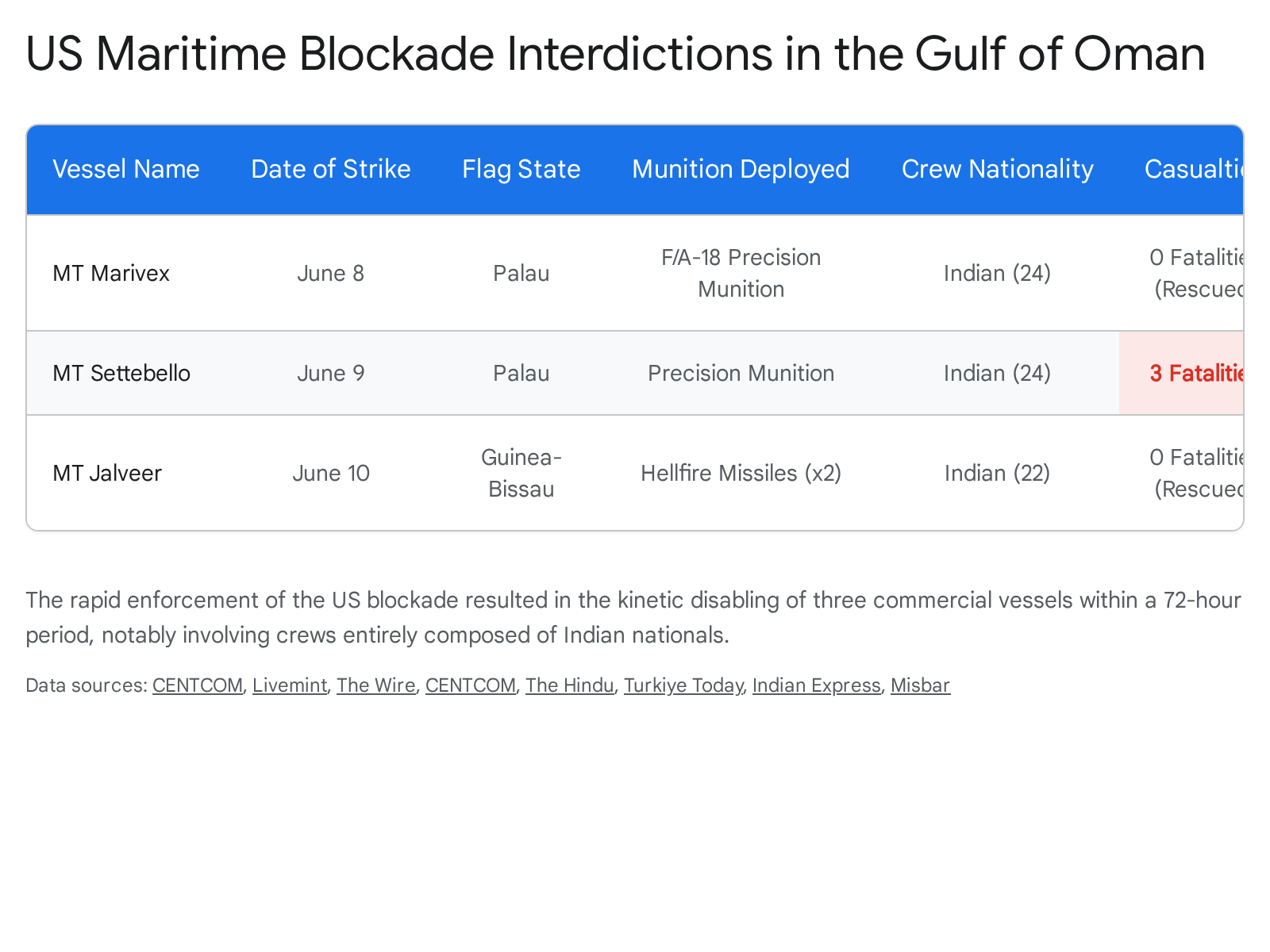
The maritime domain witnessed the most severe and lethal escalations of the conflict over the past week, primarily centered on the rigorous US enforcement of a total blockade on Iranian ports. The blockade, officially initiated on April 13, aims to systematically interdict vessels of all nations attempting to enter or depart Iranian coastal areas in the Persian Gulf and the Gulf of Oman, thereby preventing the export of Iranian energy or the import of sanctioned goods.14 US Central Command reported that since the blockade’s inception, American forces have redirected over 134 compliant ships, allowed 42 humanitarian vessels to pass, but have been forced to disable nine non-compliant commercial vessels.14 Over a critical 72-hour window between June 8 and June 10, US forces utilized direct kinetic action to disable three commercial oil tankers in the Gulf of Oman, resulting in the first confirmed civilian seafarer fatalities of the interdiction campaign.
The sequence of maritime interdictions began on June 8 with the targeting of the MT Marivex. The Palau-flagged, Panama-owned tanker, carrying an unladen cargo and a crew of 24 Indian seafarers, was intercepted while transiting international waters toward Iran.16 According to US intelligence and government sources, the vessel had made four separate attempts to evade the blockade over several days.18 On its final attempt, the ship utilized Omani territorial waters and deliberately switched off its automatic identification system (AIS) transponder to avoid detection.18 After the crew allegedly failed to comply with repeated directions, a US Navy F/A-18 Super Hornet operating from the aircraft carrier USS Abraham Lincoln fired a precision munition into the ship’s engineering and steering spaces.16 The strike sparked a significant engine room fire, prompting distress calls capturing panic among the crew.20 All 24 Indian crew members were subsequently rescued without serious injury by helicopters and naval assets belonging to the Royal Navy of Oman.17
The following day, June 9, the interdiction campaign escalated lethally with the strike on the MT Settebello. The Palau-flagged tanker was disabled by precision munitions fired into its engine room by US aircraft in the Gulf of Oman.14 CENTCOM asserted that the vessel repeatedly ignored warnings and attempted to transport Iranian oil in direct violation of the blockade.14 This strike resulted in the deaths of three Indian seafarers (identified as a deck cadet, an engine fitter, and the chief engineer), marking a significant escalation in the human cost of the conflict; the remaining 21 Indian crew members were successfully evacuated. The incident generated immediate controversy. IOS Marine FZE, the Dubai-based manager of the vessel, issued a public statement vehemently disputing the US military’s narrative, demanding a full international probe, and categorically denying that the vessel ignored communication protocols or was carrying illicit cargo at the time of the strike.21 The International Maritime Organization (IMO) Secretary-General Arsenio Dominguez formally condemned the attack, noting that 46 attacks on international shipping have occurred around the Strait of Hormuz resulting in 14 seafarer fatalities since February 2026, and underscored the paramount responsibility of all parties to protect civilian mariners under international law.22
On June 10, a third vessel, the Guinea-Bissau-flagged bitumen tanker MT Jalveer, was struck at approximately 11:20 p.m. ET.24 A US aircraft fired two AGM-114 Hellfire missiles into the tanker’s engine room after the crew, numbering between 20 and 22 Indian nationals, allegedly failed to comply with instructions.24 The strike ignited an engine room fire near the Omani port of Shinas.27 Fortunately, no casualties were reported, and the crew was successfully evacuated to shore with the assistance of Omani authorities.25 Reports indicate the MT Jalveer had previously received warning shots from US aircraft a month prior, on May 15, highlighting the persistent cat-and-mouse dynamic in the region.25
In retaliation for the heightened US blockade enforcement, Iranian forces continued to exert asymmetric pressure on global shipping choke points. On the night of June 11, Iran launched multiple one-way attack drones targeting commercial vessels—specifically identifying Indian ships—attempting to exit the Strait of Hormuz.11 US Central Command forces successfully intercepted and downed all the incoming drones, ensuring the strait remained technically open for transit, though the threat environment remains critical.11
Concurrently, the Iranian-aligned Houthi movement in Yemen significantly escalated its rhetoric and operational posture in the Red Sea and Bab el-Mandeb Strait. On June 8, corresponding with the expiration of the temporary April 7 regional ceasefire, Houthi military spokesperson Yahya Saree announced a “complete and total ban on maritime navigation on the Israeli enemy in the Red Sea”.29 Saree declared that any vessel with perceived Israeli affiliations or moving in support of the “Zionist project” would be considered a legitimate military target.29 This announcement was coordinated with the launch of two ballistic missiles directed toward the Tel Aviv area in central Israel; Israeli defense systems intercepted one missile, while the other fell short.29 The sustained Houthi campaign has caused severe disruptions to global commerce; maritime intelligence indicates that traffic through the Bab el-Mandeb Strait—which historically accommodated nearly 10 percent of global seaborne trade—has plummeted to approximately 3 percent, forcing ship operators to undertake the expensive and lengthy diversion around the southern tip of Africa.30
The strategic doctrine of the “unity of fronts” was also actively demonstrated in the Levant, linking the Gulf conflict directly to the Israeli-Lebanese border. On June 7, Israeli military forces conducted a targeted airstrike on an apartment building in the Dahiyeh district, a known Hezbollah stronghold situated in the southern suburbs of Beirut, Lebanon.31 According to the Lebanese Ministry of Health, the strike resulted in two fatalities and 20 injuries, including women and children.31 The Israel Defense Forces (IDF) publicly stated the operation was a direct, necessary response to Hezbollah’s relentless rocket and drone attacks on northern Israeli communities, specifically citing an earlier Hezbollah strike on the Dovev Barracks.31 In immediate retaliation for the Dahiyeh strike, and honoring its commitments to its proxy network, Iran fired a barrage of ballistic missiles directly at northern Israel late on the evening of June 7.34 This action marked the first direct Iranian bombardment of Israeli sovereign territory since the fragile April ceasefire, complicating mediation efforts and demonstrating Tehran’s willingness to escalate horizontally.34
Role and Involvement of Third-Party Countries
The sprawling nature of the US-Iran conflict, particularly the aggressive maritime interdiction campaign, heavily entangled various regional and global actors, triggering intense diplomatic mediation and unprecedented bilateral friction.
The Republic of India India emerged as a highly affected and pivotal third party due to the demographic composition of the crews aboard the targeted oil tankers. All 68 to 70 mariners manning the MT Marivex, MT Settebello, and MT Jalveer were Indian nationals.19 The confirmed death of three Indian sailors aboard the MT Settebello, coupled with the sheer volume of kinetic strikes endangering Indian citizens, provoked a swift and strong diplomatic rebuke from New Delhi. On June 12, the Indian Ministry of External Affairs took the rare and serious step of summoning Jason Meeks, the US Deputy Chief of Mission in Delhi, to formally lodge a protest against the American military strikes on commercial vessels operating off the Omani coast.38 Indian authorities expressed deep displeasure, condemning the attacks and urging immediate de-escalation.20 Ministry of External Affairs Spokesperson Randhir Jaiswal publicly stated that India was “deeply concerned about US attacks” and hoped they would soon end. This friction introduces significant bilateral tension between two strategic partners just days before a highly anticipated meeting between Indian Prime Minister Narendra Modi and US President Donald Trump on the sidelines of the Group of 7 summit in France, potentially complicating broader Indo-Pacific strategic alignments.38
Pakistan, Qatar, and the United Arab Emirates (UAE) The leadership of Pakistan, Qatar, and the UAE played a decisive, highly coordinated role in averting a major regional military escalation on June 11.40 Following President Trump’s public social media declaration that he intended to hit Iran “VERY HARD TONIGHT” in response to the downed Apache and subsequent skirmishes, an emergency diplomatic intervention was initiated.40 Qatari Emir Tamim bin Hamad Al Thani, UAE President Mohamed bin Zayed Al Nahyan, and Pakistani defense chief Asim Munir placed urgent calls to the White House.40 Leveraging their unique diplomatic access, back-channels, and perceived sway over both Washington and Iranian Supreme Leader Mojtaba Khamenei, these leaders assured the US administration that a preliminary framework agreement with Tehran was firmly within reach.40 According to administration officials, these specific assurances from trusted regional partners were the central factor in President Trump’s decision to walk back his immediate attack plans and pause the scheduled military strikes, allowing diplomacy a final window.40
- Pakistan: Islamabad has solidified its role as the primary, public mediator of the conflict. On June 13, Pakistani Prime Minister Shehbaz Sharif formally announced that the United States and Iran had agreed to a final peace framework, effectively bridging the gaps that had stalled previous rounds of talks.41 Prime Minister Sharif indicated that preparations were actively underway to finalize the text of the accord.41 Diplomatic sources provided conflicting reports on the logistics of the signing, with some indicating a ceremony could occur in Geneva, Switzerland, while others suggested the agreement would be signed electronically or remotely within the next 24 hours. This would be immediately followed by technical-level implementation talks to operationalize the ceasefire.41
- The United Arab Emirates (UAE): While facilitating mediation, the UAE also found itself defending its financial neutrality amid the intense informational warfare surrounding the leaked MoU. Following media speculation and reports that Abu Dhabi was preparing to unlock billions in frozen assets as a mechanism to facilitate the impending deal, the UAE Ministry of Foreign Affairs issued a categorical denial on June 13.42 The ministry stressed that “no frozen Iranian funds have been released, transferred, or facilitated through the UAE,” calling the allegations entirely false and unfounded.42
The Sultanate of Oman Oman acted as a critical logistical sanctuary and diplomatic facilitator throughout the reporting period. Omani naval forces and maritime search-and-rescue centers were instrumental in the emergency evacuation of the surviving Indian crews from the burning MT Marivex and MT Jalveer in the Gulf of Oman.17 However, Omani territorial waters were also heavily utilized by the Iranian shadow fleet attempting to evade the US naval blockade, placing Muscat in a delicate position regarding the enforcement of international sanctions.18 Diplomatically, the leaked Iranian MoU draft posits that the future administration and security architecture of the Strait of Hormuz will be managed jointly through dialogue between Tehran and Muscat, further elevating Oman’s strategic utility as a neutral, acceptable arbiter in the vital waterway.11
The People’s Republic of China China’s involvement, while less overt diplomatically, was heavily scrutinized and targeted via US economic actions. The expansion of the “Economic Fury” campaign explicitly targeted Chinese corporate infrastructure, designating entities based in China and Hong Kong as complicit in sanctions evasion.1 The designation of individuals and companies operating out of Chinese jurisdictions underscores Washington’s intelligence assessment that China remains the primary logistical, financial, and market sanctuary for Iranian energy smuggling and military procurement.3 The reliance of the IRGC on Chinese banking networks and front companies to move LPG and acquire weaponry highlights the deep, structural economic axis between Beijing and Tehran that the US is actively attempting to sever.3
3. Chronological Timeline of Key Events
The following timeline details the most significant operational, economic, and diplomatic events from the past seven days, presented in chronologically ascending order to illustrate the rapid escalation and subsequent diplomatic pivot.
- June 6, 2026:
- Iranian forces launch an early morning attack (approximately 0230 local time) consisting of four attack drones targeting cargo ships in the Strait of Hormuz. US CENTCOM forces successfully intercept the drones utilizing directed energy weapons and APKWS munitions from F-15 fighter jets.44
- Iran fires a barrage of seven ballistic missiles toward Kuwait and Bahrain. US air defenses intercept six of the projectiles, while the seventh lands harmlessly, resulting in no casualties.44
- In a proportional response, US military forces execute precision strikes on Iranian coastal radar sites and ground control stations located in Goruk, Qeshm Island, and Sirk Island.44
- The US Treasury Department publicly confirms the seizure of approximately $1 billion in Iranian cryptocurrency assets, representing a major escalation in the “Economic Fury” financial warfare campaign.2
- June 7, 2026:
- The Israel Defense Forces (IDF) conducts a targeted airstrike on an apartment building in the Dahiyeh district of Beirut, Lebanon. The strike, which kills two and injures 20, is framed as retaliation for Hezbollah drone and rocket attacks on northern Israel.31
- At approximately 10:00 p.m. local time, Iran fires a direct barrage of missiles into northern Israel in retaliation for the Dahiyeh strike. This marks the first direct Iranian bombardment of Israeli territory since the April ceasefire.34
- June 8, 2026:
- Yemeni Houthi military spokesperson Yahya Saree announces a “complete and total ban” on Israeli-linked maritime navigation in the Red Sea and claims responsibility for launching two missiles at central Israel.29
- The Palau-flagged commercial tanker MT Marivex, carrying 24 Indian seafarers, is disabled by a precision munition fired from a US Navy F/A-18 in the Gulf of Oman after reportedly making four separate attempts to evade the maritime blockade.16
- An American Army Apache helicopter is shot down by Iranian forces in the region.6
- June 9, 2026:
- Following the direction of the Commander in Chief, US CENTCOM completes a wave of self-defense strikes utilizing Air Force and Navy fighter jets against Iranian air defense and radar sites near the Strait of Hormuz in direct retaliation for the downed Apache.6
- The Palau-flagged tanker MT Settebello is disabled by a US precision strike directed into its engine room in the Gulf of Oman. The strike results in the deaths of three Indian seafarers.14
- June 10, 2026:
- At approximately 11:20 p.m. ET, the Guinea-Bissau-flagged bitumen tanker MT Jalveer, carrying 20-22 Indian sailors, is disabled by two US Hellfire missiles in the Gulf of Oman.24
- The US Treasury Department expands the “Economic Fury” sanctions regime, officially blacklisting nine entities and individuals operating primarily in China and Hong Kong for facilitating IRGC weapons procurement and clandestine banking operations.1
- June 11, 2026:
- The Indian government officially confirms the deaths of the three Indian seafarers from the June 9 US strike on the MT Settebello, escalating diplomatic tensions.39
- The United States launches a second round of airstrikes on Iranian military capabilities; Iran retaliates with largely ineffective, demonstrative drone and missile strikes directed at US bases in Bahrain, Kuwait, and Jordan.7
- President Trump publicly signals the intent to launch a massive retaliatory strike on Iran. However, an urgent diplomatic intervention by the leaders of Qatar, the UAE, and Pakistan successfully persuades the US administration to call off the strikes, citing the proximity to a finalized peace deal.40
- June 12, 2026:
- Iranian state media agencies (Mehr, IRNA) preemptively leak the details of a 14-point draft Memorandum of Understanding, claiming the US has agreed to significant concessions, including the immediate release of $24 billion in frozen funds and an end to the naval blockade within 30 days.9
- President Trump publicly rebukes the leaked terms on social media, categorizing them as “Fake News” and labeling the Iranian negotiators as “dishonorable,” while US officials clarify that the actual deal remains strictly performance-based.11
- The Indian Ministry of External Affairs formally summons Jason Meeks, the US Deputy Chief of Mission in New Delhi, to lodge a strong official protest regarding the kinetic strikes on Indian-crewed commercial vessels.38
- June 13, 2026:
- During the early hours, US forces intercept and shoot down multiple Iranian one-way attack drones targeting Indian commercial ships transiting the Strait of Hormuz.11
- The UAE Ministry of Foreign Affairs vehemently denies circulating media reports that Abu Dhabi has agreed to release $3 billion in frozen Iranian funds to facilitate the peace process.42
- Pakistani Prime Minister Shehbaz Sharif publicly announces that the US and Iran have reached an agreed-upon text for a comprehensive peace deal, stating that an electronic signing is expected within 24 hours.41
Please share the link on Facebook, Forums, with colleagues, etc. Your support is much appreciated and if you have any feedback, please email us in**@*********ps.com. If you’d like to request a report or order a reprint, please click here for the corresponding page to open in new tab.
Sources Used
- Economic Fury Disrupts Foreign Networks Supporting Iran’s Military and Weapons Programs, accessed June 13, 2026, https://home.treasury.gov/news/press-releases/sb0528
- US grabs $1B in Iranian assets under Operation Economic Fury, accessed June 13, 2026, https://coingeek.com/us-grabs-1b-in-iranian-assets-under-operation-economic-fury/
- US imposes new wave of sanctions on Iran as Trump pledges to ramp up attacks, accessed June 13, 2026, https://www.aa.com.tr/en/us-israel-iran-war/us-imposes-new-wave-of-sanctions-on-iran-as-trump-pledges-to-ramp-up-attacks/3963128
- Sanctions to Strangle Iran’s Energy Smuggling and Illicit Financial Networks, accessed June 13, 2026, https://ir.usembassy.gov/sanctions-to-strangle-irans-energy-smuggling-and-illicit-financial-networks/
- Iran Update Special Report, June 9, 2026 | ISW, accessed June 13, 2026, https://understandingwar.org/research/middle-east/iran-update-special-report-june-9-2026/
- U.S. Completes Strikes in Response to Iran’s Attack on Apache, accessed June 13, 2026, https://www.centcom.mil/MEDIA/PUBLIC-RELEASES/Article/4512968/us-completes-strikes-in-response-to-irans-attack-on-apache/
- US launches new strikes on Iran, which fires back at Gulf states and Jordan, accessed June 13, 2026, https://apnews.com/article/iran-us-ceasefire-hezbollah-israel-10-june-2026-b7ec462890f3c2afa12bd5c0672f2b6b
- Iran Update Special Report, June 11, 2026, accessed June 13, 2026, https://understandingwar.org/research/middle-east/iran-update-special-report-june-11-2026/
- Iran-US draft deal would release $24B in funds, ensure Lebanon …, accessed June 13, 2026, https://www.al-monitor.com/originals/2026/06/iran-us-draft-deal-would-release-24b-funds-ensure-lebanon-ceasefire-iranian-media
- Iran Update Special Report, June 12, 2026, accessed June 13, 2026, https://understandingwar.org/research/middle-east/iran-update-special-report-june-12-2026/
- Live Updates: Iranian negotiators ‘very dishonorable people,’ Trump …, accessed June 13, 2026, https://www.foxnews.com/live-news/us-iran-war-israel-lebanon-trump-deal-june-12
- Live Updates: “Final, agreed upon text” of U.S.-Iran peace deal has been reached, Pakistan says – CBS News, accessed June 13, 2026, https://www.cbsnews.com/live-updates/iran-war-us-trump-peace-deal-agreement/
- Senior US official: Pending deal ‘leads to’ Washington getting Iran’s enriched uranium, accessed June 13, 2026, https://www.timesofisrael.com/senior-us-official-pending-deal-leads-to-us-getting-irans-enriched-nuclear-material/
- CENTCOM Disables Non-Compliant Vessel in Gulf of Oman, accessed June 13, 2026, https://www.centcom.mil/MEDIA/PUBLIC-RELEASES/Article/4513450/centcom-disables-non-compliant-vessel-in-gulf-of-oman/
- U.S. forces attack and disable three tankers; IMO condemns attack on the Settebello, accessed June 13, 2026, https://www.shippingaustralia.com.au/u-s-forces-attack-and-disable-three-tankers-imo-condemns-attack-on-the-settebello/
- U.S. Forces Disable Non-Compliant Oil Tanker in Gulf of Oman – centcom, accessed June 13, 2026, https://www.centcom.mil/MEDIA/PUBLIC-RELEASES/Article/4511257/us-forces-disable-non-compliant-oil-tanker-in-gulf-of-oman/
- A Day After US Acknowledges Strike on MT Marivex, India Says Ship Was ‘Disabled’, accessed June 13, 2026, https://m.thewire.in/article/diplomacy/day-after-us-acknowledges-attacking-marivex-india-says-ship-disabled
- Fire on oil products tanker off Oman coast, all 24 Indian seafarers safe: Govt, accessed June 13, 2026, https://indianexpress.com/article/business/arivex-oil-tanker-fire-oman-coast-indian-seafarers-safe-10729792/
- Oman rescues 24 Indians after fire on ‘blacklisted’ oil tanker; MT Marivex found not Indian-owned, accessed June 13, 2026, https://www.livemint.com/news/world/oman-rescues-24-indians-after-fire-on-blacklisted-oil-tanker-mt-marivex-found-not-indianowned-11780937340885.html
- ‘Fire on board, please help’: the panic on an oil tanker hit by US missile off Oman, accessed June 13, 2026, https://www.thenationalnews.com/news/uae/2026/06/12/fire-on-board-please-help-panic-on-board-tanker-hit-by-us-missile-off-oman/
- Ship Manager Demands International Probe Into Fatal U.S. Attack on Tanker, accessed June 13, 2026, https://gcaptain.com/ship-manager-demands-international-probe-into-fatal-u-s-attack-on-tanker/
- Statement on the attack on tanker MT Settebello, accessed June 13, 2026, https://www.imo.org/en/mediacentre/pressbriefings/pages/imo-statement-on-settebello-attack.aspx
- India and the IMO condemn attack on tanker Settebello, accessed June 13, 2026, https://www.seatrade-maritime.com/security/india-and-the-imo-condemn-attack-on-tanker-settebello
- US forces disable third oil tanker over alleged Iran blockade violation – Türkiye Today, accessed June 13, 2026, https://www.turkiyetoday.com/region/fire-breaks-out-on-tanker-off-omani-coast-ukmto-says-3221718
- Third ship hit by US near Oman, all 22 Indians safe, accessed June 13, 2026, https://indianexpress.com/article/india/ship-with-indians-on-fire-off-oman-10734377/
- Tracking Data Irregularities Detected in Tanker Targeted by U.S. Forces in the Gulf of Oman, accessed June 13, 2026, https://www.misbar.com/en/editorial/2026/06/12/tracking-data-irregularities-detected-tanker-targeted-us-forces-gulf-oman
- US military confirms attack on third Indian-crewed tanker off Gulf of Oman, accessed June 13, 2026, https://m.economictimes.com/news/defence/us-military-confirms-attack-on-indian-crewed-tanker-off-gulf-of-oman/articleshow/131658607.cms
- No casualties, injuries reported in security incident on MT Jalveer; six more to be evacuated: Shipping Ministry, accessed June 13, 2026, https://www.aninews.in/news/world/asia/no-casualties-injuries-reported-in-security-incident-on-mt-jalveer-six-more-to-be-evacuated-shipping-ministry20260611172857
- Houthis attack Israel and announce ban on Israeli vessels in the Red Sea, accessed June 13, 2026, https://www.longwarjournal.org/archives/2026/06/houthis-attack-israel-and-announce-ban-on-israeli-vessels-in-the-red-sea.php
- How Iran-linked Houthis’ Red Sea shipping threat risks bigger oil shock, accessed June 13, 2026, https://www.straitstimes.com/world/middle-east/how-iran-linked-houthis-red-sea-shipping-threat-risks-bigger-oil-shock
- Israel army vows to operate across Lebanon, intensify actions against Hezbollah, accessed June 13, 2026, https://www.arabnews.jp/en/middle-east/article_171700/
- IDF strikes Beirut’s Dahiyeh after Hezbollah fires rockets at northern Israel, accessed June 13, 2026, https://www.timesofisrael.com/idf-strikes-beiruts-dahiyeh-after-hezbollah-fires-rockets-at-northern-israel/
- Israel strikes Beirut after rocket fire was launched in their direction, accessed June 13, 2026, https://www.washingtonexaminer.com/news/world/4598293/israel-strikes-beirut-lebanon-hezbollah-ceasefire/
- Israel says Iran launched a missile at it, in a first during fragile ceasefire – KLCC, accessed June 13, 2026, https://www.klcc.org/npr-news/2026-06-07/israel-says-iran-launched-a-missile-at-it-in-a-first-during-fragile-ceasefire
- Jerusalem, June 7, 2026 (AFP) – Israel army vows to operate across Lebanon, intensify actions against Hezbollah | NAMPA, accessed June 13, 2026, https://www.nampa.org/text/22942623
- Israel launches strikes on Iran after Tehran fires barrage of missiles, accessed June 13, 2026, https://www.washingtonpost.com/politics/2026/06/07/trump-says-us-open-unfreezing-iranian-funds-easing-sanctions-if-they-behave/
- US attack kills three Indian sailors in Gulf of Oman | Middle East Eye, accessed June 13, 2026, https://www.middleeasteye.net/news/us-attack-kills-three-indian-sailors-gulf-oman
- India summons top US diplomat for second time to protest strikes on ships off Oman, source says, accessed June 13, 2026, https://www.al-monitor.com/originals/2026/06/india-summons-top-us-diplomat-second-time-protest-strikes-ships-oman-source-says
- Three missing Indian seafarers onboard MT Settebello confirmed dead: Sonowal, accessed June 13, 2026, https://www.thehindu.com/news/national/three-missing-indian-seafarers-onboard-mt-settebello-confirmed-dead-sonowal/article71088486.ece
- Qatar, UAE, Pakistan leaders help persuade Trump to call off Iran …, accessed June 13, 2026, https://caliber.az/en/post/qatar-uae-pakistan-leaders-help-persuade-trump-to-call-off-iran-strikes
- Pakistan PM says US-Iran peace deal signing expected within 24 …, accessed June 13, 2026, https://www.timesofisrael.com/liveblog_entry/pakistan-pm-says-us-iran-peace-deal-signing-expected-within-24-hours/
- UAE denies reports of it releasing frozen funds to Iran: Report, accessed June 13, 2026, https://www.middleeasteye.net/live-blog/live-blog-update/uae-denies-reports-it-releasing-frozen-funds-iran-report
- End of war in sight as US and Iran close in on landmark accord, accessed June 13, 2026, https://gulfnews.com/world/mena/end-of-war-in-sight-as-us-and-iran-close-in-on-landmark-accord-1.500572912
- Iran launched missiles and drones toward Strait of Hormuz, U.S. military says, accessed June 13, 2026, https://www.washingtonpost.com/world/2026/06/06/iran-launched-missiles-drones-toward-strait-hormuz-us-military-says/
- Iran Launched Drones And Missiles Then U.S. Forces RESPONDED HARD – YouTube, accessed June 13, 2026, https://www.youtube.com/shorts/2bMIM169p8M
- Three Indian sailors killed after US strike on oil tanker off Oman near Strait of Hormuz, accessed June 13, 2026, https://timesofindia.indiatimes.com/world/middle-east/us-attack-on-ship-two-indians-found-dead-chief-engineer-still-missing-after-oil-tanker-crew-sent-sos/articleshow/131649132.cms