
1. Executive Summary
During the reporting period of June 13 through June 20, 2026, the geopolitical, military, and diplomatic architecture of the Middle East underwent a fundamental reconfiguration, marking the formal cessation of the 15-week international conflict that commenced in late February 2026. The defining dynamic of this seven-day operational window was the finalization, remote signing, and immediate implementation phase of the “Islamabad Memorandum of Understanding” (MoU). This 14-point diplomatic framework, brokered primarily by the Government of Pakistan with further negotiation facilitation provided by the State of Qatar, Saudi Arabia, Turkey, and Egypt 1, establishes an immediate and permanent termination of military operations across all fronts between the United States, Israel, and the Islamic Republic of Iran.1 The agreement mandates a temporary 60-day ceasefire extension, which is explicitly designed to serve as a transitional negotiating window to forge a comprehensive, permanent settlement regarding sanctions relief, nuclear capabilities, and regional security architectures.1
A vital component of the MoU’s immediate implementation is the targeted normalization of global maritime commerce. Following extreme supply chain disruptions and historic energy market volatility—which witnessed Brent crude peak at $126 per barrel earlier in the conflict and the stranding of approximately 2,000 commercial vessels in the region—the United States officially lifted its naval blockade on all Iranian coastal ports on June 18.1 Concurrently, Iran committed to a 60-day toll-free reopening of the Strait of Hormuz, initiating localized mine clearance operations to allow the safe passage of commercial transit under the newly activated Persian Gulf Strait Authority (PGSA).1 However, the strategic environment remains highly fragile. Intelligence assessments indicate that while conventional military exchanges and aerial bombardments have halted, the underlying systemic disputes regarding Iran’s nuclear enrichment capabilities, its ballistic missile infrastructure, and its regional proxy network were intentionally deferred from the immediate MoU to secure the cessation of hostilities.1 The sequencing of this agreement reverses traditional non-proliferation models by granting immediate economic relief while deferring verifiable nuclear constraints.5
Furthermore, this diplomatic resolution has significantly elevated and recalibrated the strategic profile of third-party actors. Pakistan has transitioned from a vulnerable border state to a central diplomatic broker and the potential primary beneficiary of redirected Iranian overland trade.6 Simultaneously, the People’s Republic of China (PRC) has publicly endorsed the de-escalation, positioning itself to reap the economic benefits of stabilized global energy markets and normalized Iranian oil exports without having expended direct military or financial capital during the crisis.8 Meanwhile, regional states such as the United Arab Emirates (UAE) are cautiously re-engaging, balancing mandatory multibillion-dollar financial contributions to Iran’s post-war reconstruction with enduring security apprehensions stemming from their vulnerability to asymmetric warfare.1 Consequently, the current operational environment is characterized by rapid maritime de-escalation juxtaposed against highly complex, unresolved diplomatic negotiations and regional realignments.
2. Detailed Operational and Diplomatic Developments
2.1 Direct Bilateral and Indirect Interactions Between the US and Iran
The bilateral dynamic between Washington and Tehran during this seven-day period transitioned abruptly from active naval blockades, stalled mediation, and localized skirmishes to the formal adoption of the Islamabad Memorandum. The structure, legality, and strategic sequencing of this agreement represent a highly complex diplomatic pivot that warrants extensive analysis.
The Islamabad Memorandum of Understanding: Structural Framework and Legal Nature Drafted on June 14—when an initial phase of the agreement was signed by US Vice President JD Vance and Iran’s chief negotiator Mohammad Bagher Ghalibaf—and electronically signed in its final 14-point form on June 17 by US President Donald Trump and Iranian President Masoud Pezeshkian, the Islamabad MoU functions as an interim peace mechanism rather than a ratified, permanent treaty. Analysts note that the document was intentionally structured as a “memorandum of understanding” resting on “good faith” to bypass the domestic necessity of US Senate advice and consent, which a formal treaty would require under United States law.10 In its opening clauses, the MoU establishes a permanent termination of the threat or use of force between the parties, thereby restoring the United Nations Charter’s prohibition on military aggression.10 Concurrently, it opens a strictly temporary 60-day window to resolve core systemic disputes, stipulating that the final deal will eventually be endorsed by a binding resolution of the UN Security Council.1
The sequencing of the Islamabad MoU diverges fundamentally from previous diplomatic frameworks, most notably the 2015 Joint Comprehensive Plan of Action (JCPOA). Under the JCPOA, verified nuclear constraints and IAEA inspections were established as accomplished facts before sanctions relief was delivered.5 Under the 2026 Islamabad MoU, this logic is entirely reversed.5 Immediate, unilateral economic and military concessions are placed in the present tense, while verifiable Iranian constraints are relegated to future conditional negotiations.5 The agreement serves primarily as a “circuit breaker” to halt uncontrolled escalation rather than a durable settlement based on mutual confidence.5
Immediate Economic Relief and Sanctions Waivers Upon the signing of the MoU, the United States executed immediate economic relief measures designed to stabilize the Iranian economy, secure the government’s compliance with the ceasefire, and ease the severely strained global energy market.
- Sanctions Waivers on Petroleum: The US Treasury immediately issued comprehensive waivers on sanctions targeting Iranian crude oil and petroleum exports, along with associated maritime and insurance services. This concession allows Tehran to instantaneously resume selling crude oil on the international market, generating immediate revenue.1
- Release of Frozen Assets: The agreement initiated the immediate unfreezing and transfer of Iranian state assets held in foreign jurisdictions, providing critical, immediate liquidity to the Central Bank of Iran to manage the domestic economic crisis exacerbated by the war.1
- The Reconstruction Fund Mechanism: The MoU establishes a binding commitment by the United States and aligned regional partners to develop a definitive financial plan featuring a minimum of $300 billion dedicated to the post-war reconstruction and economic development of Iran.1 While the precise mechanisms and long-term sources of this funding remain vague, the United Arab Emirates has already transferred $3 billion as an initial tranche of an expected $10 billion national contribution.1
- Schedule for Full Sanctions Termination: The United States undertook a binding commitment to schedule the permanent termination of all unilateral primary and secondary sanctions, as well as associated UN Security Council and IAEA Board of Governors resolutions. The exact timeline for this termination is designated as a mandatory deliverable for the final comprehensive deal to be negotiated within the 60-day window.1
Nuclear Commitments, IAEA Supervision, and Strategic Hedging While Iran formally reaffirmed its commitment not to procure or develop nuclear weapons, the operational constraints placed on its nuclear infrastructure remain highly fluid and subject to the upcoming 60-day negotiations.1
- On-Site Down-Blending: The MoU establishes that Iran’s highly enriched uranium stockpiles will not be surrendered or exported to third-party nations. Instead, the baseline methodology agreed upon mandates the down-blending of weapons-grade material to reactor-grade levels strictly on-site within Iranian territory.1
- Verification Gaps and Inspection Lapses: The text invokes supervision by the International Atomic Energy Agency (IAEA) to oversee the down-blending process. However, non-proliferation analysts highlight a critical intelligence vulnerability: the IAEA has lacked verification access to Iranian facilities since the outbreak of the war on February 28, 2026.5 The MoU does not specify an explicit, immediate date for the unconditional restoration of inspector access, nor does it immediately clarify the current size, location, or composition of the accumulated enriched stockpile.5
- Retention of Technical Latency: By allowing both the nuclear material and the advanced centrifuge cascades to remain inside the country during the 60-day interim standstill, Iran retains both the physical infrastructure and the institutional engineering know-how. This allows Tehran to maintain a state of nuclear latency, positioning the state to rapidly reverse the down-blending process should the final negotiations collapse.5 Compounding these verification risks, the technical negotiations designed to address these nuclear issues, originally scheduled to commence in Geneva, Switzerland on June 19, were postponed. Washington announced late on June 18 that Vice President Vance would not travel due to logistical arrangements lacking predictability.
Strategic Omissions, Regional Exclusions, and Narrative Control The 14-point framework notably omits any constraints on Iran’s ballistic missile program, which was extensively utilized during the conflict to target US bases and Israeli infrastructure.1 Furthermore, it completely bypasses the status, funding, and operational freedom of Iran’s regional proxy networks, known collectively as the Axis of Resistance.1 Israel, which was not a direct signatory or party to the MoU negotiations, has publicly disputed the framework’s application to its northern front. Israeli officials reserve the operational autonomy to conduct retaliatory strikes against Hezbollah in Lebanon, despite Clause 1 of the MoU explicitly demanding the protection of Lebanese territorial integrity and sovereignty 1—an impasse that Qatar had to directly intervene in to prevent the deal from collapsing.6
Domestically, both the US and Iranian administrations immediately launched aggressive narrative control campaigns. The White House, via official press releases highlighting the roles of President Trump and Vice President JD Vance 11, characterized the deal as “America First in action,” claiming the agreement ended the era of “endless wars” and successfully forced Iran to the negotiating table from a position of “decimated” military weakness.11 Iranian state messaging, conversely, emphasized the extraction of massive financial concessions, the strategic survival of the regime, the successful reopening of the Strait on Iranian terms, and the retention of domestic nuclear infrastructure without surrendering sovereign rights.3
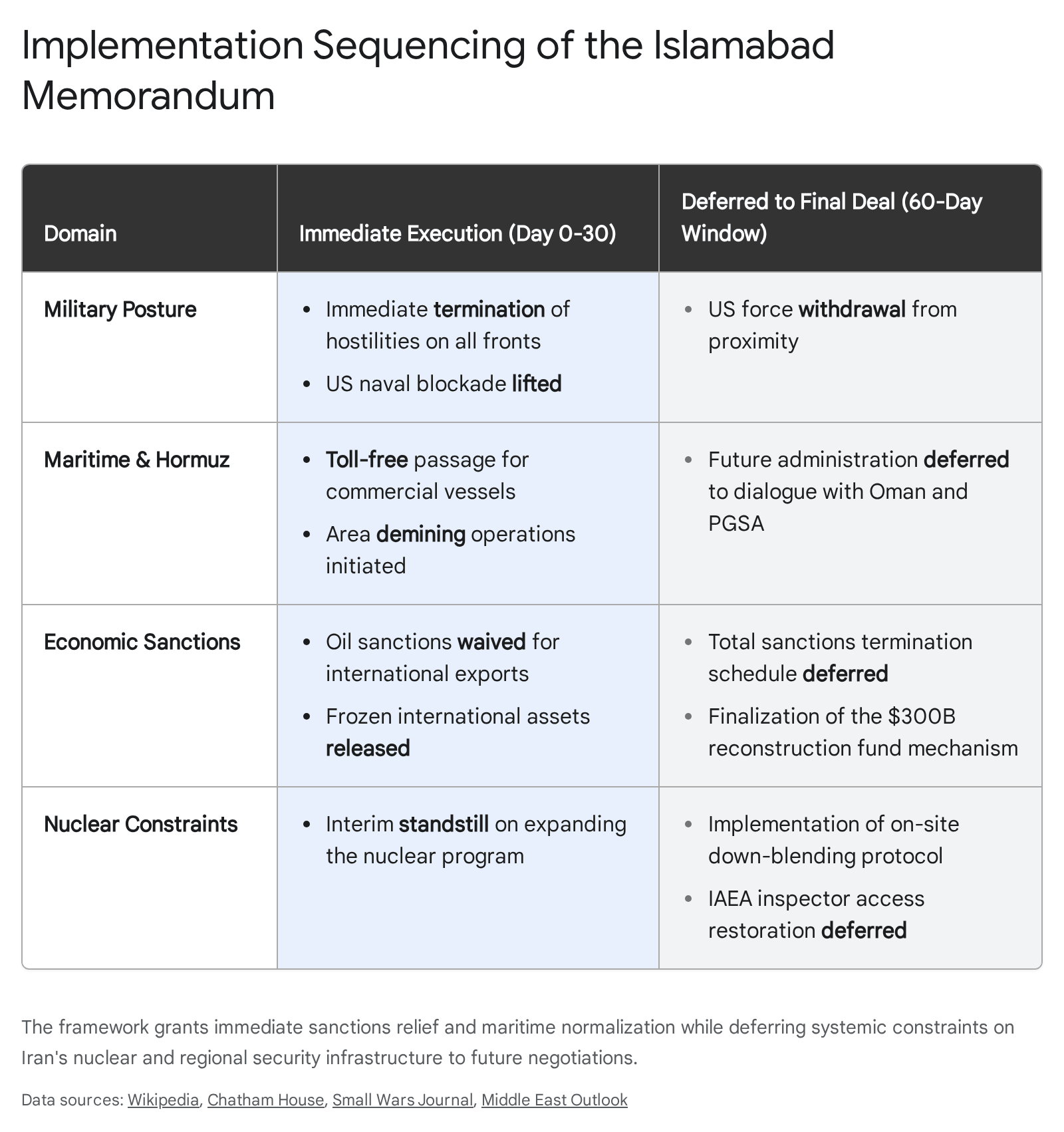
To further contextualize the scope of the Islamabad Memorandum, the following table outlines the disposition of the core negotiation parameters as established by the June 17 signing:
| Strategic Domain | Status Under the Islamabad MoU | Operational Implications |
| US Military Posture | Immediate termination of strikes; blockade lifted within 30 days.1 | Halts kinetic escalation; enables maritime flow; mandates US force withdrawal from Iran’s proximity post-final deal. |
| Economic Sanctions | Immediate waivers on oil exports; release of frozen central bank assets.1 | Provides Tehran with immediate liquidity; rapidly reintroduces Iranian crude to global energy markets. |
| Nuclear Enrichment | Interim standstill; commitment to on-site down-blending.1 | Retains nuclear infrastructure inside Iran; defers verifiable dismantlement to the 60-day negotiation window. |
| Reconstruction | Minimum $300 billion fund established; UAE transfers initial $3 billion.1 | Creates a massive financial incentive structure supported by regional Gulf monarchies. |
| Regional Proxies | Omitted from the framework.1 | Preserves the operational capability of the Axis of Resistance (Hezbollah, Houthis) for future strategic leverage. |
| Ballistic Missiles | Omitted from the framework.1 | Allows Iran to potentially redirect new oil revenues into missile development and production. |
2.2 Proxy Group Activities, Maritime Security Incidents, and Regional Military Movements
The reopening of the Strait of Hormuz—the vital maritime chokepoint through which approximately 20% of the world’s liquefied natural gas (LNG) and 25% of global seaborne oil trade normally traverses—was the primary catalyst for the intense international pressure driving the ceasefire negotiations.1 During the week of June 13 to June 20, the transition from active naval warfare and blockades to commercial maritime normalization was fraught with logistical bottlenecks, legal disputes, and secondary security hurdles.
The Strait of Hormuz and the Persian Gulf Strait Authority (PGSA) Following the failure of the mid-April Islamabad talks, the US had imposed a total naval blockade on Iranian ports on April 13, heavily interdicting maritime traffic.1 On June 18, following the signing of the MoU, US Central Command (CENTCOM) officially announced the complete lifting of the United States’ naval blockade on all maritime traffic entering and exiting Iranian coastal areas, though US naval assets will remain stationed in the general area as a deterrent force.1 Concurrently, the Islamic Revolutionary Guard Corps (IRGC) and the Iranian Supreme National Security Council formally activated the newly established “Persian Gulf Strait Authority” (PGSA).4
- Demining and Navigational Normalization: The MoU mandates that Iran use its “best efforts” to demine the strait and remove technical and military obstacles within 30 days.1 To facilitate immediate transit, the PGSA began issuing fast-tracked authorizations for stranded commercial ships. However, these authorizations require vessels to strictly adhere to highly specific, Iranian-dictated paths and timings to avoid residual sea mines and military zones.4
- The “Tolls” vs. “Fees” Legal Friction: A significant diplomatic divergence emerged regarding the long-term maritime administration of the waterway. While US officials insisted the MoU secured a “permanently toll-free” waterway, Iranian state media and officials immediately clarified that the 60-day toll-free window is strictly temporary.1 Following this 60-day period, the PGSA asserts the sovereign right to charge mandatory “fees” for security, pilotage, and navigational services. This establishes a de facto sovereign tax on international shipping through the strategic chokepoint, effectively fulfilling a long-standing IRGC objective to control access to the Persian Gulf.1
- Logistical Backlog and “Ghost Fleet” Movements: The normalization process faces severe physical constraints. During the height of the crisis in April, the International Maritime Organization reported that over 2,000 ships and 20,000 mariners were stranded in the Persian Gulf or anchored outside the strait to avoid the conflict zone.1 While Iranian state media broadcasted that 11 Iranian merchant ships successfully broke through the strait immediately following the MoU signing on June 17, clearing the massive international backlog under strict IRGC drone surveillance remains a prolonged operational challenge.1 Furthermore, intelligence satellites observed on June 13 that three Iran-flagged tankers, accompanied by one associated ghost fleet tanker 13, which had previously sought refuge approximately 20 kilometers off the coast of Galle, Sri Lanka, to evade the US blockade—were preparing to return to Gulf waters to resume operations.13
The Red Sea, Bab el-Mandab, and the Houthi Axis While the Strait of Hormuz demonstrated concrete signs of de-escalation, maritime security in the Red Sea and the Gulf of Aden remained highly volatile, exposing the localized limits of the Islamabad MoU and the autonomy of Iran’s proxy network.
- Houthi Escalations and Declarations: The Ansar Allah (Houthi) movement in Yemen, which acts with significant operational autonomy from Tehran despite its alignment with the Axis of Resistance, escalated its rhetoric and posture during the reporting window.14 On June 8, the Houthis declared a “complete and total ban” on Israeli maritime navigation in the Red Sea, effectively treating all perceived enemy movements as legitimate military targets.16 This declaration followed the firing of several missiles at Israel on the same day, breaking a pause in strikes that the Houthis had observed since the initial April ceasefire.15
- Operational Harassment: The rhetoric was followed by tactical action. On June 10, a small vessel operating off the coast of Yemen harassed a commercial ship near the Bab el-Mandab Strait, indicating an active intent by the Houthis to enforce their declared maritime ban despite the broader US-Iran de-escalation framework.17
- The “Security Belt” Doctrine: Intelligence reporting highlights a coordinated strategic vision recently outlined by Brigadier General Esmail Qaani, commander of the IRGC Quds Force. Qaani announced the objective of establishing a contiguous “security belt” stretching from the Strait of Hormuz to the Bab el-Mandab Strait.15 By linking these two vital chokepoints, the Axis of Resistance aims to possess the capability to simultaneously choke global supply chains at two distinct geographical nodes in the event of future hostilities, compounding the threat to global energy markets.14
- Proliferation and Al-Shabaab Links: Amplifying the Red Sea threat matrix, verified intelligence reports from early June suggest emerging logistical coordination between the Houthi insurgents in Yemen and Al-Shabaab militants in Somalia.18 Despite deep ideological differences, the reported exchange of military technology between the two groups threatens to expand the operational reach of anti-shipping capabilities further south along the Horn of Africa, further destabilizing the Red Sea basin.18
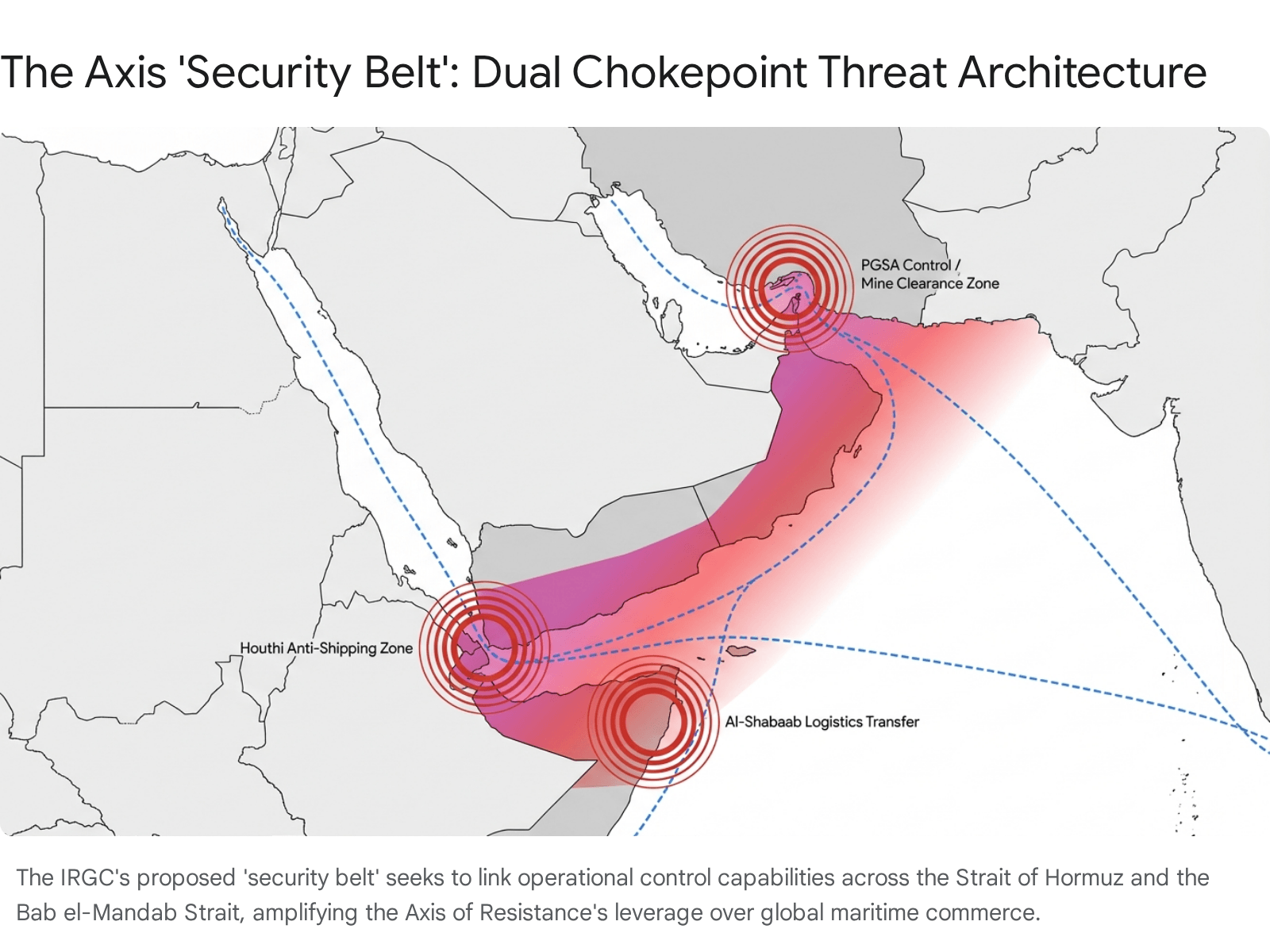
To summarize the operational status of the region’s primary maritime corridors as of June 20, 2026:
| Maritime Corridor | Current Operational Status | Primary Threat Vector | Regulatory/Administrative Authority |
| Strait of Hormuz | Reopening; Fast-tracked clearing operations ongoing.1 | Residual sea mines; Unresolved long-term fee structures.1 | Persian Gulf Strait Authority (PGSA).4 |
| Persian Gulf Ports | US Blockade Lifted; Backlog clearing.1 | Congestion of stranded vessels.1 | Port-specific authorities. |
| Bab el-Mandab / Red Sea | Highly volatile; Subject to Houthi targeting.16 | Anti-ship missiles; Harassment by small vessels.16 | Contested; International naval task forces present.19 |
| Gulf of Aden / Horn of Africa | Elevated Risk.18 | Potential Houthi/Al-Shabaab technological proliferation.18 | International waters. |
2.3 The Role, Reactions, and Involvement of Third-Party Countries
The resolution of the 2026 Iran War has permanently altered the regional diplomatic architecture. The conflict’s economic fallout and subsequent diplomatic resolution have elevated specific states to unprecedented levels of influence while exposing the critical vulnerabilities of traditional economic hubs. During the June 13-20 reporting period, the reactions of these third-party actors crystallized.
Pakistan: The Strategic Pivot and Economic Dividends The Government of Pakistan emerged as the indispensable mediator of the crisis, successfully brokering the initial April 8 ceasefire and hosting the historic, albeit initially failed, “Islamabad Talks” before ultimately securing the final MoU.1 On June 18, Prime Minister Shehbaz Sharif officially signed the Islamabad MoU in his capacity as the formal mediator and guarantor of the agreement.2
- Security Imperatives: Islamabad’s intervention was driven by acute strategic self-preservation rather than altruism. Sharing a highly porous 900-kilometer border with Iran and relying heavily on Persian Gulf energy supplies, Pakistan faced catastrophic economic inflation, energy insecurity, and domestic border instability if a prolonged US-Iran regional war continued.6
- The “Look East” Trade Realignment: Following the wartime closure of traditional UAE financial routes to Iran, Tehran accelerated its “Look East” doctrine, seeking to permanently reroute its continental trade through Pakistani overland corridors and the deep-water port of Gwadar.6 Intelligence estimates suggest that fully activating an Iran-Pakistan-China land corridor—integrating Iran into the $62 billion China-Pakistan Economic Corridor (CPEC) framework—could yield Pakistan up to $45 billion in annual revenue from transit, logistics, and warehousing operations.7
- Implementation Friction: Despite the diplomatic triumph, systemic bureaucratic inefficiencies within Pakistan continue to hinder optimal commercial execution. Hundreds of Iranian vessels that sought safe harbor near Karachi during the US blockade remain stalled due to administrative delays, highlighting a significant gap between Islamabad’s strategic ambitions and its operational capacity.6 Furthermore, US intelligence previously suspected Pakistan of covertly harboring Iranian military aircraft (such as the RC-130) at Nur Khan airbase during the height of the conflict to shield them from American strikes, indicating complex, multi-layered alliances operating beneath the diplomatic surface.1
The People’s Republic of China (PRC): The Strategic Beneficiary The PRC has positioned itself as the premier geopolitical beneficiary of the Islamabad MoU. Through calculated restraint, Beijing secured its primary strategic objectives—the stabilization of the Middle East and the unencumbered resumption of Iranian oil exports—without deploying its own military assets or depleting its financial reserves.8
- Diplomatic Messaging: On June 18, Chinese Foreign Ministry spokesperson Lin Jian publicly welcomed the signing of the MoU, commending its positive significance for easing regional tensions and avoiding further catastrophic economic fallout.23 However, Beijing subtly criticized the deferred nature of the agreement, urging both the United States and Iran to approach the impending “stage two negotiations” with a “rational and practical attitude” to ensure the fragile agreement holds.23
- Regional Influence: Chinese Foreign Minister Wang Yi held direct consultations with his Iranian counterpart to validate the deal, reinforcing China’s status as the ultimate guarantor of Iran’s economic survival via its massive, sustained oil purchases.8 Analysts assess that the crisis validated the fragility of US security umbrellas in the eyes of Gulf Cooperation Council (GCC) states, thereby accelerating regional openness to Chinese multilateral engagement.9 This strategic positioning will be further solidified as Wang Yi attends the 16th Meeting of BRICS National Security Advisors in India immediately following this reporting period.23
The United Arab Emirates (UAE): Caution and Recalibration Prior to the war, the UAE—specifically Dubai—served as the central commercial conduit for Iranian international trade and banking.6 The outbreak of hostilities forced the UAE to sever or severely restrict these ties to comply with US blockades and to protect its own infrastructure from potential IRGC retaliation.6
- Financial Leverage and Reconstruction: In compliance with the MoU’s reconstruction parameters, the UAE immediately transferred $3 billion as the first installment of a pledged $10 billion national contribution to the Iranian economic development fund.1 This rapid disbursement indicates Abu Dhabi’s willingness to utilize financial leverage to secure Iranian goodwill and prevent future proxy attacks.
- Strategic Distancing: While Abu Dhabi is cautiously moving to restore select commercial channels, a profound strategic suspicion remains. The war demonstrated that the UAE possesses an unsustainably high vulnerability to asymmetric attacks on its critical energy, transport, and desalination infrastructure.24 Consequently, commercial relations have not returned to their pre-war equilibrium. This persistent strategic distancing is directly contributing to Iran’s aggressive pivot toward Pakistan’s Gwadar port as a safer, alternative logistical hub.6
Other International Actors
- Germany and the European Union: Despite the signing of the MoU and the theoretical reopening of the Strait of Hormuz, European nations remain highly skeptical of the PGSA’s ability or willingness to ensure safe, unconditional transit. Reflecting this distrust, on June 18, the German Ministry of Defense announced the deployment of two naval vessels to the Red Sea in preparation for a potential independent military escort mission through the Hormuz chokepoint.4
- Qatar and Oman: Qatar stepped in during the final hours of the MoU negotiations to provide critical financial guarantees and implementation mechanisms necessary to overcome a near-collapse of the talks over the highly contentious issue of Lebanese sovereignty and Israeli strike autonomy.6 Oman, historically a neutral facilitator, is explicitly named in the MoU as the future co-administrator, alongside Iran, of maritime services in the Strait of Hormuz. This provision significantly elevates Muscat’s role in the future security architecture of the Persian Gulf.1
3. Chronological Timeline of Key Events
The following timeline details the specific sequence of events, intelligence indicators, and diplomatic milestones that occurred during the strict 7-day reporting window of June 13 to June 20, 2026.
- June 13, 2026:
- Intelligence satellites observe three unladen Iran-flagged tankers and one associated “ghost fleet” tanker 13 anchored approximately 20 kilometers offshore from Galle, Sri Lanka. The vessels sought logistical support from local service providers while evading the ongoing US naval blockade, signaling preparations to return to the Gulf amid rumors of an impending deal.13
- June 14, 2026:
- The framework text for the “Islamabad Memorandum of Understanding” is officially drafted. An initial phase of the agreement is signed by US Vice President JD Vance and Iranian chief negotiator Mohammad Bagher Ghalibaf, witnessed by President Trump, signaling an imminent diplomatic breakthrough after 15 weeks of high-intensity conflict.
- June 15, 2026:
- Pakistan Prime Minister Shehbaz Sharif publicly announces that the United States and Iran have reached a preliminary agreement, validating Pakistan’s role as the primary mediator.2
- Think tanks and policy analysts in Washington formally acknowledge the framework, noting the 60-day ceasefire parameters, the imminent reopening of the Strait of Hormuz, and the reversal of JCPOA-era sequencing.3
- June 17, 2026:
- The Islamabad Memorandum is officially signed. US President Donald Trump remotely signs the document during a G7 summit dinner with French President Emmanuel Macron at the Palace of Versailles. Iranian President Masoud Pezeshkian signs the document in Tehran.1
- Iranian Supreme Leader Mojtaba Khamenei issues a written statement endorsing the 14-point memorandum, despite expressing institutional misgivings regarding the US commitment.1
- NYK Bulkship (Asia) concludes a time-charter contract with JERA for two low-carbon ammonia transport vessels, reflecting immediate corporate responses to the anticipated stabilization of maritime shipping routes.4
- June 18, 2026:
- US Central Command (CENTCOM) officially announces via social media that the United States military has completely lifted its naval blockade on maritime traffic entering and exiting Iranian ports.1
- Iranian state media reports that 11 Iranian merchant ships successfully break through the Strait of Hormuz immediately following the MoU signing, marking the first commercial movements since the blockade began.1
- Iran’s Supreme National Security Council formally tasks the “Persian Gulf Strait Authority” (PGSA) with issuing fast-tracked authorizations for ships passing through the Strait, establishing strict routing and timing mandates to avoid residual sea mines.4
- Pakistan Prime Minister Shehbaz Sharif officially countersigns the Islamabad MoU in his capacity as the state mediator, declaring the agreement has entered into force.22
- Chinese Foreign Ministry spokesperson Lin Jian issues a formal statement welcoming the MoU, urging both parties to uphold the spirit of the contract in good faith during the upcoming “stage two” negotiations.23
- The German Ministry of Defense announces the deployment of two naval vessels to the Red Sea, preparing for a potential independent military mission to secure the Strait of Hormuz despite the ceasefire.4
- Late in the day, Washington announces the postponement of technical talks on a final settlement scheduled for June 19 in Geneva, Switzerland, citing that logistics for Vice President JD Vance’s travel were not “simple or predictable.”
- June 19, 2026:
- The White House releases the official, unredacted 14-point text of the Islamabad Memorandum. President Trump issues statements claiming the agreement ensures Iran will never obtain a nuclear weapon and successfully restores global free navigation.5
- Independent defense analysts publish comprehensive critiques of the MoU text, highlighting the inherent strategic risks of granting immediate economic relief (oil waivers, asset releases) while deferring verifiable nuclear down-blending to future negotiations, noting the lack of IAEA access since February.5
- The planned technical negotiations in Geneva fail to commence following the US delegation’s cancellation of travel.
- June 20, 2026:
- Regional economic realignment accelerates. A high-level commercial business delegation from Mashhad, Iran, arrives in Pakistan to formalize new trade corridors and supply chains, capitalizing on the strategic shift away from UAE-based logistics toward the Gwadar port integration.6
Please share the link on Facebook, Forums, with colleagues, etc. Your support is much appreciated and if you have any feedback, please email us in**@*********ps.com. If you’d like to request a report or order a reprint, please click here for the corresponding page to open in new tab.
Sources Used
- 2026 Strait of Hormuz crisis – Wikipedia, accessed June 20, 2026, https://en.wikipedia.org/wiki/2026_Strait_of_Hormuz_crisis
- Full Text of the Islamabad Memorandum of Understanding between …, accessed June 20, 2026, https://middleeastoutlook.com/2026/06/19/full-text-of-the-islamabad-memorandum-of-understanding-between-the-united-states-and-iran/
- The United States and Iran Announce a Deal to End the War | State of Play – CSIS, accessed June 20, 2026, https://www.csis.org/analysis/united-states-and-iran-announce-deal-end-war-state-play
- Iran’s Strait Authority To Facilitate Passage Through – Marine Link, accessed June 20, 2026, https://www.marinelink.com/news/irans-strait-authority-facilitate-passage-540477
- Trust, Then Verify Later – Small Wars Journal, accessed June 20, 2026, https://smallwarsjournal.com/2026/06/19/trust-then-verify-later/
- Pakistan successfully brokered peace between the US and Iran …, accessed June 20, 2026, https://www.dawn.com/news/2009462/pakistan-successfully-brokered-peace-between-the-us-and-iran-can-it-now-reap-the-dividend
- A Strategic Conundrum: Pakistan’s Transit Corridor to Iran as Lifeline or Liability, accessed June 20, 2026, https://mei.edu/publication/a-strategic-conundrum-pakistans-transit-corridor-to-iran-as-lifeline-or-liability/
- What the US-Iran deal means for the rest of the Middle East (and beyond) – Atlantic Council, accessed June 20, 2026, https://www.atlanticcouncil.org/dispatches/what-the-us-iran-deal-means-for-the-rest-of-the-middle-east-and-beyond/
- How Trump’s Iran war boosted Beijing – ThinkChina.sg, accessed June 20, 2026, https://www.thinkchina.sg/politics/how-trumps-iran-war-boosted-beijing
- The US–Iran memorandum of understanding nods to international …, accessed June 20, 2026, https://www.chathamhouse.org/2026/06/us-iran-memorandum-understanding-nods-international-law-can-be-taken-seriously
- President Trump’s Iran Agreement Is America First in Action, accessed June 20, 2026, https://www.whitehouse.gov/releases/2026/06/president-trumps-iran-agreement-is-america-first-in-action/
- Trump’s Iran Deal: What We Know So Far – Council on Foreign Relations, accessed June 20, 2026, https://www.cfr.org/articles/is-a-u-s-iran-deal-within-reach-six-key-issues-that-could-shape-a-ceasefire
- Iran War Shipping Update – June 15, 2026 | UANI, accessed June 20, 2026, https://www.unitedagainstnucleariran.com/blog/iran-war-shipping-update-june-15-2026
- Iran and the new Persian Gulf equilibrium | Chatham House, accessed June 20, 2026, https://www.chathamhouse.org/2026/06/iran-and-new-persian-gulf-equilibrium
- Yemen: Briefing and Consultations : What’s In Blue, accessed June 20, 2026, https://www.securitycouncilreport.org/whatsinblue/2026/06/yemen-briefing-and-consultations-45.php
- Yemen’s Houthis declare ‘total ban’ on Israeli ships in Red Sea – Al Arabiya, accessed June 20, 2026, https://english.alarabiya.net/News/middle-east/2026/06/08/yemen-s-houthis-declare-ban-on-israeli-shipping-in-red-sea-statement
- The next Strait of Hormuz crisis could be even worse – Chatham House, accessed June 20, 2026, https://www.chathamhouse.org/2026/06/next-strait-hormuz-crisis-could-be-even-worse
- Houthis and Al-Shabaab conspiring to choke Red Sea routes – Asia Times, accessed June 20, 2026, https://asiatimes.com/2026/06/houthis-and-al-shabaab-conspiring-to-choke-red-sea-routes/
- Red Sea crisis – Wikipedia, accessed June 20, 2026, https://en.wikipedia.org/wiki/Red_Sea_crisis
- Red Sea Uncertainty: A 2026 Forecast for the Houthis Actions – Global Security Review, accessed June 20, 2026, https://globalsecurityreview.com/red-sea-uncertainty-a-2026-forecast-for-the-houthis-actions/
- 2026 Iran war ceasefire – Wikipedia, accessed June 20, 2026, https://en.wikipedia.org/wiki/2026_Iran_war_ceasefire
- Pakistani premier signs Islamabad MoU as mediator between US, Iran, accessed June 20, 2026, https://www.aa.com.tr/en/world/pakistani-premier-signs-islamabad-mou-as-mediator-between-us-iran/3970578
- Foreign Ministry Spokesperson Lin Jian’s Regular Press Conference on June 18, 2026, accessed June 20, 2026, https://www.fmprc.gov.cn/mfa_eng/xw/fyrbt/202606/t20260618_11948720.html
- How the Iran war will change the Middle East | Brookings, accessed June 20, 2026, https://www.brookings.edu/articles/how-the-iran-war-will-change-the-middle-east/