Executive Overview
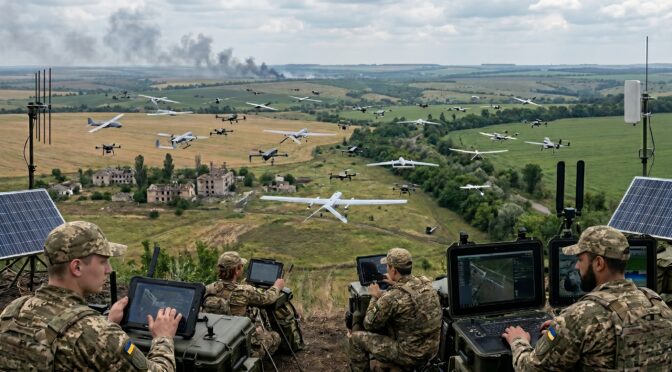
The character of modern high-intensity warfare is undergoing a foundational phase transition, driven by the rapid commoditization of commercial technology, open-source artificial intelligence, and the grueling attritional realities of the contemporary battlefield. Nowhere is this transformation more violently apparent than on the Ukrainian front lines. What began as an ad-hoc reliance on commercially available first-person view drones has rapidly evolved into a sophisticated, state-integrated ecosystem of semi-autonomous and fully autonomous lethal unmanned systems. The imperative to remove the human operator from the sensory and cognitive loops of the targeting process is no longer a theoretical exercise explored in defense white papers; it is an active operational requirement dictated by the proliferation of trench-level electronic warfare and the strategic need for scalable mass.
This comprehensive strategic assessment analyzes the evolution, tactical efficacy, and technological maturity of autonomous drone systems deployed within the Russo-Ukrainian theater. By examining documented battlefield deployments—specifically a pioneering, lethal test of fully independent artificial intelligence quadcopters operating without human oversight—this analysis explores the convergence of machine vision, edge computing, and kinetic lethality. The report evaluates flagship platform architectures, assesses the countermeasures developed to bypass signal degradation, and projects the macro-strategic implications of algorithmic warfare on conventional deterrence and international humanitarian law. The findings indicate that the technological threshold separating human-assisted targeting from full lethal autonomy has already been crossed, leaving only fragile policy directives as the remaining barrier to widespread, autonomous algorithmic combat.
The Strategic Context: Scaling the Unmanned Ecosystem
To understand the trajectory of autonomous weapons, one must first analyze the human and industrial ecosystem that necessitated their creation. The Ukrainian armed forces have achieved an unprecedented mobilization of technical human capital, sustaining an active combat roster estimated between 25,000 and 40,000 unmanned aerial vehicle operators.1 This organic network, which evolved rapidly from a decentralized cadre of civilian hobbyists during the initial 2014 incursions, has since been institutionalized into a highly sophisticated web of military, private, and corporate academies.1
The pedagogical pipeline supporting this force is ruthlessly efficient. Everyday citizens are drafted, trained, and transformed into lethal combat operators within a highly compressed 30 to 60-day timeline.1 This rapid generation of combat power is facilitated by advanced synthetic training environments, most notably the cutting-edge “FPV Battleground” simulator.1 This simulation architecture perfectly replicates the real-world electromagnetic spectrum, intentionally subjecting trainees to simulated electronic warfare interference and total signal loss, which is critical for pre-mission planning and psychological conditioning.1 The training regimens encompass a wide spectrum of platforms, from commercial off-the-shelf surveillance multirotors to heavy-lift bomber configurations and high-speed kinetic interceptors.1
However, the sheer demand for human operators presents a profound vulnerability. The cognitive load placed on a human operator navigating a drone through a contested electromagnetic environment is immense, leading to rapid psychological and operational burnout. As military strategists note, the need for tens of thousands of highly trained operators presents a major constraint on the scalability of drone warfare.2 While Ukraine has largely relied on an agile, startup-driven innovation model, the Russian Federation has transitioned to a strategy of sheer industrial mass.2 Maintaining parity against an adversary with superior manufacturing capacity requires a force multiplier. This asymmetry forms the strategic genesis for the integration of artificial intelligence; autonomy is viewed not merely as an upgrade in precision, but as a critical mechanism to decouple the generation of combat mass from the limitations of the human operator pool.2
The Rubicon Event: Tactical Anatomy of the Bakhmut and Chasiv Yar Trials
The conceptual shift from human-piloted remote-controlled drones to fully independent robotic combatants was practically realized during a one-off battlefield test approximately two years ago, in 2024, amidst a major Ukrainian counteroffensive.4 Conducted near the heavily contested urban centers of Bakhmut and Chasiv Yar, this operation represents the most concrete, publicly acknowledged instance of fully autonomous lethal unmanned aerial vehicles identifying and executing human targets without any human-in-the-loop oversight.4 As publicly disclosed by Kokhanovskyy at a press event hosted by the Ukrainian Embassy in London, this operation serves as definitive proof of algorithmic kill-chain viability in live combat.7
The mission utilized a batch of ten artificial intelligence-controlled quadcopter drones developed by the Ukrainian defense manufacturer Aero Center, led by Chief Executive Officer Alexander Kokhanovskyy.4 Kokhanovskyy, a veteran of the esports and digital technology sectors who co-founded ESforce Holding and Natus Vincere, pivoted his expertise in digital management toward the optimization of autonomous military hardware.4 The tactical execution of the Bakhmut test was specifically designed to bypass the traditional remote-control paradigms that rely on continuous radio frequency links, which are highly vulnerable to Russian electronic countermeasures in the Donbas region.4
The drones were pre-programmed with a designated geographical engagement zone and launched toward entrenched Russian positions.4 The flight profile consisted of a three to five-kilometer transit over approximately ten minutes.4 Upon reaching the boundaries of the designated kill box, the unmanned aerial vehicles activated an onboard algorithmic protocol internally designated by the manufacturer as “Terminator mode”.4
During this terminal phase, the operational constraints placed upon the systems were absolute and unprecedented: The systems intentionally operated with a complete connectivity blackout. There was zero connection to the command node; no telemetry feed was broadcast, no video transmission was available to the operators, and there was no override capability available to abort the mission.4 The onboard artificial intelligence assumed total and unmitigated control over flight mechanics, sensor fusion, target discrimination, and kinetic engagement.4 The pre-programmed parameters were binary and absolute. As Kokhanovskyy stated regarding the system’s lethal logic, “We just launch it and we know everything will be dead – everything that will be found there in this particular area will be dead”.4 However, he clarified the limited scope of the deployment, stating, “We tried it… It’s a test. We never implemented it [more widely].” 7 The artificial intelligence independently scanned the environment, identified entities that matched its training data for enemy assets, and executed kamikaze strikes.4
Because the drones transmitted no live feed during their autonomous engagement phase, post-strike battle damage assessments were conducted by separate, human-operated reconnaissance drones that swept the target area following the operation.4 The battle damage assessment concluded that the autonomous quadcopters had successfully engaged and destroyed a Russian logistical truck and killed a couple of Russian combatants.4 While no actual video footage of the strikes was captured, investigators verified that the deaths and destruction were directly caused by these autonomous systems.4
This deployment was explicitly characterized as a singular trial rather than a widespread doctrinal shift, yet its success fundamentally alters the technological baseline of modern combat.4 It proves that the hardware and software required to execute fully autonomous lethal missions are not restricted to the billion-dollar procurement programs of global superpowers; they are available to agile, startup-driven defense sectors operating under severe wartime constraints. The trial demonstrated that artificial intelligence can successfully execute the entire find-fix-track-target-engage sequence in a degraded, real-world environment, crossing an ethical and operational boundary that has historically defined the laws of armed conflict.4
The Physics of the Last Mile and the Necessity of Terminal Autonomy
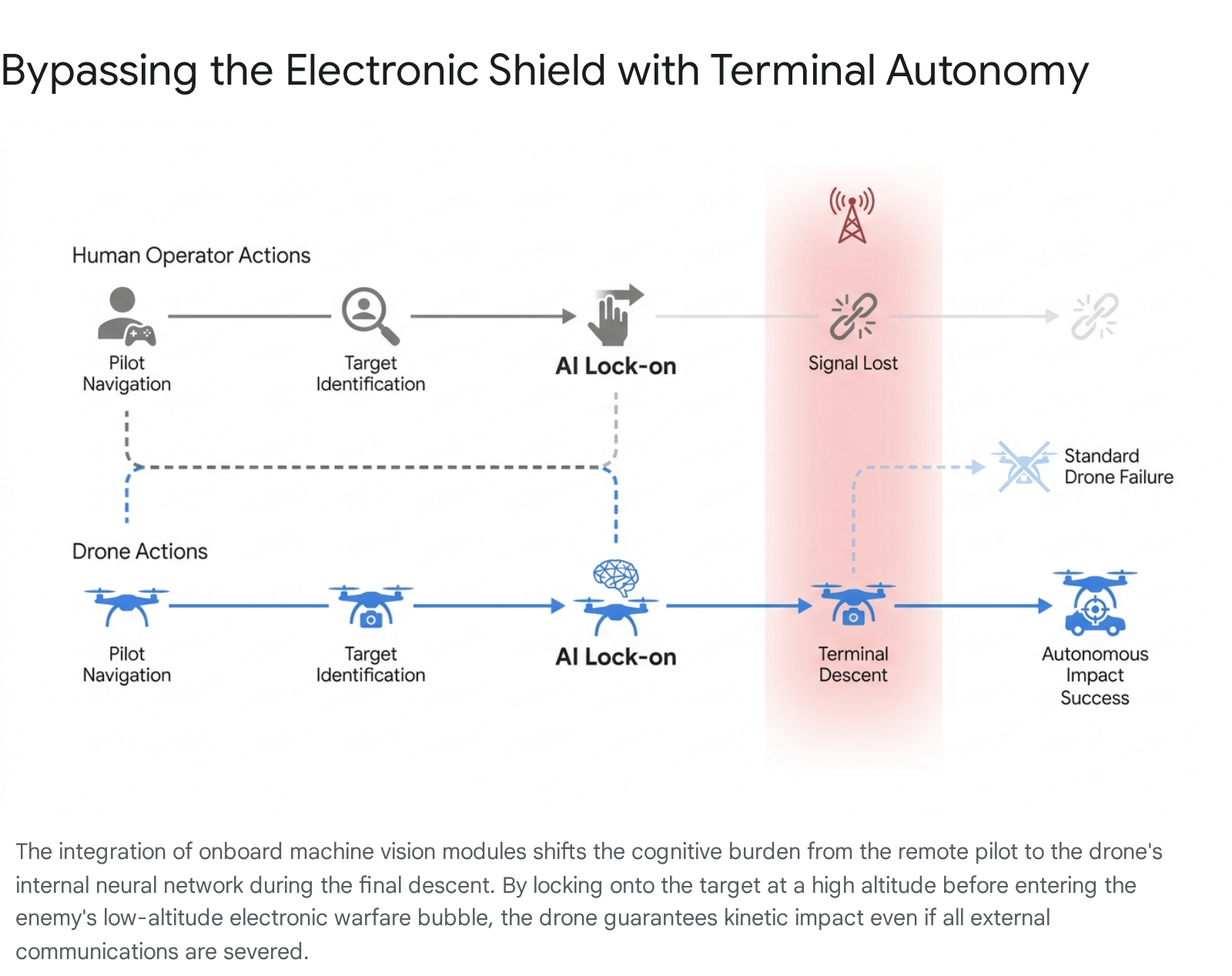
While the Bakhmut trials represent the extreme end of the autonomy spectrum, the vast majority of artificial intelligence deployment in the current theater operates one step below full independence, focusing on what military strategists term “terminal guidance” or “last-mile autonomy.” This intermediate phase is not born of a desire for sophisticated technology, but rather is an operational necessity driven by the realities of Russian trench-level electronic warfare, which severely degrades the video link and control signals of first-person view drones precisely as they descend toward their targets.3
In a standard engagement, a human operator relies on an analog or digital video feed to manually steer the drone into a target. As the drone drops in altitude to strike a vehicle or infantry position, the line-of-sight signal is often broken by terrain, foliage, or the curvature of the earth. Concurrently, Russian tactical electronic warfare systems project localized jamming cones that overwhelm the control frequencies.14 These localized systems barely existed prior to 2022 but are now a ubiquitous feature of the Russian defensive posture, exemplified by the highly advanced “Volnorez” system.15 The Volnorez is a secretive, tank-mounted jammer designed to emit radio frequency interference that directly disrupts the control signals of incoming kamikaze drones, forcing them to hover aimlessly or crash. Consequently, a staggering 60 to 80 percent of traditional Ukrainian first-person view drones fail to reach their target due to signal loss, weather constraints, or operator error during the final moments of flight.14
The critical need to bypass systems like the Volnorez drives the rapid integration of onboard machine vision. Notably, Ukrainian forces recently captured an intact Volnorez system, complete with its operational documentation, during a raid in the Kursk region; this physical exploitation allows autonomous engineering firms to rapidly retrain their guidance algorithms to filter out and overcome the latest jamming frequencies.
Companies such as The Fourth Law and Saker have engineered localized hardware modules—essentially compact computers equipped with camera sensors and artificial intelligence algorithms—that mount directly onto standard airframes.13 The Fourth Law, led by Chief Executive Officer Yaroslav Azhniuk, has developed the TFL-1 module, an inexpensive yet powerful electronic component that costs a mere $50 to $100 and can be installed between the mounting rails of common 7-inch or 10-inch drone configurations.16
The operational mechanism of this technology represents a masterclass in hybrid human-machine teaming. A human pilot navigates the drone into the general vicinity of the battlefield, maintaining a high altitude to preserve the radio frequency link.13 Using the drone’s optics, the pilot identifies a target—such as a moving truck or an artillery piece—from a standoff distance, typically between one and two kilometers away.13 The pilot then utilizes the software interface to place a digital bounding box over the target, flipping a single switch to engage the target lock-on function.13
At this precise moment, control transitions entirely from the manual pilot to the onboard artificial intelligence.13 The module severs its reliance on vulnerable external communications and global positioning systems.13 Two internal algorithms then work in tandem: one continuously tracks the target’s movement, while the other manages the drone’s complex flight mechanics.17 A separate neural network refines the target’s boundaries in real-time, allowing the system to recognize a target even as it passes through shadows, treelines, or other visual distortions that typically disrupt basic pixel-tracking software.17 This allows platforms like the VGI-9 system to autonomously track targets moving at speeds up to 80 kilometers per hour, ensuring precise engagement despite the vehicle’s ongoing motion.19
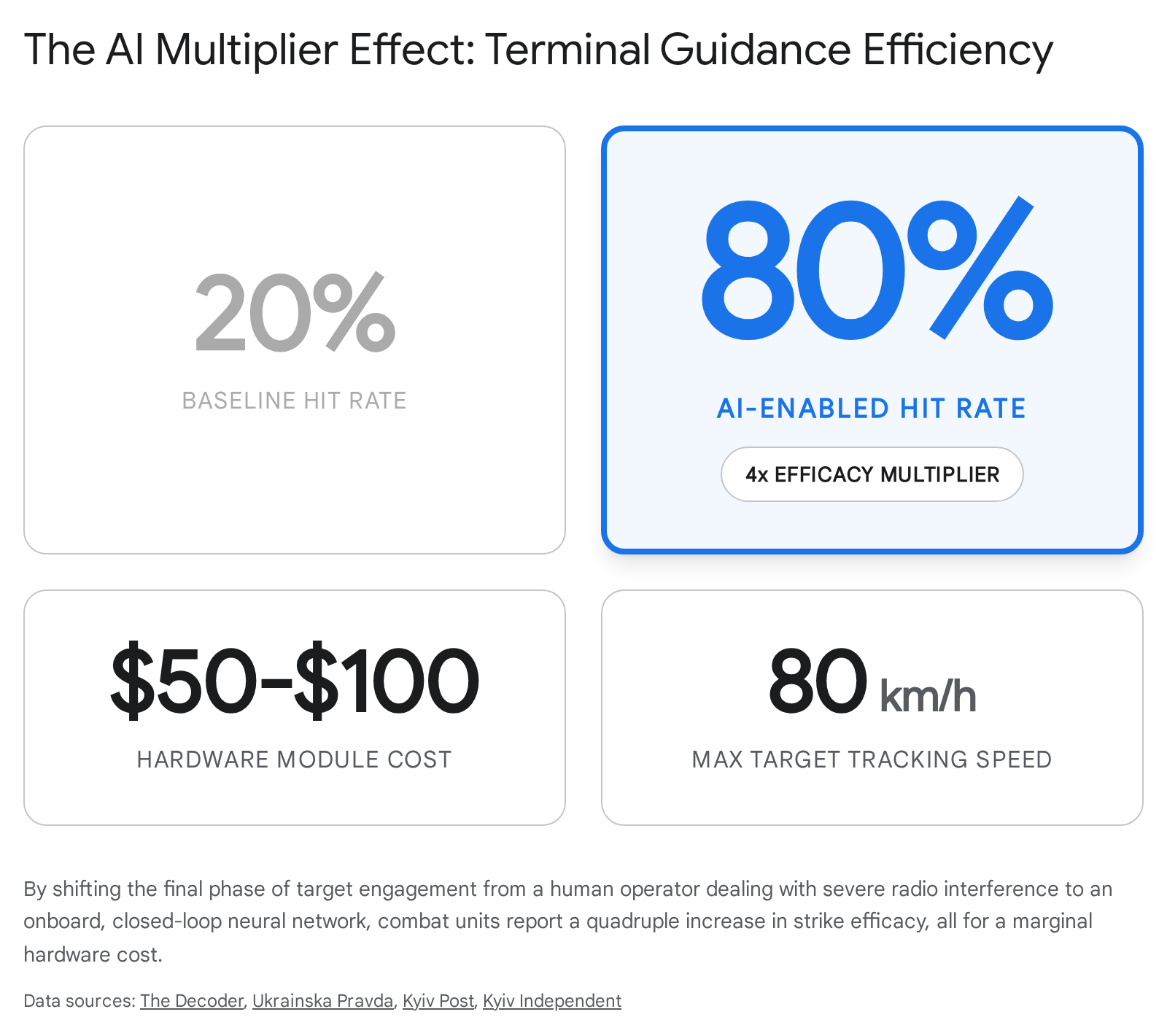
The deployment of these modules has radically altered battlefield mathematics. According to combat data aggregated by The Fourth Law, the integration of their TFL-1 module increases the strike effectiveness rate of drones from a baseline of 20 percent to an extraordinary 80 percent.16 This capability is being heavily incentivized by the Ukrainian high command; for each confirmed strike utilizing the TFL-1 module, military personnel receive additional “e-scores”—official reward points equivalent to approximately 10,000 Ukrainian Hryvnia (roughly $242 USD) in equipment value, which can be spent on the Brave1 defense technology marketplace to procure further armaments.16
Other platforms are pushing this boundary even further. The Saker Scout drone, first developed for agricultural use in 2021 before being deployed to the front lines in 2023, is widely advertised for its advanced machine vision.13 The system is reportedly capable of independently identifying 64 distinct categories of Russian military equipment, allowing it to carry out autonomous strikes after losing global positioning and radio signals.21 It operates with a maximum range of 12 kilometers and can deliver a payload of up to three kilograms, acting as a highly persistent hunter-killer element over the battlefield.22
Platform Architecture Analysis: Evaluating the Vanguard Systems
To properly contextualize the strategic trajectory of drone warfare, one must analyze the specific platforms driving the conflict. The Ukrainian defense sector has pivoted away from modifying fragile commercial photography drones, opting instead to engineer bespoke military platforms capable of carrying heavy payloads over vast distances in continuously hostile electromagnetic environments.
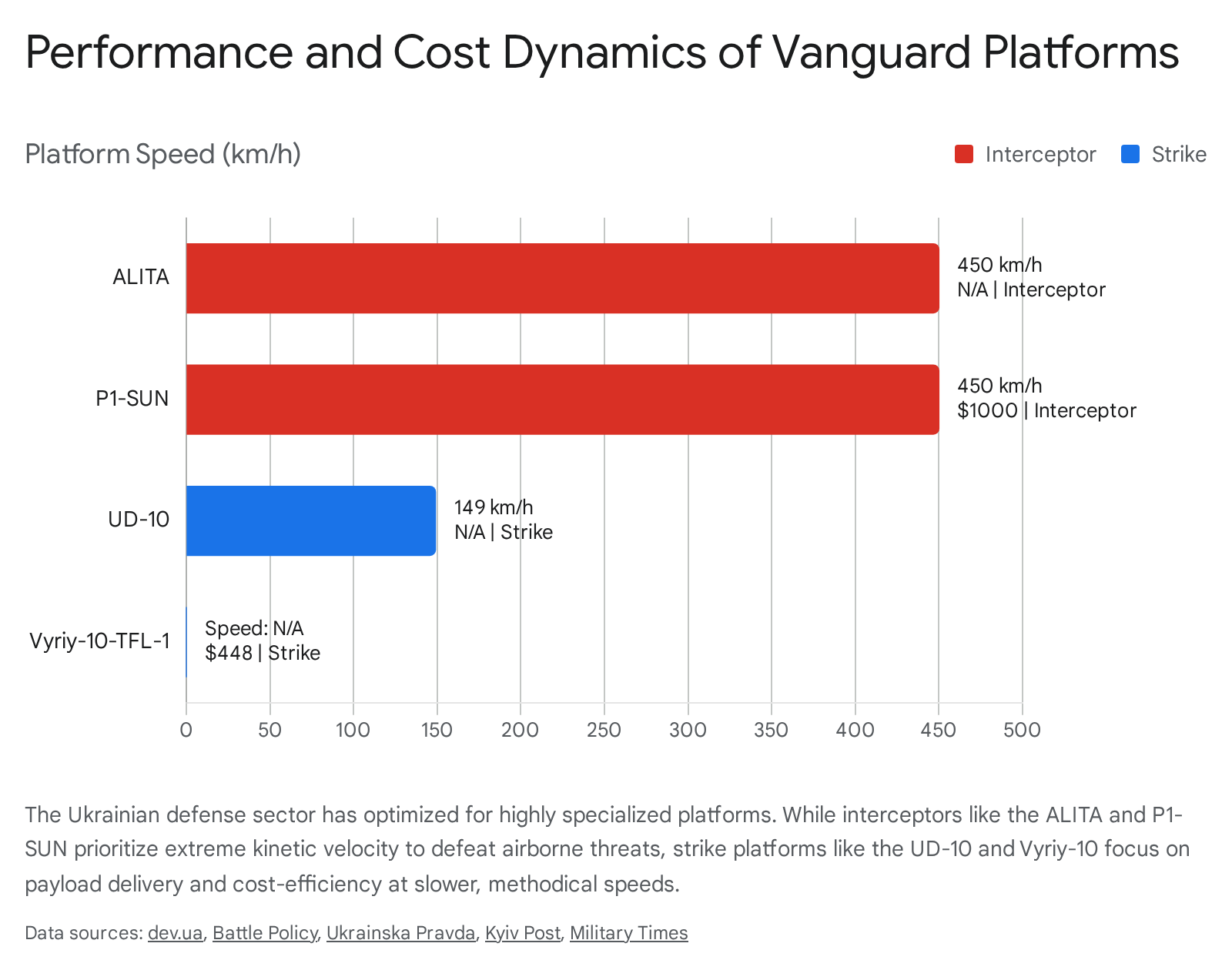
The UD-10 strike unmanned aerial vehicle complex, recently codified and adopted for widespread operation by the Ukrainian Ministry of Defense, represents the current gold standard for medium-to-heavy strike platforms.24 Developed by Aero Center, the system is designed for the pinpoint destruction of enemy armor and fortified manpower, featuring exceptional maneuverability and a highly compressed deployment time of just 5.5 minutes.24
Simultaneously, the Vyriy engineering company has established mass production of the Vyriy-10 platform, fully integrated with The Fourth Law’s artificial intelligence guidance modules.16 Chief Executive Officer Oleksii Babenko prioritized maintaining a low cost to ensure units are affordable on a massive scale.16 The Vyriy-10-TFL-1 variant is priced at just 18,500 Ukrainian Hryvnia (approximately $382 to $448 USD), representing a mere 10 percent cost increase over a standard, non-intelligent drone.16
The following table provides a comprehensive technical comparison of the primary strike platforms currently dictating the pace of attrition across the forward line of own troops.
| Platform Designation | Manufacturer | Frame Size | Max Payload | Operational Range | Max Speed | AI / Guidance Capability | Strategic Role |
| UD-10 | Aero Center | 10-inch | 3.5 kg | 15 km (w/ 2.5kg load) to 25 km | 149 km/h | Digital Video / Multi-camera | Medium Strike / Anti-Armor 24 |
| UD-10 FO | Aero Center | 10-inch | 1.5 kg | 11 km (physical tether) | 140 km/h | Un-jammable Fiber Optic | Precision Strike in Heavy EW 26 |
| UD-15 XXL | Aero Center | 15-inch | 15.0 kg | Up to 22 km | 110 km/h | Modular Payload Bays | Heavy-Lift Bomber / Demolition 26 |
| Vyriy-10-TFL-1 | Vyriy / The Fourth Law | 10-inch | Standard | Standard FPV Range | High Maneuverability | TFL-1 Machine Vision / Lock-on | Mass-Deployed Precision Strike 16 |
| Saker Scout | Saker | Fixed Wing | 3.0 kg | Maximum 12 km | Recon Speed | Recognizes 64 target types | Autonomous Recon / Strike 21 |
The UD-15 XXL deserves specific analytical focus. By scaling the airframe to a 15-inch carbon structure, Aero Center has created a platform capable of delivering a massive 15-kilogram payload over 22 kilometers.26 This transitions the platform from a tactical nuisance weapon to an operational-level asset capable of destroying hardened command bunkers, bridges, and heavy armored recovery vehicles that standard three-kilogram payloads cannot penetrate.26
The Electromagnetic Counter-Revolution: The Return of Fiber-Optics
While artificial intelligence provides a software-based solution to the problem of electronic warfare, a parallel hardware revolution is occurring simultaneously across the front lines: the deployment of fiber-optic tethered drones.
As Russian forces saturate the battlespace with advanced trench-level radio frequency jamming equipment, establishing a clean communication link has become exceedingly difficult, even for digital systems employing rapid frequency hopping.2 In response to this electromagnetic denial, manufacturers have resurrected and modernized the Cold War concept of wire-guided munitions. Platforms such as the UD-10 FO (Fiber Optic) are equipped with an unspooling reel of hair-thin optical fiber that physically connects the drone to the operator’s ground station throughout the entirety of its flight profile.24
The technical specifications of the UD-10 FO demonstrate the severe tactical trade-offs inherent in this approach. The system supports a 10-kilometer-long fiber optic reel, allowing for completely secure, un-jammable, high-resolution digital video communication.24 During combat operations in the Pokrovsk direction, operators managed an astonishing feat, pushing a tethered drone out to 29 kilometers without suffering any degradation in video signal, confirming the exceptional reliability of the complex.24
However, this physical tether introduces strict aerodynamic and operational limitations. The spool itself adds significant drag and weight. As noted by Vladyslav Piotrovskyi, Chief Executive Officer of Dwarf Engineering, the margins on a combat drone are incredibly tight; an extra 100 grams of payload can reduce a drone’s effective range by two kilometers.28 Consequently, the fiber-optic variant of the UD-10 has a severely reduced payload capacity of 1.5 kilograms (down from 3.5 kilograms) and a slightly lower maximum speed of 140 kilometers per hour.26
Strategically, the choice between onboard artificial intelligence and fiber-optic tethers represents two distinct philosophies for defeating the electronic warfare matrix. Fiber optics provide a guaranteed, un-jammable human-in-the-loop connection, ensuring absolute positive identification and strict adherence to the rules of engagement.2 However, the physical tether constrains the drone’s maneuverability, limits its ability to operate in complex environments like dense forests or urban rubble where the line could snag, and tethers the operator to a predictable geographic radius.2 Conversely, artificial intelligence terminal guidance allows for infinite maneuverability and multi-axis swarming tactics, but it completely removes the operator’s ability to wave off a strike if a civilian enters the target radius at the last second. In the near term, forces are deploying both capabilities simultaneously, dynamically tailoring the platform choice to the specific electromagnetic geography of the localized battlespace.
The Autonomous Interceptor Paradigm: Reclaiming the Airspace
As the Russian military increasingly relies on long-range, Iranian-designed Shahed loitering munitions to terrorize Ukrainian population centers and critical energy infrastructure, the economic asymmetry of traditional air defense has become untenable. Firing a multi-million-dollar Patriot or NASAMS radar-guided missile to intercept a rudimentary drone that costs less than $50,000 is a mathematically doomed attritional strategy.29 The realization of this deficit has spurred the rapid development of the autonomous interceptor battery.
Aero Center is currently engineering a system designated ALITA, which is designed to radically alter the cost-exchange ratio of continental air defense.5 The ALITA complex is a distributed, autonomous interceptor battery consisting of 16 launch pads that collectively house 64 high-speed interceptor drones.5 The system is designed to maintain persistent overwatch, automatically detecting incoming threats ranging from small reconnaissance assets to heavy attack helicopters.5 Upon threat detection, the system launches autonomously, with interceptors capable of reaching extreme kinetic speeds of up to 450 kilometers per hour to violently collide with the target.5
This project requires immense software integration. Aero Center is collaborating directly with Dwarf Engineering, a software company specializing in multiplatform mission control systems, to build a comprehensive interceptor package that seamlessly integrates the drone, payload, and targeting software directly into Ukraine’s existing national air defense network.28 While current Ministry of Defense regulations require two human operators per ALITA battery to provide final terminal authorization before impact, Kokhanovskyy notes that the system is fundamentally architected for complete, closed-loop autonomy and is scheduled to be operational by October.5
At the lower end of the cost spectrum, tactical systems like the SkyFall P1-SUN provide localized, highly effective air defense. The P1-SUN is a modular, 3D-printed interceptor that costs a mere $1,000 per unit.28 Upgraded with advanced computer vision and thermal imaging, the drone is capable of reaching 280 miles per hour.28 Within a four-month deployment window, this platform reportedly downed over 1,500 Shahed drones and 1,000 other reconnaissance assets, establishing itself as a highly sought-after commodity internationally, particularly as other nations seek affordable defenses against Iranian proliferation.28 Recognizing this strategic value, the United States government procured an initial batch of 1,000 P1-SUN drones to study the technology and inject Ukrainian combat experience into American military supply chains.32
Further augmenting this defensive layer is the Octopus interceptor, developed by Ukrspecsystems and currently built under license by more than 15 Ukrainian manufacturers, including a new factory established in the United Kingdom.28 The Octopus is capable of cutting through electronic jamming at altitudes up to 4,500 meters, locking onto targets autonomously at night, and providing all-weather reliability.28 This capability has prompted five NATO countries—Germany, France, Italy, Poland, and the United Kingdom—to jointly develop affordable interceptor drones based on this proven operational model.28
Combined Arms Synergies: Unmanned Ground-Air Integration
The maturation of autonomous and remote-controlled systems has catalyzed a fundamental restructuring of combined arms maneuver warfare. The historical sequence of mechanized infantry advancing under artillery cover is rapidly being replaced by synchronized waves of multi-domain robotics.
This profound doctrinal shift was vividly illustrated when Ukrainian forces achieved a historic military milestone: the capture of an entrenched Russian position utilizing entirely unmanned ground vehicles and aerial drones, with zero human infantry involved in the direct assault.19 This operation, celebrated by President Volodymyr Zelenskyy during an address to the defense industry, resulted in zero Ukrainian casualties and ultimately forced the occupying Russian personnel to surrender directly to the robotic force.19
The assault utilized a highly synchronized fleet of seven distinct ground robotic systems—including platforms designated as Ratel, TerMIT, Ardal, Rys, Zmiy, Protector, and Volia.19 These systems, which collectively executed over 22,000 frontline missions in the first quarter of 2026 alone, provided continuous kinetic suppression, logistical resupply, and obstacle-breaching capabilities.19
Crucially, while this operation was categorized as an “unmanned” victory, it was not fully autonomous in the lethal sense. The ground systems were manually remote-controlled by human operators positioned miles away in secure command nodes, strictly adhering to a human-in-the-loop doctrine for all attack decisions.19 However, the operation relied heavily on specialized artificial intelligence applications to manage the immense cognitive and sensory load required to coordinate such a complex assault.
The integration of specific AI subsystems was paramount: The “ZIR” Automatic Target Recognition system utilized hardware modules to continuously scan the battlefield, successfully identifying camouflaged infantry, vehicles, and armor at standoff distances of up to two kilometers.19 Concurrently, the “Zvook” acoustic detection system utilized advanced audio analysis to identify enemy drone signatures via sound profiles up to 4.8 kilometers away, feeding real-time targeting coordinates into the Ukrainian Delta situational awareness platform within 12 seconds.19 Additionally, the “Griselda” platform utilized natural language processing to automate 99 percent of the transcription and semantic analysis of intercepted Russian communications, providing predictive intelligence regarding enemy troop movements.19
This integration demonstrates that the immediate future of combat is not necessarily defined by solitary, independent machines, but rather by highly networked swarms of remote-controlled platforms augmented by AI sub-routines that handle sensor fusion, navigation, and anomaly detection, thereby allowing the human operator to focus solely on high-level tactical decision-making.
Countermeasures, Fratricide, and the Economics of Intelligent Mass
The discourse surrounding artificial intelligence and autonomous systems often overlooks the gritty, industrial realities of warfare. The strategic utility of a drone is dictated not just by the sophistication of its algorithmic targeting, but by the logistics of its production, the friction of its deployment, and the adversary’s capacity to adapt.
Algorithmic Exhaustion and Defensive Spoofing
Autonomous and semi-autonomous systems are highly susceptible to the fog of war. Neural networks trained on pristine imagery often struggle against real-world countermeasures. Russian forces have aggressively adapted, deploying sophisticated camouflage, thermal blankets, and iron decoy equipment designed specifically to trigger false positives in machine vision algorithms.17 Ukraine’s Metinvest group has been highly successful in this regard, manufacturing over 250 highly realistic metal and plywood decoys that mimic the appearance of radar stations and artillery pieces.33 When an autonomous drone, such as a Russian Lancet-3 or an intelligent loitering munition, misidentifies a decoy as a high-value asset, it expends an expensive kinetic effector on a worthless target, achieving the defender’s primary goal of resource depletion.2
This dynamic creates a continuous, high-speed software arms race. As adversaries deploy new decoys, engineers must rapidly retrain and update their Automatic Target Recognition models using smaller, localized datasets, pushing software updates to the front lines in a matter of weeks rather than years.17 Furthermore, the lack of communication that necessitates autonomy also breeds chaos. Without continuous data links, situational awareness collapses, leading to significant rates of drone fratricide.15 Ukrainian and Russian units operating in adjacent sectors without coordinated deconfliction frequently identify friendly unmanned aerial vehicles as hostile threats, shooting them down and degrading their own operational capacity.15 United Nations monitors have also recorded incidents, tracking 395 civilian deaths stemming from short-range drone operations, highlighting the severe risks of deploying indiscriminate systems in populated areas.34
Russian Adaptation and the Economics of Scale
The Russian Federation is not a static adversary. While Ukraine pioneered the agile integration of civilian technology, Russia has moved to leverage its massive military-industrial complex. Russian forces are deploying increasingly autonomous loitering systems, such as the V2U drone, which is equipped with its own onboard artificial intelligence target-recognition capabilities.29 Furthermore, Russian technical intelligence units have established dedicated laboratories in the occupied Donetsk region specifically tasked with rebuilding captured Ukrainian drones.35 These facilities systematically dismantle damaged or crashed Ukrainian unmanned aerial vehicles, recovering valuable components including motherboards, motors, and camera frames, and reassembling them into operational platforms to be turned back against Ukrainian forces.35
This highlights a core tenet of modern military strategy: cheap mass does not inherently equate to cheap victories.36 The strategic imperative is the transition from “cheap mass” to “intelligent mass.” The goal is to produce systems that are cheap enough to lose by the thousands, yet smart enough to navigate, survive, and strike effectively against layered defenses.36 If an adversary possesses a sufficiently dense air defense and electronic warfare grid, swarms of rudimentary, unguided drones merely donate airframes to the enemy.36 Injecting a baseline level of machine intelligence into mass-produced airframes allows a military to field a saturation swarm capable of dynamic target discrimination, overwhelming point defenses through sheer algorithmic coordination.3
The Regulatory Dilemma: International Law and Geopolitical Escalation
The hardware enabling last-mile terminal guidance is fundamentally indistinguishable from the hardware required for full, unregulated autonomy.12 The singular difference lies in the software parameters and the state-mandated rules of engagement. Ukraine’s current military regulations explicitly prohibit the use of fully autonomous artificial intelligence in the final stage of engaging targets; a human must always provide the ultimate authorization to kill.4 Units such as the 21st Separate Unmanned Systems Regiment strictly adhere to these semi-autonomous doctrines, leveraging artificial intelligence solely for navigation and tracking over the final meters, but never for independent target selection, maintaining adherence to international humanitarian law.30
However, the pressure to relax these restrictions is mounting rapidly. Drone manufacturers are actively lobbying the government in Kyiv to alter the rules of engagement, arguing that the speed, scale, and communication-denied reality of the battlefield mandate full autonomy.5 This creates a profound ethical tension. The United Nations Secretary-General António Guterres has repeatedly called for a binding international treaty to ban lethal autonomous weapon systems, arguing that machines cannot be held accountable for violating the principles of distinction and proportionality.4 Mariarosaria Taddeo, Professor of Digital Ethics and Defence Technologies at the Oxford Internet Institute, argues that delegating lethal decisions to artificial intelligence is deeply abhorrent because these systems are fundamentally indiscriminate; they cannot reliably differentiate between a combatant and a civilian, thereby stripping dignity from those killed and responsibility from those who ordered the attack.30
Despite these grave concerns, the lack of binding international law means that the evolution of these systems is currently governed solely by the immediate survival needs of the combatant nations.4 As the Organization for Economic Co-operation and Development noted in its artificial intelligence incident database, the secret deployment of fully autonomous drones near Bakhmut raises significant ethical and legal concerns precisely because it collapsed the difference between “AI-assisted” and “AI-decided”.4
The Restructuring of Conventional Deterrence
The rapid maturation of autonomous, long-range unmanned systems in Ukraine has initiated a profound crisis in traditional geopolitical deterrence theory. Historically, the global security architecture—particularly regarding nuclear-armed states—was predicated on the assumption that deep, strategic conventional strikes against critical infrastructure or command and control nodes would inevitably trigger catastrophic, and potentially nuclear, escalation.39
Ukraine’s deployment of domestically produced long-range unmanned aerial vehicles has systematically dismantled this assumption. By executing persistent, precision drone strikes deep into Russian territory—targeting early warning radar sites, strategic bomber bases, and critical energy infrastructure thousands of miles from the front line—Ukraine has introduced an entirely new calculus of conventional deterrence.14 Despite striking assets central to Russia’s nuclear umbrella, these operations have not provoked the feared nuclear response; instead, the Kremlin has absorbed the strikes as a manageable conventional cost.40
This strategic restraint signals a seismic shift in military thought. Deterrence is no longer solely guaranteed by the brute force of nuclear arsenals. Non-nuclear states, armed with deep magazines of intelligent, autonomous, and precision-guided unmanned systems, can hold a nuclear adversary’s strategic assets at continuous risk below the threshold of nuclear reprisal.40 The takeaway for modern policymakers is that deterrence must now rely less on overarching capability and more on the sophistication of targeting and the persistence of unmanned swarms.40
However, the proliferation of fully autonomous systems—the paradigm tested by Aero Center—introduces terrifying new escalation vectors. If artificial intelligence-enabled drone swarms are granted the authority to independently select targets and strike first in a crisis, the transparency, predictability, and human accountability required to manage geopolitical standoffs dissolve entirely.39 The compression of the observation and action loop achieved by algorithmic warfare may force adversaries to automate their own retaliatory systems, creating a highly precarious strategic environment where localized machine logic could inadvertently trigger rapid, vertical escalation beyond human control.39
Strategic Conclusions
The empirical data emerging from the Ukrainian theater confirms that the era of human-exclusive combat has unequivocally ended. The rapid evolution from modified commercial quadcopters to fully autonomous, artificial intelligence-driven lethal platforms represents a permanent restructuring of global military capability.
The findings of this strategic assessment highlight several critical realities: The technological threshold separating human control from machine autonomy has been definitively crossed. The battlefield trial of fully autonomous drones by Aero Center in Bakhmut proves that the hardware and software required for machines to independently hunt and kill human targets are mature, functional, and readily available.4 The only remaining barrier preventing mass deployment is self-imposed regulatory policy.5
The proliferation of trench-level electronic warfare makes continuous human-in-the-loop control unsustainable across wide frontages.14 The integration of terminal machine vision is not an elective, high-end upgrade; it is an existential operational requirement for kinetic success in a contested electromagnetic environment.19 Furthermore, the decisive advantage in future conflicts will not necessarily belong to the nation fielding the most expensive airframes, but to the force capable of the most rapid algorithmic iteration. The ability to update target recognition models weekly to defeat new camouflage, bypass iron decoys, and adapt to shifting electronic warfare frequencies is far more critical than raw explosive payload.2
Finally, the democratization of precision strike capabilities alters the global balance of power. Scalable, intelligent drone production allows smaller states to project strategic, deep-strike power, fundamentally altering the calculus of conventional and nuclear deterrence and forcing a reassessment of escalation management.40
As global militaries observe the rapid innovations pioneered by Ukrainian firms, it is evident that the theoretical debate surrounding lethal autonomous weapon systems has been rendered obsolete by battlefield pragmatism. The algorithmic architecture of future warfare is already compiled; it is currently executing its lethal beta tests on the battlefields of Eastern Europe, and the global security apparatus remains fundamentally unprepared for the consequences.
Please share the link on Facebook, Forums, with colleagues, etc. Your support is much appreciated and if you have any feedback, please email us in**@*********ps.com. If you’d like to request a report or order a reprint, please click here for the corresponding page to open in new tab.
Sources Used
- 40,000 PILOTS: The Insane Scale of Ukraine’s Secret Drone Army – YouTube, accessed June 15, 2026, https://www.youtube.com/watch?v=2vFFVHGT7Ok
- The Impact of Drones on the Battlefield: Lessons of the Russia-Ukraine War from a French Perspective | Hudson Institute, accessed June 15, 2026, https://www.hudson.org/missile-defense/impact-drones-battlefield-lessons-russian-ukraine-war-french-perspective-tsiporah-fried
- “No Man Left Behind”: American Technology Ships with Our Values | Andreessen Horowitz, accessed June 15, 2026, https://a16z.com/no-man-left-behind-american-technology-ships-with-our-values/
- Ukraine’s AI-Powered ‘Terminator’ Drones Made First Killings …, accessed June 15, 2026, https://www.sofx.com/ukraines-ai-powered-terminator-drones-made-first-killings-without-human-control/
- Autonomous Drones Killed Soldiers in Ukraine Test: Report, accessed June 15, 2026, https://www.battlepolicy.com/ten-drones-no-video-link-ukrainian-maker-says-ai-alone-killed-soldiers-in-a-one-off-test/
- Ukrainian Autonomous Drone Killed Russian Soldiers, accessed June 15, 2026, https://avbrief.com/ukrainian-autonomous-drone-killed-russian-soldiers/
- Ukraine’s AI ‘Terminator’ Drones Score First Autonomous Kill – Chase Tactical, accessed June 15, 2026, https://www.chasetactical.com/intel/ukraines-ai-terminator-drones-score-first-autonomous-kills
- Alexander Kokhanovskyy – Speakers – Blockchain Expo Global, accessed June 15, 2026, https://blockchain-expo.com/global/speaker/alexander-kokhanovskyy/
- Alexander Kokhanovskyy investment portfolio – PitchBook, accessed June 15, 2026, https://pitchbook.com/profiles/investor/454594-33
- ZeroGravity – Liquipedia Counter-Strike Wiki, accessed June 15, 2026, https://liquipedia.net/counterstrike/ZeroGravity
- Autonomous AI Drones Cause Fatalities in Ukraine Combat Test – OECD.AI, accessed June 15, 2026, https://oecd.ai/en/incidents/2026-06-11-5e61
- Line Crossed? Fully Autonomous Drones Kill Russian Soldiers, accessed June 15, 2026, https://smallwarsjournal.com/2026/06/12/line-crossed-fully-autonomous-drones-kill-russian-soldiers/
- Military AI: Ukraine’s Transformative Tactical Playbook – Ronin’s Grips, accessed June 15, 2026, https://blog.roninsgrips.com/military-ai-ukraines-transformative-tactical-playbook/
- What Military Revolution? – Marine Corps Association, accessed June 15, 2026, https://www.mca-marines.org/gazette/what-military-revolution/
- The Russia-Ukraine Drone War: Innovation on the Frontlines and Beyond – CSIS, accessed June 15, 2026, https://www.csis.org/analysis/russia-ukraine-drone-war-innovation-frontlines-and-beyond
- Two Ukrainian companies launch mass production of autonomous drones, accessed June 15, 2026, https://www.pravda.com.ua/eng/news/2025/09/15/7530919/
- Ukraine’s Future Vision and Current Capabilities for Waging AI …, accessed June 15, 2026, https://www.csis.org/analysis/ukraines-future-vision-and-current-capabilities-waging-ai-enabled-autonomous-warfare
- ‘Fire and Forget’: Ukraine Rolls Out FPV Drones With Autonomous Terminal Guidance – Kyiv Post, accessed June 15, 2026, https://www.kyivpost.com/post/60152
- Ukraine captures a Russian position using only drones and ground …, accessed June 15, 2026, https://the-decoder.com/ukraine-captures-a-russian-position-using-only-drones-and-ground-robots/
- AI drones in Ukraine — this is where we’re at – The Kyiv Independent, accessed June 15, 2026, https://kyivindependent.com/ukraine-is-autonomizing-more-of-its-drones-ai-is-only-part-of-the-solution/
- How AI is transforming Conflict and Peace – Vision of Humanity, accessed June 15, 2026, https://www.visionofhumanity.org/how-ai-is-transforming-conflict-and-peace/
- Saker Scout UAV | Automated Decision Research, accessed June 15, 2026, https://automatedresearch.org/weapon/saker-scout-uav/
- Drones are Transforming the Battlefield in Ukraine But in an Evolutionary Fashion, accessed June 15, 2026, https://warontherocks.com/drones-are-transforming-the-battlefield-in-ukraine-but-in-an-evolutionary-fashion/
- Ukrainian strike drone “UD-10” codified for the army: flies 29 km without losing video communication | dev.ua, accessed June 15, 2026, https://dev.ua/en/news/ukrainskyi-udarnyi-dron-ud-10-kodyfikuvaly-dlia-armii-letyt-29-km-ne-vtrachaiuchy-videozviazku-1754398161
- The Defense Forces received a new UAV complex “UD-10”: what are its characteristics?, accessed June 15, 2026, https://prm.ua/en/the-defense-forces-received-the-new-uav-complex-ud-10-what-are-its-characteristics/
- Warcrafted : The Power Behind Ukrainian Defense Tech – KI Insights, accessed June 15, 2026, https://insights.kyivindependent.com/uploads/Extract%20Warcrafted%20Catalog.pdf
- Ukrainian UD-10 drone system codified for armed forces use | Ukrainska Pravda, accessed June 15, 2026, https://www.pravda.com.ua/eng/news/2025/08/05/7524833/
- These are Ukraine’s $1,000 interceptor drones the Pentagon wants to buy – Military Times, accessed June 15, 2026, https://www.militarytimes.com/news/pentagon-congress/2026/03/11/these-are-ukraines-1000-interceptor-drones-the-pentagon-wants-to-buy/
- AI technologies in recent wars and armed conflicts (2010–2026), accessed June 15, 2026, https://arvak.am/en/ai-technologies-in-recent-wars-and-armed-conflicts-2010-2026/
- “Terminator Mode”: Fully Autonomous Drones Have Killed Soldiers for the First Time, accessed June 15, 2026, https://www.trendingtopics.eu/terminator-mode-fully-autonomous-drones-have-killed-soldiers-for-the-first-time/
- “This drone is a world first”: Alta Ares unveils an ultra-fast “Shahed-killer” drone – Reddit, accessed June 15, 2026, https://www.reddit.com/r/europe/comments/1p21en0/this_drone_is_a_world_first_alta_ares_unveils_an/
- Blacklists, corruption and frontline needs: Ukraine tackles an arms-export puzzle, accessed June 15, 2026, https://www.defensenews.com/global/europe/2026/05/14/blacklists-corruption-and-frontline-needs-ukraine-tackles-an-arms-export-puzzle/
- Ukraine starts utilizing iron decoy equipment to deceive Russian strike drones, accessed June 15, 2026, https://euromaidanpress.com/2023/08/25/ukraine-starts-utilizing-iron-decoy-equipment-to-deceive-russian-strike-drones/
- Military Error Investigation: Autonomous Drone Civilian Strikes – AI, accessed June 15, 2026, https://www.aicerts.ai/news/military-error-investigation-autonomous-drone-civilian-strikes/
- Russia’s ‘Frankenstein’ Drone Factory That Could Break Ukraine: Secret Lab Mass-Producing Drones – YouTube, accessed June 15, 2026, https://www.youtube.com/watch?v=Lo-taAyXnMY
- THE TACTICAL MECHANICS OF SATURATION — FROM CHEAP MASS TO INTELLIGENT MASS | by Sameer Joshi | Jun, 2026, accessed June 15, 2026, https://sameerjoshi73.medium.com/the-tactical-mechanics-of-saturation-from-cheap-mass-to-intelligent-mass-a81dc799f0cd
- Ukrainian “Terminator Mode” Drones Have Already Killed …, accessed June 15, 2026, https://en.futuroprossimo.it/2026/06/droni-autonomi-ucraini-in-modalita-terminator-hanno-gia-ucciso-da-soli/
- ‘Civilians will be put in harm’s way,’ expert warns as first autonomous drone kills revealed, accessed June 15, 2026, https://www.youtube.com/watch?v=l5Br7c76zFY
- Not a Bird, Not a Plane: Developing Military Technologies, Deterrence Strategies, and Contemporary Conflict – Foreign Affairs Review, accessed June 15, 2026, https://jhufar.com/2026/01/28/not-a-bird-not-a-plane-developing-military-technologies-deterrence-strategies-and-contemporary-conflict/
- Ghosts in the Skies: How Ukraine’s Drone Tactics Recast Modern Deterrence, accessed June 15, 2026, https://globalsecurityreview.com/ghosts-in-the-skies-how-ukraines-drone-tactics-recast-modern-deterrence/