Executive Summary
Between September 5 and September 19, 2026, China’s military, intelligence, and diplomatic arms carried out a coordinated series of operations across multiple domains. These moves reflect the active implementation of Beijing’s “Intelligentized Warfare” doctrine—a strategy focused on achieving information dominance through autonomous systems, artificial intelligence, and the seamless integration of civilian and military resources. Over the past two weeks, data shows the People’s Liberation Army (PLA) shifting from regional access-denial experiments to sustained, high-intensity power projection capable of challenging the United States and its allies on a global scale.
The most significant strategic developments unfolded at sea, driven by the deployment of autonomous platforms. Open-source geospatial intelligence confirmed that an Unmanned Underwater Vehicle (UUV) mothership is under construction in Shanghai. Designed to deploy extra-large autonomous submersibles well beyond the First Island Chain, the vessel operates under the command of the newly established Information Support Force (ISF)—marking a major shift in how the PLA generates mass and lethality in contested waters.
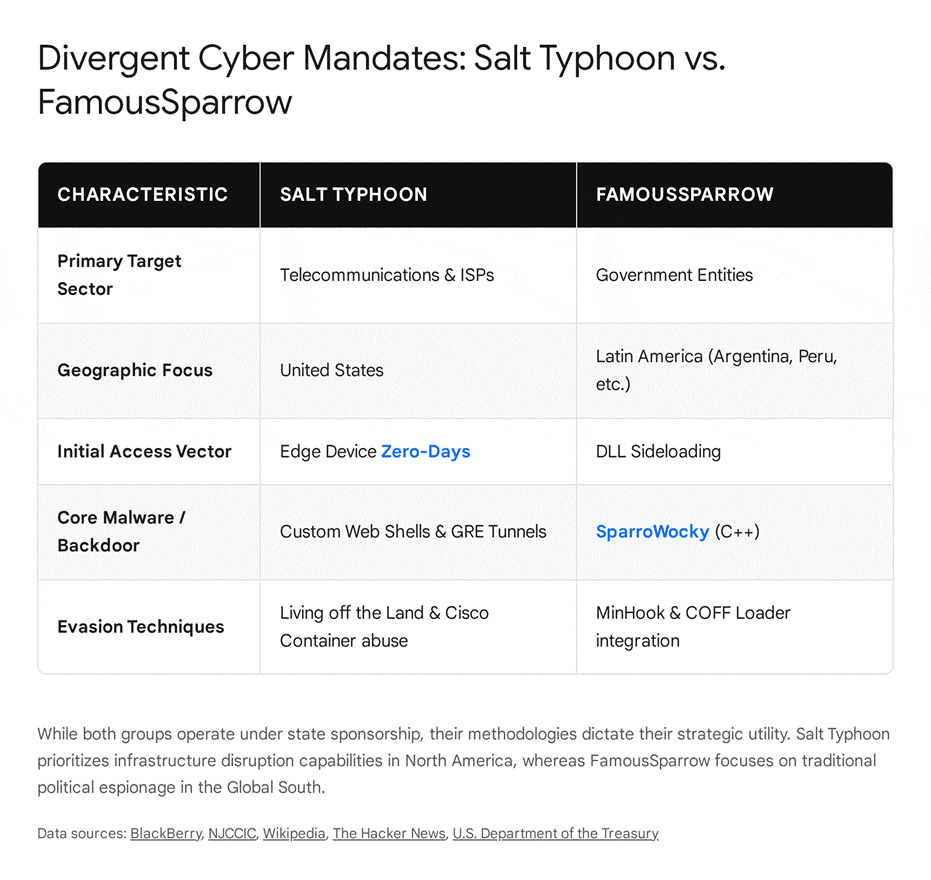
In the cyber and signals intelligence domains, Chinese advanced persistent threat (APT) groups expanded their geographic reach and achieved key operational milestones. The Ministry of State Security-linked group “Salt Typhoon” gained deep, persistent access to the core backbone infrastructure of major US telecommunications providers. Meanwhile, the “FamousSparrow” APT group launched a widespread espionage campaign across Latin America, deploying the new “SparroWocky” backdoor against government networks. This dual approach highlights Beijing’s strategy of building disruptive capabilities against primary adversaries while conducting political espionage across the Global South.
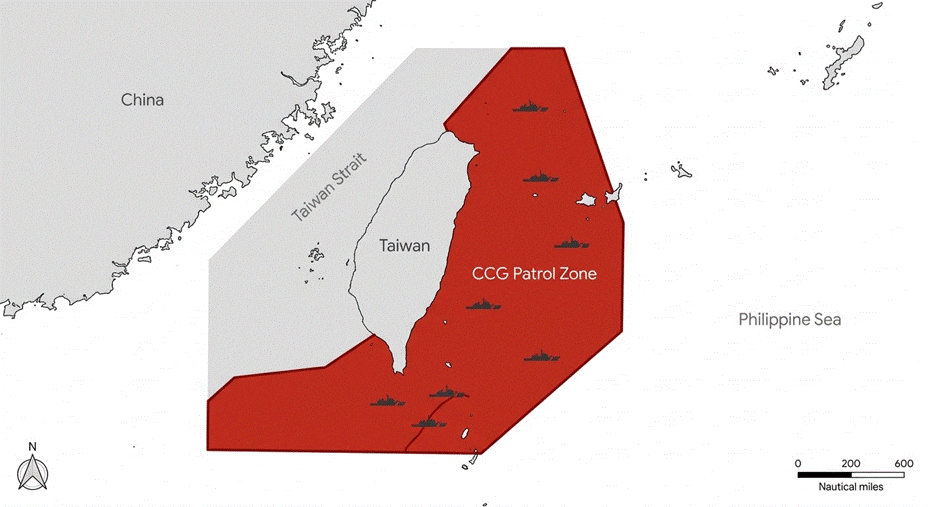
Regionally, Beijing continues to step up its coercive “gray zone” tactics, supported by major legal and structural reforms. The China Coast Guard (CCG) has established a permanent presence east of Taiwan, which could facilitate a maritime blockade. Supporting this posturing is a sweeping update to the National Defense Mobilization Law, taking effect October 1, 2026, which gives the state unprecedented authority to seize civilian assets during military contingencies. In response, regional allies—most notably Japan and Taiwan—are accelerating defense acquisitions, introducing strike capabilities, and reassessing their long-term strategic postures. The operational tempo observed over these two weeks marks a clear departure from historical baselines, pointing to a more mature, proactive, and risk-tolerant Chinese strategy.
Main Body: Key Developments and Analysis
Maritime Operations and Naval Projection
The UUV Mothership and Subsea Autonomous Warfare
During this reporting period, the UUV Mothership and Subsea Autonomous Warfare confirmed a major breakthrough in subsea naval architecture. Satellite imagery analyzed by spatial intelligence firms revealed a 205-meter surface vessel under construction at the Hudong-Zhonghua shipyard in Shanghai. According to assessments by United States naval analysts and submarine experts1, it is the world’s first dedicated drone submarine mothership. Built on an amphibious landing ship design, the vessel features an internal well-deck that opens directly underwater and is fitted with 12 specialized “jack-up” arms to launch and retrieve submersibles straight from an onboard hangar1.
Analysts estimate the mothership can carry up to four Extra-Large Unmanned Underwater Vehicles (XXLUUVs)—measuring 35 to 45 meters in length—alongside a larger array of smaller tactical UUVs1. China already uses a fleet of nominally civilian oceanographic research vessels to deploy smaller UUVs for bathymetric surveys and anti-submarine warfare (ASW) mapping1. However, this purpose-built mothership fundamentally extends the operational reach and tactical value of the PLA Navy’s autonomous subsea fleet.
China’s current generation of XXLUUVs has an independent range of up to 4,000 nautical miles and can stay submerged for months1. By using a mothership to carry these drones directly into contested waters, the PLA can preserve battery life and endurance for active operations. In a Taiwan contingency, this capability would allow the PLA Navy (PLAN) to covertly lay sea mines, maintain persistent ASW patrols near critical chokepoints, and conduct reconnaissance far from the mainland1. Operating within a protected naval task group, the vessel will serve as a floating command hub coordinating multiple submersibles1. Still, this setup creates notable trade-offs: transporting stealthy submersibles inside a visible 205-meter surface ship sacrifices acoustic stealth for deployment distance, and losing the mothership in combat would destroy unlaunched drones while severing support for those already in the water1.
China Coast Guard Blockade Rehearsals East of Taiwan
Expanding its maritime pressure campaign, the China Coast Guard significantly increased operations in the Pacific Ocean east of Taiwan. Shipping logs and investigative reporting by Bloomberg News2 confirm that Beijing has kept at least two heavy CCG cutters deployed monthly in this sector since June 2026. These patrols cover an area of 27,100 square nautical miles, operating as close as 30 nautical miles from Taiwan’s eastern coast while staying just outside Taipei’s claimed contiguous zone3.
This shift is tactical and deliberate. Historically, PRC pressure focused on the Taiwan Strait—the island’s “front door”2. By establishing a routine law enforcement presence in the Philippine Sea (“the back door”), Beijing is directly contesting maritime access routes essential for Taiwan’s supply lines and military communications with US and allied forces2. CCG crews have been recorded hailing commercial vessels, asking for origin and destination details, and staging simulated inspections4. Marine tracking data shows that more than 527 merchant ships passed through these eastern waters in a single month, carrying key imports of fuel, gas, and food3.
These actions fit neatly into Beijing’s broader strategy of “lawfare.” Under its 2021 Coast Guard Law, CCG units are authorized to use force to uphold what Beijing claims as sovereign territory2. By using civilian-style coast guard cutters rather than grey-hulled warships, China asserts de facto jurisdiction while remaining below the threshold of open conflict. Taiwan Ocean Affairs Council Minister Kuan Bi-ling3 warned that China is leveraging these patrols, along with seabed geological surveys, to alter the status quo. Defense analysts believe this persistent presence puts in place the building blocks for a maritime quarantine or full blockade, should Beijing decide to escalate2.
South China Sea Aggression and Blue Water Logistics
Parallel to its operations near Taiwan, China maintained a high tempo in the South China Sea. On September 18, a China Coast Guard ship intentionally rammed a Philippine Bureau of Fisheries vessel conducting a routine mission to deliver fuel subsidies to local fishermen5. While no injuries were reported, the collision caused structural damage and knocked equipment overboard6. Beijing’s Foreign Ministry rejected Manila’s account, claiming the Philippine ship maneuvered dangerously and ignored warnings6. This clash follows a familiar pattern of escalating physical coercion by the CCG against Philippine vessels operating within Manila’s Exclusive Economic Zone6.
Farther from home waters, the PLA Navy demonstrated growing blue-water endurance. On September 14, China’s Ministry of National Defense announced that the 48th Escort Task Group had concluded an 11-month mission in the Gulf of Aden and waters off Somalia7. The task group—comprising the Type 052D guided-missile destroyer Tangshan, the Type 054A frigate Daqing, and the supply ship Taihu—originally departed China in October 20257. On its return transit across the Indian Ocean, the flotilla made planned port visits to Bangladesh, Myanmar, and Malaysia for military exchanges and public ship tours7.
From an operational standpoint, the real significance of the 48th Escort Task Group lies in its logistics. Sustaining a three-ship task force far from home for nearly a year depends heavily on support vessels like the Taihu9. Through continuous underway replenishment of fuel, water, and provisions, the PLAN showed it can maintain an ongoing operational presence without relying extensively on foreign ports9.
Aerospace and Air Defense
Taiwan ADIZ Incursions and Live-Fire Reconnaissance
The PLA Air Force kept up relentless pressure on Taiwan’s air defenses, combining psychological stress with electronic intelligence gathering. Tracking data released by Taiwan’s Ministry of National Defense10 showed sustained high volumes of incursions into the Air Defense Identification Zone (ADIZ). In one 24-hour window ending September 19, Taiwan tracked 20 PLA aircraft and 14 naval ships around the island, with 13 aircraft crossing the median line of the Taiwan Strait10. A similar event on September 14 involved 18 aircraft and 11 naval ships, with 15 crossing the median line12. Overall, the PLA flew 3,615 sorties into Taiwan’s ADIZ in 2024—more than double the total recorded in 202313.
These missions serve a dual purpose: testing the readiness of Taiwan’s air force and collecting vital field intelligence. That intelligence focus was clear on September 18, when a PLA drone flew from Taiwan’s southwestern airspace toward Taitung County between midnight and 6:00 AM14. The timing directly coincided with the final day of a major Taiwanese live-fire exercise at the Jioupeng Base in Pingtung County, observed by Taiwanese President William Lai14. The drills involved testing Tian Kung (Sky Bow) air defense systems, HIMARS rocket launchers, and Hsiung Feng anti-ship missiles14. Deploying the drone allowed the PLA to monitor electromagnetic signatures, flight telemetry, and operational procedures during real-time missile launches.
Cyber and Signals Intelligence
The Information Support Force and Multi-Domain Precision Warfare
Recent cyber and electronic warfare operations reflect China’s ongoing military restructuring. In April 2024, President Xi Jinping dissolved the Strategic Support Force (SSF) and launched the Information Support Force (ISF), which operates alongside the newly established Cyberspace Force and Aerospace Force15. This reorganization reflects Beijing’s drive toward “Multi-Domain Precision Warfare”—the PLA’s answer to the US military’s Joint All-Domain Command and Control (JADC2) concept17.
The ISF is tasked with connecting data streams from space, cyber, and electronic warfare sensors into a unified network, enabling seamless command across China’s five Theater Commands16. The core goal is building an “intelligentized military” where algorithms, cloud computing, and AI-driven targeting speed up battlefield decision-making16. Under this framework, aggressive cyber campaigns and AI developments do not stand alone; they form integrated pieces of a broader warfighting doctrine.
Salt Typhoon and the Breach of US Telecommunications
A major cyber escalation came to light during this reporting period, driven by “Salt Typhoon,” an APT group linked to the Ministry of State Security. The group compromised core network infrastructure at major US telecommunications and internet service providers (ISPs), gaining access across critical communication backbones19.
Unlike typical cyber espionage groups that steal data and quickly disconnect, Salt Typhoon prioritizes long-term access and stealth21. They gained entry by exploiting zero-day vulnerabilities in edge networking gear, targeting firewalls, VPNs, and routers through known flaws like CVE-2024-21887 and CVE-2024-340022. Once inside, the operators relied heavily on “living off the land” (LOTL) tactics, using legitimate administrative tools rather than custom malware to blend in with normal network traffic21.
Technical analysis revealed that Salt Typhoon modified Access Control Lists (ACLs), exposed standard protocols (SSH, RDP) on non-standard ports, and built hidden GRE and IPsec tunnels directly on network hardware to siphon data22. The group also deployed a specialized Windows kernel rootkit named “Demodex” and ran commands inside Linux containers on Cisco hardware via Guest Shell—bypassing standard endpoint security because container activity is rarely logged at a granular level22. Silent Push’s research found that Salt Typhoon and another Chinese group, UNC4841, shared infrastructure. This included dozens of domains that were registered under false names to keep access for a long time.
The strategic fallout from this breach is significant. By embedding itself within ISP routing infrastructure, the MSS secured not only a vast intelligence-gathering stream—including subscriber details and network configurations—but also the ability to disrupt services during a geopolitical crisis20. In response, the US Department of the Treasury24 issued sanctions on September 15, 2026, targeting Yin Kecheng, an MSS-linked operative, and Sichuan Juxinhe Network Technology Co., Ltd., a firm accused of facilitating the operation.
FamousSparrow and the Latin American Campaign
Meanwhile, the China-aligned APT group “FamousSparrow” launched a widespread cyber campaign across Latin America. Security researchers at ESET reported on September 17 that the group had swapped its primary tool, SparrowDoor, for a modular C++ backdoor dubbed “SparroWocky”25.
Telemetry data showed over 90% of recent attacks targeted government agencies in Argentina, Ecuador, Guatemala, Honduras, Panama, Peru, Puerto Rico, and Venezuela25. SparroWocky enables attackers to execute files, collect system information, and act as a TCP proxy25. Delivered through a complex DLL sideloading sequence, the malware incorporates open-source security tools and uses the Mbed TLS library to encrypt communications25. By integrating MinHook and COFF loader techniques, it conceals execution threads to slip past local security software25. This operational expansion suggests Beijing is using cyber capabilities to track diplomatic developments and internal government communications across Latin America.
Geospatial Intelligence Proliferation and AI Weaponization
The line between commercial technology and state intelligence continues to blur in China. Intelligence reports recently highlighted that Chinese commercial geospatial firms—operating as certified defense suppliers—sold high-resolution satellite imagery of the US Muwaffaq Salti Air Base in Jordan to the Iranian government1. Iran subsequently used the imagery to plan a July 17 strike that killed three US service members and damaged military infrastructure1. The case illustrates how Beijing’s civil-military fusion doctrine enables private tech firms to act as channels for sharing intelligence with foreign partners.
At the same time, the PLA is integrating commercial AI tools into operational planning. Anthropic revealed on September 17 that a researcher affiliated with PLA institutes used its “Claude” language model to develop an electronic warfare command suite1. The 16-module software program is designed to analyze radar systems, flag vulnerabilities, rank targets, and assign jamming aircraft1. Notably, the system’s parameters were calibrated to target 12 key defense installations in Taiwan, including Patriot missile batteries, Tien Kung sites, and early-warning radars1. This aligns directly with Xi Jinping’s July 31 directive urging faster AI integration across the armed forces1.
Geopolitical Defense Diplomacy and Strategic Policy
Legal Frameworks for Total War: The National Defense Mobilization Law
To prepare for domestic war readiness, Beijing announced major revisions to its National Defense Mobilization Law. Set to take effect October 1, 2026, the updated law provides a legal blueprint for transitioning China’s economy and society onto a wartime footing27.
The legislation lowers the bar for mobilization, allowing the state to requisition private assets if national sovereignty, unity, or “development interests” are threatened27. Under the law, the PLA can draft citizens over 18 and requisition commercial assets—including shipping fleets, aircraft, satellite networks, and commercial drone factories27.
Military analysts note that this legal change directly targets the PLA’s primary bottleneck in a potential Taiwan invasion: limited military sealift capacity28. By legally integrating commercial assets—such as the massive roll-on/roll-off (RORO) ferries operated by state-owned COSCO—the PLA can quickly scale up amphibious transport28. US officials also point out that COSCO ships already collect signals intelligence globally using hidden equipment, proving that civil-military integration is actively underway28.
Space Domain Contestation and the Outer Space Treaty
Tensions over the militarization of space grew after the US Space Force confirmed it had deployed operational “on-orbit space control weapons”29. On September 15, Chinese Foreign Ministry spokesperson Guo Jiakun publicly urged the US to stop its military build-up in orbit and cease “preparing for war in outer space”31.
Beijing framed its statement around upholding the 1967 Outer Space Treaty, warning against an orbital arms race29. However, analysts point out the contradiction: while the 1967 treaty bans weapons of mass destruction in space, it leaves significant loopholes regarding kinetic impactors, lasers, and jamming satellites29. China has spent years developing counter-space tools of its own, including ground-launched anti-satellite missiles and maneuverable “inspector” satellites equipped with robotic arms capable of disabling orbiting hardware29.
The 13th Beijing Xiangshan Forum
Alongside these operations, China hosted the 13th Beijing Xiangshan Forum from September 15 to 17. The multilateral conference serves as Beijing’s main platform for regional security dialogue and projecting global influence1.
Chinese Defense Minister Dong Jun opened with a measured tone, avoiding aggressive remarks regarding Taiwan or the South China Sea1. Looking ahead to the PLA’s 2027 centenary, Dong offered to share military management experience with partner nations and proposed joint disaster relief initiatives38. The event facilitated bilateral meetings with defense leaders from Singapore, Thailand, Cambodia, and Mongolia, supporting Beijing’s efforts to build defense partnerships across Asia1. Vice President Han Zheng also highlighted using emerging technologies, including AI and space assets, for global security governance1.
Regional Reactions and Allied Posturing
The aggressive expansion of PRC capabilities has catalyzed a paradigm shift in the defense strategies of neighboring states.
Taiwan’s Asymmetric Defense Funding: As the PLA shifts from a simple beachhead assault model toward integrated air-sea seizure operations, Taipei is adjusting its strategy39. Taiwan’s legislature approved special defense budgets to ramp up asymmetric weapons production39. Funding will support long-range strike systems like the Ching Tien I (1,500 km range, Mach 3) and the Ching Tien II (2,000 km range, Mach 5), which put mainland staging areas within reach41. To counter drone threats, Taiwan launched an NTD 240 billion initiative to grow domestic drone production while taking delivery of US ALTIUS-600M and 700M loitering munitions and awaiting MQ-9B SeaGuardian deliveries40.
| Taiwanese Missile Program | Maximum Range | Speed | Strategic Function | Status |
| Ching Tien I | 1,500 km | Mach 3 | Base denial, strike on PLA Eastern Theater Command | Active |
| Ching Tien II | 2,000 km | Mach 5 | Deep strike deterrent, road-mobile | In Development/Budgeted |
Japan and South Korea’s Naval Overhaul: Japan’s Ministry of Defense is reshaping its naval fleet to balance China’s growing mass. Tokyo is building two 14,000-ton Aegis System Equipped Vessels (ASEVs) with 128 Mk.41 VLS cells and SPY-7 radars42. It is also converting its Izumo and Kaga carriers to fly F-35B stealth fighters and commissioning new Taigei-class submarines42. In mid-August, Japan conducted live-fire surface-to-ship missile drills in Hokkaido using Type 88 and Type 25 systems linked to electronic warfare networks43. South Korea is taking similar steps, developing 7,000-ton KDDX destroyers fitted with native sensor suites42.
Most notably, China’s expanding nuclear submarine fleet has shifted Tokyo’s political discourse. On September 11, Japanese Defense Minister Shinjiro Koizumi stated that Japan would “not rule out” acquiring nuclear-powered submarines45. Pointing to their speed and continuous underwater endurance, Koizumi’s comments represent an important policy departure for a nation long guided by strict defense limitations45.
Chronological Timeline of Events
| Date | Event Description | Location | Entities Involved |
| Sept 14, 2026 | Formal announcement detailing the revised National Defense Mobilization Law, authorizing civilian asset expropriation. | Beijing, China | PRC State Council, PLA |
| Sept 14, 2026 | The Gulf of Aden escort mission concludes, and the task group begins diplomatic port visits. | Gulf of Aden / Southeast Asia | PLAN 48th Escort Task Group |
| Sept 15, 2026 | The Chinese Foreign Ministry issues a diplomatic warning demanding the US halt the deployment of orbital space weapons. | Beijing / Outer Space | PRC Foreign Ministry, US Space Force |
| Sept 15, 2026 | The 13th Beijing Xiangshan Forum convenes, promoting PLA modernization and international defense cooperation. | Beijing, China | PRC MoD, International delegates |
| Sept 15, 2026 | US Treasury issues sanctions against cyber actors tied to the Salt Typhoon infiltration of US telecoms. | Washington, D.C. | US Treasury, PRC Cyber Operatives |
| Sept 17, 2026 | Cybersecurity researchers publish findings on the “SparroWocky” backdoor targeting government networks. | Latin America | APT Group “FamousSparrow” |
| Sept 18, 2026 | A CCG vessel physically rams a Philippine government ship conducting fuel subsidy operations. | South China Sea | CCG, Philippine Bureau of Fisheries |
| Sept 18, 2026 | A PLA reconnaissance drone monitors Taiwanese live-fire missile drills testing anti-ship capabilities. | Airspace off Taitung County | PLA Air Force, Taiwanese Armed Forces |
| Sept 19, 2026 | High-volume ADIZ incursion; 20 PLA aircraft and 14 PLAN vessels operate around the island, breaching the median line. | Taiwan Strait | PLA Air Force, PLAN |
Conclusion
The military and intelligence activities executed by the People’s Republic of China over the past 14 days point to a coordinated effort to prepare for future multi-domain warfare. Activity levels mark a clear shift from past patterns, seen especially in expanded Coast Guard patrols east of Taiwan and high-profile cyber intrusions into critical US telecom networks.
The trajectory is clear: Beijing is addressing structural constraints that previously limited the PLA’s reach. Construction of a subsea drone mothership signals an intention to expand autonomous capabilities, coordinated by the Information Support Force. Meanwhile, updates to the National Defense Mobilization Law link civilian transport and industrial output directly to military needs, securing a broad logistics base through civil-military fusion.
Looking ahead, intelligence monitors should track three key indicators: the movement of the 48th Escort Task Group as a sign of regional defense engagement; secondary network indicators linked to Salt Typhoon; and the routine presence of Coast Guard cutters east of Taiwan as a gauge for potential blockade preparations.
Appendix: Methodology
This Situation Report was compiled using Open-Source Intelligence (OSINT) collection and analysis methods. The assessment covers a two-week window from September 5 to September 19, 2026, relying on publicly available data.
Source Categories Consulted:
- Official State Publications and Statements: Ministry of National Defense daily tracking logs from Taiwan, press briefings from the PRC Ministry of Foreign Affairs, and public sanctions designations from the US Department of the Treasury.
- Established Think Tanks and Research Institutes: Analytical briefs from the Institute for the Study of War, the Center for Strategic and International Studies, and the US Naval War College’s China Maritime Studies Institute.
- Cybersecurity Vendor Telemetry: Threat intelligence reports from ESET and Silent Push detailing APT infrastructure, malware reverse-engineering, and vulnerability exploitation.
- Mainstream Journalistic Investigations: Verified reporting from Bloomberg, Reuters, The Japan Times, and specialized defense publications including Naval News and The Aviationist.
Validation Techniques: Information was cross-checked using a multi-source verification matrix. We confirmed claims regarding new hardware platforms (such as the UUV mothership) by matching official statements against commercial satellite imagery and expert analysis. Cyber intrusion reports were evaluated using published Indicators of Compromise (IoCs) and official government advisories.
Visibility Gaps: Certain operational details remain classified, including exact specifications for US Space Force orbital systems. Additionally, while the execution mechanisms for the FamousSparrow campaign in Latin America were identified, initial entry vectors remain unconfirmed due to ongoing private incident response efforts.
Please share the link on Facebook, Forums, with colleagues, etc. Your support is much appreciated and if you have any feedback, please email us in**@*********ps.com. If you’d like to request a report or order a reprint, please click here for the corresponding page to open in new tab.
Sources Used
- China & Taiwan Update, September 18, 2026 | ISW, https://understandingwar.org/research/china-taiwan/china-taiwan-update-september-18-2026/
- China steps up coast guard patrols east of Taiwan | Sep. 8, 2026 20:26, https://www.taiwannews.com.tw/news/6435563
- China Expands Coast Guard Patrols East of Taiwan, Raising, https://www.visiontimes.com/2026/09/09/china-expands-coast-guard-patrols-east-of-taiwan-raising-blockade-concerns.html
- China puts the ‘squeeze’ on Taiwan with new maritime patrols, https://www.aljazeera.com/news/2026/7/29/china-puts-squeeze-on-taiwan-with-new-maritime-patrols
- WATCH: Chinese ship rams PH vessel in South China Sea, https://www.manilatimes.net/2026/09/18/videos/watch-chinese-ship-rams-ph-vessel-in-south-china-sea/2428260
- Chinese Coast Guard Ship Rams Into Philippine Govt Vessel In The South China Sea, https://www.marineinsight.com/chinese-coast-guard-ship-rams-into-philippine-govt-vessel-in-the-south-china-sea/
- Chinese naval escort task group to visit Bangladesh … – China.org, http://www.china.org.cn/china/Off_the_Wire/2026-09/14/content_118695527.shtml
- Chinese naval escort task group to visit Bangladesh, Myanmar, https://english.news.cn/20260914/64c45b757ad4414d951eddd011f49346/c.html
- The 48th Escort Group: Why the Oiler Matters More Than the Port Calls, https://www.china-arms.com/2026/09/pla-navy-48th-escort-group-bangladesh-myanmar-malaysia-2026/
- Taiwan tracks 20 Chinese military aircraft and 14 ships | Taiwan News, https://www.taiwannews.com.tw/en/news/6442856
- China-Taiwan Tensions — Military Activity Tracker – GlobalMilitary.net, https://www.globalmilitary.net/conflicts/china-taiwan/
- Taiwan detects nine PLA aircraft, 12 PLAN vessels, two official ships, https://www.aninews.in/news/world/asia/taiwan-detects-nine-pla-aircraft-12-plan-vessels-two-official-ships-around-its-territory20260814070101/
- Special Report: China sets new records in air-sea operations, https://www.janes.com/defence-intelligence-insights/defence-and-national-security-analysis/china-sets-new-records-in-air-sea-operations-around-taiwan
- https://www.taipeitimes.com/News/taiwan/archives/2026/09/18/2003864500
- China’s Military Modernization: PLA Strategy and Capabilities, https://strikeorbit.com/china-military-modernization/
- China’s new Information Support Force, https://www.iiss.org/online-analysis/online-analysis/2024/05/chinas-new-information-support-force/
- China’s Answer to JADC2: Multi-Domain Precision Warfare, https://strikeorbit.com/china-multi-domain-precision-warfare-jadc2/
- Data Security and the Strategic Challenge of PLA Intelligentised, https://www.isdp.eu/publication/open-by-design-exposed-by-default-data-security-and-the-strategic-challenge-of-pla-intelligentised-warfare/
- China Threat Overview and Advisories – CISA, https://www.cisa.gov/topics/cyber-threats-and-advisories/nation-state-cyber-actors/china
- The Salt Typhoon Attacks of 2024 – BlackBerry, https://www.blackberry.com/en/secure-communications/insights/glossary/salt-typhoon
- Salt Typhoon – NJCCIC – NJ.gov, https://www.cyber.nj.gov/threat-landscape/nation-state-threat-analysis-reports/china-linked-cyber-operations-targeting-us-critical-infrastructure/salt-typhoon
- Salt Typhoon – Wikipedia, https://en.wikipedia.org/wiki/Salt_Typhoon
- Silent Push uncovers hidden Salt Typhoon domains, exposing, https://industrialcyber.co/critical-infrastructure/silent-push-uncovers-hidden-salt-typhoon-domains-exposing-overlapping-infrastructure-with-unc4841-capabilities/
- Treasury Sanctions Company Associated with Salt Typhoon and, https://home.treasury.gov/news/press-releases/jy2792
- China-Aligned FamousSparrow Deploys SparroWocky Backdoor, https://thehackernews.com/2026/09/china-aligned-famoussparrow-deploys.html
- China’s Salt Typhoon spotted probing Latin American government with newly developed SparroWocky backdoor, https://www.techradar.com/pro/security/chinas-salt-typhoon-spotted-probing-latin-american-government-with-newly-developed-sparrowocky-backdoor
- China changes law to mobilize all resources in case of conflict, https://www.defensenews.com/global/asia-pacific/2026/09/14/china-changes-law-to-mobilize-all-resources-in-case-of-conflict-should-neighbors-worry/
- China & Taiwan Update, September 4, 2026 | ISW, https://understandingwar.org/research/china-taiwan/china-taiwan-update-september-4-2026/
- China, Russia urge Washington to ‘stop preparing for war’ in space as US deploys weapons, https://www.wionews.com/world/us-deploys-space-weapons-china-russia-urge-washington-stop-preparing-war-1789472097098
- US admits weapons are in orbit — Why China is warning of a new space arms race, https://www.hindustantimes.com/world-news/us-news/us-admits-weapons-are-in-orbit-why-china-is-warning-of-a-new-space-arms-race-101789466859897.html
- China urges US to halt military buildup in space after, https://www.aa.com.tr/en/asia-pacific/china-urges-us-to-halt-military-buildup-in-space-after-acknowledgment-of-orbital-weapons/4057508
- China urges US to ‘stop preparing for war in outer space’, https://www.timesofisrael.com/liveblog_entry/china-urges-us-to-stop-preparing-for-war-in-outer-space/
- China Wants USA to Immediately Halt Military Expansion in Outer, https://dailyasianage.com/news/357966/china-wants-usa-to-immediately-halt-military-expansion-in-outer-space
- China urges U.S. to stop expanding military build-up in outer space: spokesperson, https://en.people.cn/n3/2026/0916/c90000-20500141.html
- China urges U.S. to ‘stop preparing for war in outer space’ – The Hindu, https://www.thehindu.com/news/international/china-urges-us-to-stop-preparing-for-war-in-outer-space/article71467896.ece/amp/
- China says no to star wars, https://socialistchina.org/2026/09/18/china-says-no-to-star-wars/
- Minister for Defence to Visit China for the 13th Beijing Xiangshan, https://www.mindef.gov.sg/news-and-events/latest-releases/14sep26-nr/
- China ready to share military building experience as PLA, http://www.china.org.cn/2026-09/17/content_118699784.shtml
- Taiwan legislature advances special defense budget amid, https://www.tcn.tw/news/6840510
- Taiwan Must Shift Course in its Domestic Drone Warfare Production, https://globaltaiwan.org/2026/09/taiwan-shift-course-drone-production/
- China & Taiwan Update, September 11, 2026 | ISW, https://understandingwar.org/research/china-taiwan/china-taiwan-update-september-11-2026/
- How Japan, South Korea are building up naval capabilities for, https://breakingdefense.com/2026/09/how-japan-south-korea-are-building-up-naval-capabilities-for-china-threat/
- Japan’s Surface-to-Ship Missile Training Reveals a New Maritime, https://www.armyrecognition.com/news/navy-news/2026/japans-surface-to-ship-missile-training-reveals-a-new-maritime-defense-architecture
- Japan bolsters deterrence with expanded missile defenses, https://ipdefenseforum.com/2026/04/japan-bolsters-deterrence-with-expanded-missile-defenses/
- Koizumi says Japan not ruling out nuclear subs, days after U.S., https://www.japantimes.co.jp/news/2026/09/11/japan/koizumi-japan-us-nuclear-submarines/
- Japan’s Defense Minister: Nuclear-Powered Submarines Will Not Be, https://www.navalnews.com/naval-news/2026/09/japan-defense-minister-nuclear-powered-submarines/