Category Archives: Intelligence Analytics

Intelligence Agencies and Apparatus of Nations

Transforming Tactical Intelligence with OSINT and SOCMINT

Executive Summary (BLUF)

The contemporary operational environment for law enforcement and tactical units is increasingly defined by the convergence of digital data streams and physical kinetic actions. Open-Source Intelligence (OSINT) and Social Media Intelligence (SOCMINT)—historically utilized as slow-moving, post-incident investigative tools—have evolved into mission-critical, real-time assets. When properly filtered, analyzed, and disseminated, social media data provides deployed forces with unprecedented situational awareness, enabling pre-mission environment shaping, real-time threat detection, and dynamic tactical adjustments during high-risk operations.

In the highly volatile realm of global security, criminal networks, terrorist organizations, and hostile crowds have mastered the use of ubiquitous digital platforms to advance their goals, communicate intent, and orchestrate physical movements. To counter these technologically enabled asymmetric threat vectors, law enforcement agencies must transition their intelligence apparatus from a state of passive historical collection to active, real-time exploitation. This transformation requires a highly technical architecture that aggressively filters the infinite noise of the internet, extracts verified threat indicators using artificial intelligence, and pushes concise, geolocated intelligence directly to the tactical edge without overwhelming the operator’s cognitive load.

This comprehensive analysis examines the technical data pipelines, operational workflows, and hardware procurement strategies required to transform vast, unstructured public data into actionable intelligence for tactical elements. The report details the transition of data from cloud-based multi-platform scrapers and AI-driven signal-to-noise filters, through the centralized command hub of a Real-Time Crime Center (RTCC), and ultimately to the operator at the tactical edge via the Android Tactical Assault Kit (ATAK) and mesh-networked End User Devices. Through the examination of operational case studies encompassing civil unrest, hostage rescues, and fugitive apprehension, this white paper demonstrates that the integration of OSINT into the tactical Common Operational Picture drastically reduces the latency between intelligence collection and kinetic execution. Furthermore, the analysis provides command staff and procurement officers with vendor landscape evaluations, pricing models, and strategic recommendations for legally compliant, technologically robust intelligence frameworks.

1.0 Introduction: The Evolution of Tactical OSINT and SOCMINT

The proliferation of ubiquitous internet connectivity, smartphone penetration, and social media engagement has fundamentally altered the landscape of law enforcement intelligence.1 Open-source intelligence—defined strictly within the intelligence community as intelligence derived exclusively from publicly or commercially available information that addresses specific intelligence priorities, requirements, or gaps—now accounts for the vast majority of actionable data utilized by the defense and law enforcement sectors.2 According to historical assessments by the Defense Intelligence Agency, OSINT provides roughly ninety percent of the information used by the broader intelligence community, rendering it an indispensable pillar of modern security operations.3 Within this broader domain, Social Media Intelligence provides unique, real-time insights into suspect movements, organizational structures, public sentiment, and immediate physical threats.4

Historically, OSINT was primarily a strategic, investigative asset. Analysts would spend days or weeks manually aggregating public records, forum posts, news articles, and financial data to build long-term criminal network profiles or assess the historical trajectory of threat actors.6 This methodology traces its roots back to the Second World War, where intelligence agencies monitored enemy radio broadcasts and propaganda to gauge troop morale and strategic intent without requiring clandestine border crossings.8 However, the transformation of the internet from a read-only Web 1.0 environment to a user-generated Web 2.0 ecosystem heralded a new era of intelligence.9 The modern threat matrix is now characterized by flash mobs, highly organized civil unrest, live-streamed active shooter events, and the rapid, decentralized movement of fugitives. This environment demands a tactical application of OSINT. Tactical OSINT requires the near-instantaneous collection, verification, and dissemination of data to ground force commanders and operators actively engaged in a mission, providing them with near-real-time information critical to split-second decision-making.3

The critical challenge facing law enforcement command staff today is no longer data scarcity, but rather data overload.10 Over forty-one percent of the global population has access to smartphones, creating a continuous stream of uploaded images, videos, opinions, and geospatial metadata.1 During a crisis, the sheer volume, velocity, and variety of unstructured data generated across the internet can quickly paralyze an intelligence unit.11 Therefore, maximizing the use of social media for OSINT relies on establishing a highly technical, automated data pipeline. This infrastructure must aggressively filter noise, extract relevant threat indicators via advanced artificial intelligence, and push concise, geolocated intelligence directly to the tactical edge.13

2.0 Technical Architecture of Real-Time OSINT Data Pipelines

To make OSINT actionable for deployed forces, agencies must implement a structured, automated intelligence architecture. Relying on manual searches across disparate social media platforms using standard web browsers is a lethal vulnerability in fast-paced kinetic environments, leading to unacceptable latency and the risk of missing critical links hidden within vast digital silos.10 The modern pipeline consists of automated ingestion, artificial intelligence filtering, and precise geospatial anchoring.

2.1 Data Ingestion and Multi-Platform Scraping

The foundation of the tactical OSINT pipeline is the continuous, automated ingestion of data from the surface web, deep web, and dark web. Modern OSINT platforms utilize Application Programming Interfaces (APIs) and advanced web scraping tools to monitor target vectors across hundreds of platforms simultaneously, transforming unstructured chaos into a unified, real-time intelligence layer.10

Enterprise platforms such as ShadowDragon’s SocialNet and Fivecast ONYX provide investigators with access to over two hundred distinct online data sources.20 These systems consolidate social media posts, messaging app communications on platforms like Telegram and WhatsApp, domain records, financial transactions, and dark web breach data into a single operational interface.18 Crucially, this ingestion is not limited to text-based analysis; it encompasses multimodal data, including high-resolution images, live-streamed video, audio files, and embedded geospatial metadata.17

For tactical teams, this ingestion must be hyper-local and chronologically immediate. Analysts utilize digital profiling and geofencing technologies to draw a digital perimeter around a target building, a planned protest route, or a hostage stronghold.17 This localized ingestion captures all public social media activity originating within that specific physical space, allowing the intelligence cell to identify the presence of non-combatants, the establishment of suspect fortifications, or the arrival of hostile reinforcements prior to a dynamic breach.23 Furthermore, advanced tools allow analysts to use advertising intelligence (ADINT) to track device movements and identifiers across multiple ad networks, providing an alternative vector for location tracking when standard social media signals are obfuscated.17

2.2 Signal-to-Noise Reduction and AI-Enabled Filtering

The fundamental mathematical and operational challenge of OSINT is optimizing the Signal-to-Noise Ratio. During a highly publicized event, such as a major riot or a terrorist attack, the exponential increase in public social media posting creates massive data noise. Manual processing latency increases proportionally, effectively reducing the value of the intelligence to zero before the tactical element can act upon it.8

To solve this latency, law enforcement agencies must deploy Artificial Intelligence and Machine Learning algorithms directly at the ingestion layer.13 These technologies serve as the primary filter, allowing human analysts to focus on verification rather than discovery. Modern platforms utilize several distinct AI vectors. Natural Language Processing scans unstructured text in over one hundred languages to identify specific threat indicators, criminal slang, or mentions of weaponry, bridging critical linguistic gaps during transnational investigations.11 Computer Vision algorithms analyze massive volumes of uploaded images and video to automatically identify specific objects—such as firearms, explosive precursors, or tactical gear—as well as logos or specific individuals via facial recognition overlays.14 Additionally, Sentiment Analysis monitors the emotional tone of a crowd’s digital footprint. A sudden algorithmic detection of a shift from peaceful rhetoric to violent coordination on platforms like X or Telegram can serve as an invaluable early warning indicator for deployed riot control units.3

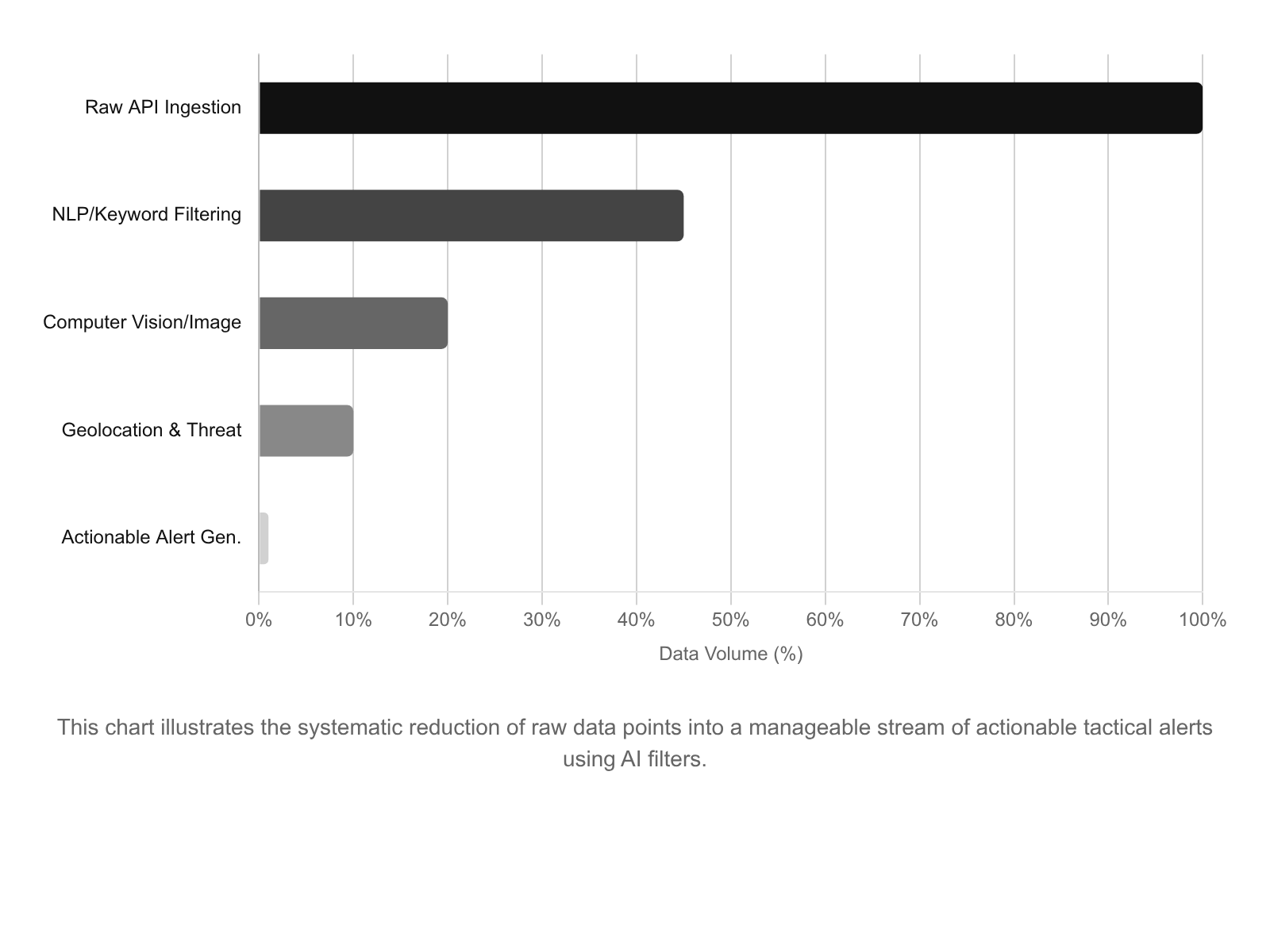
The following visual representation illustrates the critical impact of AI filtering on the data pipeline, demonstrating how millions of raw data points are systematically reduced into a manageable stream of tactical alerts suitable for field dissemination.

CHART 1.0: OSINT DATA FUNNEL AND AI SIGNAL-TO-NOISE REDUCTION

Chart showing data volume reduction through AI filters: raw API ingestion, NLP, computer vision, geolocation, and alerts.

2.3 Advanced Visual Geolocation and Chronolocation Techniques

Intelligence is tactically useless if it cannot be mapped to physical space. Determining the exact physical location of a suspect, victim, or hostile crowd based on their digital footprint is the most critical step in translating OSINT into kinetic action.19 While the digital environment is vast, every action leaves a trace that can be anchored to the physical world through rigorous analytical techniques.

Analysts employ multiple technical methods to extract and verify location data. The most direct method involves extracting Geotags and Metadata, specifically the Exchangeable Image File Format data embedded within digital photographs, which frequently contains exact Global Positioning System coordinates detailing where the device was located when the image was captured.4 However, sophisticated threat actors routinely scrub metadata before posting. In these instances, analysts pivot to Visual Geolocation and landmark identification. This technique involves analyzing visual clues within the media, such as architectural styles, unique vegetation, street signs, or infrastructure patterns.25 AI-driven tools like Picarta.ai, GeoSpy, and Google’s Cloud Vision API (Gvision) assist analysts by cross-referencing these visual features against global databases like Google Street View and OpenStreetMap to predict the location with high accuracy.26

Furthermore, analysts utilize Chronolocation—often referred to as shadow analysis—to verify the exact timeline of a target’s movements. By utilizing tools like SunCalc, investigators can analyze the angle, direction, and length of shadows cast by objects in a photograph or video.25 By calculating the sun’s position relative to the visually identified geographic coordinates, analysts can determine the exact time of day the media was captured, proving whether an image is a live representation of a threat or a recycled piece of disinformation.25 Finally, IP Address tracing and the analysis of network traffic patterns provide an approximate geographical radius of a device, narrowing the search field for subsequent visual analysis.26

When combined, these techniques create a robust digital breadcrumb trail.6 For example, a target may post an image without a geotag, but visual analysis identifies a specific intersection in the background, and chronolocation verifies the image was taken within the last ten minutes. This multidimensional verification allows command staff to adjust the deployment of containment perimeters or direct tactical teams with absolute confidence.4

3.0 Command and Control: The Real-Time Crime Center Ecosystem

The most sophisticated OSINT collection is rendered obsolete if it remains trapped on an analyst’s desktop inside headquarters. The intelligence must be pushed securely, rapidly, and legibly to the operators in the field, who are often operating in chaotic, low-bandwidth, or hostile environments.29 The bridge between the digital intelligence cloud and the physical tactical edge is the Real-Time Crime Center.

3.1 Centralized Data Fusion and Software Integration

Real-Time Crime Centers serve as the centralized nervous system for modern law enforcement operations.30 These specialized public safety units function as hubs where criminal information and intelligence analysis are fused into a cohesive operational picture. RTCCs ingest the AI-filtered OSINT from platforms like ShadowDragon and Fivecast and fuse it with a multitude of other proprietary data streams. These internal streams include computer-aided dispatch (CAD) data, fixed closed-circuit television cameras, automated license plate readers, municipal drone feeds, and body-worn camera transmissions.31

Platforms such as Axon Fusus provide the critical single-pane-of-glass interface required by the RTCC analyst.31 The workflow is highly integrated: when a social media threat is detected and geolocated by an OSINT platform, the RTCC analyst receives an immediate alert.20 The analyst can then utilize the Fusus map-based interface to pull up the nearest public or registered private security cameras to physically verify the digital threat in real time.34 Once verified, the RTCC acts as the dissemination node, packaging the intelligence—such as target photos, exact coordinates, known associates, and building floor plans—and pushing it directly to the tactical teams navigating to the objective.23

3.2 Regional Hubs and Information Sharing

The efficacy of an RTCC relies on regional interoperability and information sharing. The Michigan State Police provide a premier example of this architecture through the Michigan Intelligence Operations Center, a fusion center that provides continuous statewide information sharing among local, state, and federal public safety agencies.36 Regional Communication Centers across Michigan, such as those in Dimondale, Detroit, and Gaylord, provide direct operational support to specialty teams, integrating live highway camera feeds and intelligence data to support real-time decision-making.37

At the county level, interoperability is achieved through shared public safety software. For instance, the Berrien County Board of Commissioners in Michigan recently supported the implementation of a Mobile CAD program to expand access to real-time dispatch information, mapping, and resource data across forty-seven distinct first responding agencies within the county.38 This technological expansion, supported by strategic partnerships with software providers like Mark43 and Mi-Case, ensures that even smaller, resource-constrained municipal departments have the situational awareness necessary to coordinate seamlessly with county sheriffs and federal entities like the FBI during complex, multi-jurisdictional operations.40

4.0 Tactical Edge Dissemination: ATAK and the Common Operational Picture

To receive real-time OSINT at the point of impact, deployed forces increasingly utilize the Android Team Awareness Kit, an advanced geospatial infrastructure and military-grade situational awareness application originally developed by the Department of Defense.15 ATAK provides a Common Operational Picture, ensuring that the tactical commander, the RTCC analysts, and every individual operator in the stack share the exact same interactive map and intelligence overlay.29

4.1 Cursor on Target and Plugin Infrastructure

ATAK operates on a protocol known as Cursor on Target, a standardized XML-based schema designed to communicate the what, when, and where of any entity or event across disparate software systems.43 The power of ATAK lies in its open-source standard, allowing developers to create highly specialized plugins that integrate external intelligence feeds directly into the operator’s display.47

OSINT feeds are seamlessly integrated into ATAK via aggregator plugins like TrakBridge, which converts external location APIs and open-source intelligence feeds—such as the DeepStateMap live feed—into CoT format.48 When an RTCC analyst identifies a critical OSINT update, such as a hostage taker posting a live stream from a specific room within a stronghold, the analyst drops a CoT marker on their interface. Instantly, every operator on the entry team receives the update on their device. They can view the target building mapped out, with a red hostile icon indicating the suspect’s exact location, complete with an attached screenshot extracted from the social media live stream.15

This visual integration is revolutionary for tactical operations. It prevents the fatal funnel of traditional radio communication, where complex descriptions of suspect clothing, building layouts, or precise coordinate data are frequently misunderstood over crackling, congested, and high-stress radio traffic. Instead, operators receive high-fidelity, visual intelligence that requires minimal cognitive processing to understand.49 Furthermore, Unmanned Aerial Systems (UAS) plugins integrate commercial drones directly into the network, projecting the drone’s map position, sensor field of view, and live video feed onto the ATAK screens of ground personnel.43

4.2 Weapon-Mounted Displays and Visual Augmentation

The integration of OSINT and situational awareness does not stop at the handheld device; it extends directly to the operator’s weapon system and optics. Engaging with a handheld screen during a kinetic firefight degrades an operator’s readiness. To mitigate this, advanced optical systems like the Enhanced Clip-on Thermal Viewer (ECOTI) and the Enhanced Clip-on SWIR Imager (ECOSI) integrate directly with ATAK.50

These visual augmentation systems attach to standard night vision devices, providing a long-wave infrared thermal overlay.50 Crucially, the ECOTI acts as a Heads-Up Display for ATAK. The augmented reality capability connects to the application and projects CoT markers, navigation waypoints, and identified threat locations directly into the operator’s field of view.50 This allows an operator to look down a dark hallway and see a digital augmented reality waypoint indicating the OSINT-derived location of a threat behind a specific door, facilitating entirely hands-free operation while keeping their primary weapon oriented toward the threat.50

5.0 Hardware Procurement for the Denied Environment

Delivering OSINT via ATAK requires robust, specialized hardware. Consumer-grade smartphones are entirely insufficient for tactical kinetic environments due to their physical fragility, inadequate battery life under heavy GPS loads, and fatal reliance on commercial cellular towers. During mass casualty events, natural disasters, or large-scale civil unrest, commercial networks frequently crash due to user overload, physical destruction, or deliberate geographic shutdowns.43

5.1 Tactical End User Devices and Tablets

Procurement officers must invest in ruggedized End User Devices. Devices utilized by tactical teams must be root-enabled Android architectures, allowing them to run ATAK and associated security plugins without the interference of commercial bloatware or forced operating system updates that could compromise the software environment.52 Devices such as the GoTAK EUD V2 and the GoTAK Pro Tab offer MIL-STD-810G compliance, guaranteeing resistance to drops, water, dust, and extreme temperature fluctuations, alongside massive battery capacities.52

Similarly, Samsung Galaxy Tactical Editions provide enhanced GPS chipsets for precise location tracking in dense urban environments and utilize Knox encryption to protect the transmission of classified intelligence.54 For vehicle-mounted command elements, crash scene investigators, or mobile RTCC units, larger rugged tablets provide the necessary screen real estate for complex OSINT mapping and multi-feed video monitoring.

The following Markdown table details the technical specifications of standard ruggedized tablets utilized within law enforcement procurement channels to support tactical situational awareness:

Tablet SpecificationPanasonic Toughpad FZ-G1iX104C5 DMSR LTE TabletxTablet T1200
Ingress ProtectionIP65 (Dust tight, water jets) 55IP67 (Dust tight, immersion) 55IP65 55
Operating Temp Range14°F to 122°F 55-30°F to 140°F 55-4°F to 140°F 55
Impact ResistanceDrop tested to 4 feet 5526 drops operating from 4 feet 55Drop tested 55
Battery Runtime8.0 hours continuous 556.5 hours continuous 5511.5 hours continuous 55
Key FeaturesAuto-brightness, responsive touch 55Physical keypad, integrated biometrics 55High battery capacity 55

To ensure that these devices remain accessible during operations, tactical teams utilize specialized mounting solutions. End User Devices are typically mounted directly to the operator’s plate carrier via chest mounts manufactured by companies like Juggernaut.Case or Kagwerks. These mounts allow the operator to quickly hinge the device downward to view the ATAK map and OSINT feeds, then fold it flat and secure against their ballistic armor, keeping both hands free for weapon manipulation.56

5.2 Tactical Mesh Networking Platforms

To maintain the flow of OSINT and ATAK data when traditional cellular infrastructure is degraded or denied, law enforcement agencies utilize Tactical Mesh Networks. Mesh networking creates a decentralized, peer-to-peer communication system. Instead of relying on a centralized cell tower, each individual radio acts as a node, bouncing encrypted data—such as CoT markers, text messages, and low-bandwidth images—from operator to operator until it reaches the intended recipient.15 This architecture is self-healing; if one node moves out of range or is destroyed, the network automatically calculates a new routing path without disrupting the overall operation.15

The following Markdown table outlines the technical specifications of two dominant mesh networking hardware platforms critical for OSINT dissemination in off-grid environments:

Hardware SpecificationgoTenna Pro X2Persistent Systems MPU5
Primary Use CaseLow-cost UHF/VHF data, location tracking, text.High-bandwidth MANET, live video streaming.
Operating FrequenciesVHF (142 to 175 MHz), UHF (445 to 480 MHz).Modular bands (L-Band, S-Band, C-Band).
Physical Weight100 grams (ultra-lightweight).Approximately 800+ grams (with battery).
Power Output Settings0.5W, 1.0W, 2.0W, 5.0W (User Selectable).Up to 6.0W transmission power.
Battery Life / PowerUp to 9 hours nominal (30+ hours standby).10 to 12 hours depending on module.
IntegrationConnects to EUD via Bluetooth/USB; ATAK plugin.Native Kinesis/Wave Relay integration.

6.0 Operational Case Studies and Tactical Application

The theoretical architecture of OSINT is validated by its application in real-world kinetic environments. The following operational parameters demonstrate how the fusion of digital intelligence and tactical hardware directly alters law enforcement decision-making.

6.1 Civil Unrest, Riots, and Public Demonstrations

During civil unrest, large crowds utilize social media to organize, maneuver, and overwhelm law enforcement containment lines. Adversaries use platforms like Telegram, X, and localized mapping applications to track police movements in real time, executing flash mob tactics or targeted vandalism.3 A poignant example occurred during the 2019 to 2020 Hong Kong protests, where demonstrators utilized the HKMap Live application to crowdsource the composition and disposition of police forces. This allowed untrained noncombatants to communicate intent and mass manpower at times and places of their choosing, effectively outmaneuvering traditional police deployments.3 Similarly, the organization surrounding the events at the U.S. Capitol on January 6, 2020, relied heavily on open digital networks to direct members toward specific geographic objectives.61

By applying AI-driven sentiment analysis and keyword tracking, an RTCC can monitor the digital buildup to a protest, identifying specific nodes of agitation and potential flashpoints for violence before they materialize physically.23 During the event, SOCMINT provides minute-by-minute intelligence regarding the crowd’s size, demeanor, and intended route.23 If OSINT scrapers detect a sudden spike in keywords relating to incendiary devices geographically clustered around a specific intersection, the RTCC can instantly push a warning to the mobile field force commander via ATAK.24 The commander, viewing the common operational picture on a ruggedized tablet, can proactively maneuver armored assets and riot control formations to that exact intersection to deter the escalation. Furthermore, advanced visual analysis of crowd live streams can identify primary instigators or individuals carrying concealed firearms within the group, allowing snatch-and-grab arrest teams to execute precise, targeted removals without engaging the broader, peaceful crowd.61

6.2 Hostage Rescues and Active Shooter Interventions

In hostage barricade or active shooter scenarios, time is the ultimate friction. Traditional intelligence gathering—relying on post-incident witness interviews or prolonged negotiations—is often too slow to prevent casualties. Suspects frequently broadcast their actions, demands, or grievances via social media live streams or manifestos posted immediately prior to the event, creating a real-time digital intelligence footprint.63

When a barricaded subject initiates a standoff, off-site OSINT analysts immediately begin scraping the suspect’s digital presence. If the suspect is live-streaming, analysts perform rapid visual geolocation of the interior background. They analyze the layout of the room, the placement of the suspect’s primary weapon, the presence of improvised explosive devices, and the condition of the hostages.23 This intelligence is fed directly to the SWAT commander and the entry team stacked at the breach point. For example, if OSINT confirms via a social media post that the suspect has heavily fortified the primary door and established a fatal funnel, the tactical team will adjust their approach, opting for an explosive breach on a secondary wall or a coordinated multi-port window assault.

The kinetic value of immediate intelligence gathering is starkly illustrated by international operations. During the Israeli Yamam counter-terrorism unit’s daytime rescue of four hostages in the Nuseirat neighborhood of Gaza, operations were heavily supported by massive intelligence and IDF data integration. While the high casualty rate of the extraction underscores the extreme violence of such operations in dense urban terrain, the ability to pinpoint hostage locations in a hostile environment demonstrates the absolute necessity of fused intelligence before operators cross the threshold.65 On the domestic front, failures to rapidly synthesize and communicate intelligence during active shooter events, such as the tragic incident at Robb Elementary in Uvalde, Texas, highlight the catastrophic consequences of disjointed command and control and the failure to establish a unified operational picture.66

Furthermore, OSINT is crucial in combating the rise of swatting—the false reporting of a hostage or active shooter situation designed to provoke a lethal SWAT response against an innocent target.63 Real-time OSINT analysis can quickly cross-reference the target address, the caller’s digital footprint, and local social media chatter to determine if the threat is a verified emergency or a malicious hoax, preventing unnecessary kinetic engagement and preserving community trust.63

6.3 Fugitive Apprehension and Human Trafficking Syndicates

Tracking high-value fugitives or dismantling human trafficking networks requires meticulous pre-mission intelligence. Modern criminal syndicates operate across encrypted applications, utilizing multiple digital aliases, cryptocurrency transactions, and sophisticated counter-surveillance techniques.67

Platforms like ShadowDragon enable investigators to rapidly resolve aliases, map digital connections, and identify the physical locations of transient fugitives without tipping off the target.68 By combining breach data, domain registration records, and social media geotags, an analyst can generate a comprehensive target profile in minutes.28 In a notable counter-terrorism and fugitive apprehension case study, analysts utilized a combination of social media analysis, deep web breach data, and public fitness tracking applications. By identifying the target’s public Strava account, analysts mapped the fugitive’s exact cycling routes, daily routines, and frequent physical locations.28 This digital intelligence was then cross-referenced with deep web leak data originating from a Malaysian database breach to confirm the suspect’s passport numbers and physical addresses.28

For the deployed apprehension team, this OSINT translates directly into actionable operational planning. The tactical commander knows the suspect’s exact routine, the vehicles they use, and their known associates. The arrest can be timed to occur when the suspect is in transit or away from fortified strongholds, minimizing the risk of an armed standoff. This methodology is heavily utilized in child exploitation cases. Investigators deploy advanced technical skills to analyze deeply buried digital breadcrumbs to dismantle the highly curated personas and digital universes created by predators to target children, bringing perpetrators to justice through rigorous open-source correlation.6 The integration of modern OSINT methodologies, encrypted app tracing, and traditional intelligence provides a holistic view of the operational environment, akin to the multi-disciplinary intelligence fusion that eventually led to the capture of high-profile cartel leaders like El Chapo.67

7.0 Legal, Ethical, and Policy Frameworks

The immense power of tactical OSINT is counterbalanced by strict legal, constitutional, and ethical limitations. Law enforcement command staff must ensure that intelligence collection does not violate civil liberties, specifically Fourth Amendment protections against unreasonable search and seizure, and First Amendment rights regarding peaceful assembly and expression.70

7.1 Constitutional Boundaries and Warrant Requirements

While OSINT inherently relies on publicly available information, the aggregation, persistent monitoring, and algorithmic profiling of citizens can cross the legal threshold into unlawful surveillance.8 Civil rights organizations and legal scholars frequently challenge the use of automated social media scrapers, particularly during protests associated with political movements.70 The core legal concern is that covert surveillance via automated bots infringes upon the penumbras of privacy established by Supreme Court precedent in landmark cases such as Griswold v. Connecticut, which recognized privacy rights existing within the shadows of the protections provided by the Bill of Rights.71 Further scrutiny has been applied to federal agencies; for instance, the Department of Homeland Security and Immigration and Customs Enforcement have faced significant backlash over the procurement of OSINT tools like ShadowDragon to compile dossiers on advocates and journalists.70

Therefore, agencies must operate under the principle that while an individual social media post may be public, the persistent, targeted monitoring of a specific individual’s comprehensive digital life over time often requires judicial oversight. In jurisdictions like the United Kingdom, the Investigatory Powers Act 2016 provides a strict legal framework requiring law enforcement and intelligence agencies to obtain appropriate warrants and undergo judicial approval before conducting bulk data collection or targeted SOCMINT operations.5 United States agencies must continuously consult with local prosecutors to determine the exact threshold at which open-source observation transitions into a Fourth Amendment search requiring a warrant.

7.2 Standard Operating Procedures and Auditability

To protect the agency from civil liability and ensure the admissibility of OSINT-derived evidence in criminal court, departments must implement rigorous Standard Operating Procedures.74

Analysts must mathematically verify the authenticity of all digital evidence. Because metadata can be spoofed and generative AI can create highly convincing deepfakes, analysts must cross-reference data points and meticulously document the chain of custody for digital evidence, including capturing timestamps, URLs, and generating cryptographic hash values of downloaded media to prove it has not been altered.11

Furthermore, OSINT software platforms must maintain unalterable, automated audit logs detailing exactly what data was queried, which analyst queried it, and the legal justification or case number associated with the search.21 This infrastructure prevents the misuse of powerful intelligence tools for unauthorized personal searches or political targeting, ensuring adherence to ethical boundaries.8 Finally, agencies must maintain clear, publicly accessible policies regarding how they utilize social media monitoring. For example, Berrien County, Michigan, publicly outlines its social media monitoring guidelines and terms of service, actively managing public expectations regarding privacy, data retention, and government interaction on digital platforms.77

8.0 Vendor Landscape and Procurement Economics

For procurement officers, command staff, and defense contractors, the OSINT market offers a wide spectrum of solutions ranging from pure data aggregators to comprehensive AI analysis suites. Procurement requires balancing municipal or federal budget constraints with the absolute operational necessity for high-fidelity, real-time tactical support. Deploying OSINT to the tactical edge requires heavy, sustained investment in both the Real-Time Crime Center software infrastructure and the ruggedized hardware carried by operators.

8.1 Software Licensing Models and Infrastructure Costs

The enterprise OSINT software market operates predominantly on Software-as-a-Service (SaaS) and tiered licensing models based on data volume, feature access, and the number of user seats.

OSINT Platform / VendorPrimary Capability FocusKey Technical FeaturesRepresentative Pricing / Est. Cost
ShadowDragon (SocialNet / Horizon) 20Identity resolution, alias tracking, dark/deep web correlation.API access, Kaseware integration, Link Analysis, over 200 data sources.Enterprise licensing. (e.g., ICE contract: approx. $900k; DEA contract: approx. $29M for unlimited queries).73
Fivecast ONYX 21AI-driven threat detection, multimodal analysis, mass data ingestion.Customizable risk detectors, image/text/video AI analysis, multilingual support.Proprietary quote based on data volume and seat licenses.
Flashpoint Ignite 82Cyber threat intelligence, vulnerability monitoring, illicit community tracking.Dark web search, ransomware correlation, managed attribution (anonymous browsing).Tiered SaaS. Approx. $100,000/yr for Cyber Threat Intel; Approx. $80,000/yr for Physical Security Intel.82
Axon Fusus (RTCC Platform) 85RTCC video fusion, CAD integration, live mapping.Unified map interface, AI camera alerts, drone feed integration.SaaS subscription. Core Lite: approx. $350 initial. Core Elite AI: approx. $7,300+ annually.85

Beyond the recurring software licensing costs, agencies must account for the physical hardware required. Supplying a SWAT team with ATAK capabilities involves purchasing End User Devices (such as the GoTAK EUD V2 at approximately $600 to $1000 per unit), tactical chest mounts (ranging from $150 to $300 per unit), and tactical mesh radios (such as the goTenna Pro X2, which can cost in excess of $1000 per unit depending on government contract pricing).52 This does not include the massive capital expenditure required to physically build out the RTCC, which involves procuring video walls, secure servers, and specialized workstations.87

9.0 Strategic Directives for Command Staff

To successfully maximize the use of social media and open-source intelligence in real-time tactical operations, law enforcement command staff must transition their agencies from reactive data consumers to proactive intelligence exploiters. This requires adopting the following strategic directives:

First, agencies must establish a dedicated Tactical OSINT Desk within the Real-Time Crime Center. Command cannot rely on patrol officers or tactical operators to conduct their own digital intelligence gathering on standard smartphones while deployed. Agencies must assign dedicated, highly trained intelligence analysts to operate advanced platforms like Fivecast ONYX or ShadowDragon. These analysts must be trained not just in digital scraping techniques, but in tactical terminology, close-quarters battle concepts, and operational priorities, allowing them to rapidly filter out noise and push only critical, actionable data to the field.23

Second, the agency must standardize on the Android Team Awareness Kit for intelligence dissemination. Transitioning tactical teams away from voice-only radio descriptions of targets and locations is a critical safety imperative. By implementing ATAK as the standard Common Operational Picture, command ensures that all OSINT feeds, drone video, and RTCC alerts are converted into Cursor on Target format, providing operators with an instantly understandable, shared visual map of the battlespace.43

Third, procurement must invest heavily in resilient communications infrastructure. Command must assume that commercial cellular networks will fail, be compromised, or be deliberately shut down during a major critical incident. Equipping entry teams, mobile field forces, and crisis negotiators with tactical mesh radios ensures that the flow of OSINT data and live location tracking remains uninterrupted in off-grid or electronically denied environments.15

Finally, agencies must prioritize AI-enabled filtering solutions during software acquisition. The limiting factor in modern intelligence is human cognitive capacity. Artificial intelligence must handle the bulk sorting, natural language processing, and initial image recognition of the data pipeline so that human analysts can focus exclusively on threat verification, ethical oversight, and tactical coordination.10 By pairing robust algorithmic filtering with strict, judicially compliant standard operating procedures, law enforcement agencies can securely harness the digital domain, ensuring that operators cross the threshold with decisive, real-time intelligence.

Appendix: Methodology & Data Sources

The intelligence generated within this white paper was aggregated utilizing an Open-Source Intelligence framework, simulating the methodologies discussed herein. Data was acquired through structured queries targeting specialized B2B defense sector publications, government procurement databases, legal policy repositories, and technical documentation from primary vendors in the intelligence and tactical hardware space, including Axon, ShadowDragon, Fivecast, goTenna, and Juggernaut.Case. Search parameters included Boolean logic operators combining terms such as “Law Enforcement,” “Tactical OSINT,” “Real-Time Crime Center (RTCC),” “Android Team Awareness Kit (ATAK),” “Mesh Networking,” and “Social Media Intelligence (SOCMINT).” Cross-source validation was utilized to confirm technical specifications, legal precedents, and procurement pricing models across independent industry reports, academic literature, and official government press releases. The analysis focuses explicitly on the intersection of digital intelligence aggregation and physical kinetic application.

Ronin’s Grips Analytics provides custom, agency-specific data on this topic. Contact us to commission a tailored internal audit or procurement forecast for your department.


Please share the link on Facebook, Forums, with colleagues, etc. Your support is much appreciated and if you have any feedback, please email us in**@*********ps.com. If you’d like to request a report or order a reprint, please click here for the corresponding page to open in new tab.


Sources Used

  1. The Tactical Application of Open Source Intelligence (OSINT) – The Cove – Australian Army, accessed March 6, 2026, https://cove.army.gov.au/article/tactical-application-open-source-intelligence-osint
  2. Open Source Intelligence Strategy – United States Department of State, accessed March 6, 2026, https://2021-2025.state.gov/open-source-intelligence-strategy/
  3. Event Barraging and the Death of Tactical Level Open-Source Intelligence – Army University Press, accessed March 6, 2026, https://www.armyupress.army.mil/Journals/Military-Review/English-Edition-Archives/January-February-2021/Rasak-Open-Source-Intelligence/
  4. Social media as an investigative tool: OSINT strategies for law enforcement – Police1, accessed March 6, 2026, https://www.police1.com/investigations/social-media-as-an-investigative-tool-osint-strategies-for-law-enforcement
  5. Social Media Intelligence (SOCMINT) in Modern Investigations – OSINT Industries, accessed March 6, 2026, https://www.osint.industries/post/social-media-intelligence-socmint-in-modern-investigations
  6. The Rise Of Open-Source Intelligence in Fighting Human Trafficking | Our Rescue, accessed March 6, 2026, https://ourrescue.org/resources/child-exploitation/the-rise-of-open-source-intelligence-in-fighting-human-trafficking
  7. Law Enforcement Technology Spotlight – OSINT – Carahsoft, accessed March 6, 2026, https://static.carahsoft.com/concrete/files/8617/5154/6816/Law_Enforcement_Tech_Spotlight_-_OSINT-v2.pdf
  8. What is OSINT (Open Source Intelligence)? – SentinelOne, accessed March 6, 2026, https://www.sentinelone.com/cybersecurity-101/threat-intelligence/open-source-intelligence-osint/
  9. The Future of Open Source Intelligence for UK National Security – RUSI, accessed March 6, 2026, https://static.rusi.org/330_OP_FutureOfOpenSourceIntelligence_FinalWeb0.pdf
  10. The data challenge facing modern law enforcement – Elastic, accessed March 6, 2026, https://www.elastic.co/resources/article
  11. Osint Geolocation Challenge – Knowlesys, accessed March 6, 2026, https://knowlesys.com/en/osint/osint-geolocation-challenge.html
  12. 13 OSINT Investigation Challenges: How to Overcome Them – ShadowDragon, accessed March 6, 2026, https://shadowdragon.io/blog/what-are-the-common-struggles-of-osint-investigations/
  13. Law Enforcement and Policing in the Era of Technological Transformation – ICT, accessed March 6, 2026, https://ict.org.il/era-of-technological-transformation/
  14. AI-Assisted OSINT/SOCMINT for Safeguarding Borders: A Systematic Review – MDPI, accessed March 6, 2026, https://www.mdpi.com/2078-2489/16/12/1095
  15. THE POWER OF ATAK + MESH NETWORKS – Sovereign Systems, accessed March 6, 2026, https://sovsys.co/the-power-of-atak-mesh-networks/
  16. Best Practices for Integrating Open-Source Intelligence (OSINT) into Investigations – Penlink, accessed March 6, 2026, https://www.penlink.com/blog/best-practices-for-integrating-osint-into-investigations/
  17. Top 15 Free OSINT Tools To Collect Data From Open Sources, accessed March 6, 2026, https://www.recordedfuture.com/threat-intelligence-101/tools-and-technologies/osint-tools
  18. Advanced OSINT Investigation Solutions for Law Enforcement | Social Links, accessed March 6, 2026, https://sociallinks.io/industries/leas-and-government
  19. OSINT Techniques: Complete List for Investigators (2026) – ShadowDragon, accessed March 6, 2026, https://shadowdragon.io/blog/osint-techniques/
  20. Unleashing the power of social media analysis tools in …, accessed March 6, 2026, https://shadowdragon.io/blog/social-media-investigation-tool-kaseware-shadowdragon-partner/
  21. Fivecast ONYX – Fivecast, accessed March 6, 2026, https://www.fivecast.com/platform-overview/fivecast-onyx/
  22. Social media OSINT: helping protect victims of exploitation. – CameraForensics, accessed March 6, 2026, https://www.cameraforensics.com/blog/2023/12/06/how-social-media-osint-can-help-safeguard-victims-of-online-exploitation/
  23. Social Media and Tactical Considerations for Law Enforcement – Agency Portal, accessed March 6, 2026, https://portal.cops.usdoj.gov/resourcecenter/content.ashx/cops-p261-pub.pdf
  24. Using OSINT in Managing Violent Protests – Fivecast, accessed March 6, 2026, https://www.fivecast.com/blog/violent-protests-and-the-role-of-osint/
  25. Geolocation Techniques in OSINT Investigations – McAfee Institute, accessed March 6, 2026, https://www.mcafeeinstitute.com/blog/geolocation-techniques-osint-investigations
  26. Understanding Geolocation OSINT – Medium, accessed March 6, 2026, https://medium.com/@tohkaaryani/understanding-geolocation-osint-4bfb01d2a7eb
  27. Geolocation 101: image-based OSINT tips and inspiration from unlikely places, accessed March 6, 2026, https://www.authentic8.com/blog/geolocation-101-image-based-tips-and-inspiration-unlikely-places
  28. OSINT Case Study: Leveraging SOCMINT and Breach Data for Counter-Terrorism, accessed March 6, 2026, https://infosecdad.medium.com/osint-case-study-leveraging-socmint-and-breach-data-for-counter-terrorism-3325d7a12b04
  29. Common Operating Picture (COP) for Battlefield Visualizations – Simulyze, accessed March 6, 2026, https://www.simulyze.com/common-operating-picture-software
  30. Building an effective real-time crime center: Tips, tools, and best practices from Texas experts, accessed March 6, 2026, https://peregrine.io/resources/building-an-effective-real-time-crime-center-tips-tools-and-best-practices-from-texas-experts
  31. The Ultimate Guide to Real-Time Crime Centers – Axon.com, accessed March 6, 2026, https://www.axon.com/resources/real-time-crime-center
  32. Real-Time Crime Centers: Integrating Technology to Enhance Public Safety, accessed March 6, 2026, https://www.ojp.gov/library/publications/real-time-crime-centers-integrating-technology-enhance-public-safety
  33. (PDF) Real-Time Crime Centers: Integrating Technology to Enhance Public Safety, accessed March 6, 2026, https://www.researchgate.net/publication/394148162_Real-Time_Crime_Centers_Integrating_Technology_to_Enhance_Public_Safety
  34. Unified real-time crime center interface – Axon.com, accessed March 6, 2026, https://www.axon.com/products/axon-fusus/unified-interface
  35. Axon Fusus | Real‑Time Intelligence Platform for Public Safety, accessed March 6, 2026, https://www.axon.com/products/axon-fusus
  36. Michigan Intelligence Operations Center (MIOC), accessed March 6, 2026, https://www.michigan.gov/msp/divisions/intel-ops/mioc
  37. Regional Communications Centers – State of Michigan, accessed March 6, 2026, https://www.michigan.gov/msp/divisions/intel-ops/rcc
  38. Untitled, accessed March 6, 2026, https://www.lctberrien.org/AgendaCenter/ViewFile/Item/2164?fileID=514
  39. Police in Berrien County hoping to improve dispatch communications with new software, accessed March 6, 2026, https://www.moodyonthemarket.com/police-in-berrien-county-hoping-to-improve-dispatch-communications-with-new-software/
  40. FBI conducting law enforcement operations in Berrien County – YouTube, accessed March 6, 2026, https://www.youtube.com/watch?v=aI-B5K4oSiE
  41. FBI conducting law enforcement operations in Berrien County, accessed March 6, 2026, https://www.wsjm.com/2025/11/19/fbi-conducting-law-enforcement-operations-in-berrien-county/
  42. Mark43 and Mi-Case Announce Partnership to Deliver a Comprehensive Public Safety Platform for Law Enforcement Agencies, accessed March 6, 2026, https://mark43.com/press/mark43-and-mi-case-announce-partnership/
  43. Tactical Awareness Kit (TAK): Ultimate Guide | RECOIL OFFGRID, accessed March 6, 2026, https://www.offgridweb.com/gear/tactical-awareness-kit-tak-ultimate-guide/
  44. kylesayrs/ATAK_push_cots: Push Cursor on Target messages to TAK clients with attachments and other information – GitHub, accessed March 6, 2026, https://github.com/kylesayrs/ATAK_push_cots
  45. Command and Control Personal Computer (C2PC) | Northrop Grumman, accessed March 6, 2026, https://www.northropgrumman.com/what-we-do/mission-solutions/command-and-control-personal-computer-c2pc
  46. ATAK Plugins 2: The TAK Server – RIIS LLC, accessed March 6, 2026, https://www.riis.com/blog/atak-plugins-2-the-tak-server
  47. Integrations – COTAK, accessed March 6, 2026, https://cotak.gov/pages/integrations
  48. First public release of TrakBridge : r/ATAK – Reddit, accessed March 6, 2026, https://www.reddit.com/r/ATAK/comments/1m3mhyk/first_public_release_of_trakbridge/
  49. Snapshot: ATAK increases situational awareness, communication – Homeland Security, accessed March 6, 2026, https://www.dhs.gov/archive/science-and-technology/news/2017/11/17/snapshot-atak-increases-situational-awareness-communication
  50. ATAK Enabling Technology with ECOTI – Quantico Tactical, accessed March 6, 2026, https://www.quanticotactical.com/atak-enabling-technology-with-ecoti/
  51. Rugged Tablets for Law Enforcement & First Responders: Built for the Toughest Missions, accessed March 6, 2026, https://dtresearch.com/blog/2025/12/22/rugged-tablets-for-law-enforcement-first-responders-built-for-the-toughest-missions/
  52. GoTAK EUD V2 – Rugged Android ATAK Device – Guerrilla Dynamics, accessed March 6, 2026, https://getgotak.com/products/gotak-eud-v2
  53. GoTAK Pro Tab – Rugged ATAK Tablet – Guerrilla Dynamics, accessed March 6, 2026, https://getgotak.com/products/gotak-pro-tab
  54. Situational Awareness | ATAK Mission Technology | Samsung Business, accessed March 6, 2026, https://www.samsung.com/us/business/solutions/industries/government/situational-awareness/
  55. Ruggedized Tablets Summary – Homeland Security, accessed March 6, 2026, https://www.dhs.gov/sites/default/files/publications/Rugg-Tablets-SUM_0514-508.pdf
  56. Tactical Phone Mounts & Radio Mounts – Juggernaut Case, accessed March 6, 2026, https://juggernautcase.com/categories/shop-products/shop-by-category/mount.html
  57. goTenna Pro X2, accessed March 6, 2026, https://gotennapro.com/products/gotenna-pro-x2
  58. Getting Started with the goTenna Pro X2, accessed March 6, 2026, https://support.gotennapro.com/s/article/Getting-Started-with-the-goTenna-Pro-X2
  59. www.avinc.com // © 2025 AeroVironment, its product na, accessed March 6, 2026, https://www.avinc.com/images/uploads/product_docs/2025_ProductCatalog.pdf
  60. The digital repression of social movements, protest, and activism: A synthetic review – PMC, accessed March 6, 2026, https://pmc.ncbi.nlm.nih.gov/articles/PMC10953837/
  61. Using OSINT in Times of Social Unrest – Carahsoft, accessed March 6, 2026, https://static.carahsoft.com/concrete/files/9617/3384/0566/Cobwebs_-_Using_OSINT_in_Times_of_Social_Unrest.pdf
  62. Application of OSINT/SOCMINT techniques for the detection and analysis of terrorist profiles, accessed March 6, 2026, https://www.youtube.com/watch?v=Hq6shH3grRY
  63. The Escalating Threats of Doxxing and Swatting: An Analysis of Recent Developments and Legal Responses – National Association of Attorneys General, accessed March 6, 2026, https://www.naag.org/attorney-general-journal/the-escalating-threats-of-doxxing-and-swatting-an-analysis-of-recent-developments-and-legal-responses/
  64. researching public perceptions and swat – Scholars Crossing, accessed March 6, 2026, https://digitalcommons.liberty.edu/cgi/viewcontent.cgi?article=7830&context=doctoral
  65. Israel – Hamas 2024 Symposium – Israeli Hostage Rescue Mission and Perfidy – Lieber Institute, accessed March 6, 2026, https://lieber.westpoint.edu/israeli-hostage-rescue-mission-perfidy/
  66. Critical Incident Review: Active Shooter at Robb Elementary School – Agency Portal, accessed March 6, 2026, https://portal.cops.usdoj.gov/resourcecenter/content.ashx/cops-r1141-pub.pdf
  67. OSINT Case Studies & Investigations, accessed March 6, 2026, https://www.osint.industries/case-studies
  68. Law Enforcement – ShadowDragon, accessed March 6, 2026, https://shadowdragon.io/use-cases/law-enforcement/
  69. Harnessing OSINT in Criminal Investigations: A Case Study on the Fugitive Emmanuel Edokpolor – ESPY, accessed March 6, 2026, https://espysys.com/blog/harnessing-osint-in-criminal-investigations-a-case-study-on-the-fugitive-emmanuel-edokpolor/
  70. Social Media Surveillance by the U.S. Government | Brennan Center for Justice, accessed March 6, 2026, https://www.brennancenter.org/our-work/research-reports/social-media-surveillance-us-government
  71. Social Media Surveillance of the Black Lives Matter Movement and the Right to Privacy, accessed March 6, 2026, https://www.culawreview.org/journal/social-media-surveillance-of-the-black-lives-matter-movement-and-the-right-to-privacy
  72. Principles for Social Media Use by Law Enforcement | Brennan Center for Justice, accessed March 6, 2026, https://www.brennancenter.org/our-work/research-reports/principles-social-media-use-law-enforcement
  73. Brennan Center Files Freedom of Information Act Requests for Information on DHS’s Use of Social Media Monitoring Tools, accessed March 6, 2026, https://www.brennancenter.org/our-work/research-reports/brennan-center-files-freedom-information-act-requests-information-dhss
  74. Department Policies – State of Michigan, accessed March 6, 2026, https://www.michigan.gov/msp/about-msp/dept-policies
  75. Standard Operating Procedure (SOP) for Forensic Investigations – TaxTMI, accessed March 6, 2026, https://www.taxtmi.com/article/detailed?id=15459
  76. SOCIAL MEDIA & OPEN SOURCE INVESTIGATIONS, accessed March 6, 2026, https://www.cjtc.wa.gov/sites/default/files/2024-08/Mukilteo%20WA%20SMOSINT%20Sept%202024.pdf
  77. Social Media | Berrien County, MI, accessed March 6, 2026, https://www.berriencounty.org/79/Social-Media
  78. Privacy Policy | Berrien County, MI, accessed March 6, 2026, https://www.berriencounty.org/privacypolicy
  79. Social Media Community Guidelines – State of Michigan, accessed March 6, 2026, https://www.michigan.gov/som/social-media-pages/social-media-community-guidelines
  80. DOJ Drug Enforcement Agency signs $29M contract for ShadowDragon Horizon/Socialnet solution | OrangeSlices AI, accessed March 6, 2026, https://orangeslices.ai/doj-drug-enforcement-agency-inks-29m-contract-for-shadowdragon-horizon-socialnet-solution/
  81. Fivecast: Home, accessed March 6, 2026, https://www.fivecast.com/
  82. Flashpoint Intelligence Platform – AWS Marketplace, accessed March 6, 2026, https://aws.amazon.com/marketplace/pp/prodview-x2ne64fbs7pww
  83. Flashpoint Pricing, accessed March 6, 2026, https://go.flashpoint.io/pricing
  84. Flashpoint Ignite Reviews & Ratings 2026 | Gartner Peer Insights, accessed March 6, 2026, https://www.gartner.com/reviews/product/flashpoint-ignite
  85. Axon Fusus – AWS Marketplace, accessed March 6, 2026, https://aws.amazon.com/marketplace/pp/prodview-ba2wu4h5tdgu6
  86. Shop – Anoka County Real Time Crime Center, accessed March 6, 2026, https://connectanokacounty.org/shop/
  87. Building a Real Time Crime Center the Right Way: Insights from Industry Experts, accessed March 6, 2026, https://www.flocksafety.com/blog/building-a-real-time-crime-center-the-right-way-insights-from-industry-experts
  88. Fremont Police Department – ORT Prevention Grant Program – CA.gov, accessed March 6, 2026, https://www.bscc.ca.gov/wp-content/uploads/2025/02/Fremont-Police-Department.pdf

Iran’s Sleeper Cells: The Threat to U.S. Security As Epic Fury Continues

Executive Summary

The joint military campaign executed by the United States and Israel on February 28, 2026, officially designated Operation Epic Fury by the United States Central Command, has fundamentally altered the global geopolitical security environment. The targeted decapitation of the Iranian regime senior leadership, including Supreme Leader Ayatollah Ali Khamenei and top commanders within the Islamic Revolutionary Guard Corps, represents an existential threat to the Islamic Republic of Iran. Consequently, the deterrence calculus that previously restrained Tehran from activating embedded operative networks within the United States homeland has largely evaporated. This report provides a comprehensive national security assessment of the probability that Iranian sleeper cells, including Islamic Revolutionary Guard Corps affiliates and proxy organizations such as Hezbollah, will initiate kinetic and cyber operations within the United States.

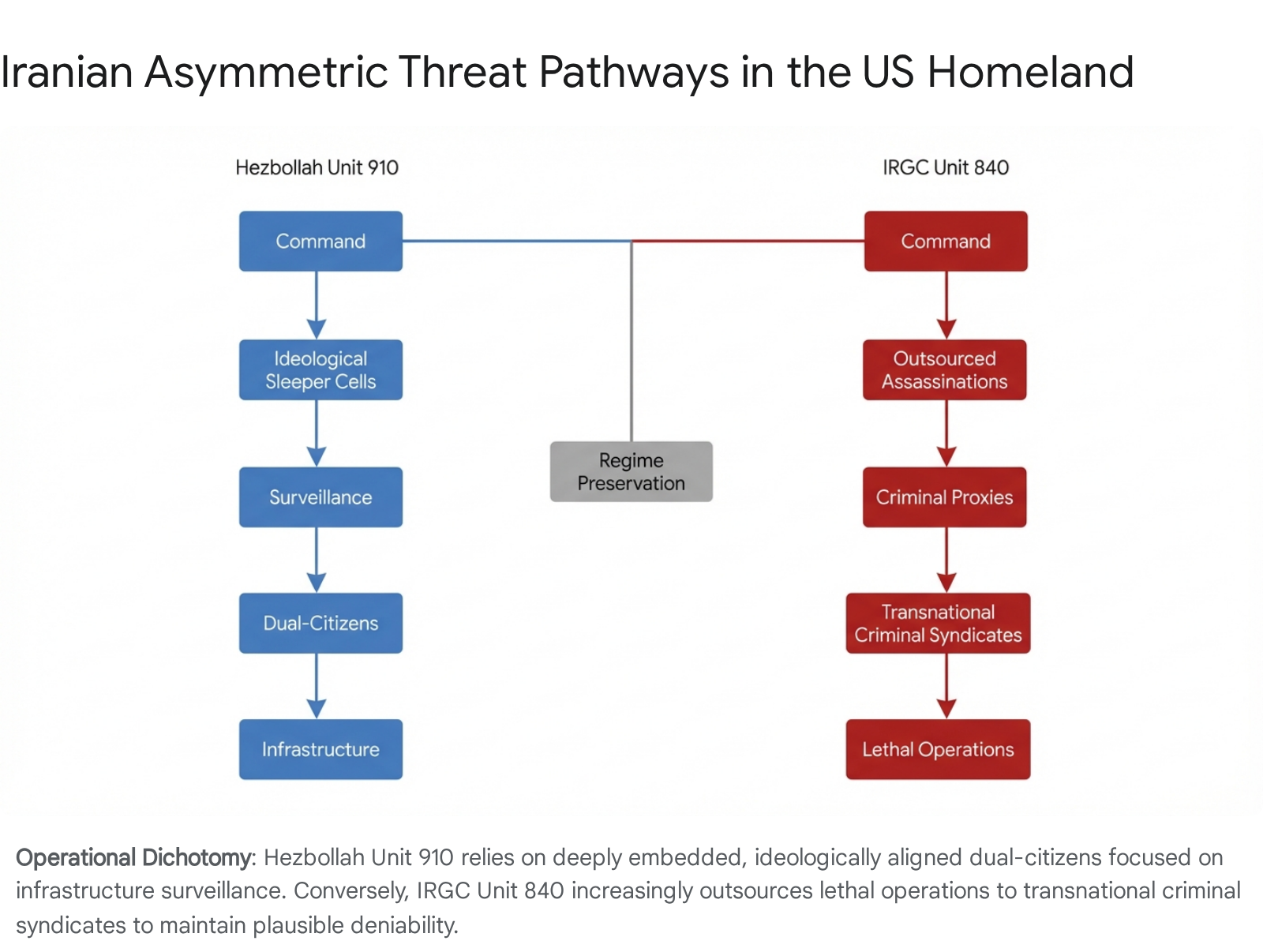
The probability of sleeper cell activation is currently assessed as exceptionally high. Iran possesses a documented, decades long history of asymmetric warfare and has methodically cultivated a homeland option for retaliatory contingencies. Intelligence indicates that these networks operate through a dual track methodology. The first track involves highly disciplined, long term operatives belonging to the Lebanese Hezbollah External Security Organization, commonly known as Unit 910 or the Islamic Jihad Organization. These individuals are deeply embedded within American communities, hold legitimate identification, and focus heavily on pre operational surveillance of critical infrastructure and military nodes. The second track involves the Islamic Revolutionary Guard Corps Quds Force Unit 840, which increasingly outsources lethal operations to transnational criminal syndicates to maintain plausible deniability.

This assessment identifies a strategic concentration of these networks within major United States metropolitan areas. Primary operational hubs remain in New York City, Washington District of Columbia, Chicago, Los Angeles, Detroit, and Houston. However, adversarial counter surveillance adaptations have prompted the dispersion of operatives into secondary logistical nodes, notably Portland in Oregon and Louisville in Kentucky, to evade federal monitoring. Target sets have expanded beyond prominent political figures and dissidents to include energy grids, transit hubs, and the defense industrial base, indicating a shift from symbolic retaliation to systemic economic disruption.

Current countermeasures executed by the Department of Homeland Security, the Federal Bureau of Investigation, and the Department of Justice face severe operational headwinds. While Joint Terrorism Task Forces remain on high alert nationwide, structural vulnerabilities within the domestic security apparatus threaten interagency effectiveness. Recent administrative dismissals within the Federal Bureau of Investigation CI-12 counterintelligence unit have degraded human intelligence networks specific to Iran. Concurrently, funding lapses and personnel reductions at the Cybersecurity and Infrastructure Security Agency have complicated the detection of hybrid cyber physical threats. Furthermore, the March 2026 mass shooting in Austin, Texas, illustrates the severe supplementary threat of lone actor mobilization driven by foreign state propaganda. The convergence of these institutional strains, combined with a highly motivated adversary facing regime collapse, presents an unprecedented challenge to the security of the United States homeland.

1. Strategic Context of Operation Epic Fury and Geopolitical Escalation

The strategic landscape shifted permanently in late February 2026 when United States and Israeli forces initiated a massive preemptive military campaign against the Islamic Republic of Iran. The offensive, codenamed Operation Epic Fury by the United States and Operation Roaring Lion by Israel, was designed to achieve total regime disruption and neutralize the Iranian nuclear and ballistic missile programs.1 This section outlines the parameters of the operation and the immediate geopolitical fallout that contextualizes the current domestic threat environment.

1.1. Execution and Objectives of the Military Campaign

Commencing at approximately 0115 Eastern Standard Time on February 28, 2026, the United States Central Command applied a comprehensive air campaign to shape the battlespace.3 The initial phases prioritized the degradation of integrated air defenses, command networks, and missile nodes. The operation involved over one thousand seven hundred strike sorties by American forces, successfully prosecuting more than one thousand two hundred and fifty Iranian targets within the first forty eight hours of the conflict.1

Most critically, the operation achieved immediate strategic decapitation. Precision strikes on a leadership compound in Tehran successfully eliminated Supreme Leader Ayatollah Ali Khamenei. The strikes also killed a significant portion of the national security architecture, including Defense Minister Aziz Nasirzadeh, Islamic Revolutionary Guard Corps Commander in Chief Mohammad Pakpour, and Military Council head Admiral Ali Shamkhani.4 The rapid elimination of the regime command and control structure triggered an immediate succession crisis and devolved military launch authority to mid level Islamic Revolutionary Guard Corps commanders.6

The stated objectives of the Trump administration centered on defending the American people by eliminating imminent threats, completely destroying the Iranian ballistic missile infrastructure, annihilating Iranian naval capabilities, and permanently crippling the nuclear program.2 While regime change was not formally declared as a statutory goal, the scale of the decapitation strikes indicates that the ultimate ambition of the campaign is the complete collapse of the current Islamic Republic framework.1

Phase of OperationTarget CategoriesStrategic ObjectiveOperational Impact
Phase One (Initial Salvo)Supreme Leader Compound, IRGC Headquarters, Defense MinistryStrategic DecapitationElimination of Ayatollah Khamenei and top IRGC generals; disruption of centralized command and control.4
Phase Two (Air Superiority)Radar installations, Surface-to-Air Missile batteries, Early Warning SystemsBattlespace ShapingNeutralization of Iranian air defenses; establishment of uninhibited airspace for allied bomber fleets.3
Phase Three (Infrastructure)Ballistic missile silos, nuclear research sites, naval basesCapability DestructionLong term degradation of Iranian force projection and nuclear weaponization capabilities.1

1.2. The Iranian Retaliatory Doctrine and Regional Escalation

The Iranian response to this existential threat was immediate, coordinated, and region wide, demonstrating a pre planned multi domain retaliation framework. Rather than capitulating, the surviving elements of the Islamic Revolutionary Guard Corps implemented layered responses combining kinetic attacks, cyber disruption, and proxy activation to impose maximum costs on the United States and its regional allies.7

Iran launched hundreds of ballistic missiles and suicide drones against Israeli territory and United States military installations across the Persian Gulf. Confirmed targets included Al Udeid Air Base in Qatar, Naval Support Activity Bahrain, Ali Al Salem Air Base in Kuwait, and Al Dhafra Air Base in the United Arab Emirates.7 By treating the United States basing network as a unified operational system rather than discrete entities, Iran signaled that the entire regional posture of the United States remains vulnerable despite the decapitation of leadership.7

Furthermore, Iran activated its Axis of Resistance network. Hezbollah initiated rocket attacks from southern Lebanon into northern Israel, while Houthi forces in Yemen resumed aggression against commercial shipping in the Red Sea.9 In a drastic measure to maintain internal security and prevent intelligence leaks regarding the locations of surviving regime figures, the Iranian government imposed a near total internet blackout, dropping national connectivity to approximately one percent of standard levels.10

1.3. Shift in the Asymmetric Deterrence Calculus

The most significant consequence of Operation Epic Fury for the United States homeland is the fundamental shift in the Iranian deterrence calculus. Historically, Iran has utilized its external intelligence apparatus to gather information, silence dissidents, and prepare contingency plans while carefully avoiding catastrophic actions that would provoke a full scale conventional war with the United States.11 This restraint was rooted in a foundational desire for regime preservation.

Following the events of February 28, that restraint has vanished. A regime in its death throes loses the deterrent logic that previously kept its sleeper cells in reserve. Because the regime views its survival as already compromised by the allied military campaign, it possesses nothing left to preserve by withholding its most devastating asymmetric assets.11 Consequently, the homeland option, a network of embedded operatives cultivated over decades, transitions from a theoretical contingency to an active operational priority.

2. Probability Assessment of Sleeper Cell Activation

The probability of Iranian sleeper cells conducting physical or cyber operations within the United States is currently assessed as exceptionally high. This assessment is grounded in the historical operational patterns of Iranian intelligence, the recent volume of disrupted plots on American soil, and the removal of the aforementioned strategic restraints.

2.1. Historical Precedents and the Homeland Option

The United States intelligence community has long recognized the commitment of the Iranian regime to developing a homeland option. Intelligence generated by the Central Intelligence Agency and the Federal Bureau of Investigation indicates that Iran has sustained embedded networks within the United States for decades. These units function as a strategic contingency, conducting intelligence gathering, targeted killings, and forging alliances with local criminal elements.12

A watershed moment in recognizing this domestic threat occurred in 2011 when federal authorities disrupted an Islamic Revolutionary Guard Corps Quds Force plot to assassinate the Saudi Arabian ambassador at a restaurant in Washington District of Columbia.12 This brazen scheme, which involved attempting to hire members of a Mexican drug cartel, reshaped federal assessments of state sponsored domestic terrorism and demonstrated the willingness of Tehran to bring kinetic conflict to the American homeland.12

2.2. Disrupted Plots and Procurement Networks (2020 to 2026)

Since 2020, following the United States military strike that eliminated Quds Force Commander Qasem Soleimani, the operational tempo of Iranian networks within the United States has increased significantly. Federal law enforcement has disrupted at least seventeen Iranian linked plots in the homeland over the past six years.13 These unsealed indictments reveal a persistent, highly resourced effort to target former United States officials, journalists, and regime dissidents.12

Prominent examples include disrupted murder for hire schemes targeting former National Security Advisor John Bolton, former Secretary of State Mike Pompeo, and former President Donald Trump, which Iranian operatives explicitly framed as retaliation for the death of Soleimani.12 Additionally, federal prosecutors charged an operative of the Islamic Revolutionary Guard Corps and two United States based individuals with plotting to surveil and assassinate Iranian American journalist Masih Alinejad in Brooklyn, New York.12

Beyond lethal operations, Iranian linked networks have maintained a robust presence on American soil for the purpose of illicit procurement. These networks actively seek to acquire sensitive dual use technology, software, and high tech equipment to support the Iranian military industrial complex and circumvent international sanctions.15 The sheer volume of these thwarted operations indicates a highly capable, deeply entrenched network that is already operational and possesses the logistical frameworks necessary to execute attacks upon receiving authorization.

3. Operational Profiles of Iranian Proxy Networks

The asymmetric threat posed by Iran within the United States is primarily executed through two distinct, yet complementary, operational pathways. The first involves the highly disciplined, ideologically aligned operatives of Lebanese Hezbollah. The second involves the transactional, outsourced operations of the Islamic Revolutionary Guard Corps Quds Force. Understanding the divergent methodologies of these two entities is critical for effective counterterrorism resource allocation.

3.1. The Threat Profile of Hezbollah Unit 910

Lebanese Hezbollah operates as the most capable and trusted proxy of the Iranian regime. Within Hezbollah, the External Security Organization, widely known as the Islamic Jihad Organization or Unit 910, serves as the clandestine black operations branch responsible for overseas terrorism.16 Historically led by Imad Mughniyeh and currently overseen by Talal Hamiyah, Unit 910 operates under the direct supervision of Iranian intelligence and the Islamic Revolutionary Guard Corps Quds Force.17

Unit 910 operatives deployed to North America exhibit a highly sophisticated level of intelligence tradecraft. They are typically recruited from the Lebanese diaspora and are highly valued if they possess dual citizenship and authentic Western passports, which facilitate unfettered international travel and border crossing.16 These individuals are rigorously trained to assimilate seamlessly into American society. Handlers instruct operatives to shave their beards, avoid attending mosques, and present a secular lifestyle to evade the behavioral scrutiny of local law enforcement and federal intelligence agencies.16

The operational history of Unit 910 within the United States reveals a deliberate focus on pre operational surveillance of critical infrastructure and law enforcement nodes. The 2017 arrests of Ali Kourani in New York and Samer el-Debek in Michigan exposed the depth of this methodology. Kourani, who explicitly described himself to federal agents as a sleeper operative belonging to Unit 910, conducted extensive reconnaissance on John F. Kennedy International Airport, the Federal Bureau of Investigation headquarters at 26 Federal Plaza, United States Secret Service facilities, and local military armories.18

Similarly, in 2019, the Department of Justice indicted Alexei Saab, a naturalized American citizen who operated as a sleeper agent for over a decade. Saab surveilled numerous structural targets, including the Port Authority Bus Terminal, Grand Central Terminal, and the New York Stock Exchange.19 Furthermore, intelligence indicates that Unit 910 operatives have actively sought to procure and stockpile explosive precursors. One documented case involved a Hezbollah operative in Texas who successfully purchased three hundred pounds of ammonium nitrate.20 The primary objective of Unit 910 is to prepare the operational groundwork over years or decades so that a catastrophic strike can be launched rapidly upon receiving a signal from Tehran.21

Iranian asymmetric threat pathways in US homeland. Hezbollah Unit 910 and IRGC Unit 840 operations.

3.2. The Threat Profile of IRGC Quds Force Unit 840

While Hezbollah Unit 910 focuses on long term embedding and strict ideological loyalty, the Islamic Revolutionary Guard Corps Quds Force Unit 840 employs a fundamentally different tactical approach. Unit 840 is an elite, covert operational unit specifically responsible for conducting assassinations, kidnappings, and punitive missions against dissidents and foreign targets abroad.22 Under the leadership of figures such as Yazdan Mir, Unit 840 has increasingly adopted a strategy of outsourcing its lethal operations to transnational criminal syndicates.22

This strategic shift toward criminal surrogates is driven by the desire to maintain plausible deniability and insulate the Iranian state from direct diplomatic or military repercussions. By hiring local gang members, drug traffickers, and independent criminals to execute attacks, Iranian intelligence officers shield themselves from direct attribution and mitigate the risk of losing highly trained, ideologically pure assets.25

In Europe, this strategy has manifested through partnerships with organized crime networks. The Swedish Security Service confirmed that Iran uses criminal networks, specifically the Foxtrot network led by Rawa Majid, to carry out violent acts against Israeli and Jewish sites.26 Within the United States, federal prosecutors have uncovered similar mechanisms, where Iranian intelligence officers have contracted members of the criminal underworld to surveil and plot the assassination of dissidents.15 This methodology significantly complicates the counterterrorism mission of the Federal Bureau of Investigation, as the perpetrators of the violence may have no ideological connection to radical Islam or the Iranian regime, rendering traditional watchlists and behavioral indicators entirely ineffective.27

Operational CharacteristicHezbollah Unit 910IRGC Quds Force Unit 840
Asset ProfileIdeologically aligned, dual citizens, deep coverTransnational criminals, gang affiliates, mercenaries
Primary MotivationReligious and political allegianceFinancial compensation, transactional contracts
Operational TimelineYears or decades of patient embeddingRapid mobilization upon contract agreement
Target PreferenceCritical infrastructure, military bases, mass transitSpecific individuals, dissidents, former officials
Detection DifficultyHigh (due to assimilation and clean records)High (due to lack of ideological indicators)

4. The Lone Actor Paradigm and the Austin Texas Incident

Beyond the structured operations of Unit 910 and Unit 840, the convergence of geopolitical escalation and digital propaganda has dramatically increased the risk of lone wolf attacks. Following the launch of Operation Epic Fury, foreign state narratives and emotionally charged calls for retaliation have permeated digital ecosystems. These narratives possess the capacity to activate personal grievances among individuals with no formal ties to terrorist organizations, providing a domestic radicalization pipeline that transforms international events into local violence.12

4.1. The Austin Shooting as a Case Study in Inspired Terrorism

The March 1, 2026, mass shooting in Austin, Texas, serves as a critical case study illustrating this hybrid threat paradigm. Ndiaga Diagne, a fifty three year old naturalized United States citizen originally from Senegal, opened fire at a crowded nightlife venue on Sixth Street, killing three individuals and wounding fourteen others.28 Diagne was subsequently neutralized by local law enforcement officers.

During the attack, Diagne wore a hoodie bearing the phrase Property of Allah over a shirt depicting the Iranian flag.29 While initial investigations by the Joint Terrorism Task Force suggest Diagne was a lone actor without direct communication links or financial ties to Iranian handlers, his social media history revealed deep pro Iranian regime sentiments and a hatred for American and Israeli leadership.28 Authorities noted he had a history of encounters with state agencies regarding mental health episodes.30

4.2. Strategic Implications of Stochastic Violence

The Austin incident highlights the profound danger of inspired terrorism, often referred to as stochastic terrorism. In this model, the sheer volume of geopolitical friction and state sponsored digital rhetoric acts as a catalyst for vulnerable individuals to independently mobilize and execute low complexity, high impact attacks on soft targets.12

This dynamic provides a massive strategic benefit to the Iranian regime. It serves as a force multiplier, generating public fear and political pressure within the United States without requiring any logistical investment, financial transfer, or operational direction from Tehran. Because these actors radicalize rapidly and operate independently of formal organizational structures, they exist in the gap between individuals of concern and those who can be legally charged with criminal conspiracy, making them exceptionally difficult for federal authorities to preempt.13

5. National Geographic Concentration and Strategic Nodes

Iranian intelligence networks and proxy operatives are not distributed evenly across the United States. Instead, they are strategically concentrated in geographic areas that offer distinct logistical, demographic, and operational advantages. Providing a national level assessment of these concentrations is essential for deploying limited counterterrorism and infrastructure protection resources effectively.

5.1. Primary Metropolitan Concentrations

Historical arrest records, unsealed Department of Justice indictments, and intelligence patterns reveal that Hezbollah and Islamic Revolutionary Guard Corps networks heavily favor major metropolitan centers. The vast majority of documented network activity is concentrated in New York City, Washington District of Columbia, Chicago, Los Angeles, Detroit, and Houston.20

These urban environments provide several critical operational benefits. First, they offer the necessary demographic density for operatives to blend into large diaspora populations, providing cover for their activities. Second, these cities feature massive international transit infrastructure, including major airports and seaports, facilitating the movement of personnel, illicit funds, and procured materials. Finally, proximity to global financial centers enables the complex money laundering operations required to fund the broader Axis of Resistance.

5.2. Tactical Dispersion and Evasion Hubs

As federal surveillance capabilities within these primary hubs have intensified over the past two decades, Iranian proxies have demonstrated significant tactical adaptation. Former intelligence officials have noted that, upon realizing the extent of Federal Bureau of Investigation monitoring and the density of Joint Terrorism Task Forces in cities like New York and Detroit, Hezbollah deliberately began placing sleeper operatives in secondary metropolitan areas.20

Specifically, intelligence assessments have identified cities such as Portland in Oregon and Louisville in Kentucky as deliberate evasion hubs.20 These mid sized metropolitan areas provide a lower law enforcement profile, allowing operatives to establish deep roots, integrate into local commercial sectors, and maintain their sleeper status with a substantially reduced risk of detection by federal counterintelligence units.20 This geographic dispersion strategy forces federal agencies to dilute their monitoring resources across a much wider geographic expanse.

5.3. Strategic Infrastructure and Target Selection Methodology

The target selection methodology of Iranian sleeper cells encompasses both symbolic retaliation and systemic economic disruption. In the event of a directed attack, intelligence assessments indicate that operatives would likely prioritize critical infrastructure nodes designed to inflict maximum psychological and economic friction on the American public.

The energy and financial sectors remain prime targets. The cyber physical convergence of modern infrastructure means that physical sabotage by a sleeper cell against a regional power substation or a liquefied natural gas terminal can exponentially amplify the effects of a coordinated Iranian cyberattack.32 Operatives have historically conducted extensive surveillance on major transit hubs, including the Port Authority Bus Terminal and local airports in the New York area.19

Furthermore, the defense industrial base is highly vulnerable. Facilities associated with the research and manufacturing of advanced aerospace systems, munitions, and satellite technologies, particularly those with corporate ties to Israeli defense firms, are assessed as high priority strategic nodes.33 The destruction of these facilities not only provides retaliatory satisfaction but also practically degrades the supply chains supporting the ongoing military operations in the Middle East.

Metropolitan AreaStrategic SignificanceAssessed Threat Vector
New York City / Washington DCHigh density of government, financial, and symbolic targets.Unit 910 surveillance; Unit 840 targeted assassinations.
Detroit / ChicagoLarge diaspora populations facilitating deep cover and logistical support.Financial laundering; procurement rings; sleeper cell embedding.
Houston / Gulf CoastConcentration of critical energy infrastructure and petrochemical refining.Physical sabotage of pipelines and energy grids; cyber physical attacks.
Portland / LouisvilleLower counterterrorism footprint; tactical evasion hubs.Long term staging; weapons caching; operational planning.
Silicon Valley / CaliforniaHigh concentration of advanced technology and defense contractors.Cyber espionage; theft of trade secrets; sabotage of defense base.34

6. Current Countermeasures and Intelligence Operations

In response to the unprecedented escalation in the Middle East and the corresponding domestic threat environment following Operation Epic Fury, the United States government has mobilized its counterterrorism apparatus. However, these efforts are currently hindered by severe institutional friction, debilitating funding deficits, and recent personnel upheavals within critical intelligence divisions.

6.1. The Posture and Vulnerabilities of the Department of Homeland Security

The Department of Homeland Security is the primary agency responsible for coordinating the national defense against physical and cyber threats. Following previous military engagements with Iran, the Department of Homeland Security promptly issued National Terrorism Advisory System bulletins, explicitly warning the public about the heightened risk of cyberattacks and violence driven by Iranian retaliation.32

Currently, Secretary of Homeland Security Kristi Noem has publicly stated that the department is in direct coordination with federal and local law enforcement partners to monitor and thwart potential threats.35 However, as of early March 2026, the Department of Homeland Security has conspicuously failed to issue an updated National Terrorism Advisory System alert regarding Operation Epic Fury.32 This critical breakdown in public threat communication is directly attributable to a lapse in federal funding caused by a partial government shutdown. The National Terrorism Advisory System website currently displays a notice indicating that it is not being actively managed due to a lack of appropriations.32

This funding crisis extends deeply into the operational capabilities of the Cybersecurity and Infrastructure Security Agency. Tasked with protecting the nation from the exact types of Iranian cyber operations that are currently escalating, the Cybersecurity and Infrastructure Security Agency is operating with sharply reduced staffing levels and has experienced a massive reduction in its workforce over the past year due to administration policy shifts.36 This limitation severely degrades the ability of the federal government to provide timely, actionable cyber threat intelligence to private sector partners operating vulnerable energy grids and financial networks.36

Border security represents an additional layer of severe vulnerability. United States Customs and Border Protection data indicates that over one thousand seven hundred and fifty Iranian nationals illegally crossed into the United States between 2021 and 2024.12 The persistence of unknown got aways traversing the border presents a critical security gap, as counterterrorism officials caution that elite Islamic Revolutionary Guard Corps operatives could easily exploit these illicit pathways to embed themselves within the homeland.12 In response to broader immigration concerns, Immigration and Customs Enforcement has initiated Operation Metro Surge, a massive interior enforcement operation. While officially aimed at undocumented immigrants, the operation acts as a sweeping domestic dragnet with counterterrorism implications, evidenced by the recent arrest of an illegal alien in Minnesota identified as a former member of the Islamic Revolutionary Guard Corps.37

6.2. Federal Bureau of Investigation Counterintelligence Constraints

The Federal Bureau of Investigation serves as the primary domestic intelligence agency tasked with neutralizing foreign operative networks. In the wake of Operation Epic Fury, Director Kash Patel has transitioned the bureau to a definitive war footing. Joint Terrorism Task Forces across all field offices have been instructed to operate continuously on high alert, mobilizing all necessary security assets to monitor Iran associated figures, conduct enhanced surveillance, and disrupt potential proxy retaliation.13 The Department of Justice continues to aggressively pursue unsealed indictments to dismantle Iranian procurement rings and publicly expose state sponsored cyber actors attempting to infiltrate United States networks.38

However, the capacity of the Federal Bureau of Investigation to preemptively dismantle Iranian sleeper cells has been severely compromised by internal administrative turmoil. Just days prior to the commencement of Operation Epic Fury, Director Patel executed the abrupt dismissal of over a dozen senior agents and staff members from CI-12, an elite Washington based counterintelligence unit.39 Unit CI-12 specializes specifically in monitoring espionage threats from foreign adversaries in the Middle East, with a profound, specialized focus on Iran and its proxy networks.39

The dismissals were reportedly retribution for the prior involvement of the agents in investigations regarding the retention of classified documents at the Mar a Lago estate.40 By gutting this highly specialized unit, the bureau lost decades of compounded institutional knowledge and critical human intelligence networks. Agents within CI-12 manage delicate relationships with confidential informants embedded deep within the Iranian American diaspora and local communities. The abrupt termination of these handlers effectively severs these vital intelligence arteries, blinding the Federal Bureau of Investigation to subterranean network movements at the exact moment the threat of Iranian sleeper cell activation is at its absolute zenith.41

7. The Cyber Physical Threat Convergence

The modern asymmetric threat landscape requires an assessment of how Iranian proxies will integrate physical sabotage with cyber warfare. Iranian cyber actors have historically aligned their activity with broader strategic objectives to increase pressure on targets including energy, critical infrastructure, finance, telecommunications, and healthcare.10

The immediate risk window involves a surge in retaliatory operations aimed at psychological effect and political signaling, such as website defacements and distributed denial of service attacks.32 However, Iranian actors actively hunt for vulnerabilities in unpatched internet facing systems and weakly secured operational technology edge devices. A coordinated attack involving a localized physical strike by a sleeper cell on a power substation, paired simultaneously with a destructive wiper malware attack on the regional energy grid software, would create catastrophic cascading economic effects and immediate public anxiety.32 Given the degraded posture of the Cybersecurity and Infrastructure Security Agency, private sector entities must rapidly fortify their network architecture against this blended threat methodology.

8. Strategic Conclusion and Threat Trajectory

The United States homeland currently faces an unprecedented convergence of threat vectors. The prosecution of Operation Epic Fury has pushed the Iranian regime to the brink of collapse, stripping away the geopolitical constraints that previously held its vast network of global sleeper cells in check. The probability that Hezbollah Unit 910 operatives, or criminal syndicates contracted by the Islamic Revolutionary Guard Corps Unit 840, will attempt retaliatory strikes on American soil is exceptionally high.

These networks are not abstract concepts; they are well entrenched, geographically dispersed across major metropolitan centers and secondary evasion hubs, and highly trained in modern tradecraft. They possess the capability to execute complex cyber physical attacks against critical infrastructure or launch targeted kinetic operations against high profile individuals. Concurrently, the proliferation of state sponsored digital propaganda guarantees an elevated risk of lone wolf violence, as tragically evidenced by the events in Austin, Texas.

The ability of the United States to detect and preempt these threats is currently in a state of perilous fragility. The ongoing government shutdown has crippled the public advisory systems of the Department of Homeland Security and degraded the defensive posture of the Cybersecurity and Infrastructure Security Agency. Simultaneously, political retaliation within the Federal Bureau of Investigation has decimated the specific counterintelligence unit tasked with monitoring Iranian espionage. To mitigate the impending risk, it is imperative that federal agencies rapidly restore funding to cybersecurity infrastructure, immediately reconstitute human intelligence networks within the Iranian diaspora, and foster seamless, real time intelligence integration with local law enforcement to harden soft targets and secure strategic nodes across the nation.

Appendix: Analytical Methodology

The findings in this report were generated utilizing a combination of established structured analytic techniques, primarily relying on the CARVER Matrix methodology and the Analysis of Competing Hypotheses framework.

The CARVER Matrix, which evaluates targets based on Criticality, Accessibility, Recuperability, Vulnerability, Effect, and Recognizability, was employed to assess the likely target selection priorities of Iranian sleeper cells within the United States. Originally developed by the United States military for special operations targeting, CARVER is highly effective for evaluating domestic vulnerabilities.42 By applying this matrix to the known modus operandi of Hezbollah Unit 910 and Islamic Revolutionary Guard Corps Unit 840, analysts can quantitatively estimate which critical infrastructure nodes present the highest strategic value to an adversary seeking asymmetric retaliation.43 This methodology underpins the assessment that operatives will prioritize targets that yield compounding economic friction and psychological impact over purely symbolic violence.

Simultaneously, the Analysis of Competing Hypotheses was utilized to evaluate the nature of recent domestic incidents, specifically the March 2026 shooting in Austin, Texas. Analysis of Competing Hypotheses requires analysts to identify all possible alternative explanations for an event, such as a directed proxy attack, inspired lone wolf terrorism, or unrelated criminal violence, and subsequently evaluate the available intelligence to disconfirm, rather than confirm, these hypotheses.44 By systematically applying the evidence surrounding the shooter profile, tactical execution, and digital footprint, the Analysis of Competing Hypotheses framework determined that the Austin incident most strongly aligns with an inspired, lone actor mobilization exacerbated by geopolitical tension, rather than a directed operation by a formalized sleeper cell. This structured methodology mitigates cognitive bias and ensures that threat assessments remain grounded strictly in the available evidentiary record.


Please share the link on Facebook, Forums, with colleagues, etc. Your support is much appreciated and if you have any feedback, please email us in**@*********ps.com. If you’d like to request a report or order a reprint, please click here for the corresponding page to open in new tab.


Sources Used

  1. Defense Update: Operation Epic Fury – https://defense-update.com/20260303_epic-fury.html
  2. The White House: Peace Through Strength – https://www.whitehouse.gov/articles/2026/03/peace-through-strength-president-trump-launches-operation-epic-fury-to-crush-iranian-regime-end-nuclear-threat/
  3. Aerospace Global News: Operation Epic Fury US Israel Air Campaign Iran – https://aerospaceglobalnews.com/news/operation-epic-fury-us-israel-air-campaign-iran/
  4. Iran International: US, Israel Launch Major Combat Operations in Iran – https://www.iranintl.com/en/202603016611
  5. DebugLies: Iran in Transition: Strategic Intelligence Assessment – https://debuglies.com/2026/03/01/iran-in-transition-strategic-intelligence-assessment-post-khamenei-succession-crisis-retaliatory-doctrine-regional-escalation-calculus/
  6. FDD Action: Operation Epic Fury: Battle Damage Assessment – https://www.fddaction.org/secure-line-readout/2026/03/02/operation-epic-fury-battle-damage-assessment-and-strategic-outlook/
  7. HS Today: Iran Responds to Operation Epic Fury – https://www.hstoday.us/subject-matter-areas/counterterrorism/iran-responds-to-operation-epic-fury-with-layered-military-cyber-and-proxy-strategy-amid-escalation-constraints/
  8. CBS News: Israel, US Attack Iran; Trump Says Major Combat Operations – https://www.cbsnews.com/live-updates/israel-us-attack-iran-trump-says-major-combat-operations/
  9. CloudSEK: Middle East Escalation: Israel, Iran, US Cyber War 2026 – https://www.cloudsek.com/blog/middle-east-escalation-israel-iran-us-cyber-war-2026
  10. Industrial Cyber: US-Israeli Campaign Triggers Iranian Counteroffensive – https://industrialcyber.co/industrial-cyber-attacks/us-israeli-campaign-triggers-iranian-counteroffensive-targeting-gulf-energy-critical-infrastructure/
  11. Middle East Forum: Iran Strike Scenarios: Retaliation, Transition, and the Path Forward – https://www.meforum.org/mef-reports/iran-strike-scenarios-retaliation-transition-and-the-path-forward
  12. HS Today: Escalating Risks of Iranian Retaliation on American Soil – https://www.hstoday.us/subject-matter-areas/counterterrorism/escalating-risks-of-iranian-retaliation-on-american-soil-following-epic-fury-campaign/
  13. The Economic Times: America is not just fighting the Iran war in the Gulf – https://m.economictimes.com/news/defence/america-is-not-just-fighting-the-iran-war-in-the-gulf/articleshow/129017775.cms
  14. The Soufan Center: IntelBrief: Western Nations Condemn Iranian Intelligence Operations – https://thesoufancenter.org/intelbrief-2025-august-15/
  15. GWU Extremism Tracker: Propaganda, Procurement, and Lethal Operations – https://extremism.gwu.edu/propaganda-procurement-and-lethal-operations-irans-activities-inside-america
  16. Grey Dynamics: Unit 910: Hezbollah’s Covert Action Unit – https://greydynamics.com/unit-910-hezbollahs-covert-action-unit/
  17. Wikipedia: Unit 910 – https://en.wikipedia.org/wiki/Unit_910
  18. Washington Institute: Inside Hezbollah’s American Sleeper Cells – https://www.washingtoninstitute.org/policy-analysis/inside-hezbollahs-american-sleeper-cells-waiting-irans-signal-strike-us-and-israeli
  19. Taylor & Francis Online: Hezbollah’s Operations and Networks in the United States – https://www.tandfonline.com/doi/full/10.1080/1057610X.2020.1759487
  20. Combating Terrorism Center at West Point: Tehran’s Homeland Option – https://ctc.westpoint.edu/tehrans-homeland-option-terror-pathways-for-iran-to-strike-in-the-united-states/
  21. Washington Institute: Hezbollah Isn’t Just in Beirut, It’s in New York, Too – https://www.washingtoninstitute.org/policy-analysis/hezbollah-isnt-just-beirut-its-new-york-too
  22. Wikipedia: Unit 840 – https://en.wikipedia.org/wiki/Unit_840
  23. Iran International: Sanctions Target IRGC Quds Force Unit 840 – https://www.iranintl.com/en/202602035806
  24. Washington Institute: Iranian External Operations in Europe: The Criminal Connection – https://www.washingtoninstitute.org/policy-analysis/iranian-external-operations-europe-criminal-connection
  25. ICCT: Iranian External Operations in Europe: The Criminal Connection – https://icct.nl/publication/iranian-external-operations-europe-criminal-connection
  26. Wikipedia: Iranian External Operations – https://en.wikipedia.org/wiki/Iranian_external_operations
  27. HS Today: U.S.-Israel Attacks on Iran Fuel Complex Domestic Radicalization – https://www.hstoday.us/subject-matter-areas/counterterrorism/u-s-israel-attacks-on-iran-fuel-complex-domestic-radicalization-and-counterterrorism-challenges/
  28. The Guardian: Austin bar shooting investigated as potential terrorism – https://www.theguardian.com/us-news/2026/mar/02/austin-bar-shooting-investigation-potential-terrorism
  29. TIME: Austin Shooting Suspect and Potential Terrorism Investigation – https://time.com/7382024/austin-shooting-suspect-victims-investigation-reactions-potential-terrorism-iran-shirt/
  30. Washington Post: Authorities investigate if Austin bar shooter was motivated by Iran campaign – https://www.washingtonpost.com/national-security/2026/03/01/iran-attack-austin-bar-shooting/
  31. GWU Extremism Tracker: Hezbollah’s Operations and Networks in the United States -(https://extremism.gwu.edu/sites/g/files/zaxdzs5746/files/Hezbollah’s_Operations_and_Networks_in_the_United_States_June30_2022.pdf)
  32. HS Today: Iran Strike Operation Epic Fury Underway – https://www.hstoday.us/perspective/iran-strike-operation-epic-fury-underway-why-has-dhs-not-issued-an-ntas-alert/
  33. CISA: Iranian Cyber Actors May Target Vulnerable US Networks – https://www.cisa.gov/resources-tools/resources/iranian-cyber-actors-may-target-vulnerable-us-networks-and-entities-interest
  34. Iran International: Silicon Valley Engineers Charged with Stealing Trade Secrets – https://www.iranintl.com/en/202602208661
  35. CTV News: Intelligence assessment warns of Iranian attacks on US following Khamenei’s death – https://www.ctvnews.ca/world/mideast-conflict/article/intelligence-assessment-warns-of-iranian-attacks-on-us-following-khameneis-death/
  36. GovTech: Iran Strikes May Test U.S. Cybersecurity Strategy Abroad – https://www.govtech.com/security/iran-strikes-may-test-u-s-cybersecurity-strategy-abroad
  37. Center for Immigration Studies: Operation Midnight Hammer and the Threat of Iranian Sleeper Cells -(https://cis.org/Arthur/Operation-Midnight-Hammer-and-Threat-Iranian-Sleeper-Cells)
  38. Department of Justice: Three IRGC Cyber Actors Indicted – https://www.justice.gov/archives/opa/pr/three-irgc-cyber-actors-indicted-hack-and-leak-operation-designed-influence-2024-us
  39. MS Now: Kash Patel’s latest firings ousted agents with expertise in Iran – https://www.ms.now/news/kash-patels-latest-firings-ousted-agents-with-expertise-in-iran
  40. The Independent: Patel fired key members of FBI spy group that monitors Iran threats – https://www.the-independent.com/news/world/americas/us-politics/kash-patel-fbi-firings-agents-iran-b2931141.html
  41. CBS News: Most of the FBI agents fired by Kash Patel worked on counterintelligence – https://www.cbsnews.com/news/fbi-agents-patel-fired-counterintelligence-including-iran/
  42. Special Eurasia: CARVER Matrix in Intelligence – https://www.specialeurasia.com/2026/01/06/carver-matrix-intelligence/
  43. SMI Consultancy: CARVER Target Analysis – https://www.smiconsultancy.com/carver-target-analysis
  44. CIA: Tradecraft Primer: Structured Analytic Techniques -(https://www.cia.gov/resources/csi/static/Tradecraft-Primer-apr09.pdf)

Works cited

  1. OPERATION EPIC FURY / ROARING LION – Defense Update:, accessed March 4, 2026, https://defense-update.com/20260303_epic-fury.html
  2. Peace Through Strength: President Trump Launches Operation Epic Fury to Crush Iranian Regime, End Nuclear Threat – The White House, accessed March 4, 2026, https://www.whitehouse.gov/articles/2026/03/peace-through-strength-president-trump-launches-operation-epic-fury-to-crush-iranian-regime-end-nuclear-threat/
  3. Operation Epic Fury: How the US & Israeli attack on Iran unfolded – Aerospace Global News, accessed March 4, 2026, https://aerospaceglobalnews.com/news/operation-epic-fury-us-israel-air-campaign-iran/
  4. Iran sleeper cell fears rise after Austin shooting, Canada gym attack | Iran International, accessed March 4, 2026, https://www.iranintl.com/en/202603016611
  5. IRAN IN TRANSITION: STRATEGIC INTELLIGENCE ASSESSMENT – Post-Khamenei Succession Crisis, Retaliatory Doctrine & Regional Escalation Calculus – https://debuglies.com, accessed March 4, 2026, https://debuglies.com/2026/03/01/iran-in-transition-strategic-intelligence-assessment-post-khamenei-succession-crisis-retaliatory-doctrine-regional-escalation-calculus/
  6. Operation Epic Fury: Battle Damage Assessment and Strategic Outlook – FDD Action, accessed March 4, 2026, https://www.fddaction.org/secure-line-readout/2026/03/02/operation-epic-fury-battle-damage-assessment-and-strategic-outlook/
  7. Iran Responds to Operation Epic Fury with Layered Military, Cyber, and Proxy Strategy Amid Escalation Constraints – HSToday, accessed March 4, 2026, https://www.hstoday.us/subject-matter-areas/counterterrorism/iran-responds-to-operation-epic-fury-with-layered-military-cyber-and-proxy-strategy-amid-escalation-constraints/
  8. U.S. and Israel launch another round of strikes on Iran following Khamenei’s killing – CBS News, accessed March 4, 2026, https://www.cbsnews.com/live-updates/israel-us-attack-iran-trump-says-major-combat-operations/
  9. Situation Report: Middle East Escalation (February 27–1st March, 2026) | CloudSEK, accessed March 4, 2026, https://www.cloudsek.com/blog/middle-east-escalation-israel-iran-us-cyber-war-2026
  10. US-Israeli campaign triggers Iranian counteroffensive targeting Gulf energy, critical infrastructure – Industrial Cyber, accessed March 4, 2026, https://industrialcyber.co/industrial-cyber-attacks/us-israeli-campaign-triggers-iranian-counteroffensive-targeting-gulf-energy-critical-infrastructure/
  11. Iran Strike Scenarios: Retaliation, Transition, and the Path Forward – Middle East Forum, accessed March 4, 2026, https://www.meforum.org/mef-reports/iran-strike-scenarios-retaliation-transition-and-the-path-forward
  12. Escalating Risks of Iranian Retaliation on American Soil Following Epic Fury Campaign, accessed March 4, 2026, https://www.hstoday.us/subject-matter-areas/counterterrorism/escalating-risks-of-iranian-retaliation-on-american-soil-following-epic-fury-campaign/
  13. America is not just fighting the Iran war in the Gulf, accessed March 4, 2026, https://m.economictimes.com/news/defence/america-is-not-just-fighting-the-iran-war-in-the-gulf/articleshow/129017775.cms
  14. Could Iran Seek to Attack the U.S. Homeland? – The Soufan Center, accessed March 4, 2026, https://thesoufancenter.org/intelbrief-2025-august-15/
  15. Propaganda, Procurement and Lethal Operations: Iran’s Activities Inside America | Program on Extremism | The George Washington University, accessed March 4, 2026, https://extremism.gwu.edu/propaganda-procurement-and-lethal-operations-irans-activities-inside-america
  16. Unit 910: Hezbollah´s Covert Action Unit – Grey Dynamics, accessed March 4, 2026, https://greydynamics.com/unit-910-hezbollahs-covert-action-unit/
  17. Unit 910 – Wikipedia, accessed March 4, 2026, https://en.wikipedia.org/wiki/Unit_910
  18. Inside Hezbollah’s American Sleeper Cells: Waiting for Iran’s Signal to Strike U.S. and Israeli Targets | The Washington Institute, accessed March 4, 2026, https://www.washingtoninstitute.org/policy-analysis/inside-hezbollahs-american-sleeper-cells-waiting-irans-signal-strike-us-and-israeli
  19. Iran and Hezbollah’s Pre-Operational Modus Operandi in the West – Taylor & Francis, accessed March 4, 2026, https://www.tandfonline.com/doi/full/10.1080/1057610X.2020.1759487
  20. Tehran’s Homeland Option: Terror Pathways for Iran to Strike in the United States, accessed March 4, 2026, https://ctc.westpoint.edu/tehrans-homeland-option-terror-pathways-for-iran-to-strike-in-the-united-states/
  21. Hezbollah Isn’t Just in Beirut. It’s in New York, Too. | The Washington Institute, accessed March 4, 2026, https://www.washingtoninstitute.org/policy-analysis/hezbollah-isnt-just-beirut-its-new-york-too
  22. Unit 840 – Wikipedia, accessed March 4, 2026, https://en.wikipedia.org/wiki/Unit_840
  23. Iran says Hatef-3 satellite launch likely by March, tests under way, accessed March 4, 2026, https://www.iranintl.com/en/202602035806
  24. Iranian External Operations in Europe: The Criminal Connection | The Washington Institute, accessed March 4, 2026, https://www.washingtoninstitute.org/policy-analysis/iranian-external-operations-europe-criminal-connection
  25. Iranian External Operations in Europe: The Criminal Connection | International Centre for Counter-Terrorism – ICCT, accessed March 4, 2026, https://icct.nl/publication/iranian-external-operations-europe-criminal-connection
  26. Iranian external operations – Wikipedia, accessed March 4, 2026, https://en.wikipedia.org/wiki/Iranian_external_operations
  27. U.S.–Israel Attacks on Iran Fuel Complex Domestic Radicalization and Counterterrorism Challenges, accessed March 4, 2026, https://www.hstoday.us/subject-matter-areas/counterterrorism/u-s-israel-attacks-on-iran-fuel-complex-domestic-radicalization-and-counterterrorism-challenges/
  28. Authorities investigate mass shooting at Austin bar as potential act of terrorism, accessed March 4, 2026, https://www.theguardian.com/us-news/2026/mar/02/austin-bar-shooting-investigation-potential-terrorism
  29. What to Know About the Shooting in Austin | TIME, accessed March 4, 2026, https://time.com/7382024/austin-shooting-suspect-victims-investigation-reactions-potential-terrorism-iran-shirt/
  30. FBI probing whether Iran attack motivated Austin shooter who killed 2, accessed March 4, 2026, https://www.washingtonpost.com/national-security/2026/03/01/iran-attack-austin-bar-shooting/
  31. HEZBOLLAH’S OPERATIONS AND NETWORKS IN THE UNITED STATES: TWO DECADES IN REVIEW – The George Washington University, accessed March 4, 2026, https://extremism.gwu.edu/sites/g/files/zaxdzs5746/files/Hezbollah’s_Operations_and_Networks_in_the_United_States_June30_2022.pdf
  32. Iran Strike Operation Epic Fury Underway: Why Has DHS Not Issued an NTAS Alert?, accessed March 4, 2026, https://www.hstoday.us/perspective/iran-strike-operation-epic-fury-underway-why-has-dhs-not-issued-an-ntas-alert/
  33. Iranian Cyber Actors May Target Vulnerable US Networks and Entities of Interest – CISA, accessed March 4, 2026, https://www.cisa.gov/resources-tools/resources/iranian-cyber-actors-may-target-vulnerable-us-networks-and-entities-interest
  34. Three Iranians in Silicon Valley face US trade secrets charges | Iran International, accessed March 4, 2026, https://www.iranintl.com/en/202602208661
  35. Intelligence assessment warns of Iranian attacks on U.S. following Khamenei’s death, accessed March 4, 2026, https://www.ctvnews.ca/world/mideast-conflict/article/intelligence-assessment-warns-of-iranian-attacks-on-us-following-khameneis-death/
  36. Iran Strikes May Test U.S. Cybersecurity Strategy Abroad – GovTech, accessed March 4, 2026, https://www.govtech.com/security/iran-strikes-may-test-u-s-cybersecurity-strategy-abroad
  37. Operation Midnight Hammer and the Threat of Iranian Sleeper Cells, accessed March 4, 2026, https://cis.org/Arthur/Operation-Midnight-Hammer-and-Threat-Iranian-Sleeper-Cells
  38. Three IRGC Cyber Actors Indicted for ‘Hack-and-Leak’ Operation Designed to Influence the 2024 U.S. Presidential Election – Justice.gov, accessed March 4, 2026, https://www.justice.gov/archives/opa/pr/three-irgc-cyber-actors-indicted-hack-and-leak-operation-designed-influence-2024-us
  39. Kash Patel’s latest firings ousted agents with expertise in Iran, accessed March 4, 2026, https://www.ms.now/news/kash-patels-latest-firings-ousted-agents-with-expertise-in-iran
  40. Patel fired key members of FBI spy group that monitors Iran threats days before Trump launched attacks: report, accessed March 4, 2026, https://www.the-independent.com/news/world/americas/us-politics/kash-patel-fbi-firings-agents-iran-b2931141.html
  41. FBI agents fired by Patel worked in counterintelligence, including on cases involving Iran, sources say, accessed March 4, 2026, https://www.cbsnews.com/news/fbi-agents-patel-fired-counterintelligence-including-iran/
  42. The CARVER Matrix in Strategic Targeting and Intelligence Assessment – SpecialEurasia, accessed March 4, 2026, https://www.specialeurasia.com/2026/01/06/carver-matrix-intelligence/
  43. The Fundamentals of CARVER Target Analysis and Vulnerability Assessment Methodology, accessed March 4, 2026, https://www.smiconsultancy.com/carver-target-analysis
  44. A Tradecraft Primer: Structured Analytic Techniques for Improving Intelligence Analysis Prepared by the US Government March 2009 – CIA, accessed March 4, 2026, https://www.cia.gov/resources/csi/static/Tradecraft-Primer-apr09.pdf

Understanding the Kill Web Doctrine

The evolution of modern warfare has precipitated a fundamental paradigm shift in how the United States military conceptualizes, plans, and executes combat operations. For decades, the United States military relied upon a linear, sequential process known formally as the kill chain, a systematic methodology designed to find, fix, track, target, engage, and assess enemy forces.1 While this linear construct secured battlefield dominance in uncontested environments and asymmetric conflicts against non-peer adversaries, the resurgence of great power competition has rendered the traditional kill chain dangerously fragile.1 Pacing threats, most notably the People’s Republic of China, have meticulously analyzed the American way of war and developed sophisticated countermeasures engineered to sever these linear chains at their most vulnerable links.1

In response to these emerging vulnerabilities, the Department of Defense has transitioned toward a vastly more complex, resilient, and adaptive operational construct known as the kill web.5 Where a kill chain represents a static, two-dimensional sequence of events intrinsically tied to monolithic platforms, a kill web is a dynamic, six-dimensional network that seamlessly integrates the air, land, maritime, space, cyberspace, and electromagnetic spectrum domains.5 By networking diverse sensors, command and control nodes, and effectors across all branches of the armed forces and allied nations, the kill web enables any sensor to provide targeting data to any appropriate shooter, guided by advanced artificial intelligence and machine learning algorithms.5

This comprehensive research report provides an exhaustive analysis of the strategic rationale underpinning the kill web doctrine. It meticulously examines the technical architecture that comprises the web, its manifestation across the military services through the Combined Joint All-Domain Command and Control initiative, the algorithmic engines driving its execution, the logistical frameworks required to sustain it, and the profound implications it holds for operational vulnerabilities and military command philosophy.

The Strategic Imperative: Countering System Destruction Warfare

The impetus for the kill web doctrine is inextricably linked to the strategic posture and capability advancements of peer adversaries. Following the overwhelming success of United States forces in operations such as Desert Storm, adversaries recognized the futility of engaging the United States in symmetric, platform-on-platform attrition warfare.4 Historically, the United States military relied on an operational paradigm that shifted in the early 1980s from Active Defense to AirLand Battle, a doctrine that provided enhanced maneuverability, increased tempo, and embraced offensive combined arms.10 However, the contemporary strategic environment necessitates a shift of equal magnitude to counter localized adversary advantages. The People’s Republic of China has developed a sophisticated Anti-Access/Area Denial strategy, specifically designed to keep United States and allied forces outside of the first and second island chains in the Indo-Pacific theater by creating an interconnected minefield of sensors, shooters, and command elements.3

The Fragility of the Linear Kill Chain

The traditional United States kill chain is characterized by highly capable but limited monolithic platforms, such as an E-3 Airborne Warning and Control System aircraft communicating directly with a strike-fighter.12 This architecture inherently creates single points of failure. The military doctrine of the People’s Republic of China, often termed System Destruction Warfare, specifically targets these critical nodes rather than attempting to engage in platform-versus-platform attrition.1 According to translated military doctrine, the People’s Liberation Army aims to collapse the overarching operational architecture by targeting high-value intelligence, surveillance, and reconnaissance assets, communication satellites, and command centers through both kinetic strikes and non-kinetic electronic warfare, termed “information soft kills”.1

If an adversary can successfully jam a satellite link, destroy a forward radar station, or neutralize a localized command center, the linear kill chain collapses entirely.1 Furthermore, the sheer scale and scope of a potential Pacific conflict introduce unparalleled complexities. Projections indicate that up to eighty percent of targets may be mobile or quickly relocatable in the early phases of an invasion scenario.1 The United States military must be prepared to close kill chains against these dynamic, fleeting targets at a scale unseen since the Cold War, operating across thousands of miles of ocean.1 A traditional linear process simply cannot accommodate the volume and speed of targeting required for such an endeavor.

The Transition to Decision-Centric Warfare

The kill web serves as the technological and doctrinal answer to System Destruction Warfare and Anti-Access/Area Denial strategies. By distributing capabilities across a vast network of disaggregated systems, the kill web removes single points of failure, rendering the architecture exponentially more survivable.1 This structural shift facilitates a fundamental transition from attrition-centric warfare, which focuses on physically destroying the enemy’s mass, to decision-centric warfare.15

Decision-centric warfare seeks to weaponize complexity. By possessing a networked web of assets that can be rapidly composed and recomposed into unpredictable force packages, the United States military can impose multiple, overlapping dilemmas upon an adversary simultaneously.13 This capability disrupts the enemy’s Observe, Orient, Decide, Act loop, effectively collapsing their decision-making cycle and paralyzing their operational tempo.5

Doctrinal CharacteristicTraditional Kill ChainAdvanced Kill Web
Architectural StructureLinear, sequential, and staticDynamic, omnidirectional, and mesh-based
Asset DependencyHighly dependent on monolithic, multi-role platformsDisaggregated, utilizing single-function and multi-function nodes
Vulnerability ProfileHigh risk of single points of failureHighly resilient; destruction of a node prompts automated rerouting
Primary ObjectivePlatform-on-platform attritionDecision superiority and cognitive overload of the adversary
Domain IntegrationTypically single or dual-domain (e.g., Air-to-Ground)Omni-domain (Air, Land, Sea, Space, Cyber, Electromagnetic)
Data ProcessingHuman-intensive, localized analysisMachine-speed analysis, AI-driven sensor fusion, automated deconfliction
Network topologies: Linear kill chain vs. networked kill web, showing sensor-to-shooter connections and distributed nodes.

Conceptual Foundations: Mosaic Warfare and Convergence

The foundational operational principle of the kill web is convergence. Military doctrine defines convergence as the process of collecting massive volumes of data from highly distributed sensors, rapidly analyzing it to discern critical tactical information, transmitting that intelligence securely to relevant operators, and optimally responding with the right munition, from the right platform, at the precise moment of maximum impact.5 Achieving convergence requires an increasingly integrated and interoperable joint force that maintains a continuous, shared understanding of the common operating environment, enabling commanders to auction off targets to platforms best postured within the web.5

The Defense Advanced Research Projects Agency and Mosaic Warfare

The technological and conceptual manifestation of convergence is heavily informed by the Defense Advanced Research Projects Agency’s Mosaic Warfare strategy.12 Traditional military procurement focuses on highly complex, multi-role platforms that require decades to develop, are exorbitantly expensive to build, and represent catastrophic losses if destroyed in combat. Mosaic warfare, conversely, treats individual warfighting platforms—whether they are manned aircraft, unmanned autonomous swarms, or non-kinetic electronic warfare pods—as individual tiles in a broader, infinitely configurable mosaic.4

Combatant commanders can rapidly select these individual force elements and tile them together to create tailored force packages designed for a specific, immediate mission.17 Because the systems are disaggregated and highly interoperable, they can mass firepower and effects unpredictably without necessarily massing physical forces in a vulnerable geographic location.13 This approach grants the joint force an asymmetric advantage, making it exceedingly difficult for adversaries to ascertain intent, identify critical vulnerabilities, or predict avenues of attack.13 Analysts note that the human immune system, which has evolved to exhibit mosaic-like properties of resilience, adaptability, and distributed response, serves as a biological analog for this warfighting construct.19

Enabling Technologies: ACK and STITCHES

To operationalize Mosaic Warfare and enable force composability directly at the warfighter level, the Defense Advanced Research Projects Agency has developed critical software architectures, most notably the Adapting Cross-Domain Kill-Webs program and the System-of-systems Technology Integration Tool Chain for Heterogeneous Electronic Systems.12

The Adapting Cross-Domain Kill-Webs program functions as a novel, highly advanced decision-aid software designed explicitly for mission commanders. It analyzes thousands of complex variables and available assets across organizational and service boundaries to recommend optimal sensor-to-shooter combinations.12 Rather than relying on rigid, pre-planned responses, the software generates actionable plays for the commander. During demonstrations, the software successfully analyzed immense volumes of data to form cross-domain webs, ultimately sending commands to applications like the Command and Control Incident Management Emergency Response Application and ground-based integrated fire control systems to scramble interceptors.12

Crucially, the System-of-systems Technology Integration Tool Chain for Heterogeneous Electronic Systems serves as the vital middleware making these rapid connections possible. It is a software-only, fully government-owned integration toolchain designed to rapidly connect heterogeneous systems across any domain.12 It circumvents traditional interoperability bottlenecks by auto-generating extremely low-latency, high-throughput middleware between systems without forcing a common interface standard or requiring massive hardware upgrades.12 This breakthrough allows legacy radar systems deployed over forty years ago to seamlessly share targeting data with modern electronic equipment, creating adaptive kill webs in a matter of days rather than the years typically required to accredit and host software on secure military networks.12

Architectural Composition: The Triad of the Kill Web

The kill web is not a single piece of hardware but a system of systems sustained by a triad of interconnected functional grids: the omni-domain sensor grid, the command and control nexus, and the effector grid.

The Omni-Domain Sensor Grid

A kill web is entirely dependent upon persistent, resilient, and multi-modal battlespace awareness. In a modern conflict prioritizing precision strikes, the quality, quantity, and survivability of sensors are often more decisive than the explosive yield of the weapons they guide.21 The sensor grid ingests data from a dizzying array of sources: space-based early warning systems, high-altitude unmanned aerial vehicles, advanced fifth-generation aircraft like the F-35 acting as forward data-collection nodes, and terrestrial radars.22

Modern sensor infrastructure, such as the AN/TPS-80 Ground/Air Task Oriented Radar, provides unambiguous views of highly cluttered, contested environments, passing that data directly into the web.23 Furthermore, to secure the ultimate high ground, the United States Space Force, through the Space Development Agency, is rapidly deploying the Proliferated Warfighter Space Architecture.24 This architecture establishes a dedicated Custody Layer utilizing visible, infrared, synthetic aperture radar, and multispectral payloads to maintain continuous, all-weather tracking of time-sensitive and mobile targets.26 This multi-modal approach ensures that if an adversary employs electronic warfare to jam a specific radar frequency, optical or infrared sensors can seamlessly maintain target custody, preserving the integrity of the kill web.26 Additionally, geographic high-latitude sensor placements, such as those in Greenland, are recognized as critical nodes for early detection and sensor fusion, compressing decision timelines for commanders across multi-domain networks and preventing reactive delays against threats emerging over the pole.28

The Command and Control Nexus

The deluge of data generated by the omni-domain sensor grid vastly exceeds human cognitive capacity. The command and control nexus acts as the central nervous system of the kill web, filtering noise and transforming raw data into actionable, targeting-grade intelligence.5 This nexus relies on an integrated data fabric, secure transport layers, and advanced edge computing to ensure information parsimony—delivering only the precise information required, to the right person or machine, at the exact moment it is needed.5 The Space Development Agency’s Transport Layer forms the backbone of this nexus in space, providing low-latency, high-bandwidth data transport that links the tracking data from the Custody Layer directly to the warfighter on the ground, enabling beyond line-of-sight tactical operations.26

The Effector Grid

The effector grid encompasses the platforms and munitions that ultimately act upon the decisions generated within the command and control nexus. In a kill web construct, effectors are not strictly kinetic, such as hypersonic missiles, long-range artillery, or precision-guided bombs. The web seamlessly integrates non-kinetic effectors, including specialized electronic warfare assets designed to execute soft kills by blinding adversary sensors, jamming communications networks, or launching offensive cyber operations.1

Furthermore, the integration of Collaborative Combat Aircraft—highly autonomous uncrewed drones flying in tandem with manned fighters—vastly expands the magazine depth and operational reach of the effector grid.31 The Collaborative Combat Aircraft program validates a modular, open-systems approach designed to operate within established command structures while extending the effectiveness of crewed aircraft, allowing manned platforms to remain outside the densest threat rings while directing uncrewed systems to sense, shield, and strike targets in highly contested environments.31

Joint and Allied Integration: The CJADC2 Ecosystem

To actualize the theoretical concepts of the kill web, the Department of Defense is aggressively pursuing the Combined Joint All-Domain Command and Control initiative. This initiative is not a monolithic procurement program, but rather an overarching strategic vision and set of rigorous data standards ensuring that the independent tactical networks developed by the respective military branches can interoperate seamlessly.36 The explicit inclusion of the Combined prefix underscores the mandatory integration of international mission partners and allied nations, particularly the Five Eyes alliance comprised of the United States, United Kingdom, Canada, Australia, and New Zealand.39

Service BranchPrimary Kill Web InitiativeCore Operational Focus and Architecture
U.S. ArmyProject ConvergenceIntegrating sensor-to-shooter webs for Large-Scale Combat Operations using AI/ML targeting algorithms.
U.S. NavyProject OvermatchDelivering the Naval Operational Architecture to enable Distributed Maritime Operations and massed sea-based fires.
U.S. Air ForceAdvanced Battle Management SystemDeveloping cloud environments and advanced data links to optimize kill chains for speed and survivability.
U.S. Marine CorpsProject DynamisModernizing command and control to enable Expeditionary Advanced Base Operations and Stand-in Forces.
U.S. Space ForceProliferated Warfighter Space ArchitectureDeploying a massive LEO satellite constellation for low-latency transport and continuous target custody.

Army Capabilities: Project Convergence

The United States Army’s specific contribution to the kill web is driven by Project Convergence, a persistent campaign of learning and field experimentation designed to dramatically accelerate target acquisition and engagement frameworks in Large-Scale Combat Operations.42 Project Convergence seeks to evolve the Army’s legacy linear processes into true sensor-to-shooter webs by combining advanced network capabilities with cutting-edge artificial intelligence.43

During landmark Project Convergence demonstrations at installations like Yuma Proving Ground, the Army successfully integrated sensors from the space domain with ground-based effectors, routing targeting data across thousands of miles. By linking space-based sensors directly to ground artillery units and Marine Corps F-35 aircraft, the Army effectively showcased how ground forces can strike deep into adversarial territory using off-board, multi-domain sensor data, replacing post-delivery interdependence with pre-requirement integration.7

Naval Capabilities: Project Overmatch and the Naval Operational Architecture

The Department of the Navy’s implementation of the combined joint all-domain concept is Project Overmatch. This high-priority initiative aims to deliver the robust Naval Operational Architecture by the middle of this decade, explicitly enabling Distributed Maritime Operations, Littoral Operations in a Contested Environment, and Expeditionary Advanced Base Operations.47 The maritime domain requires naval forces to operate over vast oceanic distances while projecting synchronized lethal and non-lethal effects, necessitating a resilient web of persistent sensors, command nodes, and weapons.47

Project Overmatch is built upon four foundational technical pillars: Networks, Infrastructure, Data Architecture, and Tools and Analytics.47 It prioritizes the deployment of Software Defined Networks to provide transport-agnostic connectivity specifically engineered to survive in severely denied environments.47 It utilizes DevSecOps principles, rapid delivery of containerized applications to the fleet, and a robust data fabric to abstract data from legacy applications, making it available as a secure service across diverse platforms.47 To bypass the sluggish pace of traditional defense acquisition, Overmatch heavily leverages platforms like Open DAGIR—Data and Applications Government-owned Interoperable Repositories—to rapidly procure, validate, and integrate commercial-off-the-shelf artificial intelligence and data analytics tools directly into fleet operations.48

Marine Corps Integration: Project Dynamis and Distributed Operations

The United States Marine Corps operates as a critical connective tissue within the naval and joint kill web through initiatives like Project Dynamis, which accelerates the modernization of command, control, communications, and computers portfolio.49 Modern Marine Corps operations rely heavily on the Marine Air Control Group, specifically units like MACG-38, which represents a fundamental shift in aviation capabilities.50 Rather than viewing aviation through individual platform types, the control group functions as the dial for force configuration, encompassing integrated air defense, tactical air control, and the communications backbone necessary to assemble tailored packages that close kill webs.50 This infrastructure directly supports Expeditionary Advanced Base Operations, where highly mobile Stand-in Forces operate within an adversary’s weapon engagement zone to sense targets and cue long-range naval and joint fires.6

The Combined Mandate: Coalition Integration and the Mission Partner Environment

The z-axis of the combined joint all-domain strategy is comprehensive allied integration.40 History demonstrates that the United States rarely engages in major conflicts alone; however, coalition operations have historically been severely hindered by disparate security protocols, incompatible waveforms, and isolated national networks.53 The modern kill web directly incorporates the Mission Partner Environment and the Secret and Below Releasable Environment framework.55 By utilizing advanced data-centric security architectures—protecting the individual data elements rather than just the perimeter network—these environments enable rapid, secure information sharing, effectively integrating foreign partners into the United States kill web to drastically cut the decision-making timeline across multinational commands.55

Recent massive wargames, such as the Indo-Pacific Valiant Shield 2024 exercise, have rigorously validated these integration concepts.58 Valiant Shield served as a premier proving ground for the combined architecture, demonstrating how joint and coalition forces can share targeting data at breakneck speeds, resulting in a highly successful sinking exercise of a decommissioned vessel utilizing precise, multi-axis, multi-domain effects.58 The primary lesson derived from these exercises is that foundational interoperability has been largely achieved; the operational focus across the Department of Defense has now shifted toward actively harnessing that resulting connectivity and visibility to apply it directly to warfighting capabilities and net-enabled weapons.61

The Algorithmic Engine: Artificial Intelligence and Autonomy

The velocity required to execute offensive and defensive operations within a modern kill web vastly outpaces human cognitive and manual processing power. Consequently, artificial intelligence and machine learning serve as the indispensable algorithmic engines of the web, drastically compressing the sensor-to-shooter timeline and enabling true decision superiority.16

Prometheus and FIRESTORM Execution

The Army’s Project Convergence effectively demonstrated the transformative power of specialized artificial intelligence algorithms, specifically the synergistic use of Prometheus and FIRESTORM.7 Prometheus functions as a highly advanced automated target identification system. It ingests massive quantities of fused sensor data—such as high-resolution satellite imagery downloaded to tactical ground stations—and utilizes machine learning to autonomously identify, classify, and geolocate enemy threats across all domains in a matter of seconds.7

Once targets are securely identified, the targeting data is instantly fed into FIRESTORM, which serves as the tactical computer brain within the assault network.7 FIRESTORM processes a multitude of variables simultaneously, evaluating complex terrain characteristics, the proximity of available friendly weapon systems, and total threat density.7 It then autonomously recommends the optimal shooter to engage the target. Crucially, FIRESTORM automates target deconfliction, ensuring that multiple friendly units do not redundantly expend munitions on the same threat—a process that historically required time-consuming radio coordination and manual deconfliction matrices.7

AI integration compresses sensor-to-shooter timelines by 98%, from 20 minutes to 20 seconds.

Enterprise Intelligence: Project Maven and Commercial Integration

At the strategic and operational levels, the Department of Defense relies heavily on Maven, originally launched as Project Maven in 2017 to accelerate the adoption of machine learning for military intelligence workflows.62 Maven integrates massive data feeds from drones, satellites, and other sensors to automatically flag potential targets, present findings to human analysts, and relay decisions to operational systems.62

This capability is being rapidly scaled through deep commercial partnerships. The Maven Smart System, powered by the commercially developed Palantir Platform, serves as an enterprise mission command interface, integrating large-scale operational data to accelerate human decision-making across joint intelligence and fires missions.63 The Department of Defense recently expanded the Maven Smart System contract significantly to prepare for an influx of demand from military users.64 Concurrently, software platforms like Anduril’s Lattice provide edge-based mission autonomy, integrating directly with robotic systems to orchestrate air defense and reconnaissance.65 The marriage of these advanced commercial systems represents the technological integration necessary to process data at the unprecedented speed of modern combat.48

The Command Philosophy Paradox: Human in the Loop versus On the Loop

The integration of highly autonomous systems within the kill web forces a critical reevaluation of established military command philosophy.16 Specifically, the capabilities of the web create severe friction with the foundational doctrine of Mission Command.

Mission Command is the prevailing command and control philosophy of the joint force, predicated on the absolute necessity of decentralized execution.66 Commanders provide clear, overarching intent but deliberately delegate authority to subordinates to exercise initiative and make tactical decisions in complex, chaotic environments where communications may be denied.66

However, the kill web’s reliance on algorithmic warfare introduces a technological paradox.16 The sheer volume of data processed by artificial intelligence provides higher-echelon commanders with an unprecedented, near-perfect common operating picture in real-time.16 This immense situational awareness, coupled with the ability of machines to orchestrate complex strikes globally, introduces a powerful temptation toward centralized control.16 If a four-star commander sitting in a maritime operations center can view the exact tactical layout via a Maven Smart System, the traditional necessity for decentralized execution diminishes, potentially leading to micromanagement and an erosion of subordinate trust.16

Furthermore, the speed of modern effectors, such as hypersonic weapons and autonomous drone swarms, dictates that human operators must increasingly transition from being in the loop—where artificial intelligence proposes an action and a human must explicitly authorize every step—to being on the loop, where the system operates autonomously within pre-defined parameters, and the human only intervenes to override or correct.7 Current Department of Defense policy continues to emphasize the necessity of appropriate human judgment over the use of force, but as the battlespace timeline compresses to milliseconds, maintaining a human in every individual tactical loop becomes physically impossible, necessitating profound ethical and doctrinal shifts regarding how lethal force is authorized within the web.7

Sustaining the Web: Contested Logistics and the 4S Framework

A kill web, regardless of its technological sophistication, is only as lethal as its logistics tail. While immense focus is placed on advanced sensors and precision shooters, the United States military explicitly recognizes that a major conflict in the Pacific theater will be characterized by severely contested logistics.75 Adversaries possess the long-range precision fires required to aggressively target supply lines, fuel depots, port facilities, and transportation nodes to starve the dispersed web of its necessary resources.75

Operations such as the Marine Corps’ Expeditionary Advanced Base Operations rely entirely on inserting small, lethal forces deep within an adversary’s weapon engagement zone to close kill webs.6 However, these highly distributed forces are astonishingly logistics-intensive.77 Recent exercises, such as Steel Knight 25, tested various force projection scenarios and revealed significant capability gaps in sustaining these distributed nodes under contested conditions, highlighting critical shortages in heavy-lift assets like the CH-53K King Stallion, MV-22 Ospreys, and C-130 aircraft.61 The traditional assumption of operating within permissive logistics environments once forces are ashore has completely collapsed.75

To address this existential vulnerability, the Defense Logistics Agency is revolutionizing defense logistics by converging commercial supply chains with combat kill chains through the implementation of the 4S Framework: Sensor to Shooter to Sustainer to Supplier.79

In this highly integrated model, the logistical enterprise is hardwired directly into the digital infrastructure of the kill web.79 When a sensor identifies a threat, or a shooter expends a precision munition, that consumption data flows seamlessly and instantaneously back to the sustainer, and ultimately, to the defense industrial base acting as the supplier.79 By utilizing artificial intelligence, machine learning algorithms, digital twins of the supply chain, and automated agentic data-bots, the 4S framework provides predictive logistics, ensuring that dispersed forces receive fuel, munitions, and repair parts proactively rather than reactively.79 In a contested environment where primary supply routes are threatened or destroyed, these automated systems can instantaneously reroute supplies or reposition logistics nodes to ensure the uninterrupted survivability of the force.78

4S Framework diagram: Sensor, Shooter, Sustainer, Supplier. Integrating logistics into the kill web.

Vulnerabilities, Friction Points, and Cyber Threats

Despite its theoretical superiority and immense lethality, the kill web introduces new, profound operational vulnerabilities. By its very definition, a networked, decentralized system relies absolutely on the integrity, bandwidth, and security of its underlying data transport layers. If the connective tissue of the web is severed, the distributed forces devolve into isolated, uncoordinated units vulnerable to defeat in detail.

Interoperability and Legacy Infrastructure Integration

The most immediate and persistent technical hurdle facing the kill web is foundational interoperability.54 The United States military currently operates thousands of legacy platforms—including older aircraft, surface ships, and ground vehicles—designed and procured decades before the advent of the combined joint all-domain concept.36 Ensuring that a tactical data link from the 1970s can securely receive artificial intelligence-processed targeting data from a 2026-era cloud environment requires extensive middleware, translation nodes, and application programming interface integration.47

As noted in extensive assessments of allied integration, attempting to mandate a single, universal data standard across all military services and coalition partners is practically impossible due to conflicting acquisition cycles and proprietary technologies.47 Therefore, the technological focus must remain on real-time data translation and highly portable data fabrics.47 Defense contractors are actively developing systems like the Unity Adapter, which functions as an open-standards interface to unlock proprietary data sets and connect disparate systems across the battlespace, alongside emerging protocols for space strategic multicast connectivity.61

The Electromagnetic and Cyber Contests

The kill web is highly susceptible to electromagnetic interference and offensive cyber operations. In a high-end conflict against a peer adversary, forces will be subjected to massive, power-based jamming designed to drown out radio frequency communications and sever the fragile links between remote sensors and their command nodes.82 The strategic importance of jamming is immense; the United States Space Force has actively deployed Remote Modular Terminals specifically designed to block adversarial aerospace satellites from transmitting targeting data, though these jammers themselves become high-value targets for anti-radiation munitions.27

Furthermore, the proliferation of space-based assets makes global satellite constellations prime targets for cyber warfare. While the Space Development Agency relies on low earth orbit proliferation for resilience, satellite modems and ground stations remain uniquely vulnerable to sophisticated cyberattacks.82 A stark, historical example of this threat occurred during the initial phase of the Russia-Ukraine conflict, when attackers deployed a wiper malware known as AcidRain.82 This highly coordinated cyberattack successfully disabled thousands of Viasat satellite modems, cutting internet access for military users and permanently blinding communications infrastructure across the region.82 Similar distributed denial of service attacks against the mesh networks underpinning the kill web could paralyze the system, forcing a dangerous reversion to localized, degraded operations.85

To aggressively mitigate these existential risks, the Department of Defense is implementing Zero-Trust security architectures, secure routing protocols, multi-factor authentication for ground stations, and post-quantum encryption standards within its transmission systems.84 Furthermore, relying on Blue A2/AD—utilizing the same geographic constraints against the adversary by establishing resilient, hardened sensor nodes in austere, highly defensible locations like Greenland or the First Island Chain—provides vital localized redundancy when global space links are jammed or compromised.28

The transition from the linear kill chain to the multi-domain kill web represents the most significant, structural evolution in United States military operational design since the inception of the AirLand Battle doctrine. Driven by the absolute strategic imperative to counter System Destruction Warfare and Anti-Access/Area Denial strategies, the kill web weaponizes information, complexity, and sheer speed. Through the robust integration of omni-domain sensors, automated algorithmic command engines like Prometheus and FIRESTORM, and highly distributed kinetic and non-kinetic effectors, the kill web fully realizes the transformative principles of Mosaic Warfare. It enables an operational posture where the joint force—alongside its critical international coalition partners—can rapidly compose unpredictable, highly lethal force packages capable of collapsing an adversary’s decision cycle. However, realizing this vision demands a flawless, highly secure data transport layer capable of surviving in the most hostile electronic and cyber environments ever conceived, alongside a revolution in contested logistics and a profound reckoning within military command philosophy regarding the shifting boundary between human oversight and machine autonomy. Ultimately, prevailing in future conflicts will not belong solely to the military possessing the most exquisite individual platforms, but to the force that can seamlessly orchestrate its diverse, distributed assets across the most resilient, intelligent, and lethal web.


Please share the link on Facebook, Forums, with colleagues, etc. Your support is much appreciated and if you have any feedback, please email us in**@*********ps.com. If you’d like to request a report or order a reprint, please click here for the corresponding page to open in new tab.


Sources Used

  1. Winning the Kill Chain Competition – Mitchell Institute for Aerospace Studies, accessed February 26, 2026, https://www.mitchellaerospacepower.org/app/uploads/2023/05/Scale_Scope_Speed_Survivability_-KillChain_-Policy_Paper_40-New.pdf
  2. How does the ‘kill chain’ actually work? : r/CredibleDefense – Reddit, accessed February 26, 2026, https://www.reddit.com/r/CredibleDefense/comments/1gbbqc1/how_does_the_kill_chain_actually_work/
  3. Air and Missile Defense and Point Defense in Near-Peer Conflict: A Joint Doctrine and ACE Imperative – Small Wars Journal, accessed February 26, 2026, https://smallwarsjournal.com/2025/12/11/air-missile-defense-near-peer-conflict/
  4. Mosaic Warfare | Air & Space Forces Magazine, accessed February 26, 2026, https://www.airandspaceforces.com/article/mosaic-warfare/
  5. Joint All-Domain Kill Webs – Marine Corps Association, accessed February 26, 2026, https://www.mca-marines.org/wp-content/uploads/Pavlak-Oct23.pdf
  6. CHIPS Articles: Revealing the hidden: The role of sensing in completing the kill web, accessed February 26, 2026, https://www.doncio.navy.mil/Chips/ArticleDetails.aspx?ID=16714
  7. Inside the Army’s futuristic test of its battlefield artificial intelligence in …, accessed February 26, 2026, https://www.c4isrnet.com/artificial-intelligence/2020/09/25/the-army-just-conducted-a-massive-test-of-its-battlefield-artificial-intelligence-in-the-desert/
  8. Joint All-Domain Command and Control (JADC2) – Missile Defense Advocacy Alliance, accessed February 26, 2026, https://www.missiledefenseadvocacy.org/defense-systems/joint-all-domain-command-and-control-jadc2/
  9. Meeting the Anti-Access and Area-Denial Challenge – CSBA, accessed February 26, 2026, https://csbaonline.org/uploads/documents/2003.05.20-Anti-Access-Area-Denial-A2-AD.pdf
  10. Shortening the “competition kill chain” Through irregular Warfare Campaigning. – Line of Departure, accessed February 26, 2026, https://www.lineofdeparture.army.mil/Journals/Special-Warfare/Spring-2024/Shortening-the-competition-kill-chain/
  11. The Challenge of Dis-Integrating A2/AD Zone: How Emerging Technologies Are Shifting the Balance Back to the Defense – NDU Press, accessed February 26, 2026, https://ndupress.ndu.edu/Media/News/News-Article-View/Article/2106488/the-challenge-of-dis-integrating-a2ad-zone-how-emerging-technologies-are-shifti/
  12. Creating Cross-Domain Kill Webs in Real Time – DARPA, accessed February 26, 2026, https://www.darpa.mil/news/2020/cross-domain-kill-webs
  13. MOSAIC WARFARE – CSBA, accessed February 26, 2026, https://csbaonline.org/uploads/documents/Mosaic_Warfare_Web.pdf
  14. Taiwan’s Layered Air Defence and the Calculus of Deterrence | Center for International Maritime Security, accessed February 26, 2026, https://cimsec.org/the-shield-of-the-strait-taiwans-layered-air-defence-and-the-calculus-of-deterrence/
  15. MOSAIC WARFARE – CSBA, accessed February 26, 2026, https://csbaonline.org/uploads/documents/Mosaic_Warfare_2.pdf
  16. Mission (Command) Complete: Implications of JADC2 > National …, accessed February 26, 2026, https://ndupress.ndu.edu/Media/News/News-Article-View/Article/3841502/mission-command-complete-implications-of-jadc2/
  17. Aligning Emerging Concepts and Capabilities With Mosaic Warfare, accessed February 26, 2026, https://ciasp.scholasticahq.com/article/127303-aligning-emerging-concepts-and-capabilities-with-mosaic-warfare
  18. DARPA Tiles Together a Vision of Mosaic Warfare, accessed February 26, 2026, https://www.darpa.mil/news/features/mosaic-warfare
  19. Distributed Kill Chains: Drawing Insights for Mosaic Warfare from the Immune System and from the Navy | RAND, accessed February 26, 2026, https://www.rand.org/pubs/research_reports/RRA573-1.html
  20. ACK: Adapting Cross-Domain Kill-Webs – DARPA, accessed February 26, 2026, https://www.darpa.mil/research/programs/adapting-cross-domain-kill-webs
  21. Sensor to Shooter Chains Turn into Kill Webs – European Security & Defence, accessed February 26, 2026, https://euro-sd.com/2022/10/articles/27530/sensor-to-shooter-chains-turn-into-kill-webs/
  22. C2-Enabled Long-Range Precision Fires for the Army – Booz Allen, accessed February 26, 2026, https://www.boozallen.com/insights/defense/c2-command-and-control/c2-enabled-long-range-precision-fires-for-the-army.html
  23. Counter Unmanned Aerial Systems (C-UAS) – Northrop Grumman, accessed February 26, 2026, https://www.northropgrumman.com/what-we-do/mission-solutions/counter-unmanned-aerial-systems-c-uas
  24. Space Development Agency – Increasing Warfighters’ Lethality, Maneuverability, and Survivability, accessed February 26, 2026, https://www.sda.mil/
  25. SDA Layered Network of Military Satellites now known as “Proliferated Warfighter Space Architecture” > United States Space Force > News, accessed February 26, 2026, https://www.spaceforce.mil/News/Article/3274487/sda-layered-network-of-military-satellites-now-known-as-proliferated-warfighter/
  26. Custody – Space Development Agency, accessed February 26, 2026, https://www.sda.mil/custody/
  27. US ‘risks electronic warfare’ with China after unveiling anti-satellite jammer network, accessed February 26, 2026, https://space4peace.org/us-risks-electronic-warfare-with-china-after-unveiling-anti-satellite-jammer-network/
  28. Greenland and the High Ground of the Kill Web: Why the Arctic Matters for Fighting at the Speed of Light | Defense.info, accessed February 26, 2026, https://defense.info/defense-decisions/2026/02/greenland-and-the-high-ground-of-the-kill-web-why-the-arctic-matters-for-fighting-at-the-speed-of-light/
  29. Kill Webs: The Wicked Problem of Future Warfighting | The Duck of Minerva, accessed February 26, 2026, https://www.duckofminerva.com/2016/06/kill-webs-the-wicked-problem-of-future-warfighting.html
  30. SDA Awards Tactical SATCOM Demo Contract – Air & Space Forces Magazine, accessed February 26, 2026, https://www.airandspaceforces.com/space-development-agency-tactical-satcom-demo-contract/
  31. Air Force validates open architecture, expands Collaborative Combat Aircraft ecosystem, accessed February 26, 2026, https://www.af.mil/News/Article-Display/Article/4405471/air-force-validates-open-architecture-expands-collaborative-combat-aircraft-eco/
  32. Collaborative Combat Aircraft program progresses through deliberate weapons integration testing > Air Combat Command > Article Display – ACC, accessed February 26, 2026, https://www.acc.af.mil/News/Article-Display/Article/4414428/collaborative-combat-aircraft-program-progresses-through-deliberate-weapons-int/
  33. Collaborative Combat Aircraft (CCA), US – Airforce Technology, accessed February 26, 2026, https://www.airforce-technology.com/projects/collaborative-combat-aircraft-cca-usa/
  34. The Need for Collaborative Combat Aircraft for Disruptive Air Warfare – Mitchell Institute for Aerospace Studies, accessed February 26, 2026, https://www.mitchellaerospacepower.org/app/uploads/2024/02/The-Need-For-CCAs-for-Disruptive-Air-Warfare-FULL-FINAL.pdf
  35. Air Force begins adding weapons to CCA drone flight tests – DefenseScoop, accessed February 26, 2026, https://defensescoop.com/2026/02/24/air-force-cca-drone-captive-carry-tests/
  36. JADC2 and the Kill Web – Military Embedded Systems, accessed February 26, 2026, https://militaryembedded.com/radar-ew/sigint/jadc2-and-the-kill-web
  37. Key to the Pentagon’s concept for modern war is standardization – DefenseScoop, accessed February 26, 2026, https://defensescoop.com/2024/08/12/key-pentagon-cjadc2-concept-modern-war-standardization/
  38. GAO-25-106454, DEFENSE COMMAND AND CONTROL : Further Progress Hinges on Establishing a Comprehensive Framework, accessed February 26, 2026, https://files.gao.gov/reports/GAO-25-106454/index.html
  39. Return of CJADC2: DoD officially moves ahead with ‘combined’ JADC2 in a rebrand focusing on partners – Breaking Defense, accessed February 26, 2026, https://breakingdefense.com/2023/05/return-of-cjadc2-dod-officially-moves-ahead-with-combined-jadc2-in-a-rebrand-focusing-on-partners/
  40. Allies Need to Take Part in Services JADC2 Goals – National Defense Industrial Association, accessed February 26, 2026, https://www.ndia.org/policy/research-blog/2023/6/23/allies-need-to-take-part-in-services-jadc2-goals
  41. Army Suggests Adding Five Eyes Nation Allies in JADC2 | AFCEA International, accessed February 26, 2026, https://www.afcea.org/signal-media/technet-augusta-22-coverage/army-suggests-adding-five-eyes-nation-allies-jadc2
  42. Project Convergence: Revolutionizing Targeting in Large-Scale Combat Operations, accessed February 26, 2026, https://www.lineofdeparture.army.mil/Journals/Field-Artillery/Field-Artillery-Archive/Field-Artillery-2025-E-Edition/Project-Convergence/
  43. Army sets sights on 2024 for next Project Convergence – Defense News, accessed February 26, 2026, https://www.defensenews.com/land/2023/02/07/army-sets-sights-on-2024-for-next-project-convergence/
  44. Project Convergence: Achieving Overmatch by Solving Joint Problems – NDU Press, accessed February 26, 2026, https://ndupress.ndu.edu/Media/News/News-Article-View/Article/2807194/project-convergence-achieving-overmatch-by-solving-joint-problems/
  45. Project Convergence – DEVCOM Soldier Center, accessed February 26, 2026, https://sc.devcom.army.mil/spotlight/project-convergence/
  46. Pushing Data ‘From Space To Mud’: Project Convergence – Breaking Defense, accessed February 26, 2026, https://breakingdefense.com/2020/09/pushing-data-from-space-to-mud-project-convergence/
  47. Project Overmatch Discussion – NDIA-SD.org, accessed February 26, 2026, https://www.ndia-sd.org/wp-content/uploads/2025/02/13-Feb-2025-QBOB-Overmatch-Brief-Nic-Bergeron.pdf
  48. News – Commercial Tech Partnerships Drive … – DVIDS, accessed February 26, 2026, https://www.dvidshub.net/news/501030/commercial-tech-partnerships-drive-unprecedented-progress-project-overmatch-and-navy-capability
  49. Project Dynamis – Marines.mil, accessed February 26, 2026, https://www.marines.mil/Project-Dynamis/
  50. MACG-38: The Command-and-Control Enabler for Marine Corps Distributed Operations, accessed February 26, 2026, https://defense.info/featured-story/2026/02/macg-38-the-command-and-control-enabler-for-marine-corps-distributed-operations/
  51. Force Design Update – Marines.mil, accessed February 26, 2026, https://www.marines.mil/Force-Design/
  52. Tentative Manual For Expeditionary Advanced Base Operations 2nd Edition – Marines.mil, accessed February 26, 2026, https://www.marines.mil/Portals/1/Docs/230509-Tentative-Manual-For-Expeditionary-Advanced-Base-Operations-2nd-Edition.pdf
  53. America First but Never Alone: The Critical Need for Coalition Information Sharing, accessed February 26, 2026, https://www.tracesystems.com/america-first-but-never-alone-part-1/
  54. Interoperability: A Continuing Challenge in Coalition Air Operations – RAND, accessed February 26, 2026, https://www.rand.org/content/dam/rand/pubs/monograph_reports/MR1235/RAND_MR1235.pdf
  55. Modernizing DOD–Coalition Information Sharing for JADC2 Warfare – SAIC, accessed February 26, 2026, https://www.saic.com/perspectives/jadc2/modernizing-dod-coalition-information-sharing-for-jadc2-warfare
  56. Mission Partner Environment Cuts Decision Making, Kill Chain – War.gov, accessed February 26, 2026, https://www.war.gov/News/News-Stories/Article/Article/2854238/mission-partner-environment-cuts-decision-making-kill-chain/
  57. Evaluation of a Line of Effort in the DoD’s Implementation of the Combined Joint All Domain Command and Control (CJADC2) Strategy (Report No. DODIG-2025-126), accessed February 26, 2026, https://www.dodig.mil/reports.html/Article/4250222/evaluation-of-a-line-of-effort-in-the-dods-implementation-of-the-combined-joint/
  58. Video – Valiant Shield 2024 | Exercise Valiant Shield wraps up – DVIDS, accessed February 26, 2026, https://www.dvidshub.net/video/929576/valiant-shield-2024-exercise-valiant-shield-wraps-up
  59. Creating a ‘kill web’: Army brings other services, allies together to test new tech for a major fight | The American Legion, accessed February 26, 2026, https://www.legion.org/information-center/news/newsletters/2024/march/creating-a-kill-web-army-brings-other-services-allies-together-to-test-new-tech-for-a-major-fight
  60. Valiant Shield 2024 Participants Conduct Sinking Exercise – U.S. Pacific Fleet – Navy.mil, accessed February 26, 2026, https://www.cpf.navy.mil/Newsroom/News/Article/3808596/valiant-shield-2024-participants-conduct-sinking-exercise/
  61. Take lessons learned from joint exercises and turn them into …, accessed February 26, 2026, https://breakingdefense.com/2024/10/take-lessons-learned-from-joint-exercises-and-turn-them-into-capabilities/
  62. Project Maven – Wikipedia, accessed February 26, 2026, https://en.wikipedia.org/wiki/Project_Maven
  63. Palantir Expands Maven Smart System AI/ML Capabilities to Military Services, accessed February 26, 2026, https://investors.palantir.com/news-details/2024/Palantir-Expands-Maven-Smart-System-AIML-Capabilities-to-Military-Services/
  64. ‘Growing demand’ sparks DOD to raise Palantir’s Maven contract to more than $1B, accessed February 26, 2026, https://defensescoop.com/2025/05/23/dod-palantir-maven-smart-system-contract-increase/
  65. Anduril and Palantir to Accelerate AI Capabilities for National Security, accessed February 26, 2026, https://www.anduril.com/news/anduril-and-palantir-to-accelerate-ai-capabilities-for-national-security
  66. Understanding mission command | Article | The United States Army, accessed February 26, 2026, https://www.army.mil/article/106872/understanding_mission_command
  67. The Trouble with Mission Command – NDU Press, accessed February 26, 2026, https://ndupress.ndu.edu/Portals/68/Documents/jfq/jfq-86/jfq-86_94-100_Hill-Niemi.pdf
  68. MISSION COMMAND – Air Force Doctrine, accessed February 26, 2026, https://www.doctrine.af.mil/Portals/61/documents/AFDP_1-1/AFDP%201-1%20Mission%20Command.pdf
  69. WILL NEW DOCTRINE FIX MISSION COMMAND? – War Room – U.S. Army War College, accessed February 26, 2026, https://warroom.armywarcollege.edu/articles/new-doctrine-mission-command/
  70. Human-in-the-loop or AI-in-the-loop? Automate or Collaborate? – arXiv, accessed February 26, 2026, https://arxiv.org/html/2412.14232v1
  71. Human-in-the-loop in AI workflows: HITL meaning, benefits, and practical patterns – Zapier, accessed February 26, 2026, https://zapier.com/blog/human-in-the-loop/
  72. Human in the Loop vs Human on the Loop | by VAIOT_LTD | Feb, 2026 – Medium, accessed February 26, 2026, https://vaiotltd.medium.com/human-in-the-loop-vs-human-on-the-loop-880e4538ca65
  73. Artificial Intelligence and Keeping Humans “in the Loop”, accessed February 26, 2026, https://www.cigionline.org/articles/artificial-intelligence-and-keeping-humans-loop/
  74. Please Stop Saying ‘Human-In-The-Loop’ – Institute for Future Conflict (IFC), accessed February 26, 2026, https://ifc.usafa.edu/articles/please-stop-saying-human-in-the-loop
  75. Lessons Learned at Steel Knight 25: Operating Within and as a Kill …, accessed February 26, 2026, https://defense.info/featured-story/2026/02/lessons-learned-at-steel-knight-25-operating-within-and-as-a-kill-web/
  76. Contested Logistics Environment Defined | Article | The United States Army, accessed February 26, 2026, https://www.army.mil/article/272922/contested_logistics_environment_defined
  77. Giving Our “Paper Tiger” Real Teeth: Fixing the U.S. Military’s Plans for Contested Logistics Against China – NDU Press, accessed February 26, 2026, https://ndupress.ndu.edu/Media/News/News-Article-View/Article/3942161/giving-our-paper-tiger-real-teeth-fixing-the-us-militarys-plans-for-contested-l/
  78. Surviving the Kill Web Adapting Army Sustainment to the Precision Strike and Unmanned Threat Era, accessed February 26, 2026, https://www.lineofdeparture.army.mil/Journals/Army-Sustainment/Army-Sustainment-Archive/ASPB-Summer-2025/Surviving-the-Kill-Web/
  79. Modernizing Defense Logistics: Converging Kill Chains and Supply …, accessed February 26, 2026, https://www.dla.mil/About-DLA/News/News-Article-View/Article/4186321/modernizing-defense-logistics-converging-kill-chains-and-supply-chains/
  80. Read “Realizing the Potential of C4I: Fundamental Challenges” at NAP.edu, accessed February 26, 2026, https://www.nationalacademies.org/read/6457/chapter/4
  81. Overcoming Joint Interoperability Challenges > National Defense University Press > Joint Force Quarterly 74, accessed February 26, 2026, https://ndupress.ndu.edu/Joint-Force-Quarterly/Joint-Force-Quarterly-74/Article/577545/overcoming-joint-interoperability-challenges/
  82. Satellite Cybersecurity: Threats & Impacts – SSH Communications Security, accessed February 26, 2026, https://www.ssh.com/academy/satellite-cybersecurity-threats-impacts
  83. Cyber Attacks on Space Information Networks: Vulnerabilities, Threats, and Countermeasures for Satellite Security – MDPI, accessed February 26, 2026, https://www.mdpi.com/2624-800X/5/3/76
  84. What is Cybersecurity in Space? – arXiv, accessed February 26, 2026, https://arxiv.org/html/2509.05496v1
  85. Cyberwarfare Targeting Undersea Cables and Satellite Mesh Networks – Medium, accessed February 26, 2026, https://medium.com/@aditrizky052/cyberwarfare-targeting-undersea-cables-and-satellite-mesh-networks-1c54ac5949ea
  86. Impact, Vulnerabilities, and Mitigation Strategies for Cyber-Secure Critical Infrastructure, accessed February 26, 2026, https://pmc.ncbi.nlm.nih.gov/articles/PMC10145335/
  87. Cybersecurity and the Problem of Interoperability – CSIS, accessed February 26, 2026, https://www.csis.org/analysis/cybersecurity-and-problem-interoperability
  88. Satellite Infrastructure Is Surprisingly Vulnerable to Cyberattacks – Risk and Resilience Hub, accessed February 26, 2026, https://riskandresiliencehub.com/satellite-infrastructure-is-surprisingly-vulnerable-to-cyberattacks/
  89. Based, Multi-Domain Anti-Access/Area Denial Forces Play in Deterring or Defeating Aggression? – RAND, accessed February 26, 2026, https://www.rand.org/content/dam/rand/pubs/research_reports/RR1800/RR1820/RAND_RR1820.pdf

European Union SITREP – Week Ending January 31, 2026

Institutional Leadership and the Cyprus Council Presidency

The transition into the 2026 legislative year has been defined by the commencement of the Cyprus Presidency of the Council of the European Union, which officially assumed its six-month mandate on January 1, 2026.1 Operating under the thematic banner of “An Autonomous Union: Open to the World,” the presidency has moved rapidly to articulate a vision of European integration that emphasizes internal resilience and strategic independence as precursors to global engagement.1 President Nikos Christodoulides has positioned the concept of “autonomy” not as a move toward isolationism, but as a necessary evolution of the European project in an era of acute geopolitical upheaval and unpredictability.1 This leadership transition comes at a moment when the Union is grappling with the pluralistic challenges of a shifting transatlantic relationship, a volatile energy market, and the complex implementation of the New Pact on Migration and Asylum.1

The operational focus of the Cyprus Presidency is structured across five primary pillars, each designed to address specific vulnerabilities within the Union’s architecture. Central to these is the push for autonomy through security, defense readiness, and preparedness.1 This involves a comprehensive review of the European defense industrial base and the acceleration of procurement processes to meet the demands of a continent facing an existential threat on its eastern flank.1 Minister of Defense Vasilis Palmas has outlined a program centered on simplifying defense procurement, strengthening the industrial base, and supporting innovative small and medium-sized enterprises (SMEs) that are critical to the supply chains of modern warfare.4 This focus extends to maritime security and the protection of humanitarian operations, reflecting Cyprus’s unique geographic position as a bridge between Europe, the Middle East, and North Africa.1

In the realm of competitiveness, the presidency is championing an “open but sovereign” EU, which seeks to boost the Single Market through the reduction of administrative burdens and the promotion of innovation.2 Minister of Energy, Commerce, and Industry Michael Damianos has underscored the importance of the 2030 consumer agenda and the protection of minors in the digital space, while Deputy Minister of Research, Innovation, and Digital Policy Nicodemos Damianou is tasked with progressing the “digital omnibus” files intended to streamline the Union’s regulatory framework for artificial intelligence and data management.4 These efforts are intrinsically linked to the presidency’s fourth pillar: the preservation of a “values-based Union” that emphasizes social cohesion and leaves no one behind.1 This includes a strong focus on gender equality, with Minister of Justice and Public Order Costas Fitiris highlighting the upcoming 2026–2030 EU gender equality strategy and the necessity of combating gender-based violence, both offline and in the digital sphere.6

Finally, the Cyprus Presidency is initiating the complex negotiations surrounding the post-2027 Multiannual Financial Framework (MFF).5 The goal is to ensure that the long-term budget is responsive to the current geopolitical landscape, reflecting both emerging security needs and longstanding requirements for solidarity and fairness across the member states.1 The presidency’s role as an “honest broker” will be tested as it navigates the competing demands of fiscal hawks and states seeking expanded investment in defense and the green transition.1

Cyprus Presidency Ministerial Priorities and Portfolios

Minister/OfficialPortfolioCore Priorities for H1 2026
Nikos ChristodoulidesPresident of the RepublicStrategic autonomy, MFF negotiations, “Open to the World” doctrine
Marilena RaounaDeputy Minister for EU AffairsInstitutional coordination, “honest broker” role in Council negotiations
Vasilis PalmasDefenseDefense readiness, SME support, maritime security, SAFE implementation
Nicholas A. IoannidesMigration & ProtectionNew Pact on Migration and Asylum, external border strengthening, returns
Costas FitirisJustice & Public OrderGender equality (2026-2030), combating organized crime and cyber threats
Michael DamianosEnergy, Commerce, Industry2030 Consumer Agenda, Single Market simplification, digital protection
Maria PanayiotouAgriculture & EnvironmentCommon Fisheries Policy (CFP), sustainable fisheries with Mauritania/Morocco
Vasiliki KassianidouCulture“Cultural Compass for Europe,” media literacy, protection of cultural goods
Alexis VafeadesTransportAir passenger rights, dual-use infrastructure, automotive package

The 2026 Legislative Agenda: Europe’s Moment of Independence

The European Commission’s 2026 work programme, unveiled as “Europe’s Moment of Independence,” reflects a profound shift toward a more sovereign and independent Union.7 This program is framed by the reality of a world in which dependencies are frequently weaponized and imperial ambitions have returned to the global stage.9 President Ursula von der Leyen has characterized this period as a critical junction for the Union to protect its citizens and uphold its values while navigating a series of systemic risks to its economy and industry.7 The 2026 agenda is comprised of 38 new policy objectives and 47 legislative initiatives, more than half of which contain a significant “simplification” dimension intended to reduce administrative costs by over €8.6 billion annually.7

The pursuit of sustainable prosperity is anchored in the proposed “Industrial Accelerator Act,” which aims to bolster Europe’s industrial base through targeted support for strategic sectors.7 This is complemented by the “Circular Economy Act,” designed to foster demand for circular products and reduce the Union’s reliance on critical raw materials sourced from unstable or hostile third countries.7 To operationalize this, the Commission plans to establish a “Critical Raw Materials Centre” by Q2 2026, which will be tasked with monitoring supplies, conducting joint purchasing, and maintaining stockpiles for the automotive, defense, and digital industries.10 These measures represent an evolution from a purely market-driven approach to a more interventionist, security-oriented industrial policy.

The digital field has seen an exceptionally active start to 2026, headlined by the entry into force of the GDPR Procedural Regulation on January 1.11 This regulation seeks to resolve longstanding issues related to the cross-border enforcement of data protection rules by harmonizing complaint admissibility, simplifying cooperation between data protection authorities, and setting a 15-month timeframe for case resolution.11 Furthermore, the Commission is advancing a “Digital Omnibus” package, which includes two major pillars: the AI-focused Omnibus and the broader Digital Legislation Omnibus.11 These files are designed to streamline the implementation of the AI Act and resolve overlapping regulatory requirements that have previously hindered European tech firms.11 The European Data Protection Board (EDPB) and the European Data Protection Supervisor (EDPS) have expressed support for these initiatives, particularly the creation of EU-level AI sandboxes, though they remain vigilant about potential weakening of individual protections or high-risk system obligations.11

Key Commission Deliverables and Timelines for 2026

Legislative InitiativePillar/CategoryExpected PublicationStrategic Objective
Digital Omnibus on AIDigital SovereigntyQ1 2026Streamlining AI Act implementation and sandboxes
Industrial Accelerator ActCompetitivenessQ1 2026Strengthening the strategic industrial base
European Innovation ActResearch & InnovationQ1 2026Promoting the “fifth freedom” of knowledge
Critical Raw Materials CentreStrategic AutonomyQ2 2026Joint purchasing and stockpiling of minerals
Gender Equality StrategyDemocracy & ValuesQ1 2026Addressing gender-based and online violence
Circular Economy ActSustainable GrowthQ3 2026Reducing resource dependency and waste
Ocean ActEnvironmentQ4 2026Unified management of maritime space
Middle East StrategyGlobal EngagementQ2 2026Supporting transitions in Syria and Lebanon

In addition to these new initiatives, the Commission is prioritizing the “28th Regime” for innovative companies, a proposed legal framework that would allow businesses to operate across the entire EU under a single set of rules.7 This initiative aims to deepen the Single Market by removing the fragmentation caused by differing national corporate laws.12 The European Parliament has also been active in debating a “Just Transition” framework to protect workers during the move toward a greener and more digital economy, calling for increased support in the post-2027 budget and the right to training during working hours.12

Transatlantic Security and the 2026 U.S. National Defense Strategy

The security environment of the European Union in late January 2026 is under exceptional strain, primarily due to a fundamental shift in the American approach to global security.13 The publication of the United States’ 2026 National Defense Strategy (NDS) on January 23 has confirmed what many European analysts feared: the move from “integrated deterrence” to a rigid hierarchy of priorities that ranks the defense of the U.S. homeland and the deterrence of China as the top missions, while demoting European security to a secondary, “enabling” role.13 This “Fortress America” doctrine revives a Monroe Doctrine-style approach, focusing on territorial control in the Western Hemisphere and demanding that allies handle regional threats independently.13

The implications for NATO are profound. While Washington remains a member and retains its nuclear deterrent role, it is no longer willing to underwrite Europe’s conventional defense by default.13 Influence within the alliance is increasingly measured by deliverable military output rather than political alignment, with the U.S. pushing for a 5% of GDP defense spending benchmark as the price for continued high-end enablers.13 Russia is described in the NDS as a “manageable” threat, not because the risk has diminished, but because the U.S. judges that a rich and capable Europe is responsible for carrying the primary burden of conventional deterrence.13

This strategic shift has manifest in a sharp territorial crisis involving Greenland.16 Since early January 2026, the Trump administration has moved from a transactional desire to purchase the island to a coercive demand for “full ownership,” using threats of punitive tariffs and the potential abandonment of NATO to pressure Denmark and its European allies.16 President Trump’s dismissal of a simple security agreement in favor of annexation has transformed the Arctic into a test of European sovereignty.16

In response, several European NATO members—led by Germany, Sweden, and Norway—have initiated “Operation Arctic Endurance,” deploying reconnaissance troops to Greenland to signal support for Danish sovereignty.17 This move is intended to demonstrate that Greenland’s security is a collective responsibility of the alliance, rather than a bilateral real estate negotiation.17 NATO Secretary General Mark Rutte has framed this collaboration as the irreplaceable foundation for shared security, even as the “Greenland for Ukraine” blackmail—the idea of ceding European territory to ensure continued U.S. support for Kyiv—is condemned by leaders like President Emmanuel Macron as a “toxic” threat to the political basis of any future guarantees.16

Comparison of U.S. NDS Priorities (2022 vs. 2026)

Strategic Priority2022 National Defense Strategy2026 National Defense Strategy
Primary FocusStrategic competition with ChinaDefense of U.S. Homeland (Fortress America)
European TheaterCore theater for integrated deterrenceSecondary theater; European allies responsible
Burden-SharingEncouraged and incentivizedRequired; 5% GDP spending benchmark
China/TaiwanFocus on Taiwan-centric aggressionDeterrence by denial along First Island Chain
Defense BaseSupporting infrastructureStrategic asset to be mobilized for scale
Strategic GoalCompetition management and guardrailsDeclarative realism and preventing hegemony

The SAFE Programme: Institutionalizing Defense Readiness

To counter the eroding U.S. security guarantee and the persistent threat from Moscow, the European Union has operationalized the “Security Action for Europe” (SAFE) programme.17 Adopted in May 2025 and entering its critical execution phase in January 2026, SAFE is a €150 billion loan facility designed to catalyze over €800 billion in defense spending by the end of the decade.18 The program allows member states to access low-cost, long-maturity loans (up to 45 years) to finance large-scale procurement and industrial expansion.19

The SAFE mechanism marks a quiet but monumental shift in the Union’s financial architecture. By treating defense as a permanent macro-financial category rather than an exceptional budgetary deviation, the EU is effectively institutionalizing its role as a security provider.17 The program is structured to prioritize “frontline” states where the threat is most acute, rather than following a principle of egalitarian distribution.17 For example, Romania has been identified as the second-largest beneficiary, with an indicative plan of €16.6 billion, while Poland’s request exceeds €43 billion.18

On January 15 and January 26, the European Commission approved the first two batches of National Defense Investment Plans, unlocking funding for sixteen member states.18 These plans are not limited to traditional military hardware; they include strategic infrastructure intended to enhance military mobility across the continent.20

SAFE Funding Waves and Allocations (January 2026)

Funding BatchApproval DateMember States IncludedKey Focus Areas
Wave 1Jan 15, 2026BE, BG, DK, ES, HR, CY, PT, ROAir defense, Black Sea deterrence, motorways
Wave 2Jan 26, 2026EE, EL, IT, LV, LT, PL, SK, FIBorder fortifications, drone swarms, Naval Strike

Romania’s detailed plan provides a blueprint for how SAFE funds will be utilized to bridge the gap between national defense and EU-wide logistics.20 Approximately €4.2 billion of its allocation is earmarked for strategic sections of the A7 and A8 motorways in the north-east, which are critical for facilitating the movement of NATO reinforcements toward Ukraine and Moldova.20 In terms of materiel, the Romanian Ministry of Defense has prioritized 198 tracked infantry fighting vehicles (€2.98 billion), Mistral and IRIS-T air defense systems, and offshore patrol vessels.20

The program however faces controversy. A “European content” requirement mandates that at least 65% of the components in any funded system must originate from the EU, Ukraine, or EEA-EFTA countries.19 This has created friction with the United Kingdom, which remains excluded from full participation due to its unwillingness to accept these terms.22 Furthermore, the Commission’s use of emergency legislative procedures to bypass the European Parliament in the establishment of SAFE has drawn criticism from MEPs who warn of a “democratic deficit” in the Union’s remilitarization.19

The Eastern Theater: Ukraine and the Abu Dhabi Peace Process

As of the final week of January 2026, the war in Ukraine has entered a phase characterized by an “apparent pause” in hostilities and intensive trilateral negotiations in Abu Dhabi.23 This pause followed a personal request from U.S. President Trump to Russian President Putin to refrain from striking Ukrainian energy infrastructure until February 1—a request the Kremlin acknowledged and reportedly agreed to, though with the caveat that the measure would end on Sunday.23 President Zelenskyy has noted that while Russian forces have largely ceased strikes on cities and power grids, they have pivoted toward targeting Ukrainian logistics.25

The negotiations in the United Arab Emirates involve senior officials from Kyiv and Moscow, mediated by members of the Trump administration.23 According to U.S. Secretary of State Marco Rubio, the talks have narrowed to a “single central issue”: the territorial control of Donetsk Oblast.25 However, this characterization is disputed by the Kremlin, which insists that “many other issues remain” on the agenda and continues to set domestic information conditions to justify its refusal to make further concessions.25

Despite the public posturing, intelligence reports suggest that significant concessions have been mapped during the August 2025 Alaska Summit and subsequent rounds in Abu Dhabi 26:

  • Russian Concessions: Moscow has reportedly agreed to drop its opposition to Ukraine’s accession to the European Union and has accepted the principle of a robust post-war Ukrainian domestic military (up to 800,000 troops).26 Furthermore, the Kremlin has parred down its territorial demands, expressing a willingness to freeze the front lines in Zaporizhzhia and Kherson.26
  • Ukrainian Concessions: Kyiv has accepted the reality that it will not recapture eastern and southeastern territories in the immediate future and has agreed to a demilitarized zone in contested parts of Donetsk.26

The talks are however extremely fragile. Rising tensions between the United States and Iran have injected fresh uncertainty, with Zelenskyy expressing concern that a U.S. strike on Iranian targets could “scupper” the negotiations.23 The scheduled weekend meeting in Abu Dhabi faces potential delays, and U.S. envoys such as Steve Witkoff and Jared Kushner have reportedly withdrawn from the upcoming round to focus on the Middle East crisis.23

Within the European Union, the prospect of a “negotiated freeze” is causing internal fractures. Incoming Dutch Prime Minister Rob Jetten has pledged continued support for Kyiv and expressed opposition to some EU leaders’ suggestions that the bloc should reopen diplomatic channels with Russia.23 Conversely, Hungarian Prime Minister Viktor Orbán has increased his opposition to Ukraine’s EU membership by 2027, potentially creating a significant obstacle for any post-war integration plan.23

The Eurozone Economic and Energy Landscape

The Eurozone economy enters the final week of January 2026 on a seemingly stable footing, with the European Commission’s economic sentiment indicator rising to 98.2 from 97.0 in December.27 This cyclical upturn is most visible in the manufacturing sector, where production expectations have surpassed their long-term averages and inventory levels are at their lowest point in three years.27 France, in particular, saw a “spectacular” sentiment jump following the approval of its 2026 budget, which reduced significant political uncertainty.27

However, this macroeconomic stability is threatened by an acute crisis in the energy market. Natural gas prices have skyrocketed by 30% since the start of the year, driven by a global demand spike during a severe winter freeze and geopolitical tensions involving Iran and the U.S..28 More concerning is the status of European gas storage, which is at its lowest level since the winter of 2021-2022.28 This vulnerability is partly the result of a September 2025 regulatory change that lowered the binding minimum storage requirement from 90% to 75%.28

Eurozone Inflation and Economic Forecasts (2025-2028)

Economic Metric2025 Actual/Est2026 Forecast2027 Forecast2028 Forecast
Headline Inflation (Avg)2.1%1.9%1.8%2.0%
Core Inflation (Avg)2.3% (Jan est)2.2%2.1%2.0%
GDP Growth (Eurozone)1.4%1.2%1.3%1.4%
Gas Import Bill (Power)€32 Billion€35 Billion (Est)
Gas Price (TTF Avg)€28/MWh€30/MWh€29/MWh€28/MWh

While the European Central Bank (ECB) remains content with current policy settings and is expected to hold rates at 2% on February 5, consumer expectations have diverged from official forecasts.30 A January ECB poll showed that household expectations for inflation five years ahead have risen to a record 2.4%, implying that the public perceives a higher risk of structural price growth than the bank’s target pace.31 This is exacerbated by the “Big Repricing” of 2026 in the renewables market, where the success of wind and solar has introduced systemic volatility and “price cannibalization,” forcing a fundamental reappraisal of the commercial value of clean energy assets.32

The EU’s reliance on U.S. LNG is another significant risk factor. U.S. imports accounted for 27% of EU gas last year, and projections suggest this could rise to 40% by 2030.28 In the context of the Trump administration’s willingness to weaponize trade tools, this geographic concentration of supply gives Washington substantial leverage over European industrial costs.28

Intelligence Assessment: Cyber Sabotage and Hybrid Threats

The security of European critical infrastructure has been compromised by a series of sophisticated hybrid operations in late January 2026, primarily attributed to Russian state actors.34 The most significant event was the coordinated sabotage of the Polish energy grid, directed against systems supporting both conventional power generation and renewable infrastructure.34

The attack, attributed to the Sandworm (APT44) unit of the GRU, utilized a new data-wiping malware strain known as “DynoWiper”.34 Unlike traditional cyber espionage, this operation was purely destructive, targeting the distributed edge of the grid—specifically 30 different sites using remote terminal units (RTUs).34 While the intrusion was contained before blackouts occurred, intelligence analysts from Eset and Dragos characterize the event as a “technical and institutional test” of the Union’s resilience.34 This has accelerated the debate in Europe over “Active Cyber Defense,” with Germany considering legal changes to allow defensive intervention within networks to neutralize malicious traffic before it impacts physical operations.34

Furthermore, the European Space Agency (ESA) suffered a massive data breach involving the theft of over 700GB of proprietary information, including mission documents and source code.36 The breach exposed supply chain details from aerospace giants like SpaceX and Airbus, highlighting the vulnerability of the European space sector to sophisticated persistent threats.36

Significant Cyber and Intelligence Events (January 20–31, 2026)

EventTargetAttributed ActorPrimary Impact
DynoWiper AttackPolish Power GridSandworm (Russia)Coordination test, OT system compromise
ESA Data BreachSpace InfrastructureScattered Lapsus$700GB of intellectual property stolen
Luxshare HackTech Supply ChainRansomHubTheft of Apple/Tesla schematics
Sicarii CampaignCorporate FinanceSicarii RaaSAES-GCM encryption of sensitive data
ESA/CBP LeakU.S. Border SecurityInsider / UnknownExposure of 4,500 employee records

In the realm of counter-terrorism, the EU Foreign Affairs Council’s designation of Iran’s Islamic Revolutionary Guard Corps (IRGC) as a terrorist organization on January 29 marks a major policy shift.37 High Representative Kaja Kallas has emphasized that the designation is both a moral and operational step to disrupt the IRGC’s ability to operate and recruit within Europe’s financial and legal systems.37 This comes amid a broader intelligence warning regarding “salad bar” terrorism, where actors adopt non-ideological or composite violent extremist views, and the increasing migration of drone expertise from conflict zones like the Sahel to Western cities.39

Migration Patterns and Social Stability

The implementation of the New Pact on Migration and Asylum has created a complex landscape of falling overall numbers but increasing localized pressure.3 Irregular crossings into the EU fell by 26% in 2025, reaching approximately 178,000 detections—the lowest level since 2021.3 However, the Central Mediterranean remains the most active route, with arrivals from Libya towards Italy remaining almost unchanged from 2024 levels.40

Irregular Border Detections by Route (2025 Full Year Data)

Migration Route2025 Detections% Change vs 2024Primary Country of Departure
Central Mediterranean66,328-1%Libya
Eastern Mediterranean~21,000-27%Libya / Turkey
Western Balkans~14,000-46%Various
Western Mediterranean~15,000+14%Algeria
Western Africa~9,000-66%Mauritania / Senegal

The “half-empty glass” of this decline is the persistent pressure on frontline states. Six countries—Bulgaria, Czechia, Estonia, Croatia, Austria, and Poland—have formally applied for relief from the pact’s solidarity pool, citing the “cumulative pressures” of the last five years.41 These exemptions, if granted by the Council, could temporarily allow these states to opt-out of relocation requirements or financial contributions, potentially undermining the pact’s core principle of shared responsibility.41

Internal social stability is also being challenged by a wave of protests across the continent. In Slovakia, tens of thousands of citizens have mobilized against Prime Minister Robert Fico’s pro-Russia policies, with demonstrations in Bratislava drawing up to 40,000 participants.42 Similar pro-EU demonstrations continue in Georgia, where protesters have vowed to maintain nightly rallies in Tbilisi until the ruling party reconsiders its stance on EU accession.43

Industrial action is also on the rise. Belgium is facing a nationwide train strike through January 30, disrupting SNCB and Eurostar services, while major farmer protests in Toulouse, France, on January 27 signaled continued resistance to the EU-Mercosur free trade agreement and mandated cattle culls.44 In the United Kingdom, large right-wing protests are expected in London on January 31, with police rerouting the march to avoid clashes in high-migrant population areas.44

Global Engagement: The New Diplomatic Realism

The European Union’s foreign policy in late January 2026 is increasingly characterized by “New Diplomatic Realism,” as evidenced by the conclusion of a historic Free Trade Agreement (FTA) with India.45 High Representative Kaja Kallas has described this as a “landmark departure,” moving beyond trade to include an annual security and defense dialogue.45 The deal reflects a strategic pivot towards “predictable” partners at a time when superpowers are attempting to rewrite the multilateral order.45

Relations with China remain at an “inflection point”.46 While the EU pursues “de-risking,” it is also implementing harder measures to protect its internal market, such as the €3 customs duty on low-value parcels and the ongoing Foreign Subsidies Regulation probes into Chinese digital platforms.46 Conversely, the U.S. has begun to reverse some export controls, with the Trump administration allowing Nvidia to sell H200 accelerators to China, a move that could potentially undermine European tech sovereignty by giving Beijing access to high-end compute power that Brussels is still struggling to regulate.46

In the Middle East, the EU is preparing a new “Middle East Strategy” to be unveiled in Q2 2026, which will focus on supporting transitions in Syria and Lebanon and rolling out the “Pact for the Mediterranean”.7 This strategy is increasingly viewed as a counterweight to the U.S. administration’s shift toward opportunistic military operations, such as the early January 2026 U.S. strike on Venezuela and the continued rhetoric of regime change in the Americas.33

Strategic Outlook: February 2026 and Beyond

The Union enters February 2026 at a crossroad. The success of the SAFE programme and the implementation of the 2026 Commission work programme will determine whether “strategic autonomy” can move from a rhetorical aspiration to an operational reality. The immediate risks are centered on the volatility of the natural gas market and the potential collapse of the Abu Dhabi peace process, which could lead to a renewed escalation in Ukraine. Furthermore, the “Greenland Crisis” remains a significant threat to NATO unity, as European states are forced to choose between supporting a core ally’s territorial integrity and maintaining the primary security link with Washington.

The leadership of the Cyprus Presidency will be critical in navigating these tensions. As the first wave of SAFE funding begins to flow and the New Pact on Migration enters its final implementation phase, the Union must balance the demands for national flexibility with the necessity of collective action. The “Moment of Independence” has arrived, but it is accompanied by the highest level of geopolitical and economic risk the Union has faced in the 21st century.


Please share the link on Facebook, Forums, with colleagues, etc. Your support is much appreciated and if you have any feedback, please email us in**@*********ps.com. If you’d like to request a report or order a reprint, please click here for the corresponding page to open in new tab.


Sources Used

  1. The programme, priorities and logo of the Cyprus Presidency of the Council of the EU 2026 unveiled – Gov.cy, accessed January 31, 2026, https://www.gov.cy/en/president-of-the-republic-presidency/the-programme-priorities-and-logo-of-the-cyprus-presidency-of-the-council-of-the-eu-2026-unveiled/
  2. Cyprus takes over EU Council Presidency – ERA Portal Austria, accessed January 31, 2026, https://era.gv.at/news-items/cyprus-unveils-priorities-for-eu-council-presidency/
  3. Irregular border crossings down 26% in 2025, Europe must stay prepared – Frontex, accessed January 31, 2026, https://www.frontex.europa.eu/media-centre/news/news-release/frontex-irregular-border-crossings-down-26-in-2025-europe-must-stay-prepared-lyKpVb
  4. Cyprus Presidency debriefs European Parliament committees on priorities | Aktuelles | Europäisches Parlament, accessed January 31, 2026, https://www.europarl.europa.eu/news/de/press-room/20260126IPR32642/cyprus-presidency-debriefs-european-parliament-committees-on-priorities
  5. draft programme of the cyprus presidency of the council – Euractiv, accessed January 31, 2026, https://www.euractiv.com/content/uploads/sites/2/2025/10/CY-PRESIDENCY.pdf
  6. Cyprus Presidency debriefs European Parliament committees on …, accessed January 31, 2026, https://www.europarl.europa.eu/news/en/press-room/20260126IPR32642/
  7. Commission unveils 2026 work programme, accessed January 31, 2026, https://ec.europa.eu/commission/presscorner/detail/en/ip_25_2414
  8. EU Commission announced 2026 Work Programme – techUK, accessed January 31, 2026, https://www.techuk.org/resource/eu-commission-announced-2026-work-programme.html
  9. Commission work programme 2026, accessed January 31, 2026, https://commission.europa.eu/strategy-and-policy/strategy-documents/commission-work-programme/commission-work-programme-2026_en
  10. EU: Sustainability initiatives in the Commission 2026 Work Programme, accessed January 31, 2026, https://sustainablefutures.linklaters.com/post/102lrh5/eu-sustainability-initiatives-in-the-commission-2026-work-programme
  11. Notes from the IAPP Europe: No slow start to 2026 in Brussels | IAPP, accessed January 31, 2026, https://iapp.org/news/a/notes-from-the-iapp-europe-no-slow-start-to-2026-in-brussels
  12. European Parliament Plenary Session Janunary 2026 | Epthinktank, accessed January 31, 2026, https://epthinktank.eu/2026/01/15/european-parliament-plenary-session-janunary-2026/
  13. America’s new Defence Strategy and Europe’s moment of truth – European Policy Centre, accessed January 31, 2026, https://www.epc.eu/publication/americas-new-defence-strategy-and-europes-moment-of-truth/
  14. Global Risks to the EU in 2026: What are the main conflict threats for Europe?, accessed January 31, 2026, https://www.iss.europa.eu/publications/commentary/global-risks-eu-2026-what-are-main-conflict-threats-europe
  15. China & Taiwan Update, January 30, 2026 | ISW, accessed January 31, 2026, https://understandingwar.org/research/china-taiwan/china-taiwan-update-january-30-2026/
  16. Greenland: Three Scenarios for Europe Facing a Predatory Ally – Institut Jacques Delors, accessed January 31, 2026, https://institutdelors.eu/en/publications/greenland-three-scenarios-for-europe-facing-a-predatory-ally/
  17. Europe on the Brink: War, Defence and the New Security Order, accessed January 31, 2026, https://behorizon.org/w-a-r-on-the-horizon/
  18. SAFE | Security Action for Europe – European Commission – Defence Industry and Space, accessed January 31, 2026, https://defence-industry-space.ec.europa.eu/eu-defence-industry/safe-security-action-europe_en
  19. SAFE: Europe’s €150 billion bet on defence and industrial competitiveness, accessed January 31, 2026, https://euperspectives.eu/2025/07/safe-europe-defence/
  20. Romania details €16.6 billion SAFE investment plan with major defence procurements and strategic infrastructure projects, accessed January 31, 2026, https://defence-industry.eu/romania-details-e16-6-billion-safe-investment-plan-with-major-defence-procurements-and-strategic-infrastructure-projects/
  21. EU approves first wave of defence funding under SAFE programme, accessed January 31, 2026, https://www.openaccessgovernment.org/eu-approves-first-wave-of-defence-funding-under-safe-programme/203915/
  22. To Build European Defense Tech Champions, Political Challenges Must Be Overcome, accessed January 31, 2026, https://www.jdsupra.com/legalnews/to-build-european-defense-tech-5945210/
  23. Ukraine war briefing: Zelenskyy fears rising US-Iran tensions will …, accessed January 31, 2026, https://www.theguardian.com/world/2026/jan/31/ukraine-war-briefing-rising-us-iran-tensions-key-peace-talks-in-uae
  24. Zelenskyy says energy ceasefire in Ukraine discussed at Abu Dhabi peace talks, accessed January 31, 2026, https://www.aa.com.tr/en/russia-ukraine-war/zelenskyy-says-energy-ceasefire-in-ukraine-discussed-at-abu-dhabi-peace-talks/3814782
  25. Russian Offensive Campaign Assessment, January 30, 2026, accessed January 31, 2026, https://understandingwar.org/research/russia-ukraine/russian-offensive-campaign-assessment-january-30-2026/
  26. Frequently Asked Questions About the Russia–Ukraine Negotiations, accessed January 31, 2026, https://quincyinst.org/research/frequently-asked-questions-about-the-russia-ukraine-negotiations/
  27. Eurozone economy starts the year on a strong footing | snaps | ING …, accessed January 31, 2026, https://think.ing.com/snaps/the-eurozone-economy-starts-the-year-on-a-strong-footing/
  28. EU gas market under pressure: low storage and rising US dependence | Think Tank Europa, accessed January 31, 2026, https://thinkeuropa.dk/en/explainer/2026-01-eu-natural-gas-prices-and-storage-status
  29. Europe’s benchmark gas price climbs to its highest level in two months, accessed January 31, 2026, https://energiesmedia.com/europes-gas-price-climbs-to-two-month-high/
  30. Eurozone Inflation: What to Expect from January’s CPI Data, accessed January 31, 2026, https://global.morningstar.com/en-gb/economy/eurozone-inflation-what-expect-januarys-cpi-data
  31. Euro zone consumers up 5-year inflation forecast to record high, ECB poll shows By Reuters, accessed January 31, 2026, https://www.investing.com/news/economy-news/euro-zone-consumers-up-5year-inflation-forecast-to-record-high-ecb-poll-shows-4475253
  32. Renewables Pricing in Europe and US Set for Major Recalibration in 2026, accessed January 31, 2026, https://www.indexbox.io/blog/renewables-pricing-in-europe-and-us-set-for-major-recalibration-in-2026/
  33. Watching China in Europe—January 2026 | German Marshall Fund of the United States, accessed January 31, 2026, https://www.gmfus.org/news/watching-china-europe-january-2026
  34. Polish Grid Hack Underlines European Need for Active Defense, accessed January 31, 2026, https://www.bankinfosecurity.com/polish-grid-hack-underlines-european-need-for-active-defense-a-30651
  35. Weekly Intelligence Report – 30 January 2026 – CYFIRMA, accessed January 31, 2026, https://www.cyfirma.com/news/weekly-intelligence-report-30-january-2026/
  36. Cybersecurity Week in Review: January 20–January 26, 2026 – Senthorus Blog, accessed January 31, 2026, https://blog.senthorus.ch/posts/27_01_2026/
  37. EU Officially Designates Iran’s IRGC as a Terrorist Organization, accessed January 31, 2026, https://www.ncr-iran.org/en/news/terrorism-a-fundamentalism/eu-formally-designates-irans-irgc-as-a-terrorist-organization/
  38. European Union adds IRGC to terror list, expands sanctions – AL-Monitor, accessed January 31, 2026, https://www.al-monitor.com/originals/2026/01/european-union-adds-irgc-terror-list-expands-sanctions
  39. Trends in Terrorism: What’s on the Horizon in 2026?, accessed January 31, 2026, https://thesoufancenter.org/intelbrief-2026-january-8/
  40. Irregular entries into the EU fell 26 per cent in 2025, except on the Mediterranean route, accessed January 31, 2026, https://www.eunews.it/en/2026/01/15/irregular-entries-into-the-eu-fell-26-per-cent-in-2025-except-on-the-mediterranean-route/
  41. EU Migration Down 22% in 2025, but 6 Countries Seek Pact Relief – ETIAS.com, accessed January 31, 2026, https://etias.com/articles/eu-migration-down-22-in-2025,-but-6-countries-seek-pact-relief
  42. 2024–2026 Slovak protests – Wikipedia, accessed January 31, 2026, https://en.wikipedia.org/wiki/2024%E2%80%932026_Slovak_protests
  43. Georgia: One Year of Protests Over EU Ascension – OSAC, accessed January 31, 2026, https://www.osac.gov/Content/Report/0d9c9ccc-2fd6-496f-a29d-292928a14d3b
  44. The Week Ahead: January 26, 2026 – SafeAbroad, accessed January 31, 2026, https://safeabroad.com/the-week-ahead/the-week-ahead-january-26-2026/
  45. Historic India-EU deal signed: Kaja Kallas calls it a milestone for trade, security and cooperation, accessed January 31, 2026, https://timesofindia.indiatimes.com/business/india-business/historic-india-eu-deal-signed-kaja-kallas-calls-it-a-milestone-for-trade-security-and-cooperation/articleshow/127623197.cms
  46. CHOICE Newsletter: Why 2026 Will Test Europe’s China Strategy – chinaobservers, accessed January 31, 2026, https://chinaobservers.eu/choice-newsletter-why-2026-will-test-europes-china-strategy/
  47. China EU Trade Relations Face Critical Turning Point 2026 – Brussels Morning Newspaper, accessed January 31, 2026, https://brusselsmorning.com/china-eu-trade-relations-policy-2026/92998/
  48. European Commission’s work programme 2026 – DAAD Brüssel, accessed January 31, 2026, https://www.daad-brussels.eu/en/2025/10/28/european-commissions-work-programme-2026/

ISLAMIC REPUBLIC OF IRAN – REGIME STABILITY ASSESSMENT (JANUARY 10, 2026)

Date: January 10, 2026

Subject: Assessment of Nationwide Unrest, Regime Stability, and Strategic Outlook for the Islamic Republic of Iran

The Islamic Republic of Iran is currently navigating the most precarious existential crisis in its forty-seven-year history, a convergence of catastrophic economic failure, the geopolitical aftershocks of the “Twelve-Day War” of June 2025, and a nationwide uprising of unprecedented scope and intensity. As of January 10, 2026, the clerical regime faces a “dual-pressure” dynamic that it has successfully avoided in previous cycles of unrest: mass street mobilization coinciding with crippling labor strikes in critical economic sectors, specifically the bazaar and the hydrocarbon industry.

The unrest, triggered on December 28, 2025, by a sudden hyperinflationary spike and the collapse of the Rial, has rapidly metamorphosed from an economic grievance movement into a revolutionary demand for the end of the theocratic system. Unlike the protests of 2009, 2017, 2019, or 2022, the current uprising is characterized by a “swarm intelligence” tactical capability among protesters and a distinct erosion of the regime’s “fear barrier.”

Key Findings:

  • Regime Survival is at Critical Risk: The probability of regime collapse or fundamental transformation within the next 6-12 months is assessed at High. The synergy between street mobilization and labor strikes—specifically in the South Pars energy sector and major bazaars—replicates the structural conditions that led to the 1979 revolution.
  • Security Apparatus Strain and Fracture: While the core of the Islamic Revolutionary Guard Corps (IRGC) remains cohesive, signs of exhaustion and localized insubordination have emerged within the Law Enforcement Command (LEC) and ground forces. The regime’s reliance on lethal force—resulting in at least 217 deaths in Tehran alone—has failed to quell the unrest, necessitating the deployment of military assets to manage civil disturbances, a clear indicator of police overstretch.
  • Leadership Vacuum and Bunker Mentality: Supreme Leader Ali Khamenei, aged 86, is operating from a secure bunker following Israeli strikes in 2025. His recent move to designate three potential successors—reportedly excluding his son Mojtaba—suggests acute anxiety regarding continuity and internal factionalism. The executive branch, led by President Masoud Pezeshkian, has been rendered effectively powerless, unable to bridge the gap between the street and the deep state.
  • Economic Irreversibility: With the Rial trading at approximately 1.47 million to the US Dollar and inflation exceeding 50%, the government lacks the fiscal capacity to buy public quiescence. The destruction of sanctions-evasion networks during the 2025 conflict and the renewed “Maximum Pressure” campaign have severed the regime’s financial arteries.

This report provides an exhaustive analysis of the operational, economic, and political vectors driving this crisis, offering detailed prognoses for the immediate and short term.

1. Strategic Context: The “Perfect Storm” of 2025-2026

To fully comprehend the volatility of the operational environment in January 2026, one must analyze the antecedent events of 2025 that dismantled the regime’s traditional survival mechanisms. The current uprising is not an isolated stochastic event but the culmination of a systematic degradation of state power and legitimacy.

1.1 The Operational Legacy of “Rising Lion” (June 2025)

In June 2025, the long-simmering shadow war between Iran and Israel escalated into a direct, high-intensity conflict known as “Operation Rising Lion”.1 This 12-day war fundamentally altered the balance of power in the Middle East and stripped Tehran of its primary strategic deterrents.

Nuclear Degradation:

Intelligence assessments confirm that joint Israeli and US operations “effectively destroyed” Iran’s uranium enrichment capacity and targeted key nuclear scientists.2 The strikes on facilities such as Natanz and Fordow utilized advanced penetrator munitions, causing extensive structural damage to underground complexes.1 This decapitation of the nuclear program removed the regime’s ultimate bargaining chip with the West, leaving it strategically exposed without the leverage of a “breakout” threat.

Conventional Defeat and Air Defense Collapse:

The Israeli Air Force (IAF) established total air superiority during the campaign, destroying over 70% of Iran’s missile launchers and creating a critical bottleneck in missile production.4 The systematic dismantling of Iran’s integrated air defense system (IADS) has left the regime psychologically naked. The destruction of S-300 and other advanced surface-to-air missile batteries forced the senior leadership, including Supreme Leader Ali Khamenei, into deep bunkers, where they reportedly remain.5 This physical isolation has severed the visible link between the leadership and the populace, reinforcing the image of a regime under siege.

Proxy Network Disintegration:

The “Axis of Resistance”—Iran’s “forward defense” doctrine—has suffered catastrophic degradation. Hezbollah in Lebanon and various militia groups in Syria and Iraq were decimated during the regional conflicts of 2024-2025. By January 2026, these groups are fighting for their own survival and are operationally unable to deploy effectively to suppress Iranian domestic unrest, a tactic the regime had utilized in previous crackdowns.6 The absence of these foreign fighters removes a critical layer of the regime’s repressive redundancy.

1.2 The Economic Precipice and “Maximum Pressure 2.0”

The military defeat was immediately compounded by a renewed economic strangulation. Following the “snapback” of UN sanctions in September 2025, the second Trump administration initiated “Maximum Pressure 2.0” in January 2025.7

Hyperinflation and Currency Collapse:

By late 2025, the Iranian Rial (IRR) had collapsed to approximately 1.47 million against the US Dollar, a historic low.7 This devaluation obliterated the purchasing power of the middle class and the Mustazafin (oppressed)—the regime’s traditional base of support. Inflation rates for food and basic goods skyrocketed to over 70% year-on-year 10, creating a situation where millions of Iranians are facing genuine malnutrition and food insecurity.

Systemic Energy Crisis:

Despite being an energy superpower, Iran faces acute domestic shortages of natural gas and electricity. Strikes on infrastructure during the war, combined with decades of mismanagement and lack of investment, have crippled the energy sector. This has resulted in rolling blackouts and heating shortages during the winter of 2025-2026, further inflaming public anger and halting industrial production.7 The regime’s inability to provide basic utilities has shattered the “social contract” of subsidized stability.

2. Operational Analysis of the Uprising (January 2026)

The current wave of protests, which began on December 28, 2025, is distinct from previous rounds in its velocity, demographic breadth, and tactical sophistication. It represents a “total war” by the populace against the state apparatus.

Operational situation map of Iran, January 10, 2026, showing unrest and infrastructure strikes.

2.1 Timeline of Escalation

The trajectory of the uprising indicates a rapid loss of state control over the street and a collapsing “escalation ladder” for the regime.

Phase 1: Economic Trigger (Dec 28 – Dec 30):

Protests began in the Grand Bazaar of Tehran—the historical heart of Iran’s conservative merchant class. Shopkeepers struck against the currency collapse and the soaring cost of imports. This was a critical signal; the Bazaaris have historically been a pillar of the clerical establishment. Their turn against the regime signifies that the clergy has lost its financial theology. Initially, the demands were economic, focused on the exchange rate and inflation.11

Phase 2: Radicalization and Expansion (Dec 31 – Jan 7):

The movement rapidly expanded beyond the merchant class. University students and youth in peripheral provinces joined the fray. Slogans shifted immediately from “Death to High Prices” to “Death to Dictator,” “Death to Khamenei,” and “Seyyed Ali [Khamenei] will be toppled this year”.11 By January 7, protests had spread to 31 provinces and over 156 locations, including religiously conservative strongholds like Qom and Mashhad.8

Phase 3: The General Strike and Blackout (Jan 8 – Present):

Following a call by exiled Crown Prince Reza Pahlavi and a coalition of Kurdish opposition parties, a general strike paralyzed the country on January 8. The regime responded with a total internet blackout, reducing connectivity to approximately 1%.13 This phase has seen the highest levels of violence, with security forces utilizing heavy machine guns and live ammunition in multiple cities.

2.2 Geography of Resistance

The Center (Tehran, Isfahan, Karaj):

Large-scale urban warfare is reported in the capital and its satellites. In Tehran, the sheer density of protests has overwhelmed the Law Enforcement Command (LEC), forcing the deployment of the IRGC Ground Forces.11 Protesters have burned government buildings, including an IRIB (state broadcaster) facility in Esfahan, demonstrating a willingness to target the regime’s propaganda organs.13

The Periphery (Kurdistan, Baluchistan):

In the west (Sanandaj, Kermanshah) and southeast (Zahedan), the uprising resembles an armed insurgency. Kurdish opposition groups (KDPI, Komala, PJAK) have mobilized, and the regime is treating these areas as combat zones, using heavy weaponry and deploying military units rather than riot police.12 In Zahedan, the weekly Friday protests have resumed with renewed intensity following sermons by Sunni cleric Moulana Abdol Hamid, who has declared the crackdown a “crime under international law”.13

The “Tank Man” Phenomenon:

Symbolic acts of defiance have shattered the aura of regime invincibility. Viral footage—circulated before the blackout—showed individuals blocking security vehicles in Tehran’s Jomhuri Eslami Street, reminiscent of Tiananmen Square.11 These images have galvanized the public, proving that the security forces can be defied.

2.3 Tactics and Organization

While the movement is often described as “leaderless,” it exhibits a sophisticated “swarm intelligence.” Protesters utilize small, mobile groups to exhaust security forces, retreating and regrouping rapidly in different neighborhoods to stretch police resources thin.

Self-Defense and Counter-Aggression:

Unlike the protests of 2009, protesters are actively fighting back. Reports indicate attacks on Basij bases, the burning of regime symbols (including statues of Qassem Soleimani), and the temporary seizure of government buildings in smaller towns like Abdanan.16 The barrier of fear has eroded; protesters are no longer fleeing from gunfire but are standing their ground or engaging in hit-and-run attacks on security personnel.

3. The Economic War: Strikes and Sanctions

The most dangerous development for the regime is the fusion of street protests with labor strikes. The 1979 revolution succeeded not because of street marches alone, but because the oil workers turned off the taps, bankrupting the Shah. A similar dynamic is unfolding in January 2026.

3.1 The Energy Sector Strike

Reports from January 7-9 confirm that strikes have spread to the strategic South Pars gas field and refineries in Abadan and Asaluyeh.17 This is a critical escalation.

Strategic Impact:

The oil and gas sector provides the vast majority of the government’s hard currency revenue. A sustained strike here serves a dual purpose: it bankrupts the state—already reeling from sanctions—and cuts off domestic fuel supplies, paralyzing logistics and transportation. The “Coordination Council for Protests of Contract Oil Workers” has been instrumental in organizing these actions, linking labor demands with the broader political uprising.11

The “Teapot” Dilemma:

China, the primary buyer of Iranian illicit oil, is facing supply disruptions. With Venezuelan supply also uncertain due to recent US interventions, Iran’s inability to export due to strikes would sever its last major diplomatic and economic lifeline.19 This loss of revenue renders the regime unable to pay the wages of the very security forces it relies on to crush the protests.

3.2 The Bazaar and Commercial Sector

The strikes in the Grand Bazaar of Tehran, Tabriz, Rasht, and Isfahan are symbolic and functional death knells for the regime’s domestic legitimacy.17 The closure of the bazaar is not merely an economic halt; it is a political withdrawal of support by the conservative middle class. The “Bazaari-Clergy Alliance,” a cornerstone of the 1979 revolution, has effectively dissolved. The bazaaris are now aligning with the “Generation Z” protesters, creating a cross-class coalition that the regime cannot easily divide.

3.3 Macroeconomic Collapse Indicators

The economic engine of the protests is the chaotic devaluation of the national currency. The correlation between the Rial’s value and protest intensity is direct and causal.

  • Currency Devaluation: The Rial, which traded at ~500,000 to the USD in early 2024, has depreciated to ~1.47 million.7 This collapse was triggered by the “Maximum Pressure” signals and the regime’s loss of access to foreign reserves.
  • Inflationary Spiral: Inflation has exceeded 50%, with food inflation significantly higher at over 70%.10 This has driven the “grey” population—those who previously stayed home due to apathy or fear—onto the streets out of sheer desperation.
  • Unemployment: The unemployment rate stands at 9.2% officially, but youth unemployment is estimated to be significantly higher, fueling the recruitment of young men into the protest movement.20

Table 1: Key Economic Indicators (January 2026)

IndicatorValueTrendStrategic Implication
USD/IRR Exchange Rate~1,470,000CollapsingErases savings; destroys middle-class wealth.
Annual Inflation52.6%AcceleratingMakes basic staples unaffordable; fuels rage.
Food Inflation>72%CriticalDirect driver of participation by lower classes.
GDP Growth (Non-Oil)-0.8%ContractingIndicates deep recession in the real economy.
Oil ProductionDisruptedVolatileStrike action threatens state revenue solvency.
Unemployment9.2% (Official)RisingProvides manpower for street mobilization.

Sources: IMF 20, Trading Economics 21, Central Bank of Iran 10

4. Regime Cohesion and Security Apparatus: The Breaking Point?

The ability of the Islamic Republic to survive depends entirely on the cohesion of its coercive apparatus: the IRGC, the Basij, and the Law Enforcement Command (LEC). Current intelligence suggests unprecedented strain and the beginning of fractures.

4.1 Force Exhaustion and Bandwidth Constraints

The regime is suffering from a “bandwidth” crisis. The simultaneous eruption of protests in 156+ locations prevents the concentration of forces—a tactic used successfully in 2019 and 2022 to crush unrest city by city.12

LEC Overstretch:

The regular police (LEC) have proven incapable of containing the crowds. In cities like Eslamabad-e Gharb and Bushehr, security forces reportedly retreated or fled due to being outnumbered.13 This loss of control forces the regime to deploy the IRGC Ground Forces, a move that signals the failure of the primary internal security layer.

IRGC Deployment and Attrition:

The deployment of the IRGC Ground Forces (e.g., the Nabi Akram Unit in Kermanshah) indicates that the situation is viewed as an insurgency rather than a riot. However, even elite units are taking casualties; the Nabi Akram unit reportedly lost at least 10 members in clashes.13 The death of IRGC soldiers implies that protesters are either armed or using lethal improvised tactics, forcing the IRGC into a kill-or-be-killed dynamic that degrades morale.

4.2 Signs of Fracture and Insubordination

For the first time in recent memory, credible reports of insubordination have emerged from within the security apparatus.

Refusals to Fire:

Human rights organizations have documented instances of security personnel refusing orders to fire on crowds. The regime has reportedly arrested several security force members for disobedience.14 This is the “nightmare scenario” for the leadership: a mutiny within the ranks. If the conscript-heavy army (Artesh) or even elements of the IRGC refuse to slaughter civilians, the regime’s coercive capacity evaporates.

Judicial Threats and Desperation:

The judiciary has resorted to extreme threats, announcing that protesters using weapons will be charged with moharebeh (“enmity against God”), a crime punishable by death.13 This legal escalation is intended to terrify the populace, but given the scale of the unrest, mass executions may only serve to further radicalize the opposition.

4.3 Structural Health of the Regime Pillars

The stability of the Islamic Republic has historically rested on five pillars. An assessment of their current status reveals a regime in structural collapse.

1. Ideological Legitimacy (Collapsed): The concept of Velayat-e Faqih (Guardianship of the Islamic Jurist) has lost all traction with the youth and the broader public. Slogans attacking the Supreme Leader directly indicate a total rejection of the theological basis of the state.

2. Economic Patronage (Collapsed): The regime can no longer afford to subsidize its supporters. The collapse of the Rial and the bankruptcy of the state mean that the patronage network—which kept the rural poor loyal—is broken.

3. The Bazaar/Merchant Class (Fractured/Opposed): As detailed in Section 3.2, the bazaar has turned against the state, severing a critical alliance.

4. External Proxies (Degraded): The “Axis of Resistance” is shattered. Hezbollah and Iraqi militias are fighting for their own survival and cannot provide reinforcements to Tehran.6

5. Coercive Apparatus (Strained but Holding): This is the only remaining pillar. The IRGC’s elite core remains loyal due to ideological indoctrination and financial interest, but the rank-and-file are wavering. If this pillar cracks, the regime falls.

5. Political Paralysis and the Succession Crisis

As the streets burn, the regime’s leadership is paralyzed by an internal crisis of succession and physical insecurity.

5.1 The “Bunker” Mentality and Leadership Isolation

Supreme Leader Ali Khamenei is reportedly operating from a secure underground location (bunker) in Lavizan or near Tehran, a measure taken during the June 2025 war and maintained due to fears of Israeli assassination.5

  • Operational Impact: This physical isolation limits his ability to project control and signals fear to the lower ranks of the bureaucracy. A leader in hiding cannot effectively rally his base.
  • Communication Breakdown: Reports indicate that Khamenei has suspended the use of electronic devices and communicates only through trusted aides, slowing down the decision-making loop during a fast-moving crisis.5

5.2 The Succession Leak and Mojtaba’s Exclusion

In an unprecedented development, Khamenei has reportedly designated three potential successors to ensure continuity if he is killed. Crucially, reports indicate that his son, Mojtaba Khamenei, was excluded from this emergency list, or at least sidelined in the immediate “war planning” scenario.22

  • The Candidates: The three named clerics are likely senior figures such as Alireza Arafi, Hashem Hosseini Bushehri, or Muhammad Mirbaqiri.23
  • Analysis: The exclusion of Mojtaba, previously seen as the front-runner, suggests a concession to the IRGC top brass or internal clerical factions who view a hereditary succession as a liability that could spark immediate revolt. Alternatively, it may be a deception plan. Regardless, the leak of such sensitive information indicates deep fissures within the intelligence apparatus.

5.3 The Irrelevance of President Pezeshkian

President Masoud Pezeshkian, elected in 2024 on a reformist ticket, has been rendered totally ineffective. His campaign promises to lift internet censorship and improve the economy have evaporated.

  • Rhetorical Weakness: His calls for “restraint” and “dialogue” 25 are ignored by both the protesters (who chant for the fall of the system) and the hardline security core (who are shooting to kill). He is effectively a spectator in his own government, blaming parliament for the crisis while the IRGC dictates policy.27
  • Political Suicide: By failing to side with the protesters or effectively manage the economy, Pezeshkian has burned his bridges with the reformist electorate, leaving him with no constituency.

6. The Opposition and Alternative Futures

The opposition landscape has evolved from fragmented dissent to a more coalesced, albeit still loose, revolutionary front.

6.1 The “Leaderless” Myth and Coordination

While often described as leaderless, the movement has symbolic leadership and operational coordination.

  • Reza Pahlavi: The exiled Crown Prince holds significant symbolic prominence. His call for a general strike on January 8 was widely heeded, demonstrating his ability to mobilize the street and the bazaar simultaneously.11 Slogans praising the Pahlavi dynasty are common, reflecting a nostalgia for a pre-theocratic era.
  • The Transition Council: There are emerging reports and rumors of a “Transition Council” being formed, potentially involving opposition figures, labor leaders, and defecting officials. While not formally announced as a government-in-exile, the coordination between Kurdish groups, labor unions, and the diaspora suggests a nascent political structure.29

6.2 Ethnic Insurgencies

The peripheral provinces are acting as the vanguard of the revolution.

  • Kurdish Unity: A coalition of seven Kurdish organizations (including KDPI and Komala) called for the general strike, showing a high degree of political maturity and unity.14 Their ability to sustain armed resistance in the Zagros mountains stretches the IRGC’s military capacity.
  • Baloch Resistance: In the southeast, the “Mobarizoun Popular Front” (MPF) has escalated attacks on security forces, declaring a state of war in response to the crackdown.30 This opens a second front that the regime cannot ignore.

7. International Dimensions: External Pressure

The external environment is maximally hostile, denying the regime any diplomatic off-ramps or financial relief.

7.1 US Policy: “Maximum Pressure 2.0”

The Trump administration has adopted an aggressive posture, explicitly supporting the protesters and threatening kinetic consequences for a massacre.

  • Direct Threats: President Trump has warned that the US will “hit them very hard” if protesters are killed, stating “we are locked and loaded”.31 This deters the regime from using air power or heavy artillery against urban centers.
  • Sanctions Tightening: The US Treasury continues to designate individuals and entities involved in sanctions evasion, tightening the noose around the regime’s remaining revenue streams.33

7.2 The European and Global Stance

The European Union and Canada have strongly condemned the violence, calling for an end to the crackdown.35 More importantly, the lack of any European attempt to mediate or offer a financial lifeline (unlike in previous years) signals that the West views the regime as terminal.

8. Prognosis and Scenarios

Based on the convergence of operational, economic, and political factors, the following scenarios are assessed for the immediate (1-4 weeks) and short term (1-6 months).

8.1 Scenario A: The Crackdown Succeeds (Low Probability)

Mechanism: The regime unleashes maximum lethal force (Tiananmen style), killing thousands. The IRGC remains 100% cohesive. The internet blackout effectively breaks the coordination of the strikes.

Why Unlikely: The sheer geographic spread (156 cities) and the “dual pressure” of strikes make this difficult. Killing thousands would likely trigger the final rupture of the army/IRGC rank-and-file. The economy would continue to collapse, leading to a resurgence of unrest within months. The regime lacks the financial resources to sustain a massive deployment indefinitely.

8.2 Scenario B: Fractured Collapse / Military Coup (Medium Probability)

Mechanism: Facing the choice between firing on their own people or losing the country, elements of the IRGC and Army refuse orders or turn on the clerical leadership.

Outcome: The IRGC pushes the Clergy aside, establishing a secular military dictatorship to “save the nation” and negotiate with the West. This would likely involve the removal of Khamenei or his successors.

Indicators: Reports of IRGC infighting, high-level defections, or a sudden change in state media tone regarding the Supreme Leader.

8.3 Scenario C: Revolutionary Overthrow (Medium-High Probability)

Mechanism: The General Strike deepens. Oil production hits zero. The Rial becomes worthless. The security forces, unpaid and exhausted, melt away or defect. Protesters seize critical government buildings in Tehran.

Outcome: The collapse of the Islamic Republic. A chaotic transition period ensues, involving a provisional council including opposition figures (Pahlavi), labor leaders, and representatives from the security forces who defected.

Immediate Prognosis (Next 2 Weeks)

Expect violence to peak. The regime will utilize its remaining loyal units to conduct localized massacres in an attempt to break the momentum. The internet blackout will persist. The critical variable to watch is the oil sector. If the strikes in Asaluyeh and Abadan sustain for another week, the regime’s cash flow will effectively terminate, accelerating the collapse of the security forces’ loyalty. The regime is currently fighting a losing battle against time, economics, and its own people.

Conclusion:

The Islamic Republic is in the terminal phase of its current iteration. It can no longer govern through consent or economic distribution, and its capacity to govern through fear is eroding by the hour. Unless it can reverse the economic collapse—an impossibility under current sanctions—the regime will likely be forced out or fundamentally transformed within the year.


Please share the link on Facebook, Forums, with colleagues, etc. Your support is much appreciated and if you have any feedback, please email us in**@*********ps.com. If you’d like to request a report or order a reprint, please click here for the corresponding page to open in new tab.


Main header image was computer generated based on reports.

Works cited

  1. Post-Attack Assessment of the First 12 Days of Israeli and U.S. Strikes on Iranian Nuclear Facilities | ISIS Reports | Institute For Science And International Security, accessed January 10, 2026, https://isis-online.org/isis-reports/post-attack-assessment-of-the-first-12-days-of-israeli-strikes-on-iranian-nuclear-facilities
  2. Iran Update Special Report, June 24, 2025, Evening Edition | ISW, accessed January 10, 2026, https://understandingwar.org/research/middle-east/iran-update-special-report-june-24-2025-evening-edition/
  3. № 4 (6), 2025. US Strikes on Iran: Timeline and OSINT Damage Assessment – PIR Center, accessed January 10, 2026, https://pircenter.org/en/editions/%E2%84%96-4-6-2025-us-strikes-on-iran-timeline-and-osint-damage-assessment/
  4. Operation Rising Lion: Achievements, Open Questions, and Future Scenarios – INSS, accessed January 10, 2026, https://www.inss.org.il/publication/rising-lion-analysis/
  5. Iran’s Khamenei said to pick three potential successors as he hides in bunker, accessed January 10, 2026, https://www.timesofisrael.com/khamenei-said-to-pick-three-potential-successors-as-he-hides-in-bunker/
  6. What to know about the intensifying protests shaking Iran and putting pressure on its theocracy, accessed January 10, 2026, https://www.pbs.org/newshour/world/what-to-know-about-the-intensifying-protests-shaking-iran-and-putting-pressure-on-its-theocracy
  7. INSIGHT: Gas shortage forces Iran plant shutdowns amid economic protests – ICIS, accessed January 10, 2026, https://www.icis.com/explore/resources/news/2026/01/08/11169675/insight-gas-shortage-forces-iran-plant-shutdowns-amid-economic-protests/
  8. Iran: What challenges face the country in 2026?, accessed January 10, 2026, https://commonslibrary.parliament.uk/research-briefings/cbp-10456/
  9. Iranian economic crisis – Wikipedia, accessed January 10, 2026, https://en.wikipedia.org/wiki/Iranian_economic_crisis
  10. Iran economy contracts despite modest oil growth as inflation and rial slide, accessed January 10, 2026, https://www.iranintl.com/en/202512280124
  11. 2025–2026 Iranian protests – Wikipedia, accessed January 10, 2026, https://en.wikipedia.org/wiki/2025%E2%80%932026_Iranian_protests
  12. Iran Update, January 8, 2026, accessed January 10, 2026, https://understandingwar.org/research/middle-east/iran-update-january-8-2026/
  13. Iran Update, January 9, 2026 | ISW, accessed January 10, 2026, https://understandingwar.org/research/middle-east/iran-update-january-9-2026/
  14. Iran Update, January 8, 2026, accessed January 10, 2026, https://www.criticalthreats.org/analysis/iran-update-january-8-2026
  15. Iran Update, January 6, 2026 | ISW – Institute for the Study of War, accessed January 10, 2026, https://understandingwar.org/research/middle-east/iran-update-january-6-2026/
  16. Iran plunged into internet blackout as protests over economy spread nationwide, accessed January 10, 2026, https://www.theguardian.com/world/2026/jan/08/iran-plunged-into-internet-blackout-as-protests-over-economy-spread-nationwide
  17. Day 11 Of Iran Uprising: Strikes Paralyze Shiraz, Tehran, And Kermanshah Markets – OpEd, accessed January 10, 2026, https://www.eurasiareview.com/08012026-day-11-of-iran-uprising-strikes-paralyze-shiraz-tehran-and-kermanshah-markets-oped/
  18. Workers join strike at South Pars refinery in southern Iran, accessed January 10, 2026, https://www.iranintl.com/en/202601072515
  19. Iranian oil will make up for China’s loss of Venezuelan supply – Reuters | Iran International, accessed January 10, 2026, https://www.iranintl.com/en/202601076231
  20. Iran – IMF DataMapper, accessed January 10, 2026, https://www.imf.org/external/datamapper/profile/IRN
  21. Iran Indicators – Trading Economics, accessed January 10, 2026, https://tradingeconomics.com/iran/indicators
  22. Khamenei picks possible successors amid war, son Mojtaba not among them – NYT, accessed January 10, 2026, https://www.iranintl.com/en/202506218672
  23. Who are Khamenei’s likely successors? | Iran International, accessed January 10, 2026, https://www.iranintl.com/en/202411172359
  24. Next Supreme Leader of Iran election – Wikipedia, accessed January 10, 2026, https://en.wikipedia.org/wiki/Next_Supreme_Leader_of_Iran_election
  25. Iran president calls for ‘utmost restraint’ in handling protests, accessed January 10, 2026, https://www.timesofisrael.com/liveblog_entry/iran-president-calls-for-utmost-restraint-in-handling-protests/
  26. Iranian President calls for restraint in dealing with protesters, accessed January 10, 2026, https://thenewregion.com/posts/4213/iranian-president-calls-for-restraint-in-dealing-with-protesters
  27. UK lawmaker cites reports on Russian flights to Iran, gold airlift | Iran International, accessed January 10, 2026, https://www.iranintl.com/en/202601088798
  28. Protests erupt in Iran’s capital after exiled prince’s call; internet cuts out soon after, accessed January 10, 2026, https://www.mprnews.org/story/2026/01/08/iran-protests-tehran-exiled-prince-internet-shutdown
  29. What to watch as anti-regime protests engulf Iran – Atlantic Council, accessed January 10, 2026, https://www.atlanticcouncil.org/dispatches/what-to-watch-as-anti-regime-protests-engulf-iran/
  30. Iran Update, January 7, 2026 | ISW – Institute for the Study of War, accessed January 10, 2026, https://understandingwar.org/research/middle-east/iran-update-january-7-2026/
  31. Trump threatens Greenland and Iran at meeting with oil bosses on Venezuela – as it happened, accessed January 10, 2026, https://www.theguardian.com/us-news/live/2026/jan/09/trump-venezuela-oil-attacks-minnesota-portland-ice-supreme-court-tariffs-latest-news-updates
  32. A timeline of how the protests in Iran unfolded and grew, accessed January 10, 2026, https://apnews.com/article/iran-protests-us-israel-war-economy-d5da3b5f56449dd3871c9438c07f069f
  33. Iran-related Designations | Office of Foreign Assets Control, accessed January 10, 2026, https://ofac.treasury.gov/recent-actions/20250807
  34. Treasury Targets Iran-Venezuela Weapons Trade, accessed January 10, 2026, https://home.treasury.gov/news/press-releases/sb0347
  35. Joint statement on the situation in Iran, accessed January 10, 2026, https://www.canada.ca/en/global-affairs/news/2026/01/joint-statement-on-the-situation-in-iran.html
  36. New wave of protests (and repression) in Iran. The EU stands with the demonstrators, accessed January 10, 2026, https://www.eunews.it/en/2026/01/09/new-wave-of-protests-and-repression-in-iran-the-eu-stands-with-the-demonstrators/

Operation Absolute Resolve: An Intelligence Assessment

This is a time-sensitive special report and is based on information available as of January 6, 2026. Due to the situation being very dynamic the following report should be used to obtain a perspective but not viewed as an absolute.

The execution of Operation Absolute Resolve on January 3, 2026, marks a definitive inflection point in United States foreign policy, military doctrine, and intelligence tradecraft within the Western Hemisphere. The operation, culminating in the extrajudicial capture of Venezuelan President Nicolás Maduro Moros and First Lady Cilia Flores, transcends the traditional boundaries of a law enforcement action or a limited military strike. Instead, it represents the kinetic validation of a re-engineered Monroe Doctrine, adapted for the era of Great Power Competition, where the boundaries between counternarcotics operations, counterterrorism, and conventional state-on-state warfare have been deliberately blurred.1

This report provides an exhaustive, multi-dimensional analysis of the operation, dissecting the intelligence architecture that enabled it, the kinetic execution that ensured its success, and the geopolitical shockwaves that continue to reverberate through Caracas, Havana, Moscow, and Beijing. The extraction of a sitting head of state from a heavily fortified urban center—protected by an Integrated Air Defense System (IADS) of Russian origin and a counterintelligence apparatus managed by Cuban state security—demonstrated a level of joint-force synchronization and intelligence penetration rarely witnessed since the initial phases of Operation Iraqi Freedom.3

Strategically, the operation serves a dual purpose. Primordially, it aimed to decapitate the Bolivarian regime, which Washington has long classified as a nexus of narco-terrorism destabilizing the region. Secondarily, but perhaps more significantly, the deployment of over 150 advanced airframes—including F-22 Raptors, B-1B Lancers, and fifth-generation F-35s—functioned as a high-visibility signal of deterrence. It demonstrated to near-peer adversaries that the United States retains the capability to dismantle sophisticated anti-access/area-denial (A2/AD) bubbles and project power with impunity in its “near abroad”.2

The intelligence community’s role in this operation was paramount, shifting from passive observation to active shaping of the battlefield. The fusion of Human Intelligence (HUMINT) derived from high-level regime defections with persistent, stealthy Signals Intelligence (SIGINT) created an inescapable “Pattern of Life” matrix around the target. This report will elucidate how U.S. intelligence agencies, including the CIA, NSA, and NGA, systematically dismantled the protective layers surrounding Maduro, exploited the failures of his foreign security guarantors, and are now managing the volatile transition under Interim President Delcy Rodríguez.

2. Phase I: Intelligence Preparation of the Operational Environment (IPOE)

The kinetic success of January 3 was the terminal phase of an Intelligence Preparation of the Operational Environment (IPOE) that spanned approximately five months, intensifying significantly from August 2025.3 This preparatory phase was characterized by a profound shift in collection posture, moving from strategic monitoring to actionable targeting.

2.1 The “Pattern of Life” Matrix and HUMINT Penetration

Since 2019, Venezuelan President Nicolás Maduro had adopted extreme operational security (OPSEC) measures to evade assassination or capture. These included the cessation of announced public appearances, the use of decoys, and a rotation schedule involving six to eight different safe houses for sleeping.3 Breaking this security protocol required a granular reconstruction of his daily existence, a process General Dan Caine, Chairman of the Joint Chiefs of Staff, described as mapping the target’s “pattern of life” down to his dietary habits and the location of his pets.3

The breakthrough in this targeting effort was achieved through a synthesis of technical collection and a high-risk HUMINT placement.

  • The Insider Threat: Agency insiders have confirmed the successful recruitment of a human source within the upper echelons of the Venezuelan government.3 This placement, described as “bold” and fraught with risk, provided the critical “last mile” verification needed to authorize the strike. In an environment where Cuban counterintelligence (G2) aggressively monitored the loyalty of the Venezuelan officer corps, maintaining such a source represents a significant failure of the regime’s internal security apparatus.
  • Fusion of Data Streams: This human reporting was cross-referenced with technical data. The intelligence community likely exploited the inevitable electronic signatures generated by a head of state’s security detail—encrypted communications bursts, convoy movements tracked by overhead assets, and logistical supply chains—to narrow the probability circles of his location to the Fuerte Tiuna military complex on the night of the operation.7

2.2 The Maritime Intelligence Node: MV Ocean Trader

A critical, often overlooked component of the intelligence architecture was the deployment of the MV Ocean Trader. A Special Warfare Support Vessel operated by the Military Sealift Command, the Ocean Trader (formerly the Cragside) functioned as a clandestine, mobile forward operating base.6

Deploying to the Caribbean theater in late December 2025 alongside the USS Iwo Jima Amphibious Ready Group, the vessel provided a unique set of capabilities tailored for this specific mission profile:

  1. Mobile SIGINT Platform: Unlike land-based stations which are static and known to the adversary, the Ocean Trader could position itself in international waters to optimize the interception of Venezuelan military communications (COMINT) and radar emissions (ELINT) without violating airspace prior to hostilities.6
  2. Special Operations Command and Control (C2): The vessel is configured to support Naval Special Warfare and Joint Special Operations Command (JSOC) elements. It likely served as the tactical staging ground for the rotary-wing assault force or as the primary relay node for the data pouring in from drone assets, ensuring that the assault team had real-time situational awareness during the ingress.6
  3. Ambiguity and Deception: Its presence, while noted by open-source intelligence observers, offered operational ambiguity. Ostensibly a support ship, its lethal capabilities and role as a “mothership” for stealth assets allowed the U.S. to build up a strike force under the guise of routine naval patrols or counternarcotics operations.9

2.3 Aerial Surveillance and the RQ-170 Sentinel

To maintain persistent eyes on the target without triggering the Venezuelan IADS, the U.S. deployed the RQ-170 Sentinel.5 This stealth, flying-wing unmanned aerial system (UAS) is designed specifically for operation in denied or contested airspace.

The deployment of the Sentinel was necessitated by the sophistication of Venezuela’s air defenses. Conventional drones like the MQ-9 Reaper would have been vulnerable to detection and engagement by S-300VM batteries. The RQ-170, however, could loiter undetected over Caracas, streaming high-fidelity Full Motion Video (FMV) and thermal imagery. This capability allowed planners to monitor the security perimeter of the Fuerte Tiuna compound in real-time, identifying the specific building housing Maduro and tracking the disposition of his Cuban security detail.5

2.4 Cyber and Electronic Shaping Operations

In the hours preceding the kinetic breach, U.S. Cyber Command and the NSA executed a series of shaping operations designed to blind the adversary and sever their command links. The most visible manifestation of this was the targeted blackout of the Caracas power grid.5

This cyber-kinetic attack served multiple tactical functions:

  • IADS Degradation: While military radar systems often have backup generators, the sudden loss of the civilian grid introduces chaos and forces a switch-over process that can expose gaps in coverage. Furthermore, the reliance on backup power limits the operational endurance of radar sites.
  • C2 Decapitation: The blackout disrupted the civilian telecommunications infrastructure—cellular towers and internet nodes—upon which much of the Venezuelan state’s routine communication relies. This forced military commanders to switch to radio frequencies, which were then subjected to intense jamming by U.S. electronic warfare assets.6
  • Psychological Dislocation: The plunging of the capital into darkness magnified the confusion among regime loyalists, hindering the mobilization of the “Colectivos” (armed pro-government paramilitary groups) and delaying any coordinated counter-attack.5

2.5 The “Project Portero” Doctrine

While focused on the Venezuelan theater, the intelligence methodology employed in Operation Absolute Resolve draws heavily from “Project Portero,” a DEA-led initiative targeting Mexican cartel “gatekeepers”.10 Although Portero is distinct in geography, the operational doctrine—leveraging deep intelligence penetration to conduct “snatch and grab” operations against high-value targets protected by quasi-military forces—served as the template. The “substantial knowledge of cartel networks” and the fusion of law enforcement authorities with military capabilities developed under Portero established the “enabling conditions” that emboldened policymakers to authorize a similar, albeit larger-scale, decapitation strike in Caracas.10

3. Phase II: The Kinetic Execution

The execution phase, authorized by President Donald Trump at 10:46 PM ET on January 2, 2026, was a masterclass in joint-force synchronization.4 The operation, lasting less than three hours, utilized a force package designed for “overmatch”—ensuring that any resistance would be instantaneously neutralized.

3.1 The Air Dominance Package

The Pentagon confirmed the participation of over 150 aircraft, a force size typically reserved for major theater wars.4 This armada included:

  • Strategic Bombers (B-1B Lancer): Likely utilized for their large payload of standoff munitions (JASSM) to strike fixed air defense sites and command bunkers from outside the engagement envelope.5
  • Air Dominance (F-22 Raptor, F-35 Lightning II): The F-22s provided air superiority cover to negate the Venezuelan Air Force’s Su-30MK2 Flankers, while the F-35s conducted “Day One” stealth strikes against S-300VM and Buk-M2 missile batteries.5
  • Electronic Attack (EA-18G Growler): These platforms conducted the SEAD (Suppression of Enemy Air Defenses) campaign, using AGM-88 HARM missiles and high-powered jamming pods to blind enemy radar.6
Map of Operation Absolute Resolve, showing U.S. forces ingress into Venezuela, including a power grid blackout zone.

3.2 The Force Package Breakdown

To understand the sheer scale of the operation, it is necessary to analyze the composition of the deployed assets. The force structure was heavily weighted towards suppression and electronic dominance to ensure the survival of the relatively vulnerable rotary-wing assault force.

Operational RoleAsset PlatformsStrategic Function & Capability
Air DominanceF-22 Raptor, F-15C EagleEstablished a “sanitized” airspace box over Caracas, deterring Venezuelan Su-30MK2s and F-16s from engaging.
SEAD / StrikeF-35 Lightning II, B-1B LancerUtilized stealth and standoff munitions to physically destroy radar sites (S-300VM) and command bunkers.
Electronic WarfareEA-18G Growler, EC-130H Compass CallJammed communications and blinded acquisition radars, creating the “electronic fog” for the raid.
ISR & C2E-2D Hawkeye, RQ-170 Sentinel, MV Ocean TraderProvided Airborne Early Warning (AEW), persistent video surveillance, and real-time command relay.
Assault / ExtractionMH-60 Black Hawk, MH-47 Chinook (160th SOAR)Conducted the low-level ingress (100ft altitude) to insert Delta Force operators and extract the targets.

Table 1: Operational breakdown of U.S. assets deployed during Operation Absolute Resolve.4

3.3 The Assault on Fuerte Tiuna

The capture itself was spearheaded by the U.S. Army’s 160th Special Operations Aviation Regiment (SOAR), known as the “Night Stalkers,” and Delta Force (1st Special Forces Operational Detachment-Delta).1

The assault force utilized MH-60 Black Hawks and likely MH-47 Chinooks, ingressing at an altitude of 100 feet above the water to stay below the radar horizon.5 Upon reaching the Fuerte Tiuna compound—described by President Trump as a “fortress”—the operators breached the facility.8

The resistance was significant but localized. Venezuelan military personnel and a contingent of Cuban security advisors engaged the U.S. forces. The firefight resulted in 56 enemy killed in action (24 Venezuelan, 32 Cuban).11 Remarkably, the operation resulted in zero U.S. casualties and no loss of equipment, a testament to the overwhelming efficacy of the pre-assault SEAD and cyber campaigns.10

4. Adversary Counter-Intelligence Failure Analysis

A critical insight from Operation Absolute Resolve is the catastrophic failure of foreign counterintelligence and defensive umbrellas within Venezuela, specifically those of Cuba and Russia. This failure has strategic implications that extend far beyond the immediate loss of the Venezuelan client state.

4.1 The Collapse of the Cuban Security Shield

For decades, the Cuban G2 (intelligence service) has been the guarantor of the Bolivarian regime’s security, managing the President’s personal detail and counterintelligence protocols.3 The operation exposed a “hollow shield” and a degradation of capability that analysts have termed a “major blow to Cuba’s proud intelligence agencies”.12

  • Operational Blindness: Despite deep penetration into the Venezuelan military—where Cuban advisors are embedded at the battalion level—Cuban intelligence failed to detect the specific timing or target of the U.S. strike. The “Pattern of Life” analysis conducted by the CIA went undetected, indicating a failure in Cuban countersurveillance tradecraft.
  • Tactical Overmatch: The confirmed death of 32 Cuban agents during the raid suggests that Cuban personnel were positioned as the last line of defense for Maduro.11 Their inability to hold off the Delta Force assault, or even to successfully evacuate the principal target, shattered the myth of Cuban invincibility.
  • Strategic Repercussions: The Wall Street Journal notes this event serves as a stark warning to other regimes relying on Cuban security assistance. Furthermore, the loss of Venezuelan oil subsidies—often traded for these security services—threatens to accelerate internal economic instability within Cuba itself.13

4.2 Russian Hardware and Doctrine Failure

Venezuela possesses one of the densest air defense networks in Latin America, built primarily on Russian S-300VM (Antey-2500) and Buk-M2 systems.14 The successful ingress of non-stealth assets (helicopters) and fourth-generation fighters (F/A-18s) into the heart of Caracas indicates a total failure of this IADS.

  • Electronic Warfare Dominance: The U.S. SEAD campaign likely utilized advanced jamming frequencies and cyber-enabled payloads that the export versions of Russian hardware could not counter.6 This suggests that U.S. electronic warfare capabilities have outpaced the defensive algorithms of legacy Russian systems.
  • Systemic Vulnerabilities: By targeting the power grid, U.S. forces exploited a physical vulnerability in the Russian-built system infrastructure. The reliance on the civilian grid and the failure of backup power generation rendered sophisticated radar systems inert, blinding the defenders at the critical moment of ingress.5
  • Diplomatic Paralysis: The Russian response was notably muted. President Putin’s “stunning silence” and the Foreign Ministry’s limitation to travel warnings and verbal condemnation highlight Moscow’s inability to project power in the Caribbean theater or to effectively protect its allies when the United States commits to decisive action.4

5. The “Internal Front”: The Delcy Rodríguez Transition & Intelligence Maneuvering

The immediate aftermath of the capture saw the swearing-in of Vice President Delcy Rodríguez as Interim President.11 While public rhetoric from Rodríguez condemned the “kidnapping” and asserted loyalty to Maduro, intelligence indicators suggest a more complex, transactional reality involving high-level backchannel negotiations.

5.1 The Qatar Backchannel

Intelligence reporting indicates that months prior to the operation, secret negotiations were conducted between U.S. officials and Delcy Rodríguez, mediated by the State of Qatar.17 Qatar, which has previously facilitated talks between Washington and adversaries like the Taliban and Iran, served as the neutral conduit for these sensitive discussions.

  • The “Soft Landing” Proposal: These talks reportedly explored scenarios where Maduro would be removed or marginalized, allowing Rodríguez to assume power. The objective was to secure a transition that would preserve the core of the Chavista state structure while acquiescing to U.S. demands for energy access and regional stability.19
  • The “Betrayal” Narrative: Analysts, including former Colombian officials, suggest that Rodríguez may have “sold out” Maduro to secure her own position.19 Her rapid pivot to offering a “balanced and respectful” relationship with the U.S. shortly after the raid—and President Trump’s comment that she was “willing to do what is necessary”—corroborates the theory of a pre-arranged understanding.16

5.2 The “Brest-Litovsk” Strategy

To manage the internal base of the Partido Socialista Unido de Venezuela (PSUV) and the military, regime loyalists have framed Rodríguez’s cooperation with the U.S. not as surrender, but as a “Brest-Litovsk” moment.21 Drawing a parallel to Lenin’s 1918 treaty with Germany, the narrative posits that the regime must make painful concessions—including the loss of Maduro and the opening of oil fields to U.S. companies—to save the “revolution” from total annihilation by a superior military force.

This narrative allows the military high command (Padrino López, Diosdado Cabello) to retain their positions and avoid a fratricidal conflict, presenting their acquiescence to the new reality as a strategic retreat rather than a capitulation. Rodríguez’s public demand for Maduro’s release is thus interpreted as necessary political theater to maintain the cohesion of the Bolivarian movement while the realpolitik of the transition is negotiated behind closed doors.21

6. Geopolitical & Strategic Fallout

6.1 The Monroe Doctrine Redux

Operation Absolute Resolve serves as the kinetic validation of a revived and militarized Monroe Doctrine. President Trump’s justification of the operation—citing “narco-terrorism” and the need to secure natural resources—signals a return to a sphere-of-influence policy where external powers (China, Russia, Iran) are forcibly excluded from the Western Hemisphere.1 The operation demonstrates that the U.S. is willing to use unilateral force to enforce this doctrine, disregarding international norms of sovereignty when vital interests (or perceived threats) are at stake.

The response from the People’s Republic of China has been characterized by a mix of diplomatic condemnation and displaced military signaling.

  • Diplomatic Condemnation: Beijing denounced the operation as a “gross violation of international law” and the UN Charter, framing the U.S. as a “hegemonic bully”.22 This rhetoric aims to rally the Global South against U.S. interventionism.
  • Military Signaling: Crucially, China’s military response was not in the Caribbean, where it lacks projection capability, but in East Asia. Following the operation, China conducted “Justice Mission-2025” drills around Taiwan, launching rockets into the island’s contiguous zone.4 This suggests China is unwilling to escalate directly with the U.S. over Venezuela but will use the event to justify its own aggressive postures in its near abroad, interpreting the U.S. action as a precedent that legitimizes unilateral action against “separatist” or “criminal” regimes.

6.3 Regional Realignments

The operation has fractured the Latin American geopolitical landscape.

  • The Leftist Bloc: Leaders in Colombia (Petro), Brazil (Lula), and Mexico (Sheinbaum) have condemned the action as an illegal violation of sovereignty.24 However, their inability to prevent or effectively respond to the operation highlights the power asymmetry in the region.
  • The Stability Seekers: Conversely, some sectors in the region view the removal of Maduro as a necessary step to resolve the migration crisis that has displaced 8 million Venezuelans.1 The exhaustion with the Venezuelan crisis may lead to a tacit acceptance of the new status quo, provided that stability is restored and migration flows are curbed.

7. Economic Intelligence: The Energy Sector Rehabilitation

A central, if under-articulated, objective of the operation appears to be the rehabilitation of the Venezuelan oil sector under U.S. stewardship. President Trump explicitly stated that U.S. oil companies would “run” Venezuela’s oil infrastructure to rebuild the country.26

7.1 Corporate Hesitancy vs. Market Opportunity

While the stock prices of major U.S. oil companies like Chevron (CVX), ExxonMobil (XOM), and ConocoPhillips (COP) spiked following the raid, the corporate reality is more nuanced.27

  • Infrastructure Decay: Years of mismanagement and sanctions have left PDVSA’s infrastructure in ruin. Rebuilding production to pre-Chavez levels is estimated to require $80-90 billion in investment over nearly a decade.29
  • Legal Uncertainty: Executives have expressed caution, noting that they require a stable legal and fiscal framework before committing capital. The “Delcy Transition” offers a tenuous partner; U.S. firms are wary of investing billions in a jurisdiction where the rule of law is maintained by a fragilized interim government.30
  • Resource Denial: Strategically, the operation aims to deny China continued privileged access to Venezuelan oil and strategic minerals like coltan. By reorienting these resources to the U.S. supply chain, Washington aims to decouple the Venezuelan economy from Beijing’s orbit.31

8.1 The “Narco-Terrorism” Warfare Model

The legal framework for the operation relies on the indictment of Nicolás Maduro for “narco-terrorism” by the Southern District of New York (SDNY).32 This represents a significant evolution in legal warfare (lawfare).

  • Domestic Law as Casus Belli: The U.S. has effectively established a precedent where the domestic indictment of a foreign head of state for criminal activity provides the casus belli for military intervention. This bypasses the traditional requirement for a declaration of war or a UN Security Council resolution, framing the military invasion as a “law enforcement support operation”.10
  • The Indictment: Maduro faces charges of conspiring with the FARC and Venezuelan officials (Diosdado Cabello, Hugo Carvajal) to flood the U.S. with cocaine. The indictment alleges he led the “Cartel of the Suns,” using state resources to facilitate drug trafficking as a weapon against the United States.32

8.2 Maduro’s Defense Strategy

In his initial arraignment before the SDNY, Maduro adopted a defense strategy focused on his status as a head of state. He declared, “I am President of the Republic of Venezuela… I am here kidnapped,” and claimed status as a “Prisoner of War” (POW).32 His defense team, including high-profile attorneys, is likely to challenge the jurisdiction of the U.S. court, arguing sovereign immunity and the illegality of his capture under international law.35 This legal battle will likely become a protracted spectacle, testing the boundaries of U.S. extraterritorial jurisdiction.

9. Future Outlook and Threat Assessment

Operation Absolute Resolve stands as a watershed moment in 21st-century warfare and U.S. foreign policy. By seamlessly integrating high-end military capabilities with deep-penetration intelligence, the United States achieved a strategic objective that had eluded it for a decade.

However, the tactical brilliance of the raid masks the volatility of the peace. The U.S. now effectively owns the Venezuelan crisis. The administration faces the monumental task of stabilizing a collapsed state, managing a potentially duplicitous interim government under Delcy Rodríguez, and countering the inevitable asymmetric responses from humiliated global adversaries.

The intelligence community must now pivot from targeting to stabilization. Key collection priorities will include monitoring the loyalty of the Venezuelan military to the new interim government, detecting any “stay-behind” insurgent networks activated by hardcore Chavistas or Cuban operatives, and securing the critical energy infrastructure against sabotage. The capture of Maduro is not the end of the Venezuelan crisis, but the beginning of a new, potentially more dangerous phase of direct American management in Latin America.


Please share the link on Facebook, Forums, with colleagues, etc. Your support is much appreciated and if you have any feedback, please email us in**@*********ps.com. If you’d like to request a report or order a reprint, please click here for the corresponding page to open in new tab.


Sources Used

  1. What Will ‘Operation Absolute Resolve’ Mean for Venezuela and …, accessed January 6, 2026, https://www.stimson.org/2026/what-will-operation-absolute-resolve-mean-for-venezuela-and-latin-america/
  2. What US aircraft were used in Operation Absolute Resolve? – Army Technology, accessed January 6, 2026, https://www.army-technology.com/features/what-us-aircraft-were-used-in-operation-absolute-resolve/
  3. Months in planning, over in two and a half hours: how the US snatched Maduro, accessed January 6, 2026, https://www.theguardian.com/world/2026/jan/04/tactical-surprise-and-air-dominance-how-the-us-snatched-maduro-in-two-and-a-half-hours
  4. ‘Over 150 aircraft’: From Trump’s go-ahead to handcuffed Maduro …, accessed January 6, 2026, https://timesofindia.indiatimes.com/world/us/over-150-aircraft-from-trumps-go-ahead-to-handcuffed-maduro-how-us-carried-out-operation-absolute-resolve-in-under-five-hours/articleshow/126325775.cms
  5. US Airpower Paved Way for Special Ops to Capture Venezuela’s …, accessed January 6, 2026, https://www.airandspaceforces.com/us-airpower-paved-the-way-for-delta-force-to-capture-venezuelas-maduro/
  6. Operation Absolute Resolve: Anatomy of a Modern Decapitation Strike, accessed January 6, 2026, https://sofsupport.org/operation-absolute-resolve-anatomy-of-a-modern-decapitation-strike/
  7. Inside ‘Op Absolute Resolve’: From CIA team to drone fleet – the …, accessed January 6, 2026, https://timesofindia.indiatimes.com/world/us/inside-op-absolute-resolve-from-cia-team-to-drone-fleet-the-planning-before-flawless-arrest-of-venezuela-president-nicolas-maduro/articleshow/126334353.cms
  8. Destruction Seen At Caracas Base That Was A Focus Of The U.S. Military Operation, accessed January 6, 2026, https://www.twz.com/news-features/major-damage-seen-in-caracas-after-u-s-op-to-capture-maduro
  9. US Special Forces ghost ship spotted near Venezuela — is a secret mission underway?, accessed January 6, 2026, https://m.economictimes.com/news/international/us/us-special-forces-ghost-ship-spotted-near-venezuela-is-a-secret-mission-underway/articleshow/124274227.cms
  10. Operation Absolute Resolve: A Rendition Revival? | Small Wars …, accessed January 6, 2026, https://smallwarsjournal.com/2026/01/06/operation-absolute-resolve-a-rendition-revival/
  11. 2026 United States strikes in Venezuela – Wikipedia, accessed January 6, 2026, https://en.wikipedia.org/wiki/2026_United_States_strikes_in_Venezuela
  12. Cuba’s Intelligence Agencies Humiliated in Maduro Arrest, accessed January 6, 2026, https://www.chosun.com/english/world-en/2026/01/06/4GX5VN74XFCI5CYPWQGAYV3MLI/
  13. “From Caracas to Havana: U.S. Strategic Options for Dismantling Cuban Authoritarian Rule”, accessed January 6, 2026, https://lansinginstitute.org/2026/01/03/from-caracas-to-havana-u-s-strategic-options-for-dismantling-cuban-authoritarian-rule/
  14. The Maduro Raid: A Military Victory with No Viable Endgame, accessed January 6, 2026, https://www.csis.org/analysis/maduro-raid-military-victory-no-viable-endgame
  15. Russia Warns Citizens Against Travel to Venezuela After U.S. Ousts …, accessed January 6, 2026, https://www.themoscowtimes.com/2026/01/05/russia-warns-citizens-against-travel-to-venezuela-after-us-ousts-maduro-a91609
  16. Delcy Rodríguez strikes conciliatory tone with US after Trump warning, accessed January 6, 2026, https://www.theguardian.com/world/2026/jan/05/venezuela-delcy-rodriguez-trump
  17. Venezuela: Did Delcy Rodriguez Sell Out Maduro to Trump and the US ?, accessed January 6, 2026, https://colombiaone.com/2026/01/04/delcy-rodriguez-maduro-trump/
  18. The Secret Negotiations Between the USA and Delcy Rodriguez – Havana Times, accessed January 6, 2026, https://havanatimes.org/features/the-secret-negotiations-between-the-usa-and-delcy-rodriguez/
  19. Was Maduro betrayed claims point to Delcy Godriguez US talks?, accessed January 6, 2026, https://en.yenisafak.com/world/was-maduro-betrayed-claims-point-to-delcy-godriguez-us-talks-3712824
  20. Trump Announces U.S. Military’s Capture of Maduro, accessed January 6, 2026, https://www.war.gov/News/News-Stories/Article/Article/4370431/trump-announces-us-militarys-capture-of-maduro/
  21. Venezuela’s Revolution still stands: debunking Trump’s psyop …, accessed January 6, 2026, https://peoplesdispatch.org/2026/01/05/venezuelas-revolution-still-stands-debunking-trumps-psyop/
  22. China imposes sanctions on five US companies as countermeasures against arms sales to Taiwan island – Global Times, accessed January 6, 2026, https://www.globaltimes.cn/page/202401/1304907.shtml
  23. Trump, Big Oil and China – Three Articles – Portside.org, accessed January 6, 2026, https://portside.org/2026-01-04/trump-big-oil-and-china-three-articles
  24. The Shoe Drops in Venezuela, accessed January 6, 2026, https://jstribune.com/sanders-the-shoe-drops-in-venezuela/
  25. U.S. Ouster of Maduro Divides World Powers, accessed January 6, 2026, https://www.chosun.com/english/world-en/2026/01/05/DSLECTVKRVBBXJENFBGXQKSA4Q/
  26. Trump says U.S. is “in charge” of Venezuela, Maduro jailed in New York after U.S. military operation, accessed January 6, 2026, https://www.cbsnews.com/live-updates/venezuela-us-military-strikes-maduro-trump/
  27. Chevron and Exxon stocks jump. Here’s what analysts are saying about big oil companies after Maduro’s capture., accessed January 6, 2026, https://www.morningstar.com/news/marketwatch/20260105205/chevron-and-exxon-stocks-jump-heres-what-analysts-are-saying-about-big-oil-companies-after-maduros-capture
  28. Chevron, Oil Stocks Soar as Trump Promises Revival of Venezuelan Oil Industry, accessed January 6, 2026, https://www.investopedia.com/chevron-oil-stocks-soar-as-trump-promises-revival-of-venezuelan-oil-industry-11878967
  29. Trump says US companies will invest billions in Venezuelan oil production. Experts aren’t so sure, accessed January 6, 2026, https://www.theguardian.com/us-news/2026/jan/06/trump-oil-companies-venezuela
  30. Venezuela oil industry too shaky for U.S. companies to rush to re-enter, experts say, accessed January 6, 2026, https://www.cbsnews.com/news/venezuela-oil-maduro-chevron-exxon-mobil-conocophiillips/
  31. Operation Absolute Resolve: Why the US Captured Maduro, the …, accessed January 6, 2026, https://researchcentre.trtworld.com/publications/podcast/operation-absolute-resolve-why-the-us-captured-maduro-the-delta-force-raid-and-the-battle-for-oil-reserves/
  32. ‘Me Considero Prisionero de Guerra’: Maduro Arraigned in Federal …, accessed January 6, 2026, https://www.lawfaremedia.org/article/me-considero-prisionero-de-guerra—maduro-arraigned-in-federal-court
  33. Beyond the Doctrine: How Operation Absolute Resolve Rewrote the Rules of American Foreign Policy in 2026, accessed January 6, 2026, https://debuglies.com/2026/01/04/beyond-the-doctrine-how-operation-absolute-resolve-rewrote-the-rules-of-american-foreign-policy-in-2026/
  34. United States of America v. Nicolás Maduro – Wikipedia, accessed January 6, 2026, https://en.wikipedia.org/wiki/United_States_of_America_v._Nicol%C3%A1s_Maduro
  35. Nicolás Maduro Hires Assange Lawyer for Criminal Defense (2), accessed January 6, 2026, https://news.bloomberglaw.com/us-law-week/nicolas-maduro-hires-julian-assange-lawyer-for-criminal-defense

The Langley Illusion: Deconstructing Hollywood’s Top Ten Misrepresentations of the Central Intelligence Agency

The portrayal of the Central Intelligence Agency (CIA) in film and television is not merely a product of artistic liberty; it is the result of a complex, decades-long interplay between the narrative demands of entertainment and the Agency’s strategic interest in managing its public image. The persistent inaccuracies that define the cinematic spy are often a feature, not a bug, serving the dual purposes of captivating audiences and advancing institutional objectives. An examination of this dynamic reveals that the line between creative invention and deliberate propaganda is often blurred, creating a feedback loop where the Agency both decries and cultivates its own mythology.

The history of the CIA’s engagement with Hollywood began long before the establishment of any formal liaison program. During the Cold War, the Agency recognized the power of film as a tool for shaping global opinion and engaged in covert influence operations targeting foreign audiences.1 In one notable instance, the CIA acquired the film rights to George Orwell’s Animal Farm after his death and funded the 1954 animated version, ensuring its message was more overtly anti-communist.1 Similarly, the Agency influenced the film adaptation of Orwell’s 1984, changing the book’s bleak ending in which the protagonist is utterly defeated.3 Through assets like Luigi Luraschi, the head of censorship at Paramount Studios, the CIA worked to insert positive depictions of American life into films, such as placing “well dressed negroes” in scenes to counter Soviet propaganda about race relations in the United States.1 These early efforts demonstrate a sophisticated, behind-the-scenes understanding of cinema as an instrument of foreign policy.

With the end of the Cold War, the Agency’s strategic focus shifted from influencing foreign populations to managing its domestic image, which had been tarnished by decades of controversy and negative cinematic portrayals in films like Three Days of the Condor.1 This led to the establishment of an official entertainment industry liaison office in 1996, with Chase Brandon—a cousin of actor Tommy Lee Jones—as its first public face.4 This office formalized the relationship, providing filmmakers with access to technical advisors, locations like the Langley headquarters, and other resources. In exchange, the Agency sought more favorable and heroic portrayals, a collaboration evident in productions such as The Sum of All Fears, Alias, Homeland, and Zero Dark Thirty.4 This marked a significant strategic pivot from covert influence to overt public relations and brand management.

This history creates a fundamental duality in the Agency’s posture toward Hollywood. On one hand, the CIA’s official website and publications actively work to debunk common myths, correcting public misconceptions about its people and processes.7 On the other hand, the Agency’s liaison program collaborates on major productions that, while often lauded for their “realism,” perpetuate a different set of heroic, if not entirely accurate, myths.5 This dynamic has created what can be described as a propaganda feedback loop. The Agency’s internal journal, Studies in Intelligence, has published reviews complaining about the pervasive “CIA is evil” trope found in films like Sicario, which it decries as a “conspiracy story, without moral ambiguity or nuance”.9 Yet, the liaison program selectively provides assistance only to productions that portray the Agency in a “positive light” and help “boost recruitment interest”.4 This results in a curated, semi-official narrative that is itself a form of mythmaking. The film Argo, for example, celebrates a successful CIA operation but strategically minimizes the Agency’s role in the 1953 Iranian coup that ultimately precipitated the hostage crisis.5 Therefore, the CIA is not a passive victim of Hollywood’s imagination but an active participant in a narrative negotiation. It complains about unauthorized myths while cultivating its own preferred ones. The critical question is not just what Hollywood gets wrong, but which version of “wrong” is institutionally sanctioned.

Misconception 1: The “Agent” Identity – The Action-Hero Archetype vs. The Reality of the “Officer”

The most fundamental and persistent inaccuracy in Hollywood’s depiction of the CIA is the misuse of core terminology. The protagonists of cinematic spy thrillers—from Jack Ryan to Jason Bourne—are almost universally referred to as “CIA agents.” This is a critical error that misrepresents the foundational structure of human intelligence operations. In the lexicon of the intelligence community, the American citizens who are employees of the Agency are “officers”.7 This applies to everyone, from the case officer in the field and the analyst at headquarters to the librarian and the public affairs specialist.8 The term “agent,” by contrast, refers specifically to the foreign nationals who are recruited by CIA officers to provide secret information from their home countries. These agents are the actual spies, the human assets who risk imprisonment or execution to serve U.S. interests.8 The distinction is not merely semantic; it defines the central relationship of human intelligence (HUMINT), which is that of an officer (the handler) and an agent (the source). The Agency itself considers this misconception so significant that it is a primary point of clarification on its public-facing website.7

This terminological error is directly linked to the creation of the action-hero archetype, a figure that bears little resemblance to a real intelligence officer. Hollywood’s “agents” are typically flawless, omni-competent individuals who are experts in martial arts, marksmanship, and high-speed driving—a “Superman syndrome” that former officers find unrelatable.10 Characters like James Bond, Jason Bourne, and Ethan Hunt are presented as lone warriors who operate outside of any recognizable organizational structure, a stark contrast to the reality of intelligence work.10 Former CIA officers John Sipher and Jerry O’Shea explicitly reject this archetype, noting that real officers are flawed human beings who find the troubled, complex characters in series like Homeland and The Americans to be more compelling and realistic precisely because of their imperfections.10

The reality of the work environment is also far removed from the perpetually high-stress, life-or-death tone of action films. Sipher and O’Shea describe the job as often “fun and farcical,” with “all kinds of crazy things” happening that require a “lightweight sense of humor” to navigate.10 This portrayal of a human, often absurd, workplace is antithetical to the grim seriousness of most spy thrillers. Furthermore, the common trope of the “rogue agent”—an officer who is betrayed by the Agency and must go on the run—is a dramatic convention that misrepresents the highly structured, team-based, and legally constrained nature of intelligence operations.11 The closest real-world equivalent to the cinematic hero, the case officer, has a very specific and defined role: to spot, develop, recruit, and handle foreign agents.8 They are not freelance assassins or one-man armies, but cogs in a vast bureaucratic machine.

Misconception 2: The Nature of the Work – Constant Crises vs. The Dominance of Desk Work and Analysis

Perhaps the single greatest distortion of the Central Intelligence Agency’s function is the near-total cinematic erasure of its analytical mission. Former officer Jerry O’Shea states this plainly: “What Hollywood doesn’t get, one, is the work of the analysts”.10 The CIA is, first and foremost, an intelligence agency, and intelligence is the final, analyzed product delivered to policymakers—not simply the raw data collected in the field. By focusing almost exclusively on the kinetic and clandestine aspects of espionage, Hollywood ignores the vast majority of the Agency’s workforce and its core purpose: to make sense of the world.

A realistic depiction of a day in the life of a CIA analyst would bear little resemblance to a movie. The work is intellectually rigorous and predominantly desk-bound. An analyst’s day typically begins with reading overnight intelligence reports and cables to identify significant global developments.13 Their primary tasks involve validating new information against multiple sources, building complex assessments, writing detailed reports, and preparing briefings for senior U.S. government officials, including the National Security Council and the President.13 For the majority of CIA officers, the lifestyle is far more akin to a standard professional “nine-to-five job” than a life of constant peril and globetrotting adventure.8 They lead typical lives with families, pets, and community involvement; their work may be secret, but their lives are not.8 This reality is echoed by intelligence professionals from other services; one former MI5 agent confirms that “a lot of spy work can be very desk bound and it can be quite routine and regular”.16

Furthermore, real intelligence operations are subject to an immense and often cumbersome bureaucracy, a reality that is anathema to the fast-paced plotting of a thriller. Far from the freewheeling improvisation seen on screen, operations require extensive planning, legal review, and meticulous reporting.17 Case officers in the field often speak of the “4,000-mile-long screwdriver,” a term for the constant second-guessing and micromanagement from “less informed, less seasoned experts riding a desk 4,000 miles away”.18 This highlights a persistent and realistic tension between field operatives and headquarters staff that is rarely explored in film. Former officer Bob Dougherty notes that in the real CIA, “bureaucracy always takes hold,” a grounding fact that is systematically excised from cinematic narratives for the sake of drama.19

The consistent failure to depict the work of analysts is more than a simple omission; it fundamentally misrepresents the Agency’s purpose and has significant strategic consequences. The CIA’s primary mission, as defined by its own doctrine, is to “collect, evaluate, and disseminate foreign intelligence” to help policymakers make informed decisions.8 The key functions of evaluation and dissemination are the domain of the analyst. By focusing almost exclusively on the most action-oriented aspects of collection, Hollywood effectively erases the intellectual process by which raw, often contradictory, information is transformed into coherent, actionable intelligence. This presents intelligence not as a product of rigorous labor, but as a series of conveniently discovered “secrets.” This distortion fosters a public perception of the CIA as a paramilitary organization rather than an information-processing one. This, in turn, devalues the critical thinking, subject-matter expertise, and painstaking research that form the bedrock of the intelligence profession. It can lead to a profound misunderstanding of both intelligence successes and failures, which are very often analytical in nature, not operational.

Misconception 3: The Operational Tempo – High-Octane Action vs. The Slow Art of Human Intelligence

Cinematic espionage is a world of immediate results, driven by coercion, seduction, and confrontation. Real-world human intelligence (HUMINT) is the antithesis of this; it is a slow, patient art form predicated on the cultivation of trust. As former officer John Sipher emphasizes, the core of the work is relational: “You have to build trust and you have to build a relationship, and you can’t just tell people things to do in our business just like any other business”.10 This process can take months or even years, involving a deep understanding of human psychology rather than the application of force. Another former officer, Bob Dougherty, dismisses the idea of the slick operator, stating that a good case officer cannot be a “used car salesman.” To be effective, they must be “genuine, authentic, and legitimate” in order to establish the strong personal rapport that is “the basis for all good human operations”.19

The recruitment of foreign agents, a central task for a case officer, is not accomplished through dramatic confrontations but through the methodical application of a psychological framework. Intelligence professionals often use the acronym “MICE” to categorize the primary human motivations that can be leveraged to convince an individual to commit espionage: Money, Ideology, Compromise (or Coercion), and Ego.20 A case officer’s job is to identify a potential asset’s specific vulnerability or motivation within this framework and then carefully exploit it over time.20 This is a delicate psychological process, not an action sequence. While all four motivators are used, assets recruited for ideological reasons are often considered the most reliable and committed over the long term.20

The high-octane action that defines the spy genre is exceedingly rare in the life of a real intelligence officer. The stories that officers tell each other behind closed doors are not about “car chase scenes or finding some exotic, beautiful thing in your bag,” according to former officer Jerry O’Shea. He states bluntly, “Those things really don’t happen”.10 This sentiment is echoed by Andrew Bustamante, another former officer, who estimates that a “lucky CIA career will have one moment of excitement that even comes close to what Ethan Hunt does… one explosion, one high-speed car chase, one border crossing where your disguise works”.21 The notion of a “license to kill,” popularized by the James Bond franchise, is a complete dramatic invention. Most intelligence officers “never have to resort to violence of any kind” in their careers.16 The operational tempo is dictated not by the ticking clock of a bomb, but by the slow, deliberate pace of human relationship-building.

Misconception 4: The Tools of the Trade – Fantastical Gadgetry vs. Practical, Purpose-Built Technology

The arsenal of the cinematic spy is a testament to Hollywood’s imagination, filled with fantastical gadgets that prioritize spectacle over practicality. Former CIA Deputy Director for Science and Technology, Dawn Meyerriecks, has systematically debunked many of these inventions. Weaponized Aston Martins from the James Bond series, high-tech adhesive climbing gloves from Mission: Impossible, and bulletproof, weaponized umbrellas from Kingsman are all pure fantasy, designed for dramatic effect rather than real-world application.22 The reality of intelligence work seldom involves such “outlandish gadgets”.23 In fact, the CIA’s actual technology priorities are far more mundane, focusing on critical infrastructure like secure mobility, advanced data analytics, and cloud management systems.24 As one official source notes, an analyst writing a report has no need for a “wristwatch with a built-in buzz saw,” however appealing the idea might be.23

The real-world equivalent to James Bond’s “Q” Branch was the CIA’s Office of Technical Service (OTS), where former Chief of Disguise Jonna Mendez worked.25 The gadgets developed by OTS were not designed for explosive combat but for the practical, clandestine support of intelligence operations. Their primary purpose was concealment, communication, surveillance, and exfiltration. Historical examples of real spy gadgets include the single-shot lipstick pistol known as the “Kiss of Death,” eyeglasses with cyanide pills hidden in the frames, and subminiature cameras like the Minox or the “matchbox” camera developed by Kodak for the OSS.27 Other practical tools included a variety of concealment devices, such as hollow silver dollars for hiding microdots, and “dead drop spikes” that could be pushed into the ground to transfer materials covertly.27

One of the most famous real-life gadgets, the Fulton Recovery System, or “Skyhook,” was a system for extracting personnel from the ground using a B-17 aircraft. This device was not only used in actual operations, such as Operation Coldfeet in the 1960s, but it was also one of the earliest examples of direct collaboration between the CIA and Hollywood. The Agency provided the filmmakers of the 1965 James Bond film Thunderball with information about the device’s capabilities and even arranged for the actual plane and crew to participate in the filming.29 This instance highlights the complex relationship where real, albeit highly specialized, technology can inspire cinematic fiction, even as Hollywood’s more extreme inventions veer into the realm of science fiction. The goal of real spy tech is to be unnoticed and effective, not flashy and destructive.

Misconception 5: The People – Superhuman Spies vs. Flawed, Forgettable Professionals

Hollywood populates its intelligence agencies with exceptionally attractive, charismatic, and physically dominant individuals. The reality, however, is governed by the “Gray Man” principle: the most effective operative is the most forgettable one. A real spy is “built to be forgotten,” an individual who can thrive by being overlooked and can blend seamlessly into any environment.30 The idea that all spies are “drop-dead gorgeous” is, according to a former MI5 agent, “counter-intuitive” to the mission. For surveillance or undercover roles, intelligence services actively seek people who look “standard, average, not too tall, not too short, not too striking so that they can blend in and not be noticed”.16 Charisma is a liability when the goal is to be invisible.

The myth of the superhuman spy extends to physical prowess. Contrary to cinematic portrayals where every officer is a martial arts expert and a sharpshooter, possessing “superhuman qualities is not a requirement” for joining the CIA.24 The Agency is a large organization with needs similar to those of a major corporation, and it hires for a vast range of skills. Its officers are scientists, engineers, economists, linguists, cartographers, and IT specialists, among many other professions.8 While certain specialized roles, such as those in the paramilitary operations division, do require candidates to be in top physical shape for missions that might involve solo parachute insertions or underwater operations, this is the exception, not the rule for the broader officer corps.12

The lifestyle of a CIA officer is also heavily distorted. The trope of the globetrotting spy with endless air miles is largely false. The amount of travel an officer undertakes is entirely dependent on their specific posting, and it is possible for an officer to spend their entire career without ever leaving the country.16 Furthermore, the romantic lives of spies are often dictated by practical necessity rather than glamour. Officers frequently date and marry within the intelligence community, not because of a shared taste for adventure, but because the secrecy of their work places immense stress on relationships with outsiders to whom they cannot speak about their daily frustrations or successes.16 In many cases, a spouse becomes a critical operational asset. A former case officer noted that his wife was often more effective at building rapport with the spouses of targets during social events, making their partnership a key element of his operational efforts.18 The reality of the people who work at the CIA is one of professional dedication, not superhuman ability.

Misconception 6: The Process – Improvisation and Intuition vs. The Deliberate Intelligence Cycle

Cinematic spy narratives thrive on improvisation, intuition, and the lone genius who pieces together a conspiracy on the fly. Real-world intelligence operations, however, are guided by a structured and methodical framework known as the Intelligence Cycle. This is a deliberate, five-step process that ensures rigor, accountability, and a clear connection to the needs of policymakers. The five stages are: 1. Planning & Direction, 2. Collection, 3. Processing, 4. Analysis & Production, and 5. Dissemination.31 This cycle is not a linear path but an iterative loop. It begins with a requirement from a policymaker—such as the President or the National Security Council—and ends when a finished intelligence product is delivered back to that same policymaker, whose decisions may then generate new requirements, starting the cycle anew.32

Hollywood, for the sake of narrative pacing and dramatic tension, almost completely truncates this process. Film and television plots focus almost exclusively on a highly glamorized and action-oriented version of the “Collection” phase. The critical, and often time-consuming, subsequent steps are ignored. “Processing,” which involves converting raw collected data into a usable format through translation, decryption, and data reduction, is tedious and visually uninteresting, so it is cut.32 Most importantly, “Analysis & Production,” the intellectual heart of the process where information is evaluated, contextualized, and synthesized into a coherent assessment, is bypassed entirely.31 The cinematic spy jumps directly from collecting a piece of raw data to taking action, with no intermediate step of converting that data into actual, verified intelligence.

This focus on the lone wolf further misrepresents the deeply collaborative nature of the real intelligence process. The Intelligence Cycle is an institutional effort that involves numerous teams and individuals with specialized expertise. It requires coordination between case officers in the field (collection), technical specialists who process signals or imagery, and subject-matter analysts at headquarters who possess deep knowledge of a particular region or issue.18 The idea of a single operative who single-handedly collects, analyzes, and acts on intelligence is a complete fabrication. It replaces a complex, bureaucratic, and team-based reality with a simple, character-driven fantasy.

Misconception 7: The Use of Force – A License to Kill vs. The Rarity of Authorized Violence

The cinematic spy is often defined by their capacity for violence, operating with an implicit or explicit “license to kill.” This portrayal fundamentally misrepresents the CIA’s mission, legal authority, and operational priorities. The CIA is a foreign intelligence agency, not a law enforcement or military body. By law and executive order, it has no law enforcement authority within the United States; that jurisdiction belongs to the Federal Bureau of Investigation (FBI).8 Its primary mission is the collection and analysis of foreign intelligence to support national security decision-making.

Consistent with this mission, the image of every officer being armed and ready for combat is false. The “vast majority of CIA officers do not carry weapons,” and most will never be issued a firearm during their careers.8 The exceptions to this rule are officers in the Security Protective Service (the Agency’s federal police force) or those serving in active war zones where they may need to carry weapons for self-defense.8 For the typical case officer or analyst, a firearm is not part of their standard equipment.

In fact, the primary “weapon” of a case officer is often social engagement. One former case officer humorously describes the operational use of “food as a weapon,” explaining that officers are expected to “wine and dine your targets into submission”.18 Building rapport over meals and drinks is a far more common and effective operational tool than brandishing a pistol. This approach underscores the profession’s true emphasis on psychology and relationship-building over the use of force. The “license to kill” trope, popularized by Ian Fleming’s James Bond novels and the subsequent film franchise, has become a “very good recruiting manual for the spy agency” due to its glamorous appeal, but it does not reflect the reality experienced by most intelligence professionals.16

Misconception 8: The Moral Universe – Unambiguous Evil vs. The Complexities of Ethical Gray Zones

A common narrative device in popular media is the “CIA Evil, FBI Good” trope.35 In this framework, the FBI is often portrayed as a law-abiding, by-the-book domestic agency, while the CIA is depicted as a shadowy, amoral organization of “sociopathic American imperialists who like to lie, cheat, steal from foreigners and perform unethical psychological experiments for kicks”.35 This trope has a long history, appearing in paranoid 1970s thrillers like Three Days of the Condor and continuing through modern franchises like the Jason Bourne series, where the Agency is the primary antagonist.

The CIA itself has expressed frustration with this one-dimensional portrayal. In its internal journal, the Agency has reviewed films like Sicario and complained that such stories lack “moral ambiguity or nuance” and that the underlying premise of “collective guilt” for controversial programs is “implausible and objectionable”.9 The Agency’s public affairs efforts and collaborations with Hollywood are, in part, a direct attempt to counter this pervasive negative image and present a more heroic narrative.5

The operational reality, however, is not a simple matter of good versus evil, but one of profound ethical complexity. The fundamental job of a case officer is to “steal secrets and conduct covert action,” which, by definition, involves engaging in activities that are illegal in the countries where they operate.18 Former officers describe their work as operating on the “very blurry edge of right and wrong and doable and not doable”.10 They are government employees tasked with breaking the laws of other nations in the service of U.S. national security. This places them in a unique and challenging moral universe, one that is far more nuanced and ambiguous than the straightforward villainy or heroism typically depicted on screen. The work is not about being evil, but about making difficult choices in a world of gray zones where the lines between right and wrong are often indistinct.

Misconception 9: The Role of Women – The Femme Fatale Trope vs. The Reality of Female Officers and Analysts

Hollywood’s portrayal of women in intelligence often defaults to tired and simplistic stereotypes. Female characters are frequently depicted as seductive “femme fatales” who use their sexuality as their primary weapon, or they are clad in impractical attire like the “black catsuit” for action sequences.37 These tropes fail to capture the diverse and critical roles that real women have played throughout the history of the CIA.

The experiences of former officers like Jonna Mendez, who rose to become the CIA’s Chief of Disguise, provide a stark contrast to these fictions. Women at the Agency have served as case officers, technical specialists, analysts, and leaders, operating undercover in some of the most hostile environments of the Cold War and participating in high-stakes, life-or-death operations.25 Mendez’s own career involved expertise in clandestine photography and the art of deception and illusion, skills that were critical to the success of many missions.25 The focus of female officers in the field was on practicality and effectiveness, not glamour. One former officer stated emphatically that she “would not have been caught dead in a black catsuit,” preferring dark, functional athletic clothing for operational work.37

Cinematic scenes often show female spies feigning drunkenness to seduce a target, a tactic that real officers view as amateurish and counter-productive. In reality, officers are trained in techniques to maintain their sobriety while appearing to drink socially, such as discreetly asking a bartender for soda instead of an alcoholic beverage or consuming substances that coat the stomach before an event.37 This practical tradecraft is a world away from the sexualized manipulation common in films. The journey for women in the CIA was also one of overcoming institutional barriers. Many had to battle a “prevailing culture of sexism” within the Agency to prove their capabilities and earn their place in a male-dominated field.38 Their real stories are of professionalism, resilience, and substantive contribution, not of femme fatales and catsuits.

Misconception 10: The Disavowed Officer – The Ultimate Dramatic Trope vs. Organizational Reality

One of the most pervasive and dramatically potent tropes in modern spy fiction is that of the disavowed officer. It forms the central plot of nearly every film in the Jason Bourne and Mission: Impossible franchises: the hero, who is the agency’s most capable operative, is framed, betrayed, or otherwise abandoned by their own organization.11 They are forced to go on the run, hunted by their former colleagues, while simultaneously working to uncover a conspiracy and save the world.

This narrative device serves a clear and effective dramatic purpose. It isolates the protagonist, exponentially raises the personal stakes, and forces them to rely solely on their own skills and ingenuity, thereby demonstrating how resourceful and exceptional they are.11 It transforms a story about institutional conflict into a personalized, character-driven struggle for survival and vindication. The trope has its roots in the original Mission: Impossible television series, which was built on the premise that the team would be disavowed by the government if caught or killed during a mission.11 However, the modern cinematic evolution—where the agency itself becomes the primary antagonist actively hunting its own hero—is a significant exaggeration.

From an organizational perspective, this scenario is highly implausible. The CIA is a massive, complex bureaucracy with a rigid chain of command, extensive legal oversight, and established support structures for its personnel. The idea that the entire organization, or a powerful faction within it, could be turned against its top operative based on flimsy or fabricated evidence strains credulity. It ignores the procedural safeguards, internal security mechanisms, and institutional loyalties that govern such an organization. The trope misrepresents the fundamental nature of the Agency as a structured government institution, replacing it with a vision of a treacherous and unstable entity that readily consumes its own. It is a powerful fiction, but one that prioritizes dramatic convenience over organizational reality.

Conclusion: The Strategic Implications of Cinematic Espionage on Public Perception and National Security

The ten misrepresentations detailed in this report are not random errors but consistent narrative choices that stem from a confluence of factors: the dramatic requirements of storytelling, the public’s appetite for action and intrigue, and the CIA’s own complex and evolving strategic communications efforts. The cumulative effect of this “Langley Illusion” is a public that largely misunderstands the true nature of intelligence work, a misunderstanding with significant implications for national security discourse and the Agency’s relationship with the society it serves. The analysis reveals a deep paradox at the heart of the CIA-Hollywood relationship, where the very fictions that distort reality can also serve the Agency’s institutional interests.

This is most evident in the “recruitment poster” paradox. Former intelligence officers consistently debunk the high-octane, violent, and glamorous lifestyle portrayed in films.10 Yet, they also acknowledge that this very portrayal has proven to be a remarkably effective recruiting tool. The image of the James Bond-style spy, while factually inaccurate, has become a “very good recruiting manual for the spy agency,” attracting candidates drawn to the allure of adventure and service.16 The CIA has leveraged this, with actors like Jennifer Garner, star of the spy series Alias, filming official recruitment videos for the Agency.4 This creates a situation where the Agency may publicly decry the inaccuracies of its cinematic portrayal while privately benefiting from their powerful appeal.

The broader impact of these misconceptions is a public whose understanding of intelligence is skewed toward the kinetic and away from the analytical. By consistently erasing the painstaking work of analysts and exaggerating the role of violence and rogue operatives, Hollywood fosters a perception that values covert action over patient intelligence gathering and critical thought. This can directly affect public support for the Agency’s budget and activities, as the perceived need for a large, well-funded intelligence apparatus is often linked to its ability to “catch the bad guys” in a tangible, cinematic fashion.4 This distorted view can also impoverish public debate on critical national security issues. When intelligence failures are discussed, a public conditioned by Hollywood may look for a bungled field operation rather than a flaw in analytical methodology. When controversial programs like enhanced interrogation are debated, films like Zero Dark Thirty—produced with CIA cooperation—can become a “key shaper of public opinion and historical memory,” regardless of their factual accuracy.5

Ultimately, the Langley Illusion is a powerful and enduring narrative co-authored by Hollywood and, to a significant degree, the Agency itself. It is a fiction that serves multiple purposes—entertainment, recruitment, and brand management. However, this comes at the cost of a nuanced public understanding of one of the nation’s most critical, powerful, and controversial institutions. The myths may make for better movies, but they do not make for a better-informed citizenry.

Table 1: Summary of CIA Portrayals: Hollywood Fiction vs. Intelligence Fact

Area of MisconceptionCommon Hollywood PortrayalOperational Reality
Personnel TerminologyAll employees are “agents”; lone-wolf heroes who perform all tasks.Employees are “officers.” “Agents” are recruited foreign nationals. Work is team-based and highly specialized.8
Nature of WorkConstant high-stakes action, car chases, combat, and globetrotting.Dominated by desk-bound research, analysis, and writing. Often a 9-to-5 job with significant bureaucracy.10
Primary SkillsetMartial arts, marksmanship, seduction, and improvisation.Patience, psychological assessment (MICE framework), and long-term relationship-building (HUMINT).10
Technology & GadgetsFantastical, weaponized gadgets (laser watches, explosive pens).Practical, purpose-built tools for surveillance, secure communication, and concealment. Flashy tech is a liability.22
Officer ProfileExceptionally attractive, charismatic, and physically imposing.The “Gray Man” principle: effective officers are forgettable and blend in. Physical standards vary by role.16
Operational ProcessIntuitive leaps and solo problem-solving lead to immediate action.A structured, five-step Intelligence Cycle (Planning, Collection, Processing, Analysis, Dissemination) guides all operations.31
Use of ForceFrequent use of lethal force; a “license to kill.”Violence is extremely rare. The vast majority of officers do not carry firearms. Social engagement (“food as a weapon”) is a key tool.8
Moral UniverseOften portrayed as unambiguously evil or rogue (“CIA Evil, FBI Good” trope).Operates in complex ethical and legal gray zones, tasked with breaking foreign laws to protect national security.10
Role of WomenStereotyped as seductive “femme fatales” or action heroines in impractical attire.Served in all roles, including case officers and analysts, battling sexism while making critical contributions.37
Organizational StatusOfficers are frequently “disavowed” and hunted by their own agency.A dramatic trope that ignores the bureaucratic structure, legal oversight, and institutional nature of the CIA.11

Appendix: Methodology

1. Source Collection

The analysis presented in this report was derived from a systematic review of open-source materials, which were categorized to ensure a comprehensive and balanced assessment. The sources included:

  • Primary Sources (Practitioner Insight): This category comprises direct accounts from former intelligence professionals. Materials reviewed included transcribed interviews, podcasts, articles, and social media commentary from former CIA officers such as John Sipher, Jerry O’Shea, Andrew Bustamante, Jonna Mendez, and Bob Dougherty. These sources provided firsthand perspectives on operational realities, tradecraft, and organizational culture.
  • Official Sources (Government Doctrine): This category includes official publications and web content from the Central Intelligence Agency and the broader U.S. Intelligence Community. Key documents included the CIA’s public-facing “Top 10 Myths” page, the “A Day in the Life” series profiling various officer roles, and official descriptions of the Intelligence Cycle. These sources provided the doctrinal and institutional baseline against which cinematic portrayals were measured.
  • Secondary Sources (Media and Academic Analysis): This category consists of journalistic and academic research analyzing the historical and contemporary relationship between the CIA and Hollywood, as well as critical examinations of common cinematic tropes. Publications such as the Los Angeles Review of Books, The Guardian, and academic papers on the topic provided critical context and analysis of the Agency’s public relations strategies and their impact on film and television.

2. Thematic Analysis

All collected source materials were subjected to a rigorous thematic analysis to identify recurring patterns of misrepresentation. The process involved identifying specific claims about the CIA in cinematic contexts and cross-referencing them with the practitioner and official sources. Discrepancies were noted and grouped into broader thematic categories (e.g., “Use of Force,” “Personnel,” “Technology”). These themes were then refined and consolidated into the ten core misconceptions that form the primary structure of this report.

3. Juxtapositional Analysis

The core analytical method employed was juxtapositional analysis. For each identified theme, the common Hollywood portrayal (the “fiction”) was systematically contrasted with the evidence-based reality derived from primary and official sources (the “fact”). This method allowed for a direct and clear comparison, highlighting the specific nature and magnitude of the inaccuracies.

4. Synthesis and Insight Generation

Beyond a simple fact-checking exercise, the final stage of the methodology involved synthesizing the findings to generate higher-order analytical conclusions. This was achieved by examining the causal relationships and strategic motivations behind the identified inaccuracies. By questioning why these specific myths persist, the analysis uncovered deeper dynamics, such as the “Propaganda Feedback Loop” (wherein the CIA complains about some myths while cultivating others) and the “Analyst’s Erasure” (the strategic consequence of ignoring the Agency’s primary intellectual function). This process elevated the report from a descriptive summary to an explanatory intelligence assessment, providing a more nuanced understanding of the complex relationship between the CIA and its popular image.


Please share the link on Facebook, Forums, with colleagues, etc. Your support is much appreciated and if you have any feedback, please email us in**@*********ps.com. If you’d like to request a report or order a reprint, please click here for the corresponding page to open in new tab.


Sources Used

  1. An offer they couldn’t refuse | Thrillers – The Guardian, accessed October 23, 2025, https://www.theguardian.com/film/2008/nov/14/thriller-ridley-scott
  2. Intelligence Activity in Hollywood: Remembering the “Agency” in CIA – University of Nottingham, accessed October 23, 2025, https://www.nottingham.ac.uk/scope/documents/2012/june-2012/jenkins.pdf
  3. How the FBI Worked With Hollywood to Build the Crime Genre’s Early Years In Film and TV : r/movies – Reddit, accessed October 23, 2025, https://www.reddit.com/r/movies/comments/14t8m1m/how_the_fbi_worked_with_hollywood_to_build_the/
  4. The History of the CIA in Hollywood Movies – The World from PRX, accessed October 23, 2025, https://theworld.org/stories/2013/08/15/history-cia-hollywood-movies
  5. The CIA Goes To Hollywood: How America’s Spy Agency Infiltrated …, accessed October 23, 2025, https://lareviewofbooks.org/article/the-cia-goes-to-hollywood-how-americas-spy-agency-infiltrated-the-big-screen-and-our-minds/
  6. How CIA, FBI & British Spies Infiltrated Movies, Music, Art and More – Spyscape, accessed October 23, 2025, https://spyscape.com/article/pop-culture-spies-how-the-cia-fbi-shape-movies-and-tv
  7. Ask Molly: Hollywood’s Depiction of Spies – CIA, accessed October 23, 2025, https://www.cia.gov/stories/story/ask-molly-reel-vs-real/
  8. Top 10 CIA Myths – CIA, accessed October 23, 2025, https://www.cia.gov/stories/story/top-10-cia-myths/
  9. The CIA’s Official Movie Reviews Are Super Salty – VICE, accessed October 23, 2025, https://www.vice.com/en/article/the-cias-official-movie-reviews-are-super-salty/
  10. “Intelligence Matters”: What Hollywood gets right — and wrong …, accessed October 23, 2025, https://www.cbsnews.com/news/what-hollywood-gets-right-wrong-about-cia-intelligence-matters/
  11. So tired of the ‘disavowed/no support’ spy trope. Can spy movies PLEASE get a new plot device? – Reddit, accessed October 23, 2025, https://www.reddit.com/r/movies/comments/3gmwuv/so_tired_of_the_disavowedno_support_spy_trope_can/
  12. How much do CIA case officers get paid? A look at life as a spook – Task & Purpose, accessed October 23, 2025, https://taskandpurpose.com/culture/cia-case-officer-life-spook/
  13. A Day in the Life of a Science, Technology, and Weapons Analyst …, accessed October 23, 2025, https://www.cia.gov/stories/story/a-day-in-the-life-of-a-science-technology-and-weapons-analyst/
  14. A Day in the Life of an Intelligence Analyst – Notre Dame International Security Center, accessed October 23, 2025, https://ondisc.nd.edu/news-media/news/a-day-in-the-life-of-an-intelligence-analyst/
  15. A Day in the Life of a CIA Political Analyst Intern, accessed October 23, 2025, https://cia.gov/stories/story/a-day-in-the-life-of-a-cia-political-analyst-intern/
  16. Which Classic Spy Movie Tropes Are True Or False?, accessed October 23, 2025, https://uk.movies.yahoo.com/spy-movie-tropes-true-or-false-121353637.html
  17. 10 Historically Accurate CIA and FBI Movies – YouTube, accessed October 23, 2025, https://www.youtube.com/watch?v=SjAg_62-Sj8
  18. Life as a CIA Case Officer: Musings from a Career in the Field – Grey Dynamics, accessed October 23, 2025, https://greydynamics.com/life-as-a-cia-case-officer-musings-from-a-career-in-the-field/
  19. CIA Stories: Bob Dougherty on Life Undercover – Spyscape, accessed October 23, 2025, https://spyscape.com/article/ex-cia-spy-bob-dougherty-on-life-undercover-and-running-agents
  20. How the CIA recruits spies. CIA spies recruit assets, also known as …, accessed October 23, 2025, https://spyauthor.medium.com/how-the-cia-recruits-spies-d7750e668461
  21. Ex-CIA Agent Rates All The ‘Mission: Impossible’ Movies | How Real …, accessed October 23, 2025, https://www.youtube.com/watch?v=dj-GypmBYG0
  22. CIA Gadget-Maker Rates 11 Spy Gadgets In Movies And TV | How Real Is It? | Insider, accessed October 23, 2025, https://www.youtube.com/watch?v=ccW1yHvTJko
  23. Myth vs. Fact Quiz – INTEL.gov, accessed October 23, 2025, https://www.intelligence.gov/how-the-ic-works/myth-vs-fact-quiz
  24. 4 CIA Myths We Often Encounter | How to Become a CIA Agent, accessed October 23, 2025, https://www.ciaagentedu.org/2014/04/4-cia-myths-we-often-encounter/
  25. Jonna Mendez | International Spy Museum, accessed October 23, 2025, https://www.spymuseum.org/host-an-event/spy-speaker-series/jonna-mendez/
  26. I’m Jonna Mendez, the former Chief of Disguise for the CIA. Ask Me Anything. – Reddit, accessed October 23, 2025, https://www.reddit.com/r/IAmA/comments/a32j7e/im_jonna_mendez_the_former_chief_of_disguise_for/
  27. The Cold War’s Greatest Spy Weapons and Gadgets: The Covert Tools of Espionage Masters – Rare Historical Photos, accessed October 23, 2025, https://rarehistoricalphotos.com/spy-weapons-gadgets-from-cold-war/
  28. The Real Spy Gadget Watches of the CIA, KGB, MIT and German Intelligence, accessed October 23, 2025, https://www.watchesofespionage.com/blogs/woe-dispatch/the-real-spy-gadget-watches-of-the-cia-kgb-mit-and-german-intelligence
  29. The CIA and Pop Culture, accessed October 23, 2025, https://www.cia.gov/stories/story/the-cia-and-pop-culture/
  30. Inside the Mind of a Real CIA Spy: Why the Movies Lie to You | by Lucid Life – Medium, accessed October 23, 2025, https://medium.com/@lucidlife007/inside-the-mind-of-a-real-cia-spy-why-the-movies-lie-to-you-12bc795fe1c2
  31. The intelligence cycle – CIA, accessed October 23, 2025, https://www.cia.gov/spy-kids/static/59d238b4b5f69e0497325e49f0769acf/Briefing-intelligence-cycle.pdf
  32. The Intelligence Cycle, accessed October 23, 2025, https://irp.fas.org/cia/product/facttell/intcycle.htm
  33. Intelligence cycle – Wikipedia, accessed October 23, 2025, https://en.wikipedia.org/wiki/Intelligence_cycle
  34. Intelligence Cycle: Collection, development and dissemination – Silobreaker, accessed October 23, 2025, https://www.silobreaker.com/glossary/intelligence-cycle/
  35. allthetropes.org, accessed October 23, 2025, https://allthetropes.org/wiki/CIA_Evil,_FBI_Good#:~:text=The%20Central%20Intelligence%20Agency%2C%20on,unethical%20psychological%20experiments%20for%20kicks.
  36. CIA Evil, FBI Good – All The Tropes, accessed October 23, 2025, https://allthetropes.org/wiki/CIA_Evil,_FBI_Good
  37. Former CIA Chief of Disguise Breaks Down 30 Spy Scenes From …, accessed October 23, 2025, https://www.youtube.com/watch?v=mUqeBMP8nEg
  38. Jonna Mendez | Unmasking My Life in the CIA – YouTube, accessed October 23, 2025, https://www.youtube.com/watch?v=tdXoMnOOX7Y
  39. Audacious with Chion Wolf: Transcript for ‘Retired CIA Chief of …, accessed October 23, 2025, https://www.ctpublic.org/audacious-with-chion-wolf-transcript-for-retired-cia-chief-of-disguise-jonna-mendez-on-magic-technology-and-the-art-of-deception
  40. Jonna Mendez Speaking Fee, Schedule, Bio & Contact Details – Premiere Speakers Bureau, accessed October 23, 2025, https://premierespeakers.com/speakers/jonna-mendez

Deconstructing the Reality of “Black Ops” in U.S. National Security

The term “black ops” has become a fixture in popular culture, evoking images of rogue agents, extra-legal missions, and a shadow government operating beyond any semblance of control. It is a shorthand for clandestine activities that, by their very nature, are intended to remain hidden from public view and, in some fictional portrayals, even from the government that sponsors them.1 This report will demonstrate that while the United States government does indeed conduct highly sensitive and secret operations, the reality is far more structured, legally defined, and subject to oversight than the “black ops” moniker suggests.

The term itself is a cultural construct, more likely to be used by novices, conspiracy theorists, and screenwriters than by professionals within the intelligence and defense communities.3 For those who plan and execute these missions, the language is more precise, more bureaucratic, and rooted in a specific legal framework. The persistence of the “black ops” label in the public consciousness, however, is not without reason. It reflects a deep-seated suspicion of government secrecy, born from historical revelations of intelligence abuses during the Cold War and amplified by a continuous stream of fictional media that fills the knowledge gap with sensationalism.4 The term has become a cultural artifact of a post-Watergate crisis of faith in government institutions, serving as a catch-all for the perceived potential of unchecked secret power.

This report will dissect the reality behind this myth. It will provide a definitive analysis of the two distinct, legally defined categories of activity—covert action and clandestine operations—that are often conflated under the “black ops” umbrella. The objective is to illuminate the complex ecosystem of legal architecture, operational actors, funding streams, and oversight mechanisms that govern these sensitive instruments of statecraft. The central argument is that these operations, far from being the work of an autonomous deep state, are a calculated tool of national policy. The motto of the Central Intelligence Agency’s (CIA) premier operational unit, Tertia Optio (“The Third Option”), perfectly encapsulates their true function: a strategic choice to be employed when traditional diplomacy is insufficient and overt military action is inappropriate or politically unfeasible.6

II. The Lexicon of Secrecy: Covert, Clandestine, and the So-Called “Black Op”

A precise understanding of terminology is essential to separating fact from fiction. In the U.S. national security apparatus, the words used to describe secret activities have specific and distinct meanings rooted in law and operational doctrine. The popular term “black ops” blurs these critical distinctions.

Covert Action (The Principle of Deniability)

A covert action is an activity or series of activities of the U.S. government designed to influence political, economic, or military conditions abroad, where it is intended that the role of the United States will not be apparent or acknowledged publicly.9 The defining characteristic of a covert action is the concealment of the sponsor’s identity.12 The operation itself may be observable—a political party gains sudden influence, a key piece of infrastructure is sabotaged, or a drone strike occurs—but the hand of the U.S. government is intended to remain hidden.13

This principle is known as “plausible deniability”.14 If the operation is exposed, the sponsoring government must be able to credibly deny its involvement. This is not merely a matter of semantics; it is a core strategic objective designed to achieve foreign policy goals without incurring the diplomatic, political, or military consequences of an overt act.16 Legally, covert action is codified as an intelligence activity under Title 50 of the U.S. Code, which places it under a specific set of authorization and oversight rules.9

Clandestine Operation (The Principle of Stealth)

A clandestine operation is an activity sponsored by a government department or agency in such a way as to assure secrecy or concealment of the operation itself.18 The primary goal is stealth; the mission is intended to go entirely undetected by the target.12 If a clandestine operation is compromised, the identity of the sponsor may become immediately obvious. The key distinction is that the focus is on hiding the act, not the actor.18

This methodology is most frequently associated with intelligence gathering. For example, the physical act of planting a listening device in a foreign embassy is a clandestine operation; the goal is for no one to ever know the device is there.18 Likewise, military special reconnaissance missions, where a small team infiltrates an area to gather information without being detected, are clandestine in nature.13 While secrecy is a component of both covert and clandestine operations, the terms are not synonymous. A single mission can have both clandestine and covert aspects. For instance, clandestine human observers could secretly direct an artillery strike (an overt act), but the method used to target the strike remains clandestine, and if the observers are part of an unacknowledged proxy force, the overall support mission may be covert.18

The “Black Operation” Construct

The term “black operation” or “black ops” is informal shorthand that derives its name from the classified “black budget” used to fund secret programs.1 It is not an official U.S. government classification.3 In popular usage, it describes a covert or clandestine operation that is so sensitive it is hidden even from parts of the sponsoring government’s own oversight bodies.1 The term implies a higher degree of secrecy, a potential for illegality or ethical ambiguity, and a deliberate lack of official records to ensure maximum deniability.2

Analytically, the “black op” is a conceptual hybrid. It merges the deniability of covert action with the stealth of clandestine operations and adds a layer of implied illegality and funding opacity. While certain historical events, such as the Iran-Contra affair, fit this description of an operation run “off the books” and in defiance of established law, the term itself is a problematic generalization that obscures the legally defined and regulated reality of most sensitive government activities.14

AttributeClandestine OperationCovert Action“Black Operation” (Popular Culture Term)
Primary GoalSecrecy of the operation itself.18Secrecy of the sponsor’s identity.12Extreme deniability, often implying an extra-legal or unauthorized nature.1
Defining Question“Is the mission secret?”“Is the sponsor secret?”“Is the mission deniable even within the government?”
VisibilityThe operation is intended to be entirely unseen. If discovered, the sponsor may be obvious.18The operation’s effects may be visible, but the sponsor’s role is not apparent or acknowledged.9The operation and sponsor are hidden from the public and, critically, from most official oversight.1
Legal Authority (U.S.)Primarily Title 10 (Military) & Title 50 (Intelligence).17Primarily Title 50 (Intelligence).9Often implies operating outside of or in the gray areas of legal authority.2
Typical ExamplePlacing a surveillance device; special reconnaissance.18Funding a foreign political movement; paramilitary support to a proxy force.12The Iran-Contra Affair.20
Official TerminologyYesYesNo (Informal/Media).3

Contrary to fictional portrayals of autonomous secret agencies, sensitive U.S. government operations are conducted within a complex and evolving architecture of laws, executive orders, and oversight mechanisms. This framework is fundamentally reactive, with each major reform emerging from the ashes of a publicly exposed scandal. This reveals a central tension in a democratic state: the mechanisms to check secret power have historically been implemented only after that power has been abused, rather than proactively preventing such abuse.

The Post-WWII Foundation

The modern U.S. national security apparatus was born from the National Security Act of 1947. This landmark legislation created the National Security Council (NSC), the Department of Defense, and the Central Intelligence Agency.22 The act granted the CIA the authority to “perform such other functions and duties related to intelligence affecting the national security as the National Security Council may from time to time direct”.24 This deliberately vague clause became the legal foundation upon which the CIA built its covert action capabilities during the early Cold War, operating with a wide degree of latitude under broad NSC directives like NSC 10/2, which authorized activities such as propaganda, economic warfare, and subversion.25

The Presidential Finding: The Keystone of Authorization

Decades of unchecked covert activities, including assassination plots and attempts to subvert foreign governments, were brought to light in the mid-1970s by the investigations of the Church Committee.4 The resulting public and congressional outrage led directly to the

Hughes-Ryan Amendment of 1974. This law fundamentally altered the landscape of covert action by prohibiting the expenditure of appropriated funds for such activities unless the President issues a formal, written “Finding” that the operation is “important to the national security”.4

The Presidential Finding is the keystone of modern authorization. Its primary purpose was to eliminate the concept of “plausible deniability” for the President, ensuring that ultimate accountability for these sensitive operations rested squarely in the Oval Office.4 By law, a Finding must be in writing (except in emergencies), cannot retroactively authorize an operation that has already occurred, and must be reported to the congressional intelligence committees

before the action is initiated, with very limited exceptions.10

Executive Order 12333: The Intelligence Community’s Rulebook

Issued by President Ronald Reagan in 1981 and subsequently updated, Executive Order 12333 serves as the foundational rulebook for the entire U.S. Intelligence Community (IC).31 It defines the roles, responsibilities, and limitations for each intelligence agency. The order formally defined covert action as “special activities” and designated the CIA as the executive agent for conducting them, unless the President finds that another agency should do so and informs Congress.1 E.O. 12333 also established critical guidelines and restrictions on intelligence activities, particularly concerning the collection of information on U.S. persons, to prevent the kind of domestic abuses uncovered by the Church Committee.31

The Oversight Revolution and Its Refinements

The Hughes-Ryan Amendment initially required notification to as many as eight different congressional committees, a process deemed unwieldy and prone to leaks.34 The

Intelligence Oversight Act of 1980 streamlined this process, formally designating the House Permanent Select Committee on Intelligence (HPSCI) and the Senate Select Committee on Intelligence (SSCI) as the sole committees of jurisdiction for intelligence oversight.35 This act codified the requirement that the executive branch keep these two committees “fully and currently informed” of all significant intelligence activities, including covert actions and significant failures.9 This legislation, born from the experience of the Church Committee era, created the modern structure of congressional oversight that exists today.

Title 10 vs. Title 50: The Jurisdictional Divide

A critical and often contentious distinction in the legal framework is the separation of authorities between Title 50 and Title 10 of the U.S. Code.17

  • Title 50 governs the activities of the Intelligence Community. Covert actions fall under this authority. They require a Presidential Finding and are overseen by the intelligence committees (HPSCI and SSCI).9
  • Title 10 governs the armed forces and “traditional military activities.” The Department of Defense (DoD) conducts its operations, including clandestine special operations, under this authority. These activities are overseen by the House and Senate Armed Services Committees and are subject to different, and sometimes less stringent, notification requirements.17

This legal division creates a significant gray area. An activity that might be considered a covert action under Title 50—such as training and equipping a foreign military force—could potentially be characterized by the DoD as a “traditional military activity” or “operational preparation of the environment” (OPE) under Title 10.17 Such a classification could allow the activity to proceed without a Presidential Finding and under a different oversight regime, a point of recurring tension between the executive branch and Congress.13 This ongoing debate over the boundaries of Title 10 and Title 50 is the modern incarnation of the historical pattern where the executive branch explores the limits of its authority, often leading to subsequent legislative clarification after a controversy arises.

IV. The Executors: Agencies and Units Behind the Veil

While popular culture often depicts a monolithic, all-powerful spy agency, the reality is a collection of specialized organizations with distinct roles, legal authorities, and chains of command. The primary actors in the realm of covert action and clandestine military operations are the CIA’s Special Activities Center and the DoD’s Joint Special Operations Command.

The Central Intelligence Agency (CIA): The “Third Option”

Under U.S. law and executive order, the CIA is the lead agency for covert action.1 This mission is housed within its

Directorate of Operations (DO), the clandestine arm of the Agency responsible for collecting human intelligence (HUMINT) and executing covert operations.39

  • Special Activities Center (SAC): Within the DO, the Special Activities Center (SAC) is the exclusive unit responsible for planning and conducting covert action and other “special activities”.6 Formerly known as the Special Activities Division (SAD), SAC is organized into two primary components:
  • Political Action Group (PAG): This group executes deniable activities related to political influence, psychological operations (such as black propaganda), economic warfare, and cyber warfare.6 Its mission is to shape political outcomes in foreign countries in alignment with U.S. foreign policy objectives without the U.S. role being acknowledged.6
  • Special Operations Group (SOG): This is the CIA’s elite paramilitary arm.6 SOG is responsible for a range of activities that require military-style skills but must remain deniable. These include direct action missions like raids and sabotage, unconventional warfare (training and leading foreign guerrilla forces), personnel recovery, and targeted killings.6 SOG is considered America’s most secretive special operations force, with its members, known as Paramilitary Operations Officers, rarely wearing uniforms and operating with little to no visible support.6

SAC/SOG heavily recruits its personnel from the ranks of the U.S. military’s most elite special mission units, including the Army’s Delta Force and the Navy’s SEAL Team Six (DEVGRU).6 This allows the CIA to field operators who possess world-class tactical skills and then train them in the clandestine intelligence tradecraft of espionage, creating a unique hybrid operative capable of functioning in the most hostile and non-permissive environments.6

The Department of Defense (DoD): The Clandestine Military Arm

While the CIA leads on covert action, the DoD possesses its own formidable capability for conducting highly sensitive and clandestine military operations under Title 10 authority.

  • Joint Special Operations Command (JSOC): As a component of U.S. Special Operations Command (USSOCOM), JSOC is the joint headquarters responsible for studying, planning, and conducting the nation’s most critical and secret military missions.19 Established in 1980 after the failed Operation Eagle Claw hostage rescue in Iran, JSOC is tasked with “America’s hardest problems” and “no-fail missions,” primarily focused on counterterrorism.41
  • Special Mission Units (SMUs): The operational core of JSOC is composed of elite, Tier 1 units from the various military branches, often referred to as Special Mission Units.41
  • 1st Special Forces Operational Detachment-Delta (Delta Force): The Army’s premier SMU, specializing in counterterrorism, direct action raids, and hostage rescue.43
  • Naval Special Warfare Development Group (DEVGRU): The Navy’s SMU, often called SEAL Team Six, with a focus on maritime counterterrorism and special operations.41
  • 24th Special Tactics Squadron (24th STS): The Air Force’s SMU, composed of Combat Controllers and Pararescuemen who provide precision air support and personnel recovery for other JSOC elements.41
  • Intelligence Support Activity (ISA): A secretive Army unit that provides dedicated signals intelligence (SIGINT) and human intelligence (HUMINT) directly in support of JSOC operations, often acting as the forward intelligence collectors for the SMUs.41

The Intelligence Support Ecosystem

Beyond the primary executors, a broader ecosystem provides critical support. The Defense Intelligence Agency’s (DIA) Defense Clandestine Service (DCS) was created to consolidate and expand the DoD’s own clandestine HUMINT capabilities, working in coordination with both the CIA and JSOC to gather intelligence on national-level defense objectives.44 Additionally, the use of private military contractors, often former special forces soldiers, has become an increasingly common, and controversial, feature of modern operations. Their employment raises complex questions of legality, oversight, and accountability when non-state actors are used to execute sensitive government functions.13

OrganizationParent Agency/CommandPrimary Legal AuthorityPrimary MissionCongressional Oversight
Special Activities Center (SAC)Central Intelligence Agency (CIA)Title 50, U.S. CodeCovert Action (Political Influence, Paramilitary Operations) 6House & Senate Intelligence Committees (HPSCI/SSCI) 17
Joint Special Operations Command (JSOC)U.S. Special Operations Command (USSOCOM)Title 10, U.S. CodeClandestine Military Operations (Counterterrorism, Direct Action) 19House & Senate Armed Services Committees 17
Defense Clandestine Service (DCS)Defense Intelligence Agency (DIA)Title 50, U.S. CodeClandestine Human Intelligence (HUMINT) 44HPSCI/SSCI & Armed Services Committees 44

V. The “Black Budget”: Funding the Unseen

The funding for America’s most secret activities is shrouded in a commensurate level of secrecy. The “black budget” is not a single, separate account but rather a complex system of classified appropriations designed to fund sensitive programs while concealing their purpose, scale, and sometimes even their existence from public view.45

Defining and Sizing the Black Budget

A black budget, or covert appropriation, is a government budget allocated for classified military research (known as “black projects”) and covert intelligence operations.45 The primary justification for its existence is national security; public disclosure of spending details could reveal sensitive capabilities, sources, and methods to adversaries.45

For decades, the total amount of intelligence spending was itself classified. However, following a recommendation from the 9/11 Commission, the Director of National Intelligence has been required by law to disclose the top-line figure for the national intelligence budget annually since 2007.46 The true scale of this spending was revealed in detail by documents leaked by former intelligence contractor Edward Snowden. These documents showed a total “black budget” of $52.6 billion for fiscal year 2013.46

This budget is composed of two primary components:

  1. The National Intelligence Program (NIP): This funds the intelligence programs and activities of the entire Intelligence Community, including the CIA. The appropriated NIP for FY2013 was $52.7 billion (before sequestration).45
  2. The Military Intelligence Program (MIP): This funds the intelligence activities conducted by the Department of Defense. The appropriated MIP for FY2024 was $29.8 billion.49

The Mechanics of Secret Funding

The system of secret funding exists in a state of tension with Article I, Section 9 of the U.S. Constitution, which mandates that “a regular Statement and Account of the Receipts and Expenditures of all public Money shall be published from time to time”.51 While the government technically complies by publishing budget reports, the vague wording of the clause has allowed for the development of accounting methods that obscure the true purpose of expenditures.52

  • “Unvouchered Funds”: A key historical mechanism, particularly for the CIA, was the authority over “unvouchered funds.” Granted by the CIA Act of 1949, this allowed the Director of Central Intelligence to spend money “without regard to the provisions of law and regulations relating to the expenditure of Government funds”.53 This was critical for conducting clandestine operations, such as paying foreign agents or making black market currency trades, without creating a discoverable paper trail.25
  • Pass-Through Funding: A significant modern technique for obscuring the allocation of intelligence funds is the use of “pass-through” or “non-blue” funding. This involves requesting funds within the budget of one government entity that are actually intended for use by another.55 A vast portion of the U.S. black budget is hidden within the Department of the Air Force’s budget request. For FY2025, the Air Force requested $45.1 billion in “pass-through” funding, money that is destined for other agencies within the Intelligence Community.55

This practice of pass-through funding is a deliberate bureaucratic tactic designed to enhance operational security. By consolidating a large portion of the classified budget under a single, massive military department’s budget, it minimizes the number of individuals who need to know the true size and destination of funds for specific intelligence agencies. However, this has a profound effect on democratic oversight. It concentrates immense power and knowledge in the hands of the few members of Congress on the intelligence and defense appropriations subcommittees who are privy to the classified annexes of the budget. This creates a significant information asymmetry within the legislative branch itself. The majority of elected representatives are forced to vote on a defense budget where tens of billions of dollars are not only classified in purpose but also misattributed in their initial request. This system compels them to trust the judgment of a small, specialized group, structurally impeding broad democratic accountability and creating a de facto “super-oversight” class within Congress.

VI. Accountability in the Shadows: Oversight, Deniability, and Consequences

The fundamental challenge of covert action in a democracy is reconciling the operational necessity of secrecy with the constitutional imperative of accountability. The U.S. has developed a complex system of executive and legislative oversight to manage this tension, though it remains a source of perpetual friction.

The Modern Oversight Framework

The primary mechanism for legislative oversight rests with two specialized committees: the Senate Select Committee on Intelligence (SSCI) and the House Permanent Select Committee on Intelligence (HPSCI).37 The Intelligence Oversight Act of 1980 mandates that the President must ensure these committees are kept “fully and currently informed” of all U.S. intelligence activities, including covert actions and significant failures.9 Intelligence agencies are required to provide written notification of their activities and analysis.56

This oversight is not absolute. The law allows the President, in “extraordinary circumstances affecting vital interests of the United States,” to limit prior notification of a covert action to a small group of congressional leaders known as the “Gang of Eight”.11 This group consists of the Speaker of the House, the House Minority Leader, the Senate Majority and Minority Leaders, and the Chairmen and Ranking Minority Members of the HPSCI and SSCI.34 Even in these rare cases, the full committees must be notified in a “timely fashion” after the fact.34

Plausible Deniability: A Double-Edged Sword

The concept of “plausible deniability” was central to early Cold War covert action. It originated with NSC Paper 10/2 in 1948, which stipulated that operations should be planned so that any U.S. government responsibility “is not evident to unauthorized persons”.59 This was designed to create a buffer, allowing senior officials—up to and including the President—to deny knowledge of an operation if it were compromised, thereby protecting the U.S. from diplomatic or political fallout.59

However, the Hughes-Ryan Amendment of 1974 was specifically intended to destroy presidential plausible deniability by requiring a formal, signed Finding for every covert action.4 Despite this legal change, the

culture of deniability persists. It can manifest as a tool for senior officials to insulate themselves from political blame for controversial or failed operations by shifting responsibility to subordinates.61 There is an inherent and perhaps irreconcilable conflict between the operational desire for deniability and the democratic principle of accountability. The secrecy required for covert work creates an environment where subordinates may act on perceived or implied approval from superiors, rather than explicit orders. The Iran-Contra affair is the quintessential example, where National Security Advisor John Poindexter testified that he deliberately withheld information from President Reagan to provide him with deniability.62 This demonstrates how the culture of deniability can override the legal framework of accountability, making it nearly impossible to establish the true chain of responsibility after a failure.

When Operations Fail: “Blowback” and Other Consequences

When secret operations are exposed or fail, the consequences can be severe and long-lasting. The term “blowback” is used within the intelligence community to describe the unintended negative repercussions of a covert operation, which can manifest years or even decades later.5

The consequences of failure span multiple domains:

  • Diplomatic: The exposure of a covert operation can cause catastrophic damage to bilateral relationships, leading to the expulsion of diplomats, the imposition of sanctions, and a lasting erosion of U.S. credibility and trust on the world stage.63
  • Political: Domestically, failed operations can ignite massive political scandals that undermine public trust in government, lead to protracted congressional investigations, and result in new, more restrictive laws that can hamper future intelligence activities.17 The Church Committee hearings, which exposed decades of abuses, brought the CIA to the brink of institutional ruin in the 1970s.5
  • Human: The most immediate cost is often human. Failed operations can result in the death or capture of operatives, the execution of foreign agents, and harm to innocent civilians.9 The psychological toll on the operatives themselves, who live isolated and high-stress lives, can be immense and lasting.1
  • Strategic: Perhaps most damaging, a failed covert action can be strategically counterproductive. The botched Bay of Pigs invasion not only failed to oust Fidel Castro but also pushed Cuba firmly into the arms of the Soviet Union, directly contributing to the Cuban Missile Crisis.64 Similarly, Operation Cyclone in Afghanistan, while successful in its primary goal of expelling the Soviets, is the subject of intense debate over whether it inadvertently empowered the very extremist groups the U.S. would later fight.5

VII. Case Studies: From Declassified Files to Public Knowledge

Applying the preceding analytical framework to historical examples illustrates the complex reality of these operations. The following case studies, drawn from declassified documents and public record, demonstrate the different forms, objectives, and outcomes of U.S. special activities.

Case Study 1: Operation Ajax (Iran, 1953) – Classic Covert Action

  • Objective: To orchestrate the overthrow of Iran’s democratically elected Prime Minister, Mohammad Mosaddegh, who had nationalized the British-owned Anglo-Iranian Oil Company, and to restore the monarch, Shah Mohammad Reza Pahlavi, to power.67
  • Methodology: This was a quintessential covert political action, jointly run by the CIA (under the codename TPAJAX) and British MI6 (Operation Boot).67 The operation did not involve U.S. troops. Instead, it relied on classic PAG techniques: spreading anti-Mosaddegh propaganda through local media, bribing members of the Iranian parliament and military, and, critically, hiring Tehran’s most feared mobsters to stage violent pro-Shah riots that created an atmosphere of chaos.68 The U.S. and British role was intended to be completely deniable.
  • Outcome: The coup succeeded in the short term, ousting Mosaddegh and consolidating the Shah’s power for the next 26 years.68 However, it is now widely cited as a textbook example of strategic blowback. The operation destroyed Iran’s nascent democracy, installed a repressive dictatorship, and fostered a deep and lasting anti-American sentiment among the Iranian people that was a major contributing factor to the 1979 Islamic Revolution.64 The U.S. government officially acknowledged its central role in the coup in 2013 with the release of declassified documents.68

Case Study 2: Operation Cyclone (Afghanistan, 1979–1989) – Large-Scale Paramilitary Support

  • Objective: Following the Soviet invasion of Afghanistan in 1979, the CIA launched Operation Cyclone, one of the longest and most expensive covert operations in its history. The goal was to arm and finance the Afghan resistance forces, known as the mujahideen, to bleed the Soviet army and force a withdrawal.70
  • Methodology: This was a massive covert paramilitary support program. To maintain deniability, the CIA did not directly arm the mujahideen. Instead, it funneled billions of dollars in funds and thousands of tons of weaponry—including, decisively, FIM-92 Stinger anti-aircraft missiles in 1986—through a third party: Pakistan’s Inter-Services Intelligence (ISI) agency.70 The ISI then chose which Afghan factions received the aid, heavily favoring the most hardline Islamist groups.71
  • Outcome: Operation Cyclone was a major tactical and strategic success in the context of the Cold War. The immense cost imposed on the Red Army was a significant factor in the Soviet Union’s decision to withdraw from Afghanistan in 1989, and some argue it hastened the collapse of the USSR itself.71 However, the operation is the subject of the most intense “blowback” debate. Critics argue that by empowering the most radical jihadist factions, the CIA and ISI inadvertently laid the groundwork for the Taliban’s rise to power and created a training ground for foreign fighters, including Osama bin Laden, that would evolve into al-Qaeda.5 U.S. officials involved in the program have vigorously disputed this, arguing that no U.S. funds went directly to foreign fighters and that the subsequent chaos was the result of a U.S. disengagement from the region after the Soviet withdrawal.66

Case Study 3: The Iran-Contra Affair (1985–1987) – A Crisis of Accountability

  • Objective: This was not a formally authorized operation but a clandestine scheme run by a small group of officials within the National Security Council.62 The dual goals were: 1) to secure the release of American hostages held by Hezbollah in Lebanon by secretly selling anti-tank and anti-aircraft missiles to Iran, in violation of a stated U.S. arms embargo; and 2) to use the profits from these illegal arms sales to covertly fund the Contra rebels fighting the Sandinista government in Nicaragua, in direct violation of the Boland Amendment passed by Congress, which prohibited such aid.62
  • Methodology: The operation was run by what participants called “the Enterprise,” a network of shell corporations, foreign bank accounts, and private arms dealers managed by NSC staffer Lt. Col. Oliver North.62 It was designed to completely bypass the entire legal framework of presidential findings and congressional oversight.
  • Outcome: When a plane supplying the Contras was shot down over Nicaragua and a Lebanese magazine exposed the arms-for-hostages deal, the scheme unraveled into one of the largest political scandals in modern U.S. history.62 It became the ultimate example of a “black operation” in the popular sense: illegal, unaccountable, and run off the books. The affair severely damaged the credibility of the Reagan administration, led to multiple high-level criminal convictions, and demonstrated the profound risks of conducting operations outside the established legal and oversight channels.73

Case Study 4: Operation Neptune Spear (2011) – Modern Clandestine Military Operation

  • Objective: The capture or killing of al-Qaeda leader Osama bin Laden at his compound in Abbottabad, Pakistan.6
  • Methodology: This was a clandestine military operation, not a covert action. It was planned and executed by JSOC, specifically the Navy’s DEVGRU (SEAL Team Six), under Title 10 authority.40 The mission relied on stealth helicopters and advanced surveillance to maintain tactical surprise and ensure the operation itself was clandestine—that is, hidden from Pakistani authorities and bin Laden until the moment of execution.74
  • Distinction and Outcome: Unlike a covert action, there was no intent for long-term deniability. Immediately upon the successful completion of the raid, President Barack Obama addressed the nation and publicly acknowledged U.S. responsibility.13 The goal was secrecy for tactical success, not secrecy for deniability of sponsorship. It stands as a clear example of a successful, high-risk clandestine military operation executed under the command and control of the Department of Defense.

VIII. Conclusion: Reconciling Hollywood with Langley and Fort Liberty

The enduring allure of the “black ops” narrative in popular culture lies in its simplicity: a world of moral absolutes, heroic individuals, and decisive action unburdened by bureaucracy or law. The reality, as this report has detailed, is a world of ambiguity, immense institutional complexity, and profound legal and ethical constraints. Reconciling the fiction with the facts is essential for a mature understanding of this critical instrument of national power.

Debunking the Myths

A clear-eyed analysis of the actual framework governing U.S. special activities dispels several core myths perpetuated by fiction:

  • The “Lone Wolf” vs. The Team: Fictional spies like James Bond and Jason Bourne are often portrayed as autonomous, hyper-competent individuals who single-handedly execute missions.75 Real-world operations are exhaustive team efforts. A single field operation is supported by a vast and often unseen bureaucracy of analysts, logisticians, technical specialists, collection managers, and legal experts who provide the intelligence, equipment, and authorization necessary for the mission to proceed.75
  • Constant Action vs. Patient Work: Hollywood thrives on action sequences—car chases, firefights, and explosions.76 While kinetic operations do occur, the vast majority of intelligence work, even in the clandestine services, is slow, patient, and methodical. It involves years of developing sources, meticulous analysis of information, and more time spent writing reports than engaging in combat.75 High-speed car chases, a staple of spy movies, are almost nonexistent in reality, as they are a reckless way to guarantee capture and diplomatic incident.77
  • “License to Kill” vs. Legal Constraints: The concept of a government-issued “license to kill” is pure fiction.77 While the U.S. does conduct targeted killings, these are not the whimsical decisions of a field operative. They are highly regulated actions authorized at the highest levels of government, subject to legal review and, in the case of covert action, requiring a Presidential Finding.
  • Rogue Agency vs. Executive Control: A common trope is the intelligence agency as a “deep state” entity pursuing its own agenda, often in defiance of the elected government.76 While the Church Committee revealed a history of insufficient control, the modern legal framework established since the 1970s firmly places these activities under presidential authority. The CIA acts as an instrument of the executive branch; it cannot legally initiate a covert action without a directive from the President of the United States.1

The Mutual Influence of Fiction and Reality

The relationship between the intelligence world and Hollywood is not one-sided. Popular culture, from the novels of Tom Clancy to the Call of Duty: Black Ops video game franchise, has a powerful effect on public perception. These narratives often simplify complex geopolitical conflicts into good-versus-evil dichotomies and can glorify clandestine warfare, effectively serving as a form of cultural “soft propaganda” that shapes how citizens view their government’s secret activities.79

Simultaneously, the intelligence agencies are keenly aware of this dynamic. The CIA has maintained a liaison office with the entertainment industry for years, understanding that it has a vested interest in shaping its public image.82 By providing assistance to certain film and television productions, the Agency can encourage more favorable portrayals, helping to frame its secret work in a positive light and counter negative stereotypes.83 This interaction demonstrates a sophisticated understanding of the power of narrative in the ongoing public debate over secrecy and security.

Final Assessment

Covert action and clandestine military operations are high-risk, high-reward instruments of national power. They are not the lawless, rogue activities of fiction but are embedded within a dense and continuously evolving framework of law, executive authority, and congressional oversight. This framework is imperfect, fraught with jurisdictional gray areas, and subject to the constant tension between the operational need for secrecy and the democratic imperative for accountability. The history of this framework is a testament to a democracy’s ongoing struggle to manage the “third option”—to wield power in the shadows while remaining true to the principles of a government of laws. Acknowledging this complex, messy, and often contradictory reality is the first and most crucial step in any serious analysis of U.S. national security policy.


Please share the link on Facebook, Forums, with colleagues, etc. Your support is much appreciated and if you have any feedback, please email us in**@*********ps.com. If you’d like to request a report or order a reprint, please click here for the corresponding page to open in new tab.


Sources Used

  1. Covert operation – Wikipedia, accessed September 28, 2025, https://en.wikipedia.org/wiki/Covert_operation
  2. Black operation – Simple English Wikipedia, the free encyclopedia, accessed September 28, 2025, https://simple.wikipedia.org/wiki/Black_operation
  3. Black Ops | Encyclopedia.com, accessed September 28, 2025, https://www.encyclopedia.com/politics/encyclopedias-almanacs-transcripts-and-maps/black-ops
  4. Hughes–Ryan Amendment – Wikipedia, accessed September 28, 2025, https://en.wikipedia.org/wiki/Hughes%E2%80%93Ryan_Amendment
  5. Covert Action and Unintended Consequences – The Simons Center, accessed September 28, 2025, https://thesimonscenter.org/wp-content/uploads/2017/08/IAJ-8-3-2017-pg106-122.pdf
  6. Special Activities Center – Wikipedia, accessed September 28, 2025, https://en.wikipedia.org/wiki/Special_Activities_Center
  7. CIA Special Activities Center: The Third Option – Grey Dynamics, accessed September 28, 2025, https://greydynamics.com/cia-special-activities-center-the-third-option/
  8. TIL the Special Activities Center (SAC) is a clandestine paramilitary division in the CIA whose motto ‘Third Option’ (Tertia Optio) refers to the US President’s third option when “military force is inappropriate and diplomacy is inadequate”. : r/todayilearned – Reddit, accessed September 28, 2025, https://www.reddit.com/r/todayilearned/comments/15t8bws/til_the_special_activities_center_sac_is_a/
  9. Covert Action and Clandestine Activities of the Intelligence Community: Selected Congressional Notification Requirements | Congress.gov, accessed September 28, 2025, https://www.congress.gov/crs-product/R45191
  10. (a) Presidential findings – U.S.C. Title 50 – WAR AND NATIONAL DEFENSE, accessed September 28, 2025, https://www.govinfo.gov/content/pkg/USCODE-2009-title50/html/USCODE-2009-title50-chap15-subchapIII-sec413b.htm
  11. 50 U.S. Code § 3093 – Presidential approval and reporting of covert actions, accessed September 28, 2025, https://www.law.cornell.edu/uscode/text/50/3093
  12. Covert Operations: Understanding Their Legal Definition, accessed September 28, 2025, https://legal-resources.uslegalforms.com/c/covert-operations
  13. Covert Operations | Research Starters – EBSCO, accessed September 28, 2025, https://www.ebsco.com/research-starters/law/covert-operations
  14. Black Operation: Understanding Covert Military Tactics | US Legal Forms, accessed September 28, 2025, https://legal-resources.uslegalforms.com/b/black-operation
  15. Black Operation Law and Legal Definition | USLegal, Inc., accessed September 28, 2025, https://definitions.uslegal.com/b/black-operation/
  16. What constitutes successful covert action? Evaluating unacknowledged interventionism in foreign affairs | Review of International Studies, accessed September 28, 2025, https://www.cambridge.org/core/journals/review-of-international-studies/article/what-constitutes-successful-covert-action-evaluating-unacknowledged-interventionism-in-foreign-affairs/96615329CBFA35271CD04AE12FBFEEA0
  17. Covert Action and Clandestine Activities of the Intelligence Community: Selected Definitions | Congress.gov, accessed September 28, 2025, https://www.congress.gov/crs-product/R45175
  18. Clandestine operation – Wikipedia, accessed September 28, 2025, https://en.wikipedia.org/wiki/Clandestine_operation
  19. US Joint Special Operations Command | Research Starters – EBSCO, accessed September 28, 2025, https://www.ebsco.com/research-starters/political-science/us-joint-special-operations-command
  20. Black operations | Wiki – FreedomGPT, accessed September 28, 2025, https://wiki.freedomgpt.com/wiki/black-operations
  21. The Ethics of Espionage and Covert Action: The CIA’s Rendition, Detention and Interrogation Program as a Case Study – The Simons Center, accessed September 28, 2025, https://thesimonscenter.org/wp-content/uploads/2016/08/IAJ-7-2-Summer2016-71-80.pdf
  22. National Security Act of 1947 – Milestones in the History of U.S. Foreign Relations – Office of the Historian, accessed September 28, 2025, https://history.state.gov/milestones/1945-1952/national-security-act
  23. National Security Act of 1947 – Wikipedia, accessed September 28, 2025, https://en.wikipedia.org/wiki/National_Security_Act_of_1947
  24. Secrets in Plain View: Covert Action the U.S. Way, accessed September 28, 2025, https://digital-commons.usnwc.edu/cgi/viewcontent.cgi?article=1470&context=ils
  25. Note on U.S. Covert Action Programs – Historical Documents – Office of the Historian, accessed September 28, 2025, https://history.state.gov/historicaldocuments/frus1969-76ve10/actionsstatement
  26. 292. National Security Council Directive on Office of Special Projects – Historical Documents – Office of the Historian, accessed September 28, 2025, https://history.state.gov/historicaldocuments/frus1945-50Intel/d292
  27. Note on U.S. Covert Actions – Historical Documents – Office of the Historian – State Department, accessed September 28, 2025, https://history.state.gov/historicaldocuments/frus1969-76v17/actionsstatement
  28. PROHIBITING COVERT OPERATIONS – CIA, accessed September 28, 2025, https://www.cia.gov/readingroom/docs/CIA-RDP90B00017R000200380007-5.pdf
  29. Presidential finding – Wikipedia, accessed September 28, 2025, https://en.wikipedia.org/wiki/Presidential_finding
  30. 12 Reaching the inflection point | The Hughes-Ryan Amendment and intelligence oversight | Genevieve Lester – Taylor & Francis eBooks, accessed September 28, 2025, https://api.taylorfrancis.com/content/chapters/oa-edit/download?identifierName=doi&identifierValue=10.4324/9781003164197-18&type=chapterpdf
  31. 1 About Executive Order 12333, United States Intelligence Activities. Executive Order 12333 establishes the Executive Branch fra – DNI.gov, accessed September 28, 2025, https://www.dni.gov/files/documents/CLPO/CLPO_Information_Paper_on_2008_Revision_to_EO_12333.pdf
  32. EO-12333 – Privacy, Civil Liberties and Transparency (PCLT) – Department of Defense, accessed September 28, 2025, https://pclt.defense.gov/DIRECTORATES/IOD/Library/EO-12333/
  33. The CIA’s Updated Executive Order 12333 Attorney General Guidelines, accessed September 28, 2025, https://www.cia.gov/static/100ea2eab2f739cab617eb40f98fac85/Detailed-Overview-CIA-AG-Guidelines.pdf
  34. Calendar No. 780 – Senate Select Committee on Intelligence |, accessed September 28, 2025, https://www.intelligence.senate.gov/wp-content/uploads/2024/08/sites-default-filesations-96730.pdf
  35. Foreign Relations of the United States, 1977–1980, Volume XXVIII, Organization and Management of Foreign Policy – Historical Documents – Office of the Historian, accessed September 28, 2025, https://history.state.gov/historicaldocuments/frus1977-80v28/d110
  36. Intelligence Oversight Act – Wikipedia, accessed September 28, 2025, https://en.wikipedia.org/wiki/Intelligence_Oversight_Act
  37. Legislative Oversight of Intelligence, accessed September 28, 2025, https://irp.fas.org/cia/product/facttell/legover.htm
  38. S.2284 – Intelligence Oversight Act of 1980 96th Congress (1979-1980), accessed September 28, 2025, https://www.congress.gov/bill/96th-congress/senate-bill/2284
  39. Directorate of Operations (CIA) – Wikipedia, accessed September 28, 2025, https://en.wikipedia.org/wiki/Directorate_of_Operations_(CIA)
  40. CIA Special Activities Division (SAD) / Special Operations Group – American Special Ops, accessed September 28, 2025, https://www.americanspecialops.com/cia-special-operations/
  41. Joint Special Operations Command – Wikipedia, accessed September 28, 2025, https://en.wikipedia.org/wiki/Joint_Special_Operations_Command
  42. JSOC – SOCOM.mil, accessed September 28, 2025, https://www.socom.mil/pages/jsoc.aspx
  43. Joint Special Operations Command | United States military task force – Britannica, accessed September 28, 2025, https://www.britannica.com/topic/Joint-Special-Operations-Command
  44. Defense Clandestine Service – Wikipedia, accessed September 28, 2025, https://en.wikipedia.org/wiki/Defense_Clandestine_Service
  45. Black budget – Wikipedia, accessed September 28, 2025, https://en.wikipedia.org/wiki/Black_budget
  46. U.S. spy network’s successes, failures and objectives detailed in ‘black budget’ summary, accessed September 28, 2025, https://www.nfoic.org/blogs/us-spy-network-successes-failures-and-objectives-detailed-black-budget-summary/
  47. IC Budget – DNI.gov, accessed September 28, 2025, https://www.dni.gov/index.php/what-we-do/ic-budget
  48. Chart of the Week: The “black budget” | Pew Research Center, accessed September 28, 2025, https://www.pewresearch.org/short-reads/2013/08/30/chart-of-the-week-the-black-budget/
  49. DOD seeks $33.6 billion for military intelligence | InsideDefense.com, accessed September 28, 2025, https://insidedefense.com/insider/dod-seeks-336-billion-military-intelligence
  50. Department of Defense Releases Fiscal Year 2024 Military Intelligence Program Budget, accessed September 28, 2025, https://www.war.gov/News/Releases/Release/Article/3952746/department-of-defense-releases-fiscal-year-2024-military-intelligence-program-b/
  51. The CIA’s Secret Funding and the Constitution, accessed September 28, 2025, https://openyls.law.yale.edu/server/api/core/bitstreams/5f5186a1-4312-4eb1-9c3f-d5f90a59dee4/content
  52. Breaking down the Black Budget – Coroflot, accessed September 28, 2025, https://s3images.coroflot.com/user_files/individual_files/original_pdf_221275_usztxpbf3ayucwhz5wasz0vqj.pdf
  53. Covert Cash and the CIA – The Cipher Brief, accessed September 28, 2025, https://www.thecipherbrief.com/book-review/covert-cash-and-the-cia
  54. Note on U.S. Covert Actions – Historical Documents – Office of the Historian, accessed September 28, 2025, https://history.state.gov/historicaldocuments/frus1969-76ve09p1/notes
  55. Defense Primer: Department of Defense Classified Funding | Congress.gov, accessed September 28, 2025, https://www.congress.gov/crs-product/IF12943
  56. About The Committee – Senate Select Committee on Intelligence |, accessed September 28, 2025, https://www.intelligence.senate.gov/about-the-committee/
  57. United States House Permanent Select Committee on Intelligence – Wikipedia, accessed September 28, 2025, https://en.wikipedia.org/wiki/United_States_House_Permanent_Select_Committee_on_Intelligence
  58. report – Senate Select Committee on Intelligence |, accessed September 28, 2025, https://www.intelligence.senate.gov/wp-content/uploads/2024/08/sites-default-filesations-9810.pdf
  59. Plausible deniability – Wikipedia, accessed September 28, 2025, https://en.wikipedia.org/wiki/Plausible_deniability
  60. Plausible Deniability – Political Dictionary, accessed September 28, 2025, https://politicaldictionary.com/words/plausible-deniability/
  61. Accountability and the art of plausible deniability – Change Factory, accessed September 28, 2025, https://www.changefactory.com.au/our-thinking/articles/accountability-and-the-art-of-plausible-deniability/
  62. The Iran-Contra Affair | American Experience | Official Site – PBS, accessed September 28, 2025, https://www.pbs.org/wgbh/americanexperience/features/reagan-iran/
  63. Bilateral Consequences of Compromised Intelligence Operations, 1985-2020, accessed September 28, 2025, https://www.belfercenter.org/research-analysis/bilateral-consequences-compromised-intelligence-operations-1985-2020
  64. Covert Operations Fail More Often than Not, so Why Do Leaders Order Them?, accessed September 28, 2025, https://mwi.westpoint.edu/covert-operations-fail-more-often-than-not-so-why-do-leaders-order-them/
  65. 5 Ways Black Ops Costs – Salem State Vault, accessed September 28, 2025, https://www-backup.salemstate.edu/call-of-duty-black-ops-6-cost
  66. Allegations of CIA assistance to Osama bin Laden – Wikipedia, accessed September 28, 2025, https://en.wikipedia.org/wiki/Allegations_of_CIA_assistance_to_Osama_bin_Laden
  67. Operation Ajax | True Spies Podcast – Spyscape, accessed September 28, 2025, https://spyscape.com/podcast/operation-ajax
  68. 1953 Iranian coup d’état – Wikipedia, accessed September 28, 2025, https://en.wikipedia.org/wiki/1953_Iranian_coup_d%27%C3%A9tat
  69. “Operation Ajax”, accessed September 28, 2025, https://uncg.edu/~jwjones/world/internetassignments/operationajax/operationajax.html
  70. The United States and the Mujahideen | History of Western Civilization II – Lumen Learning, accessed September 28, 2025, https://courses.lumenlearning.com/suny-hccc-worldhistory2/chapter/the-united-states-and-the-mujahideen/
  71. Operation Cyclone – Wikipedia, accessed September 28, 2025, https://en.wikipedia.org/wiki/Operation_Cyclone
  72. Afghanistan: Lessons from the Last War – The National Security Archive, accessed September 28, 2025, https://nsarchive2.gwu.edu/NSAEBB/NSAEBB57/us.html
  73. The Iran-Contra Affair – Levin Center for Oversight and Democracy, accessed September 28, 2025, https://levin-center.org/what-is-oversight/portraits/the-iran-contra-affair/
  74. The History And Evolution Of Black Ops – FasterCapital, accessed September 28, 2025, https://fastercapital.com/topics/the-history-and-evolution-of-black-ops.html
  75. The Real CIA vs. Hollywood: What a Retired Spy Wants You to Know | by The Law Enforcement Talk Radio Show and Podcast | Medium, accessed September 28, 2025, https://medium.com/@letradioshow/the-real-cia-vs-hollywood-what-a-retired-spy-wants-you-to-know-8b06e10fd5db
  76. “Intelligence Matters”: What Hollywood gets right — and wrong — about the CIA – CBS News, accessed September 28, 2025, https://www.cbsnews.com/news/what-hollywood-gets-right-wrong-about-cia-intelligence-matters/
  77. Myths Hollywood Taught You About Espionage – YouTube, accessed September 28, 2025, https://m.youtube.com/watch?v=EC9UuPLqjNk&pp=0gcJCa0JAYcqIYzv
  78. Top 10 CIA Myths, accessed September 28, 2025, https://www.cia.gov/stories/story/top-10-cia-myths/
  79. Top 5 Call of Duty Games to Inspire the Upcoming Movie Adaptation – Screen Rant, accessed September 28, 2025, https://screenrant.com/call-of-duty-movie-video-games-adapt/
  80. Was Call of Duty propaganda? : r/Socialism_101 – Reddit, accessed September 28, 2025, https://www.reddit.com/r/Socialism_101/comments/1b02kwu/was_call_of_duty_propaganda/
  81. Into The Ryanverse: Tom Clancy’s Tom Clancy | The Quietus, accessed September 28, 2025, https://thequietus.com/culture/books/tom-clancy-jack-ryan-military-entertainment-complex/
  82. How the CIA Spooked Hollywood Movies – Newsweek, accessed September 28, 2025, https://www.newsweek.com/how-cia-spooked-hollywood-movies-487064
  83. The CIA Goes To Hollywood: How America’s Spy Agency Infiltrated the Big Screen (and Our Minds), accessed September 28, 2025, https://lareviewofbooks.org/article/the-cia-goes-to-hollywood-how-americas-spy-agency-infiltrated-the-big-screen-and-our-minds/