1. Executive Summary
The character of modern warfare is undergoing a structural and irreversible shift, driven by the proliferation of low-cost, uncrewed autonomous systems, long-range precision fires, and continuous aerial transparency. Observations drawn from the ongoing conflicts in Ukraine and the Middle East—specifically the Islamic Republic of Iran’s utilization of asymmetric missile and drone campaigns—demonstrate that traditional, platform-centric military doctrines are increasingly vulnerable to massed, expendable architectures. For the United States and its Indo-Pacific partners, these theaters serve as real-world proving grounds, highlighting critical vulnerabilities in legacy deterrence models while offering operational blueprints to counter the People’s Republic of China (PRC).
Analysis of these conflicts reveals several fundamental strategic shifts that redefine the operational environment. First, the economic calculus of air and maritime defense has been inverted. Highly exquisite, multi-million-dollar interceptor systems are being exhausted by attritable drones and loitering munitions that cost fractions of a percent of the weapons used to destroy them. Second, the concept of secure rear areas and uncontested logistical sanctuaries has collapsed entirely. Persistent aerial intelligence, surveillance, and reconnaissance (ISR), combined with long-range strike capabilities, places critical airpower enablers—such as refueling tankers, airborne early warning systems, and staging nodes—under immediate and continuous threat. Third, uncrewed surface vehicles (USVs) have democratized sea denial, allowing materially weaker naval forces to contest and degrade superior fleets in enclosed or littoral geographies without achieving traditional sea control.
Asian nations are actively translating these lessons into localized defense strategies tailored to their unique geographic and strategic realities. Taiwan is adopting a “Hormuz Option,” seeking to weaponize its dominance in the global semiconductor supply chain to create systemic global deterrence, while simultaneously fielding thousands of asymmetric maritime drones to populate the Taiwan Strait.1 Japan is restructuring its coastal defense through the Synchronised, Hybrid, Integrated and Enhanced Littoral Defense (SHIELD) program, moving away from expensive fighter scrambles toward a layered, autonomous drone architecture.3 The Republic of the Philippines is operationalizing the Comprehensive Archipelagic Defense Concept (CADC), transforming its island geography into an integrated kill web of anti-ship and air defense missile batteries to deny the PRC freedom of maneuver in the West Philippine Sea.4 Concurrently, the Republic of Korea (ROK) is reevaluating its tank-centric mechanized doctrine in light of the vulnerability of armored columns to persistent drone surveillance and top-attack munitions.7
This report details the tactical, logistical, and economic lessons derived from the European and Middle Eastern theaters, evaluating how Indo-Pacific nations are applying these insights to construct resilient, asymmetric postures against Chinese military aggression.
2. The Inversion of Defense Economics and the Attrition Trap
The conflicts in Ukraine and the Middle East have exposed a severe economic and logistical vulnerability within modern, highly centralized military architectures: the unsustainable cost-attrition ratio of defending against massed, low-cost aerial threats.2 The mathematical reality of current air and missile defense favors the offensive actor to a degree that fundamentally threatens the viability of prolonged defensive campaigns.
The 100:1 Ratio and the Exhaustion of Magazines
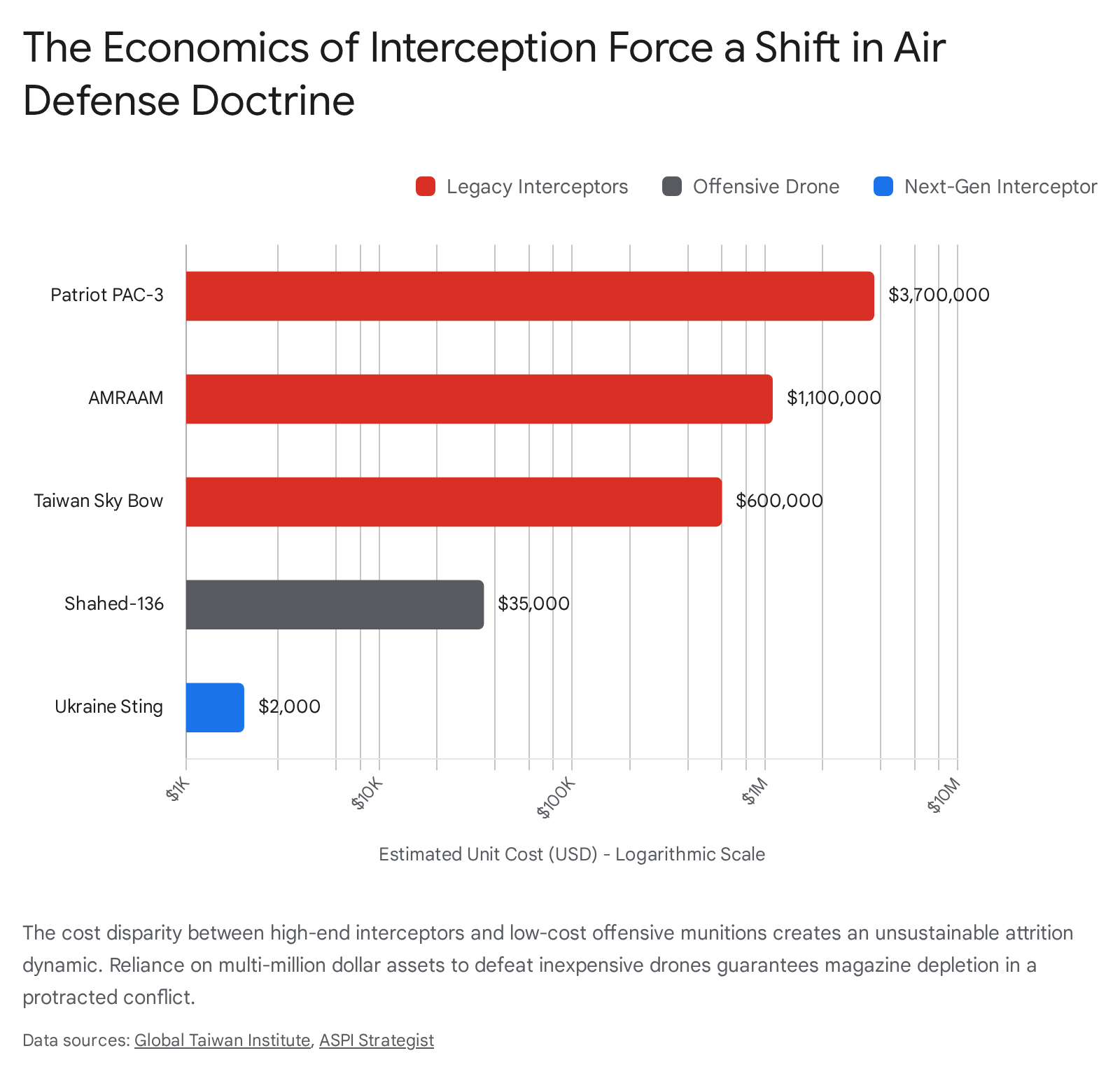
In the Ukrainian theater, Russian forces have routinely deployed Iranian-designed Shahed-136 loitering munitions (domesticated in Russia as the “Geran-2”) to saturate and overwhelm Ukrainian air defense networks.2 The production cost of a single Shahed drone is estimated to be between $20,000 and $50,000.2 In stark contrast, the primary system utilized by Western-aligned forces to intercept high-end threats—the Patriot PAC-3 missile—costs approximately $3.7 million per unit.2 This creates an asymmetric cost imbalance exceeding a 100:1 ratio in favor of the offensive actor, an exchange rate that no defense budget can sustain indefinitely.2
This dynamic was similarly demonstrated during Iran’s localized missile and drone campaigns in the Middle East. While Israel and coalition forces successfully intercepted the vast majority of the more than 290 missiles and 500 drones launched by Iran in early 2026, the financial cost and magazine depletion rates were staggering.8 A defense doctrine that commits multiple high-end interceptors—such as $1.1 million Advanced Medium-Range Air-to-Air Missiles (AMRAAMs) or $3 million Patriot missiles—against cheap, attritable cruise missiles and quadcopters is mathematically guaranteed to fail in a protracted conflict.3 Defensive postures alone treat adversary strike capacity as a fixed input, ignoring the reality that interceptor stockpiles will eventually be exhausted, allowing subsequent waves of attacks to penetrate the defensive umbrella.9
Taiwan’s Vulnerability to the Cost-Attrition Trap
For Taiwan, the implications of this cost-attrition calculus are acute and immediate. Taiwan’s layered air defense network, often referred to conceptually as the “T-Dome,” relies heavily on high-cost interceptors.2 Taiwan’s domestically produced Sky Bow (Tien Kung-2 and Tien Kung-3) missiles cost approximately $600,000 each, and production rates remain highly constrained, with only about 100 Tien Kung-3 variants produced in 2025.2 Concurrently, Taiwan maintains a planned reserve of 500 U.S.-supplied Patriot PAC-3 missiles.2
Against the People’s Liberation Army Rocket Force (PLARF)—which fields an estimated 2,000 ballistic missiles and hundreds of cruise missiles—and the People’s Liberation Army (PLA) deployment of AI-enabled drone swarms (such as the “Atlas” system capable of coordinating 96 drones simultaneously), Taiwan’s high-cost interceptor magazines would be depleted within days.2 To visualize the severity of this economic mismatch, the procurement costs of relevant systems are detailed below.
| Defense/Offense System | Origin | Primary Role | Estimated Unit Cost (USD) | Source Reference |
| Patriot PAC-3 | United States | High-Altitude Interceptor | $3,700,000 | 2 |
| AIM-120 AMRAAM | United States | Air-to-Air Interceptor | $1,100,000 | 3 |
| Sky Bow (Tien Kung-3) | Taiwan | Mid-to-High Interceptor | $600,000 | 2 |
| Shahed-136 (Geran-2) | Iran / Russia | Loitering Munition | $20,000 – $50,000 | 2 |
| “Sting” Interceptor Drone | Ukraine | Low-Cost Interceptor | $2,000 | 2 |
Operationalizing Cost-Effective Countermeasures
To rectify this imbalance, Indo-Pacific nations are examining Ukraine’s tactical adaptation strategies. Realizing that the use of Patriot missiles for routine drone defense was financially untenable, Ukraine bypassed legacy systems by developing the “Sting” interceptor—a domestically produced, GPS-guided loitering UAV that costs roughly $2,000 per unit.2 Ukrainian units also employ a diverse array of cheap, fast-climbing quad-rotors (e.g., Wild Hornets) and fixed-wing interceptors (e.g., VB140 Flamingo) specifically designed to manually ram or detonate in close proximity to incoming Shahed and reconnaissance drones.3
By networking these interceptor nodes across various sectors and sharing tracking data via battlefield management systems, Ukraine has successfully brought down approximately one in every three Russian aerial targets using assets that cost less than the threats they are destroying.3 This bends the air defense economics back in favor of the defender. Consequently, Middle Eastern powers—including the United Arab Emirates, Qatar, Kuwait, and Saudi Arabia—are actively shifting their procurement strategies away from sole reliance on U.S. Patriot systems, seeking instead to acquire Ukraine’s low-cost interceptor drones to manage the threat sustainably.2
3. Industrial Disparity and the Supply Chain Imperative
The tactical requirement for massed, low-cost interceptors immediately introduces a strategic vulnerability for Taiwan and other regional actors: industrial capacity and supply chain security. The PRC possesses an overwhelming advantage in civil-military dual-use manufacturing.
Chinese entities, led by SZ DJI Technology Co., control approximately 78.8% of the global commercial drone market.2 Intelligence estimates suggest that if mobilized for wartime production, China’s vast civilian industrial base could theoretically output one billion weaponized drones annually by utilizing less than one percent of its total assembly capacity.2 This represents a latent mobilization capability that no single nation can currently match.
In contrast, Taiwan’s domestic drone production was approximately 10,000 units in 2026, with ambitious state targets aiming to reach 180,000 by 2028.2 Decoupling from Chinese components further strains Taiwan’s scaling efforts. Seeking “non-red” supply chains commands a significant cost premium, making Taiwanese-made drones roughly 25% more expensive to produce than their DJI counterparts.2
To bridge this industrial gap, Taiwan has initiated aggressive Track II diplomacy and multilateral cooperation. On October 22, 2025, Taiwan’s Ministry of Foreign Affairs (MOFA) launched a “drone diplomacy” initiative to foster partnerships with Japan, the Philippines, Germany, Poland, and the Baltic states.2 This includes signing drone research and development memorandums with Poland and Ukraine at the 2025 International Defense Industry Exhibition, and hosting Ukraine’s IRON Cluster—a collaborative hub of over 200 unmanned systems firms—to transfer battlefield expertise directly to Taiwanese manufacturers.2
4. The Paralyzation of Airpower Enablers and the Fallacy of “Missile Math”
A secondary structural observation from the Iranian and Ukrainian campaigns is the vulnerability of critical military enablers. Western airpower debates frequently center on “missile math”—simplistically tallying interceptor inventories against strike ranges and sortie-generation capacities across a static number of runways.9 However, as demonstrated in 2024 and 2026, combat is highly interactive, shaped by adaptation, friction, and reciprocal counter-air operations.9
The Vulnerability of the Enabling Layer
Adversaries recognize that they do not need to destroy agile fifth-generation fighter aircraft in the air to neutralize an air force; they only need to paralyze its command-and-control (C2) nodes, fuel infrastructure, and early warning assets. During Iran’s strikes across the Middle East, waves of Shahed drones and ballistic missiles deliberately targeted these enablers.9 A notable attack on Prince Sultan Air Base in Saudi Arabia on March 27, 2026, successfully damaged a $270 million E-3 Sentry AWACS (airborne warning and control system) radar aircraft and multiple KC-135 refueling tankers.2 This demonstrated that offensive actors can severely degrade highly sophisticated monitoring and detection systems at a fraction of the cost.
This vulnerability is acutely amplified in the Indo-Pacific theater due to the tyranny of geographic distance. Most U.S. fighters possess combat radii of roughly 500 to 900 miles without refueling.9 Kadena Air Base in Japan—the closest major U.S. installation to Taiwan—is 370 miles away, while Anderson Air Force Base in Guam is over 1,500 miles away.9 Consequently, operational reach in the Pacific is inherently a tanker-limited problem long before it becomes an aircraft-limited one. Recognizing this architectural fragility, the PLA has developed hypersonic air defense missiles with ranges exceeding 1,200 miles specifically optimized to destroy large, slow-moving AWACS and tanker aircraft, effectively pushing U.S. and allied combat aviation out of the First Island Chain.9
The Necessity of Offensive Counter-Air (OCA)
Defense alone is insufficient to protect these enablers. Relying entirely on hardening bases, rapid runway repair, and intercepting incoming missiles treats the adversary’s strike capacity as a permanent condition.9 Runways and air bases are not binary targets—they are rarely permanently closed by a single strike—but constant attacks impose friction that degrades sortie-generation capabilities.9
The primary mechanism to defend friendly air bases and enablers is to systematically destroy the adversary’s capacity to launch attacks in the first place, a doctrine known as Offensive Counter-Air (OCA) or “demand reduction”.9 During the coalition response to Iranian attacks, allied air operations struck over 13,000 Iranian targets, which resulted in a greater than 80% reduction in Iranian missile and drone launches within four days.9 Fewer functional launchers, degraded sensor networks, and disrupted command nodes directly translate into fewer incoming threats that must be intercepted or repaired.
5. Escalation Dynamics and the Limits of Demand Reduction Against China
While the operational logic of Offensive Counter-Air proved effective in the Middle East, applying an OCA doctrine against China introduces extreme escalation risks that fundamentally alter the strategic calculus.
The PLARF maintains a highly integrated maritime intelligence, surveillance, and reconnaissance (ISR)-to-strike architecture. This includes purpose-built anti-ship ballistic missiles equipped with maneuverable reentry vehicles, hypersonic glide vehicles, and Yaogan ocean-surveillance over-the-horizon radars capable of maritime targeting at ranges exceeding 1,500 kilometers.9 Achieving demand reduction against this architecture would require U.S. and allied forces to execute deep conventional strikes against launchers, C2 nodes, and sensors located on the Chinese mainland.9
Because China is a nuclear-armed state and actively deploys dual-capable (conventional and nuclear) missile systems, deep conventional strikes carry a significant risk of being misinterpreted by Beijing as a preemptive attempt to degrade its nuclear deterrent.9 This operational reality requires careful planning, signaling, and target selection to manage the risk of inadvertent nuclear escalation, suggesting that Indo-Pacific nations cannot rely solely on the expectation of overwhelming U.S. offensive strikes to secure their airspace.
6. The Democratization of Sea Denial via Uncrewed Surface Vehicles
In the maritime domain, Ukraine’s operations in the Black Sea have fundamentally altered traditional naval paradigms. Ukraine, a state with virtually no conventional navy, successfully denied sea control to the Russian Black Sea Fleet, inflicting severe losses using asymmetric tactics and emerging technology.10
The Black Sea Blueprint
The core of Ukraine’s maritime success lies in its deployment of low-profile, explosive-laden Uncrewed Surface Vehicles (USVs), such as the Magura V5 and Sea Baby.1 These platforms are simple, highly adaptable, and optimized for littoral strike missions.1 A defining feature of their operational success is the reliance on resilient, high-capacity, two-way satellite communications (such as Starlink and Kymeta).1
Rather than relying entirely on complex, vulnerable artificial intelligence for autonomous navigation, these satellite networks enable continuous “human-in-the-loop” control.1 Remote operators guide the vessels across long distances, adapting to fluid tactical situations faster than purely automated systems could process.1 This setup reduces the initial reliance on complex automation. However, because satellite links are susceptible to terminal-phase electronic warfare (EW) jamming by Russian warships, Ukrainian forces are currently developing “last-mile” automation capabilities, allowing the USV’s onboard optical systems to lock onto a target and complete the attack autonomously even if the data link is severed.1
The temporal reality of this technological evolution is significant. Analysts note that if the invasion of Ukraine had occurred a decade earlier, prior to the deployment of proliferated low-earth orbit (LEO) satellite constellations like Starlink, the remote operation of naval drones over hundreds of kilometers would have been technologically impossible.1 The democratization of sea denial is inherently tied to the democratization of space-based commercial communications.
7. Taiwan’s Hormuz Option and Global Systemic Deterrence
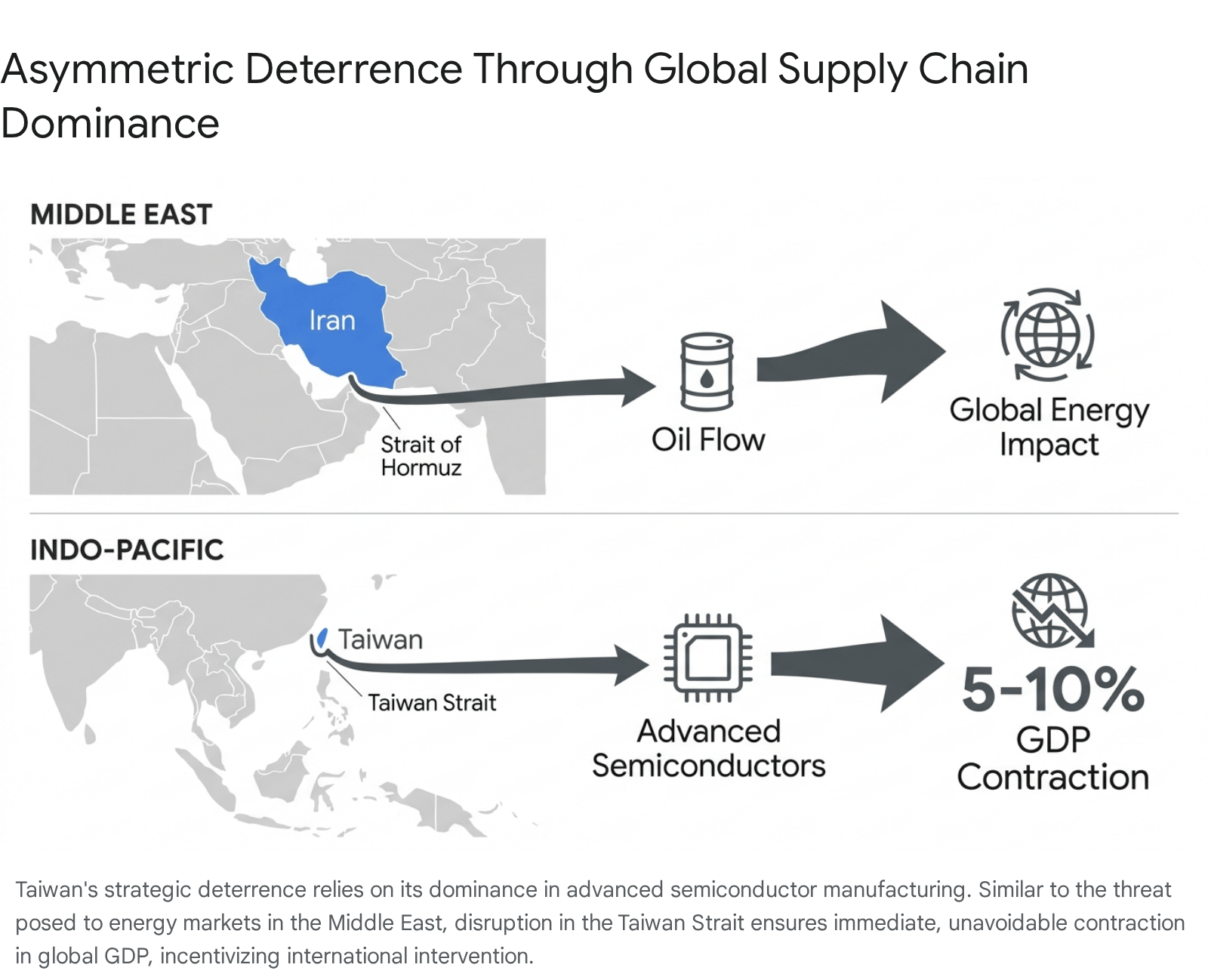
Taiwan is actively analyzing both the Middle Eastern and Ukrainian theaters to formulate a survivable deterrence model, increasingly referred to conceptually as the “Hormuz Option”.1 This strategy does not seek to achieve an unattainable conventional military parity with the PLA; rather, it aims to stretch time, impose unbearable attrition, and escalate any local blockade or invasion into a systemic global crisis that Beijing cannot easily control.1
The Semiconductor Lever as Global Deterrence
Iran’s asymmetric leverage in the Middle East is fundamentally tied to its ability to weaponize global energy flows through the Strait of Hormuz.1 Taiwan possesses an analogous, and arguably more potent, lever: its near-monopoly on advanced semiconductor manufacturing.1
Unlike hydrocarbons, which can be stockpiled or sourced from alternative global reserves during a crisis, semiconductors are bespoke, non-fungible commodities. Shifting production away from Taiwanese foundries to alternative suppliers is not a matter of simply rerouting logistics. It requires months or decades of financial capital, extensive software architecture redesigns, and lengthy certification processes for new microchips.1 While initiatives like the European Chips Act and TSMC’s partnership to build a €10 billion fabrication plant in Dresden, Germany, are underway, they are insufficient to offset near-term dependency.1
Taiwan’s deterrence strategy involves explicitly integrating this economic reality into its defense posture. Projections indicate that a Chinese air and sea blockade of Taiwan would cause an immediate 5% contraction in global GDP (comparable to the 2008 financial crisis), while a kinetic war involving the United States could shrink the global economy by nearly 10%.1 By preparing coordinated frameworks for semiconductor production shutdowns, data relocation, and export restrictions, Taipei signals to Beijing and the global community that any aggression will trigger catastrophic cascading economic shocks, transforming a cross-strait conflict into an immediate crisis for the European Union and the United States.1
8. Operationalizing Taiwan’s Hellscape Doctrine
On the tactical level, Taiwan is rapidly adopting Ukraine’s USV tactics to secure the Taiwan Strait. This forms the basis of the “Hellscape” doctrine—championed by the Center for a New American Security—which envisions flooding the Strait with a massive, highly concentrated swarm of low-cost, disposable aerial, surface, and subsurface assets to create an impenetrable, chaotic environment for a PLA amphibious invasion fleet.2
Taiwan’s domestic defense industry, led by the National Chung Shan Institute of Science and Technology (NCSIST) alongside private entities like Thunder Tiger and Lungteh Shipbuilding, is accelerating USV production.1 Key platforms currently in development or testing include:
- The Kuaiqi USV: A compact, low-cost drone optimized for littoral strike, closely mirroring Ukraine’s Magura designs.1 Uniquely, the Kuaiqi integrates twin Cox diesel outboard engines rather than the lighter petrol (gasoline) engines typically found on such vessels. While this introduces additional weight, it offers significant military advantages: improved operational reliability, safer onboard fuel storage, and easy alignment with standard military fuel logistics.1
- SeaShark 800: Developed under the government’s “Swift and Sudden” program, this USV is capable of carrying a 1,200 kg explosive payload over a 500 km range, and is currently undergoing testing off the eastern port of Wushi.12
- Endeavor Manta: Taiwan’s first designated military USV program, designed to integrate advanced AI mission technologies, swarm functionality, and resilient multi-channel communications.1
The Taiwan Navy has mandated the procurement of over 1,000 attack USVs within the next few years, with 1,320 Kuaiqi units slated for production by NCSIST for the Navy’s Coastal Combat Command and Marine Corps.1 Building the physical hulls is straightforward; the primary challenge lies in the complex systems integration of high-performance explosives, C2 networks, and terminal guidance systems resistant to PLA electronic warfare.1
To navigate this complexity, Taiwan has structured its autonomous naval technology development into three distinct phases, detailed in the table below:
| Development Phase | Target Timeframe | Primary Technological Objectives | Source Reference |
| Phase 1 | 2027–2028 | Integration of existing AI and platforms to establish basic detection and human-assisted remote navigation capabilities. | 1 |
| Phase 2 | 2029–2030 | Deployment of 3D recognition technology and validation testing across multiple, complex maritime environments. | 1 |
| Phase 3 | 2031–2033 | Realization of fully autonomous swarm-control capabilities based on advanced 3D recognition and decentralized data sharing. | 1 |
9. Japan’s SHIELD Architecture and the Shift in Defense Arithmetic
Japan is acutely aware of the shifting economics of domain awareness and perimeter defense. In the East China Sea, the Japan Air Self-Defense Force (JASDF) faces a persistent, asymmetric drain on its operational resources. China routinely deploys low-cost uncrewed reconnaissance and attack aircraft into Japan’s Air Defense Identification Zone (ADIZ).3
In response, standard operating protocol dictates the scrambling of two F-15 fighter jets. Operating these legacy airframes costs Japan up to 5 million yen per intercept, while the Chinese uncrewed platform costs roughly 70,000 yen per hour to operate.3 This operational arithmetic is profoundly unsustainable, draining readiness, accelerating airframe fatigue, and consuming defense budgets.3
Drawing directly from Ukraine’s ability to offset quantitative disadvantages through technology, Japanese Prime Minister Sanae Takaichi mandated a fundamental revision of the national defense strategy to integrate autonomous weapons, citing the urgency of preparing for “new forms of warfare”.3 This imperative manifested in the 2026 defense budget through the initiation of the SHIELD program (Synchronised, Hybrid, Integrated and Enhanced Littoral Defense).3
The SHIELD Architecture
SHIELD represents a layered coastal defense architecture designed to provide a cheaper, rapidly replaceable, asymmetric capability tailored specifically to Japan’s maritime geography, particularly the southern islands adjacent to Taiwan.3 The Ministry of Defense allocated an initial $640 million (¥100.1 billion) specifically for this system, with overall funding for uncrewed defense projected to increase tenfold from 100 billion yen to 1 trillion yen over the current five-year projection.3
The program focuses heavily on multi-domain integration, acquiring various tiers of uncrewed systems to form a cohesive, layered kill web 3:
| Branch Allocation | Asset Classification | Primary Operational Role | Source Reference |
| Ground Self-Defense Force (GSDF) | Modular FPV UAVs | Short-range intelligence collection and reconnaissance. | 3 |
| Ground Self-Defense Force (GSDF) | Small Attack UAVs (Tiers I, II, III) | Short-to-long-range strikes against vehicles and naval vessels. | 3 |
| Maritime Self-Defense Force (MSDF) | Ship-Launched / Ship-Based UAVs | Extended maritime surveillance and strikes against naval assets. | 3 |
| Air Self-Defense Force (ASDF) | Radar Site Defense UAVs | Dedicated point-defense of critical radar sites against hostile UAVs. | 3 |
| Joint (GSDF & MSDF) | Small Multi-Purpose USVs/UUVs | Intelligence collection and kinetic strikes against surface combatants. | 3 |
Crucially, Japan recognizes that the hardware must be backed by resilient software and allied interoperability. The SHIELD vision requires scalable AI-enabled decision support, multi-domain sensing, and complex data integration.3 Japan is leveraging the Defense Industrial Cooperation, Acquisition and Sustainment (DICAS) framework with the United States to ensure its autonomous platforms share secure communications, data links, and anti-jam navigation systems.3 This ensures that Japanese drones can integrate seamlessly into broader allied kill chains in the Pacific, rather than operating in isolation.3 Additionally, Japan’s ruling Liberal Democratic Party has drafted proposals for the early deployment of high-energy weapons and next-generation submarines to further bolster this asymmetric posture.13
10. The Comprehensive Archipelagic Defense Concept (CADC) in the Philippines
Concurrent with Taiwan and Japan’s adaptations, the Republic of the Philippines has executed one of the most consequential strategic pivots by a mid-tier Indo-Pacific nation in recent history. Driven by persistent Chinese Coast Guard coercion in the West Philippine Sea and incidents at the Second Thomas Shoal, Manila has formally transitioned its military focus from internal counter-insurgency to external territorial defense through the Comprehensive Archipelagic Defense Concept (CADC).4
Deterrence by Denial in the Exclusive Economic Zone
The CADC operationalizes a “porcupine defense” strategy explicitly inspired by the asymmetric, drone-dense warfare observed in Ukraine.4 The doctrine shifts the Armed Forces of the Philippines’ (AFP) center of gravity away from the shoreline and out into the 200-nautical mile Exclusive Economic Zone (EEZ).6 Instead of preparing for a traditional beachhead invasion, the CADC aims to make the maritime domain itself a highly contested killing ground, transforming the geography of the First Island Chain from a passive feature into an active operational network of missile platforms.4
To achieve this, the Philippines is rapidly modernizing its inventory under the “AFP Modernization Program Re-Horizon 3,” securing five major defensive capabilities: cyber systems, air interdiction, surface and sub-surface defense, missile defense, and support systems.6 The acquisition strategy focuses heavily on long-range precision fires and maritime domain awareness, contributing to the nation’s “Self-Reliant Defense Posture” (SRDP).16 Key acquisitions under this doctrine include:
- BrahMos Cruise Missiles: The procurement of Indian-made BrahMos supersonic anti-ship missiles provides the Philippine Marine Corps with a highly lethal, land-based coastal defense capability capable of striking PLA Navy vessels far over the horizon, establishing overlapping zones of sea denial.4
- Asymmetric Launch Systems: Integration of U.S.-supplied High Mobility Artillery Rocket Systems (HIMARS), Navy Marine Expeditionary Ship Interdiction System (NMESIS), and Typhon missile systems, which provide highly mobile, easily concealable long-range precision fires from austere island locations.4
- Maritime Domain Awareness: Expanding sensor networks and intelligence gathering through the deployment of TC-90 aircraft (donated by Japan), nine Shaldag MK V Fast-Attack Interdiction Craft (FAIC) from Israel (designated the Acero-class), and Elbit Systems long-range patrol aircraft (LRPA).16
The CADC relies heavily on joint, multi-domain logic. Air, sea, and land forces are no longer siloed; they operate as integrated layers of detection and interdiction, with drones serving as the nervous system for ISR and terminal guidance.14 By building this architecture, Manila aims to alter Beijing’s strategic calculus, ensuring that maritime coercion or intrusion into Philippine waters carries unacceptable kinetic and diplomatic costs.14
11. South Korean Mechanized Forces in a Transparent Battlespace
While maritime nations focus on sea denial and coastal defense, the Republic of Korea (ROK) faces distinct, land-based challenges regarding the future of ground warfare on the peninsula. South Korea fields one of the most capable armored forces in the Indo-Pacific, possessing between 2,300 and 2,500 main battle tanks, including advanced domestically produced K2 Black Panthers, K1 variants, and legacy systems.7 However, the war in Ukraine has ruthlessly exposed the structural vulnerabilities of concentrated mechanized forces operating in a drone-dominated environment.7
The End of Operational Concealment
The defining feature of the modern battlefield is persistent aerial transparency.7 Network-centric ISR platforms have effectively erased the distinction between front-line engagements and rear-echelon logistics.7 Assembly areas, refueling depots, and artillery staging grounds are immediately detectable. Once identified, traditional concealment methods fail, and the assets are rapidly engaged by long-range artillery or FPV loitering munitions.7
During the NATO “Hedgehog 2025” exercise in Estonia, the severity of this threat was empirically quantified. A team of approximately ten opposing-force personnel, employing Ukrainian frontline drone tactics, simulated the destruction of two entire battalions of mechanized vehicles in a single day.7 The destruction was not due to superior firepower, but the swift integration of sensor-to-shooter systems and the armored units’ lack of organic countermeasures in the low-altitude airspace (below 1,000 meters).7 Furthermore, drones frequently achieve “mobility kills” without destroying the tank entirely. By targeting vulnerable optical sensors, tracks, or accompanying soft-skinned fuel logistics convoys, cheap quadcopters can paralyze a multi-million-dollar armored advance.7
North Korean Adaptation and Dual Contingencies
This dynamic is an immediate planning concern for Seoul. North Korean military personnel deployed to Europe to observe or participate in the Russia-Ukraine conflict are actively absorbing these operational insights.7 Should Pyongyang militarize commercial quadcopters, reverse-engineer loitering munitions, and integrate AI-assisted targeting cues to shorten its sensor-to-shooter timeline, South Korea’s tank-centric defense doctrine could face unprecedented attrition.7
This vulnerability is maximized in a dual-contingency scenario, such as a simultaneous crisis in the Taiwan Strait and the Korean Peninsula. In such an event, U.S. ISR, precision-guided assets, and logistical support would likely be heavily weighted toward the Taiwan theater, and Chinese activities in the Yellow Sea could disrupt reinforcement efforts.7 Consequently, South Korean armor would be forced to conduct counteroffensives under degraded electromagnetic and logistical conditions.
To survive, the ROK Army must transition away from large, static armored concentrations toward persistent displacement, deception, and tactical dispersion. They must integrate organic short-range air defense (SHORAD), electronic warfare, and anti-ISR capabilities directly down to the division and company maneuver formations, rather than relying on centralized, reactively deployed assets.7 The recent establishment and subsequent disbandment of the ROK Drone Operations Command highlights the institutional friction in uniformly integrating these capabilities.7
12. Contested Logistics and Agile Combat Employment (ACE)
Underpinning all regional defense strategies—from air defense economics to island-based missile batteries—is the reality of contested logistics. The era of the “sanctuary base”—large, centralized, unhardened infrastructure where forces can mass and sustain operations without fear of attack—has definitively ended.18 Adversary long-range precision fires and persistent drone surveillance demand that U.S. and allied forces disperse to survive.
Setting the Theater via Agile Combat Employment
The United States Air Force’s operational response to this threat in the Indo-Pacific is Agile Combat Employment (ACE).19 ACE is a tactical and cultural shift that requires forces to disperse from massive main operating bases into a distributed network of smaller, resilient hub-and-spoke airfields across the Pacific.19 This maneuver complicates enemy targeting, dilutes their finite missile stocks, and increases force survivability, but introduces massive logistical friction.9
Executing ACE requires extensive “setting of the theater.” This involves establishing a decentralized network of logistics nodes, enabled by complex host-nation agreements such as Mutual Logistics Support Agreements (MLSA) and Acquisition and Cross-Servicing Agreements (ACSA), coordinated via the Department of State.19 It also demands the extensive pre-positioning of munitions, fuel, and repair parts to mitigate transportation bottlenecks during the outbreak of a conflict.19
REFORPAC 2025 and LOG C2 Vulnerabilities
To stress-test this doctrine, the Department of Defense executed Exercise Resolute Force Pacific (REFORPAC) in July and August 2025.19 It was the largest airpower exercise in Indo-Pacific history, designed to evaluate ACE and distributed logistics.19 The exercise deployed over 400 aircraft and 12,000 personnel across 50 dispersed locations spanning 6,000 miles east to west and 4,000 miles north to south.19
Operations were executed in phases: Phase 1 focused on rapid engineering and construction; Phase 2 employed pre-positioned materiel; and Phase 3 focused on high-tempo sortie generation.19 Sorties were generated from austere environments, with personnel from the 35th Munitions Squadron assembling munitions under degraded communications, and HH-60W helicopters executing aerial refueling to support distributed assets.19 Interoperability was heavily emphasized, with Japan Air Self-Defense Force technicians manually handing off fuel lines alongside U.S. crew chiefs.19
While REFORPAC demonstrated the viability of distributed power projection, it exposed critical gaps in Logistical Command and Control (LOG C2).19 When transitioning from steady-state peacetime operations to active distributed warfighting, legacy base-level IT systems proved highly inadequate. Tactical personnel were forced to rely on labor-intensive manual data entry, creating operational bottlenecks and data silos that prevented a unified understanding of the battlespace across echelons.19
Attempts to utilize advanced enterprise software—such as the Joint Staff’s AI-enabled Maven Smart System (MSS)—revealed that while these tools provide excellent high-level common operating pictures, they are not yet optimized to support real-time, theater-level logistics routing in highly contested, communication-degraded environments.19 Resolving these software limitations, pursuing rapid IT prototyping, and integrating securely with coalition partners remain the most pressing hurdles to operationalizing a resilient Indo-Pacific logistical architecture.19
13. Conclusion
The battlefields of Ukraine and the Middle East are providing a brutal, transparent education in 21st-century warfare. The overarching strategic lesson is that exquisite technology and legacy platforms, while highly capable, cannot single-handedly secure victory against an adversary capable of leveraging mass, autonomy, and asymmetric cost economics.
For Asian nations arrayed against the expanding military and industrial footprint of the PRC, these lessons mandate a swift doctrinal evolution. Traditional metrics of military balance—comparing the raw number of fifth-generation fighters, armored divisions, or naval tonnage—are becoming secondary to a nation’s ability to sustain operations under persistent ISR, absorb logistical disruption, and impose disproportionate costs through autonomous kill webs.
Taiwan’s Hormuz Option and mass USV deployment, Japan’s SHIELD architecture, the Philippines’ CADC, and South Korea’s urgent need for mechanized reform all represent tailored, localized applications of a unified strategic theory: deterrence by denial through asymmetric attrition. By embracing expendable drones, shifting away from indefensible centralized bases toward Agile Combat Employment, and prioritizing the protection of critical enablers over legacy platforms, the United States and its Indo-Pacific partners are actively restructuring the region’s defense architecture to ensure that the cost of revisionist aggression remains fundamentally unacceptable.
Please share the link on Facebook, Forums, with colleagues, etc. Your support is much appreciated and if you have any feedback, please email us in**@*********ps.com. If you’d like to request a report or order a reprint, please click here for the corresponding page to open in new tab.
Sources Used
- Taiwan’s Hormuz Option: What Taiwan Can Learn from Conflicts in …, accessed May 25, 2026, https://www.hudson.org/defense-strategy/taiwans-hormuz-option-what-taiwan-can-learn-conflicts-middle-east-ukraine-can-kasapoglu
- A Cost Too High to Protect the Sky? Lessons for Taiwan from the Wars in Ukraine and Iran, accessed May 25, 2026, https://globaltaiwan.org/2026/05/a-cost-too-high-to-protect-the-sky/
- Japan is pushing hard on autonomous weapons | The Strategist, accessed May 25, 2026, https://www.aspistrategist.org.au/japan-is-pushing-hard-on-autonomous-weapons/
- Could the Philippines Military Stop China With Porcupine Strategy in the West Philippines Sea? – YouTube, accessed May 25, 2026, https://www.youtube.com/watch?v=cHkDjo29wdA
- Forward and Seaward: Archipelagic Defence as a Military Strategy for the Philippines – The International Institute for Strategic Studies, accessed May 25, 2026, https://www.iiss.org/globalassets/media-library—content–migration/files/research-papers/2025/12/phillipines-maritime-strategy/archipelagic-defence-as-a-military-strategy-for-the-philippines.pdf
- PH Army to secure naval, air bases under new defense concept – Philippine News Agency, accessed May 25, 2026, https://www.pna.gov.ph/articles/1225362
- Drone Warfare and the Future of Korean Armor – Modern War Institute, accessed May 25, 2026, https://mwi.westpoint.edu/drone-warfare-and-the-future-of-korean-armor/
- The Iran War’s Real Lessons for China: U.S. Tactical Successes Should Give Beijing Pause, accessed May 25, 2026, https://www.reddit.com/r/geopolitics/comments/1sht4by/the_iran_wars_real_lessons_for_china_us_tactical/
- Missiles Aren’t Strategy: Lessons From Iran for a Pacific Air War, accessed May 25, 2026, https://warontherocks.com/missiles-arent-strategy-lessons-from-iran-for-a-pacific-air-war/
- Maritime Domain Lessons from Russia-Ukraine | Conflict in Focus – CSIS, accessed May 25, 2026, https://www.csis.org/analysis/maritime-domain-lessons-russia-ukraine-conflict-focus
- Taiwan’s USV Development and Strategic Learning from Ukraine …, accessed May 25, 2026, https://centerformaritimestrategy.org/publications/taiwans-usv-development-and-strategic-learning-from-ukraine/
- Learning From Ukraine, Taiwan Looks To Sea Drones To – Marine Technology News, accessed May 25, 2026, https://www.marinetechnologynews.com/news/learning-ukraine-taiwan-looks-649880
- Japan LDP draft calls for interceptor drones, long-term combat capability, accessed May 25, 2026, https://english.kyodonews.net/articles/-/76243
- – YouTube, accessed May 25, 2026, https://www.youtube.com/post/Ugkxu22TzSvz_VjGWDAqbxJfyToz71YCvLPu
- Philippine Army eyes air defense capability to bolster archipelagic security – Reddit, accessed May 25, 2026, https://www.reddit.com/r/PhilippineMilitary/comments/1r50age/philippine_army_eyes_air_defense_capability_to/
- “COMPREHENSIVE ARCHIPELAGIC DEFENCE CONCEPT” (CADC) OF THE PHILIPPINES AND OPPORTUNITIES FOR INDIA ARISING THEREFROM – National Maritime Foundation, accessed May 25, 2026, https://maritimeindia.org/comprehensive-archipelagic-defence-concept-cadc-of-the-philippines-and-opportunities-for-india-arising-therefrom/
- Empedrad: PH Navy needs to further develop maritime surveillance, accessed May 25, 2026, https://www.pna.gov.ph/articles/1030030
- Iran’s Asymmetric Counterair Campaign: Attacking the U.S. Air Force’s Nests and Eggs, accessed May 25, 2026, https://warontherocks.com/irans-asymmetric-counterair-campaign-attacking-the-u-s-air-forces-nests-and-eggs/
- REFORPAC 2025 and the friction of distribution: Stress-testing agile …, accessed May 25, 2026, https://www.dla.mil/About-DLA/News/News-Article-View/Article/4431053/reforpac-2025-and-the-friction-of-distribution-stress-testing-agile-combat-empl/
- Autonomous aircraft capabilities showcased by AFWERX, Joby at Department-Level Exercise > WIN THE FUTURE > News – Air Force Research Laboratory, accessed May 25, 2026, https://www.afrl.af.mil/News/Article/4291163/autonomous-aircraft-capabilities-showcased-by-afwerx-joby-at-department-level-e/