
1. Executive Summary
The national security apparatus of the Republic of the Philippines is currently navigating the most significant structural, doctrinal, and physical transformation in its modern institutional history. Driven by an increasingly volatile geopolitical environment in the Indo-Pacific theater—specifically characterized by escalating territorial friction in the West Philippine Sea and broader strategic competition along the First Island Chain—the Philippine defense establishment is deliberately transitioning from a decades-long focus on internal counter-insurgency toward a resolute posture of external territorial and maritime defense.1 This strategic pivot is operationalized at the highest levels of government through the Comprehensive Archipelagic Defense Concept (CADC) and is physically manifested in the newly overhauled “Re-Horizon 3” phase of the Revised Armed Forces of the Philippines Modernization Program (RAFPMP).2
To achieve a minimum credible deterrence posture against highly capable regional adversaries, the administration of President Ferdinand Marcos Jr. has cultivated a complex latticework of alliances and strategic partnerships, systematically moving away from a singular reliance on domestic funding or exclusive bilateral arrangements.1 Foreign defense investments, foreign military financing (FMF), and direct capability transfers from the United States, Japan, the Republic of Korea, India, Israel, and Turkey serve as the lifeblood of this modernization effort. These diverse partnerships have resulted in the accelerated acquisition of multi-role offshore patrol vessels, supersonic anti-ship cruise missiles, advanced air defense systems, and modernized light armor.
However, the efficacy of this massive capital outlay is subject to intense domestic scrutiny and auditing. The central analytical question remains whether the Philippine government is allocating these funds wisely to build a resilient, future-proof defense infrastructure, or if capital is being systematically degraded by historical corruption, bureaucratic friction, and procurement inefficiencies. An analysis of recent Philippine government’s Commission on Audit) 2, historical procurement controversies, and current institutional obligation rates indicates a highly nuanced reality. While overt, systemic graft—such as the historical black-market sale of state munitions to threat groups or the maintenance of “ghost” personnel—has been largely curtailed by stringent institutional reforms and strict leadership directives 4, the modernization of the Armed Forces of the Philippines (AFP) is currently severely hampered by administrative lethargy, rigid public procurement laws, and significant delays in budget utilization.6The defense capital is not necessarily being stolen in the traditional sense, but its strategic impact is being diluted by institutional inefficiencies that leave billions of pesos unobligated and critical capability gaps temporarily unfilled across the archipelago.
2. The Geopolitical and Domestic Imperative for Modernization
For nearly six decades, the primary operational focus of the AFP was directed inward, combatting the Maoist New People’s Army (NPA) and various separatist and extremist factions operating primarily in the southern island of Mindanao.1 As the domestic threat landscape has steadily stabilized—bolstered by the successful creation of the Bangsamoro Autonomous Region in Muslim Mindanao (BARMM) and the general operational decline of insurgent capacities—Manila has been afforded the strategic bandwidth and political capital to reorient its military toward the maritime domain.1
This strategic shift is not merely a top-down executive directive; it possesses profound democratic legitimacy and widespread public backing. According to a PhilStar Survey conducted in early 2026, 69 percent of adult Filipinos support the expansion of naval patrols and troop presence to assert the country’s territorial rights in the West Philippine Sea.7Furthermore, 64 percent of respondents specifically selected AFP modernization as a priority measure for the Marcos administration, while 66 percent favored the continuation of diplomacy and peaceful dispute resolution.7Analysts note that these findings point to a public that is acutely aware of the geopolitical challenges in the region and highly supportive of a balanced policy framework that simultaneously upholds sovereign rights while actively strengthening national defense capabilities.7This domestic consensus provides the Marcos administration with the mandate necessary to pursue historically large defense budgets and to deepen military entanglements with foreign partners.
The Philippine strategy in the South China Sea has been characterized by defense analysts as one of “assertive transparency”.3 By consistently and publicly exposing coercive maritime tactics to a global audience, Manila has not only rallied domestic political support in the battle to preserve its maritime sovereignty but has also successfully garnered international backing.3 This strategic transparency has directly paved the way for an expansion in the scope and breadth of foreign security partnerships, transforming the Philippines into a forefront actor for multidomain deterrence, maritime security governance, and defense against hybrid warfare.3
3. The Doctrinal Shift: The Horizon Modernization Framework
The overarching legislative and strategic framework for the physical transformation of the military is the Revised AFP Modernization Program (RAFPMP). Originally legislated as a 15-year initiative, the program was meticulously divided into three discrete five-year phases known as Horizons.2
Horizon 1 (2013–2017) and Horizon 2 (2018–2022) were primarily geared toward establishing foundational internal security capabilities while simultaneously building a nascent territorial defense posture in the West Philippine Sea.2 Historical assessments of the early stages of this program reveal mixed results regarding execution speed and budget utilization. During the Horizon 1 phase, the AFP managed to complete only 68 percent of its 53 planned modernization programs.8 Despite this incomplete execution, the military spent PHP 96 billion (approximately $1.82 billion USD), which represented a 28 percent increase from its initial budgetary outlay of PHP 75 billion for that specific phase.8 This historical data highlights a persistent challenge within the Philippine defense establishment: cost overruns and procurement delays frequently hamper the timely delivery of critical combat assets.
However, rapidly changing regional dynamics and increased pressure in the maritime domain necessitated a fundamental recalibration of the final phase of the program. In January 2024, President Marcos Jr. officially approved the overhauled “Re-Horizon 3” project list.2 Unlike its predecessors, which focused on minimum credible defense, Re-Horizon 3 is explicitly designed to operationalize the Comprehensive Archipelagic Defense Concept (CADC).2 This doctrinal framework aims to extend the Philippines’ power projection capabilities outward to its 200-nautical-mile exclusive economic zone (EEZ), securing vital national interests in the Luzon Strait, the Benham Rise, and the contested waters of the West Philippine Sea.9
The Re-Horizon 3 program outlines a highly ambitious 10-year procurement plan with an estimated funding allocation of P1.89 trillion (approximately $35 billion USD).2 To achieve the objectives of the CADC, priority acquisitions under this phase include multi-role fighters, advanced land-based radar and airborne surveillance systems, anti-access/area denial (A2/AD) missile systems, and the country’s first submarine force.2
Despite the strategic clarity and bold ambitions of Re-Horizon 3, the execution of the program faces profound structural and fiscal limitations. As of late 2024, the Department of Budget and Management (DBM) reported that the RAFPMP carried a massive unfunded mandate of P2.138 trillion, underscoring a severe gap between the military’s strategic ambitions and the national treasury’s actual liquidity.2 Furthermore, current Defense Secretary Gilberto Teodoro Jr. has publicly criticized the rigid 15-year statutory framework of the modernization program, describing it as “too long and impracticable”.2 Teodoro has advocated for a more flexible, agile procurement strategy that would allow the AFP to rapidly retool and adjust its acquisition priorities in response to immediate, evolving geopolitical threats, rather than being bound by rigid decade-old planning documents.2
4. The Financial Architecture of the Department of National Defense
To comprehend the necessity of foreign defense investments, one must first analyze the internal financial architecture of the Department of National Defense (DND). The domestic defense budget is large by Philippine historical standards, yet it remains fundamentally constrained by the structural costs of maintaining a large standing military force. Historically, Philippine defense spending has averaged roughly 1.25 percent of the national Gross Domestic Product (GDP), peaking in 2021 at 1.41 percent.1 Despite these increases, this remains the lowest defense spending as a percentage of GDP among U.S. treaty allies in the Asian theater.1
The proposed fiscal year 2026 expenditure program for the DND further illustrates these financial constraints. The total proposed budget stands at P299.3 billion (or P299,300.1 million), representing an 8.5 percent increase from the approved spending of P275.9 billion in 2025.2 Within this budget, new appropriations account for P295.18 billion, while automatic appropriations cover P4.12 billion.2
Crucially, the Personnel Services (PS) requirement—which encompasses salaries, benefits, and pensions for active and retired military personnel—consumes a staggering 56 percent of the entire DND budget, amounting to P167.7 billion.2 This structural reality means that the majority of the domestic defense budget is inherently dedicated to sustainment rather than physical modernization and capital outlay.
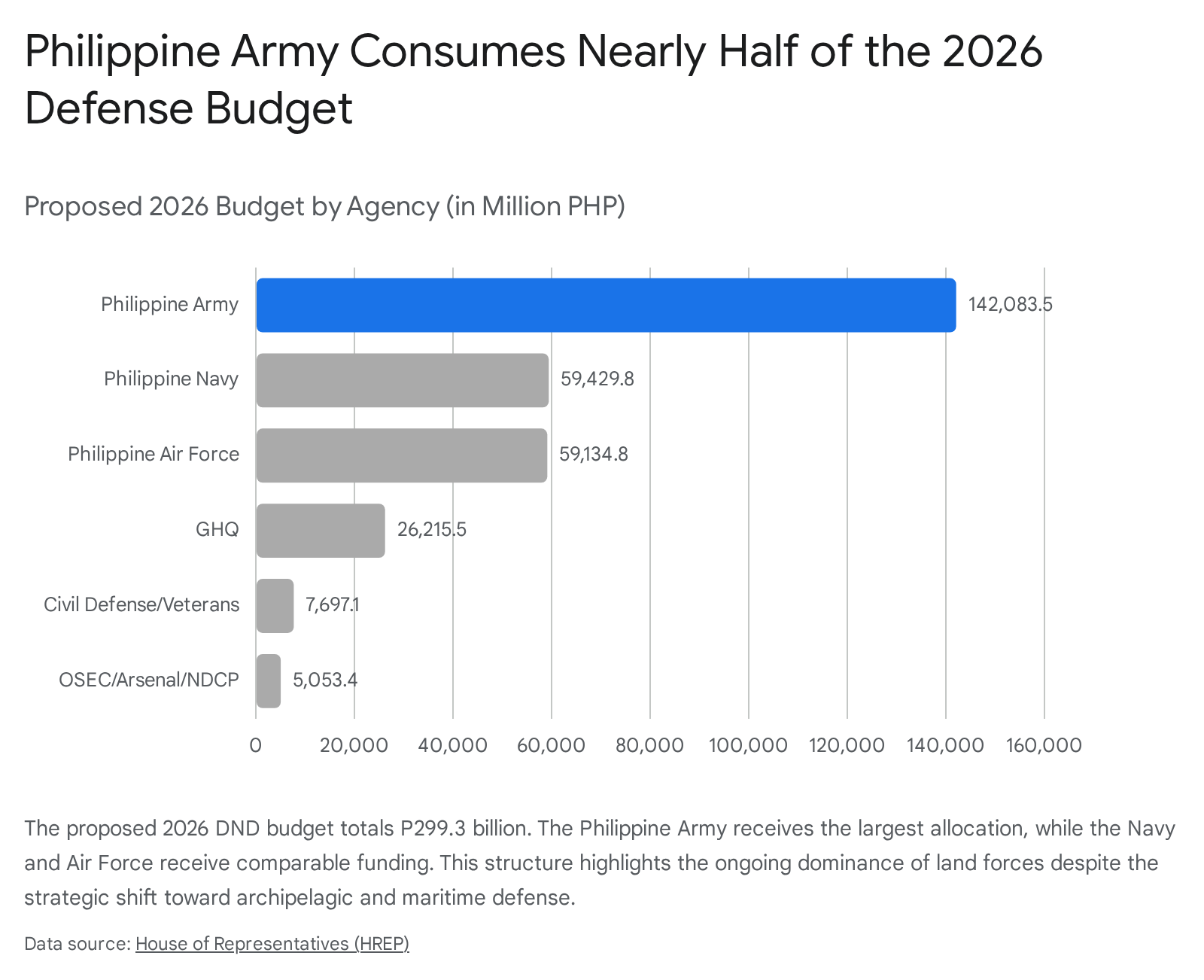
The distribution of the budget among the major service branches also highlights a lingering doctrinal inertia. Despite the explicit strategic shift toward archipelagic and maritime defense, the Philippine Army (Land Forces) remains the dominant recipient of DND funding. For 2026, the Land Forces Defense program is allocated P116.31 billion (46.5 percent of the operations budget), while the Air Forces Defense and Naval Forces Defense programs receive P54.06 billion (21.6 percent) and P53.73 billion (21.5 percent), respectively.2
In addition to the core operational expenditure program, the government allocates a separate Special Purpose Fund (SPF) specifically for the RAFPMP capital acquisitions. For 2026, this SPF is proposed at P40.0 billion.2 However, historical budget execution metrics for this fund indicate persistent difficulties in capital deployment. In 2024, while the RAFPMP was also allocated P40.0 billion, only P38.8 billion was successfully transferred to the DND, leaving P1.2 billion recorded as an unreleased appropriation.2 Furthermore, the modernization program recorded a low obligation rate of 71.7 percent and a highly concerning disbursement rate of only 52.8 percent in 2024, largely due to unreleased funds and unobligated unprogrammed appropriations.2
Given these structural budgetary realities—where domestic funds are overwhelmingly consumed by personnel costs and capital outlay funds suffer from severe disbursement delays—the AFP is inherently reliant on external support. To offset domestic budget constraints, the Philippines has diversified its defense acquisitions and established a complex, multi-polar supply chain. The United States and Japan provide critical strategic funding and maritime domain awareness tools, while South Korea, India, Israel, and Turkey function as the primary industrial suppliers for naval combatants, missile systems, and armored assets.
5. The United States: Treaty Alliance and Foundational Security Assistance
The United States remains the Philippines’ oldest, most integrated, and most consequential treaty ally, bound by the mutual defense obligations outlined in the 1951 Mutual Defense Treaty (MDT).1 While the alliance experienced a period of diplomatic volatility and strategic distancing during the administration of former President Rodrigo Duterte, President Marcos Jr. has aggressively revitalized the partnership, realigning Manila closely with Washington.1
Historically, the United States has served as the foundational contributor to the enhancement of Philippine military capabilities through frameworks established under the 1947 Military Assistance Agreement (MAA). This support was traditionally channeled through mechanisms such as Foreign Military Financing (FMF), International Military Education and Training (IMET), Foreign Military Sales (FMS), and the transfer of Excess Defense Articles (EDA).11 However, the modern iteration of the U.S.-Philippine defense relationship has evolved significantly beyond the transfer of surplus Cold War-era equipment, moving toward highly integrated, multidomain operations and the deployment of advanced asymmetric systems.
5.1 Enhanced Defense Cooperation and Infrastructure Investment
The core physical mechanism for current U.S. investment in Philippine domestic resilience is the Enhanced Defense Cooperation Agreement (EDCA). Initially signed in 2014 to grant U.S. troops rotational access to five Philippine military bases, the agreement was critically expanded in 2023.1 The U.S. military was granted access to four additional strategic locations in northern Luzon and Palawan, directly facing the South China Sea and the Taiwan Strait.1
To support this expanded footprint, the United States has committed significant financial resources toward upgrading shared infrastructure. The U.S. has pledged an ongoing $500 million commitment to Philippine military modernization, which includes the construction of a Combined Coordination Center and investments in intelligence fusion centers designed to directly support U.S. Indo-Pacific Command (USINDOPACOM) objectives.3Furthermore, during the Philippine & US strategic talks held in Manila in February 2026, the U.S. confirmed the appropriation of an additional $144 million in Fiscal Year 2026 specifically for the Department of Defense to invest in EDCA sites.12This funding is directed toward upgrading airfields, logistics hubs, and joint exercise facilities, which not only serve U.S. rotational forces but directly enhance the operational readiness, disaster response capabilities, and domestic resilience of the AFP.12
5.2 The Philippines Enhanced Resilience Act (PERA) and Advanced Capabilities
Recognizing the escalating threat environment, the U.S. legislative branch has initiated efforts to provide long-term, structural financial support to Manila. The U.S. Senate recently advanced the Philippines Enhanced Resilience Act (PERA), a bipartisan bill designed to authorize a massive $2.5 billion in Foreign Military Financing (FMF) grant assistance specifically allocated for the Philippines spanning the years 2026 to 2030.14 If enacted, this legislation would earmark up to $500 million annually to systematically develop the country’s defense capabilities over a five-year horizon, marking a critical shift from ad-hoc, year-to-year assistance toward sustained, long-term capability planning.14
Beyond direct grants, the U.S. remains a primary source for high-end Foreign Military Sales (FMS). The US State Deparment’s FY 2025 Foreign Military Sales Report reveals substantial pending transactions, including a highly significant $5.58 billion notification for F-16 aircraft for the Philippines.15While the final execution of this specific massive contract remains contingent on Philippine domestic financing, it illustrates the high ceiling of U.S.-Philippine defense trade.
Operationally, the U.S. and the Philippines have drastically scaled up their joint training engagements. The annual Exercise Balikatan has transformed into an increasingly complex, multinational training event.3 During Balikatan 2025, U.S. and Philippine personnel rehearsed multidomain defense operations at an unprecedented scale, incorporating live air and missile defense drills utilizing systems such as the Marine Air Defense Integrated System.3 To further enhance deterrence, the 2026 Bilateral Strategic Dialogue confirmed commitments to increase the deployment of cutting-edge U.S. systems to the Philippines, explicitly including the uncrewed Navy-Marine Expeditionary Ship Interdiction System (NMESIS) anti-ship missile capability, uncrewed surface vessels, and strategic midrange fires systems.3
Finally, to legally facilitate the secure exchange of classified military intelligence regarding regional threats, the two nations successfully signed the General Security of Military Information Agreement (GSOMIA) in 2024, deepening the institutional integration of their respective defense intelligence networks.3
6. Japan: Official Security Assistance and Strategic Realignment
Japan’s emerging role in the physical modernization of the Philippine military represents a watershed moment in the security dynamics of the Indo-Pacific. Breaking decisively from decades of strict post-World War II pacifist constraints on defense exports and foreign military aid, Tokyo has adopted a highly proactive deterrence posture.16 This shift is legally supported by the easing of constitutional export limitations in 2023 and 2026, allowing Japan to transfer noncombat equipment, as well as fighter jets, missiles, and warships, to strategic partners like the Philippines with whom it maintains technology transfer agreements.16
6.1 The Official Security Assistance (OSA) Framework
The primary mechanism for Japan’s physical investment in the Philippines is the newly established Official Security Assistance (OSA) framework.18 Implemented in 2023, the OSA operates entirely separately from Japan’s traditional Official Development Assistance (ODA) program, which is strictly dedicated to civilian economic development.18 Instead, the OSA provides direct financial grants for defense capacity-building and security-related infrastructure to “like-minded” nations to enhance deterrence and prevent unilateral changes to the regional status quo by force.17
The Philippines has rapidly become a premier beneficiary of this initiative. In December 2024, Japan and the Philippines formally exchanged notes on a 1.6 billion JPY (approximately $11.5 million USD) OSA grant program dedicated to the provision of essential monitoring and surveillance equipment.20 Under this specific grant, the Philippine Navy is receiving Coastal Radar Systems and Rigid-Hulled Inflatable Boats (RHIBs), while the Philippine Air Force is receiving equipment related to the Air Surveillance Radar System.20 This targeted investment directly addresses one of the AFP’s most critical vulnerabilities: persistent maritime domain awareness across its vast archipelago and EEZ. Furthermore, Japan has provided massive loan agreements to supply the Philippine Coast Guard with large multirole response vessels, such as the 2,265-ton BRP Teresa Magbanua, serving as the frontline physical presence in the West Philippine Sea.3
6.2 Institutional Integration: RAA and GSOMIA
Beyond the transfer of physical hardware, the bilateral security relationship has been deeply institutionalized over the past two years. The Philippines-Japan Reciprocal Access Agreement (RAA) officially entered into force on September 11, 2025.18 This landmark agreement establishes a streamlined legal framework that provides mutual military access between the two nations, mirroring the access agreements Japan maintains with the United Kingdom and Australia.18 Crucially, the RAA grants Tokyo and Manila a direct, independent channel to conduct enhanced joint military training, disaster response, and interoperability exercises outside of the traditional, United States-sponsored frameworks.3
Furthermore, building upon their enhanced strategic alignment, Japan and the Philippines have officially launched formal negotiations to conclude their own General Security of Military Information Agreement (GSOMIA).18 If successfully implemented, this GSOMIA will represent only the second bilateral intelligence-sharing agreement for the Philippines, following the 2024 pact with the United States.18 This development has drawn sharp criticism from the People’s Republic of China, with Chinese military analysts asserting that Manila intends to use Japan as a platform to expand intelligence cooperation and reduce its “information disadvantage” in the region, thereby strengthening the trilateral U.S.-Japan-Philippines security architecture.21
7. The Republic of Korea: The Industrial Backbone of the Naval Fleet
While the United States and Japan provide indispensable strategic financing, high-end asymmetric systems, and domain awareness tools, the Republic of Korea (ROK) functions as the primary industrial architect for the Philippine Navy’s physical surface fleet. South Korean shipbuilders, most notably Hyundai Heavy Industries (HHI), have effectively secured a monopoly on the AFP’s major naval combatant modernization over the past decade.22
The Philippine Navy is undergoing a painful but necessary transition from operating an antiquated fleet of legacy World War II and Cold War-era vessels—often reliant on decommissioned U.S. Coast Guard cutters—to deploying a modern, standardized, and interoperable naval force.1 South Korea’s highly competitive pricing, expedited delivery schedules, and willingness to engage in government-to-government technology transfers have made it the ideal partner for a nation operating under severe domestic budget constraints.
The cornerstone investments in this naval partnership include:
- Offshore Patrol Vessels (OPVs): In 2022, the Philippine DND signed a massive P30 billion ($573 million USD) contract with HHI for the construction of six 2,450-tonne multi-mission offshore patrol vessels.23 These vessels, which are expected to be fully delivered and commissioned by 2028, represent a monumental leap in the Navy’s physical endurance and patrol capabilities.25 The OPVs are equipped with acoustic detection suites for anti-submarine warfare (ASW) operations and feature modular mission bays allowing for maximum flexibility across a range of potential taskings in the West Philippine Sea.25
- Corvettes: In late 2021, a P28 billion ($547 million USD) contract was secured with HHI for the delivery of two 3,200-ton corvettes.22 These highly capable warships are designed with robust anti-ship, anti-submarine, and anti-aircraft warfare capabilities, armed with 76mm naval guns, remote-controlled weapon stations, and helidecks capable of supporting both rotary-wing aircraft and unmanned aerial vehicles.26
- Guided-Missile Frigates: These recent acquisitions build upon the foundational 2016 contract with HHI worth P16 billion, which successfully delivered the two Jose Rizal-class multi-mission guided-missile frigates that currently serve as the vanguard of the Philippine surface fleet.22
Beyond maritime acquisitions, the Philippines and South Korea have upgraded their diplomatic relations to a “strategic partnership” as of late 2024, engaging in active discussions regarding logistics collaboration, joint air force exercises, and the long-term maintenance of the Philippine Air Force’s FA-50 light fighter jets.1
8. India: Asymmetric Deterrence via the BrahMos System
The Philippines’ strategic procurement of the BrahMos supersonic cruise missile system from India marks a pivotal maturation in its national defense planning and its transition toward asymmetric deterrence capabilities. In 2022, the Philippines became the very first foreign buyer of the highly touted BrahMos system—a joint technological product of India and Russia—signing a landmark contract valued at nearly $375 million.27
Under this agreement, the Philippine Marine Corps is receiving three shore-based, anti-ship variants of the missile system, with the initial batteries arriving in 2024.28 The strategic implications of this specific investment are profound. Historically lacking any credible means to project lethal force outward from its coastlines, the introduction of the BrahMos provides the AFP with a highly effective anti-access/area denial (A2/AD) capability.
With a recognized operational range that can cover significant portions of the contested maritime domain, these shore-based batteries effectively project a “threat envelope” over the West Philippine Sea. Consequently, most of the island features claimed by the Philippines but currently occupied or contested by the Chinese military fall within the strike range of a BrahMos battery positioned on Filipino-controlled territory.29 This capability significantly alters the operational calculus for adversary naval vessels operating within the Philippines’ EEZ, moving Manila’s defense strategy away from merely maintaining a symbolic patrol presence toward deploying systems capable of imposing severe, unacceptable costs on larger, more technologically advanced maritime adversaries.29 This strategic logic is gaining traction regionally, as evidenced by India’s subsequent negotiations to export the same BrahMos system to Vietnam and Indonesia under similar defense alignments.30
9. Israel and Turkey: Specialized Ground and Aerial Capabilities
To fulfill the highly specific tactical requirements of the Horizon 2 and Re-Horizon 3 phases, the Philippine DND has increasingly looked beyond its traditional treaty allies and Asian neighbors, turning to Middle Eastern and Mediterranean defense contractors for specialized ground combat, air defense, and aerial attack assets.
9.1 Israel: Armored Reconstitution and Air Defense
Israel has emerged as a critical supplier of advanced ground combat and integrated air defense systems, providing capabilities that the AFP had completely lacked for decades. Under a $172 million contract signed with Israeli defense firm Elbit Systems in 2022, the Philippine Army acquired a modernized fleet of armored vehicles, specifically the Sabrah ASCOD 2 light tanks and wheeled Pandur II tanks, alongside armored recovery and command vehicles.32 This acquisition effectively reintroduces mechanized armored firepower into the Philippine ground combat doctrine, which had relied almost entirely on light infantry for decades.34
Furthermore, the AFP procured the SPYDER (Surface-to-air Python and Derby) air defense system from Israel’s Rafael Advanced Defense Systems.35 This system provides the AFP with its first modern, integrated protective shield designed to counter a wide spectrum of aerial threats, including hostile aircraft, helicopters, UAVs, and precision-guided munitions.34
However, defense intelligence assessments indicate that deep reliance on Israeli systems currently carries significant latent geopolitical and supply chain risks. Independent defense observers and social media reports note that the Philippines has experienced difficulties relying on defense imports from Israel due to serious delivery delays.32 These delays are largely attributed to the ongoing active conflicts involving the Israel Defense Forces (IDF), which have forced Israeli defense industries to prioritize their domestic military supply chains over export commitments, leaving international customers like the Philippines facing unexpected operational shortfalls.32
9.2 Turkey: Dedicated Aerial Attack Platforms
To address severe tactical vulnerabilities identified during internal security operations—most notably the devastating 2017 Siege of Marawi where the military lacked precision close air support—the Philippines turned to Turkey to supply dedicated rotary-wing attack capabilities.
Through a $269 million government-to-government contract signed in 2020, Turkish Aerospace Industries (TUSAŞ) was contracted to deliver six T129 ATAK advanced attack and tactical reconnaissance helicopters to the Philippine Air Force.37 The final two units of this initial order were delivered and commissioned in May 2024 at Major Danilo Atienza Air Base, albeit roughly a year behind the originally anticipated schedule.37 Designed for both day and night missions in hot, high, and maritime conditions, the T129 is equipped with advanced observation, precision targeting systems, and lethal fire support technology that directly addresses the capability gaps identified in complex urban warfare scenarios.39 Recognizing the success of the platform, defense industry sources indicate that active negotiations are underway between Manila and Ankara for a follow-on acquisition of a second batch of T129s to further sustain and expand the Air Force’s dedicated attack fleet.40
10. Domestic Resilience: The Self-Reliant Defense Posture (SRDP)
While massive foreign investment and capability transfers are currently vital for the AFP’s immediate revitalization, national intelligence and defense planners recognize that long-term strategic autonomy requires the establishment of a robust domestic defense industrial base. The over-reliance on foreign suppliers—starkly evidenced by the aforementioned delivery delays in Israeli armor and Turkish helicopters—exposes the Philippine military to external geopolitical shocks, foreign domestic crises, and supply chain disruptions over which Manila has zero control.32
To systematically mitigate this strategic vulnerability, President Marcos Jr. signed the “Self-Reliant Defense Posture (SRDP) Revitalization Act” (Republic Act No. 12024) into law in October 2024.8 Historically, the previous SRDP framework and the nation’s stringent general procurement laws contained highly restrictive provisions that effectively marginalized local manufacturers, preventing them from competing for military contracts or supplying the armed forces with indigenous technology.42
The newly enacted legislation fundamentally alters this paradigm by lifting these restrictions. The SRDP Revitalization Act aims to aggressively incentivize the local production of defense materiel, promote research into dual-use technologies, and facilitate international technology transfers through joint ventures.42 By actively cultivating local defense industries capable of producing naval vessels, aircraft components, small arms, and advanced surveillance systems domestically, the DND hopes to create a sustainable pipeline for force sustainment that does not rely exclusively on foreign capital or the fluctuating goodwill of allied nations.41 However, establishing a mature, technologically advanced defense industrial base from the ground up will require decades of sustained capital investment and institutional patience, meaning the AFP will undoubtedly remain heavily dependent on its foreign partners through the entirety of the Re-Horizon 3 timeline and likely beyond.
11. Fiscal Integrity: Assessing Waste, Bureaucratic Friction, and Corruption
The influx of billions of dollars in both foreign and domestic capital into the AFP inevitably raises critical oversight questions regarding fiscal integrity. The core query is whether this unprecedented funding is being spent wisely to build national resilience, or if it is being actively wasted and lost to the systemic corruption that has historically plagued Philippine government institutions. An objective, comprehensive analysis of recent(https://www.coa.gov.ph/reports/annual-audit-reports/), historical procurement controversies, and the structural realities of the Philippine bureaucratic system suggests that while the era of blatant, systemic embezzlement is demonstrably waning, severe administrative inefficiencies continue to silently bleed the impact of defense spending.
11.1 The Historical Baseline of Military Malfeasance
To accurately evaluate the current trajectory of the AFP’s fiscal integrity, one must first establish the historical baseline of corruption within the organization. In the early 2000s, the military was plagued by widespread, structural malfeasance that directly undermined national security. Investigative reports from organizations like the Philippine Center for Investigative Journalism (PCIJ) documented horrific instances of graft, including military personnel actively selling munitions and firearms at heavy discounts to hostile rebel groups like the NPA and the Moro Islamic Liberation Front (MILF).4 Furthermore, past COA audits identified massive systemic anomalies, such as the AFP continuing to pay millions in pensions to “ghost soldiers” or pensioners aged between 95 and 110 years old.4
Even more recently, major capital outlays have been tainted by allegations of high-level political interference. The 2018 Frigate Acquisition Project (FAP) sparked a massive national controversy when it was alleged that high-ranking political officials within the Office of the President intervened to favor a specific South Korean subcontractor to supply the Combat Management System (CMS) for the Jose Rizal-class frigates.45 This bitter dispute ultimately led to the controversial relief of the Flag Officer in Command of the Philippine Navy, generating significant friction and distrust between the military brass and the civilian political leadership.45
11.2 The Shift to Administrative Inefficiency and Bureaucratic Waste
Current military leadership has adopted a highly stringent, public stance against financial malfeasance. The AFP Chief of Staff has instituted a zero-tolerance policy against kickbacks, famously declaring in a published column that “no soldier, officer, or unit under my watch will collect a single peso from any contractor,” emphasizing servant leadership and claiming a clean COA opinion for the Philippine Army’s property records.5 While the “tone at the top” has undoubtedly improved, the 2024 COA Annual Audit Reports highlight persistent, deeply rooted issues. Crucially, however, these modern findings point less toward overt, intentional theft and more toward severe administrative inefficiency, poor financial management, and a failure to rapidly deploy capital.
The Underutilization of the NTF-ELCAC Budget In a stark example of bureaucratic failure, the COA flagged the DND in December 2025 for its exceptionally low utilization of the budget allocated for the controversial National Task Force to End Local Communist Armed Conflict (NTF-ELCAC).6 Between 2020 and 2024, the DND was allotted P14.34 million for NTF-ELCAC peace and development programs, yet it only managed to obligate P4.56 million.6 This resulted in an abysmal overall utilization rate of just 31.80 percent, ultimately forcing the return of a “significant portion” totaling P7.64 million back to the national treasury.6 The COA accurately described this as a “missed opportunity” to execute vital development projects intended to foster peace in conflict-affected areas.6 The failure here was not one of embezzlement, but of the institutional inability to effectively administer and deploy allocated capital—a severe organizational weakness when the DND is simultaneously attempting to execute a multi-billion dollar modernization program.
Unliquidated Cash Advances and Unauthorized Accounts The 2024 COA report also generated significant public controversy when it flagged P201.86 million in unliquidated cash advances across the AFP, with state auditors noting some advances had remained unsettled for extensive periods, leading to potential misstatements in expense accounts.48 Narratives on social media quickly, and erroneously, framed this specific finding as definitive proof of massive corruption.49 However, the AFP’s detailed rebuttal provides vital context. The military clarified that these cash advances were utilized for legitimate, time-sensitive, mission-essential operations—such as remote field support, transportation, and humanitarian assistance—where traditional check-based banking mechanisms are practically impossible to utilize.48
Following the 2024 COA audit which flagged P201.86 million in unliquidated cash advances, the AFP demonstrated that these funds were utilized for legitimate field operations. As of late 2025, over 82% of the flagged advances (amounting to P178.72 million) had been successfully liquidated and reconciled with accounting records, leaving an outstanding balance of P23.13 million.
| Financial Metric (As of Sept 30, 2025) | Amount (Million PHP) | Percentage of Total |
| Total Flagged Cash Advances | 201.86 | 100.00% |
| Successfully Liquidated Balance | 178.72 | 82.36% |
| Outstanding Balance Pending Resolution | 23.13 | 11.45% |
| Data Source: AFP Public Affairs Office response to COA 2024 Audit.50 Note: Minor percentage discrepancy (6.19%) unaccounted for in source statements. |
The AFP is continuing to pursue the recovery of the remaining balance, or is seeking administrative write-offs for personnel who are deceased, resigned, or Absent Without Leave (AWOL).50 This demonstrates that the funds were actively tracked within the accounting system, not stolen. Similarly, the COA flagged P72.86 million stored in “unauthorized” bank accounts in 2024.50 To provide historical perspective, in 2020, this exact same metric stood at an egregious P1.813 billion across 20 unauthorized accounts.51 The 2024 flag pertained to accounts opened to manage legitimate welfare initiatives, such as the PCSO Endowment Fund and PhilHealth payments required to retain continuous medical services for troops.49 The violation was purely procedural—a failure to secure formal approval from the Permanent Committee—rather than a diversion of funds for personal gain.49 In compliance with directives, the AFP promptly closed five of the six cited accounts and remitted the balances.50
11.3 Procurement Friction as Capital Waste
Ultimately, the most significant area of “waste” in the Philippine modernization program is the loss of time, strategic momentum, and purchasing power due to structural procurement delays. The Government Procurement Reform Act (Republic Act No. 9184) is notoriously rigid, heavily favoring the “lowest calculated responsive bid” and imposing strict bureaucratic timelines that are often highly incompatible with the complexities of international defense acquisitions and specialized military technology.52
In a prior audit, the COA flagged the AFP for failing to complete 22 active modernization projects, valued at an aggregate cost of P6.8 billion, within their specified contractual timeframes.53 The military attributed these extensive delays not to malfeasance, but to unforeseeable circumstances, systemic issues with securing licenses and clearances, site possession disputes, and manufacturing constraints imposed by the foreign contractors themselves.54 While the AFP legally penalized underperforming contractors by confiscating performance bonds, imposing liquidated damages, and terminating contracts in strict compliance with RA 9184, the tactical result remains identical: the military is deprived of the critical equipment it paid for when it needs it most.52 Until the legislative mechanisms governing defense acquisitions are streamlined, billions of pesos will continue to languish as “unobligated funds,” effectively wasting capital through inflation and delayed operationalization.
12. Conclusion
The Armed Forces of the Philippines is navigating a perilous strategic transition characterized by commendable ambition but constrained by profound structural fragility. To address the core analytical query: the Republic of the Philippines is, by and large, spending its modernization capital wisely on the strategic level. The procurement of highly lethal asymmetric systems like the BrahMos cruise missile, the expansion of maritime domain awareness tools through Japanese OSA grants, and the establishment of a modern, standardized OPV and corvette fleet from South Korea represent highly rational, cost-effective investments. These assets are specifically designed to maximize credible deterrence in the West Philippine Sea while operating within the confines of a limited national budget. Furthermore, the deliberate diversification of suppliers—drawing from the U.S., Japan, South Korea, India, Israel, and Turkey—effectively mitigates the strategic risk of the AFP becoming overly dependent on a single geopolitical bloc or falling victim to a single point of supply chain failure.
Moreover, the fundamental character of fiscal mismanagement within the Philippine defense establishment has evolved significantly. The historical narrative that modernization funds are currently being brazenly siphoned off into the private accounts of corrupt generals is largely unsupported by recent empirical data. The increasingly stringent oversight of the Commission on Audit, coupled with genuine, enforced institutional reform efforts within the AFP command structure, has forced a level of transparency that makes overt, systemic theft exceedingly difficult to execute and conceal.
However, defense value is undeniably being lost to systemic bureaucratic friction. The institutional inability to fully utilize allocated budgets—as starkly evidenced by the NTF-ELCAC funding failures—and the protracted delays in contract execution under rigid procurement laws represent a non-malicious but equally damaging form of capital “waste.” A modern military cannot effectively deter agile, highly capable adversaries if its modernization capital is perpetually tied up in unliquidated cash advances, delayed foreign contractor deliveries, and inflexible public bidding procedures. Moving forward, the ultimate success of the Re-Horizon 3 phase will depend less on securing additional pledges of foreign military financing, and more on Manila’s political will to aggressively reform its internal defense procurement architecture and rapidly execute the capital it has already acquired.
Please share the link on Facebook, Forums, with colleagues, etc. Your support is much appreciated and if you have any feedback, please email us in**@*********ps.com. If you’d like to request a report or order a reprint, please click here for the corresponding page to open in new tab.
Sources Used
- Riding Unruly Waves: The Philippines’ Military Modernisation Effort …, accessed June 5, 2026, https://www.crisisgroup.org/rpt/asia-pacific/south-east-asia/philippines-china-united-states/349-riding-unruly-waves-philippines-military-modernisation-effort
- DND+ABN+FY+2026+FIN_v3_1.pdf, accessed June 5, 2026, https://docs.congress.hrep.online/download/CSO/DND+ABN+FY+2026+FIN_v3_1.pdf
- Manila’s Strongest Security Advantage – Indo-Pacific Defense FORUM, accessed June 5, 2026, https://ipdefenseforum.com/2026/02/manilas-strongest-security-advantage/
- Petty, big, routine graft a lucrative trade at AFP – PCIJ.org, accessed June 5, 2026, https://pcij.org/2011/02/23/petty-big-routine-graft-bra-lucrative-trade-at-afp-2/
- Trust earned and guarded: The uncompromising integrity of the AFP – Inquirer Opinion, accessed June 5, 2026, https://opinion.inquirer.net/185483/brawner-column
- COA flags DND over ‘low utilization’ of P14-M NTF-Elcac budgets, accessed June 5, 2026, https://newsinfo.inquirer.net/2153100/coa-flags-dnd-over-low-utilization-of-p14-m-ntf-elcac-budgets
- Pinoys back stronger naval presence, diplomacy in West Philippine Sea – poll | Philstar.com, accessed June 5, 2026, https://www.philstar.com/headlines/2026/06/04/2532685/pinoys-back-stronger-naval-presence-diplomacy-west-philippine-sea-poll
- Philippines military modernisation: revamped but not resolved, accessed June 5, 2026, https://www.iiss.org/online-analysis/military-balance/2025/062/philippines-military-modernisation-revamped-but-not-resolved/
- Bongbong Marcos – Wikipedia, accessed June 5, 2026, https://en.wikipedia.org/wiki/Bongbong_Marcos
- Special Report on the West Philippine Sea Maritime Dispute (Part 1): Deciphering the Fourth US – Philippines 2+2 Ministerial Dialogue and the Underlying Challenges to the Security Treaty Alliance – NATO Association of Canada, accessed June 5, 2026, https://natoassociation.ca/special-report-on-the-west-philippine-sea-maritime-dispute-part-1-deciphering-the-fourth-us-philippines-22-ministerial-dialogue-and-the-underlying-challenges-to-the-security-treaty-allia/
- Redesigning the United States–Philippines Security Partnership: A Nodal Defense Approach to the Indo-Pacific – Air University, accessed June 5, 2026, https://www.airuniversity.af.edu/JIPA/Display/Article/3532941/redesigning-the-united-statesphilippines-security-partnership-a-nodal-defense-a/
- Joint Statement on the Philippines-United States Bilateral Strategic …, accessed June 5, 2026, https://ph.usembassy.gov/joint-statement-on-the-philippines-united-states-bilateral-strategic-dialogue-2/
- U.S. Commits $144M to Strengthen Military Facilities in the Philippines to Deter China, accessed June 5, 2026, https://www.youtube.com/watch?v=r7K2qvGzluY
- US Senate passes bill allocating $2.5-B security aid for PH …, accessed June 5, 2026, https://www.pna.gov.ph/articles/1265547
- Fiscal Year 2025 U.S. Arms Transfers and Defense Trade – State Department, accessed June 5, 2026, https://www.state.gov/releases/bureau-of-political-military-affairs/2026/03/fiscal-year-2025-u-s-arms-transfers-and-defense-trade
- Japan arms exports to strengthen Indo-Pacific deterrence, accessed June 5, 2026, https://ipdefenseforum.com/2026/05/japan-arms-exports-to-strengthen-indo-pacific-deterrence/
- IP25005 | Japan’s Official Security Assistance to Southeast Asia: Limited Scope, but Real Impact – RSIS, accessed June 5, 2026, https://rsis.edu.sg/rsis-publication/idss/ip25005-japans-official-security-assistance-to-southeast-asia-limited-scope-but-real-impact/
- Middle Power Politics: Tokyo-Manila Comprehensive Strategic …, accessed June 5, 2026, https://www.internationalaffairs.org.au/australianoutlook/middle-power-politics-tokyo-manila-comprehensive-strategic-partnership/
- Outstanding Issues for Official Security Assistance (OSA) and its Strategic Utilization | List of Articles | International Information Network Analysis | SPF, accessed June 5, 2026, https://www.spf.org/iina/en/articles/nishida_03.html
- Official Security Assistance (OSA) Programme in implementation …, accessed June 5, 2026, https://www.mofa.go.jp/fp/ipc/pagewe_001067_00001.html
- Japan-Philippines military collusion undermines regional peace and stability, accessed June 5, 2026, http://eng.chinamil.com.cn/2025xb/O_251451/16465704.html
- HHI secures $547m order to deliver two corvettes for Philippine Navy – Naval Technology, accessed June 5, 2026, https://www.naval-technology.com/news/hhi-philippine-navy-corvettes/
- Navy to order 6 more patrol vessels from South Korea | Cebu Daily News, accessed June 5, 2026, https://cebudailynews.inquirer.net/442806/navy-to-order-6-more-patrol-vessels-from-south-korea
- S Korea-Philippines draw closer in big patrol boat deal – Asia Times, accessed June 5, 2026, https://asiatimes.com/2022/06/s-korea-philippines-draw-closer-in-big-patrol-boat-deal/
- Hyundai Heavy Industries Aces Philippine Navy OPV Deadline, accessed June 5, 2026, https://navyleaders.com/news/hyundai-heavy-industries-aces-philippine-navy-opv-deadline/
- Philippine Navy to take delivery in April of first of 2 South Korean-made corvettes, accessed June 5, 2026, https://asianews.network/philippine-navy-to-take-delivery-in-april-of-first-of-2-south-korean-made-corvettes/
- India signs BrahMos missile deal with Vietnam, accessed June 5, 2026, https://dailynews.lk/2026/06/03/world/1004890/india-signs-brahmos-missile-deal-with-vietnam/
- Philippines inks deal worth $375 million for BrahMos missiles – The Hindu, accessed June 5, 2026, https://www.thehindu.com/news/national/philippines-inks-deal-worth-375-million-for-brahmos-missiles/article38338340.ece
- Vietnam Procures BrahMos Anti-Ship Missiles: Regional Implications in 2026 – News and Statistics, accessed June 5, 2026, https://www.indexbox.io/blog/vietnam-signs-629-million-brahmos-missile-deal-with-india/
- India says BrahMos deal signed with Vietnam, Indonesia next in line, accessed June 5, 2026, https://www.indiatoday.in/india/story/brahmos-missile-deal-vietnam-already-signed-with-india-indonesia-pact-in-final-stages-2919650-2026-05-30
- Vietnam signs $629 mn BrahMos missile deal; Indonesia pact in final stages: Defence Secretary, accessed June 5, 2026, https://manufacturing.economictimes.indiatimes.com/news/aerospace-defence/vietnam-signs-629-mn-brahmos-missile-deal-indonesia-pact-in-final-stages-defence-secretary/131419225
- Do you think the Procurement of Israeli tech is dead? : r/PhilippineMilitary – Reddit, accessed June 5, 2026, https://www.reddit.com/r/PhilippineMilitary/comments/1tasjot/do_you_think_the_procurement_of_israeli_tech_is/
- Elbit Systems Delivers Third Batch of Sabrah Light Tanks to Philippine Army | Israel Defense, accessed June 5, 2026, https://www.israeldefense.co.il/en/node/65161
- Sabrah & SPYDER: Philippines’ First Real Fist and Shield Against China – YouTube, accessed June 5, 2026, https://www.youtube.com/watch?v=0WpeBtgsNqM
- Philippines to buy SPYDER air defense missile system from Israel | The Jerusalem Post, accessed June 5, 2026, https://www.jpost.com/israel-news/philippines-to-buy-spyder-air-defense-missile-system-from-israel-575825
- The Philippines will Acquire more SPYDER ER Missile Defense Systems from Israel, accessed June 5, 2026, https://www.youtube.com/watch?v=-8XE6HDINvQ
- Philippine Air Force Receives Last Two of Six Turkish T129 Attack Helicopters, accessed June 5, 2026, https://theaviationist.com/2024/05/23/philippine-air-force-last-t129-helicopters/
- Turkey’s homegrown ATAK helicopter on way to Philippine Air Force inventory | Daily Sabah, accessed June 5, 2026, https://www.dailysabah.com/defense/2018/12/19/turkeys-homegrown-atak-helicopter-on-way-to-philippine-air-force-inventory
- Philippines receives two delayed T129 combat helicopters – Defense News, accessed June 5, 2026, https://www.defensenews.com/global/asia-pacific/2024/05/24/philippines-receives-two-delayed-t129-combat-helicopters/
- Second Batch of T129 ATAK? PH Negotiates More Attack Helicopters – YouTube, accessed June 5, 2026, https://www.youtube.com/watch?v=gK6T9C_MHVk
- Hegseth’s Burden-Sharing And Manila’s Balancing Act With Washington And Beijing – OpEd – Eurasia Review, accessed June 5, 2026, https://www.eurasiareview.com/01062026-hegseths-burden-sharing-and-manilas-balancing-act-with-washington-and-beijing-oped/
- PH eyes stronger local defense industry under revitalized SRDP law …, accessed June 5, 2026, https://newsinfo.inquirer.net/2122424/ph-eyes-stronger-local-defense-industry-under-revitalized-srdp-law
- Marcos signs self-reliant defense posture law | Philippine News Agency, accessed June 5, 2026, https://www.pna.gov.ph/articles/1234986
- Youth Solon Hits Military Anew with More Corruption Cases (PR) – Bulatlat, accessed June 5, 2026, https://www.bulatlat.com/2011/02/02/youth-solon-hits-military-anew-with-more-corruption-cases-pr/
- No meddling in Navy frigate deal – Bong Go – Philstar.com, accessed June 5, 2026, https://www.philstar.com/headlines/2018/02/20/1789592/no-meddling-navy-frigate-deal-bong-go
- Trillanes to file new complaint vs Duterte, Go over frigate deal | ABS-CBN News, accessed June 5, 2026, https://www.abs-cbn.com/news/2024/7/7/trillanes-to-file-new-complaint-vs-duterte-go-over-frigate-deal-1533
- COA flags DND for barely tapping millions of NTF-ELCAC funds | Philstar.com, accessed June 5, 2026, https://www.philstar.com/headlines/2025/12/02/2491413/coa-flags-dnd-barely-tapping-millions-ntf-elcac-funds
- AFP debunks corruption claims based on COA report – Manila Bulletin, accessed June 5, 2026, https://mb.com.ph/2026/01/30/afp-debunks-corruption-claims-based-on-coa-report
- AFP dismisses ‘misleading’ online claims on COA observations – GMA Network, accessed June 5, 2026, https://www.gmanetwork.com/news/topstories/nation/974595/afp-dismisses-misleading-online-claims-on-coa-observations/story/
- AFP rebuts COA audit narratives, clarifies 2024 observations, accessed June 5, 2026, https://tribune.net.ph/2026/01/29/afp-rebuts-coa-audit-narratives-clarifies-2024-observations
- COA flags AFP over P1.8 billion in ‘unauthorized’ bank accounts – Philstar.com, accessed June 5, 2026, https://www.philstar.com/nation/2021/07/10/2111478/coa-flags-afp-over-p18-billion-unauthorized-bank-accounts
- ‘Unforeseen situations’ delayed some modernization projects: AFP, accessed June 5, 2026, https://www.pna.gov.ph/articles/1146972
- Military explains delays in modernization projects – SunStar, accessed June 5, 2026, https://www.sunstar.com.ph/manila/local-news/military-explains-delays-in-modernization-projects
- AFP rues P6.8 billion worth of delayed modernization projects – Manila Bulletin, accessed June 5, 2026, https://mb.com.ph/2021/07/14/afp-rues-p6-8-billion-worth-of-delayed-modernization-projects/