
Executive Summary
The operational and strategic environment of the Republic of the Philippines for the week ending March 28, 2026, is characterized by a severe, multi-domain crisis architecture. The nation is currently navigating a cascading national energy emergency triggered by external geopolitical shocks in the Middle East, which is running concurrently with a significant hardening of external defense postures and escalating maritime friction in the South China Sea. This situation report provides a comprehensive assessment of the security, economic, and geopolitical landscape, evaluating the trajectory of current events and anticipating near-term developments.
The domestic energy and economic sectors are exhibiting a rapidly worsening trajectory. The effective closure of the Strait of Hormuz, resulting from the ongoing conflict involving the United States, Israel, and Iran, has acutely exposed the fundamental vulnerability of the Philippine economy: a near-total reliance on imported Middle Eastern petroleum. This massive supply shock has necessitated the unprecedented declaration of a State of National Energy Emergency by the executive branch. This declaration has triggered widespread fuel rationing, commercial disruption, infrastructure paralysis, and the rapid deployment of the Unified Package for Livelihoods, Industry, Food, and Transport (UPLIFT) framework. Furthermore, macroeconomic indicators are under severe systemic stress, with the Philippine Peso reaching historic lows against the United States Dollar and inflation projections forcing hawkish monetary policy constraints that threaten to stifle broader economic growth.
Conversely, the Philippine external defense posture continues to escalate, harden, and internationalize. Driven by an urgent strategic imperative to counter aggressive maneuvers by the People’s Liberation Army Navy (PLAN)—highlighted most recently by an intentional, highly dangerous near-collision involving a Philippine Navy warship near Pag-asa Island—Manila has aggressively expanded its security architecture beyond its traditional treaty allies. The landmark signing of the Status of Visiting Forces Agreement (SOVFA) with the French Republic marks the formal operationalization of defense ties with European powers. This diplomatic offensive complements the formidable asymmetric deterrence established by the integration and deployment of United States Typhon mid-range missile systems in Northern Luzon and Batanes, fundamentally altering the tactical geometry of the First Island Chain.
Analytically, the most profound development of the week is the intersection of these two dominant vectors: the energy crisis and maritime defense. The desperate, immediate requirement for energy security has forced a tactical diplomatic recalibration by Manila. This is evidenced by the resumption of the Bilateral Consultation Mechanism (BCM) talks in Quanzhou, China, where the prospect of joint oil and gas exploration in the disputed South China Sea has been surprisingly reopened by Philippine diplomats. Meanwhile, internal security remains highly vigilant but generally stable, with the Armed Forces of the Philippines (AFP) pivoting counterintelligence resources to root out foreign espionage, and law enforcement executing massive nationwide deployments to secure critical infrastructure during the vulnerable Holy Week period.
1. Strategic Energy Security and Macroeconomic Contagion
The most critical vector threatening the immediate stability of the Republic of the Philippines is the severe disruption of the global hydrocarbon supply chain. The nation is experiencing an acute, structural energy crisis that is rapidly mutating into a broader macroeconomic and social contagion, testing the resilience of the state’s crisis management frameworks.
1.1 The Catalyst: Strait of Hormuz Closure and Supply Chain Paralysis
The escalation of hostilities in the Middle East has culminated in the effective closure of the Strait of Hormuz, a maritime chokepoint that ordinarily facilitates the transit of approximately twenty percent of the global oil supply.1 For the Republic of the Philippines, this geopolitical event represents a worst-case vulnerability scenario manifesting in real time. The archipelago imports approximately 98 percent of its petroleum requirements directly from the Middle East, leaving it highly exposed to regional instability in that theater.1
The immediate operational reality facing the energy sector is stark. As of March 20, 2026, the Department of Energy (DOE) confirmed that the national petroleum buffer stood at a mere 45 days of fuel supply based on pre-crisis consumption levels.2 Attempts to procure an emergency buffer of one million barrels of oil from sources outside the Middle East, specifically from within Southeast Asia and other non-aligned producers, are ongoing but face severe global market competition.2 Concurrently, diplomatic backchannels managed by the Philippine Ambassador to the United States, Jose Manuel Romualdez, are actively seeking specific waivers from the U.S. State Department. These waivers would theoretically allow Manila to bypass existing sanctions and import crude oil from alternative, heavily sanctioned suppliers, potentially including the Islamic Republic of Iran and the Bolivarian Republic of Venezuela, to ensure national fuel supply continuity. However, these complex diplomatic negotiations remain a “work in progress” and offer no immediate physical relief.4
1.2 Executive Order 110 and the Activation of the UPLIFT Framework
Recognizing the imminent, existential threat to national economic continuity and public order, President Ferdinand Marcos Jr. signed Executive Order No. 110 on March 24, 2026, officially placing the entire archipelago under a State of National Energy Emergency.1 This executive declaration, which remains effective for one year unless revoked or extended, is an extraordinary measure—the first nationwide emergency invoked since the COVID-19 pandemic in 2020—designed to bypass standard bureaucratic procurement hurdles, preempt systemic fuel hoarding, and centralize the allocation of strategic national resources.4 The Philippines holds the distinction of being the first nation globally to formally declare such a domestic emergency directly in response to the current Middle East conflict.1
The operational arm of this emergency declaration is the Unified Package for Livelihoods, Industry, Food, and Transport (UPLIFT). Chaired directly by the President to ensure absolute inter-agency compliance, the UPLIFT committee is tasked with maintaining the continuity of public utilities, stabilizing vulnerable food supply chains, and preventing the total paralysis of the domestic transport sector.5 The strategic objectives and operational directives of the UPLIFT framework demonstrate a whole-of-government approach to crisis mitigation.
| Component of UPLIFT Framework | Strategic Objective and Operational Directives |
| Supply Chain and Procurement Continuity | Mandates the uninterrupted movement of food, medicine, and essential fuel. Grants the Department of Energy the extraordinary authority to make advance payments of up to 15 percent to secure international fuel contracts rapidly in a highly volatile spot market.6 |
| Transport Sector Relief and Subsidization | Authorizes the implementation of direct fuel subsidies and commuter fare subsidies. Mandates the activation of the Libreng Sakay (Free Ride) program, extended operating hours for Light Rail Transit (LRT) and Metro Rail Transit (MRT) systems, and the establishment of priority transport lanes in coordination with local government units.11 |
| Power Grid Stabilization (WESM Intervention) | Authorizes the suspension of the Wholesale Electricity Spot Market (WESM) operations by the Energy Regulatory Commission (ERC) in Luzon, Visayas, and Mindanao to prevent speculative pricing and artificial shortages.13 Directs the maximum dispatch of baseload coal-fired power plants to artificially cushion electricity rate spikes.14 |
| Labor Market and Welfare Protection | The Department of Labor and Employment (DOLE) mobilized an initial emergency fund of P1.2 billion for vulnerable workers. These funds are channeled through the TUPAD and DILP livelihood programs to assist displaced transportation, agriculture, and logistics workers severely impacted by the supply shock.16 |
The decision by the Department of Energy to maximize the output of coal-fired power plants represents a necessary, albeit environmentally regressive, tactical pivot in national energy policy.14 Pre-crisis data indicates that the Philippines’ fuel consumption remains heavily skewed towards imported petroleum products, which account for 46 percent of the energy mix, while renewable energy sources—including solar, hydroelectric, and wind—contribute only a marginal 12 percent.17 Initial simulations conducted by the Independent Electricity Market Operator of the Philippines (IEMOP) warned that WESM prices could surge dramatically from a pre-crisis average of P5 per kilowatt-hour to over P9 per kilowatt-hour due to the cost of generation fuels.15 By running legacy coal plants at maximum capacity, the DOE projects it can artificially suppress this increase by up to P2 per kilowatt-hour, shielding residential and commercial consumers from an immediate, crippling tariff shock.15
1.3 Macroeconomic Contagion: Inflation, Currency Devaluation, and Growth Constraints
The energy shock has thoroughly destabilized the macroeconomic equilibrium of the state. The Institute of International Finance (IIF) recently published a report identifying the Philippines—alongside the Kingdom of Thailand and the Republic of India—as one of the most highly vulnerable emerging economies in Asia to this specific crisis.18 This vulnerability is rooted in limited fiscal buffers, a historically high weighting of fuel and food commodities in its Consumer Price Index (CPI) basket, and profound exposure to Gulf supply routes.18
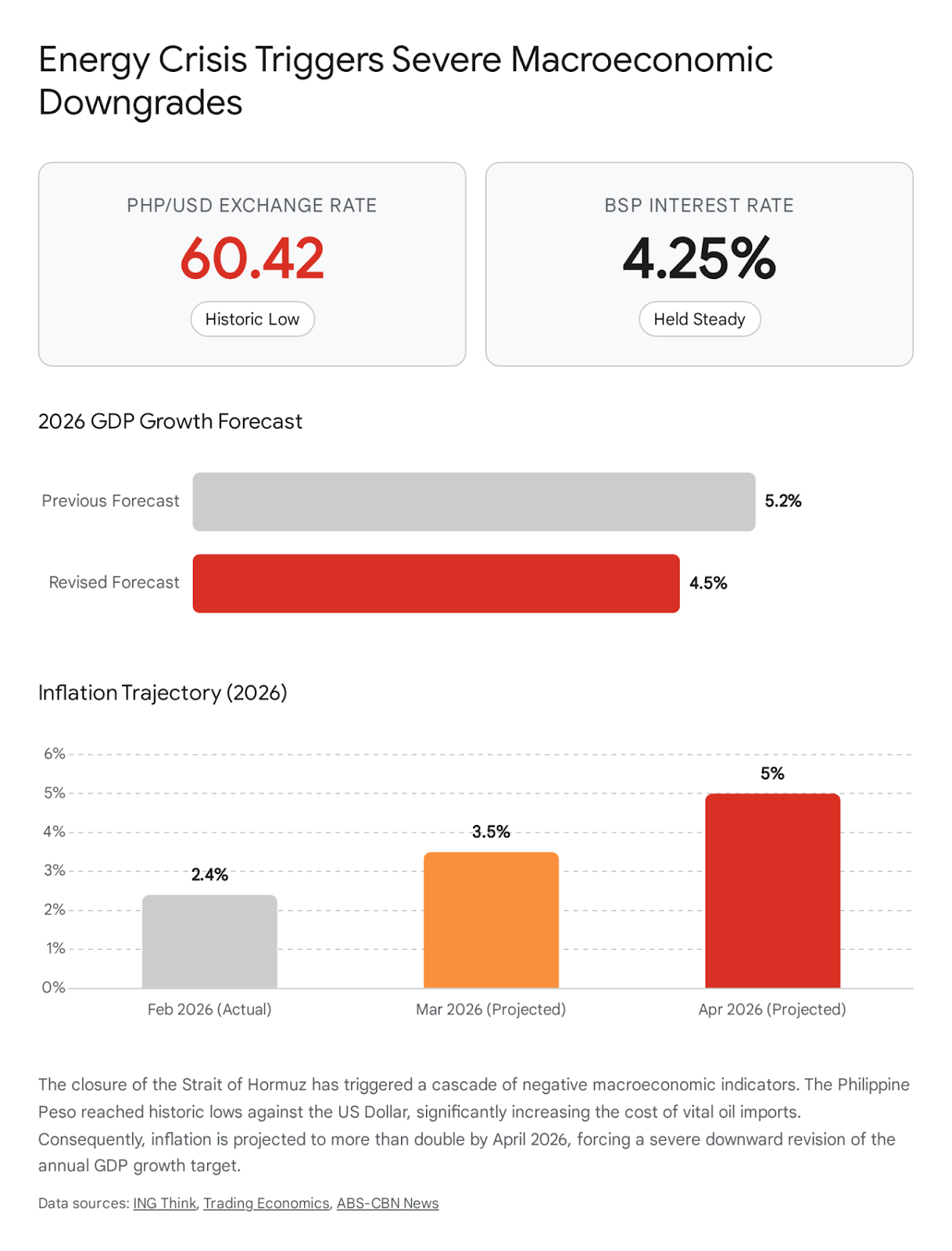
The Philippine Peso has suffered severe downward pressure in foreign exchange markets, plunging to a historic low of approximately 60.42 to the US Dollar by the end of the reporting week.3 This rapid currency depreciation acts as a destructive feedback loop, exacerbating the crisis by significantly increasing the domestic cost of dollar-denominated fuel imports. Concurrently, the Bangko Sentral ng Pilipinas (BSP) convened an off-cycle, unscheduled meeting, ultimately opting to hold the benchmark interest rate steady at 4.25 percent.3 The central bank acknowledges that inflation, which stood at a manageable 2.4 percent in February, is projected to violently breach the government’s target ceiling, jumping to an estimated 3.5 percent in March and potentially reaching 5.0 percent or higher by April 2026.3 However, BSP policymakers recognize that aggressive monetary tightening through rate hikes would be largely ineffective against imported, supply-side cost-push inflation, and would likely stifle an already fragile post-2025 economic recovery.3
The broader economic growth outlook is deteriorating rapidly. Market analysts and macroeconomic forecasting institutions have aggressively downgraded the 2026 GDP growth forecast for the Philippines from an optimistic 5.2 percent down to 4.5 percent.17 With international Brent crude prices expected to average above $80 to $85 per barrel throughout 2026, the inflated oil import bill alone is mathematically projected to shave roughly 80 basis points off the national GDP growth rate.17 This compounds existing vulnerabilities stemming from a structurally weak 2025, which was driven by a sharp, unexpected contraction in government spending.17
1.4 Domestic Unrest, Infrastructure Paralysis, and Transportation Sector Crisis
The physical manifestations of the energy crisis are increasingly visible across the archipelago, disrupting daily life and commercial operations. As of March 27, 2026, the Philippine National Police (PNP) reported that 425 filling stations nationwide had temporarily ceased operations entirely due to absolute supply depletion, out of the 14,485 stations being actively monitored for hoarding and profiteering.1 The aviation sector has been severely curtailed, with major commercial carriers Cebu Pacific and Philippine Airlines forced to suspend numerous domestic and international routes to conserve limited local aviation fuel reserves.1 Commercial infrastructure is adapting to emergency rationing protocols, with major retail conglomerates such as Ayala Malls and Robinsons Malls significantly reducing their operating hours to lower grid demand and comply with energy conservation mandates.1 Localized states of calamity have begun to emerge, notably in Sorsogon, where the Provincial Board authorized the release of disaster funds to mitigate the economic impact on the local populace.1
The most acute social friction, however, has manifested violently in the public transportation sector. Pump prices have seen consecutive, brutal hikes exceeding P10 per liter, driving diesel prices toward a projected and unsustainable P130 per liter.18 In direct response to these economic pressures, major transport syndicates—prominently including Manibela and the Pinagkaisang Samahan ng mga Tsuper at Operator Nationwide (PISTON), representing hundreds of thousands of jeepney, bus, UV Express, and Transport Network Vehicle Service (TNVS) drivers—executed a massive, coordinated two-day nationwide transport strike on March 26 and 27.22
This strike effectively paralyzed major transit arteries in Metro Manila and surrounding provinces, causing severe disruptions to the labor force and commerce.21 Drivers report that their daily net earnings have plummeted to a non-viable P200 to P300 after accounting for exorbitant fuel costs.26 The core demands of the striking organizations include the total revocation of the 1998 Oil Deregulation Law, the immediate implementation of artificial price rollbacks, and the suspension of value-added tax and excise tax on all petroleum products.23 Despite the deployment of police assets and government-sponsored free transit alternatives intended to break the strike’s impact, PISTON leadership publicly declared the mobilization a resounding success, demonstrating their capacity to hold urban centers hostage to their demands and forcing the government’s hand on fiscal policy.27 However, it is noteworthy that in regions like Eastern Visayas, some transport groups opted out of the strike, citing that halting operations would entirely devastate their already fragile daily income streams, highlighting a fracture in national solidarity among the working class.25
1.5 Legislative Intervention: The Excise Tax Suspension
Reacting to the intense street-level pressure from the transport strikes and the terrifying trajectory of macroeconomic data, the Philippine legislature executed an emergency legislative maneuver just before adjourning for the traditional Holy Week break. The House of Representatives overwhelmingly approved House Bill No. 8418 on its second reading via viva voce voting, effectively amending Section 148 of the National Internal Revenue Code.30
This critical legislation grants the President the sweeping emergency authority to suspend the collection of fuel excise taxes—currently pegged at P6 per liter for diesel and P10 per liter for gasoline and other liquid fuels.30 The trigger mechanism for this fiscal suspension is activated upon recommendation from the Development Budget Coordination Committee (DBCC) if the average Dubai crude oil price, based on the Mean of Platts Singapore, reaches or exceeds $80 per barrel for a sustained period of one month, or, crucially, if a declared national emergency results in extraordinary domestic price spikes.30 The suspension can remain active for up to six months and is renewable for an aggregate maximum period of one year, subject to further congressional action.32 Following rapid transmittal to the Senate, President Marcos signed the bill into law by the end of the week, securing a vital, albeit fiscally devastating, tool to artificially depress pump prices in the coming months at the cost of massive government revenue shortfalls.32
2. External Defense Posture and Geopolitical Realignment
While the internal domestic economy aggressively manages the fallout of the Middle Eastern energy shock, the external security environment in the Indo-Pacific remains highly volatile and escalatory. The Republic of the Philippines is currently executing a rapid, multi-vector expansion of its defense alliances to counter sustained, systematic, and increasingly aggressive coercion by the People’s Republic of China (PRC) in the West Philippine Sea.
2.1 Strategic Realignment: The France-Philippines SOVFA
On March 26, 2026, on the sidelines of the Paris Defense and Strategy Forum at the École Militaire, Philippine Defense Secretary Gilberto Teodoro Jr. and French Minister for the Armed Forces and Veterans Catherine Vautrin formally signed the Status of Visiting Forces Agreement (SOVFA).34
This agreement represents a watershed moment in Philippine grand strategy and defense diplomacy. It is the first visiting forces agreement Manila has ever secured with a European nation, joining existing foundational frameworks with the United States (effective 1999), Australia (signed 2007), and recent pacts with Japan, New Zealand, and Canada.34 The SOVFA establishes the vital, long-term legal framework governing the jurisdiction, legal protections, and operational parameters of French and Filipino military personnel operating in each other’s sovereign territories.34 This legal mechanism effectively green-lights the execution of large-scale, complex joint military exercises, naval port visits, aerial stopovers, and deep interoperability training, particularly in the realms of Humanitarian Assistance and Disaster Response (HADR) and maritime domain awareness.35
The geopolitical subtext of the agreement is unambiguous and targeted. Both defense chiefs utilized the signing ceremony to explicitly reaffirm the absolute primacy of the 1982 United Nations Convention on the Law of the Sea (UNCLOS) and the binding nature of the 2016 South China Sea Arbitral Award—a direct rebuke of Beijing’s expansive territorial claims.34 By formally integrating France into its defense matrix, the Marcos administration is deliberately and systematically internationalizing the South China Sea dispute. This strategy seeks to draw NATO-aligned, nuclear-armed European powers with global power-projection capabilities into the Indo-Pacific theater to complicate Beijing’s strategic calculus and establish a broader coalition deterrence against unilateral kinetic action. The agreement was finalized in “record time,” occurring just one year after President Marcos authorized the commencement of formal negotiations, underscoring the urgency felt in Manila.37
| Philippine Defense Alliances (Visiting Forces Frameworks) | Strategic Significance and Operational Focus in 2026 |
| United States of America (1999) | The foundational mutual defense treaty ally. Provides critical high-end hardware, signals intelligence, and the ultimate nuclear umbrella deterrence. Facilitates the massive, multi-domain Balikatan exercises. |
| Commonwealth of Australia (2007) | Deep regional Indo-Pacific partner focusing heavily on maritime domain awareness, joint counter-terrorism operations, and sustained joint naval patrols in the contested South China Sea. |
| Japan (Recent) | Critical First Island Chain security partner. The alliance has shifted significantly from mere observer status to active combat participant in upcoming joint war games, signaling a shared threat perception of the PRC. |
| French Republic (March 2026) | The first European anchor. Internationalizes the maritime dispute and brings advanced European naval and aerospace interoperability into the Philippine theater, linking Indo-Pacific security to European strategic interests. |
2.2 United States Force Posture and Typhon Missile Deployments
The United States-Philippine military axis is currently exhibiting an aggressive forward posture not seen since the height of the Cold War, driven primarily by the deployment of advanced, ground-based offensive strike capabilities that fundamentally alter the regional balance of power.
Following the 12th Philippines-United States Bilateral Strategic Dialogue (BSD) in Manila in mid-February, Washington and Manila jointly announced that the US military would actively “work to increase deployments of US cutting-edge missile and unmanned systems to the Philippines”.42 To support this, the US Congress appropriated an additional $144 million in 2026 to enhance and fortify the network of Philippine military bases opened to American forces under the Enhanced Defense Cooperation Agreement (EDCA).42
The absolute centerpiece of this localized asymmetric deterrence strategy is the deployment of the “Typhon” Mid-Range Capability launchers. Manufactured by Lockheed Martin, these mobile ground systems are capable of firing SM-6 multi-role missiles and, crucially, Block IV Tactical Tomahawk cruise missiles, the latter boasting a strike range exceeding 1,600 kilometers at subsonic speeds.42 The strategic implications of the Typhon deployment are profound and historic. These systems represent the first US ground-based intermediate-range missile systems deployed overseas since the Cold War, weapons that were previously banned entirely under the Intermediate-Range Nuclear Forces (INF) Treaty until the US withdrawal in 2019.42
Initially deployed to the Philippines in April 2024 ostensibly for temporary joint exercises, the first Typhon battery never departed. By early 2025, it was strategically relocated to an undisclosed secondary site within Luzon to test wartime survivability and rapid repositioning protocols.42 Crucially, intelligence indicates a second Typhon system, alongside the US Marine Corps’ NMESIS anti-ship missile launchers, arrived ahead of the upcoming Balikatan 2026 exercises and is slated for deployment to Batan Island in Batanes—a location positioned directly across the vital Bashi Channel from Taiwan.42
The geographic data associated with this deployment is alarming to adversaries. Operating from Northern Luzon or Batanes, the Typhon system places a vast swath of the South China Sea, the Taiwan Strait, and even critical mainland Chinese logistical staging areas within its 1,600-kilometer threat ring. This provides allied forces with a land-based, highly survivable “anti-access/area denial” (A2/AD) capability that can strike PLAN supercarriers or amphibious assault fleets operating hundreds of miles away, establishing a formidable conventional deterrent against Chinese maritime expansion.43 The upcoming Balikatan exercises (scheduled for April-May 2026) are projected to be the largest in history, moving beyond basic infantry interoperability to feature complex noncombatant evacuation operations, cyber defense, space-related drills, and the active participation of Japanese combat forces.45
Beijing has vociferously protested these deployments, officially stating that the US weapons are aimed at containing China’s rise and represent a severe threat to regional stability, demanding their immediate withdrawal.43 Manila has firmly rejected these demands. Furthermore, the US Office of the Director of National Intelligence (ODNI) released its 2026 Annual Threat Assessment, noting that while the PRC does not currently possess a fixed timeline for a kinetic invasion of Taiwan by the much-discussed 2027 window, it will aggressively intensify coercive actions, grey-zone operations, and political warfare against both Taiwan and the Philippines, specifically citing persistent military patrols at Scarborough Reef and Second Thomas Shoal.46
2.3 South China Sea Flashpoints: The Pag-asa Island Incident
This predicted coercion materialized violently and unambiguously during the reporting period. On Wednesday, March 25, 2026, a Philippine Navy warship, the Landing Ship Tank (LST) BRP Benguet (LS-507), was conducting routine, lawful maritime operations near Pag-asa Island (Thitu Island) in the contested Spratly archipelago.48 A PLAN Type 054A missile frigate (identified as Hull 532) intercepted the Philippine vessel, executing a highly dangerous and unprofessional maneuver.48
According to official statements and video evidence released by the AFP Western Command (WESCOM), the Chinese frigate intentionally “nudged” the BRP Benguet, closing to an exceptionally perilous distance of merely five to eight meters (16 to 26 feet).48 A catastrophic collision was only averted by the measured, decisive evasive actions of the Philippine crew.49 Rear Admiral Roy Vincent Trinidad, AFP spokesperson for the West Philippine Sea, categorized the maneuver as “coercive and aggressive,” noting it was a clear violation of the Convention on the International Regulations for Preventing Collisions at Sea (COLREGs).48
Crucially, Rear Admiral Trinidad marked this incident as a severe “escalation”.48 The strategic distinction here is critical for threat assessment: while the Philippines has become accustomed to routine harassment by the China Coast Guard (CCG) or the maritime militia—tactics defined as “grey-zone” operations designed to stay below the threshold of armed conflict—this incident involved a direct, aggressive engagement by a grey-hulled, heavily armed PLAN surface combatant against a sovereign Philippine Navy warship. This action signals a significantly higher tolerance for kinetic risk by Beijing and represents a deliberate probing of the thresholds of the US-Philippine Mutual Defense Treaty.48
2.4 Diplomatic Hedging: The Quanzhou BCM and the Resumption of Oil Talks
Despite the near-collision at sea involving military assets, Manila has pointedly not abandoned diplomatic channels, illustrating the complex duality of its foreign policy. In a striking juxtaposition of maritime confrontation and bilateral dialogue, the 24th Philippines-China Foreign Ministry Consultations (FMC) and the 11th Meeting of the Bilateral Consultation Mechanism (BCM) on the South China Sea convened back-to-back in Quanzhou, Fujian Province, China, on March 27 and 28.51
The Philippine delegation, led by Foreign Affairs Undersecretary Leo Herrera-Lim, lodged solemn representations regarding the Pag-asa Island incident and the continued harassment of Filipino fishermen, reaffirming Manila’s sovereign rights under UNCLOS and the 2016 Arbitral Award.51 Chinese Vice Foreign Minister Sun Weidong co-chaired the talks, countering by urging Manila to “match its words with actions” and return to the right track of handling maritime issues through dialogue, while reaffirming the historical 1975 China-Philippines Joint Communiqué and the one-China policy.55
However, the most significant intelligence to emerge from the Quanzhou BCM was not the predictable exchange of maritime grievances, but a sudden, highly pragmatic pivot regarding energy resources. Driven by the paralyzing domestic energy emergency outlined in Section 1, the Philippine delegation explicitly re-opened exploratory talks with Beijing regarding the highly controversial prospect of joint oil and gas exploration in the South China Sea.53
Undersecretary Herrera-Lim noted to the press that the talks explored “potential values for cooperation” and explicitly linked this to the “impact of prices in the Middle East,” framing the ongoing global energy crisis as an “opportunity” to secure regional energy stability and establish platforms for cooperation.53 This echoes recent statements by President Marcos expressing a newfound openness to reviving the long-stalled joint energy project—originally discussed in 2023 between Marcos and Chinese President Xi Jinping but subsequently abandoned due to intractable constitutional and sovereignty disputes regarding areas like Reed Bank.58
This development represents a profound strategic insight into the current administration’s threat prioritization. The acute vulnerability of the Philippine economy to external oil shocks originating in the Strait of Hormuz is actively forcing a recalibration of its geopolitical leverage. While Manila hardens its military alliances with the US, Australia, and France to protect its territorial sovereignty, the desperate, existential need for indigenous hydrocarbon resources is compelling the government to sit at the negotiating table with its primary geopolitical adversary to seek a commercial compromise in those very same contested waters.53 It demonstrates that economic security and energy independence are currently viewed as equal, if not superior, imperatives to absolute territorial exclusivity.
3. Internal Security, Counterintelligence, and Public Order
The domestic security apparatus of the Philippines remains robust and highly active. Law enforcement and military assets are currently executing large-scale public safety operations while simultaneously pivoting institutional resources to address sophisticated, non-traditional internal threats resulting from the nation’s elevated geopolitical profile.
3.1 Counter-Espionage Protocols and the Insider Threat Matrix
As the Philippines dramatically deepens its military integration with the United States and expands its alliance network with Western powers, its defense infrastructure has naturally become a prime target for foreign intelligence services seeking to compromise operational security. Recognizing this escalating threat, the Armed Forces of the Philippines recently released an unprecedented public framework of behavioral indicators designed to identify potential spies, infiltrators, or “insider threats” operating within the military and the broader civilian defense establishment.60
This aggressive counterintelligence push follows recent, highly publicized incidents of individuals falsely claiming military status in attempts to conduct espionage, presumably on behalf of the PRC. The AFP’s newly published threat matrix categorizes espionage risks into observable behavioral anomalies designed to be recognized by peers and commanders alike. Data indicates a notable focus on identifying individuals engaging in suspicious behavior or abnormal conduct, such as seeking unauthorized access to sensitive information or expressing support for enemy ideologies. Furthermore, the historical data demonstrates a consistent need to monitor for abrupt changes in lifestyle or unexplained wealth, as well as participation in unauthorized training or activities, and undue interest in classified matters outside a member’s scope of work.
By publicizing these specific indicators, the AFP is attempting to cultivate a resilient “culture of security” and heightened Operational Security (OPSEC) awareness across all echelons of the defense sector. The military acknowledges that conventional hardware buildup must be protected by rigorous counter-infiltration protocols. Concurrently, recognizing the legal gaps in prosecuting modern hybrid warfare, the Philippine Senate has initiated reviews to modernize the nation’s outdated anti-espionage legislation, which is ill-equipped to handle cyber-espionage and modern intelligence gathering techniques.60
3.2 Counterterrorism: Degradation of ISIS-Affiliated Networks and Continued Vigilance
The Philippine government, acting through the National Security Council (NSC) and the Anti-Terrorism Council (ATC), categorically refuted speculative reports published by foreign media designating the Philippines as an “ISIS training hotspot.” These reports stemmed from unverified rumors attempting to connect local extremist groups to a recent violent shooting incident in Bondi Beach, Australia.62 Palace Press Officer Claire Castro firmly rejected these characterizations, noting they harm the nation’s integrity and are unsupported by any validated intelligence.63
The current intelligence assessment, corroborated by the US State Department’s Country Reports on Terrorism, indicates that while the threat of terrorism persists, the operational capabilities of ISIS-East Asia (ISIS-EA) and its affiliates—such as the Abu Sayyaf Group (ASG), Daulah Islamiyah (DI), Ansar al-Khalifa Philippines, and rogue elements of the Moro Islamic Liberation Front (MILF)—have been significantly and systematically degraded since the devastating 2017 Marawi Siege.63 A continuous, highly effective “advise and assist” partnership with the U.S. military under the Kapit Bisig agreement, combined with aggressive, intelligence-led operations by the AFP and the Philippine National Police Special Action Force (PNP-SAF), has fractured the command and control structures of these organizations.64
The neutralization of key ideological and operational leadership, including the killing of ISIS Southeast Asia emir Abu Zacharia by the AFP in June 2023, has left the remnants operating in a severely diminished, fragmented capacity.63 While these fragmented elements remain capable of localized, high-impact violence—as tragically evidenced by the December 2023 bombing of a Catholic mass at Mindanao State University in Marawi City by Daulah Islamiyah remnants—they no longer possess the logistical capability, manpower, or territorial control to execute complex, multi-stage sieges.65 Violence in the southern regions is increasingly characterized by localized criminal enterprise and clan feuds rather than cohesive ideological insurgency.63 Notably, the Communist Party of the Philippines/New People’s Army (CPP-NPA) remains the most prolific perpetrator of terrorist violence in the country in terms of the sheer volume of localized attacks against security forces and civilians, though they too remain geographically isolated and strategically contained.62 The Philippines also continues to engage in robust regional counterterrorism dialogue, highlighted by the 11th Bilateral Counter-Terrorism Consultations held with Australia, focusing on preventive strategies against radicalization and online youth extremism.67
3.3 Holy Week and Critical Infrastructure Security Deployments
To manage the massive internal migration and elevated public threat profile associated with the observance of Holy Week and the broader summer travel season, the PNP has officially launched “Oplan Ligtas SumVac 2026”.68 This massive public safety initiative involves a force multiplier of 54,989 personnel mobilized nationwide. This includes 36,163 active PNP officers augmented by 4,738 members from augmented units and 14,088 personnel from auxiliary groups.68 Over 9,000 personnel are dedicated strictly to the National Capital Region (NCR) to secure 329 major places of worship, critical transport hubs, and major thoroughfares.70
Crucially, in direct response to the State of National Energy Emergency, PNP Chief Gen. Jose Melencio Nartatez Jr. ordered specialized, heavily armed deployments to secure critical energy infrastructure, fuel depots, power generation facilities, and distribution hubs across the country.1 This specific deployment serves a vital dual purpose: deterring potential sabotage by threat actors aiming to exploit the crisis to cripple the state, and preventing localized civil unrest, mass hoarding, or the hijacking of strategic petroleum reserves by organized crime syndicates seeking to profit from the severe shortages.1
4. Forward Outlook: Predictive Assessment (March 29 – April 5, 2026)
The convergence of acute economic fragility, social unrest, and strategic military buildup will continue to dominate the operational environment of the Philippines in the coming week. The administration will be severely tested on multiple fronts simultaneously.
4.1 Continued Energy Price Volatility and Social Friction Despite the passage of the excise tax suspension bill and the ongoing implementation of the UPLIFT framework, retail energy prices will experience further upward adjustments in the immediate term before any relief can materialize. Trading projections for the incoming week (March 30 – April 5) indicate a massive, destructive spike of P11 to P12 per liter for diesel fuel, which is the lifeblood of the logistics and public transport sectors.72 Gasoline prices may see a softer, but still impactful, increase of up to P3 per liter.72 This incoming diesel hike will severely test the fragile truce established after the recent nationwide transport strikes. It is highly probable that transport groups will agitate for further strikes or immediate fare hikes, and this price shock will accelerate the cascading inflation currently tracking toward 5.0 percent for April, further squeezing the working class and threatening civil stability.
4.2 Diplomatic Downsizing and Strategic Recalibration The economic strain of the energy crisis is forcing tangible, visible changes to the Philippines’ diplomatic footprint and international commitments. As the designated host of the ASEAN 2026 summit, the government has ordered a drastic, unprecedented recalibration of the event schedule to conform to the energy emergency. Over 650 preparatory working group and ministerial meetings have been abruptly shifted from physical venues to virtual, online formats to conserve national energy resources and reduce logistical expenditures.73 The main Leaders’ Summit scheduled for May will proceed in person but in a strictly “barebones” format. The agenda of the summit is expected to pivot intensely away from standard diplomatic pleasantries to urgently address regional energy security, food security, and the protection of migrant workers in the Middle East.27 Upcoming diplomatic visits, including those by South Korean and Japanese officials, will likely be dominated by discussions on energy supply chains and defense interoperability.75
4.3 Maritime Theater Projections and the BCM Aftermath
Following the hostile interception of the BRP Benguet by the PLAN, the AFP will likely increase force protection measures and operational readiness for all grey-hulled vessels operating within the Exclusive Economic Zone (EEZ). While the Quanzhou BCM talks have opened a faint, pragmatic channel for potential energy cooperation, Beijing historically utilizes bilateral dialogue to stall diplomatic pressure while simultaneously continuing aggressive tactical coercion at sea. Retaliatory or probing maneuvers by the PLAN or the China Coast Guard against Philippine resupply missions or naval patrols should be anticipated in the coming week. Beijing will undoubtedly test the resolve of the newly cemented Philippine-French defense architecture and attempt to gauge the operational status of the expanding US missile footprint in Northern Luzon and Batanes. The Philippines must balance the desperate need for joint exploration with the imperative to maintain its newly fortified territorial deterrence.
Please share the link on Facebook, Forums, with colleagues, etc. Your support is much appreciated and if you have any feedback, please email us in**@*********ps.com. If you’d like to request a report or order a reprint, please click here for the corresponding page to open in new tab.
Sources Used
- 2026 Philippine energy crisis – Wikipedia, accessed March 29, 2026, https://en.wikipedia.org/wiki/2026_Philippine_energy_crisis
- Philippine president declares energy emergency – FMT, accessed March 29, 2026, https://www.freemalaysiatoday.com/category/world/2026/03/24/philippine-president-declares-energy-emergency
- Philippine Peso – Quote – Chart – Historical Data – News – Trading Economics, accessed March 29, 2026, https://tradingeconomics.com/philippines/currency
- Philippines declares ‘national energy emergency’ and boosts coal power as Iran war grinds on, accessed March 29, 2026, https://www.theguardian.com/world/2026/mar/25/philippines-declares-national-energy-emergency-iran-war
- Marcos declares state of national energy emergency → Context.ph, accessed March 29, 2026, https://context.ph/2026/03/25/marcos-declares-state-of-national-energy-emergency/
- ‘National energy emergency’ declared in Philippines – CP24, accessed March 29, 2026, https://www.cp24.com/news/world/2026/03/24/philippines-declares-national-energy-emergency/
- Philippines declares national energy emergency as Iran war fuels oil shock fears, accessed March 29, 2026, https://www.straitstimes.com/asia/se-asia/philippines-declares-national-energy-emergency-as-iran-war-fuels-oil-shock-fears
- Marcos: No reason to panic after national energy emergency declaration – News, accessed March 29, 2026, https://newsinfo.inquirer.net/2201145/marcos-no-reason-to-panic-after-national-energy-emergency-declaration
- Philippine President Marcos declares state of national energy emergency amid Middle East conflict – Asia News Network, accessed March 29, 2026, https://asianews.network/philippine-president-marcos-declares-state-of-national-energy-emergency-amid-middle-east-conflict/
- Marcos declares state of national energy emergency | GMA News Online, accessed March 29, 2026, https://www.gmanetwork.com/news/topstories/nation/981224/president-marcos-energy-emergency/story/
- How Pinoys will benefit from the State of Energy Emergency | GMA …, accessed March 29, 2026, https://www.gmanetwork.com/news/topstories/nation/981242/how-pinoys-will-benefit-from-the-state-of-energy-emergency/story/
- What is UPLIFT and what does a ‘national energy emergency’ mean? | MEXC News, accessed March 29, 2026, https://www.mexc.com/news/979243
- Senate of the Philippines, accessed March 29, 2026, https://senate.gov.ph/media/news-release/chiz-says-phl-needs-unified-response-to-keep-economy-essential-services-stable-2
- Manila, March 24, 2026 (AFP) – Philippines declares ‘national energy emergency’ – NAMPA, accessed March 29, 2026, https://www.nampa.org/text/22895622
- DOE Enforces Emergency Measures to Keep Power Stable, Protect Consumers from Price Spikes, accessed March 29, 2026, https://doe.gov.ph/articles/3381055–doe-enforces-emergency-measures-to-keep-power-stable-protect-consumers-from-price-spikes?title=DOE%20Enforces%20Emergency%20Measures%20to%20Keep%20Power%20Stable,%20Protect%20Consumers%20from%20Price%20Spikes
- DOLE readies P1.2B funds for vulnerable workers amid energy emergency – ABS-CBN, accessed March 29, 2026, https://www.abs-cbn.com/news/business/2026/3/29/dole-readies-p1-2b-funds-for-vulnerable-workers-amid-energy-emergency-0001
- Oil price shock raises inflation and policy risks in the Philippines, accessed March 29, 2026, https://think.ing.com/articles/oil-price-shock-raises-inflation-and-policy-risks-in-philippines/
- Philippines among Asian countries most vulnerable to global energy shock, accessed March 29, 2026, https://business.inquirer.net/580138/philippines-among-asian-countries-most-vulnerable-to-global-energy-shock
- Senators score oil firms for selling pre-war fuel at premium prices | ABS-CBN News, accessed March 29, 2026, https://www.abs-cbn.com/news/business/2026/3/26/senators-score-oil-firms-for-selling-pre-war-fuel-at-premium-prices-1921
- PH military releases list of indicators of potential insider threats | ANC – YouTube, accessed March 29, 2026, https://www.youtube.com/watch?v=aCf0R5ZqHpE
- 500000 transport and TNVS drivers stage nationwide strike March 26-27 | Business 360, accessed March 29, 2026, https://www.youtube.com/watch?v=q6_Ox9gQd94
- Demonstration Alert: Nationwide Transportation Strike – March 26-27, 2026, accessed March 29, 2026, https://ph.usembassy.gov/demonstration-alert-nationwide-transportation-strike-march-26-27-2026/
- Groups back 2-day transport strike: This is everyone’s fight – News, accessed March 29, 2026, https://newsinfo.inquirer.net/2201056/groups-back-2-day-transport-strike-this-is-everyones-fight
- Second week of transport strike begins | Philstar.com, accessed March 29, 2026, https://www.philstar.com/headlines/2026/03/26/2516883/second-week-transport-strike-begins
- E. Visayas PUV drivers opt to continue operations amid transport strike, accessed March 29, 2026, https://pia.gov.ph/news/e-visayas-puv-drivers-opt-to-continue-operations-amid-transport-strike/
- Two-Day Transport Strike Scheduled for March 26 and 27 | Taguig News, accessed March 29, 2026, https://www.taguig.com/news/two-day-transport-strike-scheduled-for-march/
- Recto highlights public-private efforts to address oil crisis, accessed March 29, 2026, https://www.abs-cbn.com/news/nation/2026/3/29/recto-highlights-public-private-efforts-to-address-oil-crisis-1346
- March 26-27 transport strike a ‘success,’ says Piston – News, accessed March 29, 2026, https://newsinfo.inquirer.net/2202513/march-26-27-transport-strike-a-success-piston
- PISTON confident 2-day transport strike ‘successful’ | Headline sa Hapon (27 March 2026), accessed March 29, 2026, https://www.youtube.com/watch?v=seYGKSUn7nI
- House OKs bill suspending excise tax on fuel on second reading – News, accessed March 29, 2026, https://newsinfo.inquirer.net/2194171/house-oks-bill-suspending-excise-tax-on-fuel-on-second-reading
- House OKs 18 priority bills before Holy Week break | The Manila Times, accessed March 29, 2026, https://www.manilatimes.net/2026/03/23/news/national/house-oks-18-priority-bills-before-holy-week-break/2305071
- House transmits oil tax suspension bill to Senate | Philippine News Agency, accessed March 29, 2026, https://www.pna.gov.ph/articles/1271656
- Philippine President Marcos signs law suspending fuel excise tax – Asia News Network, accessed March 29, 2026, https://asianews.network/philippine-president-marcos-signs-law-suspending-fuel-excise-tax/
- Philippines, France sign visiting forces deal amid China tensions – Naval News, accessed March 29, 2026, https://www.navalnews.com/naval-news/2026/03/philippines-france-sign-visiting-forces-deal-amid-china-tensions/
- France becomes first EU nation to sign visiting forces pact with Philippines, accessed March 29, 2026, https://en.yenisafak.com/world/france-becomes-first-eu-nation-to-sign-visiting-forces-pact-with-philippines-3716369
- PH seals visiting forces deal with France; here’s why it matters – Manila Bulletin, accessed March 29, 2026, https://mb.com.ph/2026/03/27/ph-seals-visiting-forces-deal-with-france-heres-why-it-matters
- Philippines, France sign Status of Visiting Forces Agreement – Philstar.com, accessed March 29, 2026, https://www.philstar.com/headlines/2026/03/28/2517337/philippines-france-sign-status-visiting-forces-agreement
- Philippines, France boost mutual defense with visiting forces pact – Manila Standard, accessed March 29, 2026, https://manilastandard.net/news/314720781/philippines-france-boost-mutual-defense-with-visiting-forces-pact.html
- Philippines, France ‘very close’ to sealing Visiting Forces Agreement–AFP chief – ABS-CBN, accessed March 29, 2026, https://www.abs-cbn.com/news/nation/2026/3/25/philippines-france-very-close-to-sealing-vfa-afp-chief-1513
- PH, France ink Status of Visiting Forces Agreement – SunStar, accessed March 29, 2026, https://www.sunstar.com.ph/manila/ph-france-ink-status-of-visiting-forces-agreement
- PH, France sign visiting forces deal to deepen defense ties – Inquirer.net, accessed March 29, 2026, https://www.inquirer.net/471231/ph-france-sign-visiting-forces-deal-to-deepen-defense-ties/
- Washington to deploy more medium-range missiles to the Philippines, accessed March 29, 2026, https://www.wsws.org/en/articles/2026/03/02/akmb-m02.html
- US plans to deploy more missile launchers to the Philippines despite China’s alarm, accessed March 29, 2026, https://www.courthousenews.com/us-plans-to-deploy-more-missile-launchers-to-the-philippines-despite-chinas-alarm/
- Typhon: The U.S. Military Has New Missiles That Can Strike China or Supercarriers from … – 19FortyFive, accessed March 29, 2026, https://www.19fortyfive.com/2026/03/typhon-the-u-s-military-has-new-missiles-that-can-strike-china-or-supercarriers-from-over-1000-miles-away/
- AFP: 2026 ‘Balikatan’ exercises ‘biggest’ yet – Global News, accessed March 29, 2026, https://globalnation.inquirer.net/315370/afp-2026-balikatan-exercises-biggest-yet
- China & Taiwan Update, March 27, 2026 | ISW, accessed March 29, 2026, https://understandingwar.org/research/china-taiwan/china-taiwan-update-march-27-2026/
- 2026 Annual Threat Assessment of the U.S. Intelligence Community – ODNI, accessed March 29, 2026, https://www.dni.gov/files/ODNI/documents/assessments/ATA-2026-Unclassified-Report.pdf
- ‘Intentional’: AFP says near-collision with Navy ship an escalation by China – ABS-CBN, accessed March 29, 2026, https://www.abs-cbn.com/news/nation/2026/3/27/-intentional-afp-says-near-collision-with-navy-ship-an-escalation-by-china-1259
- PH Navy vessel avoids collision with Chinese warship in WPS, accessed March 29, 2026, https://www.pna.gov.ph/articles/1271907
- Video: Philippines Calls “Close Encounter” With Chinese Navy an Escalation, accessed March 29, 2026, https://maritime-executive.com/article/video-philippines-calls-close-encounter-with-chinese-navy-an-escalation
- PH raises concern over China’s actions in West PH Sea at Fujian meeting, accessed March 29, 2026, https://www.abs-cbn.com/news/nation/2026/3/29/ph-resumes-talks-raises-concern-over-china-s-actions-in-west-ph-sea-1011
- PH, China resume talks, tackle South China Sea tensions, accessed March 29, 2026, https://globalnation.inquirer.net/315992/ph-china-resume-talks-tackle-south-china-sea-tensions
- Philippines-China cooperation talks resume amid ongoing oil crisis, accessed March 29, 2026, https://www.gmanetwork.com/news/topstories/nation/981672/philippines-china-cooperation/story/
- PH, China make ‘initial exchanges’ on South China Sea energy cooperation, accessed March 29, 2026, https://www.mexc.co/en-IN/news/989562
- Manila urged to take concrete steps for stabilizing ties, accessed March 29, 2026, https://www.chinadaily.com.cn/a/202603/29/WS69c94189a310d6866eb407e2.html
- China, Philippines move to reset ties with renewed push for stability and dialogue, accessed March 29, 2026, https://www.pakistantoday.com.pk/2026/03/28/china-philippines-move-to-reset-ties-with-renewed-push-for-stability-and-dialogue
- Philippines, China restart talks on energy cooperation in disputed sea, accessed March 29, 2026, https://www.arabnews.com/node/2638058/amp
- China open to restart talks on SCS joint oil exploration, accessed March 29, 2026, https://manilastandard.net/news/314720319/china-open-to-restart-talks-on-scs-joint-oil-exploration.html
- Philippines Could Re-Open South China Sea Oil Talks with China – The China-Global South Project, accessed March 29, 2026, https://chinaglobalsouth.com/2026/03/25/philippines-could-re-open-south-china-sea-oil-talks-with-china/
- PH military releases list of indicators of potential insider threats – YouTube, accessed March 29, 2026, https://www.youtube.com/watch?v=Esp4ig01kQ4
- PH military releases list of indicators of potential insider threats | ANC – YouTube, accessed March 29, 2026, https://www.youtube.com/watch?v=F7DxNkqSUEo
- Palace: PH not an ISIS training hotspot, ISIS-linked groups weakened, accessed March 29, 2026, https://pia.gov.ph/news/palace-ph-not-an-isis-training-hotspot-isis-linked-groups-weakened/
- PBBM rejects PH label as terror hotspot, orders ATC to stay vigilant, accessed March 29, 2026, https://www.pna.gov.ph/index.php/articles/1265374
- Country Reports on Terrorism 2022: Philippines – State Department, accessed March 29, 2026, https://www.state.gov/reports/country-reports-on-terrorism-2022/philippines
- The Philippines: Extremism and Terrorism, accessed March 29, 2026, https://www.counterextremism.com/countries/philippines-extremism-and-terrorism
- NSC: We’re validating ISIS link in Marawi blast, there are remnants of extremist groups in PH, accessed March 29, 2026, https://www.youtube.com/watch?v=jk0y4KSyyno
- 11th Bilateral Counter-Terrorism Consultations Yield Strategic Gains for Philippines and Australia, accessed March 29, 2026, https://pia.gov.ph/news/11th-bilateral-counter-terrorism-consultations-yield-strategic-gains-for-philippines-and-australia/
- PNP to deploy nearly 55000 cops nationwide for Holy Week, summer – News, accessed March 29, 2026, https://newsinfo.inquirer.net/2196403/pnp-to-deploy-nearly-55000-cops-nationwide-for-holy-week-summer
- PNP rolls out Holy Week, summer security plan | Philippine News Agency, accessed March 29, 2026, https://www.pna.gov.ph/articles/1270700
- 9,000 cops deployed in Metro Manila for Holy Week, accessed March 29, 2026, https://www.philstar.com/nation/2026/03/30/2517817/9000-cops-deployed-metro-manila-holy-week
- PNP tightens security at energy facilities after emergency order – News – Inquirer.net, accessed March 29, 2026, https://newsinfo.inquirer.net/2200876/pnp-tightens-security-at-energy-facilities-after-emergency-order
- Softer gasoline price hike seen on March 31 – Business Inquirer, accessed March 29, 2026, https://business.inquirer.net/581836/softer-gasoline-price-hike-seen-on-march-31
- ASEAN 2026 Events, accessed March 29, 2026, https://asean2026.gov.ph/events/
- Talks on South China Sea issue to push through amid PH’s move to curb oil supply threats, accessed March 29, 2026, https://mb.com.ph/2026/03/27/talks-on-south-china-sea-issue-to-push-through-amid-phs-move-to-curb-oil-supply-threats
- List of diplomatic visits to the Philippines – Wikipedia, accessed March 29, 2026, https://en.wikipedia.org/wiki/List_of_diplomatic_visits_to_the_Philippines