1. Executive Summary
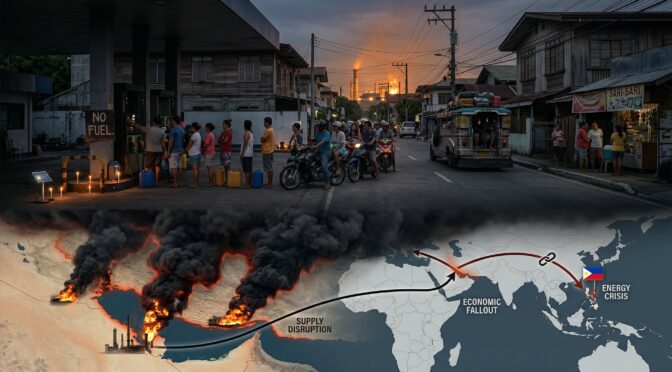
The eruption of the 2026 Iran War and the subsequent asymmetrical weaponization of the Strait of Hormuz have generated a systemic shock to the global energy architecture, representing the most severe macroeconomic and geopolitical crisis since the oil shocks of the 1970s. Triggered by Operation Epic Fury—a joint military campaign initiated by the United States and Israel on February 28, 2026, which resulted in the death of Iranian Supreme Leader Ali Khamenei—the conflict has rapidly metastasized from a localized kinetic exchange into a multi-theater conflagration.1 Iran’s retaliatory doctrine has heavily prioritized the disruption of global maritime commons, resulting in the functional closure of the Strait of Hormuz to international commercial shipping.1 This blockade has effectively stranded approximately 15.8 million barrels per day (bpd) of crude oil, representing roughly 15% of the global supply, alongside 20% of the world’s liquefied natural gas (LNG) export capacity.4
For the Republic of the Philippines, a rapidly developing archipelagic nation heavily dependent on imported hydrocarbons and entirely devoid of a meaningful Strategic Petroleum Reserve (SPR), this geopolitical rupture constitutes an acute, multi-dimensional national emergency.7 As of late March 2026, the Philippine government is fighting a complex crisis characterized by rapidly depleting energy reserves, severe macroeconomic destabilization, an impending humanitarian logistics nightmare, and opportunistic territorial coercion in its immediate maritime periphery. In response, President Ferdinand Marcos Jr. has issued Executive Order (EO) 110, formally declaring a State of National Energy Emergency and activating the Unified Package for Livelihoods, Industry, Food, and Transport (UPLIFT) framework to execute a whole-of-government survival strategy.9
This intelligence report provides an exhaustive, systemic analysis of the conflict’s cascading impacts on the Philippines, focusing specifically on power generation, transportation, and national security. The analysis reveals a deeply vulnerable national architecture across all assessed domains. In the realm of power generation, the country is currently operating on a highly precarious 45-day fuel buffer.8 The crisis has derailed the nation’s strategic transition to Liquefied Natural Gas, forcing emergency procurements of sanctioned Russian ESPO crude and a reversion to high-emission coal and Euro II fuels to avert an imminent grid collapse.8
Within the transportation and logistics sector, draconian demand destruction protocols have been activated. This includes the mandated implementation of four-day workweeks for government agencies and local government units, alongside severe reductions in commercial aviation volumes.14 The domestic logistics sector is facing an existential pricing crisis, prompting the Philippine legislature to pursue a PHP 52.8 billion supplemental budget to distribute emergency subsidies and prevent widespread labor strikes and supply chain paralysis.17
In the domain of national security, the administration is bracing for the unprecedented logistical and financial nightmare of repatriating a fraction of the 2.4 million Overseas Filipino Workers (OFWs) currently residing in the Middle East.19 Senate simulations indicate that a worst-case mass evacuation scenario could cost the state up to PHP 406 billion while simultaneously erasing billions of dollars in vital remittances, threatening the sovereign credit profile.20 Concurrently, the People’s Republic of China (PRC) is leveraging the diversion of United States military focus to the Middle Eastern theater to radically escalate gray-zone coercion in the South China Sea, placing immense operational strain on the U.S.-Philippines mutual defense posture and testing the credibility of regional deterrence.22
The predictive intelligence forecasts for the next 30, 60, and 90 days indicate a critical window of compounding vulnerability. Even if the current five-day diplomatic pause initiated by the United States yields a temporary de-escalation framework, the structural damage inflicted upon global energy supply chains and regional confidence guarantees a prolonged period of severe economic and strategic friction for the Philippine state.25
2. The Global Threat Matrix: Operation Epic Fury and the Strait of Hormuz
To fully comprehend the localized impacts on the Philippine archipelago, the macro-geopolitical environment must first be meticulously contextualized. The 2026 Iran War represents a fundamental rupture in the balance of power in the Middle East, triggering immediate, severe, and sustained disruptions across the global economic commons.2
2.1 The Kinetic Campaign and Asymmetrical Iranian Retaliation
Following the ultimate collapse of attempts to renegotiate the Joint Comprehensive Plan of Action (JCPOA) in 2025, and amid escalating tensions over Iran’s advancing nuclear and ballistic missile programs, the United States and Israel initiated Operation Epic Fury on February 28, 2026.2 Intelligence assessments indicate that in the first twelve hours alone, the combined allied forces executed nearly 900 precision strikes.2 These initial waves specifically targeted Iranian leadership, integrated air defense systems, and ballistic missile infrastructure, succeeding in the strategic objective of eliminating Supreme Leader Ali Khamenei before he could be relocated to a hardened subterranean bunker.2 U.S. Central Command (CENTCOM) reports that the military campaign has since expanded massively, encompassing over 9,000 targets across the region.25 The combined forces have severely degraded the conventional capabilities of the Iranian Navy, damaging or destroying more than 140 naval vessels to limit Tehran’s ability to project conventional force in the Persian Gulf.3
However, the defining characteristic of this conflict has been the sophisticated application of electronic warfare preceding the kinetic strikes. Before the first munitions impacted, the electromagnetic environment over Iran was systematically dismantled; radars were blinded, command-and-control links were severed, and communications networks were taken offline, demonstrating a convergence of electronic warfare, cyber operations, and information dominance.28 Despite this profound systemic degradation, the Iranian Revolutionary Guard Corps (IRGC) and the broader Axis of Resistance have demonstrated highly resilient asymmetrical capabilities. Iran launched hundreds of retaliatory ballistic missiles and thousands of loitering munitions (drones) across the region, heavily targeting Israel and Gulf state energy infrastructure, while Hezbollah initiated dozens of attacks against northern Israel from southern Lebanon.2 The civilian toll has been heavy, with more than 2,700 reported dead across the theater, alongside immense infrastructural devastation in Iran, Lebanon, and Israel.2
2.2 The Weaponization of Maritime Chokepoints
The most globally consequential element of the Iranian counter-strategy has been the weaponization of the maritime domain, specifically the functional closure of the Strait of Hormuz. Within hours of the initial allied strikes, the IRGC broadcasted VHF warnings to all commercial shipping in the vicinity, declaring the strait indefinitely closed.1 This declaration was initially universal but was later amended to specifically target vessels associated with the United States, Israel, and their Western allies.1 Iran backed this rhetorical blockade with immediate physical enforcement, deploying naval mines—estimated by intelligence agencies at fewer than ten, but highly effective as psychological and financial deterrents—and initiating direct projectile attacks on commercial vessels.1 A tragic early example was the strike on the oil tanker Skylight north of Khasab, Oman, which resulted in the deaths of two Indian crew members.1 As of mid-March 2026, Iran had conducted at least 21 confirmed attacks on merchant shipping navigating the Gulf.1
This asymmetrical blockade has forced the global energy industry into a state of paralysis. Major multinational energy corporations, including QatarEnergy, Shell, and the Kuwait Petroleum Corporation, have been forced to invoke force majeure across Gulf Cooperation Council (GCC) countries.4 Iraq, the world’s sixth-largest oil producer, has been forced to slash production in the Basra region by 70%, stranding millions of barrels as its primary export route is severed.4 Regional powers like Saudi Arabia and the United Arab Emirates have been forced to shut down major refining operations (such as the massive Ras Tanura facility) and frantically reroute crude through alternative, lower-capacity pipelines to the Red Sea.4 The International Energy Agency (IEA) has labeled this cascading failure “the greatest global energy and food security challenge in history,” projecting an unprecedented 8 million bpd plunge in global oil supply for the month of March.30
2.3 Energy Price Volatility and Diplomatic Interventions
The immediate reaction of the global spot markets mirrored the most severe historical energy shocks. Brent crude spiked violently from roughly $80 per barrel prior to the conflict to an intraday high of $119 per barrel, approaching the all-time nominal peak of $147 per barrel recorded during the 2008 financial crisis.31 Rigorous financial modeling from institutions such as Goldman Sachs and Oxford Economics suggests that if the Strait of Hormuz remains functionally closed for an extended duration, prices could experience a convex rise, testing upper bounds of $185 to $190 per barrel.5 This extreme projection is based on the sheer volume of stranded assets; 15.8 million bpd are currently disrupted, compared to a mere 4.3 million bpd during the 1990 Gulf War.5
By late March 2026, a fragile and unpredictable diplomatic window emerged. United States President Donald Trump announced a five-day pause on threatened, devastating strikes against Iranian power generation and water desalination infrastructure.25 The U.S. administration cited the existence of indirect, back-channel negotiations mediated by Oman in Geneva, aimed at securing a comprehensive settlement that would allegedly prevent Iran from acquiring a nuclear weapon and reopen the strait.25 While Iranian state media and parliamentary officials publicly denied these negotiations—framing the U.S. pause as a retreat in the face of Iranian deterrence—global markets responded rapidly to the potential for de-escalation.25 Brent crude temporarily softened to approximately $92 per barrel.27 However, energy analysts and market watchers project that even with a formalized ceasefire, the structural damage to regional infrastructure and a newly established “Cape of Good Hope rerouting cost floor” will likely keep global energy prices structurally elevated near $130 per barrel for the medium term, offering little relief to import-dependent nations.5
3. Macroeconomic Contagion: Transmission Vectors into the Philippine Economy
The Republic of the Philippines is systemically and structurally vulnerable to external energy shocks. As a rapidly developing archipelago without a functional Strategic Petroleum Reserve (SPR) and possessing no meaningful capacity to domesticate its hydrocarbon supply chain, the country operates entirely at the mercy of global spot markets.7 The macroeconomic fallout from the 2026 Iran War is currently manifesting through three interconnected, highly destructive vectors: inflationary spirals, currency depreciation, and rapid fiscal hemorrhaging.
3.1 Inflationary Spirals and the Contraction of Economic Growth
Prior to the outbreak of the conflict, the Bangko Sentral ng Pilipinas (BSP) had successfully navigated a complex and delicate monetary easing cycle. The central bank had lowered the key policy rate by a cumulative 225 basis points to stimulate a domestic economy that had recorded its weakest non-pandemic growth pace (3%) in the final quarter of 2025.37 The eruption of the Middle East crisis has effectively obliterated this carefully constructed monetary maneuvering space.
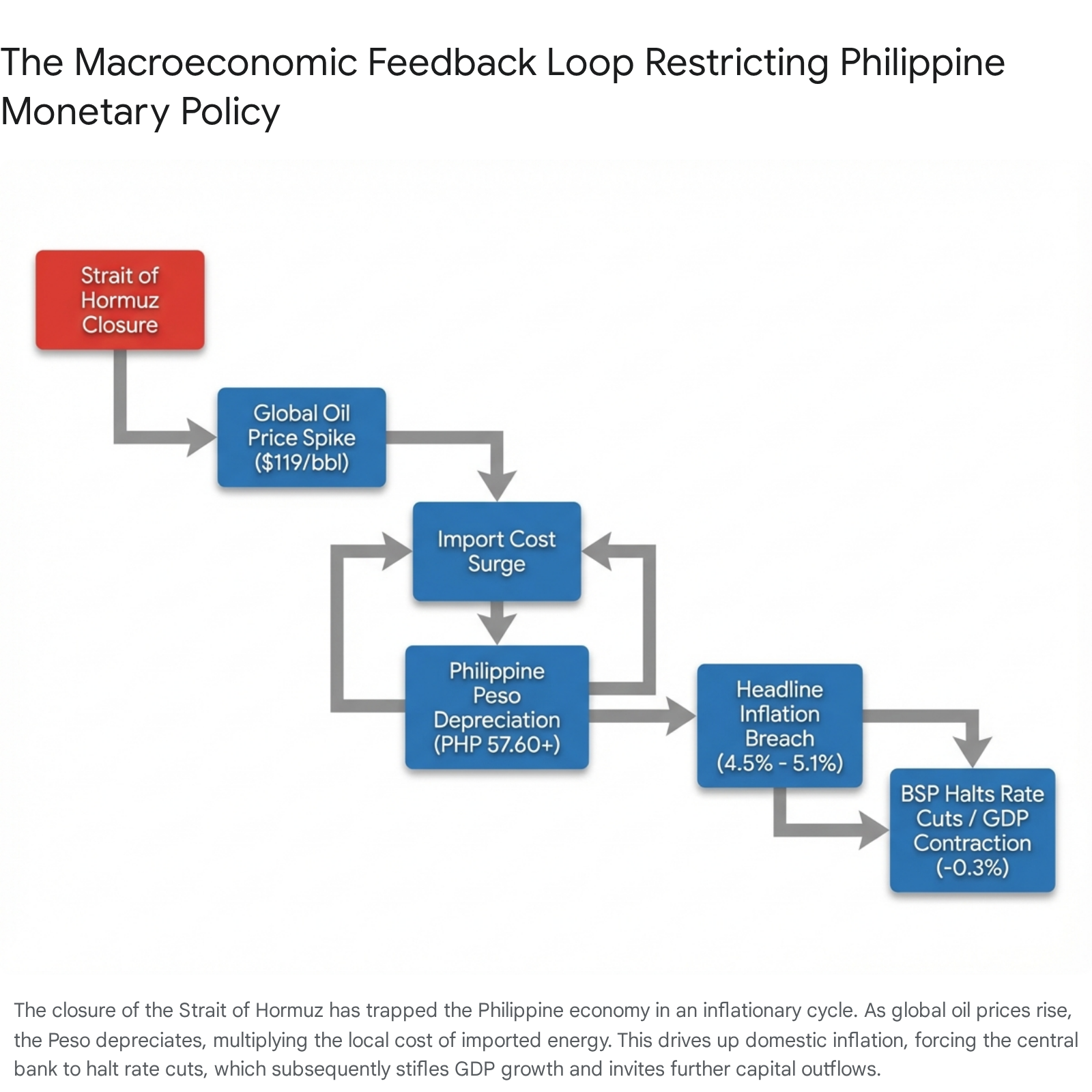
The transmission mechanism of the global energy shock into the Philippine domestic economy is ruthlessly efficient. Analysts and economists estimate a strict correlation: every $10 increase in the global price of crude oil pushes Philippine headline inflation upward by 0.5 percentage points.38 With crude prices having jumped over $40 per barrel at the peak of the market panic, the inflationary impact is profound. The Department of Economy, Planning, and Development (DEPDev) has been forced to drastically revise its baseline economic scenarios. Headline inflation, which stood at a manageable 2.4% in February 2026, is now projected to surge to between 4.5% and 5.1% in March, and is expected to remain highly elevated between 4.5% and 4.8% throughout April.20
This trajectory definitively breaches the BSP’s target maximum threshold of 4%, guaranteeing a severe erosion of consumer purchasing power and a contraction in domestic consumption.20 Furthermore, the conflict is expected to trim between 0.2% and 0.3% directly off the Philippines’ Gross Domestic Product (GDP) growth for the current year.20 The BSP, which had previously signaled the end of its easing cycle, is now cornered in a classic stagflationary trap; it cannot cut rates to stimulate faltering economic growth without exacerbating imported inflation and triggering massive capital flight, nor can it easily hike rates without crushing domestic investment.37
3.2 The Peso Depreciation Feedback Loop
The macroeconomic damage is severely amplified by the rapid depreciation of the Philippine Peso (PHP). As risk-off sentiment dominated global emerging markets in the wake of the strikes, the local currency weakened significantly, trading past the PHP 57.60 mark against the U.S. Dollar in late March.36 For a net energy importer, a depreciating currency creates a devastating, self-reinforcing feedback loop. Because global oil is priced universally in U.S. dollars, the Philippines must expend an increasing amount of its weakening domestic currency to purchase the exact same volume of fuel. This dynamic further drives up domestic inflation, which subsequently weakens the currency’s real yield, accelerating further capital flight and deeper depreciation.
Philippine Finance Secretary Frederick Go and the BSP have been forced into defensive, highly reactive interventions in the foreign exchange markets as the Peso nears the critical psychological threshold of PHP 60 to the U.S. Dollar.40 The central bank’s ability to defend the currency is constrained by the necessity of maintaining adequate foreign exchange reserves, which are themselves threatened by the potential collapse of overseas remittances.
3.3 Systemic Vulnerability to Supply Chain Disruptions
Beyond the direct cost of energy, the closure of the Strait of Hormuz has severely disrupted broader global supply chains, heavily impacting consumer goods essential to the Philippine economy. Four of the world’s largest container shipping lines suspended transits through the region within hours of the closure, leading to massive congestion, soaring war risk premiums on hull insurance (up to 1.5% of hull value), and exorbitant rerouting costs.6
The disruption affects critical inputs for the Philippine manufacturing and agricultural sectors. The export of fertilizer inputs, petrochemicals, and materials like aluminum from the Middle East has been severely curtailed, with polypropylene prices jumping 24% and aluminum increasing by 10% globally.41 For a nation highly dependent on imported agricultural inputs to ensure domestic food security, the disruption of fertilizer shipments poses a secondary, potentially more devastating threat to domestic price stability in the medium term.41
4. Power Generation and Energy Security: The Collapse of the Transition Paradigm
The Philippine electrical grid is confronting an existential threat. The architecture of the country’s power generation is heavily indexed to external supply chains, making it highly susceptible to the disruptions emanating from the Persian Gulf. The crisis has not only threatened immediate baseload power but has structurally derailed the nation’s long-term energy transition strategy.
4.1 The Declaration of a National Energy Emergency (EO 110)
Recognizing the imminent threat of grid failure and supply chain collapse, President Marcos Jr. signed Executive Order (EO) 110 on March 24, 2026, officially declaring a State of National Energy Emergency.8 This extraordinary executive measure, valid for up to one year, authorizes the executive branch to bypass standard bureaucratic inertia to secure the nation’s energy lifelines.9
The EO activates the UPLIFT committee (Unified Package for Livelihoods, Industry, Food, and Transport)—an inter-agency body integrating the departments of energy, transport, finance, agriculture, and social welfare—to execute a coordinated, whole-of-government crisis response.9 Crucially, EO 110 grants the Department of Energy (DOE) unprecedented regulatory authority. The DOE is now mandated to take direct action against hoarding and profiteering, streamline the issuance of permits, and, most importantly, authorize advance payments of over 15% of contract amounts to secure forward fuel deliveries from hesitant international suppliers.8
Furthermore, the mandate allows for drastic interventions in the domestic electricity market. The DOE is authorized to request the Energy Regulatory Commission to initiate the “suspension of market operations or the declaration of a temporary market failure” if extraordinary price volatility threatens grid reliability or consumer solvency.43 The EO also dictates a “resource conservation and prioritisation mechanism,” prioritizing grid reliability and the dispatch of cheaper generating technologies to prolong the overall energy supply.9
4.2 The 45-Day Supply Cliff and Desperate Sourcing
The fundamental catalyst for the issuance of EO 110 is the critically low inventory of domestic fuel. In a stark briefing to the Senate PROTECT (Proactive Response and Oversight for Timely and Effective Crisis Strategy) Committee, Energy Secretary Sharon Garin reported that the country possesses approximately 45 days of aggregate fuel supply remaining, based on current consumption rates.8 Specifically, this breaks down to 53 days of gasoline and a mere 46 days of diesel.12
While the state-run Philippine National Oil Co. (PNOC) and private players have scrambled to contract an additional 11 days of gasoline and 8 days of diesel from abroad, the overarching mathematical reality is grim.12 Secretary Garin bluntly warned lawmakers that the “worst-case scenario is we run dry,” indicating that if backup suppliers are not secured within a month and a half, the nation will face physical fuel exhaustion and a total economic standstill.12 The PNOC’s stated goal of purchasing two million barrels of petroleum as a strategic buffer only covers roughly 10 days of national consumption, exposing the severe, historic lack of strategic storage infrastructure in the Philippines.44
4.3 Navigating Sanctions: The Russian Pivot
In a desperate bid to replace the massive volumes of Middle Eastern crude erased from the market, Manila has initiated highly sensitive geopolitical maneuvering. On March 24, 2026, the Philippines received its first shipment of Russian crude oil in five years.13 The Sierra Leone-flagged tanker Sara Sky successfully moored at the Limay anchorage in Bataan, delivering 100,000 tonnes (roughly 750,000 barrels) of Siberian ESPO Blend crude destined for the Petron refinery—the country’s sole remaining crude processing facility.13
This transaction was legally permissible only through a temporary 30-day sanctions waiver issued by the U.S. State Department, which allowed allied and partner countries to purchase Russian cargo that was already in transit to ease the crippling global energy crunch.13 However, this represents a precarious short-term stopgap rather than a sustainable energy policy. Philippine Ambassador to the U.S. Jose Manuel Romualdez confirmed that Manila is actively lobbying Washington for broader, sustained waivers to import oil from heavily sanctioned states, explicitly stating that “all options are being considered,” including crude from both Iran and Venezuela.8 This places the Philippines in an incredibly delicate diplomatic position, highly dependent on the goodwill and strategic forbearance of the United States to keep its domestic economy functioning while navigating a complex global sanctions minefield.
4.4 The Implosion of the Liquefied Natural Gas (LNG) Strategy
Perhaps the most severe long-term casualty of the 2026 Iran War for the Philippines is the systematic collapse of its transition to Liquefied Natural Gas (LNG). Over the preceding years, the Philippine government, backed by major conglomerates like Prime Energy and Meralco PowerGen, heavily promoted LNG as the ultimate “bridge fuel”. This strategy was designed to move the electrical grid away from highly polluting coal while simultaneously compensating for the rapid depletion of the domestic Malampaya gas field, which historically supplied 20% of the country’s power requirements.49
Billions of dollars were invested in new, state-of-the-art import infrastructure in the Batangas region. This included the Atlantic, Gulf & Pacific (AG&P) onshore terminal and First Gen Corporation’s Floating Storage Regasification Unit (FSRU), the BW Batangas, which began receiving commissioning cargoes in 2023.50 The strategic logic of the LNG pivot was sound until the Middle East erupted.
Following Israeli retaliatory strikes on Qatar’s massive Ras Laffan complex—which sidelined an estimated 17% of Qatar’s export capacity for up to five years—and the subsequent closure of the Strait of Hormuz, 19% of global LNG exports (amounting to 1.5 million tonnes per week) vanished from the international market.32 The resulting supply shock has devastated the economics of gas-fired power in Northeast and Southeast Asia. According to Wood Mackenzie analysis, LNG spot prices in Asia surged 30% to $24/MMBtu (€70/MWh) as desperate Asian buyers found themselves in a cutthroat bidding war against European states for whatever uncommitted cargoes remained from non-Middle Eastern suppliers like Australia and the United States.54
At these exorbitant spot prices, the cost of LNG-fired electricity generation skyrockets to $80-$120/MWh.55 This makes LNG generation economically unviable for Philippine utilities, especially when compared to the rapidly falling costs of solar and battery generation ($30-$40/MWh) or legacy coal plants.55 Consequently, the Department of Energy has been forced into a humiliating strategic retreat. The government announced plans to boost the output of highly polluting coal-fired power plants to keep electricity costs down and maintain baseload stability, completely undermining its climate commitments.8 The country will also temporarily allow the use of cheaper, dirtier Euro II fuel.48 While pragmatic for immediate survival, this reversion shatters the country’s near-term decarbonization targets and highlights the profound inherent risks of relying on imported LNG for national energy security.56
5. Transportation, Logistics, and Domestic Demand Destruction
The transportation and logistics sector is the immediate transmission mechanism through which the global energy crisis infects the broader Philippine economy. Without domestic oil production, every drop of diesel required to move agricultural goods, manufactured products, and human capital across the archipelago must be imported at a massive premium.
5.1 Draconian Demand Destruction and Conservation Mandates
To artificially extend the precariously thin 45-day fuel buffer, the Marcos administration has initiated aggressive demand destruction protocols. The Office of the President issued Memorandum Circular No. 114, an urgent directive mandating all national government agencies and government-owned or controlled corporations (GOCCs) to adopt flexible work arrangements, specifically a four-day workweek or comprehensive work-from-home protocols.15
Local Government Units (LGUs) across the densely populated Metro Manila region, including the financial hub of Makati, as well as Marikina and the City of Manila, immediately followed suit. These LGUs shifted tens of thousands of public employees to Monday-Thursday schedules (typically 7:00 AM to 7:00 PM) to drastically slash commuting fuel consumption and reduce the operational electricity footprint of public buildings.16 Agencies such as the Government Service Insurance System (GSIS) reported that remaining Friday operations would be powered entirely by existing solar arrays to achieve zero net grid draw on those days.58
Furthermore, the private sector has been heavily pressured by the executive branch to adopt similar measures. However, business groups and chambers of commerce warn that such compressed schedules severely burden micro, small, and medium enterprises (MSMEs) that rely on continuous operational output.59 In the commercial aviation sector, the crisis is already forcing operational contraction. Budget carrier Cebu Pacific has preemptively begun cutting international flight volumes to conserve high-priced aviation fuel, a move that directly impacts the tourism sector and reduces the logistical bandwidth for international travel and cargo.14
5.2 Supply Chain Economics, Fuel Rationing, and Emergency Subsidies
For the domestic logistics networks and public utility vehicle (PUV) operators, the exponential surge in pump prices is catastrophic. Unlike neighboring Southeast Asian states such as Malaysia or Indonesia, the Philippines does not maintain broad, systemic consumer fuel subsidies, leaving both commercial drivers and everyday consumers fully exposed to international spot market volatility.60
The threat of widespread social unrest and economic paralysis is tangible. Transport workers, commuters, and consumer advocacy groups mobilized for a two-day nationwide strike in late March to protest the administration’s perceived failure to shield them from price gouging and unchecked inflation.48 To mitigate this impending civil disruption, the legislature has fast-tracked the formulation of a massive PHP 52.8 billion supplemental budget, encapsulated in House Bill 8495 and Senate Bill 1986.17 This emergency legislative fund is earmarked specifically to expand direct cash subsidies for public utility vehicle (PUV) drivers, ride-hailing operators, farmers, and fisherfolk, attempting to insulate the foundation of the economy from the energy shock.18
| Proposed Supplemental Budget Allocation (HB 8495 / SB 1986) | Proposed Funding (PHP Billions) | Strategic Objective |
| Emergency Repatriation (OFWs) | 18.0 | Immediate extraction, charter flights, and transport of workers from the Middle East theater.63 |
| OFW Reintegration Program | 20.0 | Provision of seed capital, skills training, and livelihood support for returning workers.63 |
| Transport Sector Subsidies | 12.0 | Direct cash relief for PUV drivers and logistics operators to prevent cascading fare hikes.64 |
| Agricultural Subsidies | 2.8 | Subsidized fuel for farmers and fisherfolk to protect domestic food security and mitigate food inflation.64 |
| Total Proposed Emergency Budget | 52.8 | Comprehensive crisis mitigation and social stabilization.17 |
Additionally, the Department of Energy is exploring aggressive fuel rationing and compositional mandates. The DOE is currently consulting with oil industry stakeholders regarding the feasibility of significantly raising the required ethanol blend in gasoline to 10% and the biodiesel content to 3%.65 This policy aims to dilute the nation’s reliance on pure imported petroleum with domestically produced biofuels, a maneuver that industry analysts estimate could marginally reduce pump prices by PHP 0.50 for diesel and up to PHP 5.00 per liter for gasoline.65 Furthermore, the DOE is mandating strict labeling for the temporary reintroduction of Euro II specification fuels, ensuring consumers verify vehicle compatibility before use, highlighting the desperation to secure affordable liquid fuels regardless of environmental standards.66
6. The Humanitarian and Fiscal Crises: The OFW Repatriation Nightmare
The 2026 Iran War is not merely an abstract economic crisis for the Philippines; it represents a profound and immediate national security and humanitarian stress test. The conflict is directly threatening the lives of millions of Filipino citizens residing abroad, presenting the state with a logistical challenge of unprecedented scale.
6.1 The Demographic Vulnerability in the Middle East
The Middle East is home to an estimated 2.4 million Overseas Filipino Workers (OFWs), forming one of the largest expatriate labor forces in the region.19 These workers are heavily concentrated in states directly adjacent to the conflict zone or highly vulnerable to Iranian retaliatory strikes, including Saudi Arabia, the United Arab Emirates, Qatar, Kuwait, Israel (approx. 31,000), and Iran itself (approx. 800).14 These citizens are not only the primary concern of state protection apparatuses but are also the foundational economic lifeblood of the Philippine economy, remitting over $38 billion annually in hard currency back to the archipelago.67
As the kinetic conflict expands and the economic fallout from the Strait of Hormuz closure prompts regional energy companies to declare force majeure and initiate mass layoffs, the Department of Migrant Workers (DMW) and the Department of Foreign Affairs (DFA) have been forced into a massive logistical scramble.4 By the third week of March 2026, over 1,262 formal repatriation requests had already been filed with embassies.19 The government has activated rapid response teams and chartered multiple commercial flights, utilizing the United Arab Emirates as a relatively safe, open-airspace transit hub, to bring home initial batches of vulnerable workers from Bahrain, Kuwait, Qatar, and Saudi Arabia.19
6.2 The Fiscal Abyss: Simulating the Worst-Case Scenario
However, the financial and macroeconomic implications of a mass exodus are staggering, threatening to bankrupt state emergency reserves. The Senate Committee on Finance, led by Senator Sherwin Gatchalian, has conducted extensive “tabletop computations” and simulations revealing the terrifying fiscal reality of the crisis.21
These simulations indicate that in a worst-case scenario—defined as a widespread, uncontrolled regional war necessitating the mass evacuation of hundreds of thousands of Filipinos and the total collapse of Middle Eastern supply chains—the Philippine government would require a staggering PHP 406 billion in total intervention funds.21
| Senate Finance Committee Crisis Simulations | Total Required Funds (PHP Billions) | Repatriation Cost | Agricultural Subsidy | Transport Subsidy | Social Amelioration | Logistics Support |
| Scenario 1 (Low Impact) | ~44.4 | < 1.0 | 13.0 | 7.7 | 20.5 | 2.2 |
| Scenario 2 (Moderate Impact) | 64.1 | 9.5 | 16.4 | 13.4 | 22.1 | 2.7 |
| Scenario 3 (Severe Escalation) | 139.0 | 33.3 | 36.3 | 30.1 | 33.3 | 6.0 |
| Scenario 4 (Worst-Case / Mass War) | 406.0 | 199.9 | 74.3 | 61.8 | 57.7 | 12.3 |
| (Data compiled from Senate simulations regarding the Middle East crisis fallout 21) |
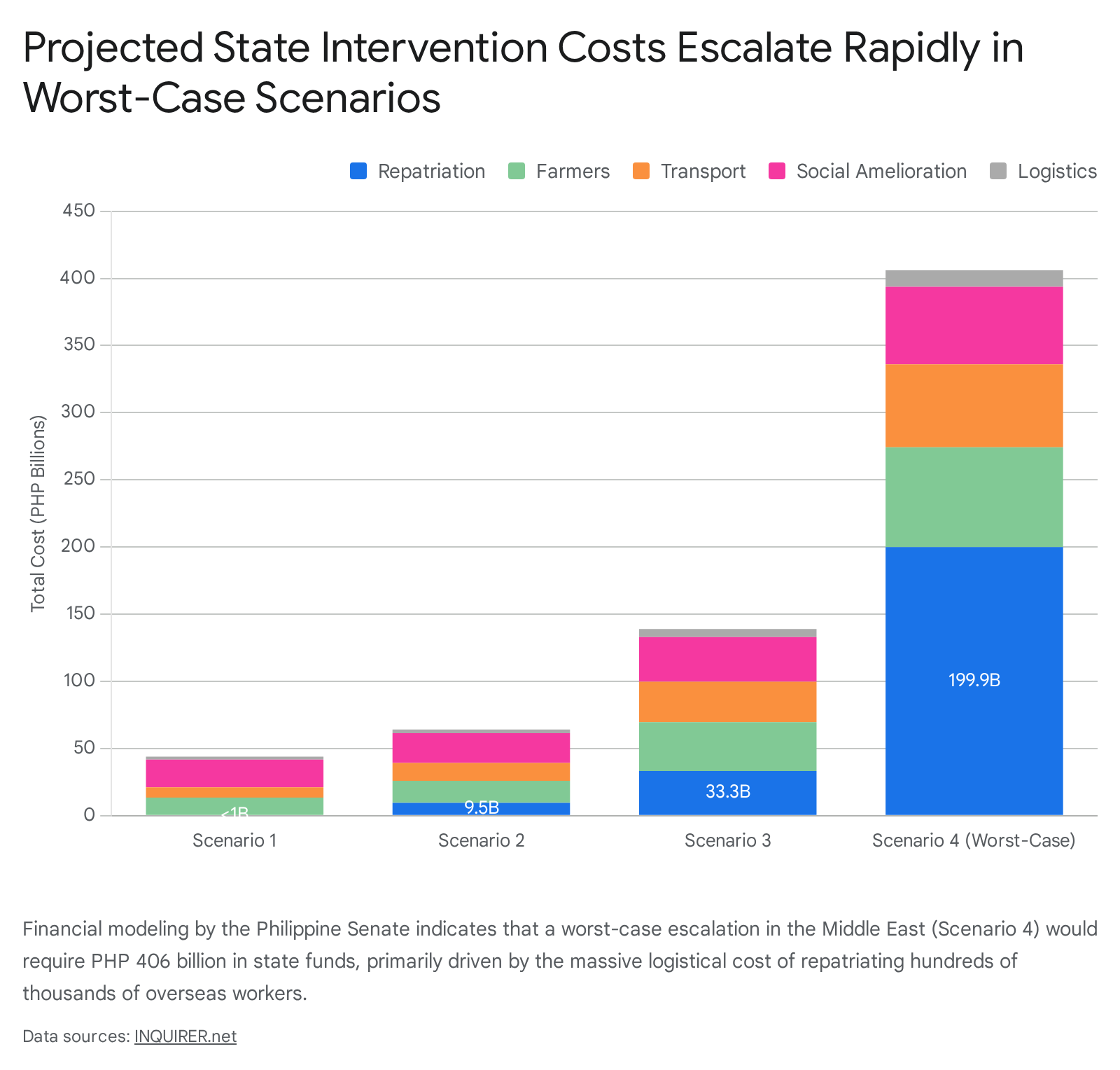
In Scenario 4, nearly half of the required PHP 406 billion budget (PHP 199.9 billion) would be consumed purely by the logistical costs of aviation charters and border extraction.21 Furthermore, DEPDev Secretary Arsenio M. Balisacan explicitly warned that if a deployment ban is imposed and a mere 550,000 OFWs are repatriated, the domestic economy would instantly lose between PHP 226.6 billion and PHP 232 billion in anticipated remittances.20 This dual blow—massive emergency capital expenditure coupled with the sudden, permanent loss of foreign currency inflows—would critically endanger the sovereign credit rating, obliterate the central bank’s foreign exchange reserves, and drastically accelerate the unravelling of the Philippine Peso.
7. National Security and Geopolitical Realignment in the Indo-Pacific
While the immediate economic and humanitarian impacts of the Iran War are severe, the secondary geopolitical effects occurring in the Indo-Pacific present an arguably greater long-term threat to Philippine sovereignty. The Middle East crisis has created a dangerous strategic vacuum, diverting United States military assets, diplomatic bandwidth, and global media attention away from Asia, a situation which the People’s Republic of China (PRC) is aggressively exploiting.
7.1 Exploitation of the Strategic Vacuum: South China Sea Gray Zone Escalation
Knowing that the U.S. military—particularly CENTCOM and vital naval carrier strike groups—is heavily occupied with managing the fallout of Operation Epic Fury and securing maritime traffic in the Indian Ocean, Beijing has intensified its “gray zone” coercion tactics against both Taiwan and the Philippines.22
China’s overarching strategy relies on calibrated, coercive maritime actions that fall deliberately just below the threshold of an “armed attack.” This precise operational calculus is designed to alter facts on the ground while avoiding the invocation of the 1951 U.S.-Philippines Mutual Defense Treaty (MDT) or a direct kinetic response from U.S. Indo-Pacific Command (INDOPACOM).23 Throughout early 2026, the PRC executed “Justice Mission 2025,” an unprecedented, highly provocative military exercise involving over 130 aircraft and naval vessels that simulated a full blockade of Taiwan, establishing temporary danger zones that disrupted over 100,000 international passengers.22
Simultaneously, the People’s Liberation Army Navy (PLAN) and the Chinese Coast Guard (CCG) have radically escalated physical, hull-to-hull confrontations in the South China Sea, focusing intensely on Second Thomas Shoal.23 Where Chinese forces previously relied on non-lethal deterrents such as high-pressure water cannons and military-grade laser dazzlers, intelligence reports confirm they have now transitioned to highly aggressive, deliberate ramming and physical boarding of Philippine rotation and resupply (RORE) vessels attempting to reach the rusting World War II-era landing ship, the BRP Sierra Madre.23
7.2 The Trilateral Deterrence Response and Hard Balancing
In response to this severe, multi-theater pressure, Manila is attempting to execute a strategy of hard-balancing against Beijing by rapidly deepening its network of security alliances. Under the Marcos administration, the Philippines has accelerated its military modernization program, seeking to shift its strategic posture fundamentally from internal counter-insurgency operations to external territorial defense.73
Crucially, Manila has expanded its multilateral operations, conducting high-profile Maritime Cooperative Activities (MMCA) within its Exclusive Economic Zone (EEZ). In February 2026, the Philippine Navy, alongside the U.S. Navy and the Royal Australian Navy, conducted highly visible replenishment-at-sea and freedom of navigation drills near contested features, explicitly to signal deterrence to the shadowing Chinese naval ships.74 Trilateral diplomatic and military coordination between the United States, Japan, and the Philippines has become the absolute cornerstone of Manila’s strategy to oppose PRC coercion.75
However, defense analysts note a highly dangerous threshold is approaching: if the United States remains bogged down in a protracted, resource-intensive Middle Eastern conflict, the PRC leadership may calculate that it possesses the operational freedom and temporal window to secure a quick tactical victory—such as the forced removal of the Sierra Madre—before U.S. forces can adequately mobilize a Quick Reaction Force (QRF) to the First Island Chain.24
8. Predictive Intelligence: 30, 60, and 90-Day Strategic Forecasts
Based on current operational tempos, severe logistical constraints, and rapidly degrading macroeconomic trajectories, the following projections outline the expected cascading effects on the Republic of the Philippines over the next 90 days.
8.1 Immediate Term (0 – 30 Days): The Buffer Depletion Phase
- Energy Operations: The Philippines will exhaust the first half of its 45-day domestic fuel inventory. The Department of Energy will desperately attempt to finalize advance-payment supply contracts utilizing the emergency powers granted under EO 110.8 Manila will lean heavily on the newly established Russian ESPO crude pipeline, resulting in intense diplomatic friction, and will aggressively push the U.S. State Department to formalize 180-day sanctions waivers regarding Iranian and Venezuelan crude.13 The U.S. bureaucratic decision on these waivers will dictate Manila’s immediate survival strategy.
- Macroeconomics: March and April inflation figures will solidify between 4.8% and 5.1%, confirming a severe breach of central bank targets and eroding civilian purchasing power.20 The BSP will be forced to maintain highly hawkish rhetoric but will hold interest rates steady, intervening aggressively in FX markets to prevent the Peso from sliding past the PHP 58/USD mark.36
- Transportation & Civil Unrest: The P52.8 billion supplemental budget will pass during an emergency legislative session, allowing the immediate disbursement of targeted cash subsidies to the transport and agricultural sectors.18 While this will temporarily pacify unionized transport groups and avert mass, paralyzing strikes, localized supply chain bottlenecks will emerge across the archipelago as independent truckers reduce operations to cut financial losses.
- Geopolitics: The outcome of the Trump administration’s 5-day negotiation window with Iran will become definitively clear.25 If strikes resume on Iranian power infrastructure, Brent crude will permanently break the $100/bbl threshold. Concurrently, the PRC will maintain high-intensity CCG patrols around Second Thomas Shoal, testing the response times and resolve of U.S. INDOPACOM assets.23
8.2 Near Term (31 – 60 Days): The Supply Cliff and Physical Rationing Phase
- Energy Operations: If the Strait of Hormuz remains functionally closed and alternative sourcing (such as Russian crude or sanctioned waivers) proves insufficient to replace the 15.8 million bpd global deficit, the Philippines will hit its mathematical “supply cliff.” The 45-day buffer will be exhausted.12 The DOE will likely be forced to invoke the most extreme emergency powers granted in EO 110, mandating strict civilian fuel rationing (e.g., nationwide odd-even license plate bans for private vehicles) and prioritizing diesel distribution exclusively to agriculture, logistics, and critical power generation facilities.8
- Power Generation: Rolling brownouts (rotational load shedding) may occur in areas heavily reliant on liquid fuels. The First Gen and AG&P LNG terminals in Batangas will operate significantly below capacity due to prohibitive spot prices ($24+ MMBtu), forcing the grid to maximize the utilization of legacy coal plants and Euro II fuels, resulting in severe local air quality degradation.8
- OFW Repatriation: As the Middle Eastern conflict solidifies into a grinding war of attrition, construction and service companies in the GCC states will continue declaring force majeure, leading to mass layoffs of migrant labor.4 Formal repatriation requests to the DMW will surge past 50,000. The government will begin rapidly burning through the proposed P18 billion emergency repatriation fund, chartering daily extraction flights from the UAE transit hub.19
8.3 Medium Term (61 – 90 Days): Structural Shifts and Geopolitical Flashpoints
- Macroeconomics: The delayed, compounding effects of the energy shock will manifest in severe second-round inflation. The cost of basic food staples will rise sharply across the archipelago as agricultural fuel subsidies prove mathematically insufficient to offset transport costs. Annual GDP growth forecasts for 2026 will be revised downward by a full 0.5% to 1.0%. The loss of initial OFW remittances from displaced workers will begin to reflect in current account deficits, applying massive, sustained downward pressure on the Peso, potentially testing the catastrophic PHP 60/USD threshold and forcing the BSP into emergency rate hikes.20
- Geopolitics & Security: With global diplomatic attention and military resources entirely exhausted by a protracted Middle East conflict, the risk of a severe miscalculation in the South China Sea reaches its absolute zenith. China may attempt a definitive, irreversible gray-zone operation—such as the forced boarding and towing of the BRP Sierra Madre or the rapid establishment of a permanent, militarized structure on a contested Philippine shoal.23 Manila will be forced into an impossible strategic dilemma: choose between yielding sovereign territory and accepting a new status quo, or initiating a kinetic military response that legally forces Washington’s hand under the Mutual Defense Treaty, risking a two-front global war.
Please share the link on Facebook, Forums, with colleagues, etc. Your support is much appreciated and if you have any feedback, please email us in**@*********ps.com. If you’d like to request a report or order a reprint, please click here for the corresponding page to open in new tab.
Sources Used
- 2026 Strait of Hormuz crisis – Wikipedia, accessed March 25, 2026, https://en.wikipedia.org/wiki/2026_Strait_of_Hormuz_crisis
- 2026 Iran War | Explained, United States, Israel, Strait of Hormuz, Map, & Conflict, accessed March 25, 2026, https://www.britannica.com/event/2026-Iran-War
- Iran Update Morning Special Report, March 11, 2026 | ISW, accessed March 25, 2026, https://understandingwar.org/research/middle-east/iran-update-morning-special-report-march-11-2026/
- Iran’s closure of the Strait of Hormuz is an international crisis, accessed March 25, 2026, https://www.aljazeera.com/opinions/2026/3/25/irans-closure-of-the-strait-of-hormuz-is-an-international-crisis
- Gulf Crisis 2026: The Daily Cost of the Closure of the Strait of Hormuz | SolAbility, accessed March 25, 2026, https://solability.com/news-insights/iran-war-marginal-cost
- The Strait of Hormuz Blockade Is Affecting More Than Just Oil Prices. Here Are 4 Stocks That Could Get Hit in 2026., accessed March 25, 2026, https://www.fool.com/investing/2026/03/25/strait-hormuz-blockade-affect-oil-price-stocks/
- MidEast crisis to cap Philippine growth through ’28 – Inquirer Business, accessed March 25, 2026, https://business.inquirer.net/581092/mideast-crisis-to-cap-ph-growth-through-28
- Philippines declares ‘national energy emergency’ and boosts coal power as Iran war grinds on, accessed March 25, 2026, https://www.theguardian.com/world/2026/mar/25/philippines-declares-national-energy-emergency-iran-war
- Why the Philippines declared a national energy emergency, accessed March 25, 2026, https://gulfnews.com/world/asia/philippines/why-the-philippines-declared-a-national-energy-emergency-1.500485749
- President Marcos declares State of National Energy Emergency …, accessed March 25, 2026, https://pia.gov.ph/news/president-marcos-declares-state-of-national-energy-emergency-activates-uplift-as-whole-of-government-response-framework/
- Philippines declares energy emergency amid Middle East war fallout, accessed March 25, 2026, https://en.yenisafak.com/world/philippines-declares-energy-emergency-amid-middle-east-war-fallout-3716229
- DOE: Month and a half left to seek supply before PH ‘runs dry’ of fuel – News, accessed March 25, 2026, https://newsinfo.inquirer.net/2200465/doe-month-and-a-half-left-before-ph-runs-dry-of-fuel
- Philippines receives first Russian oil shipment in five years, accessed March 25, 2026, https://en.vietnamplus.vn/philippines-receives-first-russian-oil-shipment-in-five-years-post339898.vnp
- Philippines Declares State of National Energy Emergency Amid Middle East Crisis, accessed March 25, 2026, https://thedeepdive.ca/philippines-declares-state-of-national-energy-emergency-amid-middle-east-crisis/
- Philippine government adopts 4-day work week amid fuel price hike, accessed March 25, 2026, https://www.hcamag.com/asia/specialisation/benefits/philippine-government-adopts-4-day-work-week-amid-fuel-price-hike/567878
- Metro Manila LGUs adopt 4-day workweek to conserve energy – News – Inquirer.net, accessed March 25, 2026, https://newsinfo.inquirer.net/2193038/metro-lgus-adopt-4-day-work-week-to-conserve-energy
- Solon asks PBBM to fast-track P53-B aid for crisis-affected sectors, accessed March 25, 2026, https://www.pna.gov.ph/articles/1271667
- Senate may hold special session to pass P52.8B subsidy budget: Hontiveros, accessed March 25, 2026, https://tribune.net.ph/2026/03/23/senate-may-hold-special-session-to-pass-p528b-subsidy-budget-hontiveros
- Philippines plans repatriation of 1,200 more OFWs from Middle East, accessed March 25, 2026, https://www.bworldonline.com/the-nation/2026/03/23/738174/philippines-plans-repatriation-of-1200-more-ofws-from-middle-east/
- Oil shock to bring inflation above 4% | Metrobank Wealth Insights, accessed March 25, 2026, https://wealthinsights.metrobank.com.ph/bworldonline/oil-shock-to-bring-inflation-above-4/
- Gatchalian projects P406B support fund in worst-case Middle East crisis, accessed March 25, 2026, https://newsinfo.inquirer.net/2200583/gatchalian-projects-p406b-support-fund-in-worst-case-of-mideast-crisis
- China remains undeterred in the grey zone | East Asia Forum, accessed March 25, 2026, https://eastasiaforum.org/2026/02/14/china-remains-undeterred-in-the-grey-zone/
- China’s Gray-Zone Escalation and the U.S.–Philippines Alliance at Second Thomas Shoal, accessed March 25, 2026, https://jhufar.com/2026/02/03/chinas-gray-zone-escalation-and-the-u-s-philippines-alliance-at-second-thomas-shoal/
- A Calm Before the Storm: South China Sea Powder Keg, accessed March 25, 2026, https://saisreview.sais.jhu.edu/a-calm-before-the-storm-south-china-sea-powder-keg/
- Trump announces Iran talks with U.S, 5-day pause on strikes on power plants, accessed March 25, 2026, https://www.ms.now/liveblog/iran-us-war-trump-israel-news-3-23
- U.S. won’t strike Iran’s power plants for 5 days, Trump says in turnaround on Strait of Hormuz deadline, accessed March 25, 2026, https://www.pbs.org/newshour/world/u-s-wont-strike-irans-power-plants-for-5-days-trump-says-in-turnaround-on-strait-of-hormuz-deadline
- Trump calls off Strait of Hormuz ultimatum as Iran receives U.S. message from mediators, accessed March 25, 2026, https://www.cbsnews.com/live-updates/iran-war-us-israel-trump-ultimatum-strait-of-hormuz/
- Signals Before Strikes: Electronic Warfare in the Iran War – Observer Research Foundation, accessed March 25, 2026, https://www.orfonline.org/expert-speak/signals-before-strikes-electronic-warfare-in-the-iran-war
- Iran Update Special Report, March 24, 2026 | ISW, accessed March 25, 2026, https://understandingwar.org/research/middle-east/iran-update-special-report-march-24-2026/
- Economic impact of the 2026 Iran war – Wikipedia, accessed March 25, 2026, https://en.wikipedia.org/wiki/Economic_impact_of_the_2026_Iran_war
- Oil Market Report – March 2026 – Analysis – IEA, accessed March 25, 2026, https://www.iea.org/reports/oil-market-report-march-2026
- Discover this week’s must-read finance stories, accessed March 25, 2026, https://www.weforum.org/stories/2026/03/energy-shock-shakes-markets/
- Why the oil and gas price shock from the Iran war won’t just fade away, accessed March 25, 2026, https://www.aljazeera.com/opinions/2026/3/23/why-the-oil-and-gas-price-shock-from-the-iran-war-wont-just-fade-away
- Drawn-out Iran conflict prompts broad-based forecast revisions …, accessed March 25, 2026, https://www.oxfordeconomics.com/resource/drawn-out-iran-conflict-prompts-broad-based-forecast-revisions/
- Iran-Israel war Highlights: Trump says Iran ‘wants to make a deal’, but Islamic Republic denies any talks, accessed March 25, 2026, https://www.thehindu.com/news/international/iran-israel-war-usa-strait-of-hormuz-donald-trump-iran-israel-west-asia-highlights-march-23-2026/article70774180.ece
- Peso weakens anew before US-Iran negotiations – Metrobank Wealth Insights, accessed March 25, 2026, https://wealthinsights.metrobank.com.ph/bworldonline/peso-weakens-anew-before-us-iran-negotiations/
- Philippine Inflation Quickens, Seen Continuing On Iran War, accessed March 25, 2026, https://www.businesstoday.com.my/2026/03/05/philippine-inflation-quickens-seen-continuing-on-iran-war/
- Iran war: Philippine fallout | Inquirer Opinion, accessed March 25, 2026, https://opinion.inquirer.net/190471/iran-war-philippine-fallout
- Asia FX Talk – What if oil prices spike further? implications of Iran conflict – MUFG Research, accessed March 25, 2026, https://www.mufgresearch.com/fx/asia-fx-talk-what-if-oil-prices-spike-further-implications-of-iran-conflict-2-march-2026/
- Oil Shock and Peso Volatility Hit Philippines Amid Iran War | Insight with Haslinda Amin 03/17/2026 – YouTube, accessed March 25, 2026, https://www.youtube.com/watch?v=y15fe65R7Hg
- Manufacturers brace for price increases from Strait of Hormuz closure, accessed March 25, 2026, https://www.manufacturingdive.com/news/manufacturers-brace-price-increases-strait-of-hormuz-closure-oil-petrochemicals/815661/
- Philippine President declares energy emergency over West Asia conflict risks – The Hindu, accessed March 25, 2026, https://www.thehindu.com/news/international/philippine-president-declares-energy-emergency-over-west-asia-conflict-risks/article70779722.ece
- Philippines Eyes Russian Oil as Marcos Declares Emergency, accessed March 25, 2026, https://www.rigzone.com/news/philippines_eyes_russian_oil_as_marcos_declares_emergency-25-mar-2026-183291-article/?rss=true
- In the midst of price shocks, will fuel run dry? – Manila Bulletin, accessed March 25, 2026, https://mb.com.ph/2026/03/23/in-the-midst-of-price-shocks-will-fuel-run-dry
- Russian crude oil arrives, accessed March 25, 2026, https://www.philstar.com/headlines/2026/03/26/2516884/russian-crude-oil-arrives
- Tanker Reportedly Carrying Russian Oil Arrives in Crisis-Struck Philippines, accessed March 25, 2026, https://www.themoscowtimes.com/2026/03/24/tanker-reportedly-carrying-russian-oil-arrives-in-crisis-struck-philippines-a92325
- Philippines receives first Russian oil shipment in five years – PortNews IAA, accessed March 25, 2026, https://en.portnews.ru/news/389468/
- Philippines says working with Washington to obtain oil from U.S.-sanctioned countries, accessed March 25, 2026, https://wkzo.com/2026/03/25/philippines-says-working-with-washington-to-obtain-oil-from-u-s-sanctioned-countries/
- Wikborg Rein advising AG&P on the Philippines’ first LNG import terminal, accessed March 25, 2026, https://www.wr.no/en/news/wikborg-rein-advising-ag-p-on-philippines-first-lng-import-terminal
- First Gen seeks new LNG cargo for Batangas FSRU terminal – LNGPrime, accessed March 25, 2026, https://lngprime.com/contracts-and-tenders/first-gen-seeks-new-lng-cargo-for-batangas-fsru-terminal/105256/
- Two Philippines LNG Terminals to Begin Operations Early 2023 – Industrial Info, accessed March 25, 2026, https://www.industrialinfo.com/iirenergy/industry-news/article/two-philippines-lng-terminals-to-begin-operations-early-2023–315102
- Philippines’ Department of Energy (DOE) Issues AG&P Notice to Proceed for the Philippines LNG (PLNG) Import Terminal in Batangas Bay, accessed March 25, 2026, https://agpglobal.com/philippines-department-of-energy-doe-issues-agp-notice-to-proceed-for-the-philippines-lng-plng-import-terminal-in-batangas-bay/
- The Strait of Hormuz closure pressures LNG spot prices, threatens Northeast Asia demand, accessed March 25, 2026, https://www.woodmac.com/press-releases/me-conflicts-impact-on-nea-gas-market/
- The energy crisis is coming to the boil – Wood Mackenzie, accessed March 25, 2026, https://www.woodmac.com/blogs/the-edge/the-energy-crisis-is-coming-to-the-boil/
- Global LNG Outlook 2026-2035 – SolAbility, accessed March 25, 2026, https://solability.com/pdfs/LNG_Market_Outlook_2026-2035.pdf
- It is unclear if LNG imports can guarantee Southeast Asia’s energy security, accessed March 25, 2026, https://zerocarbon-analytics.org/insights/briefings/it-is-unclear-if-lng-imports-can-guarantee-southeast-asias-energy-security/
- Marikina, Makati implement 4-day workweek to conserve energy, accessed March 25, 2026, https://www.pna.gov.ph/articles/1270697
- GSIS adopts 4-day on-site workweek to support energy conservation; frontline services remain open Monday to Friday – Philippine Information Agency, accessed March 25, 2026, https://pia.gov.ph/press-release/gsis-adopts-4-day-on-site-workweek-to-support-energy-conservation-frontline-services-remain-open-monday-to-friday/
- Some gov’t offices begin implementation of 4-day workweek amid oil price surge, accessed March 25, 2026, https://www.youtube.com/watch?v=fjRVu1GYHUo
- Iran war impact: Philippines declares energy emergency with only 40 days of fuel remaining, accessed March 25, 2026, https://timesofindia.indiatimes.com/world/rest-of-world/iran-war-impact-philippines-declares-energy-emergency-with-only-40-days-of-fuel-remaining/articleshow/129793128.cms
- Philippines declares energy emergency over Middle East conflict risks, accessed March 25, 2026, https://interaksyon.philstar.com/politics-issues/2026/03/25/311015/philippines-declares-energy-emergency-over-middle-east-conflict-risks/
- Hontiveros asks Congress to pass P53-B oil crisis aid bill – SunStar, accessed March 25, 2026, https://www.sunstar.com.ph/manila/hontiveros-asks-congress-to-pass-p53-b-oil-crisis-aid-bill
- What assistance does government provide to repatriated OFWs?, accessed March 25, 2026, https://www.abs-cbn.com/news/nation/2026/3/21/what-assistance-does-government-provide-to-repatriated-ofws-1253
- DBM: P230-billion funds available to address effects of ongoing crisis, accessed March 25, 2026, https://newsinfo.inquirer.net/2200402/dbm-p230-billion-funds-available-to-address-effects-of-ongoing-crisis
- Fuel rationing not needed yet – DOE | ABS-CBN News, accessed March 25, 2026, https://www.abs-cbn.com/news/business/2026/3/17/fuel-rationing-not-needed-yet-doe-1811
- DOE adopt interim fuel measure to protect energy security, accessed March 25, 2026, https://doe.gov.ph/articles/3373428–doe-adopt-interim-fuel-measure-to-protect-energy-security?title=DOE%20adopt%20interim%20fuel%20measure%20to%20protect%20energy%20security
- Another repatriation flight readied for OFWs in Middle East | Philstar.com, accessed March 25, 2026, https://www.philstar.com/headlines/2026/03/19/2515356/another-repatriation-flight-readied-ofws-middle-east
- More OFWs return on 4th chartered flight from Middle East, accessed March 25, 2026, https://www.philstar.com/headlines/2026/03/24/2516418/more-ofws-return-4th-chartered-flight-middle-east
- LIVE UPDATES: Conflict in the Middle East (March 23, 2026), accessed March 25, 2026, https://www.gmanetwork.com/news/topstories/nation/980993/live-updates-conflict-in-the-middle-east-march-23-2026/story/
- Conflict in the Strait of Hormuz is spilling into the Indian Ocean | Chatham House, accessed March 25, 2026, https://www.chathamhouse.org/2026/03/conflict-strait-hormuz-spilling-indian-ocean
- Paint it black: An asymmetric approach to China’s gray zone coercion of Taiwan | Brookings, accessed March 25, 2026, https://www.brookings.edu/articles/paint-it-black-an-asymmetric-approach-to-chinas-gray-zone-coercion-of-taiwan/
- Escalation Without War: China’s New Strategy in the Indo-Pacific – Modern Diplomacy, accessed March 25, 2026, https://moderndiplomacy.eu/2026/03/21/escalation-without-war-chinas-new-strategy-in-the-indo-pacific/
- Riding Unruly Waves: The Philippines’ Military Modernisation Effort, accessed March 25, 2026, https://www.crisisgroup.org/rpt/asia-pacific/south-east-asia/philippines-china-united-states/349-riding-unruly-waves-philippines-military-modernisation-effort
- Manila strengthens naval posture through expanded multilateral operations, accessed March 25, 2026, https://ipdefenseforum.com/2026/03/manila-strengthens-naval-posture-through-expanded-multilateral-operations/
- U.S.-Japan-Philippines Trilateral Cooperation, accessed March 25, 2026, https://www.cnas.org/publications/reports/u-s-japan-philippines-trilateral-cooperation